Front matter (continued 3)
Reading edition
Tuesday.—I went with Fanny Gaylord to see Mrs. Callister at the hotel to-night. She is so interested in all that we tell her, just like “one of the girls.”
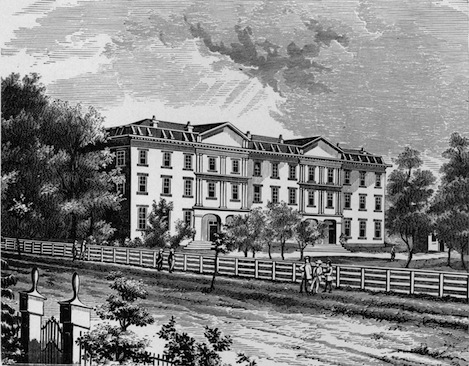
The Old Canandaigua Academy
I was laughing to-day when I came in from the street and Grandmother asked me what amused me so. I told her that I met Mr. and Mrs. Putnam on the street and she looked so immense and he so minute I couldn’t help laughing at the contrast. Grandmother said that size was not everything, and then she quoted Cowper’s verse:
“Were I so tall to reach the skies or grasp the ocean in a span, I must be measured by my soul, the mind is the stature of the man.”
I don’t believe that helps Mr. Putnam out.
Friday.—We went to Monthly Concert of prayer for Foreign Missions this evening. I told Grandmother that I thought it was not very interesting. Judge Taylor read the Missionary Herald about the Madagascans and the Senegambians and the Terra del Fuegans and then Deacon Tyler prayed and they sang “From Greenland’s Icy Mountains” and took up a collection and went home. She said she was afraid I did not listen attentively. I don’t think I did strain every nerve. I believe Grandmother will give her last cent to Missions if the Boards get into worse straits than they are now.
In Latin class to-day Anna translated the phrase Deo Volente “with violence,” and Mr. Tyler, who always enjoys a joke, laughed so, we thought he would fall out of his chair. He evidently thought it was the best one he had heard lately.
November 21.—Aunt Ann gave me a sewing bird to screw on to the table to hold my work instead of pinning it to my knee. Grandmother tells us when we sew or read not to get everything around us that we will want for the next two hours because it is not healthy to sit in one position so long. She wants us to get up and “stir around.” Anna does not need this advice as much as I do for she is always on what Miss Achert calls the “qui vive.” I am trying to make a sofa pillow out of little pieces of silk. Aunt Ann taught me how. You have to cut pieces of paper into octagonal shape and cover them with silk and then sew them together, over and over. They are beautiful, with bright colors, when they are done. There was a hop at the hotel last night and some of the girls went and had an elegant time. Mr. Hiram Metcalf came here this morning to have Grandmother sign some papers. He always looks very dignified, and Anna and I call him “the deed man.” We tried to hear what he said to Grandmother after she signed her name but we only heard something about “fear or compulsion” and Grandmother said “yes.” It seems very mysterious. Grandfather took us down street to-day to see the new Star Building. It was the town house and he bought it and got Mr. Warren Stoddard of Hopewell to superintend cutting it in two and moving the parts separately to Coach Street. When it was completed the shout went up from the crowd, “Hurrah for Thomas Beals, the preserver of the old Court House.” No one but Grandfather thought it could be done.
December.—I went with the girls to the lake to skate this afternoon. Mr. Johnson, the colored barber, is the best skater in town. He can skate forwards and backwards and cut all sorts of curlicues, although he is such a heavy man. He is going to Liberia and there his skates won’t do him any good. I wish he would give them to me and also his skill to use them. Some one asked me to sit down after I got home and I said I preferred to stand, as I had been sitting down all the afternoon! Gus Coleman took a load of us sleigh-riding this evening. Of course he had Clara Willson sit on the front seat with him and help him drive.
Thursday.—We had a special meeting of our society this evening at Mary Wheeler’s and invited the gentlemen and had charades and general good time. Mr. Gillette and Horace Finley made a great deal of fun for us. We initiated Mr. Gillette into the Dorcas Society, which consists in seating the candidate in a chair and propounding some very solemn questions and then in token of desire to join the society, you ask him to open his mouth very wide for a piece of cake which you swallow, yourself, instead! Very disappointing to the new member!
We went to a concert at the Seminary this evening. Miss Mollie Bull sang “Coming Through the Rye” and Miss Lizzie Bull sang “Annie Laurie” and “Auld Lang Syne.” Jennie Lind, herself, could not have done better.
December 15.—Alice Jewett, Emma Wheeler and Anna are in Mrs. Worthington’s Sunday School class and as they have recently united with the church, she thought they should begin practical Christian work by distributing tracts among the neglected classes. So this afternoon they ran away from school to begin the good work. It was so bright and pleasant, they thought a walk to the lake would be enjoyable and they could find a welcome in some humble home. The girls wanted Anna to be the leader, but she would only promise that if something pious came into her mind, she would say it. They knocked at a door and were met by a smiling mother of twelve children and asked to come in. They sat down feeling somewhat embarrassed, but spying a photograph album on the table, they became much interested, while the children explained the pictures. Finally Anna felt that it was time to do something, so when no one was looking, she slipped under one of the books on the table, three tracts entitled “Consolation for the Bereaved,” “Systematic Benevolence” and “The Social Evils of dancing, card playing and theater-going.” Then they said goodbye to their new friends and started on. They decided not to do any more pastoral work until another day, but enjoyed the outing very much.
Christmas.—We all went to Aunt Mary Carr’s to dinner excepting Grandmother, and in the evening we went to see some tableaux at Dr. Cook’s and Dr. Chapin’s at the asylum. We were very much pleased with the entertainment. Between the acts Mr. del Pratt, one of the patients, said every time, “What next!” which made every one laugh.
Grandfather was requested to add his picture to the gallery of portraits of eminent men for the Court Room, so he has had it painted. An artist by the name of Green, who lives in town, has finished it after numerous sittings and brought it up for our approval. We like it but we do not think it is as good looking as he is. No one could really satisfy us probably, so we may as well try to be suited.
I asked Grandmother if Mr. Clarke could take Sunday night supper with us and she said she was afraid he did not know the catechism. I asked him Friday night and he said he would learn it on Saturday so that he could answer every third question any way. So he did and got along very well. I think he deserved a pretty good supper.
1861
March 4, 1861.—President Lincoln was inaugurated to-day.
March 5.—I read the inaugural address aloud to Grandfather this evening. He dwelt with such pathos upon the duty that all, both North and South, owe to the Union, it does not seem as though there could be war!
April.—We seem to have come to a sad, sad time. The Bible says, “A man’s worst foes are those of his own household.” The whole United States has been like one great household for many years. “United we stand, divided we fall!” has been our watchword, but some who should have been its best friends have proven false and broken the bond. Men are taking sides, some for the North, some for the South. Hot words and fierce looks have followed, and there has been a storm in the air for a long time.
April 15.—The storm has broken upon us. The Confederates fired on Fort Sumter, just off the coast of South Carolina, and forced her on April 14 to haul down the flag and surrender. President Lincoln has issued a call for 75,000 men and many are volunteering to go all around us. How strange and awful it seems.
May, 1861.—Many of the young men are going from Canandaigua and all the neighboring towns. It seems very patriotic and grand when they are singing, “It is sweet, Oh, ’tis sweet, for one’s country to die,” and we hear the martial music and see the flags flying and see the recruiting tents on the square and meet men in uniform at every turn and see train loads of the boys in blue going to the front, but it will not seem so grand if we hear they are dead on the battlefield, far from home. A lot of us girls went down to the train and took flowers to the soldiers as they were passing through and they cut buttons from their coats and gave to us as souvenirs. We have flags on our paper and envelopes, and have all our stationery bordered with red, white and blue. We wear little flag pins for badges and tie our hair with red, white and blue ribbon and have pins and earrings made of the buttons the soldiers gave us. We are going to sew for them in our society and get the garments all cut from the older ladies’ society. They work every day in one of the rooms of the court house and cut out garments and make them and scrape lint and roll up bandages. They say they will provide us with all the garments we will make. We are going to write notes and enclose them in the garments to cheer up the soldier boys. It does not seem now as though I could give up any one who belonged to me. The girls in our society say that if any of the members do send a soldier to the war they shall have a flag bed quilt, made by the society, and have the girls’ names on the stars.
May 20.—I recited “Scott and the Veteran” to-day at school, and Mary Field recited, “To Drum Beat and Heart Beat a Soldier Marches By”; Anna recited “The Virginia Mother.” Every one learns war poems nowadays. There was a patriotic rally in Bemis Hall last night and a quartette sang, “The Sword of Bunker Hill” and “Dixie” and “John Brown’s Body Lies a Mouldering in the Grave,” and many other patriotic songs. We have one West Point cadet, Albert M. Murray, who is in the thick of the fight, and Charles S. Coy represents Canandaigua in the navy.
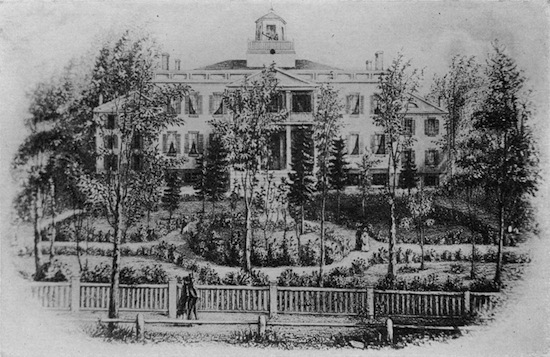
The Ontario Female Seminary
June, 1861.—At the anniversary exercises, Rev. Samuel M. Hopkins of Auburn gave the address. I have graduated from Ontario Female Seminary after a five years course and had the honor of receiving a diploma from the courtly hands of General John A. Granger. I am going to have it framed and handed down to my grandchildren as a memento, not exactly of sleepless nights and midnight vigils, but of rising betimes, at what Anna calls the crack of dawn. She likes that expression better than daybreak. I heard her reciting in the back chamber one morning about 4 o’clock and listened at the door. She was saying in the most nonchalant manner: “Science and literature in England were fast losing all traces of originality, invention was discouraged, research unvalued and the examination of nature proscribed. It seemed to be generally supposed that the treasure accumulated in the preceding ages was quite sufficient for all national purposes and that the only duty which authors had to perform was to reproduce what had thus been accumulated, adorned with all the graces of polished style. Tameness and monotony naturally result from a slavish adherence to all arbitrary rules and every branch of literature felt this blighting influence. History, perhaps, was in some degree an exception, for Hume, Robertson and more especially Gibbon, exhibited a spirit of original investigation which found no parallel among their contemporaries.” I looked in and asked her where her book was, and she said she left it down stairs. She has “got it” all right, I am sure. We helped decorate the seminary chapel for two days. Our motto was, “Still achieving, still pursuing.” Miss Guernsey made most of the letters and Mr. Chubbuck put them up and he hung all the paintings. It was a very warm week. General Granger had to use his palm leaf fan all the time, as well as the rest of us. There were six in our class, Mary Field, Lucy Petherick, Kate Lilly, Sarah Clay, Abby Scott and myself. Abbie Clark would have been in the class, but she went to Pittsfield, Mass., instead. General Granger said to each one of us, “It gives me great pleasure to present you with this diploma,” and when he gave Miss Scott hers, as she is from Alabama, he said he wished it might be as a flag of truce between the North and the South, and this sentiment was loudly cheered. General Granger looked so handsome with his black dress suit and ruffled shirt front and all the natural grace which belongs to him. The sheepskin has a picture of the Seminary on it and this inscription: “The Trustees and Faculty of the Ontario Female Seminary hereby certify that –––––– has completed the course of study prescribed in this Institution, maintained the requisite scholarship and commendable deportment and is therefore admitted to the graduating honors of this Institution. President of Board, John A. Granger; Benjamin F. Richards, Edward G. Tyler, Principals.” Mr. Morse wrote something for the paper:
“To the Editor of the Repository:
“Dear Sir—June roses, etc., make our loveliest of villages a paradise this week. The constellations are all glorious and the stars of earth far outshine those of the heavens. The lake shore, ‘Lovers’ Lane,’ ‘Glen Kitty’ and the ‘Points’ are full of romance and romancers. The yellow moon and the blue waters and the dark green shores and the petrified Indians, whispering stony words at the foot of Genundewah, and Squaw Island sitting on the waves, like an enchanted grove, and ‘Whalesback’ all humped up in the East and ‘Devil’s Lookout’ rising over all, made the ‘Sleeping Beauty’ a silver sea of witchery and love; and in the cottages and palaces we ate the ambrosia and drank the nectar of the sweet goddesses of this new and golden age.
“I may as well say to you, Mr. Editor, that the Ontario Female Seminary closed yesterday and ‘Yours truly’ was present at the commencement. Being a bachelor I shall plead guilty and appeal to the mercy of the Court, if indicted for undue prejudice in favor of the charming young orators. After the report of the Examining Committee, in which the scholarship of the young ladies was not too highly praised, came the Latin Salutatory by Miss Clay, a most beautiful and elegant production (that sentence, sir, applies to both salutatory and salutatorian). The ‘Shadows We Cast,’ by Miss Field, carried us far into the beautiful fields of nature and art and we saw the dark, or the brilliant shades, which our lives will cast, upon society and history. Then ‘Tongues in Trees’ began to whisper most bewitchingly, and ‘Books in the Running Brooks’ were opened, and ‘Sermons in Stones’ were preached by Miss Richards, and this old bachelor thought if all trees would talk so well, and every brook would babble so musically, and each precious stone would exhort so brilliantly, as they were made to do by the ‘enchantress,’ angels and dreams would henceforth be of little consequence; and whether the orator should be called ‘Tree of Beauty,’ ‘Minnehaha’ or the ‘Kohinoor’ is a ‘vexata questio.’
“In the evening Mr. Hardick, ‘our own,’ whose hand never touches the piano without making delicious music, and Misses Daggett and Wilson, also ‘our own,’ and the musical pupils of the Institution, gave a concert. ‘The Young Volunteer’ was imperatively demanded, and this for the third time during the anniversary exercises, and was sung amid thunders of applause, ‘Star of the South,’ Miss Stella Scott, shining meanwhile in all her radiant beauty. May her glorious light soon rest on a Union that shall never more be broken.—Soberly yours,
A Very Old Bachelor.”
June, 1861.—There was a patriotic rally this afternoon on the campus of Canandaigua Academy and we Seminary girls went. They raised a flag on the Academy building. General Granger presided, Dr. Coleman led the choir and they sang “The Star Spangled Banner.” Mr. Noah T. Clarke made a stirring speech and Mr. Gideon Granger, James C. Smith and E. M. Morse followed. Canandaigua has already raised over $7,000 for the war. Capt. Barry drills the Academy boys in military tactics on the campus every day. Men are constantly enlisting. Lester P. Thompson, son of “Father Thompson,” among the others.
A young man asked Anna to take a drive to-day, but Grandmother was not willing at first to let her go. She finally gave her consent, after Anna’s plea that he was so young and his horse was so gentle. Just as they were ready to start, I heard Anna run upstairs and I heard him say, “What an Anna!” I asked her afterwards what she went for and she said she remembered that she had left the soap in the water.
June.—Dr. Daggett’s war sermon from the 146th Psalm was wonderful.
December 1.—Dr. Carr is dead. He had a stroke of paralysis two weeks ago and for several days he has been unconscious. The choir of our church, of which he was leader for so long, and some of the young people came and stood around his bed and sang, “Jesus, Lover of My Soul.” They did not know whether he was conscious or not, but they thought so because the tears ran down his cheeks from his closed eyelids, though he could not speak or move. The funeral was from the church and Dr. Daggett’s text was, “The Beloved Physician.”
1862
January 26.—We went to the Baptist Church this evening to hear Rev. A. H. Lung preach his last sermon before going into the army.
February 17.—Glorious news from the war to-day. Fort Donelson is taken with 1,500 rebels. The right and the North will surely triumph!
February 21.—Our society met at Fanny Palmer’s this afternoon. I went but did not stay to tea as we were going to Madame Anna Bishop’s concert in the evening. The concert was very, very good. Her voice has great scope and she was dressed in the latest stage costume, but it took so much material for her skirt that there was hardly any left for the waist.
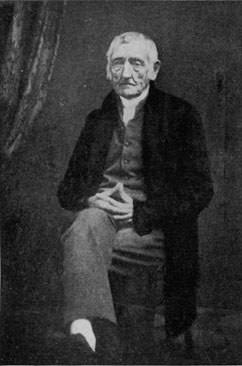
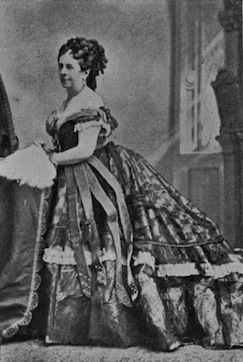
“Old Friend Burling” Madame Anna Bishop
Washington’s Birthday.—Patriotic services were held in the Congregational Church this morning. Madame Anna Bishop sang, and National songs were sung. Hon. James C. Smith read Washington’s Farewell Address. In the afternoon a party of twenty-two, young and old, took a ride in the Seminary boat and went to Mr. Paton’s on the lake shore road. We carried flags and made it a patriotic occasion. I sat next to Spencer F. Lincoln, a young man from Naples who is studying law in Mr. Henry Chesebro’s office. I never met him before but he told me he had made up his mind to go to the war. It is wonderful that young men who have brilliant prospects before them at home, will offer themselves upon the altar of their country. I have some new patriotic stationery. There is a picture of the flag on the envelope and underneath, “If any one attempts to haul down the American flag shoot him on the spot.—John A. Dix.”
Sunday, February 23.—Everybody came out to church this morning, expecting to hear Madame Anna Bishop sing. She was not there, and an “agent” made a “statement.” The audience did not appear particularly edified.
March 4.—John B. Gough lectured in Bemis Hall last night and was entertained by Governor Clark. I told Grandfather that I had an invitation to the lecture and he asked me who from. I told him from Mr. Noah T. Clarke’s brother. He did not make the least objection and I was awfully glad, because he has asked me to the whole course. Wendell Phillips and Horace Greeley, E. H. Chapin and John G. Saxe and Bayard Taylor are expected. John B. Gough’s lecture was fine. He can make an audience laugh as much by wagging his coat tails as some men can by talking an hour.
March 26.—I have been up at Laura Chapin’s from 10 o’clock in the morning until 10 at night, finishing Jennie Howell’s bed quilt, as she is to be married very soon. Almost all of the girls were there. We finished it at 8 p. m. and when we took it off the frames we gave three cheers. Some of the youth of the village came up to inspect our handiwork and see us home. Before we went Julia Phelps sang and played on the guitar and Captain Barry also sang and we all sang together, “O! Columbia, the gem of the ocean, three cheers for the red, white and blue.”
June 19.—Our cousin, Ann Eliza Field, was married to-day to George B. Bates at her home on Gibson Street. We went and had an elegant time. Charlie Wheeler made great fun and threw the final shower of rice as they drove away.
June.—There was great excitement in prayer meeting last night, it seemed to Abbie Clark, Mary Field and me on the back seat where we always sit. Several people have asked us why we sit away back there by old Mrs. Kinney, but we tell them that she sits on the other side of the stove from us and we like the seat, because we have occupied it so long. I presume we would see less and hear more if we sat in front. To-night just after Mr. Walter Hubbell had made one of his most beautiful prayers and Mr. Cyrus Dixon was praying, a big June bug came zipping into the room and snapped against the wall and the lights and barely escaped several bald heads. Anna kept dodging around in a most startling manner and I expected every moment to see her walk out and take Emma Wheeler with her, for if she is afraid of anything more than dogs it is June bugs. At this crisis the bug flew out and a cat stealthily walked in. We knew that dear Mrs. Taylor was always unpleasantly affected by the sight of cats and we didn’t know what would happen if the cat should go near her. The cat very innocently ascended the steps to the desk and as Judge and Mrs. Taylor always sit on the front seat, she couldn’t help observing the ambitious animal as it started to assist Dr. Daggett in conducting the meeting. The result was that Mrs. Taylor just managed to reach the outside door before fainting away. We were glad when the benediction was pronounced.
June.—Anna and I had a serenade last night from the Academy Glee Club, I think, as their voices sounded familiar. We were awakened by the music, about 11 p. m., quite suddenly and I thought I would step across the hall to the front chamber for a match to light the candle. I was only half awake, however, and lost my bearings and stepped off the stairs and rolled or slid to the bottom. The stairs are winding, so I must have performed two or three revolutions before I reached my destination. I jumped up and ran back and found Anna sitting up in bed, laughing. She asked me where I had been and said if I had only told her where I was going she would have gone for me. We decided not to strike a light, but just listen to the singing. Anna said she was glad that the leading tenor did not know how quickly I “tumbled” to the words of his song, “O come my love and be my own, nor longer let me dwell alone,” for she thought he would be too much flattered. Grandfather came into the hall and asked if any bones were broken and if he should send for a doctor. We told him we guessed not, we thought we would be all right in the morning. He thought it was Anna who fell down stairs, as he is never looking for such exploits in me. We girls received some verses from the Academy boys, written by Greig Mulligan, under the assumed name of Simon Snooks. The subject was, “The Poor Unfortunate Academy Boys.” We have answered them and now I fear Mrs. Grundy will see them and imagine something serious is going on. But she is mistaken and will find, at the end of the session, our hearts are still in our own possession.
When we were down at Sucker Brook the other afternoon we were watching the water and one of the girls said, “How nice it would be if our lives could run along as smoothly as this stream.” I said I thought it would be too monotonous. Laura Chapin said she supposed I would rather have an “eddy” in mine.
We went to the examination at the Academy to-day and to the gymnasium exercises afterwards. Mr. Noah T. Clarke’s brother leads them and they do some great feats with their rings and swings and weights and ladders. We girls can do a few in the bowling alley at the Seminary.
June.—I visited Eureka Lawrence in Syracuse and we attended commencement at Hamilton College, Clinton, and saw there, James Tunnicliff and Stewart Ellsworth of Penn Yan. I also saw Darius Sackett there among the students and also became acquainted with a very interesting young man from Syracuse, with the classic name of Horace Publius Virgilius Bogue. Both of these young men are studying for the ministry. I also saw Henry P. Cook, who used to be one of the Academy boys, and Morris Brown, of Penn Yan. They talk of leaving college and going to the war and so does Darius Sackett.
July, 1862.—The President has called for 300,000 more brave men to fill up the ranks of the fallen. We hear every day of more friends and acquaintances who have volunteered to go.
August 20.—The 126th Regiment, just organized, was mustered into service at Camp Swift, Geneva. Those that I know who belong to it are Colonel E. S. Sherrill, Lieutenant Colonel James M. Bull, Captain Charles A. Richardson, Captain Charles M. Wheeler, Captain Ten Eyck Munson, Captain Orin G. Herendeen, Surgeon Dr. Charles S. Hoyt, Hospital Steward Henry T. Antes, First Lieutenant Charles Gage, Second Lieutenant Spencer F. Lincoln, First Sergeant Morris Brown, Corporal Hollister N. Grimes, Privates Darius Sackett, Henry Willson, Oliver Castle, William Lamport.
Dr. Hoyt wrote home: “God bless the dear ones we leave behind; and while you try to perform the duties you owe to each other, we will try to perform ours.”
We saw by the papers that the volunteers of the regiment before leaving camp at Geneva allotted over $15,000 of their monthly pay to their families and friends at home. One soldier sent this telegram to his wife, as the regiment started for the front: “God bless you. Hail Columbia. Kiss the baby. Write soon.” A volume in ten words.
August.—The New York State S. S. convention is convened here and the meetings are most interesting. They were held in our church and lasted three days. A Mr. Hart, from New York, led the singing and Mr. Ralph Wells was Moderator. Mr. Noah T. Clarke was in his element all through the meetings. Mr. Pardee gave some fine blackboard exercises. During the last afternoon Mr. Tousley was wheeled into the church, in his invalid chair, and said a few words, which thrilled every one. So much tenderness, mingled with his old time enthusiasm and love for the cause. It is the last time probably that his voice will ever be heard in public. They closed the grand meeting with the hymn beginning:
“Blest be the tie that binds Our hearts in Christian love.”
In returning thanks to the people of Canandaigua for their generous entertainment, Mr. Ralph Wells facetiously said that the cost of the convention must mean something to Canandaigua people, for the cook in one home was heard to say, “These religiouses do eat awful!”
September 13.—Darius Sackett was wounded by a musket shot in the leg, at Maryland Heights, Va., and in consequence is discharged from the service.
September.—Edgar A. Griswold of Naples is recruiting a company here for the 148th Regiment, of which he is captain. Hiram P. Brown, Henry S. Murray and Charles H. Paddock are officers in the company. Dr. Elnathan W. Simmons is surgeon.
September 22.—I read aloud to Grandfather this evening the Emancipation Proclamation issued as a war measure by President Lincoln, to take effect January 1, liberating over three million slaves. He recommends to all thus set free, to labor faithfully for reasonable wages and to abstain from all violence, unless in necessary self-defense, and he invokes upon this act “the considerate judgment of mankind and the gracious favor of Almighty God.”
November 21.—This is my twentieth birthday. Anna wanted to write a poem for the occasion and this morning she handed me what she called “An effort.” She said she wrestled with it all night long and could not sleep and this was the result:
“One hundred years from now, Carrie dear, In all probability you’ll not be here; But we’ll all be in the same boat, too, And there’ll be no one left To say boo hoo!”
Grandfather gave me for a present a set of books called “Irving’s Catechisms on Ancient Greeks and Romans.” They are four little books bound in leather, which were presented to our mother for a prize. It is thus inscribed on the front page, “Miss Elizabeth Beals at a public examination of the Female Boarding School in East Bloomfield, October 15, 1825, was judged to excel the school in Reading. In testimony of which she receives this Premium from her affectionate instructress, S. Adams.”
I cannot imagine Grandmother sending us away to boarding school, but I suppose she had so many children then, she could spare one or two as well as not. She says they sent Aunt Ann to Miss Willard’s school at Troy. I received a birthday letter from Mrs. Beaumont to-day. She wants to know how everything goes at the Seminary and if Anna still occupies the front seat in the school room most of the time. She says she supposes she is quite a sedate young lady now but she hopes there is a whole lot of the old Anna left. I think there is.
December.—Hon. William H. Lamport went down to Virginia to see his son and found that he had just died in the hospital from measles and pneumonia. Their only son, only eighteen years old!
1863
January.—Grandmother went to Aunt Mary Carr’s to tea to-night, very much to our surprise, for she seldom goes anywhere. Anna said she was going to keep house exactly as Grandmother did, so after supper she took a little hot water in a basin on a tray and got the tea-towels and washed the silver and best china but she let the ivory handles on the knives and forks get wet, so I presume they will all turn black. Grandmother never lets her little nice things go out into the kitchen, so probably that is the reason that everything is forty years old and yet as good as new. She let us have the Young Ladies’ Aid Society here to supper because I am President. She came into the parlor and looked at our basket of work, which the elder ladies cut out for us to make for the soldiers. She had the supper table set the whole length of the dining room and let us preside at the table. Anna made the girls laugh so, they could hardly eat, although they said everything was splendid. They said they never ate better biscuit, preserves, or fruit cake and the coffee was delicious. After it was over, the “dear little lady” said she hoped we had a good time. After the girls were gone Grandmother wanted to look over the garments and see how much we had accomplished and if we had made them well. Mary Field made a pair of drawers with No. 90 thread. She said she wanted them to look fine and I am sure they did. Most of us wrote notes and put inside the garments for the soldiers in the hospitals.
Sarah Gibson Howell has had an answer to her letter. His name is Foster—a Major. She expects him to come and see her soon.
All the girls wear newspaper bustles to school now and Anna’s rattled to-day and Emma Wheeler heard it and said, “What’s the news, Anna?” They both laughed out loud and found that “the latest news from the front” was that Miss Morse kept them both after school and they had to copy Dictionary for an hour. War prices are terrible. I paid $3.50 to-day for a hoop skirt.
January 13.—P. T. Barnum delivered his lecture on “The Art of Money Getting” in Bemis Hall this evening for the benefit of the Ladies’ Aid Society, which is working for the soldiers. We girls went and enjoyed it.
February.—The members of our society sympathized with General McClellan when he was criticised by some and we wrote him the following letter:
“Canandaigua, Feb. 13, 1863.
“Maj. Gen. Geo. McClellan:
“Will you pardon any seeming impropriety in our addressing you, and attribute it to the impulsive love and admiration of hearts which see in you, the bravest and noblest defender of our Union. We cannot resist the impulse to tell you, be our words ever so feeble, how our love and trust have followed you from Rich Mountain to Antietam, through all slanderous attacks of traitorous politicians and fanatical defamers—how we have admired, not less than your calm courage on the battlefield, your lofty scorn of those who remained at home in the base endeavor to strip from your brow the hard earned laurels placed there by a grateful country: to tell further, that in your forced retirement from battlefields of the Republic’s peril, you have ‘but changed your country’s arms for more,—your country’s heart,’—and to assure you that so long as our country remains to us a sacred name and our flag a holy emblem, so long shall we cherish your memory as the defender and protector of both. We are an association whose object it is to aid, in the only way in which woman, alas! can aid our brothers in the field. Our sympathies are with them in the cause for which they have periled all—our hearts are with them in the prayer, that ere long their beloved commander may be restored to them, and that once more as of old he may lead them to victory in the sacred name of the Union and Constitution.
“With united prayers that the Father of all may have you and yours ever in His holy keeping, we remain your devoted partisans.”
Signed by a large number.
The following in reply was addressed to the lady whose name was first signed to the above:
“New York, Feb. 21, 1863.
“Madam—I take great pleasure in acknowledging the receipt of the very kind letter of the 13th inst., from yourself and your friends. Will you do me the favor to say to them how much I thank them for it, and that I am at a loss to express my gratitude for the pleasant and cheering terms in which it is couched. Such sentiments on the part of those whose brothers have served with me in the field are more grateful to me than anything else can be. I feel far more than rewarded by them for all I have tried to accomplish.—I am, Madam, with the most sincere respect and friendship, yours very truly,
Geo. B. McClellan.”
May.—A number of the teachers and pupils of the Academy have enlisted for the war. Among them E. C. Clarke, H. C. Kirk, A. T. Wilder, Norman K. Martin, T. C. Parkhurst, Mr. Gates. They have a tent on the square and are enlisting men in Canandaigua and vicinity for the 4th N. Y. Heavy Artillery. I received a letter from Mr. Noah T. Clarke’s mother in Naples. She had already sent three sons, Bela, William and Joseph, to the war and she is very sad because her youngest has now enlisted. She says she feels as did Jacob of old when he said, “I am bereaved of my children. Joseph is not and Simeon is not and now you will take Benjamin away.” I have heard that she is a beautiful singer but she says she cannot sing any more until this cruel war is over. I wish that I could write something to comfort her but I feel as Mrs. Browning puts it: “If you want a song for your Italy free, let none look at me.”
Our society met at Fannie Pierce’s this afternoon. Her mother is an invalid and never gets out at all, but she is very much interested in the soldiers and in all young people, and loves to have us come in and see her and we love to go. She enters into the plans of all of us young girls and has a personal interest in us. We had a very good time to-night and Laura Chapin was more full of fun than usual. Once there was silence for a minute or two and some one said, “awful pause.” Laura said, “I guess you would have awful paws if you worked as hard as I do.” We were talking about how many of us girls would be entitled to flag bed quilts, and according to the rules, they said that, up to date, Abbie Clark and I were the only ones. The explanation is that Captain George N. Williams and Lieutenant E. C. Clarke are enlisted in their country’s service. Susie Daggett is Secretary and Treasurer of the Society and she reported that in one year’s time we made in our society 133 pairs of drawers, 101 shirts, 4 pairs socks for soldiers, and 54 garments for the families of soldiers.
Abbie Clark and I had our ambrotypes taken to-day for two young braves who are going to the war. William H. Adams is also commissioned Captain and is going to the front.
July 4.—The terrible battle of Gettysburg brings to Canandaigua sad news of our soldier boys of the 126th Regiment. Colonel Sherrill was instantly killed, also Captains Wheeler and Herendeen, Henry Willson and Henry P. Cook. Captain Richardson was wounded.
“Abbie Clark and I
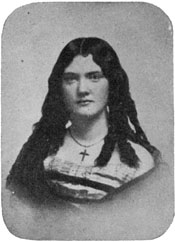
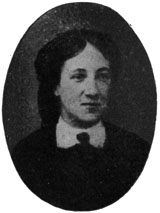
had our ambrotypes taken to-day.”
“Mr. Noah T. Clark’s Brother and I”
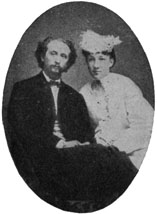
July 26.—Charlie Wheeler was buried with military honors from the Congregational church to-day. Two companies of the 54th New York State National Guard attended the funeral, and the church was packed, galleries and all. It was the saddest funeral and the only one of a soldier that I ever attended. I hope it will be the last. He was killed at Gettysburg, July 3, by a sharpshooter’s bullet. He was a very bright young man, graduate of Yale college and was practising law. He was captain of Company K, 126th N. Y. Volunteers. I have copied an extract from Mr. Morse’s lecture, “You and I”: “And who has forgotten that gifted youth, who fell on the memorable field of Gettysburg? To win a noble name, to save a beloved country, he took his place beneath the dear old flag, and while cannon thundered and sabers clashed and the stars of the old Union shone above his head he went down in the shock of battle and left us desolate, a name to love and a glory to endure. And as we solemnly know, as by the old charter of liberty we most sacredly swear, he was truly and faithfully and religiously
Of all our friends the noblest, The choicest and the purest, The nearest and the dearest, In the field at Gettysburg. Of all the heroes bravest, Of soul the brightest, whitest, Of all the warriors greatest, Shot dead at Gettysburg. And where the fight was thickest, And where the smoke was blackest, And where the fire was hottest, On the fields of Gettysburg, There flashed his steel the brightest, There blazed his eyes the fiercest, There flowed his blood the reddest On the field of Gettysburg. O wailing winds of heaven! O weeping dew of evening! O music of the waters That flow at Gettysburg, Mourn tenderly the hero, The rare and glorious hero, The loved and peerless hero, Who died at Gettysburg. His turf shall be the greenest, His roses bloom the sweetest, His willow droop the saddest Of all at Gettysburg. His memory live the freshest, His fame be cherished longest, Of all the holy warriors, Who fell at Gettysburg.
These were patriots, these were our jewels. When shall we see their like again? And of every soldier who has fallen in this war his friends may write just as lovingly as you and I may do of those to whom I pay my feeble tribute.”
August, 1863.—The U. S. Sanitary Commission has been organized. Canandaigua sent Dr. W. Fitch Cheney to Gettysburg with supplies for the sick and wounded and he took seven assistants with him. Home bounty was brought to the tents and put into the hands of the wounded soldiers. A blessed work.
August 12.—Lucilla Field was married in our church to-day to Rev. S. W. Pratt. I always thought she was cut out for a minister’s wife. Jennie Draper cried herself sick because Lucilla, her Sunday School teacher, is going away.
October 8.—News came to-day of the death of Lieutenant Hiram Brown. He died of fever at Portsmouth, only little more than a year after he went away.
November 1.—The 4th New York Heavy Artillery is stationed at Fort Hamilton, N. Y. harbor. Uncle Edward has invited me down to New York to spend a month! Very opportune! Grandfather says that I can go and Miss Rosewarne is beginning a new dress for me to-day.
November 6.—We were saddened to-day by news of the death of Augustus Torrey Wilder in the hospital at Fort Ethan Allen.
November 9.—No. 68 E. 19th Street, New York City. Grandfather and I came from Canandaigua yesterday. He is at Gramercy Park Hotel. We were met by a military escort of “one” at Albany and consequently came through more safely, I suppose. James met us at 42d Street Grand Central Station. He lives at Uncle Edward’s; attends to all of his legal business and is his confidential clerk. I like it very much here. They are very stylish and grand but I don’t mind that. Aunt Emily is reserved and dignified but very kind. People do not pour their tea or coffee into their saucers any more to cool it, but drink it from the cup, and you must mind and not leave your teaspoon in your cup. I notice everything and am very particular. Mr. Morris K. Jesup lives right across the street and I see him every day, as he is a friend of Uncle Edward. Grandfather has gone back home and left me in charge of friends “a la militaire” and others.
November 15.—“We” went out to Fort Hamilton to-day and are going to Blackwell’s Island to-morrow and to many other places of interest down the Bay. Soldiers are everywhere and I feel quite important, walking around in company with blue coat and brass buttons—very becoming style of dress for men and the military salute at every turn is what one reads about.
Sunday.—Went to Broadway Tabernacle to church to-day and heard Rev. Joseph P. Thompson preach. Abbie Clark is visiting her sister, Mrs. Fred Thompson, and sat a few seats ahead of us in church. She turned around and saw us. We also saw Henrietta Francis Talcott, who was a “Seminary girl.” She wants me to come to see her in her New York home.
November 19.—We wish we were at Gettysburg to-day to hear President Lincoln’s and Edward Everett’s addresses at the dedication of the National Cemetery. We will read them in to-morrow’s papers, but it will not be like hearing them.
Author’s Note, 1911.—Forty-eight years have elapsed since Lincoln’s speech was delivered at the dedication of the Soldiers’ Cemetery at Gettysburg. So eloquent and remarkable was his utterance that I believe I am correct in stating that every word spoken has now been translated into all known languages and is regarded as one of the World Classics. The same may be said of Lincoln’s letter to the mother of five sons lost in battle. I make no apology for inserting in this place both the speech and the letter. Mr. Whitelaw Reid, the American Ambassador to Great Britain, in an address on Lincoln delivered at the University of Birmingham in December, 1910, remarked in reference to this letter, “What classic author in our common English tongue has surpassed that?” and next may I ask, “What English or American orator has on a similar occasion surpassed this address on the battlefield of Gettysburg?”
“Four score and seven years ago, our fathers brought forth on this continent a new nation conceived in liberty and dedicated to the proposition that all men are created equal. Now we are engaged in a great civil war, testing whether that nation, or any nation so conceived and so dedicated, can long endure. We are met on a great battlefield of that war. We have come to dedicate a portion of that field as a final resting place for those who gave their lives that that nation might live. It is altogether fitting and proper that we should do this. But in a larger sense we cannot dedicate—we cannot consecrate—we cannot hallow this ground. The brave men, living and dead, who struggled here have consecrated it far above our poor power to add or detract. The world will little note, nor long remember, what we say here—but it can never forget what they did here. It is for us, the living, rather, to be dedicated here to the unfinished work which they who fought here have thus far so nobly advanced. It is rather for us to be here dedicated to the great task remaining before us—that from these honored dead we take increased devotion to that cause for which they gave the last full measure of devotion—that we here highly resolve, that these dead shall not have died in vain—that this nation under God shall have a new birth of freedom—and that government of the people, by the people and for the people, shall not perish from the earth.”
It was during the dark days of the war that he wrote this simple letter of sympathy to a bereaved mother:—
“I have been shown, in the files of the War Department, a statement that you are the mother of five sons who have died gloriously on the field of battle. I feel how weak and fruitless must be any words of mine which should attempt to beguile you from your grief for a loss so overwhelming, but I cannot refrain from tendering to you the consolation which may be found in the thanks of the Republic they died to save. I pray that our Heavenly Father may assuage the anguish of your bereavement, and leave you only the cherished memory of the loved and lost, and the solemn pride that must be yours, to have laid so costly a sacrifice upon the altar of Freedom.”
November 21.—Abbie Clark and her cousin Cora came to call and invited me and her soldier cousin to come to dinner to-night, at Mrs. Thompson’s. He will be here this afternoon and I will give him the invitation. James is asked for the evening.
November 22.—We had a delightful visit. Mr. Thompson took us up into his den and showed us curios from all over the world and as many pictures as we would find in an art gallery.
Friday.—Last evening Uncle Edward took a party of us, including Abbie Clark, to Wallack’s Theater to see “Rosedale,” which is having a great run. I enjoyed it and told James it was the best play I ever “heard.” He said I must not say that I “heard” a play. I “saw” it. I stand corrected.
I told James that I heard of a young girl who went abroad and on her return some one asked her if she saw King Lear and she said, no, he was sick all the time she was there! I just loved the play last night and laughed and cried in turn, it seemed so real. I don’t know what Grandmother will say, but I wrote her about it and said, “When you are with the Romans, you must do as the Romans do.” I presume she will say “that is not the way you were brought up.”
December 7.—The 4th New York Heavy Artillery has orders to move to Fort Ethan Allen, near Washington, and I have orders to return to Canandaigua. I have enjoyed the five weeks very much and as “the soldier” was on parole most of the time I have seen much of interest in the city. Uncle Edward says that he has lived here forty years but has never visited some of the places that we have seen, so he told me when I mentioned climbing to the top of Trinity steeple.
Canandaigua, December 8.—Home again. I had military attendance as far as Paterson, N. J., and came the rest of the way with strangers. Not caring to talk I liked it just as well. When I said good bye I could not help wondering whether it was for years, or forever. This cruel war is terrible and precious lives are being sacrificed and hearts broken every day. What is to be the result? We can only trust and wait.
Christmas Eve, 1863.—Sarah Gibson Howell was married to Major Foster this evening. She invited all the society and many others. It was a beautiful wedding and we all enjoyed it. Some time ago I asked her to write in my album and she sewed a lock of her black curling hair on the page and in the center of it wrote, “Forget not Gippie.”
December 31.—Our brother John was married in Boston to-day to Laura Arnold, a lovely girl.
1864
April 1.—Grandfather had decided to go to New York to attend the fair given by the Sanitary Commission, and he is taking two immense books, which are more than one hundred years old, to present to the Commission, for the benefit of the war fund.
April 18.—Grandfather returned home to-day, unexpectedly to us. I knew he was sick when I met him at the door. He had traveled all night alone from New York, although he said that a stranger, a fellow passenger, from Ann Arbor, Mich., on the train noticed that he was suffering and was very kind to him. He said he fell in his room at Gramercy Park Hotel in the night, and his knee was very painful. We sent for old Dr. Cheney and he said the hurt was a serious one and needed most careful attention. I was invited to a spelling school at Abbie Clark’s in the evening and Grandmother said that she and Anna would take care of Grandfather till I got back, and then I could sit up by him the rest of the night. We spelled down and had quite a merry time. Major C. S. Aldrich had escaped from prison and was there. He came home with me, as my soldier is down in Virginia.
April 19.—Grandfather is much worse. He was delirious all night. We have sent for Dr. Rosewarne in counsel and Mrs. Lightfoote has come to stay with us all the time and we have sent for Aunt Glorianna.
April 20.—Grandfather dictated a letter to-night to a friend of his in New York. After I had finished he asked me if I had mended his gloves. I said no, but I would have them ready when he wanted them. Dear Grandfather! he looks so sick I fear he will never wear his gloves again.
May 16.—I have not written in my diary for a month and it has been the saddest month of my life. Dear, dear Grandfather is dead. He was buried May 2, just two weeks from the day that he returned from New York. We did everything for him that could be done, but at the end of the first week the doctors saw that he was beyond all human aid. Uncle Thomas told the doctors that they must tell him. He was much surprised but received the verdict calmly. He said “he had no notes out and perhaps it was the best time to go.” He had taught us how to live and he seemed determined to show us how a Christian should die. He said he wanted “Grandmother and the children to come to him and have all the rest remain outside.” When we came into the room he said to Grandmother, “Do you know what the doctors say?” She bowed her head, and then he motioned for her to come on one side and Anna and me on the other and kneel by his bedside. He placed a hand upon us and upon her and said to her, “All the rest seem very much excited, but you and I must be composed.” Then he asked us to say the 23d Psalm, “The Lord is my Shepherd,” and then all of us said the Lord’s Prayer together after Grandmother had offered a little prayer for grace and strength in this trying hour. Then he said, “Grandmother, you must take care of the girls, and, girls, you must take care of Grandmother.” We felt as though our hearts would break and were sure we never could be happy again. During the next few days he often spoke of dying and of what we must do when he was gone. Once when I was sitting by him he looked up and smiled and said, “You will lose all your roses watching over me.” A good many business men came in to see him to receive his parting blessing. The two McKechnie brothers, Alexander and James, came in together on their way home from church the Sunday before he died. Dr. Daggett came very often. Mr. Alexander Howell and Mrs. Worthington came, too.
He lived until Saturday, the 30th, and in the morning he said, “Open the door wide.” We did so and he said, “Let the King of Glory enter in.” Very soon after he said, “I am going home to Paradise,” and then sank into that sleep which on this earth knows no waking. I sat by the window near his bed and watched the rain beat into the grass and saw the peonies and crocuses and daffodils beginning to come up out of the ground and I thought to myself, I shall never see the flowers come up again without thinking of these sad, sad days. He was buried Monday afternoon, May 2, from the Congregational church, and Dr. Daggett preached a sermon from a favorite text of Grandfather’s, “I shall die in my nest.” James and John came and as we stood with dear Grandmother and all the others around his open grave and heard Dr. Daggett say in his beautiful sympathetic voice, “Earth to earth, ashes to ashes, dust to dust,” we felt that we were losing our best friend; but he told us that we must live for Grandmother and so we will.
The next Sabbath, Anna and I were called out of church by a messenger, who said that Grandmother was taken suddenly ill and was dying. When we reached the house attendants were all about her administering restoratives, but told us she was rapidly sinking. I asked if I might speak to her and was reluctantly permitted, as they thought best not to disturb her. I sat down by her and with tearful voice said, “Grandmother, don’t you know that Grandfather said we were to care for you and you were to care for us and if you die we cannot do as Grandfather said?” She opened her eyes and looked at me and said quietly, “Dry your eyes, child, I shall not die to-day or to-morrow.” She seems well now.
Inscribed in my diary:
“They are passing away, they are passing away, Not only the young, but the aged and gray. Their places are vacant, no longer we see The armchair in waiting, as it used to be. The hat and the coat are removed from the nail, Where for years they have hung, every day without fail. The shoes and the slippers are needed no more, Nor kept ready waiting, as they were of yore, The desk which he stood at in manhood’s fresh prime, Which now shows the marks of the finger of time, The bright well worn keys, which were childhood’s delight Unlocking the treasures kept hidden from sight. These now are mementoes of him who has passed, Who stands there no longer, as we saw him last. Other hands turn the keys, as he did, before, Other eyes will his secrets, if any, explore. The step once elastic, but feeble of late, No longer we watch for through doorway or gate, Though often we turn, half expecting to see, The loved one approaching, but ah! ’tis not he. We miss him at all times, at morn when we meet, For the social repast, there is one vacant seat. At noon, and at night, at the hour of prayer, Our hearts fill with sadness, one voice is not there. Yet not without hope his departure we mourn, In faith and in trust, all our sorrows are borne, Borne upward to Him who in kindness and love Sends earthly afflictions to draw us above. Thus hoping and trusting, rejoicing, we’ll go, Both upward and onward through weal and through woe ’Till all of life’s changes and conflicts are past Beyond the dark river, to meet him at last.”
In Memoriam
Thomas Beals died in Canandaigua, N. Y., on Saturday, April 30th, 1864, in the 81st year of his age. Mr. Beals was born in Boston, Mass., November 13, 1783.
He came to this village in October, 1803, only 14 years after the first settlement of the place. He was married in March, 1805, to Abigail Field, sister of the first pastor of the Congregational church here. Her family, in several of its branches, have since been distinguished in the ministry, the legal profession, and in commercial enterprise.
Living to a good old age, and well known as one of our most wealthy and respected citizens, Mr. Beals is another added to the many examples of successful men who, by energy and industry, have made their own fortune.
On coming to this village, he was teacher in the Academy for a time, and afterward entered into mercantile business, in which he had his share of vicissitude. When the Ontario Savings Bank was established, 1832, he became the Treasurer, and managed it successfully till the institution ceased, in 1835, with his withdrawal. In the meantime he conducted, also, a banking business of his own, and this was continued until a week previous to his death, when he formally withdrew, though for the last five years devolving its more active duties upon his son.
As a banker, his sagacity and fidelity won for him the confidence and respect of all classes of persons in this community. The business portion of our village is very much indebted to his enterprise for the eligible structures he built that have more than made good the losses sustained by fires. More than fifty years ago he was actively concerned in the building of the Congregational church, and also superintended the erection of the county jail and almshouse; for many years a trustee of Canandaigua Academy, and trustee and treasurer of the Congregational church. At the time of his death he and his wife, who survives him, were the oldest members of the church, having united with it in 1807, only eight years after its organization. Until hindered by the infirmities of age, he was a constant attendant of its services and ever devoutly maintained the worship of God in his family. No person has been more generally known among all classes of our citizens. Whether at home or abroad he could not fail to be remarked for his gravity and dignity. His character was original, independent, and his manners remarkable for a dignified courtesy. Our citizens were familiar with his brief, emphatic answers with the wave of his hand. He was fond of books, a great reader, collected a valuable number of volumes, and was happy in the use of language both in writing and conversation. In many unusual ways he often showed his kind consideration for the poor and afflicted, and many persons hearing of his death gratefully recollect instances, not known to others, of his seasonable kindness to them in trouble. In his charities he often studied concealment as carefully as others court display. His marked individuality of character and deportment, together with his shrewd discernment and active habits, could not fail to leave a distinct impression on the minds of all.
For more than sixty years he transacted business in one place here, and his long life thus teaches more than one generation the value of sobriety, diligence, fidelity and usefulness.
In his last illness he remarked to a friend that he always loved Canandaigua; had done several things for its prosperity, and had intended to do more. He had known his measure of affliction; only four of eleven children survive him, but children and children’s children ministered to the comfort of his last days. Notwithstanding his years and infirmities, he was able to visit New York, returning April 18th quite unwell, but not immediately expecting a fatal termination. As the final event drew near, he seemed happily prepared to meet it. He conversed freely with his friends and neighbors in a softened and benignant spirit, at once receiving and imparting benedictions. His end seemed to realize his favorite citation from Job: “I shall die in my nest.”
His funeral was attended on Monday in the Congregational church by a large assembly, Dr. Daggett, the pastor, officiating on the occasion.—Written by Dr. O. E. Daggett in 1864.
May.—The 4th New York Heavy Artillery is having hard times in the Virginia mud and rain. They are near Culpeper. It is such a change from their snug winter quarters at Fort Ethan Allen. There are 2,800 men in the Regiment and 1,200 are sick. Dr. Charles S. Hoyt of the 126th, which is camping close by, has come to the help of these new recruits so kindly as to win every heart, quite in contrast to the heartlessness of their own surgeons. They will always love him for this. It is just like him.
June 22.—Captain Morris Brown, of Penn Yan, was killed to-day by a musket shot in the head, while commanding the regiment before Petersburg.
June 23, 1864.—Anna graduated last Thursday, June 16, and was valedictorian of her class. There were eleven girls in the class, Ritie Tyler, Mary Antes, Jennie Robinson, Hattie Paddock, Lillie Masters, Abbie Hills, Miss McNair, Miss Pardee and Miss Palmer, Miss Jasper and Anna. The subject of her essay was “The Last Time.” I will copy an account of the exercises as they appeared in this week’s village paper. Every one thinks it was written by Mr. E. M. Morse.
A WORD FROM AN OLD MAN
“Mr. Editor:
“Less than a century ago I was traveling through this enchanted region and accidentally heard that it was commencement week at the seminary. I went. My venerable appearance seemed to command respect and I received many attentions. I presented my snowy head and patriarchal beard at the doors of the sacred institution and was admitted. I heard all the classes, primary, secondary, tertiary, et cetera. All went merry as a marriage bell. Thursday was the great day. I made vast preparation. I rose early, dressed with much care. I affectionately pressed the hands of my two landlords and left. When I arrived at the seminary I saw at a glance that it was a place where true merit was appreciated. I was invited to a seat among the dignitaries, but declined. I am a modest man, I always was. I recognized the benign Principals of the school. You can find no better principles in the states than in Ontario Female Seminary. After the report of the committee a very lovely young lady arose and saluted us in Latin. I looked very wise, I always do. So did everybody. We all understood it. As she proceeded, I thought the grand old Roman tongue had never sounded so musically and when she pronounced the decree, ‘Richmond delenda est,’ we all hoped it might be prophetic. Then followed the essays of the other young ladies and then every one waited anxiously for ‘The Last Time.’ At last it came. The story was beautifully told, the adieux were tenderly spoken. We saw the withered flowers of early years scattered along the academic ways, and the golden fruit of scholarly culture ripening in the gardens of the future. Enchanted by the sorrowful eloquence, bewildered by the melancholy brilliancy, I sent a rosebud to the charming valedictorian and wandered out into the grounds. I went to the concert in the evening and was pleased and delighted. So was everybody. I shall return next year unless the gout carries me off. I hope I shall hear just such beautiful music, see just such beautiful faces and dine at the same excellent hotel.
Senex.”
Anna closed her valedictory with these words:
“May we meet at one gate when all’s over; The ways they are many and wide, And seldom are two ways the same; Side by side may we stand At the same little door when all’s done. The ways they are many, The end it is one.”
July 10.—We have had word of the death of Spencer F. Lincoln. One more brave soldier sacrificed.
August.—The New York State S. S. Convention was held in Buffalo and among others Fanny Gaylord, Mary Field and myself attended. We had a fine time and were entertained at the home of Mr. and Mrs. Sexton. Her mother is living with her, a dear old lady who was Judge Atwater’s daughter and used to go to school to Grandfather Beals. We went with other delegates on an excursion to Niagara Falls and went into the express office at the R. R. station to see Grant Schley, who is express agent there. He said it seemed good to see so many home faces.
September 1.—My war letters come from Georgetown Hospital now. Mr. Noah T. Clarke is very anxious and sends telegrams to Andrew Chesebro every day to go and see his brother.
September 30.—To-day the “Benjamin” of the family reached home under the care of Dr. J. Byron Hayes, who was sent to Washington after him. I went over to Mr. Noah T. Clarke’s to see him and found him just a shadow of his former self. However, “hope springs eternal in the human breast” and he says he knows he will soon be well again. This is his thirtieth birthday and it is glorious that he can spend it at home.
October 1.—Mr. Noah T. Clarke accompanied his brother to-day to the old home in Naples and found two other soldier brothers, William and Joseph, had just arrived on leave of absence from the army so the mother’s heart sang “Praise God from whom all blessings flow.” The fourth brother has also returned to his home in Illinois, disabled.
November.—They are holding Union Revival Services in town now. One evangelist from out of town said he would call personally at the homes and ask if all were Christians. Anna told Grandmother if he came here she should tell him about her. Grandmother said we must each give an account for ourselves. Anna said she should tell him about her little Grandmother anyway. We saw him coming up the walk about 11 a.m. and Anna went to the door and asked him in. They sat down in the parlor and he remarked about the pleasant weather and Canandaigua such a beautiful town and the people so cultured. She said yes, she found the town every way desirable and the people pleasant, though she had heard it remarked that strangers found it hard to get acquainted and that you had to have a residence above the R. R. track and give a satisfactory answer as to who your Grandfather was, before admittance was granted to the best society. He said he had been kindly received everywhere. She said “everybody likes ministers.” (He was quite handsome and young.) He asked her how long she had lived here and she told him nearly all of her brief existence! She said if he had asked her how old she was she would have told him she was so young that Will Adams last May was appointed her guardian. He asked how many there were in the family and she said her Grandmother, her sister and herself. He said, “They are Christians, I suppose.” “Yes,” she said, “my sister is a S. S. teacher and my Grandmother was born a Christian, about 80 years ago.” “Indeed,” he said. “I would like to see her.” Anna said she would have to be excused as she seldom saw company. When he arose to go he said, “My dear young lady, I trust that you are a Christian.” “Mercy yes,” she said, “years ago.” He said he was very glad and hoped she would let her light shine. She said that was what she was always doing—that the other night at a revival meeting she sang every verse of every hymn and came home feeling as though she had herself personally rescued by hand at least fifty “from sin and the grave.” He smiled approvingly and bade her good bye. She told Grandmother she presumed he would say “he had not found so great faith, no not in Israel.”
We have Teachers’ meetings now and Mrs. George Wilson leads and instructs us on the Sunday School lesson for the following Sunday. We met at Mrs. Worthington’s this evening. I think Mrs. Wilson knows Barnes’ notes, Cruden’s Concordance, the Westminster Catechism and the Bible from beginning to end.
1865
March 5.—I have just read President Lincoln’s second inaugural address. It only takes five minutes to read it but, oh, how much it contains.
March 20.—Hardly a day passes that we do not hear news of Union victories. Every one predicts that the war is nearly at an end.
March 29.—An officer arrived here from the front yesterday and he said that, on Saturday morning, shortly after the battle commenced which resulted so gloriously for the Union in front of Petersburg, President Lincoln, accompanied by General Grant and staff, started for the battlefield, and reached there in time to witness the close of the contest and the bringing in of the prisoners. His presence was immediately recognized and created the most intense enthusiasm. He afterwards rode over the battlefield, listened to the report of General Parke to General Grant, and added his thanks for the great service rendered in checking the onslaught of the rebels and in capturing so many of their number. I read this morning the order of Secretary Stanton for the flag raising on Fort Sumter. It reads thus: “War department, Adjutant General’s office, Washington, March 27th, 1865, General Orders No. 50. Ordered, first: That at the hour of noon, on the 14th day of April, 1865, Brevet Major General Anderson will raise and plant upon the ruins of Fort Sumter, in Charleston Harbor, the same U. S. Flag which floated over the battlements of this fort during the rebel assault, and which was lowered and saluted by him and the small force of his command when the works were evacuated on the 14th day of April, 1861. Second, That the flag, when raised be saluted by 100 guns from Fort Sumter and by a national salute from every fort and rebel battery that fired upon Fort Sumter. Third, That suitable ceremonies be had upon the occasion, under the direction of Major-General William T. Sherman, whose military operations compelled the rebels to evacuate Charleston, or, in his absence, under the charge of Major-General Q. A. Gillmore, commanding the department. Among the ceremonies will be the delivery of a public address by the Rev. Henry Ward Beecher. Fourth, That the naval forces at Charleston and their Commander on that station be invited to participate in the ceremonies of the occasion. By order of the President of the United States. E. M. Stanton, Secretary of War.”
April, 1865.—What a month this has been. On the 6th of April Governor Fenton issued this proclamation: “Richmond has fallen. The wicked men who governed the so-called Confederate States have fled their capital, shorn of their power and influence. The rebel armies have been defeated, broken and scattered. Victory everywhere attends our banners and our armies, and we are rapidly moving to the closing scenes of the war. Through the self-sacrifice and heroic devotion of our soldiers, the life of the republic has been saved and the American Union preserved. I, Reuben E. Fenton, Governor of the State of New York, do designate Friday, the 14th of April, the day appointed for the ceremony of raising the United States flag on Fort Sumter, as a day of Thanksgiving, prayer and praise to Almighty God, for the signal blessings we have received at His hands.”
Saturday, April 8.—The cannon has fired a salute of thirty-six guns to celebrate the fall of Richmond. This evening the streets were thronged with men, women and children all acting crazy as if they had not the remotest idea where they were or what they were doing. Atwater block was beautifully lighted and the band was playing in front of it. On the square they fired guns, and bonfires were lighted in the streets. Gov. Clark’s house was lighted from the very garret and they had a transparency in front, with “Richmond” on it, which Fred Thompson made. We didn’t even light “our other candle,” for Grandmother said she preferred to keep Saturday night and pity and pray for the poor suffering, wounded soldiers, who are so apt to be forgotten in the hour of victory.
Sunday Evening, April 9.—There were great crowds at church this morning. Dr. Daggett’s text was from Prov. 18: 10: “The name of the Lord is a strong tower; the righteous runneth into it, and is safe.” It was a very fine sermon. They sang hymns relating to our country and Dr. Daggett’s prayers were full of thanksgiving. Mr. Noah T. Clarke had the chapel decorated with flags and opened the Sunday School by singing, “Marching On,” “My Country, ’tis of Thee,” “The Star Spangled Banner,” “Glory, Hallelujah,” etc. Hon. Wm. H. Lamport talked very pleasantly and paid a very touching tribute to the memory of the boys, who had gone out to defend their country, who would never come “marching home again.” He lost his only son, 18 years old (in the 126th), about two years ago. I sat near Mary and Emma Wheeler and felt so sorry for them. They could not sing.
Monday Morning, April 10.—“Whether I am in the body, or out of the body, I know not, but one thing I know,” Lee has surrendered! and all the people seem crazy in consequence. The bells are ringing, boys and girls, men and women are running through the streets wild with excitement; the flags are all flying, one from the top of our church, and such a “hurrah boys” generally, I never dreamed of. We were quietly eating our breakfast this morning about 7 o’clock, when our church bell commenced to ring, then the Methodist bell, and now all the bells in town are ringing. Mr. Noah T. Clarke ran by, all excitement, and I don’t believe he knows where he is. No school to-day. I saw Capt. Aldrich passing, so I rushed to the window and he waved his hat. I raised the window and asked him what was the matter? He came to the front door where I met him and he almost shook my hand off and said, “The war is over. We have Lee’s surrender, with his own name signed.” I am going down town now, to see for myself, what is going on. Later—I have returned and I never saw such performances in my life. Every man has a bell or a horn, and every girl a flag and a little bell, and every one is tied with red, white and blue ribbons. I am going down town again now, with my flag in one hand and bell in the other and make all the noise I can. Mr. Noah T. Clarke and other leading citizens are riding around on a dray cart with great bells in their hands ringing them as hard as they can. Dr. Cook beat upon an old gong. The latest musical instrument invented is called the “Jerusalem fiddle.” Some boys put a dry goods box upon a cart, put some rosin on the edge of the box and pulled a piece of timber back and forth across it, making most unearthly sounds. They drove through all the streets, Ed Lampman riding on the horse and driving it.
Monday evening, April 10.—I have been out walking for the last hour and a half, looking at the brilliant illuminations, transparencies and everything else and I don’t believe I was ever so tired in my life. The bells have not stopped ringing more than five minutes all day and every one is glad to see Canandaigua startled out of its propriety for once. Every yard of red, white and blue ribbon in the stores has been sold, also every candle and every flag. One society worked hard all the afternoon making transparencies and then there were no candles to put in to light them, but they will be ready for the next celebration when peace is proclaimed. The Court House, Atwater Block, and hotel have about two dozen candles in each window throughout, besides flags and mottoes of every description. It is certainly the best impromptu display ever gotten up in this town. “Victory is Grant-ed,” is in large red, white and blue letters in front of Atwater Block. The speeches on the square this morning were all very good. Dr. Daggett commenced with prayer, and such a prayer, I wish all could have heard it. Hon. Francis Granger, E. G. Lapham, Judge Smith, Alexander Howell, Noah T. Clarke and others made speeches and we sang “Old Hundred” in conclusion, and Rev. Dr. Hibbard dismissed us with the benediction. I shook hands with Mr. Noah T. Clarke, but he told me to be careful and not hurt him, for he blistered his hands to-day ringing that bell. He says he is going to keep the bell for his grandchildren. Between the speeches on the square this morning a song was called for and Gus Coleman mounted the steps and started “John Brown” and all the assembly joined in the chorus, “Glory, Hallelujah.” This has been a never to be forgotten day.
April 15.—The news came this morning that our dear president, Abraham Lincoln, was assassinated yesterday, on the day appointed for thanksgiving for Union victories. I have felt sick over it all day and so has every one that I have seen. All seem to feel as though they had lost a personal friend, and tears flow plenteously. How soon has sorrow followed upon the heels of joy! One week ago to-night we were celebrating our victories with loud acclamations of mirth and good cheer. Now every one is silent and sad and the earth and heavens seem clothed in sack-cloth. The bells have been tolling this afternoon. The flags are all at half mast, draped with mourning, and on every store and dwelling-house some sign of the nation’s loss is visible. Just after breakfast this morning, I looked out of the window and saw a group of men listening to the reading of a morning paper, and I feared from their silent, motionless interest that something dreadful had happened, but I was not prepared to hear of the cowardly murder of our President. And William H. Seward, too, I suppose cannot survive his wounds. Oh, how horrible it is! I went down town shortly after I heard the news, and it was wonderful to see the effect of the intelligence upon everybody, small or great, rich or poor. Every one was talking low, with sad and anxious looks. But we know that God still reigns and will do what is best for us all. Perhaps we’re “putting our trust too much in princes,” forgetting the Great Ruler, who alone can create or destroy, and therefore He has taken from us the arm of flesh that we may lean more confidingly and entirely upon Him. I trust that the men who committed these foul deeds will soon be brought to justice.
Sunday, Easter Day, April 16.—I went to church this morning. The pulpit and choir-loft were covered with flags festooned with crape. Although a very disagreeable day, the house was well filled. The first hymn sung was “Oh God our help in ages past, our hope for years to come.” Dr. Daggett’s prayer, I can never forget, he alluded so beautifully to the nation’s loss, and prayed so fervently that the God of our fathers might still be our God, through every calamity or affliction, however severe or mysterious. All seemed as deeply affected as though each one had been suddenly bereft of his best friend. The hymn sung after the prayer, commenced with “Yes, the Redeemer rose.” Dr. Daggett said that he had intended to preach a sermon upon the resurrection. He read the psalm beginning, “Lord, Thou hast been our dwelling-place in all generations.” His text was “That our faith and hope might be in God.” He commenced by saying, “I feel as you feel this morning: our sad hearts have all throbbed in unison since yesterday morning when the telegram announced to us Abraham Lincoln is shot.” He said the last week would never be forgotten, for never had any of us seen one come in with so much joy, that went out with so much sorrow. His whole sermon related to the President’s life and death, and, in conclusion, he exhorted us not to be despondent, for he was confident that the ship of state would not go down, though the helmsman had suddenly been taken away while the promised land was almost in view. He prayed for our new President, that he might be filled with grace and power from on High, to perform his high and holy trust. On Thursday we are to have a union meeting in our church, but it will not be the day of general rejoicing and thanksgiving we expected. All noisy demonstrations will be omitted. In Sunday school the desk was draped with mourning, and the flag at half-mast was also festooned with crape. Mr. Noah T. Clarke opened the exercises with the hymn “He leadeth me,” followed by “Though the days are dark with sorrow,” “We know not what’s before us,” “My days are gliding swiftly by.” Then, Mr. Clarke said that we always meant to sing “America,” after every victory, and last Monday he was wondering if we would not have to sing it twice to-day, or add another verse, but our feelings have changed since then. Nevertheless he thought we had better sing “America,” for we certainly ought to love our country more than ever, now that another, and such another, martyr, had given up his life for it. So we sang it. Then he talked to the children and said that last Friday was supposed to be the anniversary of the day upon which our Lord was crucified, and though, at the time the dreadful deed was committed, every one felt the day to be the darkest one the earth ever knew; yet since then, the day has been called “Good Friday,” for it was the death of Christ which gave life everlasting to all the people. So he thought that life would soon come out of darkness, which now overshadows us all, and that the death of Abraham Lincoln might yet prove the nation’s life in God’s own most mysterious way.
Wednesday evening, April 19, 1865.—This being the day set for the funeral of Abraham Lincoln at Washington, it was decided to hold the service to-day, instead of Thursday, as previously announced in the Congregational church. All places of business were closed and the bells of the village churches tolled from half past ten till eleven o’clock. It is the fourth anniversary of the first bloodshed of the war at Baltimore. It was said to-day, that while the services were being held in the White House and Lincoln’s body lay in state under the dome of the capitol, that more than twenty-five millions of people all over the civilized world were gathered in their churches weeping over the death of the martyred President. We met at our church at half after ten o’clock this morning. The bells tolled until eleven o’clock, when the services commenced. The church was beautifully decorated with flags and black and white cloth, wreaths, mottoes and flowers, the galleries and all. The whole effect was fine. There was a shield beneath the arch of the pulpit with this text upon it: “The memory of the just is blessed.” It was beautiful. Under the choir-loft the picture of Abraham Lincoln hung amid the flags and drapery. The motto, beneath the gallery, was this text: “Know ye that the Lord He is God.” The four pastors of the place walked in together and took seats upon the platform, which was constructed for the occasion. The choir chanted “Lord, Thou hast been our dwelling-place in all generations,” and then the Episcopal rector, Rev. Mr. Leffingwell, read from the psalter, and Rev. Dr. Daggett followed with prayer. Judge Taylor was then called upon for a short address, and he spoke well, as he always does. The choir sang “God is our refuge and our strength.”
Thursday, April 20.—The papers are full of the account of the funeral obsequies of President Lincoln. We take Harper’s Weekly and every event is pictured so vividly it seems as though we were eye witnesses of it all. The picture of “Lincoln at home” is beautiful. What a dear, kind man he was. It is a comfort to know that the assassination was not the outcome of an organized plot of Southern leaders, but rather a conspiracy of a few fanatics, who undertook in this way to avenge the defeat of their cause. It is rumored that one of the conspirators has been located.
April 24.—Fannie Gaylord and Kate Lapham have returned from their eastern trip and told us of attending the President’s funeral in Albany, and I had a letter from Bessie Seymour, who is in New York, saying that she walked in the procession until half past two in the morning, in order to see his face. They say that they never saw him in life, but in death he looked just as all the pictures represent him. We all wear Lincoln badges now, with pin attached. They are pictures of Lincoln upon a tiny flag, bordered with crape. Susie Daggett has just made herself a flag, six feet by four. It was a lot of work. Mrs. Noah T. Clarke gave one to her husband upon his birthday, April 8. I think everybody ought to own a flag.
April 26.—Now we have the news that J. Wilkes Booth, who shot the President and who has been concealing himself in Virginia, has been caught, and refusing to surrender was shot dead. It has taken just twelve days to bring him to retribution. I am glad that he is dead if he could not be taken alive, but it seems as though shooting was too good for him. However, we may as well take this as really God’s way, as the death of the President, for if he had been taken alive, the country would have been so furious to get at him and tear him to pieces the turmoil would have been great and desperate. It may be the best way to dispose of him. Of course, it is best, or it would not be so. Mr. Morse called this evening and he thinks Booth was shot by a lot of cowards. The flags have been flying all day, since the news came, but all, excepting Albert Granger, seem sorry that he was not disabled instead of being shot dead. Albert seems able to look into the “beyond” and also to locate departed spirits. His “latest” is that he is so glad that Booth got to h—l before Abraham Lincoln got to Springfield.
Mr. Fred Thompson went down to New York last Saturday and while stopping a few minutes at St. Johnsville, he heard a man crowing over the death of the President. Mr. Thompson marched up to him, collared him and landed him nicely in the gutter. The bystanders were delighted and carried the champion to a platform and called for a speech, which was given. Quite a little episode. Every one who hears the story, says: “Three cheers for F. F. Thompson.”
The other afternoon at our society Kate Lapham wanted to divert our minds from gossip I think, and so started a discussion upon the respective characters of Washington and Napoleon. It was just after supper and Laura Chapin was about resuming her sewing and she exclaimed, “Speaking of Washington, makes me think that I ought to wash my hands,” so she left the room for that purpose.
May 7.—Anna and I wore our new poke bonnets to church this morning and thought we looked quite “scrumptious,” but Grandmother said after we got home, if she had realized how unbecoming they were to us and to the house of the Lord, she could not have countenanced them enough to have sat in the same pew. However, she tried to agree with Dr. Daggett in his text, “It is good for us to be here.” It was the first time in a month that he had not preached about the affairs of the Nation.
In the afternoon the Sacrament was administered and Rev. A. D. Eddy, D. D., who was pastor from 1823 to 1835, was present and officiated. Deacon Castle and Deacon Hayes passed the communion. Dr. Eddy concluded the services with some personal memories. He said that forty-two years ago last November, he presided upon a similar occasion for the first time in his life and it was in this very church. He is now the only surviving male member who was present that day, but there are six women living, and Grandmother is one of the six.
The Monthly Concert of Prayer for Missions was held in the chapel in the evening. Dr. Daggett told us that the collection taken for missions during the past year amounted to $500. He commended us and said it was the largest sum raised in one year for this purpose in the twenty years of his pastorate. Dr. Eddy then said that in contrast he would tell us that the collection for missions the first year he was here, amounted to $5, and that he was advised to touch very lightly upon the subject in his appeals as it was not a popular theme with the majority of the people. One member, he said, annexed three ciphers to his name when asked to subscribe to a missionary document which was circulated, and another man replied thus to an appeal for aid in evangelizing a portion of Asia: “If you want to send a missionary to Jerusalem, Yates county, I will contribute, but not a cent to go to the other side of the world.”
Rev. C. H. A. Buckley was present also and gave an interesting talk. By way of illustration, he said he knew a small boy who had been earning twenty-five cents a week for the heathen by giving up eating butter. The other day he seemed to think that his generosity, as well as his self-denial, had reached the utmost limit and exclaimed as he sat at the table, “I think the heathen have had gospel enough, please pass the butter.”
May 10.—Jeff Davis was captured to-day at Irwinsville, Ga., when he was attempting to escape in woman’s apparel. Mr. Green drew a picture of him, and Mr. Finley made photographs from it. We bought one as a souvenir of the war.
The big headlines in the papers this morning say, “The hunt is up. He brandisheth a bowie-knife but yieldeth to six solid arguments. At Irwinsville, Ga., about daylight on the 10th instant, Col. Prichard, commanding the 4th Michigan Cavalry, captured Jeff Davis, family and staff. They will be forwarded under strong guard without delay.” The flags have been flying all day, and every one is about as pleased over the manner of his capture as over the fact itself. Lieutenant Hathaway, one of the staff, is a friend of Mr. Manning Wells, and he was pretty sure he would follow Davis, so we were not surprised to see his name among the captured. Mr. Wells says he is as fine a horseman as he ever saw.
Monday evg., May 22.—I went to Teachers’ meeting at Mrs. Worthington’s to-night. Mrs. George Willson is the leader and she told us at the last meeting to be prepared this evening to give our opinion in regard to the repentance of Solomon before he died. We concluded that he did repent although the Bible does not absolutely say so. Grandmother thinks such questions are unprofitable, as we would better be repenting of our sins, instead of hunting up Solomon’s at this late day.
May 23.—We arise about 5:30 nowadays and Anna does not like it very well. I asked her why she was not as good natured as usual to-day and she said it was because she got up “s’urly.” She thinks Solomon must have been acquainted with Grandmother when he wrote “She ariseth while it is yet night and giveth meat to her household and a portion to her maidens.” Patrick Burns, the “poet,” who has also been our man of all work the past year, has left us to go into Mr. McKechnie’s employ. He seemed to feel great regret when he bade us farewell and told us he never lived in a better regulated home than ours and he hoped his successor would take the same interest in us that he had. Perhaps he will give us a recommendation! He left one of his poems as a souvenir. It is entitled, “There will soon be an end to the war,” written in March, hence a prophecy. He said Mr. Morse had read it and pronounced it “tip top.” It was mostly written in capitals and I asked him if he followed any rule in regard to their use. He said “Oh, yes, always begin a line with one and then use your own discretion with the rest.”