Front matter (continued 2)
Reading edition
February 26.—To-night, after singing class, Mr. Richards asked all who blew through combs to rise. I did not, because I could not make it go, but when he said all who groaned could rise, I did, and some others, but not half who did it. He kept us very late and we all had to sign an apology to Miss Sprague.
Grandfather made me a present of a beautiful blue stone to-day called Malachite. Anna said she always thought Malachite was one of the prophets.
March 3, 1856.—Elizabeth Spencer sits with me in school now. She is full of fun but always manages to look very sober when Miss Chesebro looks up to see who is making the noise over our way. I never seem to have that knack. Anna had to stay after school last night and she wrote in her journal that the reason was because “nature will out” and because “she whispered and didn’t have her lessons, etc., etc., etc.” Mr. Richards has allowed us to bring our sewing to school but now he says we cannot any more. I am sorry for I have some embroidery and I could get one pantalette done in a week, but now it will take me longer. Grandmother has offered me one dollar if I will stitch a linen shirt bosom and wrist bands for Grandfather and make the sleeves. I have commenced but, Oh my! it is an undertaking. I have to pull the threads out and then take up two threads and leave three. It is very particular work and Anna says the stitches must not be visible to the naked eye. I have to fell the sleeves with the tiniest seams and stroke all the gathers and put a stitch on each gather. Minnie Bellows is the best one in school with her needle and is a dabster at patching. She cut a piece right out of her new calico dress and matched a new piece in and none of us could tell where it was. I am sure it would not be safe for me to try that. Grandmother let me ask three of the girls to dinner Saturday, Abbie Clark, Mary Wheeler and Mary Field. We had a big roast turkey and everything else to match. Good enough for Queen Victoria. That reminds me of a conundrum we had in The Snow Bird: What does Queen Victoria take her pills in? In cider. (Inside her.)
March 7.—The reports were read at school to-day and mine was, Attendance 10, Deportment 8, Scholarship 7½, and Anna’s 10, 10 and 7. I think they got it turned around, for Anna has not behaved anything uncommon lately.
March 10.—My teacher Miss Sprague kept me after school to-night for whispering, and after all the others were gone she came to my seat and put her arm around me and kissed me and said she loved me very much and hoped I would not whisper in school any more. This made me feel very sorry and I told her I would try my best, but it seemed as though it whispered itself sometimes. I think she is just as nice as she can be and I shall tell the other girls so. Her home is in Glens Falls.
Anna jumped the rope two hundred times to-day without stopping, and I told her that I read of a girl who did that and then fell right down stone dead. I don’t believe Anna will do it again. If she does I shall tell Grandmother.
April 5.—I walked down town with Grandfather this morning and it is such a beautiful day I felt glad that I was alive. The air was full of tiny little flies, buzzing around and going in circles and semicircles as though they were practising calisthenics or dancing a quadrille. I think they were glad they were alive, too. I stepped on a big bug crawling on the walk and Grandfather said I ought to have brushed it aside instead of killing it. I asked him why and he said, “Shakespeare says, ‘The beetle that we tread upon feels a pang as great as when a giant dies.’”
A man came to our door the other day and asked if “Deacon” Beals was at home. I asked Grandmother afterwards if Grandfather was a Deacon and she said no and never had been, that people gave him the name when he was a young man because he was so staid and sober in his appearance. Some one told me once that I would not know my Grandfather if I should meet him outside the Corporation. I asked why and he said because he was so genial and told such good stories. I told him that was just the way he always is at home. I do not know any one who appreciates real wit more than he does. He is quite strong in his likes and dislikes, however. I have heard him say,
“I do not like you, Dr. Fell, The reason why, I cannot tell; But this one thing I know full well, I do not like you, Dr. Fell.”
Bessie Seymour wore a beautiful gold chain to school this morning and I told Grandmother that I wanted one just like it. She said that outward adornments were not of as much value as inward graces and the ornament of a meek and quiet spirit, in the sight of the Lord, was of great price. I know it is very becoming to Grandmother and she wears it all the time but I wish I had a gold chain just the same.
Aunt Ann received a letter to-day from Lucilla, who is at Miss Porter’s school at Farmington, Connecticut. She feels as if she were a Christian and that she has experienced religion.
Grandfather noticed how bright and smart Bentley Murray was, on the street, and what a business way he had, so he applied for a place for him as page in the Legislature at Albany and got it. He is always noticing young people and says, “As the twig is bent, the tree is inclined.” He says we may be teachers yet if we are studious now. Anna says, “Excuse me, please.”
Grandmother knows the Bible from Genesis to Revelation excepting the “begats” and the hard names, but Anna told her a new verse this morning, “At Parbar westward, four at the causeway and two at Parbar.” Grandmother put her spectacles up on her forehead and just looked at Anna as though she had been talking in Chinese. She finally said, “Anna, I do not think that is in the Bible.” She said, “Yes, it is; I found it in 1 Chron. 26: 18.” Grandmother found it and then she said Anna had better spend her time looking up more helpful texts. Anna then asked her if she knew who was the shortest man mentioned in the Bible and Grandmother said “Zaccheus.” Anna said that she just read in the newspaper, that one said “Nehimiah was” and another said “Bildad the Shuhite” and another said “Tohi.” Grandmother said it was very wicked to pervert the Scripture so, and she did not approve of it at all. I don’t think Anna will give Grandmother any more Bible conundrums.
April 12.—We went down town this morning and bought us some shaker bonnets to wear to school. They cost $1 apiece and we got some green silk for capes to put on them. We fixed them ourselves and wore them to school and some of the girls liked them and some did not, but it makes no difference to me what they like, for I shall wear mine till it is worn out. Grandmother says that if we try to please everybody we please nobody. The girls are all having mystic books at school now and they are very interesting to have. They are blank books and we ask the girls and boys to write in them and then they fold the page twice over and seal it with wafers or wax and then write on it what day it is to be opened. Some of them say, “Not to be opened for a year,” and that is a long time to wait. If we cannot wait we can open them and seal them up again. I think Anna did look to see what Eugene Stone wrote in hers, for it does not look as smooth as it did at first. We have autograph albums too and Horace Finley gave us lots of small photographs. We paste them in the books and then ask the people to write their names. We have got Miss Upham’s picture and Dr. and Mrs. Daggett, General Granger’s and Hon. Francis Granger’s and Mrs. Adele Granger Thayer and Friend Burling, Dr. Jewett, Dr. Cheney, Deacon Andrews and Dr. Carr, and Johnnie Thompson’s, Mr. Noah T. Clarke, Mr. E. M. Morse, Mrs. George Willson, Theodore Barnum, Jim Paton’s and Will Schley, Merritt Wilcox, Tom Raines, Ed. Williams, Gus Coleman’s, W. P. Fisk and lots of the girls’ pictures besides. Eugene Stone and Tom Eddy had their ambrotypes taken together, in a handsome case, and gave it to Anna. We are going to keep them always.
April.—The Siamese twins are in town and a lot of the girls went to see them in Bemis Hall this afternoon. It costs 10 cents. Grandmother let us go. Their names are Eng and Chang and they are not very handsome. They are two men joined together. I hope they like each other but I don’t envy them any way. If one wanted to go somewhere and the other one didn’t I don’t see how they would manage it. One would have to give up, that’s certain. Perhaps they are both Christians.
April 30.—Rev. Henry M. Field, editor of the New York Evangelist, and his little French wife are here visiting. She is a wonderful woman. She has written a book and paints beautiful pictures and was teacher of art in Cooper Institute, New York. He is Grandmother’s nephew and he brought her a picture of himself and his five brothers, taken for Grandmother, because she is the only aunt they have in the world. The rest are all dead. The men in the picture are Jonathan and Matthew and David Dudley and Stephen J. and Cyrus W. and Henry M. They are all very nice looking and Grandmother thinks a great deal of the picture.
May 15.—Miss Anna Gaylord is one of my teachers at the seminary and when I told her that I wrote a journal every day she wanted me to bring her my last book and let her read it. I did so and she said she enjoyed it very much and she hoped I would keep them for they would be interesting for me to read when I am old. I think I shall do so. She has a very particular friend, Rev. Mr. Beaumont, who is one of the teachers at the Academy. I think they are going to be married some day. I guess I will show her this page of my journal, too. Grandmother let me make a pie in a saucer to-day and it was very good.
May.—We were invited to Bessie Seymour’s party last night and Grandmother said we could go. The girls all told us at school that they were going to wear low neck and short sleeves. We have caps on the sleeves of our best dresses and we tried to get the sleeves out, so we could go bare arms, but we couldn’t get them out. We had a very nice time, though, at the party. Some of the Academy boys were there and they asked us to dance but of course we couldn’t do that. We promenaded around the rooms and went out to supper with them. Eugene Stone and Tom Eddy asked to go home with us but Grandmother sent our two girls for us, Bridget Flynn and Hannah White, so they couldn’t. We were quite disappointed, but perhaps she won’t send for us next time.
Tom Eddy and Eugene Stone “Uncle David Dudley Field”
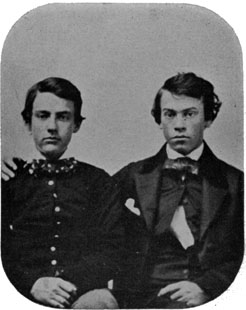
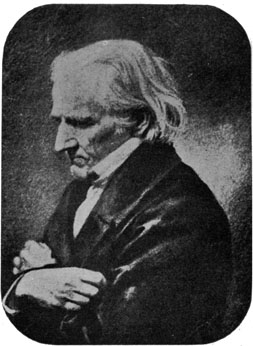
May.—Grandmother is teaching me how to knit some mittens now, but if I ever finish them it will be through much tribulation, the way they have to be raveled out and commenced over again. I think I shall know how to knit when I get through, if I never know how to do anything else. Perhaps I shall know how to write, too, for I write all of Grandmother’s letters for her, because it tires her to write too much. I have sorted my letters to-day and tied them in packages and found I had between 500 and 600. I have had about two letters a week for the past five years and have kept them all. Father almost always tells me in his letters to read my Bible and say my prayers and obey Grandmother and stand up straight and turn out my toes and brush my teeth and be good to my little sister. I have been practising all these so long I can say, as the young man did in the Bible when Jesus told him what to do to be saved, “all these have I kept from my youth up.” But then, I lack quite a number of things after all. I am not always strictly obedient. For instance, I know Grandmother never likes to have us read the secular part of the New York Observer on Sunday, so she puts it in the top drawer of the sideboard until Monday, but I couldn’t find anything interesting to read the other Sunday so I took it out and read it and put it back. The jokes and stories in it did not seem as amusing as usual so I think I will not do it again.
Grandfather’s favorite paper is the Boston Christian Register. He could not have one of them torn up any more than a leaf of the Bible. He has barrels of them stored away in the garret.
I asked Grandmother to-day to write a verse for me to keep always and she wrote a good one: “To be happy and live long the three grand essentials are: Be busy, love somebody and have high aims.” I think, from all I have noticed about her, that she has had this for her motto all her life and I don’t think Anna and I can do very much better than to try and follow it too. Grandfather tells us sometimes, when she is not in the room, that the best thing we can do is to be just as near like Grandmother as we can possibly be.
Saturday, May 30.—Louisa Field came over to dinner to-day and brought Allie with her. We had roast chickens for dinner and lots of other nice things. Grandmother taught us how to string lilac blossoms for necklaces and also how to make curls of dandelion stems. She always has some things in the parlor cupboard which she brings out on extra occasions, so she got them out to-day. They are some Chinamen which Uncle Thomas brought home when he sailed around the world. They are wooden images standing in boxes, packing tea with their feet.
Last week Jennie Howell invited us to go up to Black Point Cabin with her and to-day with a lot of grown-up people we went and enjoyed it. There was a little colored girl there who waits on the table and can row the boats too. She is Polly Carroll’s granddaughter, Mary Jane. She sang for us,
“Nellie Ely shuts her eye when she goes to sleep, When she opens them again her eyes begin to peep; Hi Nellie, Ho Nellie, listen love to me, I’ll sing for you, I’ll play for you, A dulcet melody.”
She is just as cute as she can be. She said Mrs. Henry Chesebro taught her to read.
Sunday, June 1.—Rev. Dr. Shaw, of Rochester, preached for Dr. Daggett to-day and his text was: “Whosoever drinketh of this water shall thirst again, but whosoever drinketh of the water that I shall give him shall never thirst.” He said by this water he meant the pleasures of this life, wealth and fame and honor, of which the more we have the more we want and are never satisfied, but if we drink of the water that Christ can give us we will have happiness here and forever. It was a very good sermon and I love to hear him preach. Grandmother never likes to start for church until after all the Seminary girls and Academy boys have gone by, but this morning we got to the gate just as the boys came along. When Grandmother saw five or six hats come off and knew they were bowing to us, she asked us how we got acquainted with them. We told her that almost all the girls knew the Academy boys and I am sure that is true.
Tuesday, June 8.—We are cleaning house now and Grandmother asked Anna and me to take out a few tacks in the dining-room carpet. We did not like it so very well but we liked eating dinner in the parlor, as the table had to be set in there. Anna told us that when she got married we could come to visit her any time in the year as she was never going to clean house. We went down street on an errand to-night and hurried right back, as Grandmother said she should look at the clock and see how long we were gone. Emma Wheeler went with us. Anna says she and Emma are as “thick as hasty pudding.”
June.—Rev. Frederick Starr, of Penn Yan, had an exhibition in Bemis Hall to-day of a tabernacle just like the children of Israel carried with them to the Promised Land. We went to see it. He made it himself and said he took all the directions from the Bible and knew where to put the curtains and the poles and everything. It was interesting but we thought it would be queer not to have any church to go to but one like that, that you could take down and put up and carry around with you wherever you went.
June.—Rev. Mr. Kendall is not going to preach in East Bloomfield any more. The paper says he is going to New York to live and be Secretary of the A.B.C.F.M. I asked Grandmother what that meant, and she said he would have to write down what the missionaries do. I guess that will keep him busy. Grandfather’s nephew, a Mr. Adams of Boston and his wife, visited us about two weeks ago. He is the head of the firm Adams’ Express Co. Anna asked them if they ever heard the conundrum “What was Eve made for?” and they said no, so she told them the answer, “for Adam’s express company.” They thought it was quite good. When they reached home, they sent us each a reticule, with scissors, thimble, stiletto, needle-case and tiny penknife and some stamped embroidery. They must be very rich.
Saturday Night, July.—Grandfather was asking us to-night how many things we could remember, and I told him I could remember when Zachary Taylor died, and our church was draped in black, and Mr. Daggett preached a funeral sermon about him, and I could remember when Daniel Webster died, and there was service held in the church and his last words, “I still live,” were put up over the pulpit. He said he could remember when George Washington died and when Benjamin Franklin died. He was seven years old then and he was seventeen when Washington died. Of course his memory goes farther back than mine, but he said I did very well, considering.
July.—I have not written in my journal for several days because we have been out of town. Grandfather had to go to Victor on business and took Anna and me with him. Anna says she loves to ride on the cars as it is fun to watch the trees and fences run so. We took dinner at Dr. Ball’s and came home on the evening train. Then Judge Ellsworth came over from Penn Yan to see Grandfather on business and asked if he could take us home with him and he said yes, so we went and had a splendid time and stayed two days. Stewart was at home and took us all around driving and took us to the graveyard to see our mother’s grave. I copied this verse from the gravestone:
“Of gentle seeming was her form And the soft beaming of her radiant eye Was sunlight to the beauty of her face. Peace, sacred peace, was written on her brow And flowed in the low music of her voice Which came unto the list’ner like the tones of soothing Autumn winds. Her hands were full of consolations which she scattered free to all—the poor, the sick, the sorrowful.”
I think she must have been exactly like Grandmother only she was 32 and Grandmother is 72.
Stewart went to prayer meeting because it was Wednesday night, and when he came home his mother asked him if he took part in the meeting. He said he did and she asked him what he said. He said he told the story of Ethan Allen, the infidel, who was dying, and his daughter asked him whose religion she should live by, his or her mother’s, and he said, “Your mother’s, my daughter, your mother’s.” This pleased Mrs. Ellsworth very much. Stewart is a great boy and you never can tell whether he is in earnest or not. It was very warm while we were gone and when we got home Anna told Grandmother she was going to put on her barège dress and take a rocking-chair and a glass of ice water and a palm leaf fan and go down cellar and sit, but Grandmother told her if she would just sit still and take a book and get her mind on something else besides the weather, she would be cool enough. Grandmother always looks as cool as a cucumber even when the thermometer is 90 in the shade.
Sunday, August.—Rev. Anson D. Eddy preached this morning. His text was from the sixth chapter of John, 44th verse. “No man can come to me, except the Father which hath sent me, draw him.” He is Tom Eddy’s father, and very good-looking and smart too. He used to be one of the ministers of our church before Mr. Daggett came. He wrote a book in our Sunday School library, about Old Black Jacob, and Grandmother loves to read it. We had a nice dinner to-day, green peas, lemonade and gooseberry pie. We had cold roast lamb too, because Grandmother never has any meat cooked on Sunday.
Sunday.—Mr. Noah T. Clarke is superintendent of our Sunday School now, and this morning he asked, “What is prayer?” No one answered, so I stood up and gave the definition from the catechism. He seemed pleased and so was Grandmother when I told her. Anna said she supposes she was glad that “her labor was not in vain in the Lord.” I think she is trying to see if she can say Bible verses, like grown-up people do.
Grandfather said that I did better than the little boy he read about who, when a visitor asked the Sunday School children what was the ostensible object of Sabbath School instruction, waited till the question was repeated three times and then stood up and said, “Yes, sir.”
Wednesday.—We could not go to prayer meeting to-night because it rained, so Grandmother said we could go into the kitchen and stand by the window and hear the Methodists. We could hear every word that old Father Thompson said, and every hymn they sung, but Mr. Jervis used such big words we could not understand him at all.
Sunday.—Grandmother says she loves to look at the beautiful white heads of Mr. Francis Granger and General Granger as they sit in their pews in church. She says that is what it means in the twelfth chapter of Ecclesiastes where it says, “And the almond tree shall flourish.” I don’t know exactly why it means them, but I suppose she does. We have got a beautiful almond tree in our front yard covered with flowers, but the blossoms are pink. Probably they had white ones in Jerusalem, where Solomon lived.
Monday.—Mr. Alex. Jeffrey has come from Lexington, Ky., and brought Mrs. Ross and his three daughters, Julia, Shaddie and Bessie Jeffrey. Mrs. Ross knows Grandmother and came to call and brought the girls. They are very pretty and General Granger’s granddaughters. I think they are going to stay all summer.
Thanksgiving Day.—We all went to church and Dr. Daggett’s text was: “He hath not dealt so with any nation.” Aunt Glorianna and her children were here and Uncle Field and all their family and Dr. Carr and all his family. There were about sixteen of us in all and we children had a table in the corner all by ourselves. We had roast turkey and everything else we could think of. After dinner we went into the parlor and Aunt Glorianna played on the piano and sang, “Flow gently, sweet Afton, among thy green braes,” and “Poor Bessie was a sailor’s wife.” These are Grandfather’s favorites. Dr. Carr sang “I’m sitting on the stile, Mary, where we sat side by side.” He is a beautiful singer. It seemed just like Sunday, for Grandmother never likes to have us work or play on Thanksgiving Day, but we had a very good time, indeed, and were sorry when they all went home.
Saturday, December 20.—Lillie Reeve and her brother, Charlie, have come from Texas to live. He goes to the Academy and she boards with Miss Antoinette Pierson. Miss Pierson invited me up to spend the afternoon and take tea with her and I went and had a very nice time. She told me about their camp life in Texas and how her mother died, and her little baby sister, Minnie, lives with her Grandmother Sheppard in Dansville. She is a very nice girl and I like her very much, indeed.
1857
January 8.—Anna and Alice Jewett caught a ride down to the lake this afternoon on a bob-sleigh, and then caught a ride back on a load of frozen pigs. In jumping off, Anna tore her flannel petticoat from the band down. I did not enjoy the situation as much as Anna, because I had to sit up after she had gone to bed, and darn it by candle light, because she was afraid Grandmother might see the rent and inquire into it, and that would put an end to bobsled exploits.
March 6.—Anna and her set will have to square accounts with Mr. Richards to-morrow, for nine of them ran away from school this afternoon, Alice Jewett, Louisa Field, Sarah Antes, Hattie Paddock, Helen Coy, Jennie Ruckel, Frankie Younglove, Emma Wheeler and Anna. They went out to Mr. Sackett’s, where they are making maple sugar. Mr. and Mrs. Sackett were at home and two Miss Sacketts and Darius, and they asked them in and gave them all the sugar they wanted, and Anna said pickles, too, and bread and butter, and the more pickles they ate the more sugar they could eat. I guess they will think of pickles when Mr. Richards asks them where they were. I think Ellie Daggett and Charlie Paddock went, too, and some of the Academy boys.
March 7.—They all had to stay after school to-night for an hour and copy Dictionary. Anna seems reconciled, for she just wrote in her journal: “It was a very good plan to keep us because no one ever ought to stay out of school except on account of sickness, and if they once get a thing fixed in their minds it will stay there, and when they grow up it will do them a great deal of good.”
April.—Grandfather gave us 10 cents each this morning for learning the 46th Psalm and has promised us $1 each for reading the Bible through in a year. We were going to any way. Some of the girls say they should think we would be afraid of Grandfather, he is so sober, but we are not the least bit. He let us count $1,000 to-night which a Mr. Taylor, a cattle buyer, brought to him in the evening after banking hours. Anybody must be very rich who has all that money of their own.
Friday.—Our old horse is dead and we will have to buy another. He was very steady and faithful. One day Grandfather left him at the front gate and he started along and turned the corner all right, down the Methodist lane and went way down to our barn doors and stood there until Mr. Piser came and took him into the barn. People said they set their clocks by him because it was always quarter past 12 when he was driven down to the bank after Grandfather and quarter of 1 when he came back. I don’t think the clocks would ever be too fast if they were set by him. We asked Grandfather what he died of and he said he had run his race but I think he meant he had walked it, for I never saw him go off a jog in my life. Anna used to say he was taking a nap when we were out driving with Grandfather. I have written some lines in his memory and if I knew where he was buried, I would print it on his head board.
Old Dobbin’s dead, that good old horse, We ne’er shall see him more, He always used to lag behind But now he’s gone before.
It is a parody on old Grimes is dead, which is in our reader, only that is a very long poem. I am not going to show mine to Grandfather till he gets over feeling bad about the horse.
Sunday.—Grandmother gave Anna, Doddridge’s “Rise and Progress of Religion in the Soul” to read to-day. Anna says she thinks she will have to rise and progress a good deal before she will be able to appreciate it. Baxter’s “Saints Rest” would probably suit her better.
Sunday, April 5.—An agent for the American Board of Foreign Missions preached this morning in our church from Romans 10: 15: “How shall they hear without a preacher and how shall they preach except they be sent.” An agent from every society presents the cause, whatever it is, once a year and some people think the anniversary comes around very often. I always think of Mrs. George Wilson’s poem on “A apele for air, pewer air, certin proper for the pews, which, she sez, is scarce as piety, or bank bills when ajents beg for mischuns, wich sum say is purty often, (taint nothin’ to me, wat I give aint nothin’ to nobody).” I think that is about the best poem of its kind I ever read.
Miss Lizzie Bull told us in Sunday School to-day that she cannot be our Sunday School teacher any more, as she and her sister Mary are going to join the Episcopal Church. We hate to have her go, but what can’t be cured must be endured. Part of our class are going into Miss Mary Howell’s class and part into Miss Annie Pierce’s. They are both splendid teachers and Miss Lizzie Bull is another. We had preaching in our church this afternoon, too. Rev. Samuel Hanson Cox, of Le Roy Female Seminary, preached. He is a great man, very large, long white hair combed back. I think if a person once saw him they would never forget him. He preached about Melchisidek, who had neither “beginning of days or end of life.” Some people thought that was like his sermon, for it was more than one hour long. Dr. Cox and Mrs. Taylor came to call and asked Grandfather to let me go to Le Roy Female Seminary, but Grandfather likes Ontario Female Seminary better than any other in the world. We wanted Grandmother to have her picture taken, but she did not feel able to go to Mr. Finley’s, so he came up Tuesday and took it in our dining-room. She had her best cap on and her black silk dress and sat in her high back rocking chair in her usual corner near the window. He brought one up to show us and we like it so much. Anna looked at it and kissed it and said, “Grandmother, I think you are perfectly beautiful.” She smiled and very modestly put her handkerchief up to her face and said, “You foolish child,” but I am sure she was pleased, for how could she help it? A man came up to the open window one day where she was sitting, with something to sell, and while she was talking to him he said, “You must have been handsome, lady, when you were young.” Grandmother said it was because he wanted to sell his wares, but we thought he knew it was so. We told her she couldn’t get around it that way and we asked Grandfather and he said it was true. Our Sunday School class went to Mr. Finley’s to-day and had a group ambrotype taken for our teacher, Miss Annie Pierce; Susie Daggett, Clara Willson, Sarah Whitney, Mary Field and myself. Mary Wheeler ought to have been in it, too, but we couldn’t get her to come. We had very good success.
Thursday.—We gave the ambrotype to Miss Pierce and she liked it very much and so does her mother and Fannie. Her mother is lame and cannot go anywhere so we often go to see her and she is always glad to see us and so pleasant.
May 9.—Miss Lizzie Bull came for me to go botanising with her this morning and we were gone from 9 till 12, and went clear up to the orphan asylum. I am afraid I am not a born botanist, for all the time she was analysing the flowers and telling me about the corona and the corolla and the calyx and the stamens and petals and pistils, I was thinking what beautiful hands she had and how dainty they looked, pulling the blossoms all to pieces. I am afraid I am commonplace, like the man we read of in English literature, who said “a primrose by the river brim, a yellow primrose, was to him, and it was nothing more.”
Mr. William Wood came to call this afternoon and gave us some morning-glory seeds to sow and told us to write down in our journals that he did so. So here it is. What a funny old man he is. Anna and Emma Wheeler went to Hiram Tousley’s funeral to-day. She has just written in her journal that Hiram’s corpse was very perfect of him and that Fannie looked very pretty in black. She also added that after the funeral Grandfather took Aunt Ann and Lucilla out to ride to Mr. Howe’s and just as they got there it sprinkled. She says she don’t know “weather” they got wet or not. She went to a picnic at Sucker Brook yesterday afternoon, and this is the way she described it in her journal. “Miss Hurlburt told us all to wear rubbers and shawls and bring some cake and we would have a picnic. We had a very warm time. It was very warm indeed and I was most roasted and we were all very thirsty indeed. We had in all the party about 40 of us. It was very pleasant and I enjoyed myself exceedingly. We had boiled eggs, pickles, Dutch cheese and sage cheese and loaf cake and raisin cake, pound cake, dried beef and capers, jam and tea cakes and gingerbread, and we tried to catch some fish but we couldn’t, and in all we had a very nice time. I forgot to say that I picked some flowers for my teacher. I went to bed tired out and worn out.”
Her next entry was the following day when she and the other scholars dressed up to “speak pieces.” She says, “After dinner I went and put on my rope petticoat and lace one over it and my barège de laine dress and all my rings and white bask and breastpin and worked handkerchief and spoke my piece. It was, ‘When I look up to yonder sky.’ It is very pretty indeed and most all the girls said I looked nice and said it nice. They were all dressed up, too.”
Thursday.—I asked Grandfather why we do not have gas in the house like almost every one else and he said because it was bad for the eyes and he liked candles and sperm oil better. We have the funniest little sperm oil lamp with a shade on to read by evenings and the fire on the hearth gives Grandfather and Grandmother all the light they want, for she knits in her corner and we read aloud to them if they want us to. I think if Grandfather is proud of anything besides being a Bostonian, it is that everything in the house is forty years old. The shovel and tongs and andirons and fender and the haircloth sofa and the haircloth rocking chair and the flag bottomed chairs painted dark green and the two old arm-chairs which belong to them and no one else ever thinks of touching. There is a wooden partition between the dining-room and parlor and they say it can slide right up out of sight on pulleys, so that it would be all one room. We have often said that we wished we could see it go up but they say it has never been up since the day our mother was married and as she is dead I suppose it would make them feel bad, so we probably will always have it down. There are no curtains or even shades at the windows, because Grandfather says, “light is sweet and a pleasant thing it is to behold the sun.” The piano is in the parlor and it is the same one that our mother had when she was a little girl but we like it all the better for that. There are four large oil paintings on the parlor wall, De Witt Clinton, Rev. Mr. Dwight, Uncle Henry Channing Beals and Aunt Lucilla Bates, and no matter where we sit in the room they are watching and their eyes seem to move whenever we do. There is quite a handsome lamp on a mahogany center table, but I never saw it lighted. We have four sperm candles in four silver candlesticks and when we have company we light them. Johnnie Thompson, son of the minister, Rev. M. L. R. P., has come to the academy to school and he is very full of fun and got acquainted with all the girls very quick. He told us this afternoon to have “the other candle lit” for he was coming down to see us this evening. Will Schley heard him say it and he said he was coming too. His mother says she always knows when he has been at our house, because she finds sperm on his clothes and has to take brown paper and a hot flatiron to get it out, but still I do not think that Mrs. Schley cares, for she is a very nice lady and she and I are great friends. I presume she would just as soon he would spend part of his time with us as to be with Horace Finley all the time. Those boys are just like twins. We never see one without being sure that the other is not far away.
Later.—The boys came and we had a very pleasant evening but when the 9 o’clock bell rang we heard Grandfather winding up the clock and scraping up the ashes on the hearth to cover the fire so it would last till morning and we all understood the signal and they bade us good-night. “We won’t go home till morning” is a song that will never be sung in this house.
June 2.—Abbie Clark wrote such a nice piece in my album to-day I am going to write it in my journal. Grandfather says he likes the sentiment as well as any in my book. This is it: “It has been said that the friendship of some people is like our shadow, keeping close by us while the sun shines, deserting us the moment we enter the shade, but think not such is the friendship of Abbie S. Clark.” Abbie and I took supper at Miss Mary Howell’s to-night to see Adele Ives. We had a lovely time.
Tuesday.—General Tom Thumb was in town to-day and everybody who wanted to see him could go to Bemis Hall. Twenty-five cents for old people, and 10 cents for children, but we could see him for nothing when he drove around town. He had a little carriage and two little bits of ponies and a little boy with a high silk hat on, for the driver. He sat inside the coach but we could see him looking out. We went to the hall in the afternoon and the man who brought him stood by him and looked like a giant and told us all about him. Then he asked Tom Thumb to make a speech and stood him upon the table. He told all the ladies he would give them a kiss if they would come up and buy his picture. Some of them did.
Friday, July.—I have not kept a journal for two weeks because we have been away visiting. Anna and I had an invitation to go to Utica to visit Rev. and Mrs. Brandigee. He is rector of Grace Episcopal church there and his wife used to belong to Father’s church in Morristown, N. J. Her name was Miss Condict. Rev. Mr. Stowe was going to Hamilton College at Clinton, so he said he would take us to Utica. We had a lovely time. The corner stone of the church was laid while we were there and Bishop De Lancey came and stayed with us at Mr. Brandigee’s. He is a very nice man and likes children. One morning they had muffins for breakfast and Anna asked if they were ragamuffins. Mr. Brandigee said, “Yes, they are made of rags and brown paper,” but we knew he was just joking. When we came away Mrs. Brandigee gave me a prayer book and Anna a vase, but she didn’t like it and said she should tell Mrs. Brandigee she wanted a prayer book too, so I had to change with her. When we came home Mr. Brandigee put us in care of the conductor. There was a fine soldier looking man in the car with us and we thought it was his wife with him. He wore a blue coat and brass buttons, and some one said his name was Custer and that he was a West Point cadet and belonged to the regular army. I told Anna she had better behave or he would see her, but she would go out and stand on the platform until the conductor told her not to. I pulled her dress and looked very stern at her and motioned toward Mr. Custer, but it did not seem to have any impression on her. I saw Mr. Custer smile once because my words had no effect. I was glad when we got to Canandaigua. I heard some one say that Dr. Jewett was at the depôt to take Mr. Custer and his wife to his house, but I only saw Grandfather coming after us. He said, “Well, girls, you have been and you have got back,” but I could see that he was glad to have us at home again, even if we are “troublesome comforts,” as he sometimes says.
July 4.—Barnum’s circus was in town to-day and if Grandmother had not seen the pictures on the hand bills I think she would have let us go. She said it was all right to look at the creatures God had made but she did not think He ever intended that women should go only half dressed and stand up and ride on horses bare back, or jump through hoops in the air. So we could not go. We saw the street parade though and heard the band play and saw the men and women in a chariot, all dressed so fine, and we saw a big elephant and a little one and a camel with an awful hump on his back, and we could hear the lion roar in the cage, as they went by. It must have been nice to see them close to and probably we will some day.
Grandmother’s Rocking Chair “The Grandfather Clock”
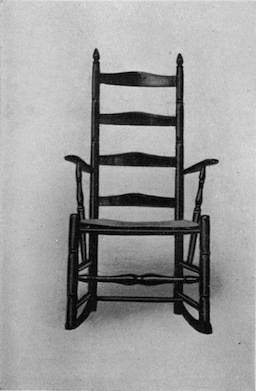
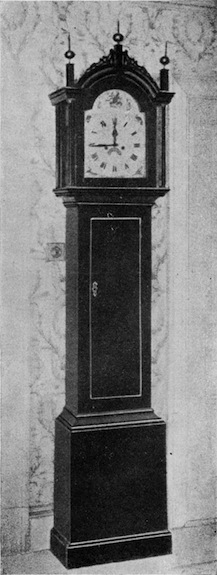
August 8.—Grandfather has given me his whole set of Waverley novels and his whole set of Shakespeare’s plays, and has ordered Mr. Jahn, the cabinetmaker, to make me a black walnut bookcase, with glass doors and three deep drawers underneath, with brass handles. He is so good. Anna says perhaps he thinks I am going to be married and go to housekeeping some day. Well, perhaps he does. Stranger things have happened. “Barkis is willin’,” and I always like to please Grandfather. I have just read David Copperfield and was so interested I could not leave it alone till I finished it.
September 1.—Anna and I have been in Litchfield, Conn., at Father’s school for boys. It is kept in the old Beecher house, where Dr. Lyman Beecher lived. We went up into the attic, which is light and airy, where they say he used to write his famous sermons. James is one of the teachers and he came for us. We went to Farmington and saw all the Cowles families, as they are our cousins. Then we drove by the Charter Oak and saw all there is left of it. It was blown down last year but the stump is fenced around. In Hartford we visited Gallaudet’s Institution for the deaf and dumb and went to the historical rooms, where we saw some of George Washington’s clothes and his watch and his penknife, but we did not see his little hatchet. We stayed two weeks in New York and vicinity before we came home. Uncle Edward took us to Christie’s Minstrels and the Hippodrome, so we saw all the things we missed seeing when the circus was here in town. Grandmother seemed surprised when we told her, but she didn’t say much because she was so glad to have us at home again. Anna said we ought to bring a present to Grandfather and Grandmother, for she read one time about some children who went away and came back grown up and brought home “busts of the old philosophers for the sitting-room,” so as we saw some busts of George Washington and Benjamin Franklin in plaster of paris we bought them, for they look almost like marble and Grandfather and Grandmother like them. Speaking of busts reminds me of a conundrum I heard while I was gone. “How do we know that Poe’s Raven was a dissipated bird? Because he was all night on a bust.” Grandfather took us down to the bank to see how he had it made over while we were gone. We asked him why he had a beehive hanging out for a sign and he said, “Bees store their honey in the summer for winter use and men ought to store their money against a rainy day.” He has a swing door to the bank with “Push” on it. He said he saw a man studying it one day and finally looking up he spelled p-u-s-h, push (and pronounced it like mush). “What does that mean?” Grandfather showed him what it meant and he thought it was very convenient. He was about as thick-headed as the man who saw some snuffers and asked what they were for and when told to snuff the candle with, he immediately snuffed the candle with his fingers and put it in the snuffers and said, “Law sakes, how handy!” Grandmother really laughed when she read this in the paper.
September.—Mrs. Martin, of Albany, is visiting Aunt Ann, and she brought Grandmother a fine fish that was caught in the Atlantic Ocean. We went over and asked her to come to dinner to-morrow and help eat it and she said if it did not rain pitchforks she would come, so I think we may expect her. Her granddaughter, Hattie Blanchard, has come here to go to the seminary and will live with Aunt Ann. She is a very pretty girl. Mary Field came over this morning and we went down street together. Grandfather went with us to Mr. Nat Gorham’s store, as he is selling off at cost, and got Grandmother and me each a new pair of kid gloves. Hers are black and mine are green. Hers cost six shillings and mine cost five shillings and six pence; very cheap for such nice ones. Grandmother let Anna have six little girls here to supper to-night: Louisa Field, Hattie Paddock, Helen Coy, Martha Densmore, Emma Wheeler and Alice Jewett. We had a splendid supper and then we played cards. I do not mean regular cards, mercy no! Grandfather thinks those kind are contagious or outrageous or something dreadful and never keeps them in the house. Grandmother said they found a pack once, when the hired man’s room was cleaned, and they went into the fire pretty quick. The kind we played was just “Dr. Busby,” and another “The Old Soldier and His Dog.” There are counters with them, and if you don’t have the card called for you have to pay one into the pool. It is real fun. They all said they had a very nice time, indeed, when they bade Grandmother good-night, and said: “Mrs. Beals, you must let Carrie and Anna come and see us some time,” and she said she would. I think it is nice to have company.
Christmas.—Grandfather and Grandmother do not care much about making Christmas presents. They say, when they were young no one observed Christmas or New Years, but they always kept Thanksgiving day. Our cousins, the Fields and Carrs, gave us several presents and Uncle Edward sent us a basket full from New York by express. Aunt Ann gave me one of the Lucy books and a Franconia story book and to Anna, “The Child’s Book on Repentance.” When Anna saw the title, she whispered to me and said if she had done anything she was sorry for she was willing to be forgiven. I am afraid she will never read hers but I will lend her mine. Miss Lucy Ellen Guernsey, of Rochester, gave me “Christmas Earnings” and wrote in it, “Carrie C. Richards with the love of the author.” I think that is very nice. Anna and I were chattering like two magpies to-day, and a man came in to talk to Grandfather on business. He told us in an undertone that children should be seen and not heard. After he had gone I saw Anna watching him a long time till he was only a speck in the distance and I asked her what she was doing. She said she was doing it because it was a sign if you watched persons out of sight you would never see them again. She does not seem to have a very forgiving spirit, but you can’t always tell.
Mr. William Wood, the venerable philanthropist of whom Canandaigua has been justly proud for many years, is dead. I have preserved this poem, written by Mrs. George Willson in his honor:
“Mr. Editor—The following lines were written by a lady of this village, and have been heretofore published, but on reading in your last paper the interesting extract relating to the late William Wood, Esq., it was suggested that they be again published, not only for their merit, but also to keep alive the memory of one who has done so much to ornament our village.
When first on this stage of existence we come Blind, deaf, puny, helpless, but not, alas, dumb, What can please us, and soothe us, and make us sleep good? To be rocked in a cradle;—and cradles are wood. When older we grow, and we enter the schools Where masters break rulers o’er boys who break rules, What can curb and restrain and make laws understood But the birch-twig and ferule?—and both are of wood. When old age—second childhood, takes vigor away, And we totter along toward our home in the clay, What can aid us to stand as in manhood we stood But our tried, trusty staff?—and the staff is of wood. And when from this stage of existence we go, And death drops the curtain on all scenes below, In our coffins we rest, while for worms we are food, And our last sleeping place, like our first, is of wood. Then honor to wood! fresh and strong may it grow, ’Though winter has silvered its summit with snow; Embowered in its shade long our village has stood; She’d scarce be Canandaigua if stripped of her Wood.
Stanza added after the death of Mr. Wood
The sad time is come; she is stript of her Wood, ’Though the trees that he planted still stand where they stood, Still with storms they can wrestle with arms stout and brave; Still they wave o’er our dwellings—they droop o’er his grave! Alas! that the life of the cherished and good Is more frail and more brief than the trees of the wood!
1858
February 24, 1858.—The boarders at the Seminary had some tableaux last evening and invited a great many from the village. As we went in with the crowd, we heard some one say, “Are they going to have tableaux? Well, I thought I smelt them!” They were splendid. Mr. Chubbuck was in nearly all of them. The most beautiful one was Abraham offering up Isaac. Mr. Chubbuck was Abraham and Sarah Ripley was Isaac. After the tableaux they acted a charade. The word was “Masterpiece.” It was fine. After the audience got half way out of the chapel Mr. Richards announced “The Belle of the Evening.” The curtain rose and every one rushed back, expecting to see a young lady dressed in the height of fashion, when immediately the Seminary bell rang! Mr. Blessner’s scholars gave all the music and he stamped so, beating time, it almost drowned the music. Some one suggested a bread and milk poultice for his foot. Anna has been taking part in some private theatricals. The play is in contrast to “The Spirit of ’76” and the idea carried out is that the men should stay at home and rock the cradles and the women should take the rostrum. Grandmother was rather opposed to the idea, but every one wanted Anna to take the part of leading lady, so she consented. She even helped Anna make her bloomer suit and sewed on the braid for trimming on the skirt herself. She did not know that Anna’s opening sentence was, “How are you, sir? Cigar, please!” It was acted at Mrs. John Bates’ house on Gibson Street and was a great success, but when they decided to repeat it another evening Grandmother told Anna she must choose between going on the stage and living with her Grandmother, so Anna gave it up and some one else took her part.
March.—There is a great deal said about spirits nowadays and a lot of us girls went into one of the recitation rooms after school to-night and had a spiritual seance. We sat around Mr. Chubbuck’s table and put our hands on it and it moved around and stood on two legs and sometimes on one. I thought the girls helped it but they said they didn’t. We heard some loud raps, too, but they sounded very earthly to me. Eliza Burns, one of the boarders, told us if we would hold our breath we could pick up one of the girls from the floor and raise her up over our heads with one finger of each hand, if the girl held her breath, too. We tried it with Anna and did it, but we had such hard work to keep from laughing I expected we would drop her. There is nothing very spirituelle about any of us. I told Grandmother and she said we reminded her of Jemima Wilkinson, who told all her followers that the world was to come to an end on a certain day and they should all be dressed in white and get up on the roofs of the houses and be prepared to ascend and meet the Lord in the air. I asked Grandmother what she said when nothing happened and she said she told them it was because they did not have faith enough. If they had, everything would have happened just as she said. Grandmother says that one day at a time has always been enough for her and that to-morrow will take care of the things of itself.
May, 1858.—Several of us girls went up into the top of the new Court House to-day as far as the workmen would allow us. We got a splendid view of the lake and of all the country round. Abbie Clark climbed up on a beam and recited part of Alexander Selkirk’s soliloquy:
“I’m monarch of all I survey, My rights there are none to dispute: From the center, all round to the sea, I’m lord of the fowl and brute.”
I was standing on a block and she said I looked like “Patience on a monument smiling at Grief.” I am sure she could not be taken for “Grief.” She always has some quotation on her tongue’s end. We were down at Sucker Brook the other day and she picked her way out to a big stone in the middle of the stream and, standing on it, said, in the words of Rhoderick Dhu,
“Come one, come all, this rock shall fly From its firm base, as soon as I.”
Just then the big stone tipped over and she had to wade ashore. She is not at all afraid of climbing and as we left the Court House she said she would like to go outside on the cupola and help Justice balance the scales.
A funny old man came to our house to-day as he wanted to deposit some money and reached the bank after it was closed. We were just sitting down to dinner so Grandfather asked him to stay and have “pot luck” with us. He said that he was very much “obleeged” and stayed and passed his plate a second time for more of our very fine “pot luck.” We had boiled beef and dumplings and I suppose he thought that was the name of the dish. He talked so queer we couldn’t help noticing it. He said he “heered” so and he was “afeered” and somebody was very “deef” and they “hadn’t ought to have done it” and “they should have went” and such things. Anna and I almost laughed but Grandmother looked at us with her eye and forefinger so we sobered down. She told us afterwards that there are many good people in the world whose verbs and nouns do not agree, and instead of laughing at them we should be sure that we always speak correctly ourselves. Very true. Dr. Daggett was at the Seminary one day when we had public exercises and he told me afterwards that I said “sagac-ious” for “saga-cious” and Aunt Ann told me that I said “epi-tome” for “e-pit-o-me.” So “people that live in glass houses shouldn’t throw stones.”
Sunday.—Grandfather read his favorite parable this morning at prayers—the one about the wise man who built his house upon a rock and the foolish man who built upon the sand. He reads it good, just like a minister. He prays good, too, and I know his prayer by heart. He says, “Verily Thou art our Father, though Abraham be ignorant of us and Israel acknowledge us not,” and he always says, “Thine arm is not shortened that it cannot save, or Thine ear heavy that it cannot hear.” I am glad that I can remember it.
June.—Cyrus W. Field called at our house to-day. He is making a trip through the States and stopped here a few hours because Grandmother is his aunt. He made her a present of a piece of the Atlantic cable about six inches long, which he had mounted for her. It is a very nice souvenir. He is a tall, fine looking man and very pleasant.
Sunday, July 4, 1858.—This is Communion Sunday and quite a number united with the church on profession of their faith. Mr. Gideon Granger was one of them. Grandmother says that she has known him always and his father and mother, and she thinks he is like John, the beloved disciple. I think that any one who knows him, knows what is meant by a gentle-man. I have a picture of Christ in the Temple with the doctors, and His face is almost exactly like Mr. Granger’s. Some others who joined to-day were Miss Belle Paton, Miss Lottie Clark and Clara Willson, Mary Wheeler and Sarah Andrews. Dr. Daggett always asks all the communicants to sit in the body pews and the noncommunicants in the side pews. We always feel like the goats on the left when we leave Grandfather and Grandmother and go on the side, but we won’t have to always. Abbie Clark, Mary Field and I think we will join at the communion in September. Grandmother says she hopes we realize what a solemn thing it is. We are fifteen years old so I think we ought to. No one who hears Dr. Daggett say in his beautiful voice, “I now renounce all ways of sin as what I truly abhor and choose the service of God as my greatest privilege,” could think it any trifling matter. I feel as though I couldn’t be bad if I wanted to be, and when he blesses them and says, “May the God of the Everlasting Covenant keep you firm and holy to the end through Jesus Christ our Lord,” everything seems complete. He always says at the close, “And when they had sung an hymn they went out into the Mount of Olives.” Then he gives out the hymn, beginning:
“According to Thy gracious word, In deep humility, This will I do, my dying Lord I will remember Thee.”
And the last verse:
“And when these failing lips grow dumb, And mind and memory flee, When in Thy kingdom Thou shalt come, Jesus remember me.”
Hon. Francis Granger Mr. Gideon Granger
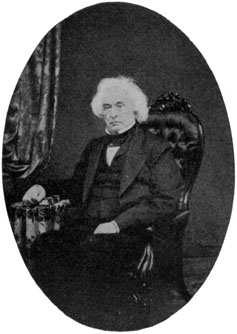
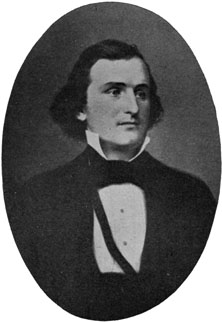
Deacon Taylor always starts the hymn. Deacon Taylor and Deacon Tyler sit on one side of Dr. Daggett and Deacon Clarke and Deacon Castle on the other. Grandfather and Grandmother joined the church fifty-one years ago and are the oldest living members. She says they have always been glad that they took this step when they were young.
August 17.—There was a celebration in town to-day because the Queen’s message was received on the Atlantic cable. Guns were fired and church bells rung and flags were waving everywhere. In the evening there was a torchlight procession and the town was all lighted up except Gibson Street. Allie Antes died this morning, so the people on that street kept their houses as usual. Anna says that probably Allie Antes was better prepared to die than any other little girl in town. Atwater hall and the academy and the hotel were more brilliantly illuminated than any other buildings. Grandfather saw something in a Boston paper that a minister said in his sermon about the Atlantic cable and he wants me to write it down in my journal. This is it: “The two hemispheres are now successfully united by means of the electric wire, but what is it, after all, compared with the instantaneous communication between the Throne of Divine Grace and the heart of man? Offer up your silent petition. It is transmitted through realms of unmeasured space more rapidly than the lightning’s flash, and the answer reaches the soul e’re the prayer has died away on the sinner’s lips. Yet this telegraph, performing its saving functions ever since Christ died for men on Calvary, fills not the world with exultation and shouts of gladness, with illuminations and bonfires and the booming of cannon. The reason is, one is the telegraph of this world and may produce revolutions on earth; the other is the sweet communication between Christ and the Christian soul and will secure a glorious immortality in Heaven.” Grandfather appreciates anything like that and I like to please him.
Grandfather says he thinks the 19th Psalm is a prophecy of the electric telegraph. “Their line is gone out through all the earth and their words to the end of the world.” It certainly sounds like it.
Sunday.—Rev. Henry Ward Beecher is staying at Judge Taylor’s and came with them to church to-day. Everybody knew that he was here and thought he would preach and the church was packed full. When he came in he went right to Judge Taylor’s pew and sat with him and did not preach at all, but it was something to look at him. Mr. Daggett was away on his vacation and Rev. Mr. Jervis of the M. E. church preached. I heard some people say they guessed even Mr. Beecher heard some new words to-day, for Mr. Jervis is quite a hand to make them up or find very long hard ones in the dictionary.
August 30, 1858.—Rev. Mr. Tousley was hurt to-day by the falling of his barn which was being moved, and they think his back is broken and if he lives he can never sit up again. Only last Sunday he was in Sunday School and had us sing in memory of Allie Antes:
“A mourning class, a vacant seat, Tell us that one we loved to meet Will join our youthful throng no more, ’Till all these changing scenes are o’er.”
And now he will never meet with us again and the children will never have another minister all their own. He thinks he may be able to write letters to the children and perhaps write his own life. We all hope he may be able to sit up if he cannot walk.
We went to our old home in Penn Yan visiting last week and stayed at Judge Ellsworth’s. We called to see the Tunnicliffs and the Olivers, Wells, Jones, Shepards, Glovers, Bennetts, Judds and several other families. They were glad to see us for the sake of our father and mother. Father was their pastor from 1841 to 1847.
Some one told us that when Bob and Henry Antes were small boys they thought they would like to try, just for once, to see how it would seem to be bad, so in spite of all of Mr. Tousley’s sermons they went out behind the barn one day and in a whisper Bob said, “I swear,” and Henry said, “So do I.” Then they came into the house looking guilty and quite surprised, I suppose, that they were not struck dead just as Ananias and Sapphira were for lying.
September.—I read in a New York paper to-day that Hon. George Peabody, of England, presented Cyrus W. Field with a solid silver tea service of twelve pieces, which cost $4,000. The pieces bear likenesses of Mr. Peabody and Mr. Field, with the coat of arms of the Field family. The epergne is supported by a base representing the genius of America.
We had experiments in the philosophy class to-day and took electric shocks. Mr. Chubbuck managed the battery which has two handles attached. Two of the girls each held one of these and we all took hold of hands making the circuit complete. After a while it jerked us almost to pieces and we asked Mr. Chubbuck to turn it off. Dana Luther, one of the Academy boys, walked up from the post-office with me this noon. He lives in Naples and is Florence Younglove’s cousin. We went to a ball game down on Pleasant Street after school. I got so far ahead of Anna coming home she called me her “distant relative.”
1859
January, 1859.—Mr. Woodruff came to see Grandfather to ask him if we could attend his singing school. He is going to have it one evening each week in the chapel of our church. Quite a lot of the boys and girls are going, so we were glad when Grandfather gave his consent. Mr. Woodruff wants us all to sing by note and teaches “do re me fa sol la si do” from the blackboard and beats time with a stick. He lets us have a recess, which is more fun than all the rest of it. He says if we practise well we can have a concert in Bemis Hall to end up with. What a treat that will be!
February.—Anna has been teasing me all the morning about a verse which John Albert Granger Barker wrote in my album. He has a most fascinating lisp when he talks, so she says this is the way the verse reads:
“Beauty of perthon, ith thertainly chawming Beauty of feachure, by no meanth alawming But give me in pwefrence, beauty of mind, Or give me Cawwie, with all thwee combined.”
It takes Anna to find “amuthement” in “evewything.”
Mary Wheeler came over and pierced my ears to-day, so I can wear my new earrings that Uncle Edward sent me. She pinched my ear until it was numb and then pulled a needle through, threaded with silk. Anna would not stay in the room. She wants hers done but does not dare. It is all the fashion for girls to cut off their hair and friz it. Anna and I have cut off ours and Bessie Seymour got me to cut off her lovely long hair to-day. It won’t be very comfortable for us to sleep with curl papers all over our heads, but we must do it now. I wanted my new dress waist which Miss Rosewarne is making, to hook up in front, but Grandmother said I would have to wear it that way all the rest of my life so I had better be content to hook it in the back a little longer. She said when Aunt Glorianna was married, in 1848, it was the fashion for grown up women to have their waists fastened in the back, so the bride had hers made that way but she thought it was a very foolish and inconvenient fashion. It is nice, though, to dress in style and look like other people. I have a Garibaldi waist and a Zouave jacket and a balmoral skirt.
Sunday.—I asked Grandmother if I could write a letter to Father to-day, and she said I could begin it and tell him that I went to church and what Mr. Daggett’s text was and then finish it to-morrow. I did so, but I wish I could do it all after I began. She said a verse from the Tract Primer:
“A Sabbath well spent brings a week of content And strength for the toil of to-morrow, But a Sabbath profaned, whatever be gained, Is a certain forerunner of sorrow.”
Monday.—We dressed up in new fangled costumes to-day and wore them to school. Some of us wore dresses almost up to our knees and some wore them trailing on the ground. Some wore their hair twisted in knots and some let theirs hang down their backs. I wore my new waterfall for the first time and Abbie Clark said I looked like “Hagar in the Wilderness.” When she came in she looked like a fashion plate, bedecked with bows and ribbons and her hair up in a new way. When she came in the door she stopped and said solemnly: “If you have tears prepare to shed them now!” Laura Chapin would not participate in the fun, for once. She said she thought “Beauty unadorned was the dorndest.” We did not have our lesson in mental philosophy very well so we asked Mr. Richards to explain the nature of dreams and their cause and effect. He gave us a very interesting talk, which occupied the whole hour. We listened with breathless attention, so he must have marked us 100.
There was a lecture at the seminary to-night and Rev. Dr. Hibbard, the Methodist minister, who lives next door above the Methodist church, came home with us. Grandmother was very much pleased when we told her.
March 1.—Our hired man has started a hot bed and we went down behind the barn to see it. Grandfather said he was up at 6 o’clock and walked up as far as Mr. Greig’s lions and back again for exercise before breakfast. He seems to have the bloom of youth on his face as a reward. Anna says she saw “Bloom of youth” advertised in the drug store and she is going to buy some. I know Grandmother won’t let her for it would be like “taking coal to Newcastle.”
April.—Anna wanted me to help her write a composition last night, and we decided to write on “Old Journals,” so we got hers and mine both out and made selections and then she copied them. When we were on our way to school this morning we met Mr. E. M. Morse and Anna asked him if he did not want to read her composition that Carrie wrote for her. He made a very long face and pretended to be much shocked, but said he would like to read it, so he took it and also her album, which she asked him to write in. At night, on his way home, he stopped at our door and left them both. When she looked in her album, she found this was what he had written:
“Anna, when you have grown old and wear spectacles and a cap, remember the boyish young man who saw your fine talents in 1859 and was certain you would add culture to nature and become the pride of Canandaigua. Do not forget also that no one deserves praise for anything done by others and that your progress in wisdom and goodness will be watched by no one more anxiously than by your true friend,
E. M. Morse.”
I think she might as well have told Mr. Morse that the old journals were as much hers as mine; but I think she likes to make out she is not as good as she is. Sarah Foster helped us to do our arithmetic examples to-day. She is splendid in mathematics.
Much to our surprise Bridget Flynn, who has lived with us so long, is married. We didn’t know she thought of such a thing, but she has gone. Anna and I have learned how to make rice and cornstarch puddings. We have a new girl in Bridget’s place but I don’t think she will do. Grandmother asked her to-day if she seasoned the gravy and she said, either she did or she didn’t, she couldn’t tell which. Grandfather says he thinks she is a little lacking in the “upper story.”
June.—A lot of us went down to Sucker Brook this afternoon. Abbie Clark was one and she told us some games to play sitting down on the grass. We played “Simon says thumbs up” and then we pulled the leaves off from daisies and said,
“Rich man, poor man, beggar man, thief, Doctor, lawyer, merchant, chief,”
to see which we would marry. The last leaf tells the story. Anna’s came “rich man” every time and she thinks it is true because Eugene Stone has asked to marry her and he is quite well off. She is 13 and he is 17. He is going now to his home in St. Paul, Minn., but he is coming back for her some day. Tom Eddy is going to be groomsman and Emma Wheeler bridesmaid. They have all the arrangements made. She has not shown any of Eugene Stone’s notes to Grandmother yet for she does not think it is worth while. Anna broke the seal on Tom Eddy’s page in her mystic book, although he wrote on it, “Not to be opened until December 8, 1859.” He says:
“Dear Anna,—I hope that in a few years I will see you and Stone living on the banks of the Mississippi, in a little cottage, as snug as a bug in a rug, living in peace, so that I can come and see you and have a good time.—Yours,
Thos. C. Eddy.”
Anna says if she does marry Eugene Stone and he forgets, after two or three years to be as polite to her as he is now she shall look up at him with her sweetest smile and say, “Miss Anna, won’t you have a little more sugar in your tea?” When I went to school this morning Juliet Ripley asked, “Where do you think Anna Richards is now? Up in a cherry tree in Dr. Cheney’s garden.” Anna loves cherries. We could see her from the chapel window.
June 7.—Alice Jewett took Anna all through their new house to-day which is being built and then they went over to Mr. Noah T. Clarke’s partly finished house and went all through that. A dog came out of Cat Alley and barked at them and scared Anna awfully. She said she almost had a conniption fit but Emma kept hold of her. She is so afraid of thunder and lightning and dogs.
Old Friend Burling brought Grandfather a specimen of his handwriting to-day to keep. It is beautifully written, like copper plate. This is the verse he wrote and Grandfather gave it to me to paste in my book of extracts:
DIVINE LOVE. Could we with ink the ocean fill, Was the whole earth of parchment made, Was every single stick a quill, And every man a scribe by trade; To write the love of God above Would drain the ocean dry; Nor could that scroll contain the whole Though stretched from sky to sky.
Transcribed by William S. Burling, Canandaigua, 1859, in the 83rd year of his age.
Sunday, December 8, 1859.—Mr. E. M. Morse is our Sunday School teacher now and the Sunday School room is so crowded that we go up into the church for our class recitation. Abbie Clark, Fannie Gaylord and myself are the only scholars, and he calls us the three Christian Graces, faith, hope and charity, and the greatest of these is charity. I am the tallest, so he says I am charity. We recite in Mr. Gibson’s pew, because it is farthest away and we do not disturb the other classes. He gave us some excellent advice to-day as to what was right and said if we ever had any doubts about anything we should never do it and should always be perfectly sure we are in the right before we act. He gave us two weeks ago a poem to learn by Samuel Taylor Coleridge. It is an apostrophe to God and very hard to learn. It is blank verse and has 85 lines in it. I have it committed at last and we are to recite it in concert. The last two lines are, “Tell thou the silent sky and tell the stars and tell yon rising sun, Earth with its thousand voices praises God.” Mr. Morse delivered a lecture in Bemis Hall last Thursday night. The subject was, “You and I.” It was splendid and he lent me the manuscript afterwards to read. Dick Valentine lectured in the hall the other night too. His subject was “Prejudice.” There was some difference in the lectures and the lecturers. The latter was more highly colored.
Friday.—The older ladies of the town have formed a society for the relief of the poor and are going to have a course of lectures in Bemis Hall under their auspices to raise funds. The lecturers are to be from the village and are to be: Rev. O. E. Daggett, subject, “Ladies and Gentlemen”; Dr. Harvey Jewett, “The House We Live In”; Prof. F. E. R. Chubbuck, “Progress”; Hon. H. W. Taylor, “The Empty Place”; Prof. E. G. Tyler, “Finance”; Mr. N. T. Clark, “Chemistry”; E. M. Morse, “Graybeard and His Dogmas.” The young ladies have started a society, too, and we have great fun and fine suppers. We met at Jennie Howell’s to organize. We are to meet once in two weeks and are to present each member with an album bed quilt with all our names on when they are married. Susie Daggett says she is never going to be married, but we must make her a quilt just the same. Laura Chapin sang, “Mary Lindsey, Dear,” and we got to laughing so that Susie Daggett and I lost our equilibrium entirely, but I found mine by the time I got home. Yesterday afternoon Grandfather asked us if we did not want to go to ride with him in the big two seated covered carriage which he does not get out very often. We said yes, and he stopped for Miss Hannah Upham and took her with us. She sat on the back seat with me and we rode clear to Farmington and kept up a brisk conversation all the way. She told us how she became lady principal of the Ontario Female Seminary in 1830. She was still telling us about it when we got back home.
December 23.—We have had a Christmas tree and many other attractions in Seminary chapel. The day scholars and townspeople were permitted to participate and we had a post office and received letters from our friends. Mr. E. M. Morse wrote me a fictitious one, claiming to be written from the north pole ten years hence. I will copy it in my journal for I may lose the letter. I had some gifts on the Christmas tree and gave some. I presented my teacher, Mr. Chubbuck, with two large hemstitched handkerchiefs with his initials embroidered in a corner of each. As he is favored with the euphonious name of Frank Emery Robinson Chubbuck it was a work of art to make his initials look beautiful. I inclosed a stanza in rhyme:
Amid the changing scenes of life If any storm should rise, May you ever have a handkerchief To wipe your weeping eyes.
Here is Mr. Morse’s letter:
“North Pole, 10 January 1869.
“Miss Carrie Richards,
“My Dear Young Friend.—It is very cold here and the pole is covered with ice. I climbed it yesterday to take an observation and arrange our flag, the Stars and Stripes, which I hoisted immediately on my arrival here, ten years ago. I thought I should freeze and the pole was so slippery that I was in great danger of coming down faster than was comfortable. Although this pole has been used for more than 6,000 years it is still as good as new. The works of the Great Architect do not wear out. It is now ten years since I have seen you and my other two Christian Graces and I have no doubt of your present position among the most brilliant, noble and excellent women in all America. I always knew and recognized your great abilities. Nature was very generous to you all and you were enjoying fine advantages at the time I last knew you. I thought your residence with your Grandparents an admirable school for you, and you and your sister were most evidently the best joy of their old age. You certainly owe much to them. At the time that I left my three Christian Graces, Mrs. Grundy was sometimes malicious enough to say that they were injuring themselves by flirting. I always told the old lady that I had the utmost confidence in the judgment and discretion of my pupils and that they would be very careful and prudent in all their conduct. I confessed that flirting was wrong and very injurious to any one who was guilty of it, but I was very sure that you were not. I could not believe that you would disappoint us all and become only ordinary women, but that you would become the most exalted characters, scorning all things unworthy of ladies and Christians and I was right and Mrs. Grundy was wrong. When the ice around the pole thaws out I shall make a flying visit to Canandaigua. I send you a tame polar bear for a playfellow. This letter will be conveyed to you by Esquimaux express.—Most truly yours,
E. M. Morse.”
I think some one must have shown some verses that we girls wrote, to Mrs. Grundy and made her think that our minds were more upon the young men than they were upon our studies, but if people knew how much time we spent on Paley’s “Evidences of Christianity” and Butler’s Analogy and Kames’ Elements of Criticism and Tytler’s Ancient History and Olmstead’s Mathematical Astronomy and our French and Latin and arithmetic and algebra and geometry and trigonometry and bookkeeping, they would know we had very little time to think of the masculine gender.
1860
New Year’s Day.—We felt quite grown up to-day and not a little scared when we saw Mr. Morse and Mr. Wells and Mr. Mason and Mr. Chubbuck all coming in together to make a New Year’s call. They made a tour of the town. We did not feel so flustrated when Will Schley and Horace Finley came in later. Mr. Oliver Phelps, Jr., came to call upon Grandmother. Grandfather made a few calls, too.
January 5.—Abbie Clark and I went up to see Miss Emma Morse because it is her birthday. We call her sweet Miss Emma and we think Mr. Manning Wells does, too. We went to William Wirt Howe’s lecture in Bemis Hall this evening. He is a very smart young man.
Anna wanted to walk down a little ways with the girls after school so she crouched down between Helen Coy and Hattie Paddock and walked past the house. Grandmother always sits in the front window, so when Anna came in she asked her if she had to stay after school and Anna gave her an evasive answer. It reminds me of a story I read, of a lady who told the servant girl if any one called to give an evasive answer as she did not wish to receive calls that day. By and by the door bell rang and the servant went to the door. When she came back the lady asked her how she dismissed the visitor. She said, “Shure ye towld me to give an evasive answer, so when the man asked if the lady of the house was at home I said, ‘Faith! is your grandmother a monkey!’” We never say anything like that to our “dear little lady,” but we just change the subject and divert the conversation into a more agreeable channel. To-day some one came to see Grandmother when we were gone and told her that Anna and some others ran away from school. Grandmother told Anna she hoped she would never let any one bring her such a report again. Anna said she would not, if she could possibly help it! I wonder who it was. Some one who believes in the text, “Look not every man on his own things, but every man also on the things of others.” Grandfather told us to-night that we ought to be very careful what we do as we are making history every day. Anna says she shall try not to have hers as dry as some that she had to learn at school to-day.
February 9.—Dear Miss Mary Howell was married to-day to Mr. Worthington, of Cincinnati.
February 28.—Grandfather asked me to read Abraham Lincoln’s speech aloud which he delivered in Cooper Institute, New York, last evening, under the auspices of the Republican Club. He was escorted to the platform by David Dudley Field and introduced by William Cullen Bryant. The New York Times called him “a noted political exhorter and Prairie orator.” It was a thrilling talk and must have stirred men’s souls.
April 1.—Aunt Ann was over to see us yesterday and she said she made a visit the day before out at Mrs. William Gorham’s. Mrs. Phelps and Miss Eliza Chapin also went and they enjoyed talking over old times when they were young. Maggie Gorham is going to be married on the 25th to Mr. Benedict of New York. She always said she would not marry a farmer and would not live in a cobblestone house and now she is going to do both, for Mr. Benedict has bought the farm near theirs and it has a cobblestone house. We have always thought her one of the jolliest and prettiest of the older set of young ladies.
June.—James writes that he has seen the Prince of Wales in New York. He was up on the roof of the Continental Fire Insurance building, out on the cornice, and looked down on the procession. Afterwards there was a reception for the Prince at the University Law School and James saw him close by. He says he has a very pleasant youthful face. There was a ball given for him one evening in the Academy of Music and there were 3,000 present. The ladies who danced with him will never forget it. They say that he enters into every diversion which is offered to him with the greatest tact and good nature, and when he visited Mount Vernon he showed great reverence for the memory of George Washington. He attended a literary entertainment in Boston, where Longfellow, Holmes, Emerson, Thoreau, and other Americans of distinction were presented to him. He will always be a favorite in America.
June.—Mrs. Annie Granger asked Anna and me to come over to her house and see her baby. We were very eager to go and wanted to hold it and carry it around the room. She was willing but asked us if we had any pins on us anywhere. She said she had the nurse sew the baby’s clothes on every morning so that if she cried she would know whether it was pains or pins. We said we had no pins on us, so we stayed quite a while and held little Miss Hattie to our heart’s content. She is named for her aunt, Hattie Granger. Anna says she thinks Miss Martha Morse will give medals to her and Mary Daggett for being the most meddlesome girls in school, judging from the number of times she has spoken to them to-day. Anna is getting to be a regular punster, although I told her that Blair’s Rhetoric says that punning is not the highest kind of wit. Mr. Morse met us coming from school in the rain and said it would not hurt us as we were neither sugar nor salt. Anna said, “No, but we are ’lasses.” Grandmother has been giving us sulphur and molasses for the purification of the blood and we have to take it three mornings and then skip three mornings. This morning Anna commenced going through some sort of gymnastics and Grandmother asked her what she was doing, and she said it was her first morning to skip.
Abbie Clark had a large tea-party this afternoon and evening—Seminary girls and a few Academy boys. We had a fine supper and then played games. Abbie gave us one which is a test of memory and we tried to learn it from her but she was the only one who could complete it. I can write it down, but not say it:
A good fat hen.
Two ducks and a good fat hen.
Three plump partridges, two ducks and a good fat hen.
Four squawking wild geese, three plump partridges, etc.
Five hundred Limerick oysters.
Six pairs of Don Alfonso’s tweezers.
Seven hundred rank and file Macedonian horsemen drawn up in line of battle.
Eight cages of heliogabalus sparrow kites.
Nine sympathetical, epithetical, categorical propositions.
Ten tentapherical tubes.
Eleven flat bottom fly boats sailing between Madagascar and Mount Palermo.
Twelve European dancing masters, sent to teach the Egyptian mummies how to dance, against Hercules’ wedding day.
Abbie says it was easier to learn than the multiplication table. They wanted some of us to recite and Abbie Clark gave us Lowell’s poem, “John P. Robinson, he, says the world’ll go right if he only says Gee!” I gave another of Lowell’s poems, “The Courtin’.” Julia Phelps had her guitar with her by request and played and sang for us very sweetly. Fred Harrington went home with her and Theodore Barnum with me.
Sunday.—Frankie Richardson asked me to go with her to teach a class in the colored Sunday School on Chapel Street this afternoon. I asked Grandmother if I could go and she said she never noticed that I was particularly interested in the colored race and she said she thought I only wanted an excuse to get out for a walk Sunday afternoon. However, she said I could go just this once. When we got up as far as the Academy, Mr. Noah T. Clarke’s brother, who is one of the teachers, came out and Frank said he led the singing at the Sunday School and she said she would give me an introduction to him, so he walked up with us and home again. Grandmother said that when she saw him opening the gate for me, she understood my zeal in missionary work. “The dear little lady,” as we often call her, has always been noted for her keen discernment and wonderful sagacity and loses none of it as she advances in years. Some one asked Anna the other day if her Grandmother retained all her faculties and Anna said, “Yes, indeed, to an alarming degree.” Grandmother knows that we think she is a perfect angel even if she does seem rather strict sometimes. Whether we are 7 or 17 we are children to her just the same, and the Bible says, “Children obey your parents in the Lord for this is right.” We are glad that we never will seem old to her. I had the same company home from church in the evening. His home is in Naples.
Monday.—This morning the cook went to early mass and Anna told Grandmother she would bake the pancakes for breakfast if she would let her put on gloves. She would not let her, so Hannah baked the cakes. I was invited to Mary Paul’s to supper to-night and drank the first cup of tea I ever drank in my life. I had a very nice time and Johnnie Paul came home with me.
Imogen Power and I went down together Friday afternoon to buy me a Meteorology. We are studying that and Watts on the Mind, instead of Philosophy.