BOOK IV (continued 2)
Reading edition
“Let Jehovah follow Jupiter into the chaos of fable. Sire, look yonder.”
Merlin’s eyes had caught life on the distant hillsides, life surging from the valleys, life, and the glory of it. Harness, helm, and shield shone in the sun. Gold, azure, silver, scarlet, were creeping from the bronzed green of the wilds. Silent and solemn the host rolled gradual into the full splendour of the day.
Uther’s eyes beheld them through a mist of tears.
“King Nentres, King Urience, and the host,” he said.
“Even so, sire.”
“They were bidden to follow.”
“Loyal to their king.”
Uther watched them with a great pride stealing into his eyes; he smiled and held his head high.
“All these are mine,” he said.
Merlin’s face had kindled.
“Grapple the days to come,” he said; “let Scripture and old ethics rot. You have a thousand knights; let them ride by stream and forest, moor and mere. Let them ride out and sunder like the wind.”
“The quest of a King’s heart!”
“Sire, like a golden dawn shall she rise out of the past. Blow thy horn. Let us not tarry.”
X
Six days had passed. Once more the sun had tossed night from the sky, and kindled hope in the hymning east. The bleak wilderness barriered by sea and crag had mellowed into the golden silence of autumnal woods. The very trees seemed tongued with prophetic flame. The world like a young lover leapt radiant out of the dawn.
Through the reddened woods rode Uther the King with Merlin silent at his side. Gloom still reigned on the gaunt, strong face, and there was no lustre in the eyes that challenged ever the lurking shade of death. Six nights and six days had the quest been baffled. Near and far armour glimmered in the reddened sanctuaries of the woods. Not a trumpet brayed, though the host had scattered in search of a woman’s face.
At the seventh dawn the trees drew back before the King, where the shimmering waters of a river streaked the meads. Peace dwelt there, and a calm eternal, as of the Spirit that heals the throes of men. Rare and golden lay the dawn-light on the valley. The song of birds came glad and multitudinous as in the burgeoning dawn of a glorious May.
Uther had halted under a great oak. His head was bare in the sun-steeped shadows; his face was as the face of one weary with long watching under the voiceless stars. Hope, like a dewless rose, drooped shaken and thirsty with desire. Great dread possessed him. He dared not question his own soul.
A horn sounded in the woods, wild, clamorous and exultant. It was as the voice of a prophet cleaving the despair of a godless world. Even the trees stood listening. Far below in the green shadows of the valley a horseman moved brilliant as a star that portents the conception of a king.
Uther’s eyes were on the horseman in the valley.
“I am even as a child,” he said.
Merlin’s lips quivered.
“The dawn breaks, sire, the night is past. Tidings come to us. Let us ride on.”
Uther seemed sunk in thought; he bowed his head, and looked long into the valley.
“Am I he who slew Gorlois?”
“Courage, sire.”
“My blood is as water, my heart as wax. Death and destiny are over my head.”
“Speak not of destiny, sire, and look not to the skies. In himself is man’s power. Thou hast broken the crucifix. Now trust thine own soul. So long as thou didst serve a superstition, thou didst lose thy true heaven.”
“And yet—”
“Thou hast played the god, sire, and the Father in heaven must love thee for thy strength. God loves the strong. He will let thee rule destiny, and so prosper.”
“Strange words!”
“But true. Were I God, should I love the priest puling prayers in a den? Nay, that man should be mine who moved godlike in the world, and strangled fate with the grip of truth. Great deeds are better than prayers. See! it is young Tristan who comes.”
The horseman in the valley had swept at a gallop through a sea of sun-bronzed fern. He was a young knight on a black horse, caparisoned in green and gold. A halo of glistening curls aureoled his boyish face; his eyes were full of a restless radiance, the eyes of a man whose heart was troubled. He sprang from the saddle, and leading his horse by the bridle, kissed the scabbard of Uther’s sword.
“Tidings, sire.”
“Tristan, I listen.”
The knight looked for a moment into the King’s face, but dared not abide the trial. There was such a stare of desperate calm in the dark eyes, that the lad’s courage whimpered, and quailed from the truth. He hung his head, and stood mute.
“Tristan, I listen.”
“Sire—”
“My God, man, speak out!”
“Sire—”
“The truth.”
“She lives, sire!”
A great silence fell within the hearts of the three, an ecstasy of silence such as comes after the wail of a storm. Merlin stroked his lip, and smiled, the smile of one who dreams. The King’s face was as the face of one who thrusts back hope out of his soul. He sat rigid on his horse, a scarlet image fronting Fate, grim-eyed and steadfast. There were tears in the eyes of Tristan the knight.
“What more?”
Tristan leant against his horse, his arm hooked over the brute’s neck.
“In the valley, sire, is a sanctuary; you can see it yonder by the ford. Two holy women dwell therein. To them, sire, I commend you.”
“You know more!”
“Sire, spare me. The words are for women’s lips, not for mine.”
“So be it.”
The three rode on in silence; Merlin and Tristan together, looking mutely in each other’s faces. Uther’s chin was bowed on his breast. The reins lay loose on his horse’s neck.
A grey cell of unfaced stone showed amid the green boughs beyond the water. At its door stood a woman in a black mantle. A cross hung from her neck, and a white kerchief bound her hair. She stood motionless, half in the shadow, watching the horsemen as they rode down to the rippling ford.
Autumn had touched the sanctuary garden, and the King’s eyes beheld ruin as he climbed the slope. The woman had come from the cell, and now stood at the wicket-gate, with her hands folded as in prayer. Tristan took Uther’s bridle. The King went on foot alone to speak with the anchoress.
“Sire,” she said, kneeling at his feet, “God save and comfort you.”
The man’s brow was twisted into furrows. His right hand clasped his left wrist. He looked over the woman’s head into the woods, and breathed fast through clenched teeth.
“Speak,” he said.
“Sire, the woman lives.”
“I can bear the truth.”
The anchoress made the sign of the cross.
“She came to us, sire, here in this valley, a tall lady, with golden hair loose upon her neck. Her feet were bare and bleeding, her robe rent with thorns. And as she came, she sang wild snatches, such as tell of love. We took her, sire, and gave her meat and drink, bathed her torn feet, and gave her raiment. So, she abode with us, gentle and lovely, yet speaking like one who had suffered, even to death. And yet, even as we slept, she stole away from us last night, and now is gone.”
The woman had never so much as lifted her eyes to the man’s face. Her hands held her crucifix, and she was pale as new-hewn stone.
“And is this all?”
The man’s voice trembled in his throat; his face shone in the sun.
“Not all, sire.”
“Say on.”
The anchoress had buried her face in her black mantle; her voice was husky as with tears.
“Sire, you seek one bereft of reason.”
“Mad!”
“Alas!”
“My God, this then is the end!”
XI
An indefinite melancholy overshadowed the world. Autumn breathed in the wind; the year was rushing red-bosomed to its doom.
On the summit of a wood-crowned hill, rising like a pyramid above moor and forest, two men stood silent under the shadow of an oak. In the distance the sea glimmered; and by a rock upon the hillside, armed knights, a knot of spears, shone like spirit sentinels athwart the west. Mists were creeping up the valleys as the sun went down into the sea. A few stars, dim and comfortless, gleamed out like souls still tortured by the platitudes of Time. An inevitable pessimism seemed to challenge the universe, taking for its parable the weird afterglow in the west.
Deep in the woods a voice was singing, wild and solitary in the gathering gloom. Like the cry of a ghost, it seemed to set the silence quivering, the leaves quaking with a windless awe. The men who looked towards the sea heard it, a song that echoed in the heart like woe.
“Sire, there is yet hope.”
“Life grows dim, and dreams elapse in fire.”
Merlin pointed into the darkening woods. His eyes shone crystal bright, and there was a great radiance upon his face.
“Sire, trust thine own heart, and the god in thee. Through superstition thou hast been brought nigh unto death and to despair. Trust not in priestcraft, grapple God unto thy soul. The laws of men are carven upon stone, the laws of heaven upon the heart. Be strong. From henceforth scorn mere words. Trample custom in the dust. Trust thyself, and the god in thy heart.”
The distant voice had sunk into silence. Uther listened for it with hand aloft.
“Yonder—heaven calls,” he said.
“Go, sire.”
“I must be near her—through the night.”
“And lo!—the moon stands full upon the hills. You shall bless me yet.”
Dim were the woods that autumn evening, dim and deep with an ecstasy of gloom. Stars flickered in the heavens; the moon came, and broidered the trees with silver flame. A primæval calm lay heavy upon the bosom of the night. The spectral branches of the trees were rigid and prayerful towards the sky.
Uther had left Merlin gazing out upon the shimmering sea. The voice called him from the woods with plaintive peals of song. The man followed, holding to a grass-grown track that curled purposeless into the gloom. Moonlight and shadow were alternate upon his armour. Hope and despair were mimicked upon his face. His soul leapt voiceless and inarticulate into the darkened shrine of prayer.
The voice came to him clearer in the forest calm. The gulf had narrowed; the words flew as over the waters of death. They were pure, yet reasonless, passionate, yet void, words barbed with an utter pathos that wounded desire.
For an hour the King followed in the woods, drawing ever nearer, waxing great with prayer. Anon the voice failed him by a little stream that quivered dimly through the grass. A stillness that was ghostly held the woods. The moonlight seemed to shudder on the trees. A stupendous stupor weighed upon the world.
A hollow glade opened sudden in the woods, a white gulf in the forest’s gloom. Water shone there, a mere, rush-ringed, and full of mysterious shadows, girded by the bronzed foliage of stately beeches. Moss grew thick about the roots; dead leaves covered the grass.
The man knelt in a patch of bracken, and looked out over the glade. A figure went to and fro by the water’s brim, a figure pale in the moonlight, with a glimmering flash of unloosed hair. The man kneeling in the bracken pressed his hands over his breast; his face seemed to start out of the gloom like the face of one who struggles in the sea, submerged, yet desperate.
Uther saw the woman halt beside the mere. He saw her bend, take water in her palms, and dash it in her face. Standing in the moonlight she smoothed her hair between her fingers, her hands shining white against the dark bosom of her dress. She seemed to murmur to herself the while, words wistful and full of woe. Once she thrust her hands to the sky and cried, “Pelleas! Pelleas!” The man kneeling in the shadow quivered like a wind-shaken reed.
The moon climbed higher, and the woman by the mere spread her cloak upon a patch of heather, and laid herself thereon. Not a sound ravaged the silence; the woods were mute, the air rippleless as the steel-surfaced water. An hour passed. The figure on the heather lay still as an effigy upon a tomb. The man in the bracken cast one look at the stars, crossed himself, and crept out into the moonlight.
Holding the scabbard of his sword, he skirted the mere with shimmering armour, went down upon his knees, and crawled slowly over the grass. Hours seemed to elapse before the black patch of heather spread crisp and dry beneath his hands. Breathing through dilating nostrils, he trembled like a craven who creeps to stab a sleeping friend. The moonlight showered vivid as with a supernatural glory. Tense anguish crowded the night with sound.
Two more paces, and he was close at the woman’s side. The heather crackled beneath his knees. He held his breath, crept nearer, and knelt so near that he could have kissed the woman’s face. Her head lay pillowed on her arm, her hair spread in a golden sheet beneath it. Her bosom moved with the rhythmic calm of dreamless sleep. Her lips were parted in a smile. One hand was hid in the dark folds of her robe.
Uther knelt with upturned face, his eyes shut to the sky. He seemed like one faint with pain; his lips moved as in prayer. A hundred inarticulate pleadings surged heavenwards from his heart.
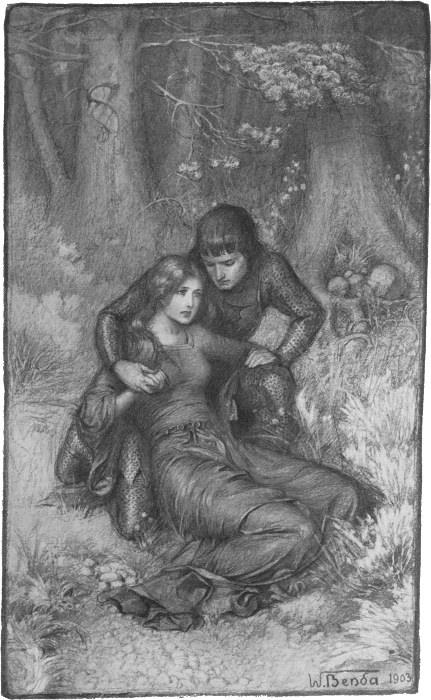
“SHALL I NOT BE YOUR WIFE”
Again he bowed himself and watched the woman as she slept. A strange calm fell for a season upon his face; his eyes never wavered from the white arm and the glimmering hair. Vast awe possessed him. He was like a child who broods tearless and amazed over the calm face of a dead mother.
Hours passed, and the man found no sustenance save in prayer. The unuttered yearnings of a world seemed molten in his soul. The moon waned; the stars grew dim. Sounds oracular were moving in the forest, the mysterious breathing of a thousand trees. Life ebbed and flowed with the sigh of a moon-stupored sea. Visions blazed in the night sky. The portals of heaven were open; the sound of harping fell like silver rain out of the clouds; the faces of saints shone radiant through purple gloom.
Hours passed, and neither sleeper nor watcher stirred. The night grew faint, the water flickered in the mere. The very stars seemed to gaze upon the destinies of two wearied souls. Death hid his countenance. Christ walked the earth.
A sudden sound of light, and the stirring of a wind. Far and faint came the quaver of a bird’s note. Grey and mysterious stood the forest’s spires. Light! Spears of amber darting in the east. A shudder seemed to shake the universe. The vault kindled. The sky grew great with gold.
It was the dawn.
Even as the light increased the man knelt and lifted up his face unto the heavens. Hope, glorious, seemed to fall sudden out of the east, a radiant faith begotten of spirit power. Banners of gold were streaming in the sky. The gloom elapsed. A vast expectancy hung solemn upon the red lips of the day.
Igraine sighed in her sleep. Her mouth quivered, her hair stirred sudden in the heather, tendrils of gold that shivered in the sun. Uther, kneeling, lifted up his hands with one long look to heaven. Prayer burnt upon his face. He strove, Jacob-like, with God.
A second sigh, and the long lashes quivered. The lips moved, the eyes opened.
“Igraine! Igraine!”
Sudden silence followed, a vast hush as of hope. The woman’s eyes were searching silently the man’s face. He bent and cowered over her like one who weeps. His hands touched her body, yet she did not stir.
“Igraine! Igraine!”
It was a hoarse, passionate cry that broke the golden stupor of the dawn. Sudden light leapt lustrous in the woman’s eyes; her face shone radiant amid her hair.
“Pelleas!”
The man’s arms circled her. She half crouched in his bosom, her face peering into his.
“Pelleas!”
“At last!”
A great shudder passed through her; her eyes grew big with fear.
“Speak!”
“Igraine.”
“Gorlois?”
“Gorlois is dead.”
Great silence held for a moment. The woman’s head sank down upon the man’s shoulder; madness had passed; her eyes were fixed on his with a wonderful earnestness, a splendid calm.
“Is this a dream?”
“It is the truth.”
Presently she gave a great sigh, and looked strangely at the sun. Her voice came soft as music over water.
“I have dreamed a dream,” she said, "and all was dark and fearful. Death seemed near, and shadows, and things from hell. I knew not what I did, nor where I wandered, nor what strange stupor held my soul. All was dark about me, horrible midnight peopled with foul forms. It has passed; now, I behold the dawn."
The man lifted up his voice and wept.
“My God! my God! out of hell hast thou brought my soul. Never again shall my vile lips blaspheme.”
And Igraine comforted him.
“Shall I not be your wife?” she said.
THE END