BOOK III (continued 3)
Reading edition
“Garlotte!”
“Yes, Igraine.”
“Imagine that you were married to a man you hated, and you loved Renan.”
Garlotte raised herself in bed.
“And Renan loved you and knew nothing?”
“Yes.”
“Would you tell Renan the truth?”
Garlotte remained motionless, propped on her two hands, and looking out of the window into the streaming moonlight. Her brown hair touched Igraine’s face as she lay still and watched her. The room was very silent, not a breeze seemed stirring, the roses athwart the window were still as though carved in wood.
Garlotte spoke very softly, looking up with her face white and solemn in the moonlight.
“I should tell Renan,” she said.
“Why?”
“Because I love him.”
“Yes—go on.”
“I should not love him rightly in God’s eyes if I kept him from the truth.”
The coverlet rose and fell over Igraine’s bosom, and there was a queer twisting pain at her heart.
“But if you were never to see Renan again?” she said.
“If I told him the truth?”
“Yes, child.”
Garlotte dared not look into Igraine’s face; her lips were twitching, and her eyes were hot with tears.
“I do not know,” she faltered.
“Think, child, think!”
“I should not tell him.”
In half a breath she had contradicted herself with a little gasp.
“Yes, yes, I should tell him.”
“The truth?”
“Because I should not be happy even with him if I were acting a lie.”
Igraine gave a dry sob, and drew Garlotte down again to her side. They lay very close, almost mouth to mouth, their arms about each other’s bodies.
“I love Pelleas.”
“Yes, yes.”
“I will tell him the truth.”
“Ah, Igraine, it is best, it is best.”
“But it will kill me if I lose him.”
“Ah, Igraine, but he will love you all the more.”
It was Garlotte who broke into tears, and hid her face in the other’s bosom. Igraine’s eyes were as dry as a blue sky parched with a summer sun, and her voice failed her like the slack string of a lute. The moonlight slanted down upon them both. Before dawn they had fallen asleep in each other’s arms.
How many a heart trembles with the return of day; what fears rise with the first blush of light in an empty sky! The cloak of night is lifted from weary faces; the quiet balm of darkness is withdrawn from the moiling care of many a heart. To Igraine the dawn light came like a message of misery as she lay beside the sleeping Garlotte, and watched the gloom grow less and less in the little room. This dawn seemed a veritable symbol of the truth that she feared to look upon—and recognise. The night seemed kinder, less implacable, less grave of face. Day, like a pale justiciary, stalked up out of the east to call her to that assize where truth and the soul meet under the eye of heaven.
How different was it with Pelleas under the eaves of the great cedar. He had slept little that night for mere wakeful happiness; the moon had kept carnival for him above the world; at dawn the stars had crept back from the choir stalls into the chambers of the night. He had known no weariness, no abatement of his deep calm joy. His heart had answered blithely to the dawn-song of the birds as though he had risen fresh from a dreamless sleep. The day to him had no look of evil; the sky was never grey; the flush in the east recalled no flashing of torches over a funeral bier. He rose up in the glory of his clean manhood, the strong kindliness of his great love. His prayers went to heaven that morning with the lark, and the Spirit of God seemed like a wind moving softly in the green boughs above his head.
Very early before it was light he had taken a plunge and a swim in the pool, a swinging burst through the still water that had made him revel in his great strength. He had come up from the pool like a god refreshed, and had put on his red harness while the mists rose from the valley, and the birds chanted in the ghostly trees. When the day was fully awake he walked the grass-path in the garden like a watchman, with the scent of honeysuckle and thyme in his nostrils, and a blaze of flowers at his feet. As he paced up and down with his face turned to the sky, he sang in a mellow bass a song of Guyon’s, the Court minstrel—
“When the dawn has come, My heart sighs for thee and the gleam of thy hair; Eyes deep as the night When the summer sky arches the world.”
So sang Pelleas as he paced the grass with his eyes wandering ever towards the doorway of the cottage.
Presently Igraine came out to him, and stood under the shadow of the porch. Her hair hung lustrous about a face that was white and drawn, despite a smile. Certainly a haze of red flushed her cheeks when Pelleas came up with a glory of love in his eyes, took her hands and kissed them, as though there was no such divine flesh in the whole wide world. How wonderful it was to be touched so, to have such eyes pouring out so strong a soul before her face, to know the presence of a great love, and to feel the echoing passion of it in her own heart!
After the barren months of winter, and the long bondage in Tintagel, it seemed ah idyllic thing to be so served, so comforted. And was this faery time but for an hour, a day, and no longer? Was she but to see the man’s face, to feel the touch of his hands, the grand calm of his love, before losing him, perhaps for life? Her heart fluttered in her like a smitten bird. And Pelleas, too, what a thrust lurked for the man, a blow to be given in the name of truth. How could she speak to him of Gorlois when he came and looked at her with those eyes of his?
Igraine had never felt such misery as this even in the gloomy galleries of Tintagel. It tried her courage to the death to face Pelleas’s wistful gaiety, and the adoration that beamed on her from his eyes.
“Dear heart, it is dawn—it is dawn!”
Pelleas held her hands, and waited for her lips to be turned to his. Instead, he saw lowered lids and quivering lashes, lips that were plaintive, a face white beneath a wealth of hair.
“Ah, Igraine, you do not look at me.”
Her eyes trembled up to his with a sudden infinite lustre.
“Pelleas!”
“Girl, girl!”
“Ah, I have hardly slept.”
“Nor I, Igraine.”
“I think I am worn out with thinking of you.”
“Ha, little woman, you are extravagant; you will die like a flower even while I hold you in my bosom.”
Garlotte came out from the cottage, and was kissed by Pelleas on the lips. The girl’s eyes were red and heavy; she had been crying but a moment ago in the shadow of the cottage room, and she was timid and very solemn. Pelleas looked at her like a big brother.
“Come now, little sister,” he said, with a rare smile; “methinks you must be in love too by your looks.”
“Yes, lord.”
“Said I not so? You women take things so to heart.”
“Yes, lord.”
“What a solemn face, little sister!”
Garlotte mastered herself for a moment, then burst into tears and ran back into the cottage. Pelleas coloured, looked troubled, glanced at Igraine, thinking he had hurt the girl’s heart with his words. Igraine’s face startled him as if the visage of death had risen up suddenly amid the flowers. He stood mute before her watching her starved lips, her drawn face, her eyes that stared beyond him with a kind of cold frenzy.
“Pelleas, Pelleas!”
It was like the wild cry of a woman over her dead love. The sound struck Pelleas with a vague sense of stupendous woe, a dim prophecy of evil like the noise of autumn in the woods. Before he could gather words, Igraine had turned and run from him as in great fear, skirting the pool and holding for the black yawn of the forest aisles. Pelleas started to follow her in a daze of wonder. Was the girl mad? Had love turned her brain? What was there hid in her heart that made her wing from him like a dove from a hawk?
By the trees Igraine slackened and turned breathless on the man as he came towards her through the long grass. Her eyes were dim and frightened, her lips twitching, and there was a bleak hunted look upon her face that made her seem white and old. Pelleas’s blood ran cold in him like water; a vague dread sapped his manhood; he stared at Igraine and was speechless.
The girl put her arm before her eyes and shook as she stood. Pelleas fell on his knees with a cry, and reached for her hand.
“Igraine, Igraine!”
She snatched her arm away and would not look at him.
“My God, what is this, Igraine?”
“Don’t touch me; I am Gorlois’s wife!”
A vast silence seemed to fall sudden on the world. It might have been dead of night in winter, with deep snow upon the ground and no wind stirring in the forest. To Igraine, swaying in an agony with her arm over her face, the silence came like the hush that might fall on heaven before the damning of a lost soul to hell. She wondered what was in Pelleas’s heart, and dared not look at him or meet his eyes. God in heaven! would the man never speak; would the silence crawl on into an eternity!
At last she did look, and nearly fell at the wrench of it. Pelleas was standing near her looking at her with his great solemn eyes as though she had given him his death. His face seemed to have gone grey and haggard in a moment.
“Gorlois’s wife!” was all he said.
Igraine hung her head, shivered, and said nothing. Pelleas never stirred; he seemed like so much stone, a mere pillar of granite misery. Igraine could have writhed at his feet and caught him by the knees only to melt for a moment that white calm on his face that looked like the mask of death.
A voice that was almost strange to her startled her out of her stupor of despair.
“How long have you been wed, Igraine?”
“Nine months, Pelleas.”
The man seemed to be struggling with himself as though he strove after the truth, yet could not confront it for all his strength. When he spoke his voice was like the voice of a man winded by hard running. He appeared to urge himself forward, to goad his courage to a task that he dreaded. There was great anguish on his face as he looked into the girl’s eyes.
“I must speak what I know, Igraine.”
The words seemed slow with effort. Igraine watched him in silence, full of a vague dread.
“Gorlois has spoken to me of his wife.”
“Say on, Pelleas.”
Pelleas hesitated.
“The truth—tell me the truth.”
She was almost clamorous. Pelleas plunged on.
“Gorlois told me how his wife was faithless to him, how she had fled with Brastias, the knight who had ward over her at Caerleon. I never knew her name until this hour.”
The words might have fallen like the strokes of a lash. Igraine stood and stared at the man, her open mouth a black circle, her eyes expressionless for the moment, like the eyes of one smitten blind. The full meaning of the words numbed her and hindered her understanding. A babel of shame sounded in her ears. The sinister intent of the man’s accusation rose gradual before her reason like the distorted image of a dream. She felt cold to the core; a strange terror possessed her.
“Pelleas, what have you said to me?”
Her voice was a mere whisper. Pelleas hung his head and said never a word. His silence seemed to fling sudden fire into Igraine’s eyes, and her face flamed like a sunset. It might have been Gorlois who stood and challenged the honour of her soul.
“Man, tell me what is in your heart.”
Her voice was shrill—even imperious. Pelleas hung his head.
“Gorlois keeps poison for his wife,” were his words.
Igraine’s lips curled.
“A sword for Brastias.”
“Generous man.”
Pelleas was watching her as a prisoner watches a judge. He had a great yearning to believe. Fear, anguish, anger, were in Igraine’s heart, but she showed none of the three as she stood forward and looked into the man’s eyes with a steadfastness no honour could gainsay.
“Pelleas!” she said.
“Girl!”
“Look into my eyes.”
He did so without flinching. Igraine took his sword and gave it naked into his hand.
“Listen! Gorlois told you a lie.”
“Igraine!”
“Do you believe me, Pelleas? If not, strike with the sword, for I will live no longer.”
The man gave a sudden cry, like one who leaps over a precipice, threw the sword far away into the grass, and falling on his knees, buried his face in his hands.
XII
Igraine stood and watched Pelleas as he knelt in the grass at her feet with his face hidden from her by his hands. She saw the curve of his strong neck, the sweep of his great shoulders. She even counted the steel plates in his shoulder pieces, and marked the tinge of grey in his coronal of hair.
Calm had come upon her with the trust won by the confessional of the sword. She felt sure of the man in her heart, and eased of a double burden since she had told him the truth and brought him to a declaration of his faith. She knew well from instinct that her honour stood sure in Pelleas’s heart.
Going to him, she bent and touched his head with her hand.
“Pelleas,” she said very softly.
The man groaned and would not look at her.
“Mea culpa, mea culpa!” was his cry.
Igraine smiled like a young mother as she put his hands from his face with a gradual insistence. It was right that he should kneel to her, but it was also right that she should forgive and forget like a woman. Yet as she stood and held his hands in hers, Pelleas hung his head and would not so much as look into her face. He was convicted in his own heart, and contrite according to the deep measure of his manhood.
Igraine touched his hair softly with her fingers, and there was a great light in her eyes as she bent over him.
“Come, Pelleas, and sit by me under the trees, and I will tell you the whole tale.”
Never had she seemed so stately or so superb in Pelleas’s eyes as she stood before him that morning, strong and sorrowful with the burden of her past. He knelt and looked up at her, knowing himself pardoned, humbled to see love in the ascendent so soon upon her face as she looked down at him from her golden aureole of hair.
“I am forgiven?” he said.
“Ah, Pelleas!”
“You have shamed me; I am a broken man.”
He rose up half wearily and stood looking at her as though some mysterious influence had parted them suddenly asunder. So expressive were his eyes, that Igraine read a distant anguish in them on the instant, and fathomed his thoughts, to the troubling of her own heart.
“Look not so,” she said, “as though a gulf lay deep between us here.”
“How else should I look at you, Igraine, when you are wife to Gorlois?”
“Never in my soul.”
“How can that help us?”
Igraine winced at the words and took refuge in silence. She went and seated herself at the foot of a gnarled oak. Pelleas followed her and lay down more than a sword’s length away, leaving a stretch of green turf between, a thing insignificant in itself, yet full of meaning to the girl’s instinctive watchfulness. The man’s face too was turned from her towards the valley, and she could only see the curve of his cheek and chin as she began to speak to him of that which was in her heart.
“You know the man Gorlois?” she said.
Pelleas nodded.
“In Winchester Gorlois saw my face and straightway pestered me as he had been turned into my shadow. By chance he had rendered me service, and from the favour casually conferred plucked the right of thrusting his perpetual homage upon me. I trusted Gorlois little from the beginning, and trusted him less as the weeks went by. His eyes frightened me, and his mouth made my soul shiver; the more importunate he grew the more I began to fear him.”
Pelleas shifted his sword and said nothing.
“A day came when the man Gorlois grew tired of courtesies, and would be gainsaid no longer. It was in Radamanth’s garden; we quarrelled, and the man laid hands upon me and crushed me against the wall to thieve a kiss. In my anger I broke from him and ran into my uncle’s house. The same night I fled to an abbey, the abbey of St. Helena, and left Winchester in my dress at dawn.”
Igraine could see the muscles of Pelleas’s jaw standing out contracted as though his teeth were clenched in an access of anger. He was breathing deeply through his nostrils, and his hands plucked at the grass with a terse snapping sound. These things pleased Igraine, and she went on forthwith.
"I left Winchester on foot at dawn and travelled towards Sarum, for I heard that Uther the King was there, and it was greatly in my mind, sire, to see his face. An old merchant friend of Radamanth’s overtook me on the road; at a ford the horse he had lent me fell and twisted my ankle. I was carried to Eudol’s house, and lay abed there many days, learning little to my comfort that Gorlois had ridden out and was hunting me through the countryside. Recovered of my strain, and fearful of Gorlois’s trackers, I held on for Sarum through the woods, and lodged the same night in a hermitage in a little valley. Here the first piece of craft overtook me, for early in the morning outside the hermitage I saw a knight ride by on a black horse, bearing red harness, and armed at all points like to you."
Pelleas turned his head for the first time and looked at her as though with some sudden suspicion of what was to follow. Igraine saw something in his dark eyes that made her heart hurry. His face was like the face of a man who fronts a storm of wind and rain with brows furrowed and eyes half-closed. There was much that was threatening in his look, a subdued ominous wrath like a storm nursed in the bosom of a cloud.
Igraine told the whole quaint tale, how she followed Gorlois in faith, how she was led into the forest, bewitched there, and made a wife, mesmerised into a false affection for the man by Merlin’s craft. It was a grim tale, with a clear contour of truth, and credible by reason of its very strangeness. It was sufficient to manifest to Pelleas how Igraine’s strong love for him had lost her her liberty and made her the victim of a man’s lust.
When she had ended the tale Pelleas left the grass at her feet and began to pace under the trees like a sentinel on a wall. His scabbard clanged occasionally against his greaves. Masses of young bracken covered the ground between the trees with a rich carpet of green, and his armour shone like red wrath under the wreathing arcs of foliage. His face was dark and moody with the turmoil of thought, but there was no visible agitation upon him; nothing of the aspen, more of the unbending oak. Igraine leant against her tree and watched him with a curious care, wondering what would be the outcome of all this silence. Down in the valley the pool glistened, and she could see Garlotte walking in the cottage garden. How different was this child’s lot to hers. With what warm philosophy could she have changed Pelleas into a shepherd, and taken the part of Garlotte to herself.
Presently Pelleas stayed in his stride through the bracken, and came and stood before her, looking not into her face but beyond her into the deeps of the wood.
“Tell me more, Igraine.”
“What more would you hear from me?”
“That which is bitterest of all.”
“God, must I tell you that!”
“Let us both drink it to the dregs.”
Igraine’s face and neck coloured rich as one of Garlotte’s red roses, and she seemed to shrink from the man’s eyes behind the quivering sunlight of her hair. She put her hands to her breast and stood in a strain of thought, of struggle against the infinite unfitness of the past.
Pelleas saw her trouble, and his strong face softened on the instant. He had forgotten milder things in his grappling of the truth. Igraine’s red and troubled look revived the finer instincts of his manhood.
“Never trouble, child,” he said; “I know enough of Gorlois to read the rest.”
But Igraine, as by inspiration, had come by other reasons for telling out the whole to the last pang. She was at pains to justify herself to Pelleas, nor was she undesirous of inflaming him against Gorlois, her lord. She had wit enough to grasp the fact that Pelleas’s wrath might be roused into insurrection against custom and the edicts of the Church. A volcanic outburst might throw down the barriers of man and leave her at liberty to choose her lot. Moreover, her hate of Gorlois, an iconoclastic passion, had crushed the reverence of things existing out of her heart. A contemplation of her evil fortune had brought her to the conviction that she was exiled from the sympathies of men, a spiritual bandit driven to compass the instincts of a rebellious soul. In her hot impulse for liberty and the justification of her faith, she did not halt from making Pelleas feel the full malignity of truth. She neither embellished nor emphasised, but portrayed incidents simply in their glaring nakedness in a fashion that promised to inflame the man to the very top of her desire.
Igraine’s cheeks kindled, and she could not look at the man for the words upon her lips. Pelleas’s face was like the face of man in torture. The woman’s words entered into him like iron; his wrath whistled like a wind, and the very air seemed tainted in his mouth. What a purgatory of passion was let loose into the calm precincts of the place! This burning vault of blue, was it the same as roofed the world of yesterday? The feathery mounts of green dappled with amber, and these flowers, had they not changed with the noon lust of the sun? There was a rank savour of fleshliness over the whole earth, and all life seemed impious, passionate, and unclean.
“My God, my God!”
The man’s cry shook Igraine from her rage for truth. In her confessional she had been carried like a bird with the wind. Looking into Pelleas’s face she saw that he was in torment, and that her words had smitten him in a fashion other than she had foreseen. It was not wrath that burnt in his eyes, only a deep grieving, a frenzy of shame and anguish that seemed to cry out against her soul. A sudden stupor made her mute. With a great void in her heart she fell down amid the bracken with a sense of ignominy and abasement overwhelming her like a deluge.
Pelleas stood and shut his eyes to the sun. A red glare smote into his brain; love seemed numb in him and his blood stagnant. Prayer eluded him like a vapour. Looking out again over wood and valley, the golden haze, the torpor of the trees mocked him with a lethargy that smiled at the impotence of man.
And Igraine! He saw her prone beneath the green mist of the fern fronds, lying with her face pillowed on her arms, her hair spread like a golden net over the brown wreckage of the bygone year. To what a pass had their love come! Better, he thought, to have lived a king solitary on a throne than to have wandered into youth again to give and win such dolor.
His face was dark as he stood and looked at the woman’s violet surcoat gleaming low under the bracken. How symbolical this attitude seemed of all that had fallen upon his heart—love cast down upon dead leaves! Igraine had feared his honour. Pelleas feared for it in another sense as he looked at the woman, and felt his pity clamouring for life. He could have given his soul to comfort her if no shame could have come upon her name thereby. As it was, some spiritual hand seemed at his throat stifling aught of love that found impulse on his lips. A superhuman sincerity chilled him into silence, and held him in bondage to the truth.
A face stared up from the bracken, wan, tearless, and tragic. The wistfulness of the face made him quail within his harness. He knew too well what was in Igraine’s heart, and the look that questioned him like the look of a wounded hare. Her eyes searched his face as though to read her doom thereon. There was no whimpering, no noise, no passionate rhetoric. A great quiet seemed to take its temper from the silence of the woods.
“Pelleas.”
“Yes, Igraine.”
“Tell me what is in your heart.”
Pelleas hung his head; he could not look at her for all his courage. She was kneeling in the bracken with her hands crossed over her breast and her face turned to his with the white wistfulness of a full moon. Pelleas felt death in his heart, and he could not speak nor look into her eyes.
“Pelleas.”
“Child.”
“You do not look at me.”
“Great God, would I were blind!”
The truth came crying to her like the wild cry of a bird taken by a weasel in the woods. A great sobbing shook her; she fell down and caught Pelleas by the knees.
“Pelleas, Pelleas!”
“My God, Igraine, I stifle!”
“Don’t leave me, don’t send me away.”
“What can I say to you?”
“Only look into my eyes again.”
Pelleas put his fists before his face; the girl felt him quiver, and he seemed to twist in an agony like a man dangling on a rope. Igraine’s hands crept to his shoulders; she drew herself by his body as by a pillar till her face met his and she lay heavy upon his breast.
“Pelleas!”
Her breath was on his lips, and her hair flooded over his hands like golden wine.
“Pelleas, Pelleas!”
The words came with a windless whisper.
“Have pity, Igraine.”
“I will never leave you.”
“Gorlois’s wife!”
“Never, never!”
“My God!”
“I am not his. Pelleas, take me body and soul; take me and let me be your wife.”
“How can I sin against your soul, Igraine?”
“Is it sin, then, to love me?”
“You are Gorlois’s wife before God.”
“There is no God.”
“Igraine!”
“I will have no God but you, Pelleas.”
The man took his hands from his face and looked into Igraine’s eyes. A strong shudder passed over him, and he seemed like a great ship smitten by a wave, till every fibre groaned and quivered in his massive frame.
A green calm covered the valley, and the whole world seemed to faint in the golden bosom of the day. Not the twitter of a bird broke the vast hush of the forest. The sunlit aisles climbed into a shadowland of mysterious silence, and an azure quiet hung above the trees. As for Pelleas and Igraine, their two lives seemed knotted up with a cord of gold. They had mingled breath, and taken the savour of each other’s souls. Yet for all the glory of the moment it was but autumn with them—a pomp of passion, a red splendour dying while it blazed into the grey ruin of a winter day.
Igraine read her doom in the man’s face. It was the face of a martyr, pale, resolute, yet inspired. A dry sob died in her throat, and her hands dropped from the man’s shoulders. Pelleas stood back and looked at her with a warm light in his dark eyes, the green woods rising behind him like a bank of clouds.
“Igraine.”
She nodded, felt miserable, and said nothing.
“I cannot love you easily.”
Igraine’s eyes stared at him with a mute bitterness. She was a woman, and thought like a woman; mere saintly philosophy was beyond her.
“You are too good a man, Pelleas,” she said.
“I would hold my love in my heart like a great pearl in a casket of gold.”
“What comfort is there in mere splendid misery, and in such words?”
“How should I love you best?”
“Ah, Pelleas, ask your own heart.”
The man was an impossible being for mere mortal argument. He seemed to bear spiritual pinions that tantalised the intelligence of the heart. Igraine felt herself adrift and beaten, and she was hopeless of him to the core.
“Think you I shall be a saint, Pelleas,” she said, “when you have given me back to myself?”
“I shall pray for you.”
“And for a devil!”
She gave a shrill laugh, and twined her hair about her wrist.
“Ah, Pelleas! you know not what you do.”
“Too well, Igraine.”
“You are too strong for me, and yet—and yet—I should not have loved you so well if you had not been strong.”
“That is how I think of you, Igraine.”
“You love me more by leaving me.”
“I love you more by keeping you pure before my soul.”
A great calm had come upon Igraine. She was very pale and firm about the lips, and her eyes were staunch as steel. Her voice was as clear and level as though she spoke of trivial things.
“I shall not go back to Gorlois,” she said.
“Beware of the man.”
“Doubtless you would speak to me of a convent.”
Pelleas fell into thought, with his dark eyes fixed upon her face.
“As a novice.”
Igraine almost smiled at him.
“And not a nun?”
For answer he spoke three simple words.
“Gorlois might die.”
The stillness of the woods seemed like the hush of a listening multitude. A blue haze of heat hung over the rolling domes of the western trees, and never a wind-wave stirred the long grass. Mountainous clouds sailed radiant over ridge and spur, and it might have been Elysium where souls wandered through meads of asphodel.
Igraine looked long over the valley with its stately trees, its flowering grass and quiet pool in the meadows. She was vastly calm, though her eyes were full of a woe that seemed to well up like water out of her soul. She still twisted and untwisted a strand of her hair about her wrist, but for all else she was as quiet as one of the trees that stood near and overshadowed her.
“Pelleas,” she said.
The man came two steps nearer.
“Go quickly.”
“Igraine!”
“Man, man, how long will you torture me? I am only a little strong.”
The calm of tragedy seemed to dissolve away on the instant. Pelleas thrust his hands into the air like a swimmer sinking to his death. His heart answered Igraine’s exceeding bitter cry.
“Would we had never come to this!”
“I cannot say that, though my heart breaks.”
Pelleas fell down and clasped her with his arms about the knees. His face was hidden in the folds of her surcoat. Presently he loosed his hold, looked up, took a ring from his hand and thrust it into her palm.
“The signet of a king,” he said; “keep it for need, Igraine. Have you money?”
“I have money, Pelleas.”
“God guard you!”
Igraine was white to the lips, but she never wavered.
“Heaven keep you!” she said.
Her voice was hoarse in her throat, and she began to shiver as though chilled by a sleety wind.
“Go quickly, Pelleas; for God’s sake hide your face from me!”
“It is death; it is death!”
He sprang up and left her without a look. Igraine saw him go through the long grass with his hand over his eyes, staggering like one sword-smitten to the brain. He never stared back at her, but held straight for the cottage and the cedar tree where his black horse was tethered under the shade. She watched him mount and gallop for the forest, nor did she move till his red harness had died into the gloom of the trees.
XIII
Down through the woods that morning rode Gorlois on his great white horse, with helmet clanging at saddle-bow, shield hung at his left shoulder, spear trailing under the trees. He was hot, thirsty, and in a most evil temper. His bronzed face glistened with sweat, and the chequered webs of light flickering through the leaves flashed fitfully upon his golden harness. Since dawn he had ridden the hills in the glare of the sun till his armour blazed like an oven; it was June weather, and hot at that; his tongue felt like wood rubbing against leather; it was a damnable month for bearing harness.
Casting about over the hills he had come upon Garlotte’s valley, and seeing it green and shadowy, had plunged down to profit by the shade. Since the Red Knight was lost to him, it was immaterial whether he rode by wood or hill. On this account, too, Gorlois’s temper was as hot as his skin. He hated a baulking above all things; he was moved to be furious with trifles, and like the savage who gnashes at the stone that bruises his foot, he cursed creation and felt thoroughly at war with the world. A grim unreason had possession of him, such a mood as makes murder a mere impulse of the hand, and malice the prime instinct of the heart.
As he rode with loose rein the trees thinned suddenly, and the forest gloom rolled back over his head. Gorlois halted mechanically under the wooelshawe, and scanned the valley spread before him under the brown hollow of his hand. He had expected no such open land in this waste of wood—open land with water, a cottage, sheep feeding, and horses tethered under the trees. One of the horses tethered there was a black. The coincidence livened Gorlois’s torpid, sunburnt face with a cool gleam of intelligence. He sat motionless in the saddle and took the length and breadth of the valley under the keen ken of his black eyes.
The man swore a little oath into his peaked black beard. His face grew suddenly rapacious as he stared out under the hollow of his hand. He had seen a streak of red strike through the green wall far up the eastern slope that fronted him, a scrap of colour metallic with the hint of armour. It went to and fro under the distant trees like a torch past the windows of a church. Gorlois’s hand tightened on the bridle. He watched the thing as a hawk watches a young rabbit in the grass.
Betimes he gave a queer little chuckle, and turned his horse into the deeper shade of the trees. He began to make a circuit round the valley, holding northwards to compass the meadows. He cast long, wary glances into the wood as he went; tried his sword to see that it was loose in the scabbard; took his helmet from the saddle-bow, and let down the cheek-pieces from the crown. Before long he kicked his stirrups away, rolled out of the saddle, and tied his horse to an oak sapling in a little dell. Going silently on foot over the mossy grass, stopping often to stare into the sunny vistas of the forest, moving more or less from tree to tree, he worked his way southwards along the eastern slope. Streaks of meadowland and the glint of water showed below him, and he heard the bleat of sheep far away, and the tinkling of a bell.
Presently the murmur of voices came to him through the woods. He ventured on another fifty paces, then stopped behind a tree to listen. There were two voices, he was sure of that: one was a woman’s, and the other had the sonorous vibration of a man’s bass. Gorlois’s eyes took a queer, far-away look, and his strong teeth showed between his lips.
He worked his way on through the trees with the cautious and deliberate instinct of a hunter. The two voices gained in timbre, character, and expression. Their talk was no jays’ chatter; Gorlois could tell that from the emphasis of sound, and a certain dramatic melody that ran through the whole. Soon the voices were very near. Going on his belly, with his sword held in his left hand, he crawled like a gilt dragon through a forest of springing fern. He crawled on till he was quite near the two who stood and talked under the trees. Lying flat, never venturing to lift his head, he crouched, breathing hard through his nostrils and holding his scabbarded sword crosswise beneath his chin.
Gorlois’s face, scarred and drawn as it was, seemed as he listened a clear mirror for the portrayal of human passion. His black moustachios twitched above his angular jaw; his eyes took a rapacious and glazed look, and a shadow seemed to cover his face. He turned and twisted as he lay, and dug the points of his iron-shod shoes into the soft ground as though in the crisis of some pain. It was the woman’s voice that did all this for him. Every word seemed like the wrench of a hook in his flesh, as he cursed and twisted under the bracken.
Presently he lay still again, as though to listen the better. He could hear something of what was said to the man in the red harness, but the main drift of their talk was beyond him. Pelleas! Pelleas! He squirmed like a crushed snake at each sounding of the name. The bracken hardly swayed as he crawled on some twenty paces and again lay still, with his cheek resting upon the scabbard of his sword.
“Gorlois might die.”
Gorlois heard the words as plainly as though they had been spoken into his ear. A vast silence hung like thunder over the forest. Gorlois lay as though stunned with a stone, his dry mouth pressed to the cold steel of the sword. His eyes took a stubborn stare under the sweep of his casque. With gradual labour he raised himself upon his elbows, drew his knees up under his body, and lifted his head slowly above the sweep of green.
The ground fell away slightly from where Gorlois knelt in the bracken, and he could look down on the two who stood under the trees, while the fern fronds hid his harness. He saw a woman in violet and gold, her hair falling straight on either side of her face, and her arms folded crosswise over her breast. He saw also the knight in red harness, with his locked hands twisting above his head as in an agony, while his face was hidden by his arm. A passionate whisper of words passed between the two. Even when Gorlois watched, the man in the red harness jerked round and fell on his knees at the woman’s feet. Gorlois suddenly saw his face; it was the face of Uther the King.
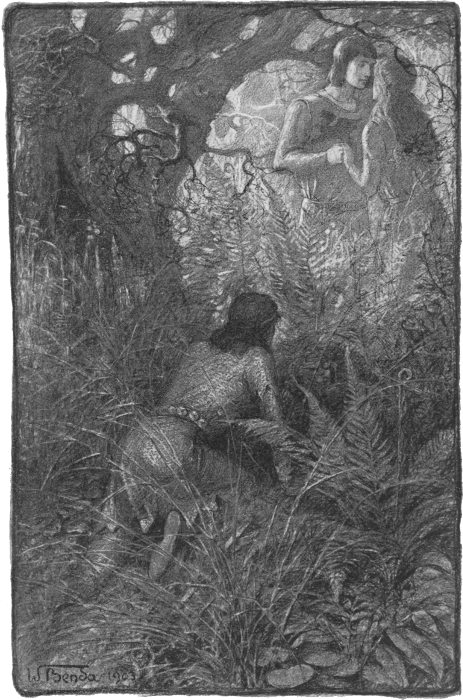
“LIFTED HIS HEAD SLOWLY ABOVE THE SWEEP OF GREEN”
Gorlois dropped back under the bracken as though smitten through with a sword. He lay there a long while with his head upon his arms. A sudden breeze came up the valley, sounding through the trees, swaying the green fronds above the man’s harness, calling a gradual clamour from the woods. The overmastering image of the King seemed to frown down Gorlois for the moment, and he crouched like a dog—with the courage crushed out of his soul.
Betimes Gorlois’s reason revived from the stroke that had stunned it for a season. Like Jonah’s gourd a quick purpose sprang up and shadowed him from the too hasty heat of his own passions. He was a virile man, capable of great wrath and great resentment. Yet he was no mere firebrand. His malice, strangely enough, was one-handed and reached out only against the woman. For Uther he conceived a superhuman envy, a passion that rose above mere bloody expiation by the sword. Gorlois had the wit to remember the finer cruelties of a spiritual vengeance, the gain of wounding the soul rather than the flesh. His malice was a thing fanatical in itself, yet taken from the forge to be cooled and tempered like steel.
When he lifted his head again above the bracken, Uther had gone, and Igraine stood alone under the trees. She stood straight and motionless as some tall flower, her hair falling like quiet sunlight, unshaken by a wind. Her great beauty leapt out into Gorlois’s blood and maddened him. As she looked out over the valley, Gorlois, straining his neck above the bracken, could see that she watched Uther as he went down from her towards the pool. Even to Gorlois there was something tragic about the solitary figure under the trees, a stiff, grievous look as though woe had transformed her into a pillar of stone. To him the affair seemed a mere assignation, a hazardous passage of romance. Measuring the souls of others by his own morality, he guessed nothing of the deeper throes that surged through the tale like the long moan of a night wind.
Gorlois saw Uther and his black horse disappear into the opposing bank of woodland. Viciously satisfied, he lay in the bracken and watched Igraine, coming by a queer pleasure in considering her beauty, and in the knowledge that her very life was poised on the point of his sword. How little she thought of the man-dragon lying in his gilded scales under the green of the feathery fronds. Gorlois felt a kind of arrogance of ownership boasting itself in his heart. Certainly he held a means more sinister than the sword wherewith to perfect his vengeance and to preserve his honour. A very purgatory, bolgia upon bolgia, stretched out in prospect for the souls of the two who had done him this great evil. Gorlois made much of it, with a joy that was hard and durable as iron.
Igraine stirred at last from her stupor of immobility. Walking unsteadily, as though faint in the heat, she passed out from the trees with their mingling of sun and shadow, and went down through the long grass towards the pool and the cottage. Gorlois knelt in the bracken, and watched her with a smile. There was little chance of her escaping, and he could be as deliberate as he pleased over the matter. He inferred with reason that the cottage served her as a lodging in this woodland solitude, where she lay hid from all the world save from Uther, whose courtezan she was. Gorlois laughed—a keen, biting laugh—at the thought of it all. At least he would go back for his horse and spear, and make a fitting entry before the woman who was his wife.
Igraine, walking as though in her sleep, came into the cottage, and almost fell into Garlotte’s arms. The girl looked frightened, and very white about the lips. She could find nothing in her heart to say to Igraine; she helped her to the bed, and ran to the cupboard to get wine.
“Drink it,” she said, the cup rocking to and fro in her hand.
Igraine did her best, but spilt much of the stuff upon her bosom, where it made a stain like blood. She sat on the edge of the bed, and looked into the distance with expressionless eyes. Her hands were very cold. Garlotte chafed them between her own, murmured a word or two, but could not bring herself to look into Igraine’s face. From the valley the bleating of sheep came up with a sudden wind, and the red roses flung their faces across the latticed casement.
Igraine was looking through the window into the deep green of the woods. She could see the place where Pelleas had left her, even the tree under which she had stood when she had pleaded with him without avail. How utterly quiet everything seemed. Surely June was an evil month for her; had it not brought double misery—and well-nigh broken her heart? And the end of it all was that she was to go back to a convent, to grey walls, vigils, and the sounding of a bell. Even that was better than being Gorlois’s wife.
Suddenly, as she sat and stared out of the casement, her body grew tense and eager as a bent bow. Her eyes hardened, lost their dreamy look; the hands that had rested in Garlotte’s gripped the girl’s wrists with a force that made her wince.
“Saddle the horse.”
The words came in a hard whisper. Garlotte stared at her, and did not stir.
“Child, never question me; be quick, on your life.”
Igraine, a different woman in a moment, had started up and taken her shield and helmet from the wall. Her sword was girded to her. Quick as thought, she gathered up her trailing hair, thrust on the casque, strapped it to the neck-plate under her surcoat. Garlotte, vastly puzzled, but inspired by Igraine’s earnestness, had hurried out with saddle and bridle over her shoulder. As she ran through the garden, she looked up to the woods and saw the reason of Igraine’s flurry. A knight had come out from the forest on a white horse, his armour flashing and blazing in the noonday sun. He had halted motionless at the edge of the woodland, as though to mark what was passing beneath him in the valley.
Garlotte found Igraine armed beside her, as she stood by the grey horse under the cedar, and tugged with trembling fingers at the saddle straps. Bit and bridle were quickly in place. Igraine, moved by a hurried tenderness, gripped Garlotte to her with both arms.
“God guard you, little sister.”
“Where are you going, Igraine?”
“God knows!”
“Who is yonder knight?”
“Gorlois, my husband.”
Igraine climbed into the saddle from the girl’s knee. She dashed in the spurs and went at a gallop over the meadows towards the south. Gorlois’s white horse was coming at full stride through the feathery grass. The man was riding crosswise over the valley, bent on cutting off Igraine from the southern stretch of meadows, and driving her back upon the woods. It was Igraine’s hope to overtake Pelleas, and to put herself behind the barrier of his shield. Gorlois, guessing her desire, drove home the spurs, and hunted her in earnest.
Igraine headed the man and won a lead in the first half mile. Her grey horse plunged like a galley in a rough sea, and she held to the pommel of her saddle to keep her seat. Gorlois thundered at full gallop in her wake, the long grass flying before his horse’s hoofs like foam. He had thrown away his spear, and his eyes were set in a long stare on the galloping horse ahead. The zest of the chase had hold of him, and he used the spurs with heavy heel.
The green woods rolled down on them as the valley narrowed to its southern end. Igraine had never wandered so far from Garlotte’s cottage, and the ground was strange to her, nor did she know how the country promised. Riding at full gallop, she saw with a shudder of fear a barrier of rock running serrate across her path and closing the narrow valley like a wall. Gorlois saw it too, and sent up a shout that made Igraine’s hate flame up into a kind of rapture. To have turned right or left up the steep grass slope towards the woods, would have given back to Gorlois the little start she had of him. With a numb chill at her heart she abandoned all hope of Pelleas, and turned to face the inevitable, and Gorlois her lord.
The man came up like a wind through the grass, and drew rein roughly some ten paces away. He laughed as he stared at Igraine, an uncouth, angering laugh like the yapping of a dog. He looked big and burly in the saddle, and the muscles stood out in his neck as he tilted his square jaw and stared down at his wife. Igraine had not looked upon his face since he had been smitten in battle. Its ugliness seemed to match his soul.
Gorlois lifted up his voice and mocked her.
“Ha, my brave, you are trapped, are you? Mother of God, but you make a good figure of a man. These many months I have missed you, wife in arms. And you have served in the pay of my lord the King. Good service and good pay, I warrant, and plenty of plunder. I will have that harness of yours hung over my bed.”
Igraine suffered him not so much as a word. She was furious, and in no mood to be scoffed down and cowed by mere insolent strength. She looked into Gorlois’s libidinous face from behind the vizor of her helmet, and thought her thoughts. Gorlois ran on in his mocking fashion. His bronzed face gleamed with sweat, and a rough lascivious smile showed up his strong white teeth to her.
“Ha, now, madame! deliver, and let us have sight of you. The King loves your lips, eh! They are red, and your arms are soft. I warrant he found your bosom a good pillow. Uther was ever such a solemn soul, such a monk, such a father. It is good for the heart to hear of him knotted up in a woman’s hair.”
Igraine shook with the immensity of her hate.
“You were ever a foul-tongued hound,” she said.
“Am I your echo?”
“I wish you were dead.”
“So said the King.”
“So you spied on us?”
Gorlois set up a scoffing laugh, showing his red throat like a hungry bird.
“And saw my wife the King’s courtezan; ha, what a jest! Come, madame, let us be going; your honest home waits for you. I will chatter to you of moralities by the way.”
He had hardly delivered himself of the saying, when Igraine’s hand clutched at the handle of her sword. She jerked the spurs in with her heels. Her grey horse started forward like a bolt; blundered into Gorlois; caught him cross-counter, and rolled his white stallion down into the grass. Igraine had lashed out at the shock. Her sword caught Gorlois’s arm, and cut through sleeve and arm-guard to the bone. As he rolled with his horse in the grass, she wheeled round, and clapping in the spurs, rode hard uphill for the forest.
Gorlois, hot as a furnace, scrambled to his feet, and dragged his horse up by the bridle. Half off the saddle, with empty stirrups dangling, he went at a canter for the yawn of the wood. His slashed arm burnt as though it had been touched with a branding-iron; blood dripped down upon his horse’s white shoulder. He was soon steady in the saddle and galloping full pelt after Igraine, the ground slipping under his horse’s hoofs like water, the long grass flying like spray.
Igraine’s horse lost ground up the slope; he had less heart than Gorlois’s beast, and was weaker in the haunches. By the time they reached the trees, Igraine had twenty yards to her credit and no more. She saw her chance gone, and heard Gorlois close in her wake, caught sideways a glimpse of plunging hoofs and angry harness. Drawing aside suddenly with all her strength, she let Gorlois sweep up on her flank and pass her by some yards. Before he could turn, she rode into him as fast as she could gather; her sword clattered on his helmet,—sparks flew.
Gorlois wrenched round and put his shield above his head.
“By God,—hold off,—would you have me fight a woman?”
A swinging cut rattled on his shoulder-plate for answer.
Gorlois rapped out an oath and drew his sword.
“Hold off!”
His roar seemed to shake the trees. To Igraine it was the mere meaningless threatening of a sea. She struck home again and again while Gorlois foined with her; more than once she reached his flesh.
Gorlois’s grim patience gave way at last; a clean cut drew spurting blood from his shoulder.
“God curse you!—take it then.”
He swung his sword with a great downward sweep, a streak of steel that struck crackling fire from the burnished casque. Igraine’s arm dropped like a broken bough; for half a breath she sat straight in the saddle, swayed, sank slantwise, and slid down into the long grass. Her horse stood still at her side, looking at her with mild blue eyes.
Gorlois gave a queer short laugh. He looked frightened for the moment; the flush of anger had passed and left him pale. He dismounted, bent over Igraine, unstrapped her helmet. She was only dazed by the blow; blood trickled red amid her hair, and her blue eyes stared him in the face.
She lifted up a hand with a bitter cry of defiance.
“Strike, strike, and make an end.”
Gorlois’s grimness came back, and his eyes hardened.
“That were too good for you.”
“Devil!”
“By God, I shall tame you—never fear!”