BOOK II (continued 2)
Reading edition
“A word with you,” he said.
The speech was rough and pertinent, showing the trend of the man’s purpose. He had abandoned superficialities. Igraine, gathering up her silks, turned and faced him with the frankness of a full moon. Gorlois saw her lips tighten, and there was a temper swimming in her eyes that promised abundant spirit and no shirking. If he had launched out to rouse her from passive antagonism, he could not have chosen a better method.
Igraine made a step towards the house, but two strides put Gorlois in her path.
“Make way—”
“Not a foot till you have the truth out of me.”
“Have a care,—I will be stormed at by no man.”
“Woman, look at me.”
Igraine was looking at him with all the temper she could summon. If Gorlois thought to ride straight over her courage, he was enormously mistaken. She would match him for all his hectoring.
“If you are not a fool,” she said, “you will end this nonsense, and go.”
“Am I a scullion?”
“You should know, my lord.”
“I have not bled for nothing.”
“As you will.”
“What have you to say to me?”
Igraine lost all patience, tossed her embroidery aside, and simply flashed out at him with all her soul.
“Say!” she said; “I have somewhat to say, and that bitter; listen if you will. You, Gorlois of Cornwall, who bade you make my name a byword in Winchester? Listen to me,—hear the truth, and profit—you who pestered me with mad tricks till I hated it all and held it insolence. Who asked you to make me gossip for a city, did I? Who took your presents? Who told you the truth? Who threw your token under the hoofs of your horse to shame you? I have mocked you enough, now leave me in peace, or rue it.”
“By God, madame—”
“Don’t echo me. Go, get out of my sight; I hate you!”
Gorlois flushed to the temples in this wind of passion. The girl looked splendid to him in her great anger, her head thrown back and her eyes steady on him as stars. The scorn of her beauty leapt over him like crimson light, and he was more a sensation than a man. He had a great thirst in him to grip her with his hands, to bend her straight body as he would bend a bow, to strangle up the scorn in her throat with his own breath. He went near her, stooping and staring in her face.
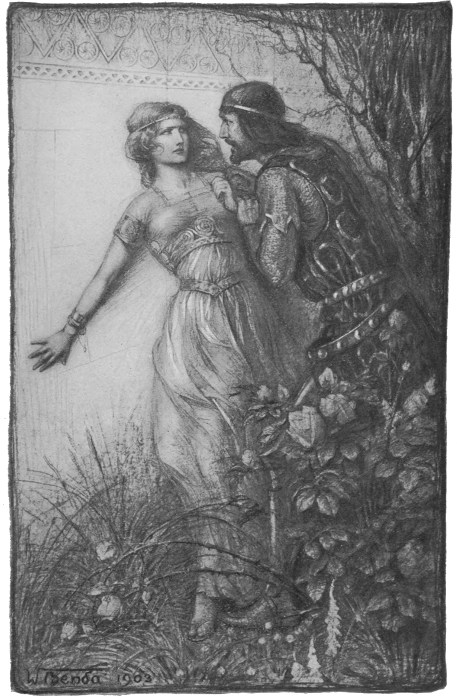
“A SUDDEN MADNESS WHIRLED GORLOIS AWAY”
“Igraine.”
“Mark my words.”
“You golden shrew, you temptation of tempers—”
“Hold off—”
“By God! I’ll tame you, don’t doubt me.”
Igraine, very watchful, slipped past him suddenly like light, and walked for the house with a sweeping air that bade him keep his distance. Coming to the door of the house, she tried it but found the lock shot. The red badge of a new anger showed upon either cheek. She turned on Gorlois; her eyes blazed out at him.
“A pretty trick!”
“What now, madame?”
“You had this door locked.”
“Never.”
“You lie in your throat.”
“Radamanth—”
“Open it.”
“I have no key.”
Igraine’s figure seemed to dilate and grow taller, and her eyes shone well-nigh as bright in colour as her hair.
“Obey me.”
“Not if I had the key.”
“Obey me.”
“I will be master before the sun is at noon.”
“You dog!”
A sudden madness whirled Gorlois away. He went red from the neck, clutched at Igraine’s wrist and held it. For a moment they stood rigid. The girl could not shake him off although he had but one hand to hold her. His breath was hot upon her face as he pressed her back against the wall, and held her there till his lips touched her neck. Igraine, breathing fast and straining from him with all her strength, set a hand on his face and thrust him away. She twisted her wrist free, and slipped from between him and the wall. Then the door opened, and Radamanth stood by them.
Igraine slipped away with a white face, and running above to her chamber threw herself down on the bed, and cried for Pelleas. She heard Gorlois stride through the house, heard the gate crash as he went out into the street. Shame and loneliness were on her like despair, and she was weak and shaken after her anger, and very hungry for love and comfort. The world seemed a dull blank about her, cold, irresponsive, and grey as a November evening. Every hand seemed against her. Even Radamanth, the man of serious years, had turned the key upon her, more kind to Gorlois than herself. Her thoughts were very bitter as she lay and brooded over it all.
Presently she heard some one coming up the stairs. Darting to the door, she bolted it, and went back to the bed, while a hand rapped out a somewhat diffident summons, and Radamanth’s voice came in to her.
“My dear niece,” it said.
Igraine made no answer.
“My dear niece, let me have a word with you.”
Still no answer. Radamanth tried the door and found it fastened.
“Gorlois is gone,” he said.
Igraine remained obdurate, with face drawn and sullen-eyed. She heard him shuffle down the stairs again, go into his parlour, and shut the door very gently, like a man who is ashamed. Then all was quiet save for casual footsteps in the street, and the garrulous chatter of a starling on the tiles.
Noon had come and gone a long while, and still Igraine lay in her room and moped. She felt sore and grieved to the heart, all her sanguine courage was at low ebb. Winchester seemed a prison-house where she was shut up with Gorlois. The man’s greed and power of soul seemed to stare upon her till white honour folded its hands over its breast and turned to flee. Oh for Pelleas and the brave look of those honest eyes, the staunch touch of those great hands. He seemed to stand up above the world, above the selfishness, the lust, the violence, like a pine on some lonely hill. She could trust, she could believe. To find him would give her peace.
As she lay there that noontide a new purpose came to her, and lighted up hope. It was frail and flickering enough, but still, it burned. She would leave Radamanth’s house and go afoot into the world to find a shadow. Anything was better than lying cooped in the place for dread of Gorlois. She had long contemplated such a measure, and that morning in Radamanth’s garden gave her decision and made her strong.
She rose up from the bed and hunted out her old Avangel habit from a cupboard in the wall. Then she set to to doff the rich stuffs Radamanth had given her, the embroidered tunic, the coloured leather shoes, the goodly enamelled girdle. In their stead she stood again in the old grey gown, hood, and sandals, with a little thrill of delicious recollection. It was like stepping back into the dream of an enchanted past.
She had hardly ended the transformation when there came a shy tap at her door, and a mild voice calling to her from the landing. It was the girl Lilith. Igraine felt a sudden warmth at her heart as she let her in and barred the door again. Lilith stood and stared at her, her great brown eyes wide with astonishment.
“Why this old dress, Igraine?”
“I will tell you, dear.”
“And you have been crying, for your eyes are red.”
Igraine took the soft-voiced little woman to the window-seat and told her sadly enough all the doings of the morning. Even Lilith looked ashamed and showed her anger openly. Radamanth had confessed nothing of what had passed in the garden.
“I never loved my father less before,” she said. "I should never have thought this mean trick of him. I am ashamed, Igraine."
“Never trouble, dear, you are my joy in Winchester.”
“And why this old nun’s habit?”
“I am going to leave you, child.”
Lilith clutched at her with both hands, her face suddenly white and almost piteous.
“Oh, no, no, Igraine!”
“I must, dear.”
“Forgive—”
“It is not that alone. I cannot rest here longer. Gorlois and the city have crushed the heart out of me.”
Lilith lifted up her child’s face to her, and then began to sob unrestrained on Igraine’s bosom.
“It seems cruel,” she whimpered.
“No, no, it is best for me after all.”
“But where will you go, Igraine?”
“Heaven knows, dear. I cannot rest here longer after this morning. I feel as if I should stifle.”
“Don’t go, Igraine.”
“Hush, dear, don’t weaken me. I am hard put as it is.”
They were both weeping now. Lilith’s slim body shook as she lifted up her face to Igraine’s, and looked at her through her tears. She had learnt to love Igraine, and jealousy of her tall and splendid kinswoman had had no place in her heart. Lilith possessed to perfection the power of sympathy, and being a simple little soul who lived wholly for the present, she perhaps felt the more for that very reason. She could not say evil enough of Gorlois, nor put too much kindness into her kisses as she sat with her head on Igraine’s shoulder.
“You cannot go out alone in the world,” she said presently.
Igraine was silent.
“I know father would never forgive himself.”
“There are convents, child. They would guard and give me harbour for a time.”
“A convent—but you hate the life.”
“If I could only hear of Uther, I would—”
“Yes, yes, I know. But will you go, Igraine?”
“My mind is made up; nothing can change it.”
“Then let me come with you.”
Igraine kissed her, but shook her head at the suggestion.
“I love you for the wish, dear, but I could never drag you into my own troubles, and it would be very wrong to Radamanth.”
That afternoon they had many words together in Igraine’s room, and dusk caught them still talking. Igraine had made Lilith promise that Radamanth should know nothing of her flight till the following morning. Lilith proved a little obstinate at first, but yielded in the end for fear of grieving Igraine. With the dusk she crept downstairs and brought up food. Igraine made a meal, while Lilith, with her tears still falling, put up food and a few trifles into a bundle, slipping in all the little store of money she had. Then she ran softly downstairs to see if the way were clear. Radamanth had gone to supper with a merchant friend, and the house seemed quiet and very lonely. In the passage-way the two girls took leave of each other, Lilith clinging to Igraine for a moment with all her heart. With sad eyes Igraine left her, and went out into the night.
VI
Igraine found lodging that night in the great abbey of St. Helena that Pelleas had spoken of on their ride from the island manor. Posing to the portress as one who had wandered long after her escape from Avangel, she was taken to the refectory, where supper was being spread by the juniors. The women of the place gathered round her, and Igraine inquired with some qualms for any chance news of Malt, Claudia, and the rest, but getting nothing she felt more confident. She told them her name was Melibœa, and she recounted at length the burning of Avangel and her subsequent wanderings, carefully purging the tale of all that might seem strange to their virgin ears, or set their tongues a-clacking. The women were very kind to her, partly for her own sake, and partly for the interesting gossip she had brought them.
At supper she sat next a young and merry nun who shared her misericords with her. The good women of the place were suffered to talk between vespers and complines, and Igraine, sly at heart, edged the talk to a tone for which she thirsted, and began to speak to her neighbours of Gratia, Abbess of Avangel.
“Did any of you know her?” she asked.
“Only by fame,” said a fat nun opposite Igraine.
“I have heard she was near of kin to the King,” said another, who drooped her lids in very modest fashion.
Igraine started in thought.
“Aurelius?” she said.
The nun nodded.
“How were they related?”
“I have heard Gratia was his aunt.”
“And aunt to Uther also?”
“Of course, seeing they are brothers.”
Igraine looked at her wooden platter, and pressed the little gold cross to her bosom with her hand. And now a strange thing happened. The old nun opposite Igraine, who was the Mistress of the Novices, brought out news that she had heard in the Abbess’s parlour that very morning.
“Uther has been seen again,” she said.
“Uther?”
The word snapped out like a bolt from a bow, and brought the nuns’ eyes on Igraine across the table.
“The man comes and goes like a shadow. He is ever riding alone to do some great deed against the beasts, or against the heathen. A great soul is Uther.”
Here were tidings dropped like dew out of heaven at the very hour she stood in need of them. Igraine felt the mist lighten appreciably in her brain. She popped an olive into her mouth and spoke almost carelessly.
“Where is Uther?”
“At Sarum town. He rode, they say, to the great camp there looking like a ghost, or as though he had been playing Simeon on a pillar.”
Igraine merely nodded.
“Uther always looks a serious soul. Have you ever seen him, sister?”
“Never. A dark man?”
“With a face like a sun and a thunder-cloud rolled into one.”
“A good man!”
“So they say; he has a clean look.”
A little bell began to sound to call them away to complines. Igraine went with the rest into the solemn chapel, and let the chant sweep into her soul, and the prayers take her heart to heaven. Incense floated down, colours shone and glimmered on the walls, the dim lamps shivered like stars under the roof. Igraine felt her hollow heart warm as a rose in the full blaze of a golden noon. She said her prayers very fervently that night, for love was awake in her and glad of her new-blossomed hope. She would go to the great camp at Sarum and see this Uther for herself.
She had little comradeship with sleep in the great dormitory that night. When the matins bell rang she was up and ready for her flight like a young lark in the day. After chapel she begged a pittance from the cellaress and stowed it with her bundle in the little wallet Lilith had given her, excusing her early going on the plea that she had far to walk that day. She set out briskly from the grey shadows of the abbey. The place lay quite close by the western gate, so that she was soon beyond the walls and in the fields and orchards where all was goldly quiet at that early hour.
Winchester stood like a prison-house, void and fooled, in the east. Igraine turned and looked down at it awhile huddled in its great girdle of stone, a medley of towers, roofs, and mist-wrapped trees. She shook her fist at it with a noiseless little laugh when she thought of Gorlois. Further yet to the east she could see the blue pine-smirched ridge where Pelleas had built her that little bower on the night he had left her sleeping. Her eyes grew deep with desire as she thought of it all, even as she had thought of it a thousand times since then. Pelleas’s dark face was garlanded with green in her memory, and trouble, as it ever does, had made love take deeper root in her bosom.
Cheeriness comes with action. Igraine, fettered no longer, footed it along the road with snatches of song on her lips, and her eyes full of summer. A quiet wind came up from the west, and the clear morning air suited her courage. All the wide world seemed singing; the trees had an epithalamium on their whispering tongues, and the sky seemed strewn with white garlands. The tall corn in its occasional cohorts bowed down to her with murmuring acclaim as though it guessed her secret.
When she had gone a league or so she sat down under a tree and made a meal from the stuff in her wallet. Country folk went by on the road, for it was market-day in Winchester. One apple-cheeked lad seeing a nun sitting there came devoutly with his palms full of fruit taken from his ass’s pannier, and made his offering with a shy smile and a bend of the knee. Igraine, touched, blessed him most piously, and gave him a kiss to cap it. The lad blushed and went away thinking he had never seen such a pretty nun before, and wondering if there were many like her in the great abbey. Igraine watched him towards Winchester, and wished some country girl joy of a good husband.
Presently she held on again in great spirits, nor had she gone very far when a tinkling of bells came up behind her with a merry clatter of hoofs. Turning aside to give passage, she looked back and saw an old gentleman riding comfortably on a white mule with two servants jogging along behind him on cobs. The old man’s bridle was fringed with little silver bells that made a thin jingle as he rode; he was solidly gowned in plum-coloured cloth turned over with sable, and seemed of comfortable degree, judging by his trappings. Igraine looked up in his face as he passed by, while the old gentleman stared down to see what sort of womanhood lurked under a nun’s hood. The man on the mule was Eudol, Radamanth’s bosom gossip.
“Hey now, on my soul,” said the little merchant, reining in with a will; “what have we here, my dear, gadding about nunwise on a high-road? My faith, I must hold a catechism.”
Igraine, knowing the old man’s vulnerability, answered with a smile.
“Ah, Master Eudol, you are a very lady’s man, a gem of discretion.”
“So, and truth,” said the merchant, with a chuckle.
Igraine went close to him and patted the white mule’s neck, while the serving men held at a wise distance.
“I am running away from Winchester,” she said.
“Strange sport, my dear.”
“Now you must not tell a soul, on your honour.”
“Not a living soul, on my honour.”
Igraine let her eyes flit a laughing look up at him.
“Why then, Master Eudol,” she said, “if you will order one of your men to walk, I will get up and ride along with you for a league or two. There is trust for you.”
Eudol appeared entranced with the suggestion. He ordered one of his fellows to dismount, to spread a cloak over the saddle, to shorten a stirrup leather and give Igraine his knee. The girl was soon mounted, seated side fashion with one sandalled foot in the stirrup and one hand on the pommel to steady her. She flanked Eudol’s white mule, and they rode on side by side at a level tramp, with the henchmen some twenty paces in the rear.
Eudol soon waxed fatherly, as was his custom. He twitted Igraine on the temerity of her venture with the senile and pedantic jocosity of an old man. He said things that would have been impertinent on the tongue of a youngster, and exerted to the full that eccentric fad of age, the supposition that youth needs pleasant patronage and nothing more. Old men, holding young folk to be fools, reserve to their rusty brains the privilege of seeming wise. They are content to straddle the crawling, leather-jointed circumspection that they call knowledge. The bird flutters to his mate, sings, soars, and is taken before night by the fowler. The snail creeps his rheumy round covered with the slime and slobber of prudence, to rot in the end under a tree-stump, unless some good throstle cracks him prematurely on a stone. Eudol had something of the snail about him, but he assayed none the less to ape the soaring of youth with a very ragged pair of wings. That morning he flew with a senile eagerness for Igraine’s favour, and thought himself a match for any young man in the matter of light chivalry.
“Come now, my dear,” he said, “let us have a good look at you.”
“Well, sir?”
“My word, you make a gorgeous nun. Who ever saw such eyes under a hood before! My dear, you are quite foolhardy to go pilgrimaging alone; men are such rogues, and you have such a pretty face.”
There was a cringing tone about the old sinner that made Igraine thoroughly despise him. He seemed to combine elderly bravado with smooth servility, qualities peculiarly obnoxious to the girl’s spirit. She had never liked or trusted Eudol overmuch in the past, but she was at pains to be civil to him now, seeing that he might serve her in sundry ways. She took his speeches with outward graciousness, and laughed at him hugely in her heart.
He began to lecture her in rather egotistical fashion.
“You must remember, my dear,” he said, "that I am a man of the world, and one whose experience may be relied upon. I may tell you that my judgment is much valued by your good uncle Radamanth, a man of much sagacity, but yet one who lacks just that subtle insight into events that I may say has always been my special characteristic. I am so experienced that I may deserve the infinite honour of advising you if you care to tell me where you are going. I have had so much to do with the world, that I can tell you the best tavern in any town this side of the Thames where clean and honest lodging may be had. I can inform you as to tolls, prices, customs, bye-laws. Are you soon returning to Winchester?"
Igraine shook her head at him.
“Who have you been quarrelling with, my dear?”
“Myself most.”
“To think of it, syrup quarrelling with honey! What will your Lord Gorlois do?”
Igraine stifled the question on the instant.
“Master Eudol, leave that name alone if you want more of my company.”
“Pardon, my dear, pardon. I did not know it was so unpleasant a topic.”
“I hate the very name of him.”
“My dear, such a splendid fellow.”
“Detestable boaster.”
“Tut, tut,—a very popular nobleman; just the very man for you, and vastly rich. Now when I heard that he—that gentleman—”
“For God’s sake, Master Eudol, leave your chatter.”
The old merchant for the moment looked a little taken aback. Then he smiled, pulled his goat’s beard, and grew epigrammatic.
“She who wears a gilded shoe,” he said, “will find it pinch in the wearing. Stick to your sandals, my dear, and let your pretty white feet go brown in the sun. Better breathe in the open than freeze in a marble house. Just play the savage and let ambition go hang.”
Igraine thanked him as though she held his counsel to be of the most inestimable value to herself. She was wise enough to know that to please an old man you must take his words in desperate earnest, and appear much caught by his supreme sagacity. Eudol smacked his lips and was comfortably warm within himself. He went on to tell the girl that he was riding to a little country manor that he owned some few leagues from Winchester. He informed her sentimentally that he was a very Virgil over his farm and garden. Igraine thought “Virgil” might well be Greek for “fool,” but she hid her ignorance under her hood. Eudol ran on to dilate on the subtleties of husbandry, making a fine parade of expert phraseology in the doing of it.
“I see you do not follow me,” he said presently. “Young folk are not fond of turning over the sods; they love grass for a scamper, not clay and dull loam. Shall we talk of petticoats or sarcenet that runs down a pretty figure like water? Eh, my dear? You set the tune, I’ll follow.”
Igraine contented herself with keeping him to his hobby.
“My father loved his violet beds,” she said.
“Wise man—wise man. A garden makes thoughts sprout as though they would keep time to the leaves. You shall see my garden. Let me see, what road are you for following?”
“The road to fortune, Master Eudol.”
“Truth, then, it must run near my doorway. The good woman who keeps house for me will make you most welcome. You must rest on your journey.”
“You are very good.”
“Not a bit of it, my dear. I shall call you St. Igraine—hee, hee!—and you will ripen all the apples in my orchard by looking at ’em. Faith, am I not a wag?”
“You ought to be at court, sir.”
“Hee, hee!”
“You would make all the young squires red with envy.”
“My dear, my dear!”
“Truth.”
“To flatter an old man so—”
“But you are really such a courtier.”
Eudol squirmed and chuckled in the grotesquest fashion.
“Assuredly we make very good friends,” he said.
Eudol’s manor nearly halved the mileage between Sarum and the royal town of Winchester, and Igraine found his suggestion quite a happy help to her plans. If needs be, she could bide the night there and make Sarum next day with but trivial trouble. She was glad in a way that she had fallen in with Eudol, for the ride had proved quite a charity to her, and his antique vanities had passed the time better than more modest characteristics could have done. Her only fear was lest he should cheat her, and send word to Radamanth. Accordingly she spoke to him again about her flight, and made him promise on the Cross that he would not betray her whereabouts. Eudol, silly soul, was ready enough by now to promise her almost anything.
About noon they halted and made a meal, with a flat stone lying under the shade of a tree for table. Eudol drank quite enough wine to quicken his failings, and to lull what common sense he had to sleep. He became so maudlin, so supremely sentimental, that Igraine had much ado to throttle her laughter. She quite feared for him when they had to get to horse again. His men had to hoist him into the saddle between them. Once there he seemed quite arrogantly confident of his seat, and being a hardy old gentleman at the pot he soon steadied down into comparative docility, managing his mule as though there had been no such luxury as dinner. He was more garrulous and fatherly than ever; now and again he had to quench a hiccough; otherwise he was only an exaggerated portrait of himself.
An hour’s ride brought them to Eudol’s own pastures. He pointed out his sheep to Igraine amid the clanking of their diverse bells, and told her the profits of the last shearing. Soon the house edged into view, a homely place set back an arrow’s flight from the road, and ringed round with a score or so old trees. It was a green and quiet spot, mellow with the warm comfort of pastureland and wood. A pool twinkled in the meadows, through which ran a small stream.
There was no bridge over the brook; the track crossed it by a shallow ford where the water gurgled over pebbles. The banks were loose and crumbling, and the trackway littered with stones. Eudol’s mule went over sure-footed as a goat, but Igraine’s horse, slipping on the slope, set a fore-hoof on a shifting stone, and rolled down with a crash. The girl did not avoid in time, and the brute’s body pinned her ankle. She felt the sinews crack, and the stones bruise her flesh. For a moment she was in danger of the animal’s plunges to rise, but one of the men came up and seized the bridle, while his fellow drew Igraine clear.
Eudol climbed down, splashed through the water, and came up puffing sympathy. Igraine tried to walk, but gave up with a wry face. The men helped her to the grass bank, where she sat down, with Eudol fussing round her like an old woman. He sent the men on to the manor to bring a bed; and seeing that Igraine had grown white from the wrench, he ran for the wine-flask at his saddle-bow and urged her to drink. The girl had more fear of a spoilt journey than a cracked bone, and feeling faint for the moment, she suffered Eudol, and took the wine. The old man was on his knees by her stroking her hand, his thin beard wagging, and his glazed eyes vinously sympathetic. When the men came back with the bed they laid Igraine thereon, and bore her through the meadows to the house, Eudol following like a spaniel at their heels.
VII
While Igraine slept in the abbey dormitory and dreamt of Pelleas, the man Gorlois burnt on the grid of his own passions, and found no peace for his soul.
The night sky was not a whit more black than his spirit, and his sinister cogitations were chequered ever with palpitating points of fire. The restless fever of an unfed leopard seemed his, and he was in and out of his tumbled, sleepless bed ten times before dawn. Only a boar-hound kept him company, a savage red-eyed brute whose temper suited that of his master; the dog followed Gorlois as he wandered from bed-chamber to atrium, out from the peristyles to the garden, down walks of yew and cypress, between the beds of helicryse and asphodel, over the smooth lawns clear in the eye of the moon. There was an evil thing in Gorlois’s thought, a thing fit for beggarly disrelish, yet very white and lovely to look upon. He stalked like a ghost in the night, biting his lips, looking into the dark with red and eager eyes. How often he reached out in naked thought and clasped only the air. He cursed himself and the woman, honoured and abused her in one breath, grew hot and cold like a live coal played upon by a fickle wind.
As soon as dawn came he had a plunge and a swim in a pool in the garden, and having suffered the ceremony of a state toilet, went out unattended into the town. It was the very hour when Igraine was shaking her fist at Winchester for thought of him, but Gorlois was spared the prick of self-knowledge and the frank truth of the girl’s distaste. He thought her nothing more than a shrew, and the possessor of a splendid temper. His long legs and the heat at his heart soon took him down through the quiet streets and the market square to Radamanth’s house.
Early as was the hour, the goldsmith had escaped sloth and was busy at his ledgers in his little counting-house behind the parlour. Gorlois came in in great state, with the serving wench who announced him feasting her curiosity on his face with a sheepish giggle. Radamanth, fetched from his figures, bowed very low, and made the gentleman a most obsequious welcome. He was wondering what Gorlois’s humour might be after the repulse of yesterday. To tell the truth, Radamanth felt somewhat ashamed of the trick he had served Igraine, and he was none too eager to meet his niece, seeing that she still seemed determined to hide her anger in her room. His doubts as to Gorlois’s mood were set at rest by that gentleman’s somewhat saturnine opening.
“Radamanth!”
“Your honour’s servant.”
“I have come to make peace.”
“Your lordship’s magnanimity is phenomenal.”
“Was I over hasty, goldsmith?”
“A young man’s way, my lord; no fault at all. Many’s the time I had my face smacked as a youngster, and was none the worse in favour. Take no serious view, sir, but press her the harder. She’ll give in—my faith, yes, being young and full of bone. You are troubled, my lord, with too much conscience.”
“Have you seen the woman since?”
Radamanth raised his eyebrows and shrugged.
“Well, no,” he said. “I am afraid my niece has rather a hot spirit—breeding, my lord—proud blood in her.”
“I know that part of her nobleness well enough.”
Radamanth refrained a moment from a sense of discretion.
“My lord would see her?”
“I’ll not budge till I have done so.”
“You understand women?”
Gorlois smiled a peculiar smile.
“I have wit enough,” he said. “I have my plan.”
“If it please you, sir, to go into the garden, I will endeavour to send her to you.”
“No more locking of doors, goldsmith.”
“Sir, I contemn my late indiscretion in your service.”
Gorlois passed out by a long passage into the gardens, with its green leaves shelving to the river, while Radamanth, half a coward at heart, went towards the stair that led to Igraine’s chamber. Halfway up he met the girl Lilith coming down, very white and frightened looking, as though she dreaded her father’s face. Radamanth kissed her, and asked for Igraine. Then her distraught look dawned on him in the twilight of the stairway, and made him suddenly suspicious.
“Is Igraine awake?”
Lilith hid her face in his sleeve.
“Speak, girl, what’s amiss?”
“The room is empty.”
“What!”
“Igraine has left us,” said the girl with a stifled whimper.
Radamanth, sage and solemn soul, lapsed into the sin of blasphemy.
“When did you learn this, girl?”
“Father—”
“Quick now, don’t lie.”
He shook her by the shoulder.
“Father, be gentle with me.”
“Quick, hussy.”
“I can’t, I can’t.”
Radamanth took her firmly by the wrist and brought her with no very considerate care into the parlour.
“Now,” he said, thrusting her into a chair, “you atom of ingratitude, tell me what you know.”
Lilith began to sob. She hid her face behind her fingers and dared not look at Radamanth. The goldsmith chafed and paced the room, hectoring her.
“Don’t think to fool me,” he said; “you know more yet; you would have answered before if there had been any truth in you.”
Radamanth’s harshness seemed certainly to calm the girl, and to conjure up some passing antagonism in her heart.
“The blame is yours, father.”
“Impertinent child.”
“Igraine was angry with you.”
“Well, have I not treated her like a daughter?”
“She fled away last night.”
“Where?”
“I don’t know.”
“You do.”
“I don’t, father; ’tis truth.”
The girl’s brown eyes appealed to him tearfully; she was honest enough, and Radamanth knew it. He took her sincerity for granted and proceeded to question her further.
“How was she clothed, child?”
Lilith looked at the floor and plucked at her gown with her fingers.
“Do you hear me?”
“Yes, father.”
“Then answer at once.”
“I can’t.”
“Upon my soul—”
“Igraine made me promise.”
Radamanth lost his temper again and began to bluster like a March wind. Lilith’s cheeks were wet with her tears; they ran down and dropped into her lap like little crystals. She shook and sobbed in her chair, but answered not a word, a martyr to her promises. Then Radamanth, man of money-bags and craft, found something wherewith to loose her tongue.
“Listen,” he said; “a certain lad never enters this house again, and you never again have speech with him, unless you answer me this at once.”
The mean measure triumphed. Lilith’s tears never ceased, but she gave way at last, and hating herself, told Radamanth what he wanted. Then he left her there to whimper by herself, and went into the garden to speak with Gorlois.
The Count of Cornwall guessed from the merchant’s face that matters had fallen out ill for him somewhere. He forestalled Radamanth’s confession with an impatient gust of words.
“She is still in a deuce of a temper?”
“My lord, it is otherwise.”
“Then why so glum—man, have I not uncovered ingots of gold for you if I wed?”
Radamanth held his hands up like a priest giving a blessing. Any one might have thought him grieved to death by the ingratitude of his niece’s desertion. The goldsmith dealt in coarser sentiment.
“My lord, the girl has forsaken my house and fled.”
Gorlois had half expected some such news. He said nothing, but merely stared at Radamanth with dark masterful eyes, while his fingers played with the tassels of his belt. His heart was already away over moor and dale chasing the gleam of a golden head of hair.
“When did you miss her, goldsmith?”
“She crept away at dusk yesterday.”
“Whither?”
“Heaven knows, my lord.”
“How dressed?”
“As a grey nun.”
“Has she gone back to the Church?”
“She did not love such a life, my lord.”
“By God, no.”
Gorlois frowned a moment in thought. The scent of the girl’s dress was still in his nostrils, and her eyes haunted him. Then he turned past Radamanth to go, hitching up his sword belt, a significant habit he had learnt long ago.
“I shall find her,” he said.
“Good, my lord.”
“I have your countenance.”
“Be kind to the girl, sir.”
“I could go to hell for her.”
“My lord, why not try heaven?”
“A good jest.”
“Men always go to hell for things,” said the goldsmith.
There was life and stir enough in Gorlois’s great house when its master came back that morning. Gorlois’s orders were like a torch to tinder. Men went to every wind, some to the gates, some to the market, others to the religious houses and the inns, all bent on striking the trail of a nun’s grey gown. The men knew their master’s mood, and the measure of his pulse on such occasions. Gorlois bided quiet in his garden, more like a leopard than a lover. He had made up his mind to catch Igraine, and to win mastery of her, hook or by crook, since she chose to play the shrew and mar his wooing. It was not likely that one of the first men in Britain should be baffled by the temper of a goldsmith’s niece.
About noon a certain slave who had gone out to net news came back with much elation and claimed his lord’s ear. Brought in before Gorlois, he told how he had talked with a boy selling fruit in the market-place, and how the boy, when questioned, had told him of a nun he had seen sitting under a tree by the road to Sarum that very morning. The lad had described her as a very beautiful lady with large eyes, and a cloud of red-brown hair, and that she wore a grey nun’s habit somewhat torn and travel-stained. Gorlois thought he recognised Igraine, and gave the slave fifty acres and his freedom on the instant. Waiting for further news, word was brought him that a grey nun had been marked by the guard going out of the western gate not very long after dawn. Later still Gorlois heard of such a nun, calling herself Melibœa, having lodged the night at the great abbey of St. Helena.
Gorlois held himself in leash no longer. He buckled on his richly gilt armour, and his great white horse was saddled and brought into the court. Not a knight would he have at his back, neither groom nor page. Getting to horse in the full welt of the afternoon sun, he rode out of Winchester alone by the western gate, watched of many people. Once clear of the town he pricked incontinently for Sarum, lusting much to catch Igraine upon the way.
About that very same hour Eudol was exerting himself in Igraine’s service in the manor farm in the meadows.
The men had carried her up from the ford and set her at her own seeking in a shady place in the garden where she might lie at peace. It was a pleasant nook enough where they had set her bed, a patch of bright green grass with a bank of flowers on one hand and dense laurel hedge hiding it from the track to the house on the other. A vine trained upon poles raised a pleasant pavilion there. Autumn would soon be whispering in the woods, and already some few leaves were ribbed with gold and maroon.
Eudol played the physician and made a very critical examination of her ankle. He prided himself, among his other vanities, on having studied Galen, and since the healing craft is often a matter of phenomenal words and wise nothings, Eudol might have outphysicked Gildas at his own game. The art of medicine is the art of hypocrisy, and the sage apothecary is often a broken reed trembling in the wind of ignorance. Eudol, having no reputation at stake, pronounced Igraine’s hurt to be a mere strain of the ankle-joint, and, as it happened, he was right. He swathed her foot in wet linen and set it on a pillow, while the woman who kept house for him, a red-cheeked piece of buxomness, brought wine and food-stuff on a tray. Seeing a nun’s habit the good woman was comforted, and indulged Igraine with many smiles and much motherly care.
Eudol came and sat beside her with a great book on his knee, Virgil’s Bucolics, as he told her, and writ most learnedly for the edification of the wise. Eudol read very little of the book that afternoon. The volume abode with him for effect, but he preferred rather to dwell upon the more Ovidian interest of the girl beside him, and to talk to her in his familiar and fatherly fashion. He made many sly attempts to get the purpose of her pilgrimage from her, but Igraine had enough wit to keep him discreetly mystified on the subject. She was wondering all the while how long her strained ankle would keep her to her bed.
Eudol smothered her with offers of hospitality.
“On my word you shall not be dull,” he said, “though there is only an old man to entertain you. One day you shall ride out in a litter to my vineyards, another you shall be carried out a-hunting. I have a little wench here who can harp and sing like a mermaid. By the poets, I can make you quite a merry time.”
Igraine made the best smile she could, and thanked him.
“You must not put yourself out for me.”
“Nonsense.”
“You are very good.”
Eudol shook his finger with most earnest expression.
“My dear lady, it is duty, duty,” he said.
They had not been so very long in the garden when Igraine’s quick ear caught the sharp and rhythmic smite of hoofs on the stony track across the meadows. The sound disquieted her, for she was in the mood for dreads and suspicions. Listening to make sure that the sound approached, she appealed to Eudol and asked him to look and see who rode for the manor. There was a little wicket-gate some way down the laurel hedge carefully screened by shrubs. Eudol went to it, and scanned the meadows under his hand. He came back somewhat flustered to Igraine, and told her that a knight in gilded armour mounted on a white horse was riding up the track to the house.
Igraine started up on her bed with her eyes very big and suspicious.
“It is Gorlois,” she said.
“Heavens, my dear!”
“You have not been lying to me?”
“On my soul—no.”
Igraine touched her forehead with her hand, and looked askance at the sun.
“Master Eudol, if you would serve me, go and fool the man—send him away.”
“My dear child—”
“He must not see the servants or have speech with them.”
“But—”
“I command you, go and speak to him; he is very near.”
Eudol looked at her with his lower lip a-droop. His grey-green eyes met Igraine’s, gleamed, and faltered. He bent over the bed.
“I will do my best. Give me a kiss, my dear. By Augustus, I will get rid of Gorlois if I can.”
He went out quickly by the wicket-gate, and closing it after him, waited for the knight to approach. There were no slaves about, and Eudol remembered with confidence that his men were in the corn fields, well away to the north. Gorlois came up with the splendid arrogance that so suited him, his rich armour glowing above the white flanks of his horse, his spear balanced on his thigh. Eudol went forward some paces to meet him, as though to learn his business. Igraine, listening behind the laurel hedge, heard their words as plainly as though the two men were but three paces away.
“Greeting, sir,” said Eudol’s thin voice.
Then she heard Gorlois’s clear sharp tenor questioning him. She heard him ask whether a grey nun had called for food, or whether Eudol had seen or heard of such a person. She heard the old man’s meandering negative, and Gorlois’s retort that a grey nun had been seen riding beside a merchant on a white mule. Igraine’s heart seemed to race and thunder. Eudol, rising to the event, suggested that the merchant might be a certain fabulous person from Aquæ Sulis; a man of means, he said, who often came by Sarum to Winchester in the fur trade. He hinted that the knight might overtake them on the road, or discover them at Sarum that evening. Gorlois fell to the suggestion. Igraine heard him inquire further of Eudol, speak to his horse, and ride away with a ringing clatter. She sat on her couch behind her laurel rampart and laughed.
Eudol came back to her, pleased as possible.
“How was that done,—sweeting?”
“Nobly,” laughed Igraine.
“The Virgin pardon me; what perjury for a pair of lips.”
VIII
Nothing is more chafing to the patience than to lie abed crippled, knowing the while that coveted hours are slipping through one’s fingers like grains of gold. To Igraine, her maimed ankle was a very thorn in the flesh. Her thoughts were tugging to be at Sarum, and she was in continual fear lest Radamanth or Gorlois should track her to her temporary refuge, and attempt to mar her freedom. She was not a woman who could take hindrance with perfect philosophy, comforting herself with the reflection that care never yet salved unrest. She chafed at delay, and even blamed Eudol with great unreason because he had obliged her with a horse not proof against stumbling.
The knowledge that Gorlois rode in search of her did not tend to the easing of her mind. She began to understand Gorlois to the full. He had betrayed so much of himself in Radamanth’s garden that her dread grew nearly as great as her disrelish.
Eudol had made her comfortable enough in his manor, she had no need to find fault with his hospitality. She had her own room, a little girl to wait and sing to her, fruit and food of the best. She spent the greater part of each day in the garden, her bed being set under the vine leaves; two of Eudol’s slaves would carry her down in the morning and bear her back again at night, so that she should not be too venturesome in trying her ankle. The old merchant kept his folk close on the farm and suffered none to go to Winchester or Salisbury, for fear lest the knowledge of Igraine’s whereabouts should leak into interested channels.
The more the girl saw of Eudol the less she relished him in her heart. The lean look of him, his little green eyes, his thin goat-like beard, reminded her much of the picture of some old Satyr she had seen in the frescoes on the walls of the triclinium at Winchester. He grew more fatherly and kind to her, would smile like some old saint as he sat and read moralities to her from the lives of some of the Fathers. He was very fond of holding her hand and stroking it while he purred sentiment, and made her colour to hear his nonsense. He was quite wickedly delighted when he had fetched a blush to her face. He would sit and chuckle and hug himself, while his little eyes glistened and his beard shook. Igraine, though her cheeks often tingled, did her best to suffer him, knowing well enough that she was greatly dependent for her peace of mind upon his good-will. She would laugh, turn his senile flatteries into jest, and assume his humour as the most vapoury and fanciful piece of fun possible. She often hinted that Eudol must be neglecting his farm for her sake, though her suggestions were absolutely to no purpose, seeing that Eudol had forgotten all about such mundane matters as harvesting or the pressing of cider.
One afternoon they had a shrewd fright, and the incident led in its final development to Igraine’s leaving the manor in the meadows. She was in the garden with Eudol when two horsemen wearing Gorlois’s livery rode up to the gate and demanded entertainment with much froth and bombast. They were sturdy hot-tongued rogues, quick at liquor, quicker still at blasphemy. Eudol, much flustered, had them brought into the house and set loose upon a wine flask while he smuggled Igraine out of the garden. There was a barn standing on the other side of a little meadow near the house, and the building was screened by a fringe of pines and a thorn hedge. Eudol hurried Igraine to the barn, saw her couched on a pile of hay, closed the door on her, and scampered back to take great care of Gorlois’s gentlemen.
Eudol proved a most obsequious and attentive host. He kept the men primed with wine, watched them like a lynx, forbade his slaves and servants the room so that there should be no chance of gossip. The fellows thought themselves well harboured. Eudol, hardy old tipster, kept them going with a will, till they swore he was the best old gentleman at his cups they had met this side of the Thames. He out-drank, out-yarned, out-jested the pair of them. Grown very mellow towards evening, they vowed by all the calendar that they loved him so much they would make a night of it, and not go to bed till they were carried. Eudol could have denied himself their great esteem, but there was nothing for it but to humour them.
He got rid of the fellows next morning, when they went away sadly, very glazed about the eyes, swearing they would pay him another visit at their very earliest opportunity. Eudol, when they were out of sight, went out to the barn and found Igraine comfortably couched there on a mass of hay. The little maid who served her had brought her supper on the sly the night before, and she had fared well enough in her new quarters.
As a matter of fact Eudol had had a parting cup with the men that morning, and had hardly outbreathed as yet the maudlin heritage gotten the previous night. He kissed Igraine’s hand, mumbled his usual courtesies, excused his long absence with a warmth that nearly brought him to tears. He was somewhat flushed over the cheek bones; his eyes were bright, and his breath pregnant with the heavy scent of wine. Igraine wiped the hand he had kissed on her gown, looked at him with little love or gratitude, and told him that she had been trying to walk, and that her ankle bore her passably.
Eudol, edging near, proceeded to narrate at preposterous length how he had kept Gorlois’s men employed, made them drunk as cobblers, and packed them off innocently to Winchester that morning. He was hugely sly over it all. He came and climbed up beside Igraine on the hay, and pinched her arm with his lean fingers as he talked. There was a gaunt, red, eager look about his face. It was quite twilight in the great barn, and a mingled smell of hay and pitch-pine filled the air, while dusty beams of light filtered through in steady streams.
Eudol’s vinous and fatherly solicitude developed abruptly into an absurd revelation of his inner self. He had hold of Igraine’s arm with one hand. Leaving go suddenly, he reached for her waist, poked his grey beard into her face, and made a clumsy dab at her cheek. In a moment the girl’s arm had swept him backwards like an impotent bag of bones. She saw him overbalance and roll off the haycock on to the edge of a scythe. Without waiting for more, and with a glimpse of the old fool’s slippers still in the air, she slipped down from the hay and out of the barn, and shutting the door, pegged the catch with a piece of wood. Then she went laughing half resentfully towards the house, and told Dame Phœbe that her master had gone to the fields to oversee his slaves.
The woman had taken a remarkable dislike to Igraine, being sulky-eyed and dumb-saucy in her presence as far as she dared. The grey nun told her that she was ending her sojourn at the farm that morning, and was going on foot for the west. The woman’s face changed as suddenly as a spring sky. She was suave and smiling instanter, ready with queries as to Igraine’s ankle, very eager to pack her wallet with stuff from Eudol’s larder. Igraine, with an inward flush, saw how the wind blew. She was keen to be gone before Eudol should be loosed from the barn; even the woman’s changed mood seemed a tacit insult in itself.
She was soon treading the meadows where the backs of Eudol’s sheep stood out like white boulders on the solitary stretch of green. The country began to be as flat as a table, though there were still masses of woodland piled on either side the great white road. Igraine kept in among the trees with just a glimpse of the highway to keep her to her mark. Her grey gown passed almost unperceptibly among the mould-grown trunks as she went in the chequered light like a grey mouse through green corn. Her ankle bore her better than she had prophesied, and she made fair travelling at a modest pace. Later in the afternoon the strain began to tell in measure, and her ankle ached and felt hot, as though she had done enough. Sitting down on a fallen tree she watched the road, and waited for some one to pass.
A charcoal burner went by with a couple of asses panniered up with a comfortable load. Then came two soldiers and a couple of light wenches who haunted camp and castle and lived to the minute. Next, a great wain half ladened up with faggots came lumbering along, drawn by a pair of sleepy horses, and driven by a peasant in a green smock and leather breeches. Igraine took her choice, and going down from the trees, stood by the roadside, and begged of the man a lift.
Seeing a nun looking up at him the man reined in, climbed down cap in hand, and louted low to her. There was some clean straw spread over the boards at the bottom of the cart. The man helped her up on to the tail-board and raked the straw into a heap to make her a seat. Then they lumbered on again towards Sarum.
In due course she began to talk to the man as he sat on a couple of faggots and held the ropes. He was an honest, ignorant fellow, with a much whiskered face that wore a perpetual look of kindly stupidity. Igraine sought to know whether he was going as far as Sarum. The man shook his bushy head like an amiable ogre, and told her that he was for his lord’s manor some two leagues distant, where he served as woodman and ranger, or soldier when there was need of steel. He commended his lord’s house to her for lodging, with a solid faith in the generosity of its board. Questioned as to other habitations, he told her of a hermit’s cell set in a little dale in the woods, a cell where wandering folk often found harbour for the night. Igraine made up her mind to choose the ascetic’s bread and water, having had enough of the world’s welcome. Possibly in some dim and distant way she began to realise the intense and engrained selfishness of the human heart.
The man of faggots, believing her a holy woman, soon began to relate his domestic troubles to her with a most touching reverence. He told her how his wife had been abed two months from her last childbirth, and how sad and dirty his little cabin was for lack of her hands. He asked Igraine to put the woman in her bede-role, a simple favour that she granted readily enough. Then the fellow with some stolid pathos went on to describe how his eldest lad, a boy of eight, had caught a fever through sleeping in the woods after rain, and how he had fallen sick.
“I went to a good monk,” said the man, “and bought holy water and a pinch of dust from a saint’s coffin. Pardy! but it cost me a year’s savings. The good father bade me pour the water on the boy’s head and shake the dust over his body. Glad I was, holy sister; I ran five miles home to cure the lad.”
“And he is well?”
The man gave a doleful whistle.
“The boy died,” said he with pathetic candour, and a short catch in his voice. “I didn’t sleep two whole nights. Then I kissed my woman, mopped her eyes, and went and told the priest.”
Igraine merely nodded.
“Ah, the dear father, he told me ’twas God’s will, and that the blessed dust had drifted the lad straight to heaven, where he would be singing next King David like any lord. So he came and buried the boy, and there was an end on’t.”
Igraine for the moment felt heavy about the eyes.
“I should like to see him there in his little white stole,” she said. “Do you know, goodman, why so many children die?”
“Faith, madame, I have no learning,” said the fellow with a dumb stare.
“Because the great God loves to have children laughing for love of him in heaven.”
“Is’t so?”
“That is why he took your boy.”
The man’s face brightened with a new dignity.
“Little Rual was ever a gentle child,” he said. “I must tell my woman; it will just make her happy.”
“I will pray for her health.”
“God bless you, holy lady, you have a wise, kind heart.”
Igraine blushed, but said nothing.
Presently the man stopped his horses, and pointed her to a little path that led, he said, to the hermitage. He helped Igraine out of the cart, and knelt on the road for her to give him a blessing. Igraine had a Latin phrase or two from Avangel, and the benediction was earnest enough in spirit, though it lacked genuine authority. Then she took the path through trees, and left the man standing cap in hand by his waggon. Her brief ride with him had done her heart good.
A mile’s walk through unkempt pastures and straggling thickets brought her to an open dale set beneath the shoulder of a wooded hill. On the grass slope over against her she saw the hermitage—a grey cell of unfaced stone standing in a garden in a grove of ancient thorns. By the rivulet that ran half hid by undergrowth a figure in a brown cassock was drawing water. Passing down over the water, Igraine overtook the recluse halfway up the slope to the hermitage garden. She remarked his bald head fringed with a mournful halo of hair, his stooping shoulders, his ungainly weak-kneed gait. Hearing her tread behind him he turned a tanned face to her, a face that brought forth a smile of brotherly greeting at sight of a nun. Igraine, by way of creating good feeling, took his water pot and carried it for him, pleading youth in extenuation of the service.
There was a keen yet kindly sapience about the old man’s big-nosed face that caught her fancy. He was a bit of a cynic on the surface, but warm as good earth at heart. Igraine confessed her need of a lodging for the night, and the man retorted bluntly with the remark that the hermitage was not his house,—but only a refuge to bury strangers in. Pointing to a great slab of stone that stood near the little cell, he told her that the stone had been his bed, summer and winter, these fifteen years, and that dew, rain, frost, and snow had worked their will upon his body and found it leather. The confession, pithily—almost humorously—put, without a trace of rodomontade, set the girl smiling. She looked at the man’s brown buckram skin and congratulated him, embodying her flattery in a little jest that seemed to catch the ascetic fancy. He commended it with a patriarchal twinkle, and throwing open the door of his cell surrendered her its shelter.
Igraine soon fathomed the shallow compass of the hermitage. It held two pallet beds, some rude furniture and crockery, and such things as were necessary to the old man’s craft, namely a scourge, a calthrop set on the end of an iron chain, a coat made of furze, a garland of thorn twigs, and a pair of spiked sandals. Gardening tools were piled in a corner. Over the doorway hung a rusty suit of harness and a red crusted sword. Here in this narrow place the war tools of world and church were mingled.
Igraine turned back into the hermitage garden. It was a quiet spot, webbed with the faery tracery of flowers and flowering shrubs, golden with helichryse, full of the mist of unshorn grass, bright with the water of its little fish-pool, where the ferns grew thick. A low wattle fence, climbed about by late-seasoned roses of red, shut the whole within its rustic pale. Some of the herb beds were cut into symbols of holy things, and a bay tree had been laboriously pruned into the rude image of a cross. A number of doves peopled the place, flocking about the hermit as he worked, often lighting on his hands or shoulders, while an old hound dozed in the sun, or followed at his heels. Peace seemed over the little refuge like a tranquil sky.
The hermit handed Igraine a hoe, as a matter of custom, and set her to work on the weeds in a neglected corner, while he busied his hands with pruning some of his rose trees, and removing the clay and linen from his grafts. He was by no means the solemn, dismal soul or the kindly simpleton Igraine might have expected. He had a keen, world-wise air about him that made him seem a sort of Christian Diogenes, and it was plain that he had lived much among men. The mingled austerity and happiness of his habits, when set beside his inwardly sympathetic yet somewhat cynic humour, gave a strong interest to his personality that quite commanded Igraine’s liking. Despite the vast responsibilities of man, as he himself put it, he was not above having a jest at life in general. “For,” said he, as he pruned his rose bushes, “he who knows and obeys the truth can of all men afford to be merry.”
Igraine, smiling through the boughs, agreed with him from her heart.
“There are no sour faces in heaven,” she said.
“Assuredly not,” said the hermit almost fiercely.
“Then why such mortifications of the flesh, father?”
Looking up from his pruning, he beamed over the world.
“I am a very human rogue.”
“Human!”
“Well, you see, sister, mea culpa, I loved the world when I was in it like my own life, and even now if I did not gnash upon myself I should grow frivolous at times. When I have spent a night in the rain, or plied my scourge, it is marvellous how swiftly vain the fabrics of a vaunting pride become. ‘I am dust, I am dust,’ I cry, and am sound at heart again. I look upon bread and olives and a draught of river water as true godsends. Having endured exceeding discomfort of the flesh, I am as happy in the sun here among my flowers as a mortal could be.”
Igraine rested on her hoe, and put her head back, while the evening light gave her hair a rare metallic lustre.
“You believe in a life of contrasts, father?”
The old man became suddenly more serious.
“To tell you the truth,” he said, “I have found that by making myself fanatically uncomfortable so many hours a day, I can attain for the rest of it that simple, contented, and heaven-soaring mood that belongs to the honest Christian. Man’s great peril is apathy, and my customs save me from sleepy ease. There is such a thing as living to pander to the flesh; it is the creed of the majority. In order to enjoy a truly spiritual end, I annihilate the appetites of the body, and ecce homo,—merry, conscience whole, clean.”
Igraine resumed her harrowing of reprobate green-stuff.
“I suppose your doctrine is right for yourself,” she said.
An answer came back to her leisurely over the rose bush.
“To the backbone, sister. Yet I am not one who would thrust my habits down other men’s throats simply because the said habits happen to suit my soul. All religious methods are a matter of individual experiment. One man may feel more Christian if he drinks wine instead of water; if so—by all the prophets—let him have his wine. I hold doctrinal tyranny to be the greatest curse in Christendom.”
Igraine agreed with him like a sister.
Soon the sun went down with a flood of gold over the trees, the little pool put off sheeny samite for black velvet, and the doves flew up to roost. The hermit in a genial mood went to his vesper meditations. Igraine saw him kneel down before the great stone with his scourge and crucifix beside him. She was still carnal enough to prefer the thin comfort of a pallet bed in the hermitage to stone or mother earth. When it had grown dark and very still she heard the swish of the steel scourge, and the man’s mutterings mingled with the occasional baying of his dog. This phase of mind was, at her age, quite incomprehensible to her. She remembered to pray that night for the peasant’s wife who had been sick in bed so long, and for the little lad who lay under the green grass. Then she went to sleep thinking of Pelleas.
IX
Radamanth the goldsmith had not wasted the hours since his niece had fled Winchester and his house in the dark. He was a man who did not let an enterprise slip into the limbo of the past till he had attempted honestly, and dishonestly, for that matter, to bring it to a successful issue. He had set his heart on getting Igraine married to one of the first lords in the island, and he also had skew ideas as to brimming up his own coffers. Taking it for granted that Lilith and the girl had not been close friends for weeks together without sharing secrets, and being also strongly of the opinion that Igraine’s perversity arose out of some previous affair, he laid methodical siege to his daughter’s confidences, and cast a parental dyke about her that should compel her to open every gate and alley to his scrutiny.
Lilith, amiable, but weak as milk, was soon worn into surrender by her father’s methods. He had an unfailing lash wherewith to quicken her apprehension, in that young Mark, the armourer’s son, should be barred the house unless she bent to the parental edicts. Lilith soon brought herself to believe that after all there could not be so much disloyalty in telling certain of Igraine’s adventures to her father. Radamanth, bit by bit, had the whole tale of the way from Avangel to Winchester. Seeing how often Igraine—woman-wise—had pictured her man to Lilith, the goldsmith won a clear perception of the strange knight’s person, how he rode a black horse, wore red armour, bore a red dragon on a green shield, and was called Pelleas. Radamanth made a careful note of all these things, and laid the knowledge of them before Gorlois. Various subtleties resulted from these facts—subtleties carefully considered to catch Igraine.
To turn to Eudol. That lean old satyr had fallen gravely into error in the conviction that he had fooled Gorlois’s men so cleverly over the wine-pot. The deceit had been deeper on the other side, and more effectual, seeing that there had been a kirtled traitor in the manor camp. If Eudol had been stirring just after daybreak on the morning after the carouse, he might have caught one of Gorlois’s men coming down a little winding stair that led to a certain portion of the house. A little earlier still he would have found the fellow with his arm round Dame Phœbe’s waist in a dark entry on the stairs. The woman did not love Igraine, nor did she want her in the house; moreover, Gorlois’s man was young, and had fine eyes, and a most wicked tongue. Eudol, like most diplomats, was far from being infallible when there was a woman in the coil, and Dame Phœbe was very much a woman.
Gorlois’s fellows had no sooner cleared the meadows that morning than they were away for Winchester at a dusty rattle. It was fast going over the clean, straight road, and the grey walls were not long in coming into view. The pair swung through the western gate, and went straight through the streets in a way that set the city folk staring and dodging for the pathway. At the gate of Gorlois’s house the porter had a vexatious damping for the spirits of these fiery gentlemen. Gorlois had ridden out. The men swore, off-saddled, and made the best of the matter over a game of dice in the kitchen.
There was great bustle when Gorlois had heard the men’s tale. They excused their not having taken Igraine on the plea that Gorlois had forbidden any to approach her save himself. The man was in a smiting mood, and he swore Eudol should rue giving him the lie and sending him a wild chase miles into the west. Getting to horse at once, and taking the two men with some ten more spears, he rode out and held for Sarum.
There was a swirl of dust before Eudol’s gate, and a sharp scattering of shingle as Gorlois and his troop rode up. A slave, who had seen them from the garden, and had taken them for robbers, was prevented from closing the gate by a brisk youth wedging it with his foot. There was a short scuffle at the tottering door. Then Gorlois and his men burst it in, and cut down those slaves on the threshold who had tried to close the door. The women folk were herded screeching into the kitchen, and penned there like sheep. Out of a cupboard in an upper room they dragged the woman Phœbe, limp with fright, and hurried the truth out of her that Igraine had gone that very morning, and that Eudol was still in the fields. Gorlois, believing her a liar, had the house searched, beds overturned, cupboards torn open, every nook and cranny probed. Then they tried the garden and the stables, with like fortune. One of the fellows catching sight of the barn across the meadows, half-hidden by pines, they made a circle round it, closed in, and forced the door. A blinking, red-eyed face came up out of the shadows, its beard and thin thatch of hair whisped with hay.
Eudol, collared with little kindness, began to wonder after his drunken sleep who these rough folk could be. A word as to Igraine brought him to his senses. He saw Gorlois, a dark-bearded, black-eyed man, with a frown that he did not like the look of. He began to shake in his slippers, to excuse himself, and to deny all knowledge of the girl since the morning. Matters were against Eudol. Gorlois thought that he had plucked the old man from hiding, and that he was a liar to the bone; his shrift was short, measured out by the man’s hard malice. They struck him down at the door of his own barn, covering his grey head with his hands, and screaming for mercy. His blood soaked the hay, and shot black streaks into the dusty floor. Then they cast back to the manor, and half-throttled the woman Phœbe, till Gorlois was satisfied that he had got all the truth from her he could. In half an hour they were at gallop again for Sarum.
Gorlois reined in cruelly more than once to fling hot questions at the folk they passed upon the road. His horse was all sweat and foam, and its mouth bloody with the heavy hand that played on the bridle. Wayfarer after wayfarer looked up half in awe at the iron-faced man towering above them in the stirrups. Their blank, irresponsive faces chafed Gorlois’s patience to the bone. Not a word did he win of Igraine and her grey gown. Waxing sullen as granite, and very silent, he looked neither to right nor left, but plodded on like a baffled sleuth-hound with the rest of the pack trailing at his tail. The girl’s hair seemed tossing over the edge of the world, like a golden hue from the west, and there was a passionate wind through the man’s moody thought.
It was towards evening when Gorlois with his men—a bunch of spears—came upon the peasant in the green smock driving his wain-load of faggots slowly towards the setting sun. Gorlois drew up and hailed him, and began his catechism anew. The fellow pulled in his team, and eyeing the horseman with some caution, acknowledged curtly that he had carried in his cart a league or more such a woman as Gorlois had pictured. To further quick queries he proved stubborn and boorish. Gorlois had lost his temper long ago. “Speak up, you devil’s dog!”
The man looked sullen. Gorlois’s sword flashed out. He spurred close up, and held three feet of menacing steel over the peasant’s head.
“Well, you be damned!” he said.
“What want you with the woman, lording?”
“Am I to argue with a clod of clay? The woman is marked for great honour, and must be taken. Will you spoil her fortune?”
The man fingered the reins, looking hard at Gorlois with his stupidly honest face. He guessed he was some great lord, by his harness and his following. It was not for him to gainsay such a gentleman, especially when he flourished a naked sword.
“I would do my best for the good nun, lording,” he said.
“Then speak out.”
“She promised to pray for my woman.”
Gorlois gave a laugh, and scoffed at the notion.
“Let prayers be,” he said; “tell me where she went.”
The man told Gorlois of the hermitage in the dale where Igraine had gone for a night’s lodging. He described how the path could be found, a mile or more nearer Winchester. Gorlois threw a gold piece into the cart, and let the man drive on. Then he sat still on his black horse with his sword over his shoulder, and looked into the wood with dark, glooming eyes. For a minute he sat like a statue, staring on nothing in keen thought. His men watched him, looking for some swift swoop from such a pinnacle of pondering; they knew his temper. His sword shot back into its scabbard, and he was keen as a wolf.
“Galleas of Camelford.”
A man with a hooked nose and high cheek bones heeled his horse forward, and saluted.
“Ride hard, find the hermitage, be wary, watch at a distance for sight of the Lady Igraine. If she is at the hermitage, gallop back to Sarum before nightfall. I shall be in Sir Accolon’s house. Attend me there.”
The man saluted again, turned his horse instanter, and rode hard into the east. Gorlois, with a half smile on his lips, rode on with his troop for Sarum.
In Sarum town there was a queer house of stone, very dark and very saturnine. It was hid away behind high walls, and hedged so blackly with yews and hollies that it seemed to stand in the gloom of a perpetual twilight. After dark a sullen glow often hung above the trees; casements would blaze blood-red light into boughs creaking and clutching in the wind; or there would be a moony glimmer on the glass, and belated folk passing near might hear voices or elvish music about them as though dropped from the stars. It was the house of Merlin,—the man of dreams,—wrapped in the gloom of immemorial yews.
That night Gorlois sat in a room hung with black velvet, where a brazier held a dying fire, and a bowl thereon steamed up perfumes in a heavy vapour. A man with a face of marble and eyes like an eternal night was chaired before him, with his long, lean, restless fingers continually touching the cloud of hair that fell blackly over his ears. His fingers were packed with rings gemmed with all manner of stones—jasper, sardonyx, chrysolite, emerald, ruby, and the like. His gown was of black velvet, twined all about with serpent scrolls of white cloth. On his breast was brooched a great diamond that blazed and wavered back the glow from the fire.
Gorlois sat in his carved chair stiff as any image. His strenuous soul seemed mewed up by the psychic influence of the man before him. He spoke seldom, and then only at the other’s motion—at a curious gesture of one of those long, lean hands. The room was as silent as the burial hall of a pyramid, and it had the air of being massed above by stupendous depths of stone.
Presently the man in the black robe began to speak with deliberate intent, holding his voice deep in his throat so that it sounded much like the voice of an oracle declaring itself in the noise of a wind.
“The woman is beautiful beyond other women.”
“Like a golden May.”
“And true.”
“As a sapphire.”
“Yet will not have you.”
“Not a shred of me.”
The man with the rings smiled out of his impenetrable eyes, and fingered the brooch on his breast.
“The woman has great destiny before her.”
“Ah!”
“I have seen her star in the night. You dare take her fate on you?”
“Like ivy holds a tree.”
“As a wife?”
Gorlois laughed.
“How else?”
“As a wife—by the church.”
“Ah!”
“Or no help of my hand.”
Again there was silence. A coal fell in the brazier, and seemed like a rock down a precipice. The black eyes that stared down Gorlois were full of light, and strangely scintillant. Gorlois listened, with his limbs asleep and his brain in thrall, while the man spoke like a very Michael out of a cloud. The clear glittering plot given out of Merlin’s lips came like a dream vivid to the thought of the dreamer. If Gorlois obeyed he should have his desire, and catch Igraine to a white marriage-bed by law and her own willing. The fire died down in the brazier, and the bowl ceased to smoke perfumes. Gorlois saw the man gather his black robe with his glittering fingers, and move like a wraith round the room, to stand beckoning by the door. In another minute Gorlois was under the stars, with the house and its yews a black mound against the sky. Like a sleeper half wakened he took full breath of the night air, and stretched his arms up above his head. But it was not to sleep that he passed back through the void streets to the house of the knight Accolon.
To return to Igraine housed for the night in the little hermitage. At the first creep of dawn, when daffodils were thrown up against the eastern sky, she left her pallet bed in the cell and went out into the hermit’s garden. The recluse was down at the brook drawing water, whither the dog and the doves had followed him. Igraine passed through the garden—spun over as it was with webs of dew. To her comfort she found her ankle scarcely troubling her, for she had feared pain or stiffness after the walk of yesterday. Going down the dale, she patted the old dog’s head, and picked up the pitcher as the recluse gave her good-morning.
“You are an early soul, sister. My dog and I come down to the brook each morning as the sun peeps over the hill.”
“You are not lonely,” said Igraine.
The old man tightened his girdle, looked over the solemn piers of the woods, sniffed the air, and hailed an autumn savour.
“Not I,” he said. “I have my dog and my doves, and folk often lodge here, and I have word of the world and how the Saxons vex us. The good people near bring me alms and pittances, or come to ask prayers for their souls, and”—with a twinkle—“for their bodies, too.”
Igraine remembered the peasant’s little son.
“Was it you,” she said, “who gave a peasant fellow near here a saint’s dust to scatter over a sick child?”
The old man shook his head and smiled enigmatically.
“I have no dealings in such marvels,” he said.
“The boy died.”
“Of course.”
“They will sell your dust some day.”
A keen look, cynical with beaming scorn, spread over the man’s gaunt face.
“Much good may it do them,” he said; “death is monstrous flatterer of mere clay. I may feed a rose bush with my bones; a better fate than the cheating of superstitious women.”
He made a sign with his hand, and the birds went wheeling in circles above him. The dog crept up and thrust his snout into the old man’s palm. The garden lay above them, ripe with an autumn mellowness; yet there was no regret though winter would soon be piping, and the man’s hair was grey.
“What think you of life?” said Igraine.
“You should know, sister, as well as I.”
“But you see, father, I am not a nun,—only a novice.”
He stared at her a moment with a slight smile.
“Remain a novice,” he said.
“You advise me so!”
“Why subordinate your soul to chains forged of men.”
“These seem strange words.”
He patted his dog’s head, and, half stooping, looked at her with keen grey eyes.
“Have you ever loved a man?”
“Yes,” she said, with a clear laugh and a slight colour.
“Is he worthy?”
“I believe him a noble soul.”
“Naturally.”
“He ran away and left me because he thought I was a nun.”
The hermit applauded.
“That sounds like honour,” he said critically.
“I am seeking him to tell him the truth.”
“And I will pray that you may soon meet,” said the old man, "for there is nothing like the love of a good man for a clean maid. If I had married a true woman, I should never have taken to the scourge or the stone bed. Marry wisely and you are halfway to Heaven."
They broke fast that morning in the garden, it being the man’s custom to make his meals on the granite slab that served him as a bed. The little dale looked very green and gracious in the tranquil light, with its curling brook and dark barriers of trees. Igraine, as she sat on the great stone and ate the hermit’s bread, followed the brook with her thoughts, wondering whether it became the stream that ran through Eudol’s meadows. She was for Sarum that day, where she would throw off her grey habit and take some dress more likely to baffle Gorlois. She had enough money in her purse. Worldling again, she could give herself to winning sight of this Uther, and to learning whether he was the Pelleas she sought or no.
As she sat and fingered her bread, something she saw down the dale made her rigid and still as a priestess smitten with the vision of a god in some heathen oratory. Her eyes were very wide, her lips open and very white, her whole air as of one watching in a sudden stupor of awe. Another moment and she had broken from the mood like a torrent from a cavern. With eyes suddenly amber bright, she touched the hermit’s hand and pointed down the dale, gave him a word or so, then left him and ran down the hill.
A man on a black horse had ridden out from the trees, and was pushing his horse over the brook at a shallow spot not far away. His red armour glowed in the sun with a metallic lustre. Even at that distance Igraine had seen the red dragon rampant on a shield of green. As she ran down the grass slope she called the man by name, thinking to see him turn and come to her. Pushing on sullenly as though he had not heard the cry that went after him like winged love, he drew up the further slope without wavering, and sank like a red streak into the dense green of the trees.
X
Igraine forded the brook and followed the man by the winding path that curled away into the wood.
She was ever a sanguine soul, and the mere sinister influences that might have discouraged her in her purpose that morning were impotent before the level convictions of her heart. She had seen Pelleas ride in amid the trees; she was sure as death as to his cognizance and his armour. Now Pelleas, she could vow, had not heard her call to him, and if he had heard he had not understood; if he had seen he had not recognised. Doubts could have no place in the argument before such a justification by faith.
It was not long before she caught sight of the red glint of armour going through the trees. It came and went, grew and disappeared, as the path folded it in its curves or thrust out a heavy screen of green to hide it like a heavy curtain. The man was going as he pleased, now a walk, now a casual jog, now a short burst of a canter over an open patch. One moment Igraine would see him clearly, then not at all. Sometimes she gained, sometimes lost ground, yet the knight of the red harness never seemed to come within lure of her voice.
In due course she reached the place where the path ended bluntly on the Winchester high-road, and where the way ran straight as a spear-shaft, so that she could see Pelleas riding for Winchester with a lead of a quarter of a mile. The distant ringing tramp of hoofs came up to her like a mocking chuckle. Putting her hands to her mouth, she hallooed with all the breath left her by her run through the wood; yet, as far as she might see, the man never so much as turned in the saddle, while the smite of hoofs died down and down into a well of silence.
Another halloo and no echo.
“He’s asleep, or deaf in his helmet.”
She forgot the distance and the din of hoofs that might well have drowned the thin cry that could have reached the rider. Maugre her heat and her flushed face Igraine had no more thought of giving in than she had of marrying Gorlois. With Pelleas so near she had made her vow to follow him, and follow him she would like a comet’s tail. If needs be she would wear her sandals to the flesh, but catch the man she must in the end.
A mile more on the high-road, with her feet and the hem of her gown dust-drenched, and she was still little nearer the man in the red harness for all her hurrying. She could have vowed more than once that he turned in his saddle and looked back at her as though to see how near she had come to him on the road. A mile from the hermitage path he turned his horse southwards from the track into a grass valley headed by a ruined tower and hedged densely on either hand by pine woods. Igraine, seeing from a slight rise in the road this change of course, cut away crosswise with the notion of getting near the man or of intercepting him before he should win clear law again. After all, the effort added only more vexation. She saw the black horse pressed to a canter and cross the point where she might have cut him off, while a great stretch of furze that rolled away to the black palisading of the pines came down and threw a promontory in her path. Pelleas was a mile to the good when she had skirted the furze and the bend of the wood, and taken a straight course southwards down the valley between the pines.
All that morning the sport of hunter and hunted went on between the novice in grey and the man on the black horse. For all her trouble Igraine won little upon him, lost little as the hours went by; while the rider in turn seemed in no wise desirous of being rid of her for good. They passed the pine woods with their midnight aisles, forded a stream, climbed up a heath, went over it amid the heather. From the last ridge of the heath Igraine saw the country sloping away into undulating grasslands, piled here and there with domes of thicketed trees. Far to the south a dense black mass rose like a rounded hill against the sky. The man in red was still about a mile in front of her, riding slowly, a red speck in a waste of green. Igraine, having him in view from her vantage point, lay down full length to rest and take some food. She was tired enough, but dogged at heart as ever. She vowed that if the man was playing with her she would tell him her mind, love or no love, when she came up with him in the end.
As the sun swam into the noontide arc she went on again downhill, and found in turn that the man had halted, for he had been hidden by trees, and getting view of him suddenly she saw him sitting on a stone with his horse tethered near. As soon as Igraine was within measurable distance she took advantage of a hollow, dropped on her hands and knees, and began to crawl like a cat after a bird. Edging round a thicket she came quite near the man, but could not see his face. His spear stood in the ground by his horse, and he had his shield slung about his neck, and a bare poniard in his hand. It was clear that he was watching for Igraine, for despite her craft he caught sight of her face peering white under the hem of a bush, and climbed quickly into the saddle. Igraine started up, made a dash across the open, calling to him as she ran. Perverse as hate his horse broke into a canter and left her far in the rear. The girl shook her fist at him with a sudden burst of temper. She was standing near the stone where the man had been sitting. Looking at its flat face she saw the reason of the naked poniard in his hand, for he had been carving out thin straggling letters in the stone.
“Sancta Igraine,” she read—
“Ora pro nobis.”
The screed dispelled the doubts in Igraine’s mind on the instant. Palpably the man knew well enough who was following him, and was avoiding her of set purpose; but for what reason Igraine racked her wit to discover. She ran through many things in her heart, the possible testing of her devotion, a vacillating weakness on Pelleas’s part that would not let him leave her altogether, a freakish wish to give her penance. Then, she knew that he was superstitious, and the thought flashed to her that he might think her a wraith, or some evil spirit that had taken her shape to have him in temptation. Maugre her vexation and her pride she held again on the trail, eating as she went some dried plums that she had in her wallet. The man had slackened down again and was less than half a mile away, now limned against the sky, now folded into a hollow or shut out by trees. Like a marsh-fire he tantalised her with a mystery of distance, holding steadily south at a level tramp, while Igraine plodded after him, her hair down and blowing out to the casual wind, her eyes at gaze on the red lure in the van.
So the mellower half of the day passed, and towards evening they neared the mount of trees Igraine had seen from the last ridge of the heath at noon. The black horse was heading straight for the cloudy mass in a way that set Igraine thinking and casting about for Pelleas’s motive. Perhaps he had some quest in the solitary place that needed his single hand. Would he take to the wood and let her follow as before, or had he any purpose in leading her thither? Drowned in conjecture she gave up prophecy with a vicious sense of mystification, and accepted inevitable ignorance for the time being as to the man’s moods and motives. She was no less obstinate to follow him to the death. If she only had a horse she would come near the man, pride or no pride, and tell him the truth.
Pressing on, with her strained ankle beginning to limp, she topped the round back of a grass rise and came full in view of the wood she had long seen in the distance. It looked very solemn in the declining light. The great trunks of giant beeches were packed pillar upon pillar into an impenetrable gloom. The foliage above, densely green, billowy, touched with red and gold, rolled upwards cloud on cloud as the ground ascended to the south and east. A great bronze carpet of dead leaves swept away into the night of the trees. There was an eternal hush, a gross silence, over the glooming aisles that seemed to beckon to the soul, to draw the heart into the night of foliage as into a cavern. Over all was the glowing ægis of the setting sun.