PART III. KEY, CLASSIFICATION AND DESCRIPTION OF THE SPECIES.
Reading edition
Method of Using the Key.
First read all the statements following the stars (*) at the beginning of the Key; decide which one of the statements best suits the specimen you have. At the end of the chosen one there is a letter in parenthesis ( ). Somewhere below, this letter is used two or more times. Read carefully all the statements following this letter; at the end of the one which most nearly states the facts about your specimen, you will again be directed by a letter to another part of the Key. Continue this process till, instead of a letter, there is a number and name. The name is that of the genus, and forms the first part of the scientific name of the plant. Turn to the descriptive part of the book, where this number, in regular order, is found. Here descriptions of the species of the genus are given. If there are many species, another Key will lead to the species. While the illustrations are intended to represent characteristic specimens, too much dependence must not be placed upon them; the leaves even of the same plant vary considerably, and the different varieties, especially of a cultivated plant, vary widely. Read the whole description before deciding.
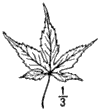
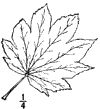
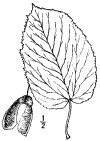
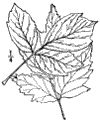
The fractions beside the figures indicate the scale of the drawing as compared with the natural size of the part: 1/1 indicates natural size; 2/1, that the drawing is twice the length of the object; ¼, that the drawing is one fourth the length of the object, etc.
In the description of leaves the dimensions given refer to the blade.
KEY TO THE GENERA OF TREES.
* Leaves narrow linear, needle, scale or awl shaped, usually but not always evergreen. (GG.) page 60.
* Leaves broad, flat, usually deciduous, occasionally evergreen, rarely over 5 times as long as wide. (A.)
A. Leaves alternate,[1] simple. (B.)
A. Leaves alternate, compound. (m.) page 57.
A. Leaves opposite or whorled on the stem. (u.) page 58.
B. Leaves with a midrib, netted-veined. (C.)
B. Leaves without a midrib, parallel-veined109. Salisburia.
C. With radiating ribs, and including those which have the lower ribs longer and more branching than those above them. (f.) page 56.
C. With distinct and definite feather-veining. (D.)
D. Margin entire, or so nearly so as to appear entire, sometimes slightly angulated but not lobed. (V.)
D. Once or twice serrate or crenate or wavy-edged, but not lobed. (E.)
D. Distinctly lobed. (S.) (If the notches are over 10 on a side, look under E.)
E. Straight-veined. (M.)
E. Not distinctly and evenly straight-veined. (F.)
F. Leaves evergreen with either revolute or spiny-tipped margins18. Ilex.
F. Leaves evergreen, lanceolate-oblong, minutely serrate; flowers white, 4 in. in diameter8. Gordonia.
F. Leaves deciduous. (G.)
G. Fruit with fleshy and often edible pulp. (K.)
G. Fruit a dry and more or less rounded pod. (H.)
G. Fruit and flowers in dry catkins; leaves, in most species, 3 or more times as long as wide, finely serrate to entire, with free stipules, in many species remaining on the young twigs, in others shown by a rounded scar on the sides of the stem; wood soft; the Willows91. Salix.
G. Fruit dry akenes with silky pappus, in small heads; whole plant whitened with scurf; leaves broadened and coarsely notched near tip; a broad spreading bush49. Baccharis.
H. Flowers conspicuous, 1 in. or more in size, white. (J.)
H. Flowers quite small. (I.)
I. Flowers and fruit in large panicles; leaves elongated, peach-like in shape, sour50. Oxydendrum.
I. Flowers in terminal, erect racemes; fruit small, three-celled pods; leaves oval, 3-7 in. long, pointed, thin, finely serrate; plant hardly a tree53. Clethra.
I. Fruit rounded, small, with calyx adhering to the lower part, one-seeded, in clusters of 3-many; leaves 1-3 in. long.56. Styrax.
I. Fruit hairy, in long, hanging panicles, tipped with long, persistent style, one-seeded57. Pterostyrax.
J. Flowers bell-shaped, 1 in. long; leaves widest below the middle; fruit winged pods58. Halesia.
J. Flowers spreading, 2 in. broad; leaves about twice as long as wide, widest near the center7. Stuartia.
J. Flowers spreading, 3 in. broad; leaves about 3 times as long as wide, widest near tip8. Gordonia.
K. Fruit a plum-like drupe with a single bony stone; plant sometimes thorny36. Prunus.
K. Fruit berry-like, ending in a conspicuous spreading calyx; plant generally quite thorny38. Cratægus.
K. Fruit berry-like, black when ripe, small, without calyx, with usually 3 cartilaginous coated seeds20. Rhamnus.
K. Fruit berry-like, red when ripe, small, without calyx, with usually 4-6 hard-coated, grooved nutlets 18. Ilex.
K. Fruit a small or large apple-like pome, with the seeds in horny cells. (L.)
L. Fruit about ½ in. in diameter, sweet, in drooping racemes39. Amelanchier.
L. Fruit either sour or much larger, and not in elongated racemes37. Pyrus.
M. Leaves harsh to the touch; somewhat oblique at base; quite distinctly two-ranked; large trees74. Ulmus.
M. Leaves decidedly oblique at base; margin wavy; small tree, usually a shrub40. Hamamelis.
M. Fruit berry-like, ending in a conspicuous spreading calyx; plant generally quite thorny38. Cratægus.
M. Leaves not regularly oblique at base; plant not thorny. (N.)
N. Leaves thin and light, not harsh to the touch; spray light; bark smooth, in two species somewhat rough on the trunk. (Q.)
N. Leaves thick; edge wavy, almost lobed; fruit an acorn. 88. Quercus.
N. Leaves broad for the length, generally doubly serrate or wavy and serrate; shrubs, rarely tall enough for trees. (P.)
N. Not included in the above. (O.)
O. Leaves 3 or more times as long as wide, widest near the center; fruit a round, prickly bur with 1-3 horny-coated nuts89. Castanea.
O. Leaves widest near the sharply serrate tip, narrow and entire near the base; fruit small pods in terminal racemes; small tree or shrub53. Clethra.
O. Leaves widest near the base, usually small; bark scaling off like the Buttonwood; fruit axillary, solitary, small (¼ in.) roundish, dry drupes. A cultivated species, has rather large leaves, widest near the center75. Planera.
P. Fruit an open oval woody catkin or cone, remaining on the plant through the winter84. Alnus.
P. Fruit a rounded stony nut, in green leafy edged bracts; shrubs or small trees85. Corylus.
Q. Usually aromatic; bark dotted on the spray and with horizontal marks on the trunk, peeling off in thin, often papery layers83. Betula.
Q. Bark not peeling off in thin layers. (R.)
R. Leaf-buds long and slender; fruit a small prickly bur with two triangular, horny-coated nuts; large trees 90. Fagus.
R. Fruit an elongated catkin with large leaf-like bracts; bark close, gray, on a grooved trunk87. Carpinus.
R. Fruit a hop-like catkin; bark brownish, finely furrowed 86. Ostrya.
S. Plant more or less thorny; shrub or small tree; fruit rounded berries ending in persistent calyx-lobes38. Cratægus.
S. Plant not thorny. (T.)
T. Leaf deeply pinnatifid, usually with the basal lobes completely separated; cultivated37. Pyrus.
T. End of leaf as though cut off; sides with one large lobe; margin entire; large tree2. Liriodendron.
T. Lower leaves three-lobed, heart-shaped at base, upper merely ovate, margin entire; small tree or shrub 66. Clerodendron.
T. Not as above; leaves usually many-lobed. (U.)
U. Leaves thin; bark of trunk peeling off in thin horizontal strips83. Betula.
U. Leaves thin; leaf-buds long, slender, sharp-pointed; bark smooth, not peeling; cultivated90. Fagus.
U. Leaves thickish; bark roughish; fruit an oval woody cone, remaining on through the year84. Alnus.
U. Leaves thick; fruit an acorn88. Quercus.
V. Leaves evergreen, small, 2-3 in. long, thick, with revolute margins; fruit an acorn88. Quercus.
V. Leaves evergreen, oval to lance-oval, usually large; small trees, almost shrubs. (d.) page 56.
V. Leaves deciduous (some are evergreen in the Southern States). (W.)
W. Plant more or less spiny. (c.)
W. Plant not at all spiny. (X.)
X. Leaf-blade thin, long, pointed, with curved parallel veins or ribs45. Cornus.
X. Leaf-blade thin, circular or broadly oval in outline, with blunt, almost rounded apex; veins not regularly parallel27. Rhus.
X. Leaf quite elongated, 5 or more times as long as wide. (b.)
X. Leaves with none of the above peculiarities. (Y.)
Y. Deciduous bud-scales (stipules), leaving a scar or mark completely around the stem at the base of the leaves.1. Magnolia.
Y. Leaves covered on one or both sides with silvery scales71. Elæagnus.
Y. No such ring around the stem, or silvery scales on the leaves. (Z.)
Z. Leaves distinctly straight-veined, thin90. Fagus.
Z. Leaves thick, obtuse; fruit an acorn88. Quercus.
Z. Leaves 6 in. or more long; crushed leaves with a rank, fetid odor5. Asimina.
Z. Leaves 3-5 in. long; twigs and leaves very spicy; shrub rather than tree70. Lindera.
Z. Leaves about 2 in. long, oval, on twigs which have ridges extending down from the sides of the leafstalk; small tree, almost a shrub, with beautiful flowers 43. Lagerstroemia.
Z. Leaves not as above. (a.)
a. Fruit a large (½-1½ in.) rounded pulpy berry with a heavy calyx at the base55. Diospyros.
a. Fruit small (¼ in.), fleshy, drupe-like, with a striate stone; limbs branching horizontally, often descending46. Nyssa.
a. Fruit a black, juicy berry (1/3-½ in.), with about 3 seeds20. Rhamnus.
a. Fruit an ovoid dry drupe (½ in.); leaves sweet-tasting59. Symplocos.
a. Fruit an apple-like pome (Quince)37. Pyrus.
b. Wood soft; both kinds of flowers in catkins in spring; with either stipules or stipular sears91. Salix.
b. Wood hard; leaves thick; fruit an acorn88. Quercus.
c. Fruit a 2-4-seeded small berry; juice not milky20. Rhamnus.
c. Fruit large, orange-like in size and color when ripe; juice milky77. Maclura.
c. Fruit small, black when ripe, cherry-like; juice milky54. Bumelia.
d. Aromatic; berries dark blue on red stalks68. Persea.
d. Not aromatic; leaves nearly 1 ft. long; flowers large and solitary.1. Magnolia.
d. Not aromatic; leaves 1-4 in. long; flowers very small; fruit small dark-colored berries, with 2-4 seeds20. Rhamnus.
d. Not aromatic; flowers large, in showy clusters. (e.)
e. Leaves 5 in. or more long52. Rhododendron.
e. Leaves less than 4 in. long51. Kalmia.
f. Leaves decidedly aromatic, usually somewhat irregularly lobed, margin entire, base tapering69. Sassafras.
f. Leaves usually deltoid, sometimes heart-shaped with serrate margin and gummy buds, rarely palmately lobed. All have either the petiole flattened sidewise, the leaf-blade densely silvery-white beneath, or gummy aromatic buds92. Populus.
f. Leaves broadly heart-shaped; margin entire; small tree with abundance of red flowers in early spring; fruit a pea-like pod.32. Cercis.
f. Leaves not as above given. (g.)
g. Leaves broadly heart-shaped, with a serrate margin and a petiole about as long as the blade, sometimes longer; base of leaf not oblique4. Idesia.
g. Leaves broadly heart-shaped, those on the suckers much lobed; base not oblique; margin serrate; juice milky; bark very tough. (l.)
g. Leaves broadly heart-shaped, with an oblique base; margin regularly serrate; juice not milky11. Tilia.
g. Leaves slightly if at all heart-shaped at base, usually somewhat oblique, with neither milky juice nor lobes. (j.)
g. Leaves decidedly and quite regularly lobed. (h.)
h. Leaves with 3-5 large lobes, the margin entire or slightly angulated.10. Sterculia.
h. Leaves star-shaped, with 5-9 pointed, serrate lobes. (i.)
h. Leaves large, irregularly margined; leaf-stem covering the bud; large tree80. Platanus.
h. Plant quite thorny; fruit berry-like, ending in a conspicuous spreading calyx; small trees or shrubs with apple-like blossoms.38. Cratægus.
h. Leaves with a tapering base; small tree, almost a shrub, with large Hollyhock-like flowers; plant not thorny9. Hibiscus.
i. Large tree, with fruit 1 in. in diameter, dry, rough, hanging on a long stem41. Liquidambar.
i. Small tree with few branches and the trunk usually quite prickly; fruit berry-like in large clusters44. Aralia.
j. Fruit small berries, with 3 flattened seeds, in clusters in the axils of the leaves, which are decidedly 3-ribbed from the base21. Hovenia.
j. Fruit small drupes, with 1 seed, either solitary or in pairs in the axils of the leaves. (k.)
k. Plant without prickles; leaves decidedly oblique at base76. Celtis.
k. Plant with prickles; leaves narrow, decidedly 3-ribbed, and 2-ranked on green twigs22. Zizyphus.
l. Fruit not very edible; leaves rough above, very hairy below, on some of the twigs opposite79. Broussonetia.
l. Fruit edible; leaves not very hairy, never opposite78. Morus.
m. Leaves of 3 entire-edged leaflets; fruit a pea-like pod28. Laburnum.
m. Leaves of 3 quite regularly serrate, transparent-dotted leaflets13. Ptelea.
m. Leaves once or twice pinnate; the leaflets entire. (s.)
m. Leaves once or twice pinnate; the leaflets with margins more or less serrate or notched. (n.)
n. Leaves irregularly once to twice, in one case three times, pinnate. (r.)
n. Leaves regularly once pinnate. (o.)
o. Leaves less than 1 ft. long, on a small, quite prickly plant; fruit very small pods (¼ in. long)12. Xanthoxylum.
o. Leaves less than 1 ft. long; leaflets 3 in. or less long; fruit bright-colored, berry-like pomes in clusters, persistent through the autumn; plant not thorny; branches not heavy-tipped.37. Pyrus.
o. Leaves usually larger on the small tree or almost a shrub; juice in most cases milky; branches heavy-tipped27. Rhus.
o. Leaves 1-2 ft. long; leaflets 3 in. or more long; fruit a bony nut with green fleshy coat; large trees. (q.)
o. Leaves very large, 2 ft. or more long on the rapid-growing branches; branches heavy-tipped; odor of bruised leaves quite strong; leaflets 15 or more in number; large trees; juice not milky. (p.)
p. Leaflets with 1-3 glandular notches at the base17. Ailanthus.
p. Leaflets entire at base, but very slightly serrate near the tip16. Cedrela.
q. Coat of fruit more or less dehiscent into 4 valves; nut smoothish; leaflets, except in one species, not over 11 in number, usually 5-782. Carya.
q. Coat of fruit not regularly dehiscent; nut, in the wild species, rough-coated; leaflets, except in a cultivated species, over 11 in number81. Juglans.
r. Leaves quite regularly twice odd-pinnate; leaflets about 1 in. long; juice not milky; fruit rounded berries in large clusters; plant not prickly; branchlets not heavy-tipped15. Melia.
r. Leaves once to twice irregularly odd-pinnate; the leaflets very irregularly and coarsely toothed; a small, round-headed tree with bladdery pods24. Koelreuteria.
r. Leaves irregularly about twice odd-pinnate; the leaflets lanceolate; quite a low plant with few heavy-tipped branches; plant without prickles27. Rhus.
r. Leaves 2 (sometimes 3) times odd-pinnate; tree-stem with prickles; small tree or shrub, with few branches44. Aralia.
r. Leaves once to twice abruptly pinnate; large tree with slender-tipped branches, usually very thorny34. Gleditschia.
s. Leaves very large (2 ft. or more long), about twice abruptly pinnate; leaflets broad and often 2 in. long; branches blunt; no thorns33. Gymnocladus.
s. Leaves and leaflets much smaller, leaves quite irregularly once or twice abruptly pinnate; branches slender-tipped; large tree, usually very thorny34. Gleditschia.
s. Leaves twice abruptly pinnate; leaflets over 400 in number, with midrib near the upper edge35. Albizzia.
s. Leaves regularly once pinnate, not over 2 ft. long. (t.)
t. Leaves abruptly pinnate, not over 5 in. long; leaflets 8-12, small, mucronate-pointed29. Caragana.
t. Leaves odd-pinnate; shrub or small tree, with few, heavy-tipped branches; no spines or prickles27. Rhus.
t. Leaves odd-pinnate; leaflets large (3-5 in. long), not usually over 11 in number; round-topped tree30. Cladrastis.
t. Leaves odd-pinnate; leaflets less than 3 in. long, frequently 11-21 in number; often with spines at the bases of the leaves in the place of stipules12. Xanthoxylum or 31. Robinia.
u. Leaves palmately compound. (CC.)
u. Leaves pinnately compound. (BB.)
u. Leaves simple, evergreen, sessile, in whorls around the stem, which they completely cover(98a. Araucaria.)
u. Leaves simple, opposite, evergreen, entire, over 2 in. long61. Osmanthus.
u. Leaves simple, opposite, evergreen, entire, under 1 in. long73. Buxus.
u. Leaves simple, deciduous. (v.)
v. Branches ending in thorns; small trees, or shrubs. (AA.)
v. Plants not thorny. (w.)
w. Leaves palmately lobed (one variety, rarely cultivated, lacks lobes, but is heart-shaped with a serrate margin), the lobes over 3 in number, or with notches or serrations; fruit dry, winged25. Acer.
w. Lower leaves palmately 3-lobed, and heart-shaped at base, upper ones ovate, all with entire margin; fruit with juicy pulp covering the 4 seeds66. Clerodendron.
w. Leaves palmately lobed; fruit small, one-seeded, berry-like drupes in large clusters, with flattened stones, or large rounded clusters of flowers without stamens or pistils; shrubs rather than trees47. Viburnum.
w. Leaves heart-shaped, entire or slightly angulated; not lobed. (DD.)
w. Leaves irregularly serrate, somewhat straight-veined; fruit single-winged; large cultivated tree60. Fraxinus.
w. Leaves neither heart-shaped nor lobed; small trees, almost shrubs. (x.)
x. Leaves entire. (z.)
x. Leaves serrate or dentate, ovate or oval. (y.)
y. Fruit rounded drupes in large clusters, with single flattened stones47. Viburnum.
y. Fruit lobed pods, which burst open in the autumn; branchlets somewhat 4-sided19. Euonymus.
z. Leaves small, lanceolate; flowers and fruit large and beautiful42. Punica.
z. Leaves broad, thin, with curved parallel veins or ribs.45. Cornus.
z. Leaves large, broad, oval, without either curved or straight parallel ribs63. Chionanthus.
AA. Leaves entire and covered on both sides with silvery, peltate scales72. Shepherdia.
AA. Leaves ovate, small, minutely serrate20. Rhamnus.
BB. Leaves large, 18 in. or more long; leaflets 11 or more, very finely serrated14. Phellodendron.
BB. Leaves smaller; leaflets entire or quite evenly toothed, usually over 5 in number60. Fraxinus.
BB. Leaflets coarsely and quite irregularly toothed, 3-5 (rarely 7) in number26. Negundo.
CC. Leaflets slender-lanceolate, almost entire; shrub or small tree, 5-10 ft. high67. Vitex.
CC. Leaflets broader and serrate; usually large trees.23. Æsculus.
DD. Leaves with radiating ribs. (FF.)
DD. Leaves with feather-veining. (EE.)
EE. Leaves 2-6 in. long; flowers small, in large, dense, terminal clusters62. Syringa.
EE. Leaves 1-4 in. long; flowers in pairs48. Lonicera.
FF. Leaves large, 6 in. or more long; two almost hidden buds, one above the other, in the axils of the leaves on the rapid-growing branches; flowers large, purple, blooming in early spring; fruit rounded pods64. Paulownia.
FF. Leaves large, 6 in. or more long; flowers large, white, blooming in June; fruit long pods65. Catalpa.
FF. Leaves 2-4 in. long, with red stems3. Cercidiphyllum.
GG. Leaves scattered singly over the stem, not in bundles or clusters. (JJ.)
GG. Leaves in large or small clusters. (HH.)
HH. Clusters in whorls of many leaves around the stem like an umbrella100. Sciadopitys.
HH. Leaves clustered in bundles of 2-693. Pinus.
HH. Leaves clustered in bundles of over 8. (II.)
II. Leaves deciduous, soft97. Larix.
II. Leaves evergreen, rigid98. Cedrus.
JJ. Leaves hardly evergreen; spray quite slender. (ZZ.)
JJ. Leaves fully evergreen. (KK.)
KK. Leaves awl or scale shaped, and mainly appressed to the stem. (WW.)
KK. Leaves linear or needle shaped, and decidedly spreading from the stem, though sometimes with a decurrent base. (LL.)
LL. Leaves narrowed to a distinct though short stem. (RR.)
LL. Leaves sessile; if narrowed, not so abruptly as to form a petiole. (MM.)
MM. Leaves opposite or whorled on the stem. (PP.)
MM. Leaves rather spirally arranged around the stem, not just opposite. (NN.)
NN. Leaves linear to lanceolate, flattened, spreading quite squarely from the stem. (OO.)
NN. Leaves not flattened but 4-sided, curved, gradually enlarging from the tips to the bases, which are decurrent, and on the young twigs completely cover the stem; cones rounded; the scales not lapping105. Cryptomeria.
OO. Leaves about linear in form, of nearly the same width throughout, and usually fastened to the cylindrical stem by a distinct disk-like base; cones erect; scales lapping.96. Abies.
OO. Leaves about 2 in. long and gradually widening from the acute tips to the broad (1/8 in.) bases, which are decurrent on the stem99. Cunninghamia.
OO. Leaves ½-1 in. long, sharp-pointed, very flat, two-ranked, somewhat lanceolate in form; base narrowed almost to a petiole102. Sequoia.
PP. Leaves not decurrent, usually in whorls of three around the stem, sometimes opposite, acute-pointed; fruit small (1/8 in.), rounded, dark-colored berries106. Juniperus.
PP. Leaves decurrent on the stem, less than ½ in. long. (QQ.)
QQ. Fruit small, globular cones; the scales not lapping104. Chamæcyparis.
QQ. Fruit small, elongated cones of few, lapping scales103. Thuya.
RR. Leaves usually but little flattened, but jointed to a short, brown petiole which is attached to a somewhat grooved twig; cones pendent, of lapping scales94. Picea.
RR. Leaves decidedly flattened, not jointed, but narrowed to a petiole which is usually green or greenish in color. (SS.)
SS. Leaves rounded or obtuse at the tip, distinctly two-ranked, usually less than 1 in. long; cones oval, 1 in. or less long, of lapping scales95. Tsuga.
SS. Leaves acute at the tip; fruit (found only on a portion of the plants, as the flowers are dioecious) drupe-like, with a single nut-like seed. (TT.)
TT. Leaves not two-ranked, over 2 in. long108. Podocarpus.
TT. Leaves quite regularly two-ranked. (UU.)
UU. Leaves marked by two longitudinal lines; bruised or burned leaves with a very disagreeable odor(107a. Torreya.)
UU. Leaves with the midrib forming a distinct ridge, odor not disagreeable. (VV.)
VV. Leaves usually less than an inch long107. Taxus.
VV. Leaves usually more than an inch long(107b. Cephalotaxus.)
WW. Spray decidedly two-ranked, fan-like. (YY.)
WW. Spray branching in an irregular way, not two-ranked. (XX.)
XX. Fruit a purplish berry; bark shreddy106. Juniperus.
XX. Fruit a cone of thick, pointed, not lapping scales102. Sequoia.
YY. Cones elongated, of lapping scales103. Thuya.
YY. Cones globular, of peltate, valvate scales104. Chamæcyparis.
ZZ. Leaves very broad at base, half clasping the stem and rapidly narrowed to an acute tip; hardly at all spreading from the thread-like twigs; flowers pinkish, in spike-like clusters6. Tamarix.
ZZ. Leaves more elongated, quite even in width, not clasping the stem101. Taxodium.
CLASS I. ANGIOSPÉRMÆ.
Plants with a pistil consisting of a closed ovary, which contains the ovules and forms the fruit.
Order I. MAGNOLIACEÆ. (Magnolia Family.)
Trees or shrubs, mainly of tropical regions, including, in our section, the three following genera:
Genus 1. MAGNÒLIA.
Trees and tall shrubs with alternate, thick, smooth, entire leaves with deciduous stipules which form the bud-scales, and are attached entirely around the stem, leaving a ridge, as in Liriodendron.
Flowers very large (3 to 10 in. in diameter), usually white, solitary.
Fruit a large cone from which the seeds, drupe-like, usually red, hang out on long threads during the autumn.
* Blooming with or before the opening of the leaves. (A.)
A. Flowers entirely white 9, 10.
A. Flowers dark purple 11.
A. Flowers mixed purple and white. A large number of hybrids from China and Japan.
* Blooming after the leaves expand. (B.)
B. Leaves evergreen, more than 8 in. long 1.
B. Leaves evergreen, not 6 in. long 2.
B. Leaves deciduous. (C.)
C. Leaves decidedly auriculate or cordate at the base. (D.)
D. Leaves very large (1 to 3 ft. long) 5.
D. Leaves smaller and much clustered at the tips of the flowering branches 6.
C. Leaves not conspicuously cordate at base. (E.)
E. Leaves clustered at the tips of the flowering branches 7.
E. Leaves scattered along the branches. (F.)
F. Base of leaf abrupt 3, 4.
F. Base of leaf tapering. (G.)
G. Leaves quite large, about 1 ft. long; a very erect growing tree 8.
G. Leaves smaller, medium thick, glossy above medium thin (5 to 10 in. long) 2. 3.
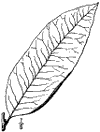
M. grandiflòra.
1. Magnòlia grandiflòra, L. (Large-flowered Magnolia. Southern Evergreen Magnolia.) Leaves evergreen, thick, oval-oblong; upper surface glossy, under surface somewhat rusty. Flowers large, 6 to 10 in. wide, white, fragrant. In spring. Fruit oval, 3 to 4 in. long, ripe in October. Seeds scarlet. Splendid evergreen tree (50 to 80 ft.) in the Southern States; half hardy, and reduced to a shrub (10 to 20 ft.) when cultivated in the Middle States.
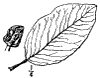
M. glaùca.
2. Magnòlia glaùca, L. (Sweet-Bay. Swamp-Magnolia.) Leaves quite thick, oblong-oval, obtuse, smooth and glossy above, white or rusty pubescent beneath; evergreen in the Southern States. Leaf-buds silky. Flowers globular, white, and very fragrant. June to August. Fruit about 1½ in. long, ripe in autumn. Shrub, 4 to 20 ft. high, in the swamps of the Atlantic States from Massachusetts southward. Slender tree, 15 to 30 ft. high, when cultivated in good damp soil.
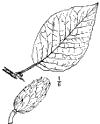
M. acuminàta.
3. Magnòlia acuminàta, L. (Cucumber-tree.) Leaves thin, green above, paler beneath, oblong, usually pointed at both ends, 5 to 10 in. long. Leaf-buds silky. Flowers pale yellowish-green, 3 in. wide, late in spring. Fruit irregular-oblong (2 to 3 in. long), rose-colored when ripe, with a few hard, bony, black seeds, coated with red pulp, ripe in autumn. Large (50 to 90 ft.) noble forest tree, wild in western New York and southward. Wood rather soft, yellowish-white, quite durable, and extensively used for pump logs. Occasionally cultivated; fine for avenues.
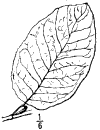
M. cordàta.
4. Magnòlia cordàta, Michx. (Yellow Cucumber-tree.) Leaves broadly ovate or oval, rarely cordate at base, smooth above, white-downy beneath, 4 to 6 in. long. Flowers lemon-yellow slightly streaked with red. June. Fruit nearly 3 in. long, red when ripe in autumn. A rather small, broad-headed tree (20 to 50 ft.), wild in the Southern States, but hardy as far north as Boston; not often cultivated. Probably an upland variety of the preceding.
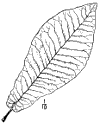
M. macrophýlla.
5. Magnòlia macrophýlla, Michx. (Great-leaved Magnolia.) Leaves very large, sometimes 3 ft. long, crowded at the summit of the branches, obovate-oblong, cordate at the narrowed base, glaucous-white beneath, green above; twigs whitish pubescent. Flowers very large (12 in. broad), white with a purple spot near the base; fragrant. Fruit cylindrical, 4 in. long, deep rose-colored when ripe in autumn. A medium-sized (30 to 40 ft.), spreading tree; wild from Kentucky south, hardy and cultivated as far north as New York City.
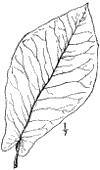
M. Fràseri.
6. Magnòlia Fràseri, Walt. (Ear-leaved Umbrella-tree.) Leaves crowded at the ends of the flowering branches, obovate or spatulate, auriculate at base, smooth (1 ft. long). Leaf-buds smooth. Flowers (6 in. wide) white, slightly scented. April to May. Fruit 3 to 4 in. long, rose-colored, ripe in autumn. Medium-sized, rather slender tree (30 to 50 ft.), with soft yellowish-white wood. Virginia and southward. Hardy and extensively cultivated as far north as New York City.
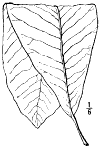
M. umbrélla.
7. Magnòlia umbrélla, Lam. (Umbrella tree.) Leaves clustered at the ends of the branches, obovate-lanceolate, pointed at both ends, 1 to 2 ft. long; downy beneath when young, but soon becoming smooth. Flowers white, 6 to 8 in. broad. May. Fruit oblong, 4 to 6 in. long, rather rose-colored when ripe in autumn. A small, rather straggling tree, 20 to 40 ft. high; common in the Southern States, and wild as far north as New York State; cultivated throughout.
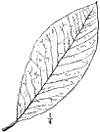
M. hypoleùca.
8. Magnòlia hypoleùca, S. & Z. (Japan Magnolia.) Leaves large (1 ft. long), somewhat purple-tinted above, white and glaucous beneath. Midrib and leafstalk often red. Flowers cream-white, fragrant, appearing after the leaves in June. Twigs stout and polished. A medium-sized, very erectly growing tree; from Japan.
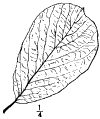
M. conspícua.
9. Magnòlia conspícua, Salisb. (Yulan or Chinese White Magnolia.) Leaves deciduous, obovate, abruptly acuminate, pubescent when young. Flowers large (4 in.), cream-white, very fragrant, appearing very early (May), before any of the leaves. Fruit rarely formed, with few (1 to 3, rarely more) seeds to a cone. Bark dark brown on the young branches; terminal winter buds over ½ in. long. Small tree (10 to 30 ft.) with spreading habit and stout branches; very extensively cultivated for its abundant early bloom; from China.
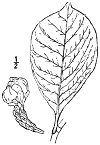
M. Kòbus.
10. Magnòlia Kòbus. (Thurber's Japan Magnolia.) Leaves similar to the preceding, but smaller. Flowers also similar, but pure white. Fruit abundantly formed, with several (2 to 12) seeds to the cone. Bark green on the young growth; terminal winter-buds under ½ in. long. Small tree (15 to 40 ft.) with erect habit and slender branches. A beautiful tree of recent introduction from Japan.
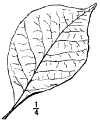
M. purpùrea.
11. Magnòlia purpùrea, Sims. (Purple Japan Magnolia.) Leaves obovate, pointed at both ends, dark green. Flowers erect, of 3 sepals and 6 obovate, purple petals; blooming about as the leaves expand. A low tree, or usually merely a shrub, from Japan; often cultivated.
Besides the Magnolias here given, there are quite a number of varieties and hybrids in cultivation, from China and Japan, most of them blooming before the leaves expand in spring.
Genus 2. LIRIODÉNDRON.
Trees with alternate, deciduous, smooth, stipulate, 4-lobed leaves, the stipules large, attached entirely around the stem, and leaving a ridge when they drop off, as in the genus Magnolia. Flowers tulip-shaped, large (3 in.), greenish-yellow. May to June. Fruit a pointed cone, 3 in. long, hanging on the tree till autumn.
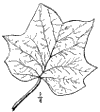
L. tulipífera.
Liriodéndron tulipífera, L. (Tulip-tree.) Leaves large, smooth on both sides, somewhat 3-lobed, the end one seemingly cut off, leaving a shallow notch; stipules light-colored, large, oblong, attached all around the stem, often remaining on through half the season. A very large (80 to 150 ft. high), beautiful, rapidly growing tree, with soft, straight-grained, greenish wood, of great use for inside work. Southern New England and southward. Especially abundant and large in the Western States. Also cultivated.
Genus 3. CERCIDIPHÝLLUM.
Shrubs or trees with opposite, rarely subalternate, simple, deciduous leaves. Fruit short-stemmed, with divergent pods, 2-4 in number, splitting open on the outer edges; each one-celled, with one row of lapping, pendulous seeds with membranous wings.
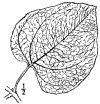
C. Japónicum.
Cercidiphýllum Japónicum. (Katsura-tree.) Leaves broadly heart-shaped, palmately veined with 5-7 ribs, and with an apparently entire margin, dark green above, somewhat glaucous beneath. Under a magnifying glass the margin will be found to have pellucid crenulations. Leafstalk dark red and jointed above the base, the veins somewhat red-tinted. A beautiful, upright tree with birch-like, dotted, brown bark; of recent introduction from Japan, and probably completely hardy throughout the region.
Order II. BIXÍNEÆ.
A rather small order of mostly tropical trees or shrubs, with alternate, simple leaves.
Genus 4. IDÈSIA.
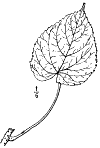
I. polycárpa.
Large trees with terminal and axillary panicles of very small flowers and berries.
Idèsia polycárpa, Hook. Leaves large, heart-shaped, serrate, palmately veined with 5 ribs; leafstalk very long, red, with two glands near the base; twigs also glandular; berries very small (¼ inch), with many seeds. A large tree recently introduced from Japan, which may prove hardy from Pennsylvania south, but is killed by the climate of Massachusetts.
Order III. ANONÀCEÆ.
(Custard-apple Family.)
An order of tropical trees and shrubs except the following genus:
Genus 5. ASÍMINA.
Small trees or shrubs with simple, deciduous, alternate, entire, pinnately-veined leaves. Flowers large, dull purplish, solitary in the axils of last year's leaves. Fruit a large, oblong, several-seeded, pulpy berry.
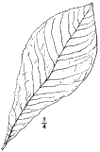
A. tríloba.
Asímina tríloba, Dunal. (Common Papaw.) Leaves large (8 to 12 in. long), oblong-obovate, acuminate, thin, lapping over each other in such a manner as to give the plant a peculiar imbricated appearance. Flowers 1 in. broad, appearing before the leaves. Fruit 3 in. long, 1½ in. thick, yellowish, fragrant, about 8-seeded, ripe in the autumn. Small (10 to 20 ft. high), beautiful tree with dark-brown twigs. All parts have a rank, fetid smell. Wild in New York and southward along streams; cultivated.
Order IV. TAMARISCÍNEÆ.
A small order, consisting mostly of shrubs (from the Old World) with minute leaves.
Genus 6. TÁMARIX.
Leaves simple, very small, alternate, clasping; old ones almost transparent at the apex. Flowers in spike-like panicles, small, red, or pink, rarely white.
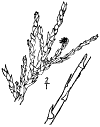
T. Gállica.
Támarix Gállica, L. (French Tamarisk.) Leaves very small, acute; spray very slender, abundant. A sub-evergreen shrub or small tree, 5 to 20 ft. high; with very small pinkish flowers, in spike-like clusters, blooming from May to October. A very beautiful and strange-looking plant, which, rather sheltered by other trees, can be successfully grown throughout.
Order V. TERNSTRŒMIÀCEÆ.
(Tea or Camellia Family.)
An order of showy-flowered trees and shrubs of tropical and subtropical regions, here represented by the following genera:
Genus 7. STUÁRTIA.
Shrubs or low trees with alternate, simple, exstipulate, ovate, serrulate leaves, soft downy beneath. Flowers large (2 in.), white to cream-color, solitary and nearly sessile in the axils of the leaves; blooming in early summer. Fruit a 5-celled capsule with few seeds; ripe in autumn.
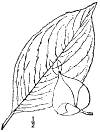
S. pentágyna.
1. Stuártia pentágyna, L'Her. (Stuartia.) Leaves thick, ovate, acuminate, acute at base, obscurely mucronate, serrate, finely pubescent, 3 to 4 in. long, one half as wide. Flowers whitish cream-colored, one petal much the smallest; stamens of the same color. Pod 5-angled.
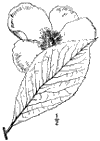
S. Virgínica.
Handsome shrub or small tree (10 to 15 ft.), wild south in the mountains, and hardy and cultivated as far north as New York City without protection. In Massachusetts it needs some sheltered position.
2. Stuártia Virgínica, Cav. (Virginia Stuartia.) Leaves elliptic-ovate, acuminate at both ends, 2 in. long, 1 in. wide, thin, serrate, silky pubescent beneath. Flowers white with purple filaments and blue anthers. Pod globular and blunt; ripe in October. A beautiful shrub rather than tree (8 to 12 ft.), wild in Virginia and south; hardy as far north as Washington.
Genus 8. GORDÒNIA.
Shrubs or small trees with alternate, simple, feather-veined leaves. Flowers large (3 to 4 in. wide), white, showy, solitary in the axils of the leaves. Blooming in summer. Fruit a dry, dehiscent, conical-pointed, 5-celled capsule with 10 to 30 seeds, ripe in the autumn.
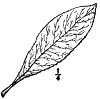
G. Lasiánthus.
1. Gordònia Lasiánthus, L. (Loblolly Bay.) Leaves thick, evergreen, lanceolate-oblong, minutely serrate, nearly sessile, smooth and shining on both sides. The large, solitary, sweet-scented, axillary flowers on peduncles half as long as the leaves. A large tree (30 to 70 ft. high) in the south (wild in southern Virginia), and cultivated as far north as central Pennsylvania, without protection; at St. Louis and Boston it needs protection. Wood of a reddish color, light and brittle.
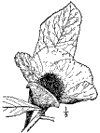
G. pubéscens.
2. Gordònia pubéscens, L'Her. Leaves thin, deciduous, obovate-oblong, sharply serrate, white beneath. Flowers nearly sessile. A small tree or shrub of the south (30 ft. high in Georgia), hardy, and rarely cultivated as far north as Philadelphia, or still farther north if slightly sheltered.
Order VI. MALVÀCEÆ. (Mallow Family.)
A large family, mainly of herbs, found in tropical and temperate regions. One cultivated species, almost a tree, is included in this work.
Genus 9. HIBÍSCUS.
Herbs or shrubs; one sometimes tree-like, with simple, deciduous, alternate, stipulate, usually lobed leaves. Flowers large, showy, 5-parted (Hollyhock-shaped), in late summer. Fruit a 5-celled, many-seeded pod, ripe in autumn.
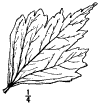
H. Syrìacus.
Hibíscus Syrìacus, L. (Tree Hibiscus.) The only woody and sometimes tree-like species; has ovate, wedge-shaped, 3-lobed, toothed leaves, and large (3 in.) white, purple, red, or variegated flowers. Usually a shrub, 6 to 15 ft. high, often cultivated throughout; introduced from Syria.
Order VII. STERCULIÀCEÆ.
Trees or shrubs (a few are herbs), with alternate leaves, and the stamens united into a tube. A large order of tropical plants.
Genus 10. STERCÙLIA.
Leaves alternate, simple, usually lobed, ovaries more or less divided into 5 carpels, each 2- to many-lobed; fruit when ripe forming a star of 5 distinct pods.
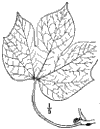
S. platanifòlia.
Stercùlia platanifòlia, L. (Chinese Parasol.) Leaves large, deciduous, alternate, palmately 3- to 5-lobed, deeply heart-shaped at base, the margin entire, the lobes acute; smooth or slightly hairy; leafstalk about as long as the blade. Flowers green, in axillary panicles; fruit star-shaped. A small, beautiful tree from China; probably not hardy north of Washington.
Order VIII. TILIÀCEÆ. (Linden Family.)
An order, mainly of trees, abundant in the tropics; here represented by a single genus:
Genus 11. TÍLIA.
Trees with alternate, deciduous, obliquely heart-shaped, serrate leaves, about as broad as long. Leaves two-ranked on the stem. Flowers small, cream-colored, fragrant, in clusters on a peculiar, oblong, leaf-like bract. Fruit small (1/8 in.), globular, woody, in clusters from the same bract. Wood white and soft; inner bark very fibrous and tough.
* Flowers with petal-like scales among the stamens; American species. (A.)
A. Leaves very large, 6 to 8 in. 3.
A. Leaves medium, 4 to 6 in. 1.
A. Leaves small, 2 to 3 in. 2.
* Flowers with no petal-like scales among the stamens. 4.
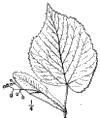
T. Americàna.
1. Tília Americàna, L. (Basswood. Whitewood. Linden.) Leaves large, 4 to 6 in. long, green and smooth, or very nearly so, thickish. Fruit ovoid, somewhat ribbed, ¼ in. broad, greenish when ripe in October, on a bract which is usually tapering to the base. Tall tree, 60 to 80 ft. high, wild in rich woods and often cultivated.
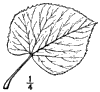
T. pubéscens.
2. Tília pubéscens, Ait. (Small-leaved Basswood.) Leaves smaller, 2 to 3 in. long, thinner and rather pubescent beneath. Fruit globose, 1/5 in. broad, on a bract usually quite rounded at base.
This is usually considered as a variety of the last-named species. It is found from New York south and west.
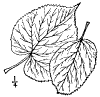
T. heterophýlla.
3. Tília heterophýlla, Vent. (White Basswood.) Leaves large, often 8 in. broad, smooth and bright green above, silvery white and downy beneath, with darker, purplish veins. A large tree; wild in Pennsylvania, west and south, and often cultivated.
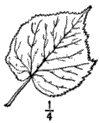
T. Europæ̀a.
4. Tília Europæ̀a, Mill. (European Linden.) Leaves twice as long as the petioles, and smooth except a woolly tuft in the axils of the veins beneath. Small and large leaved varieties are in cultivation. The flowers have no petal-like scales among the stamens, while the American species have. An ornamental tree with dense foliage; often cultivated from Europe. The twigs are more numerous and more slender than those of the American species. Nearly a score of named varieties are in cultivation. Var. laciniata has deeply cut and twisted leaves.
Order IX. RUTÀCEÆ. (Rue Family.)
Shrubs and trees, rarely herbs, in most cases with transparent-dotted, heavy-scented foliage. A rather large order in warm climates.
Genus 12. XANTHÓXYLUM.
Shrubs or trees with mostly odd-pinnate, alternate leaves. The stem and often the leaflets prickly; flowers small, greenish or whitish; fruit dry, thick pods, with 1 to 2 seeds.
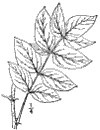
X. Americànum.
1. Xanthóxylum Americànum, Mill. (Northern Prickly-Ash. Toothache-Tree.) Leaves and flowers in sessile, axillary, umbellate clusters; leaflets 5 to 9, ovate-oblong, downy when young. Flowers appear before the leaves. Shrub, scarcely at all tree-like, with bark, leaves, and pods very pungent and aromatic. Common north, and sometimes cultivated.
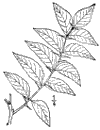
X. Clàva Hércules.
2. Xanthóxylum Clàva Hércules, L. (Southern Prickly-Ash.) Leaflets 7 to 17, ovate to ovate-oblong, oblique at base, shining above. Flowers appear after the leaves. A small tree with very sharp prickles. Sandy coast of Virginia and southward; occasionally cultivated in the north.
Genus 13. PTÈLEA.
Shrub with compound leaves of three leaflets, greenish-white flowers in terminal cymes, and 2-seeded fruit with a broad-winged margin, somewhat like the Elm, only larger.
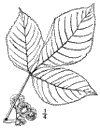
P. trifoliàta.
Ptèlea trifoliàta, L. (Hop-Tree. Shrubby Trefoil.) Leaflets ovate, pointed, downy when young. Flowers with a disagreeable odor; fruit bitter, somewhat like hops. A tall shrub, often, when cultivated, trimmed into a tree-like form. Wild, in rocky places, in southern New York and southward.
Genus 14. PHELLODÉNDRON.
Leaves opposite, odd-pinnate. Flowers diœcious; so only a portion of the trees bear the small, odoriferous, 5-seeded, drupe-like fruit.
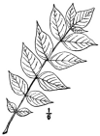
P. Amurénse.
Phellodéndron Amurénse. (Chinese Cork-Tree.) Leaves opposite, odd-pinnate, 1½ to 3 ft. long; leaflets 9 to many, lanceolate, sharply serrate, long-acuminate. Flowers inconspicuous, diœcious, in loose-spreading clusters at the ends of the branches. The pistillate flowers form small, black, pea-shaped fruit, in loose, grape-like clusters, thickly covered with glands containing a bitter, aromatic oil, and remaining on the tree in winter. Medium-sized tree (20 to 40 ft.), with Ailanthus-like leaves which turn bright red in autumn, and remain long on the tree. Hardy as far north as central Massachusetts.
Order X. MELIÀCEÆ. (Melia Family.)
Tropical trees, including the Mahogany; represented in the south by the following:
Genus 15. MÈLIA.
Trees with alternate, bipinnate leaves. The flowers are conspicuous and beautiful, in large panicles, in the spring. Fruit in large clusters of berry-like drupes, with a 5-celled stone.
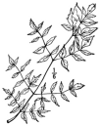
M. Azédarach.
Mèlia Azédarach, L. (China-Tree. Pride of India.) Leaves very large, doubly pinnate, with many obliquely lance-ovate, acuminate, smooth, serrate leaflets. Flowers small, lilac-colored, deliciously fragrant, in large axillary clusters. Fruit globular, as large as cherries, yellow when ripe in autumn; hanging on through the winter. A rather small (20 to 40 ft. high), rapidly growing, round-headed, popular shade-tree in the south, and hardy as far north as Virginia. Introduced from Persia.
Genus 16. CEDRÉLA.
Leaves large, alternate, deciduous, odd-pinnate. Flowers with separate petals, fragrant, white, in large clusters. Fruit 5-celled dehiscent pods, with many pendulous, winged seeds.
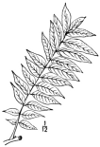
C. Sinénsis.
Cedréla Sinénsis. (Chinese Cedrela.) Leaves large, odd-pinnate, alternate, appearing much like those of the Ailanthus, but with slight serrations near the tips of the leaflets, and no glands near the base. Bruised leaves with a strong odor; footstalk and stout-tipped branches with glands. Large tree, seemingly hardy in New Jersey, but dies to the ground in winter in Massachusetts. Recently introduced from China.
Order XI. SIMARUBÀCEÆ. (Quassia Family.)
Eastern trees and shrubs, here represented by a single tree:
Genus 17. AILÁNTHUS.
Large trees to shrubs, with alternate, odd-pinnate leaves. Flowers small, greenish, in large terminal panicles. Fruit broadly winged, like the Ash, but with the seed in the center.
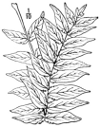
A. glandulòsus.
Ailánthus glandulòsus, Desf. (Tree of Heaven.) Leaves very large, 2 to 5 ft. long on the younger growths; leaflets obliquely lanceolate, coarsely toothed at the base, with a gland on the lower side at the point of each tooth; point of leaflets entire. Young twigs thick, rusty brown; buds very small in the axils. Only some of the trees have fruit, as some have only staminate flowers. The staminate flowers are very ill-scented. A rapid-growing tree, with useful hard wood; cultivated and naturalized; hardy throughout. See page 10.
Order XII. ILICÌNEÆ. (Holly Family.)
A small order of trees and shrubs, including for our purpose only one genus:
Genus 18. ÌLEX.
Trees or shrubs with simple, alternate, thick, mostly evergreen leaves. Flowers rather inconspicuous, mostly in clusters. Fruit berry-like, small (¼ to ½ in.), with 4 to 6 nutlets; hanging on the plants late in the autumn or through the winter.
* Leaves evergreen. (A.)
A. Leaves with spiny teeth 1.
A. No spiny teeth 2.
* Leaves deciduous 3.
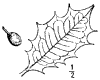
I. opàca.
1. Ìlex opàca, Ait. (American Holly.) Leaves evergreen, oval, acute, thick, smooth, with scattered spiny teeth. Flowers white; May. The bright-red berries, found only on some of the trees, remain on through the greater part of the winter. Small tree, 15 to 40 ft. high, with very hard white wood; wild in southern New England and southward. A beautiful broad-leaved, evergreen tree which should be more extensively cultivated. North of latitude 41° it needs a protected situation.
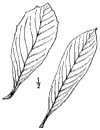
I. Dahòon.
2. Ìlex Dahòon, Walt. (Dahoon Holly.) Leaves 2 to 3 in. long, evergreen, oblanceolate or oblong, entire or sharply serrate toward the apex, with revolute margins, not spiny. Young branches and lower surface of the leaves, especially on the midrib, pubescent. Small tree, 10 to 30 ft. high; Virginia and south, with very hard, white, close-grained wood. Rarely cultivated.
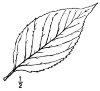
I. montícola.
3. Ìlex montícola, Gray. Leaves deciduous, ovate to lance-oblong, 3 to 5 in. long, taper-pointed, thin, smooth, sharply serrate. Fruit red, on short stems, with the seeds many-ribbed on the back. Usually a shrub but sometimes tree-like; damp woods in the Catskills and in the Alleghany Mountains.
Order XIII. CELASTRÀCEÆ.
Shrubs with simple leaves and small, regular flowers, forming a fruit with ariled seeds.
Genus 19. EUÓNYMUS.
Shrubs somewhat tree-like, with 4-sided branchlets, opposite, serrate leaves, and loose cymes of angular fruit which bursts open in the autumn.
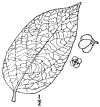
E. atropurpùreus.
1. Euónymus atropurpùreus, Jacq. (Burning-bush. Wahoo.) Leaves petioled, oval-oblong, pointed; parts of the dark-purple flowers commonly in fours; pods smooth, deeply lobed, when ripe, cinnamon in color and very ornamental. Tall shrub, 6 to 20 ft. high; wild in Wisconsin to New York, and southward; often cultivated.
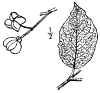
E. Europæus.
2. Euónymus Europæus, L. (European Spindle-tree or Burning-bush.) Leaves oblong-lanceolate, serrate, smooth; flowers and fruit commonly in threes on compressed stems; fruit usually 4-lobed, the lobes acute; flowers greenish-white; May; fruit abundant, scarlet, ripe in September. Generally a shrub, though sometimes tall enough (4 to 20 ft.) and trimmed so as to appear tree-like; twigs smooth, green or reddish-green. Extensively cultivated; from Europe.
Order XIV. RHAMNÀCEÆ.
(Buckthorn Family.)
An order mainly of shrubs, but including in the north-eastern United States two or three small trees.
Genus 20. RHÁMNUS.
Shrubs or small trees with deciduous (rarely evergreen), usually alternate (rarely opposite), pinnately veined leaves. Flowers small, 4-parted, inconspicuous, in clusters in the axils of the leaves. Fruit berry-like, with 2 to 4 seed-like nuts.
* Branches terminating in thorns1.
* Plant without thorns. (A.)
A. Leaves deciduous2.
A. Leaves evergreen3.
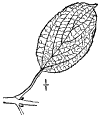
R. cathártica.
1. Rhámnus cathártica, L. (Common Buckthorn.) Leaves ovate, minutely serrate, alternate or many of them opposite; branchlets terminating in thorns. Flowers greenish. Fruit globular, 1/3 in. in diameter, black with a green juice, and 3 or 4 seeds; ripe in September. A shrub or small tree, 10 to 15 ft. high, from Europe; cultivated for hedges, and found wild in a few places, where it forms a small tree.
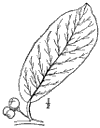
R. Caroliniàna.
2. Rhámnus Caroliniàna, Walt. (Carolina Buckthorn.) Leaves 3 to 5 in. long, alternate, oblong, wavy and obscurely serrulate, nearly smooth, on slender pubescent petioles. Flowers greenish, 5-parted, solitary or in umbellate clusters in the axils. Fruit berry-like, globular, the size of peas, 3-seeded, black when ripe in September. A thornless shrub or small tree, 5 to 20 ft. high. New Jersey, south and west. Usually a shrub except in the Southern States.
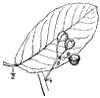
R. Califòrnicus.
3. Rhámnus Califòrnicus, Esch. (California Buckthorn.) Leaves evergreen, oval-oblong to elliptical, 1 to 4 in. long, rather obtuse, sometimes acute, generally rounded at base, serrulate or entire. Fruit blackish purple, with thin pulp, ¼ in., 2- to 3-seeded. A spreading shrub, 5 to 18 ft. high, without thorns; from California.
Genus 21. HOVÈNIA.
Leaves alternate, deciduous, simple, oblique at base. Fruit an obscurely 3-lobed, 3-celled, 3-seeded pod in dichotomous clusters, both axillary and terminal.
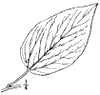
H. dúlcis
Hovènia dúlcis, Thunb. Leaves long-petioled, more or less ovate to cordate, serrate, palmately 3-ribbed, much darker on the upper surface; both sides slightly roughened with scattered hairs. Fruit sweet, edible, in clusters in the axils of the leaves; seeds lens-shaped, with a ridge on the inner side. Flowers white; in July. A large, broad-topped tree, introduced from Japan. Hardy at Washington, but dies to the ground in the Arnold Arboretum, Massachusetts.
Genus 22. ZÌZYPHUS.
Leaves simple, alternate, deciduous, 3-ribbed. Flowers axillary, 5-petaled. Fruit fleshy, drupe-like, containing a 1- to 2-celled nut.
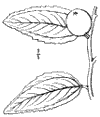
Z. vulgàris.
Zìzyphus vulgàris, Lam. (Jujube.) Leaves ovate-lanceolate, obtuse, serrate, smooth, and glossy green on both sides, upper side quite dark; slightly hairy beneath on the veins; prickles twin, one recurved, sometimes none. New growth of the year green, and resembling a once-pinnate compound leaf and usually dropping off in the autumn like one. Leaves 10 to 20 on a twig, 2-ranked; flowers and drupes nearly sessile in the axils; fruit small (¼ in.), blood-red when ripe. A small tree (10 to 30 ft. high), of recent introduction from Syria; hardy at Philadelphia, but needing some protection at the Arnold Arboretum, Massachusetts.
Order XV. SAPINDÀCEÆ. (Soapberry Family.)
A large order represented in all countries, and so varied in its characteristics as to form several sub-orders.
Genus 23. ÆSCULUS.
Deciduous trees or sometimes shrubs, with opposite, palmately compound leaves with serrated, straight-veined leaflets. Flowers usually conspicuous in dense terminal panicles. Fruit large, leathery-coated, often rough, with one or few large Chestnut-like but bitter seeds. Fruit large in midsummer, hanging on the tree until frost.
* Fruit prickly. (A.)
A. Leaflets usually 7; flowers widely spreading 1.
A. Leaflets 5-7, red-spotted and rough; flowers rosy red Æsculus rubicunda (1).
A. Leaflets usually 5; flowers not much spreading 2.
* Fruit smooth or nearly so. (B.)
B. Flowers bright red 3.
B. Flowers yellow, purplish or pinkish 4.
B. Flowers white, in long, slender, erect clusters 5.
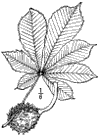
Æ. Hippocástanum.
1. Æsculus Hippocástanum. (Common Horse-chestnut.) Leaves of 7 obovate, abruptly pointed, serrated leaflets. Flowers very showy in large clusters, with 5 white, purple and yellow spotted, broadly spreading petals. A variety with double flowers is in cultivation. May or June. Fruit large, covered with prickles. Seeds large, chestnut-colored. Tree of large size, with brown twigs; cultivated everywhere; from Asia.
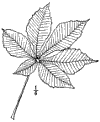
Æ. rubicúnda.
Æsculus rubicunda (Red-flowering Horse-chestnut) is frequent in cultivation; leaflets 5 to 7, red-spotted and rough; flowers rosy red. It is probably a hybrid between the common Horse-chestnut and one of the Buckeyes.
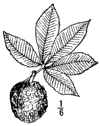
Æ glàbra.
2. Æsculus glàbra, Willd. (Ohio Buckeye.) Leaves with 5 oval-oblong, acuminate, serrate, smooth leaflets. Flowers not showy, yellowish-white, with 4 somewhat irregular, slightly spreading petals. June. Fruit small, 1 in. in diameter, covered with prickles, at least when young; ripe in autumn. Small to large tree, wild in the basin of the Ohio River, along river-banks. Sometimes cultivated.
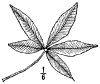
Æ. Pàvia.
3. Æsculus Pàvia, L. (Red Buckeye.) Leaves of 5 to 7 oblong-lanceolate, finely serrate, generally smooth leaflets, of a shining green color, with purple veins and petioles. Flowers (corolla and calyx) bright red, with included stamens; corolla of 4 petals, not spreading; calyx tubular. Fruit smooth, oblong-obovate, 1 in. long. Small tree or shrub, 10 to 20 ft. high, with purple twigs. Virginia west and south, and occasionally cultivated throughout.
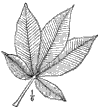
Æ. flàva.
4. Æsculus flàva, Ait. (Sweet Buckeye.) Leaves with 5 to 7 serrulate, elliptical, acuminate leaflets, usually smooth, sometimes minutely pubescent beneath; the pubescent petiole flattish toward the base. Flowers yellow, not spreading. Spring. Fruit globose, uneven but not prickly, 2 in. in diameter. Seeds large (1 in.), 1 or 2 in number, mahogany-colored; ripe in autumn. Often a large tree, sometimes only a shrub, 6 to 70 ft. high, in rich woods; Virginia to Indiana, and southward. Cultivated occasionally throughout.
Var. purpurascens of this species has flesh-colored or dull-purple flowers, and leaflets quite downy beneath.
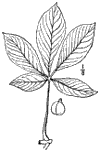
Æ. macrostàchya.
5. Æsculus macrostàchya, Mx. (Long-racemed Buckeye.) Leaflets 5 to 7, ovate, acuminate, serrate, velvety with hairs beneath. Flowers white, in long, slender, erect clusters; July; petals 4, spreading; stamens very long. A beautiful, widely spreading shrub. 5 to 18 ft. high; from the Southern States; often cultivated. Probably hardy throughout.
Genus 24. KŒLREUTÈRIA.
A small tree with alternate, once to twice irregularly pinnate leaves with many coarsely toothed leaflets. Flowers conspicuous, yellow, in terminal panicles. In summer. Fruit rounded, bladdery, 3-celled, few-seeded pods; ripe in autumn.
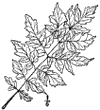
K. paniculàta.
Kœlreutèria paniculàta, Laxm. Leaflets thin and very irregularly toothed. Clusters 6 to 12 in. long, of many irregular flowers, ½ in. wide; through the summer. Fruit an ovate, bladdery capsule, ripening in autumn. A fine, small, round-headed tree, 20 to 40 ft. high; from China. Probably hardy throughout.
Genus 25. ÀCER.
Trees, or rarely shrubs, with simple, opposite, and almost always palmately lobed leaves, which, in our species, are always deciduous. Flowers small and usually dull-colored, in clusters. Fruit double-winged and 2-seeded, in some species hanging on the tree till the leaves have fallen; in others dropping off early in the spring. The species differ much in the spreading of the wings of the fruit. Wood light-colored and medium hard; bark rather smoothish, but in large trees with longitudinal cracks.
* Leaves slightly or not lobed 13.
* Leaves about 3-lobed (rarely 5-lobed); shrubs or small trees. (A.)
A. Leaves serrate 1, 2.
A. Leaves somewhat sinuate, not at all serrate; juice milky. 10.
* Leaves 5-, rarely 3-lobed. (B.)
B. The lobes acute, irregularly but quite fully serrate; juice not milky. (C.)
C. The fruit in corymbs, dropping early; American species. (D.)
D. Leaf-notches somewhat rounded; tree large; limbs drooping on old trees 3.
D. Leaf-notches acute; tree small 4.
C. Fruit in hanging racemes, remaining on the tree till autumn; leaves thickish 5.
B. The lobes acute; sparingly or not at all serrate. (E.)
E. Juice not milky 6.
E. Juice milky at the bases of the leaves 8, 9.
B. The lobes obtuse and sinuate 10.
* Leaves 5- to 7-lobed. (F.)
F. Lobes fully serrate 11.
F. Lobes sparingly serrate. (G.)
G. Juice milky 8, 9.
G. Juice not milky; leaves 8 to 10 in. broad 7.
F. Lobes somewhat sinuate, not serrate; juice milky 10.
* Leaves with 7 or more lobes 11, 12.
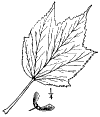
À. spicàtum.
1. Àcer spicàtum, Lam. (Mountain Maple.) Leaves with 3 (rarely 5) coarsely serrated, taper-pointed lobes, with slightly cordate base; downy beneath. Flowers greenish-yellow, in erect, slender racemes or panicles, blooming in June. Wings of the small fruit at about a right angle. Small tree, 6 to 10 ft. high, or usually a shrub, with brown twigs. Native; growing in moist woods; rarely cultivated.
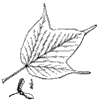
À. Pennsylvánicum.
2. Àcer Pennsylvánicum, L. (Striped Maple.) Leaves large, thin, 3-lobed at the end, cordate at base, finely and sharply doubly serrate. Flowers greenish, in drooping, elongated, loose racemes appearing after the leaves in spring. Fruit with large diverging wings. A small, slender tree, with light green bark striped with dark red. Wild throughout and cultivated.
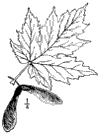
À. dasycárpum.
3. Àcer dasycárpum, Ehrh. (Silver or White Maple.) Leaves large, truncated at base, 5-lobed, with blunt notches, the lobes irregularly serrated and notched, silvery white, and, when young, downy beneath. Flowers light yellowish-purple, preceding the leaves, in crowded umbels along the branches. Wings of fruit large and forming about a right angle; ripe early in June. A rather large, rapidly growing, and usually somewhat weeping tree, with soft white wood. Special cut-leaved and weeping varieties are sold at the nurseries. Wild along river-banks, and extensively cultivated in the streets of cities.
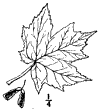
À. rùbrum.
4. Àcer rùbrum, L. (Red Maple.) Leaves cordate at base and cleft into 3 to 5 acute-notched, irregularly toothed lobes, whitish beneath, turning a bright crimson in early autumn. Flowers usually scarlet, rarely yellowish, in close clusters along the branches, appearing before the leaves in the spring. Fruit often reddish, small, with the wings at about a right angle. A rather small, somewhat spreading tree with reddish branches; wild in wet places and often cultivated.
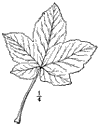
À. Pseudoplátanus.
5. Àcer Pseudoplátanus, L. (Sycamore-maple.) Leaves thickish, cordate, downy beneath, with 5 rather crenately toothed lobes, on long, often reddish petioles. Flowers in long pendulous racemes, appearing after the leaves. Fruit hanging on the tree till after the leaves fall in the autumn, the wings forming about a right angle. A rather large, spreading tree, 30 to 80 ft. high, with reddish-brown twigs. Cultivated; from Europe. Many varieties of this species are sold by the nurserymen; among them may be mentioned the Purple-leaved, Golden-leaved, Silver-leaved, Tricolored, etc.
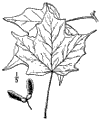
À. saccharìnum.
6. Àcer saccharìnum, Wang. (Sugar or Rock Maple.) Leaves deeply 3- to 5-lobed, with rounded notches; lobes acute, few-toothed; base heart-shaped, smooth above, glaucous beneath. Flowers hanging in umbel-like clusters at the time the leaves are expanding in the spring. Fruit with wings not quite forming a right angle. A large (50 to 100 ft. high), very symmetrical tree, ovate in form, with whitish-brown twigs. Wild throughout, and extensively cultivated in the streets of cities.
Var. nigrum, Torr. and Gray. (Black Sugar-maple.) Leaves scarcely paler beneath, but often minutely downy; lobes wider, often shorter and entire; notch at the base often closed (the under leaf in the figure). Found with the other Sugar-maple, and quite variable.
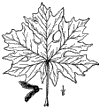
À. macrophýllum.
7. Àcer macrophýllum, Ph. (Large-leaved or California Maple.) Leaves very large, 8 to 10 in. broad; 5-, sometimes 7-lobed, with deep, rounded notches; lobes themselves somewhat 3-lobed and repand-notched; pubescent beneath. Flowers yellow, in erect panicles, fragrant, blooming after the leaves are expanded. Fruit large, with the seeded portion hairy; wings at about a right angle. Tree very large (100 ft. high); wood soft, whitish, beautifully veined. Twigs brown; buds green. Cultivated; from the Pacific coast, but not hardy north of 40° N. latitude.
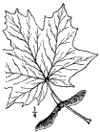
À. platanoìdes.
8. Àcer platanoìdes, L. (Norway Maple.) Leaves large, smooth, 5-, rarely 7-cleft, with cordate base; lobes acute, with few coarse, sharp teeth, bright green both sides. The leaves resemble those of the Sycamore (Platanus). Flowers a little later than the leaves in spring, in stalked corymbs, less drooping than the Sugar-maple (No. 6). Fruit with wings diverging in a straight line. A medium-sized, broad, rounded tree with brown twigs and milky juice, best seen at the bases of the young leaves. Cultivated throughout.
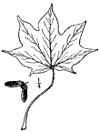
À. Læ̀tum.
9. Àcer Læ̀tum. (Colchicum-leaved Maple.) Leaves 5- to 7-lobed, scarcely heart-shaped at base, smooth and green on both sides; juice milky; the lobes usually without any notches or irregularities, sometimes with about three winding sinuations. Flowers in erect corymbs. Differs from Acer platanoides in having the lobes of the leaves more nearly entire, and the fruit much smaller with wings not so broadly spreading.
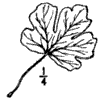
À. campéstre.
10. Àcer campéstre, L. (English or Cork-bark Maple.) Leaves cordate, with usually 5 roundish lobes, sparingly crenate or rather undulated; juice milky. Racemes of flowers erect, appearing after the leaves in spring. Wings of the fruit broadly spreading; fruit ripening very late. A low (15 to 30 ft. high), round-headed tree, with the twigs and smaller branches covered with corky bark. Occasionally cultivated; from Europe.
Var. variegatum has white blotched leaves.
À. palmàtum.
11. Àcer palmàtum, Thunb. (Palmate-leaved Japan Maple.) Leaves small, smooth, palmately parted into 5 to 9 quite regularly serrated lobes. Flowers in small umbels. A very low tree, almost a shrub; cultivated; from Japan; probably hardy throughout. There are a great number of Japan Maples, many of them probably varieties of this species, others hybrids. The leaves of some are so divided and dissected as to form merely a fringe or feather. In color they range from pure green to the richest reds.
À. circinàtum.
12. Àcer circinàtum, Pursh. (Round-leaved or Vine Maple.) Leaves orbicular, with 7 to 11 serrated, acute lobes, a heart-shaped base, reddish-green color, and both surfaces smooth. Corymbs of purplish flowers, small and hanging on long peduncles; appearing after the leaves. Wings of the fruit diverging in a straight line. A small tree or tall shrub, 10 to 30 ft. high, of spreading habit, with smooth bark, and pale brown twigs; cultivated; from the Pacific coast of North America.
À. Tartáricum.
13. Àcer Tartáricum, L. (Tartarian Maple.) Leaves ovate, slightly cordate, rarely lobed, serrated, light-colored, expanding very early in the spring. Panicle of greenish-yellow flowers erect, blooming after the leaves have expanded. Wings of the fruit parallel or sometimes touching. A small tree, sometimes shrubby in growth, of irregular form, with brown twigs; rarely cultivated; from Europe.
Genus 26. NEGÚNDO.
Leaves pinnate, of 3 to 5 leaflets. Flowers rather inconspicuous. Fruit a two-winged key as in Acer, in drooping racemes.
N. aceroìdes.
Negúndo aceroìdes, Moench. (Ash-leaved Maple. Box-elder.) Leaves pinnate, of 3 to 5 (rarely 7) coarsely and sparingly toothed leaflets. Flowers staminate and pistillate on separate trees, in drooping clusters rather earlier than the leaves. Fruit on only a portion of the trees; wings forming less than a right angle. A rather small (30 to 60 ft. high), rapidly growing tree, with light pea-green twigs; wild from Pennsylvania and south, and cultivated throughout.
Var. Californicum, Torr. and Gray (the under drawing in the figure), has leaflets more deeply cut, thicker, and quite hairy; it is occasionally cultivated.
Order XVI. ANACARDIÁCEÆ.
(Cashew Family.)
Trees and shrubs, mainly of the tropical regions, here represented by only one genus:
Genus 27. RHÚS.
Low trees or shrubs with acrid, often poisonous, usually milky juice, and dotless, alternate, usually pinnately compound leaves. Flowers greenish-white or yellowish, in large terminal panicles. Fruit small (1/8 in.), indehiscent, dry drupes in large clusters, generally remaining on through the autumn.
* Leaves simple, rounded, entire 6, 7.
* Leaves once-pinnate. (A.)
A. Twigs very hairy; rachis not winged; leaflets 11 to 31 1.
A. Twigs downy; rachis wing-margined; leaflets entire or nearly so 3.
A. Twigs smooth. (B.)
B. Rachis of leaf broadly winged; leaflets serrate 5.
B. Rachis not winged. (C.)
C. Leaflets 11 to 31, serrate; fruit hairy 2.
C. Leaflets 7 to 13, entire; fruit smooth; poisonous 4.
* Leaves twice-pinnate; variety under 2.
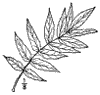
R. týphina.
1. Rhús týphina, L. (Stag-horn Sumac.) Leaflets 11 to 31, oblong-lanceolate, pointed, serrate (rarely laciniate), pale beneath. Branches and footstalks densely hairy. Fruit globular, in large, dense, erect panicles, covered with crimson hairs. Shrub or tree, 10 to 30 ft. high. It is very common along fences and on hillsides. The wood is orange-colored and brittle.
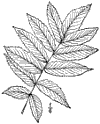
R. glàbra.
2. Rhús glàbra, L. (Smooth Sumac.) Leaflets 11 to 31, lanceolate-oblong, pointed, serrate, smooth, glaucous white beneath. Branches not hairy. Fruit globular, in a rather open, spreading cluster, covered densely with crimson hairs. A shrubby plant, 2 to 12 ft. high, found quite abundantly in rocky or barren soil throughout.
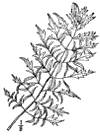
R. laciniàta.
Var. laciniata is frequently planted for ornament. It has very irregularly twice-pinnate leaves drooping gracefully from the branches.
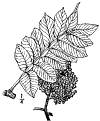
R. copallìna.
3. Rhús copallìna, L. (Dwarf Mountain Sumac.) Branches and stalks downy; leafstalk wing-margined between the 9 to 21 oblong-lanceolate, usually entire leaflets, which are oblique at base and smooth and shining above. Wild in rocky hills throughout; often cultivated. North, a beautiful shrub; south, a tree. 2 to 25 ft. high.
R. venenàta.
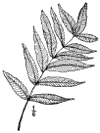
4. Rhús venenàta, DC. (Poison-sumac. Poison-dogwood. Poison-elder.) Leaflets 7 to 13, obovate-oblong, entire, abruptly pointed, smooth or nearly so. Fruit small, globular, smooth, dun-colored, in loose axillary panicles hanging on late in winter; the stone striate. This is a very poisonous species (to the touch), 6 to 18 ft. high, growing in swamps. Rarely at all tree-like.
R. Osbéckii.
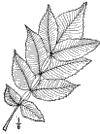
5. Rhús Osbéckii, DC. (Chinese Sumac.) Leaves very large, pinnate, assuming in autumn a rich reddish-fawn or orange color; the leafstalk broadly winged between the leaflets; leaflets serrate. A small ornamental tree, 10 to 25 ft. high; cultivated; from China; quite hardy in the Northern States.
R. Cótinus.
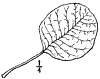
6. Rhús Cótinus, L. (Smoke-tree. Venetian Sumac.) Leaves smooth, obovate, entire, on slender petioles. Flowers greenish, minute, in terminal or axillary panicles. Fruit seldom found. Usually most of the flowers are abortive, while their pedicels lengthen, branch, and form long feather-like hairs, making large cloud-like branches that look somewhat like smoke (whence the name). A shrub or small tree, 6 to 10 ft. high, often planted for ornament; from Europe.
R. cotinoìdes.
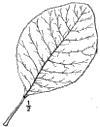
7. Rhús cotinoìdes, Nutt. (American Smoke-tree.) Leaves thin, oval, obtuse, entire, acute at base, 3 to 6 in. long, smooth or nearly so. Flowers and fruit like those of the cultivated species (Rhus Cotinus). A tree 20 to 40 ft. high; stem sometimes a foot or more in diameter in the Southern States; wild in Tennessee, west and south. Rare in cultivation.
Order XVII. LEGUMINOSÆ. (Pulse Family.)
A very large order of plants, mainly herbaceous; found in all climates. A few are shrubby, and others are from small to large trees.
Genus 28. LABÚRNUM.
Low trees or shrubs with alternate, palmate leaves of three leaflets. Flowers conspicuous, pea-blossom-shaped, in long hanging racemes, in late spring. Fruit pea-pod-shaped, dark brown, and many-seeded; ripe in autumn.
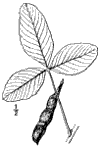
L. vulgàre.
Labúrnum vulgàre. (Laburnum. Golden-chain. Bean-trefoil Tree.) Leaves petiolate, with 3 ovate-lanceolate leaflets, pubescent beneath. Flowers bright yellow, nearly 1 in. long, in long (1 ft.), pendulous, simple racemes; in late spring. Pods 2 in. long, linear, many-seeded, covered with closely appressed pubescence; one edge thick; ripe in autumn. A low, very ornamental tree, 10 to 20 ft. high, often cultivated; from Switzerland. Varieties with reddish, purple, and white flowers are also in cultivation.
Var. alpinus has smooth pods.
Genus 29. CARAGÀNA.
Leaves alternate, deciduous, abruptly once-pinnate; leaflets mucronate; stipules usually spinescent. Flowers pea-flower-shaped, mostly yellow. Trees or shrubs of Asia.
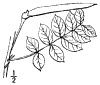
C. arboréscens.
Caragàna arboréscens, Larn. (Pea-tree.) Leaves with 4 to 6 pairs of oval-oblong, mucronate-pointed, hairy leaflets; petioles unarmed; stipules spinescent. Flowers yellow, blooming in May. Pods brown, ripe in August. A low, stiff, erect tree, 10 to 15 ft. high; in poor soil a bush. From Siberia; frequent in cultivation.
Genus 30. CLADRÁSTIS.
Small tree with alternate, odd-pinnate leaves, the base of the petiole hollow, and inclosing the leaf-buds of the next year. Flowers large, pea-blossom-like in shape, in large clusters. Fruit pea-pod-like in shape and size. Wood light yellow, firm and hard.
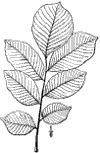
C. tinctòria.
Cladrástis tinctòria, Raf. (Yellow-wood.) Leaflets 7 to 11, oval to ovate, 3 to 4 in. long, beautiful light green in color. Flowers 1 in. long, white, not so fragrant as the common Locust, in hanging panicles 10 to 20 in. long; blooming in June. Pods 2 in. long, ripe in August. Wild but rare in Kentucky and south. A beautiful tree, 20 to 50 ft. high, with very smooth grayish bark; rarely cultivated.
Genus 31. ROBÍNIA.
Trees or shrubs with alternate, odd-pinnate leaves, having spines on each side of the stalk in place of stipules. Leafstalk thickened near the base, and covering 2 to 3 buds for the growth of a branch for the next year. An axillary bud also found that may produce a branch the same year as the leaf. Flowers large, pea-blossom-shaped, in large clusters. Fruit a pea-shaped pod.
* Branchlets and leafstalks not sticky 1.
* Branchlets and leafstalks sticky 2.
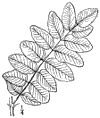
R. Pseudacácia.
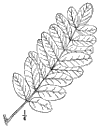
1. Robínia Pseudacácia, L. (Common Locust.) Leaflets 9 to 19, small, oblong-ovate, entire, thin. Twigs purplish-brown, slender, smooth, not sticky. Flowers white, fragrant, in hanging racemes, 3 to 6 in. long. June. Pods flat, smooth, purplish-brown, ripe in September. An irregularly growing, slender tree, 70 to 80 ft. high, with white or greenish-yellow, very durable wood, and on old trees very rough bark with long, deep furrows. Native; Pennsylvania, west and south, and extensively planted and naturalized throughout. A number of varieties, some of which are thornless, are in cultivation.
R. viscòsa.
2. Robínia viscòsa, Vent. (Clammy Locust.) Leaflets 11 to 25, ovate-oblong, sometimes slightly heart-shaped at base, tipped with a short bristle. Twigs and leafstalks sticky to the touch. Flowers in a short, rather compact, upright raceme, rose-colored and inodorous. A small tree, 30 to 40 ft. high; native south, and has been quite extensively cultivated north.
3. Robínia híspida, L. (Bristly Locust. Rose-acacia.), with bristly leafstalks and branchlets, and large rose-colored flowers, is only a bush. Often cultivated. Wild from Virginia and south.
Genus 32. CÉRCIS.
Small trees or shrubs, with alternate, simple, heart-shaped leaves. Flowers in umbel-like clusters along the branches, appearing before the leaves, and shaped like pea-blossoms. Fruit pea-like pods, remaining on the tree throughout the year. Wood hard, heavy, and beautifully blotched or waved with black, green, and yellow, on a gray ground.
C. Canadénsis.
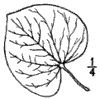
1. Cércis Canadénsis, L. (Judas-tree. Redbud.) Leaves acutely pointed, smooth, dark green, glossy. Flowers bright red-purple. Pods nearly sessile, 3 to 4 in. long, brown when ripe in August. A small ornamental tree, 10 to 30 ft. high, with smooth bark and hard apple-tree-like wood; wild from Central New York southward, and often cultivated.
2. Cércis siliquástrum (European Judas-tree.), from Europe, with obtusely pointed, somewhat kidney-shaped leaves, and white to purple flowers, is sometimes cultivated. It is not so tall or tree-like as the American species.
Genus 33. GYMNÓCLADUS.
Tall trees with alternate, very large (2 to 4 ft. long), unequally twice-pinnate leaves. Flowers white, conspicuous, in racemes at the ends of the branches. Fruit a large pea-like pod. Some trees are without fruit through the abortion of the pistils.
G. Canadénsis.
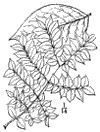
Gymnócladus Canadénsis, Lam. (Kentucky Coffee-tree.) Leaves 2 to 3 ft. long, often with the lower pinnæ simple and the upper pinnate. Leaflets ovate, of a dull bluish-green color. Shoots cane-like, blunt and stubby, quite erect. Bark exceedingly rough. Pod large, 6 to 10 in. long, 2 in. broad, with seeds over ½ in. across. A large (50 to 80 ft. high) tree with compact, tough, reddish wood. Wild from western New York southwestward, and occasionally cultivated as an ornamental tree.
Genus 34. GLEDÍTSCHIA.
Usually thorny trees with alternate, once to twice abruptly pinnate leaves. Flowers inconspicuous, greenish, in small spikes. Summer. Fruit a small or large pea-like pod, with one to many seeds; ripe in autumn, but often hanging on the trees through the winter.
G. triacánthos.
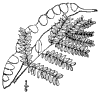
1. Gledítschia triacánthos, L. (Honey-locust.) Leaflets lanceolate-oblong, somewhat serrate. Pods linear, 1 to 1½ ft. long, often twisted, filled with sweet pulp between the seeds. A large, handsome, clean tree, with usually many stout, much-branched thorns, especially abundant on bruised portions of the trunk and large branches; thorns compressed at base. Wild from Pennsylvania southward and westward, and extensively cultivated throughout.
A variety without thorns is frequently met with (var. inermis), also one with drooping foliage (var. Bujotii pendula).
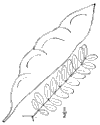
G. aquática.
2. Gledítschia aquática, Marsh. (Water-locust.) Leaflets ovate or oblong. Pods oval, 1 to 4 in. long, 1- to few-seeded, without pulp. A small tree with few slender, usually simple thorns; in swamps in southern Illinois and south. Occasionally planted for ornament. This species is quite similar to the preceding one, but the leaves are somewhat smaller, the thorns, though occasionally branching, do not branch so extensively, and the pod is very short and rounded.
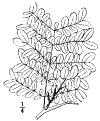
G. sinénsis.
3. Gledítschia sinénsis, Lam. (Chinese Honey-locust.) A tree with stouter and more conical thorns, broader and more oval leaflets. A medium-sized or small tree, often cultivated. This species, like the others, has a thornless variety.
Genus 35. ALBÍZZIA.
Trees or shrubs with abruptly pinnate leaves. Fruit a broad-linear straight pod.
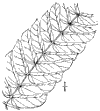
A. julibríssin.
Albízzia julibríssin, Boivin. (Silk-tree.) Leaves twice abruptly pinnate, of many (over 400) leaflets; leaflets semi-oblong, curved, entire, acute, with the midrib near the upper edge. Flowers in globose heads forming panicles. Fruit plain pods on short stems. A very beautiful small tree, introduced from Japan; probably not hardy north of Washington. The figure shows only one of the lowest and shortest side divisions (pinnæ) of the leaf. The pinnæ increase in length and number of leaflets to the end of the leaf.
Order XVIII. ROSACEÆ. (Rose Family.)
A large and very useful order of trees, shrubs, and herbs of temperate regions.
Genus 36. PRÙNUS.
Trees or shrubs with simple, alternate, deciduous, usually serrate, stipulate leaves, without lobes. The stems produce gum when injured. Foliage and nuts have flavor of peach-leaves. Flowers conspicuous, usually white, or light pink, often in clusters, peach-blossom-shaped; in early spring. Fruit in size from pea to peach, a rounded drupe with one stony-coated seed.
* Drupe large, soft velvety on the surface; stone rough (Peach, Apricot) 1.
* Drupe medium, covered with a bloom; stone smooth, flattened (Plums). (A.)
A. Usually thorny; wild, rarely cultivated. (B.)
B. Leaves acuminate 2, 3.
B. Leaves not acuminate 4, 5.
A. Not thorny; cultivated 6.
* Drupe medium to small, smooth, without bloom (Cherries). (C.)
C. Drupes clustered in umbels, ½-1 in. in diameter. (D.)
D. Small cultivated tree; drupe globose, rather large, very sour 9.
D. Large cultivated tree; drupe large, somewhat pitted at the stem 8.
D. Rather small, native tree; drupe small, flesh thin 7.
C. Drupes clustered in racemes, 1/8 - 1/3 in. in diameter. (E.)
E. Tall shrubs rather than trees; racemes short 11.
E. Trees; racemes quite elongated. (F.)
F. Stone of fruit somewhat roughened 12.
F. Stone smooth 10.
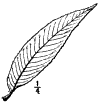
P. Pérsica.
1. Prùnus Pérsica, L. (Common Peach.) Leaves lanceolate, serrate. Flowers rose-colored, nearly sessile, very early in bloom. Fruit clothed with velvety down, large; stone rough-wrinkled. A small tree, 15 to 30 ft. high, cultivated in numberless varieties for its fruit. Var. lævis (Nectarine) has smooth-skinned fruit.
P. Americàna.
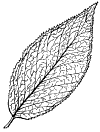
2. Prùnus Americàna, Marsh. (Wild Yellow or Red Plum.) Leaves ovate or somewhat obovate, conspicuously pointed, coarsely or doubly serrate, very veiny, smooth when mature. Fruit with little or no bloom, ½ to 1 in. in diameter, yellow, orange, or red; skin tough and bitter. Stone with two sharp edges. A small, thorny tree, 8 to 20 ft. high, common in woodlands and on river-banks. Many improved varieties, some thornless, are in cultivation. Wood reddish color.
P. Alleghaniénsis.
3. Prùnus Alleghaniénsis, Porter. (Alleghany Plum.) Leaves lanceolate to oblong-ovate, often long-acuminate, finely and sharply serrate, softly pubescent when young, smooth when old; fruit globose-ovoid, under ½ in., very dark purple, with a bloom; stone turgid, a shallow groove on one side and a broad, flat ridge on the other. A low, straggling bush, occasionally a tree, 3 to 15 ft. high. Mountains of Pennsylvania.
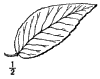
P. Chicàsa.
4. Prùnus Chicàsa, Michx. (Chicasaw Plum.) Leaves long, narrow, almost lanceolate, acute, finely serrate, thin. Flowers on short stalks. Fruit globular, ½ to 2/3 in. in diameter, thin-skinned, without bloom, yellowish-red, pleasant to taste. Stone globular, without sharp edges. A thorny shrub or small tree, 6 to 15 ft. high; wild in New Jersey, west and south, and often cultivated.
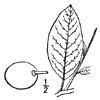
P. spinòsa.
5. Prùnus spinòsa, L. (Sloe. Blackthorn. Bullace Plum.) Leaves obovate-oblong to lance-oblong, sharply serrate, soon smooth; leafstalk smooth; fruit small, globular, black, with a bloom; the stone rounded, acute at one edge; flesh greenish, astringent. A low tree with thorny branches; it is becoming naturalized along roadsides and waste places; from Europe. Var. instititia (Bullace Plum) is less thorny, and has the leafstalk and lower side of the leaves pubescent.
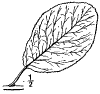
P. doméstica.
6. Prùnus doméstica, L. (Common Garden Plum.) Leaves 1 to 3 in. long, oval or ovate-lanceolate, acute to obtuse. Flowers white, nearly solitary. Drupe globular, obovoid to ovoid, of many colors (black, white, etc.), covered with a rich glaucous bloom. A small tree, 10 to 20 ft. high, in cultivation everywhere for its fruit. Over a hundred varieties are named in the catalogues.
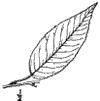
P. Pennsylvánica.
7. Prùnus Pennsylvánica, L. f. (Wild Red Cherry.) Leaves oblong-lanceolate, pointed, finely and sharply serrate, shining green, smooth on both sides. Flowers many in an umbel on long stems. Fruit round, light red, quite small, ¼ in. in diameter, sour. A small tree, 20 to 30 ft. high, in rocky woods; common north and extending southward along the Alleghanies to North Carolina.
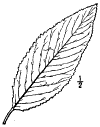
P. àvium.
8. Prùnus àvium, L. (Bird-cherry or English Cherry.) Leaves oval-lanceolate, sharp-pointed, coarsely or doubly serrate. Flowers in sessile umbels, opening when the leaves appear. Fruit of various colors, somewhat heart-shaped. This is the Cherry tree, 30 to 50 ft. high, of which there are many named varieties usually cultivated for the fruit.
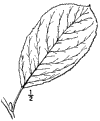
P. Cérasus.
9. Prùnus Cérasus, L. (Garden Red Cherry. Morello Cherry.) Leaves obovate and lance-ovate, serrate, on slender spreading branches. Flowers rather large. Fruit globular, bright red to dark purple, very sour; in sessile umbels. A small, round-headed tree, 10 to 30 ft. high, often cultivated. The preceding species and this one are the parents of most of the Cherry trees in cultivation.
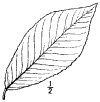
P. serótina.
10. Prùnus serótina, Ehrh. (Wild Black Cherry.) Leaves oblong or lance-oblong, thickish, smooth, usually taper-pointed, serrate, with incurved, short, thick teeth. Flowers in long racemes. June. Fruit as large as peas, purple-black, bitter; ripe in autumn. A fine tree, 15 to 60 ft. high, with reddish-brown branches. Wood reddish and valuable for cabinet-work. Common in woodlands and along fences.
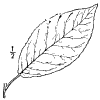
P. Virginiàna.
11. Prùnus Virginiàna, L. (Choke-cherry.) Leaves thin, oval-oblong or obovate, abruptly pointed, very sharply, often doubly serrate, with slender teeth. Racemes of flowers and fruit short and close. Fruit dark crimson, stone smooth. Flowers in May; fruit ripe in August; not edible till fully ripe. A tall shrub, sometimes a tree, with grayish bark. River-banks, common especially northward.
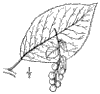
P. Pàdus.
12. Prùnus Pàdus, L. (Small Bird-cherry.) Like Prunus Virginiana, excepting that the racemes are longer and drooping, and the stone is roughened. Occasionally planted for ornament.
Genus 37. PỲRUS.
Trees and shrubs, with alternate, stipulate, simple, or pinnately compound leaves. Flowers conspicuous, white to pink, apple-blossom-shaped (5 petals); in spring. Fruit a fleshy pome, with the cells formed by papery or cartilaginous membranes within juicy flesh.
* Leaves deeply pinnatifid or fully pinnate (Mountain Ashes) (A.)
A. Leaf deeply pinnatifid, sometimes fully divided at the base. 6.
A. Leaf once-pinnate throughout. (B.)
B. Leaf-buds pointed, smooth and somewhat glutinous 7.
B. Leaf-buds more or less hairy 8, 9.
* Leaves simple and not pinnatifid. (C.)
C. Leaves entire; fruit solitary (Quinces) 5.
C. Leaves serrate; fruit clustered. (D.)
D. Fruit large, sunken at both ends (Apples) 1.
D. Fruit small (½-1 in.), sour, much sunken at the stem end and but little at the other (Crab-apples). (E.)
E. Leaves very narrow; fruit ½ in. 2.
E. Leaves broad; fruit 1 in. 3.
D. Fruit usually obovate, not sunken at the stem end (Pears). 4.
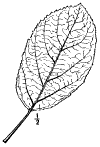
P. Màlus.
1. Pỳrus Màlus, L. (Common Apple-tree.) Leaves simple, ovate, evenly crenate or serrate, smooth on the upper surface and woolly on the lower. Flowers large (1 in.), white, tinged with pink, in small corymbs. May. Fruit large, sunken at both ends, especially at base; ripe from August to October, according to variety. A flat-topped tree, 20 to 40 ft. high, cultivated in hundreds of named varieties; from Europe.
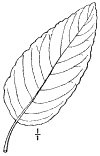
P. angustifòlia.
2. Pỳrus angustifòlia, Ait. (Narrow-leaved Crab-apple.) Leaves simple, lanceolate or oblong, often acute at base, mostly serrate, smooth. Flowers large (2/3 in.), rose-colored, fragrant, in small, simple, umbel-like clusters. Fruit very sour, small (½ in.). Twigs lead-colored and speckled. A small tree, 12 to 20 ft. high. Pennsylvania and southward.
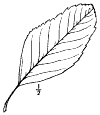
P. coronària.
3. Pỳrus coronària, L. (American or Garland Crab-apple.) Leaves simple, ovate, often rather heart-shaped, cut-serrate, often 3-lobed, soon smooth. Flowers large (¾ in.), few, in a cluster, rose-colored, very fragrant. Fruit very sour and astringent, flattened, broad, 1 in. or more in diameter, yellowish green. Small tree, 10 to 25 ft. high; New York, west and south, also frequently cultivated.
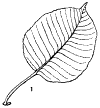
P. commùnis.
4. Pỳrus commùnis, L. (Common Pear-tree.) Leaves simple, ovate, serrate, smooth on both sides, at least when mature. Flowers large (over 1 in.), white, with purple anthers. April and May. Fruit large, usually obovate and mainly sunken at the large end; ripe July to October, according to the variety. A pyramidal-shaped tree, 30 to 70 ft. high, with smooth bark and often somewhat thorny branches. Of several hundred named varieties, native to Europe. Cultivated for its fruit. Wood slightly tinged with red; strong, and of fine grain.
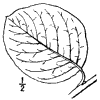
P. vulgàris.
5. Pỳrus vulgàris. (Quince. Common Quince-tree.) Leaves ovate, obtuse at base, entire, hairy beneath. Flowers solitary, large, 1 in., white or pale rose-color. Fruit large, hard, orange-yellow, of peculiar sour flavor; seeds mucilaginous; ripens in October. A low tree, 10 to 20 ft. high, with a crooked stem and rambling branches; from Europe. Several varieties in cultivation.
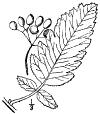
P. pinnatífida.
6. Pỳrus pinnatífida, Ehrh. (Oak-leaved Mountain-ash.) Leaves pinnately cleft and often fully pinnate at base, hairy beneath. Pome globose, ¼ in., scarlet, ripe in autumn. A cultivated tree, 20 to 30 ft. high; from Europe.
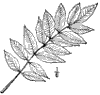
P. Americàna.
7. Pỳrus Americàna, DC. (American Mountain-ash.) Leaflets 13 to 15, lanceolate, bright green, nearly smooth, taper-pointed, sharply serrate with pointed teeth. Leaf-buds pointed, glabrous and somewhat glutinous. Flowers white, 1/3 in., in large, flat, compound cymes. In June. Fruit berry-like pomes, the size of small peas, bright scarlet when ripe in September, and hanging on the tree till winter. A tall shrub or tree, 15 to 30 ft. high, in swamps and mountain woods; more abundant northward. Often cultivated for the showy clusters of berries in autumn.
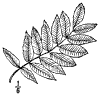
P. sambucifòlia.
8. Pỳrus sambucifòlia, Cham. & Schlecht. (Elder-leaved Mountain-ash.) Leaflets oblong, oval or lance-ovate, obtuse (sometimes abruptly sharp-pointed), usually doubly serrate with rather spreading teeth, generally pale beneath. Leaf-buds somewhat hairy. Flowers and berries larger, but in smaller clusters, than the preceding species. The berries globose when ripe, 1/3 in. broad, bright red. This species, much like Pyrus Americana, is found wild in northern New England and westward.
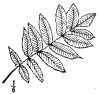
P. aucupària.
9. Pỳrus aucupària, Gaertn. (European Mountain-ash, or Rowan-tree.) Much like Pyrus Americana, but the leaflets are paler and more obtuse, with their lower surface downy. Leaf-buds blunter and densely covered with hairs. Flowers larger, ½ in. or more in diameter. Fruit also much larger, sometimes nearly ½ in. in diameter. Beautiful tree, 20 to 30 ft. high, often cultivated.
Genus 38. CRATÆ̀GUS.
Thorny shrubs or small trees with simple, alternate, serrate, doubly serrate or lobed leaves. Flowers cherry-like blossoms, usually white in color and growing in corymbs, generally on the ends of side shoots; in spring. Fruit a berry or drupe with 1 to 5 bony stones, tipped with the 5 persistent calyx-teeth; ripe in autumn.
* Calyx, stipules, bracts, etc., often glandular. (A.)
A. Flowers and fruit often over 6 in a cluster. (B.)
B. Leaves usually abrupt at base 1.
B. Leaves usually attenuate at base 2.
A. Flowers and fruit few, 1 to 6 in a cluster 10.
* Calyx, etc., without glands (No. 4 has glandular teeth to the calyx); flowers many in a cluster. (C.)
C. Leaves more or less tapering at base. (D.)
D. Leaves generally lobed; cultivated, rarely escaped 3.
D. Leaves rarely lobed; native. (E.)
E. Leaves small, shining, crenate at the end 5.
E. Leaves villous or pubescent, at least when young 9.
E. Leaves smooth or only downy at the axils, acutely serrate. South 7.
C. Leaves usually abrupt at base, sometimes cordate. (F.)
F. Leaves downy when young. (G.)
G. Leaves usually lobed 4.
G. Leaves rarely lobed; veins very prominent 8.
F. Leaves quite smooth 6.
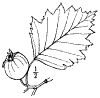
C. coccínea.
1. Cratæ̀gus coccínea, L. (Scarlet-fruited Thorn.) Leaves bright green, smooth, thin, roundish-ovate, sharply cut-toothed or lobed, on slender petioles. Branches reddish, villous-pubescent; spines stout, chestnut-brown. Flowers large, ½ to 2/3 in., many in a corymb, on glandular peduncles. May to June. Fruit scarlet, round or pear-shaped, ½ in.; ripe in September, with from 1 to 5 cells and seeds. Tall shrub or low tree, 10 to 25 ft. high, in hedges and woods; common from Canada to Florida.
Var. mollis has the shoots densely pubescent; leaves large, slender-petioled, cuneate, cordate or truncate at base, usually with acute narrow lobes, often rough above, and more or less densely pubescent beneath. Flowers large, 1 in.; fruit light scarlet with a light bloom, 1 in. broad.
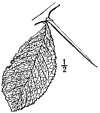
C. Crus-gálli.
2. Cratæ̀gus Crus-gálli, L. (Cockspur Thorn.) Leaves smooth, thick, shining above, wedge-obovate, finely serrate above the middle, with a short petiole. There are broad and narrow-leaved varieties. Flowers large and numerous, in lateral corymbs. May to June. Fruit globular, 1/3 in. broad, dull red; ripe in September and October. A small tree with a flat, bushy head, horizontal branches, and long, sharp thorns. Wild and common throughout, and often planted.
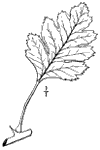
C. oxyacántha.
3. Cratæ̀gus oxyacántha. (English Hawthorn.) Leaves obovate, smooth, wedge-shaped at base, cut-lobed and toothed above. No glands. Flowers medium-sized, ½ in., single or double, white, rose, or pink-red, numerous in corymbs. In spring. Fruit coral-red, 1/3 in.; ripe in autumn. A small tree or shrub, fine for lawn; from Europe; also escaped in some places.
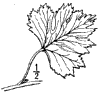
C. apiifólia.
4. Cratæ̀gus apiifólia, Michx. (Parsley-leaved Thorn.) Leaves small, ovate, with a broad truncate or heart-shaped base, pinnatifid into 5 to 7 crowded, irregularly toothed lobes; white and soft-downy when young, smoothish when grown; petioles slender. Flowers medium-sized, ½ in., many in a corymb, white. May to June. Fruit small, 1/3 in., coral-red, ripe in autumn. A handsome, low (10 to 20 ft. high), spreading tree, with flexible branches and white-downy twigs. Virginia and south, in moist woods.
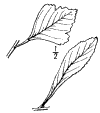
C. spathulàta.
5. Cratæ̀gus spathulàta, Michx. (Spatulate-leaved Thorn.) Leaves almost evergreen, thick, shining, spatulate, crenate toward the apex and nearly sessile, those on the young downy branches somewhat cut or lobed. Flowers small, ½ in., in large clusters. May. Fruit small, ¼ in., bright red; ripe in October. A small tree, 12 to 25 ft. high; Virginia and south.
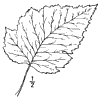
C. cordàta.
6. Cratæ̀gus cordàta, Ait. (Washington Thorn.) Leaves broadly triangular-ovate, somewhat heart-shaped, thin, deep shining green, smooth, often 3- to 5-lobed and serrate, on slender petioles. Flowers small, 2/5 in., many in terminal corymbs, white. May, June. Fruit scarlet, about the size of peas; ripe in September. A compact, close-headed, small tree, 15 to 25 ft. high, with many slender thorns. Virginia, Kentucky, and southward. Sometimes planted in the North for hedges.
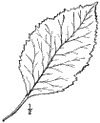
C. víridis.
7. Cratæ̀gus víridis, L. (Tall Hawthorn.) Leaves ovate to ovate-oblong, or lanceolate, or oblong-obovate, mostly acute at both ends, on slender petioles; acutely serrate, often somewhat lobed and often downy in the axils. Flowers numerous, in large clusters. Fruit bright red, or orange, ovoid, small, ¼ in. broad. A small tree, 20 to 30 ft. high, with few large thorns or without thorns. Southern Illinois and Missouri, along the Mississippi and in the Southern States.
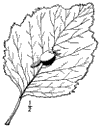
C. tomentòsa.
8. Cratægus tomentòsa, L. (Black or Pear Hawthorn.) Leaves downy-pubescent on the lower side (at least when young), thickish, rather large, oval or ovate-oblong, sharply toothed and often cut-lobed below, abruptly narrowed into a margined petiole, the upper surface impressed along the main veins or ribs. Branches gray. Flowers ill-scented, many in a corymb. Fruit ½ in. long, obovate to globose, dull red. Shrub or tree, 10 to 30 ft. high, wild in western New York, west and south.
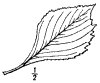
C. punctàta.
9. Cratæ̀gus punctàta. (Dotted-fruited Hawthorn.) Leaves rather small, mostly wedge-obovate, attenuate and entire below, unequally toothed above, rarely lobed, villous-pubescent, becoming smooth but dull, the veins prominent beneath and impressed above. Fruit globose, large, 1 in. broad, red to bright yellow; peduncles not glandular. Shrub to tree, 10 to 20 ft. high, with horizontal branches; Canada to Georgia.
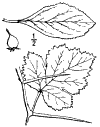
C. flàva.
10. Cratæ̀gus flàva, Ait. (Yellow or Summer Haw.) Leaves small, wedge-obovate, unequally toothed and cut above the middle; on short petioles; the teeth, stipules and petioles glandular. Flowers mostly solitary, white, large (¾ in). May. Fruit usually pear-shaped, quite large (¾ in. long), yellow or greenish-yellow, sometimes tinged or spotted with red, pleasant-flavored. Ripe in autumn. A low spreading tree, 15 to 20 ft. high. Virginia, south and west, in sandy soil.
Var. pubescens is downy-or villous-pubescent when young, and has thicker leaves and larger and redder fruit.
Genus 39. AMELÁNCHIER.
Small trees or shrubs with simple, deciduous, alternate, sharply serrate leaves; cherry-blossom-like, white flowers, in racemes at the end of the branches, before the leaves are fully expanded. Fruit a small apple-like pome; seeds 10 or less, in separate cartilaginous-coated cells.
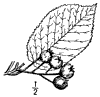
A. Canadénsis.
Amelánchier Canadénsis, Torr. & Gray. (Shad-bush. Service-berry.) A very variable species with many named varieties. The leaves, 1 to 3½ in. long, vary from narrow-oblong to roundish or cordate; bracts and stipules silky-ciliate. Flowers large, in drooping racemes, in early spring, with petals from 2 to 5 times as long as wide. Fruit globular, ½ in. broad, purplish, sweet, edible; ripe in June. It varies from a low shrub to a middle-sized tree, 5 to 30 ft. high.
Order XIX. HAMAMELÍDEÆ.
(Witch-Hazel Family.)
A small family of trees and shrubs represented in most countries.
Genus 40. HAMAMÈLIS.
Tall shrubs, rarely tree-like, with alternate, straight-veined, 2-ranked, oval, wavy-margined leaves. Flowers conspicuous, yellow, 4-parted; blooming in the autumn while the leaves are dropping, and continuing in bloom through part of the winter. Fruit rounded capsules which do not ripen till the next summer.
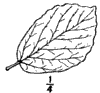
H. Virginiána.
Hamamèlis Virginiána, L. (Witch-hazel.) The only species; 10 to 30 ft. high; rarely grows with a single trunk, but usually forms a slender, crooked-branched shrub. Flowers sessile, in small clusters of 3 to 4, in an involucre in the axils of the leaves.
Genus 41. LIQUIDÁMBAR.
Trees with alternate, simple, palmately cleft leaves. Flowers inconspicuous; in spring. Fruit a large (1 in.), globular, long-stalked, dry, open, rough catkin, hanging on the tree through the winter.
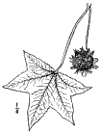
L. Styracíflua.
Liquidámbar Styracíflua, L. (Sweet Gum. Bilsted.) Leaves rounded, deeply 5- to 7-cleft, star-shaped, dark green, smooth and shining, glandular-serrate. Twigs often covered with corky ridges. A large, beautiful tree, 30 to 70 ft. high, with deeply furrowed bark. Connecticut, west and south; abundant south of 40° N. Lat. Well worthy of more extensive cultivation than it has yet received.
Order XX. LYTHRÀCEÆ.
(Loosestrife Family.)
A small order of shrubs, herbs, or trees; mainly tropical.
Genus 42. PÙNICA.
Leaves simple, usually opposite, deciduous; flowers scarlet, with 5 petals and numerous stamens; fruit a many-seeded berry.
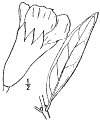
P. granàtum.
Pùnica granàtum, L. (Pomegranate-tree.) Leaves opposite, lanceolate, smooth, entire; flowers large, both calyx and corolla scarlet and very ornamental; the fruit as large as an orange, fine-flavored. A tree-shaped plant, growing to the height of 20 ft. in the Southern States. If given some protection, it can be grown as far north as Washington. It has been cultivated from the earliest times, and is probably a native of western Asia.
Genus 43. LAGERSTRŒ̀MIA.
Flowers with 6 long-clawed petals inserted on the broadly spreading calyx; fruit 3- to 6-celled pods with many winged seeds.
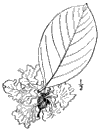
L. Índica.
Lagerstrœ̀mia Índica, L. (Crape-myrtle.) Leaves roundish-ovate, thick, smooth, short-petiolate; branches winged; flowers in terminal clusters with large, delicately crisped, long-stemmed petals of pink, purple, and other colors. A beautiful small tree, or usually a shrub, from India; often cultivated in the North in conservatories; hardy as far north as Washington.
Order XXI. ARALIÀCEÆ. (Ginseng Family.)
A small order of herbs, shrubs, and trees, here represented by the following genus:
Genus 44. ARÀLIA.
Herbs, shrubs, or trees, with pinnately or palmately compound leaves; here including Acanthopanax with palmately cleft leaves. Flowers whitish or greenish, in umbels, often forming large panicles. Fruit small, berry-like, several-celled, several-seeded.
* Leaves 2 to 3 times odd-pinnate (Aralia proper) 1, 2.
* Leaves simple, palmately cleft (Acanthopanax) 3.
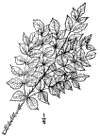
A. spinòsa.
1. Aràlia spinòsa, L. (Angelica-tree. Hercules'-Club.) Leaves large, crowded at the summit of the stem, twice or sometimes thrice odd-pinnate, usually prickly, with sessile, ovate, acuminate, deeply serrate leaflets, glaucous beneath. Large panicles of small whitish flowers in umbels, with involucres of few leaves. Berry small, ¼ in., 5-ribbed, crowned with the remains of the calyx. A tree-like plant, 8 to 12 ft. high, or in the Gulf States 30 ft. high, with the stem covered with numerous prickles. Usually dies to the ground after flowering. Wild in damp woods, Pennsylvania and south, and cultivated in the North.
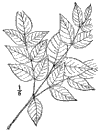
A. Chinénsis.
2. Aràlia Chinénsis. Leaves more or less fully twice-pinnate; leaflets ovate-oblong, oblique at base, acuminate, sharply serrate, hairy. Flowers and fruit in large, branching, hairy panicles; thorns few, straight. A small tree, 10 to 15 ft. high; occasionally cultivated; from China.
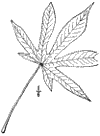
A. Maximowíczii.
3. Aràlia (Acanthópanax) Maximowíczii. Leaves long-petioled, simple, thick, palmately cleft, with 7 serrate lobes; old leaves smooth, the young with woolly bases. Panicles of flowers and fruit terminal; the berries striated. Tree-trunk usually quite prickly. This species is said to grow 50 ft. high in Japan. It has been recently introduced, and proves perfectly hardy in Massachusetts.
Order XXII. CORNÀCEÆ. (Dogwood Family.)
A small order of shrubs and trees (rarely herbs) of temperate regions.
Genus 45. CÓRNUS.
Small trees or shrubs (one species an herb) with simple, entire, curved-veined, and (except in one species) opposite leaves. The curved parallel ribs of the leaves in all the species are quite peculiar and readily recognized. Flowers small, of 4 petals, in some species rendered very conspicuous by large bracts. Fruit small, usually bright-colored drupes in clusters; ripe from August to October. There are but 3 species that grow at all tree-like.
* Leaves opposite. (A.)
A. Fruit in close head-like clusters, red when ripe 1.
A. Fruit in open clusters. (B.)
B. Branches bright red; fruit white 2.
B. Branches brownish; fruit bright red 3.
* Leaves alternate; fruit blue 4.
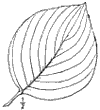
C. flórida.
1. Córnus flórida, L. (Flowering Dogwood.) Leaves ovate, pointed, acutish at base. Flowers in a head surrounded by 4 white bracts, making the whole cluster look like a single large flower 3 in. broad. Abundant in May and June. Fruit a small, bright red drupe with a single 2-seeded nut. Ripe in August. A large shrub or low tree 15 to 40 ft. high, with broad, roundish head. Common on high ground throughout, and one of the finest small trees in cultivation. A variety with the bracts quite red is also cultivated.
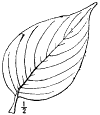
C. álba.
2. Córnus álba, L. (Siberian Red-stemmed Cornel.) Leaves broadly ovate, acute, densely pubescent beneath; drupes white; branches recurved, bright red, rendering the plant a conspicuous object in the winter. A shrub rather than a tree, cultivated from Siberia; hardy throughout.
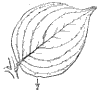
C. máscula.
3. Córnus máscula, Dur. (Cornelian Cherry.) Leaves opposite, oval-acuminate, rather pubescent on both surfaces. Flowers small, yellow, in umbels from a 4-leaved involucre, blooming before the leaves are out in spring. Fruit oval, ½ in. long, cornelian-colored, ripe in autumn, rather sweet, used in confectionery. A large shrub or low tree, 8 to 15 ft. high, with hard, tough, flexible wood, sometimes cultivated for its early flowers and late, beautiful fruit.
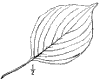
C. alternifòlia.
4. Córnus alternifòlia, L. f. (Alternate-leaved Cornel.) Leaves alternate, clustered at the ends of the branches, ovate or oval-acuminate, tapering at base, whitish with minute pubescence beneath. Cymes of flowers and fruit broad and open. Fruit deep blue on reddish stalks. Shrub, though occasionally tree-like, 8 to 25 ft. high; on hillsides throughout; rarely cultivated.
Genus 46. NÝSSA.
Trees with deciduous, alternate, exstipulate, usually entire leaves, mostly acute at both ends. Flowers somewhat diœcious, i.e. staminate and pistillate flowers on separate trees. The staminate flowers are quite conspicuous because so densely clustered. April and May. Fruit on but a portion of the trees, consisting of one or two small (¼ to ½ in.), drupes in the axils of the leaves. Stone roughened with grooves. Ripe in autumn.
* Fruit usually clustered 1, 2.
* Fruit solitary 3.
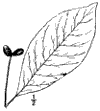
N. sylvática.
1. Nýssa sylvática, Marsh. (Pepperidge. Black or Sour Gum.) Leaves oval to obovate, pointed, entire (sometimes angulate-toothed beyond the middle), rather thick, shining above when old, 2 to 5 in. long. The leaves are crowded near the ends of the branches and flattened so as to appear 2-ranked, like the Beech; turning bright crimson in the autumn. Fruit ovoid, bluish-black, about ½ in. long, sour. Medium-sized tree with mainly an excurrent trunk and horizontal branches. Wood firm, close-grained and hard to split. Rich soil, latitude of Albany and southward. Difficult to transplant, so it is rarely cultivated.
2. Nýssa biflòra, Walt. (Sour Gum.) Leaves 1 to 3 in. long, smaller than in N. sylvatica; fertile flowers and fruit 1 to 3, in the axils; stone decidedly flattened and more strongly furrowed. New Jersey to Tennessee and southward. Too nearly like the last to need a drawing. All the species of Nyssa may have the margin of the leaves somewhat angulated, as shown in the next.
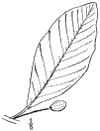
N. uniflòra.
3. Nýssa uniflòra, Wang. (Large Tupelo.) Leaves much larger, 4 to 12 in. long, sometimes slightly cordate at base, entire or angularly toothed, downy beneath. Fruit solitary, oblong, blue, 1 in. or more in length. Wood soft, that of the roots light and spongy and used for corks. In water or wet swamps; Virginia, Kentucky, and southward.
Order XXIII. CAPRIFOLIÀCEÆ.
(Honeysuckle Family.)
Shrubs (rarely herb or tree-like plants) of temperate regions.