PART III. KEY, CLASSIFICATION AND DESCRIPTION OF THE SPECIES. (continued 3)
Reading edition
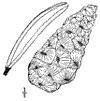
P. Banksiàna.
21. Pìnus Banksiàna, Lambert. (Gray or Northern Scrub Pine.) Leaves in twos, short, 1 in. long, oblique, divergent from a close sheath. Cones lateral, conical, oblong, usually curved, 1½ to 2 in. long, the scales thickened at the end and without points. A straggling shrub, sometimes a low tree, found wild in the extreme Northern States.
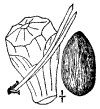
P. édulis.
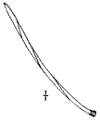
P. monophýlla.
22. Pìnus édulis, Engelm. (Piñon or Nut-pine.) Leaves mostly in pairs, rarely in threes, 1 to 1½ in. long, from short sheaths, light-colored, rigid, curved or straightish, spreading; cones sessile, globose or nearly so, 2 in. long; tips of scales thick, conical-truncate, no awns or prickles; seeds large, nut-like, wingless, edible. A low, round-topped tree, branching from near the base, 10 to 25 ft. high; from the Rocky Mountains. A fine small pine; cultivated in the East. It needs some protection at Boston. The figure shows the seed. Pìnus monophýlla, Torr. and Frem., from the mountain regions farther west, has its leaves in ones and twos; when in ones, round and very rigid; when in pairs, flat on the inner side; leaves on the young shoots bluish, glaucous green, or silvery. This is probably only a variety of P. edulis. The seeds of both are so large and nutritious that they are extensively used for food by the Indians.
Genus 94. PÌCEA. (The Spruces.)
Leaves evergreen, scattered (pointing in every direction), needle-shaped, keeled above and below, thus making them somewhat 4-sided. Fertile catkins and cones terminal; cones maturing the first year, pendulous; scales thin, without prickles, persistent, the cone coming off the tree whole.
* Leaves very short, usually ¼ to ½ in. long, obtuse 7, 8.
* Leaves usually ½ in. or more long, acute. (A.)
A. Cones over 3 in. long; cultivated. (B.)
B. Leaves dark green; large tree, common 3.
B. Leaves bright or pale green 4, 5, 6.
A. Cones 2 in. or less long; large native trees 1, 2.
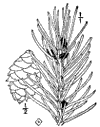
P. nìgra.
1. Pìcea nìgra, Link. (Black or Double Spruce.) Leaves about ½ in. long, erect, stiff, somewhat 4-sided, very dark green or whitish-gray; branchlets pubescent. Cones persistent, 1 to 1½ in. long, ovate or ovate-oblong, changing from dark purple to dull reddish-brown; scales very thin, roundish, with toothed or uneven edges. A conical-shaped tree, 40 to 80 ft. high; wild in the North and along the Alleghanies; often cultivated. Bark dark brown; branches horizontal; wood light reddish.
Var. rubra has larger, darker leaves, and larger, brighter-colored cones.
P. álba.
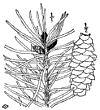
2. Pìcea álba, Link. (White or Single Spruce.) Leaves ½ to ¾ in. long, rather slender, needle-shaped, sharp-pointed, incurved, pale- or glaucous-green; branchlets smooth. Cones deciduous, 2 in. long, oblong-cylindrical, with entire, thin-edged scales. Tree 25 to 100 ft. high, of beautiful, compact, symmetrical growth when young, and such light-colored foliage as to make it a fine species for cultivation. Wild in the North, and cultivated throughout. There are varieties with bluish-green (var. cærulea) and with golden (var. aurea) foliage in cultivation.
P. excélsa.
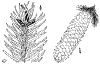
3. Pìcea excélsa, Link. (Norway Spruce.) Leaves ¾ to 1 in. long, rigid, curved, dark green. Cones 5 to 7 in. long, and pendent at maturity, with the scales slightly incurved. A large tree, 70 to 120 ft. high, of vigorous growth, with numerous, stout, drooping branches; abundant in cultivation. A score of named varieties are sold at the nurseries, some quite dwarf, others so very irregular in shape as to be grotesque.
P. políta.
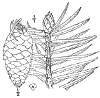
4. Pìcea políta, Carr. (Tiger's-tail Spruce.) Leaves ½ to ¾ in. long, strong, rigid, sharp-pointed, somewhat curved, glabrous, bright green, on stout branches with prominent buds. Leaves persistent for 7 years; not 2-ranked. Cones 4 to 5 in. long, spindle-shaped elliptical, rounded at the ends. Tree of slow growth, with horizontal, yellowish-barked branches. As it is a tree of recent introduction (1865) from Japan, there are no large specimens. Hardy at Boston.
P. púngens.
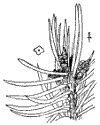
5. Pìcea púngens, Eng. (Silver Spruce.) Leaves ½ to 1 in. long, broad, rigid, stout, sharply acute, usually curved, pale green above, silvery-glaucous beneath, on smooth and shining branchlets. Cones very abundant, 3 to 5 in. long, cylindric, with elongated, undulated, retuse scales. A strictly conical tree with spreading branches and thick, smooth, gray bark. Sometimes cultivated; from the Rocky Mountains. Hardy.
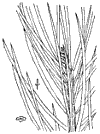
P. Morínda.
6. Pìcea Morínda, Link. (Himalayan Spruce.) Leaves 1 to 2 in. long, very sharply acute, pale green color, spreading, 4-sided, straight, rigid, slightly glaucous beneath; branches horizontal; branchlets remotely verticillate, numerous, drooping, with light-colored bark. Cones 6 to 7 in. long, ovate-oblong; scales light brown, oblong, entire, smooth, loosely imbricated. A tall tree, cultivated from eastern Asia and not hardy north of Washington except in sheltered positions.
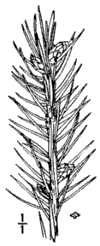
P. Alcóquina.
7. Pìcea Alcóquina, Lindl. (Alcock's Spruce.) Leaves ¼ to ¾ in. long, crowded, somewhat 4-sided, flattish, recurved, obtusely rounded at tip, deep green above, whitish or yellowish below. Cones 2 to 3 in. long, 1 in. in diameter, reddish fawn-color, with very persistent scales; scales wedge-shaped at base, rounded at tip. A large tree from Japan; fully hardy as far north as Mass.
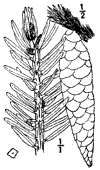
P. orientàlis.
8. Pìcea orientàlis, L. (Eastern Or Oriental Spruce.) Leaves very short, ½ in. long, 4-sided, rigid, stout, rather obtuse, dark shining green, entirely surrounding the branches. Cones 2½ to 3 in. long, cylindrical, with soft, thin, loose, rounded scales, uneven on the edges. A beautiful, conical, slow-growing, compact tree, reaching the height of 75 ft.; often cultivated; from the Black Sea. Hardy.
Genus 95. TSÙGA. (Hemlocks.)
Leaves evergreen, scattered, flat, narrowed to a green petiole, appearing 2-ranked by the direction they take, whitened beneath. Fertile catkins and cones on the end of last year's branchlets. Cones pendulous, maturing the first year; scales thin, persistent.
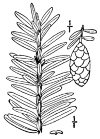
T. Canadénsis.
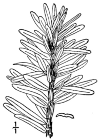
1. Tsùga Canadénsis, Carr. (Common Hemlock.) Leaves short-petioled, linear, ½ in. long, obtuse, dark green above and white beneath; the young leaves in the spring a very light green. Cones oval, ½ to ¾ in. long, pendent, of few (20 to 40) scales. A large, very beautiful tree, 50 to 80 ft. high, abundant in rocky woods, and cultivated throughout; spray light and delicate.
T. Caroliniàna.
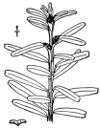
2. Tsùga Caroliniàna, Engelm. (Mountain-hemlock.) This is similar to the last; its leaves are larger, glossier, more crowded; its cones are larger, and have wider and more spreading scales; the tree is smaller, rarely growing 40 ft. high. Wild, but scarce, in the higher Alleghanies, south; beginning to be cultivated north, and probably hardy throughout.
T. Siebòldii.
3. Tsùga Siebòldii. (Japan Hemlock.) Leaves ½ to ¾ in. long, linear, obtuse to notched at the tip, smooth, thick, dark green above, with two white lines below. Cones scarcely 1 in. long, elliptical, solitary, terminal, obtuse, quite persistent; scales pale brown. A beautiful small tree, 20 to 30 ft. high, with an erect trunk, dark-brown bark, and numerous, pale, slender branchlets. Introduced from Japan, and probably hardy throughout.
Genus 96. ÀBIES. (The Firs.)
Leaves evergreen, flat, scattered, generally whitened beneath, appearing somewhat 2-ranked by the directions they take. Fertile catkins and cones erect on the upper side of the spreading branches. Cones ripening the first year; their scales thin and smooth, and the bracts generally exserted; scales and bracts breaking off at maturity and falling away, leaving the axis on the tree. A great number of species and varieties have been planted in this country, but few if any besides those here given do at all well in our dry and hot climate.
* Cones 6 to 8 in. long; leaves blunt at tip. (A.)
A. Leaves over an inch long 10, 11.
A. Leaves an inch or less long 12.
* Cones 3½ to 6 in. long. (B.)
B. Leaves 2 in. or more long, 2-ranked 9.
B. Leaves 1 in. or less long. (C.)
C. Leaves acute at tip 7, 8.
C. Leaves blunt or notched at tip. (D.)
D. Two-ranked 4.
D. Not 2-ranked 3.
* Cones 1 to 3½ in. long. (E.)
E. Leaves an inch or more long 5, 6.
E. Leaves less than an inch long 1, 2.
A. balsàmea.
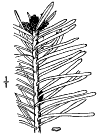
1. Àbies balsàmea, Mill. (Common Balsam-fir.) Leaves narrow, linear, ½ to ¾ in. long, and much crowded, silvery beneath; those on the horizontal branches spreading into 2 ranks. Bark yielding Canada balsam from blisters. Cones erect, on spreading branches, 2 to 4 in. long and 1 in. thick, cylindric, violet-colored, with mucronate-pointed bracts extending beyond the scales and not reflexed. Wild in cold, wet grounds; 20 to 45 ft. high, with numerous horizontal branches. Has been cultivated quite extensively, although there are better Firs for ornamental purposes.
A. Fràseri.
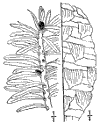
2. Àbies Fràseri, Lindl. (Fraser's or Southern Balsam-fir.) Leaves ½ to ¾ in. long, somewhat 2-ranked, linear, flattened, obtuse, emarginate, whitish beneath, the lower ones curved and the upper ones erect. Cones oblong, 1 to 2 in. long, with sharp-pointed bracts half exserted and reflexed. A rare, small tree, 30 to 40 ft. high, growing wild in the mountains, from Virginia south. A hardy tree and handsome when young.
A. Nordmanniàna.
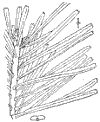
3. Àbies Nordmanniàna, Link. (Nordmann's Silver Fir.) Leaves very numerous, crowded, broad, linear, blunt or erose-dentate at the ends, somewhat curved, of unequal length, 1 in. or less long, deep green above and whitened beneath. Cones large, 5 in. long, ovate, erect, with very obtuse scales; bracts exserted and recurved. A beautiful large tree, 50 to 80 ft. high, occasionally cultivated; with numerous horizontal branches and smooth bark.
A. fírma.
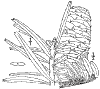
4. Àbies fírma, S. and Z. (Japan Silver Fir.) Leaves ¾ to 1 in. long, very closely 2-ranked, slightly twisted, linear, somewhat notched at the end, smooth and dark above, somewhat silvery below. Cones 3 to 4½ in. long, 1 to 1½ in. in diameter, straight, cylindric, with broad, downy, leathery, crenulated scales; bracts exserted, with acute, slightly recurved points. A beautiful tall tree with somewhat the habit of the common Silver Fir; recently introduced from Japan, and hardy as far north as central New York.
A. grándis.
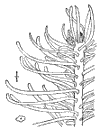
5. Àbies grándis, Lindl. (Great Silver Fir.) Leaves 1 to 1½ in. long, mostly curved, deep green above and silvery below, not 2-ranked. Cones 3 in. long and about 2 in. broad, obtuse, solitary, chestnut-brown in color. A very large (200 to 300 ft. high), handsome tree from the Pacific coast. Hardy at Washington; needs protection north.
A. Píchta.
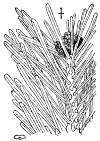
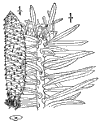
6. Àbies Píchta, Fisch. (Siberian Silver Fir.) Leaves 1 in. long, linear, flat, obtuse, incurved at the apex, mostly scattered, very dark green above, paler beneath. Cones 3 in. long, ovate, cylindric, obtuse, with rounded, entire scales and hidden bracts. A small to medium-sized cultivated tree, 25 to 50 ft. high, with horizontal, somewhat pendulous branches and dense compact growth. It is peculiar in its very dark foliage; very hardy.
A. Cephalónica.
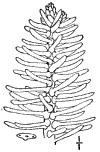
7. Àbies Cephalónica, Loud. (Cephalonian Silver Fir.) Leaves ¾ in. long, very stiff, sharp-pointed, spreading broadly from the branches in all directions, dark green above and white beneath; petioles very short, dilated lengthwise at the point of attachment of the branches. Cones very erect, 4 to 6 in. long, 1-1/3 in. in diameter; projecting scales unequally toothed and reflexed at the point. A beautiful, cultivated tree, 30 to 60 ft. high, with bright brown bark and resinous buds.
A. Pinsàpo.
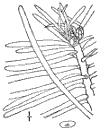
8. Àbies Pinsàpo, Bois. (Pinsapo Fir.) Leaves less than 1 in. long (usually ½ in.), rigid, straight, scattered regularly around the branches, and pointing in all directions; disk-like bases large; branches in whorls, and branchlets very numerous. Cones 4 to 5 in. long, oval, sessile; scales rounded, broad, entire; bracts short. A very handsome tree from Spain, and reported hardy at the Arnold Arboretum.
A. cóncolor.
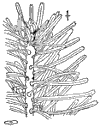
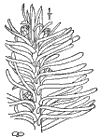
9. Àbies cóncolor, Lindl. (White Fir.) Leaves 2 to 3 in. long, mostly obtuse, but on young trees often long-pointed, 2-ranked, not crowded on the stem, pale green or silvery. Cones oblong-cylindric, 3 to 5 in. long, 1½ in. in diameter; scales twice as broad as long; bracts short, not projecting. A large tree, 75 to 150 ft. high; bark rough, grayish. Native in the Rocky Mountains; hardy at the Arnold Arboretum, Massachusetts, but needs some protection at St. Louis.
A. Cilícica.
10. Àbies Cilícica, Carr. (Cilician Silver Fir.) Leaves flat, linear, 1 to 1¾ in. long and 1/12 in. broad, somewhat 2-ranked but rather irregularly scattered around the young shoots; shining dark green above and whitish beneath. Cones 7 to 8 in. long, nearly 2 in. in diameter, cylindric, obtuse, erect, with thin and entire scales, and short and hidden bracts. A very conical tree, 50 ft. high, with branches in whorls, and numerous, small, slender branchlets. Bark light gray; recently cultivated from Asia.
A. nóbilis.
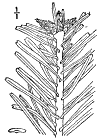
11. Àbies nóbilis, Lindl. (Noble Silver Fir.) Leaves 1 to 2 in. long, linear, much curved, the base extending a short distance upward along the branch, then spreading squarely from it, crowded, compressed, deep green above, glaucous below; base of the leaf much less disk-like than in most of the Firs; branches horizontal, spreading, numerous. Cones 6 to 7 in. long and nearly 2 in. in diameter, cylindric, sessile, with large, entire, incurved scales; bracts large, exserted, reflexed, spatulate, with terminal, awl-shaped points. A very large, beautiful tree, from the Pacific coast, where it grows 200 ft. high. Hardy in Pennsylvania, but needs some protection in Massachusetts.
A. pectinàta.
12. Àbies pectinàta, DC. (European or Common Silver Fir.) Leaves ½ to 1 in. long, linear, obtuse, occasionally with an incurved point, polished green above, two white lines below, rigid, straight; branches horizontal and in whorls. Cones 6 to 8 in. long, cylindric, brown when ripe; scales broad, thin, rounded; bracts long, exserted, with an acute reflexed tip. Introduced from Europe. Good specimens can be found as far north as Massachusetts, though our climate is not fitted to give them either long life or perfect form.
Genus 97. LÀRIX. (The Larches.)
Leaves deciduous, all foliaceous, the primary ones scattered, but most of them in bundles of numerous leaves from lateral globular buds. Cones usually small (in one cultivated species 3 in. long), ovoid, erect, with smooth scales.
* Cones less than 1 in. long, of not more than 25 scales 1.
* Cones 1 to 2 in. long, of from 40 to 60 scales 2, 3.
* Cones 2 to 3 in. long, with thick, woody, somewhat divergent deciduous scales. (Pseudolarix) 4.
L. Americàna.
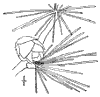
1. Làrix Americàna, Michx. (American Larch. Tamarack or Hackmatack.) Leaves less than 1 in. long, thread-like, linear, slender, light bluish-green. Cones ½ to ¾ in. long, ovoid, of a reddish color. A tree of large size, 50 to 100 ft. high, growing wild in all the northern portion of our region, and frequent in cultivation, although not quite so fine a tree as Larix Europæa.
L. Europæ̀a.
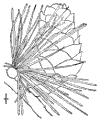
2. Lárix Europæ̀a, DC. (European Larch.) Leaves 1 in. long, linear, obtuse, flat, soft, numerous, and bright green in color. Cones sometimes more than 1 in. long, with oval, erect, very persistent scales. A beautiful tree with horizontal branches and drooping branchlets; abundant in cultivation.
Var. pendula has long, pendent branches, and forms a very fine weeping tree.
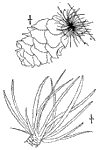
L. Leptolépsis.
3. Làrix Leptolépsis, Gordon. (Japan Larch.) Leaves 1 to 1½ in. long, slender, pale green. Cones 1-1/3 in. long, and half as wide, of about 60 scales, reflexed at the margin, pale brown in color; bracts lanceolate, acute, entire, thin, one half the length of the scales; seeds obovate, compressed, with long, obtuse, thin wings. A small tree from northern Japan, where it grows 40 ft. high. It is a handsome, erect-growing tree, with slender, smooth, ash-colored branches, and rather rigid, spreading branchlets.
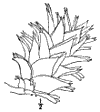
L. Kæ̀mpferi
4. Làrix Kæ̀mpferi, Lamb. (Golden Larch.) Leaves from 1 to 2½ in. long, flat, linear, sword-shaped, somewhat soft, pale pea-green in the spring, golden-yellow in the autumn. Cones 2 to 3 in. long, with flattish, divergent scales which are very deciduous. A beautiful large tree, over 100 ft. high, from China, which proves hardy as far north as central New York. It is often placed in a new genus (Pseudolarix) because of the deciduous scales to the cones.
Genus 98. CÈDRUS. (The Lebanon Cedars.)
Leaves linear, simple, evergreen, in large, alternate clusters. Cones large, erect, solitary, with closely appressed scales; seeds adhering to the base of their lacerated, membranous wings. Large, spreading-branched trees from southern Asia and northern Africa. Occasionally successfully grown from New York City southward.
* Leaves 1 in. or less long 1, 2.
* Leaves over 1 in. long, light glaucous-green 3.
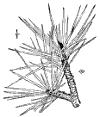
C. Libàni.
1. Cèdrus Libàni, Barr. (Cedar of Lebanon.) Leaves ¾ to 1 in. long, acuminate, needle-form, rigid, few in a fascicle, deep green in color. Cones 3 to 5 in. long, oval, obtuse, very persistent, grayish-brown in color; scales thin, truncate, slightly denticulate; seeds quite large and irregular in form. A cultivated tree with wide-spreading, whorled, horizontal branches covered with rough bark. Somewhat tender when young in the Middle States, but forming a grand tree in proper positions.
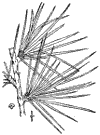
C. Atlántica.
2. Cèdrus Atlántica, Manetti. (Mt. Atlas, Silver, or African Cedar.) Leaves ½ to ¾ in. long, mostly cylindric, straight, rigid, mucronate, crowded, and of a beautiful glaucous-green color. Cones 2½ to 3 in. long, ovate, glossy. This beautiful tree has been considered a silvery variety of Cedrus Libani. They are about alike in hardiness and in general form. Cedrus Atlantica has more slender branches, denser and more silvery foliage. From Africa.
C. Deodàra.
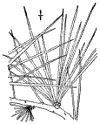
3. Cèdrus Deodàra, Lindl. (Deodar or Indian Cedar.) Leaves 1 to 2 in. in length, 3- or usually 4-sided, rigid, acute, very numerous (about 20 in a fascicle), bright green, covered with a glaucous bloom. Cones 4 to 5 in. long, ovate, obtuse, very resinous, rich purple when young, and brown when old; the scales separating from the axis at maturity. Seeds wedge-shaped, with large, bright brown wings. A beautiful pyramidal tree, with graceful drooping branches and light silvery foliage. Not hardy north of Philadelphia; from India.
Genus 98a. ARAUCÀRIA.
A. imbricàta.
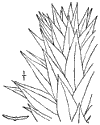
Araucària imbricàta, Pavon. (Chile Pine.) Leaves 1 to 2 in. long, ovate-lanceolate, sessile, rigid, acute, very persistent, closely overlapping, completely covering the thick stems, in whorls of 6 to 8, deep glossy green; branches horizontal, in whorls of 6 to 8, with ascending tips, covered with resinous, corky bark. Flowers diœcious; cones (on only a portion of the trees) large, roundish, about 7 in. in diameter, erect, solitary; seeds wedge-shaped, 1 to 2 in. long. A large, peculiar, beautiful, conical tree, with much the appearance of a cactus; not fitted to our climate, although a few specimens may be found growing quite well near the coast south of Philadelphia. From the mountains of Chile.
Genus 99. CUNNINGHÀMIA.
A genus of but one species. The cone-scales are very small, but the bracts are large, thick, and serrate.
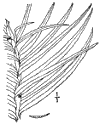
Cunninghàmia Sinénsis, R. Br. (Cunninghamia.) Leaves 1½ to 2½ in. long, flat, rigid, numerous, alternate, somewhat serrulate; the leaf gradually increases in width from the acute tip to the base, which is decurrent on the stem and about 1/8 in. wide. Cones 1 to 1½ in. long, nearly globular, erect, very persistent, mostly clustered, sessile; the scale is a mere transverse ridge, but the bract is large and prominent, like a triangular-hastate, dilated leaf. A very handsome tree, from China, which does not succeed very well in this region except in protected situations.
Genus 100. SCIADÓPITYS.
Cones elliptical or cylindrical, large, obtuse. Leaves evergreen, somewhat flattened, arranged in distant whorls around the stems, and spreading in all directions.
S. verticillàta.
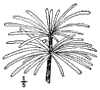
Sciadópitys verticillàta, S. and Z. (Umbrella-pine.) Leaves 2 to 4 in. long, 1/6 in. wide, linear, obtuse, smooth, persistent, sessile, entire, in whorls of 30 to 40 at the nodes and extremity of the branches. Cones 3 by 1½ in. Scales wedge-shaped, corrugated, overlapping, coriaceous, persistent; bracts adherent, broad, and smooth. A beautiful, tall, conical, slow-growing tree, with the branches whorled. Recently introduced; hardy in the New England States.
Genus 101. TAXÒDIUM.
Leaves deciduous, spreading, in 2 ranks. Flowers monœcious on the same branch, the staminate ones in spikes, and the pistillate ones in pairs below. Cones globular; the scales peltate, angular, thick, firmly closed till ripe, with 2 angular seeds under each.
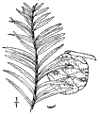
T. dístichum.
Taxòdium dístichum, Richard. (Southern or Bald Cypress.) Leaves deciduous, flat, linear, ½ to ¾ in. long, in 2 rows on the slender branchlets, forming feather-like spray of a light green color. This whole spray usually falls off in the autumn as though a single leaf. Cones round, closed, hard, 1 in. in diameter. A fine, tall (100 to 125 ft. high), slender, spire-shaped tree with a large, spreading, rigid trunk, 6 to 9 ft. thick, and peculiar conical excrescences (called knees) growing up from the roots. Wild from Maryland south, and cultivated and hardy in the Middle and many of the Northern States.
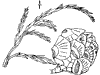
Var. pendulum.
Var. pendulum, with horizontal branches and drooping branchlets, has the leaves but slightly spreading from the stems, especially when young. Very beautiful; hardy as far north as Massachusetts.
Genus 102. SEQUÓIA.
Flowers monœcious, terminal, solitary, catkins nearly globular. Seeds winged, 3 to 5 under each scale.
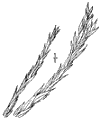
S. gigántea.
1. Sequóia gigántea, Torr. (Big or Great Tree of California.) Leaves on the young shoots spreading, needle-shaped, sharp-pointed, scattered spirally around the branchlets; finally scale-shaped, overlapping, mostly appressed, with generally an acute apex, light green in color. Cones oval, 2 to 3 in. long, of about 25 scales. The largest tree known, 300 ft. high, with a trunk nearly 30 ft. through, found in California and occasionally planted east, though with no great success, as it is almost certain to die after a few years.
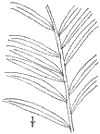
S. sempérvirens.
2. Sequóia sempérvirens, Endl. (Redwood.) Leaves from ½ to 1 in. long, linear, smooth, 2-ranked, flat, acute, dark shining green, glaucous beneath; branches numerous, horizontal, spreading. Cones 1 in. long, roundish, solitary, terminal; scales numerous, thick, rough, furnished with an obtuse point. A magnificent tree from California, where it grows 200 to 300 ft. high. In the East it can be kept alive but a few years even at Washington.
Genus 103. THÚYA. (Arbor-vitæ.)
Small, evergreen trees with flat, 2-ranked, fan-like spray and closely overlapping, small, appressed leaves of two shapes on different branchlets, one awl-shaped and acute, the other scale-like, usually blunt and close to the branch. Fertile catkins of few, overlapping scales fixed by the base; at maturity, dry and spreading. There are scores of named varieties of Arbor-vitae sold by the nurserymen under 3 different generic names, Thuya, Biota, and Thuyopsis. There are but slight differences in these groups, and they will in this work be placed together under Thuya. Some that in popular language might well be called Arbor-vitæ (the Retinosporas) will, because of the character of the fruit, be included in the next genus.
* Scales of the cones pointless, thin, straight. (Thuya) 1, 2.
* Scales reflexed and wedge-shaped. (Thuyopsis) 3.
* Scales thick, with horn-like tips. (Biota) 4.
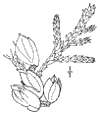
T. occidentàlis.
1. Thùya occidentàlis, L. (American Arbor-vitæ. White Cedar.) Leaves in 4 rows on the 2-edged branchlets, having a strong aromatic odor when bruised. Cones oblong, 1/3 in. long, with few (6 to 10) pointless scales. A small tree, 20 to 50 ft. high, or in cultivation 1 to 50 ft. high, with pale, shreddy bark, and light, soft, but very durable wood. Wild north, and extensively cultivated throughout under more than a score of named varieties. Their names—alba, aurea, glauca, conica, globosa, pyramidalis, pendula, etc.—will give some idea of the variations in color, form, etc.
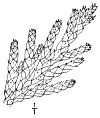
T. gigantèa.
2. Thùya gigantèa, Nutt. (Giant Arbor-vitæ.) Leaves scale-shaped, somewhat 4-sided, closely overlapping, sharp-pointed, slightly tuberculate on the back; cones more or less clustered and nearly ½ in. long. A very large and graceful tree, 200 ft. high, with white, soft wood; from the Pacific coast; introduced but not very successfully grown in the Atlantic States.
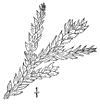
T. dolabràta.
3. Thùya dolabràta, L. (Hatchet-leaved Arbor-vitæ.) Leaves large, sometimes ¼ in. long, very blunt, in 4 rows on the flattened spray. Cones quite small, ovate, sessile, with jagged edges; scales reflexed and wedge-form. A small conical tree with horizontal branches and drooping branchlets; which, because of its large leaves (for an Arbor-vitæ) and flexible branchlets, is quite unique and interesting. In shaded and moist places it has done quite well as far north as New York.
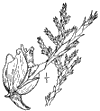
T. orientàlis.
4. Thùya orientàlis, L. (Eastern or Chinese Arbor-vitæ.) Leaves small, in 4 opposite rows, appressed, acute, on the numerous 2-edged branchlets. Cones large, roundish, with thick leathery scales having recurving, horn-like tips. Of this species there are as many varieties sold as of number one, and nearly the same varietal names are used; but it is not so good a species for general cultivation in this country.
Var. flagelliformis, Jacq. (Weeping Arbor-vitæ), has very slender, elongated, weeping branches, curving gracefully to the ground. It is a beautiful variety, often cultivated (a single stem is shown in the figure).
Genus 104. CHAMÆCÝPARIS. (The Cypresses.)
Strong-scented, evergreen trees with very small, scale-like or somewhat awl-shaped, closely appressed (except in some cultivated varieties), overlapping leaves and 2-ranked branchlets, almost as in Thuya. Cones globular, with peltate, valvate scales, firmly closed till ripe; the scales thick and pointed at the center.
* Native trees; leaves light glaucous-green. 1.
* Cultivated trees from Western America; leaves dark green. (A.)
A. No tubercle on the backs of the leaves. 2.
A. Usually a tubercle on the back 3.
* Cultivated small trees and shrubs from Japan (called Retinospora) 4.
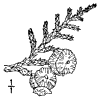
C. sphæroídea.
1. Chamæcýparis sphæroídea, Spach. (White Cedar.) Leaves very small, triangular, awl-shaped, regularly and closely appressed in 4 rows, of a light glaucous-green color, often with a small gland on the back. Cones very small, 1/3 in. in diameter, of about 6 scales, clustered. Tree 30 to 90 ft. high, wild in low grounds throughout; abundant in Middle States. With reddish-white wood and slender, spreading and drooping sprays; bark fibrous, shreddy; sometimes cultivated.
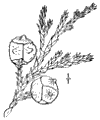
C. Nutkæ̀nsis.
2. Chamæcýparis Nutkæ̀nsis, Lambert. (Nootka Sound Cypress.) Leaves only 1/8 in. long, sharp-pointed, and closely appressed, of a very dark, rich green color; very slightly glaucous, without tubercles on the back. Cones small, globular, solitary, with a fine, whitish bloom; scales 4, rough and terminating in a sharp straight point. Tree 100 ft. high in Alaska, and would make a fine cultivated tree for this region if it could stand our hot, dry summers.
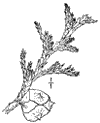
C. Lawsoniàna.
3. Chamæcýparis Lawsoniàna, Park. (Lawson's Cypress.) Leaves small, deep green, with a whitish margin when young, forming with the twigs feathery-like, flat spray of a bluish-green color; leaves usually with a gland on the back. Cones scarcely ¼ in. in diameter, of 8 to 10 scales. A magnificent tree in California, and where it is hardy (in rather moist soil, New York and south) it forms one of our best cultivated evergreens. The leading shoot when young is pendulous.
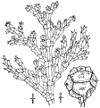
R. obtùsa.
4. Chamæcýparis (Retinóspora) obtùsa, Endl. (Japanese Arbor-vitæ.) Leaves scale-formed, obtuse, closely appressed and very persistent. Cones of 8 or 10 hard, light brown, wedge-shaped scales. Beautiful small trees or generally shrubs (in this country), of a score of named varieties of many colors and forms of plant and foliage.
There are probably a number of species of Japanese and Chinese Chamæcyparis (Retinospora), but till their size, hardiness, and origin have been more fully determined, it would be impossible to make an entirely satisfactory list for such a work as this. Figures are given of the common, so-called, species cultivated in this country; under each of these, several varieties are sold by the nurserymen. The three twigs of Retinospora squarrosa were all taken from a single branch; this shows how impossible it is to determine the varieties or species; the twig at the left represents the true squarrosa; the others, the partial return to the original. Most of the forms shown in the figures have purple, golden, silvery, and other colored varieties.
Retinospora filifera. Retinospora pisifera.
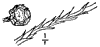
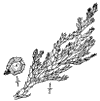
Retinospora squarrosa. Retinospora Lycopoides.
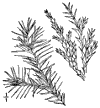
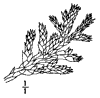
Retinospora plumosa.
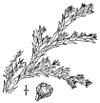
Genus 105. CRYPTOMÈRIA.
A genus of evergreens containing only the following species:
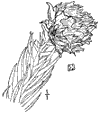
C. Japónica.
Cryptomèria Japónica, Don. (Japan Cedar.) Leaves about ½ in. long, not flattened, but about equally 4-sided, curved and tapering quite gradually from the tip to the large, sessile base; branches spreading, mostly horizontal, with numerous branchlets. Cones ½ to ¾ in. in diameter, globular, terminal, sessile, very persistent, with numerous, loose, not overlapping scales. A beautiful tree from Japan, 50 to 100 ft. high. Not very successfully grown in our climate. North of Washington, D. C., it needs a sheltered position, and should have a deep, but not very rich soil.
Genus 106. JUNÍPERUS.
Leaves evergreen, awl-shaped or scale-like, rigid, often of two shapes on the same plant. Spray not 2-ranked. Flowers usually diœcious. Fertile catkins rounded, of 3 to 6 fleshy, coalescent scales, forming in fruit a bluish-black berry with a whitish bloom, but found on only a portion of the plants.
* Leaves rather long, ½ in., in whorls of threes 1.
* Leaves smaller; on the old branches mostly opposite 2.
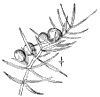
J. commùnis.
1. Juníperus commùnis, L. (Common Juniper.) Leaves rather long, ½ in., linear, awl-shaped, in whorls of threes, prickly-pointed, upper surface glaucous-white, under surface bright green. Fruit globular, ¼ in. or more in diameter, dark purple when ripe, covered with light-colored bloom. A shrub or small tree with spreading or pendulous branches; common in dry, sterile soils. There are a great many varieties of this species in cultivation, but few of them grow tall enough to be considered trees.
Var. Hibernica (Irish Juniper) grows erect like a column. Var. Alpina is a low creeping plant. Var. hemispherica is almost like a half-sphere lying on the ground.
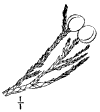
J. Virginiàna.
2. Juníperus Virginiàna, L. (Red Cedar.) Leaves very small and numerous, scale-like on the older branches, but awl-shaped and somewhat spreading on the young shoots; dark green. Fruit small, 1/5 in., abundant on the pistillate plants, dark purple and covered with fine, glaucous bloom. Trees from 20 to 80 ft. high (sometimes only shrubs), with mostly horizontal branches, thin, scaling bark, dense habit of growth, and dark foliage. Wood light, fine-grained, durable; the heart-wood of a handsome dark red color. Wild throughout; several varieties are found in cultivation. Many other species from China, Japan, California, etc., are occasionally cultivated, but few are large enough to be called trees, and those that are large enough are not of sufficient importance to need specific notice.
Genus 107. TÁXUS.
Leaves evergreen, flat, linear, mucronate, rigid, scattered, appearing more or less 2-ranked. Fertile flowers and the fruit solitary; the fruit, a nut-like seed in a cup-shaped, fleshy portion formed from a disk; red.
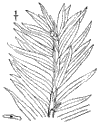
T. baccàta.
Táxus baccàta, L. (Common European Yew.) Leaves evergreen, 2-ranked, crowded, linear, flat, curved, acute. Fruit a nut-like seed within a cup 1/3 in. in diameter; red when ripe in the autumn. As this species is somewhat diœcious, a portion of the plants will be without fruit. A widely spreading shrub rather than a tree, extensively cultivated under nearly a score of named varieties. We have a closely related wild species, Táxus Canadénsis (The Ground-hemlock), which is merely a low straggling bush.
Genus 1O7a. TORRÈYA.
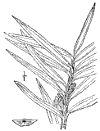
T. taxifòlia.
The Torreyas are much like the Yews, but their leaves have two longitudinal lines, and a remarkably disagreeable odor when burned or bruised. Torrèya taxifòlia, Arn., from Florida, and Torrèya Califòrnica, Torr., from California, have been often planted. They form small trees, but probably cannot be grown successfully in the region. The figure shows a twig of T. taxifolia.
Genus 1O7b. CEPHALOTÁXUS.
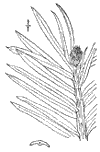
C. Fortùnii.
Cephalotáxus Fortùnii, Hook., does not form a tree in this section, but a wide-spreading bush growing sometimes to the height of 10 ft., and spreading over a spot 15 ft. wide. Leaves flat, with the midrib forming a distinct ridge on both sides, linear, sometimes over 2 in. long, glossy green on the upper side, slightly whitened beneath. Fruit very large, 1 in. or more long, elliptical, with a single, thin-shelled nut-like seed covered with purplish, pulpy, thin flesh. Branches spreading, drooping, long, slender; buds small, covered with many sharp-pointed, overlapping scales; twigs green, somewhat grooved. From Japan; about hardy in New Jersey.
Genus 108. PODOCÁRPUS.
Leaves one-nerved, opposite, alternate, or scattered, linear or oblong. Flowers axillary and mostly diœcious; fruit drupe-like, with a bony-coated stone.
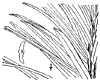
P. Japónica.
Podocárpus Japónica, Sieb. (Japan Podocarpus.) Leaves alternate, crowded, flat, linear-lanceolate, elongated, quite sharp-pointed, narrowed to a short though distinct petiole, and continued down the stem by two ridges; leaves not 2-ranked, large, 4 to 8 in. long and ½ in. wide when growing in perfection; in specimens grown in this region, 2 to 5 in. long and ¼ in. wide; midrib forms a ridge on both sides; upper side dark glossy green; lower side with two broad whitish lines. A beautiful, erect-growing, small tree; from Japan; about hardy in central New Jersey; needs some protection in Massachusetts.
Genus 109. SALISBÙRIA.
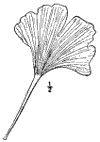
S. adiantifòlia.
Leaves broad, simple, alternate, stipulate, deciduous, deeply cut or lobed at the apex, alike on both surfaces, with long petioles. Flowers diœcious; staminate ones in catkins, pistillate ones either solitary or in clusters of a few each. Fruit a nut with a drupaceous covering.
Salisbùria adiantifòlia, Sm. (Ginkgo Tree.) Leaves parallel-veined, fan-shaped, with irregular lobes at the end, thick, leathery, with no midrib. Fruit globular or ovate, 1 in. long, on long, slender stems. A very peculiar and beautiful large tree, 50 to 100 ft. high; from Japan. Hardy throughout, and should be more extensively cultivated than it is.