TREE STUDIES IN THE WINTER
Reading edition
[83]
TREES WE KNOW BY THEIR BARK
Hunters and foresters who spend much of their time in the woods learn to know trees by name through long acquaintance. In the dead of winter, the framework of a tree may be enough to recognise it by. Where trees are crowded, this sign is not to be depended upon. The bark is often a guide to the tree’s name. The forester will tell you that the bud is the surest sign of all. The bark is one of the best signs.
It is not the easiest thing in the world to learn to know trees by the bark alone. To the beginner, so many trees with dark, furrowed bark look strangely alike, although the trees are not even related to each other. The foresters began with trees that have peculiar and easily recognised bark. So we shall begin here, and hope that the hard cases will gradually become easier.
Every tree wears a garment of bark from the ground up to the utmost twigs. The thinnest bark is on the youngest branches. The thickest is on the trunk.
Begin with the white birch upon the lawn. The bark of this tree is made of thin layers; [84] the outer one shining like white satin. It breaks and tatters, and peels off around the trunk. Three-cornered patches of black are found under each branch, and others on the trunk show where branches once came out, but were broken or cut off.
Do you notice narrow, horizontal slits of different lengths on the birch bark? These are breathing holes that let the air in to the layer under the bark. Spongy, porous substance fills these slits, but allows the air to pass through. At the lower part of the trunk the satiny outer bark is shed, leaving dark under layers, rough and checked into irregular blocks. As the tree grows older, the trunk becomes rougher and darker, but the branches always show the kind of bark that the little tree wore.
In the Northern woods the white bark of the canoe birch is stripped from the trees in layers as thick as sole leather. Out of these the Indians once made their bark canoes. Now the same material is used for making all manner of trifling souvenirs to sell to tourists. A square of this thick bark, cut on the smooth side of a trunk, may be split into a great number of thin sheets. This the camper uses to write letters upon, and it is a beautiful and fitting substitute for note paper, when one is camping out.
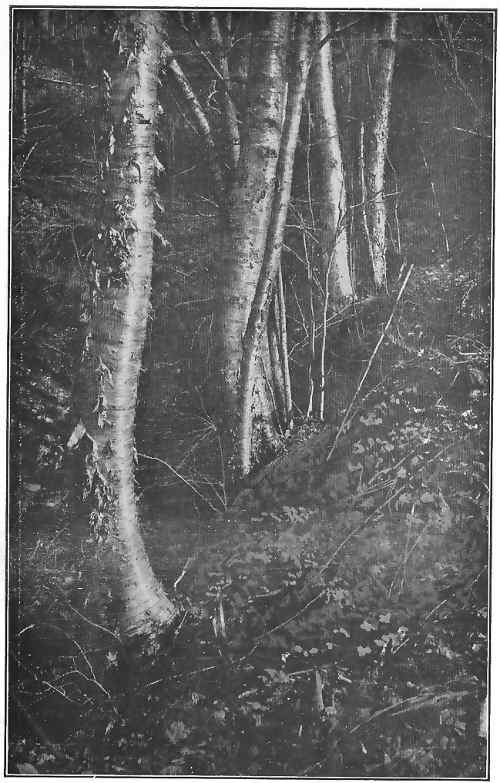
We recognize birches by their silky, tattered bark
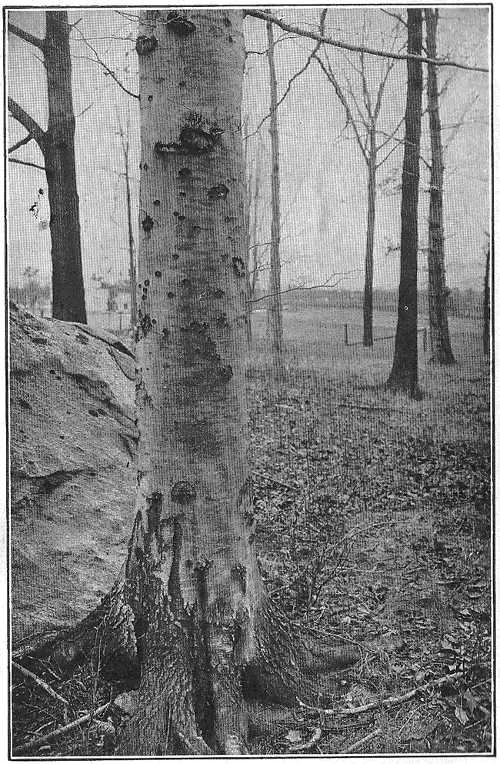
The beech trunk is clothed in smooth, pale grey bark
[85]
It is a great pity that so many beautiful trees are girdled and killed to supply the needs of camping parties. If the bark were stripped but part way around it would not kill the tree.
The yellow birch has a silvery yellow tint in the outer bark, which curls back in ragged ribbons until the tree gets old. The red birch writes its name in the rusty red colour of its papery bark, which splits into tatters in true birch fashion, and flutters the ragged ends from each branch throughout the year. The black birch has no tattered ribbons flying, but wears a close, smooth, black bark, with the narrow slits that all birches show. As the trunks grow larger the surface checks into irregular plates, separated by furrows. It is called the cherry birch, for the bark is like that of cherry trees.
The sycamore has bark which is different from that of every other tree. Indeed, it is by the bark that we recognise this tree. The tall trunk looks as if it were blotched and streaked and spattered with whitewash, from the trunk to the topmost limb. The bark is continually dropping off in thin, irregular plates, leaving smooth whitish patches of an under layer exposed. After sycamore trees grow older, the bark of the lower portion of the trunk stops shedding. Fine-checked plates of rusty brown cover this oldest [86] portion. But even on the oldest and largest trees, the pale blotches are seen in the branches and we shall never mistake the name of the tree.
The shagbark is one of the rugged and shaggy trees that boys find hard to climb without tearing their clothes into tatters. The bark gives the tree its name. Thin, narrow plates, close-woven and tough as sole leather, seem to be attached very loosely to the body of the tree, but if you try to pull off these narrow strips, you find their hold is very firm. Often they are attached at the middle, and spring out at both ends.
An old shagbark tree is a picturesque figure, as it lifts its bare arms up toward the wintry sky. The trunk is straight, but the branches are full of angles. Yet, with all their rigidity, these limbs have an expression of strength, if not of grace, and the tree’s head is usually symmetrical, and always full of character.
A young hickory has smooth, close-knit bark like that on the branches of the older trees. Gradually the growing trunk becomes furrowed, and the peculiar splintering and splitting of the bark is seen only in trees six inches or more in diameter. By the time the tree is old enough to bear nuts, it has built itself a formidable fence that boys must climb over with much hard work and [87] many a scratch, to get up among the branches and shake down the nuts.
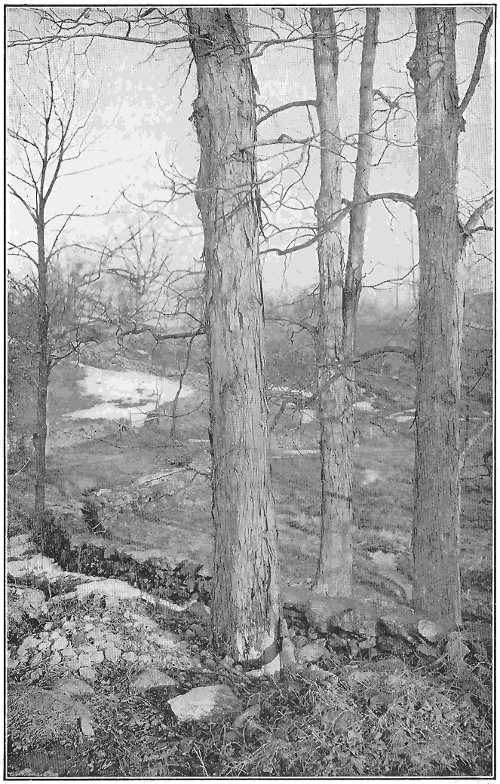
The loose, stripping bark gives its name to the shagbark hickory
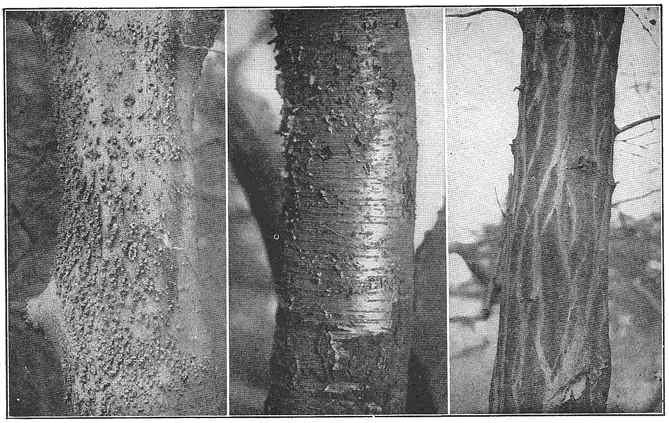
Left: Warty bark of hackberry Center: Silky bark of black birch Right: Close, sinewy bark of hornbeam
The tasteless pignuts grow on a smooth-barked hickory tree, very easy to climb, but the bark of the little shellbark hickory is the guide-post that leads to the trees where the sweet-flavoured hickory nuts grow.
The close-knit, grey bark of beech trees hardly needs to be described. The temptation to cut initials on beech trunks is more than folks with pocket-knives can resist. No matter how many fine trees there are in a beech grove near town, they are scarred all over with letters and hieroglyphics as far as hand can reach. The tree never covers these wounds. Though they do not cripple it, they mar its beauty painfully.
A little further from the haunts of picnic parties, we shall come upon beech woods that have not thus been abused by thoughtless jack-knives. From the ground, far up into the high tops, a close, beautiful garment of ashy grey bark clothes the tree. Saplings of all ages grow up among the big trees, for beeches grow in colonies. A soft radiance from these many pale tree trunks seems to lighten the woods paths, overshadowed by the dense foliage of the tree tops.
It is said that beech trees die when they come into contact with civilisation. Fine beech woods [88] are included in additions to towns; you will see the great trees die when lawns and gardens are made about their roots. In the outskirts of Indianapolis there are noble beech trees, but they are dying, as the city grows around them.
The copper beeches and the cut-leaved and weeping beeches have the same close-knit bark as our native tree, but it is not grey, but dark brown. These fancy forms are varieties of the European beech, one of the principal lumber trees of the Old World.
The bark of this tree played an interesting part in the early history of the human race. Long before the European tribes had written languages, they sent messages from one to another. These messages between tribes, friendly or warlike, were written in hieroglyphics, cut into the smooth surface of beech bark, and messengers carried them back and forth.
Sheets of beech bark, as well as birch, made the walls and roofs of the huts in which people lived. Their boats and various household utensils were made out of beech wood, which is so close-grained that vessels made of it hold water without leaking.
Another American tree with bark like the beech, but darker grey, grows always, by preference, with its roots in wet soil. It is a little [89] tree, with rigid, horizontal twigs, that form a flat tree top. This is called the blue beech, and its trunk does often have a bluish cast. It is also called hornbeam, for its wood is so hard that it was used in the early days to make the beams which went across the horns of the oxen. This is the part of the ox yoke which is the most subject to wear. Ironwood is another name that describes the hard wood.
We shall notice that this tree has not a regular cylindrical trunk like that of a beech. Strong swellings, that look like muscles, are seen, especially where the trunk branches into the main limbs. Have you ever noticed the arms of a blacksmith, or of an athlete? How the veins and muscles stand out when the arm is in use! Just like them are the irregular swellings that course up the trunk of the hornbeam, and out into the limbs.
The hackberry is a handsome shade tree, which might, at first glance, be mistaken for an elm. The bark is different from that of any other tree. Once we see a hackberry, and learn its name, we will never mistake it again. The bark is light brown or grey, and finely checked by deep furrows. The ridges between bear strange, warty outgrowths. Look for these warts among the small branches. The twigs are smooth, but [90] back a little way the warty eruptions begin, and become more prominent as the limbs thicken and approach the trunk. Sometimes the limbs have these warts so close together as to form continuous ridges.
Another tree with warty bark is the sweet gum. The negroes of the South call the tree “alligator wood,” because the lower part of the trunk is broken by furrows and cross-furrows into horny plates like the skin of an alligator. From the red-brown trunk up into the grey branches, there is a change in the character of the bark. The fissures usually run lengthwise, and the bark rises in thin ridges on each side of the fissure. These ridges become thin as knife blades on the smaller twigs, which also have a sprinkling of small warts.
A sweet gum is very rugged looking in the dead of winter, with its warts and ridges breaking out on each limb. We know it by this sign alone, but are doubly sure when we see the seed balls dangling from the twigs. The sycamore, blotched with white on trunk and limb, also carries a load of dangling seed balls throughout the winter. There is no danger of confusing these two trees, for the bark of each is so distinct.
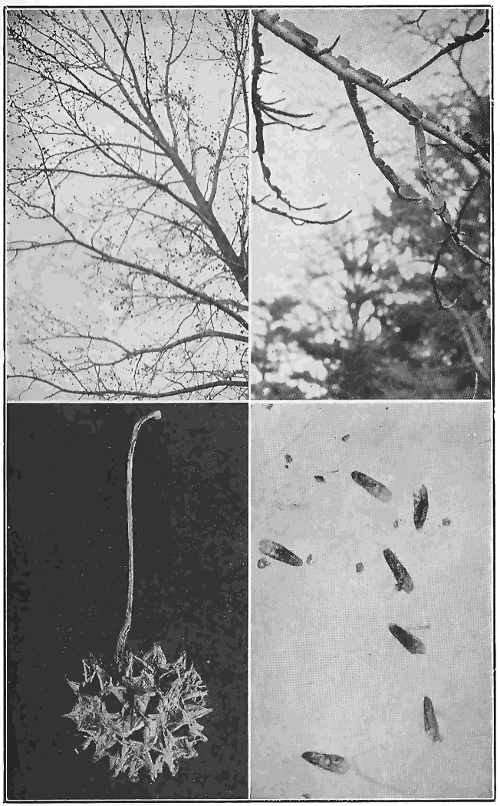
Warty, ridged bark of the sweet gum, the swinging seed balls and winged seeds
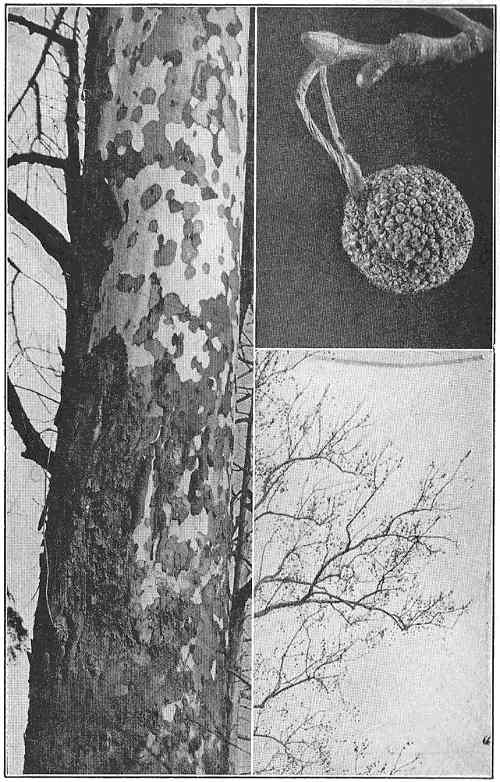
Blotched bark of sycamore, and its seed balls that hang all winter
A little tree with alligator skin bark grows [91] North and South, and chiefly in the eastern half of the country. This is the flowering dogwood, whose grey bark breaks into small squarish plates. There is no such ruggedness in its trunk as there is in the sweet gum’s, for it is always a little tree, and the bark corresponds in its checking to the tree’s size. When we see this peculiar type of bark in the winter woods we may look also for little flattened, box-like flower buds, each enclosed in four scales. We shall also find the twigs set opposite, and with these three signs be sure we know the tree.
A little tree, no larger in girth than the dogwood, but often taller, has bark that strips and loosens somewhat as the bark of the shagbark hickory does. This is the hop hornbeam, one of the ironwoods. Its bark strips are always thin and narrow, no matter how old the tree becomes. It is never as loose upon the trunk as the shagbark’s. The great buds and stout twigs of the hickory are entirely different from the slender spray and the very small buds this ironwood wears in winter. We may find on these twigs some remnant of the hop-like seed clusters which give this little tree its name, hop hornbeam. Inside its shaggy bark the lumbermen find wood so hard that it is very difficult to work, and when made into tools it lasts almost forever.
[92]
When we have learned to know at sight a dozen trees by their bark alone, we are ready to go further. A great many trees with furrowed bark like chestnuts and elms and maples, are not so distinct as those already learned, and we must study the tree’s form, its winter buds, the arrangement of these buds, and the shape of the leaf scars in connection with the bark, in order to be sure we know the tree’s name. The chestnut from which we gathered so many nuts last fall, and whose furrowed trunk we saw at every visit, we come to know through this familiarity. The trunks of other chestnut trees look like this one, and though we may not know just how we do it, we have added the chestnut to the list of trees we recognise by their bark alone. The sugar maples which we tap in spring for their sugary sap, have dark, furrowed bark, not very distinctive. And yet, by going from tree to tree, emptying the sap pails, we gradually learn to recognise the bark of the sugar maple, and add it to our growing list.
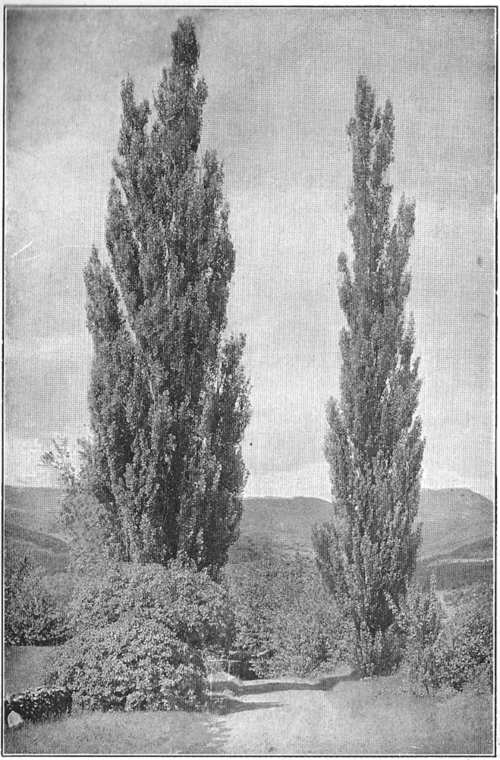
The Lombardy poplar stands like an exclamation point in the landscape
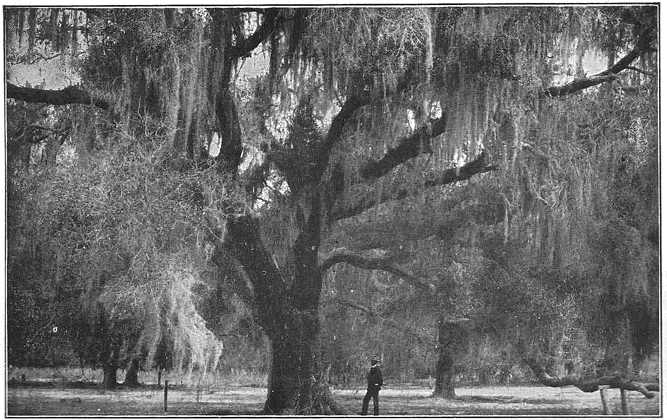
The live oak of the South is usually hung with long skeins of the weird, grey Spanish moss
Trees do not change their clothes, and they do not move away. Day after day, if we use our eyes and notice what is going on in the tree tops, as the seasons follow each other, we come to know our trees by name; we recognise them in winter by their bark, and by the framework [93] of their tops, in summer by leaves and flowers, in autumn by their changing colour and by their fruits. It is not hard work for those who love trees. It is like getting acquainted with other neighbours whom we are glad to count among our friends.
TREES WE KNOW BY THEIR SHAPES
The life of every tree depends upon its success in holding its leaves out into the sunlight. The tree which exposes the greatest amount of leaf surface to the sun makes the greatest growth. The shape of their tops is a character in which trees differ widely. We shall come to know many of them in winter time better than in summer, by the distinct shapes revealed when the foliage is gone. In any bare tree, the purpose of all of the branching and branching again, is plainly seen. Each twig and branch reaches out toward the outer surface of the dome, or pyramid. Here the buds in winter are waiting to open, when spring comes, into leafy shoots. These will cover the tree top with a dome of green greater than the one of the previous summer. Their work through the growing season will lengthen every branch and every [94] root, and add a layer of wood under the bark of trunks and branches and roots.
The most remarkable tree shape is that of the Lombardy poplar. The tall trunk is clothed with many short, close-branched limbs, which do not spread, as in ordinary tree forms, but grow upright, so as to lie almost against the main trunk. The upper branches are overlapped and crowded by those below them, and so on down the trunk. The result is a tree shaped like a capital I. In summer time, the heart-shaped leaves cover the twigs on the outside of this spire, but the beauty of the tree top is marred by the dead branches which have been smothered by the crowding.
A young Lombardy poplar is handsome as it stands covered with its twinkling leaves. It grows rapidly, and is especially striking and effective in clumps of round-headed trees. It is like an exclamation point. Architects always like to have a few of these trees dotted about the grounds to keep company with tall chimneys and distant church spires. There is no shade under trees of this form, though miles of them are planted along roadsides where they stand like tin soldiers, all alike. The older trees look very ragged, for they are unable to shed their dead limbs, and as old age comes on they [95] send up suckers from the roots that form a little forest around the parent tree.
Scattered over fallow fields of worthless ground, the red cedars are allowed to grow. They are the evergreen counterparts of the slim Lombardy poplars. Sometimes the red cedar broadens into a pyramid, wide at the base, but we are all familiar with the green exclamation points, dotted over the hillsides, wherever birds have dropped the blue berries full of seeds.
The pointed firs with their horizontal branches becoming longer and longer towards the ground, are good examples of the pyramid form so common among evergreens. This is the shape of the spruces, and the pines, and the hemlocks, until storms have broken their branches, and taken away the symmetry of the top. The pin oak and the honey locust send out horizontal branches of graduated lengths from the central shaft, imitating the evergreens in shape.
The evergreen magnolia of the South has a dome like an old-fashioned beehive, pyramidal, and regular when it grows in sheltered places. Such a dome is the hard maple’s in the North.
Some trees branch low, and their short trunks break into great limbs whose ample spread forms a dome much broader than its height. The white oak in the North and its evergreen counterpart, [96] the live oak of the South, illustrate this noble form. Somewhat like them, but with its dome elevated upon a tall trunk, is the American elm with the fan top. The lines of the elm branches are all curves from the arching limbs that rise out of the trunk to the flexible twigs which droop at the extremities of the branches. The dome of a white oak is made of angular limbs. Even the twigs are likely to be crooked. No one would confuse the elm with an oak.
Round-headed trees are many. Go from the apple tree in the orchard to the red and Norway maples along our streets. A great many trees find this form best adapted to spreading their leaves out towards the sun. Many oaks and ash trees, the hickories and birches, and the beeches have widely spreading limbs forming tops that are oblong in shape. There are trees so irregular in habits of growth that we shall never know them by their forms alone.
The winter is the best time to study tree shapes, for then the framework is revealed. The trees to study are those which stand apart from others, so that they have been able to take their natural shapes. These we shall find growing on the streets, and in yards, and parks, and in open spaces in the woods. Where trees crowd each other in growing, their branches chafe and clash [97] in storms, destroying the buds and leaves, and bruising the tender bark. Such limbs die of these injuries, and the whole shape of the tree top is changed by its losses.
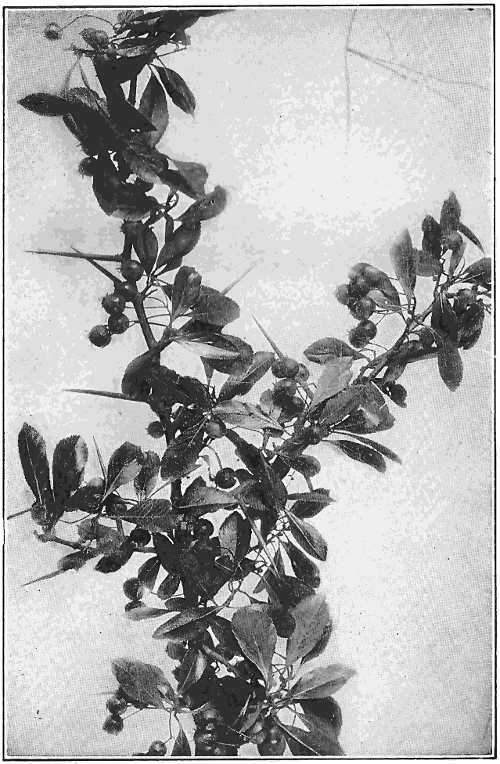
Fruiting branch of the cockspur thorn
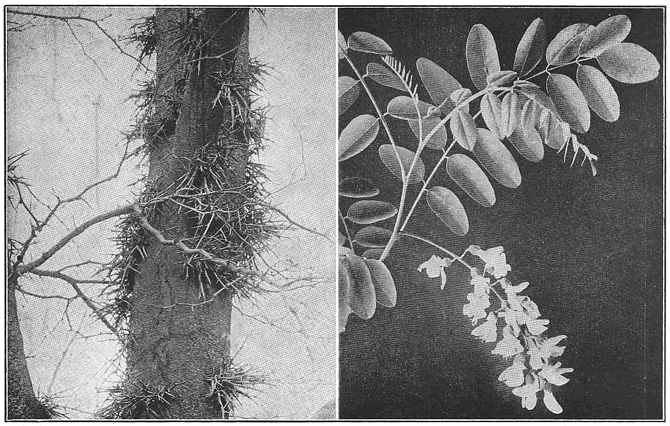
Left: Clustered thorns on trunk of honey locust tree. Right: Flowers and foliage of the black locust
It is hopeless for lower limbs to live in a dense pine forest. The top branches form so thick a wall of shade that lower branches die from lack of sun. It is the same with broad-leaved trees. In any dense woods, the trees stand bare as telegraph poles, lifting small heads of foliage at the top, and competing there with their neighbour trees for sun and air. It is only when set apart from other trees that a trunk can keep its lower branches hale and strong as those at the top.
The weeping habit gives us some strange tree forms. The Camperdown elm forms a shady summer-house on many a lawn by arching limbs which droop to the ground on all sides of the main trunk. The weeping mulberry has the same habit. Weeping birches and willows have such light foliage, and such fine, flexible twigs, that they look like fountains of green as they stand among the other trees.
All weeping trees are made by grafting in the nursery rows. They are not grown from seeds, and it is not true that they “weep” because of being planted up-side-down! This preposterous notion is not uncommon.
[98]
TREES WE KNOW BY THEIR THORNS
In winter time, the bare limbs of trees reveal many strange secrets, which the leaves cover up in summer. Some trees we may know by the thorns they wear.
The honey locust scarcely conceals in summer the three-branched thorns, for which it is famous. These thorns are twigs, but they rarely bear leaves. Each is sharpened to a needle point, and highly polished. Sometimes it is single, oftener with a main thorn and two side branches; sometimes short, but often reaching over a foot in length, and growing stronger and more wicked-looking with age. Sometimes a honey locust has a crowded group of these thorns growing out of the trunk and large limbs. Once in a great while a honey locust is thornless, growing wild. From such trees a thornless variety has been developed. It is, therefore, possible to obtain from nurserymen trees of this variety.
The unbranched spines of the osage orange trees make it a formidable hedge plant, and no fences are needed where green barriers of these trees grow. Each shining leaf has a spike at its base, stout and sharp as a needle, and strong as steel.
[99]
Two spines stand guard at the base of each leaf of the yellow or black locust, and each leaflet has two little spines of the same type. The basal spines remain after the leaves fall, so that in winter we shall find these pairs of sentinels guarding the leaf scars up and down the ridged twigs. On the thicker stems the thorns are larger, and the tree is thus well-armed and able to do duty as a hedge plant, when thickly planted.
These thorns come off with the bark, hence they are more properly called prickles. They are not rooted in the wood of the branch as the thorns of the honey locust are, but they belong in the class with rose and raspberry prickles, which are mere outgrowths of the bark.
The hawthorn trees have single spines, some long and curved, some short, some branched. All are rooted in the pith of the twig that bears them; therefore, they are not prickles, but true thorns.
The wild plum trees have a strange habit of ending their shoots with thorny tips, as if the branches needed such defence against browsing cattle. Certainly these stunted, sharp-pointed twigs are useful as weapons of defence to the little trees that grow slowly in poor soil, and are sufferers from poverty and abuse. Perhaps it is their hard luck that makes them crabbed and thorny. Wild apple trees show the same tendency [100] to have thorny twigs. The same little trees, transplanted to mellow soil, grow soft and leafy twigs, and abandon the carrying of weapons.
Hercules’ club is a tree which beats the ailanthus at its own game. Stems ten feet high and two inches in diameter at the base sometimes shoot up in a single season. These clubs of Hercules are covered with spines as thickly set as on a gooseberry bush, formidable and vicious, though only skin deep.
On account of its tropical growth, this tree is planted for ornament in gardens where there is room. Its leaves are wonderful. They come out with a rich, silky, bronze sheen in spring, and when they reach full size are often four feet long, and more than half as wide. Each one is branched and branched again, and ends in a multitude of small oval leaflets. These giant leaves sway in the summer winds, giving the tree the grace of a tree fern. In late summer a great pyramid of bloom rises above the foliage. Purplish berries, which succeed the flowers, make a fine showing in fall and winter, when the leaves have turned to red and gold.
We dare not touch this spiny tree, but we may come close and admire its wonderful crown of umbrella leaves, the biggest by far borne on any tree outside of the Tropics.
[101]
THE NEEDLE-LEAVED EVERGREENS
In our town and in our neighbourhood most of the trees drop their leaves before winter comes, and stand with bare limbs for several months. Here and there, however, a single tree stands, wearing the same green leaves it wore all summer. Everybody knows this tree as an evergreen. It belongs to a group of trees strangely different from those around it which have shed their leaves. Let us see how it differs from them.
Take the one that is nearest to you, and pull down one of its leafy, green branches. The leaves are like green needles, stiff, sharp-pointed, with waxy resin on the brown twigs, that makes your fingers sticky. Up in the tree tops strange oval, brown cones are hanging. Underfoot, a carpet of dead needles lies thick upon the grass, and cones, with their overlapping scales spread much wider than those upon the tree, lie about. Squirrels have gnawed some of these scales away, leaving a central spike like a cob from which the corn has been shelled. Little green cones, fat and waxy, no larger than your thumb, are seen near the tips of some branches. You can see the scales overlapping each other in these, [102] even though they seem to be grown solidly together.
If we walk through the village or the city in which we live, and stop under each evergreen tree we come to, we shall find nearly all alike in these two points: they have needle-like leaves, and they have cones. The evergreens with needle-like leaves, and cones on and under them, belong to four evergreen tree families, whose names every one would like to know. These four evergreen families are named pine, spruce, fir, and hemlock, and they are planted everywhere. But few people are very sure they know one from another. It is perfectly right to call them all evergreens, or conifers, which means cone-bearers. These names include all the four families. But it is common for people to call a spruce, a pine, or a hemlock, a spruce, when the truth is that one may very easily know these trees apart.
Let us begin with the first needle-leaved cone-bearing evergreen we meet. To find out whether this tree is a pine, a spruce, a fir, or a hemlock, we must ask the tree some questions. It will answer them. First: “Are your needles set one in a place on the twig, or are they in groups, or bundles, of more than one at a place?” Pull down a twig and look sharply for the answer. Suppose there are the leaves in pairs, or in threes, [103] or in fives, each bundle or group growing out of a single point on the twig. The answer is: “Not single, but in bundles, more than one at a place.” Towards the end of the shoot you will find a brownish or silvery sheath binding the leaves into bundles. Further back, this sheath may be missing, but the number of leaves in the bundle remains the same for some distance back from the end of the shoot. The leaves begin to fall from the bundles farthest from the tips, and therefore old. If two leaves is the number in a bundle, there are never more than two, young and old. If three is the number, you will find only threes. If five is the number, then you will rarely find fewer than this in any bundle.
All the trees with more than one leaf in a bundle are pines. All of the rest of the needle-leaved evergreens have a single leaf at a place upon the twig. They are the spruces, firs, and hemlocks. Let us go and look for them.
The very next evergreen we come to we must put the same question to: “Are your leaves single, or are there more than one in a bundle?” Suppose “three in a bundle” is the answer; we recognise the tree as a pine, and pass it by.
Across the street is a tree of different shape, though an evergreen and a conifer. We see [104] the long cones hanging from its drooping branches, especially near the top of the tree. Cross over and examine a twig; the needles are short and sharp-pointed, and they are set singly in spiral lines on the twigs. Every leaf sits on a little shelf, or bracket, that stands out from the twig. Pick up a dead twig under the tree. The leaves are gone, but these little brackets in spiral rows wind around the twig. They are horny and sharp, and would tear your fingers if you drew the twig quickly between them.
Notice that the little brackets are angled at the top. Pick up a dead leaf and notice the shape of its base. The leaf itself has angled sides. Roll it between your thumb and finger. It has three or four sides, and at least three sharp angles.
This is a spruce, and the signs by which we know it are the brackets on the twig, the thick, sharp, three- or four-angled leaf, and the stout twigs, to match the stout leaves.
The next needle-leaved evergreen with cones we meet we may hope will turn out to be a fir or hemlock, but the chances are that its twigs will show two, three, or five needles in a bundle. What shall we call the tree? A pine, of course, and pass it by. We need ask no further question.
[105]
The next tree has stiff twigs with brackets, and stout, stiff, angled and pointed leaves. Cones hang down upon its branches. We recognise a spruce, and go on.
Over yonder is an evergreen which waves a featherly spray of very slender twigs. There is scarcely a breeze stirring, and yet the tree is all a-tremble, and its drooping branches carry a load of pretty little brown cones. Turn up a branch, and you notice that the leaves are all silvery underneath. They are single on the twigs, so this is not a pine. They part and lie flat, a row on each side of the twig. This is very different from a spruce whose leaves stand out all around the twigs. These sprays are flat, each like a feather. The leaves are soft, not stiff. They are blunt, flat, and each has a tiny stem. The twigs are like fine wire, they are so slender. The leaves are mounted on brackets, just as the spruce leaves are, but the brackets are much smaller, to match the daintier twigs and leaves.
It is a hemlock tree. The tiny leaf stem is the thing which sets it apart from all other needle-leaved evergreens. Take a good look before you go, at the leaf itself, at the slender twigs, with their little brackets, at the shining upper surface of the flat leaf and the silvery lining that makes this tree so lovely as the wind lifts the flexible [106] branches. Pick up a handful of dead leaves, and notice that though dead and brown, they show the flat surface with a middle ridge on the under side, prolonged into the short leaf stem. The pale lining is not so distinct now.
One tree family remains of the needle-leaved, cone-bearing evergreen. That is the fir, the Christmas tree, and its close relatives. Not often do we plant our native fir, because the trees are not as handsome, nor as useful as pines, spruces, and hemlocks. We may walk far before we find an evergreen which does not turn out to be a pine, a spruce, or a hemlock. However, it is near Christmas time. The little firs will be brought into market in sufficient numbers to supply a Christmas tree to every house. This is our chance. We will go to market, and look at these little trees that stand together, with their limbs trussed like fowls, ready to be baked. This is for economy of space in shipping.
The clean, pungent odour of balsam comes from the bleeding stub, and we see tears of the whitish wax wherever the bark of a twig or branch is bruised. These are balsam firs. They have their name from this fragrant, sticky resin that leaks from their veins.
First, as to the leaves. We find them single and spirally arranged, as in the spruce, but there [107] are no brackets on the twigs. Pull off a leaf and the twig is smooth. The leaves are blunt, but flattened, and on most of the twigs they spread, feather-like, on two sides. There are more of them, however, than on the hemlock spray. They are white-lined, like the hemlock leaves, but there are no little leaf stems. The twigs are stouter than those of the hemlock, resembling the spruce twigs in size, but they lack horny little leaf brackets which are so prominent on spruce twigs.
One reason that spruce trees make poor Christmas trees is that the leaves fall so soon. Almost the day after Christmas the floor is scattered with them. The fir trees keep their leaves for weeks. This little bracket makes all the difference. Fir leaves seem to be fastened right into the twig itself, and made thus more secure.
If it chances that you find a fir old enough to bear cones, you will see another very distinct trait of this family. The cones are held erect on the twigs; the cones of pines, and spruces, and hemlocks hang down. If you are fortunate enough to find a fir tree growing, and old enough to bear its fruit, these upright cones will tell you the tree’s name before you come near enough to look at the leaves, and to see if the twigs are smooth.
[108]
THE FIVE-LEAVED SOFT PINES
An evergreen with needle-like leaves in bundles, two to five leaves in a bundle, is a pine. These bundles are usually bound with a thin, papery sheath at the base, and set in spiral rows that wind around the twig. The leaves in the newest sheaths are nearest the growing tip of the shoot. Here we shall find the leaves shorter, some so short that they have not yet got outside of their sheaths. The silky covering hides them, as the bud scales on other trees covered the undeveloped shoot with its flowers and leaves, wrapped in the winter buds.
The kind of pine depends upon the number of leaves in a bundle. This is the first thing to find out when we undertake to determine the name of a pine tree. All of the vigorous young shoots have bundles that do not vary in number of needles. Further back on the limb are leaves more than a year old. The sheaths are shorter, or have fallen away entirely. Now the number of needles in a bundle begins to be uncertain. We find bundles that have fewer needles than those on the younger wood. This is because the older leaves are falling. Finally we reach a point where the twigs are bare. On white pine [109] shoots it is easy to find leaves that are five to seven years old.
“Soft pine” is a lumberman’s term. Carpenters use it, so do all people who work in wood. It means that the wood of a certain group of pines is soft and light, and the sap is not gummy. Any boy who has cut kindling wood knows what a joy it is to whittle soft pine. Until a few years ago, this was the wood out of which boxes of all sorts were made, and it was the only kindling wood we had. Now things are changed. Much box lumber is made of poplar and other soft woods, which do not split as easily as pine. This means that soft pine is getting scarce, and is too valuable to use where cheaper woods will serve.
THE WHITE PINE
The white pine has the softest, most hair-like leaves in the whole pine family. Five needles are in each bundle, and each is delicate and flexible. When the wind blows through the top of one of these five-needled trees, the end shoots nod like plumes. The tree sends up a straight shaft sometimes to the height of nearly two hundred feet, and whorls of branches, five in a place, form regular platforms extending horizontally [110] from the trunk. Each of these sets of branches counts a year of the tree’s life; for the end bud lengthens the trunk, and at the same time, five buds that surround it grow out into horizontal branches. It is easy to count the age of a young white pine, by beginning at the tip, and counting downward. We could do it with large trees, except that the lower branches die, and at length are lost. The bark heals over the scars left where they fell, so the count is lost when we reach the point where the branches stop. The white pine is slow to shed its dead branches.
In the woods of the Eastern half of the United States any five-leaved pine that we meet is a white pine. Before we are near enough to count the needles in a bundle, we may count five branches at a whorl around the trunk, and this determines the name. Beautifully regular pyramids, the little trees are. In old age these pines lose symmetry by the loss of limbs, and become very rugged and picturesque. A white pine tree, crippled by two or three centuries of struggle with winds and lightnings, is a noble figure. The plume-like branches soften its rugged outlines, and the sombre blue-green of the older leaves is brightened by the fresher colour of the new ones. The upper half of the tree is hung with slim cones whose smooth, thin scales spread wide in [111] the autumn of their second year to let the winged seeds go.
In spring the clustering catkins of staminate flowers look like yellow cones on the ends of the pale yellow-green shoots. The wind shakes an abundant supply of golden dust out of these pollen flowers, then lets the fading catkins fall. The pistillate flowers are pinkish-purple and almost hidden, just back of the tips of the upper twigs. They are cone-shaped, and they part their scales and stand erect to catch the pollen as it drifts through the tree tops. The flowers on each scale require a grain of pollen each, in order to set seed. When its flowers are fertilised the cone closes its scales tight, but they stand erect all summer. In the autumn they are green and fleshy, and they turn downward. In winter we shall see among the swaying branches of these pines, the green, half-grown fruits, and further back, on wood a year older, the brown, full-grown cones with their scales spread. These cones often curve slightly. The largest of them may be ten inches long, but the average cone is little over half that length.
The lumbermen have stripped the white pine from the Eastern forests until there is very little left. Many states are planting this valuable timber tree, to restore the forests that wasteful lumbering, [112] and forest fires have destroyed. Thousands of young trees grown in nursery rows are transplanted to beautify home grounds and parks. We shall find no difficulty in discovering white pine trees, even though no forest near us has a specimen left. It is one of the commonest pines to be planted in cities and villages. It is the only five-leaved pine that will grow successfully on this side of the Rocky Mountains.
THE GREAT SUGAR PINE
All along the coast mountains from Oregon to Lower California, a five-leaved soft pine grows whose size makes our Eastern white pine seem like a dwarf. In that far country of big trees, it is one of the giants. I had read of these trees which grow to be over 200 feet in height, with trunks six to ten feet in diameter at the ground, but figures do not give much idea of the truth. I first saw the groves of sugar pines miles ahead of us, as the stage climbed the foot hills of the Sierra Nevada mountains. We were on the way into the wonderful Yosemite Valley. The scrawny, grey, digger pines, with cones as big as a man’s head, grew on the lower foot hills. Next came the great yellow pines, and still higher [113] up, the grand sugar pines, along the highest level of the stage road. They stood oftenest in close ranks so that their tops were small, because of the crowding. And here they had stood for centuries. The road was no wider than the broad stumps of some that had been cut down, and their prostrate trunks were longer than any log I have ever seen before. I remember calculating that the round dining table at home could be set upon this stump, and all the family seated round it with no danger of their chairs being too near the edge. The standing trunks seemed like great builded columns, too large for real trees to grow. Their feathery, dark green tips reached nearer to the sky than any trees in Eastern forests.
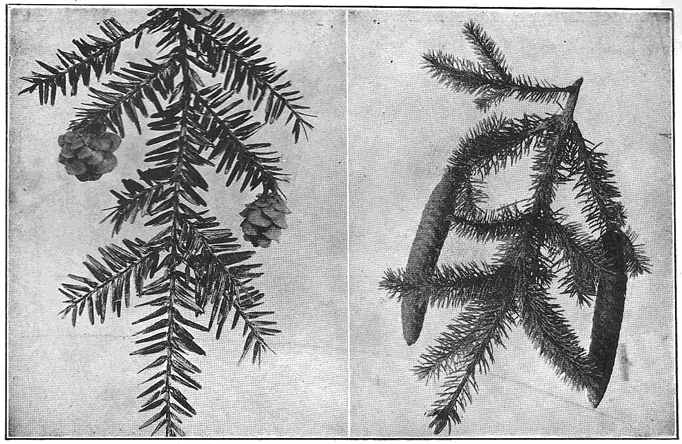
Hemlock cones are small; those of Norway spruce are four or five inches long
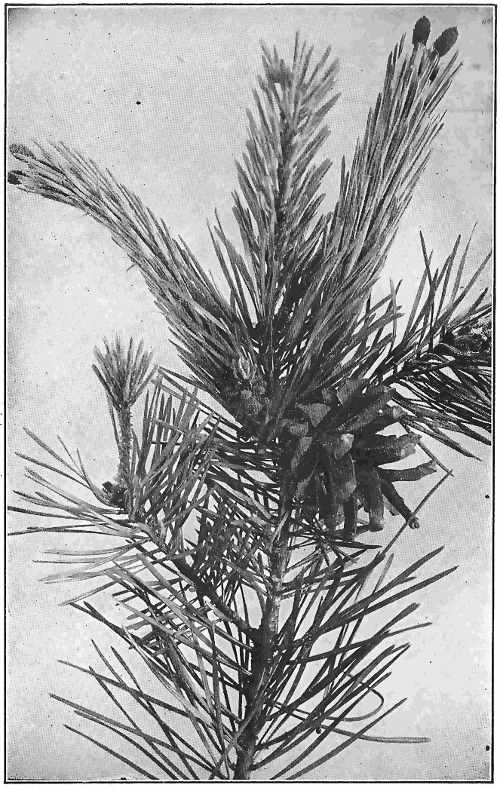
Pine twig with cones, young and old, and clustered staminate flowers
Under these pines old cones were lying. They were big, to match the trees. Twenty inches the longest one measured, with scales two inches long, and plump seeds as big as navy beans. Far off in the tree top the hanging cones looked moderate in size. We could just see the green, half-grown cones nearer the ends of the branches, for this Western white pine, like our Eastern species, requires two years to mature its fruit.
“Why call them sugar pines?” I asked the stage driver. He pointed to some drops of resin-like substance on the scales of the cone I held in my lap. “Taste it,” he said. I did, and it was [114] sweet, with somewhat the flavour of maple sugar. Crystals of this sugar come from wounds in the bark, and from the ends of green sticks when burning. The sap is quite as sweet as that of maple trees, but one is soon surfeited in eating the candy-like substance.
The stage driver told me that a lumberman could cut $5,000 worth of lumber from one of these sugar pine trees. No wonder they think that it is a burning shame for the government to reserve these noble woods of the Yosemite tract “just to be looked at.” Fortunately for us, and for the people of the whole country, some thousands of acres of magnificent forest are reserved on those Western-mountain slopes, where they are safe from the lumberman’s axe. If we cannot go to see them this year, perhaps we can fifty years hence. They will still be standing, still growing, these noble remnants of the grandest forests of any country. Specimens of what Mr. John Muir calls “the largest, noblest, and most beautiful of all the seventy or eighty species of pine trees in the world.”
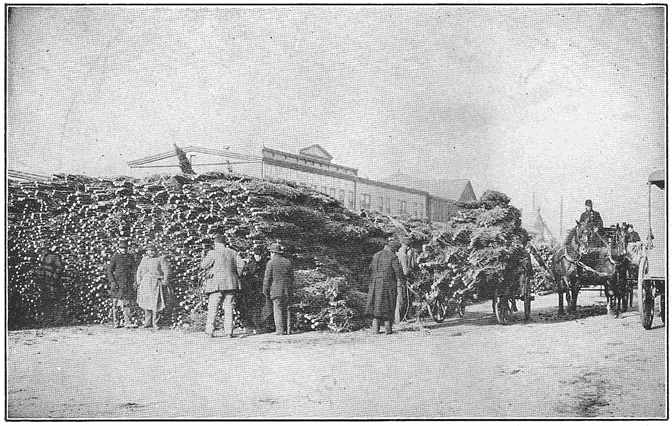
Thousands of little balsam firs supply the market with Christmas trees
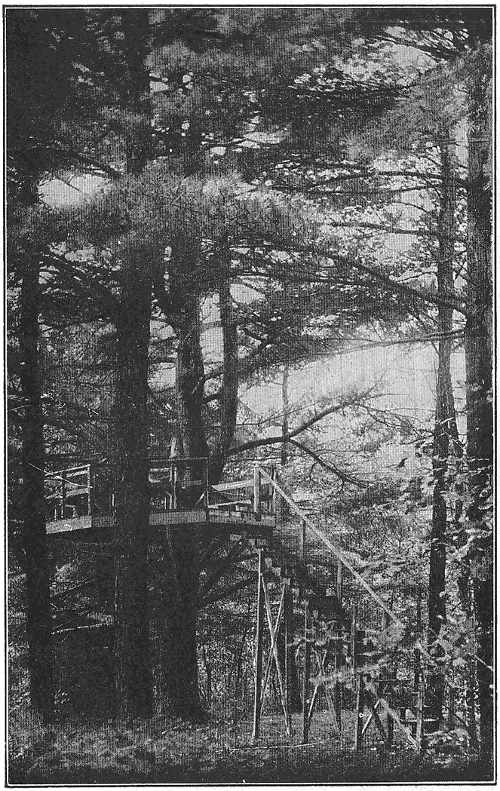
In these tall white pine trees Nathaniel Hawthorne built an out-door study, where he wrote undisturbed
THE NUT PINES
A group of soft pines, with fewer needles than five in a bundle, grows on the Western mountain [115] slopes. Small trees they are, which have to struggle hard against the winds and storms, and with the scant moisture of the desert air and soil for a bare living. They are very interesting because of the fact that they have nuts, rich, sweet, and nutritious, under the scales of their cones, and these nuts are important items in the food of many Indian tribes of the West.
The first is the four-leaved nut pine that grows on the barren mountain slopes of Southern and Lower California. It is a desert tree, rarely reaching forty feet in height, and this only in the most favourable situations. The foliage is pale sage green. No other pine has four leaves in a bundle. Its nut-like seeds are rich in oil, starch, and sugar. Without them the Indians of Lower California would probably starve. In Riverside County the tree is common at 5,000 feet above sea level. It has a regular pyramidal head, when young, becoming low, round-topped and irregular when very old.
Another piñon, but this one with a bushy, broad top, and often considerably taller, grows with the four-leaved pine on the mountains of Lower California, and northward along the canyons and mountain slopes of Arizona. The short leaves are dark green, and there are but two or three in a bundle. The seeds are plump, and rounded, or [116] angular. The upper side is brown, the lower side black, and each has a pale brown wing.
A third nut pine, or piñon, two- or three-leaved, grows on the eastern foot hills of the outer ranges of the Rocky Mountains, on both sides of the system. Forests of it are found on the high plains of Colorado and Arizona. It sometimes grows large enough to be used for lumber. The nuts are half an inch long, and have thin, brittle shells. They are gathered by Indians and Mexicans, and may often be bought in the markets of Colorado and New Mexico.
The one-leaved nut pine seems to belong with the spruces and firs, and other single-leaved evergreens, but there are frequently two leaves in the bundle, and there is a little scaly sheath at the base. The grey-green leaves often hang on for ten or twelve years. The winged nuts are over half an inch long. The wood furnished fuel and charcoal to the smelters in the mining regions, and the Indians of Nevada and California harvest the nut crop.
Every autumn when we are going for chestnuts and hickory nuts in our Eastern woods, we may think of the Indian families who leave their homes in the lowlands, and climb the mountain slopes to gather their nuts which are their staff of life. If we should miss our nutting excursion, [117] it would make no vital difference in our lives during the coming winter. Our nuts are not a serious part of the provisions of the household. But with the Indians, to miss the nut pine harvest, means to have no bread for the winter that is coming.
Mr. John Muir, who has often lived among these stunted upland forests, and seen the Indians gathering the nuts and using them later as food, tells us many interesting things. The trees of the one-leaved nut pine are low, like old apple trees, and full of cones. The Indians get long poles, and beat the cones off the trees, then roast them on hot stones, until the scales open. Then they shake out the nuts, and gather them in baskets and bags to carry home. These nuts are eaten raw or parched on hot stones. These are the easiest and simplest ways. But the best and most palatable form in which they are prepared costs much more time and labour. The nuts are parched, then ground or pounded into meal. This is stirred up with water, into a kind of mush, which is formed into cakes and baked. This is, in general, the way in which all pine nuts are made into bread.
The time of the nut harvest is, for the Indians, the merriest time of the year. If the crop is heavy, the spirits of the party are light. A [118] single family, if it is fairly industrious, can gather fifty or sixty bushels of these rich, thin-shelled nuts in a single autumn month; and with this quantity to carry home, can go down the mountains, tired but happy, knowing that their bread for the winter, and plenty of it, is assured.
THE HARD PINES
The hard pines are a group of needle-leaved evergreens, whose leaf bundles contain two or three needles, as a rule. The wood is heavy, usually dark in colour, and saturated with a resinous, gummy sap. The common name, “pitch pine,” refers to the resinous wood; it is much harder to work with than that of soft pines. The most valuable hard pine forests grow in the Southern states. These are now the chief sources of pine lumber in the Eastern half of the continent. They furnish also quantities of turpentine, pitch, tar, and oil, products of the resinous sap which saturates the wood of these trees while they are growing.
One trait of the pitch pines is that they retain the leaf sheath. The soft pines shed the sheath as soon as the leaf bundle has attained its full length.
[119]
THE SOUTHERN PITCH PINES
The woodwork and floors of a great many houses of moderate cost are done to-day in Southern pine, sometimes called “yellow pine,” sometimes “curly pine.” The alternating bands of dark and light yellowish brown, often very much waved, give the wood an ornamental grain that is much admired. It is common and most desirable that this wood should not be stained nor painted, but given the “natural finish” which brings out the rich orange colour, and shows at their full value the wavy bands and intricate patterns that are the chief beauty of the wood. The arching timbers that support the roof of a church are often made of stiff timbers cut from Southern pines, and dressed only with a coat of oil, under which time deepens and enriches the wood’s natural colours.
THE LONGLEAF PINE
The longleaf pine is one of four hard pines whose lumber is not distinguished by ordinary carpenters, but is generally called “yellow pine.” “Georgia pine” ranks a little higher than the [120] rest. That is the longleaf, which grows over a territory much greater than the state of Georgia. This is the chief source of turpentine, pitch, and tar, as well as one of the very best lumber trees of the pitch pine group. The most ornamental wood is that with the curliest grain, and the narrowest bands of alternating dark and light colour. It grows slowly in hard, sandy soils on the damp coast plains near the Gulf of Mexico.
We shall know this tree from all other pines by the length of its needles. They are twelve to eighteen inches long, flexible, dark green, shining, three in a bundle, enclosed at the base in long, pale, silvery sheaths. They remain on the tree but two years, therefore the tree top is bare except for thick tufts of these drooping leaves on the ends of the branches. If you have never seen these trees growing in their natural forest belt, that ranges from Virginia to Florida, and west to the Mississippi River, or in small scattered forest patches in Northern Alabama, Louisiana, or Texas, you may have seen branches or small trees shipped north to be used for Christmas decorations. In the waste land that the lumbermen have cut over, in the neighbourhood of these longleaf forests, men go in early December, and cut the little trees. Saplings two or three feet high bring good prices in the Northern markets, [121] where holly branches, ropes of ground pine, sprigs of mistletoe, and leaves of Southern palms are sold. A little two-foot longleaf pine, standing erect, with all its long flexible leaves bending outward like a fountain of shining green, is handsomer than any palm of the same size.
The popularity of these pine shoots is growing, and those who cut them seem not to realise that they are killing the forests of the future. Trees grow from seeds which fall in the territory cleared by the lumbermen. If these little trees that Nature plants are cut as fast as they show themselves above the forest floor, how are the longleaf pine forests to be restored? It is a great problem, for a great part of the natural wealth of the South is in these lumber tracts, now being cleared at a terrific rate of speed, and the land left practically worthless when stripped.
The cones of the longleaf pine are narrow and tapering. The scales are thick, and each bears a small spine. The leaves are the distinguishing trait, and the tall, slender trunk crowned by a long open head of short, twisted branches.
THE SHORTLEAF PINE
The shortleaf pine ranks second only to the longleaf among the forest pines of the South. [122] It is the common “yellow pine,” and “North Carolina pine” that is commonly sold from lumber yards in the North and Middle West. Its wood is almost as beautiful in the natural finish. Its leaves are short in comparison with those of the longleaf, and scarcely longer than any pines of the North. They are found in clusters of twos and threes, and they have the dark blue-green colour of the white pine, lightened by the silvery sheaths at the bases of the clusters. The leaves are soft and flexible, slender, and sharp-pointed. They vary from three to five inches in length. The cones are two to three inches long, and half as broad; the thickened scales have small spines. It takes two years to bring cones to maturity, and the old ones hang on several years. In this they differ from our Northern pitch pine.
Forests of this timber pine are scattered from Connecticut to Florida, and west to Illinois, Kansas, and Texas. They are being slaughtered by lumbermen as fast as those of the longleaf. The young trees are tapped for turpentine. In the South and East, these forests are practically gone. The lumber mills are busy in the great tracts west of the Mississippi, and below the Arkansas River, in the forests of shortleaf pine, which until recently were untouched, and too far from the markets to be profitably cut.
[123]
The shortleaf pine will reforest the old areas, and spread over a widening territory, if only it is given a chance. One hundred years is enough time to restore a forest,—to grow a crop of these trees. Young ones spring from the roots of old trees, a habit not at all common among pines. Let us hope that before the Southwestern forests are gone, new ones east of the Mississippi River will take their places, so that the shortleaf shall not disappear from the lumber markets as the white pine of the Northeastern states has done.
THE CUBAN PINE
The Cuban pine or swamp pine of the South, with stout green leaves eight to twelve inches long, in twos and threes, is not confused with the longleaf nor the shortleaf, for its leaves are intermediate in length between the two. This beautiful pine grows in forests that skirt swampy coast land. Its leaves are carried two years, so the trees have dense, luxuriant crowns of green, and are more beautiful as a part of the landscape than any other forest pine of the South. The wood of the Cuban pine is not distinguished in the lumber trade, as it is much the same in quality and appearance as longleaf pine.
[124]
THE LOBLOLLY PINE
The fourth of the yellow pines of the South is the loblolly or old field pine, whose lumber is saturated with pitch. The trees grow in marshy regions along the coast, and for the most part occupy land that is sterile and worthless. These tide water pine forests follow the swamps from New Jersey around to Texas. In early days this was the building pine of the South. The virgin forests are gone, and the new generation is inferior in quality, because the trees are not allowed to attain their full growth. Though rich in resin, there is little flow of turpentine from these trees, but the wood catches fire easily, and is one of the best of fuels.
We shall know this pine by its pale green, twisted leaves, always in bundles of three, six to ten inches long, enclosed at the base in sheaths that are not shed. The cones are three to five inches long, with ridged scales set with prickles. This tree bears a great crop of cones yearly, and its seeds are remarkable for their vitality. So are the seedlings, which grow on land so wet or so poor that few other trees compete with them. The first ten years in the life of a seedling pine is a period of tremendous growth. Fire rarely [125] sweeps these young forests, for the trees are well protected by the marshy character of the land in which they grow. Left for a century or two, these trees produce masts for the largest vessels, equal in quality to the finest in the world.
THE NORTHERN PITCH PINES
We have nothing in the Northeastern states that compares in importance with the pitch pine of Southern forests, but we have pitch pines which everybody knows. The first is the gnarled and picturesque pitch pine that grows on worthless land, and thrives in patches along the sea coast, where other evergreens are unsuccessful. The rough, rigid branches which spring from the short trunks of these trees carry a burden of blackening cones which give them a very untidy look when the trees are small. When they reach fifty or seventy-five feet in height, a certain nobility and picturesqueness of expression challenge our admiration, and the clusters of cones are not at all objectionable; indeed they heighten the tree’s beauty.
The needle-like leaves of pitch pines are always in threes, rigid, stout, and three to five inches long, dark yellow-green, the bundles in black [126] sheaths that are never shed. The cones require two years to ripen. They are from one to three inches long, pointed, with sharp backward-pointed beaks. The wood of this tree is used for fuel, and locally for lumber, but it does not interest the lumbermen. The wood is not good enough, and the trees are too small and scattered. The tree does a good work by growing on worthless land, and near the sea coast. Its picturesqueness is becoming to be more appreciated by landscape gardeners who are bringing it into cultivation.
The handsomest of our pitch pines is the red pine, whose dark green leaves are six inches long, and cluster in twos upon the twigs. The bark, the wood, and the bud scales are all red. The cones are from one to three inches long, with thickened scales which have no spines. The tree grows into a broad pyramid, branched to the ground, with stout twigs, and luxuriant foliage. The symmetry and vigour of growth makes this red pine a handsomer tree than the ragged, discouraged-looking pitch pines. It is well for the landscape that its wood is very disappointing. So many beautiful groves are allowed to reach great age, and size, where white pines would have fallen to a lumberman’s axe.
The home that has a beautiful red pine within [127] sight of its windows, or a double row of these trees serving as a wind-break to ward off the storms of winter, is truly well planted. Without one or more of these trees, there is a decided lack. Any nurseryman can furnish handsome young red pines, so no one need hesitate to plant this native tree.
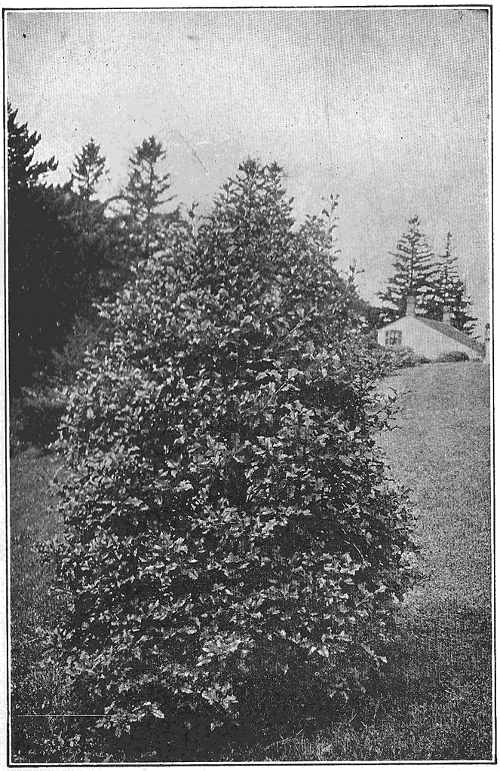
The spiny-leaved, red-berried holly is a handsome evergreen tree for the lawn
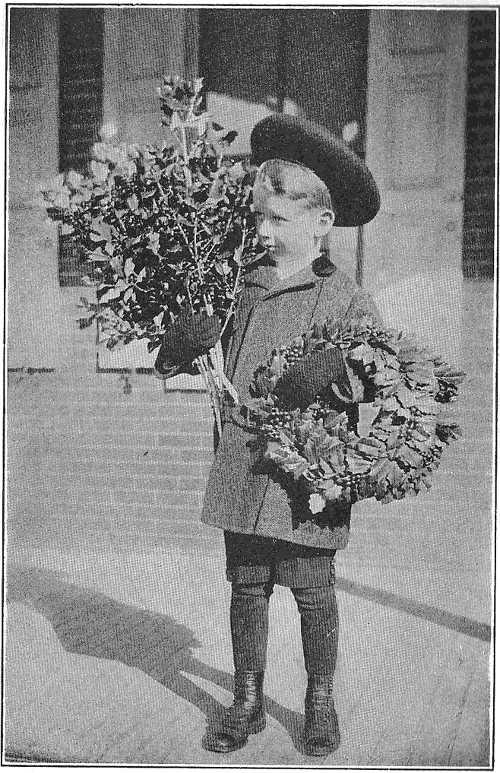
What would Christmas be without holly branches and wreaths for decoration!
The Jersey pine is a twisted, low tree, with dark, discouraged-looking branches, covered with grey-green leaves that have a sickly yellowish tinge when the new shoots appear in spring. The leaves are always in twos, and they range from one to three inches long. The small cones are dark red, oval, with thickened scales spiny-tipped. These trees cover waste land where there is a meagre living for any tree. What wonder that they look stunted? Their chief merit is that they clothe the desert places, and furnish wood for fuel and fences, and thus save the great lumber pines for higher uses.
THE CEDARS, WHITE AND RED
Beside the needle-leaved evergreens just described, there are some trees we all know, that bear cones, and are evergreens, but their leaves are strangely different from those of pines, spruces, [128] firs, and hemlocks. One of these is the familiar arbor vitæ, a conical tree, with flat leaf spray. Looking closely, one can make out the tiny, scale-like leaves, arranged in opposite pairs, clasping the wiry stems, and covering them completely. These stems are flat, so that one pair of leaves has a sharp keel on the middle. The next pair is spread out flat. The keeled pair covers the edge of the stem. The flat pair covers the broader surface. These pairs alternate through the length of the stem, and an aromatic resin seals them close.
The cones of the arbor vitæ are small, and they have few scales, compared with the cones of the needle-leaved evergreens. Each year a crop is borne, with two seeds under each scale. Few of us see the little red cone flowers in May, nor the pellets of yellow on other twigs, which are the pollen flowers. We watch the hedge clipper at work, trimming the thick green fronds that make a solid wall of green. Look carefully hereafter for the flowers and the ripe cones, in the proper season for each.
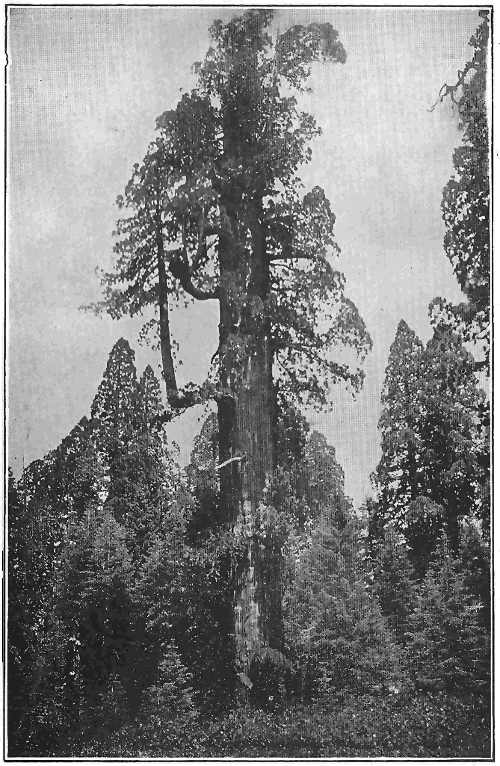
This big tree, “The Grizzly Giant,” is over three hundred feet high. It is a sequoia, one of the cone-bearing evergreens
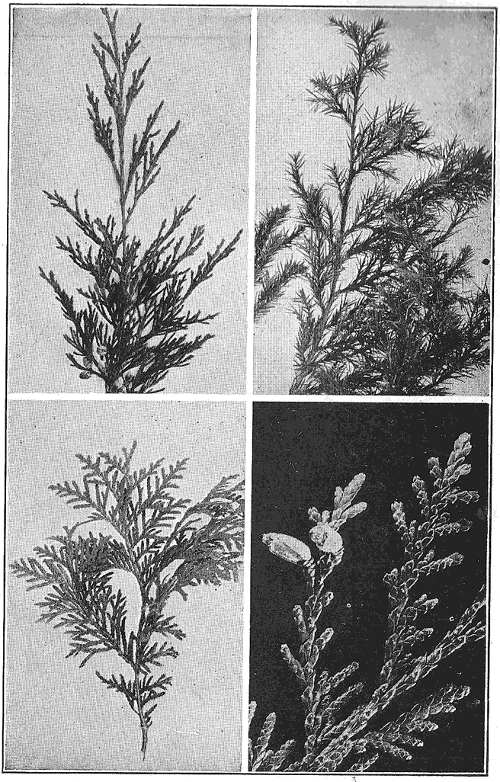
SCALY-LEAVED EVERGREENS Upper: two branches from the same red cedar tree Lower: flat sprays of arbor vitæ
The white cedar grows, a fine, conical evergreen tree, in the coast states, from Maine to Mississippi. It loves best the deep swamps, but grows well in wet, sandy soil farther inland. Here we see again the flat spray of minute, [129] pointed, and keeled leaves, but the cones are different. These are pale grey, and globular; the few scales are thick and horny, and curiously sculptured, each with a beak projecting from the centre.
The foliage mass is a peculiar blue-green, and the bark, thin, and rusty red, parts into strings and shreds.
Lumbermen call this tree a cedar. So they do the arbor vitæ. The wood of each is pale-coloured, and notable for its durability when exposed to weather and water. Fence posts of white cedar, and cedar pails, shingles, and the like, have a great reputation for durability.
The peculiarity of a red cedar is its fruit. Instead of a cone, a blue, juicy, sweet berry follows the blossoming of this tree. The foliage, too, is erratic. Minute leaves of the scale form, discovered in the other cedars, are found here on most twigs. They are still smaller, and the twigs are much smaller. But on new shoots, and often on a whole branch, the leaves are needle-like, one-half to three-quarters of an inch long, and spreading as the leaves of a spruce. The mass of the foliage is blue-green; these new ones are yellow-green. Among the branches hang these surprising berries!
The truth is that the scales of the cone thicken, [130] and become soft when ripe. They grow together, and the berry is, therefore, a cone, but much changed in its development from the cone on which the fruits of other evergreen trees are patterned.
We all know a red cedar tree by its tall, slim shape. The birds eat the berries, and scatter the seeds far and wide. The trees come up in irregular clumps in pastures and fence-rows, and in rough, uncultivated land. They are pretty widely distributed in the eastern half of the United States.
The true name for this tree is juniper. That is the name by which all its related species are known. Red cedar is the lumberman’s name for its wood, and this name, though not right, will probably stick to it always.
Red cedar chests and closets are believed to be moth-proof. The aromatic resin in the wood is supposed to be distasteful to the insects which are the pests of housekeepers. To put furs and woollen blankets and clothing into these chests does not always prevent their being moth-eaten. This many people have learned by sorrowful experience. We know the fragrance of this wood in pencils. Thousands of trees are cut every year to supply pencil factories. With the scarcity of these trees, other woods are being substituted. [131] But who will be quite satisfied, or be persuaded that cedar pencils are not the best?
TWO CONIFERS NOT EVERGREEN
Two cone-bearing trees have the astonishing habit of letting go their leaves in the fall, and thus setting themselves apart from the evergreens, to which they are otherwise closely related. Their cones are like those of pines and spruces. Their leaves are needle-like, and their flowers are the cone flowers like the rest. Although they stand bare in winter time, their fruits declare their kinships with the evergreen. Their forms also suggest this kinship, for each is a spire-like shaft, from which short branches stand out horizontally like those of the pointed firs and spruces.
THE LARCHES
In the Northern states, and Canada, long stretches of cold marsh land are covered with solid growths of tamarack, our American larch tree. In summer the branches are covered with long, drooping twigs, each set with many blunt side spurs, from which a tuft of soft, needle-like [132] leaves forms a green rosette or pompom. The end twigs have needle leaves scattered their whole length, after the fashion of the spruces. Purplish cone flowers, and yellow staminate cones appear in spring, and in autumn among the leaves that are turning yellow a crop of cones is ripening. They stand erect and solitary on the twigs between the rosettes of leaves.
In winter the long, flexible twigs are bare except for these cones. The little knobs along the twigs are the stubs which bore leaves. In the spring new leaves come out, pale lettuce green, feathery, transforming the tree top into a thing of beauty.
This larch tree of ours is more sparsely branched than the larch of Europe. It looks ragged and unhappy when planted on our lawns. It is at its best in the cold North, where it grows in dense crowds, and the tall trunks are stripped free from limbs well towards the tops. These straight shafts are cut for telegraph poles, railroad ties, and posts. The heavy, resinous wood lasts a long time in the ground.
The larches planted for shade and ornament are of the European species, which thrives in any soil. It has a denser head of branches, and much more luxuriant crown of foliage than our native species. It is a beautiful feathery pyramid of green, distinctly [133] different from other trees. In Europe large forests are grown on the mountain sides, and from these the tallest masts for vessels are obtained. The heavy, resinous wood does not easily take fire as do the pitch pines. The old wooden battle ships were faced with larch wood because of this, and because larch wood is so durable in contact with water. Indeed it has the reputation of outlasting oak, and the wood of all other conifers.
In the woods of the far Northwest, and inland to Montana, the Western larch is one of the mighty forest trees. Six feet in diameter, and 200 feet in height are not uncommon dimensions among these giant larches. These trees are of slow growth, and they stand with their roots in water or in wet soil, though on the mountain side. This is an important lumber tree with wood that has all the good qualities of its family. In Europe the tree is planted for forests, and as an ornamental tree. We cannot grow it in the Eastern United States. It is worth a journey across the continent to see it growing, one of the most magnificent trees in the world.
[134]
THE BALD CYPRESS
Travellers in the South pass forests of dark pines, and along the edges of swamps the pines often give way to solid stretches of trees with pale grey trunks, and lettuce green foliage, whose lightness contrasts strangely and beautifully with the solid bank of dark green that roofs the forests of pines. A closer look at these strange trees, which often stand knee-deep in water, is not so easy. At certain seasons of the year, however, these swamps are dry enough so that one may walk dry-shod among them, and so learn to know the bald cypress of the South, one of the most beautiful and interesting of native American trees.
This is the second of the cone-bearing trees which is not an evergreen. The leaves on the new shoots are two-ranked, soft and pale sage green in colour. The stems that bear these plumy leaves bear also scattered single blades. Among them are older twigs, tipped with cones, and bearing branchlets with scale-like leaves scarcely spreading at the tips. These are much smaller than the leaves arranged in two ranks, forming feather-like, leafy branchlets. It is these which are shed, branchlets, and all, in the autumn, and [135] fresh in spring renew the feathery grace of the long, narrow tree top.
The most surprising thing about the bald cypress is the flaring base of the trunk, and the root system which seems too large for the tall but usually narrow top. Knees of cypress rising out of the water from the main roots, are distinguished from stumps by their smooth, conical tops. The base of a great tree often spreads into wide flying buttresses, each hollowed on the inside, but serving with the others to support the hollow-trunked tree. Many a giant of great age stands thus on stilts whose submerged ends are the gnarled roots of the tree. From these rise many smooth, knobbed knees above the surface of the water in the rainy season. By some foresters, humps on the roots are supposed to be necessary to the proper breathing of the roots, submerged under water so large a part of the year. The question of what causes these growths, and of what use they are, is not fully determined.
The cones of the bald cypress are globular, and about the size of an olive. By them the tree declares its relationship to the needle-leaved evergreens. The wood is light and easy to work, but not noticeably resinous. It is used for buildings, and for special parts, such as doors, shingles. It is beautiful when stained, and would be more [136] valuable for interior finish of houses did it not keep the record of each bump and dent, as all soft woods do. Buckets and barrels to contain liquids are largely made of this wood. In railroad ties it proves very durable.
The best and strangest fact about this tree is that though it belongs to the South, and is a swamp tree by preference, it grows large and beautiful in the North, and in soil that is only moderately moist. The parks of Brooklyn have some noble specimens of this bald cypress of the South. They stand, tall, handsome shafts, feathered lightly with their short, drooping side branches, clothed with pale green leaves. There is no peculiarity of spreading trunk or knees to disturb the sod that comes up around the base of the tree. In the autumn the foliage turns yellow, and drops with the larch leaves. Through the winter the globular cones are present to prove this bald cypress a relative of the evergreens, which are its neighbours.
THE HOLLIES
No Christmas is Christmas truly without at least a few branches of the evergreen holly of the South, whose leathery, spiny-pointed leaves [137] are brightened by clusters of red berries. Every year, hundreds of crates and boxes of these holly branches are shipped north from the woods of Alabama, and other Southern states. Many people make their living by cutting loads of these branches, and hauling them to the shipping sheds where they are packed and put onto the railroad. The business has grown so rapidly within the past twenty-five years that holly trees are becoming very scarce. It has never occurred to those who cut down and strip the trees that it takes years to grow new ones, and that nobody is planting for the future.
Holly wood is white, and very close-grained. It is admirable for tool handles, whipstocks, walking sticks, and for the blocks on which wood engravings are made. The living trees are planted for hedges, and for ornament. The leaves are evergreen, and the berries add brightness and warmth to the shrubbery border when snow covers the ground.
Although it reaches its greatest size, and is most commonly found in Southern woods, this little tree follows the coast as far north as Long Island. I have found it much higher than my head, growing wild on the sand bar that separates Great South Bay from the ocean, east of New York Harbour. Further north, it is occasionally [138] found, but in stunted sizes, and it is easily winter-killed.
The holly of Europe, which has brightened the English Christmas for centuries, has a far more deeply cleft and spiny leaf than ours. Beside it, our holly leaves and berries are dull, and dark-coloured. The whole tree lacks the brightness of the European species. Hedges of this lustrous-leaved holly shut in many an English garden, and their bright berries glow cheerfully through the grey, sunless, winter days. No wonder the gardeners frown upon the little thrushes that feed upon these berries, thus robbing the garden of one of its chief winter charms.
Three other American hollies are found as shrubby trees in our Eastern woods, but none of them is evergreen, and the trees are not numerous in any locality. We shall oftenest see the species known as the winterberry, whose abundant red berries remain untouched by the birds, until late in the spring. Many of these fruit-laden branches are gathered in the wild, and sold in cities for Christmas decorations. Sprays of these berries are often added to the evergreen holly branches when their own berries are scarce.
Christmas holly is something we cannot do without. As the supply grows less, the price will mount higher. Then will come a time when it [139] is profitable to raise these trees in quantities, and holly farming will be practised in favourable localities in the Southern states. But that time has not yet come.
THE BURNING BUSH
A little tree, not at all related to the holly, but truly a cousin of the bitter-sweet, has a rather surprising name. In summer it looks like a wild plum tree, except for its fluted, ash-grey bark. The flowers have purple petals, and look somewhat like potato blossoms. They would never attract your attention as you pass the tree.
In the autumn the leaves turn yellow, and gradually the purple husks that cover the scarlet berries split open, and curl back. Watch the gradual opening of these husks, and notice, from some little distance, the gradual reddening of the tree top, as the yellow leaves fall, and more and more of the scarlet berries are revealed, as the husks curl and shrink away from them. It is in this seed and its husk that the resemblance and relationship of the burning bush and the bitter-sweet vine is revealed.
The European spindle tree, and a number of Japanese and Chinese species, are now planted [140] in American gardens, and called by their genus name, Evonymus. The red-fruited sorts all come under the common name, burning bush, and they do burn with a steady flame when winter has robbed the gardens of colour. Evergreens form a beautiful background for these ruddy little trees.