TREE STUDIES IN THE SUMMER
Reading edition
[183]
TREES WITH THE LARGEST FLOWERS
If we set out to find the trees that have the largest flowers, meaning to count only trees that grow wild in our woods, it will save time to go straight south into North Carolina, and climb the foot hills of the Allegheny Mountains. Or it may be that in the fertile valleys that lie between the low ridges we shall first come upon a magnolia, called the large-leaved cucumber tree. Anywhere from North Carolina to Florida, and west to Arkansas, these remarkable trees are likely to be found, in small groups. In cultivation, they are successfully planted as far north as Boston.
Before the tree has attained more than a man’s height it is a wonder, on account of the leaves which measure more than a foot in length, and have their long, green blades lined with white. In June the flowers open—great white bowls, made of waxen petals, in a double row, the inner ones painted purple at their bases, giving the flower a purple centre.
The wind blows the leaves about, and tears them into rags, unless the tree is in a sheltered [184] place. The silvery leaf linings, as white as the blossoms, make it difficult to see that the tree is in bloom, until one is close enough to see the petals. If the leaves were green on both sides the great blossoms, as large as a man’s head, would be seen afar off. The tree would look like a giant rose bush.
From Pennsylvania southward to the Gulf of Mexico, and west to Arkansas and Texas, the evergreen magnolia grows on stream borders, and even on uplands where the soil is not very moist. When this pyramid of shining green leaves lights all its waxen tapers, it is a sight worth a day’s journey to see. Each stiff twig is bent upward, and there a bud appears in spring. A few at a time, the flowers open, and the blooming time lasts till August.
Each blossom is a deep, creamy cup, made of six wax-like petals, surrounded by three white sepals. Inside are many stamens, purple at the base, and a cone of pistils, all grown together.
The leaves are oblong or oval, often eight inches long, thick, deep green, and bright as if polished on the upper surface. The lining is dull green, sometimes covered with rusty down. The paler green and the brighter polish on the young leaves add much beauty to the tree in summer. In winter the leaves get grimy and [185] the tree top is sombre, for most of the foliage has seen much wear and tear.
In autumn the ends of the twigs hold up green cones, made of many furry capsules that end in curved horns. Each capsule splits when ripe, and a scarlet seed, like a berry, hangs out on an elastic thread, and swings lower and lower, until finally it is carried away. Thus the magnolia sows its seeds in winter.
The shining leaves of this magnolia come North at the Christmas season, and are used to decorate homes and churches. Holly, mistletoe, palm leaves, and the beautiful Southern smilax are other Christmas greens now commonly in use. They are all gathered with magnolia and shoots of the long-leaf pine, in the woods down South.
The swamp bay is a magnolia that grows as a shrub to New England, keeping to the swampy lands that skirt the Atlantic coast. Every spring the fragrant, creamy blossoms are to be bought from street Arabs in New York and Philadelphia. A single globular flower is surrounded by a whorl of oval leaves, bright green, but lined with a white, powdery substance that makes them look silver-lined. The flowers are deliciously fragrant, and most beautiful when not spread wide open. The seller often takes the trouble to spring the petals back, to make the blossom seem [186] bigger. The waxy petals turn brown soon after such handling, and all their natural beauty departs.
From Florida westward to Texas this magnolia becomes a slender, tall evergreen tree. The best flowers of this tree are borne on shoots that are produced by pruning back the new growth each year. The largest leaves and flowers are also the handsomest.
The cucumber tree is the magnolia of the North. It is a fine tree in Ontario, Canada, and from this region it spreads south, its range widening like a fan, reaching from Arkansas to the Carolinas, and Mississippi, and Alabama. The tropical appearance of the tree is due to the big, heart-shaped leaves. Their tulip-like flowers are as large as garden tulips, but they make scarcely any show, because they are very much the same in colour as the yellowish-green new leaves that surround them.
The “cucumbers” are the green cones that contain the seeds. They are very lumpy and irregular in form, but when ripe the cells split open and the scarlet seed, let down on an elastic thread from each, looks like any magnolia seed.
Cucumber wood is soft, yellowish-brown, and close-grained. It is not very good lumber, though put to many uses. The tree is worth [187] more alive than dead. It is an admirable shade tree, though not planted as much as it deserves.
The tulip tree is a close relative of the magnolias. It is one of the trees with large flowers, though, like the cucumber tree, the colour of the flowers makes them rather inconspicuous. In June the upturned twigs blossom with yellow tulips. The three sepals flare outward, the petals form the cup. A band of orange decorates the cup, and signals the bees which come for nectar hidden near the bottom of the flower cup, among the bases of the many stamens.
Many people see the gay petals of the tulip tree flowers when they fall on the sidewalk, and some wonder what these bits of colour are. A few will say: “There must be a tulip tree near by,” and look up to find the singular squared-leaf blades that belong to no other tree. There is a whole tree top fluttering with them, and this tremulous motion explains why the tree is often called the tulip poplar. The yellow wood gives the name, yellow poplar. Pulp of this wood is used for the manufacture of the ordinary postal cards. It has many other uses, and is a valuable lumber tree. For shade and ornament it is one of the best trees to plant.
The cones of the tulip tree do not set free their seeds, as those of the magnolias do. Instead of [188] horned capsules, the cone has flat, overlapping blades, like the wing of a maple seed, and the small, closed seed case is the base of the blade. A few of these seeds are fully developed. But when the winter strips the tree of its leaves, the wind shakes the cones, and the loosened scales gradually fall. The wind catches the flat wings, and away they sail. Little tulip trees grow up where good seeds fall in favourable ground.
One day a neighbour told me that there was a tree in blossom on the side of the ravine. This was a strange story, for it was the dead of winter. We went to see this wonderful tree. What do you think it was? A tulip tree, with the seed cones half stripped of their seeds, and shining like yellow flowers on the ends of the twigs. It was not strange at all that a person who did not know the tree, and had never seen its cones in mid-winter, should make this very mistake.
The flowering dogwood invites us every spring to break off branches covered with big, white blossoms, each like a four-pointed star, with a cluster of small white buds in the centre. The trees are small and low-branching, their limbs are flat, and they spread outward and slightly downward. Who can resist cutting a few of the blossoming boughs of this lovely tree! The best part is that the tree suffers not at all if [189] the pruning is done with some care. Take a thought for the tree; cut the branches clean with a knife. Take them off where they are thick, and you will leave the tree better in shape than when you came. Do not strip it of flowers. This will cripple it. A few sprays of dogwood, prettily arranged in a vase, are a delight to the eye. A crowded mass of them is not at all.
The four outer wings of white are not the petals of a dogwood blossom. They are colourless leaves, the full-grown scales of the winter flower buds. The notch at the tip is made by the falling off of the withered tip which in winter protected the flowers. The base grew long and broad and turned gradually white. The bees see these white banners farther, perhaps, than they can catch the faint perfume. Watch the bee as she probes the middle flowers for nectar. See the pollen on her hairy body. From one to another, she is the pollen distributor of these flowers, and she doesn’t know it.
TREES MOST SHOWY IN BLOOM
Sometimes a tree with very small flowers has such a multitude of them that it attracts more attention and admiration when in blossom than the [190] trees with the largest flowers. A magnolia blossom as large as a cabbage head must sacrifice delicacy to size. We must see it at a distance to overlook its coarseness, and to escape its overpowering perfume.
An orchard in early May is transformed into fairyland by the opening of millions of buds. Apple trees have just begun to unfold the new leaves. They are pale green, and coated with white hairs, so that a silvery cloud rests on the tree when the white blossoms, warmed with a tinge of pink, come with a rush that takes one’s breath away.
A single apple blossom has its five flaring petals inside of five green sepals that are the bud’s green overcoat. The stamens are many; the pistils five in the centre of the flower. The plan of the flower is five. The green lump below the blossom is the apple, already forming. Inside it are the five cells of the core, and each has its seeds already forming, if the five pistils have each caught a grain of pollen for each of the embryo seeds its chamber of the core contained.
The delicate colour and rich fragrance of the apple orchard are enchanting. To the honey bees these two signals call to a feast of nectar. All unknown to them, they carry pollen on their furry bodies from flower to flower, and thus [191] enable the pistils to set seed. If the days are damp and there are frequent showers while the apple trees are in bloom, the bees are kept at home, and there will be but a small crop of apples. Fortunately for the bees and for us, the blossoms do not all come out on the same day. The trees and the bees are hopeful till the last moment that the sun will shine, and the nectar be gathered, before the opportunity of the year passes.
Flowers much like apple blossoms in form cover the twigs of hawthorn trees. They are usually in many-flowered clusters, set off by the green leaves. Fragrance, sometimes sickening sweet, draws the bees and other insects to these trees. Nectar drips from the blossoms of some species. The thorny branches spread sidewise, holding the blossoms out in wide platforms. The red fruits, called haws, adorn the trees in late summer.
Plum and cherry trees are laden with white bloom, and heavy with fragrance. Some species haven’t a leaf when they bloom. And these are among the showiest of blossoming trees. In these flowers there are single pistils, and but a single grain of pollen is needed to set seed. The single seed is the pit, or stone, of this family known as the trees with stone fruits.
[192]
TREES THAT BLOOM IN MIDSUMMER
In spring the big chestnut tree is late in putting out its leaves. It is May before the bare limbs are clothed with green. This crown is made of long, pointed leaves, each short-stemmed, strongly ribbed, with parallel veins on each side of the midrib, polished and sharp-toothed along its margin. It is a superb dome of unusually handsome leaves.
When the flower procession is long past and the grain fields have turned yellow, and the mower and reaper are humming busily, the chestnut’s crown turns from green to gold, as if to harmonise with the landscape of midsummer. Each twig ends in a feathery yellow plume, which waves in the breezes, and sheds its yellow pollen abroad. The fertile flowers are at the base of the plume. As the yellow pollen flowers fade, the green scaly ones below them are swelling. They are the young chestnuts. The long tongue each held out to catch pollen when it was ready for use. Each flower has three nuts as its full quota to form. Failure to be pollenated may cause one of the three to fail. The husk will then contain two nuts.
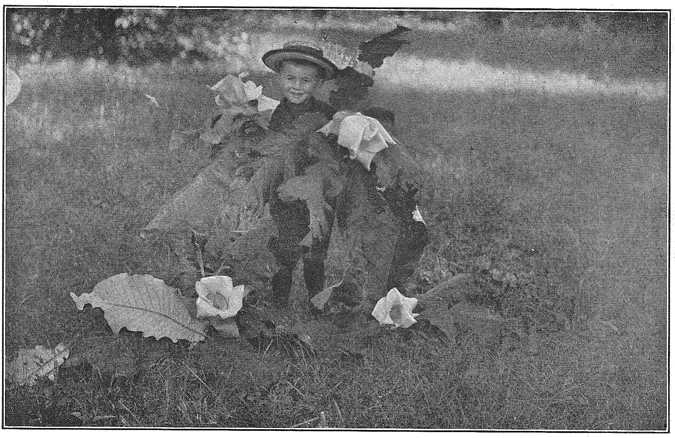
Leaves and flowers of the ear-leaved cucumber tree are the largest in the magnolia family
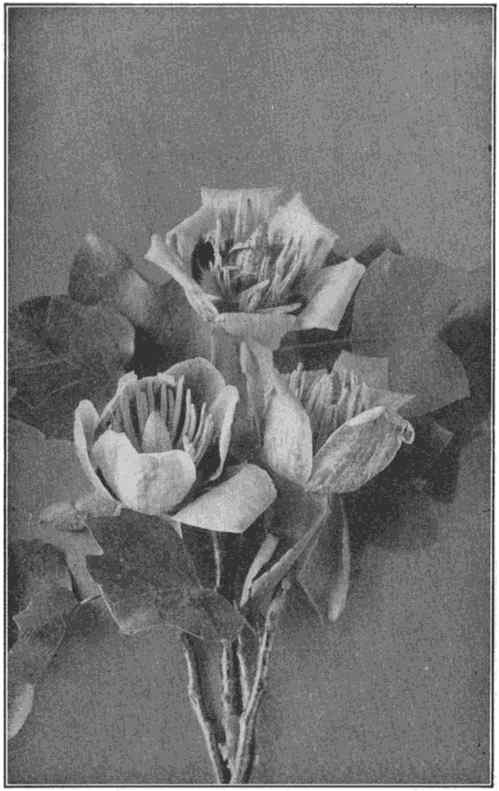
The orange-yellow flower cups and squared leaves of the tulip tree
In May the yellow locust trees still stand along [193] the roadsides, or herded together along the banks of streams, bare and ugly, while the trees around them are beautifully clothed in their green garments, and adorned with blossoms. The dead pods still cling to the locust’s branches, and not even the buds are in sight to prove the twigs alive.
Suddenly the trees wake, push out their hidden buds into shoots which unfold leaves made of tiny leaflets. The leafy spray is light and graceful, pale green with a silvery sheen at first. Soon the leaves are inundated with a flood of white blossoms, fragrant with their nectar, which hang in clusters from each twig. The bees see the white cloud on the locust tree, and hurry to the feast. Each curious pea-like flower has a honey pot in its horned petal. Throughout the summer the locust trees wave their fern-like leaves, among which the young pods swing, rosy and green, and velvety soft. The two thorns at the base of each leaf are there, but they are not conspicuous, unless you grasp a limb; then they let you know where they are, and what they can do.
On a summer evening we shall see that the locust has closed its leaves, folding the opposite leaflets together, and the whole leaf drooping from its stem. It reminds us of the old-fashioned sensitive plant whose leaves resembled these, folded its leaflets and drooped whenever it was [194] touched. Indeed, the locust tree and these plants are near relatives. The locust leaves are sensitive to the evening air. They close if a rain comes up, but open when the sun comes out again and the sky clears.
Locust trees have an insect enemy which bores into the solid wood, and ruins it for lumber. Even the twigs are swollen and distorted by these insects, which feed upon the rich sap that should go to feed the tree. It is impossible to reach this enemy with poison, so the trees are helpless.
Except for this unfortunate fact, locusts would be a profitable crop to raise for timber. Locust wood is very hard, durable, and strong. It is slow to decay when in water, so it is valuable for fence posts, and for boat building. It is used for hubs and spokes of waggon wheels, and it is an excellent fuel. The locust timber that reaches market comes from the mountain slopes, where the locust-borer is thus far unknown. The range of the tree is all over the Eastern states and west to the Rocky Mountains. We shall not find them south of the latitude of Tennessee.
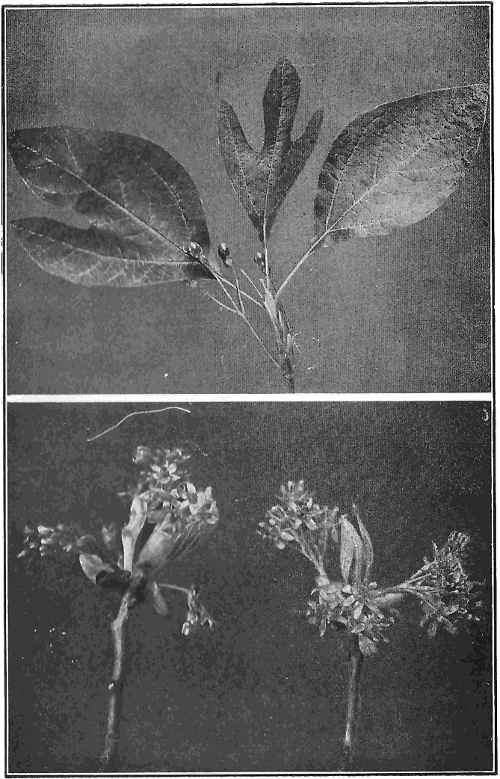
Flowers, fruit, and the three different leaf patterns of the sassafras tree
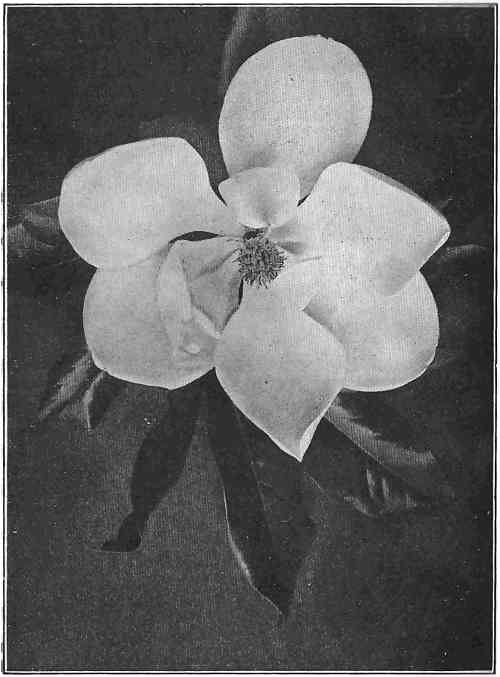
Waxy flower of the evergreen magnolia, usually eight inches across when open
The catalpa’s great heart-shaped leaves, as broad as a man’s hat, come out in May, but the leafy shoots grow a foot or more in length, and it is well along toward Independence Day before the flower buds show streaks of white above the [195] foliage mass. The upturned twigs end in a spike of blossoms, creamy in colour, but speckled within their wide throats with purple and yellow. The rim of the flower cup is daintily scalloped, and frilled, and the tree top is even more showy than the horse chestnut a month earlier.
There is stateliness, even stiffness, in the figure of a blossoming horse chestnut—a pyramid of green holding up a thousand pyramids of white. The catalpa has a round head, and the loose flower clusters are quite informal in their arrangement. The flowers nod gracefully on their stems—a thing the horse chestnut flowers are unable to do.
Why are the dots of colour sprinkled in the throat of the flower? Why are they arranged in lines that lead to the nectar sac? To guide the bees which come in swarms in answer to the signals of colour and fragrance the flowers fling out as lures to them.
The two stamens are ripe before the pistil. The bee rubs the pollen off by crowding into the flower. Some of this dust is bound to be rubbed off on the ripe stigma of an older blossom visited by this bee. Thus, unconsciously the bee helps the tree to set good seed. Of these we will study when we come to the tree again in autumn. Only a hint of the seed vessel is given by looking at [196] the oldest flower in a cluster, and noticing the green part at the base.
The linden or basswood holds its arms out so that the broad leaves are exposed to the sun in slanting strata, or platforms of shade, that strike downward. The tree’s frame is roofed in with them in an almost unbroken thatch of green. Cattle love to crop this foliage, and to enjoy the dense shade on a hot day.
In July the dark green is illuminated by thousands of starry white blossoms, a few at the end of a slender stem that rises out of a pale green, leaf-like blade. There is nothing like it borne on any other tree.
The news that the basswoods are in bloom reaches the hives in good time. One is able to hear the murmur of bees as far as he can see the flowers, but the fragrance travels much farther. Basswood honey is higher in price than other kinds. Is this the reason the bees are so hard at work? Small as the individual flowers are, they have an unusual supply of nectar, and the bees revel in the plenty of what will feed them and yield wax. They make honey while the sun shines, counting the basswoods their best source of the crude materials for honeymaking. It was so in the days of old. Greek poets sang of the honey-laden lindens. Honey made from [197] linden trees in the Lithuanian forests was carried to Rome, where it sold for three times the price of ordinary honey.
Bees swarm, and the new colony often takes to the woods and sets up housekeeping in a hollow tree. This is so likely in the Southern states to be a linden that “bee tree” is a familiar name of this tree.
THE EARLY BERRIES IN THE WOODS
Robins come to our cherry trees in June, and they hunt for our strawberries under the green leaves. The blackberries come on, and the raspberries, and currants. The birds look at them with calculating eyes. An appetite for berries is inherited in them, learned in the woods, where wild berries have grown, and ripened for them, from the times long before there were gardens and cultivated fruits.
Back in the woods we shall find wild berries ripening, and birds feasting thankfully upon them. The harvest begins with the June-berries in the month of June. Serviceberries they are also called, and the tree is known also as the shadbush. We remember the lovely veil of white blossoms this tree put on before its leaves came [198] out. In June we might not know the trees, except that they bear red berries, few on a cluster, and here the birds are feasting.
There is no other tree with berries that ripen so early, unless it be the broad-leaved mulberry. Here, too, the birds will be found in numbers. Turn back the wide, heart-shaped leaves, and you will find the single berries of all sizes, some green, some reddening and soft. They are like blackberries, each made of many tiny berries, grown together.
The beauty of the mulberry is that its fruit keeps coming on from June until August. It is a very slow, easy-going tree, in no hurry to have its harvest over. The birds like the soft, seedy berries, which to our taste are insipid.
It is a shrewd thing to plant mulberry trees on the edges of fruit gardens, and set a row of June-berry trees along the road outside the cherry orchard. It is the scarcity of wild berries that brings the birds into our gardens. Many a fruit-grower has saved his crop by planting wild berry trees for the birds.
The elders are shrubby trees with large, fern-like leaves. They lift up flat, white flower clusters, sometimes as large as dinner plates, in June, and in the middle of summer dark red berries are ripening where the flowers were. Here is another [199] feast for the birds, and elderberry pies are the reward of boys and girls who gather the berries, and take them home to mother. Grandma thinks of elderberry wine, so good for many ailments, and if the berries are plenty it is easy to gather a bucketful to make a few pints of this old-fashioned cordial.
Among the shining green leaves of the wild red cherry tree the little fruits glow like rubies in the summer. Here is a feast for the birds. We find these small pin cherries very thin-fleshed, and sour, and the biggest of them is no larger than a pea. But how the birds love them! The bird cherry is indeed the bird’s tree. In blossom it belongs to the bees, which come in swarms for nectar. To them, unconscious carriers of pollen from flower to flower, the birds owe a debt of gratitude. They insure the setting of seed, and this means a big crop of fruit.
The wild black cherry is later with its shining clusters of dark red cherries. They come in September, when the birds’ procession has turned southward. The earliest comers hold high carnival in these trees, devour quantities of the bitter-sweet fruit, and drop the seeds near and far. The wind can do little in scattering the seeds of fruit trees. The birds are the chief agents of distribution.
[200]
THE SASSAFRAS
The sassafras is not important as a forest tree, yet I do not know another to whom so many kinds of people, of all ages, go, asking for favours this tree alone can give. Even in regions where the tree does not grow, its name is well known. Sassafras tea has a world-wide reputation as a cure for “spring fever,” otherwise known as “that tired feeling.” Drug store windows are piled high in spring with bits of the corky bark of the sassafras roots, and the buds in winter taste of the same aromatic oil, whose flavour rises from a steaming pot of sassafras tea. Many a bad-tasting medicine is made more palatable by a drop or two of oil of sassafras.
The leaves and twigs of young sassafras trees are used in the South to flavour and thicken gumbo soups. The wood of sassafras is light and tough. The long limbs are cut and stripped by country boys going fishing, who know what trees yield the best fishing rods. Sassafras posts last a long while, for the wood does not rot in contact with soil, or soaked with water. It makes good boats and barrels for this same reason.
[201]
Children know the sassafras tree. In winter they nibble the dainty green buds, or dig away the snow at the roots to get a morsel of the aromatic bark. In summer it is the leaves that are the chief charm of the tree. It is a fascinating game to look for the “mittens and double mittens,” which seem to be more numerous than the plain oval leaves on this tree. There is no other tree that has three distinct leaf shapes. The mitten form has its thumb just right, on one side. It might be used for a mitten pattern. There are lefts and rights, and mittens of all sizes. The doll-sized ones are the youngest, and they grow near the tips of the twigs. The double mittens have a thumb on each side, and the simple oval shape—the hand part with no thumb at all—is usually harder to find than either of the others.
When looking for these strange leaf shapes, there is always a chance of coming upon a strange inhabitant of the sassafras tree. A great green caterpillar is lying at ease upon a hammock of silk, which he has spun for himself. There he lies, and gazes at the startled person who discovers him. Are those really eyes, or only black spots? They probably scare away birds which are looking for worms. The effect of the two “eye spots” is almost as surprising as if two [202] rolling eyeballs glared at the intruder, and threatened violence if he came near.
Carry home this fearsome green mummy on the leaf; put him in a cage made of wire screen, and watch him. He needs no food, for he is asleep. When he awakes his mummy case will split open, and out of it will emerge a wonderful butterfly, with banded wings of black and yellow velvet, and long, tapering points trailing behind, which gives him his name—the swallow-tailed butterfly. He has a flexible tongue, an inch or more in length, coiled like a watch spring. With it he will probe the tubes of flowers, and find the nectar at the base of each. He is hungry now, so let him go. Turn him loose in a bed of flowers, and you may see just how he feeds.
When the mother butterfly laid its tiny green egg on the face of an open leaf of the sassafras, the tree was probably in blossom. In June, delicate, starry, greenish-yellow flowers come out in clusters on the ends of twigs. The butterfly finds nectar in these fragrant and dainty blossoms. In the autumn birds come and feast upon the blue berries which look very handsome on their red stems. Indeed, it is quite usual for the trees to be stripped while the berries are still green, so hungry are the birds that stop to feed on their long journey to the South.
[203]
In the autumn the sassafras trees change colour from the brilliant green of summer. All colours of the sunset, purple, red, and golden, blend in these shining tree tops. A clump of sassafras and sweet gum trees, with here and there a tupelo and a dogwood, a scarlet oak and a hard maple, make a picture never to be forgotten. If the roadside trees were on fire, they would not show any more vivid colouring. It is their glorious good-bye to the year, before they all let their leaves fall and enter into the sleep of winter.
THE ASH FAMILY
The trees whose leaves are set opposite upon the twigs are few in the American woods compared with those whose leaves alternate. The maples have the opposite arrangement of leaves; so have the dogwoods. These trees have simple leaves. The horse chestnuts and buckeyes have their leaves set opposite, and these leaves are compound: five or seven leaflets rise from the end of the stout leaf stem. The ash family is another large group of trees, with leaves set opposite on the twigs. These leaves are compound, but of a different pattern from those of the horse chestnut. The leaf stem has the leaflets arranged [204] in pairs along its sides. This is the feather type of compound leaf, seen in the locust family, and among walnuts and hickories.
Ash trees are recognised by their opposite compound leaves. There is another sign: the fruit has a dry seed, pointed and winged like a dart. There is no other seed exactly like those of the ash. The seed clusters hang on the bare twigs, far into winter. The twigs are stout, and set in pairs on the branches. The trees grow large, and their tops are regular and handsome. The bark is close, broken by shallow fissures into small, often diamond-shaped plates.
Our common ash trees are distinguished by colour, as the names indicate. A few well-marked differences are shown by the species, which are often found growing together in mixed woods.
The white ash is a tall, handsome, stately tree, with a trunk like a grey granite column. The white in its name is from the pale leaf linings, that illuminate the tree top in summer. The twigs are pale, and the bark is often as pale grey as that of a white oak. The slender, dart-like seeds are one to two inches long, with a wing which is twice the length of the round, tapering seed. They hang in thick clusters, paler green than the leaves, and often flushed with a rosy tinge in late summer. All winter the wind harvests the [205] crop of seeds, and plants young white ashes wherever the darts fall on good ground.
The black ash is a slender, upright tree, with narrow head and stout twigs. The plump, leathery buds on the winter twigs are almost black, and the bark is a very dark grey. The foliage in summer is much darker green than that of any other ash, so the name is earned by buds, bark, and leaves. The seeds are flat and short, and the wing is broad and short, and deeply notched. A black ash leaf has all its leaflets stemless except the one at the tip. The white ash has a much fleecier foliage than that of the black, because each leaflet has a stem of its own.
The wood of the black ash splits readily into thin sheets, each representing the growth of a single year. The Indians taught the white men to make baskets out of black ash splints. They cut the tree down, sawed the log into the lengths required, split the blocks into pieces as wide as the splints should be. These sticks were bent over a board, and the strain separated the bands of dense, tough wood into the thin strips just right for basket weaving.
The red ash is a small, spreading tree, with a close head, slender branches, and crowded twigs. Its bark is reddish, closely furrowed, and scaly. [206] The young twigs are covered with soft hairs. The leaves are a shiny yellow-green above, often a foot long, made of seven to nine slender leaflets, whose stems and veins have a silky down, that remains all summer.
Red ash seeds are extremely slender and long, and they hang on hairy stems.
The green ash has dark, lustrous foliage, the leaf lining green, like its upper surface. The bark is grey, and closely checked, and the twigs are smooth and slender.
This is the ash tree which grows in the regions of scant rainfall; in Utah, Arizona, and Texas. In the East it is found from Virginia to Florida. It is one of the beautiful shade trees in the regions where few trees grow well. East of the Alleghenies it is but one among many ash trees, and is little noticed; but in the far West, and on the treeless plains of Nebraska and Dakota, it is a far handsomer tree than its companions, the willows and the cottonwoods.
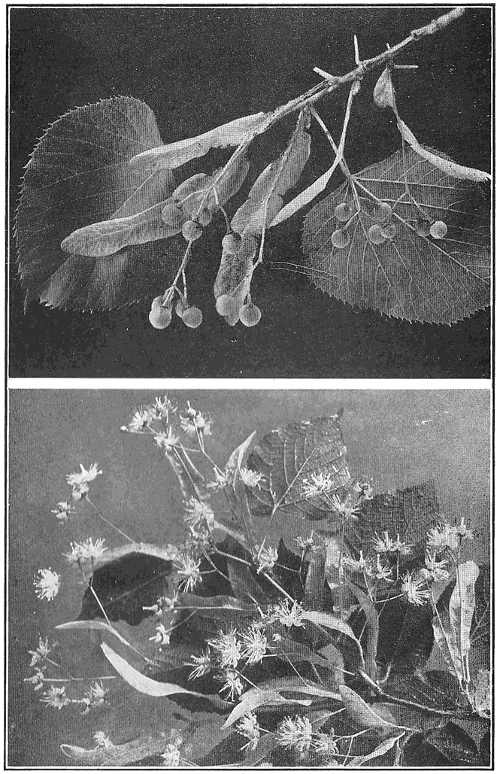
Fruits, leaves and flowers of basswood tree, called also linden
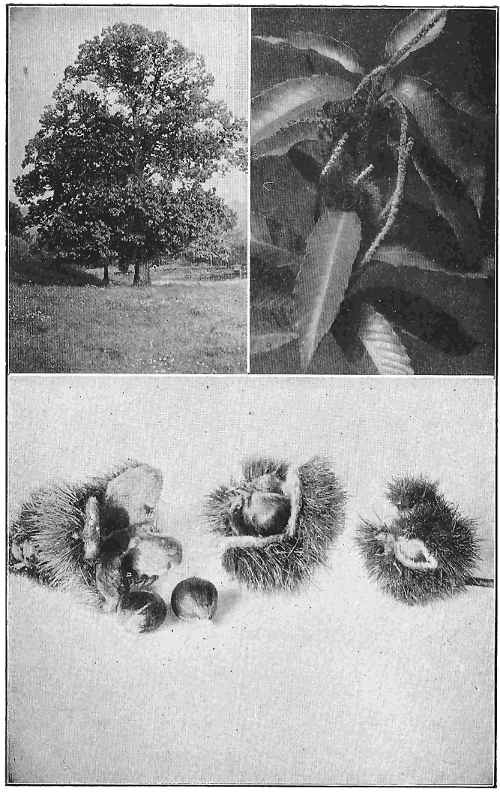
Chestnut trees blossom in July, and the nuts drop after the first severe frost
The blue ash is common on the rich river lands along the principal tributaries of the Mississippi. Some of the finest specimens grow on the limestone hills of the Smoky Mountains. It is a tall, graceful, grey-stemmed ash. We shall know it anywhere as an ash tree by its opposite twigs and leaves, and by its dart-like [207] fruits. It differs from all other ash trees in having four-angled twigs. The tree has a kind of blue dye in its inner bark. Cut out a piece and put it in water, and it is as if you had added a few grains of indigo.
The blue ash ranks high as a shade tree, and its wood is quite the equal of white ash. It is used for vehicles, for flooring, and for tool handles. It is especially desired for pitchfork handles.
The native ash of Europe is a large timber tree, whose range extends through Asia Minor. The wood of this tree had a wonderful reputation for general usefulness. Its tough, thin inner bark was used to write on before paper was invented. The wood was used for lances and spears, for bows, pikes, and shields by the soldiers, during ancient times. Every tool, vehicle, and implement of the farmer and mechanic were made of this wood. “Every prudent lord of a manor should employ one acre of ground with ash to every twenty acres of other land. In as many years it would be worth more than the land itself.”
The seeds of ash trees were used for fattening pigs. They were also used as remedies for many diseases. They were called birds’ tongues, from their shape, and every apothecary kept a stock [208] of them. Ash wood makes the best of fuel, and its ashes, rich in potash, make a splendid fertiliser, especially in orchards.
One warning the old English rhyme offers regarding this tree. It is supposed to attract lightning. Oaks have the same reputation. On the other hand, tradition holds that a beech tree is never struck by lightning. There is opportunity, where these trees grow, and where thunderstorms are frequent, to notice how true are the popular beliefs.
Have you ever been warned by this old rhyme?
“Beware of the oak, it draws the stroke; Avoid the ash, it courts the flash; Creep under the thorn—it will save you from harm.”
THE HORSE-CHESTNUT AND THE BUCKEYES
When an English lad speaks of a chestnut, he means the horse-chestnut, and the chances are that he does not know anything about the American trees, whose sweet nuts we gather in the woods at home after the frost has opened their spiny burs. In America the European tree is planted very commonly for ornament and shade, and it is always called horse-chestnut here, except by English cousins who may be visiting us.
[209]
They ask us why we put the word “horse” before this tree’s name. For answer we pull down a twig, snap off a leaf, and show the scar of the leaf’s attachment to the twig. It is somewhat like the print of a horse’s hoof on the ground. Even the horseshoe nails are there, for a thread from each leaflet goes down through the leaf stem, and its fibres are buried in the twig. There are five or seven of these nail prints in the scar, depending upon the number of leaflets. Five is the usual number, but seven is not at all unusual.
An old tradition states that the people of Eastern countries feed these chestnuts to their horses to cure them of cough, shortness of breath, and other lung disorders. Upon this is based a second claim for using the word “horse” before this tree’s name. The quality of the fruit, however, is probably the best answer to the question. The coarse, large nuts are not fit for human food. It is quite common to think that horses can eat things too rank for our more fastidious taste. Horse sugar is the name of a small tree whose sweetish twigs are browsed upon by cattle and horses in wooded pastures. Horse-radish and horse-mint are coarser, more rank-growing kinds of plants, than their closely related species which are used for human food.
[210]
We shall know the horse-chestnut in the dead of winter by the large buds, the large hoof-print leaf scars, and by the pyramidal form of the tree. The twigs are stout, and they turn upward so that the largest of the varnished buds are held up like candles. The main branches leave the trunk with an upward curve, then bend outward and downward, then up again to hold the buds upright. The tree looks, therefore, like a great complex candlestick, with many arms and many candles. The twigs are stout, and they come out opposite each other on the branch. This is a peculiarity of few trees. It belongs to all of the members of the horse-chestnut family, which includes the buckeye trees, our native horse-chestnuts.
In early spring, watch the horse-chestnut tree outside your windows and along the streets as they begin to swell, and until they finally open. The tree lights all its candles when the brown, varnished outer bud scales fall, and the soft, silky inner ones, yellow as a candle flame, are revealed. On the side twigs the buds are smaller than on the tips. Out of each small bud comes a bunch of leaves. Out of the big buds come the flowers.
In June a big horse-chestnut tree holds up a thousand pyramids of white blossoms. Below each flower duster is an umbrella-like circle of [211] leaves. Each blossom of the dense spike has in its throat dashes of yellow and red. The petals form a ruffled border. The curving stamens are thrust far out. Bees come in search of pollen and nectar.
After the flowers pass, green fruits appear, a few in a cluster, and all covered with spines. Not many of these reach full size. It seems to be enough for the tree to ripen one or two fruits in a cluster. In the autumn they turn brown, and the husk splits into three equal parts. Out of this spreading husk the brown nuts fall.
Now the boys assail the tree with sticks and stones, and the harvest of nuts is on. Who does not love them for their beauty alone? The great white spot is the place where they were attached to the husk. The kernel is as bitter as gall, and I know of no animal which eats it. If any one counts them useless, let him see the hoards of them which children gather, and use in their play. He will change his mind completely. Their glowing, soft colour is a feast to the eye, and they just fit the hand.
THE BUCKEYES
The Ohio buckeye is a little tree, but it has given its name to the Buckeye State. There must [212] have been many of them in the virgin forest that the Ohio pioneer cut down to make room for his crops of corn and grain. He noticed these trees particularly because of a disagreeable odour that comes from the bitter sap. The chopping and handling of these trees intensifies this odour, which is noticeable even when one drives past a growing tree.
The name was given by some imaginative person who saw a resemblance between the smooth brown nuts and the soft brown eyes of a buck. The white of the eye corresponds to the dash of white on the nut. Deer abounded in the virgin forests, and no doubt it was one of the first settlers, a hunter as well as a farmer, who named the tree.
The flowers and leaves resemble those of the horse-chestnut, but are smaller, as the tree is. The number of leaflets is five, rarely seven, and they cluster on the end of a long leaf stem. The flowers appear in April and May, and are not conspicuous, for they are yellowish-green, and make little contrast with the new leaves.
One thing is to be said in favour of this ill-smelling tree. Its wood has been found to be the best kind for the making of artificial limbs. To this special use the lumber is chiefly devoted.
The sweet buckeye lacks the disagreeable odour [213] of the Ohio buckeye, and its nuts are eaten by cattle. It is a handsome, large tree, with leaves of five slim leaflets, more or less hairy below, and on the veins above. The flowers are yellow and showy. Each corolla is drawn out into a tube, like a honeysuckle’s. The husks of the nuts are smooth. This species grows from Western Pennsylvania along the mountain slopes to Alabama, and on the prairies westward to Iowa. The nuts are full of starch, and these are ground into flour, which is used by bookbinders in making their paste. The reason why this paste is preferred is that destructive insects do not eat it as they do paste made of wheat flour.
A red-flowered buckeye tree of small size grows wild from Missouri to Texas, and east into Tennessee to Northern Alabama. This is not the same as the red horse-chestnut, which is sometimes seen in cultivation as a handsome tree, twenty to thirty feet high.
In the far West, the California buckeye is a wide-topped tree of good size, with leaves of the true horse-chestnut type, and white or rose-coloured flowers, in showy clusters, and smooth, pear-shaped nuts. This is the only one of our native species which grows beyond the Rocky Mountains.
[214]
THE LOCUSTS AND OTHER POD-BEARERS
When you find a tree with flat pods, containing a row of seeds, you may be sure it is a locust, or one of the family to which locusts belong. It is a near relative of the peas and beans that grow in the vegetable garden. This is a great and valuable family to the human race, for it furnishes some of the most valuable foods upon which the people of all countries live. Only one family, the grasses, is more important. This includes not only grasses that are used for making hay, but all the grains—wheat, barley, rice, oats, and corn, that make the bread of the world, and forage crops for horses and cattle. The banana and sugar cane and bamboos are in this wonderful grass family.
Along the roadsides, along rivers, and in the woods grow the black or yellow locusts that bloom in June, covering their ugly limbs with a cataract of white, pea-like blossoms, in large clusters. All summer the slim, thin pods are velvety and green, with a lovely flush of rose, as they swing among the feathery, fern-like leaves. In autumn the pods turn brown, and in winter, when the wind can switch them against the bare twigs, [215] they split, and one by one, the hard little seeds are shaken out. They are too heavy to be carried in the wind. So we see little locusts coming up among the old ones, and on the outer edges of the clump.
No tree is so discouraged-looking, unkempt, and diseased as a black locust infested with the borers, and stripped of the foliage that covered its thin, irregular limbs in the summer time. The buds, even, are hidden, and the tree looks as if life had left it. But the late spring denies the rumour by clothing the dead-looking twigs with foliage whose tender shadings and delicate leaf forms make it one of the most graceful and lovely of all native trees.
Unfortunately, we cannot have locusts of this species in this Eastern country without exposing them to the attacks of insects against which we cannot defend the trees. The eggs are laid in clefts of the bark, and the grubs hatch quite out of reach of poisons and other damaging spraying solutions. They feed on the living substance under the bark, and their presence is shown by swellings above their burrows. Twigs, limbs, and trunks are distorted, and gradually the tree loses vitality, and the wood is made worthless by the honeycombing it receives. Only in the mountainous parts of its range does the black [216] locust reach its best growth. No tree has better lumber for posts and other uses requiring durability in contact with the soil and with water.
The clammy locust is a pink-flowered species with a sticky substance exuding from the hairy surface of new shoots. The flowers are lovely but scentless. The trees are much planted in parks and on lawns as an ornament, in all temperate climates.
The honey locust earns its name in the summer time, when the curving green pods are full of a sweet, gelatinous pulp. Boys would like to get these honey pods, but the vicious thorns permit no climbing of the trees. Stoning and other throwing of missiles is a slow and unsatisfactory means of obtaining the forbidden fruit that hangs so high. By the time they ripen and fall off the pods are bitter as gall.
An old-world relative has thick, purple pods, which are sweet and palatable when ripe. These are brought to this country, and sold on small fruit stands under the name, St. John’s bread. It is said that this was the food of John the Baptist in the wilderness.
The Kentucky coffee tree is the coarsest member of the locust family in our woods. Its pods are thick and short, and the seeds inside are as large as hazel nuts. In the story of the Revolutionary [217] War, the patriotic citizens refused to pay duties on imported goods. The seeds of this locust were used as a substitute for coffee. I have tasted the bitter outside of one of these nuts, and tried to break one with a hammer, but unsuccessfully. It is not easy to understand how a beverage made of such a nut could have been fit to drink. The name of the tree seems to give colour of truth to the tradition.
A coffee tree much like our native species grows in China. We may believe that it is called by another name, for the people use its heavy pods for soap. Whether green or ripe, I do not know.
The club-like branches of our coffee tree give it a burly, clumsy appearance in winter, when nothing conceals them from view. The dangling pods rattle against the bare, stubby twigs, calling attention to their lack of grace and symmetry. Even the buds are out of sight, buried under the thin bark, just above the big leaf scars. All winter the wind strives with the stubborn pods. When one is torn off, it lies unopened until melting snow softens it, and the horny seed lies long before it is able to sprout.
A thin pod adorns the most delicate of the locust trees. This is the little red bud, a flat-topped tree, of slender, thornless branches, most [218] of them horizontal. Early in spring this tree earns its name. Quantities of rosy magenta, pea-shaped flowers cluster on its slim, angular twigs, quite covering the smaller branches. It is an unusual colour, and an unusual time to see pea-blossoms. You cannot forget it, if you have seen the tree once.
The leaves that soon follow are as unusual as the flowers. Roundish, heart-shaped, smooth, and shining as if polished, they flutter on thin, flexible stems, and the slim pods hang among them. They ripen and turn from green to rich purple when the leaves change to bright yellow. The hard little seeds are close together in the pods, so that they are numerous, though the pods are but two or three inches long.
I do not know when the red bud is most charming. Certainly its autumn garment of yellow is beautiful, trimmed with a fringe of purple pods. It is a royal robe, and so fresh and new-looking when the foliage of so many larger trees is faded and in tatters. The trees that hide in the shelter of larger ones can often save their leaves from wear and tear, and this the red bud does.
Judas tree is the name by which the red bud of Europe is commonly called. It is one of a few species to which an ugly tradition has been [219] fastened by custom. It is said that this is the kind of tree upon which Judas Iscariot hanged himself. Our little American tree has had to share the disgrace, for it looks like its European cousin. The name to use is the true one.
Nurserymen have imported a large-flowered red bud from China. Its flowers are not only more showy, but they have a paler, prettier colour—a rosy pink, and lacking the sad, blue tone of the others.
It is easy to raise red bud trees, and they are admirable in the border planting of a garden or lawn. They begin to blossom when quite young, and they never grow so large as to be out of place among shrubbery.
The yellow-wood has larger and lovelier blossom clusters than the black locust, with which it might most easily be confused. In autumn the flower stems hang full of thin pods, one to three seeds in a pod. No other locust is so scantily supplied with seeds in a pod.
In summer the leaflets prove that the tree is not a black locust. They are larger and fewer, though of the same feathered type. In the seasons when the tree blooms freely, which is by no means every year, the twigs are loaded with clusters larger than any black locust produces. In winter it is the bark that distinguishes the [220] tree. It is grey and smooth, like that of the beech; not at all like the dark trunk and rough limbs of the locust. The form of the tree is a regular head of horizontally-spreading limbs, ending in tapering twigs that droop gracefully. It is one of the handsomest trees in winter. The locust is one of the weediest and ugliest of trees when bare.
To find the yellow-wood in its native haunts, we must go to the mountains of Eastern Tennessee and North Carolina. It goes farther north and south, but its range is scant. Better chance of our meeting it in our neighbour’s yard. It is cultivated as a flowering tree by people who appreciate the finest trees that grow wild in American woods. The nurserymen call it Virgilia. This is certainly a graceful name, fitted to a tree that deserves only the best.
The catalpas are pod-bearers of a different type. Their long pencils are green, and there is no sign of splitting until autumn. The seeds are not like those of the flat pods, set in a single row. They are thin as tissue paper, and packed in overlapping layers about the thin partition that divides the pod into two compartments.
The pods hang on after the large, heart-shaped leaves fall. Winter winds bang them against the twigs, and their two sides separate lengthwise. [221] Gradually the thin, two-winged seeds escape, and are scattered. The sowing lasts a long time.
Willows and poplars have pods of a sort, but like neither locusts nor catalpas. The seeds are very minute in each family, and carried in delicate wisps of cottony down. The pods open by splitting down their walls, along two or four lines, curling back the dry segments, and thus letting the seeds escape. These trees are early in scattering their seeds. The true pod-bearers are late about it.
WILD APPLE TREES AND THEIR KIN
Go out into the woods, and you will find wild crab apple trees, bearing hard, sour little apples, unfit to eat. Four distinct kinds are native to this country. In Eastern Asia wild apple trees grow in greater variety than here. Our orchard apple trees are descended from these Oriental wild apples, which were brought under cultivation long before America was discovered. Nurserymen in Europe and Japan have for centuries worked with the wild species to improve them. The Japanese worked to produce finer flowering trees. European horticulturists desired finer and larger fruit. American orchards show how well [222] they have succeeded. For over a century American horticulture has made marked progress. Many valuable kinds of fruit have originated in this country. Our own wild apples are now studied with the aim of bringing them into cultivation, just as the Asiatic species were improved centuries ago. It is a wonderful work, accomplished by crossing, grafting, budding, by fertilising, and good tillage,—processes too special to be explained in this book.
The taming of wild apples, however, is one of the great achievements of the centuries. Every boy and every girl who enjoys the eating of a fine apple will wish to know how such glorious fruit, in abundance sufficient to supply the world’s needs, has been produced from such unpromising beginnings as the gnarled little crab trees scattered through the woods, and dwarfed by the larger forest trees that overshadowed them.
“Grafting” or “budding” a little tree insures that the fruit it bears later on will be of the variety of the tree from which the scions came. Only once in a long while does a good variety of fruit come on a seedling tree. Plant the seed of the best apple you ever ate, and then wait a dozen years or more for this tree to bear fruit. The chances are ninety-nine to one that the apples turn out to be miserable, sour, or tasteless nubbins, [223] like the roadside apples, that nobody planted. It is too expensive to experiment in hope of getting good varieties from seed.
“Johnny Appleseed” was a funny old fellow who wandered up and down the Ohio valley states, and planted apple seeds wherever he went. Queer, and perhaps crazy, he was a kindly soul, who dreamed of the days when orchards should dot the landscape, and be a part of every farm homestead. He did what he could to make the wild prairie wilderness blossom and bear fruit. No doubt many pioneer orchards came from his planting. Seedling trees, all of them, for he believed firmly that it is wrong to graft a tree!
Each year better and bigger apples are shown at fairs, and fruit shows. The history of apple culture is full of interest. It requires hundreds of books to tell the story. But any man who has an orchard can tell you how his trees were made into the varieties he ordered at the nursery. He may show you how grafting and budding is done, and how a tree may be made over in a few years to change entirely the kind of apple it bears. He may show a tree that bears distinct kinds of apples on different limbs, and show you the scar of the graft from which each new variety has sprung. When you are old enough, you can grow apple trees from seed, and graft or bud [224] them to the variety you choose,—greening, russet, northern spy—taking your scions from a tree whose apples are especially fine. It is a fascinating game to play, with the soil, and the sun, and the rain all working with you to help you win.
Meanwhile, the wild apple, though worthless as a fruit tree, is well worth knowing. No well-fed orchard tree has charm to compare with this wild thing when spring transforms its ugly, thorny twigs.
The rosy blossoms of the wild crab apple come out of a multitude of coral-red buds which open just after the leaves. The gnarled limbs are bare and ugly, until late in May. Then the silvery, velvet leaves unfold, scarcely green at first, because each one wears so thick a garment of soft, white hairs. Before the leaves have lost this velvet coat, the flower buds begin to glow, and the tree top is soon blushing with the blossoms, and the air is full of their spicy fragrance.
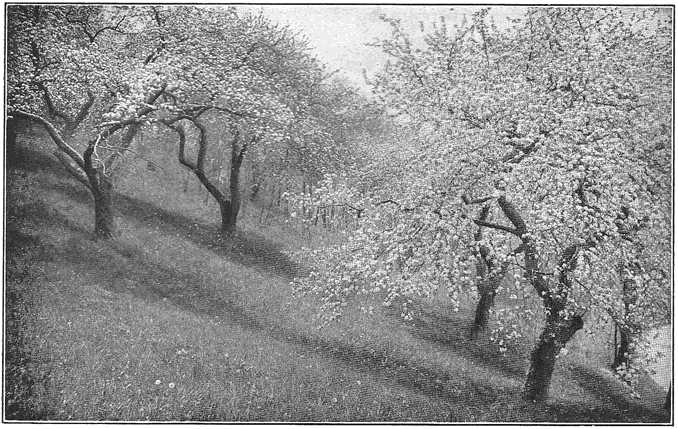
An old apple orchard is a fairy land indeed when blossoms cover the trees
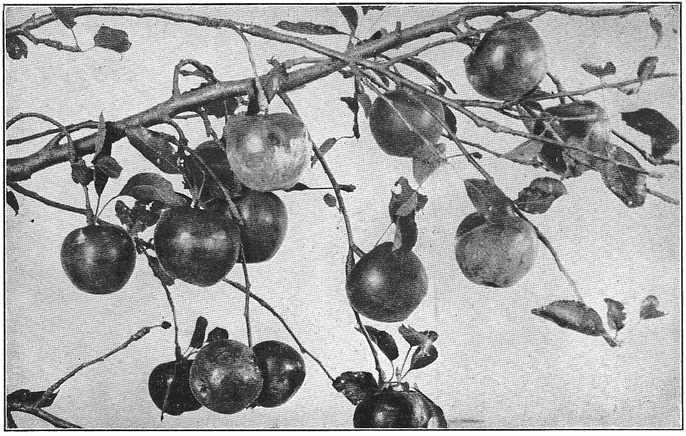
Nothing tastes so good as ripe apples picked right off the tree!
Their charm is the charm of the wild rose. Their arrangement on the gnarled twigs is irregular. The artist loves the unstudied grace of it. The great botanist, Linnæus, probably saw only pressed specimens, but he named the tree coronaria, which means, “fit for crowns and garlands.”
[225]
I remember gathering the little green apples in the fall. Hard, and almost bitter, when eaten out of hand, they make a jelly that is as distinct and delightful in its way as the flowers are more admirable than common apple blossoms. The taste is wild, and almost bitter, but beside it ordinary apple jelly tastes insipid. Perhaps I am prejudiced, and the memory of that wild crab-apple jelly too remote to be depended upon. But many people agree with me. If you are in the woods in October, and come to a thicket of trees bearing flat, yellow apples, pick as many as you can carry home. Smell their spicy fragrance, and persuade your mother to make them into jelly, so that you can form your own opinion of it.
The Eastern crab apple grows over a large part of the region between the Atlantic coast, and the dry plains east of the Rocky Mountains, and south to Northern Alabama and Texas. The prairie crab, a different species, grows in the Mississippi Valley. A narrow-leaved species grows in the South, and the Oregon crab is the native wild apple of the woods, from California north into Alaska.
Quinces are core fruits, cousins of the apples. So are pears. All of our orchard pears and quinces are cultivated varieties of species that [226] once grew wild in Europe or Asia. The Japanese quince in America is a hedge plant which in spring covers its bare twigs with large, deep rose-coloured flowers, and bears hard, freckled fruits that smell better than they taste, in September. We know all these fruits, and have them in our gardens, but they are foreigners here, though much at home. We have no native pears or quinces in America.
THE CHERRIES
Do you know the peculiar taste and odour of the pit of a cherry or peach? Then you will recognise it without difficulty when you meet it in a bruised leaf or twig of any tree that bears stone fruits, wild or cultivated. It belongs to the family which includes plums, cherries, peaches, apricots, and almonds. But one species of native cherry is a large tree. It is chiefly as fruit trees that the cultivated varieties are important. A few are grown for their beauty as flowering trees and shrubs; some for their rich bronze foliage.
The wild cherry is the one lumber tree in the family. Its wood ranks with mahogany, though not so expensive as the tree which grows no nearer to us than lower Florida and Central [227] America. It is made into furniture or used in the interior finishing of houses, parlour cars, and ocean liners. It takes a beautiful polish, and has a rich brown colour that improves with time. It is largely used as veneer on cheaper woods. “Solid cherry” is likely to be birch, if the article is of modern make.
This cherry has dark, shiny bark when young, which breaks into shallow furrows, and curls back like birch bark. The unquestionable sign by which to know a wild cherry is the bitter, peach-pit taste of the sap. Nibble a leaf or twig or bit of bark, and you get that unforgettable taste, that stays on the tongue longer than we like.
Birds feast in September on the long clusters of dark purple berries. They are bitter sweet, barely edible, I say. But birds take them thankfully, and children usually eat them freely. Old-fashioned people make them into wines or cordials for home remedies.
The choke cherry is a shrubby tree, with a rank, disagreeable odour added to the bitter and pungent odour that belongs to the black cherry. The leaves are twice as wide as the black cherry’s. The fruit shares the rank quality of the leaves and bark. Until dead ripe, the cherries are so bitter, harsh, and puckery that children, who eat [228] the black cherries eagerly, cannot be persuaded to taste choke cherries a second time. This is well-named the “choke” cherry. Only the birds can eat the berries without choking. They seem not to mind its rankness, for the fruit is all taken by the time it has turned black-ripe.
Early in summer the red bird cherry is in fruit, after its crown of white blossoms has passed. The pit is large, and the flesh thin and sour, and the whole fruit is discouragingly small. But birds are happy among the shining leaves until the last cherry is gone. This is quite sufficient appreciation. The seeds are dropped, and the little trees come up all through the woods and in the most unexpected places, due to the birds’ scattering of the seeds.
Garden cherries of the sweet and sour groups have sprung from wild species that grow in Europe. The red, black, and yellow cherries of California are the largest, most improved varieties. The garden cherries of the Eastern states are not nearly so large.
The native cherry of Japan has been cultivated as a flowering tree, until it is wonderfully beautiful. In its season of bloom, Japan is a perfect fairyland. The country is one great garden of pink cherry blossoms. At this time the people turn out to see the marvellous sight. [229] A national holiday is dedicated to this tree, which is the symbol of happiness in the Flower Kingdom.
THE PLUMS
All plum trees are small in stature, and many are thorny by the sharpening of side twigs, as if the struggle with adverse conditions made it necessary to carry weapons of defence. I speak now of the wild species. They grow in thickets, another habit of self-protection.
The wild red and yellow plums that still grow in thickets along streams in the great middle country between the East coast and the Rocky Mountains, furnished an important article of food to the pioneer families, which led the westward march of civilisation, and founded the prairie states. Only people who remember those times, and actually took part in the work of the pioneer, can know how valuable the wild fruits were, while the young orchards were growing, and no fruit was to be had for the greater part of the year.
After the first heavy frost in September the plums were fit to eat. They became soft, and sweet, and pleasant in flavour. But the skin was thick, very sour and puckery, so eating plums was not an unmixed joy.
[230]
When a team and part of the family could be spared from the farm work, a day was taken for “plumming,” and a happy and laborious day it was, but always enjoyed in true holiday spirit. Usually neighbours joined in the outing, and had a picnic dinner together in the woods. Only the oldest clothes were worn, for in the plum thickets one must risk the ruin of his raiment by the angular, thorny branches. Sheets were spread under the trees where possible, and a severe shaking or beating of the branches showered the fruit down. All hands were busy at gathering the plums, and loading the waggons with the harvest.
Perhaps there was time afterward for the boys to explore the hazel thickets, and gather a generous bagful of these small, but deliciously flavoured nuts, still in their husks. Wild grape vines, loaded with the purple fruit, tempted the frugal wife to strip them, even though the sun was low. For days after the return home, she was at work putting away for winter use preserves and jellies and pickles, and good old-fashioned plum and grape “butter,” sweetened with molasses made from sorghum cane.
Little plum trees, dug in the woods in early spring, were planted in the home garden. By setting these carefully, and tilling and enriching [231] the soil around them, larger trees and finer fruit were produced than the wild plum thicket could show. Some of the good cultivated plums have had such an origin.
A half dozen different species of wild plum grow wild in different soils and regions of the United States. Where two grow in the same territory, natural hybrids have originated, better than either parent in the quality of their fruit. Such a cross has given rise to several varieties of garden plums, of which the Miner group is a fair example. The best orchard plums for the middle of the country are crosses between native and Japanese species. The European species, like Damsons and Green Gages, do well in the Eastern states, and on the Pacific slope.
The prunes we buy are dried plums. For a century or two France has led all countries in the prune industry. Now California leads. The kinds of plums that can be dried are sweet and fleshy. Ordinary juicy plums cannot be made into prunes. The hot sun of California soon takes all the moisture out of the plums spread on tables to dry. There is no rain to fear in the hot summer months.
Peaches, nectarines, and apricots are stone fruits, closely related to the plums and peaches. These Old World fruits are grown in the warm [232] parts of this country. California raises them in quantities. The most profitable of the stone fruits has woody flesh, and is raised for its pit, which we eat. This is the sweet almond, a valuable nut. Its related species, the bitter almond, yields almond oil and hydrocyanic acid, both important drugs.
THE SERVICEBERRIES
In the same family with apples and plums and cherries is a group of slender, pretty trees called June berry, serviceberry, and on the East coast, shadbush. When the shadbush blossoms white, the fishermen know that it is time to expect the shad, which are taken in nets when they run up the rivers to spawn. The red berries are ripe in June, and the birds celebrate the event, and even take them before they begin to redden. Competition is strong, and the supply never equals the demand. Rarely can a human berry-picker find a ripe berry, to discover how it tastes.
The charm of this little tree is that it covers its slim branches so early with white blossoms. The clusters are soft and feathery, and a warm flush underlies the white, the ruddy, strap-shaped bracts, two of which are under each flower. The [233] dainty opening leaves are also ruddy, and these have opened before the blossoms pass.
In early April it is worth a long walk or drive through the woods to see the scattered serviceberry trees standing out from the bare background of leafless trees, lovely as any tree can ever be, in their robes of white. Thereafter, they seem to retire from view, engulfed by the foliage curtain the woodland draws about itself, as spring advances.
VALUABLE SAP OF TREES
In early spring on the New Hampshire hillsides, the sap begins to mount the trunks of the sugar maple trees, dissolving the sugar stored in the wood cells during the previous summer. It is time for the making of maple sugar. Winter is over. Spring work has begun.
Hundreds of twigs of elder have been cut in short lengths, and the pith pushed out, to make “spiles.” Holes are bored in the trunks of the trees, and in each hole one of these hollow spiles is driven. These are the little spouts that drain the sap from the tree into the waiting buckets that stand or hang below. Drip, drip, drip, the sweet sap flows into the buckets; and as often as they fill, the farmer makes the rounds of the trees [234] with barrels on a low sled or “stone boat,” emptying the buckets.
The sap he gathers is poured into the evaporating pans in the sugar house, and a roaring fire keeps it boiling. As the water goes off in steam, the remainder becomes maple syrup, which thickens as it boils. Skimming and straining removes any dirt or chips that fall into the sap. When it is just thick enough, the syrup is drawn off into cans, and sealed to be sent to market. A part of it, however, is boiled longer, and when drawn off, and cooled, it crystalises into the granular yellow maple sugar. It is cooled in shallow pans that hold a certain amount, and thus the bricks of maple sugar are formed. Little heart-shaped cakes are made by filling “patty pans” with this heavy syrup.
As long as the sap flows in sufficient quantities, the sugar harvest goes on. If the trees are bored with care, with holes not too close together, the tree will stand this draining from year to year, and seem not to be injured by the loss of sap. If the holes are close together, and extend all around the trunk, the tree will be practically girdled and it will die from the injury.
The finest kind of maple sugar is the wax which is made by pouring heavy syrup on the snow to cool. Quickly it thickens by the cold [235] into stringy yellow wax, which tastes like other maple sugar, but does not have the unpleasant gritty feeling, which sets some teeth on edge. Maple wax may be made at home, by melting the sugar, and pouring it into snow; but the time and the place to enjoy it most, is in the sugar camp when the hot syrup is poured from the long-handled ladle onto the nearest snow bank by the person who is in charge of the boiling. The cold air of the woods puts a keen edge on the appetite. The warm fire under the boiler takes off the chill, and the silent woods all around give a charm to the scene which one does not feel in any other place.
Hickory sap is sweet. This is sometimes added to that of the maples when maple trees are scarce.
The sap of pine trees is a liquid called resin. The pine forests of the South are rich stores of this resin, which we call also pitch. The crude liquid drained from these trees is heated, and a light liquid called turpentine is drawn off. The remainder hardens, and is known as rosin. The pine trees are tapped, not as the sugar trees of the North are, but in a way that is far more injurious to the trees. Resin hardens into gum when exposed to the air, so it is impossible to draw it out through small tubes like spiles of elder that [236] drain the maple sap. A great gash is cut in the side of the trunk of a pine tree, forming a pocket holding three pints or more. Now a square foot or more of the bark above the pocket is cut off, and the wood is chipped to a depth of an inch or more. The bleeding surface of the wood fills the pocket below with resin, and a man comes around with pails and dipper to empty these pockets as fast as they fill. The pails are carried to a still, where the resin is poured into a tank and heated to draw off the limpid turpentine.
Once a week, from March till November, more bark and wood, above the scored surface, must be chipped to renew the flow of resin. If this fresh wounding did not occur, the flow would cease, because the resin thickens and hardens when exposed to the air. This stops up the pores of the wood.
Fortunes have been made by the draining of these pine trees of their rich, pitchy sap. Turpentine and tar and rosin are all products of the sap of pines, and all are immensely valuable, especially in shipyards, and in the provisioning of sea-going craft of all sorts. The term, “naval stores,” has been applied to the products of turpentine gathering. Our forests supply most of these products to other countries.
[237]
The sap of certain tropical trees hardens into rubber. This is one of the most valuable of tree crops, for there is hardly a household that does not have rubber articles of a dozen kinds that are daily used. Lacquer varnish is the juice of certain sumach trees that grow in Japan. Gums of fir trees have a special use in medicine, and in various arts.
Sweet gum oozes from trees of that name. This is not noticeable in our trees of the North, but if we follow the trees southward, the gum flow increases. In Mexico it is an article of commerce, obtained by wounding the bark of the trees. It is one of the staple glove perfumes in France. It is also made into medicines, perfumes, and incense.
The sap of wild cherry, holly, and buckthorn, of witch hazel and sassafras all yield medicinal drugs. The flowers of locust, of basswood, and all the fruit trees furnish nectar out of which bees make honey. The juicy inner bark of the slippery elm is valuable for food, and as a medicine.
THE USES OF TREES
Imagine a stranger who has lived all his life in a desert where no trees grow, coming suddenly [238] into our village, and looking with wonder at the trees that shade the streets. He knows only the spiny cactuses, and other plants of the desert. His first question would be, “What are these great plants that stand so tall?” The name, tree, is new to him. It would be a strange experience to take such an eager and ignorant man and show him the trees, on the streets, planted in orchards, and growing wild in the woods outside of the town. His questions set us to thinking. He wants to know why we plant trees, and how we use those that grow in forests.
First, we tell him the uses of the living trees. Up and down the streets they are set for shade, and for their beauty. Rows of evergreens set close together make a protecting wall of green against the cold winds. Low clipped hedges of many kinds of trees make living boundaries, much more beautiful than wooden or wire fences. On lawns and near houses trees are planted for their beauty and for their shade. Orchards of fruit trees are planted because they furnish food. Nut orchards are set out for the same reasons.
The trees cut down in the woods, and sawed at the mills give us lumber to build houses to live in, and furniture to make them comfortable, and the same forest furnishes the fuel that keeps us warm. There is so much to explain to a [239] person who discovers trees for the first time. It takes a long time to tell all we know.
Do we think that we know a great deal about the uses of trees? If so, we are mistaken. The truth is that trees serve us in ways of which we have never dreamed.
We must travel over the world and read a great deal to learn how the people of other countries make use of trees. The basswood or linden which nobody cared to use except for fuel in the Middle West might pass for a useless tree, compared with those whose wood is harder and stronger. But in older countries people have quite a different opinion of the tree.
In Russia the tough bark of young lindens is used to make the shoes of peasants. Ropes, fishing nets, and braided mats are made from the same tough “bast” fibres, which are very long and tough in this family of trees. The seeds yield oil that is declared to be quite as good as olive oil for cooking, and for the table. Perfume is distilled from the flowers. Cattle browse on the twigs and leaves. The wood is the carver’s delight—soft, white, free from knots and imperfections. It is used for bureau drawers, carriage bodies, shoe soles, barrel staves and paper pulp. Its twigs make artist’s charcoal pencils.
Linden trees are planted for shade in many [240] countries, and in Europe they are often cut into grotesque shapes of animals as they grow. They are clipped into hedges, as close as box or yew. In America they are usually allowed to grow naturally, as shade trees. European species are rather more symmetrical than our native kinds.
The Indians of the Northwest used the soft inner bark of the tamarack pine for food. They cut down the trees, strip them of bark, and scraped out this soft lining layer. With water, they mash it into a pulp, which they cook and then mould into large cakes. A hole is next dug in the ground, lined with stones, and a fire is built in it. When the stones are hot, all ashes are removed, and the cakes, wrapped in green skunk cabbage leaves, are laid in. A fire of damp moss is built on top, and thus the cakes are thoroughly, baked. To insure their keeping, they are next smoked in a close tent for a week or more. This dries and cures them so that they may be safely packed away for future use. These hard, dry cakes are afterward broken into pieces and boiled. When the mass softens and cools, it is ready to eat. The fat of different animals is used for butter on this strange Alaskan bread.
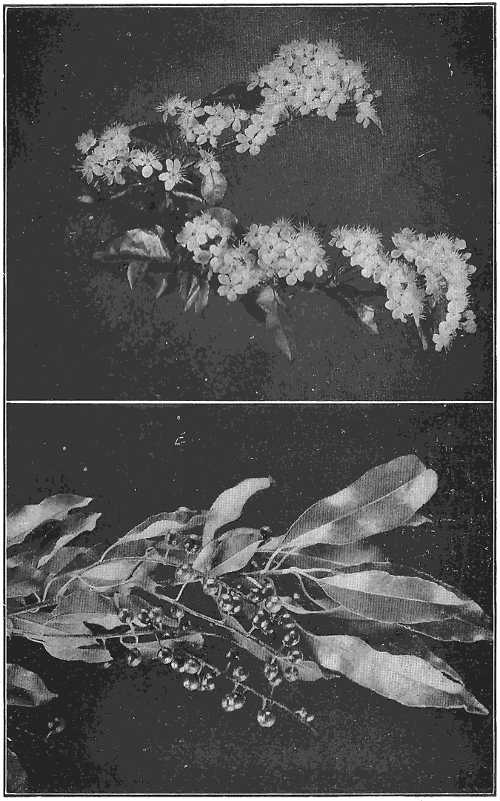
Flowers and fruit of the wild black cherry
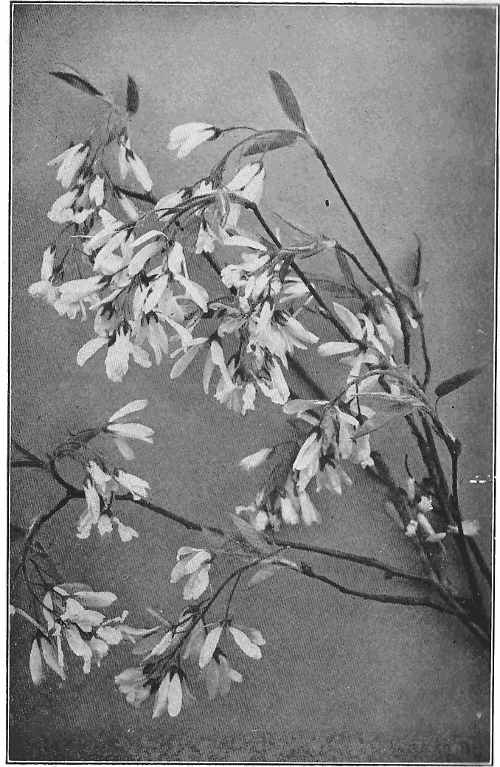
The delicate white flower clusters of the serviceberry tree
Everybody knows that trees bear fruits of many kinds that are useful as food for men and [241] beasts. Spices, such as nutmegs, mace, cloves, and allspice, may be added to this list of fruits which we have as human foods.
The bark of birches is invaluable to the Indians for the making of their canoes, baskets, and all kinds of utensils. Huts and teepees are walled with it. Rope and coarse cloth are made out of the fibre of mulberry bark, and berry baskets out of the bark of the lodgepole pine. The fibrous roots of the larch tree furnished tough thread, with which the Indians sewed canoes of birch, and they made them water-tight with the gum of the balsam. The brown gum that oozes from wounds of the Western larch is sweet and starchy. The Indians discovered in it a valuable article of food.
One of the latest uses of wood is the making of paper, although the white hornet showed in its conical paper nest that this could be done. She has been making wooden paper for hundreds of years, scraping the wood from the surface of weathern-worn fence boards, and from the dead limbs of forest trees. Our newspapers are made of ground wood, cooked to a soft pulp, and rolled out into thin sheets. The high price of paper makes it worth while to gather up papers, bleach them, convert them into pulp, and roll them out again into sheets. Spruce wood [242] and poplar are among the cheap woods which have come into demand at the paper mills. The forests of these trees, counted of little use for lumber, have become valuable because the paper mills can use them.
Look about the room, and a dozen articles, beside the chairs and table, are products of wood, or in some way owe a debt to trees. The paint that covers the window sash and frames was mixed with turpentine, which is obtained from the pitchy sap of pine trees. The shades and curtains are coloured. Dyes of many kinds are extracted from the various dyewoods, trees that grow in tropical forests. The newspaper and the books on the shelves are made of wood pulp. The lacquered box from Japan is a handsome thing. The lacquer varnish is the sap of a certain Oriental sumach tree. The perfume of the gloves in the box is made from the fragrant gum of an Oriental sweet gum tree. The skin out of which the gloves were made was tanned, not with bark, but with the acorn cups, or galls, of a European oak.
The shoes on your feet are made of leather. The hemlock trees that grow on the hills were stripped of their bark by peelers in early spring. Black oak and chestnut oak are also stripped in our woods. Carloads of bark are shipped to the [243] tanneries to be used in the tanning of skins which changes them into leather.
That beautiful book upon the table is bound in Russia leather. The acorn cups of a European oak were used to tan the skins that made this leather so much more beautiful than that of your shoes. Your gloves are made of kid skins tanned in Europe. For this particular work the nut-like galls that grow on certain oak trees are gathered in the woods.
Tannin is the substance in oak bark which makes it valuable in tanning leather. A high percentage of tannin is found in oak galls. For this reason they are gathered in many countries, and are among the most valuable and high-priced supplies for the establishments that tan skins for gloves. The most expensive inks and dyes, those that do not fade, but are practically permanent, are made from selected oak galls.
Oak apples are a strange fruit, found in more or less abundance on the leaves of our own oak trees in autumn. You have seen them in summer time, plump, green balls, sometimes as large as a hen’s egg, but globular, sitting upon a leaf. In autumn the balls take on the colour of the dying leaves.
The same tree may have hard little marble-like balls growing on its twigs. These are of [244] different sizes, and it is not unusual to find a hole in the side of each.
All such outgrowths on the leaves and twigs of oaks are called galls, and they are chiefly caused by winged insects called gall-gnats. An egg is laid in early spring, in a slit pierced in the twig or leaf. As this egg hatches, the tissue about it is disturbed in its growth by the presence of this feeding grub. The soft leaf pulp, or the tender tissues of the twig that surround it, are exactly what the grub likes to eat. Food and drink are all about it, and as it feeds, it grows. The leaf swells, and so surrounds the grub with an abnormal growth. The grub still feeds, and the swelling becomes larger, until finally, when the insect ceases to eat, it is housed in the peculiar ball which we know as an oak gall. Each species of gall-maker is known by its house.
The oak apples are of several kinds. Some are empty except for a little shell in the centre, in which the fat grub sleeps. Sometimes the substance within the “apple” is corky, sometimes spongy. Bullet galls, which form on twigs like little marbles, are usually solid to the centre, where the grub lies until the time comes for it to bore its way out to the surface, and fly away, to lay eggs which will produce other galls. Usually oak galls, found in winter, contain the sleeping [245] grub, whose transformation into a winged insect waits until the coming of spring.
The cork in your ink bottle is the bark of an oak tree. Go to Portugal or to Northern Africa, and you may see the cork harvest in progress in July or August. There is no place to go for genuine cork except to a small evergreen oak that rarely reaches a height over thirty feet. When these trees are twenty-five years old, a hard, thin layer of bark is stripped off. This is a valuable tan bark, but it is not in the least corky. The tree now produces a spongy bark entirely different from the first. It is not disturbed for eight or ten years. This is stripped off. It is the poor quality of bark which fishermen use to float their nets with.
Ten years later the bark is stripped again. It is better in quality than the first. Each ten years brings the bark stripper again to the tree. In the fiftieth year, the bark is of the finest quality, and for fifty years that follow there are five strippings of bark of the highest grade. Then the quality becomes poorer. The trees are cut down, the bark is sold to the tanners, and the wood is used for charcoal or for fuel.
It is a very particular job to get the cork off and leave the under layer uninjured. The trunk is stripped from the ground to the point where [246] it branches, and the inner “mother bark” must not be bruised, for no more cork will grow on any bruised spot. Two circular cuts are made, one at the top, one at the bottom of the columnar trunk, then two opposite slits are made dividing the bark of the trunk into two halves. These curved plates are worked off by inserting a wedged-shaped tool between the bark and the trunk, and gradually working it further in until the whole curved plate of cork comes off. These two big sheets are steamed and flattened, then bound in bundles, and shipped to wholesale dealers in cork.
The owner of a grove of cork oaks must wait ten years between crops of the bark, but every year three crops of acorns are borne on these trees. The pigs of the owner, turned into the grove, fatten on this rich food. So the little trees are very profitable in two ways.
In the south of Europe, the handsome, evergreen holm oak grows wild; its glossy leaves and compact form remind us of our holly trees. It is one of the most valuable ornamental oaks, but as a fruit tree, it has unusual value. Its acorns are sweet and rich, and the crop is heavy. Hogs are fattened upon them. In earlier days they were used as human food, and even now gipsies gather them to eat. Its acorn cups, bark, [247] and the galls it bears are of the very best quality. They are used in the most particular jobs of dyeing and tanning.
Under ground, the holm oak bears a strange fruit—a fungus called “truffle” develops on the roots. These truffles are somewhat like mushrooms in their growth. They are far more delicious to eat, and expensive to buy than ordinary mushrooms. The best of them are found in France, and French people are especially fond of them.
Trees that grow on chalky lands are more likely to produce truffles. At a dozen years old, they begin to yield, and truffles may be found upon their roots for about twenty-five years.
Not every holm oak has truffles on its roots. The finding of these delicacies is a very interesting and exciting game, and a great deal of a lottery. There is but one way to find them, and that is by the sense of smell. The truffle has a rich, strong odour. Dogs and pigs are the only animals that are able to find it. The truffle-hunter is usually an old woman, who goes with a trained pig or a trained dog into the oak forest. She has a basket, and a spading fork, and she keeps a close eye on her four-footed partner. If the pig, in rooting about under an oak, suddenly becomes excited, and begins to root furiously, she drives him away, and [248] digs out the precious ball of fungus he has scented. It is irregular in form, and looks somewhat like a potato. Meanwhile the pig locates another, and is again disappointed. The truffle dog is treated in the same manner. Unless put into a pen, or chained at night, these truffle-hunters are likely to take to the woods and feast when no one is by to interfere with their pleasure.
Truffles are shipped in cans to the United States, but we have not yet discovered them growing on the roots of our oak trees. Probably we have not yet looked for them with sufficient care and patience.
[249]