Chapter XLI
Reading edition
SOME HARDY FLOWERING TREES AND SHRUBS
The following are tables of hardy flowering trees and shrubs, and comprise only species and varieties suitable, unless otherwise stated, for almost all parts of the British Isles. An asterisk (*) denotes those of the first importance. This way has been adopted to compress as much information as possible into a small space.
Name. Country or Origin and Natural Order. Colour and Season. General Remarks.
Æsculus (Pavia), Horse Chestnut, Buck-eye Sapindaceæ A well-known group represented most largely by the Horse Chestnut, which is the tallest of the species. The Æsculi generally are of medium size, and not very particular about soil or position. The smaller growers were at one time placed in a distinct genus, Pavia, but now placed with Æsculus. The more shrubby species are welcome in the garden, where the Horse Chestnut would be out of place.
*Æ. carnea Hybrid between Æ. Hippocastanum and Æ. Pavia. Synonymous with Æ. rubicunda Bright red; late May and early June This is a handsome tree for the garden, and is generally about 15 feet high in Britain. Its chief charm is in the profusion and brilliant red colouring of the flower-spikes. It is not of quick growth, but flowers when very young. It will be found in many lists under the name of Æ. rubicunda, the red Horse Chestnut. Rosea is a good variety recommended by Mr. Anthony Waterer as a "tree for planting in smoky districts." Another fine variety, peculiarly bright in flower colouring, is Æ. Brioti.
Æ. flava A native of Carolina and Virginia, on mountain slopes; introduced in 1764. Sanguinea has red flowers. Pale yellow Those who want a tree in this family of distinct colour will find pleasure probably in this, but its colouring is dull, and the flowers are not plentiful.
*Æ. Hippocastanum (Common Horse Chestnut) From the mountains of Greece. Gerard mentions the Horse Chestnut in his "Herbal" in 1579 as a rare foreign tree White; late May or early June. There is considerable variation, as many of the trees in parks and gardens have been raised from seed The common Horse Chestnut is too well known to describe. It is not a tree for very exposed places, as its large leaves offer considerable resistance to the wind, and get torn and unsightly. The double variety (flore-pleno) is very distinct, having quite double flowers. Foliis aureis variegatis is a variegated variety, as the name suggests, with blotches of yellow on the leaves; and laciniata has cut foliage.
Æ. indica Nepaul, and other parts of Northern India. On the Himalaya the tree reaches a height of 70 feet, with a trunk 3 feet through White, with yellow and red blotches at the base of the petals; Summer This distinct and beautiful tree is perhaps the rarest of the Horse Chestnuts in cultivation, and is not so robust as the common species. It flowered in England as long ago as 1858 at Mildenhall in Suffolk, but has been little heard of. It is a tree doubtless for the Cornish and Devonshire and southern coast gardens where the Himalayan Rhododendrons thrive well. Sir Joseph Hooker, during his Himalaya travels fifty years ago, saw it loaded with its white racemes, and equal in beauty to the common Horse Chestnut of English parks. Its foliage is quite distinct from that of the other species, the leaflets numbering seven or nine, and being of a dark glossy green. In the other Horse Chestnuts the leaflets are usually only five to each leaf, and never more than seven. The racemes of this Indian species are about 8 inches long, the flowers being white, with blotches of yellow and red at the base of the petals.
*Æ. (Pavia) parviflora North America. On river banks in Georgia. Introduced to England by Mr. John Fraser in 1786 White fragrant flowers sometimes tinged with pink, and long stamens, and in long upright racemes This is better known as P. macrostachya, and is a low, spreading shrub 8 to 10 feet high; the leaves consist of five to seven finely serrated leaflets, covered underneath with a whitish tomentum. Although introduced so long ago, this August flowering shrub is not common; it is a good shrub for a small garden, and is not fastidious about soil or even situation if not too shady. It is increased by suckers thrown up around the plant. These, when detached with a portion of root, soon form good plants.
Æ. californica California. 40 feet in its native country, but not much more than a shrub here Erect spikes of white or delicate rose; sweet-smelling flowers; May This is not much known, but is a handsome shrub or tree.
*Æ. Pavia (P. rubra) North America Red; early summer This is the Red Buck-eye, and will grow 15 feet high, but is more often simply a big shrub. The flowers are very bright red in colour, and in loose clusters, unlike the dense spikes of the common Horse Chestnut. The varieties are even dwarfer. Humilis, for instance, is only 4 feet. Atrosanguinea has very dark red flowers, and those of whitleyana are brighter than the type.
Æ. turbinata Japan (introduced by Messrs. Veitch & Sons) Yellowish white, not so large as those of the common Horse Chestnut As this has not yet flowered in this country, as far as we are aware, but will probably become popular here, the following account of it by Professor Sargent in his "Forest Flora of Japan" will be interesting:—"This, however, is a noble tree—one of the largest and stateliest of all the horse chestnuts. In the forests of the interior mountain regions of Central Hondo, at elevations between 2000 and 3000 feet, horse chestnuts 80 to 100 feet tall, with trunks 3 or 4 feet in diameter, are not uncommon. These were, perhaps, the largest deciduous trees on the main island growing naturally in the forest—that is, which had not been planted by men—and their escape from destruction was probably due to their inaccessible position, and to the fact that the wood of the horse chestnut is not particularly valued by the Japanese. In habit, and in the form, venation, and colouring of the leaves, the Japanese horse chestnut resembles the horse chestnut of our gardens, the Grecian Æsculus Hippocastanum, and at first sight it might easily be mistaken for that tree, but the thyrsus of flowers of the Japanese species, which is 10 or 12 inches long, and only 2½ to 3 inches broad, is more slender; the flowers are smaller, and pale yellow, with short, nearly equal, petals, ciliate on the margins; and the fruit is that of the Pavias, being smooth, and showing no trace of the prickles which distinguish the true horse chestnuts. The Japanese horse chestnut reaches Southern Yezo, finding its most northern home near Mororan, on the shores of Volcano Bay, at the level of the ocean; it is generally distributed through the mountainous parts of the three southern islands, sometimes ascending in the south to an elevation of 4000 or 5000 feet. There seems no reason why this tree, which has already produced fruit in France, should not flourish in our northern states, where, as well as in Europe, it is still little known. In Northern Japan the fruits are exposed for sale in the shops, although they are probably used only as playthings for the children."
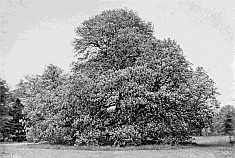
HORSE-CHESTNUT (Æsculus Hippocastanum) IN FLOWER.
Name. Country or Origin and Natural Order. Colour and Season. General Remarks.
Amelanchier Rosaceæ A charming family of spring-flowering trees, graceful in growth, and of moderate stature. There are four species, but dozens of names in catalogues; in fact, the genus is much mixed up in many books and lists.
*A. alnifolia North-West America White; Spring This is usually about 8 feet high; it is very beautiful with its wealth of white flowers in compact clusters or racemes, followed by purple berries. In the Kew "Arboretum" Hand-list no less than ten synonyms are given.
*A. canadensis Canada White; April This flowers about a month before A. alnifolia, and is one of the first trees to greet us with its wealth of snow-white blossom in spring. It should be planted in a free group. Juneberry and Snowy Mespilus are its popular names. Eighteen synonyms are given in the list referred to, the most usual being A. Botryapium. No small garden should be without this lovely small tree; it is between 6 and 8 feet high, spreading, and has purplish fruits, whilst the leaves die off deep golden yellow, so that the Snowy Mespilus has many beautiful phases. There are several varieties, but the species is as beautiful as any.
A. oligocarpa Northern United States, and found in bogs and swamps White; April and May This is quite a dwarf shrub, 3 feet to 4 feet, and the individual flowers are ¾ inch across. As it is found in moist places it should be tried in such positions in Britain.
A. vulgaris Europe White; April This has been in English gardens about 300 years. It is like the Canadian Juneberry or Snowy Mespilus, but not so beautiful. If only one Amelanchier is required, choose A. canadensis.
*Andromeda polifolia (Moorwort) Ericaceæ; widely distributed. Pink; Summer A small shrub about a foot high, with pretty pink wax-like flowers in summer. Moist, peaty soil. See Cassandra, Leucothoë, Cassiope, Lyonia, Oxydendron, Pieris, and Zenobia.
*Berberis acuminata Berberideæ; China Bronzy yellow Evergreen shrub with red young wood. Introduced by Messrs. Veitch.
*B. Aquifolium (Ash Barberry, Syn. Mahonia Aquifolium) Introduced 1823. Spread widely over the western side of North America from Nootka Sound southwards. Yellow; early Spring, dark green leaves of Summer have a purplish tinge after frost A common, but handsome evergreen shrub, reaching a clothed height of 3 to 5 feet, and with dark green pinnate and leathery leaves. The flowers are bright golden; they are succeeded by berries, purple when ripe, which add to the ornamental features of the plant. It is one of the best shrubs for growing under trees, and in many places is planted for game cover. Distinct varieties are fascicularis, which is usually 2 feet to 4 feet high and has narrower leaflets of a duller green than the type.
*B. buxifolia (Box-leaved Barberry, Syn. B. dulcis) Chili Yellow; April and early May An upright evergreen bush 5 feet high, clothed with small box-like leaves, and bearing drooping blossoms borne on unusually long stalks. It is not so handsome as B. Darwinii or B. stenophylla, but flowering before them is on that account valuable. A dwarf variety (nana) is a pretty rock-work plant.
B. concinna Himalaya Pale yellow A little deciduous shrub not more than 18 inches high, and with silvery undersides to the leaves. It needs a sheltered spot in good soil.
B. congestiflora var. hakeoides Chili Bright yellow A large interesting bush, with masses of flowers. Rare.
B. aristata Himalaya Yellow A strong-growing deciduous shrub, somewhat after the style of the common Barberry, but chiefly remarkable from the bright red of the young bark, which thus forms a fine winter feature.
*B. Darwinii (Darwin's Barberry) Chili Orange yellow; May This ranks with B. stenophylla as the most handsome of all Barberries; and, indeed, it is in the very front rank of flowering shrubs. It is of bold, wide-spreading growth 6 to 8 feet high, and the masses of dark evergreen leaves serve admirably as a setting to the clusters of orange-coloured blossoms which are at their best in May. The purple berries are very attractive towards the end of the summer. This Barberry forms a delightful lawn shrub, particularly in a fairly moist soil.
B. empetrifolia Chili Yellow; Spring A little evergreen bush less than 2 feet high, and flowering about the same time as B. Darwinii. With this just-named species it shares the parentage of B. stenophylla, which is unsurpassed in the entire genus.
B. nepalensis, Syn. Mahonia nepalensis Nepaul Yellow The stateliest of the Ash Barberries, forming a specimen 6 feet high, and regularly furnished with long compound leaves. It is, however, tender, except in the West of England and Ireland, where, in a moist, fairly open soil, it does well. Even there a sheltered spot should be chosen for it.
B. repens, Syn. Mahonia repens North America ,, Related to B. Aquifolium, and, like that, will do well in shady spots. It is dwarfer than the other just mentioned.
*B. stenophylla Garden form Yellow; Spring This is a hybrid between B. Darwinii and B. empetrifolia, and a shrub of rare beauty. The slender arching shoots are very graceful, and during the flowering period are completely wreathed with golden blossoms. Standing singly on a lawn, or near water, it is delightful. It should be in the smallest collection of flowering shrubs.
*B. Thunbergi China and Japan Pale yellow and red; Spring A spreading shrub 3 or 4 feet high, with flowers not particularly showy, and borne on the undersides of the shoots just as the young leaves are expanding. The bright-red berries are very showy, but they are surpassed by the brilliant scarlet of the decaying leaves.
*B. vulgaris (Common Barberry) Europe Yellow; Spring The common Barberry is an ornamental deciduous shrub 8 to 10 feet high, and is valuable from the fact that it will thrive in dry, stony soils. Apart from the pale-yellow flowers in spring, the scarlet berries are very showy, and by some are used for preserves. There are many varieties, the best being the purple-leaved (purpurea) and white-fruited (fructu albo).
B. wallichiana (Syn. B. Jamesoni, B. Hookerii) Himalaya and China Sulphur Yellow; June A dense evergreen bush, with dark green spiny leaves and pale yellow blossoms. It grows 4 or 5 feet high.
*B. Wilsonæ China Rich golden colour A fine shrub, the leaves changing to an intense crimson colour in autumn. Spines an inch long.
Name. Country or Origin and Natural Order. Colour and Season. General Remarks.
*Buddleia Colvillei Himalaya; Loganiaceæ Rosy crimson; June A beautiful tree, reaching a height of 30 feet in its native country, but it is hardy only in the extreme West.
*B. globosa (Orange Ball tree) Chili Orange yellow; Midsummer A deciduous shrub, 10 to 12 feet high, with long, willow-like hoary leaves, and flowers borne in globular clusters about midsummer. It is perfectly hardy in warm soils in the South of England, and is much admired.
B. japonica, Syn. B. curviflora Japan Lilac; August This has several well-marked features, forming as it does a deciduous shrub about 4 feet high, with curiously winged stems and long curved spikes of blossoms.
B. variabilis China Rosy purple, Yellowish throat; Midsummer A free-growing shrub, 6 to 8 feet high. The variety Magnifica was introduced by Messrs. Veitch from Central China; rich rose purple. Prune well back each autumn. Veitchiana is lighter in colour and flowers a fortnight sooner.
Cæsalpinia japonica Japan; Leguminosæ Canary yellow; Summer A very interesting shrub, rambling and with long flexible shoots with red prickles. The leaves are a foot long, and of a pleasing green; the flowers, which are in partially erect racemes, are about 1 inch across, and bright canary yellow in colour, against which the reddish anthers are conspicuous. It must not be planted where it is likely to get smothered. It has stood out unharmed for many years in the Coombewood Nursery (Kingston).
*Calycanthus floridus (American Allspice) North America; Calycanthaceæ Purplish red; July A deciduous, much-branched shrub from 5 to 6 feet high, well worth growing for its highly fragrant flowers, about a couple of inches in diameter. It needs a fairly cool, moist soil.
C. occidentalis (Californian Allspice) California Crimson Much like the preceding, but of more vigorous growth with larger flowers.
Cassandra calyculata (Syn. Andromeda calyculata) North America White; April and May An evergreen under-shrub, growing from 1 to 2 feet high. The shoots are arching, and the waxy Lily-of-the-Valley-like flowers are suspended from the undersides in considerable numbers. It is a pretty but by no means showy shrub, and needs moist, peaty soil.
Cassiope fastigiata Himalaya; Ericaceæ Pink; Summer A pretty little erect growing shrub about a foot high, suggesting a Club Moss or a small Conifer, with tiny bell-shaped blossoms. It is suitable only as a rock-work shrub in moist, peaty soil.
C. hypnoides Siberia White Even smaller than the preceding, and needs the same treatment.
C. tetragona North America and Northern Europe White The tiny scale-like leave of this are arranged in four rows, thus giving the branches a curious square appearance. Succeeds under the same conditions as the others. The Cassiopes are difficult to grow.
Catalpa Bignoniaceæ This genus of large deciduous trees is represented in both the eastern and western hemispheres, and contains about a dozen species. Only five of these are at present in cultivation in Britain or are known to be hardy, two being natives of North America and three of China. The Catalpas are some of the most striking and beautiful of all hardy trees, both in regard to foliage and to flower. The leaves are large and bold in outline, and the flowers borne in large terminal panicles towards the end of summer. Catalpas love a rich soil and abundant moisture. They are particularly well adapted for planting on the margins of ponds and water-courses. All the species have this peculiarity: they never form a terminal winter bud. In consequence of this, every shoot branches at its apex into two or three every spring, with the result that the trees naturally acquire a broad, spreading habit. This is especially apparent in the case of isolated trees growing on lawns—a position, it may be mentioned, in which Catalpas are seen to exceptional advantage. In the forests of North America, where they are drawn up by other trees, the Catalpas occasionally attain to heights of 50 feet to 100 feet. In gardens it may sometimes be advisable to help them to reach a moderate height, by keeping them to a single lead when young. All the species can be increased by cuttings of the roots, or of the fairly matured leafy growths.
*C. bignonioides (Syn. C. syringæfolia) Introduced from North America in 1726 Creamy white blotched with yellow, and spotted with purple in the throat; July and August This species is by far the commonest and best known of the Catalpas in Britain. It does not often attain a stature of more than 30 feet, although in its native woods it is met with twice as high. The broadly ovate leaves are in healthy trees of mature age about 6 inches long and 4 inches to five inches wide. The flower panicles are erect, branching, and pyramidal, frequently 1 foot in diameter at the base. The flower is 1½ inches across, with a broad bell-shaped base, the reflexed limb being elaborately frilled. The thin, kidney-bean-like fruits are 9 inches to 12 inches long, but in most parts of the country are only produced after exceptionally sunny seasons. The following varieties are in cultivation: Aurea, with rich yellow foliage; nana, a remarkable low shrub, 2 feet to 3 feet high, which never flowers, and can only be regarded as a curiosity; purpurea, with purple-tinged leaves and shoots.
C. Bungei Northern China White, spotted with purple; they, as well as the panicles, are larger than in Kæmpfer's Catalpa Whether the true C. Bungei is in cultivation at the present time is very doubtful. Certainly the plants supplied by some nurserymen under this name are only the dwarf variety (nana) of C. bignonioides. In any case the true C. Bungei has not flowered in Britain. It is a tree 30 feet high, with either entire or lobed leaves; they are 4 inches to 8 inches long, and about three-fourths as wide.
C. cordifolia (Syn.species) United States. It inhabits a more western region than C. bignonioides, and is found in the States of Kentucky, Louisiana, Tennessee, Missouri, Texas, &c. White, with yellow blotches in the throat; but the purple spots are not so abundant in C. bignonioides, whilst the panicles are large, and appear about a fortnight before. This is probably the finest species of Catalpa, but is not yet well known in Britain. In the United States it is often 50 feet high, and in exceptional cases over 100 feet. Owing to its having been for a long time confounded with C. bignonioides, this species was probably introduced unknowingly, and it may exist in some gardens under the other name. It is said to be somewhat the hardier of the two.
C. Fargesii China. Introduced to France by M. Maurice de Vilmorin, and sent by him to Kew in 1899 ...... Little known of this species yet.
C. hybrida A hybrid between C. cordifolia and C. Kæmpferi. Raised nearly thirty years ago by Mr. John C. Teas in Indiana, U.S.A. White, with yellow and purple markings on the throat In the United States this appears likely to prove the finest of all the Catalpas, exceeding even C. cordifolia in the vigour of its growth and the size of its panicles. Four hundred flowers have been borne on a single panicle. Generally, the plant is intermediate between the two species that share its parentage.
C. Kæmpferi China; introduced by Siebold in 1849 Flowers 1 inch across; reddish-brown and purple markings Whilst this species—named in honour of Engelbert Kæmpfer, who visited Japan in the seventeenth century—bears a strong resemblance to the American C. bignonioides, it is neither so fine nor so ornamental a tree. It has naturally the same rounded habit, but is never so large. The leaves differ in frequently being more or less lobed. Kæmpfer noted this tree in Japan, and until a recent date it was regarded as indigenous to that country. Recent travellers have, however, concluded it to be (like many other popular trees in Japan) of Chinese origin solely. It is frequent in the grounds surrounding Buddhist temples in Japan.
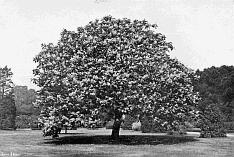
CATALPA OR INDIAN BEAN TREE (Catalpa bignonioides).
Name. Country or Origin and Natural Order. Colour and Season. General Remarks.
*Ceanothus americanus (New Jersey Tea) Eastern United States; Rhamneæ Whitish; July and August A deciduous shrub, 3 to 4 feet high, that dies partially back during the winter. The flowers, which are borne in good-sized racemes, are at their best in July and August, and on that account are very valuable. It is one of the hardiest of the Ceanothuses, and in the South of England it will flower as a shrub in the open ground.
*C. azureus Mexico Light blue; July and August This is not quite so hardy as the preceding, and it cannot be regarded as a shrub for the open ground, except in particularly favoured districts. It is, however, a delightful wall shrub. There are many garden varieties of this, mostly of Continental origin, of which may be especially mentioned Gloire de Versailles, blue; Marie Simon, pink; and Indigo, deep blue, very beautiful.
C. divaricatus California Pale blue; May and June Suitable only for a wall. With this amount of protection it will reach a height of 10 feet.
C. papillosus California Blue; May and June Like the last, it is, except in the extreme west, essentially a wall plant; it is one of the best.
C. rigidus California Purplish blue; Spring and early Summer The leaves of this are small and neat, and its charming blossoms are on a wall borne sometimes as soon as April, and are kept up through May to June. It will reach a height of 6 to 8 feet.
C. thyrsiflorus California Bright blue; Summer In its native country this attains to the dimensions of a small tree, but here it is essentially a wall plant. The flowers are in large racemes.
*C. veitchianus California Bright blue; May and June A species with neat dark-green leaves. It forms a delightful wall plant.
*Cercis Siliquastrum (Judas Tree) South Europe and West Asia; Leguminosæ Rose purple, but varies; May and June Throughout May and early June the Judas Tree is very beautiful, being smothered with pretty pear-shaped red blossoms. At Kew it flowers well in numerous places. It grows to a height of 20 feet or more in the Mediterranean region, though in gardens here it is more often represented by bushes of less than half that height. It thrives in sandy loam, and likes plenty of sun and air. The flowers are produced from all parts of the stems, much of the old wood being often smothered with flowering spurs. A variety with white flowers is in cultivation, and this may also be seen in flower at Kew. It is very free, and the flowers are of the purest white. A beautiful variety. In addition to this species, C. canadensis, from North America, and C. chinensis, a native of China and Japan, are also grown, whilst a fourth species, C. reniformis, from Western China, has lately put in an appearance.
*Chionanthus retusus (Fringe Tree) Japan; Oleaceæ Pure white; Early Summer This Chionanthus furnishes one of the many illustrations of the close affinity that exists between the flora of the United States and that of Japan, for it is very nearly related to the American Fringe Tree (Chionanthus virginicus), from which, however, it differs in being a smaller and more slender plant, while the clusters of flowers are rather less dense. When in bloom there is no danger of confounding these Chionanthuses with any other tree or shrub, as the pure white drooping fringe-like inflorescence is totally distinct from anything else. They are quite hardy, and not particular as to soil, though a fairly deep loam suits them best.
C. virginica (American Fringe Tree) North America White, narrow, fringe-like petals; hence the name An interesting bush, but taller in its native country.
*Choisya ternata (Mexican Orange Flower) Mexico; Rutaceæ White; Summer, but much depends upon position This is a shrub for warm soils and sunny position, when it makes a big, leafy, glossy-leaved bush, smothered with clusters of white flowers that, from their appearance and fragrance, have earned the shrub the name of Orange Flower. At Munstead in Surrey it grows so rampantly that it has to be cut away to keep it within reasonable bounds. In "Wood and Garden," p. 63, it is mentioned, the month is May; "The Mexican Orange Flower (Choisya ternata) has been smothered in its white bloom, so closely resembling orange blossom. With a slight winter protection of fir boughs it seems quite at home on hot dry soil, grows fast, and is very easy to propagate by layers. When cut it lasts for more than a week in winter."
Cistus albidus South-West Europe; Cistineæ Bright rose; June and July A shrub 4 to 5 feet high, with whitish leaves (hence the name of albidus) and a profusion of blossoms 2 inches across. It needs a dry, warm soil, hence will succeed on sloping banks, but even then, in the South of England, it is apt to be killed by a very severe winter. This last paragraph will apply to the genus Cistus in general.
C. crispus Southern Europe Reddish purple; Summer Reaches a height of a couple of feet, and bears its saucer-shaped blossoms in great profusion. The individual flowers are about 2½ inches in diameter.
*C. ladaniferus (Gum Cistus) South-West Europe White; Summer A bush 4 to 5 feet high, with large, white, solitary flowers. The variety maculatus has a crimson blotch at the base of each petal.
*C. laurifolius (Laurel-leaved Cistus) South of Europe White; July and August A sub-evergreen shrub 5 to 6 feet high, and the hardiest of all the Cistus. Of this there is also a variety maculatus blotched at the base with purple crimson, which forms a delightful shrub.
C. monspeliensis South of Europe White; Summer A compact bush 4 feet high, with flowers about an inch across.
C. populifolius (Poplar-leaved Cistus) Levant White; Summer The leaves of this are very distinct, being heart-shaped and long-stalked, whilst the plant itself will attain a height of 6 feet.
C. purpureus South-East Europe Reddish purple with a maroon blotch This is only suitable for planting in the West of England, but where not injured by frost it is a delightful shrub, a little over a yard high.
*C. villosus Mediterranean region Reddish purple A compact shrub, whose reddish-purple blossoms are about 2½ inches across.
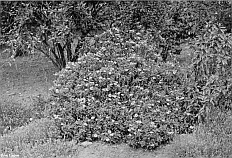
CISTUS VILLOSUS.
Name. Country or Origin and Natural Order. Colour and Season. General Remarks.
Cladrastis amurensis (Amoor Yellow Wood) Amoorland; Leguminosæ Whitish; July A very distinct shrub or small tree, which is perfectly hardy, and has peculiarly greyish-green leaves. The dense spikes of small, pea-shaped blossoms are showy when at their best. This has deep descending roots, and holds its own in sandy soils better than most shrubs.
*C. tinctoria (Virginian Yellow Wood. Syn. Virgilia lutea) North America White A tree, 30 feet high, clothed with large ornamental pinnate leaves, which die off a rich yellow. The flowers are white, and in dense drooping racemes. A fairly moist soil is necessary for this.
Clethra alnifolia United States of America; Ericaceæ White; August and early September In the United States of America the White Alder or Pepper Bush, as Clethra alnifolia is called, occurs as a native over a considerable area; hence several forms exist, but do not possess any strongly marked features, unless it be the variety tomentosa, which is certainly the most widely removed of all from the typical kind. As a rule the flowering period of the common White Alder extends throughout August and a little way into September, at which last-named period the variety tomentosa is just unfolding its earliest blossoms. As the number of flowering shrubs that are at their best during the latter part of September is very limited, the blooming of this variety of the Clethra at that time makes it valuable. The varietal name of tomentosa is derived from the whitish down on the undersides of the leaves, which serves to readily distinguish it from the other forms. The flower-spikes, too, are rather larger, while the blossoms are as in the others—white. The Clethras all form rather loose-growing bushes from 3 feet to 5 feet high, and delight in a moist soil of a peaty nature, such as that in which Rhododendrons, Azaleas, and others of that class flourish.
C. canescens (Syn. C. barbinervis) Japan Milky white; Summer A very handsome species with dark-green leaves and panicles of blossom. Well worth attention, but is yet rare.
Colutea arborescens (Bladder Senna) Mediterranean region; Leguminosæ Yellow; May and June A perfectly hardy, free growing, deciduous shrub, reaching a height of 8 to 12 feet, clothed with pretty divided leaves, and with a profusion of pea-shaped flowers, succeeded by large inflated seed-pods, which form a very noticeable feature. These pods are green, tinged with red. The Coluteas are very useful, as they will thrive in dry sandy soils where many shrubs would perish.
*C. cruenta, Syn. C. orientalis, and C. sanguinea. Orient Reddish After the manner of the last, from which it differs in its glaucous leaves, reddish flowers, and deeper-tinted seed-pods. It is also somewhat dwarfer.
Coronilla Emerus (the Scorpion Senna Coronilla) Southern Europe; Leguminosæ Yellow-tinged red; May and June A free-growing bush 6 feet high, with a profusion of pea-shaped blossoms. It needs a well-drained, warm soil.
C. juncea (the Rush-like Coronilla) South of France Bright yellow An erect shrub less than a yard high, with rush-like shoots, suggesting those of the Spanish Broom, and also almost devoid of leaves. When in full bloom it is decidedly pretty.
*Corylopsis pauciflora Japan; Hamamelideæ Primrose; Spring, before the leaves This delightful little shrub, when fully grown, makes a dense bush, with branches 6 feet high. The leaves are small, thin in texture, prettily tinted when young, and again in autumn. The flowers are primrose-yellow in colour and fragrant. They are arranged from two to four together in drooping catkins from every node on the previous season's wood. Though it is quite hardy in other respects the flowers are easily damaged by frost.
C. spicata Japan Also cowslip-coloured and scented A shrub between 3 and 4 feet high, and better known than C. pauciflora. It flowers in spring before the leaves appear.
*Cratægus (Thorns). See p. 376.
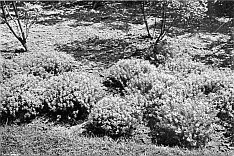
CYTISUS CAPITATUS.
Name. Country or Origin and Natural Order. Colour and Season. General Remarks.
*Cytisus albus (White Spanish or Portuguese Broom) Spain and Portugal; introduced in 1752; Leguminosæ White; May A beautiful and popular Broom. It grows with great rapidity, and flowers bountifully and regularly. A bush 6 or 7 feet high, in full flower is a delightful picture, and one never seems to tire of it. Group it with the common Broom. It is very cheap and easily raised from seed. Loudon says: "In good soil it is of very rapid growth, attaining the height of 5 feet or 6 feet in three or four years, and in six or eight years growing as high as 15 feet or even 20 feet if in a sheltered situation. Placed by itself on a lawn it forms a singularly ornamental plant, even when not in flower, by the varied disposition and tufting of its twiggy thread-like branches. When in flower it is one of the finest ornaments of the garden." Loudon also says that bees are fond of the flowers.
C. albus incarnatus Variety Pinkish Rare, and not so beautiful as the parent.
*C. Ardoini Maritime Alps Pure yellow; April and May Quite a dwarf Broom, a few inches high. It is a charming Broom for the rock garden, placing it where it can spread out its shoots on all sides. It is happiest in sun and dry soil as the other Brooms.
*C. austriacus (Austrian Broom) Native of Austrian woods, also of Italy and Siberia. Introduced in 1741 Yellow; July and August C. banaticus and C. serotinus are synonyms. The chief value of this Broom is in its late flowering, when its yellow flower clusters are very welcome.
C. a. leucanthus Variety Very pale yellow, sometimes almost white Not important.
C. biflorus Hungary Bright yellow; May This is not so important as the Moonlight Broom, Andreanus, and some others. It grows about 3 feet high, but even in a group it is not imposing.
C. capitatus Found on wood edges in Austria and introduced in 1774 Yellow; June This is also a dwarf and not important Broom.
C. hirsutus Asia Minor and South of Europe. Introduced in 1739 Yellow; June This is another dwarf and unimportant shrub.
*C. kewensis Hybrid between C. albus and C. Ardoini Creamy white; May A most interesting and beautiful Broom, which, as it becomes better known, will be popular in gardens. It was raised in the Royal Gardens, Kew; hence the name, C. Ardoini being the seed parent. It is only suitable for the rock garden, where its slender shoots can spread out and form a mantle of soft colouring, or to make a spreading group on the grass. There is little trace in it of C. albus, except in the flower colouring. This is a Broom for all good gardens.
*C. nigricans Austria Bright yellow; July and August This is also a lovely Broom, so named because it turns black when dried. It should be in the smallest list of beautiful flowering shrubs, and it is singular that it is so seldom seen. The growth is bushy and smothered with flowers in July and August, sometimes before, and lasts a long while in beauty. Sunshine and poor soil bring out its finest qualities. One can scarcely say too much in its praise, especially as it blooms at a time few trees and shrubs are in flower.
*C. præcox Hybrid between C. purgans and C. albus Sulphur yellow; April to May One of the most fascinating of all flowering shrubs. It makes clouds of soft colouring, every shoot hidden with the wealth of bloom; whilst when out of flower there is beauty in the brilliant green colouring of the long slender shoots. It is a shrub to make groups of in the flower garden, grows quickly, does not soon get "leggy," and is very dense. The big groups of it on the grass in the Royal Gardens, Kew, are one of the delights of the spring season there. The ordinary shrubbery is the worst place for it, all its gracefulness is lost, there is no fountain of flowers from the slender shoots. It is best raised from cuttings, as seedlings are apt to reproduce C. albus only. Also well known as Genista præcox.
C. purgans South and Central Europe Yellow Chiefly of note because it is one of the parents of C. præcox, but is of little account for the English garden. It is necessary in a collection, but nowhere else.
*C. purpureus Found in Eastern Europe in exposed situations Purple A delightful shrub when properly placed. Loudon's advice to graft it "on the laburnum standard high" is bad, and has been followed in many gardens. This way of treating the shrub is utterly foreign to its nature; it is a trailing Broom, and therefore should be planted on the rough garden or some bank where it can spread in its own way. We have seen it falling over a boulder and making a trail of purple colouring in May. Rare varieties are albus, white, and one with flowers of rose tint. The famous Cytisus Adami is the outcome of grafting this species on the Scotch laburnum (L. alpinum). This curious graft-hybrid usually excites much interest when in flower, both yellow and purple racemes appearing on the same tree.
C. sessilifolius A native of the south of France and Piedmont, and was cultivated in Britain by Parkinson in 1569. Yellow; May A Broom for a collection, but without the effectiveness of C. præcox, Andreanus, and others.
C. Schipkænsis Introduced White This is a charming little rock-garden shrub, and very rare as yet, but well worth noting for its distinctiveness and freedom.
*C. scoparius (Common Broom) Europe Yellow The hardy Cytisuses are popularly known as Brooms, and the Broom of the waste lands of the British Isles is Cytisus scoparius, which makes clouds of golden yellow in the early summer. Many a dryish bank now flowerless might be made beautiful with this glorious shrub. Where Broom is not plentiful as a wild plant, and therefore generally where the soil is not suitable for it, the soil should be made so; it need only be well drained and open.
*C. s. andreanus Choice variety found in Normandy by M. Ed. André, after whom it is named Brownish crimson and yellow; Spring This varies considerably from seed, and often reverts to the typical yellow Broom. If possible get own root-plants from original stock. A beautiful shrub, which we can scarcely have too much of, but in some gardens it is used too freely. When in full bloom, and the variety is rich in colouring, it is superb.
C. s. pendulus (Drooping Broom) Variety Pale yellow Quite a pendulous variety, but uncommon. It is apparently little known, though so charming when on a bank or rock garden. A group of it in either of these positions would be a revelation to those who know not the value of this family for the English garden.
*C. s. sulphureus (pallidus), (Moonlight Broom) Variety Pale yellow Described by Loudon in his "Arboretum" as C. s. albus, "the flowers white or of a very pale yellow." It is a rare shrub, but should not be so. Mr. Goldring writes of it in "The Garden" as follows: "The Moonlight Brown is a very old variety, as it was described by Loudon sixty years ago, but it is still a rare shrub, not easily obtainable, though it is grown in some of the largest nurseries. Its pale yellow flowers are in beautiful harmony with the rich yellow of the type Andreanus. The only private garden where I have seen it in established mass is that of Mrs. Robb at Liphook, where all kinds of tree and shrub varieties are treasured. I do not know if it comes true from seed, but I fancy not."
C. s. flore-pleno Variety Yellow A so-called double variety in which some of the petals are duplicated, but it is not finer than the type, though it is interesting as one of the few double varieties in pea-shaped flowers.
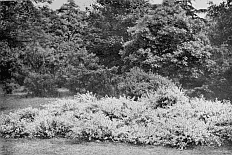
MOONLIGHT BROOM (Cytisus scoparius var. pallidus).
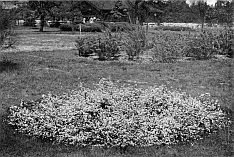
A HYBRID BROOM (Cytisus kewensis) AT KEW.
Name. Country or Origin and Natural Order. Colour and Season. General Remarks.
Cratægus (Thorns) Rosaceæ The Cratægus family comprises nearly 100 species and varieties, contains some of the most beautiful of small garden trees, both with regard to the charm of their white, pink, and scarlet flowers, and the scarlet, black, and yellow fruits. Most of the Thorns are either large shrubs or small trees, and are specially suitable for small gardens, whilst none of them require particular attention, as all will grow in almost any soil and situation. Old trees occasionally require to be relieved of small wood and decaying branches, and a good top-dressing of manure is beneficial sometimes to those which flower and fruit freely; but beyond this Thorns need no attention after they have been planted and become established. The species can be increased by seeds, which are obtained by gathering the fruits when ripe, and mixing them with sand. The mixture of fruits and sand should then be put in a heap in a sheltered place out-of-doors, and covered with a few turfs. By the following spring the fruits will have rotted, and the seeds can be separated and sown. A fair proportion will germinate the first year, and the remainder the second. Many of the Thorns can also be propagated by root cuttings. For this purpose healthy, vigorous shoots, as thick as a man's finger, should be obtained in autumn or winter, and cut into pieces four inches to eight inches in length, cutting the end nearest the stem flat, and the other slanting, so that either end can be readily distinguished. These should be inserted upright in the ground, with the tops nearly or just covered; they soon form roots, and grow into strong plants. The genus is found practically throughout the temperate region, from Europe throughout the East and Central Asia to China and Japan, and in North America. One species is found in Mexico—but this, and in fact all the Thorns are hardy in this country.
*C. Azarolus South-East Europe and Asia Minor Pure white; late Spring This grows to a height of about 20 feet. It is very showy, and has pure white flowers followed by large yellow fruits; the leaves are about twice the size of those of the Hawthorn, and rather deeply cut. Cratægus Aronia is a synonym.
*C. Carrièrei A reputed hybrid, but parentage unknown. Supposed to be C. mexicana and C. tomentosa Pure white; late Spring A very handsome Thorn, 12 feet to 15 feet, shapely, leaves large, bright glossy green above, whitish beneath. Flowers appear freely in large corymbs, followed by clusters of pear-shaped green fruits, which hang on the tree until the end of the year, changing finally to dull, yellowish red.
*C. coccinea (the Scarlet Thorn) North America; introduced in 1683 White; late Spring This is one of the most striking of all the thorns; it has large bright-green leaves, and flowers nearly an inch across, and in dense corymbs. These are followed by clusters of brilliant scarlet-coloured fruits. There are several varieties equal to or even finer than the species. One is *Macracantha, which has spines sometimes 5 inches long, and bright scarlet haws, not so large as those of the species, but produced more abundantly. It should be more frequently seen in gardens, and is worthy to rank as a species. Indentata has deeply-cut leaves and bright-red fruits.
*C. cordata (Washington Thorn) North America White; June This is a small tree with thin, glossy, heart-shaped leaves and small flowers, orange-red fruits, not unlike those of C. Pyracantha, and carried late in the year. Birds, however, enjoy them.
C. Crus-Galli (the Cockspur Thorn) North America White; June This is a handsome American Thorn, and one of the most striking of the whole family. It has stout, glossy leaves and formidable spines, these often being from 3 to 4 inches long, and gave rise to the popular name. The brick-red fruits hang on the tree long after the leaves have fallen, and make a bright winter picture. There are several varieties. Arbutifolia has shorter spines and smaller fruits than the type; the leaves are also narrower and duller in colour; linearis has long linear leaves and bright-red fruits. Ovalifolia has large oval shining leaves and bright scarlet fruits, it is rather more upright han the type. *Splendens makes a handsome, shapely tree about 20 feet high, and flowers and fruits very freely; the leaves are rounded, green, and shining, and the flowers pure white, in small corymbs, and followed by bright-scarlet fruits.
C. Douglasii Western side of North America White; late Spring This is a large irregular-shaped tree 20 feet to 30 feet, and has short stout spines about an inch long; the flowers appear in small clusters, and the fruits are small and black. Wood and spines are brown and quite shiny. Rivularis has smaller and thicker leaves, and shorter and stouter wood.
C. hiemalis Probably a hybrid, but origin unknown White; Spring A tree 15 feet to 20 feet high, round shining leaves, and rather large black fruits, which are the first to ripen of the Thorns.
*C. melanocarpa Caucasus White; Spring A very handsome Thorn. It is a small flat-topped tree of medium height, the leaves somewhat like those of the Hawthorn in shape, and covered with a thick grey tomentum; the fruits are small, black, and shining.
C. mollis United States White, with a small red mark at the base of each petal Like C. coccinea, but even handsomer. It is a small tree, 15 feet high, with spreading head, and large firm leaves slightly woolly on the back; the flowers are large, and succeeded by bright-crimson, medium-sized fruit.
C. nigra Eastern Europe White; May This makes a fair-sized tree, and has small black fruit. The foliage is very abundant, deeply cut, and woolly on both sides. It almost hides flowers and fruit.
*C. orientalis Europe White; May A handsome Thorn in fruit. It is a small flat-topped tree, and has large clusters of flowers, the oval fruits being yellowish red. Sanguinea is a very showy variety, with deep ruby-red fruits, but the scarlet colour of the type is brighter.
*C. Oxyacantha (Hawthorn, White Thorn, May) Widely distributed, Europe, Western Asia, and North Africa White; May Too well known to describe. It has been divided into two sub-species, viz. C. monogyna in which there is usually only one style in the flowers and one seed in the fruit, and C. oxyacanthoides, where the number of styles is usually three, and from two to four seeds in the fruit. These differences are generally decided. There are other differences also in growth difficult to explain, but can be detected easily by an experienced eye.
C. monogyna (sub-species) ...... ...... This is the Hawthorn of the hedgerows, and there are many varieties. Twenty-eight are recorded in the Kew Hand-list. The most beautiful are aurea, with golden-yellow haws, crispa pendula, a pretty weeping tree; Gumperi versicolor, very handsome deep-red, shading to pink in the centre; laciniata, a handsome tree with deeply cut leaves, sometimes called C. apiifolia, but must not be confounded with North American species of that name. Macrocarpa has larger fruits than the type, oxyphylla, large white flowers and handsome fruits, a round-headed tree. Præcox is the Glastonbury Thorn, supposed to flower at Christmas, but rarely does so owing to frost. This is the Thorn which is associated with the famous legend. *Semperflorens is a good variety, a low-growing tree, which flowers for a much longer period than the other Thorns. Stricta makes a dense upright-growing tree, 30 feet or more high; it grows rapidly, and when in flower is strikingly distinct in appearance.
C. oxyacanthoides (sub-species) ...... ...... This is distinguished from C. monogyna by the styles and seeds as stated above; and also by the larger leaves, flowers, and fruit. All the double-flowered Thorns belong to this section. Atrofusca, a large, shapely tree, of weeping growth; the flowers large, pure white, and the fruits fair sized and abundantly produced. *Flore-pleno albo, the double white Thorn, with purest white flowers. This, like the other double Thorns, rarely fruits. *Flore-pleno coccineo, the double Scarlet Thorn, one of the most beautiful of trees when covered with its scarlet flowers. Very pleasing when grouped with the double white variety or the Laburnum; *Paul's double Scarlet, a well-known and beautiful Thorn. *Flore puniceo, a rich purplish pink, single, and fructu luteo, bright yellow fruits, effective in autumn.
*C. pinnatifida China and Central Asia Pure white; May The variety *major is the best to grow. It is stronger, and has very large leaves, 4 to 6 inches long, thick and shining. It does not show its true beauty until of some age, but it is a hardy tree of great beauty. The flowers are in large corymbs, and the fruits are of an intense shining red, pear-shaped, and make a bright picture in autumn. This variety is often labelled C. Layi.
*C. punctata East and North America Variable A good garden tree; it is variable, but the accepted type has white flowers and bright red fruits as large as a small Crab apple. Another form has smaller deep ruby-red fruits. Brevispina, striata, and xanthocarpa are varieties, the last mentioned with bright yellow fruits.
*C. Pyracantha (Fiery Thorn) South Europe, in hedges and rough ground White An evergreen Thorn. Introduced in 1629, and a well known shrub. Its charms consist in its dense glossy leaves and brilliant masses of scarlet berries. It can be grown as a bush or trained up a wall or trellis. It is so brilliant when in fruit that the French call it buisson ardent, or Burning Bush. This Thorn should be more grown as a bush, and not confined as it usually is to a south wall. As the fruits are bitter they are not cared for by the birds, and thus make a display through the winter. Lælandi is a variety with larger and deeper coloured fruits.
C. sanguinea Siberia White; May This is not of great garden value, but effective in winter owing to the red bark. Songorica is a variety also with reddish bark.
*C. tanacetifolia (Tansy-leaved Thorn) Levant; introduced 1789 White; May This is rare, and can be recognised by bracts at the base of the fruits. The fruits are very large, yellow, and of good flavour, and eaten in the native country of the tree. The specimen at Kew flowers regularly and abundantly every year.
C. spathulata United States White; May A very distinct Thorn, small, and the leaves are persistent, remaining on until the New Year. The fruits are very small and scarlet.
*C. tomentosa Eastern United States White; June A late flowering and handsome Thorn when its orange-yellow fruits are in perfection, but the birds soon consume them.
C. uniflora North America, and introduced by the famous tree bishop, Bishop Compton, in 1713 Creamy white; early June More curious than beautiful; it is only 2 feet to 3 feet high and has greenish haws.
Name. Country or Origin and Natural Order. Colour and Season. General Remarks.
Cyrilla racemiflora Florida to North Carolina, &c. Cyrillea White Quite a shrub, 4 feet to 6 feet high, very rare, although introduced as long ago as 1765. The flowers are in drooping racemes on previous season's growth.
*Daboëcia polifolia, St. Daboëc's Heath (Syn. Andromeda Daboëcia) Western Europe and Ireland; Ericaceæ Rosy purple, bell-shaped; May, and throughout Summer and Autumn A pretty little Heath-like shrub growing about 18 inches high, and producing erect spikes of comparatively large bell-shaped blossoms. It is the most continuous blooming of its class. There is a beautiful pure white variety—alba.
Daphne alpina (Alpine Daphne) Alps of Europe; Thymelæaceæ White; May and June A spreading deciduous shrub, with white, sweet-scented flowers. It grows about a couple of feet high, and is essentially a shrub for the rockwork, as it is particularly happy when the roots are wedged between stones.
*D. blagayana Carniola Ivory white; March and April Like the last, this forms a spreading bush, and is equally at home under similar positions. It is, however, of an evergreen character; the ivory white are very sweet-scented blossoms. It is worthy of a place among the most select Daphnes, but difficult to grow well.
*D. Cneorum (Garland Flower) South Europe Bright rose; May to June A delightful little evergreen, with highly fragrant blossoms. A good proportion of vegetable soil is necessary to its welldoing.
D. Genkwa (Japanese Lilac) Japan Lilac In its flowers this Daphne closely resembles the Lilac, so that it is frequently mistaken for that well-known shrub. It needs the protection of a wall in most parts of England.
D. Laureola (Spurge Laurel) South Europe and North Africa Yellowish green The flowers of this are not particularly showy, but as an evergreen bush some 3 or 4 feet high it is valuable from the fact that it will thrive under the drip of trees, and is one of the few evergreens absolutely rabbit proof.
*D. Mezereum (the Mezereon) Northern Europe Red; early year This is an upright deciduous bush that flowers in February or March according to the season. At that time the still leafless branches are packed for some distance with the pretty fragrant blossoms, so that it may be regarded as the most showy shrub at that time in bloom. There is a variety (alba) with white blossoms, and another (autumnalis or grandiflora) that blooms before Christmas. A cool, loamy soil suits this best.
*D. oleoides (Syn. D. fioniana, Syn. D. neapolitana) South Europe Purplish rose A neat growing evergreen bush about a yard high, whose flowers are often borne throughout the greater part of the year. It is less attractive than some of the others.
D. pontica Asia Minor Yellow A good deal in the way of Daphne Laureola, but the flowers are of a brighter yellow, and are borne in April and May, whereas D. Laureola flowers in February and March.
D. sericea (Syn. D. collina) Deep pink A compact evergreen 2 to 3 feet high, clothed with dark-green box-like leaves, while the terminal clusters of flowers are borne in early Spring. It prefers a cool, fairly moist, yet well-drained soil.
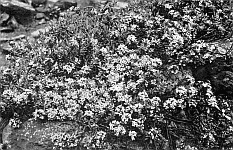
GARLAND FLOWER (Daphne Cneorum) ON SUNNY BANK, EDINBURGH.
Name. Country or Origin and Natural Order. Colour and Season. General Remarks.
*Deutzia crenata (Syn. D. scabra) Japan; Saxifrageæ White; Midsummer A bold growing and handsome deciduous shrub, with white blossoms. There is a double-flowered variety, tinged with purple on the outside, known as D. crenata flore-pleno purpurea. Both are beautiful shrubs that will thrive in most soils.
*D. discolor purpurascens China White, tinged purple; late May This has pretty purple-tinged blossoms borne in flattened corymbs, and not, when in the bud state, liable to be injured by late spring frosts.
*D. gracilis Japan White; Spring The best known of all the Deutzias, forming a compact bush a couple of feet high, and bearing masses of its pretty white blossoms.
*D. hybrida Hybrid White and pink There are now several beautiful hybrid Deutzias, viz., hybrida rosea, hybrida venusta, kalmæflora, Lemoinei, Lemoinei compacta, all of which merit a place in gardens.
*D. parviflora China White; end of April and early May An upright shrub 5 feet high, with flattened clusters of white blossoms, very suggestive of those of the Hawthorn.
*Diervilla florida (Syn. Weigela amabilis, W. rosea) Japan; Caprifoliaceæ Rose; Summer A beautiful free-growing, free-flowering shrub, that will hold its own almost anywhere. Its flowering time is in May or early June, but occasionally there is an Autumn display. Beside the original species there are many garden varieties, all of which are beautiful, but there are so many that a selection is necessary. Three of the best are: *candida, white; *Abel Carrière, bright rose; and *Eva Rathke, claret crimson, which lasts in flower more or less from May till the end of the Summer. Other good varieties are: Dr. Baillon, red; Grœnewegenii, rose and white; hortensis nivea, white, spreading habit; Looymansi aurea, golden leaves; præcox, rose, earlier than any of the others; and P. Durchartre, purplish red. In any selection of flowering shrubs some of the Weigelas must certainly have a place.
D. middendorfiana Siberia Yellowish Remarkable among Weigelas for its distinct yellow flowers. Though pretty in itself, it is likely to prove of more value in the production of new varieties by crossing it with the older kinds.
Enkianthus campanulatus Japan; Ericaceæ Dark red A very charming and interesting shrub resembling one of the Andromeda. A tree in its native country. The flowers are pendent and in clusters.
Epigæa repens (Trailing Arbutus, Ground Laurel, Mayflower) Ericaceæ. The most popular of wild flowers in New England Pale white, with pink tint; very sweetly scented; Spring In Bailey's "Cyclopædia of American Horticulture" it is mentioned: "The cultivation of the Trailing Arbutus, especially in districts where it has been exterminated by ruthless 'mayflower parties,' always attracts interest.... Occurs in sandy and rocky woods, especially under evergreen trees, in earliest Spring. Thrives only in humid soil and shady situations. Transplanted with difficulty. Best on north side of a hill in bright, sandy soil, mixed with leaf mould. Once established, it spreads rapidly. Propagated by division of old plants, layers, or cuttings. Seeds are rarely found, but when found may be used, though slow to develop." My experience is that it likes a damp, shady ditch side in peaty soil. Mr. G. F. Wilson planted it near to Shortia galacifolia, and the two were quite happy together.
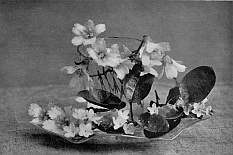
THE MAY-FLOWER (Epigæa repens). (Shortia galacifolia is the top flower)
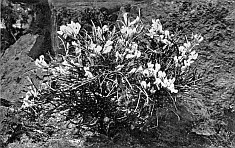
ERINACEA PUNGENS.
Name. Country or Origin and Natural Order. Colour and Season. General Remarks.
Erinacea pungens Spain; Leguminosæ Blue; May and June Somewhat resembling the dwarf-growing Genistas is this extremely rare and pretty little shrub. It grows very slowly, and seldom attains a height of 9 inches, spreading out in a mat-like mass rather than growing in an upward direction. The branches are short, stiff, and spiny, and what few leaves there are are small. The pea-shaped blossoms come from the axils of short, spiny branches, and are blue. This plant has been in cultivation for a great number of years, never, however, having become at all common. This is no doubt due to the great difficulty there is in propagating it. Seeds appear to be the only means of increase, and these are borne very sparingly even when the plant is growing under natural conditions. It has been said to be a tender plant, but it has withstood several winters out of doors at Kew without injury. Plants are to be seen there near the Temperate house, and they flower every year.
Escallonia illinita Chili; Saxifrageæ White; Summer A neat evergreen shrub 4 to 5 feet high, with pretty white flowers. It is only in mild districts, such as the South and West of England, that the Escallonias are seen at their best.
*E. macrantha (Syn. E. Ingrami) Chiloe Crimson red; Summer The finest of all the Escallonias, and one of the hardiest. It is a free-growing shrub over 6 feet high, clothed with rich green shiny leaves, and the bright-coloured fuchsia-like flowers are freely borne. It is a good wall-plant, and stands the sea-breeze well.
E. langleyensis Hybrid Rose carmine Raised by Messrs. J. Veitch between E. sanguinea and E. philippiana. It has small, dark-green leaves, and an abundance of brightly coloured flowers. A good shrub.
E. montevidensis (Syn. E. floribunda) Montevideo White Grows from 8 to 10 feet high, and bears its clusters of white flowers in great profusion. It is too tender for planting except in the extreme West of England and in Ireland.
*E. philippiana Valdivia White; Summer Will succeed as a bush in the neighbourhood of London, where its small white flowers are borne in the greatest profusion.
E. punctata Chili Deep red; July A much-branched evergreen shrub 5 to 6 feet high.
E. rubra Chili Red; Summer and early Autumn Differs from the last in the absence of spots on the young leaves, in the flowers being rather lighter in colour, and borne for a longer period.
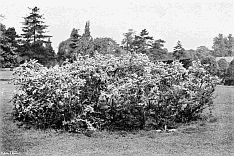
ESCALLONIA PHILIPPIANA (Kew).
Name. Country or Origin and Natural Order. Colour and Season. General Remarks.
Exochorda grandiflora China; Rosaceæ May; White See p. 2.
*Forsythia (Golden Bell) intermedia Oleaceæ; hybrid between F. suspensa and F. viridissima. Represents the two parents Yellow; Spring This is a charming early shrub. It may be either grouped or trained, but one has to be careful not to make it too stiff. It is quite hardy, and a bush.
*F. suspensa (Syn. F. Fortunei and F. Sieboldi) China Yellow; Spring A graceful and beautiful rambling shrub, now well known. It succeeds well in London—that is, if given anything like favourable conditions. A fence fully exposed to the sun in a London backyard is clothed with it, and each recurring spring the Forsythia flowers profusely, and forms an object of great beauty. Immediately the season of blooming is past the plant is severely pruned, the old and exhausted wood being cut out and the vigorous shoots spurred back to within three or four eyes of the base. This results in the production of long, wand-like shoots, which are allowed to develop at will, hence they dispose themselves in a loose and informal way, and being from the position of the plant thoroughly ripened, the spring display is in every way satisfactory. When autumn pruning is done the best portion of the flowering wood gets cut away.
*F. viridissima China Yellow; Spring Quite a bush, and very handsome when in full bloom. Likes full sun and air.
Fraxinus Ornus (Flowering Ash), (Syn. Ornus europæa) Mediterranean region and Orient Creamy white; late May This is a very charming lawn tree with luxuriant panicles of flowers, and foliage like that of the common ash. Angustifolia, latifolia, and variegata are varieties.
F. floribunda (Syn. Ornus floribunda) Himalaya White; Summer Rather tender, but very vigorous and handsome.
Fuchsia.—Though the genus Fuchsia is an extensive one, most of them are of more value in the greenhouse than outdoors—that is to say, throughout the greater part of the country. Still there are a few quite hardy Fuchsias, for, even if cut to the ground during severe winters they soon recover, while in particularly favoured districts, such as in the West of England and the Isle of Wight, they grow unchecked into large bushes, and sometimes make delightful hedges. Few flowering shrubs are more beautiful than F. corallina and F. Riccartoni when in full bloom. The hardiest are:—
*Fuchsia corallina (Syn. F. exoniensis) Garden origin; Onagraceæ Red; Summer and Autumn A plant of more vigorous growth, and with larger leaves and flowers than any of the other hardy Fuchsias. It is very popular in the West of England, but is not nearly so effective when cut to the ground each winter as some of the others are.
*F. globosa Chili Red; Summer and Autumn A free-growing Fuchsia which, if cut to the ground, pushes up long, wand-like shoots that branch out freely, and towards the latter part of the summer are smothered with bright-coloured flowers. In the bud state these are of a globose shape, hence its specific name.
*F. gracilis Mexico Red; Summer and Autumn The name gracilis well expresses the prominent features of this Fuchsia, for, though as vigorous as globosa, it is far more slender and graceful. Where not perfectly hardy the drooping flowers are seen to great advantage when the shrub is trained to a wall, and planted in a permanent bed the old stools will, even in the North of England, pass unscathed through the winter, if protected by a mulch of decayed leaves. Very tender.
*F. Riccartoni Garden Origin Red; Summer and Autumn This has the reputation of being the hardiest of all the hardy Fuchsias. It is in appearance about midway between F. gracilis and F. globosa, and is as good as F. gracilis.
*Garrya elliptica California; Cornaceæ Greenish; Winter and very early Spring A handsome evergreen shrub with very dark green, leathery, oval leaves, about 3 inches long. Its most notable feature is the long, pendulous male catkins, with which the plant is freely draped during the early months of the year. This Garrya is all the better for the protection of a wall in most parts of the country. The male and female flowers are borne on separate plants, the male being, owing to its catkins, by far the most ornamental.
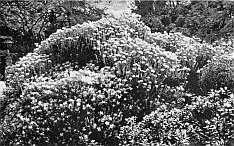
GENISTA (Ulex) HISPANICA. SPANISH FURZE.
Name. Country or Origin and Natural Order. Colour and Season. General Remarks.
Genista Leguminosæ ...... A popular group of shrubs, allied to the Cytisus, and delighting in dry sandy soils. A group of the finer species is very rich in colour when in flower.
*G. æthnensis Slopes of Mount Etna, in Sicily Golden yellow; July and August This Broom is perfectly hardy near London. It is one of the rarest of shrubs in gardens in spite of its beauty, and it flowers in July and August, a season when even inferior flowering shrubs are not plentiful. It has a rather gaunt, yet not inelegant habit, and assumes a somewhat tree-like form when old, being often reduced to a single stem at the base. It carries, however, a wide head of thin cord-like, arching or pendulous branches, with little or no foliage except when the wood is quite young. The flowers are of a rich golden-yellow, and during the series of hot summers we have experienced in recent years have been especially abundant. It would, indeed, be difficult to find a shrub better adapted for hot, light soils than this, a fact that is amply proved by the way it succeeds at Kew. It is a good plant for associating with medium-sized evergreens, which hide its bare stems and render it more effective when in flower. It grows 10 feet to 14 feet high, and is thus one of the tallest—if not the tallest—of the Brooms hardy in Britain. It ripens seed freely, and is best propagated by that means.
G. cinerea South-West Europe Yellow; July This is a shrubby plant for the rock-garden in sunny places.
*G. hispanica South-West Europe Yellow; July A dwarf and charming shrub, 1 foot to 2 feet high, and when in bloom covered with flowers. One of the best of its race.
G. monosperma Sicily White Not well known but interesting. Sandy soil. Tender.
G. pilosa Europe, England Rich Yellow; May and June A prostrate plant for the rock garden. Ordinary soil.
*G. radiata Central and Southern Europe Yellow; Summer Very beautiful when in full flower on the rock garden, and will even succeed in a rough wall.
G. sagittalis Europe Yellow; May and June Another dwarf species for rock garden.
G. tinctoria Britain Yellow; July and September The double variety flore-pleno and elatior are finer than the species. Elatior makes quite a bush and is very attractive when in full bloom.
*G. virgata Madeira Yellow; June and July This must attain a certain age and size before it displays its full beauty, small plants flowering sparsely or not at all, while older specimens are a glorious sight during the period of flowering. Thoroughly hardy in at least the southern half of England, self-sown seedlings of it having been known to spring up in considerable numbers under old plants in sheltered positions. In a shrubbery or wood it makes a brilliant blaze of yellow. It succeeds in almost any soil or situation provided it is not too heavy or wet. Under favourable conditions it reaches a height of 16 feet to 20 feet, with rather straggling branches, every little twig of which is covered with flowers in season. The leaves are about half an inch in length, and covered with white, silky hairs on the under side and a few scattered ones on the upper surface. Easily raised from seed. Excellent for barren land.
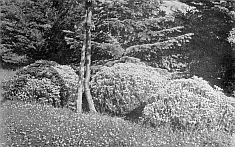
THE SPANISH FURZE ON ROUGH SLOPE.
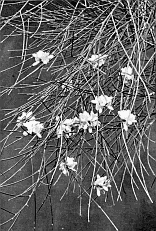
GENISTA MONOSPERMA.
Name. Country or Origin and Natural Order. Colour and Season. General Remarks.
Gordonia Lasianthus (Loblolly Bay) Virginia to Florida; Ternstrœmiaceæ White; July A sub-evergreen shrub 6 to 8 feet high, bearing beautiful white flowers like single Camellias. It needs a sheltered spot and a moist peaty soil.
G. pubescens Georgia and Florida White Of rather smaller growth than the preceding, while the leaves are pubescent underneath. The flowers, too, have the tuft of yellow stamens more pronounced than in G. Lasianthus. Both need the same treatment.
Halesias (Silver Bell, or Snowdrop trees) Styraceæ ...... This is a beautiful family of flowering trees, named after Dr. Stephen Hales. The flowers are like the snowdrop in shape, hence the name, and there are two distinct sections, American and Asiatic. The Halesias like a rich, moist, loamy or peaty soil. Although often trees of considerable size in their native homes, they mostly retain a somewhat shrubby character in this country. All the species, however, except H. parviflora, can, by pruning away the lower branches, be made to form small trees.
Halesia corymbosa (Syn. Pterostyrax corymbosum) Japan, in the province of Higo White, tinted with pink or yellow; Spring Mr. Bean writes in The Garden, May 19, 1900, p. 361, about this species as follows: "I do not know if there is any authenticated instance of its having flourished in Britain or even in Europe, most plants so called being H. hispida. It was first found on the mountains of the most southern of the main islands of Japan, in the province of Higo, and may possibly not be quite so hardy as H. hispida. Judging by pictures and dried specimens, its racemes, whilst having much the same general character as that species, are shorter, broader, and more branched, and the flowers are not so numerous on the branches of the racemes, and the fruits are more downy than bristly. The flowers have the same one-sided arrangement on the racemes."
H. diptera South-eastern United States White; late Spring Not a common species, and dwarfer than H. tetraptera. The flowers are white, Snowdrop-like, and are borne on slender pendulous stalks as in H. tetraptera; they differ, however, in having the corolla almost lobed to the base. Very distinctive is the seed-vessel, which has but two prominent wings, the other two being only rudimentary. Whilst not perhaps equal in merit to H. tetraptera this species appears to have been undeservedly neglected. Its dwarf bushy habit will also render it more suitable for some positions; it loves abundant moisture at the root. It blossoms rather later than H. tetraptera.
H. hispida China and Japan. Introduced about 1870 White This belongs to the Asiatic group of Halesias, and is very distinct from the American species. It is a vigorous shrub, a small tree with large oblong leaves, and small flowers, which are very numerous on the raceme, which is 4 inches to 8 inches long. One striking peculiarity of the raceme is that the flowers are arranged on the upper side only of its branches (a somewhat similar arrangement is seen in Freesia flowers). The seed-vessels are covered with bristly hairs. Mr. Bean says, "Whilst perfectly hardy at Kew in the open, it blossoms more freely on a wall. The finest specimens I have seen of this Halesia are growing near a carriage-road leading to Mr. Gumbleton's house and garden at Belgrove, Queenstown." It flowers in this country in June.
H. parviflora South-eastern United States. Introduced in 1802 White; end of May This is invariably a shrub. It is represented in the Kew collection by a large bush, which flowers as a rule with great freedom towards the end of May each year. The arrangement of the flowers is more racemose than fasciculate, and whilst they are very abundant they are not so large as in H. tetraptera or H. diptera. They are white and Snowdrop-like. The seed-vessels are only slightly and unequally winged. On the whole, therefore, the species is easily distinguished from its two fellow American species. The grace and abundance of its bloom make it well worthy of cultivation wherever a variety of hardy shrubs is desired.
*H. tetraptera (Common Snowdrop tree) South United States. Introduced by a London merchant named Ellis in 1756 White; May A beautiful tree. Whilst according to Prof. Sargent it occasionally attains a height of 80 to 90 feet in its native country, it is seldom more than 20 feet high in the British Isles. Its flowers are like pure white Snowdrops, hence the popular name. The seed-vessels are 1½ inches to 2 inches long, and have four prominent wings that transverse them lengthwise.
H. t. Meehani This originated as a seedling in Meehan's Nursery, Germanstown, Philadelphia. White A very handsome and distinct variety, with shorter flower-stalks, and thicker and more coarsely wrinkled leaves than the type.
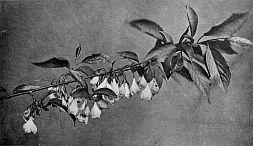
SHOOT OF SNOWDROP TREE (Halesia tetraptera).
Name. Country or Origin and Natural Order. Colour and Season. General Remarks.
Hamamelis (Witch Hazel) Hamamelideæ Orange-yellow; Winter A charming tree when in flower. It blooms early in the year, the precise time depending upon the weather. When the leafless shoots are studded with the golden-yellow, narrow-petalled flowers, with their crimson calyces, it is very pretty. It is also worth using with some shrub like Gaultheria procumbens as a groundwork. It enjoys an open situation, and is not very particular about soil.
*H. arborea China
H. japonica Japan Pale yellow; Winter An interesting shrub, of which *Zuccariniana is a well-known variety.
H. mollis Japan Bright yellow This is a rare Witch-Hazel, with very broad and large leaves, and wavy brightly coloured, fragrant flowers.
H. virginica Eastern North America Pale yellow; Autumn For many years this species was the only Witch-Hazel in cultivation. Being spread over the eastern side of North America from Canada to the Southern United States, it naturally attracted the notice of the earlier colonists, and it was, in fact, introduced to Britain as long ago as 1736. During the last twenty or thirty years, however, new species have been discovered and brought home from China and Japan. They surpass this old American species in garden value, and are, indeed, amongst the most interesting and attractive of the shrubs that flower in the early part of the year. H. virginica, on the other hand, is at its best in autumn. It has the narrow, twisted, bright yellow petals which, with but little variation, are characteristic of all Hamamelis flowers. The flowers cover the younger branches in close, dense clusters. It is a sturdy shrub, almost a small tree, and has leaves very like those of the English Hazel (Corylus).
*Hibiscus syriacus (Tree Mallow, Syn. Althæa frutex) China; Malvaceæ White; blotched red An upright growing deciduous shrub 6 feet high, is particularly valuable from the fact that it flowers towards the later part of August, when so few hardy shrubs are in bloom. It needs a well-drained, loamy soil, that is, however, not parched up at any time, and a spot fully exposed to the sun. There are many varieties of this, ranging in colour from white to purple, both single and double flowered forms being represented. Celestes, blue, and Totus albus, white, are the best.
*Hippophaë rhamnoides (Sea Buckthorn) A British shrub, chiefly in the south and south-east coasts; Eleagnaceæ Flowers inconspicuous; yellowish A beautiful somewhat spiny tree, or rather shrub, to plant by the side of a lake, pond, stream, moat, or anywhere a free spreading shrubby growth is desired. But it will succeed as well inland as by water. A splendid group may be seen near the pond at Kew, and for many years has made a beautiful winter picture in the gardens. Every winter the wood made the previous year is thickly cased with the bright orange-coloured berries, which remain on the branches all the winter, but later on, if hard frosts are experienced, they lose most of their brightness. It must not be forgotten that the flowers are unisexual, i.e. those of one sex only are borne on a tree. Male trees therefore do not produce berries, and to get fruit a female and male must be near. In each group, say of about half-a-dozen plants, one plant should be male and the rest female. This is of the utmost importance, and see to it before the plants leave the nursery. The Sea Buckthorn is a large shrub or small tree. A very pretty standard tree results from keeping it to a single stem and removing the lower branches. The leaves are very charming in colour, a silvery grey. The male plant is of more upright growth than the female.
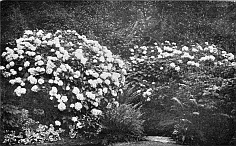
HYDRANGEAS.
Name. Country or Origin and Natural Order. Colour and Season. General Remarks.
*Hydrangea Hortensia (the Hydrangea, Syn. H. hortensis) China and Japan; Saxifrageæ Deep pink; Summer and Autumn Better known throughout the greater part of England as a greenhouse plant than as an outdoor shrub, but in the extreme south and west it is very handsome in the open ground. The huge heads of flowers make a great display. There are several varieties, some of them being often regarded as distinct species, the most notable of which are: Lindleyi, with the large sterile flowers limited to a few around the outside of the cluster. They are pink, tinged with blue. Mariesii is a very handsome Japanese variety, with large sterile flowers, pinkish mauve. Nigra or cyanoclada has purplish black stems, and is very notable on that account. Rosea has all the flowers sterile, and of rich rose colour. Stellata has the sterile flowers double and star-like. Thomas Hogg has white blossoms.
*H. paniculata Japan Creamy white; Autumn A handsome shrub that may be grown as a dwarf bush or as a standard.
H. var. grandiflora This is far more popular than the type, and is grown largely for flowering under glass as well as in the open ground. In this the huge pyramidal-shaped heads are composed entirely of sterile blossoms. If to be kept dwarf it must be pruned back hard when dormant, and only three or four shoots allowed to develop.
H. petiolaris (Climbing Hydrangea) Japan Creamy white; June and July A free-growing climber, that attaches itself to a wall by means of aerial roots after the manner of ivy. It has flattened clusters of flowers. Being so distinct from all the rest, it at once attracts attention.
H. quercifolia North America White A shrub about a yard high, with large lobed leaves. The flowers are less showy than some of the others. It needs a moist soil and a very sheltered spot.
H. radiata North America White The flowers of this are not at all showy, but the leaves are clothed on the under sides with a dense white felt-like substance, which renders it very noticeable when ruffled by the wind.
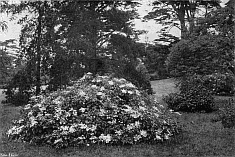
HYDRANGEA PETIOLARIS. A GROUP IN WOODLAND.
Name. Country or Origin and Natural Order. Colour and Season. General Remarks.
Hypericum Androsæmum (Tutsan, Syn. Androsæmum officinale) Europe; Hypericineæ Yellow A free-growing deciduous shrub from 2 to 3 feet high, with a mass of small flowers, but not very showy. It will grow in the shade better than many other shrubs.
H. aureum North America Yellow; July and August Reaches a height of about 4 feet. The orange-yellow flowers, about 1½ inches across, have a large and conspicuous mass of yellow stamens in the centre.
*H. calycinum (Rose of Sharon, St. John's Wort) Levant Yellow; July to Autumn Forms a dense mass a foot high, while the golden-yellow flowers are quite 3 inches across. The long hair-like stamens are very numerous and attractive. It will both grow and flower well in shady spots.
H. elatum (Tall St. John's Wort) North America Yellow Grows 4 to 5 feet high, and is very robust. The flowers, however, though freely borne, are only about an inch in diameter.
H. hircinum Europe Yellow; Autumn When roughly handled the leaves of this species have an unpleasant goat-like odour, but it is decidedly ornamental, forming as it does a bush a yard high, while the flowers are bright yellow.
*H. hookerianum (Syn. H. oblongifolium) Himalayas Yellow; Autumn Rather more tender than some of the Hypericums, but a showy kind. It grows over 4 feet high, and has clusters of large golden flowers.
*H. moserianum Garden hybrid Yellow; early Autumn A hybrid between H. calycinum and H. patulum, and one of the most desirable of all the St. John's Worts. The slender branches are graceful, and terminated by clusters of rich golden-yellow flowers a couple of inches across.
H. patulum Japan Yellow A delightful little shrub, but even in the south of England it is liable to be killed by a severe winter.
H. prolificum North America Yellow Grows 3 feet high, and bears its clusters of blossoms very freely. The individual flowers are about an inch across.
H. uralum (Syn. H. nepalense) Himalayas Yellow Somewhat in the way of H. patulum, and like that species rather tender.
Itea virginica Virginia; Saxifrageæ White; July A freely branched rounded shrub, from 3 to 4 feet in height, and has small spikes arranged in much the same way as the shrubby Veronicas. It is a favourite of the Red Admiral butterfly (Vanessa Atalanta). It is quite hardy, but needs a moist peaty soil.
Jamesia americana Rocky Mountains; Saxifrageæ White; April and May A somewhat upright shrub, 4 to 5 feet high, with oval-shaped leaves and a great profusion of terminal clusters of pure white blossoms. It is quite hardy and needs a cool moist soil.
Kalmia angustifolia (Sheep Laurel) North America; Ericaceæ Bright purplish red; end of May A delightful little evergreen shrub about a couple of feet high, with bright-coloured, saucer-shaped blossoms. All the Kalmias prefer cool damp soil, especially of a peaty nature— indeed, conditions favourable to Rhododendrons suit them well.
K. glauca North America Purplish pink Flowers two or three weeks earlier than the preceding, and is somewhat dwarfer, but is equally desirable.
*K. latifolia (Mountain Laurel) North America Pink; May through Summer This forms a large rounded bush from 6 to 8 feet high, clothed with handsome, bright-green foliage, while the flowers are pink and wax-like. It is a desirable subject to associate with Rhododendrons, which, except in flowers, it much resembles.
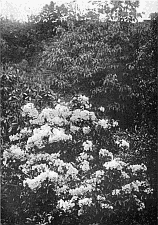
KALMIA LATIFOLIA. A GOOD SHRUB FOR PEATY SOILS.
Name. Country or Origin and Natural Order. Colour and Season. General Remarks.
Kœlreuteria paniculata China; Sapindaceæ Yellow; June and July A small picturesque tree 10 to 15 feet in height, with ornamental pinnate leaves, and large terminal panicles of bright yellow flowers, very distinct.
Laburnum (Cytisus) vulgare (Golden Rain or Chain) Loudon writes: "A native of Europe and the lower mountains of the South of Germany, and of Switzerland, where it grows to the height of 20 feet or upwards. It was introduced in 1596"; Leguminosæ ...... There is no need to praise the laburnum; it is one of the most beautiful of all trees, and its countless flowers make a shower of gold in early summer. It seems strange to read that the laburnum is not a native, for it is so general in gardens, and is even used in hedgerows in some parts of the country. We have in mind a hedgerow in Berkshire with laburnums rising above the thorn, and a pleasant sight this is in late May and early June. Laburnums grow so freely almost everywhere that they are somewhat overdone in gardens, but it is so beautiful a tree that many would say: "I don't mind how many laburnums I have in the garden." Mr. Goldring, writing in the "Gardeners' Magazine" about laburnums, says:— "Besides the common way of growing the laburnum as a shrubbery or plantation tree, it may be put to various other uses. It is a beautiful covering for a wall on the north, east, or west sides. In some old gardens one meets with huge trees of it covering large areas of wall, and affording a lovely sight at flower time. This is a common way of growing it on the Continent, and in some of our old botanic gardens it may be seen trained against a wall as a host for the wistaria, which flowers about the same time, and produces a lovely contrast of colour. "I have pleasing recollections of seeing it in some old gardens trained over a path as a covered way before pergolas were in vogue in this country. For several weeks such covered pathways are glowing with colour, and for the rest of the summer they afford a pleasant shade. In some of the old Sussex gardens laburnum 'tunnels' are still to be seen, and they are worth imitating in new gardens. "Of the two commonly grown species of laburnum, L. vulgare and L. alpinum, there are numerous varieties, differing more or less from the types, though the differences in some cases are slight, even from a garden point of view. A laburnum is a laburnum to most people, and nothing more, but there is a great difference between a worthless seedling with short flower clusters of a poor yellow, and the varieties such as Watereri and Parksii which bear racemes fully 16 inches in length, and of a rich-toned yellow. There is, unhappily, in gardens, a preponderance of inferior seedling trees, because they can be raised easily and sold cheaply, but it is better to have one grafted tree of a first-rate variety than a dozen inferior kinds. "The number of named varieties of L. vulgare enumerated in Continental and English nursery lists exceed a score, and most of them are mere monstrosities of leaf-form or colour, only appreciated by the collector of curiosities. The finest varieties are those named Alchingerii, giganteum, Carlieri, and grandiflorum. Any of these, if true to name, are the kinds to plant. They all bear very long racemes, produced abundantly."
*L. alpinum (Cytisus alpinus), Scotch laburnum Called the Scotch laburnum because a supposed native of Scotland, but this is not true. Loudon says: "It was introduced into Britain about the same time as the other species, 1596." The other species is Laburnum vulgare Yellow This is a well-known tree. Some of its varieties are very beautiful.
L. Watereri Hybrid Yellow We have given this special prominence for the reason it is a hybrid. In Bailey's "American Cyclopædia" occurs this note: "Watereri, Dipp. (L. Parksii, Hort, C. alpinus and vulgaris Wittst.) Hybrid of garden origin, but found also wild.... As hardy as L. alpinum and sometimes considered to be a variety of that species."
L. Adami (Purple laburnum) Graft-hybrid Purple, yellow, and buff This is a remarkable tree, and is named after M. Adam, who grafted Cytisus purpureus on the common laburnum. Loudon says the purple laburnum "is a hybrid between Cytisus laburnum and C. purpureus, in which the flowers are of a reddish purple, slightly tinged with buff, and are produced in pendent spikes eight inches or more long. It was originated in Paris, in the nursery of M. Adam in 1828; it was introduced into England about 1829, and has been a good deal cultivated." We noticed a tree of it in a hedgerow near Burnham Common, Slough. It is a strange tree. Some branches will perhaps bear entirely yellow flowers, like those of the common laburnum and others varied like Cytisus purpureus, by a flower that shows the characters of both parents. It is more curious than beautiful.
Name. Country or Origin and Natural Order. Colour and Season. General Remarks.
*Ledum latifolium (Labrador Tea) Northern portion of North America; Ericaceæ White; late April A much-branched shrub 2 to 3 feet high, and when in bloom covered with its rounded clusters of white blossoms. It needs a cool moist peaty soil,and given this it is very attractive when in bloom.
L. palustre (Marsh Ledum) Northern part of Eastern Hemisphere White, tinged pink Much like the last, except that it is rather smaller, and the blossoms tinged with pink.
Leiophyllum buxifolium (Sand Myrtle), (Syn. L. thymifolium) New Jersey and Virginia; Ericaceæ White; May A compact little evergreen shrub about a foot high. Every twig, however small, bears a cluster of pretty blossoms, in colour white tinged with pink. It is a good rockwork shrub in a cool moist position.
Lespedeza bicolor Japan; Leguminosæ Rosy red; July Sends up stiff annual shoots to a height of 4 feet. The leaves are trifoliate. It needs a warm soil, and is not particularly attractive.
*L. Sieboldi (Syn. Desmodium penduliflorum) China and Japan Reddish purple; September A deciduous sub-shrub that dies nearly to the ground in the winter. From the base are pushed up long wand-like arching shoots to a height of 6 feet, clothed with trifoliate leaves, and bearing large terminal panicles of pea-shaped blossoms. Should it escape the autumn frosts it is delightful.
Leycesteria formosa Temperate Himalaya; Caprifoliaceæ Purplish white, and purple bracts A very interesting shrub, 6 feet high in the milder parts of these isles, but hardy almost everywhere. These flowers are succeeded by purple berries which are relished by pheasants, hence it is planted for covert in some places.
Ligustrum coriaceum (Thick-leaved Privet) China; Oleaceæ White A sturdy evergreen shrub, with very dark-green leaves, thick, about 1½ inches long and roundish oval in shape. It reaches a height of about a yard, and is of extremely slow growth.
L. Ibota (Syn. L. amurense) Japan White; June and July A graceful shrub with long, slender, arching branches, narrow leaves, and white flowers.
L. japonicum (Japanese Privet) Japan White; early July Reaches a height of 6 to 8 feet, and forms a freely branched bush clothed with bright shining green leaves from 2 to 3 inches, oval pointed in shape.
*L. lucidum (Wax Tree) China White; July and August This is the most ornamental of all the Privets in foliage, the leathery dark-green leaves being sometimes as much as 6 inches long, and over two inches wide. It reaches a height of 9 to 12 feet, and has large panicles of white flowers. There is a variety—tricolor, with leaves beautifully variegated, but being tender it needs wall protection.
L. massalongianum (Syn. L. rosmarinifolium) Khasia Hills White The long narrow leaves of this species make it distinct from all other Privets. It is hardy only in the west of England and Ireland.
*L. ovalifolium (Oval-leaved Privet) Japan White This sub-evergreen species is one of the hardiest of all Privets, being much used for hedges, and for planting where little else will thrive. Its small dense clusters of flowers are borne in great profusion, but they (in common with most Privets) possess such a heavy and unpleasant odour as to unfit them for planting near dwelling-houses. The golden form of this Privet, known as Aureum or Elegantissimum, is met with nearly everywhere, particularly in the environs of London.
*L. Quihoui China White; late September A somewhat spreading shrub about 5 feet high, with small leaves and terminal panicles of flowers. For this reason it is worth growing as a flowering shrub.
*L. sinense (Chinese Privet) China White The finest of all Privets as regards its flowers. It forms a sub-evergreen shrub from 12 to 15 feet high, with arching branches, and frond-like arrangements of the smaller branchlets, which are clothed with leaves about the size of those of the Common Privet, and pale green in colour. The white flowers are borne in such profusion towards the end of July that the entire plant is quite a mass of that colour. It needs a well-drained soil.
L. vulgare (Common Privet) Europe White As a hedge plant this is to a great extent superseded by L. ovalifolium, but it is still a useful shrub for rough places. It is one of the subjects that can be clipped into all manner of shapes, hence it is very popular for topiary work.
*Liriodendron tulipifera (Tulip tree) United States; Magnoliaceæ Yellow; June The Tulip tree is one of the most beautiful and distinct of all our hardy trees, for the peculiarly shaped four-lobed leaves cannot be confounded with those of any other. It occurs over a considerable extent of country in North America, and when suitably situated attains a height of 130 to 140 feet. Though these dimensions are not reached in this country, specimens nearly 100 feet high are known, and its great value as a timber tree has been demonstrated here as well as in the United States, where it is given the name of the White Wood. The yellow Tulip-like flowers, from whence its popular name in this country is derived, are very pretty, but as a rule borne at such a height that their beauty cannot be seen. They, however, add to the interest and charm of the tree, and with the handsome leafage and the rich yellow hue of the foliage in the Autumn, as well as its thorough hardiness and almost complete indifference to soil and situation, make it one of the most desirable of our large growing trees. There are several varieties, notable among them being integrifolia, in which the distinctive lobes of the leaves are suppressed; aurea maculata, whose leaves are blotched with yellow; and fastigiata, which is of upright growth. These are all interesting, but not equal in beauty to the type.
Loropetalum chinense China; Hamamelideæ Pure white; Winter A very interesting shrub, with long petals, resembling one of the flowers of Hamamelis; they appear 6 to 8 together in clusters at the bract tips. Tender.
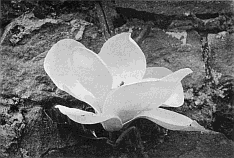
FLOWER OF YULAN (Magnolia conspicua). ABOUT HALF NATURAL SIZE.
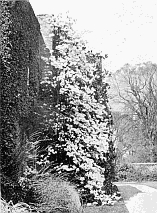
YULAN (Magnolia conspicua); ITS USE AS A WALL SHRUB, CROWSLEY PARK, HENLEY.
Name. Country or Origin and Natural Order. Colour and Season. General Remarks.
Magnolia acuminata (Cucumber tree) North America; Magnoliaceæ Greenish yellow From a flowering point of view this is one of the least showy of the Magnolias, but the tree has handsome foliage; it reaches a height of many feet. The leaves are nearly a foot long, and half as much in width. There is a tree 60 feet high in Syon Park, Middlesex.
*M. conspicua (the Yulan) China Pure white; early Spring Of all the Magnolias, and indeed of all our deciduous trees, this is one of the finest, and also one of the earliest flowering. It blooms in some seasons as early as March, and the pure white flowers, like silver chalices, stand out boldly from the bare dark-coloured branches. Owing to the flowers expanding so early, they are sometimes injured by spring frosts, hence in the northern parts of the country this species is often given wall protection. This Magnolia succeeds best in a good, well-drained, loamy soil of not too heavy a nature, indeed, such will suit all the Magnolias perfectly.
M. Fraseri (Fraser's Magnolia), (Syn. auriculata) North America Creamy white; May A distinguishing feature of this Magnolia is the shape of the large leaves, which are broader towards the upper portion than at the base. It reaches a height of 30 feet or more, but needs a spot sheltered from strong winds. The sweet-scented flowers are nearly 6 inches across.
M. glauca (the Swamp Magnolia) North America White A shrub from 10 to 12 feet high, with flowers not borne all at once, as in most of the others, but scattered over two or three months, from June onwards. It makes a pretty lawn shrub for a damp spot.
*M. grandiflora (the Evergreen Magnolia) Southern United States White; late Summer The evergreen Magnolia is more generally grown as a wall plant than in the open ground, though in the south and west of England it will thrive perfectly without protection. As a wall covering the handsome dark-green leaves render it effective at all seasons, and they also serve as an admirable setting for the large cup-shaped deliciously-scented flowers.