Chapter XLI · (continued 2)
Reading edition
M. hypoleuca Japan Creamy white In Japan this is a tree 60 feet high, and is said to be a very desirable kind, but it has not been long introduced, and the plants of it in this country are small.
*M. Lennei Garden origin Glowing purple outside, pinkish within; late Spring The flowers of this are large, massive in texture, and delightfully coloured. They are a month or two later than those of the Yulan, hence they escape the frosts which sometimes injure it.
M. obovata (Syn. M. purpurea) Japan Purple outside, whitish within; late Spring A spreading shrub 6 to 8 feet high, with flowers much smaller than those of M. Lennei, and not of so pleasing a colour. It is, however, a handsome shrub, less particular in its requirements than most Magnolias.
M. parviflora Japan White; May and June A neat bush. The centre of the flower is occupied by a ring of bright-red filaments. It is rather tender.
*M. soulangeana Garden origin White, tinged purple outside; Spring A small tree more spreading in character than M. conspicua, and flowering also a little later. Very pretty, early flowering.
*M. stellata (Syn. M. halleana) Japan Pure white; March The earliest of all the Magnolias. It is a much branched shrub, seldom more than 4 feet high, and as much through. The flowers, which are borne in great profusion, are about 3 inches in diameter, and composed of a dozen or so of strap-shaped petals; a lovely shrub. There is a variety of this with pink flowers.
M. tripetala (Umbrella tree), (Syn. M. Umbrella) North America Creamy white; early Summer A tree remarkable for its large handsome leaves, which are arranged in a regular manner towards the upper parts of the branches. The flowers are creamy white. A sheltered spot suits this best.
M. Watsoni Japan Ivory white inside, flushed with rose on the exterior; May and June A bush about 5 feet high. The flowers are remarkable for their central cluster of crimson filaments. It needs a sheltered spot.
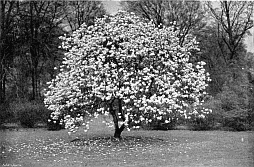
MAGNOLIA CONSPICUA var. SOULANGEANA (late Spring).
Name. Country or Origin and Natural Order. Colour and Season. General Remarks.
Notospartium Carmichæliæ New Zealand; Leguminosæ Rose; June This grows in New Zealand several feet high, but not here. It has graceful shoots, which are very pretty when smothered with the pink pea-shaped flowers. A correspondent to the Garden, writing in July 1900 from Castle Douglas, N.B., says: "I am sure if my plant of Notospartium Carmichæliæ were to be seen by any one who has not got it, there would be countless inquiries for it. It has always done well and flowered freely, but this year it is simply magnificent, with only the points of the twigs visible above the mass of bright pink blossoms."
Nuttallia cerasiformis California; Rosaceæ White; early Spring This is one of the prettiest and most interesting of March shrubs. It is of good habit, and produces a large quantity of dull white flowers in drooping racemes. The fruits, too, are pretty, not unlike those of a small plum, of reddish-yellow colour, with a plum-like bloom. It must be noted that the flowers are liable to be diœcious, and so, therefore the sexes must be planted together, though we have obtained fruit by sticking branches of the male flowers among those of the female shrub.
*Olearia Haastii (Daisy Bush) New Zealand; Compositæ White; July and August A valuable evergreen Box-like shrub, laden with small white Daisy-like blossoms with a yellow disc. Though a native of New Zealand, it is hardy in most parts of England.
O. macrodonta (New Zealand Daisy tree), (Syn. O. dentata) New Zealand White; July This has large Holly-like leaves, silvery on the undersides, and heads of Daisy-like blossoms. Far more tender than O. Haastii, this needs a wall in most parts of the south of England, though it is hardy in the extreme west and in the south of Ireland.
O. stellulata (Syn. O. gunniana, Eurybia gunniana) New Zealand White, yellow disc; May and June An evergreen bush, with small narrow leaves, the undersides covered with whitish felt. The Daisy-like flowers appear in profusion. Its requirements are the same as the last.
O. Traversii (Syn. Eurybia Traversii) New Zealand White; June In its native country this is a timber tree, but here it needs the same treatment as the last two. The flowers are small and creamy white.
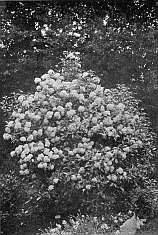
OLEARIA MACRODONTA. (Redruth.)
Name. Country or Origin and Natural Order. Colour and Season. General Remarks.
Oxydendron arboreum Eastern United States; Ericaceæ Pure white; June and July This is a charming shrub, but in its native country grows to a height of 40 feet. The leaves are dark green, but very richly coloured in autumn. The bell-shaped white flowers remind one of those of the Lily of the Valley, and appear in pretty racemes.
Ozothamnus rosmarinifolius South Australia and Tasmania; Compositæ White; July A neat shrub, 4 to 5 feet high, with narrow rosemary-like leaves, and during the summer a profusion of white Aster-like blossoms. It is hardy only in the West of England.
*Pernettya mucronata Cape Horn, introduced in 1828; Ericaceæ Berries the chief beauty Many garden varieties. Between 1878 and 1882 the floral committee of the Royal Horticultural Society awarded no less than seven first-class certificates, selecting the following varieties for the purpose: P. alba, carnea nana, lilacina macrocarpa, nigra major, rosea purpurea. and sanguinea. There are ten or a dozen quite distinct shades of colouring, from white through tenderest pink, white and rosy pink, the colours then reaching to a soft scarlet, and ending with a dark blood-red, reminding one of the seeds of the Pomegranate, and also the differences in the size of the berries and foliage, particulars which impart additional interest to this useful group of plants. Some fifty or so years ago Mr. Davis of Hillsborough began his experiments with such forms of the Pernettya as were then in cultivation, and he selected as his first seed-parent P. angustifolia, a native of China, a densely branched, narrow-leaved evergreen shrub, growing to a height of about 3 feet. The fruit of this species is light pink in colour. It is a very effective subject, thriving well under the shade of trees, but in such a position does not, as might be expected, flower so freely as when grown in the open. P. mucronata, the type, bears reddish-tinted fruits. Regarding P. angustifolia as the hardiest of the two, Mr. Davis made this the first seed-bearing parent, and found the seedlings from it to vary considerably in the character of the foliage and colour of the fruit. This encouraged him to take seed from the best of his seedlings, and from it obtained the fine varieties which are now in our gardens. It is difficult to over-estimate their value as berry-bearing plants in autumn in peaty soil.
Philadelphus coronarius (Mock Orange or Syringa) Europe and Asia; Saxifrageæ White; early May A well-known shrub, from 6 to 10 feet high, with a profusion of white, strongly scented flowers. There are several varieties, the best being aurea, with golden leaves, and Keteleerii, with double blossoms.
P. gordonianus North America White; early July A free-growing bush with flowers twice the size of the preceding, and about six weeks later in expanding.
*P. grandiflorus (Large-flowered Mock Orange, Syn. P. inodorus) Southern United States White; Midsummer Forms a bush about 12 high, with large leaves and blossoms. It lacks the fragrance of the other species, which is to many people a point in its favour.
P. hirsutus (Hairy-leaved Mock Orange) North America White Grows about 5 feet high, and bears its comparatively small flowers in great profusion.
*P. Lemoinei (Lemoine's Hybrid Mock Orange) Garden Hybrid White; June and July A hybrid between P. coronarius and the little New Mexican P. microphyllus. It (P. Lemoinei) forms a slender, freely-branched shrub about 5 feet high, and has a profusion of small pure-white flowers that are most agreeably scented, the fragrance reminding one of ripe apples. The variety erectus is a rather stronger grower, and even a finer plant. Other delightful hybrid forms are, Boule d'Argent, a neat bush with double flowers; Candelabre, with larger blossoms than the other forms of Lemoinei; Gerbe de neige, dwarf form with large single flowers; and Manteau d'Hermine, semi-double. These are among the most charming of all hardy shrubs.
*P. Lewisii Western North America White; Mid-June One of the best, with long graceful arching shoots, and large trusses of pure white blossoms.
*P. microphyllus (Small-leaved Mock Orange) New Mexico White A dense rounded bush, 3 feet high and as much across, clothed with tiny leaves, and very fragrant flowers one inch across.
P. Satsumi (Japanese Mock Orange) Japan White Rather tenderer than the American kinds this forms a distinct spreading bush thinner than most of the others. The flowers are pure white and fragrant, and differ from the others in that the petals are less rounded and full, thus forming a more starry bloom.
*Pieris floribunda (Syn. Andromeda floribunda) North America; Ericaceæ White; April to May A rounded evergreen shrub, from 3 to 5 feet high, clothed with very dark green leaves, and with spikes of pure white Lily-of-the-Valley-like blossoms. It needs a fairly sheltered position and a cool moist soil, such as Rhododendrons delight in.
*P. formosa Himalayas White; May and June A large bold-growing shrub, with handsome dark-green leathery foliage. It has spikes of wax-like urn-shaped blossoms. It is too tender for general cultivation, except in the West of England and in Ireland.
*P. japonica (Syn. Andromeda japonica) Japan White This differs from the last in the white wax-like flowers being borne on long pendulous racemes, so that at their best the entire plant is quite veiled with them. The tips of the growing shoots too are bright red. This blooms naturally earlier than P. floribunda, and on that account the flowers are often injured by spring frosts, to prevent which, as far as possible, it should be planted in a sheltered spot, where the early morning sun does not shine direct on it.
P. mariana (Syn. Andromeda mariana) North America White; Summer A deciduous shrub a yard high, with wax-like flowers. A damp peaty soil suits it best.
P. ovalifolia Nepaul White; May Grows to a height of 10 to 12 feet, and has spikes of white flowers. This species succeeds better in the West of England and in Ireland than elsewhere.
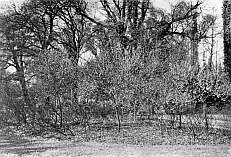
A GROUP OF PRUNUS PERSICA (Kew.)
Name. Country or Origin and Natural Order. Colour and Season. General Remarks.
Prunus (Rosaceæ) ...... ...... This is a beautiful genus. As at present constituted it contains all those trees which were formerly and in many places still are included under the generic titles of Amygdalus, Persica, Cerasus, Padus, &c. The genus is divided into six sections, viz., Amygdalus, which includes Almonds and Peaches; Armeniaca, the Apricots; Prunus, which contains the true Plums and the Blackthorn; Cerasus, the various Cherries; Padus, the Bird Cherries; and Laurocerasus, under which is placed the Cherry Laurel, Portugal Laurel, &c. Although these genera may differ outwardly, yet they are botanically of the same character. The genus is widely spread, representatives being found in Europe and through Asia southward to Persia and Afghanistan, and eastward to China and Japan; it is also well represented in North America. With the exception of the section Laurocerasus, all the members of the genus are deciduous trees or shrubs of various sizes, and most of them are very beautiful, especially in spring. A fairly light well-drained soil is best. If inclined to be cold and heavy and is not very deep, the plums or any which succeed on the plum stock, are best, as they are more surface-rooting than the remainder. The presence of lime in the soil is highly beneficial to all the Prunuses and, if not naturally present, can easily be given in the form of old mortar-rubbish forked in liberally round them. Propagation is effected by seeds, cuttings, layers, or by budding or grafting. Details of propagation will be found with each section.
P. Amygdalus (the Almond) Native of Southern Europe and the Levant Pink; Spring This is the Almond, the tree which foreshadows the coming of spring, its leafless shoots enveloped in pink-tinted flowers. In the southern and central parts of the country it is largely grown, especially in small suburban gardens, but is not quite hardy enough for the north, unless the position is very favourable. The fruit is chiefly composed of the large deeply-pitted stone, which is only covered with a thick, tough, woolly skin. There are five good varieties: Amara, the Bitter Almond, with large white flowers tinged with a soft rose colour in the centre; dulcis, the Sweet Almond, with large red flowers and amongst the first to open; macrocarpa, which has larger flowers and fruits than the type, but the flowers are of paler colour; pendula, a half-weeping variety, deep pink flowers; persicoides, a handsome tree, more upright in growth than the type, and very free. The large pink flowers open somewhat earlier than those of the common Almond.
*P. davidiana (Amygdalus davidiana) China White or pale rose; January or early February This is a small tree and one of the earliest to bloom; the flowers opening as early as January in mild weather, though the middle or end of February is its usual flowering time. The buds are not injured by frost, but open when the weather gets milder. The leaves are broader and of duller colour than those of the Almond, but the flowers are of about the same size and substance. There are two forms, alba, white, which is the best, and rubra, rose or red. Beautiful under glass.
P. incana (Amygdalus incana) Asia Minor Pale red; March and April This species is allied to the pretty P. nana; it is a spreading shrub 4 to 6 feet high with linear leaves silvery-white underneath. The flowers are about half the size of those of the Almond and freely produced.
*P. nana (Amygdalus nana) Eastern Europe and the southern parts of Russia Rose; March and April This delightful little shrub is rarely more than 3 feet high, the thin twiggy growths being covered every Spring with rose-coloured flowers. It makes a charming bed for the Spring, and is very easily increased by layering.
P. orientalis Western Asia Rose; April This shrub grows to a height of about 6 feet, but is not very hardy. So many, however, enjoy the beauty of the Almond family that we include it, as in many southern gardens it is happy. The willow-like leaves are silvery white.
*P. Persica (the Peach), (Syn. Persica vulgaris and Amygdalus Persica) China, but formerly considered a native of Persia Pink; April or May This beautiful spring-flowering tree needs no description. It is not grown, however, so much as the various double-flowered varieties, such as flore-roseo-pleno and flore-albo-pleno; the former has very double bright rose flowers and the latter white. Flore-rubro-pleno is a double red form. The variety foliis rubris has deep purple-coloured leaves; the flowers are tinged with the same colour and the fruits are dark and freely produced. Magnifica is a double red-flowered variety with larger and finer flowers than the others, and the finest of all. All the Almonds are best propagated by budding or grafting on suitable stocks, which are the common Almond for warm light soils, and the Plum for heavier soils and colder localities. For budding the Mussel plum stock is the best to use, and either the same or the Myrobella plum for grafting. The latter is not usually a good stock for budding, the bark being too thin to hold the bud properly, which objection does not hold good with the Mussel plum stock. The species can also be got from seeds, and P. nana is best raised as stated from layers, or cuttings of half-ripened wood, which will strike, though not very readily.
P. Armeniaca (the Apricots) Many of the species in this group are amongst the most precious flowering shrubs of the garden. All can be increased by seed. P. tomentosa and P. triloba flore-pleno can also be got from layers or cuttings. Half-ripened wood of the latter will also root readily, and soon form sturdy young trees. These two in particular should always be on their own roots: a plum stock kills them in a few years.
P. Armeniaca (common Apricot) Northern China Small, white, opening early in the year, and frequently blackened by frost We mention this because it is the parent of the various varieties of Apricot.
*P. Mume Japan Rose; early, before the leaves This is a small and pretty tree of upright growth, and the leaves large and shining green in colour. There are four varieties, viz., flore-albo-pleno, double white; flore-roseo-pleno, double bright rose; flore-rubro-pleno, double red; and pendula, which makes a pretty, small, weeping tree if worked standard high.
P. tomentosa China and Japan Pinkish This is a pretty, small branching shrub, with stout leaves covered with a thick tomentum; the flowers are followed by small red fruits.
*P. triloba China Pink; March or early April The species is not of much account, but the double variety flore-pleno is one of the most handsome of flowering shrubs. Its large, double, rose-coloured flowers are produced so profusely that hardly a leaf is visible. For a wall it is invaluable, but in this position it should only be pruned immediately after flowering, the summer growths being allowed to develop at will, as this is the wood that will produce flowers the following season.
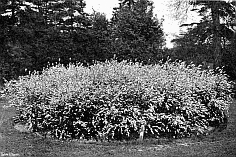
PRUNUS JAPONICA. (Syn. P. sinensis.)
Name. Country or Origin and Natural Order. Colour and Season. General Remarks.
Prunus (the Plums) There are several species of Prunus, but those mentioned are the most important for gardens. The Plums are best grown from seeds, but if these cannot be got then they must be worked upon the Wild, Mussel, and Myrobella or Myrobalan Plum. Plum stocks should be raised from seed. If got from layers or suckers they are liable to throw up suckers from the base, and ruin the plants worked on them.
P. cerasifera (P. mirobalana) Uncertain, but probably of Caucasian origin Small, pure white; Spring This is the well-known Myrobalan Plum, and the seedlings are used as stocks. Its hardiness and vigour in almost all soils and climates make it a good small shrub, and its white flower-clusters are delightful in early spring. The fruits are popular on the Continent, and are red in colour. It is used as a hedge in some places. There are two varieties, viz., angustifolia pendula, which is half pendulous in growth, and the well-known atropurpurea, more often called *P. Pissardi, which is a native of Persia, and has warm purple leaves, which get darker with age. The flowers are rose-tinted. It is a good shrub for colour, but must not be too freely planted.
P. communis (Wild Plum) The origin of this plum is uncertain; it is stated in some works to be a native of Britain, Europe, and a part of Asia White; April and March The wild plum is mentioned because a well-known tree, but its varieties are more beautiful. *Pruneauliana is very handsome; its fruit is the prune imported from abroad. It is of upright growth, with downy leaves, and large, pure white flowers. *P. fl. pl. is extremely handsome; it has double flowers. The wild plum is the same as P. domestica.
*P. divaricata Wide distribution from Macedonia Caucasus and Persia. Introduced in 1822 White; April or late March in a mild season This is one of the most beautiful of the Plums, but rarely seen. A fine example of it is now in the rock garden at Kew, and when the weather is mild before March is out, this spreading tree is enveloped in snowy-white flowers. But unfortunately its flowers are sometimes spoilt by late frosts. The growth is slender, twiggy, and dark in colour.
P. spinosa (the Sloe) Britain, and Europe, North Asia, &c. White The Sloe or Blackthorn of the English hedgerow is familiar, but the variety *flore-pleno is a good garden shrub; its spreading Spring shoots are covered in April with double white flowers, each like a little rosette, and longer lasting than the Sloe of the English lane. It is as yet rare in British gardens. This should be worked on the type.
The Cherries (Cerasus group) A beautiful group of flowering trees. They are propagated by seeds or by grafting them on stocks of the Gean (P. Avium), but never resort to this practice if possible to avoid it. The small-growing cherries, P. humilis, P. Jacquemontii, P. japonica, P. prostrata, and P. pumila, must be increased by layers; the Gean stock kills them.
P. acida Europe White; April P. acida would be little heard of if it were not for its variety, P. a. semperflorens, (the All Saints' Cherry), which blooms twice or thrice in a season, indeed, keeps up a scattered succession from May to September. The first display of flowers takes place in April, and in about two months afterwards it blooms again. The fruits are very abundant, and are scarlet in colour. There are several other varieties, but not of much consequence.
P. Avium (the Gean or Wild Cherry) Europe, and a woodland tree in many parts of these Isles Pure white; April and May The Wild Cherry is pretty, and it is interesting as the parent of the fruiting cherries, but neither this species nor its varieties, decumana, white, the cut-leaved laciniata, or the weeping pendula, can approach the beauty of the *double white (flore-pleno), which is one of the loveliest of all flowering trees. In late April the whole tree seems enveloped in blossom as white as driven snow, and it lasts for many days in this condition. No garden should be without this queen of flowering trees.
P. Cerasus (Dwarf or Wild Cherry) Europe and Britain White; Spring This is not very interesting, except that it is one of the parents of the fruiting cherry, and in the garden is hardly wanted, as its double-flowered varieties are far more beautiful, especially *Rhexi flore-pleno, which has very double, snow-white, rosette-shaped flowers. It is one of the most beautiful of all the Cherries, and when grown as a standard makes a small and spreading tree of much charm. It is sometimes catalogued as C. caproniana multiplex, C. c. ranunculiflora, and C. serotina flore-pleno. Persicifolia has similar flowers, but tinged with rose. C. Cerasus and C. Avium have much in common, but the former has smaller leaves and an acid fruit.
P. Chamæcerasus (Siberian Cherry) Europe, but long grown in English gardens White flowers, ¾ in. across; Spring This is a small shrub, seldom more than 4 feet high; it has slender branches, shining dark-green leaves and flowers, followed by small reddish-purple acid fruits. When grown as a standard it makes a round, half-drooping and graceful tree.
*P. japonica China and Japan Double, pure white This is one of the prettiest of small shrubs when in flower. It is very charming against a wall, but is a success in the open, flowering freely, and for this reason makes an interesting and beautiful group. It grows between 3 and 4 feet high, and its long slender branches are often weighed down by the wealth of pure-white flowers. The leaves are tinged with red when young. The flowers of the variety flore-roseo-pleno are rich rose; it is a beautiful shrub. Increase only by layers or by cuttings; never graft.
*P. prostrata Mountains of the Levant Bright pink; Spring Mr. Goldring in the Gardener's Magazine, April 6, 1901, p. 210, writes thus of this Cherry: "I am afraid that this species, which is a low shrub from the mountains of the Levant, is not very easy to obtain, yet it is one of the most delightful of dwarf cherries. It is a spreading plant with slender arching branches, but scarcely prostrate. The leaves are amongst the smallest in this group, being from a half-inch to one and a half inches long, and finely toothed. Nor are the flowers large, being a half-inch or little more in diameter, but in their profusion they almost hide the branches. The colour is a bright, and, among Prunus, unusual shade of rose. This shrub was known to Loudon, and was recommended by him. It has, indeed, been in cultivation for nearly one hundred years, but seems to have shared the fate of many other lovely hardy shrubs in the middle decades of last century, and almost passed out of cultivation. It grows at elevations of 5000 to 6000 feet, and is perfectly hardy."
P. pseudo-cerasus (Japanese Cherry) China and Japan ...... This is a glorious cherry, and very popular in Japan; indeed, it is one of the most beautiful introductions we have had from that land of flowers. The recent double-flowered varieties should be in all gardens, and given a fairly moist soil and sunny situation, will bloom well. P. pseudo-cerasus goes under several names, such as Cerasus Sieboldi rubra, C. Watereri, and others. It is a small tree here, with stout greyish branches, and firm broad serrated leaves. *J. H. Veitch, with intense deep rose flowers, is very charming, and blooms from a fortnight to three weeks later than the type. The brownish-tinted foliage is quite a feature.
*P. pendula (Cerasus pendula rosea) Japan Deep pink; April and May A beautiful tree of distinct weeping habit, and raised from seed quite readily, retaining its true character. The flowers are borne profusely, and sometimes open in March. It is a tree that could be raised from layers. Mr. Bean, writing in the Garden of April 13, 1901, says: "Prunus pendula is as naturally pendulous in growth as the Babylonian Willow is, and it should, if possible, be obtained on its own roots. It is an early flowering kind—probably the earliest of the Cherries—being in bloom as a rule soon after April comes in. The flowers are of a lovely shade of delicate rose, but are not large. They are, however, freely borne, especially after a hot, ripening Summer and Autumn. In the United States it succeeds even better than here, and by some authorities is regarded as the loveliest of Japanese trees introduced to that country. So much cannot be said of it in Britain, but it is well worth cultivation for its beauty and earliness."
*P. serrulata (Cerasus serrulata) Introduced from China about 80 years ago. Also a native of Japan The flowers are in large loose heads, and are white, or white suffused more or less deeply with rose, and 1 inch to 1½ inch across. End of April This is one of the most ornamental of the Cherries. It is naturally a small tree with a rather loose habit, and is peculiar by reason of its short-jointed stunted-looking branches. The leaves are fairly large and very evenly serrated. For lawns or shrubberies it is excellent, making a good companion plant to its own countryman, the large-flowered pseudo-Cerasus and its European cousins, Cerasus and Avium. In addition to being an excellent outdoor tree, it may be cultivated in pots for forcing for the conservatory in Winter and Spring.
*P. Mahaleb Europe White; April and May The Mahaleb is well known for its remarkable profusion of pure white blossom and its free graceful habit. In the variety pendula, the pendent character of the branches is not unduly marked, but is sufficient to add greatly to the beauty of the tree. It is not only one of the best of Cherries, but of all flowering trees, and is as well adapted for planting in groups as it is when isolated as a single specimen. The flowers are borne on short racemes, and in such abundance as to envelop the tree in a snow-white mantle. Every garden should have at least one weeping Mahaleb.
P. Padus (the Bird Cherry) Europe, and a great part of Asia White; Spring A well-known tree, and frequently seen in woodlands, where its strong scent is quickly detected. It is a shapely tree, growing 20 feet to 30 feet high, and has long erect branches, and in Spring drooping racemes of flowers 6 inches or more long. The fruits are small and shining black in colour. There are, however, many poor forms, sometimes with almost greenish flowers. Perhaps the most valuable is the double variety, flore-pleno, which has very long racemes and very pure white. Pendula is a weeping variety which will, no doubt, be an acquisition, but it is of too recent appearance here to say much about it. It is curious to note that there is a variety (stricta) with an exactly opposite tendency, branches and racemes being quite erect. P. virginiana, a nearly allied Bird Cherry from North America, is also represented by a pendulous form. P. serotina and its variety pendula, and the other members of the Padus group, are not important.
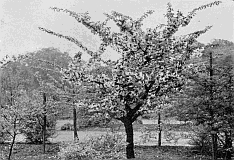
PRUNUS SERRULATA IN FLOWER. (Spring.)
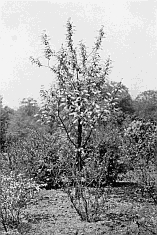
THE DOUBLE-FLOWERED BIRD CHERRY. (Prunus Padus fl. pl.)
Name. Country or Origin and Natural Order. Colour and Season. General Remarks.
Laurocerasus Group.
P. ilicifolia California White A tender evergreen with holly-like leaves, but only hardy in warm southern and western countries. It is a small bush, 6 feet to 8 feet high, and has short and erect flower racemes and deep-green leaves.
P. Laurocerasus (Cherry Laurel) East Europe White A well-known evergreen, too freely planted in the past, and so vigorous as to over-run the garden in course of years. The varieties are more planted than the type, as they are handsomer. The most distinct are Bertini (latifolia), camelliæfolia, caucasica, rotundifolia, and schipkænsis; the last mentioned is about the hardiest.
*P. lusitanica (Portugal Laurel) Spain and Portugal White A popular evergreen. There are four varieties—azorica, which is very tender; coriacea; myrtifolia, small narrow leaves, and bears clipping well. P. ilicifolia is the only plant that need be raised from seed. The Cherry and Portugal Laurels, with their varieties, are usually propagated by cuttings, ripened wood of almost any size being cut into pieces 8 inches or so in length, and inserted nearly their full length in the ground. This can be done from the time the wood is ripe enough until the end of the year. Practically every cutting will root and make sturdy plants in a twelvemonth. The Portugal Laurel is also largely raised from seeds, which are gathered when ripe and sown immediately without any preliminary cleaning. If kept in sand until the following spring, they begin to grow before the season is sufficiently advanced to sow them, and if dried, nearly a year is lost before they germinate.
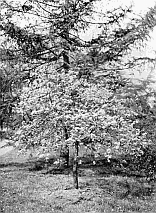
PYRUS SINAICA.
Name. Country or Origin and Natural Order. Colour and Season. General Remarks.
Pyrus Rosaceæ An important and beautiful genus, as it includes the Pears, Apples, and Quinces of the hardy fruit garden, and such trees as the Flowering Crabs, the White Beam tree, Mountain Ash, and Pyrus japonica. It is divided into seven sections, viz., Pyrophorum, which includes the true pears; Malus, the Wild Crab apples, parents of many garden forms; Aria, of which the White Beam tree is a good type; Sorbus, in which is found the Mountain Ash; Adenorachis, which only contains the North American species, Cydonia, the Quinces, and Mespilus, with which is placed the Medlar. These are found practically throughout the northern temperate zone, under varying conditions, and with one or two unimportant exceptions, are all hardy in this country. The majority of the Pyrus are trees of considerable size. A few are small trees, and about half a dozen are low-growing and dense shrubs. All are deciduous, and will grow in ordinary garden soil, but none of them like a cold and moist soil and position. Ground that will grow Apples and Pears well will suit the Pyruses, though they will thrive in considerably poorer soil than is recommended for fruit culture. In planting, the ground should be deeply trenched, and the bottom well broken up, any clay or gravel that is encountered being thrown out and replaced with good soil. Most of the Pyrus root deeply, and if the soil is not properly prepared in the first place they are apt to fail and get cankered. Propagation is done by seeds, budding, or grafting, and in a few cases by suckers. The best ways are given with each section.
Pyrophorum Group (the True Pears).
P. betulæfolia China and Japan White; early Spring A small and pretty tree, 15 feet to 20 feet high, with leaves somewhat like those of a Birch in shape, though rather larger. They are on long petioles, and have a pleasing sound when ruffled by the wind. It does not flower or fruit much until well established. The white flowers are in dense clusters and appear before the leaves.
*P. communis (the Wild Pear) Europe and Asia White; Spring As this is widely distributed it varies greatly. The type is more interesting for its flowers than for its fruit, which is hard, gritty, and dry. It grows 30 to 40 feet high, and has long spreading branches, half pendulous. When the tree is covered with its white flowers the effect is very beautiful. There are several named varieties, the best being flore-pleno, with semi-double flowers; linearis, with long, narrow leaves, and pendula, described by the name.
P. nivalis Eastern Europe White; Spring A small spreading tree which flowers in great abundance; the fruits are plentifully produced, and are nearly globular in shape, and of fairly good flavour, but dry. The habit of the tree and shape and flavour of the fruit suggest some of the garden pears. There is a variety with leaves variegated with white.
P. sinaica Asia Minor White; April This is one of the few species worth growing for their leaves alone, for during Spring and Summer it is quite silvery. Although about 20 feet high in its native country, it makes here, as a rule, a small bushy stunted tree.
*P. salicifolia (Willow-leaved Pear) Levant A beautiful tree, about 15 feet high, and delightful to make groups of for the sake of its long and narrow silvery-white leaves. There is a creeping variety of it. The flowers are white, and the fruits small and woody, neither of much account. It is the effect of the foliage that we must consider, which is very charming when waving in the wind. A good tree for grouping and for small gardens, and this remark applies also to the weeping form. The Pyrophorum group will come true from seed, which is the best way of propagating them. If not from seeds they can be worked on stocks of the Wild Pear, on which they do fairly well, though much better on their own roots. There are other species in this section, such as P. auricularis, P. Michauxi, P. parviflora, P. Pashia, and P. sinensis, but the above are the most important.
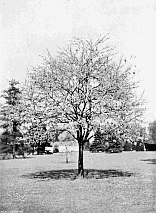
PYRUS SPECTABILIS ON LAWN. (Spring.)
Name. Country or Origin and Natural Order. Colour and Season. General Remarks.
Malus Group (the Apples).
*P. baccata (Siberian Crab) Himalaya to Japan Rose pink; May A well-known tree, very beautiful on the lawn. It grows 20 feet to 30 feet high, and as much or more in diameter, and the flowers smother every branch, followed by a glorious display of brilliant scarlet fruits, which are esteemed by some when preserved. There are several varieties, of which three may be mentioned, Bertini, which is of rather more upright growth than the type, and has large white flowers and scarlet fruits; and Genuina, which differs from the type in its more open growth and larger fruits. Xanthocarpa has bright golden fruits.
*P. coronaria (American or Fragrant Crab) Eastern United States. Introduced 1724 Rose; May and early June A beautiful and neglected tree, 15 feet to 20 feet high, with large, deliciously-fragrant flowers. It is worth growing on this account alone. The leaves are dark-green and lobed, and the fruits sweetly scented and grass-green, not very ornamental. It should become more popular in English gardens. The variety flore-pleno has large, almost double, rich rose-coloured flowers.
*P. floribunda Japan Rose; late Spring and early Summer A delightful tree and happily much planted in gardens. It is quite small, little more than a graceful bush, rarely exceeding a height of 10 feet, wreathed in flowers in the appropriate season, the buds intense crimson, but opening out a paler shade, and thus there is a gradation from one colour to the other. It should be freely grouped and planted in small and large gardens. The fruits are yellow, and about the size of a pea. There are two good varieties, Atrosanguinea, which has flowers of much deeper colour than those of the type, and flore-pleno or Malus Parkmanni, as it is more often called. This has semi-double red flowers, and reddish wood and leaves.
P. Malus (Crab Apple) Britain; Europe and Asia White; late Spring This is the Crab Apple of the hedgerow, and although not very ornamental, three varieties of it deserve notice. These are *coccinea, which has large scarlet fruits in abundance; flore-albo-pleno, with large semi-double, pure white flowers, and Neidzwetzkyanus, a very handsome form with purple-tinted leaves and fruit. But no tree can become popular with such a name. We hope it will be changed. Pendula is welcome for its drooping growth.
P. prunifolia Siberia Rose; late Spring This much resembles P. baccata, and has many varieties, one of them named pendula being a beautiful weeping tree.
P. Ringo Japan Late Spring A small tree about 20 feet high, with rather long spreading branches, and large flower trusses followed by bright yellow fruits. These are sometimes borne so abundantly that the branches get weighed down.
*P. Schiedeckeri Supposed hybrid (P. spectabilis, *P. Toringo) Soft rose; May This hybrid has for its near allies such popular and beautiful plants as Pyrus floribunda, P. spectabilis, P. baccata (Siberian Crab), &c.; yet it is not inferior in beauty to any of them. It is only in recent years that it has been in commerce. It has not, of course, reached its full size yet in this country, but it is evidently going to be a small tree. It is nearly related to P. floribunda, but gives every indication of possessing a more tree-like character, its branches being sturdier and more erect in growth. But it is for its wealth of blossom that it is chiefly remarkable. Even among such profuse-flowering things as those of its allies mentioned above, it is noteworthy for its qualities in that respect. During May, its flowering season, clean branches 3 feet and even 4 feet long can be cut, which are wreathed from end to end with blossom. The flowers are semi-double and come in the usual Apple-like clusters; each flower is about 1½ inches across.
*P. spectabilis (Chinese Crab) China and Japan Pink; Spring A beautiful and fairly well known tree, 20 feet to 30 feet high, with large semi-double flowers of much charm; the fruits are bright red. Every garden should possess a group of it, and at least a single specimen standing out by itself, unfettered by trees or shrubs near. There are three varieties of note: flore-pleno-albo, with white flowers; flore-pleno; and Kaido, which is a very charming tree, upright in growth, and with rose-pink flowers and yellowish-red fruits. These trees of the Malus section are usually propagated by being budded or grafted on stocks of the Common Crab. If any of them are growing singly away from other species, then seeds from them will come true to name, but where various species are growing together they become crossed when in flower, and the seedlings result in a variety of hybrids, few or none of which are of any value. But as all of them succeed very well when worked on Stocks of the Common Crab, this is probably the better way to propagate them.
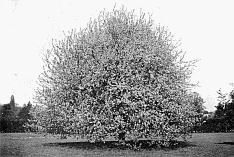
THE SIBERIAN CRAB (Pyrus Malus baccata) SHOWING ITS BEAUTY ON LAWN.
Name. Country or Origin and Natural Order. Colour and Season. General Remarks.
Aria Group (White Beam trees) ...... ...... A very distinct group.
P. Aria (Common White Beam tree) North Temperate Zone White A well-known tree, frequently seen in chalky districts. It is a large tree, 40 to 50 feet high, and has oval leaves, which are silvery white on the under surface. The white flowers are borne in large clusters, followed by oval red or scarlet coloured fruits. There are several varieties. Lutescens is very handsome, with its broad and silvery leaves; chrysophylla has leaves of quite a golden hue; græca is a handsome form found in Greece, it is much later in flowering and fruiting than any of the others; salicifolia has striking leaves, quite silvery white underneath.
P. decaisneana Origin unknown; presumably a hybrid ...... A handsome vigorous tree, with oval leaves, 6 inches long by 2 to 3 inches broad, silvery beneath. The pinkish flowers are on large dense corymbs, followed by bright scarlet fruits. A tree well worth growing.
*P. lanata Himalaya White This is better known under its garden name of Sorbus majestica, and is perhaps the most beautiful of this section of Pyrus. It is an upright-growing tree, 30 feet to 40 feet high, with large serrated leaves, covered beneath with a dense silvery tomentum. The flowers are succeeded by corymbs of intense scarlet fruit. P. pinnatifida is also of note for its silvery leaves.
P. vestita Northern India White Thoroughly hardy in this country, and a handsome tree, met with commonly under the names of P. Thomsoni and Sorbus magnifica. It has large oval silvery leaves, and is worth growing for this reason alone. The white flowers and scarlet fruit are an additional charm. The above are all best propagated from seeds, which are freely produced, and come true to name, with the exceptions of P. alpina and P. decaisneana, which, being hybrids, cannot be depended on. These two, and the varieties of P. Aria, are best worked on stocks of P. Aria, on which they succeed very well as a rule, care being taken to choose clean, vigorous stocks with straight stems.
Sorbus Group.
P. americana North America White This is the American Mountain Ash, and is not a great success in this country. It is of smaller growth than our Mountain Ash, and has pinnate leaves and clusters of red fruit, which, like those of most of the Pyruses, are much liked by birds. There are several varieties.
*P. Aucuparia (Mountain Ash or Rowan tree) Native White; Spring This adds a brilliant note of colour to the garden landscape in Autumn, and is the glory of many a Scotch and Welsh ravine. In the north the berries are very rich. There are many varieties; the best are asplenifolia, a very handsome tree, with finer leaves and more deeply serrated leaflets than those of the type; dulcis, a handsome, vigorous variety, with bold foliage and larger fruits than those of any of the other Mountain Ashes. Fastigiata has somewhat the habit of the Lombardy Poplar; fructu luteo has bright yellow or orange fruits, which are freely borne and very showy; pendula is a weeping form with branches that sweep the ground.
P. lanuginosa Eastern Europe Dull white This is a showy tree, 30 feet to 40 feet high, with pinnate leaves, woolly on both surfaces. The fruits are red.
*P. sorbus (Service tree) Native White This is more commonly known under the names of P. domestica or Sorbus domestica, and is like the Mountain Ash in leaf, though more spreading in growth. The flowers are succeeded by green fruits about the same size as those of a Crab Apple. There are two forms, viz., maliformis, with apple-shaped fruits, and pyriformis, with fruits shaped like those of a pear.
P. thianschanica Eastern Asia White This is a comparatively new introduction, but a valuable tree. It has reddish-coloured shining wood and pinnate glossy leaves, with pointed and serrated leaflets. The fruits are small and scarlet. The above can, and should, be propagated from seeds, which germinate readily, and the seedlings soon form strong plants. The varieties of the Mountain Ash should be worked on that species, and, if absolutely necessary, most of the other species can be increased in the same manner and on the same stock. We have seen P. lanuginosa worked on a Hawthorn stock, on which it succeeded very well, but should not recommend the Hawthorn as a stock for any of the Pyruses.
Adenorachis Group. Not a very important group,containing two species, P. arbutifolia and P. nigra. Both are easily raised from seeds, but the quicker way is to detach suckers.
Name. Country or Origin and Natural Order. Colour and Season. General Remarks.
Cydonia (the Quinces)
P. cathayensis China Rosy red; late Spring, early Summer Best on a wall as at Kew. Bolder in growth than P. japonica, but not so hardy. Very handsome on a wall.
*P. Cydonia (Syn. Cydonia vulgaris) Unknown Flesh The Quince is for the garden orchard. "How seldom does one see Quinces planted for ornament, and yet there is hardly any small tree that better deserves such treatment. Some Quinces planted about eight years ago are now perfect pictures; their lissome branches, borne down with the load of great deep-yellow fruit, and their leaves turning to a colour almost as rich and glowing. The old English rather round-fruited kind with the smooth skin is the best both for flavour and beauty—a mature tree without leaves in winter, has a remarkably graceful, arching, almost weeping growth. The other kind is of a rather more rigid form, and though its woolly-coated, pear-shaped fruits are larger and strikingly handsome, the whole tree has a coarse look, and just lacks the attractive grace of the other. They will do fairly well almost anywhere, though they prefer a rich loamy soil, and a cool, damp, or even swampy place."—Wood and Garden, p. 128.
*P. japonica China and Japan Scarlet; April, earlier in some gardens A beautiful shrub, one of the most valuable introductions that we have ever had from China and Japan. It is the "japonica" of many a cottage and villa wall, and in sheltered warm gardens begins to bloom before winter has gone, a bright, cheery, and welcome shrub indeed in border or on wall. It is so well known that a description is almost needless, but there are several varieties, with considerable range of colour, from white to scarlet. We give the six from the Kew list: candicans, white; luteo-viridis, yellow; Moerloesi, crimson; nivalis, white; sulphurea perfecta and versicolor lutescens, both yellowish. All the varieties are good, especially Knap-Hill scarlet, which is a brilliant scarlet, delightful in a group; it is a most valuable shrub. Sinica has very showy deep red flowers.
*P. Maulei Japan Orange scarlet; May A charming shrub, dwarfer than P. japonica; the fruits are yellow, and have a pleasant aromatic odour, and, like those of P. japonica, make an excellent preserve. Superba is a variety or rather reputed hybrid between P. Maulei and P. japonica, and has deep scarlet flowers. The Quince can be propagated by seeds, by cuttings, or by layers. Cuttings of well-ripened wood about 9 inches long should be taken in autumn and inserted 6 inches in the ground, when they soon form roots and make sturdy plants. P. japonica and P. Maulei can be increased by seeds, by suckers, or by root-cuttings. Suckers are freely produced by old plants, and can easily be detached, so that this method is the easiest means of propagating them.
Mespilus Group.
*P. germanica (the Medlar) (Syn. Mespilus vulgaris) Europe and Asia Pure white; early Summer A small tree for the garden, orchard, or woodland. It is handsome in leaf and growth, a dense spreading tree, with fruits of acceptable flavour when eaten at the right stage.
*P. lobata (M. Smithi; M. grandiflora) Unknown; probably a hybrid White A very handsome but neglected tree, about 20 feet high, with dark-green leaves and snow-white flowers, rather smaller than those of the common Medlar; it has small pear-shaped reddish fruits, and is a good lawn tree. These trees are best propagated by grafting or budding on the Pear or Quince stocks, on which they do well. The Medlar can also be increased by seed.
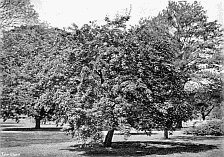
PYRUS (Mespilus) LOBATA.
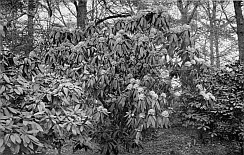
RHODODENDRONS ARBOREUM HYBRID. (Outdoors, Kew.)
Name. Country or Origin and Natural Order. Colour and Season. General Remarks.
Rhododendron Species.
Rhododendron arboreum Himalaya; Ericaceæ Bell-shaped, various colours—blood-red, white, rose, and, as a rule, spotted This is a famous Himalayan Rhododendron, a tree attaining a height of 40 feet in its native country. It has bold, thick foliage, green above but quite silvery beneath, and the bell-shaped flowers vary in colour. There are several varieties, such as album, cinnamomeum, kingianum, Nilagiricum, puniceum, and others, but difference in flower colouring is the chief reason for distinctive names. Not hardy except in a few very favoured spots, chiefly Cornwall and south-west generally. Must be grown under glass, and requires a big house. Many beautiful trees in the Temperate House at Kew.
R. barbatum Sikkim Bell-shaped, blood-red, 1½ inches across This is a tree 40 feet to 60 feet high in its native country. It is hardier than R. arboreum.
R. californicum California Rose-purple, upper petal spotted with greenish yellow; broadly campanulate, almost without a tube. Good sized umbels; June This is a strong-growing Californian species, the leaves dark-green; fairly hardy.
R. campanulatum Himalaya Lilac, with purplish spots; June. Leaves elliptic or elliptic oblong, blunt as a rule at both ends, April This is a beautiful species, about 4 feet high. We have seen it in several Surrey gardens, but it requires shelter. It is not one of the hardiest.
R. campylocarpum Himalaya Bell-shaped, clear, pale yellow, 2 inches or so across, in rather loose clusters; May or late April The best hardy yellow Rhododendron at present known is this. It is hardy at Kew in sheltered spots, but succeeds better farther to the south. It is a shrub of neat compact habit, with leaves 2 inches to 3 inches long, dark-green and glossy above, blue-white beneath. When full of flower it is a singularly pretty and distinct Rhododendron. It varies somewhat in shade, and the flowers are sometimes of a pale lemon tint, becoming almost white with age. The late Mr. Mangles, we believe, raised some hybrids from this species, but we know of none in commerce.
R. catawbiense Mountainous regions of Southern United States Good-sized heads of lilac or purplish flowers; late May and June This is a strong growing species and one of the hardiest of all Rhododendrons, and has played a large part in the production of the present race of garden Rhododendrons, and is with R. ponticum the best stock on which to graft the various varieties, and is useful for covert. It is hardier than R. ponticum, and varieties with much of the Catawbiense blood in them are hardier than those closely allied to other species. Fastuosum fl. pl. is a well known form.
R. caucasicum Introduced nearly a century ago from high rocks close to the snow-line in Caucasus Rose or whitish green spotted flowers, in compact and upright clusters This is a quite hardy Rhododendron. The true species is rare in gardens, but there are several forms, and it has been used to a great extent by the hybridist. It is dwarf, spreading, little more than a foot high, with ovate leaves with brownish tomentum on the under surface. It flowers late in July or in August, but its progeny is in beauty during May and June. A hybrid, which flowers at a considerable earlier date than the others, is nobleanum; it claims R. arboreum as its other parent, and flowers from December onwards until the end of March. At Kew there are several large groups in the Rhododendron dell.
R. ciliatum Sikkim Flowers are white, suffused with rose; April outdoors This is a Rhododendron more adapted, except in the quite southern counties such as Cornwall, South Wales, &c., for a cold house. It is of compact and bushy growth, 2 feet or 3 feet or less high, but varies according, of course, to locality, and is part responsible for a number of hybrids, such as præcox, Rosy Bell, and Queen of Dwarfs. The hybrids mentioned are all hardy, but owing to their early flowering often get injured by frost.
R. cinnabarinum Himalaya Flowers are tubular, with short, spreading limb, pendulous, and orange-scarlet, orange, or red; they vary somewhat in size, but are usually about 2 inches long and ¾ of an inch across the mouth, and thick and fleshy This is a very distinct-looking shrub, about 3 feet; but only an approximate height can be given, as it is sometimes more than this. The growth is somewhat loose, and the branches upright and slender, the leaves ovate, 2 to 2½ inches long, and glaucous. Only moderately hardy.
R. dauricum Alpine regions of Eastern Asia Rosy purple; January This is quite hardy, but flowers so rarely that it is only seen in beauty very often in a cold house. It is almost deciduous, as most of the leaves fall off in winter. It is a bush, and has been crossed with R. ciliatum, the well-known præcox and Rosy Gem being two of the hybrids.
R. ferrugineum (Alpine Rose) European Alps. Introduced about 150 years ago Flowers small, funnel-shaped, and in small upright terminal clusters in June; bright rose or scarlet This is frequently seen in rock gardens, and grows about 1 foot high, forming a rounded mass thickly clothed with small green leaves, covered with minute reddish-brown spots. When young the leaves are slightly hairy, but the mature foliage is almost free from hairs. There are varieties, one with white (albiflorum), another with rosy or scarlet flowers (myrtifolium), but there are others. Its popular name is Alpine Rose.
R. Fortunei China Fragrant, pale rose-coloured flowers, with seven petals; Mid-May This is one of the hardiest of the Himalayan species, and, as it does not flower until well into May, it is generally untouched by late frosts, which so disturb early-flowering species. It grows from 10 feet to 12 feet high, and has large, handsome oblong leaves. It is the origin of a distinct race.
R. fulgens Eastern Himalaya Blood-red; April and May There are several forms of this Himalayan Rhododendron in gardens, the best producing compact clusters of medium-sized flowers of the colour mentioned. The leaves bear a striking resemblance to those of R. campanulatum in both size and colour. Although hardy, it is seldom seen in true beauty outdoors, because of its naturally early-flowering season.
R. glaucum Himalaya Rose, waxy, ¾ of an inch across, and in small upright heads; May This is a dwarf species, with small oblong leaves, seldom more than 2 feet high, and rarely seen in cultivation, although very pretty.
R. hirsutum Alps Pale red; May and July In many ways this is the counterpart of R. ferrugineum, the chief difference being in the intensely hairy leaves of this species. The two species grow side by side in the Alps, and the one under notice is one of the few species that will grow in a limy soil. It has also been used by the hybridist.
R. Keysii Bhotan Flowers tubular, red and yellow, and 1½ inches long; May A distinct, upright-growing, scantily branched species, suggesting affinity to R. cinnabarina, but it is quite distinct. It grows from 4 feet to 6 feet high, has narrow quite distinct ovate or lanceolate leaves 2 inches long.
R. lepidotum Temperate and Alpine Himalayas Colour varies, usually purple and yellowish; curious flattened form, and about 1 inch across; May and June The individual flower does not suggest a Rhododendron, so unlike other species is it in this respect. It is a low-growing plant with small oblong leaves; it succeeds outdoors at Kew.
R. maximum (Great American Laurel) North America Rose, or whitish spotted with yellow or red This will grow to a height of 35 feet, and has large, thick, elliptical, oblong leaves. It is not much grown here. In the "Cyclopædia of American Horticulture," it is mentioned: "This is one of the hardiest species, being hardy as far north as Quebec and Ontario.... This species and the former (catawbiense) are now often extensively used in park-planting, and taken by the car-load from the woods. If properly handled and taken from a turfy soil with a sufficient ball of earth around the roots, they are usually successfully planted." There are three varieties, album, purpureum, and roseum.
R. Metternichii Japan; known here about 30 years Rose; about 2 inches across, and in small clusters; March This is not in general cultivation, but is hardy. As yet no opportunity has arisen of ascertaining to what dimensions it will grow in this country; it has thick and leathery oblong leaves, 3 to 4 inches long, green above, and covered underneath with a thick grey or brownish tomentum.
R. niveum Himalaya; 8 to 9 feet Purplish; April At Kew this species lives outdoors, but is not a success, and even in Cornish gardens gets injured in severe weather. It makes a dense bush, with medium-sized leaves, green above, and covered with a dense greyish tomentum beneath. It has been in cultivation about 40 years.
R. ponticum This has a curious distribution, being found in Portugal and not again until Asia Minor is reached Purple; about 2 inches across; May Of all the hardy Rhododendrons this is the most largely grown and most popular; it is much used as an undergrowth in woods and other places. In many parts it has become naturalised, reproducing itself from self-sown seeds. It has been much used by the hybridist, and with R. caucasicum and R. catawbiense has produced many beautiful hybrids. It will grow beneath trees, and its evergreen foliage is not the least of its attractions. There are several varieties.
R. punctatum North America, Alleghany Mountains, from North Carolina to Georgia Flowers rose; 1 inch across; in clusters in June A dwarf and evergreen species. R. minus is a synonym.
R. racemosum First exhibited by the introducers, Messrs. Veitch, in 1892, and is a native of Western China, where it is found 6000 to 10,000 feet elevation Pink-white; April The introduction of this added another type to this genus, for both in flower and general habit it is distinct from other species. It is dwarf, with small oval leaves, and flowers borne in axillary and terminal clusters, and so profusely that every branch is a mass of blossom. It is quite hardy and very welcome. There is a form with deep rose flowers.
R. Rhodora (Rhodora canadensis) North America Magenta-purple; April Not much grown, but colour probably not popular. It makes an upright deciduous shrub, 3 feet to 4 feet, slender, twiggy wood, and small ovate lanceolate leaves. Should have moist peaty soil. A failure on dry and sandy ground. Does not object to partial shade. Easily increased by seeds and layering.
R. Smirnowi Caucasus Crimson-purple; 3 inches across; April and May This has large flowers and leaves, and, as recorded elsewhere, has founded a distinct race. It blooms freely when about a foot or so high. The leaves are about 5 inches long, 2 inches wide, and covered on underside with a soft white felt.
R. Thomsoni (see page 437)
R. yunnanense Yunnan; first flowered at Kew in 1899 White, with blood-red spots on upper petal; in loose clusters in May This is an erect shrub, with glossy green leaves 2 to 2½ inches wide. A very useful shrub, and should not be forgotten by the hybridist.
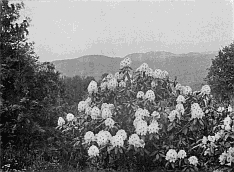
HYBRID RHODODENDRON IN DONEGAL. (A wild bit of planting.)
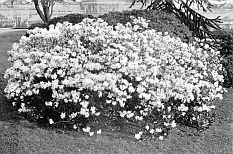
RHODODENDRON PRÆCOX. EDINBURGH BOTANIC GARDENS.
Name. Country or Origin and Natural Order. Colour and Season. General Remarks.
R. Hardy Hybrid Ericaceæ ...... Very few of the species of Rhododendron have not some value either for out of doors or under glass. Rhododendrons are widely distributed, species being found in North America, Europe, and through temperate Asia as far south as the Malay Peninsula, the headquarters of the genus being Western Asia and the temperate Himalaya. Rhododendrons also differ greatly in size, some very tall as R. arborea, which is sometimes said to grow to a height of 40 feet in the Sikkim forests, to the little alpine R. Chamæcistus, which rarely exceeds 6 inches high. There is quite as marked variation in the size of the leaf, several species, of which R. Falconeri may be taken as a type, having large and handsome leaves, sometimes a foot high and 6 inches wide, whilst the quaint little Japanese species R. serpyllifolium has tiny leaves not a third of an inch long and of corresponding width. The Rhododendron family may be divided into two great sections, deciduous and evergreen. The evergreen section consists of a large number of species, either quite hardy or tender, the tender ones being represented by such beautiful flowers as R. griffithianum, Edgeworthi, R. Dalhousiæ, R. Nuttalli, the Malayan species, &c. With the exception of R. ponticum true species are seldom met with outdoors, except in gardens where collections are formed, or in the south-west countries. The scarcity of species is doubtless due to many of the hybrids being much hardier, and begin to flower and grow at a later time of the year. Although some of them will stand severe frost in mid-winter without injury, growth beginning early in the year, the young leaves and shoots get considerably injured by the late spring frosts, and flowers when open in March are also destroyed or much spoilt. In Cornwall, South Wales, and parts of Ireland, huge specimens of R. arboreum, barbatum, grande, Falconeri, griffithianum, and others may be seen in full vigour, but all have to receive protection from the north. Although these species cannot be grown successfully outdoors in most parts of the country, the hybridist knows their value. Through crossing them with hardier and later growing and flowering species many beautiful hybrids have been raised. Hardy evergreen hybrid Rhododendrons may be divided into several groups according to parentage. Of these groups by far the most familiar is the one that has originated through the crossing and intercrossing of the Himalayan R. arboreum with the American R. catawbiense, the Caucasian species R. caucasicum, or the European and Asiatic ponticum. This hybridising has been progressing for half a century or more, and the parentage is plainly seen in the offspring. Thus where R. arboreum asserts itself most strongly we find rich red flowers and leaves with a silvery under-surface. Where R. catawbiense is most in evidence the leaves are large and handsome, deep green, and softer to the touch than R. arboreum, while the clusters are often of great size, the flowers prettily spotted, and the plants of exceptionally good habit. For very cold districts the catawbiense hybrids are the best, being hardier than the others. The flowers of many of the earliest of the R. catawbiense hybrids are of lilac or purple colouring. The influence of R. caucasicum is most plainly shown in the rose, white, and heavily spotted varieties,whilst it also imparts some of its sturdy habit to its progeny. R. ponticum shares with R. catawbiense the honour of producing many of the best lilacs and purples, but through so much intercrossing it is difficult to trace the influence of any particular species in many of the newer hybrids. In this group raisers are fastidious, regarding the shape of the inflorescence as of first importance, that is, a conical truss of symmetrical outline, the flowers on short stalks and held firmly in the truss. In the Rhododendron dell at Kew many of these hybrids are to be seen, and in a number of the older ones it is not difficult to trace the influence of the various species mentioned. Some of those which show much of the catawbiense character are album elegans, white with yellow spots, delicatissimum, blush, everestianum, lilac with darker spots, fastuosum fl. pl., double lilac, and purpureum elegans and purpureum splendens, with dark-spotted flowers. R. arboreum blood is very noticeable in the early flowering, bright-red nobleanum, the rich red russellianum, and russellianum superbum, the white dark-spotted Baron Osy, the blush or almost white Blanche superb, and many others, whilst R. ponticum is in evidence in a large number of hybrids. In addition to this group there are others which, though not so universally grown, are quite as beautiful. For a number of years other species besides those worked on to produce the last-named group have been taken in hand in several places, notably at Tremough by Mr. Gill, and all who are interested in shrubs know the great work accomplished by Messrs. Anthony Waterer of Knaphill, John Waterer & Sons of Bagshot, Wm. Paul & Son of Waltham Cross, George Paul of Cheshunt, Fisher, Son & Sibray of Sheffield, Messrs. J. Veitch, and in the Royal Gardens, Kew.
R. Thomsoni Sikkim Blood red; June R. Thomsoni may be taken as a type of a group in which it has played a great part. This species is hardy even near London, and farther north, but flowers very early, so much so that frost frequently destroys its beauty. It grows from 6 feet to 15 feet, has broadly ovate leaves and loose trusses of six or eight waxy flowers.
R. Luscombei Hybrid between R. Thomsoni and R. Fortunei Rich rosy red; April This was raised by Mr. Luscombe about thirty years ago. It is finely represented in the Arboretum at Kew, the largest specimen being 8 feet high and as much through. The flowers are in loose trusses, tubular, 3 inches across, and very waxy; a handsome hybrid.
R. F. Thiselton-Dyer Hybrid, same cross as Luscombei Deep rose, with darker mark at the base of the tube This is a Kew-raised hybrid, and very similar to Luscombei in growth.
*R. Ascot Brilliant Raised by Mr. Standish Rich scarlet; mid and late May; a peculiarly brilliant colour This is a flower of wonderful colour and the whole shrub in growth, size of calyx, texture, and clusters reminds one strongly of R. Thomsoni. It is of dwarf and bushy growth, and flowers with great freedom.
*R. Shilsoni Raised by Mr. Gill, gardener to Mr. H. Shilston, Tremough, Penrhyn, Cornwall, between R. Thomsoni and R. barbatum Crimson This beautiful hybrid combines the good qualities of both parents. It resembles R. barbatum in height and R. Thomsoni in foliage, and the flower truss is compact as in the former parent, with the larger, more fleshy leaves of the latter. It is an exceptionally fine Rhododendron for Cornwall, but at Kew is grown in a cold house, although a small plant withstood the winter of 1901-2 outside without injury.
R. Harrisii A hybrid raised by Mr. Harris, at one time gardener to Lord Swansea; the parents are R. Thomsoni and R. arboreum Red; early Spring This is a hybrid of much interest, and flowers freely when quite small. It is apparently quite hardy, but would be happier in the south than elsewhere.
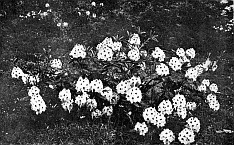
RHODODENDRON SAPHO IN IRISH GARDEN. (Donegal.)
Name. Country or Origin and Natural Order. Colour and Season. General Remarks.
Griffithianum Group.
*R. Aucklandi Himalaya White; May The group, in which the Himalayan species griffithianum, better known as R. Aucklandi, is most marked, is composed of a number of large-flowered hybrids which vary considerably in size of flower and colouring. It is probably the finest species of Rhododendron in existence, and named in honour of Lord Auckland, a Governor-General of India, by Sir Joseph Hooker. It appears, however, to have previously been named after Griffith, the Indian botanist, whose name it ought now properly to bear. It carries its flowers in large, loose trusses, and individually they are frequently 6 inches across. This Rhododendron, we believe, ranks first in the genus in regard to the size of its bloom. Six or eight of these are borne in a truss, and they are pure white when once fully expanded, although pink in the bud state. The handsome leaves are smooth, narrow-oblong, 6 inches to 12 inches long, and of a deep lustrous green. When fully grown this becomes a small tree, the bark peeling from the trunk in large flakes. It is not, unfortunately, one of the Himalayan species that can be grown out of doors near London. In Cornwall and similar places it is magnificent. It only just escapes being hardy, and can be grown out of doors in tubs for the greater part of the year. Some of the best specimens in the country have, in fact, been grown in this way. Even when placed under glass little or no fire-heat is needed. We know plants that have stood 18° of frost without injury. It is remarkable that this Rhododendron has not been used more for hybridising. Most people seem to have been slow in awakening to its value, and although, at the present time, there are doubtless thousands of young hybrids from it in existence, it will be some years before they flower. There are, however, a few hybrids that are hardy and very beautiful.
*R. kewense A hybrid between R. griffithianum and R. Aucklandi Delicate rose, passing to white with age; April and May This was raised at Kew in 1875, but did not flower until fourteen years later. Since then it has flowered very freely every year. It makes a large bush 6 to 8 feet high, spreading, and with leaves resembling those of R. griffithianum, and the flowers as regards shape and size being also similar, whilst they are very sweetly scented. In addition to the true Kewense, there is a form in cultivation with red flowers. The bracts are light red. Kewense is a hybrid of charming colouring—so many shades of rose and deeper-tinted buds.
*R. Manglesii Hybrid sent out about 1880 by Messrs. Veitch & Sons, and the outcome of crossing R. griffithianum with the catawbiense hybrid album elegans White, the upper petal spotted with red or reddish brown; April and May This is a very beautiful hybrid, popular, and very free. Although the leaves are smaller, this Rhododendron—named after one whose interest in the race was intense—resembles the Himalayan parent when not in bloom, but the influence of the American parent is seen in the flowers, which are about 4 inches across. A peculiarity of the inflorescence is the long truss. There are several forms, that only differ slightly in size or density of the spotting from the type.
*R. Pink Pearl Raised by Messrs. J. Waterer & Sons of Bagshot Delicate pink; May This beautiful Rhododendron has rapidly become popular. The leaves and size of flowers point to the griffithianum influence. The flower truss is very large, well formed, and the individual flowers 4 to 5 inches across. No doubt new hybrids with R. griffithianum influence will be constantly occurring, but raisers must remember that hardy growth is of the greatest importance. R. griffithianum has been much used by Mr. Mangles as a parent, in whose garden there are many beautiful hybrids, such as Liza Stillman, Dulcie Daffan, Manglesii var. delicatum, Daphne Daffan, Mrs. Mallard, and others.
Fortunei Group.
R. Fortunei China White with deep pink suffusion, and very fragrant; May and early June This species, when not in flower, bears a strong likeness to R. griffithianum, but the flowers are very distinct, about 3 inches across, and very fragrant, whilst each one has seven petals. The hybrids are of good habit, flower with great freedom, are very fragrant, and each bloom frequently has six petals, whilst the stamens are often imperfect. The group displays a wide range of colouring, pink and deep rose predominating, but a few are red, and many are prettily spotted or blotched with red or chocolate. We hope this group will be better known, as many of the hybrids are very charming, a few having names; thus those raised at Kew were named respectively Mrs. Thiselton-Dyer and George Thiselton-Dyer. They bloom profusely, the flowers being very deep rose with dust-brownish blotches at the base; the chief difference is that the flowers of the former are paler than those of the latter. An interesting hybrid raised at Kew by crossing R. Fortunei with the variety Meteor has flowered well for the last four years. The cross was made in 1893, and the plants flowered when only a few inches high. Several plants have now grown to a height of 2½ feet. The flowers are in compact, rounded trusses, and appear in May; they are delicate pink, and fragrant. The great peculiarity of the hybrid is that no plant has perfect stamens, some being full size but barren, others reduced to mere specks, and occasionally they are quite absent.
R. Smirnowi Native of Caucasus. Flowered for the first time in England at Kew in 1893 Bright rosy-lilac; April and May This is a handsome species, of compact growth, and 3 feet to 6 feet high, with large, deep-green leaves, covered on the underside with quite a dense, whitish, wool-like substance. The flowers are from 2½ inches to 3 inches across, and in shapely trusses. Both at Kew and in the nursery of Mr. George Paul many hybrids have been raised. The first raised at Kew resulted from crossing the species with the scarlet-flowered garden hybrid Johnsoni in 1893. It flowered when four years old, and was of dwarf growth, with rosy-red flower. Of numerous other hybrids raised since then three resulted from crosses made in May 1896; they flowered in May 1902, and are so far the best. One of these was raised by crossing with the variety purpureum splendens; this has trusses of purplish flowers. Another claims R. Fortunei as its male parent; it has large fragrant flowers with five or six petals, pink, and arranged in shapely trusses. In the third case kewense was selected as the male, and this is the prettiest of the three; the flowers are on long stalks, droop, and have daintily fringed petals; they are fragrant, rose colour, mottled with dark spots in the throat. The somewhat drooping character of the flowers is not an advantage.
R. azaleoides Cross between R. (Azalea) viscosum and R. maximum White, lilac-tinted flowers; June This grows about 3½ feet high, and, as the parentage shows, is a cross between the evergreen and deciduous sections. It has been known under the names of hybridum, fragrans, odoratum. Quite hardy.
*R. Smithi aureum This is not new, but rare; it is supposed to have been raised by a nurseryman named Smith of Norbiton, between a variety of R. caucasicum and a yellow form of R. sinense, and is said to have been exhibited at Chiswick in 1841 Buff inclining to apricot; June This is a very beautiful Rhododendron, dwarf, not very compact in growth, but when its handsome flower clusters are out the bush is almost smothered with bloom. At Saltwood, near Hythe, in a Rhododendron glen Mr. Leney has several plants of it. A glaucous-leaved form is in cultivation, but the flowers are not so rich in colour as those of the plainer leaved one. Quite hardy.
R. roseum odoratum Hybrid between the two sections. One a white-flowered deciduous variety, and the other a red-flowered evergreen form Reddish; June Quite hardy.
R. altaclarense Result of crossing R. catawbiense and R. ponticum. Flowered first in 1835. Raised at Highclere Bright scarlet A very charming, bright flowered hybrid.
*R. præcox A hybrid between R. ciliatum and R. dauricum Rose-purple; late February and early March This hybrid is quite hardy, but must have a sheltered spot, if not grown in a cool house for the sake of its colour, as it blooms early in Spring, and therefore is apt to get spoilt by frost and rain. It makes a bush about 3 feet high, spreading, with a profusion of flowers, very rich in colour, but the variety rubrum is darker than the type.
Name. Country or Origin and Natural Order. Colour and Season. General Remarks.
*R. (Azaleas) ...... ...... For many years the hardy, deciduous Rhododendrons were known only as Azaleas, and in many places the name Azalea is still maintained. When the two sections—deciduous and evergreen—are compared it will be at once seen that there is no real structural difference between them. Although in the making of the two genera the number of stamens was considered one of the principal points, it has since been shown that it is a point unworthy of notice, as the number of stamens varies considerably in both deciduous and evergreen species. It is doubtful whether the name of Azalea will disappear, but we are following here the latest classification, and therefore place the "Azalea" in its proper group. About 20 species have been known under the name of Azalea, 3 or 4 of which are evergreen, and the remainder deciduous. Of these about half-a-dozen are really well known in gardens, either by the type plants, hybrids, or garden forms. The majority of the species belong to China and Japan and North America, one species being found in the Caucasus. Several of the North American species, such as R. arborescens, calendulaceum, nudiflorum, &c., the Chinese and Japanese species R. sinense (better known as Azalea mollis), and the Caucasian flavum (Syn. Azalea pontica), have proved splendid breeders, and in the hands of the hybridist a wonderful assortment of varieties has been obtained, which for delicate shades and rich self-colourings are unsurpassed among hardy shrubs. The colours range from white to pink and from pink to blood-red, from lemon to deep yellow and orange-scarlet, with all descriptions of intervening shades and combinations of colour. From R. calendulaceum most of the orange and orange-scarlet and red forms have originated; flavum has been responsible for many of the yellows and terra-cottas; arborescens, occidentale, and viscosum for the whites and pale rose varieties, also for the late flowering ones; while R. nudiflorum has been responsible for a great number of hybrids of all shades. As a rule it is much easier to trace R. sinense blood among hybrids than that of other species, the flowers in that case being larger and the leaves more closely resembling those of the species, but even in some of these repeated intercrossing has almost obliterated the special sinense characters. Many of these hybrids have been raised in the old-world city of Ghent, a fact which has given rise to the name "Ghent Azaleas." In England Mr. Anthony Waterer has raised beautiful forms at Knaphill, such as the pure white Mrs. Anthony Waterer. Few are named, however, nowadays, this brilliant group being called the "Knaphill," and it is rich in beautiful colours, from white through yellow, orange, buff, crimson, scarlet, and other flaming tones, which create glorious pictures in the garden in late Spring and early Summer. The shrubs should be planted in groups in woodland and elsewhere when the rich colouring of the flowers is most effective, and in Autumn the foliage turns to warm tints, crimson, brown, purple, and other shades intermingling, making the bushes almost as beautiful in their Autumn dress as when covered with flowers in Spring and early Summer. Of late years these Rhododendrons, especially the sinense group, have been much used for forcing, and they are extremely useful for that purpose, as has been so well demonstrated by the brilliant groups exhibited at various meetings of the Royal Horticultural Society by Messrs Cuthbert and other firms. When planting these hardy Azaleas, choose a sheltered position, not because they are tender, but to protect the flowers as much as possible from cold winds and late frosts. The majority of them are in bloom before the time of frosts has passed, and sometimes the flowers get destroyed wholesale. Few shrubs are more suitable for planting in woodland or on the fringe of walks in single groups, as here the colours are fully brought out. A peat soil or a mixture of loam and peat will provide quite suitable material. Mr. Anthony Waterer writes as follows: "In a general way all American plants may be said to delight in and to require what is called a peat soil; it was at one time believed they would not grow in any other. Experience, however, proves the contrary, and it is now found that Rhododendrons and Azaleas, which are the most important of that class, as well as any other of the more vigorous plants, succeed in almost any soil that does not contain lime or chalk. In many sandy loams they grow with as much luxuriance as they do in peat; in fact, almost any loamy soil, free from lime or chalk, may be rendered suitable for them by a liberal admixture of leaf mould or any fibrous material, such as parings of pasture lands. When the soil is poor, thoroughly decayed cow dung is one of the best manures for Azaleas." Seed pods should be picked off immediately the flowers are over.
R. arborescens (Syn. Azalea, arborescens) Found by Pursh, and described in 1816 in his "Flora of North America." It is a native of the mountainous regions from Pennsylvania to South Carolina and Tennessee, especially about the lower portions of the mountains of North Carolina, where it is said to grow along the borders of streams. It attains a height of from 15 feet to 20 feet White, tinged with rose, the stamens scarlet; occasionally the colour is rose This has fragrant flowers, and grows about 9 feet in the British Isles.
R. calendulaceum (A. calendulacea) Alleghany Forests. Introduced about 100 years ago Great range of colour; yellow, red, orange and other shades; May and June It forms a large, handsome bush about 8 feet high, and is one of the most beautiful of the species.
R. flavum (Syn. A. pontica) Native of Caucasus, and has been grown for upwards of a century, viz., introduced in 1793 Yellow, fragrant; early Summer Few Rhododendrons are better known; it grows from 6 feet to 8 feet, and has fairly large shining leaves. Excellent for forcing.
R. indicum (A. indica) Widely distributed in the mountains of China and Japan Various; early Summer This is the plant regarded as the "common" Azalea. It has been improved considerably under cultivation, and there are several beautiful garden forms of it. The majority of these are unfortunately not hardy, and a few only can be planted outside with safety. About ten years ago Professor Sargent, of the Arnold Arboretum, collected seeds of this type in the mountains of Japan. The young plants have proved fairly hardy, but flower, as a rule, too early to be of any great garden value. The well-known Azalea amœna is the hardiest of the varieties; it is easily recognised by its reddish hose-in-hose flowers. Balsaminæflorum is dwarf, and suitable for the rock garden; it has pretty, double, rose-like salmon flowers. In many southern gardens R. indicum is hardy; we have seen borders of it in Mr. Leney's garden near Saltwood, Hythe, and of course in Devonshire and Cornwall.
R. ledifolium (A. ledifolia) China and Japan Pure white; March This reminds one of the old white A. indica of gardens, but the leaves are more hairy, and it is hardier. It is like the preceding, and evergreen. It grows well out of doors in the Royal Gardens, Kew.
R. nudiflorum (A. nudiflora) From Canada to Florida and Texas. On side of hills. Introduced in 1734 Pinkish as a rule; April and May An extremely useful shrub, and has been of considerable service to the hybridist. It grows about 6 feet high, and makes a wide-spreading bush. It bears pinkish-coloured flowers, though many hues are to be found among its many forms.
R. occidentale (A. occidentalis) California White; late June This species flowers later than most of the others, and, through using it as a parent, hybrids have been produced between it and the earlier flowering species, thus the flowering period is prolonged. It makes a good-sized bush, and blooms freely; the flowers are fragrant; the leaves are very glossy.
R. rhombicum (A. rhombica) Japan Rose-lilac; April This is easily distinguished from other Rhododendrons by its rhomboid leaves and large flowers. In the seedling stage it is somewhat tender, and until several years old its growth is not satisfactory.
A. Vaseyi Mountains of North Carolina White suffused pink; April Of the lesser known species this is one of the most beautiful, and should be in every collection. It makes a small bush here, though in its native country it grows more than 15 feet high, and is quite hardy in the Thames Valley. Album is a white variety.
R. viscosum (A. viscosa) North America. In shady woods and swamps. Introduced in 1734 White and sometimes pink; July This does not usually flower until most of the others are over. It is readily recognised by its viscid leaves.
Name. Country or Origin and Natural Order. Colour and Season. General Remarks.
*Rhodotypos kerrioides (White-flowered Kerria) China and Japan; Rosaceæ White; May and June A very pretty shrub, 4 to 6 feet high, and bearing some resemblance to the popular Kerria japonica, hence it is often called the white-flowered Kerria, though it is really quite distinct. The white flowers are very much like those of a single Rose.
Ribes alpinum (Alpine currant) Northern Hemisphere; Saxifrageæ Greenish A beautiful group of flowering shrubs. R. alpinum is a dwarf bush 3 feet high, and has a golden-leaved form, which in the Spring is one of the prettiest of shrubs with this leaf colouring.
R. americanum North America Greenish Has little claim to beauty, except the vivid autumn tints of the decaying foliage.
*R. aureum (Missouri Currant) North America Yellow; early May A shrub 4 to 6 feet high, with drooping clusters of golden-yellow blossoms. It forms a good companion to the flowering Currant, Ribes sanguineum.
*R. gordonianum Garden hybrid Yellow and red A hybrid between the species immediately preceding and the flowering Currant; it is in all respects about intermediate between the two.
R. multiflorum Carpathian Mountains Yellowish green Grows 5 to 6 feet high, and is remarkable for the long, pendulous and graceful racemes of small yellowish blossoms.
*R. sanguineum (Flowering Currant) Western North America Bright rosy red; April A shrub 5 to 6 feet high, with bright-coloured flowers. A deservedly popular shrub of easy culture. There are numerous varieties, all beautiful, viz.: album, nearly white; atrosanguineum, very deep coloured; flore-pleno, with double flowers the last of all to bloom; glutinosum, pale rose; malvaceum, dense clusters of rosy-lilac flowers.
*R. speciosum (Fuchsia-flowered Gooseberry), (Syn. R. fuchsioides) California Deep scarlet; April and May Shrub 6 to 8 feet, stems spiny, flowers very beautiful. A delightful wall plant, though quite hardy in south of England.
*Robinia hispida (Rose Acacia), (Syn. Robinia rosea) South United States; Leguminosæ Purplish rose; June From a flowering point of view this is the finest of all the Robinias. Though usually a small standard grafted on the common False Acacia, this is naturally a rambling shrub some 6 feet in height, with wide-spreading branches clothed with dark-green pinnate leaves, and about June the pendulous racemes of large snowy blossoms are at their best. In this species the stiff hairs that clothe the young shoots and flower stalks are very noticeable, but there is a variety (inermis) in which they are entirely absent.
*R. neo-mexicana Colorado and New Mexico Rose A small tree related to the common False Acacia, but it differs from that well-known tree; the chief differences are—the glaucous green of its prettily divided leaves, the bright rose tint of its flowers, and the hairy flower stalks and seed pods. A beautiful autumn-flowering tree.
*R. Pseudacacia (Common Locust or False Acacia) North America White; late May and June One of the handsomest of all hardy trees; the elegant pinnate foliage retained in all its freshness throughout the entire Summer, however hot and dry, renders it a delightful object during the whole of that time, and its beauty is considerably increased when the racemes of white flowers are fully open. In Winter, when bare, the deeply fissured bark, and its somewhat rugged aspect, are picturesque. There are many distinct varieties, chief among them being—aurea, in which the leaves are tinged with yellow; bella rosea, a smaller tree with rose-coloured flowers; bessoniana, a round-headed thornless form; decaisneana, with pretty rose-tinted blossoms; fastigiata, as upright as a Lombardy Poplar; inermis (Syn. umbraculifera), a mop-headed small tree; pendula, of weeping growth; and semperflorens, which continues to flower throughout the growing season.
R. viscosa (Clammy Locust Tree), Syn. R. glutinosa North America Pale rose; June and July A small tree, easily known by the sticky glands that cover the new wood and leaf stalks. The leaves are larger than those of the others.
*Romneya Coulteri (Californian Poppy) California (Papaveraceæ) White, with golden stamens; Summer Few flowers are more beautiful than those of the Californian Poppy. The flowers are so simple in form and delicate in substance. At first sight they remind one of the finest white crêpe, and flutter in the slightest breeze, their purity enhanced by the great golden boss of stamens from which they radiate. Many of the flowers are six inches and more in diameter, and when a dozen or more are open at one time, form a beautiful picture, whilst the fragrance is delicate. The plant, although flourishing in the south-west of England, is not absolutely safe there; several specimens were killed by the severe frost of a few winters ago. A certain amount of protection is desirable, but undue coddling often leads to the plant rotting to the root stock and so perishing. The Romneya is very impatient of root disturbance. When once established in the open ground, however, it grows strongly. The seeds take a long while to germinate. The plants may also be raised from root cuttings and layers. When growing in the rock-garden it often sends out shoots at some distance from the parent stem. Probably the best site for Romneya Coulteri is a sheltered one backed by a wall.
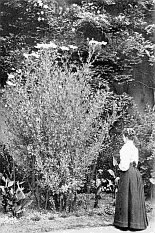
CALIFORNIA POPPY. (Romneya Coulteri.)
Name. Country or Origin and Natural Order. Colour and Season. General Remarks.
Rubus bambusarum Rosaceæ The flowers give place to a black edible fruit Henbane. Introduced by Messrs. Veitch from China, the trailing branches 10 ft. to 12 ft.
*R. biflorus (White-stemmed Bramble) Himalaya; Rosaceæ White This Bramble forms an upright freely-branded specimen, 10 ft. high, and has whitened stems, which, especially in winter, are very conspicuous.
*R. deliciosus (Rocky Mountain Bramble) Rocky Mountains White A Currant-like, bushy shrub, with large white flowers (like single Roses) in great profusion. It is one of the finest flowering shrubs we have.
R. flagelliformis Central China White Introduced by Messrs. Veitch. The flowers are on growths 6 ft. to 8 ft. in length. Partly evergreen. A useful climber.
*R. fruticosus flore-pleno (Double Pink Bramble), Syn. R. bellidifolius. Garden form Pink; late Summer A double pink form of our common Bramble, and of a loose rambling nature, soon forming a tangled mass.
R. innominatus Hupeh; Central China Interesting for its stems covered with a soft pubescence and large orange scarlet fruits, which are edible Introduced by Messrs. Veitch, and is a great addition to dessert fruits.
R. laciniatus (Cut-leaved Bramble) Garden origin White A strong-growing Bramble with elegantly cut leaves. It is essentially a plant for the wild garden, while the fruits are particularly good.
R. nutkanus (Nootka Sound Raspberry) North America White A free upright species that pushes up annual shoots like the Raspberry, while the lobed leaves are decidedly ornamental. The large white blossoms are borne in May and June.
R. odoratus (Purple-flowered Raspberry) North America Rosy purple Somewhat like the last, but with rosy-purple blossoms that are rather later in expanding than those of R. nutkanus. It thrives best in partial shade.
*R. phœnicolasius (Japanese Wine Berry) Japan Whitish A strong-growing Raspberry-like plant, densely clothed with hairs. It is principally grown for its fruits, that are, when ripe, of a bright red tint, and appreciated by many. But this is a picturesque spreading shrub worth growing for its colouring and rambling growth alone. It is a good bank shrub, or to spread about over the rougher parts of the rock garden.
R. spectabilis (Salmon Berry) North America Purple; early May A shrub so aggressive that it must go into the wild garden. It forms a dense tuft 6 feet high, and when laden with its drooping purple flowers is decidedly ornamental.
R. thyrsoideus flore-pleno (Double White Bramble) Garden form White A semi-double white-flowered Bramble, less effective, however, than the double pink.
Sophora japonica China; Leguminosæ Creamy white panicles, which show up against the dark-green foliage Excluding the plants formerly known as Edwardsia, now included in Sophora, this is the only well-known member of the genus, and it is the only one of our large-growing hardy trees that flowers in autumn. Regarded only from a foliage point of view, it forms a very handsome specimen, the elegant pinnate leaves retaining their deep green tint long after most trees acquire their autumnal hue. Like many other Leguminosæ, the deep descending nature of its roots enables it to resist a long period of drought during the summer months better than most trees. It is very quick in growth, and is therefore valuable where rapid results are desired. The Sophora has been grown in this country for the last century and a half, and though in its early days considered to be rather tender, it has long proved to be thoroughly hardy. Varieties are not numerous, there being one, variegata, which is but a poor thing, while another, pendula, is one of the most striking of weeping trees. In winter the bright-green bark of this is a very noticeable feature.
Spartium junceum (Spanish Broom) Europe; Leguminosæ Golden yellow Owing to the deeply-descending nature of their roots, many of the Leguminosæ resist drought better than the majority of shrubs. A case in point is furnished by the Spanish Broom, which in summer is laden with its large golden-yellow blossoms. Against a dark-tinted background it stands out conspicuously, while seen in a mass or clump it is particularly striking. The Spanish Broom ripens seeds freely, from which young plants can be readily raised, but as they make very few fibres and do not as a rule transplant well, they should be put into their permanent quarters while still young. The leaves are very few in number, their place being filled as in some of its allies by the young shoots, which are dark green and Rush-like. There is a double variety, flore-pleno.
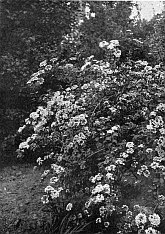
SPIRÆA CANESCENS.
Name. Country or Origin and Natural Order. Colour and Season. General Remarks.
*Spiræa arguta Garden origin; S. multiflora and S. Thunbergi (Rosaceæ) White; late April One of the best of the shrubby Spiræas, forming a dense bush about 4 feet high, which towards the end of April is profusely laden with clusters of pure white blossoms, despite frosts or cold winds, which play havoc with some of the early kinds.
S. bella Nepaul Deep pink; May and June A free-growing species, 5 feet high, with pretty flowers.
S. betulifolia (Syn. S. splendens) Europe Clear cherry-pink; midsummer A dwarf bush, 2 feet high, with pretty cherry-pink flowers.
S. brachybotrys (Syn. S. luxuriosa) Garden origin; S. canescens and S. Douglasi Pale pink; June A bold bush, 6 feet or more in height.
S. bracteata Japan White; May Grows 5 or 6 feet high.
*S. bullata (Syn. S. crispifolia) Japan Rosy carmine; July A dwarf species suitable for rockwork.
*S. canescens (Syn. S. flagelliformis, Syn. S. nepalensis, Syn. S. rotundifolia) Himalaya White; June and July The shoots of this are slender and arching so that it forms a graceful freely-branded shrub, some 5 to 8 feet in height. It is one of the best Spiræas.