BOOK VII. (continued 4)
Reading edition
Soon after this, a servant arrived from Ras Michael, with a magnificent saddle and bridle as a present to Engedan. This man told us that a messenger had come from Waragna Fasil, desiring a place might be marked out for him to encamp, for he was to join the king early in the morning; but nobody gave any credit to this, nor did he, as far as I ever heard, advance a foot nearer the camp. The messenger commanded us all, moreover, to go to bed, which we immediately complied with. I only went to the king's tent, where the company was dispersing, and kissed his hand, after which I retired. In my way home to my tent, I saw a faggot lying in the way, when the story of the Guraguè came presently into my mind. I ordered some soldiers to separate it with their lances; but it had been brought for fuel, at least no Guragué was there.
I was no sooner laid upon my bed, than I fell into a profound sleep, which continued uninterrupted till five o'clock in the morning of the 20th. I had spared myself industriously in last night's carousal, for fear of contributing to a relapse into despondency in the morning; but I found all within serene and composed as it should be, and entirely resigned to what was decreed, I was perfectly satisfied, that the advancing or retarding the day of my death was not in the power of the army of Begemder. I then visited all the horses and the black soldiers, and ordered two or three of them, who were not perfectly recovered from their hurts, to stay in the camp. I afterwards went to the king's tent, who was not yet up; and the very instant after, the Ras's first drum beat, and the king rose; soon after which, the second drum was heard for the soldiers to go to breakfast. I went into the king's tent to kiss his hand, and receive his orders. He told me they were speedily then going to breakfast within, to which meal I was engaged at Ozoro Esther's. He answered, Make haste then, for I am resolved to be on the field before king Theodorus to-day. I am his senior, and should shew him the example. He seemed more than ordinary gay and in spirits.
I finished my breakfast in a few minutes, and took a grateful, but chearful leave of Ozoro Esther, and received many acknowledgements, and kind expressions, both from her and Tecla Mariam, who did not fail to be there according to appointment. The day was clear, the sun warm, and the army descended into the plain with great alacrity, in the same order as the day before. Guebra Mascal, with his musqueteers, took possession of the long hill in the valley, and coasted the left flank of our left wing, the river Mariam and its high banks being only between us. The king took his post, with the winding road aforementioned (up the steep banks of the Mariam) close on his left. Guebra Mascal having come to the south end of the hill below, marched briskly up the road, and then advanced about 200 yards, making his men lye down at the brink of the hill next the plain, among bent grass, and thin tall shrubs like Spanish broom, so as to be perfectly out of sight; his line was at right angles with our front, so that his fire must enfilade the whole front of our line.
If not very useful, yet it may, however, be thought curious, to know the disposition of a barbarous army ready to engage in a pitched battle as this was. Kefla Yasous, who commanded the left-wing under the king, placed his cavalry in a line to the opening of the road down into the valley; between every two musquets were men armed with lances and shields; then, at a particular distance, close before this line of horse, was a body of lances, and musquets, or sometimes either of them, in several lines, or, as they appeared, a round body of soldiers, standing together without any order at all; then another line of horse, with men between, alternately as before; then another round corps of lances and musquets, advanced just before the line of horse, and so on to the end of the division.
I know nothing of the disposition of the rest of the army, nor the ground they were engaged on; that where we stood was as perfect a plain as that commonly chosen to run races upon, and so I believe was the rest, only sloping more to the lake Tzana.
The king's infantry was drawn up in one line, having a musqueteer between every two men, with lances and shields. Immediately in the center was the black horse, and the Moors of Ras el Feel, with their libds, disposed on each of their flanks. Immediately behind these was the king in person, with a large body of young nobility and great officers of state, about him. On the right and left flank of the line, a little in the rear, were all the rest of the king's horse, divided into two large bodies, Guebra Mascal hid in the bank on our left at right angles with the line, enfilading, as I have already said, the whole line of our infantry; this will be easily understood by consulting the plan where H H, G G, F, and I, represent the disposition that I have now described.
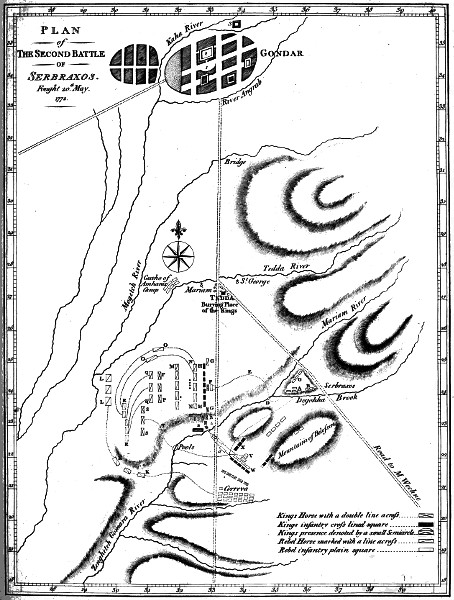
Plan —— of —— The Second Battle —— OF —— Serbraxos. Fought 20th May, 1772.
SECOND BATTLE.
Explanation.
1. Gondar.
2. King's palace.
3. King's palace on the River Kaha.
4. Mahometan town on the River Kaha.
A The king marches from his camp to F by the road D and E.
GG The two bodies of horse.
HH Line of infantry, muskets, and lances alternately.
I Guebra Mascal in ambush, in the face of the banks of the Mariam, among the bushes.
KK Powussen's march from his camp at Correva.
LL Powussen's first appearance in disorder.
MM Powussen's line formed in the front of the king.
NN The army of Begemder galloping to charge the king, receive a close fire from Guebra Mascal hid in the bank at I, and immediately after from the king's line HH.
OO Part of the army of Begemder wheeling to the left, and flying over the plain in disorder.
PP The king, with his reserve following the right of the Begemder horse.
QQ The right of the Begemder horse pursued by the king, having rallied.
RR The Begemder horse turn to slowly surround the king at SS, and drive him to the edge of the Bank.
T The king escaping down the bank, crosses between the pools of the River Mariam, and enters the valley.
V The king arrived in the valley, is joined by the foot that ran scattered down by the bank.
W Engedan detached from the camp by Ras Michael, joins the king.
X Musketeers detached by Michael, take post on the south side of the long hill.
Y Part of the king's musketry posted on a rocky ground on the south side of the valley.
Z The king's troops under Kefla Yasous filing down the narrow road from the plain above into the valley, with the heavy armed horse behind him.
a Guebra Mascal drawn up at the foot of the banks, makes way by his fire for the black horse to take post in the king's front.
It was full half an hour after the king had formed before the army of Begemder made any motion. The Ras first saw them from the hill, and made a signal, by beating his drums and blowing his trumpets; this was immediately answered by all the drums and trumpets of the left wing, and for the space of a minute, a thick cloud of dust (like the smoke of a large city on fire) appeared on the side of Korreva, occasioned, as the day before, by the Begemder troops mounting on horseback; the ground where they were encamped being trodden into powder, by such a number of men and horse passing over it so often, and now raised by the motion of the horses feet, was whirled round by a very moderate breeze, that blew steadily; it every minute increased in darkness, and assumed various shapes and forms, of towers, castles, and battlements, as fancy suggested. In the middle of this great cloud we began to perceive indistinctly part of the horsemen, then a much greater number, and the figure of the horses more accurately defined, which came moving majestically upon us, sometimes partially seen, at other times concealed by being wrapt up in clouds and darkness; the whole made a most extraordinary, but truly picturesque appearance.
I was so struck with this, that I could not help saying to Billetana Gueta Ammonios, who commanded the horse under me, Is not that a glorious sight Ammonios! who, that was a king, would not be fond of war? David, however, curses those that delight in war, says Ammonios. Therefore, replied I, there must be pleasure in it, or else no body would fall into a sin that was disagreeable in itself, and at the same time forbidden by God. Well, well, replied Ammonios, this is not a time for argument, see what a glorious spectacle we shall all be before sun-set.
At this time Powussen's whole army was distinctly seen; they came riding backwards and forwards with great violence, more as if they were diverting themselves, than advancing to attack an enemy, of our consequence, that was waiting them. They seemed like two wings, and a main body, each nearly equal in numbers, as far as I could guess, and are described in the plan by the letters L L, but they were sometimes all in one croud together, and in such perpetual motion, that it was impossible to ascertain their precise form.
Four men, upon unruly, high-mettled, or at least ill-broke horses, rode galloping a small space before, conversing together, as if making their observations upon us: they were now arrived at about six hundred yards distance, but it was not a time to make accurate calculation; they then made a stop, and began extending the left of their line to the westward, as described by M M. I suppose, too, their horses needed to breathe a little, after they had so imprudently blown them to no purpose.
In the middle of their cavalry, or rather a little more towards their right, than opposite to the place where the king was, a large red flag was seen to rise, and was saluted by the drums and trumpets of their whole army. An accident happened at this moment, which endangered the discovery of the hidden part of our disposition, and which would thereby have destroyed the sanguine hopes we had of victory, and endangered the safety of the whole army. Upon displaying the red flag, two musquets were fired from the post in the face of the hill where Guebra Mascal lay in ambush. Luckily, at that very instant, all the king's drums beat, and trumpets sounded, a kind of mock alarm, (such as the posture-masters and mountebanks use,) in ridicule of king Theodorus, and his red flag then flying before us.
Immediately upon this, as on a signal for battle, the whole army of Begemder set out full gallop, to charge, as at N N, and a long hundred yards before they joined, they received, through the very depth of their squadron, a close well-directed fire from the whole musquetry of Guebra Mascal, and from the king's line an instant after, which put them into the utmost confusion, so that they in part came reeling down upon our line, half wheeled about to the left, as men that had lost their way, with their right, that is, their naked sides exposed as they turned, their shields being in their left. The fire from Guebra Mascal was the signal for our line to charge, and the heavy-armed horsemen, with their pikes, broke thro' them with little resistance, the line in the mean while, with horse and foot, closed with them, after the musquets had given them their fire, and then staid behind to recharge. Part of their left did not engage at all, but wheeled about, and fled southward over the plain.
While their army was thus separated into two divisions, both in great confusion, the king, with his reserve, fell furiously upon them; and being followed by all the rest of the horse, they pushed the right division (where Powussen was in person) along the plain, but these retired, fighting very obstinately, and often rallying. Kefla Yasous saw the great danger to which the king would quickly be exposed by pursuing the troops of Begemder so far at a distance from his foot, and that they would soon turn upon and overpower him with numbers, and then surround him. He therefore, with great presence of mind, provided for his retreat. He drew up the heavy-armed horse which could not gallop, the Moors of Ras el Feel, and the foot which were left behind, and which had now recharged their firelocks before the narrow road, and ordered Guebra Mascal to resume his station. He then twice, with great earnestness, cried in a loud voice to the soldiers, The king's safety depends upon you,—Stand firm, or all is lost. After which, he galloped, with a small body of horse, to join the king, closely engaged at a considerable distance: The foot that had pursued, or were scattered, now came in by tens and twelves, and joined the heavy-armed horse, so that we began again to shew a very good countenance. Among these, a common soldier of the king's household, busied in the vile practice of mangling and spoiling the dead, found the red colours of king Theodorus lying upon the field, which he delivered me, upon promise of a reward, and which I gave a servant of my own to keep till after the engagement.
At this instant Guebra Mascal came up from below the bank, leaping and flourishing his gun about his head, and crying, just before my horse, "Now, Yagoube, stand firm, if you are a man." "Look at me, you drunken slave, said I, armed, or unarmed, and say, it is not a boast if I count myself at all times a better man than you. Away to your hiding-hole again, and for your life appear within my reach. Away! you are not now, as the other day, before the king." The man cried out in a transport of impatience, "By G—d, you don't know what I mean; but here they all come, stand firm, if you are men;" and saying this, he ran nimbly off, and hid himself below the bank, with his lighted match in one hand, and all ready.
It is proper, for connection's sake, though I did not myself see it, to relate what had happened to the king, who had pursued the Begemder horse to a very considerable distance, and was then at S S in the plan, when the whole army of the rebels that had not engaged, observing the resistance made by Powussen, and part of the division which they had left, turned suddenly back from their flight, and at R R nearly surrounded the king and his cavalry, whom they had now driven to the very edge of the steepest part of the bank of the Mariam. Kefla Yasous's arrival, indeed, and his exerting himself to the utmost, fighting with his own hand like any common soldier, had brought some relief; yet as fresh horse came in, there can be little doubt at the end, that the king must have been either slain or taken prisoner, if Sertza Denghel, a young man of Amhara, a relation of Gusho, and who had a small post in the palace, had not dismounted, and offered to lead the king's horse down the steepest of the banks into the river. To this, however, he received an absolute refusal. "I shall die here this day, says the king, but while I have a man left, will never turn my back upon the rebels." Sertza Denghel hearing this vain discourse, and seeing no time was to be lost, took hold of the bridle by force, at T, and happily led the horse along one of the sheep-paths, slanting down the declivity of the bank. The king having in vain threatened displeasure, and even death, with the butt-end of his lance, in despair, struck Sertza Denghel in the mouth, and beat out all his fore-teeth. A bank of gravel, like a bridge, separated two deep pools, in the river Mariam, over which the king escaped, though with difficulty, the ground being foul with quick sand.
All the foot that had remained about the king ran down the bank, where the Begemder horse could not pursue them, and joined him in the valley, where he made the best of his way towards the south side of the long low hill, by the winding road, on the side of which, and just above him, was placed Guebra Mascal. Ras Michael, who saw the dangerous situation and escape of the king, and who had kept Ayto Engedan near for some such purposes, dispatched him with a considerable body of horse, along the low hill, ordering him immediately to join the king, and cover his retreat; he likewise detached a considerable body of musqueteers, and mounted for the greater speed upon mules, who were directed to take post upon the south end of the round hill, below the winding road, while another party possessed themselves of some rocky ground on the south side of the valley. This command was as soon executed as given. Ayto Engedan joined the king, who had lost all his kettle-drums but one, now beating before him, and upon his arrival at the entrance of the valley, the king, at V, turned his face to the enemy, having the musquetry, at X and Y, newly arrived from the camp on his right and left.
Kefla Yasous was immediately acquainted with the king's escape, and, knowing the consequence of protracting time, renewed the engagement with so much vigour, that he pushed the horse of Begemder to some small distance back into the plain. Powussen, whose only view was to take the king prisoner, and wrest the possession of his person, and with that his authority from Ras Michael, was much disconcerted at the unexpected way by which the king escaped; he after this halted a little for council, then divided his troops, with one part of which he resolved to go down the winding road, and with the other to pass at the junction of the rivers, and enter the valley in that direction, in order to overtake the king, and intercept him in his way to the camp, in case any thing obstructed his passing the winding road. Kefla Yasous took advantage of this movement, and with his horse made his way to join the heavy-armed troops, and those who had joined the line, standing closely and firmly where they were stationed.
The first person that appeared was Kefla Yasous, and the horse with him, stretching out his hand, (his face being all besmeared with blood, for he was wounded in his forehead) he cried as loud as he could, Stand firm, the king is safe in the valley. He had scarce faced about, and joined the line, when the enemy approached at a brisk gallop. The Begemder horse were closer than usual, and deeper than the front was broad; they resembled therefore an oblong square, if they resembled any thing; but the truth is, they were all in disorder, and their figure, never regular, changed every moment; the right of their front (which was not equal to ours) was finally placed against the road, being close by Guebra Mascal's post, whose men were much increased in number; they received the discharge of his whole musquetry in two vollies, so near that I scarce believe there was one shot that did not take place on man or horse. A great cry from the bank at the same time added to their panic, which was answered by the king's troops, who immediately charged them as before, as they wheeled half round to the left. They were pursued, for a small distance, by some of the troops that had not engaged in the morning, and it was easy to perceive their disorder was real, and that they were not likely to rally. By this last discharge, Powussen was slightly wounded, and his men were plainly seen hurrying him off the field. In the very instant the rebels turned their backs, Kefla Yasous ordered all the troops, horse and foot, to file off down the narrow road into the valley, behind the heavy-armed horse, who kept their ground before the road, and there to join the king.
For my part, I thought the affair was over, when, last of all, we, too, with our heavy horses, descended the road, where we found Guebra Mascal, (whose activity was above all praise) drawn up on our right along the foot of the bank, (with a large pool of water in his front) flanking the valley, the king drawn up in the narrowest part of it, and just engaged with the troops of Lasta and Begemder, that had gone round by the junction of the rivers. These had lost, as we afterwards heard, much time in giving their horses water. They were, however, the more refreshed when they did come, and though they had received a fire from the troops on the round hill, and from those posted on the rocky ground, on the other side of the valley, they had beat the king and Engedan back, and wounded him in the thigh.
At this time the Koccob horse, and Yasine with his Moors (who had the charge of the road above till all the troops were gone) arrived, being as it were shut out from the army, who were engaged at the other side of the hill. Kefla Yasous, after descending through the winding road into the valley, ordered Guebra Mascal to pass the pool, and stand at the bottom of the winding road, for fear the enemy should enter at the valley on the king's right, where the river ran, and so cut us off from our camp.
This space he was then occupying when Yasine, first, and afterwards, our black horse, arrived. He had, it seems, cried out to me before from the side of the pool, but I had not then heard him. He now, however, repeated, Where are you going, Yagoube? To die, said I, surlily; it is the business of the day. He then added, Kefla Yasous has crossed over behind Basha Hezekias, and fallen into the king's rear. You know well, said I, our post is in his front. Then follow me, cried Mascal, for by G—d I say you shall not take one step to-day, but I will go five before you. So saying, he advanced very hastily, and when he saw the Begemder colours retreating before the king, he poured in a volley, which, though at a considerable distance, turned all to a perfect flight.
We entered upon the smoke, just before the Shoa horse, with no loss, and very little resistance, and came just into the place which we occupied in the morning. Though the flight of the rebels was apparently real, Kefla Yasous would not suffer a pursuit into the plain, but advancing singly before us, began to form immediately; the musquetry were planted on each side of the valley as far up the hill as to be out of reach of the horse, and the rest of the infantry in the plain; Basha Hezekias was on the round hill just behind the center, where the king had placed himself, and Guebra Mascal nearly where he stood before.
The army now made an appearance of a large section of an amphitheatre. I observed the king had pulled off the diadem, or white fillet he wears for distinction, and was very intent upon renewing the engagement: the Begemder troops were forming, with great alertness, about half a mile below, being reinforced from time to time. The king ordered his drums to beat, and his trumpets to sound, to inform the enemy he was ready; but they did not answer, or advance: soon after (it being near three o'clock) the weather became overcast, and cold, on which the troops of Begemder beat a retreat; the king, very soon after, did the same, and returned to the camp without further molestation; only that coming near a rock which projected into the valley, (not far distant from the camp) a multitude of peasants belonging to Mariam-Ohha, threw down a shower of stones from their hands and slings, which hurt several. The king ordered them to be fired at, though they were a great distance off, and passed on: but Guebra Mascal commanding about fifty men to run briskly up the hill, on each side of the rock, gave them two discharges at a less distance, which killed or wounded many, and made the rest disappear in a moment.
I doubt that my reader will be more than sufficiently tired with the detail of this second battle of Serbraxos; but, as it was a very remarkable incident in my life, I could not omit it as far as I saw it myself, and suppressing any one part of it would have involved the rest in a confusion, with which I fear it may be still too justly charged. I therefore shall only say for connection's sake, that Gusho and Guebra Christos, in the center, were but partially engaged, and Kasmati Tesfos of Siré, second commander for the king, in that division, wounded, and taken prisoner. Guebra Christos, the king's uncle, was slain, (as it was believed) by a shot of his own men; few other lives of note were lost on either side, in that division. The king's troops fell back under the hill of Serbraxos, where Michael was, and, though followed by Gusho, were no further attacked by him. But on the right, Billetana Gueta Tecla, and Welleta Michael, after a very obstinate and bloody engagement, were beaten by Kasmati Ayabdar, and forced across the river Mogetch, where, having rallied and posted themselves strongly, it was not thought proper to attempt to force them, and they all joined the camp soon after the king, but with very great loss.
This battle, though it was rather a victory than a defeat, had, however, upon the king's affairs, all the bad consequences of the latter, nor was there any thinking man who had confidence in them from that day forward. Near 3000 men perished on the king's side, a great proportion of whom was of the left wing, which he commanded; near 180 young men, of the greatest hopes and noblest families in the kingdom, were among that number; Guebra Christos was in all respects a truly national loss. Kefla Yasous was twice wounded, but not dangerously, besides a multitude of others of the first rank, among whom was Ayto Engedan, who by proper care soon recovered also, but in the meantime was sent to Gondar, to his cousin Ayto Confu. On our side, too, a son of Lika Netcho, and a son of Nebrit Tecla, were both slain.—Providence seemed now to have begun to require satisfaction for the blood of the late king Joas, in the shedding of which these two were particularly concerned. Among the slain were our friends the Baharnagash and his son, who died valiantly fighting before the king at the time he escaped down the bank into the valley.
But what served as comfort to the king, was the still heavier loss sustained by the enemy, who, by their own accounts that day, lost above 9000 men, seven thousand of whom were from the troops of Begemder and Lasta, with which the king was engaged. For my own part, I cannot believe, but that both these accounts are much exaggerated; the great proportion that died of those that were wounded must have greatly swelled the loss of the rebels, because most gun-shot wounds, especially if bones are broken, mortify, and prove mortal. Among the slain, on the part of Begemder, were two chiefs of Lasta, and two relations of Powussen, (a brother-in-law and his son) they were both shot, bearing the banner of king Theodorus. The unworthy Confu, brother to Guebra Mehedin, and nephew to the Iteghé, whom I have often mentioned, had escaped, indeed, from Kasmati Ayabdar, who had given orders to confine him, to die a rebel this day among the troops of Begemder.
The king being washed and dressed, and having dined, received a compliment from Ras Michael, who sent him a present of fruit, and a thousand ounces of gold. There began then the filthiest of all ceremonies that ever disgraced any nation stiling themselves Christians; a ceremony that cannot be put in terms sufficiently decent for modest ears, without adapting the chaste language of scripture, which, when necessity obliges to treat of gross subjects, always makes choice of the least offensive language.
All those, whether women or men, who have fiefs of the crown, are obliged to furnish certain numbers of horse and foot. The women were seldom obliged to personal attendance, till Ras Michael made it a rule, in order to compose a court or company for Ozoro Esther. At the end of a day of battle each chief is obliged to sit at the door of his tent, and each of his followers, who has slain a man, presents himself in his turn, armed as in fight, with the bloody foreskin of the man whom he has slain hanging upon the wrist of his right hand. In this, too, he holds his lance, brandishing it over his master, or mistress, as if he intended to strike; and repeating in a seeming rage, a rant of nonsense, which admits of no variation, "I am John the son of George, the son of William, the son of Thomas; I am the rider upon the brown horse; I saved your father's life at such a battle; where would you have been if I had not fought for you to-day? you give me no encouragement, no cloaths, nor money; you do not deserve such a servant as I;" and with that he throws his bloody spoils upon the ground before his superior. Another comes afterwards, in his turn, and does the same; and, if he has killed more than one man, so many more times he returns, always repeating the same nonsense, with the same gestures. I believe there was a heap of above 400 that day, before Ozoro Esther; and it was monstrous to see the young and beautiful Tecla Mariam sitting upon a stool presiding at so filthy a ceremony; nor was she without surprise, such is the force of custom, that no compliment of that kind was paid on my part; and still more so, that I could not be even present at so horrid and bloody an exhibition.
The superiors appear at this time with their heads covered as before their vassals; their mouth, too, is hid, and nothing is seen but their eyes: this does not proceed from modesty, but is a token of superiority, of which, covering or uncovering the head is a very special demonstration. After this ceremony is over each man takes his bloody conquest, and retires to prepare it in the same manner the Indians do their scalps. To conclude this beastly account, the whole army, on their return to Gondar, on a particular day of review, throws them before the king, and leaves them at the gate of the palace. It is in search of these, and the unburied bodies of criminals, that the hyænas come in such numbers to the streets, where it is dangerous, even when armed, to walk after dark.
This inhuman ceremony being over, also the care of the wounded, which indeed precedes every thing, the king received all those of the nobility who had distinguished themselves that day; the tent was crowded, and he was in great spirits at the slaughter that had been made, which unbecoming pleasure he never could disguise. He mentioned the death of his uncle Guebra Christos with a degree of chearfulness, presuming, that when such a man died on his side, many of that rank and merit must have fallen on the other. Villages, appointments, and promotions, gold, promises, and presents of every kind, had been liberally bestowed upon those who had presented themselves, and who had merited reward that day by their behaviour. The king had been furnished with means from the Ras, and according to his natural inclination (especially towards soldiers) he had bestowed them liberally, and I believe impartially. Guebra Mascal had not appeared; he was waiting upon his uncle Ras Michael, looking after his own interest, to which no Abyssinian is blind, and exposing those bloody spoils, which I have just mentioned, to the Ras, his uncle and general.
I had been absent from another motive, the attendance on my friend Engedan, to whose tent I had removed my bed, as he complained of great pain in his wound, and I had likewise obtained leave of the Ras to shift my tent near that of his, and leave the care of the king's horse to Laeca Mariam, an old slave and confidential servant of the king.
As these men were the king's menial servants in his palace, a number of them (about a fourth) staid at Gondar with the horses, and few more than 100 to 120 could now be mustered, from about 200 or 204 which they at first were: the arranging of this, attendance upon Ayto Engedan, and several delays in getting access to the Ras, who had all his troops of Tigrè round him, made it past eight o'clock in the evening before I could see the king after he entered the camp; he had many times sent in search of Sertza Denghel, but no such person could be found; he had been seen bravely fighting by Engedan's side in the entrance of the valley, when that young nobleman was wounded, and he had retired with him from the field, but nobody could give any account of him, and the king, by his repeated inquiries after him, shewed more anxiety, from the supposition he was lost, than he had done for Guebra Christos his uncle, or all the men that had fallen that day; I had seen him in Ayto Engedan's tent, sitting behind his bed, in the darkest place of it; both his lips, nose, and chin were violently cut, his whole fore teeth beat out, and both his cheeks greatly swelled. I had given him what relief I could, nor was there any thing dangerous in his wounds; but the affront of receiving the blow from the king, when he was doing a most meritorious act of duty, (the saving him from death, or the hands of the rebels), had made such an impression upon a noble mind, that as soon as he arrived in Engedan's tent, he had ordered his hair to be cut off, put a white cap, or monk's cowl upon his head, and by a vow dedicated himself to a monastic life. In vain the king flattered, rewarded, and threatened him afterwards, and went so far as to make the Abuna menace him with excommunication if he persisted in his resolution any longer. After this I carried him, as we shall see, by the king's desire, to Gusho, in his camp, and interested him also to persuade Sertza Denghel to renounce his rash vow: no consideration could however prevail, for, like a private monk, he lived at home in the village which belonged to him in patrimony, and, tho' he often came to court, never slept or ate in the palace, the excuse being, when desired to stay dinner, that he had no teeth. He constantly slept at my house, sometimes chearful, but very seldom so. He was a young man of excellent understanding, and particularly turned to the study of religion; he was well read in all the books of his own country, and very desirous of being instructed in ours; he had the very worst opinion of his own priests, and his principal desire (if it had been possible) was to go with me to die, and to be buried in Jerusalem.

CHAP. VIII. King rewards his Officers—The Author again persecuted by Guebra Mascal—Great Displeasure of the King—The Author and Guebra Mascal are reconciled and rewarded—Third Battle of Serbraxos.
After the engagement, as every body had access to the king's presence, I did not choose to force my way through the crowd, but went round through the more private entry, by the bed-chamber, when I placed myself behind the king's chair. As soon as he saw me, he said, with great benignity, "I have not inquired nor sent for you, because I knew you would be necessarily busied among those of your friends, who have been wounded to-day; you are yourself, besides, hurt: how are you?" I answered, "that I was not hurt to-day, but, though often in danger, had escaped without any other harm than excessive fatigue occasioned by heat and weight of my coat of mail, and that one of my horses was killed under Ammonios."
I then took the red colours from the servant behind me, and going to the carpet spread before the king, laid them at his feet, saying, "So may all your majesty's enemies fall, as this arch rebel (the bearer of this) has fallen to-day;" a great murmur was immediately raised upon seeing these colours, and the king cried out with the utmost impatience, "Has he fallen into your hands, Yagoube? who was he, where did you meet him, or where did you slay him?" "Sir, said I, it was not my fortune to meet him to-day, nor did I slay him. I am no king-killer; it is a sin, I thank God, from which my ancestors are all free; yet, had Providence thrown in my way a king like this, I believe I might have overcome my scruples. He was killed, as I suppose, by a shot of Guebra Mascal, on the flank of our line; a soldier picked up the colours on the field, and brought them to me in hopes of reward, while you was engaged with the troops of Begemder, near the bank; but the merit of his death is with Guebra Mascal. I do him this justice, the rather because he is the only man in your majesty's army who bears me ill-will, or has been my constant enemy, for what reason I know not; but God forbid, that on this, or any personal account, I should not bear witness to the truth: this day, my fortune has been to be near him during the whole of it, and I say it from certain inspection, that to the bravery and activity of Guebra Mascal every man in your left wing owes his life or liberty."—"He is a shame and disgrace to his family, says the king's secretary, who was standing by him, if after this he can be your enemy."—"It must be a mistake, says the king's priest (Kiis Hatzè), for this should atone for it, though Yagoube had slain his brother."
While this conversation was going on, an extraordinary bustle was observed in the crowd, and this unquiet genius pushing through it with great violence, his goat's skin upon his shoulders, and covered with dust and sweat, in the same manner he came from the field; he had heard I was gone to the king's tent with the red flag, and not doubting I was to complain of him, or praise myself at his expence, had directly followed me, without giving himself time to make the least inquiry. He threw himself suddenly, with his face to the ground, before the throne, and rising as quickly, and in violent agitation, he said to the king, or rather bellowed, very indecently, "It is a lie Yagoube is telling; he does not say the truth; I meant him no harm but good to-day, and he did not understand my language. I don't say Yagoube is not as good a man as any of us, but it is a lie he has been telling now, and I will prove it."
A general silence followed this wild rhapsody; the king was surprised, and very gravely said, I am sorry, for your sake, if it is a lie; for my part, I was rash enough to believe it was true. Guebra Mascal was still going to make bad worse, by some absurd reply, when the secretary, and one or two of his friends, hauled him out behind the throne to one of the apartments within, not without some resistance, every one supposing, and many saying, he was drunk; the king was silent, but appeared exceedingly displeased, when I fell upon the ground before him, (a form of asking leave to speak upon any particular subject) and rising said, Sir, With great submission, it is not, I apprehend, true, that Guebra Mascal is drunk, as some have rashly said now in your presence; we have all ate and drank, and changed our cloathing since the battle; but this man, who has been on foot since five in the morning, and engaged all day, has not, I believe, ate or drank as yet; certainly he has not washed himself, or changed his habit, but has been taking care of his wounded men, and has presented himself now as he came from the field, under the unjust suspicion I was doing him wrong. I then repeated what had happened at the bank when the king was pursuing the troops of Begemder. Now I understand him, says the king, but still he is wrong, and this is not the first instance I have seen, when there was no such mistake. At this time a messenger came to call me from within.
The king divined the reason of sending, and said, No, he shall not go to Guebra Mascal; I will not suffer this. Go, says he to one of his servants that stood near him, desire the Ras to call Guebra Mascal, and ask him what this brutality means? I have seen two instances of his misbehaviour already, and wish not to be provoked by a third. At this instant came Kefla Yasous, with his left hand bound up, and a broad leaf like that of a plane upon his forehead. After the usual salutation, and a kind of joke of the king's on his being wounded, I asked him if he would retire and let me dress his forehead? which he shewing inclination to do, the king said, Aye, go, and ask Guebra Mascal why he quarrels with his best friends, and prevents me from rewarding him as he otherwise would have deserved. I went out with Kefla Yasous, being very desirous this affair should not go to the Ras, and we found Guebra Mascal in appearance in extreme agony and despair.
The whole story was told distinctly to Kefla Yasous, who took it up in the most judicious manner. He said he had been detained at his tent, but had come to the king's presence expressly to give Guebra Mascal the just praise he deserved for his behaviour that day: that he was very happy that I, who was near him all the action, and was a stranger, and unprejudiced (as he might be thought not to be) had done it so justly and so handsomely. At the same time he could not help saying, that the quarrel with Yagoube in the palace, the taunting speech made without provocation in the king's presence on the march, his apostrophe in the field, and the abrupt manner in which he ignorantly broke in upon the conversation before the king, interrupting and contradicting his own commendations, shewed a distempered mind, and that he acted from a bad motive, which, if inquired into, would inevitably ruin him, both with King and Ras; and he had heard indeed it already had done with the former.
Guebra Mascal, now crying like a child, condemned himself for a malicious madman in the two first instances: but swore, that on the field he had no intention but to save me, if occasion threw it in his way; for which purpose alone it was he had cried out to me to stand firm, for the troops of Begemder were coming upon us, but that I did not understand his meaning. Guebra Mascal advances nothing but truth, said I, to Kefla Yasous; I did not perfectly understand him to-day in the field, as he spoke in his own language of Tigrè, and stammers greatly, nor did I distinctly comprehend what he said across the pool, for the same reason, and the confusion we were in: I shall however most readily confess my obligation to him, for the opportunity he gave me to join the king. I am a stranger, and liable to err, whilst, for the same reason, I am entitled to all your protections and forgivenness. I am, moreover, the king's stranger, and as such, entitled to something more as long as I conduct myself with propriety to every one. I have never spoken a word but in Guebra Mascal's praise, and in this I have done him no more than justice; his impatience perverted what I had said; but the real truth, as I spoke it, remains in the ears of the king and of those that were by-standers, to whom I appeal.
Every thing went after this in the manner that was to be wished. Guebra Mascal and I vowed eternal friendship to each other, of which Kefla Yasous professed himself the guarantee. All this passed while I was binding up his head; he went again to the king. For my own part, tired to death, low in spirits, and cursing the hour that brought me to such a country, I almost regretted I had not died that day in the field of Serbraxos. I went to bed, in Ayto Engedan's tent, refusing to go to Ozoro Esther, who had sent for me. I could not help lamenting how well my apprehensions had been verified, that some of our companions at last night's supper, so anxious for the appearance of morning, should never see its evening. Four of them, all young men, and of great hopes, were then lying dead and mangled on the field; two others besides Engedan had been also wounded. I had, however, a sound and refreshing sleep. I think madness would have been the consequence, if this necessary refreshment had failed me; such was the horror I had conceived of my present situation.
On the 21st, Engedan was conveyed in a litter to Gondar; and early in the morning of that day arrived an officer from Powussen, together with three or four priests. He brought with him twenty or thirty kettle-drums belonging to the king, with their mules, and as many of the drummers as were alive. The errand was sham proposals of peace, as usual, and great professions of allegiance to the king. As Powussen's attack, however, that day, had something very personal in it, and that the story of Theodorus was founded upon a supposition that the king was to be slain on the field of Serbraxos, little answer was returned, only the red flag was sent back with a message, That perhaps, from the good fortune that had attended it, Powussen might wish to keep it for Theodorus his successor, but it was never after seen or heard of.
Gusho likewise, and Ayabdar, sent a kind of embassy to inquire after the king's health and safety; they wished him, in terms of the greatest respect, not to expose himself in the field as he had done in the last battle, or at least, if he chose to command his troops in person, that he should distinguish himself by some horse, or dress, as his predecessors used to do; and they concluded with severe reflections on Michael, as not sufficiently attentive to the safety of his sovereign. Gracious messages were returned to these two, and they all were dismissed with the usual presents of clothes and money.
About eleven o'clock in the forenoon I received an order from the Ras to attend him, and, as I thought it was about the affair of Guebra Mascal, I went very unwillingly. I was confirmed in this by seeing him waiting with many of his friends without the tent, and still more so upon our being called in together: the Ras was conversing low to two priests, who by their dress seemed to have come lately from Gondar; he paid little regard to either of us, but nodded, and asked in Tigrè how we did? Three or four servants, however, brought out new fine cotton clothes, which they put upon us both; and, upon another nod, several officers and priests, and a number of other people, conducted us to the king, though still, as the Ras had scarcely spoken to us, I wondered how this should end. After staying a little we were both introduced; the Likaontes, or judges, some priests, and my friend the secretary, stood about the king, who sat in the middle of his tent upon the stool Guangoul had sat down upon; the secretary held something in his lap, and, upon Guebra Mascal's first kneeling, bound a white fillet like a ribband round his forehead, upon which were written in black and red ink, Mo ambassa am Nizelet Solomon am Negadè Jude, "The lion of the tribe of Judah of the race of Solomon has overcome." The secretary then declared his investiture; the king had given him in fief, or for military service for ever, three large villages in Dembea, which he named, and this was proclaimed afterwards by beat of drum at the door of the tent. The king then likewise presented him with a gold knife, upon which he kissed the ground, and arose.
It was my turn next to kneel before the king. Whether there was any thing particular in my countenance, or what fancy came into his head I know not, but when I looked him in the face he could scarce refrain from laughing. He had a large chain of gold, with very massy links, which he doubled twice, and then put it over my neck, while the secretary said, "Yagoube, the king does you this great honour, not as payment of past services, but as a pledge that he will reward them if you will put it in his power." Upon this I kissed the ground, and we were both reconducted to the Ras, with our insignia; and, having kissed the ground before him, and then his hands, we both had leave to retire. He seemed very busy with people arrived from without; he only lifted up his head, smiled, and said, Well, are you friends now? We both bowed without answer, and left the tent.
The chain consisted of 184 links, each of them weighing 3-1/12 dwts of fine gold. It was with the utmost reluctance that, being in want of every thing, I sold great part of this honourable distinction at Sennaar in my return home; the remaining part is still in my possession. It is hoped my successors will never have the same excuse I had, for further diminishing this honourable monument which I have left them.
About a few hours after this, a much more interesting spectacle appeared before the whole camp. Ayto Tesfos, governor of Samen under Joas, had never laid down his arms, nor paid any allegiance to the present king or his father, but had constantly treated them as usurpers, and the Ras as a rebel and parricide. He had continued in friendship with Fasil, but never would co-operate or join with him, not even when he was at Gondar as Ras. He lived in the inaccessible rock, (called the Jews Rock) one of the highest of the mountains of Samen, where he maintained a large number of troops, with which he overawed the whole neighbouring country, and made perpetual inroads into Tigrè. Enemy as he was to Ras Michael, he would not venture to take an active part against him, till the king's affairs were plainly going to ruin. I have already mentioned, that the last thing Michael did was to send Kefla Yasous, Basha Hezekias, and Welleta Michael, to dispossess him of his stronghold if possible, and in this they had failed. But now that Tesfos saw there was no probability that Michael should be able to retreat to Tigrè, he came at last to join Gusho, bringing with him only about a thousand men, having left all his posts guarded against surprise, and strong enough to cut off all recruits arriving from Tigrè. Nothing that had yet happened ever had so bad effect upon Michael's men as this appearance of Tesfos. It was a little before mid-day when his army appeared, and from the hills above marched down towards the valley below us, not two musquet-shot from our camp.
Though Samen is really on the west of the Tacazzé, and consequently in the Amharic division of this country, yet, on account of its vicinity to Tigrè, the language and customs are mostly the same with those of that province. There is a march peculiar to the troops of Tigrè, which, when the drums of Tesfos beat at passing, a despondency seemed to fall on all the Tigran soldiers, greater than if ten thousand men of Amhara had joined the rebels. It was a fine day, and the troops, spread abroad upon the face of the hill, not only shewed more in number than they really were, but also more security than they were, in point of prudence, warranted to do, when at so small a distance from such an army as ours.
Tesfos took a post very likely to distress us, as he had more than 300 musquetry with him. He sat down with horse and foot in the middle of the valley before us, with part of his musquetry posted upon the skirts of the mountain Belessen on one side, and part on the top of that long, even hill, dividing the valley from the river Mariam. Over his camp, like a citadel, is the rock that projects into the valley, from which the peasants of Mariam-Ohha had thrown the stones when we were returning to our camp after the last battle. Upon this rock Tesfos had placed a multitude of women and servants, who began to build straw-huts for themselves, as if they intended to stay there for some time, though there was still plenty of the female sex below with the camp. Indeed, I never remember to have seen so many women in proportion to any army whatever, no not even in our own.
If Tesfos had been long in coming, he was resolved, now he was come, to make up for his lost time, as he was not a mile and a half from our camp, and could see our horses go down to water, either at Deg-Ohha or Mariam; that same day at two o'clock, his horse attacked our men at watering, killed some servants, and took several horses. This behaviour of Tesfos was taken as a defiance to Kefla Yasous in particular, and to the army in general.
There was no person in the whole army, of any rank whatever, so generally beloved as Kefla Yasous; he was looked upon by the soldiers as their father. He was named by the Ras to the government of Samen, but had failed, as we have already stated, in dispossessing Ayto Tesfos, whose disorderly march at broad mid-day, so near our army, the ostentatious beating of the Tigran march upon his kettle-drum as he passed, and his taking post so near, were all considered as meriting chastisement. That general, however, though very sensible of this bravado, did not venture to suggest any thing in the present situation of the army, but all his friends proposed it to him, that some reproof should be given to Tesfos, if it was only to raise the drooping spirits of the troops of Tigrè. Accordingly 400 horse, and about 500 foot, armed with lances and shields only, without musquetry for fear of alarm, were ordered to be ready as soon as it was perfectly dark, that is, between seven and eight o'clock.
Tesfos having waited the coming of his baggage, and arranged his little camp to his liking, was seen to mount, with about 300 horse, to go to the camp of Gusho or Powussen a little before sun-set, at which time Kefla Yasous was distributing plenty of meat to the soldiers. About eight o'clock they descended the hill unperceived even by part of our camp. Kefla Yasous was governor of Temben (a province on the S. W. of Tigrè) immediately joining to Samen, and the language and dialect was the same. The foot were ordered to take the lead, scattered in a manner not to give alarm, and the horse were to pass by the back of the low, even hill, in the other valley, along the banks of the river Mariam, close to the water, in order to cut off the retreat to the plain. A great part of the Samen soldiers were asleep, whilst a number of the mules that had been loaded were straggling up and down, and some of them returning to the camp. The Temben troops had now insinuated themselves among the tents, especially on the side of the hill.
The first circumstance that gave alarm was the appearance of the horse, but they were not taken for an enemy, but for Ayto Tesfos returning. Kefla Yasous now gave the signal to charge, by beating a kettle-drum, and every soldier fell upon the enemy nearest him. It is impossible to describe the confusion that followed, nor was it easy to distinguish enemies from friends, especially for us on horseback; only those that fled were reckoned enemies. The greatest execution done by the horse was breaking the jars of honey, butter, beer, wine, and flour, and gathering as many mules together as possible to drive them away. Few of the enemy came our way towards the plain, but most fled up the hill: in an instant the straw huts upon the rock were set on fire, and Kefla Yasous had ordered rather to destroy the provisions than the men, since there was no resistance. I passed a large tent, which I judged to be that of Ayto Tesfos, which our people immediately cut open; but, instead of an officer of consequence, we saw, by the light of a lamp, three or four naked men and women, totally overpowered with drink and sleep, lying helpless, like so many hogs, upon the ground, utterly unconscious of what was passing about them. Upon a large tin platter, on a bench, lay one of the large horns, perfectly drained of the spirits that it had contained; it was one of the most beautiful, for shape and colour, I ever had seen, though not one of the largest. This horn was all my booty that night. Upon my return to Britain, it was asked of me by Sir Thomas Dundas of Carse, to serve for a bugle-horn to the Fauconberg regiment, to which, as being partum sanguine, it was very properly adapted. That regiment being disbanded soon after, I know not further what came of it; it is probably placed in some public collection, or at least ought to be.
The fire increasing on the hill, and several musquets having been heard, it was plain the enemy, in all the camps, were alarmed, and our further stay became every moment more dangerous. Kefla Yasous now beat a retreat, and sent the horsemen all round to force the foot to make the best of their way back, ordering also all mules taken to be ham-stringed and left, not to retard our return. Trumpets and drums were heard from our camp, to warn us not to stay, as it was not doubted but mischief would follow, and accordingly we were scarce arrived within the limits of our camp when we heard the sound of horse in the valley.
Michael, always watchful upon every accident, no sooner saw the fires lighted on the hill, than he ordered Guebra Mascal to place a good body of musqueteers about half way down the hill, as near as possible to the ford of Mariam, thinking it probable that the enemy would enter at both ends of the long hill, in order to surround those who were destroying their camp, which they accordingly did, whilst those of our people, who had taken to drinking, fell into the hands of the troops that came by the lower road, and were all put to death. Those that reached the upper ford served to afford us a severe revenge, for Guebra Mascal, after having seen them pass between him and the river, though it was a dark and very windy night, guessed very luckily their position, and gave them so happy a fire, that most of those who were not slain returned back without seeing Ayto Tesfos's camp, being afraid that some other trap might still be in their way.
In the morning of the 22d, we found that the slain were men of Begemder and Lasta. Tesfos, it seems, had been in Powussen's camp when he saw the fire lighted on the hill, and thence had provided an additional number of troops to attack Kefla Yasous before he had done his business, but in this he miscarried. Tesfos's party was thus totally destroyed and dispersed, his mules slaughtered, and his provisions spoiled. About thirty of Kefla Yasous's infantry, however, lost their lives by staying behind, and intoxicating themselves with liquor. Of the horse, not a man was either killed or wounded. I was the only unfortunate person; and Providence had seemed to warn me of my danger the day before, for passing then that rock which projected into the valley, the fire giving perfect light, the multitude assembled above, and prepared for that purpose, poured down upon us such a shower of arrows, stones, billets of wood, and broken jars, as is not to be imagined. Of these a stone gave me a very violent blow upon my left arm, while a small fragment of the bottom of a jar, or pitcher, struck me on the crest of my helmet, and occasioned such a concussion as to deprive me for a time of all recollection, so that, when lying in my tent at no great distance, I did not remember to have heard Guebra Mascal's discharge. I certainly had some presaging that mischief was to happen me, for passing that rock, just before we entered Tesfos's camp, I desired Tecla, when I returned, to allow fifty men to proceed up the hill and cut those people in pieces who had stationed themselves so inconveniently; but he would not consent, being desirous to return without loss of time, and before the enemy knew the calamity that had befallen them.
Ayto Tesfos now became a little more humble, retreated to the south end of the long hill, till being joined, next day the 23d, by his neighbours, Samuel Mammo of Tzegadé, and Heraclius of Walkayt, who had a very large force, he again removed nearer us, about half a mile farther than his first position, and extended his camp quite across the valley, from the foot of the hill to the river Mariam, keeping his head-quarters on the top of the long, even hill, so often mentioned. Mammo and Heraclius had passed by Gondar, and, being much superior in number, had taken Sanuda, Ayto Confu, and Ayto Engedan prisoners, and, though the two last were wounded, carried them to Gusho's camp.
I need not trouble the reader with the attention shewed me upon my accident; all that was great and noble at court, from the king downwards, seemed to be as sensible of it as if it had happened to one of their own family; the Ras very particularly so; and I must own, above all, Guebra Mascal shewed himself a sincere convert, by a concern and friendship that had every mark of sincerity. Ozoro Esther was several times the next day at my tent, and with her the beautiful Tecla Mariam, whose sympathy and kindness would more than have compensated a greater misfortune; for, saving that it had occasioned an inflammation in my eyes, the hurt was of the slightest kind.
Many people came to-day from the several camps with proposals of peace, which ended in nothing, though it was visible enough to everyone that a treaty of some kind was not only on foot, but already far advanced. In the evening a party of 400 foot and 50 horse, which went to Dembea to forage for the king, was surprised by Coque Abou Barea, and cut to pieces; after which that general encamped with Gusho, and brought with him about 3000 men.
Provisions were now become scarce in the camp, and there was a prospect that they would be every day scarcer; and, what was still worse, Deg-Ohha, which long had stood in pools, was now almost dry, and, from the frequent use made of it by the number of beasts, began to have both an offensive smell and taste; whilst, every time we attempted to water at the Mariam river, a battle was to be fought with Tesfos's horse in the valley. On the other hand, an epidemical fever raged in the rebels camp on the plain, especially in that of Gusho and Ayabdar. The rain, moreover, was now coming on daily, and something decisive became necessary for all parties.
On the 24th, in the morning, a message arrived from Gusho to the king, desiring I might have liberty to come and bring medicines with me, for his whole family were ill of the fever. The king answered, that I had been wounded in the head, and was ill; nor did he believe I could be able to come; but, if I was, he should send me in the morning.
A little before noon the drums in the plain beat to arms. Heraclius, Mammo, and Tesfos on the side of the valley, Coque Abou Barea and Asahel Woodage on the side of the plain, with fresh troops, had obtained leave from Gusho and Powussen to try to storm our camp, without any assistance from the main army, in order to bring the whole to a speedy conclusion. There had been a time when such an undertaking would not have been thought a prudent one to much better men than any of those who now were parties in it; but our spirits were greatly fallen, our number, too, much decreased; above all, a relaxation of discipline (and desertion, the consequence of it) began to prevail among us to an alarming degree. This was generally said to be owing to the despondency of the Tigrè troops upon the arrival of Tesfos; but it required little penetration to discern, that all sorts of men were weary of constant fighting and hardships, for no other end but unjustly maintaining Michael in a post in which he governed at discretion, to the terror of the whole kingdom, and ruin of the constitution.
The hill of Serbraxos, when we first took post on it, was rugged and uneven, full of acacia and other ill-thriving trees, and various stumps of these had been broken by the wind, or undermined by the torrents. The great need the soldiers had of fuel to roast the miserable pittance of barley, (which was all their food) had cleared away these incumbrances from the side of the hill, and the constant resort of men going up and down, had rendered the surface perfectly smooth and slippery; so that our camp did not appear as placed so high, nor nearly so inaccessible as it was at first. For this reason, Ras Michael had ordered the soldiers to gather all the stones on the hill, and range them in small walls, at proper places, in a kind of zig-zag, under which the soldiers lay concealed, and with their fire-arms protected the mules which went down to drink. Michael had lined all these little fortifications with musquetry, from the bottom of the hill to the door of his tent and the king's.
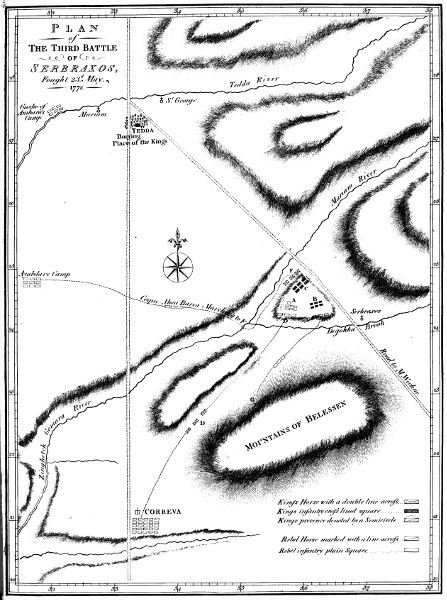
Plan —— of —— The Third Battle —— OF —— Serbraxos, Fought 23d. May, 1772.
THIRD BATTLE.
Explanation.
A The center commanded by the king in person.
B The van encamped under Ras Michael.
C The rear encamped, Guebra Christos being slain, commanded by several officers.
DD Woodage Asahel marching up towards the hill to attack the king's camp.
E Ayto Tesfos of Samen making a lodgement in the bank, or side of the hill, under the van, to favour the attack of Woodage Asahel.
F Coque Abou Barea making a mock attack on the rear to create a diversion in favour of Woodage Asahel.
G Servants of Tesfos, his camp and rebellious peasants of Mariam Ohha on a high rock.
About noon the hill was assaulted on all sides that were accessible, and the ancient spirit of the troops seemed to revive upon seeing the enemy were the aggressors. Without any aid of musquetry, the king's foot repulsed Coque Abou Barea, and drove him from the hill into the plain, without any considerable stand on his part: the same success followed against Mammo and Heraclius; they were chased down the hill, and several of their men pursued and slain on the plain; but a large reinforcement coming from the camp, the king's troops were driven up the hill again, and Tesfos, with his musquetry, had made a lodgment in a pit on the low side of one of these stone-walls Ras Michael had built for his own defence, from which he fired with great effect, and the king's troops were obliged to fall back to the brow of the hill immediately below the tent, and that of the Ras's. In a moment appeared Woodage Asahel, with a large body of horse, supported likewise with a considerable number of foot. This was the most accessible part of the hill, and under the cover of Tesfos's continued fire: they mounted it with great gallantry, the troops above expecting them with their irons fixed at a proper elevation in the ground; for it must be here explained, that no Abyssinian soldier in battle rests his gun upon his hand, as every one is provided with a stick about four feet long, which hath hooks, or rests, on alternate intervals on each side, and which he sticks in the ground before him, and rests the muzzle of his gun upon it, according to the height of the object he is to aim at; and here is discovered the fatal and most unreasonable effect of fear in these troops, who have not the knowledge or practice of fire-arms, and are about to charge, for as soon as they hear this noise of planting the sticks, (which is somewhat louder than that of our men cocking their musquets) they halt immediately, and give the fairest opportunity to their enemies to take aim; and, after thus suffering from a well-directed fire, they fall into confusion, and run, leaving the musquetry time to recharge. This is as if they voluntarily devoted themselves to destruction; for if, either upon hearing the noise of setting the sticks in the ground, or before or after they have received the fire, the horse were to charge these musqueteers, having no bayonets, at the gallop, they must be cut to pieces every time they were attacked by cavalry; the contrary of which is always the case.
Woodage Asahel had now advanced within about thirty yards of the musquetry that were expecting him, when unluckily the hill became more steep, and Ayto Tesfos (for some reason not then known) ceased firing. The king was now close to the very brow of the hill, nor could any one persuade him to keep at a greater distance. I was not far from him, and had no sort of doubt but that I should presently see the whole body of the enemy destroyed by the fire awaiting them, and blown into the air. Woodage Asahel was very conspicuous by a red fillet, or bandage, wrapt about his head, the two ends hanging over his ears, whilst he was waving with his hands for the troops below to follow briskly, and support those near him, who were impeded by the roughness and mossy quality of the ground. At this instant the king's troops fired, and I expected to see the enemy strewed dead along the face of the hill. Indeed we saw them speedily disappear, but like living men, riding and running down the declivity so as even to excite laughter. Woodage Asahel, with two men only, bravely gained the top of the mountain, and, as he passed the king's tent, pulled off his red fillet, making a sign as of saluting it, and then galloped through the middle of the camp. He was now descending unhurt upon the left, where Abou Barea had been engaged and beaten, when Sebastos, a Greek, the king's cook, seventy-five years of age, of whom I have already spoken in the campaign of Maitsha, lying behind a stone, with his gun in his hand, seeing the troops engage below, fired at him as he passed: the ball took place in the left side of his belly. He was seen stooping forward upon the tore of his saddle, with some men supporting him on each side, in his way to his tent, where he died in the evening, having, by his behaviour that day, deserved a better fate. Sebastos reported this feat of his to the king, but it was not believed, till a confirmation of the fact came in the evening, when Sebastos was cloathed, and received a reward from the king.
Tesfos had been observed not to fire since Woodage Asahel gained the steep part of the hill, and it was thought it was from fear of galling his friends; but it was soon known to be owing to another cause. Kefla Yasous had ordered two of his nephews to take a body of troops, with lances and shields only, and these were to go round the Ras's tent, and down the side of the hill, till they were even with Tesfos behind the screen where he lay. These two young men, proud of the sole command which they had then received for the first time, executed it with great alacrity; and tho' they were ordered by their uncle to watch the time when Tesfos had fired, and then to run in upon him, they disdained that precaution, but coming speedily upon him, part of them threw down the stones under which he was concealed, and part attacked him in the hollow, and, while much intent upon the success of Woodage Asahel, he was in a moment overpowered and dislodged; and, being twice wounded, with great difficulty he escaped. Seventeen of his match-locks were brought into the camp, and with them a man of great family in Samen, a relation or friend of Kefla Yasous. This person, after having been regaled with the best that was in the camp, and cloathed anew after their custom, was sent back the same night to Ayto Tesfos, with this short message, "Tesfos had better be upon his rock again, if my boys can beat him upon the plain at broad noon-day."
Coque Abou Barea, after having attempted several times to ascend the hill, was beaten back as often, and obliged to desist. On the king's side only eleven men were killed. The loss of the enemy was variously reported. Sixty-three men only, and several horses of those with Woodage Asahel, were left upon the side of the hill, after the fire of near 1000 musquets—so contemptible is the most dangerous weapon in an ignorant and timid hand. That night the body of musqueteers called Lasta, part of the king's household, (in number about 300 men) deserted in a body. One of the worst consequences of that day's engagement was, that the enemy, when in possession of the foot of the hill, had thrown a great number of dead bodies, both of men and beasts, into Deg-Ohha, which therefore now was abandoned altogether by our troops. To make up for this, Ras Michael, that very evening, advanced 2000 men upon the end of the long hill, immediately below him, which post was never molested after, so that our beasts had water in greater plenty and safety than when they were at a less considerable distance.
Below the north-west side of the hill, where it was a steep precipice, two or three pools of water were found retaining all their original purity, out of the reach or knowledge of the enemy, in the bed of the torrent which surrounded the north side of the mountain: the descent was very difficult for beasts, but thither I went several times on foot, and bathed myself, especially my head, in very cold water, which greatly strengthened my eyes, much weakened from the blow I had received.
CHAP. IX. Interview with Gusho in his Tent—Conversation and interesting Intelligence there—Return to the Camp—King's Army returns to Gondar—Great Confusion in that Night's March.
On the 25th of May, early in the morning, I went to Gusho. When I arrived near his tent I dismounted my mule, and, as the king had commanded me, bared myself to below the breasts, the sign of being bearer of the king's orders. Four men were now sent from the tent, who, two and two, supported each arm, and introduced me in this state immediately to Gusho. He was sitting on a kind of bed, covered with scarlet cloth, and edged with a deep gold fringe. As soon as I came near him, I began, "Hear what the king says to you." In a moment he rose, and, stripping himself bare to the waist, he bowed with his forehead on the scarlet cloth, but did not, as was his duty, stand on the ground, and touch it with his forehead, tho' there was a good Persian carpet, as pride and newly-acquired independence had released him from those forms, in the observance of which he had been brought up from his childhood.
On seeing him attentive, I continued, "The king sends you word by me, and I declare to you from my own skill as a physician, that the fever now amongst you will soon become mortal; as the rains increase, you will die; consequently, being out of your allegiance, God only knows what will happen to you afterwards. The king therefore wishes you to preserve your health, by going home to Amhara, taking Powussen, and all the rest along with you who are ill likewise, and the sooner the better, as he heartily wishes to be rid of you all at once, without your leaving any of your friends behind you." It was with difficulty I kept my gravity in the course of my harangue; it did not seem to be less so on his part, as at the end he broke out in a great fit of laughter. "Aye, Aye, Yagoube, says he, I see you are still the old man; but tell the king from me, that if I were to do what you just now desire of me, it was then I should be afraid to die, it was then I should be out of my duty; assure the king, continued Gusho, I will do him better service. Were I to go home and leave Michael with him, I, who am no physician, declare, the Ras would prove in the end a much more dangerous disease to him than all the fevers in Dembea."
I then introduced his relation, Tecla Mariam, who stood with the people behind; and, as he had on his monk's dress, Gusho at first did not know him. He had been well informed, however, of his having saved the king, and of the blow that he had received from him. He said every thing in commendation of the young man, and his honourable action, adding, that the preservation of kings was a gift of Providence particularly reserved for the people of Amhara. He then ordered new cloaths to be brought and put upon Tecla Mariam, who scrupled to take off his cowl; on which Gusho violently tore it from his head, dashed it on the floor, stamped twice on it with his foot, and then threw it behind the back of the sofa. At parting, Gusho ordered him five ounces of gold, a large present for one that loved money as Gusho did, commanding him strictly to return to his duty and profession, and ordering me to carry him to the king, and see him reinstated in his office in the palace.
I then desired his permission to visit the sick, and left ipecacuanha and bark with Antonio, (his Greek servant,) and directions how to administer them. One of his nephews, (Ayto Aderesson) the young man who had lost Gusho's horse, had the small-pox, upon which I warned Gusho seriously of the danger to which he exposed all his army if that disease broke out amongst them, and advised him to send his nephew forthwith to the church of Mariam, under the care of the priests, which he did accordingly.
The tent being cleared, he asked me if I had seen Welleta Selassé; if I was with her when she died; and who was said to have poisoned her, Ras Michael or herself, or if I had ever heard that it was Ozoro Esther? I told him her friends had sent for me from the camp, but missed me, not knowing I was at Koscam with Ayto Confu, who had been wounded; but that I could have been of little service to her if they had found me sooner: That she had scarce any signs of life when I entered her room, and died soon after: That she confessed she had taken arsenic herself, and named a black servant of hers, a Mahometan, from whom she had bought it; and the reason was, her fears that her grandfather, Ras Michael, whom she had always looked upon as the murderer of her father, should force her when he returned to Gondar. He seemed exceedingly attentive to all I said, and mused for a couple of minutes after I had done speaking.
A plentiful breakfast was then brought us, and many of his officers sat down to it. I observed likewise some people of Gondar, who had formerly fled to Fasil at Michael's first coming. He said he wished me to bleed him before I went away, which I assured him I would by no means do, for if he was well, as I then saw he was, the unnecessary bleeding him might occasion sickness; and, if he was dangerously ill, he might die, when the blame would be laid upon me, and expose me to mischief afterwards. "No, says he, I could certainly trust you, nor would any of my people believe any harm of you; but I am glad to see you so prudent, and that you have a care of my life, for the reason I shall give you afterwards." I bowed, and he made me then tell him all that passed in my visit to Fasil, which I did, without concealing any circumstance. All the company laughed, and he more than any, only saying, "Fasil, Fasil, thou wast born a Galla, and a Galla thou shalt die."
Breakfast being over, the tent was cleared, and we were again left alone, when he put on a very serious countenance. "You know, says he, you are my old acquaintance. I saw you with Michael after the battle of Fagitta, as also the presents you brought, and heard the letters read, both those that came from Metical Aga, and those of Ali Bey from Cairo. All the Greeks here who have considerable posts, and are proud and vain enough, have yet declared to us several times, (as Antonio my servant did to me last night) that, in their own country, the best of them are not higher in rank than your servants; and that those who hitherto have come into this country were no better. We know then, and the king is sensible, that in your own country you are equal to the best of us, and perhaps superior, and as such, even in these bad times, you have been treated. Now, this being the case, you are wrong to expose yourself like a common soldier. We all know, and have seen, that you are a better horseman, and shoot better than we; your gun carries farther, because you use leaden bullets; so far is well; but then you should manage this so as never to act alone, or from any thing that can have the appearance of a private motive[11]." "Sir, said I, you know that when I first came recommended, as you say, into this country, Ayto Aylo, the most peaceable, as well as the wisest man in it, the Ras, and I believe yourself, but certainly many able and considerable men who were so good as to patronize me, did then advise the putting me into the king's service and household, as the only means of keeping me from robbery and insult. You said that I could not be safe one instant after the king left Gondar, being a single man, who was supposed to have brought money with him; that therefore I must connect myself with young noblemen, officers of consequence about court, whose authority and friendship would keep ill-disposed people in awe. The king observing in me a facility of managing my horse and arms, with which, until that time, he had been unacquainted, placed me about his person, both in the palace and in the field, for his own amusement, and I may say instruction, and for my safety; and this advice has proved so good, that I have never once deviated from it but my life has been in danger. The first attempt I made to go to the cataract, Guebra Mehedin way-laid and intended to murder me. When the king was in Tigrè, Woodage Asahel designed to do me the same favour by the Galla he sent from Samseen; and so did Coque Abou Barea at Degwassa, by the hands of Welleta Selassè. No safety, therefore, then remained to me but in adhering closely to the king, as I have ever since done, and was advised from the first to do, which indispensibly brought me to Serbraxos, or wherever he was in person. You cannot think it is from a motive of choice that a white man like myself runs the risk of losing his life, or limbs, so far from home, and where there is so little medical assistance, in a war where he has no motive that can concern him."
"Do not mistake me, Yagoube, says Gusho, your behaviour at Serbraxos does you honour, and will never make you an enemy, so does the like affair with Kefla Yasous; there is no man you can so properly connect yourself with as Kefla Yasous; all I wanted to observe to you is, that it is said Woodage Asahel would have escaped safely from the mountain if you had not shot him, and that yours was the only musquet that was fired at him; which is thought invidious in you, being a stranger, as he is the head of the Edjow Galla, the late king's guards; they may yet return to Gondar, and will look upon you as their enemy, because a leaden bullet was found in Woodage Asahel's body fired at him by you."—"Sir, said I, it is very seldom a man in such a case as this can have the power of vindicating himself to conviction, but that I now happily can do. All the Greeks in the king's army, their sons and families, all Mahometans, who have been in Arabia, India, or Egypt, use leaden bullets. The man who shot Woodage Asahel is well known to you. He is the king's old cook, Sebastos, a man past seventy, who could not be able to kill a sheep till somebody first tied its legs. He himself informed the king of what he had done, and brought witnesses in the usual form, claiming a reward for his action, which he obtained. It was said that I, too, killed the man who carried the red flag of Theodorus at Serbraxos, though no leaden bullet, I believe, was found in him. A soldier picked up this flag upon the field, and brought it to me. I paid him, indeed, for his pains; and, when I presented the flag to the king, told him what I had seen, that the bearer of it had fallen by a shot from Guebra Mascal. I had not a gun in my hand all that day at Serbraxos, nor all that other day when Woodage Asahel was slain. I saw him pass within less than ten yards where I was standing behind the king, in great health and spirits, with two other attendants; but, so far from firing at him, I was very anxious in my own mind that he should get as safely out of the camp as he had gallantly, though imprudently, forced himself into it. It is not a custom known in my country for officers to be employed to pick out distinguished men at such advantage, nor would it be considered there as much better than murder: certainly no honour would accrue from it. But when means are necessary to keep officers of the enemy at a proper distance, for consequences that might otherwise follow, there are common soldiers chosen for that purpose, and for which they are not the more esteemed. This, however, I will confess to you, that when either the king's horses or mine went down to Deg-Ohha to water, and never but then, I sat upon the rock above, and did all in my power to protect them, and the men who were with them, and to terrify the enemy who came to molest them, by shewing the extensive range of our rifle guns; and that very day when Ayto Tesfos arrived, some of his troops having driven off the mules, among which were two of mine, I did, I confess, with my own hand shoot four of them from the rock, and at last obliged the rest to keep at a greater distance; but as for Woodage Asahel, I disown having had arms in my hand the day he entered the camp, or having been absent, till late in the evening, from the king's person."
"Now, all this is very well, continued Gusho; who killed Theodorus, or the man at Serbraxos; who killed Ayto Tesfos's men, is no object of inquiry; Deg-Ohha was within the line of the king's camp, and they that wanted to deprive him of this possession, or the use of it, did it at their peril. If you had shot Ayto Tesfos himself, attempting to deprive you of water for the camp, no man in all Amhara would have said you did wrong; but I am very much pleased with what you tell me of Woodage Asahel. The short, yellow man, who breakfasted with you, was one of those two who accompanied Woodage Asahel when he was shot, and is a friend of mine; he brought word that he was killed by a frank, and the leaden bullet fix'd it upon you."
This man was now immediately called for. He went by the nickname of Goul, or the Giant, from his small size and debility of body. "Is this your man, says Gusho, who shot Woodage Asahel on the hill?" "O, by no means, says Goul; he was an old man with a long grey beard, and a white cloth round his head. This man I know well. I saw him with Fasil. This is Yagoube, the king's friend; he would not do such a thing." "No, certainly he would not, says Gusho, and so mind that you tell Woodage Asahel's friends." Upon this he withdrew. And now, says Gusho, talk no more upon this affair, I will take the rest upon myself. There is a servant of Metical Aga's now in the camp, sent over by desire of your friends and countrymen[12] at Jidda, to know if you are alive and well. He has also a message to the king, and perhaps I may send him to the camp to-morrow, but more probably defer it till we meet at Gondar. Mean time, remember my injunction to you, to keep close by the person of the king, and then no accident can befal you in the confusion that will soon happen. I thanked him for his friendly advice, which I promised to follow. I then asked for Ayto Confu and Engedan, as also for Metical Aga's servant, but he answered, I could not then see them.
He had now in his hand some silk paper, in which they generally wrap their ingots of gold, and he was preparing to slip this into my hand at parting, in the same manner we do the fee of a physician in Europe. "You forget, said I, what you mentioned in the morning, that I am no cast-away, no Greek nor Armenian servant, but perhaps of equal rank to yourselves: if I wanted money, Metical Aga's servant would procure it for me upon demand. It is your wife and two daughters who are ill; and when you shall hereafter be great, and governing every thing at Gondar, I will by them put you in mind of any piece of friendship I may stand in need of at your hand; and you shall grant it."—"You are a good prophet, Yagoube, says he; and so I shall; but remember my advice; I know you are a friend of Ozoro Esther, but she cannot protect you; Ozoro Altash[13] may: the best of all is to keep close to the king, to defend yourself if any body molests you on your way to Gondar, and leave the rest to me."
An officer was now appointed to conduct me across the plain, and several servants laden with fish and fruit. About a hundred yards from the tent, a man muffled up met me, whom I found to be a servant of Engedan. "Your army will disband, says he to me, in a low tone of voice; keep by the king, or Aylo my master's brother, and he will bring you over here." Having left him, we continued across the plain, and saw several small parties of horse patroling, but they came not near us. My conductor said they were Galla, waiting for some opportunity to do mischief. He told me that Ozoro Welleta Israel, and his son Aylo, had joined their army that day with 10,000 men from Gojam, to no purpose at all, continued he, but that of eating up the country. But your friend the Iteghé could not see Ras Michael fall without giving him a shove, though she has staid till the very last day before she ventured, for fear of accidents. Gusho's men set the fish down at the advanced guard, and returned with the officer who had attended me, while I went towards the king's tent, musing what all this might mean, what power was to carry us to Gondar, disband the army, depose Michael, and not hurt the king.