BOOK VII. (continued 3)
Reading edition
Before his departure he had two long conferences with the king upon the contents of the dispatches sent by his father from Shoa. The substance he frankly told me was, that he did not intend to meddle with the quarrels of Ras Michael, nor those of Fasil; that they should settle these in their own way; but if either attempted any thing against the king, set up any usurpers, as they had done in the person of Socinios, and continued so far against their allegiance to Tecla Haimanout as to withhold his whole revenue, and not to pay him wherewithal to support his state, that he would consider himself as protector of the royal family of Solomon, as the governors of Shoa had always been.—It was believed very generally, by Amha Yasous coming in person, that a treaty between some of the great men in both sides, begun at his instance, would bring every man that could mount a horse from as far south as Gingiro, to over-run both the provinces of Begemder and Amhara, and either displace the two governors, or at least force them to their duty; and it was owing to this, in all probability, that Gusho acted with such moderation as he did in the campaign that soon followed.

CHAP. V. Rebel Army approaches Gondar—King marches out of Gondar—Takes Post at Serbraxos—The Author returns to Gondar with Confu wounded.
Gentle showers of rain began now to fall, and to announce the approach of winter; nay, some unusually severe and copious had already fallen. Gusho and Powussen of Amhara and Begemder, Kasmati Ayabdar governor of Foggora, Aylo son of Ozoro Welleta Israel the queen's daughter, governor of Gojam, Woodage Asahel, with the troops of Maitsha, and Coque Abou Barea from Kuara, were at the head of all the forces they could raise about Emfras and Nabca, and the borders of the lake Tzana. A brother-in-law of Powussen had brought a considerable body of troops from Zaat and Dehannah, two clans of Lasta, enemies to Guigarr, who had declared for Michael; and these were the best horse in the rebel army, superior to any in Begemder.
This numerous army of Confederates were all ready, expecting the rain would make the Tacazzé impassable, and cut off Michael's retreat to Tigrè. Fasil alone kept them in suspense, who, with about 12,000 men, remained at Ibaba, professing to be at peace with Michael, in the mean time keeping all Maitsha quiet, and waiting for the coming of Welleta Yasous, and 20,000 Galla, whom he had sent for from the other side of the Nile, intending, as he said, to march on the arrival of this reinforcement, and join the king at Gondar. Although it may well be doubted if ever he intended all or any part of this, one thing was very certain, that he was sincere in his hatred to Gusho and Powussen; he never could forget their treachery in breaking their appointment and promise at Court-Ohha, and exposing him either to fight Michael singly, or have his whole country burnt and destroyed. Although Michael had, for these last months, done every thing in his power to bring back to the king such people of consideration that possessed the lands and estates about Gondar, and were the most respectable of their nobility for influence and riches, bred up about court, and who did chiefly constitute it; yet the cruelty of his executions, his insatiable greed of money and power, and the extreme facility with which he broke his most sacred engagements, had terrified them from putting themselves into his hand; though they did not raise men, or join any side, but lived privately at a distance, yet their absence from about the king had the very worst effect upon his affairs. A great desertion had likewise happened since his coming among his old troops of Tigrè, both of officers and soldiers. The execution of Guebra Denghel, and other two noblemen, had greatly alienated the minds of many of their countrymen and their connections; but, above all, his breach of promise made before the mountain of Haramat, that he was to levy no taxes upon that province for seven years, (but which he was now doing with the greatest rigour before one had expired) discontented them all.
The return of Welleta Michael and Kefla Yasous from Samen, with about 6000 men, had considerably strengthened his army; added to this, 2000 more, who came voluntarily, from their love to Kefla Yasous, from Temben, where he was governor; these were picked men, partly musqueteers; there was nothing equal to them in the army.
Gusho was advanced to Minziro. Powussen had his head-quarters at Korreva, not above sixteen miles from Gondar. The whole plain to the lake was covered with troops. The weather was unseasonably cold, and considerable quantities of rain had fallen from the 23d of February to the 29th of March. The rebels had begun to lay waste Dembea, and burnt all the villages in the plain from south to west, making it like a desert between Michael and Fasil, as far as they dared venture to advance towards either. This they did to exasperate Michael, and draw him out from Gondar; for they had most of them great property in the town, and did not wish to be obliged to fight him there. He bore this fight very impatiently, as well as the constant complaints of people flying into the town from the depredations of the enemy, and stripped of every thing.
The king often ascended to the top of the tower of his palace, the only one to which there remains a stair, and there contemplated, with the greatest displeasure, the burning of his rich villages in Dembea. One day while he was here he shewed an instance of that quick penetration for which he was remarkable, and which, as a proof of this, I shall here mention.
There is a large waste space on each side of the palace where the market is kept. It had rained, and it was in the evening almost destitute of people; there were only two men at a considerable distance, who seemed to be in close conversation together, one of them apparently very much the worse of liquor, the other had hold of the end of the sash, or girdle, which was round the body of the drunk man; it is a narrow web of cotton cloth, which they wind eight or ten times about their waist. The king said to me, Do you know, Yagoube, what these two men are about? I answered, No. I saw the drunkard untwine one turn of his sash, which the other was feeling and looking curiously at, as if examining and doubting its goodness. That man, says the king, is robbing the drunkard of his sash: go down two or three of you who run best, and apprehend him, but hide yourselves till he has committed the theft, and seize him as he passes. The orders were quickly obeyed; the drunkard unwound his sash, by turning himself round and round, while the other seemed to be measuring it by the length of his arm, from his elbow to his forefinger, and then gathering it up. This was done very deliberately till it was all unwound, and the far end loose; upon which the fellow, who was measuring, gathering it in his arms, ran off as fast as he could, leaving the drunkard standing motionless, apparently in great surprise and amazement. The thief was immediately seized and brought up to the king, who ordered him to be thrown over the tower. At my intercession, and that of those about him, he was pardoned, and the drunkard's sash was returned to him.
Ever since the middle of February, Ras Michael had resolved to march out, and give battle to the rebels encamped about Korreva, committing every sort of violence, and burning all the villages, houses, and barns in Dembea, with the corn they contained more than what served for their present use; but the great superiority of the enemy in horse had always made him delay his intention.
Yasine had, indeed, succeeded in his commission to Sennaar, as far as it regarded the horses. He had found the Arabs encamped immediately upon the frontier at Ras el Feel, and had received from them very near 200 of one kind or other, of which 76 only answered the purpose of mounting the king's black servants; the others were distributed among the rest of the army that wanted them. But they had not been equally successful in purchasing their coats of mail, fourteen only of which had been brought with the horses. In order to buy the rest, the messenger continued his journey to Sennaar, and with him my servant Soliman with my letters, to which, of consequence, I had as yet no return. But what appeared at that time most material to me, Fidele Shekh of Atbara wrote to Yasine, "That, there was no fear but that I should be well received at Sennaar, where Nasser, a young king, had succeeded his father, whom he had deposed; but that the great difficulty was to pass between Ras el Feel and Teawa, the place of his residence, and from thence to the banks of the river Dendera, for that the Ganjar horse of Kuara, and the Arabs their friends, were at war with the Arabs of Atbara, and had burnt all their crops and villages: that he sometimes did not think himself safe in Teawa, and that a load of salt had not been suffered to pass for several months; which, indeed, was the reason why the Arabs of Atbara were come so near Ras el Feel, and that the king's horse were procured so readily at the first coming." This traitor, however, added, "That if, by any means, I could advance to him at Teawa, I need not take any thought about the rest of the journey; and that it was better I should come quietly and quickly, without writing to Sennaar before-hand: and he concluded with great professions of respect and friendship for me."
It had been very cold, and more than usual rainy, since the beginning of February; the 9th was a day of close rain; and this, being earlier than common, very much discouraged the soldiers who were naked, and, therefore, very sensible of cold, or rain, and, as I have before said, never can be brought to engage willingly, unless under the influence of a warm sun.
At last the cries of the people flying into Gondar, seeking protection from the cruelties of the rebels, determined the Ras to march out, and set his all upon the fortune of a battle. The risk was not thought great, as he had been all his life in use to conquer; had a better army at that time than ever he commanded; the Begemder troops, too, in whom the rebels trusted most, were but those which he and his men had beaten at Nefas Musa, although led by a very brave and valiant officer, Mariam Barea. All this was true; but then, since that period, these troops of Begemder had been constantly led by himself, had been trained, and disciplined with the old troops of Tigrè, and taught to conquer with them. Above all, they had been used to see the effect of fire-arms, which they no longer feared as formerly, but boldly rushed in upon the musqueteers, sometimes without giving them time to fire, or at least before they had time to charge again.
At last, having previously called in all his out-posts, on the 13th of May he marched out of Gondar, taking with him the King and Abuna, as also Ozoro Esther, and Ozoro Altash her sister, and all the other ladies about court, who were in possession of the great fiefs of the crown, and whom he obliged to personal attendance, as well as to bring the quota of troops they were bound to by their respective tenures.
The king's army halted upon the same ground they had done on their return to Gondar. They were then supposed to be near 20,000 foot, belonging to Tigrè and its dependencies, incomparably the best troops of the empire, 6000 of which were armed with musquets, six times the number that all the rest of Abyssinia could furnish, and, considering they were all match-locks, very expert in the management of them. The rest of the foot which joined them since he passed the Tacazzè were about 10,000, besides 2000 of the king's household, 500 of which were horsemen; of these, few short of 200 were his black servants, armed with coats of mail, the horses with plates of brass on their cheeks and faces, with a sharp iron spike of about five inches in length, which stuck out in the middle of their forehead, a very troublesome, useless piece of their armour; their bridles were iron chains; the body of the horse covered with a kind of thin quilt stuffed with cotton, with two openings made above the flaps of the saddle, into which the horseman put his thighs and legs, and which covered him from his hip (where his shirt of mail ended) down to a little above his ancle: his feet were covered with slippers of thin leather, without heels, and his stirrups were of the Turkish or Moorish form, into which his whole foot entered, and, being hung very short, he could raise himself, and stand as firmly as if he was upon plain ground. The saddles were in the Moorish form likewise, high before and behind; a strong lace made fast to the coat of mail by the one end, the other passed through a small hole in the back of the saddle, kept it close down, so that the back was never exposed by the coat of mail rising over the hinder part of the saddle. Each had a small ax in the surcingle of his saddle, and a pike about fourteen feet long, the weapon with which he charged; it was made of very light wood, brought from the banks of the Nile, with a small four-edged head, and the butt end balanced by a long spike of iron; this entered a leather case fastened by a thong to the saddle, and was rested sometimes below the thigh, and sometimes above, and guided by the right hand at the height the point was intended to strike at. The horseman's head was covered with a helmet of copper, or block tin, much like those of our light horse, with large crests of black horse tail.
The officers were distinguished from the soldiers by locks of hair dyed yellow, interspersed with the black. Upon the front of each helmet was a silver star, at least a white-metal one, and before the face, down to the top of the nose, a flap of iron chain, made in the same manner as the coat of mail, but only lighter, which served as a vizier. This was the most troublesome part of the whole, it was hot and heavy, and constantly fretted the cheek and nose, when either the man or the horse were in motion; and therefore I always substituted a black silk net, which concealed my colour better, and for the rest of my face I committed it to the care of Providence.
This body of horse was able to make their way through all the cavalry in Abyssinia, if they had been drawn up against them with equal fronts; for every horseman sat immoveable upon his saddle, and acted most powerfully by his weight alone, and was perfectly master of his person also by the breadth and shortness of his stirrups; whereas the Abyssinian horsemen were placed most disadvantageously, their head and body naked, their saddle small, and of no support to them, their stirrup-leathers long, and no stirrups to put their foot in; but being constantly afraid of their horse falling upon them, the only hold which they had was the outside of an iron ring, which they grasped between their great and second toe, so that they had no strength from their stirrups, whilst their foot was always swelled, and their toes sore and galled.
Of the thousand Shoa horse about 60 had deserted; the rest were all in good order, each armed with their lances about ten feet long, and two light javelins, their shafts being of cane, which they threw at a great distance; the lance they never loosed out of their hand; as for their stirrups and saddle, they were of the same bad construction as those of the Abyssinians in general, and this reduced them nearly to a footing with them.
The horsemen of the king's army were about 7000, mostly very indifferent troops; so that his whole muster was nearly 7000 musqueteers, 25,000 foot, armed with lances and shields, and about 7500 horsemen; in round numbers about 40,000 men. It is not possible, I believe, to know, with greater precision, the number, such is the confusion of barbarous armies on these occasions, and such the inclination of their leaders to magnify and increase their quotas. Besides these, Ayto Confu and Sanuda were left with about 600 men each, to protect Gondar from flying, pillaging parties, and to keep the communication open between the army and the capital, from whence the provisions were to be supplied.
This army was furnished with a number of excellent officers, veterans of noble families, who had spent their whole life in war, which we may say, for these last 400 years, has never ceased to lay desolate this unhappy country; the principal were Ras Michael, who, arrived at the age of seventy-four, had passed the last 50 years of his life in a course of continued victories, Atsham Georgis, and Guebra Christos, uncles by the mother's side to the king; Kefla Yasous, in the full vigour of life, who, though unhappily born in a country plunged in ignorance, and where there is no education, possessed every quality that became a man, whether a soldier, statesman, citizen, or friend; Welleta Michael, master of the household to the king; Billetana Gueta Tecla; Basha Hezekias, and Guebra Mascal, two principal officers of his musquetry, and a great number of others of equal merit, known better in the camp than at the court; Aylo, and Engedan, two sons of Kasmati Eshté; Ayto Confu, son of Ozoro Esther, all young men, employed generally in enterprises, and growing every day more and more into reputation.
It is impossible so much as to guess at the number of the enemy, they were always very numerous, but constantly changing. It was said, that Begemder and Lasta had at one time 30,000 horsemen; I should believe this number greatly exaggerated, from what I heard afterwards; and that the whole cavalry in their army did not exceed what it was at the battle of Serbraxos. I suppose indeed, that, together with their foot, they did not much exceed that number, tho' they were at times magnified to 50 and 60,000, most of them very bad troops, continually deserting, excepting about 4000 men belonging to Gusho, from Amhara, who likewise brought about 100 match-locks, and besides these there were scarcely any in the rebel army. I must not, however, forget 200 horsemen, Edjow Galla, servants and relations of the late king Joas, who behaved in the most gallant and undaunted manner, and upon all occasions set a noble example to the rest of the army.
Ras Michael himself led the van; the king the center, with Guebra Mascal, and a considerable body of musqueteers of Tigrè; he had no horse but those of his own household. The rear was commanded by Welleta Michael, and Tecla: how disposed, or of what troops constituted I know not, for the front, center, and rear were understood to march in order, but it was often impossible to discern any such divisions; we were often all in confusion, sometimes we were in the middle of the front, sometimes joined and mixed with the rear; all our officers had left their command, and were crowding about. Ras Michael and the king; women bearing provisions, horns of liquor, and mills for grinding corn, upon their backs; idle women of all sorts, half dead with fear, crying and roaring, mounted upon mules; and men driving mules loaded with baggage, mingled with the troops, and passing through in all directions, presented such a tumultuous appearance that it surpassed all description. There were above 10,000 women accompanying the army: the Ras had about 50 loaded with bouza, and the king I suppose near as many.
The sight threw me for a moment into low spirits. I know not if the king saw it. I was perfectly silent, when he cried, Well, what do you say to us now, Yagoube? I answered, Is this the order in which your majesty means to engage? He laughed, and said, Aye; why not, you will see. If that is so, I replied, I only hope it is the enemy's custom as well as your majesty's to be in no better order. The king was going to answer me, when Guebra Mascal, who was just beside him, cried out, This is a business you know nothing about, Yagoube; go to your Felac (quadrant) and your fortune-telling, if you are afraid; we have no need of you, nor your advice to-day. Respect for the presence of the king, which you seem to be void of, said I, hinders me from answering you as I otherwise would have done; but be assured, in which ever army they were to-day, they are not men like Guebra Mascal whom I should be afraid of. The king looked at him much displeased, and, I believe, said something favourable of me; what it was I did not distinctly hear.
It was now about 10 o'clock, when, marching close along the foot of the hills, we arrived at Tedda. The burying-place of Hatzé Hannes I. son of Facilidas, and father of Yasous the Great, was scarce a quarter of a mile to the S. W. of us, and the church of St George a little more on the east, when orders came from the Ras for us to encamp on the side of the hill, which we accordingly did, and were presently in better order than we were when marching. The Ras, who had passed the river of Tedda, encamped on the south side of it. It happened that our two bodies, the front and center, were at that time treading upon one another's heels; but the rear, from some accident, was considerably behind, and part of it had scarce passed the Mogetch.
Both the burying-place, and church near it, were planted thick round with Cyprus and cedar trees. Just a little before the Ras ordered us to encamp, a messenger arrived from Netcho, (the Fit-Auraris) that he had that morning met the Fit-Auraris of Begemder on this side of the river Mariam; that he had killed the Fit-Auraris himself, (a man of Lasta) with 37 of his men, and driven them back: he added, that he intended to fall back himself upon the Ras's army, unless stopt by contrary orders; these the Ras did not send, being desirous that he should join him, as he soon after did, without being pursued: he brought word that the army of the rebels was near at hand, between Korreva and the lake; that Powussen's head-quarters were at Korreva, and that he had heard Gusho had pushed on advanced posts, as far as the church of Mariam; but this he did not know for certain, being only the information of a dying man. Ras Michael immediately detached Guebra Mascal, and another officer, with 400 men to take possession of the sepulchre and the church at Tedda, and conceal themselves among the cedar-trees.
We had not encamped long, before the rear came in sight. Confu, son of Ozoro Esther, whom the Ras had left to guard Gondar, hearing how near the enemy was, and the probability of a battle that day, had left his post, and joined Yasine, with the horse of Ras el Feel, that were in the rear; soon after this junction, Asahel Woodage, with about 400 men, partly Edjow Galla, (the late king Joas's household) partly Maitsha, came up from the Dembea side of the lake Tzana, and began to harrass the rear, marching in great confusion. Confu, though something superior in number, was thought to be inferior in the goodness of troops by much more than the difference; but the event proved the contrary, for he charged Woodage Asahel so forcibly, that he obliged him to quit our rear, and retire across the plain at a pace, which if not a flight, did very much resemble it. Ayto Confu pressed vigorously upon him, till, being now clear of the rest of the army, and in the fair open plain, Woodage wheeled shortly about, and shewed by his countenance that it was not to avoid Ayto Confu, but Ras Michael's musquetry, that he retreated to a greater distance; both sides stopt to breathe their horses for some minutes; but it was plain afterwards, Asahel Woodage, an old soldier, trusted much to the known valour of his troops, and wished to strike a blow of consequence in presence of his old enemy the Ras.
Ras Michael was at the door of his tent then playing at dams, or drafts, as was his custom, and Ozoro Esther was trembling to see her son on the point of being surrounded by merciless Galla, the nation who most of all she detested, and who had every cause to hate her. All the young men, (Confu's friends) with their lances in their hands, and ready to mount on horseback, beseeched the Ras to allow them to go down into the plain to the assistance of Confu; but the old general, without leaving off his game, said, "I do strictly forbid one of you to stir; Confu has broke my orders to-day, and brought himself into a scrape by his own folly; let me see him get out of it by his courage and conduct, and thereby set the army a better example than he yet has done."—"Sir, said I, at least station some musquetry on the small hill, at the edge of the plain, that, if Confu is beaten, I may not have the mortification of seeing Yasine, and the new troops of Ras el Feel, (who were in their proper post) and have all my baggage and provisions, massacred before my eyes by these cowardly barbarians." I spoke this in the utmost anguish, when the Ras lifted up his head with, a ghastly kind of laugh, and said, "Right, well do so, Yagoube." Though this was but an imperfect permission, I ran down to the station with such haste that I fell twice in my way, and was considerably hurt, for the ground was rocky, and the grass slippery.
Although I had only waved my cloak, and cried come on sirs, a large number of match-locks of Ozoro Esther's, and the king's, hastened immediately to the ground. Confu by this time had charged, and after a stout resistance beat Woodage back into the plain; Woodage, however, again faced about, and after some resistance, Confu in his turn was driven back in evident disorder, and pushed almost in upon the post, where our soldiers had made ready their musquets, to fire if they came a step nearer. At this instant a body of about 30 or 40 horse (the commander we afterwards knew to be Ayto Engedan) came up full gallop from the right, and stopt the Galla in their pursuit. Confu's men rallied upon this assistance, and Asahel Woodage retired in a direction passing close under the sepulchre, Engedan and Confu keeping at a moderate pace on his left between them and the army, and forcing them down, as it were, to the trap they knew was laid for them. They were yet a long shot from the cedars that surrounded the sepulchre, when a volley was discharged at them from among the trees, where Michael had posted his 400 men, which, though it did little or no execution, terrified Woodage Asahel's men so much, that Confu and Engedan, charging in that instant as upon a signal, they all dispersed through different parts of the field, and their leader after them: Joas's Edjow, indeed, would not fall back a step upon the volley, but, after an obstinate resistance, they were broken by superior numbers, and forced to retreat before an enemy, so overcome with fatigue and wounds, as to be unable to pursue them.
The whole of this engagement lasted near an hour by my watch. One hundred and thirteen of Woodage Asahel's men were slain upon the spot, and their bloody trophies brought and thrown before the king. On Confu's side about 70 were killed and wounded; he himself received two wounds, one a large flesh wound in the hip, the other more slight upon the head, both of them at the very beginning of the engagement.
Notwithstanding the natural hardness of his heart, and that the misfortune which had happened was in immediate disobedience of orders, Ras Michael shewed great sensibility at hearing Confu was wounded; he came immediately to see him, a visit not according to etiquette, and gave him a slighter reproof than was expected for leaving his post in the town, as well as for his fighting without his orders. Confu, with great submission and address at the same time, excused his leaving his post, from the repeated information he had received that a decisive battle was to be fought that day, and knowing the Ras's want of horse, he could not stay at Gondar, and keep his idle, when the fate of so kind a father, (as the Ras had been) and that of a mother, to whom he owed every thing, was depending. He said it would be more agreeable to him to die by the hands of the executioner of the camp, as an example for disobedience of orders, than survive with the reflection that he had been voluntarily absent from such an occasion. As for engaging with Asahel Woodage that day, he said he had no intention of that kind; that he knew not who he was when he attacked him, and only endeavoured to hinder him from harrassing the rear of the army, and destroying the provisions: That when he charged him first, Woodage was among the women, loaded with bouza, flour, and spirits, which were coming to the Ras, and great part of which he had intercepted, as the Ras would find. Michael could not help laughing at this last part of the excuse, but went away, and, in his conversation that evening, gave Confu the highest praises for his conduct and bravery, but said nothing of his fault.
Engedan was next arraigned for fighting without orders. He, too, answered with great humility, That when he saw the infantry run down the hill, with their matches lighted, he thought it was the Ras's intention to relieve Confu by the most effectual means possible; but at any rate he could never, with arms in his hands, stand looking on, while his cousin-german and companion was massacred by Galla. All ended well. The truth is, Michael never would find fault with a man that fought, however imprudently he fought the occasion: courage was to him in place of charity; it covered a multitude of sins.
Ozoro Esther, in the deepest concern, had attended her son from the moment of his arrival, and had seen his wound dressed and swathed up. A large gaping flesh-wound (such as his was) frightens ignorant people more than the small orifice made by a shot, which breaks bones and endangers life. Such was Ozoro Esther's apprehension; and every minute she inquired of me if I thought it was possible he could recover. I had not quitted him since he had got off his horse. I advised him by all means to go in a litter to Gondar, either carried by men or mules; but no persuasion, nor consideration, would induce him to go otherwise than on a mule, with his horse harnessed and led by him.
Every thing was accordingly prepared, when I received a message from the Ras to wait upon him. I immediately went to his tent, and found him with two dwarf boys only, who were fanning the flies from his face. "Ozoro Esther wishes, says he, that you would see Confu safe to Gondar, and bring us word to-morrow how he is; and you must stay with him altogether, if he is in danger."—"If he has no fever, said I, he is in no danger. If the king and you"—He then interrupted me,—"The king, and I, and every one, wishes you to attend Confu." I bowed, and went away without reply. When I was got to the door he cried after me, "Don't be afraid, you will be in time enough to see every thing; neither they nor I wish an engagement but at Serbraxos."
I did not understand the meaning of the speech, but went away without reply straight to the king's tent; and I was just going to speak when he stopt me, by crying, "Go, go, for God's sake! Ozoro Esther has been here almost out of her senses." I went on this to her tent, where I found her sitting by Confu and drowned in tears, which at times were interrupted by fits of seeming distraction. He began to feel the loss of blood, which would have made me wish not to move him; but there was no staying here for sick people; and so violent a spirit had spread through the army, upon Netcho's success and Confu's victory, that one and all insisted upon fighting the next day; and several of my friends, who knew where I was going, shook hands with me at my passing them, saying, "Farewell, Yagoube; we are sorry to lose you, but all will be over before you come back."
I now insisted more than ever upon Confu's going in a litter, and setting out immediately, which was accordingly complied with. Ozoro Esther had dinner, or rather supper, ready in a moment, and I had great need of it, having scarcely tasted any thing for two days. While I was eating, Ozoro Esther could not stop the effusions of her gratitude for the care I had again taken of Confu. "I knew, says she, you would have refused me, if I had endeavoured to persuade you to go away from the camp, when there are such fair expectations, you may be knocked on the head to-morrow; and therefore I applied to the Ras by force to bend that rash, proud spirit of yours, which one day will be the occasion of your death."—"Madam, said I, you do me injustice if you will not believe that I had rather obey your commands than those of any general upon earth: But, pray, what is the meaning of the Ras's speech to me about both armies wishing to fight at Serbraxos[9]? Where is this Serbraxos?"—"Why, says she, here, on a hill just by; the Begemder people have a prophecy, that one of their governors is to fight a king at Serbraxos, to defeat him, and slay him there: in his place is to succeed another king, whose name is Theodorus, and in whose reign all Abyssinia is to be free from war, or from any trouble, sickness, or famine; that the Galla, Shangalla, and Mahometans are all to be destroyed, and the empire of Abyssinia to be extended as far as Jerusalem."—"All this destruction and conquest without war! That will be curious indeed. I think I could wish to see this Theodorus," said I, laughing. "See him you will, replied Ozoro Esther; peace, happiness, and plenty will last all his reign, and a thousand years afterwards. Enoch and Elias will rise again, and will fight and destroy Gog and Magog, and all this without any war."—"On which I again said, that must be cleverly managed. And now, why does Ras Michael choose to fight at Serbraxos? I do not think he is desirous to pay his court to the king Theodorus, or any king brought him by Begemder."—"Why, says she, all the hermits and holy men on our side, that can prophecy, have assured him he is to beat the rebels this month at Serbraxos; and a very holy man, a hermit from Waldubba, came to him at Gondar, and obliged him to march out against his will, by telling him this prophecy, which he knows to be true, as the man is not like common prophets, but one who never ate any thing but roots, or drank other liquor than water, since the day of his nativity. Such a man as this, you know, Yagoube, cannot lie." "And I, says Ayto Confu, being a prophet that hath ate beef and drunk bouza ever since my nativity, whenever I could not get wine or brandy, and who give my share of water freely to the saints of Waldubba, as a proper reward for the lies they tell, I do prophecy, that there are now two thousand men eating their supper within sight of Serbraxos, who will never see it nearer, but will all be slain in a battle fought at this place to-morrow, at which time Yagoube shall be feasting with me at Gondar, without caring a fig for king Theodorus and his plenty."—"A blessed prophet you!" says Ozoro Esther.
At this instant the servants at the door informed us there was scarce light to see the way down the hill, and we got our wounded prophet, without much difficulty or complaint, into the litter. A number of men supported him down the hill, and about 50 of his own horse attended. I desired him to feel often the bandage if his wound bled; and, finding it did not, I rode on horseback close by his side. For some time, not hearing him stir or speak, I thought he was asleep, or had fainted; on which I stopt the litter, felt his pulse, and asked him if he was dosing? He said, No; he was thinking of all the lies his mother had been telling me: but there is one thing she did not care to tell you, Yagoube, she says you laugh at these stories; but there is a spirit who always appears to Michael and assures him of victory. The devil, said I, probably; for what good arises from all these victories? are they not the ruin of innocent people, and of the country? No, replied Confu, it is St Michael the archangel; he saw him just before he surprised the mountain Haramat, but neither at Gondar, nor since he passed the Tacazzé, and this makes him sorrowful. The spirit has been afraid to catch cold, said I, by wetting his feet in that cold river. I doubt so, answered Confu; but the liar of a monk, who my mother supposes never eats nor drinks, told him he was to see him at Serbraxos.
At this time we heard the noise of horses, and could discern (as we thought) three men that passed the bridge of Mogetch briskly before us. As they seemed to avoid us, six or eight of Confu's men pursued them at full gallop, but lost them in the darkness. They, however, were found to be soldiers of Kasmati Sanuda, who hearing Woodage Asahel had been engaged with Ayto Confu, had come out with the unworthy purpose of collecting some filthy trophies, by mangling the dead or wounded, though these must have been their own companions, the soldiers of Ayto Confu, who had been slain; for the whole of Woodage Asahel's men had already undergone what Strates emphatically called the operation, by the knives of Confu's soldiers. We now arrived at Koscam without any adventure, and Confu was laid to repose, after taking a little food: in obedience to the orders of Ozoro Esther, I lay down by him in the same apartment.
Early next morning I was sent for by a servant of Ozoro Esther, to attend Welleta Selassé, who I was told was at the point of death. I repaired immediately to the house of Ras Michael, where she then was, but found her without possibility of recovery, having already lost her speech. She expired a few minutes afterwards, apparently in violent agonies. The cause was never properly known; some attributed it to the jealousy of Ozoro Esther, others alledged that she had taken poison from apprehension of falling into the hands of Ras Michael: whatever was the truth, her servants certainly told me, that she had confessed she had taken poison, and not till the pain became violent, and then she turned afraid, would she consent to have an express sent to Ozoro Esther, to bring me from the camp. I had unluckily left it before to attend Ayto Confu, neither is it probable I could have been of any service, as the poison she had taken was arsenic. This accident detained me that whole day, so that, instead of returning to the army, I went to Ayto Confu at Koscam, where I found another messenger in search of me.
The king's Mahometan was returned from Sennaar, and with him Soliman my servant, who brought me answers to the letters I had written; they had come by Beyla to Ras el Feel, by Sim Sim, and the western deserts, the way to Teawa being much infested by gangs of Arabs, and Ganjar horse, who murdered every body they found in their way. They brought with them only twelve horses, eighteen coats of mail, and about thirty libd[10]; these were mostly returns made by the principal members of government to the presents the king had sent them, for every body at Sennaar now set too great a value upon the armour, and horses, to part easily with them, on account of the unsettled state of the times, the history of which we shall give afterwards.
My letters informed me that the whole kingdom of Sennaar was in arms, that Nasser (who had deposed his father by the help of two great brothers, Mahomet Abou Calec, and Adelan) was upon the point of trusting his life and kingdom to the event of a battle with these two officers. I was, moreover, conjured, with all the earnestness, as I thought, of a truly honest man, that I would by no means undertake the journey I intended; that to come from Ras el Feel to Sennaar, was, for a white man like me, next to an absolute impossibility, connecting the danger of the way with the great hardships from the excessive heat of the climate, and want of food and water; that even arrived at Sennaar, I should be in the utmost danger from the soldiery, and the king's slaves, under no subordination or government; and that, even if I was happy enough to escape these, the worst still remained, and no human power could convoy or protect me, in my remaining journey to Egypt through the great desert. I was therefore begged to lay all such intention aside as impossible, and either stay where I was, or return by Tigrè, Masuah, and Arabia, the way by which I first entered Abyssinia. This was the severest of all blows to me, and threw me for some time into the lowest despondency, but it did not change my resolution, which was already taken, not to turn to the right or the left, but either compleat my journey to Syene, the frontier of Egypt, by Sennaar, and Nubia, or perish in the attempt.
I now resolved to proceed immediately to the camp, taking twenty horse from Sanuda, and twenty from Confu, to escort the coats of mail and horses from Sennaar. I set out that evening with Mahomet the king's servant, by the road of Sema Confu, and arrived about nine o'clock in the camp, without any adventure, bringing the news of Welleta Selassé's death, which seemed to cause neither surprise nor sorrow, and was never after spoken of either by the Ras or Ozoro Esther; but very great rejoicings were made at the good accounts of Ayto Confu, with very kind expressions of me, both from the Ras and Ozoro Esther.
Before he went to bed, the king had examined Mahomet, and drawn from him the true state of the kingdom of Sennaar; he then sent for me, and ordered me to deliver him my letters, which I did, interpreting them to him, word for word. He said, however, but little at this time, as he thought that that door, being so effectually shut against me, less could be urged against the safer, and more known road through Tigrè, which, of course, it was presumed I should more eagerly embrace; he kept my letters, and ordered me to choose two of the horses for myself, which I did, one of them near seventeen hands high, I suppose one of the most powerful horses in the world. The rest he distributed among the black troops; the same he did with the coats of mail. I found the army in great spirits, but still the story of fighting only at Serbraxos seemed to be obstinately persisted in. I asked Ozoro Esther if St Michael had yet appeared to the Ras; she answered, "Hush! for God's sake, don't make a joke of this, one word of this kind repeated to him would prevent your ever receiving a favour from Michael."
It happened that, the day after I had attended Ayto Confu to Gondar, Ras Michael sent some soldiers into Dembea to forage, these had been intercepted by a party posted on purpose by Kasmati Ayabdar and Gusho, consisting of Edjow Galla, with some horse from Foggora and Amhara. An engagement happened pretty much in the same place and manner as that with Woodage Asahel and Ayto Confu, in full view of the camp, and assistance was sent on both sides to the respective parties. The troops commanded by Aylo, brother of Engedan, and Guebra Mascal, were beaten back almost close to the camp, by the horse led by the Edjow Galla, though brave and veteran soldiers, while Ras Michael ordered Yasine and his 200 from Ras el Feel, (all with their libds on) to charge the Galla, now advanced very near. Each horse had a number of brass bells at his neck, and they no sooner appeared than the whole cavalry of the enemy, starting at the hideous figure and noise, fell into confusion, and, being closely pressed with violent blows of their great swords, no longer disputed the ground, but left the field on the gallop. A beautiful grey horse of Gusho's, superbly ornamented with gold and silver, and having a very rich broad-sword hanging at his saddle, and a pole-ax on the other side under the surcingle, was taken by some soldiers of Ras el Feel, who spread the report instantly that Gusho was slain. Immediately on this, orders were given for the whole army to descend into the plain, which they did with great alacrity, forming in order of battle, though neither the king nor Ras Michael left the camp, nor did any adversary appear; and the troops, content with this bravado, returned again in great spirits to the camp.
This is the account I heard of that day's skirmish, for I was not present there, being at Gondar with Ayto Confu. In the evening of that very day arrived a messenger from Gusho, telling Ras Michael, that a young boy, a nephew of his, had, without his knowledge, gone to see the engagement, and had taken with him his favourite horse, who, being frightened at the Arabs with their libds, had thrown him, after which he had run off and left the horse among the enemy. He begged to have his horse restored at any price, if the man that had taken him was allowed to sell him. He at the same time sent a present of a large quantity of fruit and fresh fish from the lake. The messenger was a priest well known by Ras Michael, and warmly attached to the king, and it was thought came with an errand of more consequence than either about the horse or the fish. The Ras sent him for his answer to the King, who told him, the horse being taken by the troops of Ras el Feel, belonged to me, and with me he must make his bargain: that I was at Gondar, and my return uncertain; but that the next day he might have my answer. This was the better to conceal the priest's real business, for the King and Ras knew how they were to dispose of the horse; at least they certainly knew I was not to return him without their orders.
The morning after my arrival this same priest came to me with a message from Gusho, desiring I would send him his horse, as a proof of the friendship which he said had always subsisted between us, at the same time offering me any sum of money that I might have promised to content the soldiers who took him. As I had before obtained leave from Ras Michael to restore the horse, so I did it with the very best grace possible, sending Yasine himself, chief of the troops of Ras el Feel, with the message to Gusho, that I reckoned myself exceedingly happy in having that opportunity of obliging him, and of shewing the value I had ever set upon his friendship; that he very well knew the little regard I had for money, and that the soldier who took the horse was my servant, and had already been abundantly satisfied. I desired Yasine to add, that I hoped, in order to a continuation of that friendship, he would avoid, in his own particular command, or in that of his relations, attacking where the king was in person, because it was my indispensible duty to be there, and that his nephew might not escape with the loss of a horse, if he again happened to be engaged with the Moorish troops, who, though under my command, were Mahometans, strangers to the language, and to whom it was impossible for me to convey any distinction of persons. Gusho was exceedingly sensible of this civil return of the horse; he cloathed Yasine magnificently, made him a present of another horse, and sent a very flattering message by him to me.

CHAP. VI. Michael attempts to enter Begemder—First Battle of Serbraxos—The Rebels offer Battle to the King in the Plain—Armies separated by a violent Storm.
Yasine had scarcely returned to the camp when all the tents were struck, and the army on its march. The Ras and Guebra Mascal led the van, the king and Guebra Christos the center, Kasmati Kefla Yasous the rear; Netcho the Fit-Auraris being about half an hour's march before us, we proceeded along the plain without interruption; Ayto Engedan, with a small body of horse, was covering the king's right flank at some distance. The church of Serbraxos was on our left upon the side of a hill, and we expected to see the Fit-Auraris take up his ground for encamping there, as it was the field of action determined upon by both parties. The Fit-Auraris, however, first, and then Ras Michael with the van, passed below Serbraxos at so brisk a pace that we in the center found it difficult to keep up with them.
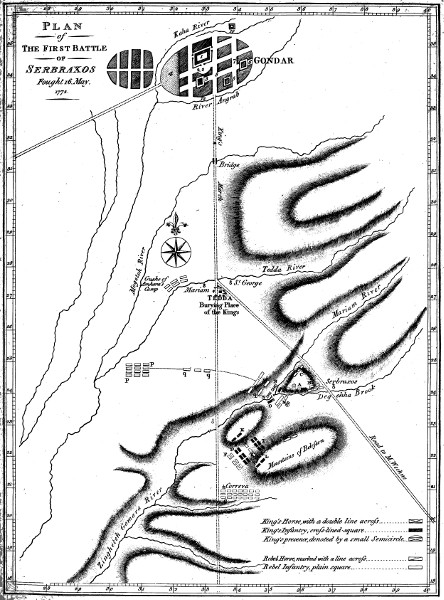
Plan —— of —— The First Battle —— OF —— Serbraxos Fought 16 May, 1772.
FIRST BATTLE.
Explanation.
1. King's palace and high walls surrounding it.
2. Ashoa, public place where the troops assemble, and gunpowder is sold, and where public executions are made.
3. Hamar Noh, Noah's Ark, a church.
4. A close quarter over a precipice on the West, to which the merchants carry their effects upon sudden revolutions, especially those that have flour and provisions.
5. Abbo, where the Romish priests were stoned and lye unburied.
6. Debra Berhan, famous church upon the highest part of the hill over the Angrab.
7. Riggobee Ber, or Pigeons Pass, a rocky part of the town, fortified in time of troubles.
8. Abbo, great street, called from the church and saint of that name.
9. Mahometan town on the river Kaha.
10. King's palace on the river Kaha.
11. Brook of St Raphael.
12. The river Angrab.
A The centre commanded by the king and Guebra Christos encamped on the South of the hill Serbraxos.
B Ras Michael, who leads the van, encamped upon the South-East, and highest part of the hill.
C Kefla Yasous, who commands the rear encamped upon the North-West.
D Ras Michael marching from his camp at Serbraxos, is stopt at the mouth of the valley, and engages Powussen and the troops of Begemder at E.
E The rebel troops of Begemder engaging Ras Michael.
F Ayto Engedan with a thousand men marches from the King's camp to reinforce Michael at the mouth of the valley.
G Powussen's camp at Correva.
H A reinforcement marches from Powussen's camp, and joins the rebels engaged with Michael at E.
I Ras Michael beat back into the valley, retires under cover of his musketry at K and L, which stop the rebels advancing.
M Kefla Yasous joins the king, marches to the head of the valley, wheels to the right, and faces to the westward.
N The king's horse upon the ford of the Mariam facing westward.
OO Two bodies of the king's musketry placed to defend the ford of the Mariam.
P Ayabdar's army encamped.
QQ Ayabdar's army marches from the camp, and halts a small distance from the king's horse at NN, but retreats to SS without attacking them. All but the Edjow Galla, who remain at T, and are all cut to pieces by the king's horse, and the musketry on the hill.
A long valley, having the mountains of Begemder on the south, or farthest end, was what the Ras had now entered, and he flattered himself, by a forced march, to arrive at those mountains. When once in Begemder, he knew that he not only should occasion a revolt among the troops of Powussen, (many of whom had followed him by force rather than inclination) but likewise he was assured that he should be met by many powerful noblemen and friends to the king, both of Lasta and Begemder, whom Powussen dared not force to follow him, and who had staid at home; by this means, he conceived his army would be so much increased that he soon should bring the rebels to reason.
The river Mariam runs along the west side of this valley, shallow, but brisk and clear, and the water excellent, while a small brook, called Deg-Ohha, (that is, the water of honour, or of worth) falling from the mountains on the east, runs close by the bottom of the hill of Serbraxos, where it joins the Mariam. The center of the army was just entering from the plain into the valley, and the king's horse passing Deg-Ohha, when we heard a firing in the front, which we guessed to be from the Fit-Auraris; soon after followed a repeated firing from the van, engaged about a short two miles distance, though a long even hill in the midst of the valley, and its windings, hindered us from seeing them.
Guebra Christos immediately made his disposition; he placed his horse, and foot in the intervals of the horse, in the middle of the valley; his musquetry on the right and left, the former upon the skirts of the hill already mentioned, to run along the valley; the latter up the skirts of the hill of Serbraxos. Orders very soon arrived from Ras Michael, which did not alter the disposition; and Kefla Yasous with the rear arriving at the same time, just joined and doubled the several posts as they had been taken; our position was to the utmost of our wish; but it had not been so with Michael, for he no sooner had got into the plain, where he had the hills no longer either on his right or left, than he was attacked by Powussen, with the whole force of Begemder, who cut off the troops of his Fit-Auraris to a man, he, and two or three common soldiers, only escaping. This was owing to Michael's retreating instead of supporting him; for he had scarcely given time for Powussen to come up with his horse, who fought more desperately than was their usual custom, than he himself again took possession of the entrance of the valley, and lined the hill on both sides with fire-arms. A very general and sharp fire from Guebra Mascal, and the musquetry, (who had occupied the south end of the long hill) soon obliged Powussen to leave Michael's cavalry, which he would else have inevitably destroyed, and shelter himself in the plain from the violent effect of the shot, which rained upon him alternately from the hills on each side of the valley.
At this time we were in the greatest anxiety, from the report of the musquets always coming nearer us, though, by the contrary winds, the smoke was carried from us. The day was far advanced, and excessively hot: the foot soldiers were busy in giving our horses drink out of our own helmets, which they filled from Deg-Ohha. All the troops were impatient, however, to come to an action upon that ground. At this time an officer from Michael came to Kefla Yasous, who was on horseback near the king, ordering him to send a body of fresh horse to support the cavalry of his division, with an intention, if possible, to bring on a general engagement. In the mean time he ordered Kefla Yasous to keep firm, as he then was, in the post of Serbraxos, and not to advance till he was sure that Gusho and Ayabdar had left their ground, joined Powussen, and were engaged with him at the south end of the valley. These instructions were perfectly understood by that sagacious and veteran general. He detached 500 Shoa, with near the same number of horse belonging to Engedan, and commanded by him, and these, joined to the cavalry already in the van, again attempting to pass the plain, were attacked by Powussen and the troops of Begemder, who had been likewise reinforced, and after an obstinate engagement they had retired into the mouth of the valley, not from being actually beaten, but by direction of Ras Michael, in order to bring the enemy pursuing them under the fire of the musquetry, on each side of the entrance of the valley.
I was exceedingly curious to have seen this engagement, and I begged Kefla Yasous to speak to the king to permit me to go singly with Engedan. To this, however, I had a flat refusal, not without some marks of peevishness and displeasure, which Kefla Yasous qualified by saying, "Don't be dismayed, you shall see;" and in that instant the word was given to march to the right, whilst the troops left the valley between the long hill and the mountains, and took post on the side of the river Mariam, with their faces fronting the west. The musquetry was placed upon the eminences to the north and south, as if to defend the ford of the river, thro' which the entrance was, to the north end of the valley. Michael, in the mean time, had, by the feigned retreat of his cavalry, decoyed the Begemder troops within reach of the musquetry, and they were again put in disorder by the discharge on each side of the hill, without being able to advance a step further; after which he ordered some tents to be pitched upon the hill on his right, as if intending to encamp there.
Kasmati Ayabdar, who commanded the left wing of the rebels, imagining that the whole army had advanced to the south of the valley with Ras Michael, thought this was an opportunity of surrounding the king's troops, and cutting them off from their camp and strong post upon the hill of Serbraxos; with this intention he advanced rapidly to the ford of the river Mariam, thinking to take post on the hill which was to our rear, being that of Serbraxos. When he advanced, however, near that river, and saw the king and his cavalry drawn up on the banks of it, his heart failed him, and he halted within a short quarter of a mile of our troops. In order to decoy and make him more confident, Kefla Yasous ordered the horse to retreat and cross the river as fast as they could, with an appearance of confusion, that he might draw their horse within reach of our musquetry planted upon every eminence. The king shewed great reluctance at this manœuvre, however wise. He repeated very peevishly, What is this! What is this! Am I retiring before rebels?—Neither did this stratagem succeed but in part, for Ayabdar, either distrusting the trap laid for him, or afraid to enter into an engagement with the king, advanced but a few paces, and again halted, apparently not decided what he was to do.
The Edjow Galla alone advanced to the very brink of the river, and when the musquetry began to be fired at them, which would probably quickly have put them into confusion, the king, losing all patience, ordered the black horse, and all the heavy-armed troops, to charge them, which was instantly executed with the greatest speed; the Galla were all borne down, with little or no resistance, by the length of our pikes, and the superior weight of our horses, and those that were not slain were scattered over the plain. But a greater misfortune befel us from our friends than from our enemies, as a volley of shot was poured upon us from Serbraxos hill, on the right hand, which killed seven men, notwithstanding their coats of mail. The king himself was in great danger, being in the middle of the engagement, and unarmed; young prince George, who fought by his side, was shot in the thumb of his left hand. Kefla Yasous, who saw the danger the king was in, riding about, holding out his hand and crying not to fire, was shot through the hair, the ball just grazing his head above the ear, and another wounding his horse just above his thigh, but so slightly, that it was afterwards extracted by a servant's fingers.
Ayabdar, after the loss of his Edjow Galla, retreated to the camp, amidst the curses and imprecations of the army, who, not informed of the king's strength, thought the war might have been ended by a proper exertion and perseverance in his part that day. Gusho his nephew, who had staid to guard the camp, but who had reinforced Powussen and Ayabdar each of them with a part of his troops, spoke of his uncle in the bitterest terms of reproach, continually calling him dotard and coward, and declaring him incapable of command or service. Whether this was really his opinion, or only said with a view of forwarding a scheme already laid, I will not say; but certainly it was the foundation of a quarrel which, by its consequences, did greatly weaken the rebels, and contributed much afterwards to maintain the king upon the throne; for Gusho, who, upon the defeat of Ras Michael, was destined by all parties to take the lead, was as lavish in praises of Powussen for his behaviour that day, as he was bitter in condemning his uncle, which created a violent misunderstanding between these two chiefs, insomuch that Asahel Woodage, with his troops of Maitsha, left Ayabdar, and joined Powussen. Confu, moreover, son of Basha Eusebius, and brother to Guebra Mehedin, who had frustrated my first attempt to discover the source of the Nile, endeavouring to promote a revolt among the troops of Foggora, to which he belonged, was put in irons by Ayabdar, from which he was but too soon released to meet, a few days afterwards, a fate that put an end to his profligacy and follies.
Powussen in this conflict had retreated, if not beaten, with a considerable loss; nine hundred of his best troops were said to have been slain that day, and a great many more wounded, most of whom (those I mean that had gun-shot wounds) died from the want of surgeons, and the ignorance of those who undertook to cure them. On the part of Michael about 300 men, all of the cavalry, were said to have perished that day, including the troops of Netcho the Fit-Auraris. Of the king's division about twenty-three were killed, seven of these being his guards, I believe mostly by the unfortunate fire of his troops, arising from his own impatience in attacking the Galla unadvisedly, of whom about sixty were left upon the field, all slain in the attack, for they were not pursued, but joined their main body immediately.
Ras Michael fell back upon the army, which had encamped on the hill of Serbraxos; and it now was believed more than before, that the fate of the empire was to be determined on that spot. Another thing, however, appeared plain, that whatever belief Michael pretended in the prophecy, he would not have preferred fighting at Serbraxos, if he could by any means have given the rebels the slip, and marched his army into Begemder. The king was exceedingly pleased at the part he had taken that day; it was the first time he was engaged in person, nor did any body venture to condemn it; he shewed, indeed, very little concern at his brother's wound, which was only a slight one in the fleshy part of his thumb, nor did the young prince trouble himself much about it; on the contrary, when I went to dress and bind it up, he said to me, I wish, Yagoube, the shot had carried the thumb off altogether, it would have made me incapable of succeeding to the throne, and they would not then send me to the hill of Wechné. The king, upon hearing this, said with a smile, George forgets that Hatzé Hannes, my father and his, was called to the throne many years after his whole hand had been cut off. Every one agreed that Ras Michael had that day shewn a degree of intrepidity and military skill superior to any thing which had appeared in many former engagements in which he had commanded. No sooner had he refreshed himself with a meal, than he called a council of his officers, which lasted great part of the evening, notwithstanding the fatigue he had undergone throughout the day.
This was the first battle of Serbraxos, which, though it contained nothing decisive, had still two very material consequences, as it so daunted the spirits of the Begemder horse, that many chiefs of that country withdrew their troops, and went home, whilst such discord was sown among the leaders, that I believe they never sincerely trusted one another afterwards; Gusho and Ayabdar, in particular, were known to correspond with the king daily.
On the morrow after the battle, three messengers arrived from Gusho, Powussen, and Ayabdar, and each had a separate audience of the King and Ras, before whom they all three severally declared, that their masters desired to continue in allegiance to him their king, Tecla Haimanout, but under this condition only, that Ras Michael should be sent to his government of Tigrè, never more to return. They endeavoured to persuade the king also to take the sense of his army, the majority of which, they asserted, were ready to abandon him. If Michael should agree to return to Tigrè, they offered to carry the king to Gondar, place him in his palace, and allow him to choose his own ministers, and govern for the future after his own ideas. This, indeed, was the universal wish, and I did not see what Ras Michael could have done, had he adopted it; but fear, or gratitude, or both, restrained the young king from such a measure; and the messengers left him after a plain declaration, That they had endeavoured all in their power to save him, and he must now abide the consequences, for they washed their hands of them.
The rains were now become more frequent, and an epidemical fever had shewn itself in the rebel army on the plain; every consideration, therefore, seemed to persuade a speedy decision, but the consequences of the last engagement seemed to have damped the spirit of the rebels, without having much raised that of the king's army. In fact, the days were dark and wet, and the nights cold, circumstances in which no Abyssinian chooses to fight. The army was thinly cloathed, or not cloathed at all, and encamped on high ground, where fuel, though it had not failed them yet, must soon have done so.
An accident that happened this night had nearly brought about a revolution which the wisest heads had laboured for many years in vain. Ras Michael had retired to bed at his ordinary time, somewhat before eleven o'clock, and a lamp was left burning as usual in his tent, for he was afraid of spirits. He was just fallen asleep, when he felt a man's arm reach into the bed over him, which he immediately seized hold of, crying to his attendants, at the same time, for help. Those that ran first into the tent threw down the lamp and put out the light, so that the man would have escaped, had not the people behind got about him, and endeavoured to hold him down, while entangled in, and struggling with the cords of the tent. The first person that seized him was a favourite servant of the Ras, a young man named Laeca Mariam, of a good family in Tigrè; he, not perceiving his danger for want of light, received a stab with a broad knife, which pierced his heart, so that he fell without speaking a word. Numbers immediately secured the assassin, who was found to have dropt one knife within the Ras's tent, with which he had attempted at first to have stabbed him: but he was found to have another knife, two-edged, and sharp in the point, fixed along his arm, with which he had stabbed Laeca Mariam. This wretch was a native of a very barbarous nation near Shoa, S. E. of Gojam. The name of their country is Guragué. They are Troglodytes, and all robbers: their constant occupation is attending the Abyssinian camps, and stealing horses, mules, or whatever they can get, which they do in a very singular manner.
They all wear their hair very short, strip themselves stark-naked, and besmear themselves from head to foot with butter, or some sort of grease, whilst, along the outside of their arm, they tye a long, straight, two-edged, sharp-pointed knife, the handle reaching into the palm of their hand, and about four inches of the blade above the knob of their elbow, so that the whole blade is safe and inoffensive when the arm is extended, but when it is bent, about four inches projects, and is bare beyond the elbow joint; this being all prepared, they take a leafy faggot, such as the gatherers of fuel bring to the camp, which they fasten to their middle by a string or withy, spreading it over to conceal or cover all their back, and then drawing in their legs, they lie down, in all appearance, as a faggot, and in the part of the camp they intend to rob, crawling slowly in the dark when they think they are unperceived, and lying still when there is any noise or movement near them: In case they find themselves discovered, they slip the faggot and run; and whatever part of them you seize escapes your fingers by reason of the grease. If you endeavour to clasp them, however, which is the only way left, the Guragué bends his elbow and strikes you with his knife, and you are mortally wounded, as was the case with Laeca Mariam.
This assassin was no sooner secured and disarmed, than a noose, with a running knot, was slipt round his neck, and his hands tied behind his back, in which manner he was carried before Ras Michael, who sat upon a stool at some distance from his tent, after every part of it had been searched. The fellow at first refused to speak, but, being threatened with torture, answered, in his own language, which I did not understand. He was asked, who had employed him to attempt that assassination? He said, The rebels; and named Gusho and Powussen: he then varied, and said the Iteghé employed him. Before he was sent away he contradicted all this, and declared, that Hagos, his brother, had employed him; and that he was then actually in the camp, with four others, who were determined to murder the Ras and Guebra Mascal, whatever it should cost them.
A search was on this ordered through all the camp, but no stranger found, excepting one of the same nation, who had planted himself and his faggot near the tent of the Abuna; and who being seized, examined, and promised pardon, declared himself absolutely ignorant of any scheme but robbing, for which purpose three of them, he said, had come into the camp together; one of them had stolen two mules the night before, and gone off, and that he was that night intending to take away two of the Abuna's mules; and he supposed his companion had the same intention with regard to the Ras; but as to murder, or any other plot, he knew nothing of it. Being put slightly to the torture, he persisted in his declaration; and when interrogated, declared, that they all three had come from Guragué with Amha Yasous, to load and unload his baggage, and take care of his beasts: that none of them had been at Gondar before the attempt, except the assassin, who had formerly lived there some years, but whether with Hagos, or any other, he did not know, nor did he ever hear him pronounce the name of Hagos, nor see any stranger, whom he did not know, converse with him: that they all three had lain the last night at the church of Serbraxos: but he further declared, that the person apprehended spoke the Amharic language as well as his own, contrary to what the villain had all along pretended.
This declaration, which I heard from the king's secretary, word for word as it was given, threw all the council into great confusion, the more so, that, being gently talked to, and food given him after his examination, at night the assassin had again repeated what he before said about Gusho, and that Fasil, too, was accessory to the attempt. And what made this labyrinth of lies still more intricate was, that it was certainly known that Hagos, his brother, had constantly lived with Coque Abou Barea, in Kuara, from the time Ras Michael had put his brother to death at Gondar. It was intended therefore to try the effect of further torture in the morning, to make him confess the truth. His guard, however, having fallen asleep, or gone out of the tent, he was found strangled by the running noose that was left round his neck; nor was any further light ever thrown upon this affair at any time after; but it was generally believed the attempt had been made at the instigation of some connection of the Iteghé, and there were some who went so far as to name Welleta Israel.
Early in the morning some priests came from Powussen, Ayabdar, and Gusho, to take the most solemn oaths before the Abuna, that they never had the smallest knowledge of what the assassin had laid to their charge; and they took upon themselves sentence of excommunication, which the Abuna then pronounced conditionally, if they had directly, or indirectly, been principal or accessory, or known, or been consulted, in any manner whatever, as to the designs of that assassin. Several principal officers of the rebels, moreover, who had left Gondar and gone over to Fasil, and who were there in Gusho's camp, came over to congratulate with Ras Michael upon his escape, so that, for a moment, one would have thought the whole country interested in saving him whom all were actually in arms at that instant to destroy. What surprised me most of all, probable as the thing might seem to be, not one man in the camp, from the Ras and King downward, seemed to think that this attempt of the Guragué had been in any shape the plot of the rebels; and yet, in old times, murder by treason must have been very frequent in his kingdom, as appears by their customs preserved to this day; no person, be their station, connection, or friendship what it will, can offer any one meat or drink without tasting it before them.
Proposals of peace followed this friendly intercourse, but the condition being always that Michael should depart to Tigrè, which he thought was but in other terms a proposal to destroy him, these friendly overtures ended in defiance and protestation, That to him alone was owing the effusion of human blood, and the ruin of his country, which was immediately to follow.
It was the 17th of May, at night, the attempt had been made on the Ras's life; and the 18th was spent in excommunication before the Abuna; and, in the evening, Michael received intelligence, that Ayto Tesfos, from the mountains of Samen, and Heraclius and Samuel Mammo, from Walkayt and Tzegadé, were both preparing to join the rebels with a considerable force. We were now arrived at the fatal field of Serbraxos, as we had endeavoured to pass it, but in vain; nothing now remained but to try to find which side the devil (the father of lies) had been forced to tell the truth, or whether he had yet told it to either. Darion, a principal man of Belessen, and Guigarr of Lasta, joined the Ras's army about noon, bringing with them 1200 men, chiefly horsemen, good troops, and they were joyfully received.
A council was held with all the great officers that evening, and the order of battle fixed upon for next day. Kefla Yasous, with the best of the foot from Tigrè, with the king's household troops, the Shoa horse, and the Moors of Ras el Feel, with their libds, (in all not amounting to 10,000 men, but the flower of the army) composed the left wing, in the center of which was the king in person, the heavy-armed black horse before him, and the officers and nobility surrounding him: Guebra Christos, and Kasmati Tesfos of Siré, commanded the center, in which was Darion and Guigarr's cavalry, for the Lasta men, though of different sides, could never be prevailed upon to fight against one another, so instead of being with the king against Begemder and Lasta, they were placed in the center against Gusho and Amhara. The right of the king's army was commanded by Welleta Michael and Billetana Gueta Tecla, opposed to the left wing of the rebels under Kasmati Ayabdar, who had lately received large reinforcements from Gojam, by means of the Iteghé, who well knew him to be an inveterate enemy to Ras Michael, and one who would never make peace with him.
I have often heard it observed by officers of skill and experience, that nothing is more difficult to describe than a battle, and that as many descriptions as are given of it, they generally disagree, and seem as many different battles. To this I shall add, that I find as great difficulty in giving an idea of the ground on which a battle was fought, which perhaps is not the case with professional men; and though I describe nothing but what I saw, and what my horse passed over, still I very much doubt if I can make myself intelligible to my readers. The hill of Serbraxos was neither very high nor steep, unless on the north and east, where it was almost a precipice. It was not a mountain joined with others, as the bed of a torrent, that ran very rapidly from Belessen south of Mariam-Ohha, divided it from these mountains. The west side of it sloped gently to a large plain, which extended to the brink of the lake Tzana, and upon this our rear was encamped. The S. W. side of this hill was like the former, and about half a mile from it came an elbow of the river Mariam, so called from a church in the plain: on this side of the hill our center was encamped with the king, Abuna, and the princesses; whilst on the south face (which looked down a valley) was Ras Michael and the van of the army: the hill here was considerably steeper, and I have already said ended with the precipice on the north. Along the bottom of this south face of the hill lay the small stream called Deg-Ohha, which stood in pools, and was the safest and readiest supply for the army, as being perfectly under command of our musquets, where our horses could water without danger: immediately south from this ran a valley full half a mile broad, which ended in a large plain about two miles off.
The valley where Michael and the van first engaged, was formed by the hills of Belessen on the east, and the river Mariam on the west, and near the middle of the valley there was a low and flat-topt hill, not above 30 yards in height, which did not join with the hill of Serbraxos. Between them there was an opening of about 100 yards, through which ran Deg-Ohha, to the ford of the river Mariam, from which you ascended in a direction nearly N. W. up into the plain which reached to the lake Tzana. On the south end of this hill, as I have said, which might have been about two miles in length, the banks of the Mariam are very high, and the river stands in large deep pools, with banks of sand between them. Where this hill ends to the right is another ford of the river Mariam, where a deep and narrow sandy road goes winding up the banks, in a direction N. W. like the former, and leads to the same plain bordering on the lake Tzana: so that the plain of the valley where the Mariam runs, which is bordered by the foot of the mountains of Belessen, and continues along the plain south to Tangouré, is near 200 feet lower than the plain that extends on the side of the lake Tzana. Nor is there a convenient access from the plain to the valley, at least that I saw, by reason of the height and steepness of the banks of the Mariam, excepting these two already mentioned; one between the extremity of the long even hill, and slope of the mountain on the north, and the other on the south, through the winding sandy road up the steep banks of the river, by the south end of that low hill, as I have already said. At these two places are the two fords of the river, which continue passable even in the rainy season, and the water at that time stands in pools below it, till several miles further it joins the Zingetch Gomara, a larger stream than itself, whose banks are low, and where the stream is fordable also; but the banks of the river Mariam continue steep, and run in a southern direction. In this valley, at the south end of this hill near the ford was the engagement between Michael with the van, and the Begemder troops, on the 16th; at the ford on the north end of this hill, in the same valley, was the fight between the light troops and Kasmati Ayabdar, and the king in person, the very same day; so that the valley was perfectly known by the enemy, and as they had few or no musquetry, was wisely considered as not fit ground for their purposes being narrow and commanded by hills everywhere.
On the 19th of May, word was brought that the whole rebel army was in motion, and before eight o'clock (reckoned in Abyssinia an early hour for such business) a great cloud of dust was seen rising on the right of the rebels towards Korreva, and this was the moment the Begemder troops got on horseback in the dusty plain; soon after we heard their kettle-drums, and about nine o'clock we saw the whole troops of Begemder appear, drawn up at such a distance in the plain, above the road up the steep bank of the Mariam, as to leave great room for us to form with the road on our left, and a little on our rear; Michael easily divined Powussen's intention, which was to beat us back by a superior force of horse, and then making a number of troops glide below unseen, along the river in the valley, take possession of the round hill, at the north ford of Mariam, and cut off our retreat to our camp at Serbraxos; the Ras immediately dispatched some single horsemen to take a view of the enemy more nearly, and report what their numbers were, and where Gusho and Ayabdar were posted, for we could distinguish the colour of the horses, and all the movements of the Begemder troops, not being much above three miles distance, yet we did not know whether they were alone, or whether one or more of the other generals were with them: we saw indeed Powussen's standards, but they were so weather-beaten and faded, that we could not distinguish their real colours, which were blue and yellow.
The king's whole army was descending into the valley, and passing over the ford of the Mariam, to the plain above where Kefla Yasous was riding to and fro with great earnestness, encouraging his troops. In a very short time the left was formed; the Ras, having given all his orders, and taken to himself the charge of the camp and the reserve, sat down, as was usual, to play at drafts with the black servants. The army was now all in the plain, when the scouts arrived, and brought word that Gusho and Ayabdar had both taken their ground, not directly in a straight line from Powussen, square with the lake, but as it were diagonally declining more to the southward, so that the most advanced, or nearest to us, were the troops of Begemder; and this was probably done, in order that, our backs being more turned to the lake, we might be easier cut off from our camp, and surrounded in the plain, between their army and the Tzana, if Powussen was so fortunate as to beat the king and the left; but this disposition of these troops was out of our sight, being down nearer the lake. Nor is it to be understood that I mean here to give any account of their movements, or of any other, unless those of the left wing under the king, where I was myself engaged.
Several spies came into Ras Michael at this time, and they, and the horsemen that had been sent on the service, all agreed, that in the center of the Begemder horse a large red standard was displayed, with a number of kettle drums beating before it, which the Ras no sooner heard, than giving his draft board a kick with his foot, he overturned the whole game, and afforded, at least, a bad omen of the future engagement. He then called for Kefla Yasous, and Guebra Mascal, and having conferred with them both, he detatched Guebra Mascal with five hundred musqueteers to take possession of the hill in the valley below, and coast along the left flank of our left without appearing in sight.
The day had been exceeding close, seeming to threaten violent thunder, and we were now come so near as to see distinctly the large red standard, which being pointed out to the king, he said, smiling with a very chearful countenance, "Aye, aye, now we shall soon see what miracle king Theodorus will work." The clouds had been gathering ever since we went down the hill, and some big drops of rain had fallen. The soldiers were now covering their lighted matches, for fear of more, when first a most violent storm of thunder, lightening, and rain began, then a tempest of rain and wind, and last a dead calm, with such a heavy shower that I scarce ever saw the like even in the rainy season.
Had I been commander of the Begemder troops that day, this shower should have been the signal of charging; for all the king's fire-arms were useless, and the matches wet; but the Begemder horse seemed most uneasy under the fall of rain; they began to be unmanageable, and turn tail to the wind, which now arose and was directly in their faces, and in a few minutes they wheeled about, and retired to their camp. The king halted on the ground where he was, ordered the kettle-drums to beat, and the trumpets to sound; and having continued half an hour till the heavy shower began, he fell back as did the whole army, and retired to the camp. When he got up the hill, and passed the brow where Ras Michael was sitting with some slaves, who held up a piece of sail-cloth over his head to keep off the rain, the servants raised the Ras upon his feet; without any previous salutation, he then asked the king what he had done with king Theodorus? and was answered, "Begemder brought him, and Begemder took him away, we saw nothing but his flag." Lasta carried his flag, says one of the nobility. He is a peaceable prince, says the king; yet he begins with fighting, but he will make amends afterwards, if he governs this country in peace a thousand years. If he does that, says the Ras, Powussen is to die at the next battle, for the thousand years peace will never begin, as long as he is alive.
CHAP. VII. King offers Battle to the Rebels in the Plain—Description of the Second Battle of Serbraxos—Rash Conduct, and narrow Escape of the King—Both Armies keep the Ground.
The whole evening of the 19th of May was spent in festivity and joy; a prophet from some part in Dembea had foretold the defeat of king Theodorus, and what was much more interesting, two large droves of cattle, the one from Belessen, near Mariam-Ohha, the other from Dembea, were driven that day into the camp. Ras Michael, who knew the value of to-morrow, spared nothing that might refresh the troops this day. The king and he, Ozoro Esther, and Ozoro Altash, Kefla Yasous, and the Abuna himself, gave each of them entertainments to the principal officers of the army, and all those who were likely to bear the burden of the ensuing conflict. The soldiers were in great spirit, but it was now very generally known that the officers were mostly disaffected, engaged in private treaties, and in daily expectation of peace.
A very short council was held at the king's tent; all that could be resolved upon had been already fixed the day before, and little had happened since to occasion any alteration. All the young nobility were, as usual, at Ozoro Esther's. It was with infinite pity I heard them thoughtlessly praying for a warm and fair day to-morrow, the evening of which many of them were never to see.
Besides the stores that Ozoro Esther always was provided with, the king had sent her two live cattle, wine, brandy, and hydromel; and what was a very unusual condescension, the Ras, immediately after council, came into the tent, and brought with him a fresh supply. He was very gracious and affable, said a number of kind things to everybody, and asked me particularly how we drank in England?
I explained to him as well as I could the nature of our toasts, and drinking to the health of our mistresses by their names in bumpers; that our soldiers toasts on such a night as that, if the general honoured them as he did us now with his company, would be, A fair morning, and speedy sight of our enemy. He comprehended it all very easily, and when I saw he did so, I asked if I should give my toast? and he and all the company joining in a loud cry of approbation, I filled a horn with wine, and standing up, for he had forced us all to be seated, I drank, Long life to the king, health, happiness, and victory, to you, Sir, and a speedy sight of king Theodorus. A violent shout of applause followed. He himself (the soberest of men) would drink his horn full, which he did, with many interruptions from immoderate fits of laughter; the horn went quickly round, and I ventured to prophecy, that, in the thousand years he is to reign, Theodorus will never again be so chearfully toasted.
The Ras then turning to me said, I wish I had 5000 of your countrymen, Yagoube, to-morrow, such as you are, or such as you have described them. I answered. Would you had one thousand, and I had twenty lives staked upon the issue. Ayto Engedan upon this got up, and passing across the tent in a very graceful manner, kissed the Ras's hand, saying, Do not make us think you undervalue, or distrust your children, by forming such a wish: Yagoube is one of us, he is our brother, and he shall see and judge to-morrow, if we, your own sons, are not able to fight your battle without the aid of any foreigners. Tears, on this, came into the old man's eyes, who took Engedan in his arms, and kissed him; then recommending to us not to sit up late, he withdrew. A great deal of buffoonery followed about toasts, and soon after arrived two officers from the king, desiring to know what was the reason of that violent outcry? by which he meant the shout when we drank the toast. Ozoro Esther answered, We were all turned traitors, and were drinking the health of king Theodorus. But it was afterwards thought proper to explain the whole matter before the messengers went back, and make them drink the toast also.
Tecla Mariam had not spoken much, her father having sent for her at that time to the king. Before she departed, I begged Ozoro Esther to apologise for me, that I had absented myself, and had not waited upon her in the morning. I intreated her to continue her kind partiality to me the next day, and to judge for ever of the esteem I had for her by my then behaviour. She promised to do so with the utmost complacency and sweetness, and departed.