CONTENTS OF THE SECOND VOLUME.
Reading edition
CHAPTER XIX.
Departure for Timbuctoo on the 13th of March — Description of the banks of the river — Slaves released from their chains — Populous villages — Vessels of from sixty to eighty tons burthen — Branch of the river forming a large island — Mode of building canoes — Villages of Banan — Character of the Mandingoes — Description of Lake Debo — Islands called St. Charles, Henry, and Maria-Theresa.
CHAPTER XX.
Tongom, a village in the country of the Dirimans — Co — Do — Sa, a commercial port — Mercantile flotillas — The Soorgoos or Tooariks, a nomadic and predatory tribe — Baraconga — Lelel — Garfola — Filinsa — Baracondié — Tircy — Liquor made from the kondoo — Alcodia, the Diriman capital — Customs of the inhabitants — Salacoila — Cora — Coratoo — Separation of the river into two branches — Arrival at Cabra, the port of Timbuctoo — Description of the place.
CHAPTER XXI.
Journey from Cabra to Timbuctoo — First view of the city — The Kissoors — The king grants the traveller an audience — Condition of the slaves — Description of the city, its buildings, extent, and commerce — Food and dress of the people — Bousbéhey, a city of the Zawats — Toudeyni — Tribe of Salah — Terror inspired by the Tooariks — Description of that tribe — The Jinbalas — Particulars respecting the fate of Major Laing — Reflexions on the means of penetrating to the centre of Africa.
CHAPTER XXII.
Departure from Timbuctoo on the 4th of May, 1828 — Caravan of six hundred camels — Entrance of the desert — Suffocating heat — The caravan falls in with the Tooariks — Manner in which the Arabs direct their course in the desert — Aspect of Sahara, like the bed of a sea without water — Details respecting the caravans — The place where Major Laing was assassinated — El-Arawan, a city in the desert: its springs, population, and trade — Information respecting Tawât and Walet — Caravan of four hundred camels — Disheartening effect of the view of endless sands.
CHAPTER XXIII.
Violence of the east winds — Pillars of sand — Scarcity of water — Deplorable situation of the caravan — Hills of loose sand — Rocks of granite — Wells of Telig — Toudeyni, rich salt mines — Thistle of the desert — Vexations and persecutions of the Moors, their intolerance — Wells of Cramès — Wells of Trases or Trarzas — Trajacant Moors.
CHAPTER XXIV.
Wells of Amoul-Gragin — Enormous serpents — High sand-hills called Helk — Wells of Amoul-Taf — Hills of various-coloured granite — Wells of el-Ekseif; very good water — Wells called Marabouty, el-Guedea, Mayara, and Sibicia — High and steep mountains, defiles and precipices — A severe fall — Encampment of Sidi-Aly — El-Harib — The Berbers. Tatta — Description of the country at el-Harib, customs; the tribes who inhabit it.
CHAPTER XXV.
Country of el-Drah — Zawât — el-Hamid — Bounou — Town of Mimcina — Camp of Berbers — Tabelbât — The Tawâts — Wells of Yeneguedel, of Faratissa, of Bohayara — Customs of the Berbers — Wells of Goud-Zenaga, of Zenatyia — Town of el-Yabo — Wells of Chanerou, of Nyela — Arrival at Tafilet — Town of Ghourland — Market — Ressaut, the residence of a Governor under the Emperor of Morocco.
CHAPTER XXVI.
Description of Tafilet and its commerce — Flourishing state of agriculture and industry — Miserable condition of the Jews; their habits and customs — Afilé — Gardens — Taneyara, Marca, M’Dyara, Rahaba — Chains of granite mountains — Small river of Guigo — L’Eyarac, Tamaroc, Kars, Ain-Zeland, L’Eksebi — Very high mountains covered with cork-trees — L’Quin — Guigo — Town of Soforo — Town of el-Fez, or Fez, the ancient capital of Morocco.
CHAPTER XXVII.
Description of el-Fez — Markets, monuments, gardens, police — Mequinaz — Inhospitality — Arm of the sea called Sbo — Arbata or Rabata or Rabat, the ancient Sallee — Visit to the Consular Agent — The traveller avoids the camp of the Emperor of Morocco — Writes to the Vice Consul M. Delaporte — Larache — Arrives at Tangier 7th of September, almost dying, emaciated by want, fatigue, and fever — Generous reception of M. Delaporte — Anxiety of the traveller — Is introduced by night and concealed by the Consul — M. Delaporte obtains from the naval commander of the Cadiz station a vessel to convey him to France.
GEOGRAPHICAL REMARKS AND INQUIRIES.
CHAPTER I.
§ I.—General retrospect of the published information on this subject prior to M. Caillié’s travels.
§ II.—Analysis of the itinerary map, and of the general map of the travels.
ARTICLE I.
Early travels of M. Caillié.
ARTICLE II.
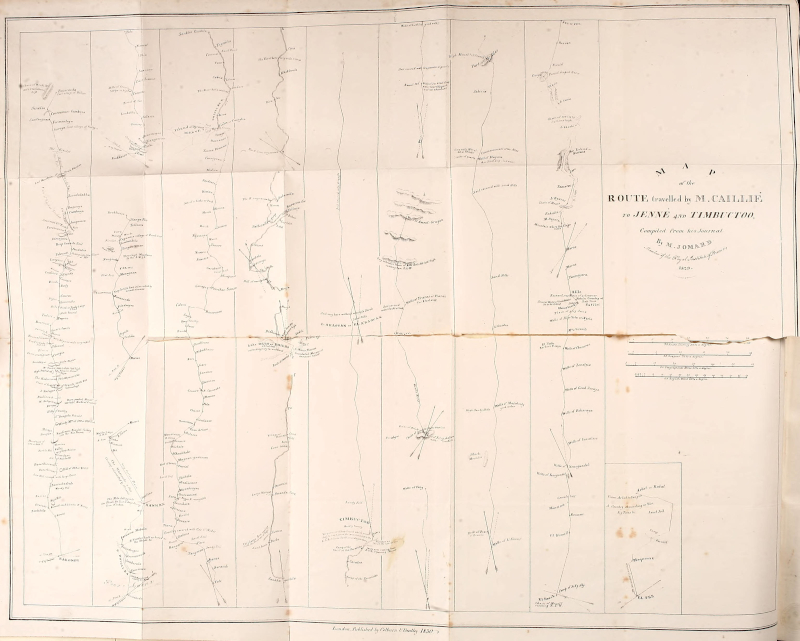
Map of the traveller’s route.
First part of the journey.
Second part of the travels.
Observations on the course of the Dhioliba as traced from Couroussa to Sego and Djenné.
Third part of the travels.
ARTICLE III.
Remarks on the general map of the travels and the elements which serve for its basis.
Observations on the situation of Timbuctoo, and particularly on its longitude.
Bearings of M. Caillié’s routes.
Computation of the days’ journeys.
§ III.—Of the nomenclature.
§ IV.—Of some results of the travels of M. Caillié.
§ V.—Of the course of the Dhioliba above and below Timbuctoo.
CHAPTER II.
VOCABULARIES COLLECTED BY M. CAILLIÉ.
English and Mandingo vocabulary.
Kissour vocabulary.
Observations on the vocabularies.
CHAPTER III.
M. Caillié’s Itinerary.
CHAPTER IV.
Explanation of the plates.
Miscellaneous notes.
CHAPTER V.
Documents and miscellaneous papers.
Correspondence.
(Higher-res)
MAP of the ROUTE travelled by M. CAILLIE TO JENNÉ AND TIMBUCTOO, Compiled from his Journal By M. JOMARD Member of the Royal Institute of France 1829