Chapter XXI
Reading edition
Journey from Cabra to Timbuctoo — First view of the city — The Kissoors — The king grants the traveller an audience — Condition of the slaves — Description of the city, its buildings, extent, and commerce — Food and dress of the people — Bousbéhey, a city of the Zawats — Toudeyni — Tribe of Salah — Terror inspired by the Tooariks — Description of that tribe — The Ginbulas — Particulars respecting the fate of Major Laing — Reflexions on the means of penetrating to the centre of Africa.
On the 20th of April, at half past three, I set out for Timbuctoo, escorted by Sidi-Abdallah Chebir’s slaves. Our road lay northward. The slaves who had been on board our canoe also accompanied us, so that we formed a numerous caravan. The youngest slaves were mounted upon asses, as the road is very sandy and wearisome. Near Cabra we passed two lakes, the banks of which were overgrown with mimosas from five to six feet high. A little further the eye was refreshed by some signs of vegetation. The country presented the same scenery until we had proceeded half way on our journey, and then it began to be more naked, and the sand becoming exceedingly loose, rendered travelling very difficult. On the road we were followed by a Tooarik, mounted on a superb horse. This marauder, who appeared to be about fifty years of age, shewed a disposition to appropriate to himself a young negro slave. Sidi-Abdallah Chebir’s men represented to him that the slave belonged to their master, and that if, on arriving at the city, he would pay him a visit, he would doubtless receive a present. This appeared to satisfy him, and he ceased to molest us. He eyed me narrowly, and several times inquired who I was, and whence I came. They told him I was poor, and he relinquished the hope of getting any thing from me.
At length, we arrived safely at Timbuctoo, just as the sun was touching the horizon. I now saw this capital of the Soudan, to reach which had so long been the object of my wishes. On entering this mysterious city, which is an object of curiosity and research to the civilised nations of Europe, I experienced an indescribable satisfaction. I never before felt a similar emotion and my transport was extreme. I was obliged, however to restrain my feelings, and to God alone did I confide my joy. With what gratitude did I return thanks to Heaven, for the happy result which attended my enterprise! How many grateful thanksgivings did I pour forth for the protection which God had vouchsafed to me, amidst obstacles and dangers which appeared insurmountable. This duty being ended, I looked around and found that the sight before me, did not answer my expectations. I had formed a totally different idea of the grandeur and wealth of Timbuctoo. The city presented, at first view, nothing but a mass of ill-looking houses, built of earth. Nothing was to be seen in all directions but immense plains of quicksand of a yellowish white colour. The sky was a pale red as far as the horizon: all nature wore a dreary aspect, and the most profound silence prevailed; not even the warbling of a bird was to be heard. Still, though I cannot account for the impression, there was something imposing in the aspect of a great city, raised in the midst of sands, and the difficulties surmounted by its founders cannot fail to excite admiration. I am inclined to think, that formerly the river flowed close to Timbuctoo; though at present it is eight miles to the north of that city, and five miles from Cabra, in the same direction.
I took up my abode with Sidi-Abdallahi, who received me in the most friendly manner. He had already been indirectly acquainted with the alleged circumstances, which, as I pretended, had occasioned my journey across the Soudan. He invited me to sup with him; and an excellent couscous of millet and mutton was served up. Six of us partook of the dish, and we ate with our fingers; but in as cleanly a way as was possible under such circumstances. Sidi-Abdallahi, according to the custom of his countrymen, did not say a word to me. He was a mild, quiet, reserved man. His age might be about forty or forty-five. He was five feet high, stout and pitted with the small-pox. His countenance was pleasing, his manners grave, and rather dignified. He had no fault but his religious fanaticism.
After bidding my host good night, I went to repose upon a mat which was spread upon the ground in my new lodging. At Timbuctoo the nights are as hot as the days, and I could get no rest in the chamber which had been prepared for me. I removed to the court adjoining the house, but still found it impossible to sleep. The heat was oppressive; not a breath of air freshened the atmosphere. In the whole course of my travels I never found myself more uncomfortable.
On the morning of the 21st of April, I went to pay my respects to my host, who received me with affability; afterwards I took a turn round the city. I found it neither so large nor so populous as I had expected. Its commerce is not so considerable as fame has reported. There was not as at Jenné, a concourse of strangers from all parts of the Soudan. I saw in the streets of Timbuctoo only the camels, which had arrived from Cabra laden with the merchandise of the flotilla, a few groups of the inhabitants sitting on mats, conversing together, and Moors lying asleep in the shade before their doors. In a word, every thing had a dull appearance.
I was surprised at the inactivity, I may even say, indolence, displayed in the city. Some colat-nut venders were crying their goods in the streets, as at Jenné.
About four in the afternoon, when the heat had diminished, I saw several negro traders, all well clothed and mounted on good horses richly harnessed, go out to ride. Prudence forbids them to venture far from the city, for fear of the Tooariks, who would make them pay dearly for their excursions.
In consequence of the oppressive heat the market is not held until three in the afternoon. There were few strangers to be seen except the Moors of the neighbouring tribe of Zawât, who often come hither; but in comparison with Jenné, the market is a desert.
At Timbuctoo, it is very unusual to see any other merchandise except what is brought by the vessels and a few articles from Europe, such as glass wares, amber, coral, sulphur, paper, &c.
I saw three shops kept in small rooms, well stored with stuffs of European manufacture. The merchants put out at their doors cakes of salt for sale, but they never exhibit them in the market. Such as do business at the market have stalls made of stakes covered with mats, to protect them against the heat of the sun. My host Sidi-Abdallahi was obliging enough to shew me over one of his magazines in which he stowed his European merchandise. I observed there many double-barrel guns, with the mark of Saint-Etienne, and other manufactories. In general French muskets are much prized, and sell at a higher rate than those of other nations. I also saw some beautiful elephants’ teeth. My host told me that he procured some from Jenné, but the larger ones had been bought at Timbuctoo; they are brought hither by the Tooariks or Soorgoos, the Kissoors, and the Dirimans, who inhabit the banks of the river. They do not hunt the elephant with fire-arms, but catch it in snares. I regret having never seen one of these animals caught.
On the 22nd of April, Sidi-Mbark, to whom I had made a present of a piece of cloth with the view of gaining his friendship, told me he should have a caravan ready in two days to go to Tafilet, and that I must hold myself prepared to accompany him to the great desert. This information vexed me, for I was not disposed to quit Timbuctoo so soon. I did not, however, lose all hope of prolonging my stay in that city.
In the evening I mentioned Mbark’s proposition to my host, adding that I was greatly fatigued by the long journey I had performed on foot, and that I wished to rest at Timbuctoo for about a fortnight, after which I would avail myself of the first caravan that might depart. I had scarcely expressed this wish, when he interrupted me, saying in the kindest manner: “You may remain here longer than a fortnight, if you please. You will gratify me by so doing; you shall want for nothing.” I gratefully thanked him for his generous hospitality. Shortly after I had another instance of his kindness, for which I was very grateful. He had at first given me a chamber to myself; but the Mandingo negro by whom I had been so ill treated on board the canoe, on his arrival in Timbuctoo, quartered himself and his female slave in my apartment. I bore this patiently for some days; but the presence of the intruders prevented me from taking my notes which I could only do in secret. I mentioned to Sidi-Abdallahi that I should prefer being alone; and, after reprimanding the negro, he lodged me in another house belonging to him, which was near the marketplace and opposite to that which had been occupied by Major Laing, the street only intervening between them.
Often, when seated before my door, I thought of the fate of that unfortunate traveller, who, after surmounting numberless dangers and privations, was cruelly assassinated when on the eve of returning to his country. In the course of these reflections I could not repress a feeling of apprehension, lest, should I be discovered, I might be doomed to a fate more horrible than death—to slavery! But I determined to act with caution, and not to afford any ground for suspicion.
I found myself much more comfortable in my new lodging. Sidi-Abdallahi my host had directed a mat to be spread in my chamber, of which he gave me the key. The slaves who lived in the house were ordered to wait on me, and they brought me twice a day couscous and rice seasoned with beef or mutton.
The city of Timbuctoo is principally inhabited by negroes of the Kissoor nation. Many Moors also reside there. They are engaged in trade, and, like Europeans, who repair to the colonies in the hope of making their fortunes, they usually return to their own country to enjoy the fruits of their industry. They have considerable influence over the native inhabitants of Timbuctoo, whose king or governor is a negro. This prince, who is named Osman, is much respected by his subjects. He is very simple in his manners: his dress is like that of the Moors of Morocco; and his house is no better furnished than those of the Moorish merchants. He is himself a merchant, and his sons trade with Jenné. He inherited a considerable fortune from his ancestors, and is very rich. He has four wives, besides an infinite number of slaves, and is a zealous Mahometan.
The sovereignty is hereditary, descending to the eldest son. The king does not levy any tribute on his subjects or on foreign merchants, but he receives presents. There is no regular government. The king is like a father ruling his children. He is mild and just, and has nothing to fear from his subjects. The whole community, indeed, exhibits the amiable and simple manners of the patriarchs. In case of war, all are ready to serve; but the mild and inoffensive manners of these people afford little ground for quarrels, and when they arise the natives of Timbuctoo repair to their chief, who assembles a council of the elders, all of whom are blacks. Though the Moors are not permitted to take part in these councils, yet my host Sidi-Abdallahi, the friend of Osman, was sometimes allowed to be present at them. The Moors acknowledge a superior among themselves; but they are, nevertheless, amenable to the authorities of the country. I requested my host to present me to the king, which, with his usual good-nature he consented to do.
The prince received me in the midst of his court. He was seated on a beautiful mat with a rich cushion. We seated ourselves for a few moments at a little distance from him. Sidi-Abdallahi, after briefly relating my adventures, told him that I wished to pay my respects to him. I could not understand their conversation, for they spoke in the language of the Kissoors. The king afterwards addressed me in Arabic, asking some questions about the christians, and the manner in which they had treated me. After a short time we took our leave: I wished to have seen the interior of the house, but my curiosity could not be gratified. The king appeared to be of an exceedingly amiable disposition; his age might be about fifty-five, and his hair was white and curly. He was of the middling height, and his colour was jet black. He had an aquiline nose, thin lips, a grey beard, and large eyes, and his whole countenance was pleasing; his dress, like those of the Moors, was composed of stuff of European manufacture. On his head was a red cap, bound round with a large piece of muslin in the form of a turban. His shoes were of morocco, shaped like our morning slippers, and made in the country. He often visited the mosque.
There are, as I have already mentioned, many Moors in Timbuctoo, and they occupy the finest houses in the city. They very soon become rich in trade, and they receive consignments of merchandise from Adrar, Tafilet, Tawât, Ardamas, Tripoli, Tunis, and Algiers. They receive from Europe tobacco and other articles, which they send by canoes to Jenné and elsewhere. Timbuctoo may be regarded as the principal entrepôt of this part of Africa. All the salt obtained from the mines of Toudeyni, is brought hither on camels. The Moors of Morocco and other countries who travel to the Soudan, remain six or eight months at Timbuctoo to sell their goods, and get their camels re-laden.
The cakes of salt are tied together with cords, made of a sort of grass which grows in the neighbourhood of Tandaye. This grass is dry when gathered; but it is afterwards moistened, and then buried under ground to keep it from the sun and the east wind, which would dry it too rapidly. When sufficiently impregnated with moisture, it is taken out of the earth and platted into cord, which the Moors use for various purposes. The camels frequently throw their loads off their backs, and when the cakes of salt arrive in the town they are frequently broken. This would spoil their sale, if the merchants did not take the precaution of making the slaves join them together again. When the pieces are fastened together, the cakes are packed up again with a stronger kind of cord made of bull’s hide. The cakes are ornamented with little designs, such as stripes, lozenges, &c., traced in black. The slaves are very fond of executing these ornaments, an employment which enables them to collect a little supply of salt for their own use. In general, the slaves are better treated at Timbuctoo than in other countries. They are well clothed and fed, and seldom beaten. They are required to observe religious duties, which they do very punctually; but they are nevertheless regarded as merchandise, and are exported to Tripoli, Morocco, and other parts of the coast, where they are not so happy as at Timbuctoo. They always leave that place with regret, though they are ignorant of the fate that awaits them elsewhere.
At the time of my departure, I saw several slaves affectionately bidding each other adieu. The conformity of their melancholy condition excites among them a feeling of sympathy and mutual interest. At parting, they recommended good behaviour to each other; but the Moors frequently hurry their departure, and interrupt these affecting scenes, which are so well calculated to excite commiseration for their fate.
When I was at the mosque, a middle-aged Moor stepped up to me gravely, and without saying a word slipped a handful of cowries into the pocket of my coussabe. He withdrew immediately, without affording me time to thank him. I was much surprised at this delicate way of giving alms.
The city of Timbuctoo forms a sort of triangle, measuring about three miles in circuit. The houses are large, but not high, consisting entirely of a ground-floor. In some, a sort of little closet is constructed above the entrance. They are built of bricks of a round form, rolled in the hands, and baked in the sun. The walls, except as far as regards their height, resemble those of Jenné.
The streets of Timbuctoo are clean, and sufficiently wide to permit three horsemen to pass abreast. Both within and without the town there are many straw huts of a circular form, like those of the pastoral Foulahs. They serve as dwellings for the poor, and for the slaves who sell merchandise for their masters.
Timbuctoo contains seven mosques, two of which are large; each is surmounted by a brick tower.
This mysterious city, which has been an object of curiosity for so many ages, and of whose population, civilization, and trade with the Soudan, such exaggerated notions have prevailed, is situated in an immense plain of white sand, having no vegetation but stunted trees and shrubs, such as the mimosa ferruginea, which grows no higher than three or four feet. The city is not closed by any barrier, and may be entered on any side. Within the town are seen some of the balanitis ægyptiaca, and in the centre is a palm tree.
Timbuctoo may contain at most about ten or twelve thousand inhabitants; all are engaged in trade. The population is at times augmented by the Arabs, who come with the caravans, and remain awhile in the city. In the plain several species of grass and thistles afford food for the camels. Fire-wood is very scarce, being all brought from the neighbourhood of Cabra. It is an article of trade, and the women sell it in the market-place. It is only burnt by the rich; the poor use camel-dung for fuel. Water is also sold in the market-place; the women give a measure containing about half a pint for a cowrie.
Timbuctoo, though one of the largest cities I have seen in Africa, possesses no other resources but its trade in salt, the soil being totally unfit for cultivation. The inhabitants procure from Jenné every thing requisite for the supply of their wants, such as millet, rice, vegetable butter, honey, cotton, Soudan cloth, preserved provisions, candles, soap, allspice, onions, dried fish, pistachios, &c.
If the vessels from Cabra should chance to be stopped by the Tooariks, the inhabitants of Timbuctoo would be reduced to famine. To obviate this misfortune, they take care to have their warehouses always amply stored with every kind of provision. I saw the magazines of Sidi-Abdallahi full of great sacks of rice, which keeps better than millet.
For these reasons, the vessels which come down the river to Cabra are deterred from making any resistance to the Tooariks, notwithstanding the burthen of their exactions. I was assured that, if the crews dared but to strike one of these savages, they would forthwith declare war against Timbuctoo, and intercept all communication with the port; the city could then receive no supplies.
To the W. S. W. of the town there are large excavations, from thirty-five to forty feet deep: these are reservoirs, which are supplied by the rains. Hither the slaves resort to procure water for drink and cooking. This water is tolerably clear, but it has a disagreeable taste and is very hot.
These reservoirs had no covering whatever; the water is consequently exposed to the influence of the sun and the hot wind. The excavations are dug in loose sand. I descended into the largest of them by a gentle declivity: the bottom was not quite covered with water. I remarked some veins of hard red sand; with this exception the soil was grey sand, of a coarsish grain.
Near the reservoirs are some small plantations of tobacco. This plant grows here no higher than five or six inches, and that only by dint of watering. It is the only cultivated vegetable that I observed in this country. Some negroes were engaged in gathering it; and I remarked that it had already run to seed. They dry the leaves and pound them in a mortar, and then take the powder without any further preparation. It is merely a green powder, and has not even the smell of tobacco. They bring it to market; but the richer class of people prefer that which comes from Morocco, which is of a far better quality.
The inhabitants of Timbuctoo do not smoke, but the wandering Moors who dwell in the neighbourhood of the city use pipes.
The slaves draw the water from the reservoirs in calabashes, with which they fill leathern bags, which are carried by asses. Before they proceed to work, they always amuse themselves with a short dance; for, in spite of their hard lot, they are constantly full of gaiety. On their return home, they pour the water into jars, where it cools and loses somewhat of its disagreeable taste. I saw some female slaves washing in large calabashes beside the reservoirs.
Two days’ journey N. E. of Timbuctoo stands the town of Bousbéhey, built of bricks, made of a sandy clay. It belongs to the tribe of Zawât, who wander in the desert of that name. The inhabitants of Bousbéhey trade in salt, which they procure in the small village of Toudeyni. They possess many camels, which constitute their principal property: they drink their milk, of which they also make butter. They possess a few sheep and some horned cattle.
The merchants of Timbuctoo purchase cattle from these people, and give in exchange millet and rice; for the soil of Bousbéhey is totally barren, and scarcely furnishes fodder for the camels. The Timbuctoo merchants likewise procure salt at Toudeyni, for which they barter millet, rice, cloth, and gold.
Bousbéhey and Toudeyni, being only supplied with the grain which the merchants of Timbuctoo receive from Jenné, would of course be reduced to famine if the trade between the two latter cities should be interrupted.
The country of Salah, which is inhabited by a wandering tribe like that of Zawât, is situated on the east, and is ten days’ journey from Timbuctoo, whither the people of Salah often come for the purpose of trade. They possess numerous herds of camels, the milk of which, together with the grain they procure from Timbuctoo, forms their subsistence. Sidi-Abdallahi informed me, that there was no traffic or communication by water between Timbuctoo and the country of Haoussa; because, said he, the navigation of the river ceases at Cabra.
The negroes and Moors devote their attention exclusively to trade: they possess but limited ideas of geography. All to whom I applied for information respecting the course of the river to the east and E. S. E. of Timbuctoo agreed in stating, that it runs to Haoussa, and empties itself into the Nile.[4] I was unable to obtain any more accurate information on this point, and the great problem of the issue of the Dhioliba into the ocean will thus be left to the demonstration of some more fortunate traveller; but, if I may be permitted to hazard an opinion as to the course of the river, I should say, that it probably empties itself by several mouths into the Gulf of Benin.
The Moors of Tripoli, as well as those of Ardamas, trade with Haoussa, whither they carry European merchandise, and in exchange bring back gold, which they procure in the rich country of Wangara; they afterwards go to Timbuctoo with packages of the fine cloth of Wangara, which is woven in narrow breadths, dyed a beautiful blue, and well glazed with gum. Sidi-Abdallahi shewed me a beautiful piece; it resembled the cloth manufactured by the negroes more to the north. At Galam, in 1819, I saw a similar kind of cloth which was brought from Sego, and was made by the Bambaras. It was as well glazed as that which I saw at Timbuctoo. In general, the negroes of the Senegal set a high value on this article.
As the country of Timbuctoo is entirely destitute of pasture, (for even the camels can scarcely find food) the people obtain a considerable quantity of fodder from Cabra, which the inhabitants of that town grow in the marshes, and which they dry for the purpose of selling to those who keep horses, cattle, sheep, and goats. This forage is stowed on the roofs of the houses. Timbuctoo and its environs present the most monotonous and barren scene I ever beheld. I once indeed saw a herd of camels near the town feeding here and there upon thistles which had been dried up by the scorching east wind, and on branches of the mimosa ferruginea, the long thorns of which did not prevent these animals from devouring them. I was told that these camels belonged to the Moors who journey across the great desert.
All the native inhabitants of Timbuctoo are zealous Mahometans; their dress is similar to that of the Moors. Like the Arabs, they are allowed to have four wives each. The women attend to domestic occupations, and they are not like the Mandingo females, subject to the punishment of beating. The people of Timbuctoo, who are in constant communication with the half-civilized inhabitants of the Mediterranean, have some idea of the dignity of human nature. I have constantly observed in my travels, that in proportion as a people was uncivilized the women were always more enslaved. The female sex in Africa have reason to pray for the progress of cultivation. The women of Timbuctoo are not veiled like those of Morocco: they are allowed to go out when they please, and are at liberty to see any one. The people are gentle and complaisant to strangers. In trade they are industrious and intelligent; and the traders are generally wealthy and have many slaves. The men are of the ordinary size, well made, upright, and walk with a firm step. Their colour is a fine deep black. Their noses are a little more aquiline than those of the Mandigoes, and like them they have thin lips and large eyes. I saw some women who might be considered pretty. They are all well fed: their meals, of which they take two a day, consist of rice, and couscous made of small millet, dressed with meat or dried fish. Those negroes who are in easy circumstances, like the Moors, breakfast on wheaten bread, tea, and butter made from cow’s milk. Those of inferior condition use vegetable butter. Generally speaking, the negroes are not so well lodged as the Moors. The latter have great influence over them, and indeed, consider themselves far their superiors.
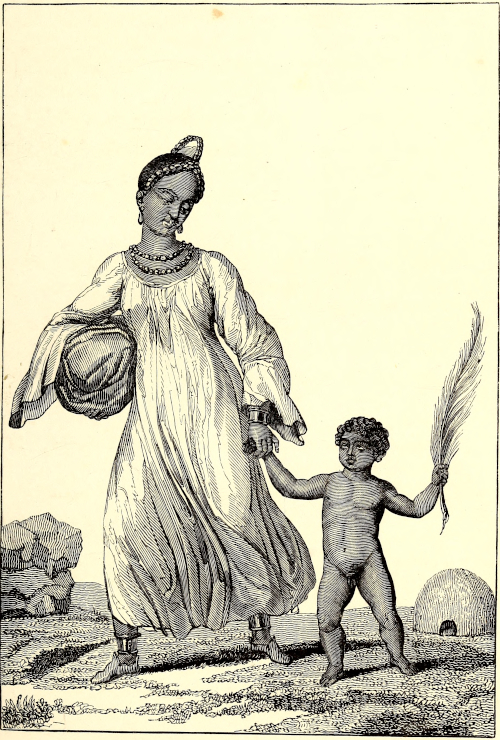
WOMAN OF THE CITY OF TIMBUCTOO.
The inhabitants of Timbuctoo are exceedingly neat in their dress and in the interior of their dwellings. Their domestic articles consist of calabashes and wooden platters. They are unacquainted with the use of knives and forks, and they believe that, like them, all people in the world eat with their fingers. Their furniture merely consists of mats for sitting on; and their beds are made by fixing four stakes in the ground at one end of the room, and stretching over them some mats or a cow-hide. The rich have cotton mattresses, and coverlets, which the neighbouring Moors manufacture from camel’s hair and sheep’s wool. I saw a woman of Cabra employed in spinning these coverlets.
The natives of Timbuctoo, as I before observed, have several wives, and to these many add their slaves. The Moors, indeed, cohabit only with their slaves, and these females are employed in vending merchandise in the streets, such as colats, allspice, &c. Some also have a little stall in the market-place, while the favourite stays at home, superintending those whose business it is to cook for the household: the favourite herself prepares the husband’s meals. These women are very neatly dressed: their costume consists of a coussabe, like that worn by the men, except that it has not large sleeves. Their shoes are of morocco. The fashion of the head-dress sometimes varies; it principally consists of a fatara of fine muslin, or some other cotton stuff of European manufacture. Their hair is beautifully platted. The principal tress, which is about an inch thick, comes from the back to the front of the head, and is terminated by a piece of cornelian of a round form and concave in the centre; they put a little cushion under the tress to support it, and add to that ornament several other trinkets, made of imitation of amber or coral, and bits of cornelian cut like that just mentioned. They also anoint the head and the whole body with butter, but less profusely than the Bambaras and the Mandingoes. The great heat, which is augmented by the scorching east wind, renders this custom necessary. The women of the richer class have always a great number of glass beads about their necks and in their ears. Like the women of Jenné, they wear nose-rings; and the female who is not rich enough to procure a ring, substitutes a bit of red silk for it; they wear silver bracelets, and ancle-rings of plated steel, the latter of which are made in the country; instead of being round, like the bracelets, are flat, and about four inches broad. Some pretty designs are engraved on them.
The female slaves of rich masters have gold ornaments about their necks; instead of wearing ear-rings as in the environs of the Senegal, they have little plates in the form of a necklace. A few days after my arrival at Timbuctoo I fell in with a negro, who was parading about the streets two women, whom I recollected to have been fellow-passengers with me on board the canoe. These women were not young, but their master, to give them the appearance of an age better suited to the market, had dressed them well. They wore fine white pagnes, large gold ear-rings, and each had two or three necklaces of the same metal. When I passed them, they looked at me, and smiled. They did not appear in the least mortified at being exhibited in the streets for sale, but manifested an indifference which I could easily enough account for, by the state of degradation to which they had been reduced and their total ignorance of the natural rights of mankind. They thought that tilings should be so, and that they had come into this world to be bought and sold.
The negroes of the Diriman Malaka and Kissoor villages, situated on the banks of the river, come to Timbuctoo in their canoes. They bring to that market slaves, ivory, dried fish, earthen pots, and various other articles, which they exchange for glass trinkets, amber, coral and salt.
To the south of Timbuctoo there is a country called Ginbala, which extends far inland. The inhabitants are, as I was told, all Mahometans. They seldom come to Timbuctoo on account of the Tooariks, whom they dread. They are very industrious, and raise crops of millet and rice; they are hospitable to strangers, and have numerous herds of horned cattle and flocks of sheep and goats. They grow cotton, with which they manufacture stuffs for clothing. Having nothing to fear in communicating with Jenné, they prefer trading with that place.
The Foulahs who inhabit the neighbourhood of the river also visit Timbuctoo. The few whom I happened to see were similar in features and colour to those of the Fouta-Dhialon. They were armed with several pikes.
The trade of Timbuctoo is considerably cramped by the Tooariks, a warlike nation who render the inhabitants of the town their tributaries. The latter, for the privilege of carrying on their trade, give them what they demand, independently of the duties levied on the flotillas at Cabra. A refusal to satisfy them would be attended with serious consequences; for the Tooariks are very numerous, and sufficiently strong to cut off all communication between Cabra and Timbuctoo, when the city and its neighbourhood, having within themselves no agricultural resources, would be reduced to famine. The Moors entertain a profound contempt for the Tooariks, and when they would express their utmost hatred of them, they compare them to the christians, whom they suppose to be the same kind of vagabonds and depredators. I endeavoured to refute this error, which received implicit credit here. I assured them that the Europeans were not to be compared to those marauders; that, instead of robbing, they were always ready to assist and succour their fellow creatures. “But if the christians are so very good,” said they, “why did you not stay among them;” This question embarrassed me a little; but I replied that God had ordained it otherwise, and had inspired me with the idea of returning to my country to resume the religion of my fathers.
The house of my host Sidi was constantly infested with Tooariks and Arabs. These people visit Timbuctoo for the sole purpose of extorting from the inhabitants what they call presents, but what might be more properly called forced contributions. I have often seen them sit in the court and insist on being supplied with food until the master sent them his tribute. They always come on horseback and their horses must be provided with forage.
When the chief of the Tooariks arrives with his suite at Timbuctoo, it is a general calamity, and yet every one overwhelms him with attention, and sends presents to him and his followers. He sometimes remains there two months, being maintained all that time at the expense of the inhabitants and the king, who sometimes give them really valuable presents, and they return home laden with millet, rice, honey, and preserved articles.
The Tooariks and Soorgoos are the same people: the former name is given to them by the Moors and the latter by the negroes. They are a wandering race, and inhabit the banks of the Dhioliba from the village of Diré to the environs of Haoussa, which my host informed me was twenty days’ journey E. by S. E. of Timbuctoo, situated in a vast country of the same name, watered by the river.
The Tooariks have terrified the negroes of their neighbourhood into subjection, and they inflict upon them the most cruel depredations and exactions. Like the Arabs, they have fine horses which facilitate their marauding expeditions. The people exposed to their attacks stand in such awe of them, that the appearance of three or four Tooariks is sufficient to strike terror into five or six villages. At Timbuctoo the slaves are never allowed to go out of the town after sun-set, lest they should be carried off by the Tooariks, who forcibly seize all who fall in their way. The condition of these unhappy beings is then more deplorable than ever. I saw some in the little canoes almost naked, and their masters were constantly threatening to beat them.
The Tooariks possess numerous flocks of sheep and herds of oxen and goats. Milk and meat are their only food. Their slaves gather the seed of the nenuphar, which is very common in all the surrounding marshes; they dry it and thrash it. It is so small that it does not require bruising; they boil it with their fish. The Tooariks cultivate no kind of vegetable. Their slaves are employed in tending their flocks and herds. They have no grain for their own use, except what they obtain from the flotillas passing from Jenné to Timbuctoo. During the swell of the waters, the Tooariks retire a little into the interior of the country, where they find good pasture. They have numerous herds of camels, whose milk is always a certain resource for them.
The Foulahs who live in the neighbourhood of the river are not kept in subjection by these savages. The Foulahs are very superior to the pure negro race; they are full of energy, and are too brave to submit to the degrading yoke of the Tooariks. These Foulahs do not speak the Poulh language of the Fouta-Dhialon. I addressed to them some words in that dialect which they did not understand. They speak the language of Timbuctoo; but they have also a particular dialect which they use among themselves. All those whom I saw on the banks of the river were rovers.
I sometimes saw the camels of the Tooariks employed in transporting merchandise from Cabra to Timbuctoo; but only the poorest among them would condescend to earn any thing by this sort of labour. The rich are too proud to work. They sell at Timbuctoo oxen and sheep for the usual consumption of the town. Milk is very dear and not so good as on the banks of the river.
The Tooariks have, like all Mahometans, several wives. The largest and the fattest are the most admired. To be a real beauty with them, a woman must have such a degree of obesity as will render her unable to walk without two assistants.
They are dressed like the Moorish women on the banks of the Senegal; but instead of blue Guinea stuffs they wear blue pagnes, which are brought from Jenné, and which the merchants of Timbuctoo procure for them. Those I saw in passing the chief’s camp were very dirty, and the men did not appear to be very careful about their dress. Like the negroes of Timbuctoo, they wore a white or blue coussabe, and trowsers reaching to the ancle, such as are worn at Jenné and Timbuctoo. The slaves have breeches, like the Moors who inhabit the banks of the Senegal. The dress of the Tooariks, except as to the head, resembles that of the Moors. They wear, both night and day, a band of cotton cloth, which passing over the forehead hangs down over the eyes and even upon the nose, for they are obliged to throw back the head a little to enable them to see. After two or three turns round the head the band is passed under the nose, and made to descend a little below the chin, so that only the point of the nose is visible. They do not take it off either to eat, to drink, or to smoke. On these occasions they merely lift up this bandage, which the negroes call fatara.
The Tooariks are great smokers. They have all fine horses, which they manage ably. They are as cruel as they are warlike. Their weapons consist of three or four pikes and a poniard which they wear on the left arm; the blade pointing upward and the hilt touching the back of the hand. To the sheath of these poniards is attached a kind of muff, through which the hand is passed; they are straight and very well made. This weapon is brought from the banks of the Mediterranean. These men also carry bucklers, of tanned ox-hide, the workmanship of which is elegant. In their form they resemble the shields of the ancient knights, except that they are square at the extremities.[5] They are adorned with handsome designs, and are large enough to cover the whole body. Some negroes of Timbuctoo have likewise bucklers of the same form, but smaller. The only weapons of the Tooariks, who are always on horseback, are the lance and the poniard. They do not use the bow, as the management of their bucklers would prevent them from employing that weapon advantageously. The people who compose this wandering tribe have long hair and a very swarthy complexion, like the Moors. The nose is aquiline, the eyes large, the mouth finely formed, the face long, and the forehead rather elevated. The expression of their countenance is, however, savage and barbarous. They are supposed to be of Arab origin, and in fact, in some of their customs they resemble that race; but they speak a particular dialect. They assemble in force to attack the caravans from Tripoli, but the Morocco caravans are less exposed to their depredations because their haunts are more northerly. They keep many slaves, whom they partly employ in collecting gum on the banks of the river. This gum, and also considerable quantities of ivory, they sell to the merchants of Timbuctoo.
It is astonishing that such a number of different tribes submit quietly to the yoke of these Tooariks, when, were they to come to an understanding, they could so easily rid themselves of their troublesome enemy. The Dirimans, the Ginbalas, the Kissoors, and the Moors of Zawâ and Salah, if united, would be greatly superior to the Tooariks, and could soon deliver themselves from their oppression. The Tooariks dread fire-arms, of which they make no use, while the negroes of Timbuctoo and the Moors are armed with double-barrel guns.
The Foulahs in the neighbourhood of Jenné, led by their chief Sego-Ahmadoo, attacked the Tooariks; the Foulahs were few in number, on account of their distance from their country, and the difficulty of procuring supplies of provisions; nevertheless, they defeated the Tooariks, made a number of prisoners, whom they put to death, and carried off a multitude of slaves and cattle, which were valuable prizes to the victors. This defeat proves, that there is no good reason for the dread with which the Tooariks are regarded, and that they are really formidable to those only who fear them. Were these tributaries, supported by the Moors, to attempt to throw off their yoke, they would quickly succeed; but, in general, the negroes are indolent, and the Moors, being addicted to commerce, have no martial character. Sego-Ahmadoo, indignant at seeing these Tooariks, who are Mahometans, although certainly not very zealous disciples of that creed, imposing a tax on the vessels from his country, has determined to make war upon them; but he is too distant to maintain a long war. I conjecture that Mungo Park was murdered by these barbarians.
After residing four years at Jenné, or Timbuctoo, the Moors return to their own country with a little fortune; they carry with them a number of slaves; the greater part, however, prefer trading with Sansanding and Yamina, on account of the vicinity of the gold mines of Bouré, whence they obtain considerable supplies of this precious metal. The Arabs, who come from Tafilet, Adrar, Tripoli, and other countries, bring wheat to Timbuctoo: of the flour of this wheat small leavened loaves are made; they are round, and weigh about half a pound each; the bread is good, and a loaf may be purchased for about forty cowries, (equal to four sous French money). The rich merchants, as I believe I have already observed, eat this bread at breakfast, with tea; they have tea services which are brought from Morocco; those which I saw were made of tin, and the cups were small, like Sidi-Ulad-Marmoo’s, at Jenné. All the negroes of Timbuctoo are able to read the Koran, and even know it by heart; they make their children begin to learn it very early, whether they take upon themselves the task of instructing them, or confide their education to the Moors, of whose abilities they have a high opinion. They employ writing in their correspondence with Jenné.
Provisions are very dear in Timbuctoo, and I should have been greatly embarrassed if, as at Timé, I had been obliged to maintain myself, for my means would have been soon exhausted. To the worthy and generous Sidi-Abdallahi-Chebir, I was therefore indebted for my return through the great desert. I had only merchandise to the value of thirty-five piastres, which I reserved to buy a camel, to carry me to the sea-coast, either through the great desert, or by directing my course westerly. I confess that the idea of crossing the Sahara in so dry a season was accompanied by not a little alarm; I was afraid that, with my slight resources, I should not be able to support the privations and fatigues of such a journey, augmented, as they must be, by a scorching wind, which blows unceasingly and renders the heat intolerable. However, after mature reflection, I resolved to encounter the dangers to which the great drought could not fail to expose me, and to venture with a caravan among the moving sands of the desert. I reflected that if I should return by the way of Sego, Sansanding, and our establishments at Galam, those who might envy the success of my enterprise, the very undertaking of which had created for me many enemies, would pretend to doubt the fact of my journey and of my residence at Timbuctoo, whereas, by returning through the Barbary states, the mere mention of the point at which I had arrived would reduce the most malignant to silence.
Sidi-Abdallahi daily lavished on me marks of his kindness; he even went so far as to urge me to remain in Timbuctoo. He said he would give me merchandise to trade on my own account; and, observed, that when I should have accumulated sufficient profit, I might return to my own country without assistance from any one. However, the fear of being discovered, joined to a strong wish to re-visit my native land, induced me to decline his generous offers. I considered, moreover that, as my departure for the interior of Africa was not authentically known, even that circumstance would be buried in oblivion, were I to perish, and the observations I had made would be lost to my country. Influenced by these considerations, I resolved to endeavour to return as speedily as possible. As the opportunity on which I relied, was likely to occur soon, I did not neglect to take advantage of the short time which would probably be at my disposal. I visited the great mosque on the west side of the town; it is larger than that on the east, but is built in the same style. The walls are in bad repair, their facing being damaged by the rains, which fall in the months of August and September, and which are always brought on by easterly winds, accompanied by violent storms. Several buttresses are raised against the wall to support them; I ascended the tower, though its staircase, which is internal, is almost demolished. I returned several times to make my notes, for in this little frequented spot I was not afraid of being observed. During these travels, I always endeavoured to conceal myself while writing, lest I should awaken the suspicion of the Moslems: I always endeavoured to get into a wood, or placed myself under the shade of a bush or a rock, when I wished to commit what I thought worthy of remark to writing.[6]
From the tower I had an extensive view over an immense plain of white sand, on which nothing grows except a few stunted shrubs, the mimosa ferruginea, and where the uniformity of the picture is only here and there broken by some scattered hills or banks of sand. I could not help contemplating with astonishment the extraordinary city before me, created solely by the wants of commerce, and destitute of every resource except what its accidental position as a place of exchange affords. The western quarter of the mosque seems very ancient, but the whole façade on that side is in ruins. There are also some vaulted arcades, from which the whole of the plaster facing is detached. This mosque is constructed of sun-dried bricks, of nearly the same form as those made in Europe. The walls are rough-cast with a kind of coarse sand, similar to that of which the bricks are made, mixed with the gluten of rice. In some parts of the desert there is found a very hard ash-coloured earth, in which sand predominates. This earth has been used in making the bricks for the mosque. The rest of the edifice appears to have been built after the western part was in ruins. Though the new part is very well for a people ignorant of architecture, it is greatly inferior to the ancient remains.
I was surprised to find in the ancient part three galleries, each supported by ten arcades, as well built as if they had been the work of a skilful architect. The arches are six feet wide and ten high; there the plaster is in an excellent state, and appears to have been white-washed. The style and the position of this building connect it with the ruins. I am inclined to think that the mosque consisted originally of this part only, and that additions were afterwards made to it.
The eastern part is composed of six galleries; those of the west are supported by nineteen pillars. The apertures are each six feet and a half wide, and ten or eleven high. The workmanship, though pretty well executed, is, as I have already observed, far from equalling that of the other quarter. The first three galleries on the east side, are one hundred and four ordinary paces[7] long, and about two and a half broad: the three next are only sixty-four long. The length of those on the west is only thirty nine paces. They lead to the great tower, which faces an inner court, closed on the west by the ruins. It is of a square form, but terminates in a small truncated pyramid, which is also built of brick and surmounted by a pot of baked earth. Its height may be estimated at fifty or fifty-five feet from the base to the summit. The steps of the staircase, which is constructed internally, are supported by pieces of wood fixed in the walls and covered with earth. The dilapidated state of the staircase prevented me from ascertaining the exact number of the steps, but I observed the traces of thirty-two.
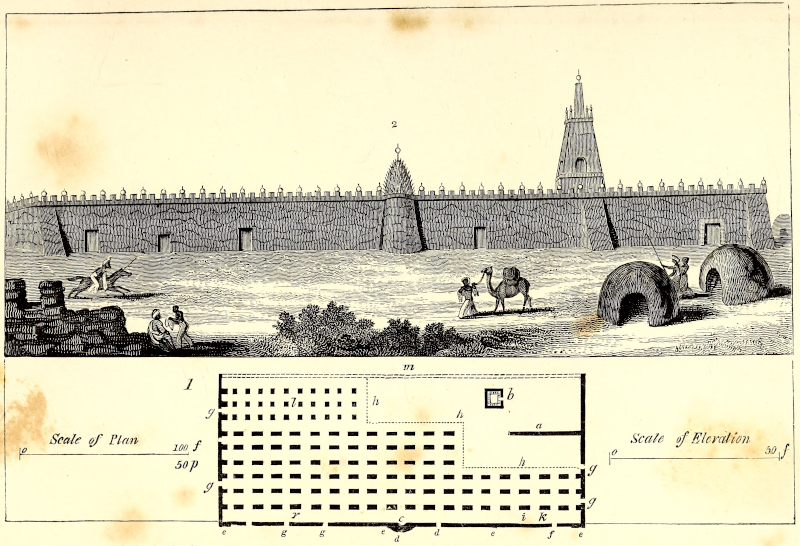
SKETCH OF THE PLAN OF THE GREAT MOSQUE OF TIMBUCTOO, AND VIEW TAKEN FROM THE E. N. E.
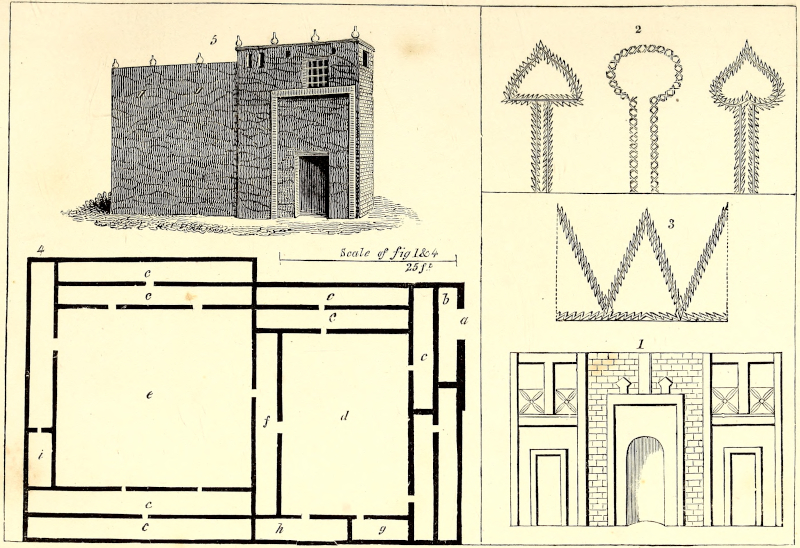
1, 4, 3, DETAILS OF THE GREAT MOSQUE OF TIMBUCTOO; 4, 5, PLAN AND FRONT OF THE HOUSE OF SIDI ABDALLAH CHEBIR, IN WHICH MR. CAILLIÉ RESIDED.
The walls of the mosque are fifteen feet high and twenty-five or twenty-six inches thick. The top of the wall of the east front is indented in the form of battlements, the salient parts of which are surmounted by pots of baked earth, similar to that on the summit of the tower.
Another massive tower, of a conical form, surmounts the front wall. It is about thirty feet high. On the dome, projecting pieces of wood are perceptible, the use of which seems to be to unite the masonry.
The roof of the mosque has a terrace like that of the tower, and is moreover surrounded with a parapet eighteen inches high.
The roof of the building is supported by rafters, formed of the trunks of the ronnier tree split into four, and placed at the distance of a foot from each other. Pieces of salvadora wood, brought from Cabra, where it grows in great abundance, cut to the length of the intervals between the rafters, are placed obliquely in double rows, crossing each other. Over these are laid mats made of the leaves of the ronnier, which are covered with earth.
This mosque has five gates of different sizes on the eastern side, three on the south side, and two on the north. On the western side the ruins form at once the boundary of the mosque and of the city. On the eastern and northern sides, the floor of the building is level with the ground; but on the south is an ascent of four steps.
On the eastern wall, in the interior of the building, there are some ornaments made of yellow clay. They are in the form of a chevron or triangular festoon, two feet high, with an opening of a foot and a half. They commence about eighteen inches above the ground. The pillars supporting the arcades in front, have some ornaments of the same material tolerably executed, but very much defaced. A kind of niche, in the centre of the eastern wall, is destined for the marabout who officiates at prayers. In another similar niche there is a large wooden pulpit, into which the priest ascends by two or three steps, on the days when he reads certain passages of the Koran. The floor of the mosque was covered with mats, on which the people kneel during prayers.
Conceiving that the description alone would not convey an adequate idea of the construction of this mosque, I ventured to make a sketch of it, as well as of the town; both would, I thought, convey a better idea than words alone of the objects with which I wish to make the reader acquainted[8].
To make my sketch of the mosque, I sat down in the street in front of it, and, covering myself in my large wrapper which I folded over my knees, I held in my hand a sheet of white paper close to a leaf of the Koran. When I perceived any one approaching, I hid my drawing, and looking at the leaf of the Koran I appeared to be absorbed in devotion. The passers-by, far from suspecting me, regarded me as one of the elect, and applauded my zeal[9].
The eastern mosque is much smaller than that on the western side. It is surmounted by a square tower, similar in form and dimensions to that of the western mosque. The walls are entirely stripped of their parget. Many buttresses have been erected to support the building. It has three arcaded avenues. The galleries are six feet wide and thirty feet long.
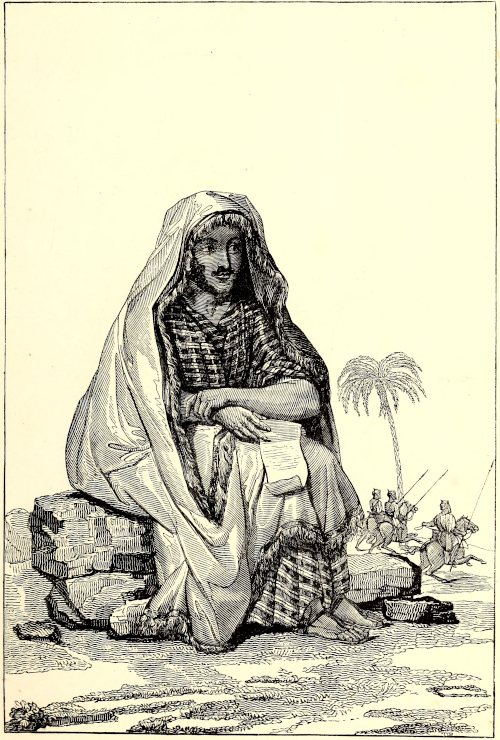
MR. CAILLIÉ MEDITATING UPON THE KORAN AND TAKING NOTES.
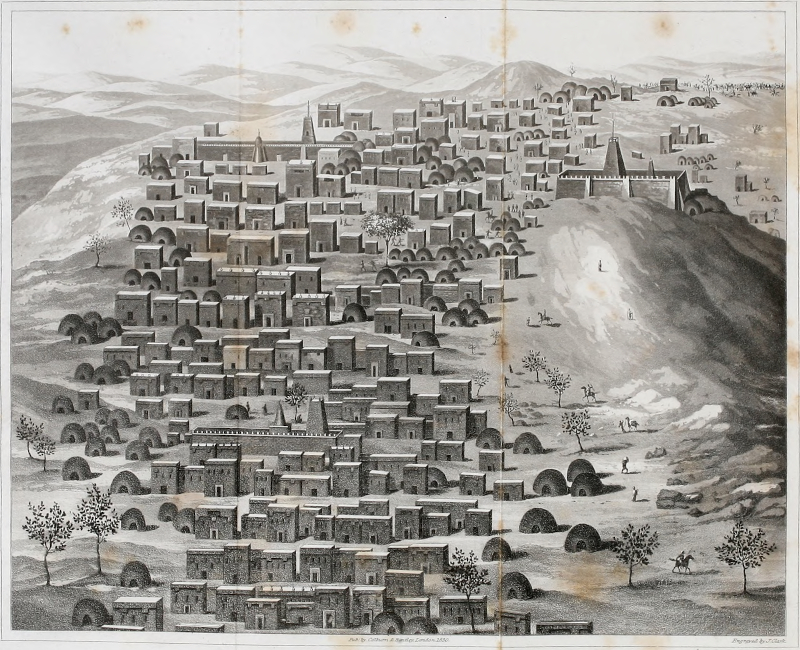
VIEW OF THE CITY OF TIMBUCTOO.
The mosque itself is thirty paces long and five and twenty wide. The arcades which are three feet and a half wide and seven and a half high are built of the same bricks as those of the western mosque. There is an inner court, which must be passed through before we can ascend the tower. No part of this mosque is in ruins, though it appears very old. It is not very regularly built. I remarked that it had two gates looking to the south and one to the north. The western and eastern sides had no apertures. Near the mosque, on the eastern side, are seen a small hillock of sand, and some buildings overwhelmed by the sand blown up by the east wind.
In the centre of the town is a kind of square surrounded by circular huts. Here grow some palmæ christi and a palm-tree, the only one I saw in the country. In the middle of this square is a large hole, dug for a receptacle for filth. Two enormous heaps on the outside of the town appeared to me to be also collections of dirt or rubbish. Many a time have I ascended to the tops of these hills to obtain a complete view of the town and to make my sketch[10].
A third and somewhat remarkable mosque stands nearly in the centre of the town. This likewise has a tower, but not so high as those of the other two. It has square arcades: the naves are seven feet wide and twenty five long. The front wall is ornamented with many ostrich eggs, some of which are also placed on the top of the tower. On the east side is a very extensive court, in the middle of which a balanites ægyptiaca is planted by way of ornament. At the back of the mosque on the opposite side, some salvadoras.
There are five mosques besides those which I have mentioned; but they are small and built like private houses, with the exception that each is surmounted by a minaret; all of them have an inner court, to which the people resort in the evening to perform their religious devotions. The criers, whose business it is to call to prayers, receive no salary; but at stated periods they announce to the faithful from the summits of the minarets that it is time to pay their contributions. I happened to be at Timbuctoo at one of these periods. Each person made his offering, consisting of bread, millet, rice, dried fish, pistachios and cowries; all these articles were deposited on a mat spread on the ground, before the door of the mosque.
It frequently happened that Moors who felt interested in my situation questioned me about European customs and the treatment I had experienced at the hands of the christians. I tried in my turn to obtain from them information concerning the neighbouring nations and the distance of their country from Timbuctoo. But, so far from satisfying my curiosity, they pretended not to hear me, and turned from me to speak to each other. Unfortunately, I had not the means of gaining their favour by presents. They called me the meskine (beggar). The little information I obtained at Timbuctoo was furnished me by my host Sidi-Abdallahi-Chebir, and by some Kissour negroes. These were the only individuals who had the civility to reply to my questions. They had no definite idea of the course of the river eastward of the city. Sidi assured me, that it went to Haoussa and joined the Nile[11]. This is the general opinion of the Arabs of this country. This river bears at Timbuctoo the name of Bahar-el-Nil (Nile river).
The house which was appropriated for my residence not being quite finished, I had opportunity to observe the way in which the houses of this country are built. An excavation is made in the town itself to the depth of some feet, where a grey sand mixed with clay is found. This is made into bricks of a round form, which are baked in the sun. These bricks are similar to those used at Jenné. The young slaves carry them on their heads in calabashes, the way in which they also carry the mortar, which is formed from the same material. The builders, who are slaves, execute their work as cleverly as those of Jenné. I thought indeed that their walls were better constructed. Their doors are well made and solid; they are formed of planks joined with bars and nails brought from Tafilet. They fasten their doors by locks made in the country, without iron: even the keys are of wood[12]. Some Moors use iron locks and keys which they bring from the coasts of the Mediterranean. Locks are not used in the interior of the houses; but chains or bars supply their place. The roofs of the houses, none of which have more than the ground-floor, are, like those of the mosques, supported by rafters cut from the trunk of the ronnier, a tree which grows to a prodigious height on the banks of the river. I have seen some of these trees above a hundred and twenty five feet high. The trunk is split into four quarters, which are rounded off, laid upon the walls, and then covered with pieces of wood, mats and earth, like the roofs of the mosques.
Each house forms a square,[13] containing two inner courts, round which are ranged the chambers, each of which is of a narrow oblong form and serves at once for a magazine and bed-room. These rooms receive light only from the door of entrance, and another very small door opening into the inner court. They have neither windows nor chimneys.
The people of Timbuctoo have not adopted the practice, which is general in the Soudan, of lighting fires in their houses. Some of them build in the court a small hut of mats, in which during summer they live day and night; the chambers being too warm.
A chamber similar to those I have above described was allotted to me; but I had well nigh been suffocated in it. I found it impossible to endure the heat, especially in the night. But what could I do in a country where there is not a tree to cast the least shade? My only refuge was a mosque which was the coolest and most airy place I could find. The east wind too, by raising clouds of dust, darkens the atmosphere and augments the heat. The inhabitants stay within doors during the heat of the day, and only go out in the mornings and evenings. The nights bring with them an oppressive calmness of the atmosphere, and if by chance there is a breath of air, it is felt like a burning vapour, and seems almost to scorch the lungs. I was continually ill at Timbuctoo.
The caravan destined for Tafilet was not to leave Timbuctoo for some days, and I was informed that the next did not start for three months; I therefore determined to take advantage of the earliest conveyance; for I dreaded so long a stay at Timbuctoo, notwithstanding the reiterated invitations of Sidi-Abdallahi, who recommended to me to take the route of Tripoli by Ardamas rather than that of Morocco. He told me that he had intended to make a collection for me, but that my speedy departure afforded him no time to do so. He assured me that, if I would remain with him some months, my subsistence should cost me nothing. I scarcely knew how to decline such kindness, but I had formed my determination; I excused myself to Sidi, by telling him that I was afraid to travel in the rainy season, and finding me obstinate he looked out for a good guide to conduct me to Tafilet.
The Moors in whose company I was about to travel were far from being so kind and civilized as those who reside in the city. I had had an opportunity of observing their manners before I started; for, they often came and begged of me, and made no scruple of rousing me out of my sleep. They are a class of men whom the Moors of a superior order call zenagues, (tributaries). They are very ignorant. Many of them do not know the first prayers of the Koran. They however observe religious ceremonies. A poor stranger like myself, unacquainted with their language, was in their eyes an object of contempt. I expected therefore to suffer much in crossing the desert.
Sidi-Abdallahi informed me that he had hired a camel to carry me to Tafilet. The thirty thousand cowries’ worth of cloth, the proceeds of the sale of my merchandise at Jenné, sufficed to pay for the camel. Sidi told me that he would keep my cloth and give my guide ten mitkhals of gold, or thirty piastres.
I employed the remainder of the time I stayed in Timbuctoo in collecting information respecting the unfortunate death of Major Laing, which I had heard mentioned at Jenné, and which was confirmed by the inhabitants of Timbuctoo whom I questioned respecting the melancholy event. I learned, that when within a few days’ journey of the city, the caravan to which the major belonged was stopped, on the road to Tripoli, by the Tooariks, or as others alleged, by the Berbiches, a wandering tribe, near the Dhioliba. Laing, being discovered to be a christian, was cruelly attacked, and his assailants continued beating him with a club until they thought him dead. I conclude that the other christian, who was said to have been actually murdered, was a servant of the major’s.
The Moors belonging to the caravan raised Laing up, and succeeded in restoring him to animation. When he became sensible, they placed him upon a camel, but he was so weak that they were obliged to tie him on. The robbers left him almost destitute, having robbed him of the greater part of his merchandise.
On his arrival at Timbuctoo, Major Laing healed his wounds by the aid of an ointment which he brought with him from England. His recovery was slow; but he was made very comfortable, owing to the letters of recommendation which he had brought from Tripoli, and especially to the attention of his landlord, a Tripolitan, to whom he had been directed. The house of this Moor was near that in which I lodged at Timbuctoo. I had frequent opportunities of seeing him. He appeared to me a man full of kindly feelings. Many a time he has given me dates, from mere charity, and the day before I left he made me a present of a pair of blue cotton trowsers, to wear on my journey.
He told me that the major had been recommended by a Tripolitan house to an old Moor, who, not having convenience to lodge him, transferred him to his hospitality. Laing, he added, never laid aside his European dress, and used to give out that he had been sent by his master the King of England, for the purpose of making himself acquainted with Timbuctoo and the wonders it contains.[14] It would appear that the traveller had openly taken a plan of Timbuctoo, for the same Moor told me in his simple way that he had written down every thing in it.
Other Moors, whom I questioned respecting Laing, merely told me that the major ate little, and that he lived entirely on bread, eggs, and poultry. I moreover learned that he was tormented to say that there is but one God and that Mahomet is his prophet; but he always stopped at the words: “There is but one God” They then called him cafir, and infidel, but, without ill treating him, left him free to think and pray in his own way. Sidi-Abdallahi, whom I often questioned as to whether the major had been insulted during his stay at Timbuctoo, always replied in the negative; shaking his head, to give me to understand, that they would have been sorry to annoy him.
This toleration may be accounted for by the fact, that the Moors who reside at Timbuctoo come from Tripoli, Algiers, and Morocco, and that, being in the habit of seeing christians in their own countries, they are less liable to be offended at their worship and their manners. For instance, Sidi-Abdallahi, who came from Tatta, a town near Cape Mogador, was not inimical to the christians. Thus it may easily be conceived that the major was free to inspect every part of the town and even to enter the mosques.
It would appear that, after he had made himself completely acquainted with Timbuctoo, he wished to see Cabra and the Dhioliba. But had he left the city in the day time he would have incurred the greatest danger from the Tooariks, who are continually roaming about the environs of Timbuctoo, and whose attack he had too much reason to remember. He determined to set off during the night. This was wise, for though the Tooariks dared not touch him while he staid in the town, they would have wrecked their vengeance on him had they caught him beyond its limits, and murdered as well as robbed him.
Taking advantage of a dark night, Major Laing mounted his horse, and, unaccompanied by a single native, reached Cabra, and even, it is said, the banks of the Dhioliba, without accident. On his return to Timbuctoo, he ardently wished, instead of proceeding to Europe by the desert, to travel by Jenné and Sego, ascending the Dhioliba, whence he might have reached the French factories on the Senegal. But, no sooner had he communicated his plan to the Foulahs established on the borders of the Dhioliba; (a great number of whom had resorted to Timbuctoo, on hearing of the arrival of a christian) than they all declared they would never suffer a nasarah to set foot in their territory, and if he made the attempt, they warned him that he would have cause to repent it.
The major, perceiving that he could do nothing with these fanatics, chose the rout of el-Arawan, where he hoped to join a caravan of Moorish merchants, conveying salt to Sansanding; but alas! after journeying five days to the north of Timbuctoo, the caravan with which he had come up was stopped by Sheikh Hamet-oul’d-Habib, an old fanatic, chief of the tribe of Zawât, who wander in the desert of that name. Sheikh Hamet seized the major, under pretence of his having entered his territory without permission. He then wished to compel him to acknowledge Mahomet to be prophet of God, and required him even to make the salam. Laing relying too confidently on the protection of the pacha of Tripoli, who had recommended him to all the sheikhs of the desert, refused to obey Hamet, who more and more urgently insisted on his acknowledging himself a Musulman. Laing continued firm, and chose to die rather than yield; a resolution which made one of the most intelligent of travellers a martyr to the cause of science. A Moor, belonging to the train of the chief of the Zawâts, who was directed by his master to kill the christian, refused to execute his order. “What!” said he, “do you wish me to slay the first christian who has come among us, and one who has done us no injury? give the commission to another; I will not be the instrument of his death; kill him yourself.” This address suspended for a moment the fatal sentence, and the question of Laing’s life or death was warmly debated for some time. At length the latter was decided on. Some black slaves were summoned, and they were ordered to perform the horrid deed, with which the Moor had refused to stain his hands. One of the murderers immediately tied his turban round the neck of the victim, and strangled him on the spot, he pulling one end while his comrade held the other. The corpse of the unfortunate Laing was cast upon the desert, to become the prey of the raven and the vulture, the only birds which inhabit those desolate regions.
When the major had once been discovered to be a christian and a European, death was a thousand times preferable to even a temporary change of religion, since he must have renounced all hope of again visiting Europe. The fate of Laing, had he become a Musulman perforce, would have been irremediably wretched. He would have been the slave of merciless barbarians, and exposed to all the miseries and dangers peculiar to that country; in vain would the pacha of Tripoli have demanded his liberation. At that immense distance, the chief of the Zawâts would have scorned his menaces and detained his prisoner. The resolution of Major Laing was perhaps at once a proof of intrepidity and of foresight.
On his departure for El-Arawan the major took with him some astronomical instruments and his papers, but very little merchandise, for the Tooariks had relieved him of nearly all he possessed. The Sheikh Hamet therefore gained little by the murder of the English traveller, and he was even obliged to divide that little with the wretches whom he had made the instruments of his crime. A Moor of Tafilet, who belonged to the caravan, had for his share of the spoil a sextant, which I was informed might be found in the country. As for the major’s papers and journals, they were scattered among the inhabitants of the desert. During my stay at Gourland, a village of Tafilet, I saw a copper pocket compass, of English manufacture. Nobody could tell me whence this instrument had come, and I concluded that it had belonged to Laing. Had it not been for the precautions I was compelled to observe in my Arabic disguise, I would have given a good price for it; but I could not, without betraying myself, show that I attached the least value to an instrument, of the use of which I was supposed to be ignorant.
I have left a wide field of discovery for those who come after me, especially in the geography and natural history of this country. What I have suffered should not discourage future enquirers. Their attempts will doubtless be attended with hardships and danger; but an enterprise conducted with prudence would triumph over obstacles. To ensure success, the traveller should, I think, make no sort of display; he should externally adopt the worship of Mahomet, and pass himself off for an Arab. A pretended convert would not enjoy so much liberty, and would be an object of suspicion to such distrustful people. Besides, I am of opinion that a converted christian would not be tolerated among the negro tribes. The best plan would be, I think to cross the great desert of Sahara in the character of an Arab, provided with adequate but concealed resources. After remaining for some time in the Musulman town selected by the traveller as his starting point, where he might give himself out as a merchant, to avoid suspicion, he might purchase some merchandise in that town, under the pretence of going to trade further on, carefully abstaining from all mention of the city of Timbuctoo.
Let us suppose Tangiers or Arbate to be the place chosen as the point of departure; mercantile business at Fez might be alleged as an excuse for setting off. Still adopting the same pretence, the traveller might proceed from Fez to Tafilet, and thence to Timbuctoo. At Tafilet there would be no danger of speaking of Timbuctoo, for there a journey to the Soudan is an affair of frequent occurrence and it excites no attention. It would be advisable to purchase merchandise at Tafilet for the purpose of exportation. On reaching Timbuctoo, the traveller should settle there, establish a mercantile house; but he should above all things avoid appearing rich, and must make himself familiar with the customs of the country, and be very circumspect in every thing connected with religion.
After remaining at Timbuctoo seventeen or eighteen months, and purchasing some Mandingo or Bambara slaves speaking the Kissour and Tooarik languages, he might procure a middle-sized well built canoe, for the conveyance of merchandise and provisions. It would be necessary to take a supply of the latter, on account of the uncertainty of being able to procure them from the people who dwell on the banks of the river. By promising the slaves their liberty, they might be easily prevailed upon to undertake the voyage, the pretended object of which would be to trade in the lower part of the river, and to purchase gum, ivory, &c. It would not be necessary to adopt all these precautions for the passage of the river above Cabra.
To lull suspicion, it would be advisable to leave at Timbuctoo a certain quantity of merchandise, under the care of a confidential slave, who might have orders to dispose of it under the direction of a Moorish merchant, during his master’s absence.
Being once fairly embarked in the canoe with six slaves, good swimmers, it would be preferable to proceed onward during the night on account of the wandering tribes of Tooariks and others. But even if they were met during the day time, they might be got rid of with a few presents. This course, prudently and cautiously followed, would, I doubt not, be attended with complete success, and it appears to me preferable to the plan of sending numerous expeditions, which would rouse the cupidity and distrust of the natives.
The rapid passage of the little canoe would render the voyage infinitely less fatiguing and dangerous than if performed in a large vessel. Sidi-Abdallahi informed me that Haoussa was only a twenty days’ passage from Timbuctoo, descending the river; but in a small canoe the passage might be accomplished in twelve days, and then the mouth of the river might be speedily reached, especially if it empties itself into the Ocean. This plan, I am convinced, would be far less dangerous than that of starting from the gulf of Benin, where great difficulties would always be experienced in ascending, both on account of the climate and the inhabitants.