APPENDIX.
Reading edition
APPENDIX.
This ratio, , increases somewhat with the depth of the grain, but the increase is slight after a depth of from 2½ to 3 times the width or diameter of the bin is reached.
The theory of bin pressure is utterly different from the ordinary theory of earth pressure in an unlimited granular mass; but it is seen that the latter may be of some use in furnishing a value of when experimental values are lacking, as in the case of various kinds of earth, both granular and more or less consolidated.
This reduces to the usual formula when .
It is seen from Fig. 19, if we lay off at the depth, , , that the horizontal ordinates of the triangle, , measure the values of the first term of the right member of Equation (1). The second term, , is constant, and is represented by the horizontal ordinates of the rectangle, . Thus the value of at the depth, , is represented by .
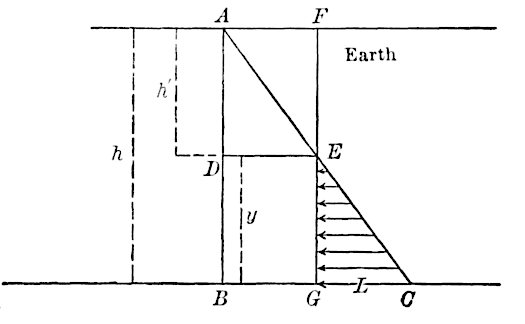
Fig. 19.
In Equation (1), for , , therefore
Solving this for ,
For given values of , , and , having computed , we have, on subtracting Equation (2) from Equation (1),
which is true only for or . When , .
If we put , the equation reduces to the ordinary form, and thus the center of pressure of the thrust on (or ) acts at above , and its amount is .
and, putting , we have, from Equation (4),
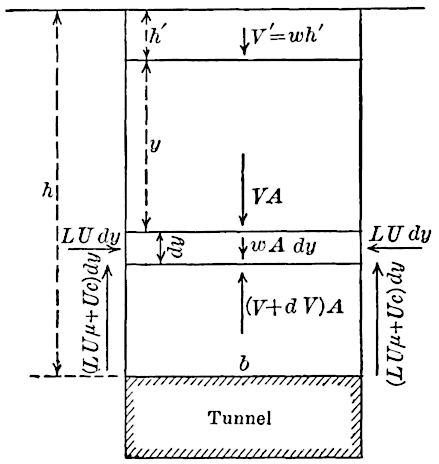
Fig. 20.
In Fig. 20, let be the distance from the roof of the tunnel to the surface of the earth. Compute from Equation (3) and lay it off from the top down.
The foregoing equation, , will be used as a semi-empirical formula to express the relation between and , but now is no longer equal to but at present is unknown. As before, .
Properly, should be determined by experiments, but, from lack of such experiments, it will be computed from the formula above,
Consider now the conditions of equilibrium of a horizontal slice of earth of depth, , the weight of which is .
The top surface, at the depth, , is acted on by the force, , acting downward, and the bottom surface by the force, , acting upward. The total lateral force acting on the area, , is and this causes a frictional force of , acting upward. The cohesive or shearing resistance on the area, , acts upward, and its amount is . Placing the sum of the vertical forces acting on the slice equal to zero.
In reality, an arch or dome of the earth should be considered in place of the horizontal stratum, but the result is the same, because the same vertical forces act in either case. Simplifying the above equation, and dividing by ,
Putting , and ,
on placing, , .
It follows that, therefore .
When , ,
where , the Napierian base.
Solving for ,
Substituting the values of and , we have,
in which it must be remembered that,
The lateral thrust is now given by,
To get the pressures, and , at the top of the tunnel, replace by .
The weight of the upper stratum, of depth , is in part sustained by the cohesion of the sides, but as is generally small, this cohesive force can be neglected, as was done above.
Equations (5) and (6) reduce to the ordinary bin formulas of Janssen, when , , and therefore , . The modification due to these terms is generally small, unless is very large.
For large values of , is small, and as increases indefinitely, approaches as a limit the value
This expression may be derived independently, and is of practical value when a very high surcharge is considered.
Referring to Fig. 20, it is evident that the maximum limit of would be realized if the weight of any horizontal lamina is entirely held up by the friction and cohesion of the sides; for then, for all lower slices, and remain the same.
as given above.
As seen, such a state is not exactly realized, but is practically true for great depths.
For a long tunnel, the perimeter of the section, , can be taken as , whence,
This value was used in all the computations.
As a numerical illustration of the use of Equations (5) and (6), suppose a tunnel, ft. wide, and, for the earth covering let ; therefore , lb. per cu. ft., and lb. per sq. ft.
We deduce , , ft., therefore lb., .
Equations (5) and (6) readily reduce now to
These formulas give the vertical and horizontal unit pressures at the top of the tunnel when,
In computing the values of and for various depths of earth covering, , a short table of hyperbolic logarithms is a convenience. The curves given by the equations above are shown on Fig. 17.
On balancing components parallel and perpendicular to the plane, and then following familiar methods, it can be shown that the true value of corresponds to , and that this value is,
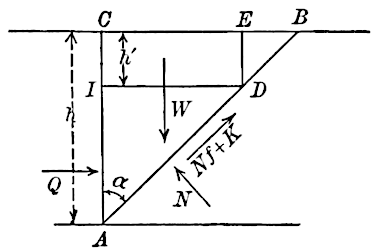
Fig. 21.
The derivative of this, with respect to , gives the intensity, , at the depth, , exactly the same as Equation (1), and the subsequent deductions hold. Thus the fundamental Equation (1), according to the interpretation given, is seen to correspond to a prism of rupture, , which is a little nearer the true one, having a curved surface of rupture, than the wedge, .
The above refers to the pressure on a vertical plane of a mass of level-topped earth of indefinite extent; but suppose that is the back of a retaining wall, and that a slight movement downward of the prism of rupture is imminent; then, if the earth along the plane, , can exert sufficient tension, the mass, , in descending, may drag down the wedge, , with it, so that the full friction and cohesion along will be added to that along . In other words, the prism of rupture must now be taken as the wedge, ; hence, the value of corresponding is given by the equation above, on making , as this introduces, in the first equations for equilibrium, the fact that the prism of rupture is now the wedge, .
It is only one step farther to find the greatest height at which the vertical face of an open trench will stand for given coefficients, and . On making in the equation for above when , we find, after reduction,
a value which has been quoted elsewhere in this paper. It is double the value for given by Equation (3). The reason for this, though, is now evident; for the last equation follows as a consequence of assuming that the full cohesive and frictional resistances along were exerted; whereas Equation (1) ignores them.