Chapter V · OFFENSIVE TORPEDO WARFARE. (continued 2)
Reading edition
When the grappling hook U1, on the lower or outer end of the line or rod U, engages with any obstruction the boat will be stopped, and this stoppage will be indicated on the keyboard. The operator by this indication is apprised of the stoppage of the boat by an obstruction, and by sending a current through the cable by means of a switch provided for this purpose on the keyboard he can immediately release the explosive case U2, which runs down the line or rod U, and engages by its grappling hook U5 with the hook U1. The line or rod U is then disengaged from the boat A, and the explosive case U2 turns or falls over. As it turns over the ball or weight 3 contained in the tube 1 drops on the said phial 2, fractures it, and thereby allows the acid to mix with the explosive or fulminating charge and explode the case U2. This explosion will rupture or destroy the obstructing chain or bar, so that the ironclad ships or other vessels can pass freely and safely into the harbour or beyond the point where it was intended to stop them.
Used to clear away Mines and Electric Cables.—For this purpose there is an implement V provided, Fig. 136, somewhat of an anchor form, but with four or any desired number of arms V2 extending outward at a suitable angle from its shank V1. In the neck of each of these arms are fitted two small plain or toothed discs V3, which are so arranged as to present their teeth to any object lying in the angle or corner formed by and between the arms V2 and shank V1 of the said implement, as shown at W.
In using this implement it may be attached to a line or cable coiled in the torpedo boat, which, in this case, is used without being charged with explosive material, and is sent in advance of any ship that has to enter or pass through the suspected water. This line must be arranged in combination with a detaching apparatus controlled by electro-magnetic apparatus included in the circuit of the cable which connects the torpedo boat with the keyboard at the operating station.
LAY'S LOCOMOTIVE TORPEDO.
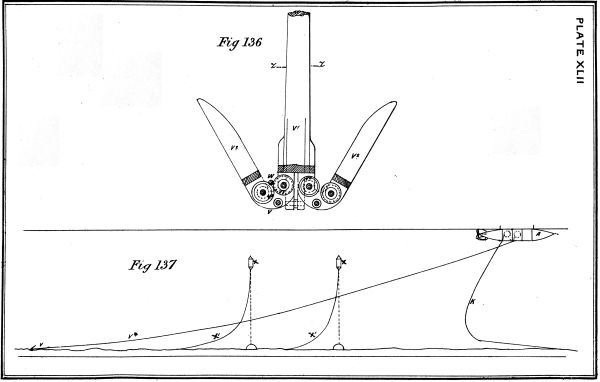
By sending a current from the station the operator releases the said implement or its line from the detaching hook or holding device. The said implement then sinks to the bottom; then the said boat returns to the ship, paying out the said line as she so returns. The end of this line is then taken by a steam tug or other vessel, and the said grappling implement is thereby dragged along through the water over which the ships are to advance, thus breaking any wires or cables that may be in its course. This operation is shown at Fig. 137, in which A is the towing boat, K the controlling cable, V the said implement, V* the line attached to the implement V, X X submerged mines, and X1 X1 are the mine cables.
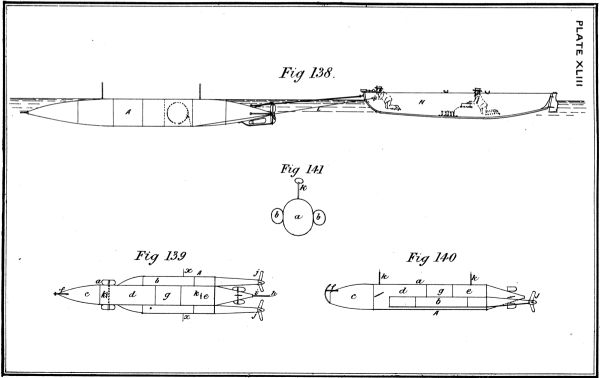
In some instances it may not be practicable to reach the enemy's ship or other object of attack directly from the station to which the torpedo boat is connected, and from which it is controlled. In this case a small boat, &c., is used in addition, which should be so arranged as to present to the enemy's view as slight a surface as possible. This mode of attack is shown at Fig. 138, where A is the torpedo boat, and N is the small auxiliary boat. This boat N is provided with a keyboard and battery like that described at page 144, and the electric cable L, carried on and payed out from the torpedo boat A, is connected with the keyboard. The boat N is also attached to and towed by the torpedo boat A by the tow line O; and the torpedo boat is steered and guided by means of the said keyboard in the boat N. The auxiliary boat is designed to contain two men, who lie down, one at the bow, the other in any convenient position abaft him; the latter has control of the keyboard, while the former by the aid of a telescope keeps the torpedo boat in view, and transmits his orders to the man at the keyboard. On arriving at such a distance from the enemy as to render an attack practicable, the tow line O is disengaged, and the torpedo boat A, guided and controlled, and fired from the boat N. The torpedo boat being exploded, the auxiliary boat can be rowed back to the station or ship to which it belongs. By this means the range of action of the torpedo boat is greatly extended, and with comparatively slight danger to those employed in making the attack.
A more recent form of the Lay torpedo boat is shown at Figs. 139, 140, and 141, where Fig. 139 is a plan or top view of such a boat, Fig. 140 is a side elevation of the same, and Fig. 141 is a midship section on the line x x. A is the hull of the boat, a is the main or central portion of the said hull, b, b are side or auxiliary portions of the same. These parts a and b may be oval or circular in transverse section; they are constructed of thin steel or other suitable sheet metal, and secured together by riveting or bolting. The side or auxiliary portion b form the reservoirs or chambers for the gas; they also serve to contain the propelling engines. c is the magazine, d the chamber or compartment for containing the coiled cable, e is the compartment containing the electrical steering and other apparatus, f is the firing rod or pin, g is the water ballast chamber, h is the cable, i the paying-out tube, j, j are the screws or propellers which rotate in opposite directions, and k, k are the sight or guiding rods.
The parts of the apparatus or mechanism whereby the various operations of the torpedo boat are effected are connected to the cable and controlled by electric currents transmitted from the station through the cable, as previously described. The Lay torpedo boat weighs about 1 ton, its length is 23 feet, and speed 12 knots per hour.
Spar or Outrigger Torpedo.—By a spar or outrigger torpedo is meant a torpedo which is carried at the end of a pole or spar projecting from a boat or vessel, and which may be fired either by contact or at will.
This system of submarine offence has up to the present time been the only one that has successfully stood the crucial test of actual warfare.
During the civil war in America the spar torpedo attack was resorted to by the Confederates and Federals, principally by the former, the result being the loss of two large men of war and severe injury to several other ships composing the Federal fleet, and the loss of one vessel of war belonging to the Southerners.
The spar torpedo was also used on several occasions by the Russians in their attacks on the Turkish ships in the war of 1877-8, but in only one attempt was it the means of sinking a Turkish vessel.
Description of McEvoy's Duplex Spar Torpedo.—At Fig. 142 is shown a sketch of Captain McEvoy's improved patent duplex spar torpedo, which is the form most generally used at the present time, and which seems to fulfil all the requirements of such a submarine weapon, viz.:—
1.—Handiness, at the same time capable of containing a charge of gun-cotton sufficient in contact to destroy the most powerful vessel afloat.
2.—Certainty of action.
3.—Capable of being fired either on contact or at will.
4.—Mode of attaching the spar simple and very secure.
LAY'S LOCOMOTIVE TORPEDO.
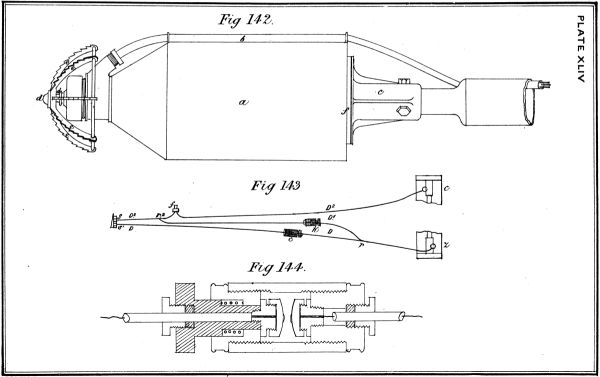
In Fig. 142, a is the case, capable of containing some 33 lbs. of gun-cotton; b is the tube through which the three wires w, w1, and w2 are led; c is the socket in which the wooden or steel spar is introduced and secured, d is the striker, which is attached to a brass contact plate within the head of the case a in such a manner that any pressure either on the head or side of the striker d will force the aforesaid plate in contact with the two studs to which the battery wires are attached; e is a cradle affixed to the striker d to ensure its action on contact being made by the torpedo with the attacked vessel; the explosive is inserted at f, the socket c being made to screw on and off.
When a hollow steel spar is used, the battery wires are sometimes led through the interior of the torpedo and the spar, by which means they are well protected; the only objection to this method of leading the wires being the probability of injury to them, should the spar be broken on contact, or by a shot.
McEvoy's Arrangement of Torpedo Wires.—At Fig. 143 is shown the arrangement of wires as devised by Captain McEvoy, whereby the spar torpedo may be exploded at will or on contact. c and z are the poles of the firing battery, to which are attached respectively the wires d and d2; f is the fuze, which is placed in the centre of the charge, and to the poles of which the wire d2 is attached, the other end of this wire being connected with the stud s; to the stud s1 is attached the other end of the wire d, and at the point c in the same wire is inserted a contact breaker; another wire d1 is connected to the wires d and d2 at the points r and r2 respectively, and at the point k in this same wire is inserted a firing key, which latter is shown in section at Fig. 144, from which the mode of connecting the two ends of the wires and of using the key will be at once apparent. The contact breaker is somewhat similar to the firing key, but there is no spring in it, contact being made or broken by screwing the two parts together or apart. The object of the contact breaker is to prevent the torpedo being exploded by contact, and so to place the control of the weapon entirely in the hands of the operator. As will be seen from Fig. 143, if contact is broken at c, it is impossible to fire the torpedo unless the firing key k be pressed in; but should contact be made at c, then either by means of the firing key k, or by the torpedo striking the hostile vessel, its ignition will be effected.
The foregoing method of arranging the spar torpedo wires is certainly very neat and effective, and is at the present time in extensive use. As yet it has not been adopted by the English government, they still preferring to fire the spar torpedo at will alone.
The different methods of manipulating the spar torpedo from boats will be described in the following chapter.
General Remarks on Offensive Torpedoes.—The torpedoes that have been described in this chapter are the only ones that at the present time can be considered as having been proved to be practically useful, and which in future wars may be employed against ships with some chance of success.
The spar, the Whitehead fish, and the Harvey towing torpedo have each been subjected to the test of actual service, the former weapon being the only one that has under those conditions been successfully used. Taking this fact into consideration, also the high pitch of excellence that has been attained in the construction of steam torpedo boats, and also the results of the numerous exhaustive experiments that have been from time to time carried out in England, America, and Europe, with various modifications of the locomotive, towing, and spar torpedoes, there can be no two opinions as to which of the numerous species of offensive submarine weapons is the most practicable and effective, and that is the spar or outrigger torpedo.
To manipulate successfully locomotive and towing torpedoes in an attack against hostile vessels, the operators must be not only unusually fearless and self-possessed, but also must possess a thorough practical knowledge of the complicated method of working and manœuvring those weapons—in fact, they must be specialists; whilst in the case of the spar torpedo, which may be fired by contact, it is only necessary to employ men capable of handling a boat well, and possessed of dash and pluck, to ensure an attack by such means being generally successful. Of course under some circumstances, such as in a general action, when the locomotive and towing torpedoes are manipulated from specially constructed torpedo vessels, they will prove of great value, and the fish torpedo fired from a boat, in close proximity to the attacked vessel, in smooth water, and unmolested, would sink a vessel which under the same circumstances, owing to her being protected by booms, might prove impregnable to a spar torpedo attack; but such favourable conditions will not often occur in war time.
Mc. EVOY'S DUPLEX SPAR TORPEDO.
As an offensive submarine weapon of defence, the Lay torpedo boat should prove of real value; and also manœuvred from specially constructed vessels, it seems capable of being used in a variety of ways. As yet little is known of this weapon, all the experiments carried out with it having been confined to America; but now that Russia has adopted it, and one or two have also been secured by the Peruvians, its practical value will become more generally known.