APPENDIX.
Reading edition
McEvoy's Single Main System.—Hitherto in connection with a system of electrical submarine mines, it has been necessary to employ either a single cable between each submarine mine and the torpedo station, or a single cable, termed a "multiple cable," containing a limited number of insulated wires, leading from the station, and branching off from a junction box to each mine, by which considerable cost and complication is incurred. To remedy the above serious defects of such a system, and also to simplify the arrangement of electrical tests, Captain McEvoy has devised and patented the following apparatus; at the firing, or torpedo station, the end of the single main cable, that is, the single core cable leading to the junction box, is connected to a make and break contact apparatus, by which, by the movement of a dial or pointer around a fixed centre, a battery can be successively put in connection with the wire, and disconnected from it, in a somewhat similar manner to Wheatstone's step by step dial telegraphs. In the junction box at the opposite end of the single core main cable is an electro-magnetic apparatus for working a dial or pointer in exact unison with the aforesaid dial or pointer at the torpedo station. This junction box dial or pointer serves as a contact maker to put the wire of the main cable successively in contact with the branch wires leading to the several torpedoes, as it is caused to turn with a step by step motion by the sending of a succession of currents from the firing station.
As the contact maker completes the circuit between the main cable and one of the branch wires, the current passes from the cable through the wire, and through the fuze of that particular torpedo to "earth"; but when any one or other of the torpedoes is to be exploded, the circuit between the main cable and the torpedo wire being completed, it is only necessary to send a current through the main cable of sufficient strength to ignite the fuze, and so explode the mine.
The strength of the current used for giving the aforesaid step by step motion to the junction box dial or pointer is not sufficient to cause the ignition of the fuzes in the torpedoes.
Again, if it be desired that the torpedoes should be so arranged that when any of them are struck by a passing vessel, the fact of its having been struck should be instantly signalled to the firing station. The dial apparatus in the junction box is arranged so that at one point of its revolution, termed the "zero point," all the torpedo branch wires are in circuit with the main cable, and that then a constant current is passing from the firing station through all the circuit closers, and out through resistance coils to "earth." In this case, if one of the circuit closers be struck, and therefore short circuit formed, the current passes direct to earth without going through the aforesaid resistance, and the fact of its having done so is at once indicated by a galvanometer at the firing point, by the movement of which a bell is rung at the station. The operator can then explode such torpedo at once by merely switching in the firing battery.
At the same time the passage of the strong firing current may fuze a connection in the junction apparatus, by which the exploded torpedo is detached, i.e. the direct "earth" connection of such a torpedo is cut off, and the remaining submarine mines are left in proper working order; this effect may also be arrived at by other means.
General Description of Apparatus.—The following is a general description of this exceedingly clever and useful invention:—
At Fig. 168 is shown a diagram view of the apparatus.
A is the instrument at the firing point on the shore or vessel; B is the cable wire led to a submerged box situated near the spot where the several torpedoes are grouped; C is the instrument enclosed in the submerged box; D, D are insulated wires led away from the box to the several torpedoes, there being a separate wire for each torpedo.
Each of the wires D is coupled to one or other of a series of metallic contact pieces E ranged in a circle round the axis of a metallic pointer F, which can be turned with a step by step motion and successively brought into electrical contact with the several contact pieces E. The axis of the pointer is in electrical communication with the wire of the cable. The wire from the cable is first led to the coils of an electro magnet G, and thence passes to the axis of the pointer. H is a magnetic armature in front of the electro magnet G; when a positive current of sufficient strength is sent through the cable the armature is rocked in one direction, and when a negative current is sent, it is rocked in the opposite direction. From the armature motion is transmitted to a pawl which works into the teeth of a ratchet wheel on the axis of the pointer F, so that by sending a succession of reversed currents of sufficient strength through the cable, the pointer F is turned with a step by step motion and is successively brought into electrical contact with the several contact pieces E.
Mc.EVOY'S SINGLE MAIN SYSTEM
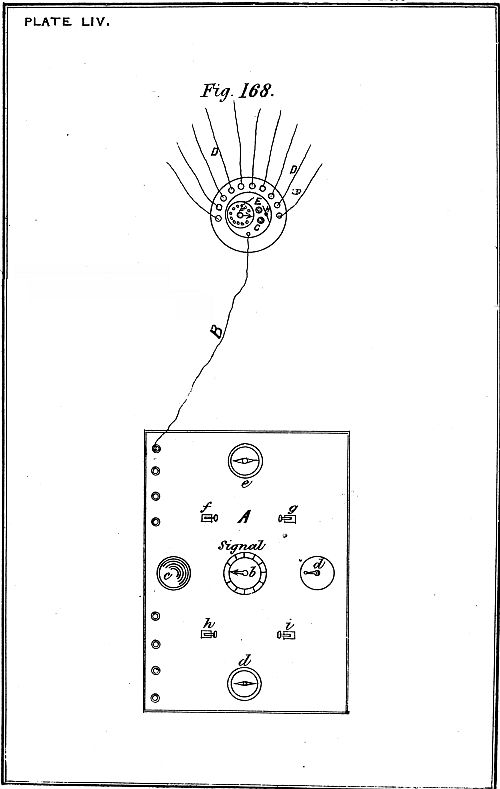
In the instrument, at the firing point a is a handle, by the turning of which a step by step motion is given to the pointer of a dial b and a simultaneous movement to the pointer F of the instrument C in the submerged box. When the handle a has made a half turn it couples one pole of the battery to the cable and the other to the earth connection, and when it has made a complete turn the connections are reversed. The pointer of the dial b then moves forward from one division of the dial to the next, and simultaneously the pointer F is turned in unison with it. The operator at the firing point can therefore always see which of the torpedoes is in electrical connection with the wire of the cable, and he can test each torpedo in succession by moving a handle, say at h, to cause the current passing back from the torpedo to pass through a galvanometer at e, and by the movement of the needle of the galvanometer it can be seen whether the resistance of the circuit through this torpedo is in its normal and proper working state.
When the pointer of the dial b is brought to zero, or as it is marked in the drawing to "signal," then the pointer F of the apparatus C is in electrical communication with a contact point which is coupled to all of the branch wires D, and usually the apparatus is left in this condition, the handle a being then locked and prevented from turning by a bolt actuated by a handle at G.
The current from the battery at the firing point then passes to earth through the resistances in all of the torpedoes. If now any one or other of the torpedoes is struck by a passing vessel and the wire from its fuze put directly to earth, so that the current passes freely to earth instead of having first to pass through the resistance, the fact of the current passing freely to earth is notified at the firing point by the movement of the needle of a galvanometer d; the movement of the needle of this galvanometer effects an electrical connection by which a small battery is caused to sound a bell at c. The operator at the firing point can then if he pleases at once fire the torpedo that has been struck by moving a handle at f and coupling up to the wire of the cable a battery of greater strength; the strong firing current will pass to earth through the fuze of the torpedo that has been struck, and will ignite this fuze, but will not affect the fuzes of the other torpedoes, as to pass through these fuzes it has also to pass through resistances which impede its passage and reduce its strength, so that the portion of the current which passes to earth through them is not of sufficient strength to ignite the fuzes.
When the fuze of any one or other of the torpedoes is exploded by the passing of a strong firing current through it, the wire leading from the box C to this torpedo is simultaneously cut off from electrical connection with the contact pin E to which it was previously connected, and this pin is put to earth through a resistance either somewhat greater or less than the resistances in the torpedoes, so that the firing of one or more of the torpedoes does not interfere with the power of being able to turn the pointer F of the apparatus C in unison with the pointer of the dial b.
Afterwards the operator at the firing point can ascertain which of the torpedoes has been fired by passing the pointer of the dial b to each of the divisions of the dial in succession, and ascertaining by the galvanometer a the resistance of the circuit through each of the torpedoes, so that he at once ascertains which torpedo has been put to earth through the greater or less resistance.
The cutting off of the wire D from its contact E when a strong current is passed through it may be effected by the wire being coiled around an iron core forming an electro magnet, which when a strong current is passed through the wire is of sufficient strength to shift the position of a contact apparatus and then effect the required alterations in the connections, but which is not of sufficient strength to effect any change when the weaker currents used for the signalling and testing operations are passed through the wire.
It will be evident that with the above described apparatus any one or other of the torpedoes can if desired be exploded by the operator at the firing point whenever he desires to do so. To effect this he would by turning the handle a bring the pointer of the dial b opposite to the division of this dial; that would indicate that the cable had been brought into electrical communication with the torpedo required to be exploded, and then when it is ascertained by previously adjusted sight points that the vessel is above the torpedo, he can fire the torpedo by passing a strong firing current to the cable.
In this way the apparatus can be used for firing any one or other of a group of sunken torpedoes, or if the torpedoes are buoyant ones, they need not be fitted with apparatus for putting the wire from their fuze directly to earth whenever the torpedo is struck by a passing vessel. The same arrangement of apparatus can also be used for firing any one or other of a number of mines or torpedoes on land and for separately testing the firing mechanism of each mine whenever desired.
Captain McEvoy's single main system will shortly undergo a series of experiments under the supervision of the English torpedo authorities at Chatham, which will most probably result in its adoption by the English government, and also by the principal continental powers.
TABLE[Y] showing the value of the fractions A and B for every half degree.
A B
Arc. 150 + α 150 - α
α 150 - α 150 + α
145 59·00 0·017
144·5 53·54 0·019
143·5 45·15 0·022
143 41·86 0·024
142·5 39·00 0·026
142 36·50 0·028
141·5 34·29 0·029
141 32·33 0·031
140·5 30·58 0·033
140 29·00 0·035
139·5 27·57 0·036
139 26·27 0·038
138·5 25·09 0·040
138 24·00 0·042
137·5 23·00 0·044
137 22·08 0·045
136·5 21·22 0·047
136 20·43 0·049
135·5 19·69 0·051
135 19·00 0·052
134·5 18·35 0·054
134 17·75 0·056
133·5 17·18 0·058
133 16·65 0·060
132·5 16·14 0·062
132 15·67 0·064
131·5 15·22 0·066
131 14·79 0·068
130·5 14·38 0·070
130 14·00 0·071
129·5 13·63 0·073
129 13·28 0·075
128·5 12·95 0·077
128 12·64 0·079
127·5 12·33 0·081
127 12·04 0·083
126·5 11·76 0·085
126 11·50 0·087
125·5 11·24 0·089
125 11·00 0·091
124·5 10·76 0·093
124 10·54 0·095
123·5 10·32 0·097
123 10·11 0·099
122·5 9·91 0·101
122 9·72 0·103
121·5 9·53 0·105
121 9·35 0·107
120·5 9·17 0·109
120 9·00 0·111
119·5 8·84 0·113
119 8·68 0·115
118·5 8·52 0·117
118 8·37 0·119
117·5 8·23 0·121
117 8·09 0·123
116·5 7·96 0·126
116 7·82 0·128
115·5 7·69 0·130
115 7·57 0·132
114·5 7·45 0·134
114 7·33 0·136
113·5 7·22 0·139
113 7·11 0·141
112·5 7·00 0·143
112 6·89 0·145
111·5 6·79 0·147
111 6·69 0·150
110·5 6·59 0·152
110 6·50 0·154
109·5 6·41 0·156
109 6·32 0·158
108·5 6·23 0·160
108 6·14 0·163
107·5 6·06 0·165
107 5·97 0·168
106·5 5·89 0·170
106 5·82 0·172
105·5 5·74 0·174
105 5·67 0·176
104 5·52 0·182
103·5 5·45 0·183
103 5·38 0·186
102·5 5·31 0·188
102 5·25 0·190
101·5 5·18 0·193
101 5·12 0·195
100·5 5·06 0·198
100 5·00 0·200
99·5 4·94 0·202
99 4·88 0·205
98·5 4·82 0·207
98 4·77 0·209
97·5 4·71 0·212
97 4·66 0·215
96·5 4·61 0·217
96 4·55 0·220
95·5 4·50 0·222
95 4·45 0·224
94·5 4·40 0·227
94 4·36 0·230
93·5 4·31 0·232
93 4·26 0·235
92·5 4·22 0·237
92 4·17 0·240
91·5 4·13 0·242
91 4·08 0·245
90·5 4·04 0·247
90 4·00 0·250
89·5 3·96 0·253
89 3·92 0·255
88·5 3·88 0·258
88 3·84 0·260
87·5 3·80 0·263
87 3·76 0·266
86·5 3·72 0·269
86 3·69 0·271
85·5 3·65 0·274
85 3·62 0·276
84·5 3·58 0·279
84 3·54 0·282
81·5 3·38 0·296
81 3·35 0·299
80·5 3·31 0·302
80 3·28 0·304
79·5 3·25 0·307
79 3·22 0·310
78·5 3·19 0·313
78 3·17 0·316
77·5 3·14 0·319
77 3·11 0·322
76·5 3·08 0·325
76 3·05 0·327
75·5 3·03 0·330
75 3·00 0·333
74·5 2·973 0·336
74 2·947 0·339
73·5 2·921 0·342
73 2·896 0·345
72·5 2·871 0·348
72 2·846 0·351
71·5 2·822 0·354
71 2·797 0·357
70·5 2·773 0·360
70 2·750 0·364
69·5 2·726 0·367
69 2·703 0·370
68·5 2·680 0·373
68 2·658 0·376
67·5 2·636 0·379
67 2·614 0·382
66·5 2·592 0·386
66 2·571 0·389
65·5 2·550 0·392
65 2·529 0·395
64·5 2·509 0·398
64 2·488 0·402
63·5 2·468 0·405
63 2·448 0·408
62·5 2·428 0·412
62 2·409 0·415
61·5 2·389 0·418
59 2·296 0·435
58·5 2·278 0·439
58 2·261 0·442
57·5 2·243 0·446
57 2·226 0·449
56·5 2·208 0·453
56 2·191 0·456
55·5 2·174 0·460
55 2·158 0·463
54·5 2·141 0·467
54 2·125 0·471
53·5 2·109 0·474
53 2·093 0·478
52·5 2·077 0·481
52 2·061 0·485
51·5 2·045 0·489
51 2·030 0·492
50·5 2·015 0·496
50 2·000 0·500
49·5 1·985 0·504
49 1·970 0·508
48·5 1·955 0·511
48 1·941 0·515
47·5 1·926 0·519
47 1·913 0·523
46·5 1·898 0·527
46 1·884 0·531
45·5 1·870 0·535
45 1·857 0·538
44·5 1·843 0·542
44 1·830 0·546
43·5 1·816 0·550
43 1·803 0·554
42·5 1·790 0·558
42 1·777 0·562
41·5 1·765 0·567
41 1·752 0·571
40·5 1·739 0·575
40 1·727 0·579
39·5 1·714 0·583
39 1·702 0·587
36·5 1·643 0·609
36 1·631 0·613
35·5 1·620 0·617
35 1·608 0·622
34·5 1·597 0·626
34 1·586 0·630
33·5 1·575 0·635
33 1·564 0·639
32·5 1·553 0·644
32 1·542 0·648
31·5 1·531 0·653
31 1·521 0·657
30·5 1·510 0·662
30 1·500 0·667
29·5 1·489 0·671
29 1·479 0·676
28·5 1·469 0·681
28 1·459 0·685
27·5 1·449 0·690
27 1·439 0·695
26·5 1·429 0·700
26 1·419 0·705
25·5 1·409 0·709
25 1·400 0·714
24·5 1·390 0·719
24 1·380 0·724
23·5 1·371 0·729
23 1·362 0·734
22·5 1·352 0·739
22 1·343 0·744
21·5 1·334 0·749
21 1·325 0·754
20·5 1·316 0·760
20 1·307 0·765
19·5 1·298 0·770
19 1·290 0·775
18·5 1·281 0·780
18 1·272 0·786
17·5 1·264 0·791
17 1·255 0·796
16·5 1·247 0·802
16 1·238 0·807
15·5 1·230 0·813
15 1·222 0·818
14·5 1·214 0·823
14 1·206 0·829
13·5 1·198 0·835
13 1·189 0·841
12·5 1·181 0·847
12 1·173 0·852
11·5 1·166 0·858
11 1·158 0·863
10·5 1·150 0·869
10 1·143 0·875
9·5 1·135 0·881
9 1·127 0·887
8·5 1·120 0·893
8 1·112 0·899
7·5 1·105 0·905
7 1·097 0·911
6·5 1·090 0·917
6 1·083 0·923
5·5 1·076 0·929
5 1·068 0·935
4·5 1·061 0·942
4 1·054 0·948
3·5 1·047 0·954
3 1·040 0·960
2·5 1·033 0·967
2 1·027 0·974
1·5 1·020 0·980
1 1·013 0·987
0·5 1·006 0·993
A SYNOPSIS OF THE PRINCIPAL EVENTS THAT HAVE OCCURRED IN CONNECTION WITH THE HISTORY OF THE TORPEDO.
Date. Operator, &c. Event. Place. Remarks.
1585. Italian Engineer, Zambelli. Attack on a bridge formed over the Scheldt. Antwerp. Bridge completely destroyed. Vessels, each carrying a heavily charged magazine, fired by clockwork, were carried by the stream against the bridge.
1775. Captain D. Bushnell. Numerous small experiments with gunpowder charges. America. By which he proved that a charge of gunpowder could be fired under water.
1776. " Attack on the English frigate H.M.S. Eagle by his submarine torpedo boat. New York. Boat managed by Sergeant E. Lee. Attack failed, owing to his inexperience in manipulating this novel kind of craft.
1777. " Attack on the English man-of-war H.M.S. Cerberus by his drifting torpedoes. New London. Drifting torpedoes employed. Crew of a prize schooner astern of the Cerberus hauled one of the torpedoes on board, which exploded, killing 3 men and destroying a boat.
1777. " Attack on English ships by numerous floating torpedoes. Known by the name of "Battle of Kegs." " This failed, owing to the ships having previously hauled into dock to avoid the ice, but it created a great amount of confusion and alarm among the crews of the vessels.
1797. R. Fulton. Experiments with torpedoes on the Seine. France. These first attempts were generally failures.
July 3, 1801. " Experiments with his submarine boat named the Nautilus. Brest, France. These experiments were successful in so far as proving that with such a boat he could descend to any given depth and reascend to the surface at will, and that he could remain below for a considerable time.
August 1801. " Attempted to sink a small vessel by means of one of his torpedoes. " Completely successful. This is the first vessel known to be destroyed by means ofa torpedo. Charge of submarine mine 20 lbs. gunpowder.
1801. " Attempted to destroy one of the English channel fleet by means of his drifting torpedoes. Off Boulogne, France. Owing to the ship altering her position at the moment of setting the torpedo adrift, this attack failed.
Oct. 3, 1804. " Catamarran expedition under Lord Keith to destroy the French fleet. Boulogne, France. Failed, owing to a mistake in the constructionof the torpedoes. The mines exploded, but did no damage to the French ships.
Oct. 1805. " Similar expedition. " Similar failure, owing to causes above mentioned.
Oct. 15, 1805. " Attempted to destroy a brig Dorothea with his drifting torpedoes. Dover, England. The brig was completely demolished. Two torpedoes employed, each charged with 180 lbs. gunpowder and fired by clockwork.
July 20, 1807. " Experiment on a large hulk brig. New York, America. Finally successful, several attempts being necessary, owing to faulty construction.
Oct. 1810. " Attack on the U.S. sloop Argus for finally testing the efficacy of his torpedo schemes. New York. Failed, owing to the very ingenious though elaborate defence of the vessel, carried out under the directions of Commodore Rodgers.
1812. Mr. Mix. Attack on the English frigate H.M.S. Plantagenet with his drifting torpedoes. Lynn, Haven Bay, America. Complete failure, though six different attempts were made.
June 15, 1813. " Attack on H.M.S. Ramilies by blowing up a schooner alongside. New York. An utter failure.
1820. Captain Johnson. Experiment with a submarine boat carrying a torpedo on its back. Moulsford, Berks, England. Idea was to fasten the torpedo by means of screws to the bottom of the hostile vessel. Trial proved successful, but the English government refused to sanction the project as being too diabolical.
July 4, 1829. Colonel Samuel Colt. Experiment on a raft with his submarine battery. Ware Pond, America. Successful.
1839. General Paisley, R.E. Destruction of the wreck of the Royal George by submarine mines. Portsmouth, England. He is stated to have employed galvanic firing to explode the mines.
1840. Captain Warner. Experiment on the John O'Gaunt. England. Successful. Details not known.
June 4, 1842. Colonel S. Colt. Experiment to explode a submarine mine by electricity. New York. Successful. The operator was at a great distance from the torpedo.
July 4, 1842. " Experiment on the U.S. gunboat Boxer with electric submarine mines. Castle Garden, New York. Successful. The operator was on board U.S. man-of-war at some distance from the place where the explosion occurred.
Aug. 20, 1842. Colonel S. Colt. Similar experiment on a schooner. Potomac River, America. Successful, the operator being stationed at a distance of 5 miles from where the mine was placed.
Oct. 18, 1842. " Similar experiment on the brig Volta, 300 tons. New York. Successful. The operator being on board the revenue cutter Ewing, at a considerable distance from the scene of the explosion.
April 13, 1843. " Experiment to destroy a vessel of 500 tons under weigh by electric submarine mines. Potomac River, America. Successful. The vessel was, at the time of the explosion, sailing at the rate of 5 knots per hour, and to prevent the possibility of any collusion between the operator and crew, they left the ship a few moments before the catastrophe. Operator 5 miles distant. Probably several mines were placed in the form of a circle.
July, 1844. Captain Warner. Experiment with his invisible shell, on a barque of 450 tons. Brighton, England. The vessel completely destroyed.
Jan. 1, 1845. Colonel S. Colt. Experiment with an electric submarine mine. New York. Successful. The operator being at a distance of 40 miles from where the explosion took place.
1846. Professor Schonbein. Discovered the explosive agent "gun-cotton." .. Brought into use for military purposes about 1863, by Professor Abel.
1846. Sobrero. Discovered the explosive agent nitro-glycerine. .. Brought into use about 1863, for blasting purposes by M. Alfred Nobel, a Swede.
1854. Russians. Attempted destruction of the English men-of-war Merlin and Firefly, by stationary submarine mines. Cronstadt. Several torpedoes were exploded near these ships, but with no other results than a wetting to some of their men.
Feb. 18, 1862. Confederates. Federal gunboats attempting to force the Savannah river. America. Considerably delayed, caused by the submarine mines, but no actual damage done. This was their first appearance in a practical form during the civil war.
Dec. 13, 1862. " Destruction of the Federal ironclad Cairo, by stationary torpedoes. Yazoo River, America. Two torpedoes exploded under her; vessel much shattered, and sunk in 12 minutes. First vessel destroyed in this war.
Feb. 28, 1863. " The Federal monitor Montauk, severely damaged by a submarine mine. Ogeechee River, Georgia. She was saved from sinking by being run on the mud, thus enabling the hole to be temporarily closed, and the vessel taken to Port Royal.
July 22, 1863. " The Federal ironclad gunboat Baron de Kalb, sunk by a submarine mine. Yazoo River. The vessel went down in 15 minutes. As she was sinking a second torpedo exploded under her stern. No lives were lost.
Aug. 8, 1863. " The Federal gunboat Commodore Barney severely damaged. James River. The ship was, at the time of the explosion, steaming 9 knots, and ran into it, losing 20 men, and being some what severely damaged. It was an electric submarine mine charged with 1750 lbs. gunpowder.
Oct. 5, 1863. " Boat torpedo attack on the Federal ship Ironsides. Charleston. Failed. It was made by a boat armed with a spar torpedo with 60 lbs. gunpowder.
1863. " Confederate steamers Marion and Ettiwa destroyed by their own mines. " Owing to the shifting of the position of barrel torpedoes.
1863. " Confederate flag of truce boat Shultz. James River. The same cause.
Feb. 17, 1864. " Boat torpedo attack on the Federal frigate Housatonic. Charleston. Successful, the ship being sunk. A submarine boat was employed on this occasion, and owing to her running into the hole made by her torpedo, went down with the ship.
March 6, 1864. " Boat torpedo attack on the Federal ship Memphis. North Edisto River, South Carolina. Failed, owing to the torpedo spar being broken by the vessel's screw.
April 1, 1864. " Destruction of the Federal transport Maple Leaf. St. John's River, Florida. This was effected by a floating torpedo.
April 9, 1864. " Boat torpedo attack on the Federal ship Minnesota. James River. The ship was severely damaged, but not sunk. Spar torpedo, charge 53 lbs. gunpowder.
April 19, 1864. " Boat torpedo attack on the Federal frigate Wabash. Charleston. Failed, owing to the boat being discovered.
May 6, 1864. " Loss of the Commodore Jones. James River. Completely demolished by an electric torpedo, 1750 lbs. gunpowder. This part of the river having been carefully dragged.
Aug. 5, 1864. Confederates. Loss of the Federal monitor Tecumseh. Mobile Bay. This occurred during the Federal attack onthe defences of Mobile Bay, the ship disappearing almost instantaneously. The captain and 70 of the crew were killed.
Oct. 27, 1864. Federals. Boat torpedo attack on the Confederate ironclad Albemarle. Near Plymouth, America. The only Federal torpedo success during the war. The boat was armed with the Wood and Lay disconnecting spar torpedo. The ship was sunk.
Dec. 9, 1864. Confederates. Loss of the Federal steamers Otsego and Bazeby. Roanoke River. The latter vessel was proceeding to the assistance of the former. Both were totally destroyed.
1864. M. A. Nobel. Introduction of dynamite. .. A modified form of the explosive nitro-glycerine.
1864. Captain Lupuis and Mr. Whitehead. First series of experiments with the fish torpedo. Fiume, Austria. The idea of such a weapon previously known, but not acted on.
Jan. 15, 1865. Confederates. Loss of the Federal monitor Patapsco. Charleston. Completely destroyed by a barrel torpedo, sinking in a few minutes. Sixty-two officers and men drowned.
March 1, 1865. " Loss of the Federal steamer Harvest Moon. Near Georgetown. The place where this catastrophe occurred had been previously swept for torpedoes.
March 30 to April 19, 1865. " Loss of two Federal monitors, and three gunboats. Mobile Bay. These losses occurred in the final attack on Mobile, at the close of the war.
Sept. 2, 1866. Paraguayans. Loss of the Brazilian war steamer Rio Janeiro. Currupaity, Paraguay. Completely destroyed by a stationary torpedo at the bombardment of Currupaity by the Brazilian fleet.
1874. England. Adoption of the electric light in the Navy.
May 29, 1877. English. Torpedo attack by H.M.S. Shah on the Peruvian ironclad Huascar. .. This is the first Whitehead fish torpedo ever fired against an hostile ship. It failed, owing to the Huascar being at too great a distance.
May 12, 1877. Russians. Russian torpedo boat attack on several Turkish ships. Batoum. Failed. A Turkish ship was struck by a towing torpedo, but it failed to explode.
May 26, 1877. " Russian torpedo boat attack on the Turkish ships Fettu Islam, Duba Saife, and Kilidj Ali. Matchines, River Danube. Successful. A Turkish monitor, Duba Saife, was sunk.
June 9, 1877. " Russian torpedo boat attack on the Turkish ironclads Feteh Bulend, Moocardemikhair, and Idglalieh. Sulina, mouth of the Danube. Failed. The Russian torpedo boat No. 1 was sunk, and her commander, Lieutenant Poutschin, with his crew, taken prisoner. The attack was made by six boats.
June 20, 1877. " Turkish monitor attacked by the Russian spar torpedo boat Choutka. Rutschuk, on the Danube. Failed. The officer in command of the boat being severely wounded, and the torpedowires cut. This attack was made in the daytime.
June 23, 1877. " Two Russian torpedo boats attacked a Turkish monitor. Mouth of the Aluta, Danube. Failed, owing to the spirited defence on the part of the Turks. Another day affair.
Aug. 22, 1877. " The Turkish ironclad Assari Shefket attacked by four Russian torpedo boats. Soukoum Kaleh. Failed. The captain of the Assari Shefket had placed guard boats in advance of hisship, by which he was warned of the approach of the torpedo boats, and so enabled to foil the attack by a well-directed, hot fire.
Oct. 10, 1877. " Loss of Turkish gunboat Suna at the Russian attack on Sulina. Sulina. The gunboat was sunk by striking an electro-contact mine, placed by the Russians about 3/4 mile above the Turkish defences. About fifteen officers and men killed and wounded.
Dec. 27, 1877. " Turkish squadron attacked by four Russian torpedo boats, two being armed with the Whitehead fish torpedo. Batoum. Failed. The Russians fired two Whitehead fish torpedoes (the first attack of this nature during the war), both of which were picked up by the Turks.
Jan. 25, 1878. " Attack on Turkish ships by two Russian torpedo boats, armed with the Whitehead fish torpedo. Batoum. Successful. A Turkish revenue steamer on guard being sunk. Final torpedo attack made in the Russo-Turkish war (1877-78).