Chapter IV
Emilie Poulsson translation
The Release
While all this was taking place, Prince Abderraman was riding the wide world over, with his sword at his side and his staff in his hand. There was not a mountain in Asia, not a desert in Africa, nor a field, town or city in Southern or Middle Europe which he had not traversed in vain. But what had he to hope for in Europe? No tigers are found there except the tame ones exhibited in the city menageries; and among them there was no Ahriman! Sorrow drew the prince back on the way to Persia, and his trusty dog, Valledivau, accompanied him.
One day the dog hunted a wild duck among the reeds of a lake, captured it and carried it alive to his master. Just as the prince was about to kill it, the duck quacked out:
"Spare my life, and I will tell you something!"
"I will spare your life, wonderful bird," the prince exclaimed, astonished. "What have you to tell me?"
"Ride to Lapland!" quacked the duck, at the same time escaping into the water.
Lapland! The prince had never even heard of such a kingdom. When he inquired about it and how he should find it, people answered:
"Ride northward, steadily northward; and stop not until the road ends, the forest ends, and you no more find a human dwelling with builded hearth."
"Wonderful!" thought the prince, and he followed the advice. He rode northward, steadily northward; stopping not until the road came to an end, the forest came to an end, and no human dwelling was to be seen but one lone movable tent.
It was on the last day of August, after he had ridden many long and weary miles without seeing a single trace of man, that the prince suddenly discovered, at the foot of a high mountain, this lone tent of reindeer skin. The last day of August! The sun still shone and the heather still blossomed, but the sky had changed and a cool north wind blew. When the wind ceased, then would come the frost!
The prince drew nearer to the tent that he might once more repeat his fruitless query for the lost princess, when to his indescribable astonishment he perceived in the distance an inscription on a rock on the mountainside. The characters were very legible. He read the name of
Lindagull!
The wizard had carved the name there, over the door of the mountain grotto, so that he could find the place again when he moved his tent away.
The prince had dismounted, and was just about to draw his sword and enter the tent when Hirmu came out on his way to the heath.
"Give me back the Princess Lindagull or I will send you to the Kingdom of the Prince of Darkness!" shouted Abderraman.
The wizard was a crafty fellow who knew many a trick by which to save himself when in a dilemma. But he lost his presence of mind at this unexpected encounter and could think of no better way out of the difficulty than to change himself instantly into a mountain fox. With a hasty spring he fled swiftly away into the mountain. He thought thus to be safe from the prince's sword, but he forgot the dog by whom the prince was followed!
No sooner had Valledivau seen the fox spring away than he was off on the hunt after it. The fox hid in every cleft and jumped over the mountain ravines; but Valledivau, even more agile, chased him to the highest mountain top, tore him in pieces, and ate up his heart.
This proved the death of Hirmu the wizard; for his heart had entered the fox just as it had before gone into the tiger; and when the heart was eaten up, that was the end of the wizard.
When the dog returned with his nose covered with blood, his master understood that now their common enemy had met his destruction. But where was Lindagull to be found?
The prince went to the door of the tent. The Lapp woman, Pimpedora, was cooking reindeer meat; and her boy, Pimpepanturi, stretched lazily on the soft moss, was sleeping instead of doing something useful while he was waiting for dinner.
"Woman," said the prince, "your husband is dead. Give me back the Princess Lindagull, and no harm shall come to you."
"O mercy! And is he dead?" exclaimed the Lapp woman, coming out of the tent, but not appearing very much distressed. "Ah, well! It's time there should come an end to his evil arts. As for Lindagull, we must seek her out there among the heather blossoms. My husband has changed her into a heather blossom, exactly like many thousands of others; and to-night the frost will come and then all will be over with her!"
"Ah! dearest little Lindagull! Must you die to-night and I not be able to discover the stalk on which you wither?" cried the prince, throwing himself down among the heather on the boundless moor, where a thousand times a thousand pale, purple-pink blossoms, exactly like each other, awaited death.
"Hold!" said the Lapp woman. "Despair not! Now occurs to me the saying with which Lindagull was enchanted! I thought he planned a wrong against the child, and crept back of a big stone to see what my husband was going to do. Then I heard him say:
"Adáma donai Marrabataësan!"
"Ah!" sighed the prince, "how can that help us when we do not know the words which loosen the enchantment?"
Pimpepanturi, waking and thinking that the dinner had been long enough deferred, walked out of the tent to look for his mother. When he heard the prince's words, he scratched his forehead thoughtfully a few times and said, "Father used to change the saying around when he wanted to disenchant any one."
"Yes, so he did!" said the Lapp woman.
Prince Abderraman, with terrified eagerness, gave a great leap, landed on a rock, and shouted as loudly as he could over the limitless heath:
"Marrabataësan donai Adáma!"
The words rang out through the air without effect. No blossom arose. The sun was sinking rapidly toward the horizon and the wind was growing still.
The prince, fearing he should not give the right turn to the magic command, repeated it time after time saying the words in different order and with different expression. But in vain.
At last, at a certain way of saying the words, it seemed to him that a bit of heather on a distant mound had lifted itself up to listen, but sunk immediately back, undistinguishable among the multitudinous blossoms.
"The sun is going down," said the Lapp woman. "If we do not quickly find the right manner of saying the words, the frost will come, and then it will be too late."
By this time the sun's red beams had sunk quite down to the horizon. All nature was silent. A cool and damp evening mist, the forerunner of the frost, spread itself like a veil over moor and mound. All living things which had ventured to bloom for a short time in Lapland were now doomed to death.
Prince Abderraman was pallid with terror. His voice choked, and he could scarcely articulate the one untried arrangement of the magical words:
"Marraba donai Adáma taësan."
Behold! On the distant hillock, a heather blossom raised itself on its stalk. It grew as rapidly as does the lily which the Afghanistan fairies cause to spring forth in the red dawn, when they tap on the blue mountains with their magic wands.
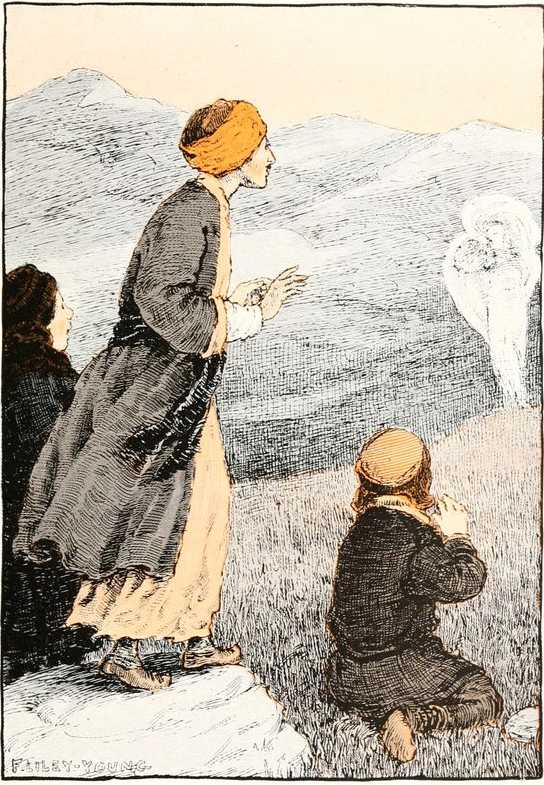
The mist lay all around the mound. Out of the mist arose a slender figure, and as the prince approached the mound, running breathlessly, Lindagull came toward him pale with the escape of death. Prince Abderraman had found the right order for the words just in time to save her life.
The Princess Lindagull was borne to the tent in the arms of Abderraman, and her strength soon returned under the Lappish woman's kind care. Pimpedora was happy; and Pimpepanturi in his gladness forgot his longed-for dinner, which was sadly burnt in the pot.
OUT OF THE MIST AROSE A SLENDER FIGURE.
The hero-prince, picturing to himself the perils of the princess and the wonder of her recovery, swooned with rapture. His first words as he recovered were a prayer to Allah; and then he asked Lindagull:
"How did it feel to be changed into a heather blossom?"
"Just as if one sank back into the cradle of childhood and knew no more of the world than to eat, drink, and be happy in God's love," answered Lindagull.
"And how did it feel when you came back to life again?"
"Just as when one awakes on a clear morning after a deep and pleasant slumber."
"To-morrow shall we go back to Persia?"
"Yes," answered Lindagull. "But the good woman and her son have had a share in saving the poor captive Lindagull. We will take them with us and they shall have a palace in Ispahan."
"No; many, many thanks," answered Pimpedora; "I like my reindeer tent in Lapland better."
"Are there snow and reindeer in Persia?" asked Pimpepanturi.
"Snow is found only on the highest mountains," said the princess; "and instead of reindeer we have horses, antelopes, and gazelles."
"No, thank you heartily, then," said Pimpepanturi. "You can go with pleasure, and marry whom you wish. Nowhere in the world is there to be found so good a land as Lapland!"
It was of no use trying to dispute that question with the Laplanders, so the prince and princess set out the following day without them. Before departing they presented the Lapp woman and her son with their gold-embroidered clothes and with many jewels; receiving in return gifts of Lappish garments made from reindeer skin.
The Lapp woman put the costly Persian robes carefully away in birch bark, and rejoiced because with them she could buy a whole field of grain.
Shah Nadir sat alone in Ispahan's golden palace and groaned with grief. He could not forget his lost daughter. His wicked and ungrateful sons had raised a rebellion against him, and were marching with a large army toward the capital to cast their father from the throne.
While affairs were at this juncture the Grand Vizier announced that a young foreign couple, dressed in reindeer skin and followed by a dog, wished to prostrate themselves at the king's feet.
Shah Nadir never refused audience to a stranger,—(perhaps such a traveler would know something of his dear lost child!)—and so the two foreigners were led into his presence.
The young man cast himself down before the feet of the Shah; but the young woman, without ado, threw her arms around his neck; at which proceeding the Grand Vizier's beard became green with consternation!
But Shah Nadir, under her Lappish hood of reindeer skin, recognized his child so long sought and so hopelessly bewailed. "Allah! Allah!" cried he in joy; "now I am willing to die!"
"No, my lord king," broke out Prince Abderraman. "Now shall you live to rejoice with us, and to win back your kingdom again."
When Shah Nadir learned about his daughter's captivity and of the loyal service which the prince had shown her, he immediately proclaimed Prince Abderraman successor to his throne, promised him the Princess Lindagull in marriage, and sent him in command of the fifty thousand knights with gold saddles to fight the rebellious army.
It was not long before the prince won a glorious battle, took the rebel sons prisoners, and came back victorious to the rejoicing people of Ispahan.
Then was the wedding of Prince Abderraman and Princess Lindagull celebrated with great state (but without a wild beast fight!) and they lived long and happily after. But one day every year,—and that was the thirty-first of August, the date of Princess Lindagull's deliverance,—the royal pair showed themselves (to the great wonderment of magnificent Persia) in the Lapps' outlandish clothes of reindeer skin, so that in their prosperity they should not forget the great escape and blessing of the past.
In his old age, Shah Nadir had happy little grandchildren to sit upon his knee. The wicked sons ended their careers as swineherds for old King Bom Bali in Turan. The dog, Valledivau, lived to be thirty years old and died of the toothache (!); his skin was stuffed and kept in great honor. But about Pimpedora, and Pimpepanturi who bore for a season the proud name of Morus Pandorus von Pikkuluk´ulikuck´ulu, nothing has since been heard in Persia. Probably they have never found a better land on the earth's broad expanse than Lapland.
—Z. Topelius.