A LEGEND OF MERCY
Emilie Poulsson translation
On one side of the lake there was a large town; on the opposite shore stood a little lone cottage. The snow whirled over the frozen lake in great clouds and the wind was very keen; for it was winter and Christmastide in the world.
At the cottage there was poverty inside, but riches on the roof. Up there stood the great golden sheaf of grain about which the birds of heaven gathered joyfully for their Christmas feast, while inside the cottage food was scanty, as usual. The peasants' little children, however, listened happily to the birds' joyous twitter from the housetop, and took great delight in seeing the fine prints of the sparrow's tiny feet in the smooth snow roundabout.
"If we had threshed that grain, instead of giving it to the sparrows, we might have had fresh wheaten rolls for the children for Christmas," sighed the peasant's wife.
"Don't you know that the merciful are blessed?" asked the gentle old peasant with a kind glance at his dissatisfied wife.
"But to let the birds of the air eat our bread," she sighed again.
"Yes, the birds. Furthermore, what matter, even if it were the wild beasts of the forest? Should we not show mercy? Besides, I have saved enough to be able to buy four fresh rolls and a can of milk for Christmas. Let us send the children across the lake to the town with their sled. They will easily get back with the things before evening."
"But suppose they meet a wolf on the ice," suggested the mother.
"I will give Arvid a big club," said the father. "He will get along all right, having that."
So it happened that Arvid and his sister Hanna went to town to buy the treat of white rolls and milk. By this time the snow was piled in great drifts on the ice, and the children had difficulty in dragging the sled, so that when they turned toward home the early darkness was already beginning to settle down. They trudged through the snow as fast as they could, but the drifts were much higher than before, and darkness came on in earnest while they still had quite a long distance to go.
As they struggled on, something black moved in the darkness. When it came nearer, the children saw that it was a wolf.
"Don't be afraid, Hanna," said Arvid. "I have a good club." And with these words, he raised it threateningly.
The wolf was now close beside the children but made no attempt to harm them. He only howled, but the howling was extraordinary for it sounded as if he uttered words in it,—words that the children could understand. "It is so cold, so cold," howled the wolf. "And my little ones have nothing to eat. Give me some bread for them in the name of mercy."
"Poor little things!" said Hanna. "We will give you our two rolls for them, and we ourselves will eat hard bread to-night, but father and mother must have their Christmas treat."
"Many thanks," said the wolf as he took the two fresh rolls and glided away.
The children strove on through deeper and deeper snow, but in a little while they heard some creature treading heavily behind them. It proved to be a bear.
The bear growled out something in his own language, and at first the children could not find out what he meant although they tried hard; but the bear kept on growling and finally, strangely enough, the children understood. The bear, too, desired a Christmas gift.
"It is so cold, so cold," growled the big creature. "All the water everywhere is frozen and my poor little ones have nothing to drink. Be merciful and give me a little milk for them."
"How is this?" asked Arvid. "Why are you not asleep in your den for the winter, as other bears are? But that is your affair. We will give you our half of the milk for your little ones. Hanna and I can very well drink water to-night, if only father and mother have something good for Christmas."
"Many thanks," said the bear, as he took the milk in a birch-bark cone which he carried in his fore-paws. Then with slow, pompous steps, he lumbered away into the darkness.
The children waded along through the drifts still more eagerly now, for they could see the Christmas lights shining through the windows of their home; but they had not gone far before an ugly owl came flapping along beside them.
"I will have bread and milk! I will have bread and milk!" screamed the owl, stretching out her long claws to scratch the children.
"Oh, ho!" said Arvid. "If that is the kind you are, I shall have to teach you to be polite." So saying, he gave the owl such a clever blow on the wings with his club that she flew screaming away.
Soon after this the children were at home, gaily beating the snow from their clothes in the little entry.
"We have met a wolf!" shouted Hanna.
"And given a bear some milk!" added Arvid.
"But the owl got a taste of the club!" laughed Hanna. Then they told all their adventures.
The parents looked thoughtfully at each other. How wonderful! To think that their children had shown mercy even to the wild beasts of the forest! What would happen next? What did it all mean?
It was now supper-time. The peasant family gathered at the table upon which, besides the usual poor fare, was the half portion of the expected treat—all that the children had brought home.
Arvid and Hanna wished to eat only dry bread and drink only water, so that their parents might have the Christmas goodies; but the parents would not allow that. They joyfully shared with the children the two rolls and the half-tankard of milk which were such luxuries.
But as they ate, they noticed something very marvelous. However often they broke and broke pieces from either of the rolls, the fresh delicious wheaten rolls never grew smaller; and however often they poured milk from the tankard into one bowl after another the milk never grew less!
While they were wondering greatly over this, they heard a scratching at the little window, and behold! there stood the wolf and the bear with their fore-paws against the window pane. Both animals grinned and nodded in a knowing, friendly way. An owl could be heard flapping behind them in the darkness, and calling out in a hoarse voice to Arvid:
"Sometimes hits Sharpen wits. Hoo, hoo! Hoo, hoo! Not from need But from greed I begged of you. Hoo, hoo! Hoo, hoo!"
THERE STOOD THE WOLF AND THE BEAR.
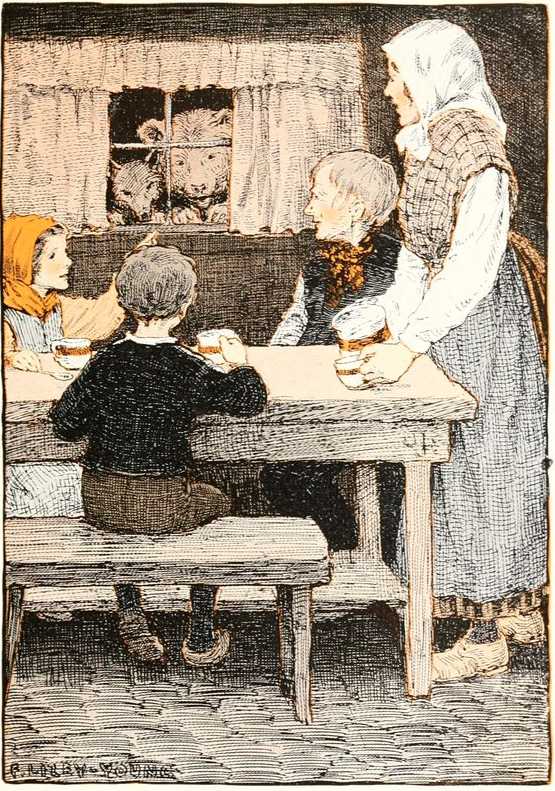
Then her hoarse cries died away in the distance, and the two beasts, after a little more grinning and nodding, disappeared from the window.
The peasant and his wife and the children understood now that a blessing rested upon their Christmas food because it had been shared in mercy with those that needed it; and they finished their meal in wonder and thankfulness.
On Christmas morning when they went to get their breakfast of dry bread and water, not expecting to have anything else, they found to their amazement that both rolls and milk were as fresh as when the children bought them,—and with no sign that the rolls had ever been broken or any milk used! And all that day it was the same! There were not only riches on the roof, but joy and plenty inside the peasants' cottage, where the children feasted and sang as gaily as did the sparrows, fluttering about their Christmas sheaf of golden grain.
—Z. Topelius.