ANTON'S ERRAND
Emilie Poulsson translation
OR THE BOY WHO MADE FRIENDS BY THE WAY
Far to the South lies a beautiful land. High forest-clad mountains lift themselves toward the sky, and between them spreads a wide fruitful valley. A mighty river rushes southward singing of courage and joy, and from the mountains the merry brooks come hurrying along, the one faster than the other, as if racing to see which would get down first.
In the fields, the grass is tall and full of flowers, the grain waves like a billowy sea, and the fruit trees bend beneath the weight of rich fruits. But more than all else, grapevines grow here. The vines twine themselves in an endless wreath through the valley; and in the long arcades hang millions of clusters of grapes cooking themselves ripe in the sun's heat.
From olden times, an industrious folk lived in this valley cultivating their fields and pruning their vines. They gathered themselves together into small towns which were dotted here and there in the valley's green expanse like birds' nests in a spreading tree. On the surrounding heights rose the proud castles where the nobles lived. They tyrannized over the farmers in the valley, and if the poor peasants made the least complaint, down from the cliffs came the barons, like eagles from their eyries, and dug their claws into their defenseless prey.
Many, many years ago, a powerful baron named Rudolf Reinhold Rynkebryn lived in one of the largest of the mountain castles. He had, by force and violence, made himself Lord over one of the cities in the valley, and all who lived there must toil and moil for the hard master on Falkensten.
When the grain was ripe and the meal ground, many hundred bags of it must be carried on horses' backs up to the mountain castle; and when the grapes were ripe and the wine pressed out, many hundred barrels must go the same way.
So had it been for many years, but at last the peasants grew tired of this state of things, and gathered together for consultation.
"There is no sense in it," said an old man. "Here we plow and sow and reap and grind so that Rynkebryn can swallow the bread that belongs to us and our children."
"Yes. Isn't that the truth?" said another. "Isn't it a sin and a shame, also? We plant vines and prune them in the sweat of our brows and when the grapes are ripe, the wine we make must go to Falkensten so that Rynkebryn and his men may drink themselves crazy and descend like birds of prey upon us poor peasants. We should not endure it any longer."
"No, we will not endure it any longer!" shouted all in chorus. Then it was determined that they should send Rynkebryn a letter, in which they renounced their allegiance to him.
For the future he might get his bread and his wine wherever he chose. Neither bag nor barrel should go from the valley to Falkensten.
Oh, yes! To come to this decision was easy. Nor was there any great difficulty about getting the letter written. The Mayor himself wrote it; and upon the letter he set the city's great seal which bore a sheaf pierced by a sword.
The difficulty was to find a messenger to deliver the letter, for every one well knew that he who carried such a message to the Baron of Falkensten would not return alive to the valley.
All to whom the mission was proposed immediately raised objections. One had no clothes, another had pains in his legs, another could by no means be spared from home, and another was sure he could never find the way up there. Oh, there were many difficulties about taking that particular letter to the Baron!
Finally someone said, "Why not send little Anton?" And immediately all shouted, "Yes, that is an excellent plan. Anton can go with the letter."
Anton was a poor boy, usually called "little Anton." He had neither father nor mother nor sister nor brother, but had been brought up among other poor children of the town in the Cloister School. Now that he was twelve or thirteen years old, he must take care of himself, and since he could do small jobs of all sorts, people made use of him, here, there and everywhere.
He helped to dig in the vineyards, to lay stone and mortar when a house was to be built; he ran with messages and letters out to the country roundabout; and as he could manage the most spirited horse, he drove, too, if there were no other driver to be had. He often took care of the babies while their mothers were out at work; he carded wool and picked hops; he sang at funerals and played at weddings.
Indeed, there was scarcely anything for which they did not use little Anton. He was quick of foot and light of hand, true as gold and silent as a locked box, so every one liked him and gave him plenty to do.
The Mayor himself went to little Anton and told him that the whole city had decided to entrust to him a very important errand. He was to go to Falkensten with a letter to Baron Rynkebryn. Of what was in the letter the Mayor said nothing, for if he had, little Anton would have realized that he was risking his life.
The others realized it very decidedly, but they reasoned thus: "Little Anton is a poor lone child, with no parents to mourn him, and if anything happens to him,—well!—we must hope that all is for the best. It is surely better that he should perish than that we who have wives and children should. Besides, the town is full of these little poor boys whom we can get to help us when we need them."
Anton took the big letter, turned it over and over in his hands, and asked if there would be any answer.
The Mayor became a little embarrassed and took a pinch of snuff. He could not look Anton straight in the face as he replied, "Answer? No, I do not think there will be any answer."
"So I can come right back?" queried little Anton.
"Yes, indeed. Deliver the letter and take to your heels as soon as you can."
The next day, early in the morning, Anton put on his thickest shoes, stuffed a couple of rolls and a small bottle of wine into his pocket, slung an old gun over his shoulder and started on his long tramp from the valley to Falkensten. He could see the castle high, high up like an eagle's nest, on the top of a cliff from which it looked out over three different valleys, many, many miles away.
It was a hot August day. The sky was without a cloud and the sun stood and smiled its broadest on the vineyards where the grapes steamed and cooked in the heat. Vines were planted on the lowest slopes of the mountain, so here Anton could walk up the stone steps between the walls. He turned and saw the city which looked shining and gay in the sunlight. The church was white as snow, and the hands on the clock glittered like gold.
By and by the vineyards ended and Anton came to some fields. The grass had already been cut for the second time and the fields were deserted. Not a person was to be seen.
Next he came to the forest of chestnut-trees. From here everything in the valley looked very small; houses and farms, and even the church, looked like toys spread out on a green carpet. The sun glowed hotter and hotter, and Anton took off his jacket, and walked on, in his shirt-sleeves. The road grew steeper and steeper. He was hot and thirsty so he sat down in the shade of a rock and took out his bottle of wine.
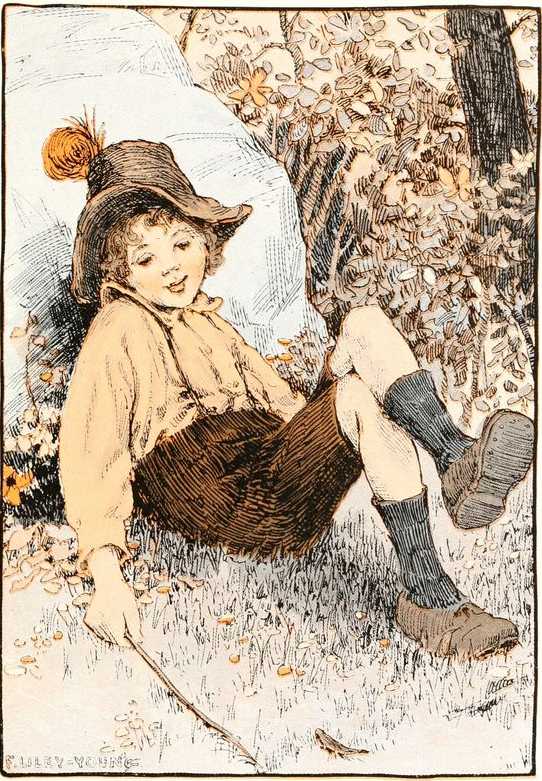
When he had refreshed himself, he leaned back, humming a little song and idly striking the ground with a switch he had broken from a bush.
As he sat there, he heard a soft rustling at his side and saw a little lizard come from the wall of rock and creep forth among the ferns. It wriggled its supple little body out into the sunshine and then lay perfectly still in front of Anton, gazing at him with its clear eyes.
"That was a beautiful song you sang," said the lizard. "Would you be so kind as to sing it once more? I am foolishly crazy over music."
"I can certainly do that much for you," answered Anton, and hummed the song again. He kept the switch behind him now, not wishing the lizard to see that he had it.
The lizard lay perfectly still, listening, but when the song was finished the little creature said to Anton, "Come, Anton, what are you really thinking of? I think your dark eyes have a sly look in them. Surely you are not, by any chance, intending to harm me?"
"Oh, I don't know!" said Anton, smacking his whip. "But I do think it might be amusing to give you a hit with this so that you snapped in two like a piece of glass."
"Do you think so?" asked the lizard drawing its tail close. "Well, well! How strange! It seems to me that would not be at all amusing. I think it is much more amusing to live, to lie here and enjoy myself in the sunshine."
THE LIZARD LAY PERFECTLY STILL, LISTENING.
Anton began to laugh, but continued to beat the ground with his switch.
"Listen, Anton," said the lizard. "I have really such a very short time to live. Let me go in peace. Don't do me any harm. Perhaps I can be of use to you some day. You may be sure you will never regret it if you let me go."
"What could such a forlorn little creature as you ever do for me?" asked Anton, as he got up. "But since you ask me so prettily, I will let you run. Suppose we see which of us will get to Falkensten first."
"Oh, I shall, I shall!" hissed the lizard; and it hurried away through the grass, calling back, however, "Farewell, Anton; you may be sure I shall not lose sight of you." With that, the lizard disappeared and Anton resumed his toilsome journey.
The sun mounted higher and higher and the whole sky was like a sea of burning light. The houses and churches in the valley looked now like many tiny white stones scattered over the ground. The path, steeper and steeper, led through a grove of larches, and here little Anton must again rest. He took two big swallows from his bottle, and wiped his hot face with his shirt-sleeves.
Hearing a strange cracking sound over his head and looking up, he saw a little squirrel that sat on the branch of a neighboring larch, eating the seeds from a cone. Between the mouthfuls he spat the shells down, chattering softly meanwhile as if to say, "What an excellent breakfast this is! Truly a delicious breakfast!"
Anton took his old gun quietly from his shoulder, got down on his knees, and crept carefully along. He held the gun by its barrel. With the butt end he could easily enough hit the little squirrel. But the alert creature, which was watching him with keen, anxious eyes, saw him before he had raised the butt end, and with a couple of big leaps, reached a higher branch of the tree.
"What are you going to do to me?" asked the frightened squirrel, poking his little head out. "What is it you really want to do to me?"
"Oh, I should just like to have your tail!" said Anton. "It would be a nice fur collar for me when the autumn storms howl from the mountain tops."
"But I would so much rather keep my tail myself," said the squirrel, raising it as high as he could in the air. "You see I was born with this tail, and therefore it is mine; and so, if you kill me and take it away from me, you are a thief,—a thief,—a real little tail-stealer!"
"You must stop saying such rude words," said Anton, lifting the gun. "If I can only catch you, your tail will be mine."
"No, stop, stop!" shrieked the squirrel, springing about in the branches. "It is horrid and ugly and disgusting of you. I don't want to be crushed with the butt end of a gun. It is ugly of you to think of it, ugly, ugly! And to be broken off in the middle of my nice breakfast to be murdered is truly most unpleasant. Would you like that, little Anton?"
The squirrel still leaped and sprang from branch to branch in fright. Anton laid his gun on the ground.
"Oh, little Anton!" piped the squirrel. "Let me alone! Let me hop around, a happy living squirrel. That is so much better and pleasanter!"
"Well, hop then," said Anton, throwing the gun over his shoulder again. "I am afraid I should dream of the frightened look in your eyes. And now we might see which of us can get to Falkensten first."
"Oh, I shall, I shall!" called the squirrel, wild with joy. "If you are going to Falkensten, I shall go, too. No harm shall happen to you while I am able to hop." With that, the squirrel set off with long leaps from tree to tree, and soon disappeared; and Anton walked on up the mountain.
The air became more and more sultry. The sky, which had been bright blue, grew white in some places, and the white ran together like thick milk and heaped itself in close masses. The sun was no longer to be seen. The clouds changed to gray and violet and dark-blue, with glowing edges, and thunder began to roll among the mountains. Anton could not see the valley now at all. The lofty peaks towered one behind another, and there seemed to be nothing else in the world. The path grew steeper and yet steeper.
Little Anton began to be frightfully tired. He had to lie down again and again on the ground, groaning with weariness. Not a drop more of the refreshing sour wine did he have to quench his thirst,—the bottle had been drained long ago.
Suddenly he heard a rushing sound, and lo! from the rock bubbled a white foaming stream of water, so fresh and living that one could not understand how it could gush forth from the dead stones. Anton knelt down and drank eagerly from his hands. Never had he found any draught so wonderfully reviving.
When he had quenched his thirst, he thought he would resume his journey, but at that instant he caught sight of a dove flying toward him. It was a charming wood-dove, with blue-flecked wings and a little round head. The dove must, like him, have been thirsty, for she flew directly to the foaming water and bent over it to drink. "That is a lovely bird," thought Anton; and he took his gun noiselessly from his shoulder. "I can surely hit her."
He had laid the gun to his cheek and was taking aim, when the dove lifted her head from the water and fluttered her wings.
"Why should you shoot me, little Anton?" she asked. "You have quenched your thirst and I have quenched mine. The spring has been good to both of us. Why should you do evil to me?"
"You have such beautiful wings," said Anton. "It would look fine if I stretched you out flat and fastened you on the barn door."
"It looks much finer when I float upward toward the sunlight," said the dove. "The mountain path is difficult for you, little Anton; but you are at least free to pursue your way. Let me fly mine. Here in these solitudes no one should do another harm."
The dove looked so gentle and talked in such friendly tones that Anton felt thoroughly ashamed of himself.
"Yes, fly away, little dove, fly wherever you will," said he, waving his hands. "We might see which of us two will get to Falkensten first."
"Oh, I shall!" responded the dove, lifting her wings. "But if it is to that fierce Baron you are taking a message, I prefer to wait outside on the tower." Then up she flew.
The sky was now one dark mass of thunder-clouds. The thunder rumbled among the mountains; the green fields on the heights shone out like emeralds against the dark blue haze beyond. All creatures had become wonderfully silent; not a bird sang, not an insect hummed. Anton went forward with dragging step, and the dove floated silently above him,—a white speck against the dark sky.
But what was that high up there on the cliff? It was a little chamois that stood with all its four feet close together on a point of rock, and looked about.
"Hurrah! I shall get you!" thought Anton as he cocked his gun; but the chamois with a couple of nimble bounds sprang farther up the mountain.
"Ho, ho! That won't help you any!" said Anton, running nearer to the rocks where the chamois stood. "I am a good shot, let me tell you; and I must have prey of some sort to take with me from the mountain."
"But why should you kill me?" asked the chamois, bounding a little farther away. "What harm have I ever done to you? Does it annoy you that I stand here and look at the view?"
"No, but you have such handsome little horns. I should like to put them up over my door as a sign that I had conquered you."
"For you to conquer me would be easy," said the chamois. "You have a gun, and I have nothing. But I had always believed that the mountain was made for us both."
Anton made no reply but scrambled hastily up the rocks to get nearer the chamois.
"Oh, Anton, little Anton! let me alone!" called the chamois, making the longest leap it could. "I would truly rather have my horns on my head than over your door! Cannot you understand that? If you love your freedom, let me keep mine."
At that moment the thunder pealed with a frightful crash among the mountains. Anton became altogether uncomfortable and put his gun down. "Leap where you will, then," he called to the chamois. "Perhaps we might see which of us can get to Falkensten first."
"Oh, I shall, surely," said the chamois, starting off with a big leap. "But I will wait for you outside the castle wall, and if you need my help you will know where to find me." And with these words the chamois vanished.
"Shall I never, never reach Falkensten?" groaned Anton. He was dead tired and began to think he had gone astray, but suddenly, at a turn in the path, the castle stood before him as if it had sprung up out of the earth.
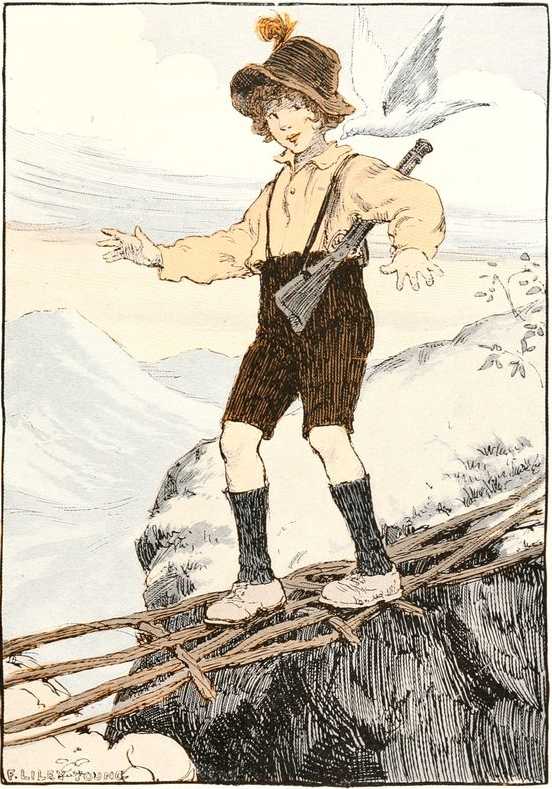
It was of the same color as the rocks upon which it was built, and how big and high and thick-walled it was! It had but few windows scattered here and there on the side toward the path. From the tower waved Rynkebryn's banner,—a fiery red flag on which was a black falcon. The drawbridge that led over to the castle was drawn up, and over the chasm that was between the rocks on which the castle was built and the other rocks, there was only a rough narrow bridge, made of slender branches placed side by side.
Anton stood still. It would be dangerous to go over such a bridge without any kind of a railing to hold fast to; but he must deliver the letter. Just then he heard something whispering at his feet:
"Since you can't glide like me, and creep, Be wise; cross not the chasm deep."
It was the little lizard that came hurrying toward him with this warning.
"But how should I then get the message to Baron Rynkebryn?" said Anton. He had already started across the bridge.
And now something came hopping along at his side. It was the squirrel with his red tail high in the air like a flag, and with wide-open eyes; and while he hopped about Anton's feet he chattered:
"Since you can't hop like me, and climb, That castle shun; be warned in time!"
"But how then should I attend to my errand?" Anton was now half-way across the bridge.
As he stood there, the dove came flying and floating on her wings above the abyss.
"Since you can't float and fly like me, Turn back, turn back and homeward flee,"
said the dove, flying near Anton's cheek.
"Yes, that I will do when once I have given the Baron his letter," said Anton, "but I don't turn back when I am half-way over the bridge, nor flee homeward until my errand is done."
So he proceeded. The thin branches in the loosely-made bridge creaked and bent under his feet. On both sides of him was the dizzy chasm. He had a queer pain in his heart and everything turned black before his eyes; but he pressed his hands against his breast where he had hidden the letter, kept his gaze straight ahead, and walked on with firm step. There! Now he could draw a long breath, a sigh of relief; for he was at last safely across the frail bridge,—on the other side of the chasm, and under the castle wall.
At first he could see no opening in the wall; it stretched up as hard and impenetrable as the rock upon which it stood, but when Anton stole around it, he found a small door,—an iron door with many locks and fastenings. He picked up a stone and knocked hard on the door, but no one answered. Everything around him was still as death.
Suddenly he heard a strange rumbling sound, which he thought at first might be the echo of the thunder among the rocks; but no. The sound came from the hall where Baron Rynkebryn and his men sat and drank, and roared with laughter loud enough to make the castle tremble.
"TURN BACK, TURN BACK," SAID THE DOVE.
Since no one seemed to hear Anton, he lost patience, took his gun which was still loaded and shot it off. He could hear the echoes answer from mountain to mountain and at last die away; but now there were signs of life in the castle. A man opened a shutter high up in the tower and called, "Who shoots under Falkensten Castle? Is it friend or foe?"
Anton put both hands to his mouth and shouted back, "A friend! A friend! A messenger from the valley!" Then he heard the man slam the shutter to, come with a clatter down the stairs, trudge across the courtyard, and begin to rattle the locks and bolts of the iron door. At last the door opened slowly and a gruff-looking warrior stood before little Anton.
"What do you want?" asked the warrior. His voice sounded like a bear's. "What have you to say to the Lord of Falkensten?"
"That I must tell to Baron Rynkebryn himself," answered Anton. "The message is to him and none other."
"Listen to the young sparrow that dares to come into the falcon's nest!" said the warrior, but he opened the door just wide enough for Anton to slip in.
As the boy turned in the doorway, he caught sight of the chamois which stood on a stone beside the chasm, stretching its head forward.
"Yes, here I am!" called the chamois. "I will keep on the watch by the wall, so you will know where to find me!"
At that instant the heavy iron door clanged shut after Anton, and he was at last inside the walls of Falkensten. His steps echoed with a hollow sound in the small courtyard; and it was dark and damp as a cellar, inside the castle on the great winding stairs that led to the baronial hall. Little Anton felt his heart beating like a hammer and choking him, when the warrior opened the door to the hall and let him pass in.
At the end of a long oaken table sat Baron Rynkebryn and his retainers, drinking. Their eyes were bloodshot like those of an angry bull, and they laughed and shouted so that the high rafters shook. Little Anton squeezed himself into a corner near the door and stood, hat in hand, waiting until Rynkebryn should speak to him.
Long did he wait, for the Baron was wholly absorbed in his carousing. The wine flowed over his beard; he sat with both arms leaning on the table and laughed till his bones rattled. Suddenly his eye fell upon Anton.
"Who is that little whipper-snapper shivering there by the door?" he asked, pointing with his big finger. So Anton had to go forward. He bowed many times as he crossed the room, each bow deeper than the last, and when he reached the Baron, he took the letter from his breast and presented it.
The Baron snatched it from him and began to read it, Anton meanwhile standing still and looking out of the tower window. Never before had he seen so far out into the world. One mountain chain after another gleamed forth, lit by the sun; streams lay like narrow white ribbons in the valley; and the boundless sky arched over all, its big thunder-clouds looking like mountains above the other mountains. Anton forgot entirely where he was while gazing at all this glory; but he was awakened to reality by a roar from Rynkebryn.
"So this is the kind of message you bring me, is it?" he screamed, and he struck his fist on the table so violently that the wine bottles tumbled over, and the rich red wine ran in streams across the white cloth, like blood. "How dare you bring such a letter to the Lord of Falkensten?"
"How should I know what was in the letter?" asked Anton. He trembled like an aspen leaf. "I do not read the letters people trust me with."
"Oh, you don't, don't you?" roared Rynkebryn. He had first grown red as the wine he drank, but now he was as white as the table-cloth. "It might have been well for you if you had peeped into this letter. If you had, I think you would have turned back with it. Herein"—he shook the letter till it rattled—"herein those traitors of the valley renounce their allegiance to me; and he who goes on errands for traitors is a traitor himself and shall die a traitor's death. Do you understand that, you miserable little worm?"
Anton tried to speak, but could not get a word over his lips. He grew icy cold and shook as if he had the ague.
"But I shall revenge myself on that pack," shouted Rynkebryn. "I shall descend upon them like an overwhelming horror, like a thief in the night, and lay their land waste. Sure as death, before three nights have passed there shall be neither stick nor stone left of their city in the valley."
"Shall I tell them that?" asked Anton, in a low, frightened voice.
"No, you can spare yourself the trouble!" shouted Rynkebryn, laughing. "I shall say it to them myself with a drawn sword. No, my little friend,"—his eyes glared horribly, "you shall have a night's lodging at Falkensten. Your guest-chamber is ready. You shall march down to the castle prison, and there you can lie and amuse yourself guessing what death you are to die in the morning. Let me see. I must think of something very fine. I might, for instance, hit you with a club so that you broke in two like a piece of glass. That might be very amusing to see. Ha! ha! ha!"
Anton shuddered. He remembered that he had threatened the little lizard with this very treatment, and had had the same idea that it would be amusing to see.
"Or," continued the Baron, "I could crush you with one whack of my gun, so!—That would be very quickly done."
The icy shivers ran down Anton's back. Just this kind of terror that he was feeling must the squirrel have felt when Anton threatened him with the butt of his gun.
"Or I could fasten you out on the castle wall, as one fastens a bird that has been shot upon a barn door. There you could hang as a warning to traitors, until you fell to pieces," growled Rynkebryn, stroking his beard.
Things turned black before Anton's eyes. "Oh!" he thought with anguish. "This is just the way I threatened the dove, the innocent little creature!"
"Or I could chop your head off!" roared Rynkebryn, rushing toward Anton with clenched fists. "Then I could put your head on top of the tower where there is a glorious view. What a treat that would be for you!" All the men laughed so hard at this that they had to hold their sides.
But little Anton did not laugh. He stood there thinking, with deep remorse, how he had threatened to take the life of the harmless chamois, and put its horns over the door. "Oh, God be praised that I let it run!" he thought; but just then Rynkebryn's men caught hold of him, tied him securely, hand and foot, with strong rope, and took him to the castle prison.
Dark and damp indeed was the prison cell. It had no windows except, high up in the wall, a little opening with strong iron bars across it. The men threw Anton on the floor and then went out, locking the door after them with so many locks that Anton knew he could never open that door, even if he had both his hands free.
There he lay, looking up at the barred window. The sunset glowed through it still, but faded little by little, and darkness came on. High in the sky the stars twinkled out, one after another. And Anton lay and thought that when their light was quenched again, his life was to be put out, as if it were but a spark. What made him most unhappy was the thought that he could not get a message to the city in the valley, so that some one might know that Rynkebryn, the next night, was going to creep upon them like a thief, burn their city and devastate their land.
He laid his head on the damp floor of the cell and began to cry. All at once he heard something rustle,—a queer little sound. He thought it might be a rat that would bite him, and drew his legs up close; but something small came creeping lightly over him right up to his cheek. "Don't be afraid," it whispered. "It is only I, the little lizard you met on your way. I have hurried at your heels the whole time, until you disappeared through the castle door. But how have you brought yourself to this? You should have followed my advice and turned back in time,—you who can neither creep nor glide."
"Perhaps," sighed poor Anton. "But it is too late to think of that, and no one in the world can help me now."
"Oh," answered the lizard, "one should never give up hope. Since I could get into the castle prison, we shall manage to get you out." And with that the tiny creature rustled away in the darkness.
A minute or two after, little Anton saw something black against the barred window. It squeezed itself between the bars and dropped with a thump to the floor.
"Here am I," chattered the squirrel, hopping to Anton. "What foolishness has been going on here?"
"As you see," replied Anton, "I am captured and bound, and in the morning I am to die."
"Oh, in the morning!" said the squirrel. "It is a long time to morning. Much can happen before the sun gets up again."
"But I cannot stir hand or foot," said Anton. "Don't you see how they have tied my hands behind my back?"
"Oh, yes! I see that well enough," replied the squirrel, opening his big eyes wider than ever. "Where are the knots?" And with one jump he was on Anton's back, beginning immediately to gnaw at the knots with his small pointed teeth. He bit and pulled at the rope so that his little body shook with the effort; and it was not long before Anton felt the loosening at his wrists and afterward at his ankles. All at once the ropes fell off and he was free.
"Oh, you blessed little animal!" said Anton, hugging and kissing the squirrel. "Now I am a free person again, and not a tied-up bundle!"
"Yes, but there is still the high, barred window," said the squirrel. "We must have the dove's help now." And he sprang up to the window and vanished through it.
Little Anton stood looking after him, but suddenly he could no longer see the stars and the sky as before, for they were blotted out by something that filled the whole window. He soon saw that it was the dove flapping her out-spread wings against the bars. She could not get in, but she had something in her bill which she let fall through the window. It clanged as it hit the floor, and when Anton stooped to pick it up, he saw that it was a file.
"I found that in Rynkebryn's own window where it lay, ready to be used for his evil purposes; but now it shall help you out of prison," said the dove.
No one would have imagined they could do it, but the squirrel and the dove helped Anton to get the ropes he had been tied with up to the window, and to fasten them there so firmly that he could climb up the ropes. Then he filed and filed at the iron bars till his hands bled, while the lizard ran up and down the wall saying: "Make haste! Make haste! It will soon be morning!"
But the sun had not yet risen when little Anton stood, rescued and free, on the rocks outside the castle wall.
And there was the chamois waiting for him!
"Seat yourself on my back, little Anton!" said the chamois. "And hold tight! for we are going to gallop down the mountain so fast that straps and buckles would not keep you on!"
So Anton got on the chamois' back and held tight. This was necessary indeed; for slow as it had been trudging up the mountain, he now went down with a speed like that of a stone which, being tossed, bounds from rock to rock as it strikes them on its downward-flying way.
"I shall fall! I shall fall!" shouted Anton, clinging for dear life to the chamois' neck. "I shall pitch off head first!"
"Oh, no! You won't fall," said the chamois; "nor I, either. I am very sure-footed," and on it leaped as fast as ever.
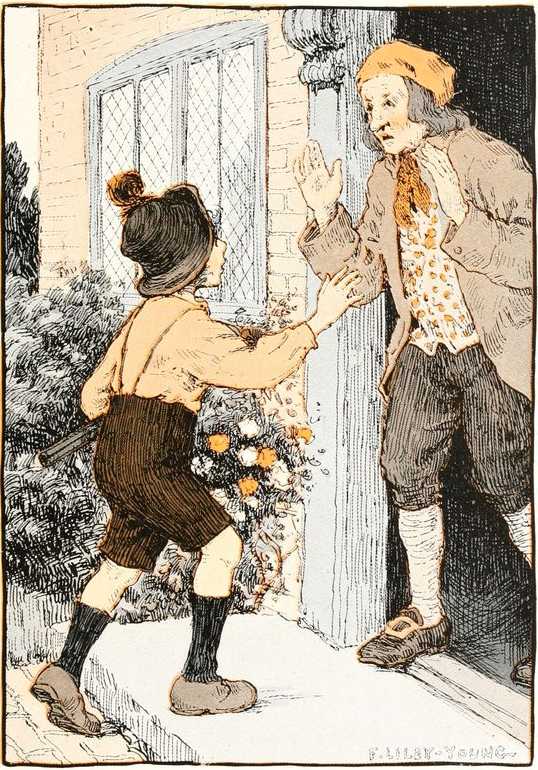
Just as the sun rose, Anton stood at the Mayor's door and knocked. The Mayor himself came to open it, and was overwhelmed with wonder when he saw little Anton standing there as alive as ever, and without so much as a hair of his head hurt!
"I come with bad tidings," said Anton. "If you don't look out, you will have Rynkebryn and his men after you before you know it; and he is not going to spare any of you,—yourselves or your property. Every one had better be armed and ready."
The next night, Baron Rynkebryn with all his warriors came sneaking down the mountain expecting to take the peasants by surprise, and to catch them all as one catches rats in a trap; and he felt himself completely fooled when he found the peasants on the alert and prepared to give him a warm welcome! From all the country round had the town folk summoned help, and the men were armed with lances and javelins, with scythes and pitchforks; and there was nothing for Rynkebryn to do but to hasten up the mountain again as fast as his legs could carry him. But the peasants followed him all the way to Falkensten, gathered brushwood and branches which they heaped about the castle, and then set on fire, determined to destroy that den of thieves. It blazed and flamed like a bonfire and sent ruddy light far and near. The wicked Baron Rynkebryn and his men were forced to flee and to hide like wild eagles high up in desolate clefts of the mountains.
And now there was nothing good that the people did not wish to do for little Anton! They would have him to be Mayor, and a great festival should be held in his honor in the palatial hall of the Council House. But little Anton only thanked them over and over. He had not the least desire in the world to be Mayor, neither did he care to sit and feast and sing with those who had recently sent him out on that dangerous errand without troubling themselves at all as to what would happen to him.
Therefore, he asked only that he might have what he needed in order to give a party to his nearest and dearest friends. Oh, yes! The people would gladly give him anything; he need only say what he wished for.
THE MAYOR WAS OVERWHELMED WITH WONDER.
Then Anton said he would like one vest-pocket full of grain, and the other full of small snails; and one trousers-pocket full of nuts, and the other full of salt. He would like also a loaf of white bread, a bottle of wine and a handful of fresh peaches.
The people thought his wishes were very peculiar indeed; but he received what he had asked for and then started toward the mountain.
A little later, as he sat under a chestnut-tree and looked out over the valley, he heard the drums and trumpets from the festival in the Council House, where the people sat and feasted, and shouted hurrahs for their old Mayor. A spring bubbled near him; the chestnut-tree shaded him; the sun shone on the vineyards below, while high up at the top of the mountain, smoke was still rising from the ruins of Falkensten.
He had spread his table on the fresh green grass. There lay the bread and the peaches and beside them stood the flask of wine; but before he began to eat, he invited his guests to take their food. The lizard had all the little snails; the dove ate grain from Anton's one hand, while the chamois licked salt from the other; but the little squirrel sat above in the chestnut-tree and stuffed himself up to his throat with nuts, throwing all the shells down upon little Anton's head.
—Helena Nyblom.
THE FOREST WITCH
It was in the earliest springtime. In the shade the air was still quite cold; but where the clear and strong sunshine streamed down, one could see that spring had come, for there the blossoms were beginning to stretch upward on their tiny stalks.
A couple of children were walking through the forest: a ten-year-old girl, named Nina, and her little brother Johannes.
They were seeking flowers. Nina had to find them because the flowers were too tiny and too much hidden for so small a child as Johannes to discover them for himself, but she always let him have the pleasure of picking them.
It was such a joyous spring walk that Nina did not notice how far they were straying away from their grandmother's hut, back of the hill. This little hut had been their home only for a short time. When their dear father and mother died, their grandmother had kindly taken them to live with her; and this was their first walk in the forest.
At last Nina thought they ought to go back, but just as she turned around with Johannes by the hand, who should stand before them but a hideous old creature, more glaring and frightful than you can imagine!
"What are you doing here, you wretched children?" she shrieked; "are you plucking flowers in my forest? Then shall I pluck you, you may believe!"
"Oh, pardon us," cried Nina; "we did not know that we must not pick flowers here. We are strangers in this forest. Pray, pray pardon us."
"Snikkesnak!" (fiddlestick!) answered the terrific old Witch, for such the creature was. "Don't talk to me! I never pay any attention to what children say; nor to old folks' talk either, for that matter. Indeed I don't! Snikkesnak! snikkesnak! But it is not you that I want, silly girl. It is the boy there who has offended me. The little rascal! It is he who picked the flowers. Now I shall take him!"
"Oh! take me, take me instead," cried Nina in terror, flinging her arms around her brother. "It is my fault! I showed him the flowers, and let him pick them. You've no right to take him! Oh! do take me; he is too little."
"Snikkesnak!" answered the Witch; "what a lot of talk! But you are right; the boy is small to come into my service, so I suppose I shall have to take you. Now listen well to what I say. Spring and summer are coming and I shall have no work for you then; so I shall not trouble myself about you for the present. But when autumn has come and gone, and all the leaves and flowers have disappeared, then are we very busy in the underground world. Then you may believe that I shall teach you how to work! and I live deep down, very, very deep! Now you may go; but I will make a bargain with you. When the last flower is faded—listen!—when the last flower is faded, meet me here on this spot—or—or——"
The old Witch stopped to think what she could best threaten Nina with. Her wicked eyes glared around for an instant till she noticed that Nina stood, with her arms about her little brother, ready to ward off any evil that might come upon him.
"Or I shall come and catch this little rascal, and twist his arms and legs all out of joint!" screamed the Witch, shaking her knotty stick at little Johannes.
Then, after a dark glance at Nina, she shuffled off through the forest, with the crows shrieking after her, and the leaves and flowers trembling on every side.
As soon as the Witch was out of sight, Nina hastened home with Johannes. Like a kind sister she suited her frightened pace to his, so that he should not stumble and fall.
The poor little boy had been so terrified at the Witch that he had not in the least under stood the cruel threats she had used against him, or the dreadful fate which was in store for Nina.
NINA STOOD WITH ARMS AROUND HER LITTLE BROTHER.
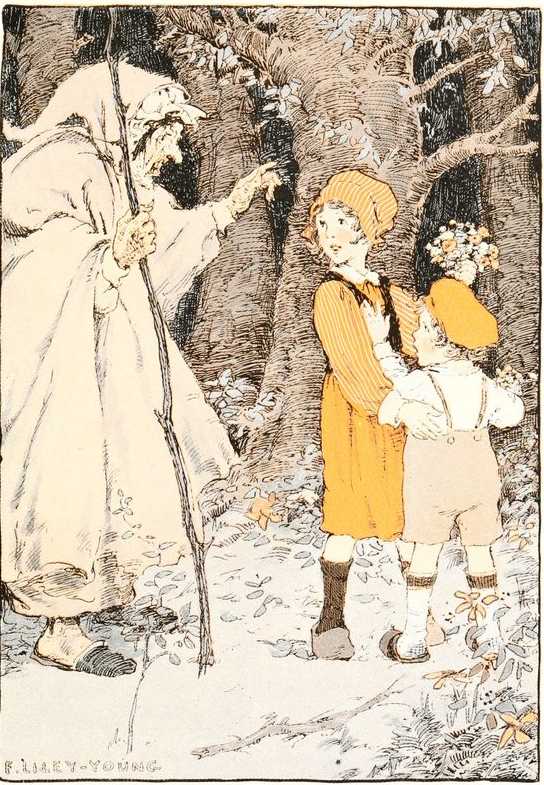
Nina was rejoiced that this was so; for then he could not tell their grandmother what the Witch had said, and she herself would not disclose the dreadful doom hanging over her. She was determined that the poor grandmother should not be made anxious and sorrowful as long as it could be helped.
Shortly after this, the spring burst forth in all its power and beauty, and the blossoms shot up everywhere—in the woods, the fields, the meadows, and the gardens. Nina welcomed them as her dearest friends. They would protect her against the Forest Witch. So long as she had a single one of these, she would not have to go down into the dark earth to serve the hideous creature.
Nina had always loved flowers, but never had she thought so much about them as now. Yet, alas! Spring soon turned into summer, and summer went faster than ever before, it seemed to poor Nina. The tears streamed down her cheeks, as she saw the blue cornflowers fall before the reaper's scythe, when the grain was cut in harvest-time.
But Nina could still hope, even then; for the roses continued to bloom on Grandmother's old rose-bush outside the door of the hut. Nina kissed them and begged them to last as long as ever they could! And so they did—the dear, friendly roses!
When the last little rose had at length withered, autumn had almost passed and the many-colored leaves were dropping from the trees by thousands. Yet Nina discovered to her joy and comfort that there were flowers still. Along the roadside stood the simple, hardy wild aster, which blossomed on and on, although the autumn winds and rains destroyed everything else.
Winter began; but so mildly that it seemed as if it were still autumn. When the asters finally disappeared, other help came to Nina; for the hazel-bush was completely hoaxed by the mild weather and thought it was spring; so it began to unfold its yellow catkins, standing beautiful and bright, as one saw it between the bare trees over the hedges.
So, even when the winter was far advanced, Nina was still saved from going to the Witch; but this could not long continue. Cold weather must soon come, because Grandmother had said that Christmas was near.
And suddenly winter did come in earnest, with its icy frosts and drifting snows. For five days it was impossible to get out of the hut, because the wind kept whirling the snow into high drifts all about it. But when the sixth day came the wind abated and the snow lay peacefully on the ground.
Now Nina dared no longer to stay in the house, for surely all the flowers were dead, and buried under the cold snow, after this bitter storm. She must go and keep her compact with the Witch. So gathering together all her courage, she stole out of the house without being seen by any one.
Outside, she stood still for an instant, took a last look at the hut, which now seemed so cozy and dear, whispered "Farewell," and started on her way to the forest.
But she had gathered too little courage, after all; for it melted away immediately when she discovered the Witch a few steps from the door, standing in the little roadside garden, waiting for her.
"You've been rather slow about keeping to your bargain!" exclaimed the Witch angrily. "I was just coming after you."
"Oh! do not make me go with you!" cried Nina.
In her agony she fell down upon the snow at the Witch's great feet, and besought her wildly: "Let me be free! Oh, do let me be free!"
"Snikkesnak!" snapped the Witch. "Up with you! No nonsense!"
"Is there not a single flower to save me?" wailed Nina. She half rose, and, fairly beside herself with fright and despair, began to scrape the snow away from the garden-bed at the side of the path, trying to find a flower.
"Oh, yes, look if you like! Snikkesnak! snikkesnak!" laughed the Witch, her face glowing with exultation at Nina's trouble.
But an instant after, her countenance became filled with fury, for where Nina had cleared the snow away, there appeared a plant with fresh dark-green leaves and white flower buds!
Nina clasped her hands together in great joy and thankfulness; then, breaking off a bud, she lifted it up high toward the Witch and rushed away into the hut. The Witch, in her disappointment and vexation, sprang about so wildly in the snow that it rose in a cloud all about her, and Nina never saw her again.
Safe at home in the little hut, Nina now told all her adventure; and the grandmother took the little girl's sweet, frightened face between her two old hands, and kissed her forehead many times.
Faithfully every day Nina went to pay a loving visit to the little "Christmas Rose" in the garden (helleborus niger); for that was the flower which had saved her; and the whole winter long, it could be found fresh and beautiful, here and there under the snow.
Though no other blossoms dare come forth to face the snows and frosts of deep winter, the Christmas Rose ventures bravely out into the bleak weather, and with modest and serene courage holds her own against its powers. The snow lying over it keeps it from freezing; and if one brushes away this beautiful covering, the Christmas Rose appears with its lovely, white, gold-centered blossoms, laughing at the frost. It blooms steadily on until it can say "Good-day" to spring's first blossom—the little snowdrop; and so, through all the year, there are flowers blooming in our dear Northern land, Denmark.
Thus it was that Nina escaped the Witch, who, being a Forest Witch, did not know of the Christmas Rose, because that is a garden flower.
—J. Krohn.
THE TESTING OF THE TWO KNIGHTS
Down in the town all was laughter, dancing and jollity. Banners were flying from housetops and windows, flowers were wreathed about poles and arches, and green branches decorated every gateway and door. Clearly, a great festival was in progress.
High on a hill overlooking the town, towered the old red castle of a duke. In front of the castle, on a beautiful green mound, stood gilded cannon, which at intervals sent thunderous peals through the town and over the near-lying hills.
Inside the castle, speeches were being made and toasts given, and many were the eager shouts of "Hail to the Princess!" and "Long life to the Princess!" for this was the birthday of the Duke's only daughter, Princess Inga, and the festival was in her honor. At the conclusion of each speech and chorus of joyous shouts up at the castle, the cannon sent forth their signaling volley; and at each volley the people in the town took up the rejoicing and heartily echoed "Hail! hail! Long life to the Princess!" for they had loved the beautiful daughter of their good Duke ever since that first day when she had appeared among them, a tiny smiling child, in her little carriage drawn by a pair of white goats.
After the feasting was over, the guests dispersed from the stately hall and strolled about the terraces and gardens to enjoy the summer night and its sweet refreshing air.
Down one of the shadowy garden walks paced the Duke, and with him a man conspicuous among the richly adorned guests for the dull simplicity of his attire. He was no other than the Wise One from Fir Forest who wore now, as at all times, his plain dark robe of brown,—against which flowed in sharp contrast his long snow-white wavy beard.
"The day has passed right merrily," said the Duke, "and there has been no lack of congratulations and speeches; and all the speeches were to no other end than to wish happiness and good fortune to my beloved daughter. What showers of good wishes have been poured upon her to-day! If she receives but a quarter of all these blessings, her life will overflow with happiness."
"I pray that it may," said the Wise One gravely. "But the Princess, like all others, must win her own happiness."
"What say you?" asked the Duke.
The Wise One answered slowly, "Happiness comes from forgetting self and living for the joy of others. In no other way can one be truly happy."
"Yet I am happy," said the Duke.
"You, dear Duke, yes!" answered the Wise One. "And well may you be happy, for you never think of yourself. You take kindliest care of all in your dukedom, ever doing good among the poor and the sick, and giving pleasure to all those about you, especially to the Princess. To gladden her is your greatest pleasure."
"That is true," assented the Duke, with evident gratification. He could not but be pleased at the Wise One's praise, never lightly given.
"And now, my good friend," continued the Duke, "since we speak of the Princess, I would fain ask your good counsel concerning her. Suitors will come to strive to win her hand. Indeed, two have already asked to appear before me, and I receive them in the morning. Many will seek her for the dukedom's sake, since the one she weds will become duke after me; and among all the suitors how shall we know which is a true and worthy knight? She should have the best of all,—only the very best."
"The best, like the happiest, is the person who thinks last of himself and first of all others, he who is wholly free from selfishness and envy. Only to such a one," said the Wise One earnestly, "only to such a one should we give our dear Princess."
"Oh, yes!" responded the Duke. "That is right, and very well conceived and stated, too. But how am I to test the hearts of those who come? Their hearts are not of glass, so that one may peep into them! How shall I discover, for instance, the true character of the rivals who seek audience to-morrow?"
The Wise One pondered for some minutes and then inquired slowly, "Who is the most despised, the meanest in station, of all the castle servitors?"
"Oh, that is easily said," responded the Duke, laughingly. "It could be no other than that stupid, good-natured Klaus Klodrian. He is but the fourth groom's under stable-boy, and yet he will never rise higher, poor, dull-witted fellow!"
"Good," said the Wise One. "He will serve our present purpose well. Let the rivals each take his turn dwelling one day as honored guest at the castle, and one day in the poor hut of Klaus Klodrian, and perhaps this will disclose the true knight to us. If not, there are other tests, but let us try this first."
"Yes, let us try it," said the Duke. "Glad am I to rely on your help, and most grateful for your counsel."
After arranging the plan a little more in detail, the Wise One said farewell and started on his homeward way. He was glad to leave behind the festivities and excitement of the castle, and longed to reach his peaceful little log hut in the midst of the great Fir Forest. Seldom were other sounds heard there than the whispering of the wind in the tree-tops, the glad twitter of birds and the whirring of their wings.
Just as he was turning from the roadside into the forest, two knights came galloping past, and he knew that they must be the expected suitors for Princess Inga's hand. Both were young and stately and sat proudly upon their beautiful horses. The one knight was clad in green velvet, with graceful hat and waving plume of the same color, and the trappings of his horse shone with gold. The other knight was richly dressed also, but in blue velvet and with a snowy plume in his blue hat, and silver on the trappings of his horse.
As they rode gaily along, looking so happy and handsome, and exchanging friendly words and glances, it would be hard indeed to wish success to one at the expense of the other.
The Wise One went hastily into the forest, directing his steps to its densest part, where was sequestered his lonely home. Soon after, a great blackbird stole forth from the woods, turned its yellow beak toward the road which the two knights had taken and flew after them. The knights quickly reached the town and rode to "The Golden Fish," an inn not far below the castle.
Before they went to their sleeping-rooms, the Blue Knight opened one of the windows and leaned far out, looking up into the high, dark-blue heavens, where the stars gleamed in myriads.
"What are you doing?" asked the Green Knight.
"Looking at the stars," answered the other.
"But why, pray?" asked the Green Knight.
"Oh, it is but a fancy of mine," answered the Blue Knight. "I like to look up there every evening. The stars shine down upon us with such benign watchfulness, that I would fain render some return; and to enjoy their beauty seems all I can do."
The next morning the two knights started in good-fellowship riding at leisurely pace, side by side, through the streets and up the castle hill. Many eyes peeped out at them through windows and door cracks, and the host of "The Golden Fish" rubbed his fat hands together with pleasure. He saw that he should have a profitable day in his tavern, for the town folk would soon come flocking in and out, to hear what they could of the suitors.
In the great gilded hall of the castle, the Duke sat in state to give audience to the knights. Princess Inga stood by his side. White-robed and with a cluster of dewy roses in her hand, she looked so fair, so gracious and lovely, that both the cavaliers were enraptured.
After the salutations were over, the Duke, in a straightforward manner, gave them his friendly permission to make further acquaintance with the Princess, provided they would yield to his wishes in one respect.
To prevent either suitor from interfering with or standing in the way of the other, the Duke would have each knight in turn spend one day with the Princess and one day with Klaus Klodrian, a humble servitor of the castle, who dwelt in a hut on the borders of the estate.
If they had any disinclination to do this, the matter was at an end; for this was the plan he had fixed upon, and it was unalterable.
"Have the goodness, my honored guests," then continued the Duke, "to agree between yourselves which of you shall remain here to-day, and which shall now go to Klaus Klodrian."
Since the Green Knight sat in silence with the evident intention of awaiting what the other might say, the Blue Knight politely offered to give his fellow-suitor the first day with the Princess. The offer was accepted with much pleasure, and while the Green Knight bowed before the Princess and began to talk with her, the Blue Knight was conducted out of the audience hall, down a broad staircase, across a great courtyard, and thence on and on, through garden and park, through barnyards and stables, into the lane at the end of which stood the hut of the stable-boy, Klaus Klodrian.
Poor Klaus sat inside, being just about to begin his frugal noonday meal. He jumped up in great confusion at the sudden entrance of a grand gentleman.
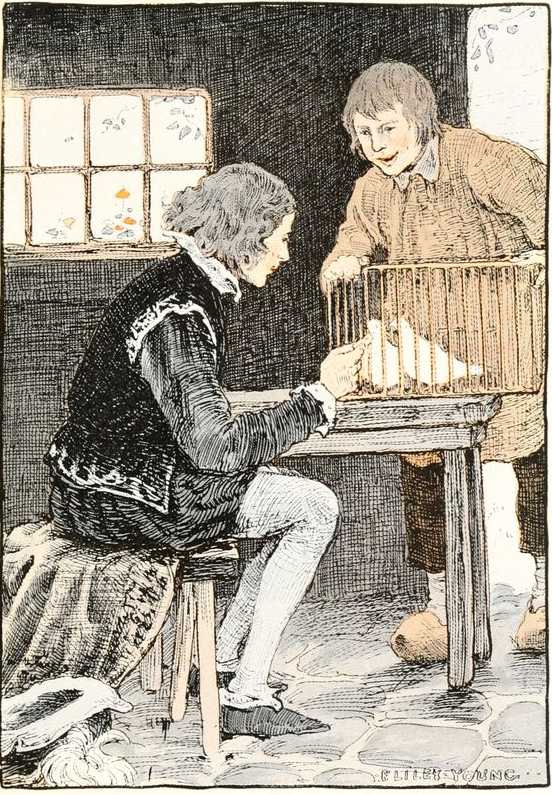
Holding a long loaf of black bread in his hands, he stood startled and bewildered, his round eyes staring, his great mouth wide open; but when the Blue Knight gave him a gentle greeting, courteously asked permission to spend the day with him, and began to talk to him in a friendly manner, Klaus gradually recovered from his confusion and became his quiet, simple self again. He clattered clumsily about on his heavy wooden shoes, with long straws from the stable dangling from his clothes and littering the floor. Always good-natured and unused to any attention save ridicule, he soon glowed with happiness because of the Blue Knight's kind treatment.
"I will show you something," said Klaus with joy and pride, though shyly; and he brought forth his only treasure—two white doves in a cage,—and began to talk eagerly about them. It seemed as if he could reiterate the praises of these doves endlessly. To him there was nothing equal to them in the whole world.
That day would have been long and tedious, indeed, to the knight, if he had not found something with which to occupy himself. With his ready sympathy toward all, he soon discovered that Klaus Klodrian was not altogether a hopeless dullard. If only one would tell him a thing twelve or fourteen times, he could then understand most of it; but no one heretofore had found this out, because no one had taken pains enough, or been patient enough with him.
The Blue Knight, feeling sorry for the poor witless fellow, labored earnestly with him, giving him long explanations, telling him the same things again and again, and showing him better ways of doing his work with the horses and about the stalls.
And Klaus Klodrian, as the day wore on, really began to show a little comprehension. He laughed so heartily over it all, that it seemed as if his wide mouth really did stretch from ear to ear.
As for the Blue Knight, he became so absorbed in trying to teach Klaus, that the long summer day was neither tiresome nor unhappy. Twice during the day had he seen the Princess and the Green Knight walking together in the castle garden. They talked and laughed, and seemed, he thought, to have become exceedingly good friends. So also thought the Duke, and he remarked upon it to the Wise One who, in his evening walk, came past the castle.
"Ah, but this Green Knight is a magnificent fellow," said the Duke. "And he is very talented. He will gain the Princess. They are already excellent friends, and I am greatly prejudiced in his favor. He is really charming! You should have heard the good stories he told to-day when we were dining. Yes, he will certainly gain the Princess."
KLAUS BROUGHT FORTH HIS ONLY TREASURE.
"To-day he is sailing with the wind," said the Wise One. "Let us see him to-morrow when the wind is against him."
The sun had gone down and darkness had spread itself all around, but the castle was brilliantly illuminated, and from its windows the light streamed out, while soft strains of music floated through the halls and into the summer air. There was a ball at the castle.
Thoughts of the lovely Princess had been present with the Blue Knight all the day long, no matter how intently he was laboring with Klaus; so when evening came he sought to get just a glimpse of her through the castle window.
Yes—there she was. The Green Knight held her hand and danced with her. She danced more gaily than any other in the merry company, and oh! how proud and happy she looked! And the Duke nodded and smiled at the handsome pair as they glided past him.
The Blue Knight had seen enough. He turned away and walked sadly back to the stable-boy's hut.
Klaus Klodrian had also been out,—to hear the dance music. He could remember a little of one of the airs, and now sat down upon the edge of his straw bed, and tried to play it by striking one wooden shoe against the other.
"Good-night and sleep well," said Klaus, as the knight entered. "And thanks for the day."
"Good-night, and best thanks to yourself, my good Klaus Klodrian," was the answer. "If I gain nothing more by my journey hither, I have learned from you how little a man need have in order to be content, and that is good. When men learn to be content with little, there will be less trouble in the world."
"Yes, yes," said Klaus Klodrian. "If one owns a pair of fine doves, one can hold out against anything." And therewith he settled himself in the bed and slept. The Blue Knight, however, went out under the summer sky and gazed long at the stars. He was convinced that he had lost the Princess, and that the Green Knight had won her; but as he stood there, looking at the stars, a sense of peace stole over him, and in his heart were none but good wishes for the Princess and the Green Knight. The stars seemed to tell him that this was right, for never before had they sparkled down upon him with such friendly rays.
The next morning he awoke refreshed, and led out his horse, thinking it was useless to press his suit after having seen the success which his rival had met with the previous day. But before he had mounted, a courteous message came from the Duke, requesting that he should now come to the castle in his turn, according to their agreement.
Likewise according to agreement, came the Green Knight down to Klaus Klodrian; but though he came, he felt that he was being subjected to great indignity, and showed his ill-humor plainly.
Simple Klaus began at once to try to entertain him by showing his precious doves, but the Green Knight sullenly told him to hold his tongue; and when, a little after, poor Klaus, stupid and forgetful, began again his rambling talk in praise of the doves, the Green Knight impatiently kicked over their cage, and the terrified doves flew away.
They took their flight through the Fir Forest, and when the Wise One saw them, speeding with fear-quickened wings over the tree-tops, he said, "Aha! The Green Knight likes not to sail against the wind!"
Then he gave a call, and out flocked the blackbirds from the trees near the Wise One's hut. These gloomy-looking, swift-flying birds were his messengers. Daily they took their flight out into the world, far and near, and when they came back to the forest, they told their master all they had seen and heard. Thus he received much strange and minute information, but so secretly, that no one guessed how he gained his knowledge.
This morning he gave some of the birds special directions, and the result was that all day long, blackbirds hovered in unusual swarms near the hut of Klaus Klodrian, and over the castle gardens. They had hovered there, keeping watch, the day before also, but no one had remarked it. Who notices a few blackbirds more or less?
That was a hard day for Klaus Klodrian. He missed his kind instructor of the previous day sadly, and had no gentle doves to cheer his heavy spirit. The harsh treatment of the Green Knight made him so excited and unhappy, that though he strove hard to hold fast to all that the Blue Knight had taught him, he felt only confusion of mind, and in his bewilderment made more stupid blunders than ever before. But worst of all, it was impossible for the poor witless fellow to understand the gathering wrath of the Green Knight, and so, now and again throughout the day, he made attempts at friendly conversation. At last it ended in his receiving a thrashing from the ill-tempered cavalier, so that when evening closed in, poor Klaus was fain to stretch his bruised body on the soft cool meadow grass, not daring to seek his straw bed.
Who can tell how miserably the hours dragged by for the Green Knight, with his jealous, uncontrolled temper? He could not endure to think of the Blue Knight up at the castle, walking in the garden with the Princess. And when he went near enough to see her pluck roses for her companion, he thought that the roses the Blue Knight received were much richer and redder than those which she had given him the day before from the same bush!
Venting his anger upon poor Klaus had not cooled it in the least. Rage boiled within him hotter than ever, after he had given the thrashing. And when the day was at last ended and the darkness fell, his bitter envious thoughts drove him to the castle. Here were music and dancing and feasting again, this time in honor of the Blue Knight.
The Green Knight stole cautiously up to the balcony, hid himself in the shadow of its twining vines, and looked at the gay scene within the hall. Ah! There were the Princess and the Blue Knight. His heart burned with envy; he forgot that the Blue Knight was having no more opportunity and enjoyment than he himself had had. "Never shall that fellow become Duke, never!" he muttered.
Full of evil thoughts, the Green Knight drew his sword; but he did not notice that as he did so, a bird rustled out from the vines above, and flew swiftly away.
The music ceased at last with prolonged, rapturous trill. The Princess, however, was enjoying the ball so much that she asked the Duke if she might not have just one single dance more. And well it was that her request was granted.
After this very last dance was finished, the Blue Knight turned toward the balcony door, drawn by a great desire to greet the stars, so happy and thankful did he feel.
Just at this moment the Wise One strode into the hall. The Duke and all the guests were greatly astonished, for never before had the revered counselor visited the castle at such a late hour.
The Wise One placed himself before the Blue Knight, gave a sign to the liveried torch-bearers standing near, then threw wide open the large doors leading to the balcony. There stood the Green Knight, with his naked sword in his hand. His guilty gaze sought the ground—and his limbs refused to flee.
"What means this?" asked the Duke.
"There stand Envy and Jealousy disclosed," answered the Wise One. Then he turned and with gentle step approached the Princess. In her terror she had grasped the Blue Knight's arm and was still clinging to him, while tears shone in her tender eyes.
The Wise One looked toward the Duke an instant and then said:
"There stands the true knight! and I believe that the heart of the Princess has chosen him."
"And to him shall she be given," said the Duke. "The day with Klaus Klodrian has indeed brought to light the true character of the suitors. Your wise counsel has served us well, good friend. Will you not honor us now by coming to the banqueting hall and being the first to offer congratulations and good wishes to the Princess and to her proven knight?"
Then the music began again,—the musicians playing gladdest melodies with all their hearts.
The Green Knight plunged into the darkness and ran to his horse. Hastily mounting, he sped his steed mercilessly forward, with whip and spur, into the murky night.
Some days later the Blue Knight rode forth from the castle with face as radiant as the morning. He was to ride to his home, bearing thither the news of his good fortune, but he was soon to wend his way back. The Princess watched as long as her eyes could see him, while he bowed and waved fond adieus. Behind the Blue Knight rode, rather awkwardly, his new squire,—none other than Klaus Klodrian! He was proudly conscious of his fine long riding-boots and other new attire, and happier than ever before; for not only was he now to serve the knight whose kindness had won his heart, but his precious doves had been restored to him. The Wise One had recovered them for him through the aid of the watchful blackbirds.
—J. Krohn.