TOM WALLIS (continued 4)
Reading edition
'Well, come inside, and let us read those letters again. Father, it may be that Tom is not on board Captain Hawkins's ship after all.'
'What!' cried Mr. Wallis in startled tones. 'What on earth makes you think that, Jack?'
Entering the sitting-room and closing the door, the two men seated themselves at the table, and looked expectantly at Jack, who stood, his grey eyes filled with trouble.
'Father, this is what makes me think that some fresh mishap has come to Tom. Now, listen; here is what Tom says in one part of his letter--
'"There is a Maori half-caste on board named Chester. He and I are great friends."
'Now it is just those words which keep running in my head, because of something in Captain Casalle's letter--that part about Bully Hayes and his ship.' Then he read--
'"During the fighting she also took, or was set on, fire, and only for another vessel (said to be a Sydney brig) coming to her assistance, the niggers would have massacred every one of the crew. After this Hayes touched at Fortuna Island for provisions, and while there fell foul of one of his officers, a New Zealand half-caste, who seems to have been lent to him by the Sydney brig, and was about to flog him, but in the night this man, with a white sailor and a young lad, who was a passenger (on the Leonie, I suppose), escaped in one of the boats, after scuttling the brig in two places."
'Don't you think it strange, father, that Tom should speak of a "Maori half-caste," and that a "New Zealand half-caste" was lent to Captain Hayes by the captain of a Sydney brig?'
'It is certainly a coincidence, Jack; but surely it cannot be anything more,' and Mr. Wallis looked at Casalle, as if wishing for confirmation of his views.
The seaman nodded. 'A coincidence, sir, no doubt; but yet----' he paused a moment, 'some very strange things do occur at times at sea. Did not the captain of the Virago say that the Lady Alicia was going northward to New Britain?'
'Yes.'
'And my brother in his letter says that Hayes was coming from New Britain, bound to Samoa. Can it be that the two ships have met, and, by some means, Tom and the half-caste officer left their own vessel and went on board the Leonie?'
Mr. Wallis thought for a few moments before replying.
'It is very disturbing to think about. Your brother says there was heavy fighting on board Hayes's ship, and that the Sydney brig lent Hayes an officer; but then the young lad is spoken of as being a passenger on board the Leonie--not on board Tom's ship. No; after all, Jack, I do not think we need distress ourselves. But, anyway, let us drive out to Mr. Biffen's house. He may be able to tell us if there are any other brigs in the South Sea trade sailing out of Sydney.'
A short drive brought them to the agent's house, and Mr. Wallis at once mentioned the suspicions which had arisen in Jack's mind, and asked him if there were any other Sydney trading brigs likely to have been cruising about the Solomons.
Mr. Biffen at once answered, 'No, no brigs; of that I'm certain. I know every vessel sailing out of Sydney (and Melbourne as well) which is an island trader. There would be about there at that time the barques Anna and Lightning, and the schooner Meg Merrilies, but no brig. The only other vessel of that rig besides Hawkins's ship which would be seen down there, is the Mexicana, and she has been laid up here for the past six months. It certainly is curious, I must admit, but it is only a coincidence, as you surmise.'
But, in spite of this opinion, both Mr. Wallis and Jack left the agent's house feeling somewhat depressed and anxious.
'We can only wait, Jack, and trust in God. The Lady Alicia may be here in a few weeks now.'
As the time went by, however, even Jack ceased to let the matter trouble him much, and, like all bush-bred boys, entered into the delights of Sydney life with a zest. Unlike Tom, ships and sailors possessed no interest for him beyond that which had lately become engendered in his mind through Tom himself; nevertheless, he and Henry Casalle spent much of their time in sailing about the harbour, watching the great merchant clippers entering the Heads, or being towed to sea; at other times, taking little Nita with them, they would spend the day fishing in one of the countless bays of the Harbour, or on the bright waters of the Parramatta River or Lane Cove.
Early one warm, drowsy afternoon, as Jack, accompanied by Nita only, was returning homewards from a fishing excursion, and the boat was sailing slowly between Goat Island and the Balmain shore, he saw that signals were flying at the Observatory flagstaff, 'Ship from Fiji Islands.'
Knowing that the Malolo was due, Jack took down the sails, got out his sculls, and sent the boat skimming over the water to town.
'Perhaps it is the Malolo, Nita.'
Nita's black eyes danced with delight, but, having something of her father's grave manner, she did not pester Jack with childish questions. Pulling in to Miller's Point, Jack left the boat with the owner, and in a few minutes he and Nita were hurrying along the squalid streets leading from the Point into the city proper. Almost as soon as he entered the hotel, Mary Potter, Nita's nurse, ran up to him.
'Mr. Wallis and Mr. Casalle have gone down the Harbour, sir, in the Customs launch; the Malolo is come in. And will you and Miss Nita follow in a waterman's boat down to Woolloomooloo Bay, where the ship will anchor? I won't be five minutes dressing, Miss Nita.'
The walk from Petty's Hotel to the Circular Quay only took a few minutes, and as soon as the boat rounded Fort Macquarie Jack saw a large white-painted barquentine, which he knew was the Malolo, just being cast off by a tug, as she anchored between Lady Macquarie's Chair and Garden Island. The moment the boat came alongside, Captain Casalle, who had been talking to his brother and Mr. Wallis aft, ran down the gangway ladder, and caught his child up in his arms.
'How are you, mister?' said a cheerful voice to Jack as soon as he reached the deck; and his old acquaintance, Mr. Brooker, the mate, gave him a hurried handshake as he passed along for'ard; 'here we are back again, safe and sound, with our pockets full of dollars and our hearts as sweet as honey, and right glad I am to see you again.'
Several native sailors, whose faces Jack at once recognised, rushed up to him and shook hands. They were members of the old crew of the lost Bandolier.
Going aft, Jack saw a pretty picture--the two brothers, whom fate had thus brought together so strangely after more than twenty years, and when each only thought of the other as dead, were walking the deck together hand in hand, speaking in low but eager tones, with little Nita clinging tightly to her father's disengaged hand, looking into his face and drinking in every word he uttered.
As soon as possible the captain, his brother, Nita, and Mr. Wallis went ashore, leaving Jack to spend an hour or so on board with the mate, and then follow and join them at dinner.
Whilst the active mate (whose manner of addressing the crew Jack thought to be extremely personal and vigorous) was getting the decks cleared, and the ship made snug, before sitting down to chat, Jack had time to have a better look at her. Next to the Virago, she was the largest vessel he had ever boarded, and although externally her white-painted hull was reddened and yellowed with rust stains, within board she was spotlessly clean and neat, and her lofty pitch-pine spars were as bright and smart-looking as those of a crack yacht. She carried three boats--a long boat, which was stowed on the main hatch, and two beautifully moulded whale-boats, one on each quarter. She was a flush-decked vessel, and of great beam for her tonnage, with a sheer that would not be perceived until one actually stood on her deck, either for'ard or aft, and looked right along it.
Going below to the cabin, he was met by the steward, a brown-skinned, smiling-faced Samoan, who, putting his arms around Jack's shoulders, rubbed noses with him as he shook his hand.
'Don't you 'member me, Mister Jack? Oh, I never forget you and Kooringa, never.'
'Of course I haven't forgotten you, Salu, but I thought you were a sailor on the Bandolier. Now you are a steward.'
'Yes, sir. You see, sir, my sister Solepa was fafine tausi teine (nurse) to Mrs. Casalle's Nita. And now Mrs. Casalle and Solepa are dead and gone to God, and I am Salu, the steward to the captain; and now I am glad, very glad, for I hav' hear that your brother never is dead.'
'No, Salu, he is not dead. He will soon be here in Sydney, I hope.'
The steward smiled delightedly. 'I am glad; every one on boar' this ship is glad. Your fath' is a good man. Now, if you please, let me make you some coffee.'
'No, thank you, Salu,' said Jack, shaking the man's hand, as he looked around the cabin and noticed the number of Snider rifles and cutlasses arranged in racks on both sides. 'What a lot of arms, Salu!'
'Yes, sir. We go to some bad places. Sometimes we have to fight, but Capt'en Casalle never want to fight. He always go ashore first when we go to some new place where the natives is wild and we want to trade. He won't let the covering boat come too close, because these wild peoples, when they see the rifle and the cutlass, they get afraid and begin to shoot poison' arrows. He just jump out of boat and walks up on th' beach, with his han's in his trousers' pocket, and smokin' his pipe; an' he says to those wild people, "What's the matter with you? I hav' come to talk an' trade, not to fight. I am not a fighting man. I wan' to buy your copra an' ivory nuts. See, I have no little gun," and then he lifts up his pyjama pocket and show them his bare skin, wis'out no revolver strapped to his waist. Oh, he is a fine man, a good man.'
Mr. Brooker came rattling down the companion way.
'Oh, here you are, Jack. Now, look here, here's the whole lot of the old Bandolier's crew wants to shake hands with you again. And so do I, Jack,' and he seized Jack's hand in his and wrung it vigorously. 'I reckon I've got some new ideas about British people since I struck Port Kooringa. I was brought up pious enough by a father and mother who believed that the only good people ever produced by Great Britain were the Mayflower folks; and then in the village school I was taught to consider the Britishers of those times as inhuman bein's, who with a mob of Hanoverian or other Dutch-bred soldiers jest delighted to kill American farmers, and their wimmen folk and children, by sticking bayonets into them as a sorter light amusement. Yes, thet is so, Jack. I come from Martha's Vineyard, and us boys were always taught to hate Britishers. We are a mighty poor lot of people down thet way, and the farming folk are the poorest of all--only get a square meal once a week. They'd look sour at a barrel of cider for working after twelve o'clock on Saturday night, and kick a cat for catching a mouse on Sunday morning. But, say, let's get on deck again; these men want to see you mighty bad before you go ashore again. They hev' got something to give you.'
Lighting a huge cheroot, he led the way.
All the crew of the Malolo were gathered together on the main deck, awaiting Jack's appearance. Every man had a present of some kind--a bundle of Solomon Island spears, bows and arrows, baskets of magnificent shells, snowy white coral, clubs, native fish hooks, made from iridescent pearl shell, a whale's tooth, necklaces of porpoise teeth, shell armlets, carved coco-nut shells, and many other curios from the savage islands of Melanesia. Placing them upon the deck at Jack's feet, they drew back, and their spokesman, a sturdy, square-built native of Rotumah Island, made a short speech--
'All these things here me and my shipmates bring you because we want to give you something. All the time we stop at Kooringa, your father and you and old man Mr. Foster very kind to us all, and woman with red hair give us plenty kai-kai.[#] That woman is good woman, and me and my shipmates very sorry we can' see her no more. So if you please, sir, good afternoon, and very much oblige'.'
[#] Food.
Simple as were the man's words, their sincerity was very pleasing to Jack, who thanked them individually, shaking hands with them all. Most of them were natives of the South Sea Islands; one came from beautiful and verdant Rotumah; another from lonely Easter Island in the far eastern Pacific; two from Nuié--the 'Savage Island' of Captain Cook; one from Yasawa in Fiji; and the remainder from various island groups in the South Pacific.
Mr. Brooker regarded them with a good-natured smile before telling them to go for'ard again; then he turned to Jack, and said quietly--
'I was taught to despise niggers of any kind or breed, but this sort of thing jest jumps up and hits me in the face. I never yet saw many white sailors show any gratitude or remembrance for a good turn. Jack Tar is generally Jack Dog, and a darned or'nary yellow dog, with nary a good point about him. Why, every one of these natives aboard is a Christian, and lives clean in mind and body. You should see 'em in the evenings sitting on the main hatch, every man with his Samoan Bible or hymn-book in his hand, and waitin' for Salu the steward to begin the service. It's jest good to hear 'em sing! Where is the crowd of white sailors who'd have the courage, even if they had the inclination, to do as these men do, night after night! And every one of 'em is a right down smart sailor man. Now come below into my cabin, and we can hev' some talk. I want to hear all about your brother Tom, and where in thunder the skipper's brother come from, and all about the folks at Port Kooringa. Come on; the second mate will look after the ship.'
CHAPTER XIV
THE MALOLO SAILS IN SEARCH OF TOM
The following two weeks passed very quickly, Jack and his father and the two brothers being constantly in each other's society. The Malolo, after discharging her cargo, went into dock and came out again a bright shining white, and Mr. Wallis and the captain set about buying trade-goods for her next voyage. The second mate was paid off, and Henry Casalle shipped in his place, much to his satisfaction.
Late one night, after Jack had turned in and his father was about to follow, a hansom drove up to the hotel, and a short stout man, wearing a frock-coat and tall hat, jumped out, and for two or three minutes poured out a torrent of abuse upon the construction of the vehicle and the anatomy of the horse.
'And as for you, my joker,' he said to the cabman, 'you think that I don't know you've brought me by the most circumbendious route you could think of you thundering swab trying the great circle dodge on a poor old sailor.'
'Oh, come now, captain, don't say that. I've driven you a good many times, and hope to do so again.'
'Do you? Well, you won't; what's the figger I have to pay you for betraying me into your crazy old rat-trap?'
'Nothing at all--not to-night, anyway, skipper. You ain't in a good temper. Shall I wait for you?' replied the cabman, who evidently knew his fare.
'No, but come back for me in an hour. And here's five bob.'
Just as Mr. Wallis was ascending the stairs, he heard the stranger's voice, speaking to the hall porter.
'I want to see Mr. Charles Wallis of Port Kooringa young man; tell him that Captain Samuel Hawkins of the brig Lady----'
Mr. Wallis ran up to him with outstretched hand.
'I am Tom's father. How are you? Where is Tom?'
'In Samoa or else on his way up to Sydney. But it's a long yarn and----'
'Come to my room, captain. Porter, call my son, and tell him that Captain Hawkins is here.'
For once in his life old Sam said what he had to say in as few words as possible; and in less than five minutes Mr. Wallis and Jack heard of the meeting of the Lady Alicia with the Leonie, the fight, Mr. Collier's death and Tom's injuries, and how on account of the latter incident Captain Hawkins had acceded to Hayes's request to let Tom remain on board the Leonie with Maori Bill.
'And I'm sure that Bully Hayes would treat him well, sir, and I'm somewhat disappointed at not finding him here with you----'
'There is a very good reason for that, Captain Hawkins,' said Mr. Wallis, sadly. 'Tom never reached Samoa, and heaven knows what has happened to him and Maori Bill.' And then he told the captain the story that was heard by Captain Casalle in Fiji.
Old Sam was deeply distressed. 'God knows, sir, I acted for the best; and now it is clear I did the worst. Of course, the young lad mentioned must be Tom, and of course the New Zealand half-caste is my William Henry. Now sir what is to be done? I and my brig are at your service. If Tom and Maori Bill and the other man had a good boat they could have easily reached Fiji from Fotuna. And yet they might not have put to sea, after all; they might have gone ashore on some part of Fotuna and hidden until the Leonie had sailed! Fotuna is the place to try first, sir. They may be there now, waiting for a ship. If they did not stay there they would have headed for Fiji.'
Mr. Wallis sighed. 'I fear the very worst, Captain Hawkins. Surely had they reached Fiji we should have heard something by now! Fotuna, I am told, however, is seldom visited by even trading vessels, and it may be that my boy is there now. Now, will you come here to-morrow morning at ten o'clock, and meet my friend Captain Casalle, of whom you have heard from Tom? and we will discuss what is best to be done. He has a vessel ready for sea, and I think I shall charter him to go to Fotuna. If Tom is not there, Captain Hawkins, I shall go to Fiji. I shall never rest until I know what has become of my poor boy. I cannot but think that he and his companions may have perished at sea; though there is a chance that, by God's mercy, they have reached one of the islands.'
Old Sam pondered, then said, 'I don't want to alarm you, Mr. Wallis, but if Tom and Maori Bill reached Fiji they ought to have been in Sydney by now. But if they didn't leave Fotuna, they might be there for another six months before they could get away in a ship. And, as I said before, I and my ship are at your service; I will lend her and myself and crew to you for six months free of charge to look for Tom, for I love the boy.' He took out a violently coloured silk handkerchief, and mopped his red face and suspiciously watery eyes.
Mr. Wallis pressed the old man's hand. 'Thank you, Hawkins. You have been a good friend to Tom, as his letters show. But come here to-morrow, and we shall decide what we shall do. And always bear in mind one thing, Hawkins--that whether God has or has not spared my boy to meet me again, I shall always be glad to call you my friend.'
The old sailor's eyes filled. 'I'm only a rough old shellback Mr. Wallis but you know what I mean my ship and myself----'
'I know that you saved my boy's life, I know that you are a good and generous-hearted man, and I thank you very heartily for your offer. But we will talk of all these things to-morrow. Now tell me about your cruise in search of the Marengo. Were you successful?'
'Successful we was, sir. Leastways we found the men right enough, and a miserable lot they were too; not six good sailor-men in the whole crowd. But we had a long long passage back to Noumea, nothing but light winds and calms for weeks together; half of the Frenchmen were bad with fever and some died and me and Mr. de Cann was right glad when the job was finished. And the brig too is badly strained and will have to undergo a lot of repairs.'
Then, bidding Jack and his father good-night, the old captain went away, leaving them a prey to anxiety and torturing surmise about Tom.
Early on the following morning, Mr. Wallis went on board the Malolo for Captain Casalle, and returned with him to the hotel, where at ten o'clock they were joined by Captain Hawkins; and the three men at once went into the subject of the most likely course which would have been taken by Tom and his companions after leaving Fotuna.
'Fiji, of course, would be the nearest land,' said Captain Casalle; 'but, as Captain Hawkins says, they may not have left Fotuna at all, but have waited about till Hayes had sailed. If they had reached any part of Fiji, I should certainly have heard of them whilst I was there. In my opinion, there are at Fotuna still.'
'Then I will charter the Malolo from you, Casalle, and we shall go there----'
'There is no question of a charter, Mr. Wallis. The Malolo is your ship, not mine. I am at your service, and will be ready to sail in twenty-four hours.'
'And as I told you, sir, last night,' said old Sam, 'me and my ship are yours for as long as you want us. If harm has come to the boy, it is through me.'
'No, no, Captain Hawkins. Do not say that. You are in no way to blame. And I thank you very sincerely for your offer; but, as you see, the Malolo is ready for sea, while your ship has just come into port after a long and trying voyage, and needs repairs. So it must be the Malolo.'
Before noon that day Mr. Brooker was informed of the decision arrived at, and he and Henry Casalle at once began to make the vessel ready for sea. A cabin was fitted up for Nita and her nurse, and another for Mr. Wallis and Jack, and in something under thirty hours everything was ready. That night the master of Kooringa wrote a long letter to old Foster, giving him full instructions as to what to do in his absence, and concluded by saying--
'We may be away eight months or longer. If we cannot find Tom in six months, I shall give up all hope of ever seeing him again.'
Just before sunset on the following day a tug came alongside the Malolo, and by seven o'clock the beautiful vessel had gained an offing, and was heading eastward on her quest.
CHAPTER XV
ON ALOFI ISLAND
A little before dawn broke, Tom was awakened from a heavy slumber by Maori Bill, and, sitting up, he saw that the boat was within a cable length of densely verdured Alofi, which, unlike its sister island of Fotuna, has no protecting barrier reef along its shore.
'There's a little bit of creek just here, where we can fill our water breakers,' said the Maori, 'but I can't see it just yet. It will be a fine place for us to lie by in until to-night, and then slip out again.'
Taking down the sail, they waited until the light became stronger, and then a little further to the southward they saw a break in the thick foliage which grew to the water's edge.
Charlie, whose arm was not yet strong enough to use an oar in pulling, now came aft and steered, and Tom and Bill went to the oars. It was fortunately high water, and they were enabled to bring the boat not only into the mouth of the creek, but some fifty yards higher up, where she lay completely hidden from view under the thick and drooping foliage of the trees, and in pure fresh water.
Just as the boat was made fast rain began to fall heavily, and Tom and his friends found excellent shelter between the buttresses of an enormous fallen maso'i tree, where they ate their breakfast in comfort and watched the descending torrents with complacency.
Maori Bill, as he filled his pipe, seemed well pleased. The place to which he had brought them was well known to him, though many years had passed since he had last seen it. The island of Alofi, he told his companions, had but one small village of half a dozen houses, situated on the northern point, where there were extensive plantations of yams, taro, sugar-cane, and bananas owned by the people of Fotuna. The rest of the island, though of extraordinary fertility, was left to solitude, except when a party of young men would visit it on a pig-hunting or pigeon-snaring expedition.
'Then there's no fear of any natives being about now,' said Tom.
'No; but we must not make a fire. The smoke might be seen by some one. We can lie by here nice and comfortable all day, whether it rains or clears up,' answered the Maori.
As he spoke a grunt sounded near him, and in an instant he lay flat upon the leaves, motioning to Tom and Charlie to do likewise.
'It's a pig,' he whispered, taking his knife out of its sheath.
The grunt was followed by squeaks, and presently a sow, followed by a litter of seven pretty black and yellow striped piglets, came down the side of the leaf-strewn hill, tossing up the leaves with their little snouts in search of maso'i berries.
'Let 'em get between us and the boat,' said Bill to Tom. 'I'll tackle the old sow; perhaps you can knock over one or two of the young ones.'
Quite unsuspicious of danger, mother and children rooted their innocent way along till they were well between the water and the fallen tree. Then Bill leapt up and flung himself upon the sow, seized her by a hind leg, and thrice quickly drove his knife into her ribs; the progeny, with squeals of terror, scattered in all directions, some going up the hill-side and others taking to the water like otters. Tom managed to secure one, which promptly bit him savagely on the hand; and Maori Bill jumped into the creek, and caught another, as it was swimming across.
'Don't kill them!' he cried; 'fresh pork for the boat.'
Tearing off some bark from a sapling, Bill lashed the animals' feet securely together and carried them to the boat. They were both very plump, and yelled and squealed and bit vigorously. The sow was at once cut up by Tom, who was no novice at such work, for he had often lent a hand in the killing yard on his father's station, and soon the quarters were hung up to a branch.
After nine o'clock the rain ceased, the sun came out bright and warm, and the trade wind blew fresh and clear, and brought with it the sweet earthy smell from the rain-soaked forest around and above them. Flock after flock of small but noisy green and gold and scarlet plumaged parrakeets came screaming down from the mountain sides, and settled on the bushes which overhung the creek, and every now and then, with heavy flapping of wings and deep booming note, pigeons, singly and in pairs, lit in the branches of the loftier trees, to feed on the scarlet berries of the maso'i and se'ase'a.
Satisfied from the absence of any paths along the mountain side that they were not likely to be disturbed by native visitors, and that the boat could not possibly be discerned from the sea, the three adventurers hauled her alongside of a smooth, flat rock on the bank of the creek, and unloaded her. Everything was spread out to dry, and Tom was astonished at the number and variety of articles his companions had managed to smuggle away from the Leonie.
Bill smiled grimly. 'That's the first time I've ever robbed any one--if it is robbery. The steward helped me to get most of the provisions.'
'Robbery!' said Charlie, 'not a bit of it. There's a matter of about three hundred dollars due me by Bully Hayes for wages, which I shall never see.'
'And I was to get a hundred from him with my discharge from Samoa,' said Bill, 'so that's four hundred dollars he'll be to windward.'
'Let us reckon up the value of all this gear, and see how we stand with Bully,' said Charlie, with a grin. 'Mr. Wallis, you do the figgerin', an' me an' Mr. Chester will do the valooin'. Now here goes; but as we hasn't any pens an' paper these will do.'
He went down to the water's edge and returned with his cap full of small smooth pebbles, which he handed to Tom. Then, seizing a flour-sack, which was full of various articles, he turned them out on the rock.
Thirty-four tins of canned dog, called American meat. How much, Mr. Chester?'
'Half a dollar a tin.'
'Half a dollar it is. Got that down, Mr. Wallis?'
'Yes,' said Tom, 'seventeen dollars;' and he counted out seventeen pebbles.
'Six bottles of pickles, two bottles of chutney, and two bottles of green things like plums, one bag of oatmeal, and a tin box of raisins. How much for that lot?'
Bill was not sure. 'Say ten dollars.'
'Fourteen-pound box of "Two Seas" tobacco--Mr. Chester, you has a right noble mind to think of it,--three hanks twine, palm and sail-needles, one box fish-hooks, four pair dungaree pants, six dozen packets Swedish stinker matches, lot o' clay pipes all broken, three clasp-knives, and one tin o' mustard. How much?'
After a little discussion the lot was valued at forty dollars; and then the contents of the next bag were turned out. They consisted of about fifty pounds of biscuit, some tins of German sausage, a rug belonging to Mr. Kelly, a bag of bullets, a fan-tail hatchet, a bundle of fishing-lines, a burning-glass, a Dutch cheese in a tin, ten boxes of percussion-caps, and one bottle of Edinburgh ale.
'Put them down at twenty dollars, Mr. Wallis.'
The next 'lot' was rolled up in the steward's own blankets, and carefully seized round with spun yarn--three Snider carbines with three hundred or four hundred cartridges, the steward's own razor, glass, and comb, Tom's gun (that given him by the captain of the Virago at Noumea), some more tins of powder, caps, a bag of No. 3 shot, a bottle of one 'Kennedy's Medical Discovery for the Cure of all Diseases,' a bag of salt, a piece of New Zealand bacon, Mr. Harvey's revolver with case and fittings, a roasted fowl, and a sextant-case without the sextant.
'About a hundred and fifty dollars will square that lot,' said Maori Bill, thoughtfully.
In addition to these items, the steward and Bill had casually picked up some unconsidered trifles in the trade-room, such as bottles of brandy, a dozen tins of sardines and salmon, a bundle of tomahawks, some loose tobacco, and a German concertina, which were appraised at twenty dollars by Bill, who seemed anxious to give every article its full value.
'Two hundred and fifty-seven dollars,' said Tom, counting his pebbles.
'Then there's the boat and all her gear complete--sails, oars, and compass,' said Bill, virtuously. 'That's worth another hundred and fifty.'
Charlie grinned and shook his head. 'Don't count that in--the Leonie herself wasn't bought by Hayes; he found her. Found her in the Bonin Islands, when her captain and most of the afterguard was ashore drunk at a Portugee dance; and so, as he hadn't a ship himself, and was shocked at seeing such a fine brig being left in charge of a few Manila men sailors, he went aboard with a few of his friends--I was one of 'em--and lifted the anchor and went to sea to look for the owners. But he couldn't find the owners, though I've heard him say that he's just wearing out his life trying to find 'em, and has to go into nigger-catching to pay his expenses. No, you needn't set the boat down. Now, there we are; two hundred and fifty-seven dollars from four hundred.'
'Leaves a hundred and forty-three,' said Tom.
'That Bully Hayes owes us. Well, he owes a lot more to other people, so we'll forgive him our little bill,' said Charlie, as he began laying the various articles out separately on the rock, so as to dry in the sunshine.
Tom looked at the man in silence. He was tall and thin, with red hair, deep-set eyes, a square, determined chin, and a set mouth scarcely veiled by a straggling moustache and ragged beard of the same hue as his hair. His face, on the whole, Tom thought, was not a taking one; but his voice was pleasant, though a cynical and reckless humour was ever noticeable in his speech. Suddenly he turned and caught Tom's eye, and his cheeks flushed. He stood up stiffly and put his hand in his trouser pocket.
'Look here, Mr. Wallis! Don't you think I run away from Bully Hayes and the Leonie for the sake of these'--he held out the ten sovereigns which Tom had given him the previous night, and then let them fall carelessly upon the rock. 'I came with you and this man here because I was sick of the life I've led with Hayes for the past four years. Mind you, I'm not saying anything against the man; I like him. He did me a good turn when I was lying in gaol in Cape Town, and was as good as booked for ten years for smashing a man's----'
Bill strode forward and placed his brown hand over the sailor's mouth.
'Shut up, Charlie, shut up, I tell you!' he said in a savage whisper; 'what does this boy want to hear 'bout the doings of men like you an' me? It won't do him no good, I tell you; an' I won't have it. I'm no better than you, Charlie. I've been in goal for killing a man I didn't mean to kill, and I've suffered for it too. Don't let us talk 'bout such things--for the boy's sake.'
The white sailor immediately collapsed. 'Of course I won't. I'm not the man to shove my opinions on nobody, but Bully Hayes is not a bad sort.'
'He's not--with his mauleys. But he's not a better man with them than I am with mine, Charlie. If you don't believe me, wait till we get to Fiji, and I'll thump you and any other three men, one after another, in the yard at Manton's Hotel--for nothing.'
'Thank you, mister; you have a noble mind for trifles, as I said just now. But I take it for granted, and I'm sorry I spoke as I did before the boy. Now what about filling these water-breakers?'
The Maori put both his huge hands on the sailor's shoulders, and with a good-humoured smile forced him down upon the rock in a sitting posture.
'You sit down there and let me do that. You mus' look out that you don't hurt your arm. We may have to pull a lot between here and Fiji. And while I am filling the water-breakers you can fix up some fishing-lines. We can catch some fish here before we leave, and after we have stowed the boat again I'll get a hundred or so of young drinking coco-nuts.'
The remainder of the morning passed away pleasantly enough. Tom and Charlie, baiting their hooks with large fresh-water prawns, which were very plentiful in the creek, threw their lines out in the shallow water at its mouth, and soon caught some purple-scaled fish called by the natives afulu, and resembling English barbel in shape and size.
Meanwhile Maori Bill, after placing everything back in the boat, and filling the water-breakers, had walked along a narrow beach to where a grove of coco-nuts displayed their tempting fruit in great clusters. He ascended two or three trees, threw down a score or so of the young nuts from each, tied them together by tearing out a piece of each husk with his sharp teeth, and returned to the camp just as Tom and Charlie appeared with a string of fish and a huge soft-shell crab, which they had found lying in a weedy pool.
Bill's eyes glistened at the sight of the crab. 'That's a beauty! Let me feel him. He weighs ten pound. What a pity we can't light a fire and cook him! But, never mind, we'll cut him athwart-ships and rub some salt into him when we do the pig. The fish we can dry in the boat. Now what about some dinner?'
With a tin of what Charlie termed 'canned dog,' but what was really excellent American beef, half a dozen biscuits, and some deliciously sweet young coco-nuts, the three made a hearty meal. Then the two men filled their pipes and discussed their coming voyage while roughly salting the pig.
'I couldn't get a chart of Fiji,' said Bill, 'as Bully had locked his door when he went ashore. But it doesn't matter a bit. We have only to steer a course between S. and S.S.W. to hit the north end of Fiji. If we can strike the Nanuku Passage, I'll know my way right down to Levuka. They're a bad lot of natives in the northern part; but even if we have to land there, we'll get along all right without fighting, as I talk Fiji well. I had a Fiji girl for wife once; she came from just that part--from a little island called Thikombia.'
Just as they had finished salting the pork, and were about to stow the boat again, Charlie, looking up at the tree tops, remarked that the wind seemed to have fallen very light 'all of a sudden.'
Bill was on the alert at once. 'I'll have a look outside;' and he walked down to the mouth of the creek, from where he could have a good view of the sky and the sea horizon as well. He came back at a run.
'There's going to be a blow--a big blow from the eastward. Like as not it'll last for five days; three days for certain, anyway. We'll have to snug down here until it's over. Let's get the boat up as far as we can; there'll be a thundering big sea rolling right into the creek before night. Heavy rain is coming too, and we'll have to house in and weather it out.'
His suggestions were carried out as quickly as possible. Everything movable was first taken out of the boat, which was hauled still further up the little creek, and the stores were carried up to the fallen tree, and placed under its buttress, on the dry leaves which covered the ground. Then, leaving Charlie at the camp, Tom and Bill set off in search of fallen coco-nut branches to make a roofing. In an hour they had collected enough, and Bill at once set to work to make thatching, which he did with such speed and cleverness that Tom was lost in admiration at his resourcefulness. By four o'clock in the afternoon they had made the buttress of the fallen maso'i into a perfectly rainproof house, open to the westward, and protected at the back from the coming gale by the mighty trunk of the tree itself.
By this time the atmosphere had become intensely close and oppressive, and every now and then a warm gust of wind would sway the branches overhead. The calls of the forest birds had ceased, but vast numbers of ocean birds came flying in from seaward, filling the air with their hoarse, screaming notes.
'It's coming presently,' said Bill to Tom; 'don't you hear the sea making a booming noise? It always does in these places when it is coming on to blow from the eastward. When the natives of the Tokelau[#] Islands hear the sea make that sound, they know it means heavy weather from the eastward or the northward, and always haul up their canoes and secure their houses from the matagi afa,[#] as they call it.'
[#] The Union, Ellice, and Gilbert Islands are now generally termed Tokelau by the inhabitants of the eastern islands of Polynesia. Formerly, however, only the low-lying islands of the Union Group were meant by the term.
[#] Hurricane.
Before Tom could answer there came a droning, humming sound from the sea, and then a wild and deafening clamour, as the first squall of the coming hurricane smote the island, and ripped and tore its way through the forest.
'That's the first lot,' shouted Bill in Tom's ear; 'now we'll get some rain, and after that another squall or two and more rain, and then it'll settle down to business properly, and blow like forty thousand cats yowling at once. I'm glad we put in here.'
It certainly did settle down to business properly, for before another hour had passed the wind was blowing with almost hurricane force, and the sea was a succession of seething, foaming billows, which, dashing furiously against the eastern shore of the island, sent their spume and spray in a continuous misty shower, high up among the swaying and crashing branches of the trees half a mile inland.
Sitting under the shelter of the great tree, Tom and his comrades listened to the howling of the storm with feelings of the utmost serenity, for they were completely protected from its force.
'Let us light a fire,' said Bill, picking up a tomahawk; 'the smoke of fifty fires wouldn't be noticed now, and we can cook the pork and fish.'
The dead tree itself furnished plenty of firewood, and presently Bill and Tom had cut quite a pile; then the former went to the shore with a bag, and returned with it half filled with large, rough stones.
'I'll show you how we cook in the South Seas, Mr. Wallis,' he said, as he turned out the stones and began to dig out a shallow hole in the soft soil just in front of their shelter. This done, he lit a fire in the centre of the hole, laid a lot of thick pieces of wood across, and then piled the stones on top.
Then as the fire blazed up and began to heat the stones, he and Charlie took the four quarters of pork, cut them up into smaller pieces, wrapped each portion in wide green leaves and placed them aside; the fish were simply disembowelled without being scaled, and then neatly parcelled round with coconut leaf, the crab being treated in the same manner. In the course of an hour the stones, at white heat, fell into the depression, and were spread out evenly by means of a stick, the pork and fish placed on them, and then the whole lot quickly covered up by layers of thick heavy leaves, on top of which again was placed a covering of loose soil.
Whilst waiting for the food to cook, Tom and the others made their way through the forest to the nearest point overlooking the sea. The sky was grey and sullen, and the sea, a mile or so out, presented an appalling aspect; immediately under the lee of the island it was not so bad, though every now and then great billows would come rolling in to the very mouth of the creek, as Bill had foretold. Fotuna Island, although the nearest point, and but eight miles distant, was quite obscured from view, for, in addition to the salty spume which filled the air, there was a sharp, driving rain.
'Bill,' said Tom, 'where should we be now if we had kept on in the boat?'
Bill shook his head. 'We could only have done two things--either let her run before it, and most likely broach to and capsize, or put out a sea-anchor and tried to ride it out that way; but whatever we did we would have been carried away to the westward, and there's no land that way, except the New Hebrides--a matter of more than a thousand miles. I can tell you, sir, that it's lucky for us we left the Leonie without any water. If we had had water in the boat, I should have kept on.'
Returning to the camp before darkness set in, the oven was opened, and the three made another hearty meal by the light of a blazing fire. The two piglets were partially freed by being tethered with a bit of spun yarn to a hind leg. The boat was seen to, and then, spreading out the sail on the ground inside the hut, Tom and his comrades lay down and slept, undisturbed by the clamour of the sea and the moaning of the wind.
CHAPTER XVI
THE ENDING OF THE BOAT VOYAGE
For the following two days, during which time the gale still blew with unabated force, Tom and his companions found that time did not hang idly on their hands. The Maori had discovered a patch of wild yams growing in the mountain forest, and whilst he dug, and Charlie carried them down to the camp to be baked in preparation for the voyage, Tom was employed in shooting pigeons and manutagi, a species of ringdove, great numbers of which had been driven over to the lee side of the island by the storm.
On the afternoon of the third day the wind hauled round to the south-east, and towards evening it blew with but moderate force; the sea went down rapidly, the sky cleared, and by dawn the ordinary gentle trade had set in, and a deeply blue ocean lay shining and sparkling in the bright and glorious sunshine.
It was decided at breakfast to make a start that evening just after sunset, when they could not possibly be seen by any one on Fotuna. Charlie bluntly asserted that if Captain Hayes caught sight of their boat, he would give chase in the second whaler, 'and then we'd have a mighty bad time. You, Mr. Wallis, would be all right, but me and Mr. Chester might as well jump overboard and let the blue sharks get us, as be taken back to the Leonie again. He's a passionate man, and doesn't stop at trifles. Me he'd either shoot at sight, or half murder me afterwards, during the voyage.'
Immediately after breakfast, Bill started off to collect a few old coco-nuts to add to their already ample store of provisions, and Tom and Charlie remained at the camp to slaughter and cook the two captive piglets, and catch a few more fish; but hardly had they begun operations by lighting a fire, when Bill came running back.
'The Leonie is all right. She's just coming out of Singavi, and will most likely run past here. Put out that fire, quick, and come and look at her.'
'Oh, I'm so glad that she is all right, Bill!' said Tom. 'It would be a pity if such a beautiful vessel sank altogether.'
'Beautiful to look at, you mean,' said the Maori, grimly.
Walking through the forest to the mouth of the creek, they seated themselves on a vine-covered pile of loose boulders, and watched the brig approach. She was running before the wind, and in an hour was so close that many of her people could be recognized. Hayes was leaning on the rail smoking his inevitable cigar, and apparently having a good look at the shore; Mr. Kelly and the other officers were also visible, and a number of the 'blackbirds' were squatted about on the main deck under the care of the usual armed guards. The brig was, of course, much deeper in the water, now that she had more than a hundred tons of yams aboard, but she moved along very quickly. Presently she hauled up a little, so as to round the south point of Alofi, and the unseen watchers heard Hayes's voice for the last time as he called out, 'Steady there, José!' to the man at the wheel. In another five minutes she had disappeared round the headland.
Then Bill turned to his companions, and said, 'Now, Mr. Wallis, and you, Charlie, I would like to say a word. There goes the Leonie, and with her goes any danger to us, if we decide to go back to Fotuna. Now what is it to be--shall we go back? Will you speak first, Mr. Wallis?'
'I vote for Fiji, Bill. I don't want to live on Fotuna for perhaps six months. My father and brother will give me up as dead when the Lady Alicia gets back to Sydney without me.'
Charlie was equally as eager for the boat voyage, pointing out that it could be accomplished without danger; that they had a good boat, and provisions and water enough to last them a month; and that with ordinary fair weather they should reach the Fiji Group in four days at the outside. Bill, who was tacitly understood to be captain, was also in favour of the voyage, and so the matter was decided.
By two o'clock in the afternoon everything was in readiness for a start; but Bill, suspicious that Hayes might imagine they were in hiding somewhere on one of the islands, and only be sailing round the coast to see if he could discover the boat, suggested that they should first make sure of the whereabouts of the Leonie by ascending the highest peak. This they at once set about to accomplish, and after an hour's arduous struggle succeeded in climbing to the summit, and from there obtaining a view of the horizon.
'We're all right,' said Charlie. 'There she is; I can just see her'--and he pointed to a little white speck far away to the eastward; 'she's off, sure enough.'
After resting for a while, and enjoying the glorious view, they descended again, and reached the camp just as darkness fell.
Opening some coco-nuts, Bill poured out a drink each for himself, Charlie and Tom.
'Here's success to our voyage, sir!' he cried, tossing off the liquor, and then sending the shells spinning in the air. 'Now, all hands aboard.'
Tom jumped in, got out his oar, Bill followed, and, with Charlie steering, the boat was pulled out of the tree-darkened little creek into the bright starlight. A hundred yards from the shore the oars were taken in, the boat-lamp, used as a binnacle, lit, the mainsail and jib hoisted, and with a loud 'Hurrah!' from Tom, the little craft was headed S.S.W. with Bill at the tiller--she was steered with either a rudder or a steer oar, the latter being used when there was a strong breeze only.
The night was warm, the breeze fair, and with plenty of heart in it, and the three comrades were all more or less excited and disposed to talk, and made light of the really venturesome voyage before them. Presently Charlie, to Tom's astonishment, began to sing a catching air in Spanish, learnt when he had served in the Chilian navy years before, and Bill, usually so grim and taciturn, joined in the chorus with his deep, guttural tones.
'Hallo, Bill!' cried the white sailor, dropping the 'Mr. Chester,' 'wherever did you learn this old yamacueca jingle?'
'Long, long ago, when I was boat-steerer on the Prudence Hopkins, a New Bedford ship. We had a lot of Chileno hands aboard, and they were always singing it. Now let's quit fooling a bit, and fix up 'bout watches.'
This was soon arranged, and then Bill told Charlie and Tom his plans in detail. He hoped to be able to make the Great Ngele Levu lagoon, remain there for a few days, and then sail across to the island of Rambi, where they were almost sure to find a trading cutter or schooner bound to Levuka; if not, then he would keep on, passing between Taviuni and Vanua Levu, and then head direct for Levuka, where they were certain to meet with a Sydney or New Zealand vessel.
All that night the boat ran before a steady breeze, and at daylight Fotuna and Alofi were fifty miles astern, and there was nothing to break the wide expanse of the ocean around them except a few wandering sea-birds floating upon its bosom. As the sun rose higher, the wind gained in strength without the sea increasing, and the boat slipped through the water in gallant style. A keen look-out was kept astern, for, as Bill said, there was a possibility of their being overtaken by a trading vessel bound from Samoa to Fiji, or a 'blackbirder' heading for the New Hebrides.
Then, as near to eight o'clock as could be judged, the Maori lay down to sleep till midnight, leaving Charlie to steer and Tom to act as 'crew.'
As the night wore on the wind fell somewhat lighter, and both the white sailor and his youthful companion found it hard to resist the feeling of drowsiness which the insidious warmth and beauty of the night was weaving around them.
'Charlie,' said Tom, 'if you will hold the sheet for a minute or two, I'll go for'ard, strip off, and souse some water over myself. I can't keep awake.'
Charlie nodded. 'Right you are, sir; but it's hardly worth while now. I think it must be about eight bells, and time to call the skipper.'
Passing the mainsheet over to him, Tom picked up the bucket used as a bailer, stepped over the mast thwart to the bows, and began to strip, when Charlie sprang to his feet.
'I say, sir, here's a ship close to!' And then his voice rang out loudly--
'Ship ahoy!'
The Maori was up in an instant, his seaman's eye took one quick glance at the dark, towering mass of canvas not two hundred yards away, and almost right abeam. Seizing the tiller from Charlie, he called out sharply--
''Bout ship, in with the mainsheet there; she's close-hauled, and we'll catch her up in no time. Give another hail, Charlie. Mr. Wallis, take this lamp, stand up for'ard and sway it; hold it up as high as you can.'
Round went the boat, and then, to their intense delight, at Charlie's second hail, and as Tom swayed his light, an answering cry came from the ship--
'Boat ahoy, there! We see you,' followed by the rattle and squeaking of blocks as the ship's braces were let go, and her main-yard swung back. Then a bright light was shown from the weather mizzen rigging, and a voice hailed--
'Are you able to come alongside? I've lost three of my boats, and the other two are badly damaged.'
'Yes, thank you,' answered Bill, as he and Charlie lowered the mast and sail; 'we'll pull alongside.'
Ten minutes later, Tom and his companions were standing on the deck of the barque Adventurer, of New Bedford, Captain Frank Herrendeen, a typical American whaling skipper, who received them very kindly, his first question being whether they were hungry.
'No, sir,' replied Tom, who, at Bill's suggestion, acted as spokesman; and then, in as few words as possible, he told their story, adding, 'We have suffered no hardships whatever since we left the island, and were making for Fiji. Where are you bound for, captain?'
'Fotuna Island. Won't that suit you?' he inquired, noticing the look of disappointment on their faces.
'The fact is, sir, I have a very strong reason for wishing to get to Fiji or some place where I can find a ship as quickly as possible,' said Tom, who then gave his reasons as briefly as possible, the captain listening with the greatest interest.
'Well, don't decide in a hurry. Come below and let us have some talk. Mr. Burr, don't hoist in these men's boat; put a hand in her to steer, and then veer her astern. She'll tow nicely enough in such weather as this until daylight.'
As soon as they entered the well-lighted cabin, the captain motioned them to seats, and then, as his eye fell on the dark features of the Maori half-caste, he uttered an exclamation of pleasure.
'Why, it's William Chester, as sure as I'm Frank Herrendeen. How are you, William?' and rising, he shook hands warmly with Bill, saying to Tom, 'Why, this man was boat-steerer with me when I was mate of the Prudence Hopkins, seven years ago.'
The steward brought the three men liquor and cigars, and Tom a cup of hot coffee; and then the skipper of the whaler went into the subject uppermost in his mind at once.
'Now look here. I don't want to induce you three to do anything against your wills; but I'd be mighty glad if you'd give the word, and let me have that boat of yours hoisted on deck. I'm in a tight place, and that's the truth of it, and I'd like you to help me. We had a heavy blow a few days ago, lost five men overboard--my fourth mate was one--and the ship started a butt end, and is leaking; you'll hear the pumps going presently. Two of my boats were swept away one after another, and it was while endeavouring to secure the third that the fourth mate and four of the hands were carried overboard; the ship was thrown on her beam ends at the same time, and the poor fellows were never seen again. So that is why I should like you to give up the idea of going to Fiji--to be right out plain with you, I want to buy that boat. I'll give you two hundred dollars for her, and if you, William, will take a 'fourth mate's berth, I'll be mighty pleased.'
Bill shook his head. 'I can't do it, captain. I've pledged my word to Captain Hawkins to stick to Mr. Wallis here, and I can't go back on it. If you were not cruising, but were bound to a port where me and Mr. Wallis and Charlie here could strike a ship going to Australia, it would be different.'
The master of the whaler jumped to his feet. 'But I'm not cruising exactly, William. I'm going to make Fotuna to heave the barque down and try and get at the leak, and pick up some hands in place of those I've lost; then I'm going to Samoa to land a couple of passengers (I'll tell you all about them presently), and at Samoa you and this young man can get a passage to either Sydney or New Zealand easy enough. You'll reach Australia from Samoa just as quick as you can from Fiji. Come, William, just study it out. I do want that boat of yours real bad. I haven't one I can lower, if we raise a whale. And a boat may mean a lot to me between here and Samoa.'
Bill looked at Tom, and Tom at Bill. The skipper's anxious face appealed to them both.
'I think we can get to Sydney sooner by going on to Fiji, Captain Herrendeen,' said Bill, bluntly; 'there is more chance of a Sydney ship to be met with there than in Samoa. But if Mr. Wallis is willing for us to----'
As he was speaking, one of the cabin doors on the port side opened, and a woman's soft voice said--
'Can I help in any way, Captain Herrendeen? Solepa tells me that you have picked up a boat with some shipwrecked men. I was fast asleep. Shall I dress and come out?'
The captain got up out of his seat and went to the door.
'Don't you worry, Mrs. Casalle; the men are all right. Good night.'
With eyes gleaming with excitement, Tom sprang to the captain's side just as the door was shut.
'Casalle, Mrs. Casalle! Did you say Casalle, sir,' he said, 'of the Bandolier?'
'Yes, Casalle, that is the lady's name. She and her servant are my passengers. Her husband's ship was the Bandolier, and ran on to Middleton Reef, and nearly all hands were lost----'
'No, they were not!' Tom shouted. 'Captain Casalle and a lot of his men and his little girl came to Port Kooringa in a boat. I saw them; I saw them, captain, I tell you! They came to our house. They----'
Herrendeen raised his hand tremblingly. 'Steady, my boy, steady, for God's sake! She's a poor little weak sort of thing, and this news might kill her right out. Are you certain?'
'I am certain, captain,' replied Tom, with an irrepressible sob of joy; 'I am certain--Captain Casalle! the Bandolier! and all the rest of it! There can be no mistake. He told Foster and I that his wife was drowned with the second mate, two men, and a Samoan girl.'
Captain Herrendeen's voice quavered as he put out his hand to Tom. 'Say, let us tell it to her quietly. William, and you, mister, just go on deck awhile.'
The Maori and Charlie at once went on deck, and left Tom and Captain Herrendeen alone. The captain sat down with his hand to his brow for a minute or so, and then looked at Tom with a strange smile on his face.
'I've been dreaming, my boy; but it's all ended now, and I'm glad, real glad.'
He rose from his seat and tapped gently at the cabin door from which the woman's voice had issued.
'Mrs. Casalle,' he called softly, 'will you dress and come out? I have some real, downright good news for you.'
'Good news, Captain Herrendeen,' said the same musical voice Tom had heard before; 'I think I know what it is--you have found the leak, and we are bearing away for Samoa.'
'Better than that, Mrs. Casalle,' said the captain, turning to Tom, with a smile; 'just you come out, quick.'
There was a murmur of two female voices; then the cabin door opened, and a slenderly-built, pale-faced, dark-haired woman came out, followed by a young native girl.
'What is your good news, Captain Herrendeen?' she said, with a faint smile, as she bowed to Tom, who, boy-like, was too confused to speak for the moment.
'Sit down here, Mrs. Casalle,' and the captain led her to a seat. 'This young man here will tell you something that will do your heart good, something--now just you sit here beside me; and there ... hold on. Now, young fellow----'
Tom, trying to conceal his nervousness, and yet look dignified at the same time, came forward and took her hand.
'Mrs. Casalle, I am Tom Wallis. Captain Casalle and your little girl are safe. They came to Port Kooringa in one of the boats belonging to the Bandolier.'
She looked at him in a half-dazed sort of way, and then fainted off quietly into Captain Herrendeen's arms.
'She'll be all right presently,' said the captain. 'Here, bear a hand, Solepa. I guess you know what to do better than me.'
'Oh yes, I know, I know,' answered the native girl, quickly; 'she have faint like this plenty of time. You can go, sir. She will soon get better now with me.'
Leaving Mrs. Casalle with her attendant, the captain returned to the main cabin.
'Now, Mr. Wallis, you'll have to sit up and keep me company for an hour or two, until the poor little woman feels better; steward, get a spare bunk ready for Mr. Chester; and let the red-haired man turn in here until breakfast time.'
'You have made up your mind that we're going to Fotuna with you, then, captain?' said Tom, with a smile.
'Of course I have; and of course you have, too? Come, a day or two won't matter much to you, and during that time I'll have talked you round, and get you to come on to Samoa with me. You have just saved the little woman's life, and she'll want to talk to you for about a week, anyway. Come, promise me.'
Neither Tom nor Bill could refuse such a request, and then presently the captain, putting his hand on the former's shoulder, asked him if he was too tired to tell him about the rescue of the captain of the Bandolier.
'Not a bit,' answered Tom; 'and then I want to know how Mrs. Casalle was saved. I heard her husband say that she, the second mate, two seamen, and the nurse were all drowned.'
'Only one hand was drowned. Mrs. Casalle, the second mate, the Samoan girl, and the other sailor managed to cling on to the swamped boat, which they succeeded in clearing of water after a while. They drifted about all night, and about seven o'clock in the morning found themselves quite close to Elizabeth Reef. They had no oars, but by breaking up the bottom boards of the boat they managed to get on shore, lived there on birds' eggs for nearly a week, and there I found them. Then I sailed to and examined Middleton Reef, but found no trace of any other survivors. She and the girl have been with me ever since, waiting to get back to Samoa; the second mate and men are with me, too.'
At sunrise Solepa, the native girl, whose brown face was radiant with smiles, came on deck.
'If you please, captain, will dis gentleman come now and talk to her? She is better.'
Tom went below, and found Mrs. Casalle waiting for him. She was deathly pale, but tried hard to speak calmly.
'You are sure, quite sure,' she said tremblingly, as she grasped Tom's hand convulsively; 'my husband and my child! You saw them?'
Pitying her intensely, Tom told her the whole story. She did not faint again--only laid her head on Solepa's bosom and wept tears of joy and thankfulness.
Just as Tom rose to leave her, the native girl beckoned him to come back.
'Did you see any Samoa men in that boat, sir?' she asked quietly. 'I did have my brother on board. His name was Salu. I 'fraid he was drown'.'
'There were thirteen men in the boat,' said Tom, 'but I cannot tell you if any of them were Samoans. There were only three or four white men, though; so very likely your brother was there. I hope so,' he added kindly.
Solepa smiled sadly. 'I hope so. But if he is drown' I will not cry no more now, for we shall see the captain and little Nita again.'
CHAPTER XVII
BACK TO FOTUNA
That morning after breakfast, as the Adventurer heeled her weather-beaten sides over the trade wind, and the clanking pumps sent a stream of clear water through the lee scuppers, Tom and Bill on the one part, and Herrendeen on the other part, made a bargain.
Mrs. Casalle had come on deck and was reclining in a cane lounge, with Solepa sitting at her feet fondling her hands and looking into her mistress's face, as she talked volubly to her in Samoan. With her new-found happiness shining in her eyes, and tinting her pale cheeks, Mrs. Casalle seemed to scarcely heed the girl's prattle--she was trying to hear the good-natured argument going on between Tom, the Maori, and the captain. The two hours' talk she had had with Tom had not satisfied her; she wanted to hear his story over and over again; to hear him tell her how he had carried 'the little one' up from the beach and placed her in Kate Gorman's arms; to question him again about her husband and how he looked, and about Port Kooringa, and his own father and brother, and Kate--and then to lie down and think of God's goodness to her in sparing husband and child to meet her again. Oh, if she could but know where they were now!
She closed her eyes for a moment, and tried to think how many long, long months would pass before she would hear those loved voices and see those dear faces again. The breeze played with her soft hair under the wide Panama hat she wore, and then she heard Herrendeen's tones.
'Now, let us go and tell Mrs. Casalle.'
She sat up with extended hands--one for Herrendeen, the other for Tom--'What is it you are going to tell me, captain? Only one thing in the world can make me happier than I am now.'
'And I reckon you shall have that one thing before long,' said the captain, knowing what she meant, and pressing her hand between both his own. 'Now here is what we have to say. Young Mr. Wallis here, and Bill--this is Mr. William Chester, Mrs. Casalle, one of the best men in the world that ever gripped a whale lance--and we have been talking. They wanted to go in their boat to Fiji, and I said it was just flyin' in the face of Providence.'
'But you will not--surely you will not?' she said to Tom, excitedly; 'think of the dangers of a boat voyage--the risks, the terrible risks. I am a sailor's wife--and I know.'
Tom smiled. 'There is not much risk for us, Mrs. Casalle. We could easily reach Fiji in another day or two. Why, Captain Casalle and thirteen men made a voyage of 400 miles in bad weather to Port Kooringa! But, as I told you, I was anxious to get to Fiji because we thought that from there we could sooner get a ship to Australia. And my poor father and brother----'
Her eyes filled at once. 'Ah, of course! I did not think of that. See how selfish and thoughtless my own happiness makes me! Forgive me; but oh, do not go away in the boat; do not, do not, I beg of you! You are safer here. In a boat you run such awful risks.'
'Just what I said, Mrs. Casalle,' broke in Herrendeen. 'I say that this young man, who has had enough escapes from death to last an or'nary person all his life, and has a father and brother, has no business to think of scooting around the Pacific in a whaleboat when he has a good solid deck under his feet. And so he isn't going to do it. He's just coming along with us to Samoa.'
'I am so glad; perhaps we may meet my husband and child there.'
'Just what I said. Your husband wasn't likely to stay long at Port Kooringa. He would naturally try to get back to Samoa, where he had his trading station, as soon as he possibly could, if only to settle up his business before going to sea again. Now I shouldn't be a bit surprised if we hear that he has been there, and we'll know where he's gone to. Perhaps he may be there when we arrive.'
The wife's eyes lit up, and again a smile illumined her beautiful face. 'Ah, Captain Herrendeen, how you talk! If I were strong enough, I would just get up and dance with you and Solepa and Mr. Wallis. I'm a girl again to-day, and don't care what I do. Come here, Tom--I guess I won't say "Mr." any more--now stoop. Why, you're as tall as a man, and I shouldn't do it, but I just shall!' and putting her hands on Tom's cheeks, she kissed him half a dozen times, much to the amusement of Herrendeen and Solepa, the latter clapping her hands and crying, 'Malie, malie! Ua fia fia lau lotu, seula misi!'[#]
[#] 'Good, good! Your heart is glad, dear mistress!'
'Yes, Solepa. My heart is glad. So glad that I think sometimes everything is but a happy dream, and that to-morrow I shall awake to sorrow again,' said Mrs. Casalle, in English, as she raised her face to the captain.
'Well, I reckon when you look at me, Mrs. Casalle, and Tom, and Bill Chester here, and hear those darned old pumps agoing again, and have to eat salt pork and beans again for dinner, you'll conclude it isn't a dream,' said Herrendeen, with a kindly smile; 'and with this wind we can lay up pretty close to Fotuna, and ought to be there by to-morrow night, and then, while we're getting at this blamed leak, you can rest ashore, and try and pick up a bit. Ten days of a beat--if we have to beat--will bring us to Samoa, and then, Mrs. Casalle, if your husband is there, you just shall have a dance with me.'
'Indeed I shall. You, and Tom here, and you, Mr. Chester, and Mr. Burr, and every one on this ship who has been kind to me--and every one has been kind to me--shall dance me off my feet.' She spoke merrily, but her voice trembled nevertheless, and ended in something like a sob, as she lay back on the lounge, and looked at them with eyes filled with happy tears.
By this time the boat had been hoisted in, and presently Maori Bill, lifting his cap to Mrs. Casalle, went down to the main deck, and picking up a bunch of young coco-nuts, brought them up on the poop, and placed them at Solepa's feet.
'These are for thee, O maid with the star-like eyes!' he said gravely to her in Samoan, 'but first let me offer one to the white lady.'
Mrs. Casalle started, and smiled as she heard him speak in Samoan, and then took from him and drank part of a nut which he opened and presented to her. Then she asked Tom to come below. 'You can stay here, Solepa,' she said in English to the girl, 'until I call you.'
Maori Bill, although usually slow of speech, was no laggard in love-making. Leaning against the fife-rail, he set to work without delay.
'From what part of Samoa do ye come?' he asked.
'From Leone in Tutuila, where my mistress lives. Why do ye ask?'
'Because thou must be my wife. I love thee. When we get to Samoa I shall ask for thee.'
'I shall say "No,"' said the girl, looking at him from the corner of her eye as she raised a coconut to her lips.
'Why? Am I ill-favoured? I will make thee a good husband. Many will envy thee.'
'Aue! Hear the man talk!' and Solepa rolled her eyes up at the sky. 'Tell me, how came ye to speak my tongue so well?'
'Such things are easy to me,' said Bill, affably; 'when we are married I shall teach thee to speak good English. We shall marry in Apia at the mission church; then thou shalt go to Tutuila with thy mistress, and wait till I return from Sydney. I have money saved up there. Then when I return I will buy a cutter, and trade on the coast. Hast many poor relations?'
'Not many.'
'That is good. It is a bad thing for a wife to have people who eat up her husband's substance. But yet I am not a mean man.'
'Why dost thou want me for wife?' said the girl, edging a little nearer to him, and looking up at his stalwart figure.
'Because I am a widower, and I have some money saved, and want to live in mine own house again. My dead wife was a girl of Thikombia in Fiji.'
'Pah!' said Solepa, turning down her lips in contempt. 'Ou te inoino fafine Viti, e matapua'a.'[#]
[#] 'Fiji women disgust me, they are so ugly.'
'True, very true,' said Bill, diplomatically, 'many of them be ugly; but she was not. She was beautiful; but yet not so beautiful as thee, Solepa.'
He took a silver ring off his little finger, and, stooping down, lifted her left hand.
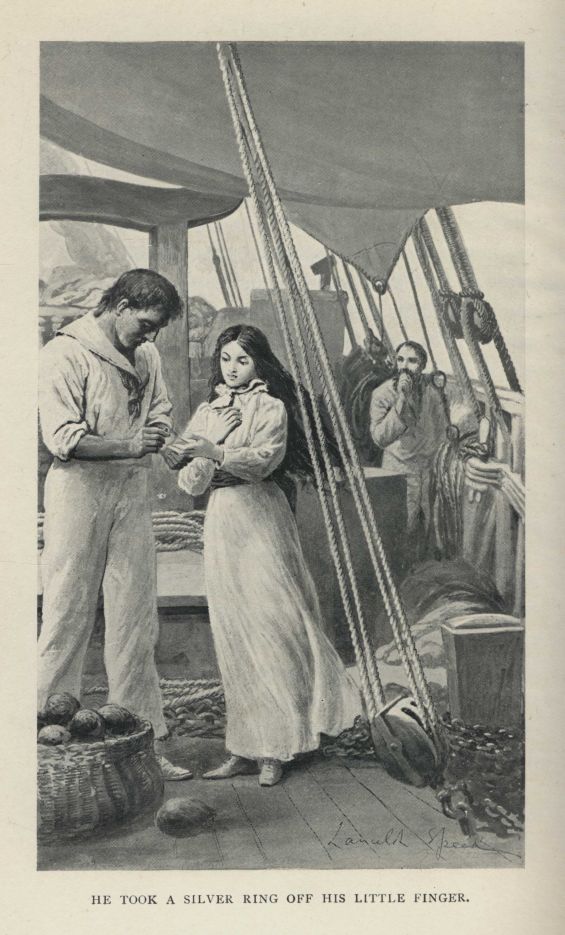
HE TOOK A SILVER RING OFF HIS LITTLE FINGER.
'It is large for even the largest of thy fingers,' he said, placing it on; 'but when we get to Apia I shall buy thee one of gold. Art content to promise me?'
Solepa nodded placidly. 'Ay, I am content to wed thee; but not content to leave the white lady. I would be always tavini tausi tama (nurse) to her.'
Bill waved his hand magnificently. 'It may be that I shall let thee remain to serve her while I go to sea. But I cannot tell now. Try and please me, and all will be well.'
Then, filling his pipe, he strolled for'ard, to announce his engagement to Charlie, for whom he had conceived a liking.
During the morning Mrs. Casalle gave Tom an interesting account of her home in Leone Bay, on the Island of Tutuila. She had an ardent admiration of the Samoans generally, and of the girl Solepa she spoke in terms of absolute affection. 'She saved my life over and over again that dreadful night, Tom; for although I can swim unusually well for a white woman, I was dulled and paralyzed with fear. Then, when we reached Elizabeth Reef, she tended and nursed me back to life again, for I really was at the verge of death from exhaustion and grief. I do hope the poor girl's brother Salu was one of the boat's crew which reached Port Kooringa. She has fretted and grieved in silence, and until this morning has hardly mentioned his name, for fear it would add a fresh poignancy to my own constant and unhappy reflections.' She paused awhile, and then resumed, in brighter tones--
'And so, after all your own strange adventures, you are still bent on a sailor's life? Would it not be delightful if you could sail with my husband? He, of course, now that the Bandolier is lost, must get another ship.'
'I should be only too glad,' answered Tom, 'especially if Captain Casalle continues in the South Seas.'
'Well, we shall know before many months--perhaps weeks--are past. Of course you will have to go home first. Then you must come to us in Samoa. Now tell me something about that strange man, Captain Hayes. I have often heard of him from the natives, who always speak well of him. He sometimes visits Apia with a cargo of natives, but our home is sixty miles from there, so neither my husband nor myself have ever seen him.'
'He knew of Captain Casalle by name,' said Tom, who then gave her a description of Hayes himself, his ship's company, and the fight on board. Then he told her all about old Sam and his wonderful brig, at which she was greatly amused.
'I should like to meet the dear old fellow,' she exclaimed.
During the night the wind worked round two or three points, and enabled the barque to lay a direct course for Fotuna, and at daylight Singavi Harbour was plainly in sight, with the yellow-thatched huts peeping out among the bright green of the cocoa-palms.
As soon as the Adventurer was safely moored, the French priest whom Tom had met previously came on board. The old man was both surprised and pleased to see him again, and told him he had done wisely in returning to the island, instead of going on the boat to Fiji. Then Captain Herrendeen introduced him to Mrs. Casalle, briefly telling him her story. The priest was very sympathetic, and at once urged her and Tom to take up their abode at the mission until the Adventurer was ready for sea again.
'You need rest, oh, very much rest, and change of food, so that you may become strong again. And next to my own house there is a small school-house which you shall use as your own. It shall be made as comfortable as possible. We shall be most pleased. You are the first white lady we have seen at Fotuna for ten--no, twelve--years, and my people will be proud, I do assure you. Now I shall not delay, but return at once to prepare for you;' and hurriedly shaking hands with them, he bustled off ashore again.
By this time the decks were filled with natives of both sexes, all of whom crowded round Mrs. Casalle and Solepa, and gave utterance to expressions of sympathy, when the latter, speaking in Samoan, told them what had befallen her mistress and herself. Presents of fruit were brought to them in such profusion that within an hour or two the after deck was completely covered.
Early in the afternoon the mission boat came alongside, to take Mrs. Casalle, Solepa, and Tom to the mission station at Alō, as the journey over the mountain paths would have been more than the former could have accomplished. The Singavi people, however, who were jealous of Alō securing the tamaitai papalagi[#] as a guest, urged her not to go in the boat, but let them carry her through the mountain forest on a litter. At length, after a violent dispute between the two parties, the Singavi natives gave way, on it being pointed out to them by Maori Bill that although the white lady, Tom, and the Samoan girl were going to Alō, the ship would remain at Singavi, and prove a considerable source of profit to them, as their services would be required to help in heaving her down. This ended matters satisfactorily, and bidding the kind-hearted captain and his officers good-bye for the present, Tom and Mrs. Casalle went off in the boat, the brown-skinned crew of which at once struck up a canoe song as they plunged their long, narrow-pointed canoe-paddles into the water.
[#] White lady.
'I'll come and see you in a few days,' called out Herrendeen, as the boat shot out through the opening in the reef.
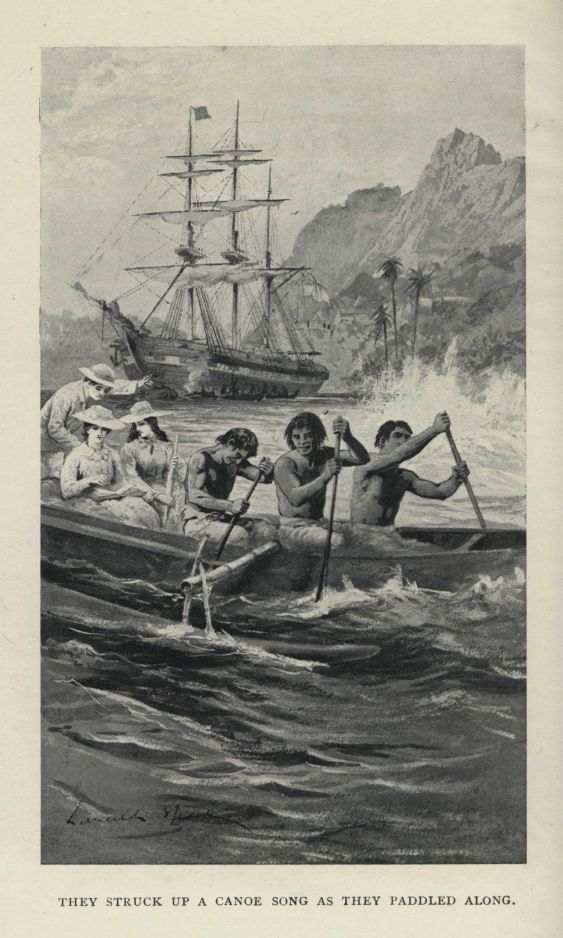
THEY STRUCK UP A CANOE SONG AS THEY PADDLED ALONG.
Before starting to heave down the ship, came the tedious task of discharging over three hundred barrels of oil, and rafting them ashore; then the barque was taken in close under a rocky bluff, which offered excellent facilities to carry out the work in water as calm as a mill pond, and as clear as the purest crystal. The started butt-end was found and repaired, the ship righted again, and preparations made for re-shipping the oil by the morning of the fifth day.
That afternoon Herrendeen visited the mission house, where he found Mrs. Casalle and Solepa busy at work with two or three young native women, making dresses out of some more modestly coloured prints than those she had been able to obtain on the Adventurer, which were of the very brightest hue, being intended only for disposal to the colour-loving natives of the Moluccas, and other islands where the captain usually called to buy provisions during his cruise.
'We'll be ready for sea in another week,' he said, looking at his passenger with undisguised admiration. 'Why, Mrs. Casalle, my officers won't know you again, you look----' He was about to say 'so beautiful,' but stopped himself in time.
'Ten years younger, Captain Herrendeen, I hope you were going to say, but I'll be content if you say five,' she broke in, with a laugh. 'Have you seen Father Serge yet?'
'No, I came to see you first, of course; but here he comes. Where is Tom?'
Mrs. Casalle nodded her pretty head half a dozen times in rapid succession, and threw up her hands in affected indignation.
'Away, of course. He's never here between daylight and dark. If he's not out pig-hunting in the forest, he's away fishing in the middle of the ocean between here and Alofi. He's just deserted me altogether. Is not that so, father?' she said to the old priest, who with another Marist priest as old as himself just then entered the house to greet the captain.
'He is what you call a rambler, a rambler! Oh yes, a great rambler; but he is a good boy, madame, a good boy. Now will you not come with us, so that we may show our friend here all over our mission station?'
Just before supper at the mission house that evening, Tom, brown-faced, dirty, and panting, came staggering up the pebbled path with a turtle on his shoulder.
'We got three,' he said triumphantly, putting the creature down on the verandah,--'and this is only the smallest. Hallo, captain, how are you?'
'Tom Wallis, you ought to have been born a Red Indian or a Samoan,' said Mrs. Casalle, laughingly.
'That's what my father has often said, Mrs. Casalle. And I believe he was right.'
CHAPTER XVIII
TOGETHER AT LAST
One afternoon, after more than two weeks had passed, the whaling barque still lay quietly at anchor in Singavi Harbour, ready for sea again, and waiting only for a breeze. For, soon after the repairs were finished, the trade-wind had flickered and died away, and a 'furious calm,' as Mr. Burr, the chief mate, called it, had set in, and seemed likely to continue. The captain had started off early the previous morning to walk to the mission house at Alō, and spend a day or two shooting with Tom and Maori Bill, for the natives had assured him that there was not the slightest chance of anything more than the very lightest airs from the eastward for many days to come, and he decided that it was better to be lying at anchor instead of drifting away to the westward. And so, although Mr. Burr and his fellow-officers, to whom an idle day was an abomination and a vexation of spirit, grumbled exceedingly, they had to admit that the 'old man' was right after all. The two damaged boats had been repaired, and were now, as well as the one obtained from Tom and Bill, fit to be lowered again, should whales be seen whilst the ship was at anchor. Look-outs had been stationed on two of the highest points of the island, and a series of smoke-signals arranged, so that if by good luck a whale or whales should be sighted from the mountains, the boats would know where to look for them, if they were not visible from the ship.
The day had been intensely hot, and at five o'clock Mr. Burr and the second mate, as they sat under the awning on the poop deck, were eating oranges and pineapples with a steady determination to do some kind of work.
Presently a canoe came off from the beach and brought off the shore look-outs, who duly came aft and reported.
'See anything, you fellows?' asked the mate, stabbing a pineapple through with his knife and drawing it to him.
'Saw 'bout nine or ten finbacks close in under the south point 'bout an hour ago,' drawled one of the look-outs.
'Finbacks is pizen, and ain't fit to be mentioned to a decent man. Snakes and finbacks air a curse to humanity. But if we hev to lie here and rot much longer, and one of them comes foolin' around, I'm going to put an iron into him, and let him tow me all around this island for forty days and forty nights. See any blackfish?'
'Nary one. But there's a ship way out to the northward. Saw her early this morning. Reckon she ain't much nearer now. 'Bout fifteen mile off now.'
Mr. Burr displayed a faint interest, and then, being a good-natured, thoughtful man, said to his subordinate--
'Like to take a boat and pull round to the mission house and tell the old man? If that ship is bound to Fiji, she'll most likely pass between here and Alofi, and maybe he or the little woman might want to send a letter. You can stay all night if you like.'
The second mate was only too glad to get away from the ship for a night; and soon after supper he called his boat's crew and started, secretly hoping that on the way back in the morning he might raise a whale.
As the boat rounded the southern point of the island, a gentle, cooling breath of air came from the eastward, and the mate sniffed it approvingly, not because it was laden with the sweet scent of maso'i, tamanu, and wild orange trees of the mountain forest, but because it felt to his cheeks as if it were the re-awakening to life again of the long-waited-for trade wind.
'Guess the captain won't do much gunning to-morrow,' he remarked in the condescending manner peculiar to whaleship officers, who in rare moments of relaxation unbend themselves sufficiently to make an observation to members of the crew not directly connected with their vocation. 'There's going to be a steady breeze before morning, in spite of what these copper-coloured Kanaka folks say. Give way, there. I'm mighty glad we came now. Maybe we'll get back again to-night.'
The officer's surmise seemed likely to prove correct, for by the time the boat was abreast of the mission station, and just as the evening fires of the natives were being lit, the breeze had certainly strengthened.
Landing directly in front of the white-walled church, the crew hauled the boat up on the soft white sand, and were soon surrounded by the usual crowd of inquisitive natives, while the mate walked on up the hill to the mission house, where he found his captain, Mrs. Casalle, and Tom at supper with the two old fathers.
'Mr. Burr reckoned he had better let you know that there is a ship in sight to the northward; the look-out saw her early this morning, and thinks she's coming this way. If so, she'll be in the straits here by midnight. And there's a steady breeze coming, captain; guess this eternal calm is about broke up.'
This latter news decided Captain Herrendeen to leave Alō as soon as the moon rose, which would be an hour before midnight, as he would thus have time to reach Singavi by daylight, get the ship under way and well out from the lee of the land as soon as possible; for should it fall calm again he would either have to anchor or tow back again, to avoid the strong westerly current. As for the vessel which the look-outs had sighted, he determined to speak her in the morning, if it could possibly be done.
His hospitable hosts, knowing his anxiety to put to sea again, did not persuade him to wait till morning; but, calling their servants, bade them carry down and fill the mission boat with fruit and vegetables for the use of the ship's company. Then, as there were still some hours before them, supper was proceeded with, and the rest of the evening was spent on the verandah.
At last the time came to say farewell. The moon had risen, and sent a long steady blade of light down the strait, the breeze was blowing fresh and cool and rustling the line of palms in the mission garden, and the two boats with their crews were waiting on the beach.
'Come, my friends,' said the older of the two missionaries to his guests, 'let us go. My brother Garnier and myself are not so old that we cannot walk down with you to the boat.'
As the little procession left the mission it was joined by some hundreds of young women and lads, who pressed forward to say good-bye to Mrs. Casalle and Solepa; many of them were unable to restrain their tears, and Tom could not help remarking upon their warm-hearted impulsiveness to Captain Herrendeen, adding that Hayes had told him that the Fotuna natives were inclined to be saucy and domineering.
'Ah,' said the old priest, who overheard him, 'but Captain Hayes did not understand the changes we have made here of late years. The Fotunans were always a more suspicious and irritable people than the other Polynesians; even now they do not take quickly to strangers like the Samoans or Tahitians, but that is because there is a strain of Papuan blood in them. And it is not more than twenty years ago since my predecessor, Père Channel, was beaten to death by their clubs here at Alō.'
They reached the boats, and then, almost in silence, Tom and Mrs. Casalle bade the good old men farewell.
'Farewell, madame; farewell, Tom!' murmured Père Serge, who was almost afraid to trust his own voice, as he took their hands in his; 'may Heaven protect you both! You have both suffered much, but now happiness is near to you. Think of us sometimes, living out our quiet lives on this lonely little island. And to you farewell, captain, and to you, sir, and to you,' as he held out his hand to Herrendeen, the second mate, and Maori Bill; 'may your voyage be a very happy, a very prosperous one! Perhaps in a year or two you may come to Fotuna again, and tell me that you have killed many whales.'
Another hand-grasp, and Mrs. Casalle and the captain took their seats in the whaler's boat, Bill--who contrived to get Solepa and Tom with him--took charge of the other, and the word was given to push off.
The priests, surrounded by their flock, stood watching on the beach, and then, as the boats cleared the reef and headed southward, Tom and the captain stood up and waved their hats. For some minutes the two black-garbed figures remained stationary, silhouetted against the white background of moonlit beach; then they turned and disappeared under the shadow of the palms.
When the boats were a few hundred yards beyond the barrier-reef the oars were taken in, the sails hoisted, and soon both were slipping quickly over the water, which, though ruffled by the gentle breeze, was very smooth. The mission boat, however, being both clumsy and heavily laden, dropped behind considerably, and gradually the voices of her native crew, who were singing merrily as they sailed, grew indistinct.
'We mustn't run away from them, Captain Herrendeen,' said Mrs. Casalle, quickly. 'Don't think me nervous, but even being in a boat now terrifies me, and Tom is such an awful boy. If it came on to blow hard, he would just be delighted. Why, as we were leaving I asked him to come with us, but he said he wanted to go with Mr. Chester, as they might pick up a turtle in the moonlight! And that boat is loaded down to the gunwales already. If they swamped'--she shuddered--'and anything happened to him, it would break my heart.'