TOM WALLIS (continued 2)
Reading edition
The seaman's eyes filled. 'Wallis, what can I say? How can I tell you what I feel? I never had a friend in my life till I met you. My father, who was a native of Funchal, was killed in a boat accident when I was a boy of ten. He was a rough Portuguese whaler, and after his death my mother was left in poverty, and died when I was away at sea, on my first voyage. My one brother, who was seven years older than me, also went to sea. I have never seen him since, but heard that long after he had passed as second mate, he returned to our native island, only to find that our mother was dead, and that I had gone. Until I met my wife, who was a native of the New England States, I led the wildest, the most dissolute----'
The master of Kooringa held up his hand. 'Never mind that, old man. There are not many--men such as you and I, wanderers on the face of the earth--who can show a clean sheet. Like you, I was sent out into the world when a mere boy; but I was less fortunate than you, for instead of a life of honourable hardship, I was led to look forward to--by my parents' influence--to one of ease. You, perhaps, were driven to dissipation when on shore, by the rough life of a whaleship's fo'c'sle. I led a dissipated and worthless existence, because I was cursed with ample funds, and but few of my many associates in India, during all the time I was in the Company's service, had any other thought but of leading a short life and a merry one, or else making as much money as possible and returning to England to live upon it. And like you, a good woman came to my rescue. Now, my dear fellow, let us say no more on this subject. Come, let us see what Jack has caught.'
Too overcome to find words to express his gratitude for such unlooked-for generosity from a man who, two months before, had been an utter stranger, the captain could only wring his companion's hand in silence.
In another day or two he would have to say good-bye to little Nita and the master of Kooringa; for the antiquated paddle-wheel coasting steamer William the Fourth, which called at Port Kooringa every three months, was then in harbour loading with hides and timber for Sydney, and he had taken passage by her. Brooker, the chief mate, and the whole of the crew, had preceded him some weeks by a sailing vessel, and were awaiting him in Sydney, for no one of them but wanted to sail with him again--and indeed the feeling that existed between captain and crew was something more like comradeship than aught else.
But here I am again, drifting away to leeward, and never a word about the Bandolier herself, and how she came to such mishap, and what happened between the time of that unlucky fire and now--when the two men and Nita and Jack are walking slowly home to spend their last night together in the old house which faced the restless bar.
* * * * *
When the missing boat had sailed past Misty Head at dawn on the day following the fire, Mr. Wallis had told the officer that they should reach the boat-harbour just below his house in another three or four hours; but misfortune overtook them. Twice was the boat, despite the officer's careful handling of her, filled with lumping seas and swamped, and in this dangerous situation furious rain-squalls burst upon them, and lasted almost without cessation for two hours. So darkness had set in ere they landed at the little boat-harbour, drenched and exhausted, and the first intimation Captain Casalle had of the safety of the missing men was by being awakened out of a deep slumber by his American mate, who was standing at his bedside wringing his hands. He was soon followed by Mr. Wallis, who congratulated the master of the Bandolier most warmly upon his escape, and then added a few words of sympathy for the loss of his wife--the mate already having given him some particulars of the disaster to the ship and the manner of the poor lady's death.
The moment he had entered the house, old Foster had told him of Tom's departure the previous day, and expressed some alarm when he found that his father had not seen him, and Mr. Wallis himself could not repress a feeling of anxiety. This he tried to put away, by thinking that the lad would be sure to turn up early on. the following morning. Many things, he knew, might have happened to delay Tom's return--primarily the fire, which might have caused him to make a wide detour, or else ride on hard to Kooringa Cape to avoid it; or perhaps--and this he thought very probable--the boy had had to take to the beach and wait till the fire burnt out before going on to the Cape. Nothing, however, could be done until morning, and in the morning they would be sure to see Tom safely back, none the worse for his adventure. He was a brave lad, and the bush and its ways were a second nature to him.
Late that night, as the father and son were talking over the exciting incidents of the previous day, the captain of the Bandolier tapped at the dining-room door and then entered, followed by his mate. In a moment Mr. Wallis was on his feet and making his visitors comfortable, whilst big red-haired Kate brought in liquor, cigars, and pipes. Then until long past midnight the three talked, and solemn-faced Jack listened with devouring interest to the full tale of the wreck of the Bandolier.
She was a barque of nearly four hundred tons, and Casalle's own vessel. He, from the time he was a lad of fifteen till he was nearly forty years of age, had sailed in American whaleships. From 'green hand' he had risen step by step from boat-steerer to junior officer, then to first mate, and finally to master; and then, having saved enough money to embark on a venture of his own, and believing that a fortune awaited him in the South Seas as a trader, he had bought the Bandolier, and sailed her out to Samoa. Here he purchased land from the natives for a trading station, and refitted the barque for her future voyages among the island groups. His wife, a young American girl, whom he had married in New London, Connecticut, six years before, had accompanied him with their little daughter; and whilst he was away in the Bandolier cruising through the New Hebrides and Solomon Islands, she remained in charge of the trading station. From the very first he had been fortunate, and at the end of two years he decided to take a cargo of coco-nut oil and other island produce to Sydney, sell it there, instead of disposing of it in Samoa, and invest the proceeds in a fresh supply of goods, which would practically give him a monopoly of the island trade from Samoa to the far-away Marshall Islands. But, as he expected to remain in Sydney for some months whilst the Bandolier underwent extensive repairs, he determined that his wife and child should accompany him. Then, as he thought it very likely he would be able to pick up for a low price in Sydney a small schooner of about a hundred tons, which he intended to use as a tender to the barque, he shipped ten extra native sailors--Tahitians, Savage Islanders, and Rotumahans--just the sort of men he wanted for the work in which the new vessel would be engaged.
'We made a splendid run from Samoa till we were, as I thought, fifty or sixty miles north of Lord Howe's Island,' Casalle went on to say. 'Then the weather became squally and generally dirty, and at four o'clock on the afternoon of the following day I decided to heave-to for the night, not wishing to attempt to run by the island in the dark, my chronometer being unreliable. Just before sunset a big, full-rigged American timber ship, with her decks piled high with lumber, came racing up astern. Just as she was abreast of the Bandolier, the squall before which she and my own vessel had been running died away, and as we were within easy hailing distance I spoke her, and asked the captain for his approximate position. Much to my satisfaction, it agreed with mine within a mile or two, so I kept on, expecting to pass Lord Howe's Island about midnight. The American ship, which was keeping the same course, soon drew away from us when the next squall came, for the Bandolier was under short canvas.
'About ten o'clock we were running before what appeared to be a steady breeze, although the sky was dull and starless. My wife and I were having a cup of coffee in the cabin, and little Nita was fast asleep, when, without a word of warning, the ship struck heavily. The moment I got on deck I saw that there was no hope of saving the ship, for her bows were jammed into a cleft of a reef, and she was tearing her bottom to pieces aft, for every sea lifted her, and she soon began to pound violently upon the rocks. The native crew worked well--we carried but two white seamen exclusive of my first and second mates--and we got two of the boats away safely, under the chief mate and boatswain, each one with a fair amount of provisions and water. Most unfortunately, my poor wife refused to leave the ship in either of these boats, declaring she would not leave till I did, in the third and last boat; she, however, permitted Mr. Brooker here--my chief mate--to take the little girl with him. Then the child's nurse--a young Samoan native girl--satisfied that her charge was in safety, begged to remain with her mistress. Poor Solepa, her affection cost her her life. Five minutes after we struck, the ship began to fill very rapidly, and I to fear that, before we could get clear of her in the third boat, she would swing round, slip off into deep water, and founder, for, although she was still bumping aft with every sea, she had worked free for'ard.
'Despite the darkness, however, we managed to get the boat ready for lowering, the second mate and two native sailors jumping into her, so as to cast her clear of the falls, and bring her astern the moment she touched the water. This they succeeded in doing, and at that moment, and whilst the steward, a sailor, and myself, were standing by ready to lower my wife and the native girl into the boat, the ship gave a sudden heavy roll to starboard and crashed over on her bilge. Then a black wall of sea towered high over the buried rail, and fell upon us. What happened immediately after will never be known, for I was knocked almost senseless by the sea, which tore my wife from my arms, and then swept us all over the side together.
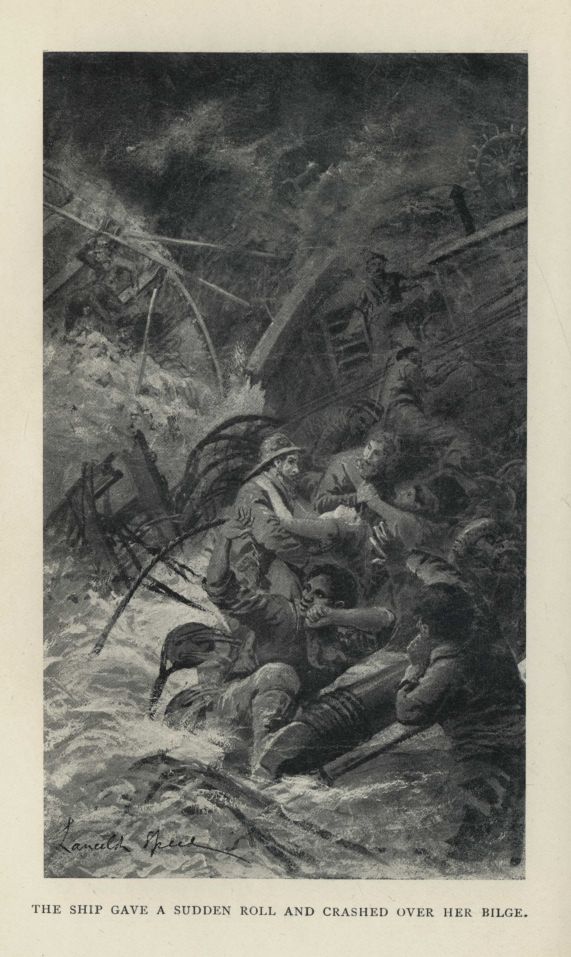
THE SHIP GAVE A SUDDEN ROLL AND CRASHED OVER HER BILGE.
'When I came to, many hours later, I was lying in the mate's boat, and learnt from him that not only had my wife and those who stood with me on deck perished, but my young second mate and his two hands as well; for the same sea which carried us overboard, doubtless capsized the boat, then hanging on under the counter on the port side, and drowned them all. When morning broke we were about five miles off the southern end of Middleton Reef. A wild hope that some of them might yet be alive impelled me to head back for the reef itself, although I knew it was generally covered at high water. With the two boats we pulled right round it--nothing, nothing, Wallis, but the leap and roar of the thundering surf upon the coral barrier. As for the old Bandolier, she had slipped off into deep water and disappeared.
'My own escape from death was marvellous. The waiting boats had, in the darkness, been actually carried over the reef through the surf into smooth water beyond; then they pulled out through a narrow passage on the lee side, and returned to the scene of the wreck to look for the third boat. Suddenly the mate's boat fouled the wreckage of the deckhouse, mixed up with some of the for'ard spars and canvas, and in getting clear of it I was discovered lying dead, as was thought, on the side of the house. Whether I was washed there, or managed to swim there, I cannot tell. One of the South Sea Islanders jumped overboard, got me clear, and swam with me to the boat. Then when daylight came ... as I have said ... we went back to the reef.'
He ceased, for he could speak no longer, and Brooker, the rough American mate, with a soft, kindly light in his usually stern eyes, took up the tale.
'And then, yew see, Mr. Wallis, we had nothing to do but to keep away for Australia. So I went into the small boat, and for about ten days we kept together; then one night it came on to blow mighty hard from the south'ard, and when daylight came the captain's boat was not in sight, and I hed nothin' else to do but keep right on. And now here we are all together again, and thet little Nita sleepin' as sound and happy as if there was no sich things as misery and death in the world.' Then he added savagely, 'I should just like to come across that galoot of a skipper who was the cause of it all. Why, mister, instead of our being where we thought we were, we were just running dead in for Middleton Reef. I guess he had a narrow shave himself, but, anyway, I hope to see the feller piled up somewhere before I quit sea-goin'.'
Then the two men rose and retired to their rooms, leaving the squatter and his son to pace to and fro on the verandah and watch for daylight and Tom.
And then when daylight came, and the sea mist lifted from the long, long line of curving beach, and Foster, glass in hand, joined his master to scan the yellow sand, and they saw naught to break its outlines but the whitening bones of a great fin-back whale, cast ashore a year before, the master of Kooringa Run turned to the old sailor with trouble in his eyes.
'Foster, I fear something has gone wrong with the lad. Even if he had lost his horse, he should have turned up by now. He is too smart a boy to have let the fire head him off into the ranges. And yet where else can he be? Anyway, there is no time to lose. Jack, you and Wellington must saddle up at once, cross the river high up, and work down from the range till you come to the edge of the burnt country, then follow that right along to Kooringa Cape. I'll take Combo and Fly, and go along the beach between the bar and Misty Head. Most likely I'll meet him footing it home. But hurry, lad, hurry.'
Before noon that day Jack and Wellington were searching the country at the foot of the ranges, and Mr. Wallis and his party were examining the beaches beyond Misty Cape.
But never a trace of Tom could be found, though his horse came home next day. The heavy rain-squalls had obliterated any tracks made on the beach itself: and so when, after a week's steady search, in which all the surrounding settlers joined Tom's shirt and trousers were found lying buried in the sand, by the action of the sea, the heart-broken father bent his head in silence, and rode slowly home.
And that night, as he and Jack sat with hands clasped together, looking out upon the wide expanse of the starlit ocean, and thinking of the face they would never see, and the voice they would never hear again, they heard poor Kate Gorman, who had just laid her little charge to sleep, step out into the darkened garden, and, crouching on the ground, wail out the sorrow her faithful heart could no longer suppress.
Oh, Tom, Tom! the babby that was your mother's own darlin' an' mine, an' mine, an' mine!'
Old Foster came softly over to her. 'Hush, Kate, hush! The master will hear you; don't make it harder for him than it is.'
CHAPTER VI
TOM MEETS SOME STRANGERS ON WRECK REEF
When the Lady Alicia, after bruising and pounding her noisy way over the sea for ten days, made Wreck Reef, and dropped anchor under the lee of the one little islet enclosed within the wide sweep of many lines of leaping surf, the ship's company were astonished to find the place occupied--a boat was drawn high up on the beach, and five ragged fellows were standing on the sand awaiting the landing of the people from the brig. As soon as Captain Hawkins set foot ashore, one of them, who appeared to be the leader, held out his hand, and in good English said he was glad to see him. He and his comrades, he said, were the only survivors of an Italian barque, the Generale Cialdini, which had run ashore on the coast of New Guinea, and after great hardships they had reached Wreck Reef some days before, and were now resting, on their way to the mainland of Australia.
Old Sam eyed him critically for a moment or two, then said quietly--
'You want water and provisions, I suppose?'
The man nodded an eager assent; and indeed he and those with him presented a wretched appearance, for their faces and bodies showed traces of severe hardship.
'Very well,' said Hawkins, 'I'll give you both if you'll come alongside. My boat's crew will lend you a hand to get your boat into the water again.' Then he drew the man aside a little, and added, 'And look here mister don't you spin me any more cuffers about that Italian barque and New Guinea. I know where you come from right well and as my ship is on Government service I ought to collar the lot of you and hand you over to the Sydney police but I don't want to be bothered with you and there's an end of it and what is more, I'll do what I can to help you'--here he grinned humorously--'I'll even give you a passage back to New Caledonia if you like. I am bound to Noumea.'
The stranger started back, his leathern-hued visage paled, and such a despairing look came into his wild eyes, that old Sam was sorry for his jest.
'There don't get scared I mean you no harm; but at the same time, for reasons of my own I don't want your company here. Have you any idea of what part of the coast of Australia you're going to?'
A sigh of relief broke from the man, then he answered in perfect English--
'I will not try to deceive you. We escaped from Noumea thirty-eight days ago, and reached this place a week since. I do not know what part of the coast to steer for. A year ago a party of ten prisoners escaped, and reached some place in Queensland safely; none of them were ever brought back to Noumea. And we are prepared for death--better to die of thirst on the ocean than live in such agony and despair.'
The old man nodded, then mused. 'Look here food and water I would give you in any case but I'll tell you why I am so disposed to assist you. When I was coming up the coast I picked up a boy lying on the beach he was not able to tell me who he was or where he came from for two weeks and then it was too late for me to land him at any settlement. Now we want to send a letter to his father. Will you promise me to do your best to try and get that letter forwarded? I'm not playing any game on you you can see the boy and read the letter if you like when you come off to the ship.'
'I swear to you that I will act honestly,' answered the convict, who was trembling with excitement, 'I shall do my best. And now I, too, will be open. When I and my comrades saw your vessel early this morning, we planned to attempt to capture her if she anchored here, and had not too many men on board. We thought she might be only a small schooner, with not more than five or six men.'
'Thank you kindly mister. You've got the mug of a born pirate I must say. However I bear you no ill-will and I'll trust you with that letter. If you don't send it on you'll never have a day's luck in your life and be the two ends and bight of a lyin' swab into the bargain. Have you got a compass? No! Why didn't you steal one when you pirated the boat? Might as well be hung for a sheep as for a lamb, sonny. Now there's your boat ready; follow me off to the ship but don't come aboard and I'll see that everything you want is passed down to you letter included and I'll give you a boat compass as well. All you've got to do is to steer due west till you sight the Great Barrier Reef which you ought to do to-morrow night; then run the reef down southerly till you come to the first opening--you will find plenty of boat passages--then once you are inside steer west again for Cape Manifold which you'll see thirty or forty miles away. Then follow the coast southerly again till you come to the settlement in Keppel Bay. If you don't like landing there you can go on to Port Curtis--there's a lot o' people there but I don't think they will trouble to ask you many questions. A new gold field has been discovered a little distance back from there. Like as not you'll find half a dozen vessels lying there without crews so if you don't care to go on to the gold fields you'll find you'll have no trouble in getting a ship to take you away. But mind don't forget about the letter.'
The convict's eyes glistened with pleasure, and his face worked. 'I repeat that I will be true to the trust you are placing in me--I swear that this letter shall reach the person for whom it is intended. I am an escaped convict, and a few hours ago I was ready to turn pirate rather than be taken back to New Caledonia. Why I am what I am, I cannot now tell you, but I am not a criminal, that I swear to you--only a despairing and desperate man on the verge of madness, through unmerited suffering and wrong.'
He spoke these last words with such a passion and emphasis, that old Sam was impressed.
'Well there's many a wrong done. But you ain't a Frenchman are you?'
'No, I am an American, and a seaman. But five years in a chain gang have made me look as I look now.... Now, sir, I am ready to follow you. But before you go, will you let me take your hand? It will be something for me to remember. Come, sir, do not refuse me.'
The old seaman held out his hand. 'There you are mister; if that will do you any good there it is.'
'It will, it has, sir. I shall never see you again, but I shall never forget you. And some day it may be that you may hear the name of Henry Casalle spoken--Henry Casalle, sentenced to transportation for life for mutiny, and for the murder of the captain of the ship Amiral Jurien de la Graviere; and as God is my witness, sir, I am an innocent and unjustly condemned man.'
Hawkins looked at him keenly. 'If you are lyin' to me, you ought to be struck dead in your tracks; but I don't believe you are. Now I'll get aboard, and get the boy to write that letter.'
In ten minutes the energetic little man was on board the brig again, and giving Mr. Collier orders to get some provisions and water ready. Then he beckoned to Tom to come below.
'Tom my son you've got a longish head for a person of your age being an infant in the eyes of the law. Now cock your ears and listen. Those fellers who are comin' off in that boat are escaped convicts from New Caledonia and I am giving them assistance to get to the mainland. The leader of 'em seems to be honest enough--or else he's a flamin' out-an'-out liar--and he's promised to see that your father gets a letter if you give him one. Now don't start askin' questions I believe the feller means to act all square and shipshape an' there's every chance of your father getting the letter in another month or two. I'm doing a disrespectful thing to the Government just on your account by aidin' and abettin'--no more an' no less under any circumstances. But I'll chance it anyway. So just you write.'
So Tom, beaming with joy at the opportunity, set to work, with the skipper standing over him and dictating:--
'Brig Lady Alicia: Wreck Reef, 'Lat. 22° 10' 25" S., Long. 155° 30' E.
'MY DEAR FATHER,
'I was rescued by Captain Samuel Hawkins, of the brig Lady Alicia, bound to the above and New Caledonia, and wish to state I have received every comfort, she being on Government service and he desiring to present his respects to you in every possible manner whatsoever, and to inform you that for reasons not herein specified this letter may not reach you owing to extraneous and futile circumstances. The master of the said brig will use all and every promiscuous endeavour to forward me (the said Thomas Wallis) to Australia by Her Majesty's ship Virago from Noumea, should she as aforesaid be returning to Sydney previous to the aforesaid brig Lady Alicia, also to inform you that clothing and all such supernumaries shall be duly attended to on arrival at Noumea, where Captain Samuel Hawkins is duly respected.
'Your affectionate Son,
'THOMAS WALLIS.'
'That'll do, Tom, that'll do. Put it in an envelope and address it to your father, but don't close it, and be ready with it in ten minutes. Steward get a gallon of rum and five pounds of tobacco for these shipwrecked and distressed foreign seamen who are coming alongside and bring it on deck to me and ask Mr. Collier for that boat compass in his cabin.'
Poor Tom, too dazed and muddled to know what he was doing, was just about to place his letter in the envelope, when the mate came below for the compass. He showed what he had written to Collier, who could not help laughing.
'Write another, Tom, as quick as you can, and enclose it. Otherwise I'm afraid your poor father will think you have gone mad. Hurry up, Tom. Tell your father that you are well, and that you are writing very hurriedly, as a boat is waiting. And say that there is a chance of your being able to get back to Australia by the Virago some time within six months. Perhaps it will be as well to say nothing about these Frenchmen--your letter might be opened, and might lead to the poor wretches being captured by the Queensland police.'
Tom set to work with renewed vigour, and contrived to convey to his father as nearly as possible all that had befallen him since that direful day on Misty Head. Then he went up on deck with the letter.
The boat with the five 'shipwrecked and distressed foreign seamen' was lying alongside, and old Sam was bustling up and down the poop, puffing and grumbling about being delayed on Government service 'by a lot of blessed foreigners.'
A large bag of biscuits, some tinned meats, and other provisions were being passed down into the boat, and Tom stared with astonishment when two of the sun-baked creatures thrust their hands into a sugar bag containing raw potatoes, and began to eat them with the greatest zest imaginable. Their leader stood quietly aft, holding the steer oar, looking straight before him, and giving mono-syllabic orders to his crew regarding the stowage of the water and provisions. Once only he looked up and caught sight of Tom, who was standing just above him, letter in hand; he pulled off his battered and blackened straw hat and bade him good day in low tones, then turned again to watch his comrades. Brief as was the glance which Tom had of the man's features, they seemed somehow to be familiar to him--to remind him of just such another type of face he had seen somewhere--the jet-black hair and eyebrows, and the deep-set and somewhat stern-looking eyes beneath. Where had he seen such a face before? Then he remembered--the captain of the Bandolier! Yes, the resemblance was most striking, although the man before him was not so tall, and his beard and moustache were short and stubbly. Tom was too interested, however, in the men generally to let his mind dwell on the peculiarity of the resemblance, and soon forgot all about it.
As soon as the convicts had stowed the boat properly, the leader looked up at the master of the brig, and said in French, 'I am quite ready, sir.'
'Well, here's the letter--it's not closed, you see.'
'I do not wish to read it, sir,' said the convict, 'therefore I beg you to close it.'
'Oh, all right, just as you please. There, there it is. Now, is there anything else I can do for you? No? Well, good-bye. Let go that line there.'
The boat's painter was cast off, the steersman flung her clear of the ship, the big lug sail was hoisted, and then, following the leader's example, the rest of the wild-looking creatures stood up, waved their hats and caps in farewell, and called out adieu. In ten minutes the boat was slipping out of the lagoon into the long sweep of the ocean swell, and then she was hauled up a point or two, and headed off westward.
'Well, that's satisfactory,' said old Sam to the mate. 'It's a good job we didn't get here a week sooner, and provide these coveys with a brand new boat and gear worth three hundred pounds. Now let's get to work, Mr. Collier and get her over the side. Tom my bantam d'ye want to have a run ashore? There's any amount of crayfish out on the reef, and the water is full of whopping blue gropers. Ask William Henry to give you his fish-spear and you can prod it into one for our dinner.'
Highly delighted, Tom fled along the deck, secured the spear from the Maori--who had taken a great liking to the boy--and was at once put ashore, where, his mind now free from anxiety to a certain extent, he revelled in the joys of chasing and spearing some splendid fish, for, as the captain had said, the shoal water inside the reef was literally swarming, not only with brilliant, blue-scaled gropers, but half a dozen other kinds of fish. In less than an hour he had secured enough to last the ship's company for a couple of days, and then burying them in the sand, to protect them from the sun till the boat returned, he started off to investigate some wreckage at the further end of the island. The history of these time-worn timbers had been told him by old Sam--they were the remains of the Porpoise and Cato, two Government vessels, lost there August 3, 1815, and on one of which the gallant and ill-fated Matthew Flinders was a passenger on his way to England, a third vessel, the transport Bridgewater, sailing away, and leaving them to their fate.
In less than a week the shed was built, the boat safely housed, and a flagstaff erected, and then the little islet was left to its loneliness again, and the never-ceasing roar of the surf upon the network of reefs and shoals which surrounded it, and once more the old brig's bluff bows were dipping into the blue, as he braced up sharp for her long beat against the trade wind to New Caledonia.
Thirteen days later she entered Noumea Harbour through the Dumbea Pass, and there awaiting her was her Majesty's paddle-wheel steamer Virago, Commander Bingham. As soon as possible the brig hauled alongside the warship, and the blue-jackets were at work on the coal, whilst old Sam, swelling with importance, and using the longest words he possibly could, was relating the story of Tom's rescue to the captain and first lieutenant; and presently Tom himself was sent for, and, dressed in a best suit of the mate's clothes, three sizes too large for him, he soon made his appearance. The captain and his officers treated him with much kindness, made him stay to lunch, and got him to tell his story over again. Offers of clothing were made to him on all sides, and a smile went all round when old Sam, who was sweltering in a heavy frock-coat, and wearing a brilliant green tie with a huge nugget of gold as a scarf-pin, begged them 'on no account whatsoever to trouble,' as he was going ashore with the young gentleman to buy him all that was needed, 'in order that he may be in a manner of speaking assimilated with the proper conditions of irrefutable society without regard to expense on my part, I being sure that his father will do the square thing with me.'
After lunch the commander told the master of the brig that the Virago was not returning to Australia for another four or five months, when another ship would be sent to relieve her in her surveying work among the islands. 'I am sorry, Mr. Hawkins, that this is so. Nothing would give me greater pleasure than to take your young friend to Sydney, but, as you see, you will be there long before we are. I trust that the letter he sent by those gentry you met at Wreck Reef will be delivered safely. Oh, and by the way, you need not, of necessity, when reporting that incident to the authorities here--er--er mention that you--er imagined these men were escaped prisoners.'
Old Sam shut one eye. 'I've my log to show 'em. "Five men only survivors of Italian barque Generale Cialdini wrecked on coast of Noo Guinea, etsettery."'
The officer smiled. 'I see, I see, Mr. Hawkins. But you have behaved very humanely--and wisely as well, in not letting them on board to mix with your crew; it might have led to some unpleasantness here with the authorities.'
Early on the following morning the Cyclope, an ancient-looking corvette, arrived from Sydney with mails from France for the Governor and garrison, and the commander of the Virago went ashore to lunch with the captain at the Governor's house. When he returned, he sent for old Sam, and said--
'Mr. Hawkins, I have something to tell you that will, I think, interest you. The Governor had for three months been expecting the arrival of a large vessel--a transport--with stores for the garrison and convicts. She was despatched from Saigon, in Cochin China, nearly six months ago, and now news has reached Sydney by an island trading vessel that a large French ship was reported by some natives to have been lost on the coast of New Britain, and all hands either drowned or murdered by the inhabitants of a large village there. The Governor fears that this is the missing transport, and is most anxious to ascertain the truth. He has, however, no vessel available for such a long voyage--the Cyclope cannot be spared, and there are but two very small schooners, neither of which is fit for such a task, especially as the crew of the transport may all be alive, and would have to be brought here. Now, he is most anxious to charter your brig to proceed to New Britain and search the coast. I told him I would send you to see him, so you had better go ashore at once. I should think you will find such a charter highly remunerative, and your knowledge of that part of the South Seas will be invaluable to you.'
Old Sam, scenting a fat charter, was profuse in his thanks, and hurried off on shore, taking Mr. Collier with him as interpreter. Meanwhile the work of coaling the Virago went on vigorously, and by six in the evening the brig had hauled off from her side, and all hands were employed in cleaning and washing down.
The little man was soon back, bustling with excitement, having practically come to terms with the Governor, and the brig was to begin taking in stores as quickly as possible. As the Virago was to leave soon after daylight, Tom went on board to say good-bye to the commander and his officers, and, much to his delight, the former presented him with a handsome double-barrelled gun, with ample ammunition; told him to write again to his father, and leave the matter with the Governor, in case the Cyclope might return to Sydney; said that old Sam was a thorough old gentleman, who would make a man and a sailor of him, and shaking the lad's hand warmly, bade him good-bye.
For many hours that night Tom sat listening to the mate and captain discussing their future proceedings; then, unable to sleep, he went for'ard and woke up the Maori half-caste, and with him began fishing till dawn. Then, as the first rays of sunrise lit up the hills, the smoke began to pour from the Virago's yellow funnel, the boatswain's whistles piped shrill and clear in the morning air, the great paddle-wheels made a turn or two, and churned under the sponsons, the boats were hoisted in, and the tramp, tramp of the blue-jackets' bare feet sounded on the decks as the capstan was manned and the heavy cable came in, and then the old-fashioned war-vessel pointed her nose for Havannah Pass, and steamed slowly away for the New Hebrides.
For the next few days every one on board the Lady Alicia was kept busy preparing her for sea. The Governor was sending an officer from the Cyclope to nominally command, but who was really to rely upon old Sam's judgment and advice in everything, until the survivors--if there were any--of the transport were found. If any seamen could have been spared from the Cyclope, some would have been sent, but old Sam energetically assured the Governor that they would not be needed. He, however, did not demur to taking on board thirty rifles and a plentiful supply of ammunition.
Everything was ready at last, and then came the last day of the ship's stay in Noumea. The skipper had gone ashore to receive his final instructions, and Mr. Collier and the second mate were pacing the deck together, looking out for his boat, and whistling for a breeze to spring up, for a dead calm had prevailed since early dawn, and the day had become swelteringly hot, so hot that even the marine infantry sentries guarding the convicts working on the foreshore of the harbour were handling their rifles very gingerly, for the steel barrels were as hot to the touch as a burning coal, and the bare, treeless hills at the back of the newly-formed town seemed to quiver and tremble, and appeal for rain to slake their parched and sun-baked sides. Out in the harbour lay, covered with awnings fore and aft, the Cyclope, a hulking, wall-sided old French corvette, which had been stationed at Noumea ever since Tardy de Montravel founded the settlement, ten years before. Nearer inshore was a tiny French schooner, and between her and the warship was the Lady Alicia. For'ard, on the latter's deck, were Master Thomas Wallis and the black cook, the latter being engaged in instructing Tom how to polish a shark's backbone, and make it into a walking-stick fit for a gentleman of quality.
Nearly five months had passed since Tom had first appeared on board the brig, and his always brown face was now browner still; and as he rubbed away at the shark bone his honest, grey eyes seemed full of content; and, indeed, he was happy enough. For now he was to have, he felt sure, further adventures.
'De ole man's a mighty long time ashore,' said the coloured gentleman presently; 'I guess he ain't comin' aboard till he's shown these yere Frenchers the proper way to wear a stove-pipe hat an' long tail-coat. He's been an' gone an' took Maori Bill with him--"my servant," he calls him now; an' he's filled Bill's pockets with 'bout six pound o' tobacco cut up inter small chunks, an' Bill hez ter drop 'em along the road, so ez them poor convicts workin' on the chain gang can pick 'em up when dey sentries isn't lookin'.'
'It's very kind of him, Joe,' said Tom.
The negro nodded. 'Oh yes; he's right 'nuff dat way, is de ole man. It's on'y when he gits usin' dem big high-class college words dat he makes himself contemptuous. Why, sometimes I hez to hold on tight to somethin', for fear he'll see me laughin', and start out on me. Hullo, dere he is comin' down to the jetty with the French officer, and dere's the blessed breeze comin' too.'
Ten minutes later, Captain Hawkins, perspiring profusely in his shore-going garments, and accompanied by a pleasant-faced young naval officer dressed in white duck, stepped on deck, and in the most dignified and awe-inspiring manner asked Mr. Collier if he was 'prepared to heave up.'
'All ready, sir.'
'Thank you Mr. Collier. Then please get the hands to loose sails and man the windlass without delay. Mr. Collier this is Lieutenant de Cann of the Cyclope Mr. de Cann, Mr. Thomas Wallis will you step below, sir, and see if your cabin appurtenances and gear generally are concomitant with all and any natural expectations. One moment, Mr. Collier, before you start heavin' up, Mr. de Cann is doing me the honour to drink a bottle of Tennant with me, and I will thank you to join us. Tom my bantam lay aft here and wet your whistle.'
Five minutes later he was in his sea togs stamping about on deck, and bawling and roaring out the most dreadful threats of violence to his crew, as a 'pack of fat lazy good-for-nothing swabs only fit to scrub paint work or clean out a stable instead of eatin' good vittels.'
A boat was coming alongside from the warship with some of De Caen's fellow officers to wish their shipmate good-bye, and old Sam was determined to show them how he could do things.
The French officer looked inquiringly at Tom as he heard the din overhead, and Tom laughed.
'That is only his way, Mr. de Caen, and I really think the men don't mind it a bit. Mr. Collier says they like it, and that if the captain didn't bully them when he's getting the ship under way or shortening sail, they would be afraid he was becoming ill. Look, here's the steward come for a bottle of Hollands to "grease the windlass," and you'll find that as soon as we are clear of the port that Captain Hawkins will call all the men aft, make them a funny little speech about good conduct, and give them more Hollands.'
'Ah, I see, I see. I did hear from Captain Byng that your captain was very droll sometimes.'
'Boat from the Cyclope alongside, sir,' said Tarbucket, a native sailor, unceremoniously putting his head down through the skylight, and receiving at the same time a tremendous thwack on his back from old Sam's open hand for his want of manners.
The Frenchmen jumped on deck, bade De Caen a hurried good-bye, and then descended into their boat again, as the old Lady Alicia, dipping her ensign to the Cyclope, began to slip through the water before the freshening breeze.
CHAPTER VII
NORTHWARD TO THE SOLOMONS
Once clear of the dangerous expanse of reefs which surround the entrance to Noumea Harbour, the captain hauled up to the N.N.W. and ran along under the land, the brig going in gallant style, for the water was smooth and the wind fresh and steady. Before reaching Noumea, old Sam had bent his best suit of sails, and painted the ship inside and out, so that she now cut quite a respectable appearance below as well as aloft; and now, as he stood at the break of the poop, smoking a huge cigar, his fat little body swelled with pride. De Caen had expressed his admiration at the manner in which he had worked the brig out through the Dunbea Pass; also he had complimented him upon the serviceable condition and smart appearance of the four carronades and their gear generally.
This had gone to the skipper's heart, and he was struggling with two emotions--one of which was to joke with his crew, as was usual with him when in a good temper; and the other was to treat them with dignified hauteur in the presence of the French officer. He decided upon a middle course by unbending to Tom--he could not possibly remain silent for a whole quarter of an hour. So, calling the lad to him, he pointed out the various headlands and bays on the line of coast, with every one of which he was familiar. The day was clear and bright, with a cloudless sky of blue, and Tom could not but be enchanted by the panorama of tropical beauty which was unfolded before him as the vessel quickly opened out bay after bay and beach after beach, with a background of the loveliest green imaginable rising beyond; and here and there the curious conical-shaped and thatched roofs of a native village could just be discerned embowered in a forest of coco-nut palms.
'And a murdering lot of ruffians they are, too, Tom, these New Caledonia Kanakas; no better now than they were fifteen years ago, before the Frenchmen took the place. Why I can tell you if anybody can all about 'em. I was in the sandal-wood trade with Captain Paddon, of Annatam--old Jimmy Paddon who is living in Sydney now worth millions. Do you see that narrow bay in there? Well, that's Uaran; it's a big village full of the most poisonous niggers as ever polished teeth on a man's thighbone. I was partner with Paddon. We had a little fore-and-aft schooner called the Kirribilli which he sailed about the coast while I kept to this brig meeting him now and again at Noumea, Levuka in Fiji, or Tongatubu in the Friendly Islands or any other port agreed upon.
'Well, one day as Jimmy Paddon was sailing along the coast, just about where we are now four miles off Uaran he sprung his mainmast and ran in there to anchor and fish it. He knew the place pretty well and was friendly with the two head chiefs who sometimes visited his trading station at Noumea; so when one of 'em came aboard with a lot of his people they were allowed to have the run of the decks and he came down into the cabin, smoked a pipe with Jimmy, and then went ashore, saying he would send off some food for the crew as a present. Towards four or five o'clock a whaleship was sighted about four miles off the land; and as it was falling calm, Jimmy decided to pull out to her and try to buy a bolt or two of canvas. He took four hands with him leaving the mate and six others on board. He got the canvas and started back for the schooner just after dark, one of the whaleship's boats coming with him with her second mate and five hands, to buy some pigs from the natives. She was lying nice and quiet but was showing no light anywhere and there wasn't a sign of any one on deck. In a moment he thought something was wrong, so they stopped pulling and hailed--no answer. "Pull up, lads," he said, and they ran alongside, and as the poor chap who was pulling bow oar stood up and caught hold of the rail, a tomahawk came down like a flash and cut off his hand, and in a moment the schooner's decks were alive with natives, who began firing at the boat, killing another man before it could be pushed off again; and then the blacks, seeing the whaler's boat coming, began to jump overboard and swim ashore.
'They, of course, meant to wait till Jimmy and his boat's crew were all on deck, and then club them, but one of 'em was in too much of a hurry and begun work too soon, and that spoilt their plan. As soon as the other boat came up they lit a boat lantern, and Jimmy and the rest went on board; and there were the decks just smothered in blood, but no trace of the mate and the rest of the men. But it was easy to know where they had been taken to, for the cannibals' drums were beating, and every now and then the saucy niggers would send a bullet flying out, and then give a yell together. The schooner was gutted of most everything of any value--arms, ammunition, trade goods, and even the sails and standing rigging were cut to pieces. Jimmy wasn't long in hoisting lights for assistance, slipping his cable, and towing out towards the ship, which helped him to get the schooner to Noumea. And that there job cost us nigh on four hundred pounds, let alone the loss of the poor mate and the other men who went into the niggers' gullets.'
Tom was deeply interested in the skipper's story--only one of hundreds of such tragedies as were then of common occurrence throughout the savage Western Pacific, and even at the present day are still enacted among the murderous and cannibalistic natives of the Solomon Group and the German Islands of the Bismarck Archipelago.
For three days the brig ran steadily along the coast of New Caledonia, till D'Entrecasteaux Reefs being cleared, the captain and De Caen held a consultation. The latter was in favour of laying a direct course for New Britain. The former thought that the brig should work through the Solomon Islands, where they would be sure to meet with trading vessels, from which they might obtain valuable information; furthermore, he contended that if any of the survivors of the Marengo (the missing transport) had escaped in boats, they would be almost sure to steer for Noumea by way of the Solomons, where not only was there a likelihood of meeting with trading vessels, but where they could obtain fresh supplies of water and food from numberless islands, many of which being uninhabited, they could land at and refresh without danger. Then again, both he and Mr. Collier pointed out to De Caen that the boats, by working through the smooth waters lying between the two chains of islands which form the vast archipelago of the Solomon Group, would, when they reached San Christoval, the last island of the cluster, have but five hundred miles to traverse to reach the nearest land--the Huon Islands, off the coast of New Caledonia itself--instead of a long and trying voyage of sixteen hundred miles across the open sea, without even sighting a single island, did they endeavour to make a direct course from New Britain to Noumea.
De Caen followed old Sam's reasoning very closely, and could not but be convinced of the soundness of his arguments. The general chart of the Western Pacific was spread out upon the cabin table, and he looked at it thoughtfully.
'It is possible, Captain Hawkins, that the officer in command of the boats--if, alas! there is an officer alive--may have steered for the coast of New Guinea, rounded the Louisiade Archipelago, and kept away for the Australian coast.'
'That's true enough, Mr. de Cann, but if they have done that it's no use our looking for them now and our orders are to search northward--through the Solomons if we like, if not, then along the coast of Noo Britain for the relicks if any are available. At the same time I am under your orders if you like to tell me to steer west for Whitsunday Pass on the Great Barrier Reef and then work up along the coast to the Louisiades.'
'Certainly not, captain! I merely advanced a supposition. I have the most absolute faith in your very excellent judgment and superior knowledge. Let us steer north for San Christoval, and trust that good fortune may attend our search.'
Old Sam's red face beamed with a childish pleasure, and he gurgled something out about 'the intense relevancy of the satisfaction it gave him to be in such complete and personal discord with Mr. de Cann,' and that he 'sincerely trusted they would always remain as such.' Then he strutted away, and bawled out an order to the second mate to tell the cook to kill the pig, as the creature 'discommoded and dirtied the decks with continuous incessity and was always rubbing itself against one of the carronades and suffusing the ship with its intolerability.' (As a matter of fact, he had no ill-feeling against poor Julia, but thought it rather undignified to have the creature poking about the main deck with a naval officer on board.)
These were happy days for Tom. Between himself and the quiet, self-contained young mate there already existed a feeling of friendship, which grew stronger day by day. The advent of De Caen, an educated and travelled man, whose usually refined and dignified manner but concealed a disposition that in reality was brimming over with an almost boyish love of merriment and an ardent spirit of adventure, was another source of pleasure to him; and both of the grown men seemed to vie with each other, as the days went on, in instructing a mind so open and ingenuous, and so quick to receive impressions for good; for whilst Collier gave him lessons in navigation and practical seamanship, De Caen talked to him of the world beyond the Southern Seas, of the history of his own country, and was delighted to find that Tom knew a good deal of his (De Caen's) pet hero, the adventurous Dupleix, and of his struggle with Clive for the supremacy of India in the early days of 'John Company.'
And then in the evenings Collier would tell him tales of his own adventures in the South Seas, tales that made Tom's heart beat quicker as he listened, for the quiet, grave-eyed young officer had faced death and danger very often, from one side of the Pacific to the other.
'The South Sea Islands are a bit different, though, Tom, to what they were fifty, ay, twenty years ago,' he said, with a smile; 'but even Captain Hawkins, who pretends to grumble at the changes that have occurred, admits that us sailor-men have much to be thankful for. The missionaries--English missionaries, I mean--have done a lot for us, quite apart from what they have done for the natives. And yet most trading captains have not a good word for the missionary.'
'Why is that, Mr. Collier?'
'For many reasons, Tom. One is because the advent of the missionary means less profit to the trader, less prestige to him as the one white man on one particular island. The trader wants to sell his grog and his firearms, and he ruins and destroys the natives; the missionary comes to elevate and redeem them. Tom, my boy, you should read what English missionaries have done in the South Seas! It is a better tale than that of the victories won by British troops upon the blood-stained field of battle; for the victories of the missionary have brought peace and happiness instead of tears and sorrow to the vanquished. Look here, Tom.'
He took down a book from the shelf over his bunk.
'Here, look at this. It is the narrative of the first voyage of John Williams to the South Seas--John Williams, who gave up his life for Christ under the clubs of the savage people of Erromanga. Here you will read the story of those first missionaries. Some of them, perhaps, were better fitted for the task than others; but all were eager to teach the gospel of Jesus Christ. And they taught it well. Some of them, like Williams, gave their lives for those whom they had come to help; others lived and worked and died, and no one hears of them, Tom. But though they have no earthly monument to record their good work, God knows it all, Tom; God knows it all.'
One morning at breakfast De Caen was telling Collier some stories about the characters of the convicts in New Caledonia, and of their continual attempts to escape to Australia in small and ill-equipped boats. Once, he said, a party of nine desperate creatures hurriedly made a raft by tying together some timber intended for the flooring of the Governor's house, and with a few bottles of water and a bag of flour to sustain them during a voyage of more than a thousand miles, set out to reach Australia. They actually succeeded in clearing the reefs surrounding Noumea, when the raft came to pieces, and the poor wretches were devoured by sharks, in the presence of the crew of a vessel entering Dumbea Pass.
'Quite recently,' continued the French officer, 'five men, three of whom were seamen, managed, through the negligence of their guards, to escape in a good boat. Their leader, an American by birth, had been sentenced to penal servitude for life, for the murder of the captain of a French ship, of which he was chief officer. He always protested his innocence, and at his trial in Bordeaux said that the steward was the guilty man. Our Governor, who is very just and humane, once told my captain that he believed his assertions; and indeed the poor fellow was innocent; for the Cyclope brought an intimation from France to that effect, and instructions to set him at liberty. This was told to me by the Governor the day after the Cyclope arrived from Sydney.'
Old Sam nearly choked himself with a large mouthful of bread, and then said--
'What might his name be Mr. de Cann?'
'Casalle--Henri Casalle.'
'Casalle!' Tom echoed; 'why, that was the name of the captain of the Bandolier; and the man we saw at Wreck----'
The captain gave him a furious kick beneath the table, upset his own cup of coffee, and jumping up from his seat, uttered a yell at the helmsman at the same time.
'Now then, mutton head, where are you steering to? Excuse me Mr. de Cann, but that fellow who is steering is the continual cause of my flamatory objections. I could tell you some queer things about him. He is a native of Rotumah--ever been there, sir?--fine island with remarkable lucidity of climate one of Natur's handmaidens as it were only waiting to be tickled with a hoe to laugh with the utmost profligacy. Tom, as you have finished will you be so good as to go on deck and tell the second mate to hoist out a barrel of pork I want to see the head taken off being American pork I'm dubious about it if there's anything in the world that disturbs my naval and automical principles it's stinking pork.'
De Caen waited until he had finished, then added--
'The Governor was much distressed to think that this unfortunate man may never learn of his pardon, for if he and his companions succeed in reaching Australia, they will most likely never be heard of again. Once they get to any of the gold-fields in New South Wales or Victoria, it will be impossible to trace them.'
Collier nodded assent, and then in his quiet manner remarked that, as one of the five was an innocent man, he hoped they had all reached Australia in safety. Then, seeing that old Sam was looking very uncomfortable, he said nothing further, and the subject was dropped.
Under clear, cloudless skies, and with the brave south-east trade wind blowing steadily all day, and dropping to a faint air at night, the Lady Alicia made steady progress to the northward till within a hundred miles of San Christoval. Then it fell calm, and for two days the brig lay sweltering upon a sea of glass, under a fierce, relentless sun, and rolling heavily to a long sweeping swell from the eastward. On the morning of the third day, the wind came away from the westward, and blew in sharp, short squalls, attended by thick, driving rain, which, rising black and lowering on the sea-rim, changed to a dull grey and then to snowy white, as it came rushing and roaring down upon the ship.
Just before noon the sun came out for a brief space, and Maori Bill, who happened to be aloft, called out that a sail was in sight right ahead, and standing down towards the brig. Mr. Collier at once went aloft, and there, not three miles away, was a large white-painted vessel carrying single-topsails, like the Lady Alicia, and running with squared yards before the wind.
For the moment Mr. Collier could not make out whether she was a barque or a brig, as she was coming 'dead on,' but presently she lifted to a high sea and yawed a bit, and he saw that she was a brig of about 500 tons. In an instant he hailed the captain.
'Please come aloft, sir, at once.'
Old Sam waddled along the deck, and then clambered up to the fore-yard beside his mate.
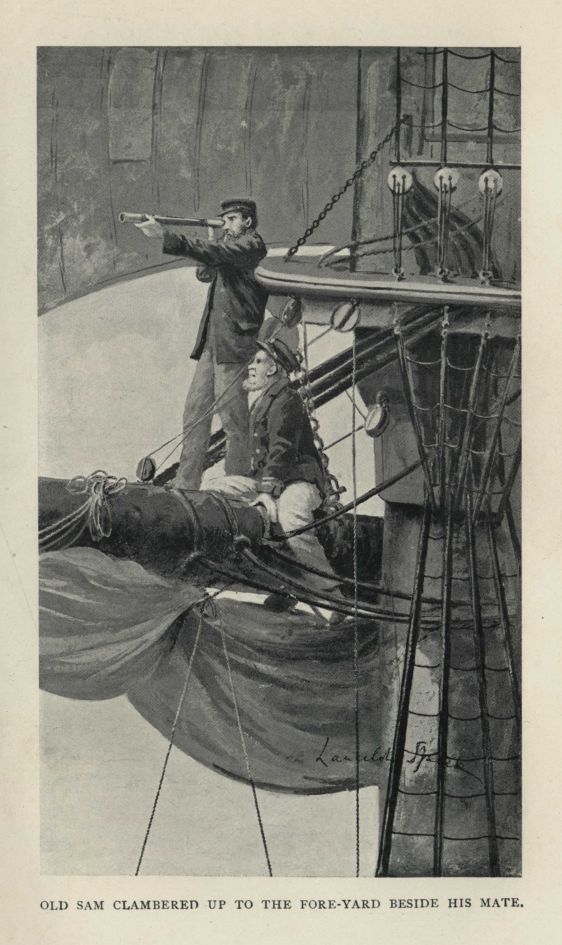
SAM CLAMBERED UP TO THE FORE-YARD BESIDE HIS MATE.
'What is she, Mr. Collier?' he began, and then he gave a gasp of rage, mingled with alarm, as his eye lit upon the stranger.
'May I be shot if it isn't Bully Hayes's brig! I've never seen the Leonie but that's her sure enough for I've heard all about the look of her.'
'Yes, that is the Leonie, sir. I knew her when she was in the China trade, before Captain Hayes stole her. There is no other vessel like her in the South Seas. He means to speak us, at any rate--if he intends no further mischief--and he can sail rings round us, so it is no use our trying to get away from him. What will you do, sir?'
'Fight him,' said the little man energetically, 'fight him like I would any other pirate--for he is a pirate and nothing else.' Then he bawled to the second mate to stand by to wear ship, and in another five seconds was on deck, followed by Collier.
The helm was put hard up, the yards squared, and the old brig put nearly before the wind, which was her best sailing point, and which would give those on board another hour to prepare. Old Sam, though really bursting with excitement, gave his orders quietly and calmly, and then turned to Lieutenant de Caen, who was thoroughly at a loss to understand why the brig's course had been so suddenly altered by the appearance of another ship.
'Mr. de Cann least said is soonest done as it were so with your permission I will call the hands aft and if you do not care to participate in my remarks you are free to do so. All hands aft.'
The crew, headed by Maori Bill, trooped along the main deck and stood in a group in front of the poop, from which the skipper spoke.
'My lads, I'm not running away from that ship, which is commanded by Captain Bully Hayes, an out-an-out pirate. I mean to fight him that's all I have to say and I hope you will not disgrace me and this ship which is on foreign service. Bos'un, cast off the housings and clear the guns for action. Mr. Collier you and the steward pass up the small arms. Mr. Todd you and two hands pass up ammunition for the carronades and if I see any man funking his mother won't know him again. Mr. de Cann you may depend upon me to collorate any suggestions you may make you being as it were my superior in such a case as is now protruded. Stations men and don't disgrace me and Mr. de Cann. Tom you can bring up that flash gun of yours and stand by me here; every little helps and it is a poor heart that never rejoices so cheer up my lad. I will never let you come to harm through a refuted pirate. Mr. de Cann, this ship is to all intents and purposes a French ship as it were and I am willing to obey your orders I am confident that we can smash this fellow but you must let me have my own way and propagation of ideas which is to lie low and let him come close to and then let drive at him with the carronades unless he begins pounding at us beforehand with his two big guns which I believe he carries being stolen property like the ship herself. Why, he is the man who sunk a Portuguese gunboat in the East Indies five years ago. Certainly he only fired one shot at her but it did the trick and she sunk and when the American commodore at Hongkong tried to arrest him he sent him a letter and said it was an accident and that if it wasn't an accident it was a joke.'
The French officer, who could scarcely follow old Sam's rapid utterances, but quite understood that the strange vessel meant mischief, was quickly enlightened by Mr. Collier in a few words.
'Captain Hayes is the most notorious man in the Pacific, and his crew have the reputation of being a band of unmitigated ruffians. That very vessel you now see he carried off out of Singapore five years ago, and since then he had been cruising among the Islands, trading, pearl-shelling, and engaging in native wars. A Portuguese gunboat tried to capture him off Macao--he sunk her with one shot. He has been chased all over the Pacific by English and American cruisers, but never yet caught. At the same time, I do not believe all that is said about him and his savage nature, but he certainly is a dangerous man.'
During the few minutes which had elapsed since the stranger was sighted, the utmost activity had prevailed on board the Lady Alicia. Nearly two-thirds of the eighteen men she carried were determined, resolute fellows, who had stood by their captain in many a fight with the savage natives of the Solomon and New Hebrides Group; and they were well able to work the four carronades, though rifles were more to their liking. The small arms on board consisted of fifty Enfield rifles and cutlasses, and then, in addition to these, were the thirty rifles brought on board by Mr. de Caen. These were breech-loaders, which had only been adopted by the French Navy a year or two before. They were a Swiss invention, heavy and awkward to handle, but yet very effective. These were brought up by the lieutenant's orders, and he at once proceeded to load them, aided by Tom. Meanwhile, old Sam had his carronades loaded in readiness, and the decks of the little vessel presented the appearance of those of an old time ten-gun brig going into action.
The strange vessel was now rapidly overhauling the Lady Alicia, and Tom, as he stood beside the French officer on the poop, could not repress his admiration of the beautiful sight she presented as she rose and sank to the swelling seas--with her snowy white canvas glinting and shining against the sun. For some minutes the little group watched her in silence; then Hawkins, noticing how very quickly she was coming up, turned quietly to the mate.
'Hands to the braces. Mr. Collier, let him come up as quick as he likes, I'm ready for him.'
The yards were braced up, and the brig laid to her former course; the stranger at once followed suit, and as she sailed three feet to the one of the Lazy Alice, she was soon within hailing distance. On decks were a number of naked natives, some of whom were standing on the top-gallant fo'c'sle. Aft, on the quarter deck, a big black-bearded man, dressed in pyjamas, was standing beside the helmsman, smoking a cigar.
The strange ship came sweeping on, then suddenly kept away, so as to pass astern of the Lady Alicia.
As she surged past, the big man walked over to the rail, and drawing one hand carelessly through his flowing beard, he nodded to Captain Hawkins, and said with a laugh--
'Good morning, captain. Will you be so good as to back your main-yard and let me come aboard? But you won't hurt me, will you?'
Before old Sam could frame a reply, the strange brig came to the wind swiftly and noiselessly, a whaleboat which hung on the port quarter was lowered, and pulled over towards the Lady Alicia, the big bearded man steering.
'Back the main-yard, Mr. Collier,' said old Sam, quietly. 'Let him come aboard and see how we look.'
CHAPTER VIII
CAPTAIN BULLY HAYES COMES ON BOARD
The boat drew alongside, and the tall bearded man climbed up the rope ladder hung on the side amidships, and then jumped lightly on the deck, where he was met just inside the gangway by Captain Hawkins, who had descended from the poop.
'How do you do, captain?' said the stranger, affably, extending his hand. 'My name is Hayes;' and then, as his bright blue eye took in the surroundings, and he saw the brig's crew standing by the guns, and a group of armed men on the poop deck, he gave a loud hearty laugh, so genuine and spontaneous that old Sam stared at him in astonishment.
'I asked you not to hurt me, and of course you won't. So you, too, think that poor Bully Hayes is a bloodthirsty pirate! Come, shake hands, my red-faced little fighting-cock. I like you all the better for your pluck. There, that's right;' and seizing the skipper's unwilling hand in his own, he shook it with tremendous vigour; 'but please make your men put away those rifles and cutlasses. I'm such a nervous man, and the sight of any one with a gun in his hand makes me both mad and frightened, so that I can't help knocking him down, just to protect myself.'
'What is it you want on board my ship, Captain Hayes?' said old Sam, pointedly.
'My dear sir, do not look at me in that distant manner,' and he clapped his sun-browned hand on the captain's shoulder, 'it pains me. You've rolling topsails, I see. How do you find them answer? Bonnets trouble you? Mine are perfection. You must come on board and see my ship. Come, now, my dear sir, don't look so angry. I'm not at all a bad fellow, I can assure you, nothing so black as I am painted.'
'Well, you mustn't blame me,' said old Sam, more graciously, 'you've got the name anyway; but I must say you don't look like----'
'Like a cut-throat, Captain----' He paused.
'Hawkins, if you please.'
'Captain Hawkins, I'm glad to meet you. Now, can you sell me a few bags of rice and some casks of molasses for my native passengers? I've a hundred and twenty blackbirds on board, bound for Samoa, and I'm afraid I'll run short of rice.'
'I can do that,' said Hawkins, delighted to find that his visitor had no evil intentions.
'Thank you very much.' Then, going to the side, he hailed his boat's crew and told them to pass up a bag of dollars; and when old Sam asked him below to have a glass of wine, he again laughed in his boyish and apparently unaffected manner. 'Certainly, captain, with pleasure. You have passengers, I see,' he added, indicating Mr. de Caen and Tom, but politely ignoring the pile of rifles lying on top of the skylight.
'Yes,' said the skipper, 'Mr. de Cann, of the French Navy lieutenant of the Cyclope and Mr. Tom Wallis--Captain Hayes.'
The moment the visitor heard the words 'French Navy,' a swift gleam of light passed over his handsome face; but he bowed courteously to the officer, and together the three men went below and seated themselves at the table, whilst the steward placed refreshments before them. In less than ten minutes, so engaging was Hayes's outspoken yet polite manner, that both Hawkins and De Caen were laughing and talking with him as if they had known him for months.
'Where are you bound to, sir?' asked Captain Hawkins, again filling his visitor's glass; 'you have a lot of natives on board. Where are they from?'
'I am bound to Samoa. The natives are from various islands to the northward. I recruited them for the German planters in Samoa. They are a very savage lot, and'--here he smiled--'although I hate to have armed men about a ship's deck, we have to keep our weather eye lifting, or we might lose the ship some day. Now, tell me,' he added pleasantly, 'where are you bound to, Captain Hawkins?'
'To the Solomons and Noo Britain, captain;' and then, with an air of pride which he tried hard to conceal, 'We're under charter to the Governor of Noo Caledonia to make a search for relicks human or otherwise of a French transport loaded with exigencies for the garrison and convicts at Noumea.'
'Ah,' said Hayes, quickly, 'so you're looking for the Marengo?'
De Caen and Hawkins sprang to their feet. 'Yes. Do you know anything about her?'
'Yes, I do,' he answered curtly, with a harsh inflexion in his hitherto modulated tones. 'I can tell you all about her, and where to find the ship's company--on a certain condition.'
'What is it?' said De Caen, with a contemptuous shrug of his shoulder; 'is it a question of money?'
An angry flash came from Hayes's blue eyes. 'Be careful how you speak, or you'll get no information from me. I don't want money for putting you on the right course to rescue your countrymen--though I have little cause to love them--your admiral at Tahiti sent a rotten old gunboat to the Paumotus to chase and harry me from one island to another, when I was a legitimate trader. I could have captured that gunboat on two separate occasions, had I desired it, and made a bonfire of her for her confounded meddling. And now that I have said so much, I might as well tell you both, that if I had wanted to do this old hooker of a brig any harm, and had acted up to the reputation I have of being a pirate, I could have knocked you to pieces in half an hour, although you do carry four carronades--I've something better than those.' Then he added, with a hard laugh, 'Perhaps you would like me to show you.'
There was a brief silence, then De Caen said smoothly--
'I am sorry for my remark, Captain Hayes. I did not wish to offend you. But surely no seaman would try to take advantage of shipwrecked people?'
'I do not wish to do them any harm, but I want to do myself a considerable lot of good; and it rests with you entirely whether I tell you where to find them, or let you go and look for them--and a pretty search you will have, I can assure you.'
De Caen thought a moment. 'Anything that it is in my power to do I will do; but surely you will tell me this first, are the survivors in danger?'
Hayes laughed. 'Ah, that's a clever question, and I should not answer it until you have heard my condition, and have given me your answer. But I shall. They are not in danger, and, furthermore, not a single life was lost when the ship was wrecked. This,' he added slowly, and watching old Sam's and De Caen's faces, 'was told me by Commander Goigoux himself when he boarded my vessel a few weeks ago.'
De Caen's face flushed with pleasure. 'I am pleased indeed. Now, sir, tell me what it is you wish me to do.'
'Steady there, if you please, Mr. de Cann,' interrupted Hawkins, 'before you go making any promises. Now look here Captain Hayes without wishing to cast inflections on your mere verbose statement I would like you to show us some proof that you are not playing us a trick, and that you did see Captain Gee--go. I've heard that you are very fond of a joke, and----'
'That is all right, my little bantam. I----'
'Bantam!--you overgrown turkey-cock!' began the old man furiously, when the French officer placed his hand on his arm, and then looked appealingly at Hayes, who was regarding Hawkins with an amused smile.
'For goodness' sake, Captain Hawkins, do not let us quarrel. Captain Hayes, I am sure, would not act so heartlessly.'
'No, indeed I would not. And there, Captain Hawkins, I meant nothing offensive to you. You're a white man to your backbone. I've heard all about you and this fine vessel of yours years ago, from Captain Bannister, who sailed with you as mate when you were in the blackbirding trade--as I am now.'
The fat little man was mollified in an instant. 'Joe Bannister is a good friend of mine but I was never a "blackbirder"--I got my natives honest square and fair--and if you withdraw "bantam" I regret "turkey" both of which are good birds alive or dead;' and he laughed at his own wit as he held out his hand.
Hayes smiled good-naturedly as he grasped it, and then resumed--
'Now the captain, officers, and crew of the transport would be aboard my ship this moment but for three things. In the first place, I had on board two hundred and twenty natives, which are worth nearly two thousand pounds to me delivered in Samoa; and Captain Goigoux would not guarantee me more than fifteen thousand francs for taking him and his men to Noumea; therefore, as a business matter, I could not accept his offer. In the second place, the Governor of New Caledonia might seize me and my ship for some little differences I had with the admiral at Tahiti. To be perfectly plain, I would have brought the shipwrecked people away, but did not want to risk losing both my ship and my liberty for six hundred pounds. But I told Captain Goigoux that I would try to send him assistance; and if you will give me your promise that you will endeavour to get the Governor of New Caledonia to have the orders for my arrest issued by the Governor of Tahiti cancelled, I will tell you where you can find Captain Goigoux and his ship's company. Have I made myself clear to you? I told him then what I tell you now.'
'I will certainly do all in my power for you with the Governor,' said De Caen; 'for such a service as you propose to render me he will be grateful.'
'I hope so,' said Hayes, quietly. 'I have been hunted from one end of the Pacific to the other for five years. I bought land in the Gambier Group, settled down, and would be a rich man by now if the Governor of Tahiti had not driven me out of the Paumotus, and then outlawed me for acts I was driven to commit through the interference of the greedy priests and the persecution of his deputy-governor. Now, about the Marengo. She went ashore in the straits between New Britain and New Ireland, and broke up very quickly. All the boats but two were smashed in the surf, but the crew all got to shore safely, and a number of stores were saved. From the spot where the ship was lost they made their way to Mioko Harbour, in the Duke of York Island, where you will find them. Half of them are down with fever at one time or another, but otherwise they are safe. They built a cutter from the wreck to carry them to Noumea, but she was accidentally burnt, and when I left they were beginning another; but sickness hinders the work, and the natives have twice attacked them.'
He stopped, and then with a twinkle in his eye, as he looked at old Sam, took a letter from his pyjama jacket and went on.
'And here is a letter addressed to the commander of any French ship of war, the naval officer in charge at Noumea, or the French Consul at Sydney or Melbourne. It was written by Captain Goigoux. No doubt you will open it, Mr. de Caen.'
De Caen took the letter from his hand with an eager exclamation, and at once read it.
'I thank you very much, Captain Hayes. You have made our task easy for us. And the Governor will not forget that Captain Goigoux here writes that you gave him many very necessary articles to aid him in building and fitting out the second vessel he is constructing, and would not accept any payment. For myself I thank you very sincerely.'
'And so do I,' said old Sam; 'and believing in the old axleiom that one good turn deserves another I won't charge you for the rice and molasses no one ever said I don't know how to recipercate in the same way a good or bad action, under any circumstances so put up those dollars captain and your good health.'
They drank together, and then Hayes rose to leave, with the remark that he must not delay, as two of his officers and a dozen of his men were suffering from fever, and that with so many dangerous natives on board he had to exercise great care, only letting fifty on deck at a time, and these were carefully watched.
'I have never been caught napping yet,' he added, 'but I'll be honestly glad when I'm rid of my cargo this time; for they are all recruited from the north end of New Ireland, and are as savage a lot of beggars as ever ate roast man. If they came from various islands they would be safe enough, I could play one lot against the other, if any party of them plotted to take the ship; but all coming from one place, I have had an anxious time, with so many of my men sick.'
'Have you plenty of arms, Captain Hayes?' said the master of the Lady Alicia. 'I can spare you ten or a dozen rifles.'
'Thank you, I have plenty; more than we could use--if we have to use them. My brig, as you may have seen, is flush-decked, which is another disadvantage; but I have a white line painted across the after part, and another just above the fore hatch. Whenever one of them steps over either of these lines, he gets a crack on the head from a belaying pin, to make him remember. So far, we have had no serious trouble. I treat them kindly, and none of my officers or men hit a man unless he is obliged to do so for our common safety.'
Old Sam nodded. 'Ay, ay, once let 'em think you're frightened it's a case of bloodshed and murder. But you'll have to be careful, captain.'
Just as they were leaving the cabin, the mate entered.
'The rice and two casks of molasses are in Captain Hayes's boat, sir; but I don't think it safe to lower the other barrels--she won't stand it in such a lumpy sea. She's too deep as she is.'
The two captains went on deck and looked over the side.
'Drop our own whaleboat into the water, Mr. Collier,' said Hawkins, 'and put the two casks into her. Then take a couple of hands with you and get back as quick as you can.'
Hayes thanked him for his good nature. 'I'm sorry to cause you so much trouble. I would have brought another boat as well, but could not spare the hands. Now, won't you come aboard yourself, and have a look at my cargo?'
Old Sam shook his head, and made his usual remark, about not being able to leave his ship when on Government service.
'Can't I go with Mr. Collier, sir?' put in Tom, quickly; 'I'd give anything to go.'
'Would you, my cockerel? Well, I don't know. What do you think, Captain Hayes?'
Hayes laughed. 'Yes, let him come, captain. He'll see what a "blackbirder" looks like. Come with me in my boat.'
Tom was delighted, and presently slid down the boat falls and waited.
Then Hayes, after giving Hawkins some important particulars about the entrance to Mioko Harbour, bade him and De Caen farewell, with wishes for a speedy voyage, got over the side into his own boat, which shoved off, and followed that of the mate.
'You'll get wet before you get alongside, Captain Hayes!' cried Hawkins, pointing to a rain-squall which was approaching.
The big captain made some jesting reply, and then Hawkins went below to discuss the important news they had learnt with the French officer, leaving Mr. Todd to attend to the ship.
CHAPTER IX
THE FIGHT ON BOARD THE LEONIE
Mr. Collier's boat, being much lighter than that belonging to the Leonie, and manned by Maori Bill and three stalwart natives, soon left the latter some distance astern. The two brigs had now drifted about a mile and a half apart, and presently Hayes, looking at the coming squall, said--
'We'll have to bring to for a while until----' The rest of his words were lost in the hum of the wind and the tropical rain, which descended upon the boat with a noise like the simultaneous falling of thousands of great forest trees; and had not Tom seized a bucket used as a baler, and set vigorously to work, the boat would have filled. For ten minutes Hayes kept her head to wind, then the rain ceased as if by magic, and the sun shone out as brightly as ever.
'It's all over, my lad,' said Hayes, as he swung the boat round again, 'and--oh, the natives have broken loose. Pull, boys, pull for your lives!'
As he spoke, there came the sound of rifle shots from the Leonie, followed by the roar of a heavy gun, answered by yells and savage cries; and Tom saw that the brig was lying all aback, and her after part was crowded with struggling figures.
'Pull, boys, pull!' shouted the captain, as a second gun was fired; 'the mate is firing into them with the two after guns. Ah, bravo!' he added, as a third heavy report came from the Lady Alicia; 'the brig is coming to assist us. Bravo, little man, bravo!'
Tom, who at the first alarm had sprung to double-bank the after oar, took a hurried glance astern, and saw that his own ship was indeed running down with squared yards towards the Leonie. Old Sam had evidently fired one of his carronades, to let Hayes know he was coming.
For the next five minutes no word was spoken, as the dark-skinned seamen panted and bent to their oars, and Hayes, his face now set hard and cruel-looking, kept his eyes on his ship, from which came the continuous crack of small arms.
As the boat swept on, he stooped down, and from the stern locker took out half a dozen broad-bladed tomahawks and six short Snider carbines with belts, and filled cartridge pouches and threw them at his feet. The four native seamen showed their white teeth and grinned savagely.
In another two or three hundred yards they overtook Mr. Collier's boat, which was lying to, waiting for the Lady Alicia.
'I wish I could help you, sir,' shouted the mate quickly, as Hayes passed, 'but we are unarmed. Tom, jump overboard, and I'll pick you up.'
But Tom either could not or would not hear, as he tugged away at his oar, although Mr. Collier continued to shout and gesticulate.
"Stay where you are,' said Hayes; 'you need not come on deck. Now, look out, boys. I'll lay you alongside at the fore-chains. Avast pulling there for a bit, and take these.'
In a few moments each man had buckled on his cartridge pouch, thrust a tomahawk through his belt, loaded his carbine, and placed it in readiness beside him. Then once more they seized their oars, and as they dashed alongside, and the bow oarsman grasped the fore-chains, a chorus of savage yells sounded above, as the body of a white sailor was thrown over the side, to fall into the boat.
'Up you come!' roared Hayes to his boat's crew as, tomahawk in hand, he sprang up the chains and disappeared over the bulwarks, followed by the men, leaving Tom alone in the boat, gazing with horror-struck eyes at the ensanguined form lying across the midship thwart on which it had fallen. The sight was too much for him, though his courage quickly returned.
Seizing the painter, he hurriedly made it fast, then ran aft, picked up the remaining carbine, and with his heart thumping against his ribs clambered up after the others, and jumped down on deck, landing on the top of some dead natives lying between the bulwarks and the for'ard deckhouse.
For a moment or two he was dazed, not only at the sight of the awful carnage the decks presented, but with the din, and smoke, and yells, and curses that filled the air. The fore deck was covered with dead and dying savages, and the main filled with a swaying, surging mass of naked figures, half of whom were pressing towards the after deckhouse, to which the survivors of the crew had been driven, and the others surrounding the giant figure of Hayes and his boat's crew, who were hacking and hewing their way through them with their hatchets; for, after the first few shots, they had been unable to use their carbines again.
Hardly knowing what he was doing, Tom raised his Snider to his shoulder, and sent his first bullet into the packed mass before him. Then quickly jerking out the empty case, he slipped in another cartridge and fired again.
'That's good!' shouted a voice above him; 'jump up here, young feller, quick!'
Loosely coiled on top of the deckhouse was a huge coir hawser, and in the centre of it was the man who had called Tom. He was evidently wounded, for he was in a sitting position. Putting one foot through a port in the deckhouse, Tom clambered up, and took his place beside him.
'Quick! Lie down, and fire into 'em there on the starboard side,' said the wounded man; 'my arm is nearly broken, and I'm no good. Ah! that's it!' he cried, as Tom began firing steadily into a crowd of savages on the starboard side, who were so tightly jammed together that every shot did deadly work. 'Hurrah! the skipper's through into the house, and one man with him. Look out, young feller, they've seen us. I oughtn't to have brought you up here. Jump down again, and over the side, and swim round to the stern. Don't mind me, youngster, I'm done for. Even if I was all right, I can't swim.'
'I'll help you,' panted Tom, putting another cartridge into the breach, 'and the boat is here under the chains.'
In an instant they were on their feet, jumped down, and got over the side into the boat just in time, for half a dozen enemies made a savage rush at them, and one, springing up on the rail, hurled a club at Tom. It struck the barrel of his Snider, and sent it flying out of his hand into the sea.
The sailor, although his right arm was almost useless, and he had received a slashing cut across his ribs, quickly severed the painter with his sheath-knife, and then, pushing the boat off, he put an oar out, and, with Tom's aid, worked the boat round to the stern of the brig.
'The mate and some other sick men are in the cabin; the ports are open, and we can get in, if you heave the painter through, and have it made fast.'
Breathless and excited as he was, Tom, without answering, did as he was told, and as soon as the boat was under the square stern of the brig, he called out--
'Stand by there, and catch this line.'
A man's face appeared at the port, and, as Tom hove the line, he caught it, and then called out--
'All fast.'
Leaving the wounded sailor--who protested that he was quite comfortable--in the boat, Tom, with the aid of the painter, got through the port and into the main cabin, just as Hayes rushed down the companion.
'Where is the steward, Mr. Kelly?' he said to the man who had spoken to Tom, and who was lying on cushions on the transoms.
'Dead, sir;' and Kelly pointed to a prone figure near the cabin table. 'He was one of the first to be cut down when the niggers rushed the after guard. I did what I could for him, but he did not last long.'
Hayes bent down and looked into the face of the dead man.
'Poor Manuel! poor Manuel!' he muttered, and drawing off the tablecloth he spread it over the body. Then, as he turned to speak to his chief officer again, he caught sight of Tom. 'Ah, my boy, I'm glad you are safe. Mr. Kelly, we have beaten the natives back for the present, but they have possession for'ard and below in the 'tween decks. But there are two boats coming from that brig, and I hope we can avoid further bloodshed.'
The mate, a tall, thin American, who was hardly able to stand through weakness, was about to make some reply, when the boats were reported alongside, and then a second later a hoarse cry rang out--