TOM WALLIS (continued 3)
Reading edition
'Fire! The ship is on fire, sir!'
Hayes leapt up the companion way, followed by Tom, and saw, as he gained the deck, that smoke was issuing from the fore part of the main hatch, which was open. And at the same moment, and as the men from the Lady Alicia, headed by old Sam and Collier, sprang on deck, the natives streamed up from below from both fore and main hatchways, and again attempted to get possession of the deck. So sudden was their onslaught that most of the white men, although they shot five or six of the foremost, were driven back aft to the deckhouse, leaving Mr. Collier, Maori Bill, and Tom cut off and surrounded by a score or so of blood-maddened savages, all armed with clubs and tomahawks. Old Sam, a gigantic American negro belonging to the Leonie, and half a dozen of Hawkins's men, made a dash to their aid, and slashed their way through to them with their cutlasses--for they were unable to use their rifles. Tom and Mr. Collier were down, and not knowing whether they were alive or dead, their rescuers picked them up and then fought their way aft again. Then Hayes, with rage and despair in his heart, as he saw the smoke increase in volume, called out to Hawkins to make a stand with his men on each side of and in front of the deckhouse.
'Keep them at bay for another five minutes. I shall show them no mercy now!'
Utterly undaunted by the steady and deadly fire which had been poured into them by the crew of the Lady Alicia and the crew of the Leonie, the natives made the most determined efforts to overwhelm them by sheer force of weight alone. Then Hayes's voice was heard--
'Stand back there!--this will settle the business.'
He and some of the Leonie's crew had loaded the two guns with heavy charges of nuts and bolts, nails, and whatever other bits of iron which could be found in the deckhouse.
The guns were quickly run forward, until their muzzles were almost touching the naked bodies of the savages, and then fired by Hayes and the big negro.
For a moment or two after the bursting roar of their discharge there was silence; and even Hayes, maddened and desperate as he was, could not help shuddering when he saw the awful sight the main deck presented.
Driving all who were left alive of the now cowed and terrified natives down into the fore peak, Hayes and Hawkins turned their attention to the fire, leaving their own wounded to be attended to by Mr. Todd and Lieutenant de Caen, both of whom now appeared with a fresh party of men from the Lady Alicia to assist.
The fire was fortunately confined to the after part of the 'tween decks, and the hands from the Lady Alicia turned to with such hearty good-will that two hoses were soon at work; and a cheer went up when, after ten minutes' vigorous pumping, the smoke rapidly decreased, and a party were able to descend and completely extinguish it.
Then old Sam and Hayes, blackened with smoke and all but exhausted, went aft to the deckhouse. Todd met them with a grave face.
'Mr. Collier is dying, Captain Hawkins, and wishes to see you; and that poor lad is pretty badly hurt too.'
Sitting in the centre of the house, and supported by De Caen, poor Collier was breathing his last, his dark features fast paling with the coming dissolution of soul from body.
Above, in one of the berths, lay Tom, with closed eyes and bandaged head. In all the remaining bunks--six in all--there was either a sick or a wounded man. Tom had received a heavy blow on his forehead, and another on his ribs from a club; the mate had been cut down with a tomahawk.
As Hayes and the captain of the Lady Alicia entered, and Tom heard old Sam's voice, he opened his eyes, and vainly tried to sit up.
'My poor boy, my poor boy!' said the old seaman, stepping over to him, and taking his hand, 'are you badly hurt?'
'Not much, sir; but I got a tremendous crack on the side, that pains terribly,' said Tom in a faint voice. 'Oh, how is poor Mr. Collier, sir?'
Hawkins shook his head sadly. 'Going fast my lad, going fast!' he said, as he turned away from Tom to kneel beside the young mate, who was feebly asking for him.
Tom saw the skipper's old white head bend close to Collier's face, and the two men speaking to each other.
Then a brief pause, and then Collier called out distinctly--
'Tom!'
'Yes, Collier,' replied Tom.
'Good-bye, Tom, my dear lad. I cannot see your face; good-bye.'
He made a faint motion of farewell with his hand, leant his head against old Sam's shoulder, and Tom covered his face, and sobbed under his breath. When he looked again, De Caen and the captain were gone, and the still figure of his friend was lying on the deck with his face covered with old Sam's blue-and-white silk handkerchief. Seven of the Leonie's crew of thirty had been killed, and as many more wounded; and as soon as possible the bodies of the former were brought on the quarter deck and made ready for burial, together with that of the first mate of the Lady Alicia.
For some little time, as the two brigs sailed along within a few cable lengths of each other, Hayes and the master of the Lady Alicia paced the quarter deck and talked of the fight. The old man was deeply distressed at the death of Collier, and Hayes, worried as he was with his own troubles, was touched at the spectacle of his grief.
'I am sorry, for your sake, that we ever sighted each other, Captain Hawkins,' he said; 'more than that I cannot say. I do not want to speak of my own losses; but I do want you to believe me--I am sorry, very sorry.'
Old Sam drew his hand across his eyes. 'It cannot be helped,' he answered huskily, 'and I only did for you what was my duty as a man, and what I believe you would have done for me if I stood in the same danger; but I would rather have lost my ship and all I have in the world than that poor young fellow. A better seaman never trod a deck, and a better, cleaner livin' man never drew breath, an' he's gone with a clean sheet too.'
Hayes nodded, and smoked on in silence for another half a dozen turns, then said--
'About that poor boy, Captain Hawkins. His back is badly hurt, and if you take him away with you, the chances are that he will die of fever when you get to New Britain. This is the rainy season, and that some of your ship's company will be laid up with fever is a dead certainty. He will never recover from even a slight attack.'
Old Sam groaned. 'Poor lad! what can I do? Believe me, sir, I'd as lief die myself as see him go. It would just about finish me if I had to write to his father and----'
'Leave him with me,' said Hayes, quickly. 'I pledge you my honour as a man to take good care of him. With this westerly weather we shall make a quick run to Samoa. If he is not better by the time we get to Apia, there are two good doctors there. And from Samoa he will soon get a chance to return to Australia. I will pay his passage. If you take him with you, you are risking his chances of recovery, strong as is his constitution. Mr. de Caen,' turning to the Frenchman, who had joined them, 'do you not think so?'
De Caen did think so, and so it was decided that Tom should remain on board the Leonie, and old Sam and De Caen went to bid him farewell.
'Tom my hearty,' said the skipper, after he had explained to the lad the reasons for his decision, 'you have to get well without any prevarication and go home to your father and brother and tell them that old Sam Hawkins isn't a bad old shellback with all his delimits and sincrasses as it were and that he knows his duty and proper evolutions, and you'll have Maori Bill with you to remind you of me and the old Lady A--for Mr. de Cann is a gentleman and is going to do mate's duty in place of poor Mr. Collier and I've given Captain Hayes the loan of Maori Bill and I want you Tom to never disremember that if you never see old Sam Hawkins again, that his last words were always do the straight thing and keep clear of drinkin' and swearin' and dirty conduct and do your duty and give my honoured requests to your father and eat all you can, the more vittels you stow away under the bunt when you have broken bones the more they get settled up as it were and inform their natural functions on the germinus through which the pores circulate. Good-bye my boy, and God bless you and never say die under any exemplifications no matter where or how rigidous.' And the kind-hearted old sailor wrung Tom's hand so warmly that even had not the lad's overwrought feelings at parting with him brought the tears to his eyes, the energy of the farewell would have done so. Then De Caen came and bade him good-bye in his effusive French fashion, much to Tom's discomfiture--for what lad with British blood in his veins likes being kissed by a man?--and promised to write to him from Noumea. Late in the afternoon both brigs hove to. Mr. Collier's body was placed in one of the boats from the Lady Alicia, and Hayes once again bade Hawkins and De Caen good-bye.
Maori Bill, whose own chest, with Tom's effects, had been sent on board the Leonie, shook hands with his captain and Mr. de Caen in silence, and then quietly walking through the men assembled on the main deck, descended to the boat in which the body of the mate was laid, lifted the rug which covered it, and pressed his face to the dead man's hand, and uttered a short tagi, or cry of mourning. Then returning to the deck, he stood awaiting the orders of his new captain.
As the two boats pulled quickly away towards the Lady Alicia, Hayes waved his hand to De Caen and Hawkins, and then beckoned to Maori Bill.
'Bill, come here. I want you to do the second mate's duty. He will take Mr. Kelly's place. I know that you are a good man, and will stand no nonsense. Stand by me, and I will stand by you. Call the hands aft.'
The crew trooped aft silently, and Hayes said, curtly--
'Men, this man here is the second mate now, instead of Mr. Harvey, who will take Mr. Kelly's place until Mr. Kelly is able for duty again. Remember that he is an officer now, and "Mr. Chester."'
Then, turning to a coloured man who was now doing duty as steward, 'Serve out some grog.'
Grog was served out liberally to the hands as they stood, and then Hayes brought the brig up a couple of points, so as to increase her speed. The breeze had now freshened, and for an hour or so the two vessels kept the same course.
As the sun began to dip into the western sea-rim, Hayes hove-to and hoisted the American colours half-mast. The Lady Alicia also brought to, and half-masted both British and French colours.
Standing in the waist with bared heads, Hayes and most of the crew waited till the bodies of the seven murdered men were brought from aft, and laid side by side on the deck. Then, as he said in low but distinct tones the words, 'We therefore commit these bodies to the deep, to be turned into corruption,' the canvas-shrouded forms were launched overboard in succession as quickly as possible.
Scarcely had the last body plunged towards its resting-place two thousand fathoms deep, when Hayes called out in a harsh voice--
'Turn to again, Mr. Harvey. East by south is the course. Steward, serve out some more grog to the men. Mr. Harvey, lower the colours, and then run them up again and dip to the Lady Alicia.'
He strode aft again, and Tom, lying and listening in his bunk in the deckhouse, heard him suddenly burst out into an awful torrent of blasphemy, cursing his ill-luck: his officers, who 'could let a lot of naked niggers take charge of the ship, and kill seven men who were as good and better men than any one of them,' and the crew themselves for being such a lazy, useless lot of loafers and dead-beats, who deserved to have their throats cut. And, he added savagely, he would show them what he thought of such a lot of crawling, useless 'soldiers,' who were not fit to be left in charge of a canal boat tied up to a horse's tail.
He ceased as suddenly as he began, and then coming to the door of the deckhouse, peered in and spoke to the fever-stricken and wounded men in such suave and kindly tones, that Tom could scarcely believe the evidence of his own senses.
'And how are you, my boy?' he said, coming over to him, and placing his hand on his knees with almost fatherly kindness. 'Do you think you can bear moving? I want to have you down in the cabin, where you will be more comfortable than in this house. You can lie on one of the transom lockers, where you will get plenty of air through the stern ports. The mate will be near you, and you and he will have to make a race to see who gets on his pins first.'
Tom smiled. 'Just as you please, sir; but I don't want to give too much trouble.'
Hayes nodded. 'That's all right. You're to be the leading invalid on board the Leonie, and all hands and the cook are to stand by and wait on you.' Stepping outside, he called out--
'Send a couple of hands here, Mr. Harvey, to carry Mr. Wallis below; and tell Charlie to come here.'
'Charlie' was the sailor with the injured arm, who, as soon as Tom was lifted out of his bunk, appeared with his arm in a sling, contentedly smoking a pipe.
'How are you, Charlie?' said Hayes.
'Right as rain, sir. I guess you've made a good job of it, sir,' indicating his arm. 'Hallo, young feller, how are you? Here, shake;' and he put out his left hand to Tom; 'my right arm is parcelled up like a half dollar roll of preserved Tahiti bananas. Young feller, I reckon thet you hev the makin's of a general in you. If it hadn't been for him, captain, I wouldn't be here now. He's grit to the backbone.'
Tom was lifted up carefully by two of the crew, and carried below to a comfortable, amply cushioned lounge on the transoms, where he was greeted by the sick mate, whose legs were so enormously swollen from the effects of fever and quinine that he was unable to stand. Otherwise he was perfectly sound, and in full possession of a truly remarkable fund of vituperative expressions, some of which, when he heard Tom let an expression of pain escape him, he hurled at the two men who brought him down. Neither of them, he asserted with many unnecessary oaths, had the strength to lift a sitting hen off her nest, nor the will to pull their mothers out of a fire; also that as soon as he 'got around' again he would haze their worthless lives out of their useless carcases for their clumsiness, and derive unalloyed pleasure from seeing them go over the side feet first with a round shot at their heels.
The men, both of whom were Chilenos, grinned and made no reply. They were used to him, for, ruffian and brute as he was to them occasionally, they yet had a liking for him, born out of their constant association with him in the face of danger and death. And Tom, though the man's language and merciless severity shocked and horrified him, later on learned to respect the many good traits in his character, chief of which were his unswerving devotion and loyalty to Hayes, his iron resolution and dauntless courage, and his restless, untiring energy and watchfulness in all that concerned his duty and care of the ship. Then, too, he had a sense of humour, grim enough, perhaps inborn, perhaps unconsciously acquired from Hayes, who, in his bursts of temper, would kick an offending seaman all round the deck, down the companion-way, and bawl out 'Arnica!' to the steward simultaneously.
Unable to sleep from the pain he suffered, Tom was rather glad than otherwise that the mate, from the same cause, was rather restless, and disposed to be very communicative. The night was brilliantly clear and bright from the light of myriad stars; and from the widely opened stern ports he and Tom, who were lying near each other, watched the bubble and boil of the phosphorescent water in the brig's wake as it went hissing astern. Mr. Kelly, in expectation of one of his frequent attacks of ague, was heavily wrapped up in blankets and rugs, so that only his face was visible.
'We have the breeze set steady now, I believe,' he said, 'and ought to sight Vanikoro in a couple of days. Were you a passenger on that brig?'
Tom gave him the history of his adventures, to which the American listened with great interest, and in return he gave Tom an account of the origin of the attempt to capture the Leonie by the natives.
When Hayes left to board the Lady Alicia the brig was in charge of the second mate, who had with him the carpenter and boatswain, the latter being stationed for'ard to watch the natives--about forty--who were on deck at the time. The chief mate himself, the third officer, and two boys who were suffering severely from fever, were lying down in the main cabin, and in the after deckhouse were two or three other sick men, and two more were lying on mats under the topgallant fo'c'sle, being attended to by Manuel, the half-caste Portuguese steward. On the topgallant fo'c'sle were two white seamen armed with rifles and cutlasses; another stood guard over the main hatchway, keeping watch upon the remaining hundred and eighty savages in their quarters in the 'tween decks, and two other men armed with cutlasses only were stationed one on each side of the deckhouse aft. Between the deckhouse and the bulwarks were two brass guns (heavily charged with slugs and bullets), but these had their housings on, on account of the rain-squalls, and were not instantly available at the moment they were wanted. The rest of the crew, who were not armed, but whose rifles and cutlasses were handy for use in the for'ard deckhouse, or in their own bunks, were dispersed about the decks, engaged in various work, utterly unsuspicious of any danger.
Suddenly, and in the midst of a heavy, drenching rain-squall, the forty natives on deck sprang upon the crew, killed the two sentries up for'ard and the one at the main hatch, and were instantly joined by many others from below, the poor seaman on guard there being cut down as he was attempting to unhook the ladder and drop it below. A third party, who had cut a hole through the forward bulkhead, made their way on deck through the fore-scuttle, and armed with tomahawks and clubs united with their fellows, and made a determined rush aft, driving before them most of the unarmed seamen. Fortunately, the men who were on sentry in the alley-ways beside the house made good use of their Sniders, and so gave their comrades time to obtain arms from both the deckhouse and main cabin. Then it was that the second mate succeeded in firing the two guns. The discharge from the first cut a lane through the swarming savages on the port side; the second, through being badly pointed in the mad confusion, did but little damage.
'Then,' added the mate,' you fellows came along; an' I guess I felt pleased. I couldn't get up to take part in the proceedin's myself--had to stay down here and load rifles and pass 'em up on deck. Anyway it's been a mighty bad business all round.... Seven of our men gone, one of yours, and ninety valooable----'
'Don't,' said Tom shudderingly, covering his face with his hands; 'don't say any more--it was too horrible.'
The American desisted at once, when he saw how even the memory of the dreadful scenes affected the lad's mind.
The morning of the third day broke bright and glorious. Overhead a vault of cloudless blue, beneath, the gently heaving bosom of a sea shimmering and glinting and sparkling in the clear, warm sunshine, with here and there groups of white birds floating lazily upon its surface; five miles astern the high, wooded peaks of Vanikoro Island were fast changing their purple loom to a vivid green, as the wind dispelled the mountain mists of the past night.
With every stitch of her snowy canvas swelling to the sweet, cool breeze, the Leonie was cutting her way through the water at six knots, almost without noise. Aft, pacing the quarter deck on the weather side, Hayes, dressed as usual in linen pyjamas, and smoking his first cigar, was waiting for his coffee, and casting a look, now at the island abeam, and now aloft; then as his eye fell upon the end of the for'ard deckhouse, which faced the main hatch coamings, and he noticed anew its wrecked and shattered condition, caused by the fire of the guns, his features underwent such a sudden and ferocious change, that Maori Bill, whose watch it was on deck, turned his head away, and pretended not to notice. In a moment or two, however, the captain resumed his walk, but there played about his lips such a vicious, savage smile, that those who knew him, and had chanced to see it, would have known that there was mischief afloat.
Presently up came Tom from below, walking somewhat stiffly, and carrying two books in his hand.
'Well, Wallis, my boy, how are you this morning? Ready for your coffee, eh? What's that you have?--ah, La Pérouse's Voyage autour du Monde. Who gave you that? Can you read French?'
'Not very well, sir. Mr. de Caen gave me both La Pérouse's Voyage and this one, The Fate of La Pérouse, which is by Captain Dillon, and I am now reading about his discovery of the relics of the Boussole and Astrolabe, La Pérouse's ships, on Vanikoro in 1828.'
'Ha, I must read that. There's Vanikoro, my boy, over there, and that's where Jean François Galaup, Comte de la Pérouse, perished with every other living soul on board the two ships.'
Then, for the next twenty minutes, as he drank his coffee, he talked; now mentioning some wild adventure in the China seas, now sneering at Englishmen and their 'dull pig-headedness,' and then suddenly flying off at a tangent, and saying--
'Did you ever read that piece about Deering Woods by Longfellow? I know Deering Woods well, although I come from Cleveland City, on the Great Lakes. The smell of those woods is in my nostrils now, even after fifteen years.'
Presently the boatswain came aft, and said, 'There is a big nigger sulking, sir. He won't eat. Says he's sick.'
Hayes scowled. 'Shamming, I suppose?'
'Of course he is. He is the fellow who killed Manuel.'
'Ah!'--and the savage fury of the captain's voice made the blood in Tom's veins run cold--'that is that big buck who has been at the bottom of the mischief all along. Rout the whole lot of them up on deck; I'll give him some medicine anyway.'
Followed by two or three seamen, the boatswain descended to the 'tween decks, and in a few minutes the black 'cargo' of the Leonie was standing on the main deck. Out of the hundred and thirty who were left, many were wounded, either by bullet or cutlass; a dozen or so women, equally as savage and repulsive-looking as the men, grouped themselves together, and stared sullenly at the captain. Four of the men were handcuffed--these had been especially prominent in the outbreak, among them was the man whom the boatswain had reported as being sick. He was of herculean stature, and the natural ferocity of his aspect was heightened by his hideous red lips and black teeth, the result of chewing betelnut.
'Range them on both sides of the main hatch, Mr. Harvey,' said Hayes, producing a pocket-book, 'and tell every man that as I call his name he must step out and come aft.'
Then he began to call out the names, slowly and quietly. When no response was made, Harvey called out, 'Dead,' and he drew his pencil through the name.
When the last name on the list had been called, and the natives were grouped together aft, Hayes looked at them with a lowering brow. Then he motioned to Harvey.
'Come here, Harvey.'
Harvey stepped over to the captain, and for a few minutes the two conversed in low tones, the crew meanwhile, with loaded rifles, keeping a close watch upon the natives.
Then Harvey (the only man on board who could speak the New Ireland language) at Hayes's behest spoke to the sullen savages.
'The captain says this. He is stronger than you. You tried to kill us all. Now ninety of you have gone into the bellies of the sharks. Now, tell him who among you was the leader?'
There was no answer.
Hayes's face paled with anger. 'Tell them that I will take every one of them, one after another, and flog them until I am told who it was hatched the plot.'
Harvey repeated his words, but without effect.
'Take that fellow first,' said the captain, pointing to the native nearest to him, 'trice him up, and flog him until he speaks.'
Shuddering and sick at heart, Tom saw the man--a strong, well-built savage with a mop of hair twisted into hundreds of greasy curls--seized for punishment, and a sigh of relief escaped his lips when at the third or fourth lash he called out that he would tell.
Dewarrian, he said, was the man who had planned the attack. Dewarrian had killed many white men before, and so they listened to him.
Dewarrian, a big native, was brought before the captain by two seamen; Mr. Harvey stood with them to interpret.
'Dewarrian,' said Hayes, quietly, 'you ought to die. But there are too many blood-stains on this deck. So I will spare your life. Trice him up and give him six dozen. Then let the hands get breakfast.'
'Oh, captain, don't, please don't!' cried Tom. 'Can't you give him some other punishment? Do, I beg of you, let him off any further flogging.'
The passionate tone of entreaty that rang in his voice had its effect; and Hayes considered a moment.
'Very well, Tom, I'll let him off. Put him in irons again, Mr. Harvey, and send him below. I guess he's scared enough as it is.'
At breakfast Tom did not join the captain, who sat alone at the table, apparently not caring for the society of any one. During the rest of the day he scarcely spoke, even to his officers, though Mr. Kelly came and reported himself as fit for duty again. A curt nod was the only recognition he received.
Then followed days of weariness and vexation to all, for the wind failed, and a long calm ensued, and the captain gave way to such mad bursts of rage, that Tom began to sicken of the Leonie and her strange master. One night he spoke to Maori Bill on the matter.
'So am I sick of it,' said the seaman. 'I've sailed in a good many rough ships in my time, Tom; but this brig is the worst of any, and Hayes is more of a devil than a man. Look how he treats his men!--sometimes so nice and soft to them that you'd think butter wouldn't melt in his mouth, and the next minute he knocks a man down senseless. And the curse of God is on this labour trade, for, although Hayes treats these savages pretty well, he only does so because he wants to land them in prime condition in Samoa. It's slavery, Tom, that's what it is, and nothing else. These poor beggars think that they are only going to Samoa to work on the German plantations for three years--they'll be lucky if they see their own country again in seven.'
'How cruel! But can nothing be done for them? Will not the Samoan Government protect them?'
'There's no government there worth speaking of--only the three consuls: German, Yankee, and English, who help the native king to pay the police, that's all.[#] And the big German planting firms can do just as they please in Samoa; they pretty well rule the country.'
[#] This was the actual condition of affairs in Samoa at the time.
'Don't the missionaries interfere?'
'No, sir. How could they? Samoa is a no-man's land, and if an English missionary were to try to get in on to one of the big plantations, just to see how the natives were being treated, he'd get into a lot of trouble. His own Consul would round on him and threaten him with all sorts of penalties, and half a dozen of the British storekeepers in Africa would write a letter to the Governor of New South Wales saying that the missionaries were again inciting the imported natives to rebel against their masters, and bring about bloodshed. It's just this way, Tom: the planters in Samoa say they cannot carry on unless they have coloured labour from the other islands, and the storekeepers say the same, and the two together work dead against the missionaries. They do the same thing in Fiji. The cotton planter, and the sugar planter, and the big storekeeper all work together to keep the labour trade, as they call it, going; but I call it slavery. The missionaries and a few other white men want to see it swept away, and swept away it ought to be. But we mustn't stand talking here any longer. This is a dangerous ship, and we must be careful. Good night, sir.'
CHAPTER X
TOM AND MAORI BILL GO ON A BOAT VOYAGE
In the tenth day after sighting and dropping Vanikoro, and when the beautiful islands of Fotuna and Alofi, two of the gems of the Pacific, were plainly visible from the deck, Hayes came up from below in unusually good temper.
'Mr. Kelly, I'm going to run into Singavi Harbour on Fotuna to buy yams--a hundred tons, if I can get them. They will bring a thumping price in Samoa, and we can get them for almost nothing here, and clear over five thousand dollars.'
'Reckon thet will help you pull up some over them dead niggers.'
Hayes smiled pleasantly. 'Yes, it will about bring things even. Keep her head for that high peak on Fotuna. We'll be there early enough to start the natives digging this afternoon. Tom, you'll see some rare old trading now. Come and lend me a hand in the trade-room.'
The trade-room of the Leonie was on the port side of the main cabin; three of the state-rooms had been made into one, and shelves fitted all round. On the upper of these such articles as prints and calicoes were stored; the lower ones being filled with old-fashioned muskets, axes, tomahawks, 16-inch butcher-knives, pistols, and vast numbers of discarded short Enfield rifles with bayonets attached. On the deck were eight or ten huge tierces of negrohead tobacco, cases of gin, and kegs and boxes of powder.
Hayes, with Tom and a couple of the hands, were soon hard at work on a couple of tierces of tobacco, digging out the compact layers of the black, fragrant weed, pulling each stick apart, tying them up in bundles of ten, and passing them on deck, where they were placed in trade boxes. Then followed powder and bullets, caps, knives, bales of Turkey red twill and navy blue calico.
Hayes was in such an excellent humour that the work proceeded very pleasantly, and he talked with almost boyish exuberancy to Tom about the island of Fotuna and the natives. They were, he said, rather a saucy lot, and as he did not want to have his decks filled with three or four hundred of them, and run the risk of a fight occurring between them and his cargo of 'blackbirds,' he would do all the trading on shore, weigh the yams on the beach, and send them off in the boats to the ship.
'They are not a bad lot of people,' he added, 'although they are all good Catholics--that is, every man, woman, and child of them have crucifixes hanging round their necks--and all are born thieves. However, they know their mark, and won't try to rob me.'
Soon after dinner the Leonie sailed into a tiny little harbour under the shadow of Mount Schouten, and anchored within a few yards of the beach, and directly in front of the largest village on the island. Taking Tom with him, the captain at once went on shore, and interviewed the leading chief and the one white trader--an old white-headed Englishman, whom Tom learnt afterwards was an escaped convict. A bargain was soon made, as yams were very plentiful, no trading ship had touched at the island for many months, and the natives were eager to sell. The chief showed Hayes some specimens of the yam crop--three enormous vegetables, each of which weighed sixty or seventy pounds. Then a conch-shell was sounded, and the chief and his head men summoned the people together, and ordered them to begin digging the yams at once.
Promising to bring the trade ashore at daylight, and begin weighing the yams, Hayes, accompanied by the chief and the old trader--who seemed a respectable, quiet-mannered man--returned to the ship, leaving Tom to enjoy a few hours' pigeon-shooting along the sides of the forest-clad mountain.
The birds were uttering their deep crooing notes everywhere around him, as they fed upon the scarlet berries of the lofty maso'i trees, and the native lad who came with Tom as guide soon had eight or nine brace of the fat, heavy birds to carry. Returning by the banks of a noisy mountain stream, Tom threw himself down beside a deep crystal pool to rest, whilst the lithe, bronze-skinned native, whose only garment was a girdle of grass, ascended a coco-nut tree for some young drinking nuts. The largest of these he quickly husked with his sharp white teeth, and handed it to Tom to drink. As he drank he heard a footstep near, and looking up he saw standing beside him a man dressed in the habit of a priest. He saluted Tom politely, told him that he was Père Serge, one of the two priests living on the island, made a few inquiries about the Leonie, frowned expressively when he heard the name of Captain Hayes, but then said, cordially enough, that he would be pleased if Tom would visit him.
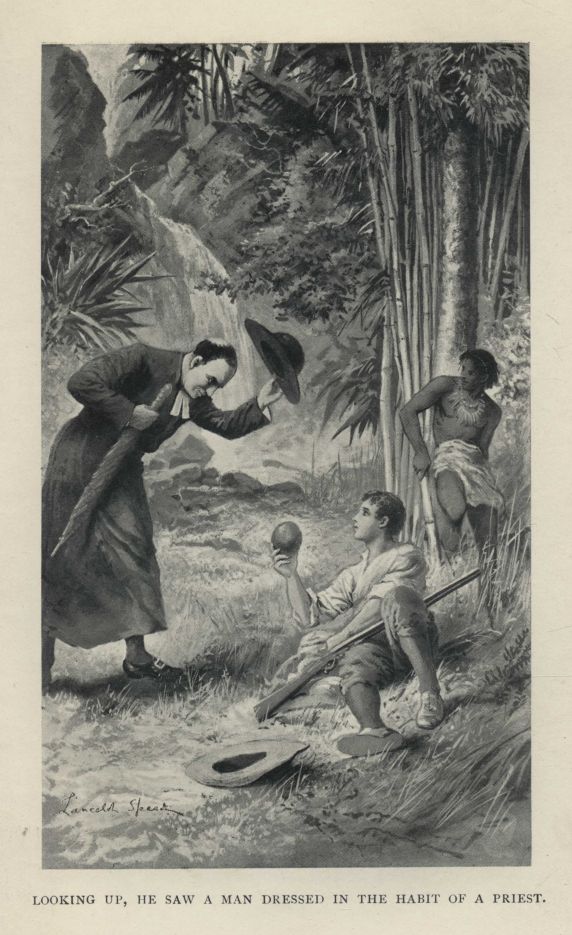
LOOKING UP, HE SAW A MAN DRESSED IN THE HABIT OF A PRIEST.
'Thank you,' said Tom, 'I shall be very pleased to come to-morrow, if the captain does not want me on board.'
'But you surely are not a sailor, and an officer; no, you cannot be, you are too young?' inquired the priest in his clear English.
'I am a passenger, sir.'
The père held up his hands. 'A passenger with such a captain, and on such a ship! Ah! my poor sir, you have fallen into bad hands, I fear;' and then noticing the sudden flush on Tom's cheeks, he added hurriedly, 'But never mind Captain Hayes. I shall be glad if you will come to me. And at my mission, two miles from here, there are many more pigeons than there are at Singavi, and the waters of this little river here are full of very nice fish. You shall fish and shoot, and tell me of your travels;' and he smiled as he held out his hand. 'You will not forget to come?'
As soon as Tom returned on board he found the captain, the old trader, and Mr. Kelly all seated together on the quarter deck, drinking, smoking, and chatting. He was pleased to see that nearly every one of the 'blackbirds' were also on deck, devouring with great gusto baked pork, fish, taro, and yams, which Hayes had bought for them from the Singavi natives. Great piles of young coco-nuts were everywhere lying about the deck, mingled with bunches of bananas, pineapples, and baskets of sun-dried oranges--the latter being left untouched, as the 'blackbirds,' never having seen an orange before, would not eat them. They were all talking, and shouting, and eating at such a rate that Tom was astonished; and his astonishment was increased when he noticed that none of the brig's crew were armed, and that the usual guard were up for'ard, smoking and playing cards.
As he was washing his hands in the cabin, Mr. Harvey, a young, hard-faced, silent man of about thirty, with whom Tom seldom exchanged a word, came below and sat down and began filling his pipe.
'What do you think of the happy-family party on deck, Mr. Wallis? I mean the woolly-haired, black-toothed crowd.'
'Don't they seem jolly, Mr. Harvey? And they have the run of the deck, too.'
Harvey laughed in his quiet way. 'They're all right. Did you notice those two big iron pots with fires lit under them, on shore, just outside the trader's house?'
'Yes, I did. Whaler's try-pots, aren't they? What is boiling in them?'
Harvey nodded. 'Only water. They belonged to the Comboy, a New Bedford whaleship, which went ashore here a good many years ago--before you were born. Well, about an hour ago the skipper called our "blackbirds" together, and solemnly told them that the pots are used by the Fotuna natives to cook strangers in, and that fires had been lighted under them in the hope that Hayes would sell a few of his passengers every day to make a feast. It just scared the life out of them, especially as an old French priest happened to pass along the beach at that time, followed by a lot of converts dressed in white sulus; Hayes pointed him out to them, and said he was the principal "devil doctor" who, with his gang of meat carvers, had come down to the beach to see if there was any meat ready.'
Tom laughed. 'It's funny; but do the "blackbirds" believe it?'
'Rather. And as long as we are at this island we shall have no trouble with our cargo of niggers. They think that they would be killed, cut up, put into those pots, and eaten by the Fotuna natives in a brace of shakes, if Hayes gets mad with them. Oh, it's a mighty smart trick, and saves the hands a lot of trouble.'
'But don't you think, Mr. Harvey, that it is rather a mean sort of trick? The Catholic priests here have done a lot of good to the natives, and redeemed them from their savage customs, have they not? Mr. Collier said that of them.'
Harvey laughed scornfully. 'I'm a "holy Roman," lad--born and bred--but I've sailed the South Seas for twenty years, and I know as much about missionaries as any man, and I tell you this--these French priests here have done a lot of good, in many ways; and yet these Fotuna natives are taught to believe that all white men who are not Roman Catholics will be damned.'
'Are you sure, Mr. Harvey?'
'Sure!'--and the stern-faced young officer dashed his clenched hand down upon the cabin table--'sure! My boy, you will learn a lot before you get back to your home again in Australia. Wait till we get to Samoa, and there you will see what the Protestant missionaries have done, and what the French priests have done, and you can size up the work of both alongside, and draw your own conclusions. I am, as I said just now, a Roman Catholic, but I know a lot about the way in which the French priests "Christianize" the natives of these islands, and I despise many of their ways. They have come to the South Seas under the protection of the British flag, in British ships, following in the wake of English missionaries who have done all the hard graft, and then they teach their converts to hate and despise everything that is English and Protestant--from the pennant of an admiral to the jibsheet-block of a British trading schooner.'
'Poor Mr. Collier told me that the French missionaries, although they cause a great deal of trouble, are very good men, Mr. Harvey.'
'Good men! Ay. Guess they're good enough in some ways. They build their own churches and live like the Kanakas themselves, and I allow they don't go in for making dollars. But they poison the native mind against everything that is British or American. Why, three years ago, when I was in Wallis Island, I went ashore to church, and the priest there gave me a bundle of school primers printed in Samoan, and asked me to spread 'em around amongst the natives in the Tokelau Group, on account of the pictures.'
'Pictures?'
'Ay, pictures--pictures that would just grip the fancy of nine out of every ten Kanakas; pictures showing how the cruel and wicked lotu Peretania (Protestant faith) was sending people to hell; pictures showing an English missionary chasing a native woman--with thundering lies printed at the foot; pictures showing Jesus Christ and the Virgin Mary dressed in store clothes.'[#]
[#] Note by the author.--This school primer of which Harvey speaks was actually circulated in the South Seas by the Roman Catholic missionaries. It was printed in Marseilles, but other editions were issued from Sydney in 1866 or 1867.
'Oh, stop, Mr. Harvey, stop! Don't speak like that! Don't laugh so mockingly when you name our Saviour!'
'Mockingly, Tom? No! I'm a rough sailor, and a fit man to be an officer for such a hell afloat as the brig Leonie. I'm as bad as any man can be morally, but I am no mocker of sacred things.'
'I did not mean to hurt or offend you, Mr. Harvey. And I know that you are neither a brute nor a bully.'
The second mate placed his hand on Tom's shoulder.
'I'm glad to hear you say that, Tom, and I wish it was true. But I was brought up in a rough school--in the fo'c'sle of a New Bedford whaler--and I guess I've been getting more and more of a brute and a basher every day of my life. My father was an Irishman and a Roman Catholic, but didn't care a cuss for the priest; my mother was not only an Irishwoman and a holy Roman, but a bigoted one as well, and taught me from the very first to hate and despise the Protestants; and I hated and despised them profusely until I went to sea in the whaler, and found out that a Protestant was just as good a sailor-man as any holy Roman. But I was going to tell you about those pictures.'
He laughed again, and his usually gloomy face was so lit up, that Tom could not help smiling in anticipation.
'These good, gentle priests,' continued Harvey, 'hate Englishmen and Americans like poison; they cause more bloodshed and misery by their lies---- There, that's all. I'm off on deck for a smoke before supper.'
Just after supper was over Maori Bill suggested to Tom that they should ask the captain to let them have one of the whaleboats, and go fishing out in the deep water of the harbour. Tom at once went to Hayes, who was pacing the main deck, talking to the old trader.
'Certainly,' he answered. 'I'd come with you myself, but Ned and I are talking about business. Take a couple of hands with you, and bring back a load of fish. You'll get some hundred-pounder groper, and red rock-cod here. Oh, Bill is going with you, is he? Tell him I want to see him for a minute or two first.'
In a few minutes Tom had his fishing-gear ready; the boat with two hands was brought alongside, and Maori Bill, carrying a basket of young coco-nuts in his hand, came up to the captain.
'Mr. Wallis told me you wanted to speak to me, sir.'
'Yes, Bill, I do. It is only'--and here Hayes spoke in his sauvest tones--'it is only to say that you have done your duty as second mate to my satisfaction. But as Mr. Kelly is now well again, and I have no need for you on board, I am going to leave you here as a trader in place of old Ned, who wants to make a trip to Samoa.'
The big half-caste placed his basket on the deck, and looked at Hayes steadily.
'I don't want a trader's berth, Captain Hayes. I came aboard here to look after young Mr. Wallis, and do second mate's duty, until Mr. Kelly was better. That was the agreement you made with Captain Hawkins.'
Hayes's face flushed deeply. 'Man! do you know who you are talking to?'
'Yes, sir, to you. And I'm willing to go for'ard and do my duty as a seaman if you ask me, but I'm not going to take a trader's berth ashore to please you or anybody else. My father was a white man--as good as you. I mean no disrespect to you, sir. But I'm not a Chileno or a Dutchman, and won't be hazed by any man on God's earth!'
For a moment or so Hayes regarded the half-caste steadily, then he said quietly--
'You're a bit of a fighting man, aren't you?'
'Yes, sir. But that has nothing to do with my going ashore here.'
'Put up your hands, you half-bred nigger!' and Hayes strode up to Maori Bill with blazing eyes. 'I'll pound the life out of you in two minutes!'
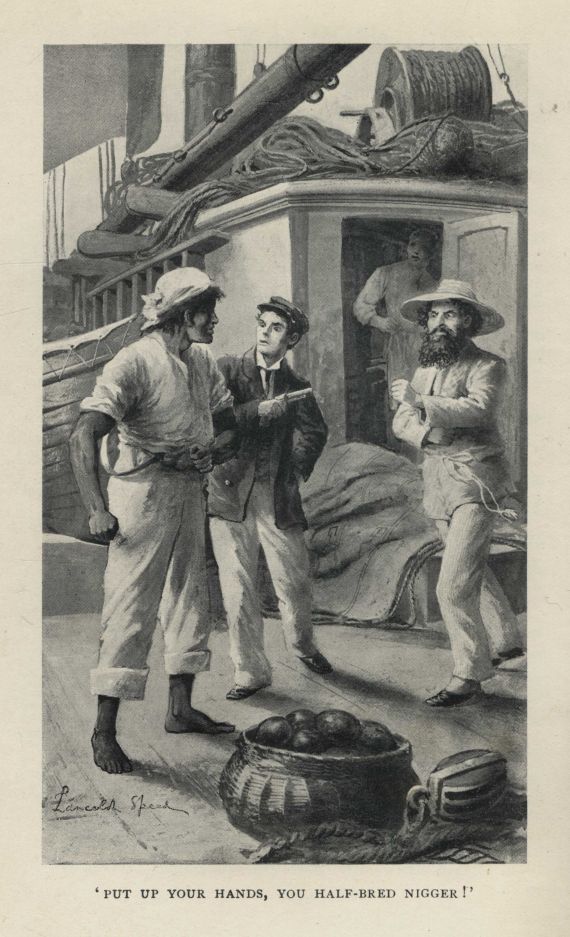
'PUT UP YOUR HANDS, YOU HALF-BRED NIGGER!'
'No, you won't, captain!' and Kelly, the chief mate, sprang in front of him, and put the muzzle of a Colt's revolver against Maori Bill's chest. 'We can't afford to hev no trouble.'
In an instant the Maori seized the weapon by the barrel, wrenched it from Kelly's hand, and threw it overboard, then lifting the mate up in his arms, he dashed him down upon the deck, where he lay stunned.
The second mate and carpenter both made a rush at the half-caste, but Hayes was before them.
'Keep back, Harvey! keep back, carpenter! Let me deal with him. Now, Mr. Maori Bill, I'll teach you a lesson that will last you for a month of Sundays!' and launching out his left hand with lightning-like rapidity, he seized the Maori by the throat, and in a moment the two men were struggling madly on the deck.
But the half-caste, whose herculean stature and prodigious strength made him a match for Hayes, quickly freed himself from the captain's grip, and then dealt him such a smashing blow over the temple with his right hand, that Hayes staggered, and would have fallen but for Mr. Harvey. The Maori stepped back and waited, his dark face pale with fury, and his teeth set hard.
'That's a bit of a staggerer,' said Hayes, quietly, as he put his handkerchief to his face. 'You're a good man, Mr. Maori Bill; but wait a minute.'
The half-caste folded his arms across his chest. 'I do not want to fight you, Captain Hayes, although you have called me a half-bred nigger. But the white blood in me is as good as yours, and the mate put a pistol to my chest. Let me alone--this sort of work don't suit me.'
'But it shall suit you! I'll pound you first, Bill, then I'll make you useful. You've as good as killed Mr. Kelly, and maybe I'll want you as second mate again. Stand back there, Mr. Harvey.'
'Stand back yourself, sir!' cried the Maori, passionately. 'I am a dangerous man. If I hit you again I will kill you!'
Hayes laughed contemptuously, and in another instant the two were at it again, fighting with such silent ferocity that even the savage natives surrounding them drew back in terror. But Hayes was at a disadvantage, for he could scarcely see; and presently the Maori struck him a terrific blow on the chin, which sent him reeling across the deck, and ended the fight. And then two or three Chilenos and the carpenter sprang upon the half-caste and bore him down, some of them striking him repeatedly in the face. But once again he freed himself, rose to his feet, and sent one of his Chileno assailants down with a broken jaw; then Harvey dealt him a fearful blow on the top of his head with an iron belaying-pin, and stunned him.
'Ah! you coward!' and Tom sprang at the second mate with clenched hands. 'You coward, Mr. Harvey! You have killed him!' and then he knelt down and looked into Bill's face.
Harvey laughed sullenly. 'He had to be settled one way or another.'
Ten minutes later, when the half-caste regained consciousness, he found himself in irons in the for'ard deckhouse, and Tom seated beside him, bathing his head with cold water.
'Bill,' said Tom, taking his hand, 'we must leave this ship.'
The Maori turned his bloodshot eyes on Tom for a moment or two.
'I am quite ready to leave her, sir; but I doubt if I can get away now,' and he held up his manacled hands.
'I won't go without you, Bill. And as for the handcuffs, I can set you free at any moment. I know where I can put my hand on half a dozen keys in the cabin. But first I shall tell the captain I am leaving the ship.'
Bill protested vigorously at this suggestion. Hayes, he said, was so unreliable and changeful, that it would be folly to tempt him to another burst of temper. 'I know more of him than you do,' he added; 'he will never forgive me, and will make my life a hell to me unless I bend to him.'
Tom thought a moment. He did not like the idea of leaving the Leonie in a surreptitious manner, but leave her he would, for Hayes's treatment of Maori Bill he regarded as wrong and cruel.
'Very well, Bill,' he said, 'I shall say nothing; but I don't like sneaking away.'
'He won't let you go over the side if you tell him--you'll only rouse all the devil in him again,--and we'll be all right here, Mr. Wallis, on this island, once we get ashore. I speak Samoan well, and these people understand it. We can live here very comfortably until a whaleship or trading schooner comes along.'
The two conversed for a few minutes longer, and agreed to get ashore that night, either swimming or in a chance canoe. Then Tom rose to go aft again, get some supper, and make such preparations as he could, and then return with a key to unlock the handcuffs.
It was now becoming dark, and just as Tom stepped out on to the deck Hayes met him. His head was bound up, and the moment he spoke Tom knew that he was in a white heat of passion.
'What are you doing here?' he demanded hoarsely.
'I was speaking to Mr. Chester, sir.'
Hayes laughed cynically. 'I'll "mister" him, the yellow-hided soldier! Here, boatswain, bring a light, and tell Jules to come here with his green bag.'
A light was produced, and Hayes, attended by the boatswain and the negro Jules, went inside the house. Tom followed, burning with indignation, and determined to prevent the unfortunate Maori from being flogged.
'Take his irons off,' said the captain, speaking in the same low but savage tone he had used when addressing Tom.
The handcuffs were unlocked, the leg-shackles removed, and the prisoner stood up.
'Now, Bill,' said Hayes, 'I'm not going to round on you for hitting me in fair fight, but you've nearly murdered the mate.'
'You can stow all that, sir. I don't believe you.'
The captain apparently did not heed the interruption.
'And now I've come to talk to you a bit. Will you go ashore here and trade for me?'
'No, I won't. I am willing to go to Samoa and do second mate's duty as I did before, but I am not going to be separated from Mr. Wallis. I have my orders from Captain Hawkins.'
'Very well'--and then he gave vent to his suppressed fury--'if you won't do as I want you, I'll give you a flogging, and chuck you over the side to drown, you mutinous Maori dog! Either that, or turn-to again.'
'For my sake, Captain Hayes, think of what you are doing! Surely you won't flog a man because he beat you, as you say yourself, in fair fight? No man would do such a thing.'
The Maori's right hand gripped Tom by the wrist, and he uttered a low warning, 'Sh! Not a word more. I'll fool him.'
Hayes turned furiously upon Tom. 'Away out of this, boy, and do not meddle with matters which do not concern you!'
'But this does concern me, sir?' began Tom, when Bill interrupted him.
'I'll give in, captain. I'll do whatever you want, but I don't like leaving Mr. Wallis. And I'm willing to turn-to again this minute. Come, captain, I'm a good sailor-man.'
Hayes's mood changed instantly. 'Very well, Bill, we won't quarrel. But we'll have another talk in the morning. Perhaps I'll keep you on board. Jules, clear out. What are you hanging about here for? Go aft and tell the steward to get Mr. Chester some supper. Tom, I'm going ashore. Do you care to come?'
'No, thank you,' said Tom, bluntly, 'I'll stay and get some supper too.'
Hayes smiled good-naturedly. 'Oh, well, just as you please. Bill, did I hurt you at all?'
Bill tried to look pleased. 'Nearly broke one of my ribs, sir.'
Half an hour later Hayes, old Ned the trader, and the carpenter were on their way ashore, and Tom and the half-caste were having supper and talking in low, whispered tones.
'He will not be back before midnight,' whispered Bill, 'I heard him say so. We can easily get away. The whaleboat is astern. Get as many things as you can, and put them on the transom here. The mate is in his own bunk, and there is no one to see you. I'll slip overboard at eight o'clock, and bring the boat up under the port. There is a strong breeze, and the night is very dark. We can manage it. I have five English sovereigns. Have you any money?'
Tom nodded. 'Fifteen. Captain Hawkins lent them to me.'
The Maori's hand gripped his shoulder. 'That will do us. Charlie, the white sailor, is on watch aft. Go up to him and give him ten sovereigns; don't say anything--just put them in his hand and come away; he'll most likely come with us. And I'll give the steward another, to go for'ard and keep out of the way.'
An hour after supper the whaleboat, which was lying astern, seemed to drift right up under the stern ports. She remained stationary for a minute or two, then veered away again, and was lost in the darkness, drifting steadily out to sea before the strong trade wind.
But as the lofty spars of the Leonie became indistinct, and the lights of the native houses on shore grew dimmer and dimmer, Maori Bill sprang to his feet with a laugh, and he and Charlie hoisted the sail.
It's all right, Mr. Wallis. We have a rattling good boat, plenty of food and arms, but only a little water. We'll have to get some at Alofi. I know where we can land at daylight and get all we want. And I and Charlie have given Captain Hayes something to do that will keep him from coming after us.'
'What have you done, Bill?'
The Maori grinned at him through the darkness, as he stood at the long steer-oar.
'We've made a couple of holes into the brig, one for'ard and one aft, and it'll take some time to find 'em out. She'll have four feet of water into her before the skipper comes aboard again. And Charlie here gave the hands a gallon of rum to keep 'em amused. I'd have set fire to her only for that.'
'But she may founder, and drown some of the people!' cried Tom.
'Don't be alarmed about that, Mr. Wallis. No one will be drowned. Even if she fills before the holes are discovered, she can't sink, for there's only six or eight feet of water between her keel and the bottom--she'll take the ground nice and easy.'
Then he struck a match and lit his pipe, and as he puffed out the first whiffs of smoke he turned and shook his fist at the vanishing land.
'Good-bye to you, Mr. Bully Hayes. I feel a bit better now than I did an hour ago. I'm even with you, anyway. Mr. Wallis, you lie down and sleep. We shall call you when we are running into the fresh-water river at Alofi.'
'And after, Bill?'
'For Fiji, I think, sir. We can run down there in two days easily. Plenty of ships there, sir, an' we'll be in Australia in another month or two.'
Exhausted and excited with the events of the past few hours, Tom lay down in the stern sheets, and the whaleboat leapt and spun along in the darkness towards the scarcely discernible outline of Alofi Island.
CHAPTER XI
JACK AND HIS FATHER HEAR GOOD NEWS
Nearly eight months had come and gone since the captain of the Bandolier had left Port Kooringa, and in the quaint, old-fashioned dining-room of the house under the bluff Jack and his father were sitting--Mr. Wallis smoking his pipe and thinking, and Jack cleaning his gun. It was nearly sunset, and presently Kate Gorman entered.
'Shall yez have the lamps lit, sor?'
'Yes, Kate; and then bring the little one to say good night. I am expecting my letters presently, and will say good night to her now.'
'Shure, sor, but ould Foster tuk her out on the brow of the hill to see the stheamer comin' in, and he's not brought her back yet. He's a terrible conthrary man, he is, and would sphoil any child.'
Mr. Wallis smiled in his grave way, as he rose and went to the door leading out upon the verandah.
'You are just as bad as he is, Kate. And you, Jack, are worse than either. Between you all Nita is being spoilt.'
'And you, father, are the very worst of all,' said Jack, laying down his gun, and putting his sun-burnt hand on his father's shoulder. 'Why, old Foster knows it as well as Kate and I do.'
As Kate lit the lamp, father and son stepped out on the broad verandah, and paced to and fro together, as they had done almost every evening since Tom had been taken from their life. Much as they had grown to love the dark-eyed child who had come to them at that dreadful time, their thoughts were now, as they had always been, with the memories of the happier past, when Tom was with them, and his merry, boyish tones were sounding in their ears as he disputed with old Foster or argued with faithful Kate.
Just as Wellington, the black stockman, came cantering up to the gate with the letters and papers, old Foster and little Nita Casalle came up from the beach. The old man had taken her down to the wharf to see the William the Fourth come in, and, instead of her usual joyous prattle when she was with Foster, she entered the house silently, and with the traces of tears on her face.
'What is the matter, Nita?' said Jack, bending down and kissing her.
A suppressed sob escaped from her. 'I saw a man, Jack--I saw a man who looked so like my father that I had to cry.'
'Indeed she did, sir,' said Foster to Mr. Wallis. 'He was one of the steerage passengers on board the steamer, and I must say he's mortal like Miss Nita's father.'
Mr. Wallis, who had just looked at his letters, lifted Nita up in his arms.
'Poor little woman! But here's something to dry your tears. Here's another letter from your father. Come inside, Foster; come in, Jack. I have quite a budget of letters here, but we'll read Captain Casalle's first. Nita, you shall stay up an hour later to-night, and hear all about father and the new ship, and the Solomon Islands.'
Returning to the dining-room, Mr. Wallis drew his chair up to the table, and with Nita on one side and Jack on the other, first opened Captain Casalle's letter, without looking at the others. He read the letter aloud, omitting those parts which dealt with business matters. It was written from Levuka, in Fiji, where Casalle had arrived three months previously, after a very prosperous trading voyage among the Solomon Islands. He was delighted with his new vessel, which was a barquentine of 200 tons, called the Malolo. 'She is,' he wrote, 'the fastest vessel of her size in the South Seas, and even Bully Hayes's Leonie, of which I have often told you, could not catch her. Speaking about Hayes, I have just heard from Captain Harding, the master of a trading schooner, the Lilla, which has just arrived here from Samoa, that the redoubtable Bully nearly lost his ship a few months ago coming from New Britain, when his cargo of blackbirds nearly captured her. There was some terrible fighting, and about a hundred of the natives were killed, as well as some of Hayes's people. During the fighting she also took or was set on fire, and only for another vessel (said to be a Sydney brig) coming to her assistance, the niggers would have massacred every one of the crew. After this Hayes touched at Fotuna Island for provisions, and while there fell foul of one of his officers, a New Zealand half-caste, who seems to have been lent to him by the captain of the Sydney brig, and was about to flog him; but in the night this man, with a white sailor, and a young lad who was a passenger (on the Leonie, I suppose) escaped in one of the boats, after scuttling the brig in two places. Bully had, I believe, a very tough time to keep her afloat. However, he managed to get away all right, and the Lilla met him thrashing through the straits between Upolu and Savaii in gallant style. He sent a boat aboard the Lilla to inquire what ships were in Apia Harbour, and it was from the officer in charge of the boat that my informant gained these particulars. As soon as Harding told him that the British cruiser Cameleon was at anchor in Apia, the officer hurried back mighty quick to the Leonie, which at once wore, and went scurrying away under the lee of Savaii. I am afraid that poor Bully will find his voyage unprofitable, especially if the cruiser should catch him.'
Jack's eyes sparkled. 'What an exciting bit of sea life, father!' Then he added in a softer tone, 'How poor Tom would have loved to have heard all this!'
The letter went on to say that the Malolo would, after refitting, make another cruise to the Solomons, and load there for Sydney. 'So you see, my dear Wallis,' the writer concluded, 'that, everything going well, I shall see you all in about five months from now, and show you my white-winged Malolo.'
Mr. Wallis looked at the date of the letter; it had been written nearly four months previously.
'Why, Nita, little one, 'tis only another month from now! Jack, my lad, we will all go up to Sydney on this very trip of the William the Fourth. Just write a note to the captain, and find out when he is leaving Port Kooringa.'
Just as Jack was setting about his pleasant task, and his father had placed his hand upon the remaining letters, a knock sounded at the front door.
'Some one from the steamer, most likely, father. Perhaps it is the captain himself.'
Foster came to the door. 'Some one to see you, sir, on most partickler business, so he says. I told him you was busy, but he says he must see you at once, sir.'
'Who is he, Foster?'
Foster placed his hand over his mouth, and looked curiously at Nita. 'It's that person, sir, who I was telling you that Miss Nita mistook for Captain Cashall.'
'Show him in.'
The moment the visitor entered the room, both Mr. Wallis and Jack arose with half-uttered exclamations of astonishment. The face of the man before them certainly bore an extraordinary resemblance to Nita's father. He was dressed in a rough but decent manner, and for a moment or two seemed slightly bewildered.
'Sit down, sir,' said Mr. Wallis, kindly.
But, instead of seating himself, the man came forward and held out his hand.
'Mr. Wallis, I have good--good news for you.' His voice shook a little, then he steadied himself. 'Your son Tom is alive. Have you not had a letter from him?'
'For goodness' sake, man, speak! Tell me all. Where is he?' And Tom's father seized the man by the shoulders, and looked wildly into his face.
'I repeat that he is alive. I last saw him on board a brig named the Lady Alicia at Wreck Reef. Here, sir, is a letter from him which will explain all.' And he gave Mr. Wallis the letter which Tom had written from Wreck Reef.
Seizing the envelope with trembling hand, Tom's father tore it open. There were two enclosures--Tom's own note, and honest old Sam's fancifully worded communication; and as he read them through a sob of joy broke from his bosom, as with streaming eyes he put them into Jack's eager hand. Then restraining himself from further emotion by a strong effort, he tried to speak, but could not frame a word, but there was a whole world of inquiry as he pointed mutely to the letters.
'I will tell you all I know, sir. The letter, as you see, was written from Wreck Reef. I and--and some shipwrecked companions were there, when for some reason the Lady Alicia came in and anchored. The captain told me that many weeks previously he had picked up a lad who was lying all but dead on the beach, but was now recovered. I saw him, sir. He looked well, strong, and happy.'
'Thank God, thank God!' at last burst from Mr. Wallis, as, hardly knowing what he was doing, he wrung the seaman's hand again and again; and then Jack, upsetting the astonished and alarmed Nita, made a spring to the door, and tore through the hall in search of the servants, shouting their names at the top of his voice.
'Foster, Foster, come here! Kate, come here! Where are you all? Where's everybody? Tom is alive! Tom is alive! We've had a letter!' Then back he darted into the dining-room to pick up and hug Nita.
In a moment the house was thrown into the wildest confusion, as the women-servants, the stockmen, who were sitting smoking in the kitchen, old Foster, Wellington, and red-haired Kate, came rushing pell-mell into the dining-room, attended by a dozen or so of barking and yelping kangaroo dogs; the whole lot, dogs and humans, all tumbling over each other in a glorious heap on the carpet, and seriously endangering the house by partially capsizing the lamp.
As soon as he could make himself heard, their master told them the news, and old Foster led off with a cheer; then, by main strength and persuasion combined, he and Kate sent them out again.
'Forgive me, sir,' said Mr. Wallis, as soon as order was restored. 'But you will indeed think me an inhospitable man. Foster----'
Foster was back in a miraculously short time with a tray holding wines and spirits, and Kate, unasked, hurriedly began to lay the dining-table, copiously damping the cloth with her tears, and shaking with joyful excitement as she banged about and misplaced every article.
The stranger, whose quiet eyes were bent in sympathy on Mr. Wallis's face, rose, and took the glass of brandy-and-water which Jack had poured out for him. Mr. Wallis raised his own, and the two men drank to each other in silence. Then, as they resumed their seats, Jack's father, whose face seemed to have grown ten years younger in as many minutes, said--
'You have brought joy and happiness to me and mine, and yet I have not asked your name.'
A swift shadow passed over the visitor's countenance, but he answered quietly--
'I call myself Charles Brown; that is not my real name, which I have only uttered once in the past five years, and that was when I gave it to the master of the brig which rescued your son. But I will not conceal it from you. My name is Henry Casalle.'
Both father and son started.
'Casalle!'
The man smiled bitterly. 'Ah, you know it. Yes, I am Henry Casalle, who, with four other prisoners, escaped from New Caledonia to Wreck Reef. I suppose the police are looking for me?'
In an instant Mr. Wallis was on his feet, closed the door, and turned the key. The man watched him with the utmost calmness.
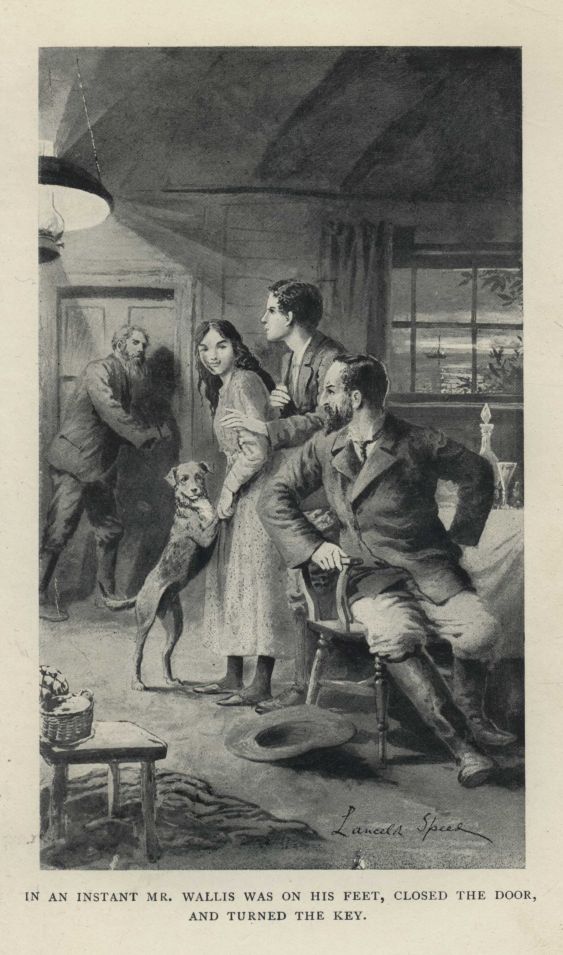
IN AN INSTANT MR. WALLIS WAS ON HIS FEET, CLOSED THE DOOR, AND TURNED THE KEY.
'You ask me,' said Mr. Wallis in a low voice, 'if I know the name of Casalle.' He placed his hand on the visitor's shoulder. 'I do know it. That little girl there is the daughter of a man who has become a dear friend of mine. His name is Ramon Casalle.'
The stranger's swarthy face paled visibly, and his lips twitched.
'I had a brother Ramon. I have never seen him since we were children together. Where is he?'
'At sea; but he will be in Sydney in a month. He told me he had never seen you since you were a boy of eight.'
The ex-convict passed his hand across his brow, as if trying to recall the past; then looking at the little girl, who was regarding him intently with her lustrous dark eyes, he said almost in a whisper--
'Will she come to me? She is my brother's child, and has our mother's face.'
Jack led Nita over to him. Casalle took her little hand in his for a moment, drew her gently to him, and kissed her. Then he leant back in his chair, and covered his face with his hands.
When he had recovered himself a little, and Jack had taken Nita away to Kate, Mr. Wallis, as clearly and briefly as possible, told him the story of the wreck of the Bandolier, and all that had happened since.
Casalle heard him with the deepest interest to the end, and then told him his own story, beginning with the account of his trial and conviction at Bordeaux, and the horrors of his prison life at Noumea. Here he broke down, and Mr. Wallis placed his kindly hand on his knee.
'Tell me no more, Casalle. It pains you to tell, and me to hear it. That you are an innocent man I believe.'
'As God is above us I am! The captain and I did not get on well together, and one day in a moment of passion I forgot myself under his repeated insults, and threatened his life. He was a gross tyrant, his chief mate almost as bad, and the crew were later on goaded into mutiny. I was asleep in my bunk when both captain and mate were stunned and tossed overboard. The ship was then within sight of the coast of Portugal, and the mutineers, headed by the steward, took to the boats and made for the land, leaving me alone on board. A few hours later I was in irons on a Spanish man-of-war. I was sent to Bordeaux, and the very men whom I had often endeavoured to save from brutal ill-usage swore my life away.'
'Forget it all, Casalle, forget it all, or think of it only as some bad dream. You are safe here with me. To-morrow we will decide what is best to be done.'
In calmer tones the ex-convict then related his adventures and wanderings after leaving Wreck Reef. He and his companions had followed old Sam Hawkins's instructions, and had safely reached the Queensland coast, where they separated, three making for the Port Curtis goldfield, and Casalle and another shipping as seamen on a vessel bound to Port Adelaide, in South Australia. From Adelaide he had steadily worked his way northward again to Sydney, and there made inquiries as to the best way of sending a letter to Port Kooringa. He found that the William the Fourth was leaving in a few days, and decided to bring the letter on to Mr. Wallis himself.
'I swore that you should have the letter safely,' he added, 'and there were no means of sending it to you from Port Curtis.'
'Come, father,' said Jack, 'Kate is waiting to bring in dinner. Then we must go through the papers which have come, and see if there is anything about the Virago, or the Lady Alicia. Perhaps they are both in Sydney Harbour this very moment, dad, and Tom might have only just missed the William the Fourth.'
Such a happy evening had not been spent in the old house for many a long month. Jack, too excited to eat any dinner, set to work on the papers at once, but could find no mention of either Lady Alicia or the Virago, beyond the fact that both were in the list of 'expected arrivals.'
'Never mind, Jack,' said his father cheerfully, 'the latest of those papers is a week old, and Tom is on board one or the other ship. Casalle, my dear fellow, to-night you shall sleep in the room that your brother slept in when he first came to us with little Nita.'
CHAPTER XII
HENRY CASALLE ALSO HEARS GOOD NEWS
No one slept much that night in that happy household, for the news of Tom's escape had spread like wildfire among the townspeople of the quaint old port, and until long past midnight there were many callers, some coming on foot and some on horseback. Most of them were men and women who had known Tom since his infancy, and who had felt a deep and sincere sympathy for his father in the time of his affliction. And all were welcome.
Mr. Wallis, being a shrewd man, was at first rather concerned that the servants had already made it known that their visitor was a brother of Captain Casalle; but it was now too late to remedy the matter. On second thoughts, however, he felt sure that there was no danger to his guest at Port Kooringa, the people of which hardly knew that there was such a place as New Caledonia, and that sometimes convicts escaped from there to Australia. In Sydney, there would be some danger of Henry Casalle being recognized and recaptured, and sent back to a life of misery. This, however, was a matter to which he would attend; and indeed he had already outlined his plans to his guest.
It was nearly dawn before the last of the visitors had left, and then Mr. Wallis, his son, and Henry Casalle went out upon the verandah facing the sea, and had a quiet talk.
Cheerfully as he had spoken to Jack at dinner about the surety of Tom's return, Mr. Wallis was secretly anxious. As far as he could glean from the letter brought by Casalle, the Lady Alicia was returning to Sydney as soon as she had discharged her cargo at Noumea, but there was a possibility of Tom obtaining an earlier passage to Australia by the Virago. But the Lady Alicia should have been back in Sydney two months ago! What could have happened to her? he thought.
He decided to go to Sydney as quickly as possible, and announced his determination to Jack and Henry Casalle.
'We shall go to Sydney, Mr. Casalle--you, Jack, Nita, and I--and wait for your brother and the Malolo, and Tom and the Lady Alicia. I could not bear to remain here in suspense. The William the Fourth leaves to-night at six. Let us make our preparations at once.'
That evening, as the old Puffing Billy, as she was nicknamed, floundered and gasped and rolled sponsons under against the sweeping seas of the bar, and her long thin funnel sent up clouds of black smoke, Jack, his father, and Casalle waved their hands in farewell to old Foster and Kate, who, with the rest of the servants, were standing on the bluff to watch the steamer pass out. Little Nita was below with her maid--one of the stockmen's daughters.
Early one morning, after a tedious passage of nine days along the coast, Jack came on deck, and saw right ahead the bold outline of the North Head of Sydney, and in another hour the little steamer, which always seemed to be at her last gasp when there was the least sea on, groaned her way through the noble entrance into fair Sydney Harbour. The captain, a rough old sea dog, something after the style of old Sam Hawkins, beckoned to Jack to come up on the bridge, where he was soon joined by his father, both being anxious to see what men-of-war were lying in Farm Cove.
In half an hour they were abreast of the Cove, which lay embosomed in the vivid green of the loveliest gardens in the southern hemisphere, and presently Jack uttered a shout as several men-of-war were seen--one of which was a paddle-wheel barque-rigged steamer.
'That's the Virago, father. I've seen her twice passing Port Kooringa.'
'Ay, ay, that's her, Mr. Wallis,' said the captain. 'She ain't much to look at, neither. If I was to give the old Billy's funnel a coat o' yellow wash, she'd be just as good-looking.'
Hailing a passing schooner, the captain inquired how long the Virago had been in port.
'Three days about.'
'Has the Lady Alicia arrived?'
The master of the schooner shook his head.
'Haven't heard of her, and haven't seen her. She always lies at Cuthbert's slip up here in Darling Harbour. She's expected, I know.'
'Well, we shall soon know if Tom came in the Virago, anyway,' said Mr. Wallis, as the William the Fourth rounded Miller's Point, and headed for her wharf; 'we'll drive to Biffen and Chard's as quick as a hansom can take us.'
As soon as the steamer was made fast, Mr. Wallis told Casalle--who had made some very judicious changes in his personal appearance, changes which made him appear ten or a dozen years younger--to go to Petty's Hotel and await him there; and then he and Tom jumped into a hansom and drove to his agent's office in Pitt Street.
The moment he gave his name to one of the clerks, a big, stout man with a round red face, merged into one vast smile, rushed out of an office marked 'private' and seizing his hand, wrung it with such vigour that Mr. Wallis fairly winced.
'My dear Mr. Wallis,' he said, almost dragging his visitor into his room, 'what a happy meeting! I've glorious, glorious news for you! Your son Tom----'
'I know, my dear Biffen. Tom is alive. Is he here?'
The big man gasped in astonishment. 'Here! No, of course he's not here; but how did you----'
'I know that he was picked up by the Lady Alicia, and he sent me a letter viâ Queensland, saying that it was possible he might get a passage to Sydney in the Virago from Noumea.'
'Well, the Virago has arrived, and has brought you another letter from him. Here it is; but before you read it let me tell you that the first lieutenant brought it here himself. He told me that your boy was looking splendid. You must go and see him.'
Mr. Wallis nodded. 'Of course I shall, at once. Now let me see what Tom says.'
Mr. Biffen went and left Jack and his father together.
This letter of Tom's was a very much longer one than that from Wreck Reef, and gave a detailed account of his adventures, from the time he lit the fire on Misty Head to his arrival at Noumea. 'I do so hope,' he went on to say, 'that the letter I sent you from Wreck Reef has long since reached you. The person to whom it was given pledged his solemn word of honour to Captain Hawkins that it would reach you safely. There is no harm now in my telling you that he and his companions were escaped convicts from New Caledonia. I often think of them, and wonder if they reached the mainland without much hardship. I do really love old Captain Hawkins for being so good to those poor wretches, and when you meet him I am sure you will like him too, and so will Jack. Dear old Jack, with his solemn old face! Oh, how I wish I could see into the room at Port Kooringa--that is, if you have received my letter from Wreck Reef, for then I know you would feel happy, and would perhaps be talking about me. Sometimes, after I began to get better, I would think so much of you by day, and dream of you all at night, that I could not stand it, and would sneak out of the cabin, and go up into the fore-top, where I could have a quiet blubber to myself.
'Mr. Collier, the chief mate, is just as kind to me as Captain Hawkins. He is a very religious man, and such a gentleman, and Captain Hawkins says that a better seaman never trod a deck. We often have long talks, for I always stand out the watch with him. The captain himself is the dearest old fellow in the world. Sometimes he swears horribly at the men, and threatens them with the most awful punishments, and they only wink at each other, and don't take the least notice of him, for he has the kindest heart of any man living. He is so proud of his ship, and of the way in which he dresses when he goes ashore--top-hat, frock-coat, gloves, walking-stick, and a watch-chain like a chain cable. This morning he has gone to call on the Governor, and he was half an hour deciding whether he would wear a green satin tie or a scarlet one, with a tiger's claw for a pin. He called Mr. Collier and me into his cabin to decide for him. We said green. It makes such a contrast to his fiery red face and white hair. 'There is a Maori half-caste on board named Chester. He and I are great friends. Captain Hawkins says that he (Chester) could be hobnobbing with dukes and duchesses in London if he had a mind to, as he can knock out any "pug." in the world in four rounds. Mr. Collier is teaching me navigation. I quite forgot to mention that the man who took my letter from Wreck Reef looked just like that shipwrecked captain who came to Port Kooringa that day. I often wonder what became of him and all his men, and whether that poor little girl lived or died. She looked just like a starved monkey. But I shall hear all about it when I come back. I am not very sorry that the Virago is not returning to Sydney before the Lady Alicia, as, although Captain Byng would give me a passage, I would rather stay with Captain Hawkins. Now good-bye for the present.'
The next portion was written very hurriedly:--'My dear father and Jack. Such news! The Governor has chartered the Lady Alicia to go in search of a missing French transport--the Marengo. We are to search the islands to the northward, and leave as quickly as possible. Of course I am very sorry that it will now be perhaps four or five months more before I see you; but you will know that I am all right, and of course I feel very excited at going on such a cruise. Captain Hawkins, too, is very pleased, and I believe will make a lot of money out of it. He has such a funny way of making long speeches and never stopping for a second, so that you never can understand what he means. About an hour ago he called the hands aft and said, "My lads me and this ship has the honour of being employed by the Governor of this Colony to institoot a search for a missing ship whose whereabouts is secluded in mystery you stand by me and do your dooty like men and preserve decority inasmuch as there is a naval officer coming aboard and if I see any man spitting on the deck or smoking at the wheel he will get such a lift under the ear that his own mother won't know him again and if we find this ship I will give every one of you a five-pound note so go for'ard again and study out this revelation."
'And now, my dear father, good-bye! You will not hear from me again until you see me come tearing up over the hill from the town. Give my love to Foster, and Kate, and Mrs. Potter, and Wellington, and all the hands. I hope poor Peter was not burnt up in that awful fire. When I last saw him he was running up and down on the beach, with the reins hanging down, looking for me. And please tell old Foster that the Lady Alicia has single rolling topsails like Uncle Hemsley's brig in the picture over the mantel, and also tell him that I can furl the fore royal by myself; Captain Hawkins says I manage it "with mendicity and ability not to be aversed or commented on by the most improper mind." Oh, I shall have such a lot of things to tell you about him, and the extraordinary words he uses!
'The other day, one of our native sailors met with a rather bad accident--smashed his big toe--and Captain Hawkins made me write a note to the doctor of the Virago, asking him to come on board, as one of his men "was suffering from a fragmentary pediment which was in a state of collusion and might suborn tettans or some corresponding aliment." Good-bye once more, dear dad!'
Intensely disappointed as he was at the prospect of Tom not returning for so many months, Mr. Wallis could not help laughing at his description of old Sam. Presently Mr. Biffen returned, and Mr. Wallis read the letter to him.
'Well, your boy is in good hands, Wallis. Old Hawkins is a sterling old fellow, in spite of his many absurdities, and if the lad has any inclination for a sea life he could not be with a better man. Oh, by the way, you received a letter from Casalle, didn't you? I sent one on to you.'
'Yes; and as he told me he expected to be in Sydney in a month after it reached me, I mean to wait here for him. I have brought his little girl up with me. Possibly the Lady Alicia may soon follow. Anyway, I shall of course wait for her arrival as well.'
'Why not go on board the Virago and see Captain Byng? He can give you a good idea of how long the Lady Alicia is likely to be. I'm sure that both he and the first lieutenant will be delighted to see you; they'll have a lot to tell you about Tom.'
Thanking Mr. Biffen, and promising to call again later on in the day, Mr. Wallis and Jack rose.
'Casalle tells me in his letter to me that the Malolo is a heeler,' said the merchant (he and his partner had transacted the business of buying her for Captain Casalle), 'and that he expects to repay you about thirteen hundred pounds after selling his cargo.'
Mr. Wallis smiled pleasantly and shook hands with his agent. 'I'm glad he likes his new ship, Biffen. He is a good fellow, I'm sure.' The repayment of thirteen hundred pounds was a matter of no moment to him at such a time, when his thoughts were full of Tom.
Driving up to Petty's Hotel, he and Jack lunched with Henry Casalle and little Nita, and then father and son walked down to the Circular Quay and took a waterman's boat for the Virago.
Captain Byng happened to be on board, and greeted them most warmly, answered all their inquiries about Tom, told them all he knew of the mission on which the Lady Alicia had been sent, and said that he certainly thought she should be in Sydney in a few weeks, whether she had discovered the Marengo or not. Then followed a long talk, in the course of which Mr. Wallis mentioned the fact of his having received a letter from Tom by a somewhat unusual source. 'It was written at Wreck Reef,' he said, 'but only reached me ten days ago.'
The naval officer's face lit up. 'Of course, of course, I know all about it. That amusing old fellow, Hawkins, as well as Tom, gave me an account of the party of gentlemen they met there; and now I've something interesting to tell you. But tell me, do you know where to find the poor fellow who was their leader?'
'He is here in Sydney--with me. I am interested in the man. I believe him to be innocent of the crime.'
The commander jumped up from his chair and went to the cabin door.
'Ask Mr. Perry to come to me at once,' he said to his steward.
Mr. Perry, the second lieutenant, at once made his appearance.
'Perry, this is Mr. Wallis and his son. I want you to tell them what it was the Governor at Noumea said about the party of convicts who escaped a few weeks before the Lady Alicia arrived.'
'He said that the Cyclope had brought a pardon for one of them, an American named Castelle or Casalle, or some name like that, and that he hoped that he at least would reach Australia safely. It seems that something came to light in France which clearly proved his innocence.'
An exclamation of delight broke from Mr. Wallis, who could not now refrain from telling the sympathetic Byng both the story of Henry Casalle, and that of his brother Ramon.
'Well, I'm heartily glad. 'Twill be a happy meeting for them. No doubt the French Consul here has received advices from the Governor on the subject; but at the same time I should strongly advise your friend not to go near him; the chances are that the Consul would apply to the authorities here for extradition papers, and get the poor fellow sent back to Noumea, in order to be told he was innocent. Then the beggars there would most likely give him seven years' detention for running away "while under sentence." That's the French style. He's safe enough now anywhere in the colonies, and I'll use my influence with the Governor at Noumea, when I am there next month, to have the pardon sent on here.'
Mr. Wallis expressed his thanks, and then only remaining a few minutes longer--so eager was he to tell the good news to Casalle--he and Jack shook hands with Captain Byng, and hurried ashore.
Casalle and little Nita were seated on the wide verandah of the hotel, awaiting their return, when father and son dashed up in a cab. Jack's excited face told Casalle that something unusual had occurred.
'Casalle,' said Mr. Wallis, with his grave, kindly smile, as he grasped the ex-convict's hand, 'you were the bearer of happy tidings to me, and now I have good news to tell you.'
'Your son Tom----'
'No, my dear fellow, nothing about my boy--but good news for you. The captain of the Virago has just told me that you have been pardoned. Your innocence has been proved. This he heard from the Governor of New Caledonia only a few weeks after you escaped. Come, let us go inside, and I will tell you all about it. Come, Nita, little one. This is a happy day for us all.'
Regardless of the people who were sitting about, Henry Casalle leapt to his feet, his dark eyes shining with great joy. Then they filled with tears.
'God is good to me, and I thought He had deserted me! The world is bright to me again.'
Then entering a quiet room he knelt down and buried his face in his hands, as Mr. Wallis led Nita away.
CHAPTER XIII
JACK HAS MISGIVINGS
After dinner that evening, as the two men were sitting in the hotel garden smoking, and talking, of course, about the return of the Malolo and the Lady Alicia, Jack, who had been unusually quiet and thoughtful, came up to his father.
'Father, there has been something troubling me all day--ever since we got Tom's letter from Mr. Biffen this morning. Let me have it, please, to read again, and Captain Casalle's as well.'
'What is it, Jack, that is troubling you?'
'Let me read the letters first, dad, then I'll tell you.'
His father gave him both, and Jack, whose always serious face was now more serious than ever, went quietly away into a sitting-room, and placing them side by side, read them through carefully.
He sat considering for a few minutes, then went out again to the garden with the letters in his hand.
'Father, I must tell you and Mr. Casalle what is troubling me. Don't think me foolish.'
'Certainly not, my boy,' said Mr. Wallis, who knew that Jack must have some good reason for speaking as he did.