L.T. Meade (continued 5)
Reading edition
“You are very complimentary to me, I must say,” said Annie. “But listen; I will calm your poor, palpitating little heart. I did a splendid thing; I sold the necklace to Mr Manchuri.”
“Who on earth is Mr Manchuri?” said Mabel.
“Mabel, you really are silly. He is the dear old Jewish gentleman who took Priscilla Weir home.”
“And why did you give it to him?”
“Because, my dear, I invariably use my eyes and my ears and, if possible, my tongue; and I made a discovery with regard to Mr Manchuri. He owns a big jeweller’s shop in Bond Street; therefore why should not he have the necklace? So you see it is safe out of Switzerland by this time.”
“And,” continued Mabel, “he gave thirty pounds for it?”
“Oh, he didn’t think much of it,” said Annie. “Still, he gave me that, and I was glad to close with the offer.”
“Well,” said Mabel, “it is a certain relief to know that it won’t be found in any of the shops in Interlaken.”
“It is a very great relief,” said Annie. “And now our object is, if possible, to make little of it to Lady Lushington. I think I can manage that; but come upstairs, won’t you? I am certain your aunt won’t say anything more about the stupid old thing this evening.”
“I hope not, I am sure,” said Mabel. “But don’t go in for a minute or two, Annie, for the omnibus has just arrived, and we may as well watch the fresh visitors.”
The girls came forward towards the deep porch. The large green-and-gold omnibus, with the words ‘Beau Séjour’ painted conspicuously on its sides, drew up with a clatter and fuss in front of the hotel. Waiters and servants of different sorts darted out to assist the visitors to alight. The omnibus was nearly full, and there was a quantity of luggage on the roof. Ladders were put up to get it down, and the girls watched the proceedings with intense amusement—the pearl necklace forgotten, all cares for the moment laid aside. They made a pretty pair as they stood thus side by side. Annie, in her ethereal blue dress, might have been taken for that sweetest of all flowers, the blue forget-me-not; Mabel, in her purest white, for the stately lily.
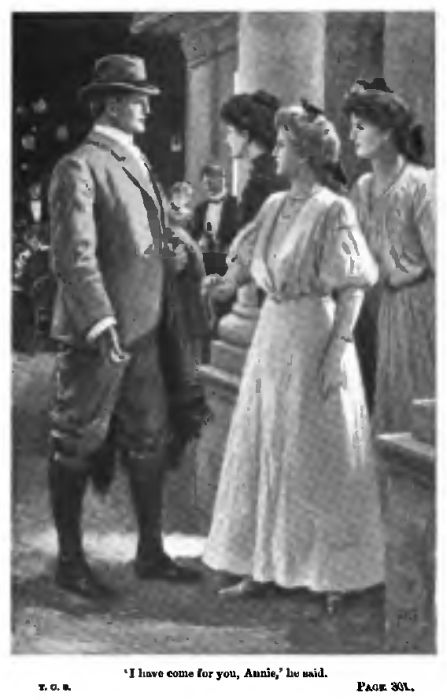
So thought for a brief instant a certain young man as he alighted from the omnibus; but the next moment his face changed. A hard expression came into his eyes. He came straight up to Annie Brooke.
“I have come for you, Annie,” he said.
Chapter Twenty Three.
A Stern Decision.
In the briefest of all instants everything changed for Annie Brooke; the gay people, the gay hotel, the pleasant, easy living seemed to fade from her sight. She trembled all over. Mabel looked at her in astonishment.
“Come indoors; I must speak to you. We must go away to-night if possible,” said John Saxon.
“May I introduce my friend Mabel Lushington?” said Annie, making a valiant effort to recover herself.
Saxon bowed to Mabel as though he did not see her. Annie whispered to her friend:
“He is my cousin. I am afraid, my dear, that Uncle Maurice is very ill. I will come to you in your room, Mabel, soon. Please don’t say a word to Lady Lushington.”
Mabel nodded. There was an anxious note in Annie’s voice which was unmistakable. Mabel was not specially sympathetic, and would never be so to one she knew as thoroughly as she did Annie. But even she recognised the reality of Annie’s present trouble.
“What in the world am I to do without her?” she thought as, refusing the lift, she went up the wide and spacious staircase, up and up to that fourth floor of the immense hotel where the Lushingtons’ rooms were situated.
Meanwhile Saxon drew Annie aside into a small room which led out of the great hall.
“Why did not you come when I telegraphed? I sent you money for the purpose. You must come with me now, at once. A train leaves here for England at midnight. Will you go and pack your things? Take that off”—he glanced at the pretty blue dress. “Get ready. Do you wish to see him alive?”
“John, don’t look at me like that. Where is the use? How could I tell that Uncle Maurice was so ill? I can’t stand it, John, if you look at me like that. Although you are my cousin, John, you have no right to.”
“No right to?” he said with scorn. “I know a woman when I see her, and a butterfly when I look at her. Do you think it was a pleasure to me to leave the dying old man, to run the risk of his dying in my absence, in order to bring you to him? But he shall have his last great wish gratified, and I believe God will spare him just that he may see you again. But I tell you what it is, Annie Brooke, if we return and find that saint has left the world before the one wish of his heart is gratified, I shall feel uncommonly like cursing you. Now you know what I think of you. Go upstairs at once and get ready; we leave here immediately.”
“Oh John!” moaned poor Annie.
But John Saxon was obdurate. One of the waiters came in and asked the gentleman if he wanted a room. John briefly explained his errand. He would have a meal of some sort, he said, and must leave by the midnight train. The young lady, Miss Brooke, his cousin, would accompany him.
If Mabel scorned the lift in order to get to her room, Annie was glad to avail herself of it. She was glad to sink back into a corner of the spacious lift and close her eyes for a minute and try to recover her scattered thoughts. Was the whole world crumbling to pieces around her? Were all her schemes to come to naught? The necklace—would her dealings with Mr Manchuri in the matter of the necklace ever be discovered? Would other matters in connection with that disgraceful affair come to light? Would Mabel—poor silly Mabel, left all alone with Lady Lushington and Mrs Ogilvie—confess the truth? Annie was terrified that Mabel would do so. At this moment she dreaded Mabel even more than she had dreaded Priscilla; for Mabel was essentially weak, whereas Priscilla was essentially strong. If Priscilla thought it right to go through a certain course, she would go through it, come what might; but Mabel could be moved and turned and tossed about by any wind of chance.
Mabel was certainly in a tight hole. To pursue a different metaphor, her little boat was out on a most stormy sea. With Annie as pilot it might get safely to shore, but without Annie it was sure to knock to pieces on the rocks of circumstance. Mabel would tell. What was Annie to do? Why had John Saxon come? How she hated, how she loathed her manly cousin at that moment! What a fool she had been to give him her address! She had done it in a moment of impulse, little, little guessing that he would act upon the information so quickly.
He had come in person. She could not shuffle out of the strong grasp of that iron determination. She must leave all her fun just where she hoped it was really beginning.
It was a pale and worn-out Annie who presently arrived in Mabel’s room. Mabel was pacing up and down, her face quite chalky in colour and her eyes wild with fright.
“Well, now,” she said the moment she saw her friend, “what is to be done?”
“Oh, do think of some one besides yourself!” said Annie. “Have you no pity for me, with my dear uncle so ill—dying?”
“But you don’t really care,” said Mabel, looking full at Annie.
Annie felt inclined to stamp her foot.
“You little wretch!” she said. “Do you suppose I have no heart?”
“To be truthful with you, Annie,” said Mabel, “I do not think you have much; but that’s not the point. Are you really going with that—that dreadful young man?”
“My cousin, Mr Saxon? Yes; we leave here by the midnight train. I have about two hours longer to spend in the hotel.”
“Then what am I to do?” said Mabel.
Annie sat down determinedly.
“Let me think,” she said. She covered her face for a moment with her hand. Already she was beginning, after a fashion, to recover herself, to get back her aplomb, her great talent for double dealing. “Let me think,” she said again.
“Well, don’t be long,” said Mabel, “for time passes.”
“Yes; but if you will be silent I will have thought out something after a minute or two.” Just then Parker tapped at the door.
“Shall I let her in?” whispered Mabel.
In reply to this, Annie herself went to the door, unlocked it, and flung it wide-open.
“Come in, Parker; come in,” she said.
“Why, what is the matter with you, Miss Brooke?” said that astute woman.
“A great deal,” replied Annie. “I have got to go home at once; my cousin, Mr Saxon, has come to fetch me. My dear, dear uncle is—is dying. He has been as a father to me. I must leave by the midnight train.”
“So I heard downstairs,” said Parker, putting on a certain sympathetic manner and trying to penetrate beneath Annie’s apparent grief. “I will pack your things for you, of course, Miss Brooke; you need have no trouble on that score. I came up here to offer my services. What dress will you wear travelling, miss?”
“Oh, my dark-blue serge will be best; but it doesn’t matter,” said Annie.
“I will put in some of the pretty things you wore while you were here, miss,” said Parker. “I know her ladyship would wish it. I don’t suppose your trunks will quite hold them all, but I can get in a good many.”
“Thank you, Parker; I don’t care about them now. I am in dreadful trouble about dear uncle.”
“Of course you must be, miss; but I am sure we are all sorry to lose you, for you do manage her ladyship in the most wonderful way, and I will say that you are as unselfish and pleasant-spoken a young lady as ever I came across. You will find the dresses and other things useful some time, miss, so I will get as many as ever I can into your trunks.” Annie murmured something. She would love to keep her pretty dresses; they would be effective at school. She could think of school and her appearance there, and the looks of envy of her companions even at this supreme moment.
“Then I will go and pack at once,” said Parker, preparing to leave the room.
She had nearly got as far as the door when she turned.
“By the way, miss,” she said, looking at Mabel, “my mistress is quite annoyed about a necklace she bought for you at Interlaken yesterday. She said that it was valuable, although old-fashioned—a pearl necklace set in silver. She thought I had it with the rest of the jewels; but you never gave it to me, Miss Lushington. My mistress said that I was to see it safely in the jewel-case before I went to bed to-night. Where did you put it? Can I get it now, miss?”
Mabel was silent. Her voice quite choked with the agony of the moment. Annie, however, took the initiative.
“Of course you can, Parker,” she said. “It was awfully silly of Mabel not to give you the box that contained the necklace; it was the most idiotic thing I ever heard of.—I am sure, darling, I urged you to do so. But there, no doubt it is safe. You put it into the lid of your big trunk.”
Mabel nodded. She could not bring herself to speak.
“Then we will find it immediately,” said Annie. “Notwithstanding my own great sorrow, it will be a comfort to me to know that the necklace is safe under Parker’s care before I leave; for the fact is, Parker, it was I who discovered it. I thought it was quite a valuable thing, but I am rather afraid now that Lady Lushington paid too much for it. However, that is neither here nor there; we have got to find it.”
“Here are the keys of Miss Lushington’s trunks,” said Parker. She proceeded as she spoke to unlock the largest of the trunks, which happened to be a canvas one, and slightly the worse for travel.
“I am very sorry indeed, miss, you put it in here,” said Parker. “Why, see how loose the cover is. A person could almost put his hand in between the cover and the inside of the trunk. Well, where did you put it, miss?”
“I will find it; I will find it,” said Annie.
She stooped as she spoke and began that examination which she knew beforehand must be fruitless. Mabel stood with her back to the two, looking out of the window. Annie longed to shake her. Was not her very attitude giving the whole thing away?
“I really can’t find it,” said Annie after a moment’s pause. “Do come and look yourself, May. Are you dazed? Have you lost your senses? Oh, I know, poor darling May! it is sorrow at parting with poor little me.—Parker, Miss Mabel just adores me; don’t you, precious one! Well, well, Parker will do all she can for you when I am gone.”
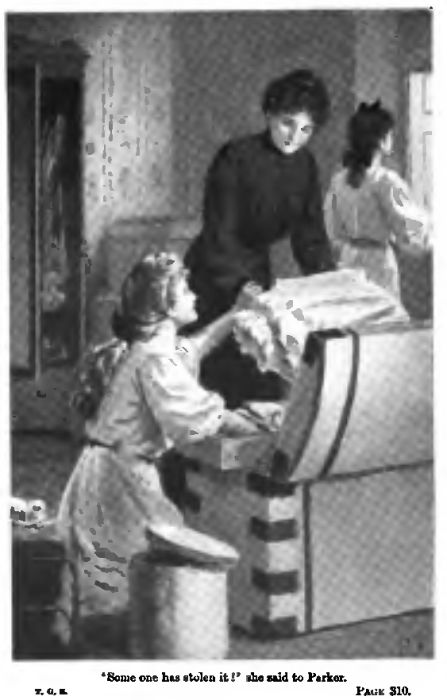
“I can’t take your place, Miss Brooke. I am really sorry you have to go.—But now, Miss Mabel, the best thing to do is just to empty the lid of the trunk. We’ll get to the box that way without disarranging all your pretty things.”
The lid of the trunk was speedily emptied, and of course no necklace was found.
“There!” said Annie. Her heart was beating so fast that the pallor of her face was far from assumed. The fear in her eyes, too, seemed only too natural.
“Some one has stolen it!” she said to Parker. She clasped the woman’s arm. “What are we to do?”
Parker looked distinctly annoyed. Mabel stood stonily silent, apparently almost indifferent.
“Miss Lushington,” said the woman—“do wake up and consider, miss. Perhaps you didn’t put it into the lid of the trunk; perhaps you put the box that held the necklace somewhere else.”
“No, I didn’t; I put it into the lid,” said Mabel. “I won’t say I put it anywhere else; the lid will do; I put it there. I won’t be bothered about it!”
She marched out of the room, got as far as the wide landing, and burst out crying. Her queer conduct and queer words terrified Annie and amazed Parker.
“What is the matter with Miss Mabel, miss?” said the maid, turning to the girl.
Annie put her pretty, white hand on Parker’s arm.
“Leave her alone with me for a little, please, Parker. Just go off and pack my things, like the jewel you are. She is awfully upset at my going—and you know I must, on account of my dear uncle.”
Annie’s voice quavered. Indeed, she herself was very nearly breaking down.
“I must go, you know, Parker,” she said, her pretty eyes filling with tears which only added to their beauty. “But I’ll manage Mabel. It is dreadful about the necklace; but perhaps you will recover it.”
“We never will,” said Parker. “It’s a dreadful bit of business. Her ladyship will be wild. She does so hate it when anything is stolen. But there are lots of robberies taking place on the railways of late. It is a perfect disgrace. Even the registering of your goods seems not to secure things. Of course I always carry the jewels in my own hand; it’s the only safe way. Miss Mabel must have been mad to put a valuable necklace such as her ladyship described into that old trunk.”
“It wasn’t nearly so valuable as Lady Lushington supposed; that is the only comfort,” said Annie.
“But, miss, I don’t understand. I thought it was you who urged her ladyship to get it, and that you had quite a knowledge of gems.”
“I found out afterwards—I will tell you the secret, Parker, and you can break it to her ladyship when I am gone—I found out afterwards that I had made a slight mistake. The necklace was worth, say, about twenty pounds, but no more, for some of the pearls were quite worthless. I happened to show it to a gentleman I knew very slightly at the Belle Vue Hotel, and he deals in that sort of thing. He disappointed me in his estimate of the necklace; but that doesn’t matter. It is terrible that it should be lost. Still, you might tell Lady Lushington what he said. There is no use in telling Mabel. She doesn’t care twopence about it, poor child, at the present moment; she is so broken down at my leaving.”
“Well, miss, I must be off to do the packing. I will make the best of things and never forget how pleasant you have been during your visit, miss. I will see, too, that you have a basket of sandwiches and some wine packed for your journey.”
Parker went off. The moment she did so Annie went into the corridor and fetched Mabel in.
“Oh, you goose of all geese!” she said. “Now the worst is over; I tell you the worst is over. You don’t suppose for a single moment your aunt, Lady Lushington, will think that you stole the necklace or that I stole it. She will suppose, most assuredly, that it was stolen on the journey between Interlaken and Zermatt. Parker is convinced on the subject and I have let Parker understand that it was not nearly as valuable as I supposed. Lady Lushington won’t trust me to manage a bargain for her again; that is the worst that can happen. Now, May, do cheer up. You are all right. I will manage things for you when Priscilla’s Christmas bill comes round. You will see plenty of me, I fancy, between now and then. Dry your eyes, darling. I know you are sorry to part from me.”
“I can’t go on being wicked without you; that’s the principal thing,” said Mabel. “I know I’ll give in.”
“Think what injury you’ll do me; and do you really want to go back to that horrid school?”
“I don’t think I’d mind so very much; it was peaceful, at least at school.”
“You would soon be sick of that sort of peace.”
“I suppose I should,” said Mabel.
She had already wiped her eyes, and she began slightly to cheer up.
“Annie,” she said eagerly, “is your uncle really dying?”
“John Saxon says so; otherwise, of course, he would not have come,” said Annie.
“If,” said Mabel, trembling a good deal—“if afterwards you could come back—”
Annie’s heart bounded.
“I can’t talk of it,” she said; “don’t speak of it now. When the time comes, if you—were—to write I will write to you, that is, if I have strength to write to any one. You have my address. You know how deeply I shall always love you. You know there is no good turn I would not do for you.”
“I want you to help me until Priscilla’s year at school is out,” was Mabel’s matter-of-fact retort. “Of course, dear, of course; and I will. Your Annie will never forsake you. But now perhaps we had better go downstairs.”
The girls made a quite picturesque appearance as they went slowly down the broad staircase. Mabel had not cried enough to look ugly, and Annie’s few tears and pallor and evident distress gave to her face the depth of expression which in her lighter moments it had lacked.
John Saxon was seated close to Lady Lushington. Lady Lushington had recognised him as a friend and a favourite. He rose when the girls appeared, and Lady Lushington went at once up to Annie.
Her manner was very cold and distant. “You did not give me the slightest idea, Miss Brooke, how ill your uncle was when you received your cousin’s letter.”
“I didn’t know that he was especially ill,” said Annie.
Lady Lushington looked full at her. It seemed at that moment that a veil had fallen away from Annie’s face, and that the gay, proud, and selfish woman of the world saw the girl for the first time as she was.
Lady Lushington, with all her faults—the faults of her class and her manner of life—was exceedingly good-natured, and could be remarkably kind. She was thoroughly angry with Annie for concealing the truth with regard to John Saxon’s letter. She could, and would, forgive much to any young girl who was enjoying herself and who wanted to continue the good time which had fallen to her lot; but to forget one who stood in the place of a father, to let him long for her in vain, was more than Lady Lushington could stand.
“I don’t appreciate that sort of thing,” she said to herself. “It is, somehow, beneath me. I don’t understand it.”
She made up her mind on the spot, that, as far as Mabel was concerned, the friendship between the two girls was to terminate there and then. Never would she have anything farther to do with Annie Brooke. As that was the case, she did not consider it necessary to correct her.
“I am sorry,” she said briefly, “that you did not interpret very plain English in the manner in which it was intended. I don’t think for a single moment that your cousin meant to complain of you to me, but he simply quoted some words of his letter, and seemed altogether astonished that you did not start for England the day before yesterday. However, I trust you will find your dear uncle alive when you get home. I have desired Parker to pack your things, and now you would doubtless like to go up and change your dress.”
“Thank you,” said Annie very meekly. She glanced in Mrs Ogilvie’s direction; but Mrs Ogilvie took no notice of her.
“Mabel, come and sit here near Mrs Ogilvie,” said Lady Lushington as Annie once again disappeared. “You can say good-bye to your friend presently; there is no necessity for you to spend the whole evening upstairs.”
Chapter Twenty Four.
Home No More.
It was all over—the fun, the gaiety, the good things of life, the delights of fine living, the charm of being with rich friends. It is true that Annie Brooke returned to England with a little private fund of her own in her pocket; but John Saxon insisted on her returning him the two five-pound notes he had enclosed to her. Out of these he paid for her ticket back to England.
John Saxon was a very cold, silent, and unsympathetic fellow-traveller. He sat moodily in a corner, wrapped in his greatcoat, the collar of which he turned up; a travelling-cap came well down over his head, so that Annie could see little or nothing of his face. He had done what he could to make her comfortable, and had wrapped her round with warm things. Then he had taken no further notice of her.
On the whole, Priscilla Weir had a far more interesting journey to England than had that spoiled child of fortune Annie Brooke. Annie, however, was glad to be left alone. She did not want to talk to that odious man, Cousin John Saxon. But for him, life would not have been suddenly spoiled for her. She would not have been found out. She was far too clever not to be sure that Lady Lushington had found her out. Not that Lady Lushington had discovered any serious crimes to lay at her door, but then she had read her character aright, and that character was of the sort which the great lady could not tolerate. Therefore Annie was—and she knew it well—shut away from any further dealings with Mabel Lushington.
Poor Mabel! How would she provide the money for Priscilla’s two remaining terms at school? How would she go through a stern catechism with regard to the necklace when Annie was no longer by her side?
“Everything will be discovered,” thought Annie Brooke. “There is no help for it. What shall I do? And I’d managed so well and so—so cleverly. There isn’t a bit of good in being clever in this world. It seems to me it’s the stupid people that have the best times. Of course that idiotic old Mabel will let out the whole story before many hours are over. And then there’ll be a frightful to-do, and perhaps Mabel will be sent back to Mrs Lyttelton’s school—that is, if Mrs Lyttelton will receive her, which fact I very much doubt. As to me—oh, well, I’ll have to hide somewhere. I hope to goodness Mr Manchuri will never tell anybody about the necklace; he faithfully promised he wouldn’t and he seemed an honourable sort of man. But then, ought I to expect any one to be honourable in his dealings with me? I don’t know; the world seems coming to pieces. Horrid John Saxon! How I detest him! Oh, I feel as though I could go mad!”
Annie started up impatiently. She went across the carriage and opened one of the windows, putting her head out at the same time. She hoped Saxon would take some notice. She wanted him to speak to her. His silence, his apparent indifference to her, were just the sort of thing to madden the girl in her present mood.
Saxon was seated facing the engine, and, in consequence, when Annie opened the window wide he was exposed to a tremendous draught. He bore it for a minute or two; then, rising, he said very quietly:
“Will you excuse me? I don’t think the night air is good for you, and it is certainly bad for me. I will, therefore, with your permission, shut the window; it is cold.”
“I am suffocating,” said Annie.
“I will open it again in a few minutes so that you can have fresh air from time to time.”
“Oh!” said Annie, with a sudden burst of passion, beating one small hand over the other, “why have you been so cruel to me?”
Saxon glanced at her. There was only one other occupant of the carriage—an old gentleman, who was sound asleep and snoring loudly.
“Won’t you speak?” said Annie. “Why do you sit so silent, so indifferent, when you have spoiled my life?”
“We have different ideas on that point,” he said. “You can do exactly as you please with your life, as far as I am concerned, by-and-by. At present you are under the care of your uncle, the Rev. Maurice Brooke. While he lives you have to do his wishes, to carry them out according to his views. I am helping him in this matter, not you. Afterwards, we will discover by your uncle’s will what he wishes to have done with you. You are only seventeen; you must yield to the directions and the will of those who are older than yourself and who are placed by God in authority over you.”
“Oh, how I hate you when you preach!”
“Then perhaps you will not speak to me. I am exceedingly tired; a journey to Zermatt and back again without any rest makes a man inclined for slumber. I will sleep, if you have no objection. In the morning perhaps we shall both be in a better temper than we are at present.”
“I wish,” said Annie, speaking in sudden passion, “that I could fling myself out of that window. You have destroyed every prospect I ever had in life.”
“You talk in an exceedingly silly way,” said Saxon. “Now do try and be quiet, if you please.”
His absolute disregard of her threat to end her own miserable life made Annie at once furious and also strangely subdued. She sat back in her corner like a little wild creature caught in a trap. There was nothing whatever to be done but to submit. To submit as she was now doing was indeed new to Annie Brooke. Her head was in a whirl; but by-and-by, to her own relief, she also slept, and so part of the miserable journey was got through.
It was late on the following afternoon when Annie and John Saxon found themselves driving in the gig to Rashleigh Rectory. They had to pass through the little village, and Annie looked with a sort of terror at Dawson’s shop. She wondered if the matter of the cheque would ever be brought up against her. So occupied was she with herself and with all the dreadful things she had done that she could scarcely think of her dying old uncle at all.
The memory of a text, too, which she had learned as a child began to be present with her. Her head was aching, and the text, with its well-known words, tormented her.
”‘Be sure your sin will find you out. Be sure—your sin—will find you out,’” murmured Annie in too low a tone for Saxon to hear.
They had been met at the railway station with the information that Mr Brooke was still alive, and Saxon uttered a sigh of relief. Then his journey had not been in vain. Then the old man would be gratified. The greatest longing and wish of his life would be fulfilled. The darling of his heart would be with him at the end.
John Saxon turned and looked at the girl. She was crouching up in the gig. She felt cold, for the evenings were turning a little chill. She had wrapped an old cloak, which Mrs Shelf had sent, around her slim figure.
Her small, fair face peeped out from beneath the shelter of the cloak. Her eyes had a terrified light in them. Saxon felt that, for Mr Brooke’s sake, Annie must not enter the Rectory in her present state of wild revolt and rebellion.
He suddenly turned down a shady lane which did not lead direct to the Rectory. His action awoke no sort of notice in Annie’s mind. Her uncle was alive; he probably was not so very bad after all. This was a plot of John Saxon’s—a plot to destroy her happiness. But for John, how different would be her life now!
They drove down about a hundred yards of the lane, and then the young man pulled the horse up and drew the gig towards the side of the road. This fact woke Annie from the sort of trance into which she had sunk, and she turned and looked at him.
“Why are you stopping?” she asked.
“Because I must speak to you, Annie,” was her cousin’s response.
“Have you anything fresh to say? Is there anything fresh to say?”
“There is something that must be said,” replied John Saxon. “You cannot, Annie, enter the Rectory and meet Mrs Shelf, and, above all things, go into that chamber where your dear uncle is waiting for the Angel of Death to fetch him away to God, looking as you are doing now. You are, I well know, in a state of great mental misery. You have done wrong—how wrong, it is not for me to decide. I know of some of your shortcomings, but this is no hour for me to speak of them. All I can say at the present moment is this: that you are very young, and you are motherless, and—you are about, little Annie, to be fatherless. You are on the very eve of losing the noblest and best father that girl ever possessed. Your uncle has stood in the place of a father to you. You never appreciated him; you never understood him. He was so high above you that you could never even catch a glimpse of the goodness of his soul. But I cannot believe in the possibility of any one being quite without heart or quite without some sense of honour; and I should be slow, very slow, to believe it of you.
“Now, there is one last thing which you have got to do for your uncle Maurice, and I have brought you down here to tell you what that last thing is.”
Annie was silent. She shrank a little more into the shelter of the rough old cloak, and moved farther from her cousin.
“You must do it Annie,” he said, speaking in a decided voice; “you must on no account whatever fail at this supreme juncture.”
“Well?” said Annie when he paused.
“Your uncle is expecting you. God has kept him alive in order that he may see your face again. To him your face is as that of an angel. To him those blue eyes of yours are as innocent as those of a little child. To him you are the spotless darling, undefiled, uninjured by the world, whom he has nurtured and loved for your father’s sake and for your own. You must on no account, Annie, open his eyes to the truth with regard to you now. It is your duty to keep up the illusion as far as he is concerned. I have taken all this trouble to bring you to his bedside in order that he may have his last wish gratified, and you must not fail me. Perhaps your uncle’s prayers may be answered; and God, who can do all things, will change your heart.
“Now, remember, Annie, you have to forget yourself to-night and to think only of the dying old man. Promise me, promise me that you will do so.”
“You have spoken very strangely, Cousin John,” said Annie after a very long pause. “I—I will do—my—best I am very bad—but—I will do—my best.”
The next instant Annie’s icy-cold little hand was clasped in that of John Saxon.
“You have to believe two things,” he said. “A great man who was as your father, whom God is taking to Himself. That man loves you with all his heart and soul and strength. When he dies, there is another man, unworthy, unfit truly, to stand in his shoes, but nevertheless who will not forsake you. Now let us get back to the Rectory.”
There was a feeling of peace in the old house, a wonderful calm, a strange sense of aloofness as though the ordinary things of life had been put away and everyday matters were of no account. The fact was this: that for several days now, for long days and long nights, the beautiful Angel of Death had been brooding over the place; and the people who lived in the old Rectory had recognised the fact and had arranged their own lives accordingly.
Money did not matter at all in the shadow of that Presence; nor did greatness—worldly greatness, that is—nor ambition, nor mere pleasure; and, above all things, self-love was abhorrent in that little home of peace, for the Angel of Death brooding there brought with him the very essence of peace.
It was a curious fact that Annie Brooke, when she passed under the threshold and entered on what she expected to be the most awful time of her whole life, found that same peace immediately descend upon her. She lost all sense of fear, and every scrap of regret at having left the good and gay things of life at Zermatt.
She had not been five minutes in the house before she forgot Zermatt, and Mabel, and Lady Lushington. It is true, she thought of Priscilla, and Priscilla’s eyes seemed to haunt her. But even they, with their look of reproach, could not affect the queer peace that had fallen upon her.
Mrs Shelf kissed her warmly, not uttering a word of reproach, and Annie stepped with a light and fairy step, and crept to her own room and put on one of her little home dresses—a blue gingham which she often wore and which her uncle loved. She tripped downstairs again in a few minutes, and entered the kitchen and said to Mrs Shelf:
“Now I am ready.”
“Go in by yourself, darling,” said Mrs Shelf. “I won’t take you. He is in the old room; there is, no one with him. He knows you are here; he knew it the minute you stepped across the threshold. You couldn’t deceive him, bless you! Go to him all alone, dearie, and at once.”
So Annie went. A minute later she was seated by the old man’s bedside, and silently her little hand was laid on his. He just turned his head very slowly to look at her. They both felt themselves to be quite alone together except for the presence of the Angel of Death, who, brooding over the house, brooded more deeply over this sacred chamber, with wings held open, ready to spread themselves at any instant, and arms half extended to carry that saint of God to his home in the skies.
Mr Brooke had longed for Annie, had imagined her to be by his side in hours of delirium, had awakened to his usual senses a day or two before the end and had discovered her absence; had said no word of reproach with regard to his little Annie, but had missed her with a great heart-hunger. Now she was here. She was his own dear child. To the rest of the world Annie was at that moment a wicked, designing, double-faced, double-natured creature, but to Mr Brooke she was just his wee pet lamb, his darling; the treasure whom God had given him.
“You are back, my love,” he said when his very feeble voice could speak. “I missed you, my little one.”
“Yes, I am back,” said Annie, and she did that which comforted him most; she laid her head on the pillow beside him, and kissed his cheek, already cold with the dews which precede the moment when the great Angel of Death carries the soul he has released from its prison away.
“I am going to God,” said Mr Brooke. “It is a wonderful happiness that I am soon to be admitted into the presence of the King of Kings. There is no saying, Annie, what marvels will be revealed to me and what glories mine eyes shall look upon. I shall see in His good time the Saviour of the world. When I am ready for that sight of all sights, it will be given to me. But, my own little Annie, even in that moment of satisfaction, when I wake up after His likeness, I shall carry you, my child, in my heart of hearts. I shall look for you, my little one. You will come to me—not yet, my darling, for you are very young, but some day. Promise me, my dearest dear.”
Annie’s choked voice sounded low and faint.
“I cannot hear you, my sweetest. Say the word I want—say the word I want to take away with me.”
“What shall I say, Uncle Maurice?”
“Say ‘Yes’—one word, my darling, that I may carry it with me into the great eternity of God.”
“Yes—oh, yes!” said Annie.
“Lord, now lettest Thou Thy servant depart in peace,” said the old man. Then the Angel of Death did open wide his glorious wings, and two bright spirits passed out of that room where one had come in.
Chapter Twenty Five.
Very Dark Days.
Mr Brooke’s death was followed by total collapse on Annie’s part. The time between the death and the funeral was passed by the girl in a sort of delirium, in which she was too restless to stay in bed, but too feverish to go out. On the day of the funeral itself, however, she did manage to follow her uncle to his last resting-place.
A pathetic little figure she looked in her deep mourning, with her pretty face very pale and her golden hair showing in strong relief against the sombre hue of her black dress.
Saxon and Annie were the only relations who followed the Rev. Maurice Brooke to the grave. Nevertheless the funeral was a large one, for the dead man had during a long lifetime made friends and not one single enemy. There was not a soul for miles round who did not know and love and mourn for the Rev. Maurice Brooke. All these friends, therefore, young and old, made a point of attending his funeral, and he himself might well have been there in spirit so near did his presence seem to lonely Annie as she stood close to the graveside and saw the coffin lowered to its last resting-place.
She and John Saxon then returned to the Rectory. Annie was better in health now, but very restless and miserable in spirit. Saxon was consistently kind to her. Her uncle’s will was read, which left her all that he possessed, but that all was exceedingly little, not even amounting to sufficient to pay for Annie’s school expenses at Mrs Lyttelton’s.
Saxon asked her what she would like to do with her future. Her reply was almost inaudible—that she had no future, and did not care what became of her. Saxon was too deeply sorry for her to say any harsh words just then. Indeed, her grief touched him unspeakably, and he almost reproached himself for blaming her so severely for not attending to his first letter.
It was two or three days after the funeral, and Saxon was making preparations to leave the old Rectory, where Annie herself could remain for a few weeks longer under the care of Mrs Shelf, when one morning he got a letter which startled him a good deal. Colour rose to his cheeks, and he looked across at Annie, who was pouring out tea.
“Do you know from whom I have just heard?” he said.
“No,” said Annie in a listless tone.
She did not much care whom her cousin heard from, as she said over and over to herself, nothing ever need matter to her any more. But his next words startled her, and she found that she had a heart and susceptibilities, and that once again cruel, terrible fear could visit her.
“This letter is from a man whom I happen to know exceedingly well; I have met him several times in Australia. He is a certain Mr Manchuri.”
“Yes,” said Annie, her lips parted and the colour rushing into her cheeks.
“He says he knows you—he met you at the Hotel Belle Vue at Interlaken—and that, seeing your uncle’s death in the paper, he has written for a double purpose—to convey his condolences to all those who loved your dear uncle, and to request me to meet him in town on important business in connection with you.”
“Oh!” said Annie. She had been standing; she almost fell into her seat.
“He says further,” pursued Saxon, “that a great friend of yours, a Miss Priscilla Weir, is staying with him.”
“She told him, of course,” said Annie.
“What did you say, Annie?” John Saxon looked at her, a puzzled expression between his brows. Then he started to his feet. “I shall run up to town,” he said. “I will go to-day and see what this means. It was through Miss Weir he learned that I was staying here. But for that he says that he would have come himself to have an interview with you; as it is, he thinks I can manage matters best.”
“Don’t go!” said Annie in a choked voice.
“Don’t do what, my dear Annie?”
“Don’t go; don’t mind him. He means mischief.”
“I don’t want to be cross to you, dear Annie, but really this is silly. Mr Manchuri is a most excellent man; I and my father before me have both known him. My father has transacted some business with him from time to time. He is a first-rate man of business, and straight, in every sense of the word. Of course I shall go; I cannot possibly neglect your affairs. Why, what is it, my dear?”
“You can go if you like,” said Annie. “I—I don’t feel well; that is all.”
She crept out of the room, tottering as she did so, and supporting herself by catching hold of various articles of furniture. When she disappeared John thought for a minute. Then he went into the kitchen, where Mrs Shelf was busy.
“Mrs Shelf,” he said, “I have just had a letter which obliges me to go to London at once; I shall catch the next train. It is scarcely possible for me to be back to-night, but I shall certainly come early to-morrow. In the meantime you will look after Annie.”
“You needn’t doubt it, Mr John,” said Mrs Shelf.
Saxon lowered his voice. “I don’t quite like her appearance,” he said. “She is suffering a good deal; I think you ought to watch her. Don’t let her out of your sight.”
“Oh, I will see to her, Mr John. The poor child is fretting; she has found her true heart at long last. The death of my beloved master has revealed many things to our Annie.”
“Well, be careful of her,” said the young man. “I will be back as soon as I can.” Shortly afterwards he started for town.
As soon as ever the sound of the horse’s hoofs which was conveying John Saxon to the railway station died away on the road, Annie, who had been crouching rather than lying down in her room, ran to the window and looked out. The semi-peaceful, semi-stunned expression on her face had given way now to the old watchful, almost crafty look which used to characterise it. She was quickly making up her mind. Mr Manchuri could only want to see John Saxon on one subject—the necklace. Priscilla, horrid Priscilla, had told him everything. He had given Annie one hundred pounds for the necklace, seventy of which she had kept for herself. In all probability, if Mr Manchuri carried things out to the bitter end, she could be locked up for theft. She might even see the inside of a prison. The terrified girl felt nearly mad. She paced up and down her little chamber, fearing—she knew not what. She would have prayed, but she did not dare. She would have cried to God, but as she knew nothing would induce her to be good and to confess her sin, she was equally certain that God would not listen to her.
She remembered her promise to her uncle that she would meet him. Of course she never would. They were parted for ever and ever. But she must not think of that now. She must think of the present, and there was not a single minute to lose.
There was only one thing for Annie to do. She must go away. She had in her possession at that moment seventy pounds. With seventy pounds she could go a good way. She could leave England; there was nothing else for it; she must be well out of the country before John Saxon returned from London. He would probably come to Rashleigh Rectory accompanied by Mr Manchuri and that horrible Priscilla, and then the whole story would get out—the whole awful story—Annie’s conduct with regard to the prize, Annie’s conduct with regard to Susan Martin’s poems, Annie’s dreadful conduct with regard to Dawson and her uncle’s cheque which she had kept for herself.
John Saxon would remember how she had borrowed twenty pounds from him, and that too would be told against her. But her last and very greatest crime seemed to be in connection with the pearl and silver necklace. Her theft was biggest here, her craftiness greater, her double dealing more marked.
Oh yes; such a character ought only to be put in prison. But she would not live in prison—she, the gay, the clever, the free, the bold. She would not lose her liberty; it was worth a struggle to keep it. And she had her stolen money; it should do something for her; it should help her to keep the only thing left—the power to go where she pleased, to do what she liked.
“Annie, my darling!” called Mrs Shelf’s voice at the outside of the locked door.
“Coming in a minute, Mrs Shelf,” said Annie, making an effort to speak cheerfully.
She knew well that if she was to carry out her project she must be very wary, she must make her plans. Fortunately for herself, she now believed that she was an experienced traveller, and that, once on the Continent, she could easily baffle all attempts at discovering her.
She went to a glass and surveyed her little face. It had more colour than it had the day before, for excitement and the imminence of her peril brought back some of her old vivacity.
After a minute’s pause she opened the door and ran downstairs. Mrs Shelf was in the kitchen. She was engaged mournfully and with considerable pain searching through cupboards and counting out all the possessions of the late Rev. Maurice Brooke which would now belong to Annie. The poor housekeeper was sighing bitterly over her famous stores of jam, over her incomparable jellies, over her pickles, her liqueurs, her bottles of home-made wine. Not for her again would the trees in the garden blossom and bear fruit; not for her would the strawberries redden or the raspberry-canes yield of their abundance. Other people who could not possibly understand the value of the dear old garden would possess it; it would pass into the hands of strangers, and poor Mrs Shelf felt perhaps as acutely as Annie herself that her life was over. Far more than Annie, too, did this worthy soul love the good old man who had passed away.
It was a tearful face, therefore, she turned upon the girl.
“Ah, my dearie!” she said, “the days are turning a bit nippy for the time of year, and I thought you would be lonesome all by yourself in your bedroom. Come along and sit by the fire for a bit, won’t you, lovy? and I’ll warm you up a cup of good broth. I have some lovely and tasty in the pantry. Then maybe you’d help me to make a list of the glass and china and the old silver. There’s a quantity of old silver, and most beautiful it is; and it’s all yours, dear. Whenever you start a house of your own, you won’t have to go far to seek for means of making it pretty. There’ll be the silver and the china, and that magnificent Crown Derby dinner-set that your precious uncle took such pride in; and there’ll be the great branch candlesticks—old Sheffield they are, and very valuable; and there’ll be the beautiful house linen—such linen as is not to be found anywhere else in the country-side. You won’t be so bad off when you settle down with your good man, Miss Annie.”
“I’ll never have a good man,” said Annie in a petulant tone. “Nothing would induce me to marry. I hate the thought of it.”
“Poor lamb!” said Mrs Shelf; “you are but a baby yet; but the time will come—you mark my words.”
Annie made no reply. She gazed drearily into the fire. She was wondering how she could circumvent old Shelfy, who might, if she chose, prove a sad hindrance to her getting away before Saxon’s return.
“Shelfy,” she said, “don’t let’s bother about the old things now. I tell you what: I’ll go into the dining-room and write some letters—oh no! I couldn’t go near his study. I’ll just go into the dining-room and stay there for an hour or two; and then, if you will give me some lunch early, I will come and help you in the kitchen soon after that; but I don’t feel up to it this morning. When did John Saxon say he would be back, Shelfy?”
“Not to-night, darling, but some time to-morrow for sure. He’s a very good young man, is Mr John.”
“Well, Shelfy, you know I hate good young men,” said Annie.
Instead of reproving her, Mrs Shelf laughed.
“I declare, now,” she said, “that speech of yours, naughty as it is, is more like your old self than anything I have heard you utter since you came back. But you mustn’t turn against Mr Saxon, lovy, for he is just the best of the best, and sets store by you; any one can see that.”
“Well, I will go into the dining-room now,” said Annie; and she went out of the kitchen.
Mrs Shelf, quite cheered and reassured about her, went busily on with her duties, and Annie was presently able to go softly to her own bedroom, where she made preparations. She fastened her precious notes into her little pocket, which the placed in an inner petticoat, keeping out enough small change for her immediate necessities. She then carefully chose from her wardrobe some of the least smart dresses she had worn when at Interlaken. She must not wear her black; that would cause her to be discovered immediately. But the pretty print and cambric frocks which she had looked so charming in while away from home would not be recognised by any of those who might possibly think it worth while to follow on her track. A dark-blue dress which she used to wear when travelling with Lady Lushington would also come in handy. In short her very modest little wardrobe was quickly selected and put into a small travelling-bag which the could carry herself in one hand.
She could take this as far as the railway station; but that railway station was not to be the one just outside Rashleigh village, but another called Norton Paget, which was situated three miles farther down the line. Not a soul would recognise Annie at Norton Paget in the clothes Lady Lushington had given her. It would be easy to go from Norton Paget to London by the night express, and once in London, she would take an opportunity of getting as far away from England as her means would permit.
Annie from time to time had been fond of reading detective stories, and in these she had learned that there was no place so splendid for hiding in as London itself. She did not know London very well, however, and felt that she would be safest farther afield.
Having carefully packed her little bag, she hid it in a deep cupboard in her room, locked the cupboard, and put the key in her pocket. She then went downstairs.
Mrs Shelf coaxed her to come into the kitchen and share her dinner there. The dinner was very good and nourishing and comforting, and Annie ate quite heartily. She knew well that it was necessary to husband her strength. How to get Mrs Shelf, however, away from the Rectory for two or three hours towards nightfall was the problem which exercised Annie’s brain. Think and think as she would, she was puzzled how to manage this. For if Mrs Shelf was in the house, Annie knew well that she could not possibly leave it without being heard. If Mrs Shelf missed her at once, the hue and cry would be raised, and she could not possibly walk to Norton Paget with her somewhat heavy bag before being discovered. It was, therefore, necessary to get both Mrs Shelf and Dan, their one outside factotum, off the premises.
Almost immediately after lunch, the morning, which had been a bright and sunny one, clouded over and the day became threatening. A few drops of rain, too, fell at intervals, and there was a slight autumnal sound in the wind.
Annie started up from her meal apparently quite excited and anxious to begin those lists in which Mrs Shelf took so deep an interest. The woman and the girl, therefore, began systematically to count over piles of linen, stacks of china, quantities of glass, and then, when these were done and they were both somewhat tired, to plunge into the mysteries of the famous store cupboard. Annie jotted down items on little scraps of paper.
All of a sudden, as the dusk was beginning to fall, she turned to her companion.
“Now I tell you what it is, Mrs Shelf. We will make a clear list of all these things before I go to bed to-night.”
“Oh, nonsense, my dearie!” said Mrs Shelf. “You will be killed over it.”
“No, I won’t. I should like to do it. I sleep very badly, and should enjoy the work. Please take me when I am in the humour, Shelfy; you know I am hard to control when I turn contrary.”
“That you are, my love; but you have been very sweet since you returned from Switzerland.”
“Well, if you want me to go on being sweet you must do what I want.”
“And what is that, dear?”
“You must just put the horse to the gig and get Dan to drive you in to Rashleigh in order to buy a proper manuscript book for me to write my list in.”
“Oh, but must I do that to-night and leave you all alone?”
“You can go and come back within an hour and a half,” said Annie; “and I want some other things, too—lots of cottons and needles, and some black lining for that new dress which I am going to make for you.”
“Oh, my darling, you are kind!”
“And some oil for the sewing-machine; in fact, a whole list of things. You may as well get them all while you are about it, Shelfy, do you hear?”
“But I hate leaving you.”
“And why should not I be left for an hour or an hour and a half, or even two hours? Do go—do, dear—and get me the book. I want it dreadfully badly.”
Annie, after a great deal more coaxing, after a vast amount of arguments and pretty smiles and pathetic gestures, had—as she knew she would have—her own way. Mrs Shelf owned that her dear young lady’s whim was a just one; that there was no possible harm in leaving her for even a couple of hours at the Rectory while she drove in to Rashleigh to get the necessary things. It was scarcely four o’clock yet, and she could be back certainly not later than seven o’clock. She could unfasten Rover, the watch-dog and leave him loose in the yard; therefore Annie would be quite safe even if any marauders did appear round the premises. But as burglaries were things unknown in the peaceful parish of Rashleigh, Mrs Shelf was not at all afraid of anything happening to Annie in her solitude.
“If I must, I must,” she said. “You are a very masterful young lady; but I will own I shall rather enjoy a breath of the air this fine evening. Only why should not you come with me, lovy? Why not? You could drive, and Dan could look after the house. Now why not, Miss Annie, dear? It would do you a sight of good.”
“No, no, Shelfy; I couldn’t bear it. You don’t suppose I can see people yet after my dear uncle’s—”
Her voice trembled; her eyes filled with real tears.
“Very well, dear,” said Mrs Shelf. “I am sorry I mentioned it my pet. Well then, I will be off. You will be sure to give yourself a cosy tea, Annie; and I’ll be back, at the latest at seven, if not before.”
Dan was summoned; the old horse was put to the old gig which had been used so often by the rector, and Mrs Shelf and Dan drove smartly out of the yard.
Annie was alone in the house.
“I have succeeded,” she said to herself.
She did not know whether her pain at the thought of all that lay before her and at the final severance of the ties of her entire life was as keen as her pleasure at the thought of escaping from her greatest fears. She knew she had very little time to spare. Mrs Shelf was a quick sort of woman, not at all gossipy, and she would be certainly anxious at the thought of Annie staying behind alone. But the girl, bad as she was, felt that she could not go away for ever without doing one last thing; and a moment later, in her black dress, with her fair hair tumbling loosely about her neck and shoulders—for she had let it down while helping Shelfy in the kitchen—she ran into the garden, and picking a great quantity of large white lilies, pursued her way along a narrow path until she reached a wicket gate which led into the old churchyard. Soon the girl in her black dress, with her fair face and her lovely golden hair, was kneeling by a newly-made grave.
She laid the lilies on the grave, pressed her lips, not once, but many times, against the fragrant flowers, and said in a choked, husky, agonised voice:
“Good-bye, Uncle Maurice; good-bye for ever and ever. Ask God to tell you everything. Good-bye, Uncle Maurice;” and then she came back to the house.
There was now nothing more to be done except to write a letter to Mrs Shelf.
“Dear Shelfy,” wrote Annie on a piece of black-edged paper, “I have gone away. I sent you to Rashleigh on purpose. You won’t ever find me again, for I am going to a part of the world where no one will know me. I shall lead my own life and perhaps be happy. Please forget me, Shelfy, and tell John Saxon to do the same; and when you hear all the wicked, wicked, dreadful stories that you will hear about me, try to believe that—that I am sorry now, and would be different if I could—but I can’t. Try, too, to believe that I will never forget Uncle Maurice nor—nor the old place. Good-bye, Shelfy, darling. Annie.”
This letter was not left where it could be immediately discovered, but was put with great discrimination and craft by Annie in Mrs Shelf’s work-box, which she knew the old lady would be scarcely likely to open that night, but would most assuredly look into on the following day. Thus she would have a longer time to escape; for when Mrs Shelf came back and found that Annie was not in the house, she would naturally wait for a little before she began to search for her at all. For Annie all her life had been fond of prowling about in the dusk. Thus her escape was practically assured.
Chapter Twenty Six.
Dawson’s Shop.
When Mrs Shelf arrived at Rashleigh she made haste to carry out her commissions. These she executed with her accustomed despatch, and would have been back at the Rectory some time before seven o’clock but for a little event which took place in no less a shop than Dawson the butcher’s.
Mrs Shelf, having bought the manuscript book and the other odds and ends which Annie required, suddenly thought that she might as well choose the meat and small dainties which would be necessary for the reduced family at the Rectory during the next few days.
Accordingly she desired Dan to take her to Dawson’s, and getting slowly and ponderously down out of the gig, she entered the shop.
Dawson himself was present, and came forward with much respect and alacrity to serve his well-known customer.
“Glad to see you out, Mrs Shelf,” he said. “The air will do you good, ma’am. The evenings are turning a bit nippy, aren’t they? Autumn coming on all too quickly. Ah, Mrs Shelf! and winter follows autumn just as death follows old age. We don’t know ourselves without the rector, Mrs Shelf. No wonder that you feel it—no wonder. Perhaps I ought not to have spoken of it. But you’ll come in now and have a cup of tea with my wife, won’t you, Mrs Shelf?”
“No, that I can’t,” said Mrs Shelf, quickly wiping away the tears which had sprung to her eyes at mention of the beloved name. “I must hurry back to Miss Annie; she is all alone, poor little thing! at the Rectory.”
“Is she, now?” said Dawson. “Well, now, and a sweetly pretty young lady she be. Of course you don’t want to leave her by herself. But isn’t that nice-looking young gentleman, her cousin, staying with you for a time?”
“Mr Saxon, you mean?” said Mrs Shelf. “So he be; but he had to go up to London on business this morning, no Miss Annie and I are by ourselves for the time. Now I want please, Mr Dawson, two pounds of your best rump-steak and a piece of kidney for a pudding, and a pound and a half of the best end of neck of mutton. That’s about all to-day. We sha’n’t be wanting as much meat as formerly; and perhaps, Mr Dawson, you wouldn’t mind sending in your account in the course of the next week or so, for Mr Saxon is anxious to square up everything for Miss Annie before he leaves for Australia.”
“I will see about the account,” said Dawson. “And now, that reminds me. I was going to speak about it before, only the dear rector was so ill, I couldn’t worrit him. But the fact is, I changed a cheque for twenty pounds for Miss Annie about a month ago; I can’t remember the exact date. The cheque was one of Mr Brooke’s, and as correct as possible. Miss Annie wanted it in gold, and I gave it to her; and the following Monday I sent Pearson, my foreman, round with it to the bank, and in some way the stupid fellow tore it so badly that they would not cash it, and said they must have a new cheque. Of course I would have gone to the rector, knowing that he would give it to me, but for his illness. Now, however, I should like to have my money back. Shall I add it to the account, or what would be the best way to manage it, Mrs Shelf?”
“But I can’t make out what you are driving at,” said Mrs Shelf. “Has Miss Annie asked you to cash a cheque for her—a cheque of the master’s for twenty pounds?”
“She certainly did. Let me see when the date was. It was a day or two after she came back from school, looking so bonny and bright; and, by the same token, Mr Brooke was taken ill that very day, and Miss Annie was sent into town in a hurry to get some things that you wanted for the master.”
“But,” said Mrs Shelf; then she checked herself. A queer beating came at her heart and a heaviness before her eyes. “Perhaps,” she said, sinking into a chair, “you would let me see the cheque that is so much torn that you can’t get it cashed.”
“I will, with pleasure, ma’am. I am sorry to worry you at all about it at the present moment but you seem the best person to talk to, being, so to speak, not exactly one of the family.”
“Show me the cheque and don’t worrit me with my exact relations to the family,” said Mrs Shelf with dignity.
Dawson accordingly went to his private safe, which he unlocked, and taking out a ponderous banker’s book, produced the cheque; which Mrs Shelf immediately recognised as one which Mr Brooke had written in order to pay the half-yearly meat-bill. The cheque had been badly torn, and was fastened together at the back with some stamp-paper.
“They won’t take it; they are mighty particular about these things,” said Dawson. “It has been a loss to me, lying out of my money; but I wouldn’t worry the dear old gentleman when he was ill for three times the amount.”
“And you say that Miss Annie brought you this. Didn’t she bring you an account or anything with it?”
“Not she. She asked me if I would cash it for her. You see it was made payable to bearer, not to me myself. Is there anything wrong about it, Mrs Shelf?”
“Not the least bit in the world,” said the bewildered woman, trying to keep back a rash of words from her lips. “The master thought the world of our dear Miss Annie, and doubtless gave it to her the day after she returned from school; for she has a pretty, coaxing way; and you know well, Mr Dawson, that young things like our Annie want their bits of finery.”
“To be sure,” said Dawson. “I gave her the money without a thought.”
“But your bill—I was under the impression that your bill for the last six months was met.”
“Bless you, madam! you may rest easy about that. It was Miss Annie herself brought me the money and asked me to give her a receipt for the bill. She brought it two days later in five-pound notes. You have the receipt, haven’t you?”
“To be sure—at least, I suppose so. I am all in a bewilderment!” said the good woman.
She certainly looked so, and Dawson glanced after her as she left the shop with a very solemn expression of face. Just as she crossed the threshold she turned back to say:
“You will have another cheque instead of that as soon as the will is proved. You understand, of course, that there is a short delay always on account of those blessed lawyers when a death takes place,” said Mrs Shelf.
“Yes, madam, I quite understand that; and I think the best thing for me to do is to add the twenty pounds to my bill which you have asked me to send you.”
“Yes, perhaps you are right, Mr Dawson,” said Mrs Shelf, and she got soberly and laboriously back into the gig.
During her drive home Mrs Shelf did not utter a single word. To say that she was puzzled, amazed, frightened, would but inadequately explain the situation. Her heart beat with dull fear. Annie had cashed her uncle’s cheque—that cheque which had been drawn to pay the butcher’s bill. Annie had cashed it for herself and had not paid the bill. But, again, Annie had paid the bill two days later—not with the cheque, but with Bank of England notes. Really, the thing was too inexplicable. It did not look at all nice; Mrs Shelf, somehow, felt that it did not, but of course the child would explain. She would speak to her about it, and Annie would tell her. At present she could not understand it. Annie had taken twenty pounds of her uncle’s money; but then, again, Annie had restored it, and almost immediately.
“It’s enough to split anybody’s brain even to think the thing over,” was the good woman’s comment as, stiff and cold and tired and inexplicably saddened, she entered the desolate Rectory.
Rover, the watch-dog, had made no noise when Annie had slipped away. He was still in the yard, and ran joyfully to meet the old woman. She stopped for a minute to fondle him, but she had no heart to-night even to pet Rover.
She entered the house by the back-way, and immediately called Annie’s name. There was no response, and the chill and darkness of the house seemed to fall over her like a pall. A week ago, in very truth, peace had reigned here; but now peace had given way to tumults without and fears within. The very air seemed full of conflict.
Mrs Shelf called Annie’s name again. Then she set to work to light the lamps and stir up the kitchen fire. She put fresh coals on it and stood for a minute enjoying the pleasant warmth. She was not frightened—not yet at least—at Annie’s not responding to her cry. Annie Brooke was a queer creature, and as likely as not was in the garden. There was one thing certain, that if she had remained in the house she would have lit the lamps and made herself comfortable. She was the sort of girl who adored comfort. She liked the luxuries of life, and always chose the warmest corner and the snuggest seat in any room which she entered.
Mrs Shelf looked at the clock which ticked away solemnly in the corner, and was dismayed to find that it was very nearly eight. How stupid of her to stay such a long time at Dawson’s! No wonder Annie was tired at the lonely house. Dan came in after having done what was necessary for the horse, and asked Mrs Shelf if there was anything more he could do for her. Mrs Shelf said “No” in a testy voice. Dan was a clumsy youth, and she did not want him about the premises.
“You can go home,” she said. “Be here in time in the morning, for Mr John may want you to drive to the station early for him; there is no saying when he will be back. We will have a wire or a letter in the morning, though.”
Dan stumbled through the scullery and out into the yard. A minute or two afterwards the fastening of the yard gates was heard, and the sound of Dan’s footsteps dying away in the country lane.
“Poor child!” thought Mrs Shelf. “That story of Dawson’s is a caution, if ever there was one—to cash the cheque for herself and to bring the money back in two days. My word, she do beat creation! Nevertheless, poor lamb, she had best explain it her own way. I’d be the last to think hardly of her, who have had more or less the rearing of her—and she the light of that blessed saint’s eyes. She will explain it to me; it’s only one of her little, clever dodges for frightening people. She was always good at that; but, all the same, I wish she would come in. Goodness, it’s past eight! I’ll get her supper ready for her.”
Mrs Shelf prepared a very appetising meal. She laid the table in a cosy corner of the kitchen; then she went ponderously through the house, drawing down blinds and fastening shutters. After a time she returned to the kitchen. Still no Annie, and the supper was spoiling in the oven. To waste good food was a sore grief to Mrs Shelf’s honest heart.
“Drat the girl!” she said to herself impatiently; “why don’t she come out of the garden? Now I am feeling—what with nursing and grief—a touch of my old enemy the rheumatics, and I’ll have to go out in the damp and cold calling to her. But there, there! I mustn’t think of myself; he never did, bless him!”
The old woman wrapped a shawl about her head and shoulders, and opening the kitchen door, she passed through the yard into the beautiful garden. It was a moonlight night, and she could see across the lawns and over the flower-beds. The place looked ghostly and still and white, for there was a slight hoar-frost and the air was crisp and very chill.
“Annie, Annie, Annie!” called Mrs Shelf. “Come in, my dear; come in, my love. Your supper is waiting for you.”
No answer of any sort. Mrs Shelf went down the broad centre path and called again, “Annie, Annie, Annie!” But now echo took up her words, and “Annie, Annie, Annie!” came mockingly back on her ears. She felt a sudden sense of fright, and a swift and certain knowledge that Annie was not in the garden. She went back to the house, chilled to the bone and thoroughly frightened. As she did so she remembered John Saxon’s words, that she was to take very great and special care of Annie. Oh, how mad she had been to leave her alone for two hours and a half! And how queer and persistent of Annie to send her away! What did it mean? Did it mean anything or nothing at all?
“Oh God, help me!” thought the poor old woman. She sat down in a corner of the warm kitchen, clasping her hands on her knees and looking straight before her. Where was Annie? On the kitchen table she had laid a pile of the little things which she had bought at Rashleigh by Annie’s direction. Mechanically she remembered that she had supplied herself with some spools of cotton. She drew her work-box towards her, and opening it, prepared to drop them in. Lying just over a neatly folded piece of cambric which the old woman had been embroidering lay Annie’s note.
Mrs Shelf took it up, staggered towards the lamp, and read it. She read it once; she read it twice. She was alone in the house—absolutely alone—and no one knew, and—brave old lady—she never told any one to her dying day that after reading that note she had fainted dead away, and had lain motionless for a long time on the floor of the kitchen—that kitchen which Annie’s light footfall, as she firmly believed, would never enter again.
Chapter Twenty Seven.
A Defender.
When Annie left the “Beau Séjour” at Zermatt, Mabel felt herself in a state of distressing weakness and uncertainty. Annie had been her prop, and, as she had expressed it, she could not possibly go on being wicked without her. Accordingly, when the loss of the necklace was revealed to Lady Lushington on the following morning, Mabel let out a great deal more with regard to the loss of that treasure than Annie had intended her to do. She said nothing to deteriorate its value, but murmured so vaguely that she had certainly put it into the old trunk, and looked so sheepish when she was saying the words, that Lady Lushington began to suspect the truth.
“Now, Mabel,” she said, taking her niece’s hand and drawing her towards the light, “you are not at all good at concealing things; you have not the cleverness of your friend. I have for some time had my suspicions with regard to that quondam friend of yours, Annie Brooke. I don’t want you to betray her in any sense of the word, but I will know this: are you telling me the truth about the necklace? Did you put it into the lid of the trunk?”
Mabel prevaricated, stammered, blushed, and was forced to admit that she had not done so. On the top of this revelation, Lady Lushington was quick in pressing her niece to make a further one, and at last Mabel admitted that she thought, but was not at all sure, that Mr Manchuri, the old Jewish gentleman who had been staying at the Hotel Belle Vue, knew something about the necklace.
“It is quite safe; I am certain it is quite safe,” said Mabel; “but I think he knows about it. Had not we better write and ask Annie?”
“We will do nothing of the kind,” said Lady Lushington. “Mabel, I am disgusted with you. You can go away to your room. You are my niece, or I would never speak to you again; but if I do not get to the bottom of this mystery, and pretty quickly, too, my name is not Henrietta Lushington.”
“Oh dear,” thought poor Mabel, “what awful mischief I have done! Annie will be wild. Still, all is not known. I don’t think Aunt Henrietta can think the very worst of me even if she does learn the story of the necklace; that won’t tell her how I won the prize, and that won’t explain to her the true story of Mrs Priestley’s bill.”
As Mabel was leaving the room, very downcast and fearfully miserable, Lady Lushington called her back.
“I am disgusted with you,” she repeated. “Notwithstanding; justice is justice. I never wish you to have anything more to do with Annie Brooke; you never shall speak to her again, if I can help it. But in one thing she was right. I have received Mrs Priestley’s bill thin morning with all due apologies, and begging of me to forgive her for having, through a most gross error, and owing to the fault of one of her assistants, added another lady’s account to mine. Your bill for clothes, therefore, Mabel, only amounts to forty pounds, which is high, but allowable. As you are not going back to the school we shall never require Mrs Priestley’s services again. I will send her a cheque to-day for forty pounds, and that closes my transactions with the woman, whom, notwithstanding apologies, I do not consider too straight.”
Even this small consolation was better than nothing to Mabel. She went away to her room feeling very queer and trembling, and Lady Lushington took those immediate steps which she was fond of doing when really aroused. She did not know Mr Manchuri’s private address, but she was well aware that he was a wealthy Bond Street jeweller. She wrote, therefore, straight to his place of business, and her letter, when it reached him, electrified the good man to such an extent that he scarcely knew what he was doing. Fortunately for himself, he had not yet sold the necklace. Having read the letter, he sank down into a chair and gazed before him. Well did he remember the scene when Annie, looking sweet, innocent, and charming, had told him with a little pride of her knowledge with regard to gems, and had shown him with extreme diffidence the valuable necklace, and asked him what it was worth.
“What a fool I was to snap at it!” he said to himself. “I might have known that no honest girl of the class of Annie Brooke would have forty pounds to spend on jewellery. But just that hateful desire to make money came over me, and I grabbed at the thing. Now what is to be done?”
Mr Manchuri returned home early that day. Lady Lushington’s letter was burning a hole all the time in his pocket.
“What a comfort it is,” he said to himself, “that that dear, nice Priscilla is still in the house! She certainly told me nothing about the necklace. That little horror of an Annie Brooke begged and implored of me to keep the whole thing a secret. But the time has come, my young miss, when I fed absolutely absolved from my promise. I must consult Priscie. Priscie has as wise a head on her shoulders as even my own beloved Esther had.”
The old man entered the house; and Priscilla, who was busily reading in the library, hearing the click of the latch-key in the lock, ran out into the hall. Her face had improved during the last few days. The look of great anxiety had left it. She had, in short, made up her mind, but even Mr Manchuri did not quite know what Priscilla was going to do.
“You are in early,” she said, running to meet him and helping him off with his overcoat and putting his stick in the stand.
“Yes, Priscilla,” he answered; “and I am right glad you are in. The fact is, I came back to consult you, my dear.”
“You will have some tea first,” said Priscilla. “Now that is exactly what Esther would have said,” was the old man’s response. “What a fuss she did make about me, to be sure! And you are going to make a fool of me now. I was a young man when my Esther was there, and I am an old man now, but the difference seems bridged over, and I feel young once more with you so kind to me, Priscilla. But there, there, my child, there is no tea for me until I relieve my mind. Where were you sitting, my dear, when you heard me come into the house?”
“In the library. I had just discovered the most glorious edition of Don Quixote, and was revelling in it.”
“We will go back to the library, Priscilla, if you have no objection.”
Priscilla turned at once; Mr Manchuri followed her, and they entered the great library full of books of all sorts—rare editions, old folios, etc,—as well as a few really valuable pictures.
“Priscilla,” said Mr Manchuri, “you know all about Annie Brooke?”
“Yes,” said Priscilla, her face turning very pale. “I wanted to write to Annie; her dear uncle is dead.”
“You told me so a few days ago. You can write or not, just, as you please. In the meantime, can you explain this?”
As Mr Manchuri spoke he took Lady Lushington’s letter from his pocket and handed it to Priscilla. Priscilla read the following words:
“Dear Sir,—I regret to have to trouble you with regard to a small circumstance, but I have just to my unbounded astonishment, been informed by my niece, Mabel Lushington, that you can throw light on the disappearance of an old-fashioned pearl necklace set in silver which I bought for her at Interlaken the day before we left. I was assisted in the purchase by a girl who was of our party—a Miss Brooke. She professed to have a knowledge of gems, and took me to Zick’s shop in the High Street where I bought the trinket. I paid forty pounds for it, believing it to be a bargain of some value. At present the necklace is not forthcoming, and there has been an idea circulated in the hotel that it was stolen on our journey from Interlaken to Zermatt. My niece, however, now with great reluctance mentions your name, and says that she thinks you can explain the mystery. Will you be kind enough to do so without a moment’s loss of time?—Yours sincerely, Henrietta Lushington.”
When Priscilla had finished this letter she raised a white and startled face. Her eyes saw Mr Manchuri’s, who, on his part, was trying to read her through.
“What do you make of it?” he said.
“I never heard of the necklace,” she said.
“Well, perhaps you heard something else or you noticed something else. Were you sitting in the garden of the Hotel Belle Vue just before déjeuner on the day that you and I left Interlaken?”
“Yes,” said Priscilla.
“I remember quite well now,” considered the old man, “that I noticed you from where I myself was sitting on the terrace. I saw Miss Brooke go up to you, and presently you went away. Then I joined Miss Brooke.”
“Yes,” said Priscilla.
“You have not the least idea what occurred, have you, Priscilla, when Miss Brooke and I were alone?”
“I have not the faintest idea,” said Priscilla.
“Well, I will tell you,” said the old man.
He crossed the room as he spoke, opened the door, and went out, but presently returned with something in his hand. This something he laid on the table before Priscilla.
“Have you ever seen that before?”
“Never,” said Priscilla. “It is rather pretty.”
“It is a valuable old ornament,” said Mr Manchuri. “It was bought at Zick’s shop in the High Street at Interlaken. I gave Annie Brooke one hundred pounds for it.”
“Mr Manchuri!”
“She told me it was her own, and asked if I would buy it. I knew it was worth a good deal more than the sum I paid her; now it seems that she took me in, I have purchased Lady Lushington’s necklace; it never belonged to Annie Brooke. What is to be done?”
Priscilla sat, white as death, with her hands clasped before her.
“Did you ever,” she said at last after a very long pause, “notice in all your knowledge of mankind how from the beginning of a little act of deceit great and awful things take place? If I had not yielded to a temptation which was put before me at Mrs Lyttelton’s school, Annie would never have been a thief; there would have been no need—no need! Mr Manchuri, I feel that I am responsible for this.”
“Nothing of the kind, child. Please don’t take on in that way! It is too dreadful to hear you.”
Priscilla’s lips trembled.
“We must, we must save Annie Brooke,” she said. “She is in trouble. Her uncle is dead; she has no home any longer. Oh, Mr Manchuri, for the sake of your Esther, don’t be too hard on her!”
“I am just mad with rage,” said the old jeweller. “There are some things I can stand, but not deceit.”
“You can stand me,” said Priscilla very gently, “and yet I was deceitful.”
“You have repented, child; and you are going to do all in your power to show that your repentance is real. I will not have you and Annie Brooke spoken of on the same footing. I cannot bear it, Priscilla.”
“You will be kind to her,” repeated Priscilla.
“I must answer this good woman’s letter. I have got the necklace. I don’t choose to be at the loss of one hundred pounds. There are things I will not bear—I cannot and will not stand—even for you, Priscilla. I have been cheated by that girl, and have lost one hundred pounds on a trinket which I now cannot possibly sell. If Lady Lushington will send me that sum, she can have the necklace back; otherwise Miss Brooke herself must return the money.”
Priscilla was surprised and most distressed at the obduracy of the old man. In the and she could only persuade him to write to John Saxon, whose name she knew well. It would be better for him to be acquainted with this ghastly fact than for Lady Lushington’s just indignation to be turned on Annie’s devoted head.
Accordingly John Saxon was written to, and thus the explanation of his sudden visit to London was arrived at Mr Manchuri had asked the young man to meet him at his house of business, and Saxon, much as he dreaded what might lie before him, little guessed the ghastly news which he was to hear. Mr Manchuri, affectionate as he was to Priscilla, nursed his wrath more and more against Annie during the hours which intervened between his receiving Lady Lushington’s letter and the arrival of John Saxon on the scene.
“I am glad you have come, Mr Saxon,” he said when the young man entered the old jeweller’s private sitting-room, which was situated at the back of the business premises.
“Yes; I came at once,” replied Saxon. “What is it you want with me, Mr Manchuri? You said you had something important to tell me with regard to my cousin, Miss Brooke.”
“Something very ugly to tell you, sir. Now listen. What do you make of this story?”
Saxon did listen while Mr Manchuri enlarged on Annie’s apparently innocent, wheedling ways, on her story with regard to the necklace, and on the fact that he had given her in exchange for it ten notes, each of the value of ten pounds.
“A hundred pounds in all,” said the old jeweller; “and, to tell you the truth, Mr Saxon, cheap at the price, for I could sell that necklace to-morrow for two hundred and fifty pounds, or even three hundred. Mark you, my dear young sir, I could do it, but you could not, nor could she, sharp as she is; for I know the trade and you don’t, and she doesn’t, and Lady Lushington doesn’t. Therefore a hundred pounds is a very fair sum to pay for what only cost her ladyship forty. Now, will you read that?” he added, handing him Lady Lushington’s letter.
John Saxon did so. He returned it and looked full into the face of Mr Manchuri.
“Well, sir,” said the merchant, “what do you mean to do?”
“What do you mean to do, Mr Manchuri?”
Mr Manchuri spread out his hands.
“I,” he said—“I mean to take the law in this matter. I mean to write the simple and exact truth to Lady Lushington, and I mean to confront that precious Miss Brooke with the truth. That is what I mean to do. That sort of wickedness ought not to be permitted, sir. It ought to be nipped in the bud.”
“I agree with you,” said Saxon. He spoke very slowly, and with pain. “It ought to be nipped in the bad, and I am,”—a lamp came to to his throat—“almost glad that you have made this discovery. There would be nothing quite so dreadful for my poor little cousin as that this thing should be hidden. Now it is known, soon a great deal more will be known—of that I am persuaded. But, sir, I want to plead with you on behalf of the guilty party. In the first place, the girl in question is only seventeen. Her exceeding youth, which ought to be the shield of innocence, has not proved sufficient to keep her from acting in the most crafty and guilty manner. But she was the beloved child of one of the beet of men, and for his sake I will not have her name dragged in the dust; if I can save her from the world’s knowledge of such a grave crime as this, I will. Mr Manchuri, you have lost one hundred pounds. Here is my cheque for the amount.”
Here John Saxon took a cheque-book from his pocket.
“Give me a pen and ink,” he said, “and I will fill it in for you. Having received this, will you return the necklace to Lady Lushington, telling her any story you please, but as far as possible shielding Annie Brooke from the worst consequences of her sin?”
“This makes all the difference, sir,” said Mr Manchuri. “I am not appointed in any sense to be the guardian of Miss Annie Brooke. I wish never to see the young lady again. She has acted abominably. I will take your cheque, sir, and return the necklace to Lady Lushington.”
“So far, so good. Then perhaps this ends our business,” said John Saxon.
He took up his hat as he spoke.
“Not quite sure there are not other things I wish to say. Will you sit down?”
Saxon very unwillingly complied.
“You have, perhaps,” continued Mr Manchuri, “heard Miss Brooke speak of a schoolfellow of the name of Priscilla Weir?”
“I have. I believe the young lady was with her and Miss Lushington in Switzerland.”
“That is true,” said Mr Manchuri; “and I had the privilege—I was, in short, the fortunate man to be allowed to escort Miss Weir back to England.”
“Indeed?” said Saxon, who, terribly shocked at this story about poor Annie, could with difficulty bring himself to take the slightest interest in Priscilla.
“You have told me, sir, that Miss Brooke’s uncle is dead?”
Saxon bowed his head. Mr Manchuri gazed hard at the young man.
“Your father was my good friend,” he said, a softer note coming into his voice, “and I have always thoroughly respected you. Your father and I have transacted business, and you yourself have shown me hospitality in a distant part of the world I would not be unkind to you, Mr Saxon, and I pity you very much indeed because of your relationship to Miss Brooke.”