L.T. Meade (continued 4)
Reading edition
It was one of Lady Lushington’s peculiarities always to wish to have her coffee and rolls in the breakfast salon. She said that lying in bed in the morning was bad for her figure, and for this reason alone took care, whatever had been the fatigues of the previous day, to get up early. Priscilla, strange as it may seem, was the only one of the party who had her rolls and coffee in her own room. But that Priscilla liked to rush through her breakfast, and then day after day to go out for a long ramble all alone, whereas Lady Lushington preferred to linger over her meal and talk to those acquaintances whom she happened to meet and know in the hotel.
Annie glanced at the clock which was hung over the great doorway, guessed that she would have two or three minutes to herself, and, taking a chair, seated herself and opened John Saxon’s letter. It was very short and to the point, and Annie perceived, both to her annoyance and distress, that it had been written some days ago.
“Dear Annie,” it ran, “I promised to let you know if your uncle was worse and if your presence here was a necessity. I grieve to say that it is; he is very far from well, and the doctor is in constant attendance. Your uncle does not know that I am writing this letter; but then, I am sorry to tell you that he has not often known during the last few days what is passing around him. He is quite confined to his bed, and lives, I believe, in a sort of dream. In that dream he is always talking of you. He often imagines that you come into the room, and over and over he begs that you will hold his hand. There is not the least doubt that he is pining for you very much, and it is your absolute duty to return to him at once. I hope this letter will be forwarded from the Grand Hotel in Paris, as you have forgotten, my dear Annie, to give us any further address. I am, therefore, forced to send it there. If you will send me a wire on receipt of this, I will manage to meet you in London; and in case you happen to want money for your return journey—which seems scarcely likely—I am enclosing two five-pound notes for the purpose. Do not delay to come, for there is imminent danger, and in any case your place is by the dear old man’s bedside.—I am, dear Annie, your affectionate cousin, John Saxon.”
Annie had barely read this letter and crushed it with its precious two five-pound notes into her pocket before Lady Lushington and Mabel made their appearance. Mabel looked rather white and worried. Lady Lushington, on the contrary, was in a good-humour, and seemed to have forgotten her vexation of the previous day; but Annie’s scarlet face and perturbed manner could not but attract the good lady’s attention.
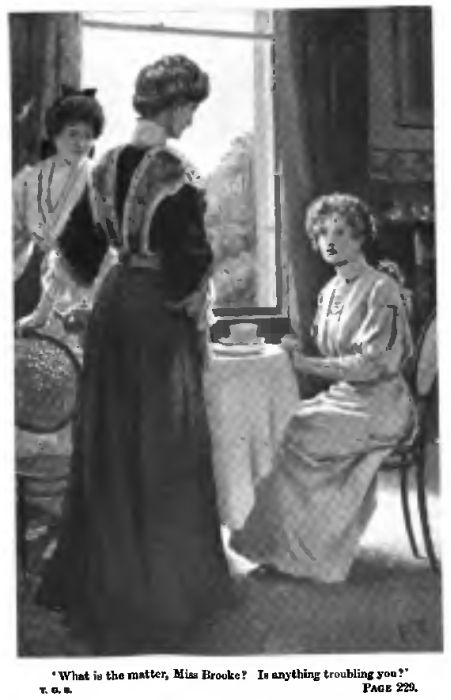
“What is the matter, Miss Brooke? Is anything troubling you?”
“Oh no; at least, not much,” said Annie. She reflected for a minute, wondering what she could safely say. “The fact is, Uncle Maurice—the dear old uncle with whom I live—is not quite well. He is a little poorly, and confined to bed.”
“Then you would, of course, like to return to him,” said Lady Lushington, speaking quickly and with decision.
“Oh,” said Annie hastily and scalding herself with hot coffee as she spoke, “that is the very last thing Uncle Maurice wishes. It is quite a passing indisposition, and he is so glad that I am here enjoying my good time. I will wire, dear Lady Lushington, if you will permit me, after breakfast, and give my uncle and the cousin who is with him our address at Zermatt. Then if there should be the slightest danger I can go to him immediately, can I not?”
“Of course, child,” said Lady Lushington, helping herself to some toast; “but I should imagine that if he were ill your place now would be at his bedside.”
“Oh, but it would distress him most awfully—that is, of course, unless you wish to get rid of me—”
“You know we don’t wish that, Annie,” said Mabel.
“Certainly we don’t,” said Lady Lushington in a more cordial tone. “You are exceedingly useful, and a pleasant, nice girl to take about. I have not half thanked you for all the help you have given me. If you can reconcile it to your conscience to remain while your uncle, who must stand in the place of a father to you, is ill, I shall be glad to keep you; so rest assured on that point.”
“I can certainly reconcile it to my conscience,” said Annie, breaking a roll in two as she spoke; “for, you see, it is not even as though my uncle Maurice were alone. My cousin can look after him.”
“Oh, you have a girl cousin? I did not know of that.”
“Not a girl; he is a man. His name is John Saxon.”
“What!” said Lady Lushington, her eyes sparkling; “Mr Saxon, the young Australian? Why, I met him in London last year. What a splendid fellow he is! I have seldom met any one I admired so much; and they say he is exceedingly rich. I want him to come over to London and enjoy himself for one of the seasons. I could get him no end of introductions.”
“He is with my uncle now,” said Annie, speaking rather faintly, for it seemed to her as though entanglements were spreading themselves round her feet more and more tightly each moment. “Doubtless he is a good nurse,” said Lady Lushington. She then turned the conversation to other matters.
After breakfast Annie went out and sent her telegram. In this she gave the address of the hotel where they were going to stay at Zermatt, at the same time saying that she much regretted, owing to the grave complications, that she could not leave Lady Lushington for a few days. She spent a fair amount of John Saxon’s money on this telegram, in which she begged of him to give her love to Uncle Maurice, and to say that if he really grew worse she would go to him notwithstanding that business which was involving all the future of her friend.
The telegram was as insincere as her own deceitful heart, and so it read to the young man, who received it later in the day. A great wave of colour spread over his face as he read the cruel words, but he felt that he was very near the presence of death itself, and not for worlds would he disturb the peace of that departing saint who was so soon to meet his Maker face to face.
“I will not wire to her,” he said to himself; “but if the old man still continues to fret, and if the doctor says that his longing for Annie is likely to shorten his days, I shall go to Zermatt and fetch her home myself. Nothing else will bring her. How could dear old Mr Brooke set his affections on one like Annie? But if he can die without being undeceived as to her true character, I at least shall feel that I have not lived in vain.”
Meanwhile, as these thoughts were passing through the mind of a very manly and strong and determined person, Annie herself was living through exciting times. She was not without feeling with regard to her uncle. After a certain fashion she loved him, but she did not love him nearly as well as she loved her own selfish pleasures and delights. She was sadly inexperienced, too, with regard to real illness. Her belief was that John Saxon had exaggerated, and that dear, kind Uncle Maurice would recover from this attack as he had done from so many others. Now she had much to attend to, and forced herself, therefore, after the telegram had gone, to dismiss the matter from her mind.
As Annie had predicted, Lady Lushington did call Mabel into her private sitting-room soon after early breakfast on that eventful day, and did speak very seriously to her with regard to Mrs Priestley and her bill.
“I don’t pretend for a single moment,” said Aunt Henrietta, “that I am poor, and that I am unable to meet a bill of three times that amount; but I do not choose you to be wantonly extravagant, Mabel, and it is simply an unheard-of and outrageous thing that a schoolgirl should spend seventy pounds on dress during one short term. You know I invariably pay your dressmaker at the end of each term. Now this bill is more than double the amount of any that I have hitherto paid for you. Will you kindly explain why it rises to such enormous dimensions?” Mabel was very much frightened, and stammered in a way that only increased her aunt’s displeasure.
“What is the matter with you, May? Can’t you speak out? Are you concealing anything from me?”
“Oh no, no, indeed, Aunt Hennie—indeed I am not! Only the fact is, I am quite certain Mrs Priestley must have made a mistake.”
“What is all this about?” said Annie Brooke, who entered the room at that moment.
“Oh, we were talking business.”
“I beg your pardon. Shall I go away?”
“No, don’t, Miss Brooke,” said Lady Lushington rather crossly; “you are really wanted here to help to clear matters. Seeing that I am honoured by the possession of so clever a niece as Mabel, I wish she would not on every possible occasion act the fool. She is as stupid over this outrageous bill as though she were an infant.”
“Well, Mabel,” said Annie, “you know quite well that you had some nice dresses, hadn’t you?”
“Yes,” said Mabel, who seemed to have a wonderful amount of added courage now that Annie had appeared on the scene. Then she nimbly quoted a description of the beautiful gowns which Annie had falsely described the day before.
“Most unsuitable for a schoolgirl,” said Lady Lushington. “And where are they, may I ask?”
“Oh, I—I—left them at school,” said Mabel.
“Worse and worse; you seem to have lost your head.”
“Poor May!” said Annie; “no wonder. You must know, Lady Lushington, that after your letter came May nearly worked herself into a fever to get that literature prize. She could think of nothing else. She did so long to be with you; didn’t you, May?”
“Indeed I did,” replied Mabel.
“Well, that is gratifying, I suppose,” said Lady Lushington; “although I am by no means certain, my dear May, that I return the compliment. My impression is that another year at that excellent school would do you no end of good. Well, you lost your head trying to get that prize. But how could that fact affect Mrs Priestley’s bill?”
“I mean,” said Mabel, “that I forgot about packing my dresses and taking them away, and I had not an idea that my bill amounted to that. In fact,” she added, meeting Annie’s eyes, “I am quite positive that Mrs Priestley has made a mistake, and that you will find the bill—”
Here she hesitated.
“I,” said Annie, “happen to know pretty well what May’s lovely dresses cost. Oh, you know, Lady Lushington, we thought them perfectly ruinous in price—we schoolgirls; for our best dresses usually come to from three to four pounds. But May’s—oh, some of hers were up to ten or twelve guineas. Even so, however, I don’t think May can owe Mrs Priestley more than forty pounds.”
“Then the woman’s a thief and a cheat!” said angry Lady Lushington.
“I think, perhaps,” said Annie, speaking in her gentlest tones, “it might be fairest to let her explain. She has probably—oh, she has such numbers of customers!—put down some items that don’t belong to Mabel in her account.”
“Well, well, we shall see,” said Lady Lushington. “You posted that letter, didn’t you, Miss Brooke?” Then she added, hastily and without waiting for an answer, “I shall be glad if it is so. I make no objection to paying forty pounds, but I do draw the line at seventy.”
“Thank you, auntie; thank you so much,” said Mabel, running up to her aunt and kissing her.
“Now don’t, my dear! You disturb the powder on my cheek. Do sit down; don’t be so impulsive.”
“I know what you are wanting to do; I know what is in your head, you silly Mabel,” said Annie at this juncture.
Lady Lushington looked up. “What is it?” she asked.
“Oh,” said Annie, “it is that necklace—that wonderful, amazing bargain.”
Lady Lushington pricked up her ears. She could not—and all her friends were aware of the fact—ever resist a bargain. She would have gone from one end of London to the other to secure the most useless old trash if she was firmly convinced in her own mind that she had to get it as a bargain. She now, therefore, sat up with sparkling eyes, and Mrs Priestley and her bill were as absolutely forgotten as though they had never existed.
“There are no bargains at Interlaken,” was her next remark.
“Oh, are there not?” said Annie. “Mabel and I know something very different from that.”
“What is it, my dear? What is it?”
“Well,” said Annie, “it was I who found it out. I showed it to May yesterday. You know Zick the jeweller in the little High Street?”
“Of course; his shop is full of rubbish.”
“There is a necklace there which is not rubbish,” said Annie, “and the best of it is that he is not a bit aware of its value himself.”
“A necklace? What sort?”
“He can’t be aware of its value,” said Annie, “which is very surprising, for these Swiss are so sharp; but I can assure you I was taught to recognise the beauty of good pearls, and there are some lovely ones in that necklace. Now nothing in all the world would be so becoming to May as real, good pearls; and this necklace—it belonged to an old French marquise, who was obliged to sell it, poor dear! to get ready cash. Zick paid—oh, he would not tell me what; but he is offering it for a mere bagatelle.”
“My dear Miss Brooke—a bagatelle!”
“Yes; only forty pounds.”
“Nonsense!” said Lady Lushington. “Forty pounds! All the contents of his shop are not worth that sum.”
“I dare say you are right,” said Annie, by no means abashed; “with the exception of the necklace. But now, you are a judge of jewels, aren’t you?”
“Well, I rather flatter myself that I am.”
“I saw two or three ladies from this hotel looking at the necklace yesterday. I was dying to tell you, but I had not an opportunity. I am so awfully afraid it may be snapped up. Do, do come at once and look at it!”
“If they are really fine pearls,” said Lady Lushington—“and the old French noblesse were noted for the beauty of some of their gems—it would be exceedingly cheap—exceedingly cheap at forty pounds. But then, of course, the whole thing is a hoax.”
“Oh, do, do come and see! It would be such a beautiful present for May.”
“She can’t wear ornaments until she is presented,” said Lady Lushington.
“Well, but think what even a string of pearls would cost, you know, in Bond Street.”
“Of course I know I could not get anything decent under a hundred pounds. You say forty pounds. Of course, the thing could be re-set—Would you really like it, May?”
“Like it?” said Mabel, trembling. “I’d—I’d adore it, auntie!”
“Well,” said Lady Lushington, “if your conjecture, Miss Brooke, with regard to Mrs Priestley is correct and Mabel has really only spent forty pounds on her dress, I should not mind doing a deal for the necklace; but as things are—”
“As things are,” said Annie, “I should not be one scrap surprised if Mrs Warden has the necklace already in her possession. It is certain to be bought up immediately, for it is a real bargain.”
“In that case,” said Lady Lushington, “I had better, Mabel, ring for Parker. I will just walk down with you to Zick’s. You can both come with me.”
Annie skipped as she ran up to her attic bedroom. Mabel, it may be mentioned, had a very nice room on the same floor as her aunt.
Priscie was out and all alone among the mountains. So much the better. Uncle Maurice, in his room which faced west, was listening for a light footstep that did not come, for the pressure of a little hand that was not present, for the love that he imagined shone out of blue eyes, but which in reality was not there. Annie forgot both Priscie and Uncle Maurice. Things were going swimmingly. How clever she was! How abundantly Mabel would thank her and love her and help her all the rest of her days!
Lady Lushington, accompanied by the two girls, went to Zick’s, and soon began the fierce war of words over the necklace. She perceived at once that Annie was right, and that the pearls were a very great bargain even at forty pounds; but she would not have been a true bargain-hunter if she did not try to bring Zick to accept lower terms. Unfortunately for her, however, two other ladies had been in the shop that morning, had examined the necklace, and had promised to call again. Lady Lushington, in the end, was afraid of losing it. She paid the money, and the necklace became her property.
“Oh May, you are in luck!” said Annie. “Lady Lushington has bought this for you.”
Mabel looked longingly at the little box in her aunt’s hand.
“Take it, child,” said Lady Lushington impulsively. “Be sure you don’t lose it. Let Parker pack it for you to-night with your other small trinkets; but on no account wear it until after your presentation. Really, those pearls are so fine that I think they might be re-set for the occasion. It is my strong impression that I have only given half the worth of that necklace to Zick. What an idiot the man must be to sell it so cheap!”
Chapter Nineteen.
A Profitable Transaction.
Annie Brooke was the sort of girl who was sure to be popular wherever she went. She had already made many friends in the Hotel Belle Vue at Interlaken. Amongst these was a quaint old gentleman with shaggy hair, deep-set eyes, a much-hooked nose, and a decidedly Jewish appearance. Few people were attentive to the old man, and he used to be glad when Annie came and sat next him in the big lounge after dinner, and listened to his rather rambling and rather meaningless talk. But Annie Brooke was the sort of person who does nothing without intent. She never met any one without trying to learn something with regard to that person’s peculiarities, that person’s past, and, if possible, that person’s present history.
Now Mr Manchuri was a dealer in gems, and it darted through Annie’s fertile brain as she was returning to the hotel with Lady Lushington and Mabel that she might do a little stroke of business both for herself and her friend if she showed the precious necklace to him. The more she thought on this, the more did this idea fascinate her. It would be very, very much better than taking the necklace back to Zick or offering it for sale to some other dealer at Interlaken. The jewellers there were not so clever with regard to the true value of gems as was Mr Manchuri; and besides, it was quite on the cards that they might exhibit the necklace in their windows for sale during the afternoon of that same day, and there was also a possibility that Lady Lushington, who was always rather wayward and uncertain in her movements, might postpone going to Zermatt for a day or two; in short, it would be very much safer to consult Mr Manchuri with regard to the necklace. He was going to return to England that very afternoon. If he took the necklace with him all would be safe; but Annie did not dare to confide her thoughts to Mabel. She was certain Mr Manchuri would not betray her, but she had to act warily and with tact.
Now Priscie had gone for a long walk into the mountains, and when she came back she was very tired. She went accordingly to sit in the lovely shady garden which was one of the principal features of the hotel. She chose a comfortable rustic seat under a wide-spreading tree, and sat for some time with a book on her knee lost in thought. By-and-by Annie entered the garden. She saw Priscilla, and was much annoyed. She knew that it was Mr Manchuri’s custom to smoke in the garden before lunch. She meant to join him and have a pleasant little talk. But the most shady seat—the seat, in fact, which he generally occupied—was now filled by the—to Annie—ungainly figure of Priscilla Weir.
“Oh dear me, Priscilla!” said Annie, pausing when she saw her friend, and looking at her with a great deal of exasperation.
“Yes,” said Priscie; “what is the matter?”
“I want to sit just where you are.”
“Well, I suppose you can; there is room for two.”
“But there isn’t room for three,” said Annie.
“Three?” said Priscilla. “Who is the third?”
“Oh, never mind,” said Annie; “I suppose we’ll find another seat. It is Mr Manchuri; he is going to England, you know, to-day. He is such a nice old man, and I did think I could send a little present by him as far as London, and then it could be posted to dear old Uncle Maurice. I wanted to give him a special message about it. But there, never mind.”
“I will go in if I am in the way,” said Priscie. She rose hastily and went towards the house. She felt that Annie was becoming almost unendurable to her. Such a queer, sore sensation was in her heart that she almost wondered if she could live through the next term at Mrs Lyttelton’s school in the presence of this girl—this girl so devoid of principle. But then, where were Priscilla’s own principles? What right had Priscilla to upbraid another when she herself was so unworthy? She crushed down the dreadful thought, and went back into the house feeling limp and miserable.
Meanwhile Mr Manchuri walked slowly down the garden in his meditative, cautious fashion, never hurrying in the very least, and gazing abstractedly at a view which he did not in the least admire, for he had no eyes for the really beautiful things of nature. Nevertheless he considered the strong, sweet air of the Swiss mountains good for him, and as such was the case, was satisfied with his surroundings. Presently he caught sight of Annie’s white frock. He liked Annie Brooke; she was a pretty little thing, very good-natured and amusing. He thought to himself how much nicer she was than any other girl in the hotel. She had no nonsensical airs about her, and could listen to an old man’s maunderings without showing the slightest sign of weariness. Her eyes were very blue, too, and her hair golden. He did not consider her pretty; no one ever thought Annie Brooke quite pretty; but then she was charming, and had a way of making a man feel at his very best while he talked to her; and she did not object to his smoking.
He accordingly made his way as straight as an arrow from the bow to the comfortable seat where Priscilla had been reposing, and which Annie had left vacant for him. Annie was seated on a far less comfortable chair herself. She was looking straight before her, her hands lying idle in her lap, her hat slightly pushed back. She did not appear to notice Mr Manchuri until he was close to her side. But when he said, “Hallo, Miss Brooke!” she looked up, and a happy smile parted her childish lips.
“Oh, now, this is nice!” she said. “I was wondering if I should see you before you went.”
“I am not going until late this evening,” was the answer.
“I thought you were going this afternoon.”
“No; I have decided to travel by night. It is too hot for day travelling at present.”
He sank into a seat and began to pull at his pipe vigorously. Annie gave a gentle sigh.
“What is the matter?” he asked.
She looked at him, glanced round her, and then, dropping her voice to a whisper, said:
“I wonder if I might confide in you.”
“Of course you may, Miss Brooke,” he said.
“But it is,” said Annie, “a most sacred confidence. I mean that if I tell you, you must never tell anybody else.”
“I am very honoured, I am sure,” said Mr Manchuri. “Now what is this confidence, young lady?”
“You will respect it?” said Annie.
“Here is my hand on it,” he said; and he laid his wrinkled hand for a minute in her little white one.
“Then it is just this,” said Annie. “I have a dear, dear uncle in England—Uncle Maurice. He is a clergyman; he is awfully good and sweet, and he is not at all well, and he is not rich, although he has enough. I am most anxious to send him a little present, something all from myself. Now I happened to get this to-day,” and she took a box from where it lay concealed in the folds of her dress. “I got this to-day at Zick’s, the jeweller’s. You must not ask me what I paid for it. I assure you it was not a great deal, but I am under the impression that it is worth far more than Zick has any idea of. I—I want to sell it in order to send a little present to dear Uncle Maurice, and you are such a judge of gems and precious stones of all sorts. May I show it to you? The fact is, I got it as a great bargain; but if you could tell me what I ought to ask for it, it would be such a help in disposing of it again. Do you think you could—and—would?”
Mr Manchuri gave Annie a long glance. It was the first very observant glance that he had given her. Hitherto he had simply regarded her as a nice, well-mannered, pleasant little girl, who did not mind amusing an old man with little nothings of conversation and little scraps of local news; but now it seemed to him all of a sudden that he saw something more in her face.
“And how,” he asked after a pause—“how is it, Miss Annie Brooke, that you happen to know that I am a judge of gems and precious stones?”
Annie did not expect this question, and in consequence she coloured very vividly. After a pause she said:
“I am always fond of putting two and two together; and don’t you remember that evening when you told me the wonderful story of the Duchess of Martinborough’s bracelet, and—and—about the ring that was stolen and sought for afterwards by the Secret Service people?”
“Yes, I remember quite well. Well, go on.”
“I thought what a lot you knew about those things. Don’t you?”
“Bless your heart, child!” he said, “I am in that trade myself; I have made a pretty snug fortune in it. Yes, I can glance at your little bargain and tell you, if you like, whether it is a bargain or not.”
“And you remember your promise; you will never tell any one?”
“Honour bright,” was his answer.
She then put the box into his hand. He opened it, and took out the old necklace with its pearls of various sizes and different shapes, and its very quaint, old-world setting. Annie glanced at him and saw a subtle change creep over his face. He had hitherto regarded the whole thing as a joke. Annie Brooke, child as she was, could not possibly know a bargain when she saw it, and those Swiss fellows were as sharp as knives and never let anything good escape them. And yet, and yet—here was something of real merit. Those centre pearls were distinguished—round and smooth and of the most exquisite colour.
He dangled the thing lightly in his hand.
All the tricks of the trade, all that which had made him the rich old man what he was, rushed quickly through his brain, and yet he looked again at Annie Brooke. For the life of her, Annie could not keep the eagerness out of her eyes.
“Is it a bargain, or is it not?” she said. “Have I been fooled about it?”
“Will you tell me in strict confidence what you gave for it?” he asked.
Annie had hoped he would not put this question to her.
“I was a little mad, I think,” she said. “I gave my all for it.”
“That tells me nothing. What is your all?”
“Forty pounds,” she said in a choked sort of voice.
“Were you not rather unwise to part with your last penny?”
“You don’t understand,” said Annie, who, having at last declared a part of the truth, felt better able to go on. “I have studied pearls a great deal; and Uncle Maurice, dear Uncle Maurice, has taught me their true value and something of their history, and I guessed that this was really cheap, and thought I could sell it for more.”
“By Jove!” said Mr Manchuri, “you are the sharpest girl I ever saw. How old are you?”
“Seventeen,” said Annie.
“God help the man who marries you!” said Mr Manchuri under his breath.
“What did you say?” asked Annie.
“Nothing, nothing, my dear. Of course I admire your cleverness. Well, you have come to the right person. I will give you one hundred pounds for this necklace; there, now.”
“And you won’t say anything about it?” said Annie, who felt at once faint and delighted, overpowered with joy, and yet subdued by an awful weight of apprehension.
“Nothing to any one in this hotel. But the thing is a curio, and I shall probably sell it for double what I give you. I do not conceal anything from you. Miss Annie Brooke. You might try for ever, and you would find it difficult to get your forty pounds back. But I, who am in the trade, am in a different position. Had I gone to Zick before you, I would have probably bought the thing for thirty pounds and thought no shame to myself for doing so. But I won’t cheat a young lady, particularly such a very clever young lady, and you shall have your hundred pounds at once. Here; I have notes on my person. You would prefer them to a cheque?”
“Oh yes, please!” Annie trembled with joy.
Mr Manchuri counted out ten ten-pound notes, and Annie gave him the quaint pearl necklace.
She then lingered a little longer trying to talk on indifferent matters, but her interest in the old Jew was gone, and, as a matter of fact, she did not want to see him any more.
As to the old man himself, he felt that he hated her; but he was glad to have made a good stroke of business, although he was very rich. That was always worth something. He would in all probability clear one hundred and fifty pounds on the necklace, which would more than pay for his trip abroad and for the benefit he had derived from the air of the Swiss mountains.
Annie went into the house, rushed up to Mabel’s room, and, taking three ten-pound notes out of her pocket, said exultantly:
“There, I have done it! Now who is clever?”
“Oh, you are,” said Mabel. “But where did you sell it, and to whom? We must keep Aunt Henrietta from going to any of the shops to-day.”
“Oh, we will easily manage that,” said Annie. “She is going to have a little drive after lunch, and I am going with her—trust me. We must get to Zermatt to-morrow. Now I am going to write a long letter to Mrs Priestley enclosing this. I shall barely have time before déjeuner.” When that day Annie Brooke did sit down to déjeuner she considered herself a remarkably wealthy young woman, for she had in her possession nearly eighty pounds, every one of which she intended to keep for her own special aggrandisement; and Mrs Priestley was paid—paid in full, with a long explanatory letter desiring her emphatically to send an account to Lady Lushington which would only amount to forty pounds.
Annie was exceedingly pleased. The colour of excitement bloomed on her cheeks; her eyes looked quite dark. At these times she was so nearly pretty that many people remarked on her and turned to look at her again. She was in her wildest, most captivating mood, too, and Priscilla looked by her side both limp and uninteresting. If only Priscilla would go. Her very face was a reproach. Annie wondered if she could accomplish this feat also. Mr Manchuri could take her to England. What an excellent idea, if Annie could only work it!
“I have had everything else I wanted to-day,” thought the girl, “and if I can do this one last thing I will see the pinnacle of my success reached.”
“You will come for a drive, won’t you?” said Annie, bending towards Lady Lushington as the tedious meal of déjeuner was coming to an end.
Lady Lushington yawned slightly.
“Oh, I don’t know,” she said; “the heat is so great that I have not energy for anything. I wonder if I ought to travel to-morrow.”
“Oh yes,” said Annie; “it will be cooler at Zermatt.”
“That is true; but the journey—”
“We have taken our rooms in the hotel, have we not?” said Annie.
“Well, that is just it; I am not sure. I telegraphed this morning to the ‘Beau Séjour,’ but have not had a reply yet. I insist on staying at the ‘Beau Séjour.’ There is no hotel like it in the place.”
“There are such a lot of us, of course,” said Annie; “but Priscie and I do not mind sharing the tiniest little room together; do we, Pris?”
Here she glanced at Priscilla. Priscilla looked up.
“I don’t want to be unpleasant,” she said, “but I certainly should like a room to myself.”
“Of course, my dear,” said Lady Lushington.
“Dear, dear! I must consult with Parker. There’s a room for me, a room for Mabel, a room each for you two girls—that makes four; and Parker’s room, five. You two girls would not by any chance mind sleeping in another hotel, would you?”
Here she looked first at Annie and then at Priscilla.
“Certainly not,” said Annie. “I do not mind anything.”
Priscilla was quite silent. Just then one of the waiters appeared with a telegram. It was to Lady Lushington. She opened it. There were only four bedrooms available at the “Beau Séjour.”
Annie spoke impulsively. “I tell you what,” she said. “I won’t be in the way; I won’t. I will go back to England to-night. I can go with Mr Manchuri, that funny old Jew gentleman whom I have been so friendly with. I know he will let me travel with him. It is just too bad, Lady Lushington; you must let me. I have been, oh! so happy, and it will be a cruel disappointment to go; but I will. Yes, I will go.”
“Seeing that your uncle is ill, perhaps—” began Lady Lushington.
“Oh, please don’t think that it is on account of that. Uncle Maurice constantly has these attacks. He is probably as well as ever by now; but it is just because I won’t crowd you up.”
“But, Annie,” said Mabel in a troubled voice, “you know I can’t live without you.”
“It is very awkward indeed,” said Lady Lushington—“very awkward. The fact is, I can’t very well spare you; you are of great use to me.”
Priscilla rose from the table. She had scarcely touched anything during the meal.
“I think I know what Annie Brooke means,” she said. “She means that one of us two girls is to offer to go back, and she naturally does not intend to go herself.”
“But I offered to go. How cruel you are!” said Annie. “I will go, too,” she added, pouting and looking at once pretty and petulant. “Yes, Lady Lushington, I will go.—Mabel, I can’t help it. You are my very dearest ownest friend; but I won’t crowd you up. You will have Priscie.”
“No,” said Priscilla mournfully; “I am no use. I don’t think at present I love people, and I can’t talk much, and I can’t wear”—she hesitated—“the dresses that other people wear. I will go. I have had a beautiful time, and I have seen the mountains. It is something to have had even a glimpse of the higher Alps; they are like nothing else. A little disappointment is nothing when one has had such great joy. I will go to-night if Mr Manchuri will let me accompany him.”
“It does seem reasonable, Miss Weir,” said Lady Lushington. “We can’t stay on here, for our rooms are let, and I won’t go anywhere at Zermatt except to the ‘Beau Séjour.’ As to one of you girls sleeping out it cannot be thought of, although I did propose that two of you might—that is, together; but there seem to be difficulties. You have not been very happy with us, have you, Miss Weir?”
“You have been the cause of great happiness to me, and I thank you from my heart,” said Priscilla.
“Well, my dear, I will of course pay your fare back. I hope we may meet again some day. Then that is settled.—Annie, please go at once and wire that we will engage the four rooms, and—who will see Mr Manchuri and arrange with him to let Priscilla accompany him to England?”
“I will do both,” said Annie.
She hastily left the salle-à-manger and ran through the great lounge with a sort of skipping movement, so light were her steps, and so light and jubilant her heart. The old Jew did not make any demur when he was told that the tall, slender young lady was to accompany him home.
“I will look after her,” he said. “Don’t thank me, please, Miss Brooke; I don’t suppose that she will be the slightest trouble.”
Priscilla went up to her room, flung herself on her bed, and wept.
Chapter Twenty.
A Confession and a Friend.
It is quite true that very clever people are sometimes apt to overstep the bounds of reason and prudence; and whether all that befell Annie Brooke and all that retribution which she so richly merited would have fallen so quickly and so decisively on her devoted head had she not been anxious to get rid of poor Priscilla must remain an unsolved question. But certain it is that Priscilla Weir’s departure in the company of Mr Manchuri was the first step in her downfall. Annie, with eighty pounds in her pocket and with all fear of Mrs Priestley laid at rest, felt that she had not a care in the world.
But Priscilla, when she stepped into the first-class carriage which was to convey her en route for England, was one of the most perplexed and troubled girls who could be found anywhere. Mr Manchuri, with all his faults, his love of securing a bargain, his sharpness, had a kindly heart. He saw that the girl was in trouble, and took no notice at all of her for more than an hour of the journey.
It so happened, however, that very few people were returning to England so early in the season, and the pair had the railway carriage for a long time to themselves. When Priscilla had sat quite silent for a considerable time, her eyes gazing straight out into the ever-gathering darkness, Mr Manchuri could contain himself no longer.
He had scarcely ever glanced at Priscilla Weir when she was at the hotel. She was not pretty; she was not showily dressed; she was a queer girl. He knew that she belonged to Lady Lushington’s party, but beyond that he was scarcely aware of her existence. Now, however, he began to study her, and as he did so he began to see marks of what he considered interest in her face. What was more, he began to trace a likeness in her to some one else.
Once, long ago, this queer, dried-up old man had a young daughter, a daughter whom he loved very passionately, but who died just when she was grown up. The girl had been tall and slender, like Priscilla, and strangely unworldly and fond of books, and, as the old man described it, good at star-gazing. He did not know why the memory of Esther, who had been in her grave for so many years, returned to him now. But, be that as it may, Priscilla, without being exactly like Esther, gave him back thoughts of his daughter, and because of that he felt inclined to be kind to the lonely girl. So, changing his seat which he had taken at the farther end of the carriage, he placed himself opposite to her and said in a voice which she scarcely recognised:
“Cheer up now, won’t you? There is no good in fretting.”
Priscilla was startled at the kindness of the tone. It shook her out of a dream. She turned her intensely sorrowful eyes full upon Mr Manchuri and said:
“I shall get over my disappointment, I am sure; please don’t take any notice of me.”
“But, come now,” said Mr Manchuri, “what are you fretting about? You are going home, I understand.”
“Oh no, I am not,” said Priscilla; “I am going back to school.”
“Oh, so you are a schoolgirl?”
“Yes, sir.”
“How old are you, my dear?”
“I am nearly seventeen,” said Priscilla.
Now Esther had been nearly seventeen when she died; she was not quite seventeen. Mr Manchuri felt glad that Priscilla was not quite seventeen.
“I thought of course, you were going home,” he said—“that perhaps you had some one who wanted you very much. Why should you, I wonder, leave Lady Lushington’s party?”
“There was not room for all of us at the hotel at Zermatt, so I am going back to England.”
“But why you?” said Mr Manchuri. He felt quite angry. How furious he would have been if any one had treated his Esther like that!—and this girl had a voice very like Esther’s. “Why you? Why should this be your lot?”
“Oh, I don’t know,” said Priscilla. “Some one had to do it.”
“I see; that little Annie Brooke would not go, for instance—not she; she is far too clever.”
“She offered to go,” said Priscilla, who would not allow even Annie to appear at a disadvantage.
Mr Manchuri laughed.
“There is a way of offering, isn’t there, Miss— Forgive me, my dear; I have not caught your name. What is it?”
“Priscilla Weir.”
“I like the name of Priscilla; it is so quaint and old-fashioned. Do you know that I once had a girl called Esther. She was my only child. That is a quaint name too, if you like. Don’t you think so? Don’t you think that Esther is a very pretty name?”
“Very,” said Priscilla. “It is a beautiful name,” she added; “and that story about Queen Esther is so, so lovely!”
“Isn’t it?” said Mr Manchuri. “And my girl was like her—a sort of queenly way about her. Do you know, miss—you don’t mind if I call you Priscilla?”
“Please do,” said Priscilla.
“Do you know that in a sort of manner you remind me of my dear Esther. She was darker than you; but she was like you. God took her. Shall I tell you why?”
“Please,” said Priscilla. She had come back to the present world now, and was gazing, with all her heart in her eyes, at the queer old man.
“She was too good for earth,” said Mr Manchuri; “that is why God took her. He wanted her to bloom in the Heavenly Gardens. She wasn’t a bit like me. I am all for money and bargains—I made a rare one to-day; but I mustn’t talk of that. That is a secret. I am a rich man—very rich; and when I die I will leave my money to different charities. I have not kith or kin to leave it to—neither kith nor kin, for Esther is with God and the angels. But, all the same, I can’t help making money. It is the one pleasure I have. If a week goes by when I can’t turn over a cool hundred or even sometimes a thousand I am put out and miserable. You don’t understand that feeling, do you?”
“No; I don’t,” said Priscilla.
“No more did Esther; I could not get it into her. I tried to with all my might, but not one little bit of it would get through that pure white armour she wore—the armour of righteousness, I take it.”
“Tell me more about her,” said Priscilla, bending forward and looking full into Mr Manchuri’s eyes.
“I could talk about her for ever to you,” was the answer; “although, as a matter of fact, I have not mentioned my child’s name to a living soul for going on thirty years. It is thirty years since she went to God, and she is as young as ever in the Heavenly Gardens—not seventeen yet; just like you.”
“Yes,” said Priscilla. “It is very, very interesting,” she added. “It seems to me,” she continued, “as if I knew now why I am taking this journey, and why God did not want me to see the lovely mountains that surround Zermatt.”
“You are more and more like Esther the more you talk,” said Mr Manchuri. “She was all for star-gazing and that sort of thing. I take it, that includes mountain-gazing and going into raptures at sunsets and at sunrises, and going into fits at shadows on the hills and lights across the valleys, and little flowers growing in clumps by brooks, and living things that you can see if you look deep into running water, and the songs of birds, and the low hum of insects on a summer evening. After these things, which she liked best of all, she loved books that made her think, and I could not get her to take the slightest interest in what she wore, or in money, bless you! But she was sweet beyond words with children, and with people who were in trouble; and there were girls of her own class in life who adored her. They are elderly women now—oldish, almost—with children of their own; but two or three of them have called their girls Esther after her, although they don’t resemble her one little bit. You are the first girl I ever came across who in the very least resembles her. I wish I could see your face in the light.”
“I love the things she loved,” said Priscilla.
“Hers must have been a most beautiful nature.” Then she added fervently, “It was very lucky for her that she died.”
“Why do you say that?” said Mr Manchuri. “Lucky for her? Well, perhaps so, for God and the angels and the Gardens of Heaven must be the very best company and place for one like my Esther; but nevertheless, she would have had a good time down here.”
“No, she wouldn’t,” said Priscilla stoutly. “The world is not made for people like her.”
“Then you don’t find the world a good place?” said Mr Manchuri, speaking in an interested voice.
Priscilla took a long time before she replied. Then she said very gravely:
“I don’t find the world a good place—I mean the people in it; and I want to say something”—her voice broke and changed—“I must say something; please let me.”
“Of course you shall, my dear Priscilla. My dear girl, don’t agitate yourself; say anything you like.”
“You have been so kind comparing me to your child—to your beautiful child,” said Priscilla. “But I must undeceive you. Although I love the mountains and the things of nature, and although I cry in my heart for goodness, and although I am the same age as your Esther was when she went away to God, I am not a bit like her, for I am not good. I am—wicked.”
Mr Manchuri was startled at this statement, which he took to be the exaggeration of a young and sensitive girl.
“You must not be too introspective,” he said after a pause. “That is very bad for all young things. Esther was not. She had a beautiful belief in God, and in goodness, and in joy. She was never, never discontented—never once. If you are not like her in that, you must try to grow like her. I tell you what; you interest me tremendously. You shall come to see me in London, and I will show you Esther’s portrait.”
“I can’t come,” said Priscilla. “You talk to me out of your kind, very kind heart; but you don’t know. I am not a good girl. I have done something far and away beyond the ordinary bad things that girls do, and I cannot possibly come to you under false colours. If I could, I would be friendly with worldly people, but I am not in touch with them; and good people I can have nothing to do with. So I must stand alone. I shall never see your Esther; I know that; but thank you all the same for telling me about her; and—and—I shall never forget the picture you have given me of her most lovely character.”
Mr Manchuri was considerably startled at Priscilla’s words, and in some extraordinary way, as she spoke, the image of Annie Brooke when she looked at him with that crafty expression in her eyes returned to him, and he said to himself:
“I will get to the bottom of the secret that is troubling the girl who is like my Esther; and I have a very shrewd suspicion that Miss Brooke is mixed up in the affair.” Priscilla closed her eyes after she had uttered the last words, as though she were too tired to say any more, and Mr Manchuri sat and watched her. She had very handsome, long, thick, black eyelashes, and the likeness to his Esther was even more apparent in her face when her eyes were shut than when they were open. The more the old man looked at her, the more did his heart go out to her. It had been for long years a withered heart—a heart engrossed in that most hardening of all things—money-making. To make money just for the love of making it is enough to crush the goodness and frankness out of all lives, and Mr Manchuri had twenty times too much for his own needs. Still, his excitement over a bargain or a good speculation was as keen as ever; and even now, at this very moment, was he not wearing inside his waistcoat that curious necklace which he had bought from Annie Brooke that day? He would make, after paying the hundred pounds which he had given Annie, at least one hundred and fifty pounds on the necklace.
Yes; he lived for that sort of thing. He had a very handsome house, however, at the corner of Park Lane, and this house was filled with rich furniture, and he had a goodly staff of servants, and many friends as rich as himself came to see him, and he drank the most costly wines and ate the most expensive dinners, and never spent a penny on charity or did one good thing with all his gold. There was one room, however, in that house which was kept sacred from the faintest touch of worldliness. This room contained the portrait of the child who was taken away from him in her first bloom. It was a simple room, having a little white bed and the plainest furniture that a girl could possibly use. There were a few of Esther’s possessions lying about—her work-box, her little writing-desk, a pile of books, most of them good and worth reading; and Mr Manchuri kept the key of that room and never allowed any one to enter it. It was the sacred shrine in that worldly house. It was, in short the heart of the house.
But now Mr Manchuri discovered on this midnight journey that that withered heart of his own, which he had supposed to be dead to all the world, was suddenly alive and keenly interested in a girl of the age of his Esther—a girl who absolutely told him that she was not good, and that because she was not good she must stand alone.
“I will get her secret out of the poor young thing,” he said to himself; “and what is more—what is more, I will help her a little bit for the sake of my Esther.”
Priscilla was really very tired. She slept a good deal during the night, all of which time they had the carriage to themselves. But in the morning some fresh travellers entered their compartment, and Mr Manchuri had no opportunity of saying a word in private to Priscilla until they were on their way to London. When, however, they had crossed the Channel, the first thing he did was to engage a private coupé on the express train, and soon, as they were whirling away towards the great centre of life and commerce, he was once again alone with his young companion.
“Now, my dear,” he said, “you will just forgive me for asking you a plain question.”
“I am sure I will, Mr Manchuri,” said Priscilla. “You have been most, most kind to me.”
“We shall arrive in London,” said Mr Manchuri, “at five o’clock. Now, may I ask where you intend to go for the night?”
“I will send a telegram to my schoolmistress, Mrs Lyttelton, and then take the next train to Hendon,” was Priscilla’s remark.
“But is your schoolmistress at home?”
“I do not know; but somebody will be.”
“Do you want to go back to school in the holidays?”
“Not very specially; but I must go, so there is no use talking about it. I felt so bewildered yesterday that I did not send a telegram, as I might have done. But I know the servants can put me up, and it will be all right—and you have been, oh! so kind, Mr Manchuri.”
“Not at all, my dear Priscilla; not at all. The fact is, I have never enjoyed a journey so much; your company has given me real pleasure. And now what do you say—”
“Yes?” interrupted Priscilla.
“To coming to me to my house for a few days—even for a night or so—instead of going back to Hendon?”
“To your house, Mr Manchuri?”
“Yes, my dear; you will have a hearty welcome there, and I assure you it is quite large enough. I have got excellent servants, who will look after you, and you won’t see much of me except in the evening, and then perhaps you will cheer me up a bit; and—and I want to show you what you know, my dear—”
Priscilla turned first red and then white.
“I have told you why I cannot see that,” she said.
“That is the subject I want to discuss with you more fully. Will you come back with me to Park Lane, and to-night? I am an old man and lonely, and you, my dear little girl, have stirred something within me which has never been stirred for thirty years, and which I thought was quite dead. You won’t refuse me, will you? That, indeed, would be a sin. That would be putting a heart back once more into its grave.”
Priscilla was startled at the words, and still more at the expression in the old face; there was such a hungry, pleading look in the eyes.
“Oh no,” she said simply, “I am not so bad as that. If you want me like that—I, who am not wanted by any one else—indeed, I will come.”
Chapter Twenty One.
Confessions.
Mr Manchuri was a person who seldom had his soft moods; but he was very kind to Priscilla. She found the house most luxurious, and was allowed to do exactly what she liked in it. The housekeeper, Mrs Wolf, petted her a good deal, and the other servants were most respectful to her. She was given a large, luxurious room to sleep in, and was allowed to do what she liked with herself while Mr Manchuri was busy all day long over his business affairs.
So one day lengthened into two, and two into three; and a week passed, and still Priscilla was the guest of old Mr Manchuri. It was a Sunday evening, the first Sunday after her visit, when she and the old man were seated together, and the old man put out his hand and touched hers and said:
“There is a dress of Esther’s upstairs; it is all grey and long and straight, and belongs to no special fashion, and I believe if you put it on it would exactly fit you; and I think, in this sort of half-light, if you came down to me in that dress I should almost believe that Esther had returned.”
“But I can’t wear the dress,” said Priscilla, “because of that which I have told you; nor can I see the portrait of your Esther for the same reason.”
“Now, my dear,” said Mr Manchuri, “I won’t ask you to wear the dress and I won’t show you the portrait of my child until you yourself ask me to do so. But what I do want to say is this: that whatever happens, I am your friend; and as to your having done something that you call wicked—why, there—I don’t believe it. What can a young girl who is not yet seventeen have done? Why, look at me, my dear. I am as worldly an old fellow as ever lived, and I have made a capital good bit of business while at Interlaken. It is connected with that secret that I hinted to you about when we were on our way back from Interlaken.”
“Mr Manchuri,” said Priscilla, “what you have done in your life cannot affect what I have done in mine. I have done a very bad thing. It seems dreadful to me, and”—here she looked at him in a frightened way—“you attract me very much,” she said. “You have been so wonderfully kind to me, and the thought of your Esther seems to give me a sort of fascination towards you, and if you will let me I—I—should like to tell you what I have done.”
“Ay?” said the old man, rubbing his hands. “Now we are coming to the point.”
“You will send me away, of course,” said Priscilla; “I know that. I know, too, that you will counsel me to do the only right thing left, and that is to make a clean breast of everything to Mrs Lyttelton.”
“She is your schoolmistress?”
“Yes.”
“Then it is something you have done at school?”
“That is it.”
“Oh, a schoolgirl offence—a scrape of that sort! My dear young lady, my dear Priscilla, when you come to my age you won’t think much of things of that sort.”
“I hope I shall never think lightly of them,” said Priscilla; “that would be quite the worst of all.”
“Well, out with it now. I am ready to listen.”
“I want you to do more than listen,” said Priscilla. She took one of his hands and held it in both of hers. “I want you to be Esther for the time being. I want you to judge me as Esther would judge me if she were here.”
“My God!” said the old man. “I cannot do that. I cannot look at you with her eyes.”
“Try to, won’t you? Try to, very hard.”
“You move me, Priscilla. But tell me the story.”
“It implicates other people,” said Priscilla—she sank back again in her seat—“and in telling you my share in it I must mention no names; but the facts are simply these. I have a great and very passionate love for learning. I am also ambitious. I was sent to Mrs Lyttelton’s most excellent school by an uncle in the country. He could not very well afford to pay the fees of the school, and his intention was to remove me from it at the end of last term. I ought to tell you, perhaps, that I have a father in India; but he has married a second time and has a young family, and he is very poor. Uncle Josiah is my mother’s brother, and he has always done what he could for me. But he is a rather rough, uneducated man; in short, he is a farmer in the south-west of England. Towards the end of the last term I received a letter from him saying that he could not afford to keep me at school any longer, and that I was to come back to him and either help my aunt in the house-work—which meant giving up my books and all my dreams of life—or that I was to be apprenticed to a dressmaker in the village.
“Now both these prospects were equally odious to me. I struggled and fought against them. The suffering I endured was very keen and most real. Then, just when I was most miserable, there came a temptation. By the very post which brought me the dreadful letter from my uncle Josiah, there came a letter to another girl in the school who was most keenly desirous to leave it. I cannot mention the girl’s name, but she was told that unless she won the first prize for literature at the break-up she was to remain for another year. You see, Mr Manchuri, this was the position. One girl wanted to go; another girl wanted to stay. Now I wanted to stay, oh! so tremendously, for another year at school would give me a chance which would almost have been a certainty of getting a big scholarship, which would have enabled me to go from Mrs Lyttelton’s school to Girton or Newnham, and from there I could have continued my intellectual life and earned my bread honourably as a teacher.”
“This is quite interesting,” said Mr Manchuri. “And what happened? You are still at school—at least, so you tell me.”
“Yes,” said Priscilla, “I am still at school; I am there because I—sinned.”
“How, child? Speak, Priscilla; speak.”
“There was another girl in the school, and she was wonderfully clever. I must not tell you her name. She managed the thing. She managed that the girl who wanted to leave the school should get the prize for literature, and that I should stay for a year longer at Mrs Lyttelton’s.”
“But how? How could she do it?”
“She was so marvellously clever that she did do it—of course with my connivance.”
“Oh, with your connivance. How?”
“Well, you see, I could write better essays than most girls in the school, and—and—it was arranged, and—and I consented to give up my essay to the girl who wanted to go, and to allow her to put her signature to it, and I took her essay and put my signature to hers. So she got the first prize for literature and left the school, and I stayed on, my reward being that my fees were to be paid for the ensuing year. That is the wicked thing I have done, and it has sunk into my heart and has made life unendurable.”
“Thank you; thank you very much,” said Mr Manchuri.
Priscilla bowed her head. The old man started up and began to pace up and down the room. After a time he went up to the girl, just touched her on her bowed head, and said very gently: “We will judge this thing, if you please, in the presence of my daughter Esther. Come with me now to her room; you shall see her. The portrait of her is so good that you will almost feel that you are looking at her living self.” Priscilla rose tremblingly. She was weak and exhausted in every limb, but it seemed to her that a powerful hand was drawing her forward, and that she had very little will to resist. Mr Manchuri took the girl up to a room on the first floor. It was a beautifully large room, but scantily furnished. He lit some candles that had been previously arranged in front of a large picture which stood on an easel. This picture had been painted by one of the great portrait-painters of thirty years ago. It was a most speaking likeness, and Priscilla, when first she saw it, started, turned very white, and clasped Mr Manchuri’s hand.
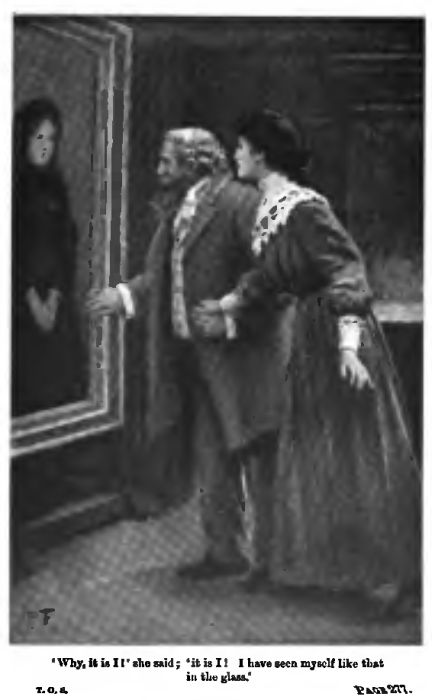
“Why, it is I!” she said; “it is I! I have seen myself like—like that in the glass.”
Mr Manchuri drew a deep breath of relief.
“Didn’t I know it?” he said. “Didn’t I say that you were like her? And see—she smiles at you.—You forgive Priscilla, don’t you, Esther? Smile at her again, Esther, if you forgive her.” The smile on the young face of the girl who had so long been dead seemed to become more pronounced, more sweet, more radiant.
“There,” said Mr Manchuri, “Esther has judged just as God does, I take it; and the thing is forgiven as only God forgives; but what you have to do, Priscilla Weir, is this. You have to put yourself right with your schoolmistress, and in doing so you cannot, in any justice, shield your schoolfellows. I am no fool, dear girl, and I know their names well enough. One of them is that Miss Lushington whom I met at the Hotel Belle Vue, and the other—the girl who arranged the plot and carried it through with such cleverness—is no less an individual than my little quondam friend, Annie Brooke. You see, my dear, there is no genius in my making this discovery, for I have heard them both talk of Mrs Lyttelton’s school, and Miss Brooke often entertained me in the most charming way by giving me a minute description of Miss Lushington’s talents and how she won the great literature prize. Little, little did I then guess that I should be so much interested in you, my dear. We will leave Esther now. Come downstairs with me again.”
Chapter Twenty Two.
Contrary Influences.
Annie’s high spirits continued with her during all the somewhat hot journey from Interlaken to Zermatt. She was, in truth, the life of the party, and kept every one in the best possible humour. Her charm was undoubted, and her apparent unselfishness made her invaluable. Even Parker acknowledged that there never was such an obliging young lady, or such a thoughtful one, as Miss Annie Brooke. Mabel could groan at the heat. Lady Lushington grumble and complain, even Parker herself could give way to insupportable headache, but nothing, nothing daunted the unflagging good-humour of Annie Brooke. Had she not the eau-de-Cologne handy for poor Parker’s head? Could she not chat cheerfully to Lady Lushington and make her laugh, and could she not insist on Mabel’s having the seat where she was at once protected from too much draught and yet not exposed to the full glare of the August sun?
When they reached the hotel, too, it was Annie who chose, without a moment’s hesitation, the one uncomfortable room of the little suite which was set apart for Lady Lushington’s party.
“Nothing matters for me,” said Annie. “I have got unflagging health, and I am so happy,” she said. “Every one is so kind to me.”
“You really are a dear little thing,” said Lady Lushington when Annie herself entered that lady’s room bearing a cup of tea which she had made from Lady Lushington’s own private store, and which smelt so fragrant and looked so good. “Oh, my dear Annie,” continued the good lady—“I really must call you by your Christian name—I never did find any one quite so pleasant before. Now if Mabel had not been such a goose as to get that literature prize, which I verily believe has swamped every scrap of brain the poor girl ever possessed, I could have had you as my little companion for a year. How we should have enjoyed ourselves!”
“Oh, indeed, how we should!” said Annie, a bitter sigh of regret filling her heart, for what might she not have made of such a supreme opportunity? “But,” she added quickly, “you would not have known me then, would you? You would never have known me but for Mabel.”
“It is one of the very luckiest things that could have happened to me—Mabel wishing that you might join us,” said Lady Lushington. “You are the comfort of my life; you are worth fifty Parkers and a hundred Mabels. Yes, is the exact right angle for the pillow, my dear. Thank you so much—thank you; that is delicious, and I think I will have a biscuit. What a glorious view we have of Monte Rosa from the window!”
“Oh yes,” said Annie, “isn’t it lovely?”
“By the way, Annie, you are quite sure that Mabel is taking care of those pearls of hers. We have to thank you too, you clever little thing, for discovering them. I am quite under the impression that I have come by a good bargain in that matter.”
“I am sure you have, dear Lady Lushington; and the pearls are quite, quite safe.”
“I knew you would see to it, dear; you are so thoughtful about everything. By the way, I have already seen on the visitors’ list the name of a certain Mrs Ogilvie. If she is my friend I should like to show her the necklace.”
Annie felt her heart nearly stop for a minute. “Of course you must show it,” was her gentle response; “and I will see that dear Mabel takes care of the precious things.”
“Well, you can go now, darling; you have made me feel so nice, and this room is delicious. Really, the journey was trying. It is horrible travelling in this intense heat, but we shall do beautifully here.”
Annie tripped out of the room and went straight to Mabel’s. Mabel’s room was not nearly as good as the one which Lady Lushington occupied, but still it was a very nice room, with two large windows which opened in French fashion and had deep balconies where one could stand and look into the very heart of the everlasting hills. Parker’s room was just beyond Mabel’s, and Annie’s was at the back. It was arranged that Parker should be within easy reach of her mistress and her young lady, and self-forgetful Annie therefore selected the back-room. She had no view at all; but then, what did views matter to Annie, who was blind to all their beauty? Mabel was alone. She felt very hot and dusty after her journey, and had just slipped into a cool, white dressing-gown.
“Let me take down your hair, dear May,” said Annie, “and if you sit in that deep arm-chair I will brush it for you. Isn’t it nice here, May?”
“Yes,” replied Mabel, “I suppose it is; only you have a horrid small room, Annie.”
“I don’t care a bit about that,” said Annie. “I am not going to be much in it except to sleep, and when one is asleep any room suffices. But, May, I want to talk to you.”
“What about?” said May. “Anything fresh?” Annie carefully shut the door which communicated between Mabel’s room and Parker’s.
“It is this,” said Annie; “Your aunt Henrietta has been talking to me about the pearl necklace, and says she hopes you have it safe.”
“Well, yes,” said Mabel, with a yawn; “it is quite absolutely safe, isn’t it, Annie?”
“Yes; but this is the crux: I thought she would have forgotten all about it, but she evidently hasn’t, and she says she thinks a friend of hers—a Mrs Ogilvie—is staying in the hotel, and if so, she would like to show it to her.”
“Oh, good gracious!” said Mabel, springing to her feet, and knocking the brush out of Annie’s hand in her excitement; “and if such a thing happens—and it is more than likely—what is to become of us?”
“If such a thing happens,” said Annie with extreme coolness, “there is only one thing to be done.”
“Oh Annie, what—what?”
“We must pretend that we have lost it. So many people are robbed nowadays; we must be robbed also: that is all Parker is supposed to have charge of it; you must confess that you never gave it to Parker, but put it into the lid of your trunk. You must lose one or two other things as well. You must have your story ready in case Mrs Ogilvie is in the hotel.”
“Oh! I don’t think I can stand any more of this,” said poor Mabel. “You seem to lead me on, Annie, from one wickedness to another. I don’t know where it is to end.”
“You must obey me in this,” said Annie with great determination.
“Oh, we are both lost!”
“We are nearly out of the wood; we are not going to lose our courage at the supreme moment. Come now, Mabel, don’t be absolutely silly; nothing may happen. But if anything happens, you must be prepared to do what I tell you.”
“You have an extraordinary power over me,” said Mabel. “I often and often wish that I had not yielded to you at that time when Aunt Henrietta wrote me that letter and I was so cross and disappointed. I think now that if you had not been present I should be a happier girl on the whole. I should be going back to the horrid school, of course, and Priscie would have left; but still—”
“Come, come,” said Annie, sitting down determinedly on a low chair by her friend’s side. “What is the matter with you? I really have to go over old ground until things are quite disagreeable. What have you not won through me? A whole year’s emancipation, a jolly, delightful winter, a pleasant autumn at the Italian lakes and in Rome and Florence. I think, from what she tells me, Lady Lushington means to go to Cairo for the cold weather. Of course you will go with her. Think of the dresses unlimited, and the balls and the fun, and the expeditions up the Nile. Oh, you lucky, you more than lucky Mabel! And then home again in the early spring, and preparations for your great début taking place, your presentation dress being ordered, and all the rest. Imagine this state of things instead of pursuing the life which your poor faithful little Annie will lead at Mrs Lyttelton’s school! And yet you blame me because you have to pay a certain price for these enjoyments.”
“I do blame you, Annie; I can’t help it. I know it all sounds most fascinating; but if you are not happy deep down in your heart, where’s the use?”
When Mabel said this Annie looked really alarmed.
“But you are quite happy,” she said. “You are not going to follow that idiotic Priscie. You are not going to get a horrible, troublesome conscience to wake itself up and torment you over this most innocent little affair.”
“I will go through it, of course,” said Mabel. “It seemed very bad at the beginning, but the amount of badness it has risen to now shocks even me. Still, I will go through that, for I cannot go back. As to Priscie, I am convinced she would rather be apprenticed as a dressmaker than live as she is doing with that load on her conscience.”
“Oh, bother Priscie!” cried Annie. “She is one of those intolerable, conscientious girls whom one cannot abide. All the same,” she added a little bitterly, “she took advantage of my talent as much as you did, Mabel.”
Mabel sighed, groaned, struggled, but eventually yielded absolutely to Annie’s stronger will, and it was definitely arranged between the two girls that Mabel was to be fully prepared to declare the loss of her necklace if Mrs Ogilvie was proved to be in the hotel.
“If she is not it will be all right,” said Annie; “for I know your aunt Henrietta pretty well by this time, and she will have other things to occupy her mind. We can soon find out if the good woman is there through Parker.”
“I don’t think I would consult Parker if I were you,” said Mabel. “She talks a great deal to Aunt Henrietta, and of late, somehow, I have rather imagined that she is a little suspicious.” Annie soon afterwards retired to her own room, but not like Mabel and Lady Lushington, to rest. Those who follow crooked ways have seldom time for rest, and Annie Brooke was finding this out to her cost. She was really exceedingly tired; even her strength could scarcely stand the strain of the last few weeks. Priscilla’s misery, Mabel’s recklessness, Lady Lushington’s anger with regard to Mrs Priestley’s bill, the terrible possibility of being found out—all these things visited the girl, making her not sorry for her sin, but afraid of the consequences. Then, too, in spite of herself, she was a little anxious with regard to Uncle Maurice. There was always a possibility—just a possibility—that Uncle Maurice might be as bad as that tiresome John Saxon had declared him to be; and if so, was she (Annie) kind about it all? A great many things had happened, and Annie had sinned very deeply. Oh, well, she was not going to get her conscience into speaking order; that mentor within must be kept silent at any cost.
Still, she was too restless to lie down on her bed, which, indeed, was not specially inviting, for the room was a most minute one, and looked out on a wall of the hotel, which, as with most great foreign hotels, surrounded a court. Not a peep of any glorious view could be seen from Annie’s window, and the hot western sun poured into the little room, making it stiflingly hot; and she could even smell the making of many dishes from the kitchens, which lay just beneath her windows.
So she changed her dress, made herself look as neat and fresh as possible, and ran downstairs into the great, cool hall.
It was delicious in the hall. The doors were wide-open, the windows also stood apart, and in every direction were to be seen peeps of snow-clad mountains soaring up far into the clouds. Even Annie was touched for a minute by the glorious view. She went and stood in the cool doorway, and was glad of the refreshing breeze which fanned her hot cheeks.
Business, however, must ever be foremost. She was pining for a cup of tea, but it was one of Lady Lushington’s economies never to allow extra things to be ordered at the hotel. She had tea made for herself and her party in her room every day, and therefore kept strictly to the pension terms. Annie, however, suddenly remembered that she herself was the proud possessor of eighty pounds. Surely so wealthy a young lady need not suffer from thirst. She accordingly called a waiter and desired him to bring her thé complet. This he proceeded to do, suggesting at the same time that the young lady should have her tea on the terrace.
The broad terrace was covered by an enormous veranda, and Annie found it even more enjoyable outside than in. She liked the importance of taking her tea alone, and was particularly gratified when several nice-looking people turned to look at her. She was certainly an attractive girl, and when her cheeks became flushed she was almost pretty. The waiter came up and asked her for the number of her room. She gave it; and he immediately remarked:
“I beg your pardon, madam; I did not remember that you belonged to Lady Lushington’s party.”
“Yes; but I wish to pay for this tea myself,” said Annie, and she produced, with considerable pride, a five-pound note.
The man withdrew at once to fetch the necessary change. As he did this a party of travellers who had evidently only just arrived turned to look at Annie. There was nothing very special about her action; nevertheless the little incident remained fixed in their memories. They had heard the waiter say, “You belong to Lady Lushington’s party.” The note of wonder was struck in their minds that a girl of Annie’s age and in the care of other people should pay for her own tea. Annie, however, collected her change with great care, counting it shrewdly over and putting it into her purse.
She then re-entered the lounge. When she did so the lady who was seated near her turned to her husband and said:
“Is it possible that Lady Lushington is here?”
“It seems so,” said the gentleman; “but we can soon ascertain, my dear, by looking at the visitors’ list.”
“I shall be exceedingly pleased if she is,” said Mrs Ogilvie, for it was she. “I have not seen Henrietta Lushington for two or three years. She used to be a great friend of mine. But what in the world is she doing with that girl?”
“Why should not Henrietta Lushington have a girl belonging to her party?” was Mr Ogilvie’s response. “There is nothing the matter with that fact, is there, Susan?”
“Oh, nothing; and I know she has a niece, but somehow I never thought that the niece would look like that girl.”
“Why, what in the world is the matter with her? I thought her quite pretty.”
“Oh, my dear Henry! Pretty perhaps, but not classy; not for a moment the style of girl that Lady Lushington’s niece would be expected to be. And then her paying for her own tea—it seemed to me slightly bad form. However, perhaps the girl does not belong to our Lady Lushington at all.”
Meanwhile Annie was doing a little business on her own account in the great hall. She had got possession of the visitors’ book, and was scanning the names of the visitors with intense interest. Nowhere did she see the name Ogilvie, and in consequence a great load was lifted from her heart. She ran up in high spirits to Mabel’s room.
“No fear, May; no fear,” she said, skipping about as she spoke. “Mrs Ogilvie is not here at all; I have looked through the list.”
“Well, that’s a comfort,” said Mabel, who was lying on her bed half-asleep before Annie came in. “But what a restless spirit you are, Annie! Can you ever keep still for a minute? I was certain you were asleep in your room.”
“You could not sleep much yourself in my room, darling. It is a little hot and a little—dinnery. Not that I complain; but there is a magnificent hall downstairs, and such a terrace! And, do you know, I received a wee present of money a couple of mornings ago from darling Uncle Maurice, so I treated myself to some tea. I was thirsty. I had it all alone on a little table on the terrace. I can tell you I felt distinguished.”
“You poor dear!” said Mabel. “Why, of course you ought to have had tea when we had it. I will say this for you, Annie, that you are the queerest mixture I ever came across. You have—oh, you know the side to which I allude; but then, on the other hand, you are the most absolutely unselfish creature that ever lived. Why, even Parker has been enjoying delicious tea, and we never thought of you at all.”
“Poor little me!” said Annie. “Well, it doesn’t matter, for, you see, I thought of myself. Now I will leave you. Be sure you make an effective toilet to-night. There are really some very nice-looking people downstairs; we shall have a jolly time at this hotel. What a good thing it is we got rid of Priscie! She made us look so odd and peculiar.”
“I suppose the poor thing is bored to death at Hendon by this time,” said Mabel.
“Oh no, she is not quite there yet; she will have plenty of time to think of her conscience while she is at Hendon. And now you and I will forget her.”
Annie spent the next hour or two on the terrace—where she pretended to read—and looked at the different visitors as they came in and out of the hotel. She went up in good time to her bedroom, and Parker, who was always exceedingly particular with regard to the dress of both the young ladies, arrayed her on this occasion in a dress of the softest, palest, most becoming blue crêpe-de-Chine. This demi-toilet, with its elbow-sleeves and lace falling away from the young, round throat, was absolutely the most becoming garment Annie could possibly wear. It seemed to add to the blue of her blue eyes and to bring out the golden shades of her lovely hair.
She felt as she entered the great salle-à-manger that she was looked at very nearly as much as Lady Lushington and Mabel. They had a pleasant little dinner in one of the great bay windows, which commanded a glorious view of the Alps; and during dinner Lady Lushington was her most charming self, and continued to be exceedingly friendly to Annie.
It was not until the meal had nearly come to an end that a remark was made which caused both girls to feel slightly uncomfortable. Lady Lushington turned to Mabel.
“My dear Mabel,” she said, “I am really rather annoyed.”
“What about, auntie?”
“Oh, please don’t be annoyed this glorious evening,” interrupted Annie; “we are so happy and you are so sweet. I thought perhaps we might have coffee on the terrace; I know the very table where we can sit and we can watch the moon sailing up from behind that great mountain—I cannot possibly remember its name; I am not good at all at names.”
“We will have coffee on the terrace if I wish it, Annie Brooke. In the meantime I want to say what I have to say.”
No one knew better when she was snubbed than Annie. She immediately retired into her shell and looked very modest and pretty—something like a daisy when it droops its head.
“I have been asking Parker about the jewels,” continued Lady Lushington, turning to her niece, “and she assures me you did not give her the necklace to put away with the other things.” Mabel coloured.
Annie said at once, “Mabel dear, did you not put it into the tray of your trunk? You know I asked you to be sure to give it to Parker.”
“I was in such a hurry at the last minute, I had not time; but it is quite safe in my trunk,” said Mabel.
“Well, I hope it is,” said Lady Lushington; “but it is a foolish and dangerous thing to do; and, Annie, I thought you would see that Parker had the necklace. However, no matter now; you will give it, Mabel, to Parker to-night. It is not safe to have valuable jewels lying about in these hotels. You know that there is a notice in every room that the proprietors will not consider themselves liable if they are lost. No one can tamper with the jewel-case, however, when it is under Parker’s care.”
The girls murmured something, and the subject was dropped. They then all went out on the terrace. They had not been there more than a minute or two when a lady was seen to emerge from a shadowy corner and advance towards Lady Lushington. There was an affectionate interchange of greetings, and Annie whispered to Mabel to come away.
“How tiresome!” said Mabel. “When once Aunt Henrietta gets hold of an old friend she is good for nothing. Now she won’t take us anywhere and we shall be as dull as ditch-water.”
“Oh, nonsense, Mabel! We will make friends on our own account. What a good thing the friend is not Mrs Ogilvie!”
“How can you tell that she isn’t?” said Mabel. “Why, of course she isn’t; Mrs Ogilvie’s name is not on the visitors’ list.”
The girls paced up and down.
“I got a great fright at dinner,” said Mabel after a pause; “but you helped me out of it as usual.”
“Yes; but it was an awkward moment,” said Annie. “I didn’t for a moment suppose that your aunt would keep on thinking of that necklace. I hope she won’t insist on seeing it. I am afraid, after all, even though Mrs Ogilvie is not here, we must manage to lose it.”
“Oh! I shall go wild if I have to go through that sort of thing,” was Mabel’s answer.
“Besides,” continued Annie, “the friend your aunt met may be another of those women who adore looking at bargains and old-fashioned gems. I am certain we shall have to lose it; there is no other possible way out.”
“And I know I shall die in the process,” said Mabel. “I feel myself quite wasting away.”
“You are too silly,” said Annie. “You look as bonny as ever you can look, and there isn’t a scrap of any appearance of decline about you.”
It was at that moment that Lady Lushington’s voice was heard calling in the darkness, “Mabel, come here!”
“Now what does she want?” said Mabel.
“Come with me, for goodness’ sake, Annie! I can’t walk a single step of this tortuous way without your help.”
“Really, Mabel,” said Annie, “you are using quite a poetic expression. Your character of a poetess will be established, my dear, if you continue to speak in that vein.”
“Mabel!” said her aunt.
“I will help you through your tortuous way,” laughed Annie; and the girls advanced arm-in-arm.
“Mabel,” said Lady Lushington, “I have the pleasure of introducing you to my dear friend Mrs Ogilvie.”
Poor Mabel gave a start; but for Annie’s supporting arm, big as she was, she might have fallen.
The terrace was lighted with Japanese lanterns, which swayed slightly in the faint breeze. These cast lights here and there, and immense shadows in other directions. Annie and Mabel had now got into the light. Lady Lushington moved a step or two, bringing Mrs Ogilvie forward as she did so, and the four figures were all distinctly visible.
“Which of these girls is your niece, my dear Henrietta?” said Mrs Ogilvie.
“This is my niece, Susan,” was Lady Lushington’s response; and Mabel felt her hand clasped by a kindly but firm palm. She looked into the eyes of a tall woman with a pleasant expression of face, who was becomingly dressed in black lace.
This lady had hair turning grey, and a face which did not show the slightest trace of being made up. She might have been fifty years of age.
“I must also introduce you,” said Lady Lushington, “to our little friend Miss Brooke. Miss Brooke: Mrs Ogilvie.”
Annie’s hand was also held for a minute, and Annie instantly remembered that she had sat next this lady when she was enjoying her tea on the terrace, and that Mrs Ogilvie had seen her pay for her own meal. But she could not allow this trifling circumstance to worry her on the present occasion; there were too many other rocks ahead.
“We will go into the hall in a minute or two,” said Lady Lushington; “and then, Mabel, you will go upstairs, please, and bring down the pearl necklace which I bought at Interlaken. Mrs Ogilvie is so much interested in antique gems and old settings that I was telling her about it.”
“You sometimes do pick up good things,” said the lady, “in out-of-the-way places. From what you tell me, Henrietta, you seem to have hit upon a bargain.”
“I must be just,” said Lady Lushington. “I should never even have heard of the necklace but for this dear, clever little girl, Miss Brooke. It was she who discovered it.”
Mrs Ogilvie glanced for a minute at Annie. Annie’s eyes were raised and fixed on the good lady’s face.
“How lovely it is here!” said Mrs Ogilvie after a pause. “I think the peace of nature the most soothing thing in all the world. Don’t you, Miss Brooke?”
Annie said “Yes,” uttering the word with a little gasp. She was wondering in her heart of hearts what to do next. Whatever happened, she must rush upstairs with Mabel. How could she have overlooked Mrs Ogilvie’s name in the visitors’ list? But Mrs Ogilvie’s next words explained the circumstance.
“We too are fresh arrivals,” she said. “We must have come by the very next train after you, Henrietta.”
“Oh dear!” thought Annie. “If you only would have stayed away! How one does get pursued by all sorts of contrary influences when one is just hoping that one is out of the wood! The peace of nature indeed! Much peace it gives to me.”
“It is getting a little chilly here,” said Lady Lushington. “I think, if you don’t mind, Susan, we will go indoors.—Girls, you can follow us in a few minutes.”
Annie gave a deep sigh of relief. Not a word about the necklace. Perhaps there might be a few hours’ reprieve. Perhaps it would not be mentioned again until the morning.
The two elderly ladies moved slowly together into the house, and the girls were left alone.
“Didn’t I tell you,” said Mabel, “that she would be sure to be here? Isn’t it just like our bad luck?”
“We must go through with it,” said Annie.
“Perhaps it is best in the end. Of course there will be a commotion and a great fuss, but nothing ever can be discovered.”
“I know what they will do,” said Mabel, in an agony of terror. “They will search all the jewellers’ shops at Interlaken, and of course it will be found. Oh Annie, I am fit to die!”
“You must compose yourself,” said Annie; “things are not quite as bad as that. We should indeed be in a desperate hole if I had sold the necklace to a jeweller at Interlaken; but I did nothing of the sort.”
“Then you didn’t sell it at all? You have it all the time?”
“Now, Mabel, what nonsense you talk! Didn’t I show you three ten-pound notes, and didn’t I send them to Mrs Priestley?”
“Oh, I am bewildered!” said poor Mabel.
“Why did I ever pose as a genius? I am sure I have no head at all for the complications of wickedness.”