L.T. Meade (continued 2)
Reading edition
During the rest of that evening, while apparently busy over her studies, the mind of Annie Brooke was in a whirl. In what sort of way was she to fulfil her promise made to all those odious girls that Mabel would read her verses aloud? She saw that the girls were already slightly suspicious. She knew it was all-important for Mabel’s success when she won the literary prize that the girls’ minds should be already prepared with regard to her genius. If they were really satisfied that she wrote even moderately good verse, they would accept without comment the fact that she had won the prize over Priscilla’s head. But how—oh! how—in what sort of fashion were these verses to be produced?
Annie was in the mood when she would have stopped short at very little. Could she have safely pilfered the verses of anybody else she would have done so; but there was no great store of poetry at the school. The few books out of which the girls learned their different pieces for recitation were too well-known to be tampered with, and yet Annie must do something. Her head ached with the enormity of the task which she had so unwittingly undertaken. Why, oh! why had she started that awful idea of Mabel’s poetical genius in the school? Far better would it have been even to have the girls’ suspicions slightly aroused by the excellence of her prize essay. Poor Annie had not only to think of this and to solve the riddle set her, but she had to appear before the eyes of her schoolfellows as utterly calm and cool. She was at her wits’-end, and certainly matters were not improved when Mabel that night tapped at her wall—the signal that the girls had arranged between them when it was necessary for one to speak to the other.
It was about eleven at night when Annie, feeling miserable beyond words, crept into Mabel’s room. Mabel was sitting up in bed with all her fine hair hanging about her shoulders.
“I have not had a minute to speak to you before,” said Mabel. “You know perfectly well, Annie, that I never wrote a line of poetry in my life. I can’t abide the stuff; I can’t even read it, far lees write it. And now what is to be done? You are going to produce a specimen of my verse which I am to read aloud before all those odious girls to-morrow!”
“Oh, I’ll manage it,” said Annie; “only don’t keep me now, May. I had to start that little rumour in order to make it all safe for you on prize day. You don’t suppose, darling did May, that I have brought you as far as this with such wonderful success in order to desert you now? You leave it to me, May Flower. I’ll manage it for you somehow.”
Mabel lay back on her pillow. “I did get an awful fright,” she said. “I can’t tell you how terrible it was when they all clustered round me, and Agnes remarked one thing about me, and Constance another. Agnes said I was a satirist. What on earth is a satirist, Annie?”
“Oh, not you, darling, at any rate,” said Annie, kissing her friend. “Poor May! that is the very last thing you could ever be.”
“I know you think me very stupid,” said Mabel in an offended tone. “It is too awful to give a girl the imputation of a genius, when you know all the time that she is an absolute fool.”
“A very pretty one, at any rate,” said Annie, kissing her friend again. “You’re not offended, silly May, because I said you were not a satirist? Why, a satirist is an awful creature, dreaded by everybody. A satirist is a person who makes fun of her best friends. Now, you would never make fun of your own Annie, would you?”
“No, indeed! I am glad I am not a satirist,” said May. “What a horror those girls must think me!”
“Go to by-by now, May, and leave me to settle things for you,” said Annie; and she crept back to her own bed.
Chapter Eight.
A Touch of the Sun.
Towards morning a thought came to Annie. She could not quite tell when it first darted through her brain. Perhaps it came in a dream. She was never quite certain, but it certainly caused her to jump, and it made her heart beat tumultuously.
“I wonder,” she said aloud; and then she added, “The very thing!” Then she said once more, “I will do it, or my name is not Annie Brooke.”
That morning the mistress and the girls missed the pleasant face of Annie Brooke from the breakfast-table. Mabel Lushington, as her greatest friend, was begged to go to her room to see if anything was the matter. She tapped at Annie’s door. A very faint reply came, and Mabel entered in much consternation. She found her friend lying in bed, a handkerchief wrung out of eau-de-Cologne and water on her brow, her hair dishevelled, her face pale.
“Oh Annie, you are ill!” said poor Mabel. “What is wrong?”
“My head, dear; it aches so badly.”
“Oh, I am sorry!” said Mabel. “Mrs Lyttelton sent me upstairs to know what is wrong.”
“Tell her she must not be at all alarmed,” said Annie. “It is just one of my very worst headaches, no more. I sha’n’t be able to do any lessons to-day. But I will creep out into the garden presently. I want air and perfect quiet. I’ll get into one of the hammocks in the garden and lie there. Tell them all not to be a bit anxious, for I know what I want is rest.”
“You do look bad,” said Mabel. “Dear Annie, I know I am the cause of it.”
“You are most truly,” thought Annie under her breath. But aloud she said, “No, dear, not at all; I am subject to headaches.”
“I never knew you with one before,” said Mabel.
“I have kept them to myself, darling; but Mrs Lyttelton knows, for I told her. This is just worse than the others, and I can’t keep it to myself. If Miss Phillips likes to come up, she might bring me a cup of tea and a little toast. I couldn’t eat anything else, indeed. Now, love, go down; don’t be distressed; your Annie will be all right in the afternoon.”
Mabel longed to say, “What are you going to do about the poem?” but in sight of that pale presence with its look of suffering, and the bondage on the head, she thought that such a remark would be quite too heartless. She stepped, therefore, very softly out of the room, and going downstairs, made a most effective announcement with regard to Annie.
“She says it is nothing,” remarked Mabel, who was almost in tears; “but she looks quite dreadful—so ghastly white.”
Little did Mabel know that Annie had smeared powder over her face to give it that death-like appearance. She had managed it with great skill, and trusted to its not being noticed.
“Miss Phillips,” said Mrs Lyttelton, “will you go and see what is wrong? If Annie is feverish we must get a doctor. She may have a little touch of the sun, my dears; it is always unwise to be out too much this hot weather.”
“She looked awfully flushed,” said one girl, “when we met her in the High Street yesterday. It was after she had been with Mrs Priestley.”
“It must be a touch of the sun,” said Mrs Lyttelton; “perhaps I had better go to her myself.”
“Let me go first, dear Mrs Lyttelton,” said Miss Phillips; “I can soon let you know if there is anything wrong.”
Accordingly, Miss Phillips went gently upstairs Annie had the curtains drawn at the windows, but the windows themselves had their sashes open. She was lying in such a position that the powder on her face could not be noticed. When Miss Phillips came in Annie uttered a groan.
“Oh, why do you trouble?” she said, opening half an eye and looking at the mistress.
Her dread was that Mrs Lyttelton herself might appear. It would be difficult to hide the powder from her. Old Phillips, however, as she termed her, was a person easily imposed upon. “Don’t fuss about me, please,” said Annie. “I have just a bad headache. I am sorry I can’t be in the schoolroom this morning; but I just can’t. I am not a bit hot—not a bit—but my head is dreadful. I want to go out and lie in one of the hammocks in the garden. Do you think Mrs Lyttelton will let me?”
“Indeed she will, poor dear!” said Miss Phillips. “She is ever so sorry for you. You do look bad, Annie. Wouldn’t you like me to draw back the curtain, dear? Your room is so dark.”
“Oh, please don’t!” said Annie. “I can’t bear the light.”
“Well, my dear—well, of course—how thoughtless of me! I have brought you some tea.”
“Thank you; I shall be glad of a cup.”
“Poor child! Then you wouldn’t like to see Mrs Lyttelton herself?”
“Not for the world,” said Annie with unnecessary vehemence. But then she added prettily, “It is so sweet of her to think of it, and for little me—as if I were of any consequence. It’s just a headache, and I’ll be all right in the garden, and at dinner-time you will see me looking just as usual.”
“I hope so, indeed,” said Miss Phillips, who went downstairs to report that Annie was singularly pale, but not in the least feverish, and that her great desire was to lie in a hammock during the entire morning in the shady garden.
“Go up at once and tell her that she has my permission,” said Mrs Lyttelton.
Miss Phillips opened the door very softly. Annie was still lying with her eyes shut, the bandage at once shading and concealing her face; but the cheeks, the tip of the little nose, and the chin were all dreadfully white; only the pretty lips were still rosy.
Annie just opened languid eyes.
“I am better, really,” she said in the faintest and most patient voice.
“You poor, sweet thing,” said Miss Phillips. “How I sympathise with you! I get those frantic headaches myself sometimes.”
“It hurts me even to talk,” said Annie. “I do value your sympathy, but I can’t express what I feel. May I go into the garden? Did you find out?”
“Yes; Mrs Lyttelton has given you her permission. I am so sorry, dear, that none of us will be able to be with you. Mrs Lyttelton herself is going to drive to London, and of course the rest of us will be busy; but if you want any one, love, I could send one of the maids to you.”
“I shall want nothing,” said Annie, whose voice, in her eagerness, had suddenly become strong. Any one who was not poor Phillips would have been suspicious on the spot. “I am so dreadfully sorry,” said Annie, “that you should be put out about me; but if I am allowed to treat my headache in my own way, I shall be all right by early dinner. Now go, dear, won’t you? I will get dressed and creep down to the garden as soon as lessons begin.”
“You are such a thoughtful, unselfish girl,” said Miss Phillips. “Anybody else who looked so terribly ill would make a fuss.”
“Sweet Miss Phillips!” murmured Annie; and with these words sounding in her ear Miss Phillips left the room.
The moment she did so Annie sprang to a sitting position on her bed. She flung the bandage across the room with a petulant movement, and the next instant she had locked the door and begun an active and hurried toilet. The powder was removed. The small, fair face assumed its normal complexion, and by the time prayers were over and the girls were all assembled in the different class-rooms, Annie, in her neat cotton dress, wearing a big shady hat, with gloves drawn over her small white hands, and a parasol ready to shade her from the sun, stood waiting by her open window.
Presently she heard a welcome sound—the noise of wheels disappearing down the avenue. Now was her time. Across the lawn she went. The hammocks were there, but Annie had no use for them at present. Until she was well out of sight of the house she did not dare to run, but when a depression in the ground hid the house from view she put wings to her feet, and flew panting and racing along by the shrubbery, until, at the farthest end, she found a small postern door.
This door opened by means of a certain catch, so that to the uninitiated it always seemed locked, whereas to the initiated it would open any minute. Annie was one of the initiated. She let herself out being very careful to close the door after her, so that it would respond to that same apparently gentle touch when she wished to come back. It was most important that she should make all things right with regard to the door, as by that means she saved at least half-an-hour of her precious—her most precious time. Oh, if only Miss Phillips could see her now! Where was the pallid, suffering girl? Surely she was not represented by this red-faced, panting, strong-looking creature who was careering along the dusty roads en route for Hendon.
By-and-by she reached the suburbs, turned down a side street, and knocked loudly at a little green door. The door was opened by a woman who was evidently at once the owner of the house and her own servant.
“How do you do, Miss Brooke?” she said, looking at Annie in some astonishment. “I am very sorry indeed, miss, but Susie has been having her bad days, and your dresses are not ready for you. She’ll send them down this evening, if possible; but when her back aches at its worst she cannot manage the machine, miss; so I do hope, Miss Brooke, that you won’t be hard on her.”
“Not at all; I am very sorry for her,” said Annie in her gentle voice. “May I go in and talk to her for a few minutes, Mrs Martin?”
“To be sure, miss; you will find her upstairs in the sewing-room.”
Annie seemed to know her way quite well about this house. She ran up some very steep stairs and entered a low room which had at the end a sloping roof. There was a bed tucked as it were out of sight under the eaves; but right in the fall blaze of the summer sun, and where the room was most stiflingly hot, sat a very pallid girl with a large, over hanging brow, pale, tired-looking eyes, and a sensitive mouth.
The girl was bending over a large sewing-machine, the work of which she was guiding with her hand, while her feet worked the treadles. The moment she saw Annie she looked at her with a great rush of colour spreading over her face.
“Why, Miss Brooke!” she said.
“Ah,” said Annie, “you are behaving very badly indeed to me, Susie. I have just seen your mother, and she says that your back is so bad you can’t do your machining, and in consequence my work—mine, Susan—is not finished. Oh Susan! it is somebody else’s dress you are making now, and you are quite well enough to do your machining. I am surprised.”
“It is true what mother said, all the same, miss,” replied the girl, interrupting her words as she spoke with a great and exhausting fit of coughing. “I ain’t fit for no work, and this room is that stifling with the sun pouring in and no means of opening more than that little crack of the window. I haven’t done your work, miss, for I knew you ’ud be kind, and Mrs Hodge at the mill is so cross if I don’t carry out her least wish. But I meant—I did indeed, miss—to go on with your things this afternoon. I did most truly, miss, for it’s a real pleasure to work for you, Miss Brooke.”
“Never mind my things to-day,” said Annie; “you’re not fit, and that is the simple truth. You ought to go downstairs, Susan, and get your mother to take you into the park; that is what you want.”
“I may want it, miss,” said Susan, “but I won’t get it, for mother have her hands full with the parlour lodger and the drawing-room lodger. Much time she do have for walking out with me as though I were a fine lady.”
“Poor Susie!” said Annie; “and you so clever, too.”
“Ah, miss, nothing frets mother like me thinking myself clever. She says that all I want is to know the three R’s—reading, writing, and ’rithmetic—that’s how she calls ’em. She hates my books, miss; and as to my thoughts—oh, dear Miss Brooke! you are the only one in all the world as knows about them.”
“And I want to help you,” said Annie. “I have come here all the way this morning to ask you to lend me that manuscript book of yours. I mean to show your lovely poems to a great, clever, and learned man, and if by chance he should publish any of them, you would be famous, Susan, and you need never do this horrible grinding work any more.”
“Oh, miss,” said the poor girl, “you don’t say so!”
“I do say so, Susie; and I suppose I ought to know. Give me the book, dear, at once; don’t keep me, for I haven’t a minute. These are school hours, and I had to pretend I had a headache in order to get away to see you. You must let me manage about your poetry, Susie; and of course you will never tell.”
“Why, miss, is it likely?”
“Well, fetch the book, then.”
Susie crossed the room, went on her knees before an old chest of drawers, and with the colour now high in her wasted cheeks and her light eyes darker with emotion, she presented the treasured book to Annie.
“There is my last bit, miss; you will find it at the end. It’s ‘Thoughts on the Sunset’ I was thinking them in reference to my own early death, miss, and they’re very affecting indeed. Perhaps you will show them the first, miss, for they seem to me the very best I have done.”
Susie looked with a world of pathos at Annie. Her eyes said as plainly as eyes could speak, “Oh! do read the poem before you go, and tell me what you think of it.” Annie read the message in the eyes, but had not an idea of acceding to poor Susie’s wish.
“You will have your book back in a few days,” she said, “and I do hope I’ll have good news for you; and here is half-a-crown, and you needn’t hurry about my things. Good-bye, Susie. Do go into the park if you can.”
Susan nodded. She felt so grateful to Annie, and so excited, that she could not speak. With the book tucked under her arm, Annie flew downstairs.
She was much annoyed at being intercepted in the passage by Mrs Martin.
“I do ’ope, miss,” said that poor woman, “that you ain’t been ’ard on my girl. She does do her very best; for, what with the unpickin’ of your old dresses, and what with tryin’ to turn ’em into new ones, it don’t seem as though it were worth while. You pays her very little, miss; and what with never givin’ her anythin’ new, it don’t seem worth the trouble, that it don’t.”
“Oh! I am so sorry,” said Annie, who in her moment of victory was inclined to be kind to any one; “but, you see, I take an interest in Susan for other matters. She is not well, and she wants rest. I am so glad to have some one to alter my old things, and if I did not give the work to Susan, I should have to employ a girl I know at home. But I will try—I really will—to give her some new plain cotton dresses to make for me later on. In the meantime, Mrs Martin, I have been recommending her to go for a walk in the park. She has great talent, and her life ought not to be sacrificed.”
“There, miss!” said Mrs Martin, putting her arms akimbo and looking with great dissatisfaction at Annie. “It’s you as encourages her in scribblin’ of that poetic stuff. Never did I hear such rubbish in all my born days. If it wasn’t for you, miss, she would burn all the stuff instead of sittin’ up a-composin’ of it. What with sunsets, and deathbeds, and heartaches, and green grass, and other nonsense, I don’t know where I be when I listen to her words; I don’t really. I see you’ve got the book under your arm now, miss; and I do wish you’d burn it—that I do!”
“It would hurt her very much indeed if I did,” said Annie; for a further thought had darted through her brain at Mrs Martin’s words. Here would be an easy way to hide her own deed for ever and ever. If Mrs Martin sanctioned the burning of her daughter’s book, surely Annie’s wicked scheme would be concealed for ever.
“I agree with you,” said Annie, “that it is bad for poor Susan to write so much poetry. Her heart is set on it, I know; still, if you disapprove—”
“That I do, miss; I wish you’d give me the book now, and I’ll keep it under lock and key.”
“No, no,” said Annie eagerly. “Don’t do that on any account whatever. I have thought of a much better plan. She has lent me the book, for I promised to read her poems, poor girl! and to talk them over with a friend of mine. I need not give them back to her for the present.”
“Oh, miss! I’d be that grateful if you’d keep them altogether.”
“I don’t see that I can quite do that. Still, if you wish it—”
“I do, miss; that I do.”
“Well, good-bye for the present. You mustn’t keep me now, as I am in a great hurry.”
Mrs Martin moved aside, and once more Annie pursued her way up the dusty road. The postern door presented no hindrance when she reached it, and by-and-by, with a sigh of relief, she found herself in the cool shade of the grounds. How inviting looked that hammock under the trees! But she had not a moment of time to indulge in rest just then. Unperceived by any one, she managed to reach her room. She locked the door. She made a quick selection from poor Susan’s verses. She then calmly dressed, washed her face and hands, and when early dinner was announced, took her place at table.
The girls were all pleased to see her, and when she assured them that she was as well as ever they all congratulated her. Priscilla Weir sat at table near Annie. Priscilla was not looking well. The headache which Annie pretended to have was in reality possessed by poor Priscilla. She was easily startled, too, and changed colour when any one addressed her in a hurry.
Towards the end of the meal, as the girls were about to leave the room, she bent towards Annie and said:
“Is it really true that Mabel Lushington is going to read some poems at four o’clock this afternoon?”
“She is going to read some of her own poems. Why not?” said Annie. She spoke defiantly.
“Her own poems?” echoed Priscilla, a world of scorn in her voice.
“Yes. Why not?” said Annie.
Priscilla was silent for a minute. Then she said in a very low voice:
“I know how clever you are; but even your genius cannot rise to this. I have seen you struggle to make even the slightest rhyme when we have been playing at making up verses. You can’t manage this.”
“Never mind,” said Annie. She jumped up almost rudely. The next minute she had seized Mabel by the arm. “We have half-an-hour. Come with me at once to my room.”
Mabel did so. When they reached the room Annie locked the door.
“Now then,” she said, “who’s a genius? I said I would find a way out. Sit down immediately before my desk and write what I tell you.”
“Oh Annie, what do you mean?”
“I mean exactly what I say, and the fewer questions you ask the better. I will dictate the poem, and you shall copy it.”
“But—but,” said Mabel, turning from red to white—“it isn’t, I hope, from a printed book. I have thought of that I have been so frightfully miserable that I’ve thought of everything; but that would be so terribly unsafe.”
“This is not unsafe at any rate,” said Annie, “Now you begin. Write what I tell you.”
Annie’s look of triumph and her absolutely fearless manner impressed Mabel. She wrote as best she could to Annie’s dictation, and soon two of poor Susan Martin’s attempts at verse were copied in Mabel’s writing.
“There you are!” said Annie. “That ‘sunset’ one will take the cake, and that pretty little one about ‘my favourite cat’ will come home to every one.”
“But I haven’t a favourite cat,” said Mabel, “and why ever should I write about it?”
“Did you never in the whole course of your life,” was Annie’s answer, “hear of a poet’s licence? You can write on anything, you know, if you are a poet.”
“Can I?” replied Mabel. “Then I suppose the cat will do.”
“It will do admirably.”
“I hope,” said Mabel, “they won’t question me afterwards about the animal. It sounds exactly as though it were my own cat, and every one in the school knows that I can’t even touch a cat.”
“What a pity you didn’t tell me that before,” said Annie, “and I would have chosen something else! But there’s no time now; we must fly downstairs immediately.”
“You are clever, Annie. I can’t think how you got these poems. But the ‘sunset’ one sounds dreadful too. I never even looked at a sunset. And then there’s the thoughts about dying—as if—as if I could know anything of that.”
“You must read them as pathetically as you can,” said Annie, “and make the best of a bad job. I believe they’ll go down admirably. Now then, fold them up and put them away; and don’t let’s be found closeted together here.” Sharp at four that afternoon Mabel appeared before her assembled schoolfellows and read—it must be owned rather badly—first some “Lines to a Favourite Cat,” and then “Thoughts on the Sunset.” The poems were not poetry in any sense of the word; nevertheless, there was a vague sort of far-off suggestion of poetry about them. It is true the girls giggled at the thought of Mabel and her cat, and were not specially impressed by the violet and rose tints of the sunset, or by the fact that florid, large, essentially living-looking Mabel should talk of her last faint breath, and of the time when she lay pale and still and was a corse.
She read the lines, however, and they seemed thoroughly genuine. When she had finished she looked at her companions.
“Well, I’d like to say, ‘I’m blowed!’” said Agnes; while Constance Smedley, the head-girl of the school, said in a low tone:
“I congratulate you, Mabel; and I’m very much surprised. There is no saying what you will do in the future, only I hope you won’t speak of dead people as corses, for I dislike the term.”
“And of course after this,” said a merry, round-faced girl who had hitherto not spoken, “we will expect to have further lines on pussie, poor, pussie; and, oh, Mabel, what a cheat you are! And you always said you loathed cats!”
At this instant one of the youngest girls in the school rushed up and flung a tabby-cat into Mabel’s lap. The cat was large; a very rough specimen of the race. Being angry at such treatment, it unsheathed all its claws. Mabel shrieked with terror, and flung the poor animal aside with great vehemence.
“Oh, poor pussie, poor pussie!” laughed the others; “but she loves you all the same.
“When pussy comes, so sleek and warm, And rubs against my knee, I think we’re safe from every harm, My pretty cat and me.
“Oh Mabel, Mabel! you are a humbug.”
“I hate cats!” burst from Mabel.
Annie turned pale for a minute; but her self-composure did not long desert her. “Being a poet, you know, you’re quite certain to be a little mad at times,” she remarked. “All poets are. I suppose you had a mad fit, dear Mabel, when you wrote about your favourite cat. I thought so.”
“I think so, and I think I am mad now,” said Mabel, marching away from the others as she spoke, and plunging into the cool depths of the paddock.
At that moment, more than cats, she hated herself; she hated Annie; she hated Priscilla. What an awful tissue of lies she was weaving round herself! Surely another year at Mrs Lyttelton’s school would have been much better than this. But, alas! it is not given to us to retrace our steps. Mabel had taken up a position, and there was nothing for it now but to abide by it. To confess all that she had done, to demand the money back from Priscilla, to stay on at school, were greater feats than she had courage to perform; and even if she were willing to do this, was not Annie always by her side—Annie, who did not repent, who was feathering her own nest so nicely, and who was priding herself on having overcome the immense difficulty of proving poor, stupid Mabel a poet?
The great day of the prize-giving followed soon after, and, to the unbounded astonishment of the girls, Mabel Lushington’s essay on “Idealism” won the first literature prize.
The essays were not read by the girls themselves, but by one of the teachers who had a beautiful voice and that dear enunciation which makes every word tell. The vote in favour of Mabel was unanimous. Her paper had thought; it had even style. In all respects it was far above the production of an ordinary schoolgirl, and beyond doubt it was far and away the best essay written.
Priscilla’s paper passed muster, but it did not even win the second prize. Mabel looked quite modest and strikingly handsome when the great prize was bestowed upon her—a magnificent edition of all the great English poets, bound in calf and bearing the school coat-of-arms.
Mrs Lyttelton, more astonished than pleased, was nevertheless forced to congratulate Mabel. She turned soon afterwards to one of the girls.
“I must confess,” she said, “that I never was so surprised in my life.”
“I should have been just as amazed as you,” answered Constance, “but for the fact that there is far more in Mabel than any one has the least idea of. She is a poet, you know.”
“A poet, my dear?”
“Yes; indeed she is. We simply would not believe it; but she read us some of her verses. A few, of course, were nothing but drivel; but there were lines on the sunset which quite amazed me, for they were full of thought.”
“I am glad to hear it, Constance; nevertheless, I may as well confess to you that my feelings at the present moment are mingled ones. I wanted Priscilla to win the prize.”
Meanwhile Mabel, surrounded by glory—her schoolfellows and the different visitors who had come to the school for the occasion crowding round her and congratulating her—had no longer any feeling of remorse. She acknowledged that Annie was right, and loved Annie, for the time being, with all her heart.
It was Annie herself who took the telegram to the post-office to convey the great information to Lady Lushington. It was Annie herself who was the happy recipient of the reply which came later on that evening. The words of Lady Lushington’s telegram were brief:
“Congratulation. True to my word. Join me in Paris on Friday. Writing to Mrs Lyttelton.”
The three girls with whom this story first opened were together once more in the private sitting-room at Lyttelton School. When Mabel had read her telegram she flung it across to Priscilla.
“Then all is well,” she said; “and we owe it to Annie.”
“Yes,” said Priscilla. “And I have had a telegram,” she added, “an hour ago. It is from Uncle Josiah. He wishes me to remain with Mrs Lyttelton daring the vacation. He doesn’t care that I should return home at present.”
“Well, that will suit you exactly, won’t it?” said Annie.
“I suppose so. I only wonder what Mrs Lyttelton will say.”
“And I am going to my uncle. We all break up to-morrow; but you and I shall meet again in the autumn, Priscilla. You will have to say good-bye to dear old Mabel now.”
“You must wish me luck,” said Mabel. “I won’t forget my part; you need have no anxiety about your school fees.”
“Uncle Josiah seems pleased on the whole that I should remain,” answered Priscilla, “although I cannot make out the wording of his telegram; but I do wonder what arrangement he will make for paying Mrs Lyttelton.”
“If he cannot pay her you ought to go back,” said Annie, who did not at all wish to have this additional expense laid at Mabel’s door. She wished as much as possible of Mabel’s money should be devoted to herself. “But I suppose you will hear in the morning.”
“Yes; I suppose so,” said Priscilla.
“You look pretty miserable, Priscie. I wonder why, seeing all that Mabel and I have done for you.”
“All that I have done for you, you mean,” said Priscilla.
“Well, I like that,” said Annie.
“I will speak out for once,” said Priscilla, her eyes flashing fire and her pale face becoming suffused with colour. “I have gone under, and I hate myself. The hour of triumph to-day ought to have been mine. Don’t you suppose that I feel it? I loathe myself so deeply that I don’t think I am even a good enough girl to help my aunt in the house-work at home; and I pity the village dressmaker who would have me apprenticed to her. I am so bad that I loathe myself. Oh, you think that I shall be happy. You don’t know me; I can never be happy again!”
Mabel’s face immediately became pale. She looked at Priscilla as though she were going to cry. It was Annie who took the bull by the horns.
“Now, this is sheer nonsense,” she said. “You know perfectly well, Priscilla, that no better thing could have been done than what has happened to-day. In the first place, you are not disgraced, for the essay you read was quite creditable. It ought to have been, indeed, seeing that it was my work. And, in the second place, you have a year’s schooling guaranteed. With your brains, think what you will achieve—a fine scholarship at least, and then Girton as your reward. You mean to say that for the sake of some little pricks of conscience you would not take these advantages? Of course you will! Indeed, you have done so, so there’s no good saying anything more about it.”
“I know there isn’t,” said Priscilla. “I don’t expect sympathy; I deserve all that I can get.” She left the room as she spoke.
“Oh, isn’t she quite too dreadful?” said Annie.
“I don’t know,” answered Mabel; “I expect I’d feel much the same if I were she.”
The next day Priscilla received a letter from her uncle. She had written to tell him that the funds for another year’s schooling had been provided for her.
“My dear Priscilla,” he wrote, “I am more disappointed than glad at your news; but of course, if a friend wants to pay for your schooling, I don’t interfere. You say that you hope to win a scholarship at the end of the term. That may or may not be the case. All that I can say is that I hope you will get it, for it is my intention to wash my hands of you. I made you a sensible offer, and you have rejected it. Your aunt and I agree that as you are too grand for us, we, on our part, are too poor for you. Henceforth you may look to your father in India for any assistance you may require. But as I don’t want to be hard on you, I am willing to pay a small sum for your support during the coming holidays, which I wish you to spend at Lyttelton School. I enclose money herewith—five pounds. I have no doubt the mistress will keep you for that for it will more than cover your consumption of food.
“Good-bye, my dear Priscilla. I look upon you as an instance of want of gratitude. You are too fine a lady for your aunt and me.—Your uncle, Josiah.”
Chapter Nine.
The Rector.
It was a pretty old Rectory to which Annie Brooke was going in order to spend the first week of her holidays. It was situated on the borders of Wales, and the scenery was superb. Mountains surrounded it, and seemed, after a fashion, to shut it in. But these glorious mountains, with their ever-changing, ever-shifting effects of light and shade, their dark moments, their moments of splendour, were all lost upon such a nature as that of Annie Brooke.
She hated the Rectory. Her feelings towards Uncle Maurice were only those of toleration.
She loathed the time she spent there, and now the one thought in her breast was the feeling that her emancipation was near, and that very soon she would be on her way to gay Paris to join Mabel Lushington.
Yes, Annie had achieved much, if those actions of hers could be spoken of in such a light; she had won that which she desired. Priscilla remained at school. Mabel had left Lyttelton School, and she (Annie) was to join her friend on the Continent.
Still, of course, there was a small thing to be done. Uncle Maurice must produce the needful. Annie could not travel to Paris without money, and Uncle Maurice must supply it. She did not anticipate much difficulty in getting the necessary sum from her uncle. Her dress was, of course, very unsuitable for the time of triumph she hoped to have in the gay capital and during her time abroad with Lady Lushington and Mabel. But nevertheless, she was not going to fret about these things in advance, and perhaps Uncle Maurice would be good for more than the money for her journey.
She was seated now in a high gig, her uncle himself driving her. He had come to meet her at the nearest railway station ten miles away, and as the old horse jogged along and the old gig bumped over the uneven road Annie congratulated herself again and again on having such a short time to spend at home.
Mr Brooke was an old clergyman approaching seventy years of age. He had lived in this one parish for over forty years; he loved every stone on the road, every light on the hills, every bush that grew, every plant that flowered; and as to the inhabitants of the little parish of Rashleigh, they were to old Maurice Brooke as his own children.
He was pleased to see Annie, and showed it now by smiling at her from time to time and doing his best to make her comfortable.
“Is the rug tucked tightly round you, Annie?” he said. “You will feel the fresh air a bit after your time down south. It’s fine air we have in these ports—none finer in the land—but it’s apt to be a little fresh when you come new upon it. And how are you, my dear girl? I’ve been looking, forward to your holidays. There’s a great deal for you to do, as usual.”
“Oh uncle!” said Annie, “but you know I don’t like doing things.”
“Eh, my love?” said the old clergyman. “But we have to do them, all the same, when they come to us in the guise of duty.”
“That is what I hate,” said Annie, speaking crossly. “Don’t let’s worry about them to-night, Uncle Maurice; I have had a long journey, and am tired.”
“Poor bit thing!” said the old man. He stopped for a minute to pull the rag up higher round Annie’s knees. “Mrs Shelf is so pleased at your coming back, Annie. She looks to you to help her with the preserving. She is not as young as she was, and her rheumatism is worse.”
“Oh, I hate rheumatic old folks!” thought Annie, but she did not say the words aloud.
By-and-by they reached the Rectory, and while the rector took old Rover back to his stable Annie ran into the house.
The Rectory was large and rambling, and had
(This page missing)
“You are looking well, my dear,” said the woman, “and I am glad you are back, for we want young life about the old place.”
“You won’t have it long,” said Annie.
Mrs Shelf took no notice. “The raspberries are past,” she said; “but there are a good few gooseberries still to preserve, and there are the early pears coming on; they make beautiful jam, if boiled whole with cloves and lemon-peel and a little port wine thrown in. But you must stand over them the whole time in order to keep them from breaking. Then there are the peaches; I set store by them, and always put them in bottles and bury them in the garden. There are gherkins, too, for pickling; and there are a whole lot of walnuts. We mustn’t lose a day about pickling the walnuts, or they’ll be spoiled. We might begin over some of the jams to-morrow. What do you think?”
“You may if you like, Shelfy,” said Annie; “but I sha’n’t. I have only come here for a visit. I’m off to Paris immediately.”
“You off to Paris!” said the old woman. “Highty-tighty! what will your uncle say?”
“Uncle Maurice will say just what I like him to say,” answered Annie. “Please have a chop or something nice for my supper, for I can’t stand slops. And is my room ready?”
“I hope so, child. I told Peggie to see to it.” Peggie was not the best of servants, and Annie’s room was by no means in a state of immaculate order. It was a large room, but, like the rest of the house, very badly furnished. There was a huge old four-poster for the girl to sleep in, and there was a little rickety table which held a looking-glass with a crack down the middle, and there was a cracked white basin and jug on another table at the farther end of the room. Of wardrobe there was none; but a large door, when opened, revealed some shelves and a hanging press.
“Oh! it is just as of old,” thought the girl—“an intolerable, horrid place. I could never live here—never; and what’s more, I won’t. How wise I was to make provision for myself while at school! I declare, bad as I thought the old place, I didn’t imagine it to be quite so ramshackle.”
While these thoughts were rushing through Annie’s mind she was brushing out her pretty golden hair and arranging it becomingly round her small head. Then she straightened and tidied her dress, and presently ran downstairs, her trim little figure quite stylish-looking for that old house, and pretty enough, in the rector’s opinion, to gladden any place which she chose to grace.
Old Mr Brooke loved Annie. She was all he possessed in the world. He had never married, and when his only brother, on dying, had left the child to his care, he had vowed to be a father to her, to bring her up well, and to do the best he could for her. Annie was the child of an English father and an Italian mother. In appearance she had taken in every respect after her father’s race, being fair, with all the attributes of the Saxon, but in her nature she had some of the craftiness which distinguishes the Italian. Hers was a difficult nature to fathom, and to a very high-minded man like the Rev. Maurice Brooke she was a problem he could never solve. For a couple of years past he had owned himself puzzled by Annie. When she was a little child she delighted him; but more and more, as she returned from school for each holiday, he felt that there was something behind. She was frank with him; she grumbled quite openly in his presence. These things he did not mind, but he was sure there was something behind the grumbling, and that fact puzzled and distressed him.
Still, he looked forward to the weeks which Annie spent at Rashleigh Rectory as the golden periods of his life. All the little pleasures and indulgences were kept for this time. “When my niece comes back we’ll do so-and-so,” was his favourite remark. “When Annie comes, Mrs Shelf, we must have that new tarpaulin put down; and don’t you think her room ought to be repapered and painted for her? Girls like pretty things, don’t they?”
But Mrs Shelf read Annie’s nature far more correctly than did her old uncle.
“If I were you, Mr Brooke,” she said, “I wouldn’t spend money on that girl until I knew what she was after. Maybe she won’t take to the room when it’s painted and papered.”
“Won’t take to it?” he replied. “But naturally she’ll take to it, Mrs Shelf, for it will be her own room, where, please God, she will sleep for many long years, until, indeed, she finds another home of her own.”
Mrs Shelf was silent when the rector said these things. But, somehow, the room was not papered, nor was the old paint renewed; and Annie failed to notice these facts.
“Well, my little girl,” he said on the present occasion, as they both sat down to supper in a small room which opened out of the study, “it’s a sight for sair een to see you back again; and well you look, Annie—well and bonny.” He looked at her admiringly. She was not at all a beautiful girl, but she was beautiful to him. “You have a look of my brother Geoffrey,” he said. “Ah, Geoffrey, dear fellow, was remarkably good-looking. Not that looks signify much, Annie; we ought never to set store by them. It is the beauty of the mind we ought to cultivate, my love.”
“Well,” said Annie, “I’d like to be handsome. I don’t see, for my part, why I should not have both. What do you think, uncle?”
“That would be as the Almighty chose,” he replied. “But come now, my love; time passes quickly. I often forget, myself, how the years run on. How old are you, my dearie?”
“I was seventeen my last birthday, Uncle Maurice; quite grown up, you know.”
“Why, to be sure, to be sure,” he replied.
“Your mother was married at seventeen, poor young thing! But in these days we are more sensible, and girls don’t take the burden of life on them while they are still children. You are a schoolgirl yet, Annie, and won’t be anything else for another year at least.”
“Oh, all right, uncle,” said Annie, who had no wish to change Lyttelton School for the dullness of Rashleigh Rectory.
“But the months fly on,” said the old man. “Help yourself to a roast-apple, my dear. And before we know where we are,” he continued, “you’ll have left school and be back here with me. I look forward to that time, my little Annie; there will be a power of things for you to do, and the parish will be all the better for your society.”
Annie shuffled her feet and grew red. The old rector did not especially notice her. He was absorbed in contemplation. He had eaten his large bowl of Quaker oats, and now he laid the spoon on his plate and gazed into the fire.
“It’s a fine thing,” he said, “to be able to help the poor and needy. I always say to myself, ‘When my bit Annie comes back we’ll do so-and-so. We’ll have more mothers’ meetings and classes for young women.’ There are some mill-hands near here, Annie, who are neglected in their spiritual part shamefully. They want a lady like yourself to understand them and to show them what girls ought to know. You might have sewing-classes, for instance; and you might read aloud to them just to interest them, you know. I have been thinking a lot about it. And then what do you say to a Sunday afternoon class, just in one of the big rooms here, for the mill-hands? It would be a pretty bit of work, and I wouldn’t be above catching them, so to speak, by guile—I mean that I would give them tea and cake. Mrs Shelf wouldn’t mind. We’d have to manage her, wouldn’t we, Annie?”
“Yes, uncle,” said Annie, yawning; “yes.”
“Then there’s a carving-class for the young men.”
“I wouldn’t mind that so much as the other,” said Annie suddenly.
“Now, that is really nice of you, my child, for those rough mill-hands are often very troublesome. I would always accompany you myself to the carving-class. We’d get our patterns from London, and you would encourage them a bit.”
“Only I can’t carve,” said Annie.
“Well, well, that needn’t be a difficulty; for it is easy to learn, I am told; and you might have lessons during your last term at school. Oh, there’ll be a deal for you to do, my pretty one, and no minute left unemployed; and you, all the time while you are so busy, the very sunshine of your old uncle’s life.”
“Am I, Uncle Maurice?” she asked.
“Are you that?” he replied. He rose and held out his arms to her. “Aren’t you just all I’ve got,” he said—“all I have got?”
She allowed him to kiss her, and even faintly responded, for she had made up her mind not to trouble him about Paris that night.
After a time he allowed her to go to bed, which she was exceedingly glad to do. But when she had flung herself in her bed and was quickly lost in slumber, the old man himself sat up and thought a great deal about her, and prayed for her not a little.
“She is a bonny lass, and a pretty one,” he said to himself; “and, thank the Lord! I don’t see a trace of that dark-eyed mother about her. She takes after Geoffrey, the best of men. Yes, she is a good child, and will settle down to my busy life here, I make no doubt, with great equanimity. I have much to be thankful for, and my Annie is the apple of my eye. All the same, I wish—I do wish—that she was just a little more responsive.”
The next day Annie awoke with the lark. She jumped up, and long before breakfast was out of doors. The house was shabby enough, but the Rectory garden was a place to revel in. The rector cared nothing about indoor decoration, but his hobby was his garden. Lawns with some of the finest turf in England rolled majestically away from the house towards the swift-flowing river at the other end of the grounds. There were gay parterres filled with bright flowers. There were shrubberies and paddocks, and even a labyrinth and an old Elizabethan walk where the yew-trees were cut into grotesque forms of foxes and griffins. There was an old sun-dial, which at one time used to interest Annie but which she had long ceased to notice; and there was a kitchen-garden, which ought to have delighted the heart of any young person; for not only were the vegetables first class, but here was to be found the best fruit in the neighbourhood. The rector was celebrated for his peaches and apricots, his pears, his apples, his nuts. He had a long vinery full of choice grapes, and there were hotbeds containing melons of the finest flavour; and there were even—and these were as a crown of all crowns to the old rector—pines growing here in perfection.
Annie was too self-loving and too keenly appreciative of the good things of life not to like the old garden. She forgot some of her grievances now as she walked here and there, helping herself indiscriminately to the ripest and beet fruit.
By-and-by the postman was seen coming up the avenue. Annie ran to meet him. She had been delayed for a day in leaving Lyttelton School, and she knew, therefore, that Mabel’s invitation would probably arrive at Rashleigh Rectory this morning. Yes; here it was in Mabel’s own writing. Annie looked at the outside of the envelope for a minute or two with intense appreciation; then she deliberately opened it and took out two letters. The first was from no less a person than Lady Lushington herself:
“My dear Miss Brooke,—I write by Mabel’s wish to beg of you to join my niece and myself here early next week. We are going to Switzerland, where we hope you will accompany us, but will remain here at the ‘Grand’ until Wednesday. If you can manage to be with us on Tuesday night, that will be quite time enough. I hope your uncle will spare you to us; and you may assure him that while you are my guest you will be treated as though you were my child, and will have no expense of any sort.
“Looking forward to making your acquaintance, and with my compliments to your uncle, believe me, yours sincerely, Henrietta Lushington.”
“Hurrah! hurrah!” cried Annie. She read the other letter, but more carelessly; Lady Lushington’s was the important one. Mabel wrote:
“Dear Annie,—It is all right. Don’t fail to be with us on Tuesday night. Aunt Henrietta will send Parker to meet you at the Gare du Nord, and you will doubtless find some escort to bring you to Paris. It’s great fun here, although the weather is very hot, and we are dying to be away amongst the cool mountains of Switzerland. Aunt Henrietta goes to all the fashionable hotels, and dresses exquisitely, so if you can screw a little money out of that old flint of an uncle of yours, so much the better; but even if you are shabby, I dare say I can manage to rig you up.—Your affectionate friend, Mabel Lushington.”
“P.S.—That awful bill has not come yet! I shake when I think of it.
“P.S. Number 2.—I am very glad now that I took your advice. It is heavenly to be emancipated. I wouldn’t be back at that odious school for a kingdom. Do come quickly.”
Armed with these letters, Annie now entered the same little room where she and her uncle had partaken of their supper on the previous night.
Chapter Ten.
The Illness.
Mr Brooke was not very well. He was subject to very severe headaches, and had at these times to stay quiet. Annie might have noticed by his languid brown eyes and his slow and somewhat feeble step that something was wrong with him, had she not been so absorbed in her own pleasure.
“Good-morning, Uncle Maurice,” she said. “I hope you are hungry for breakfast; for if you are not, I am.”
“I can’t manage much this morning, my love,” said the old rector. “Just a cup of tea, please, and—and—well, yes—a very small piece of toast.”
“Are you ill?” said Annie a little crossly, for she had small sympathy for suffering.
“Not exactly, my love. I have a headache; but it will pass.”
“Oh, if you only knew how I suffered from them at school,” said Annie in a careless tone. “Dear me! isn’t this room too hot, Uncle Maurice? Do you mind if I open the window?”
“No, my love,” he answered. But when she flung wide the window he shivered slightly, although he would not show his discomfort for the world.
Annie helped herself to the excellent breakfast provided by Mrs Shelf. She was really hungry, and was in excellent spirits. Things were turning out well. Even the Rectory would be endurable if she might leave it on Monday. She made a careful calculation in her own mind. This was Friday morning. She would have to go to London on Monday night.
She must sleep at a hotel; that would be all the better fun. Then she would start on Tuesday from Victoria Station and arrive in Paris that night. Nothing mattered after that; all would be golden after that. Her reaping-time would arrive; her harvest would be ready for her to gather. Oh yes, she was a happy and contented girl this morning!
“How nice the home-made bread is!” she said; “and the butter is so good! Have you got Cowslip and Dewlip still, Uncle Maurice?”
“Yes, my dear,” he answered, brightening up at her interest in the Rectory animals; “and Dewlip has such a lovely calf with a white star on her forehead. We have called it after you—Annie. I hope you don’t mind. Mrs Shelf would do it; for she took it into her head that the calf had a look of you.”
“Really, uncle! That’s not a compliment; but I don’t care. I’ll have some of that strawberry jam, if you please.”
“The jam is good, isn’t it?” said Mr Brooke. “It is made from the last crop of strawberries. Mrs Shelf is a first-rate housekeeper.”
Annie helped herself plentifully. She poured rich cream on the jam, and ate with an epicure’s appreciation. At last her appetite was satisfied, and she had time to consider as to when she would break her tidings to Uncle Maurice.
“Are you coming out with me?” she asked. “What are we going to do with ourselves this morning?”
“Well, my love—I am really sorry—it is most unlucky—I haven’t suffered as I am doing to-day—I may say for months. I suppose it is the excitement of having you back again, little Annie; but I really do fear that until my head gets better I must remain quiet. I get so giddy, my darling, when I try to walk; but doubtless by lunch-time I shall be better. You must amuse yourself alone this morning, my little girl; but I have no doubt that Mrs Shelf has all kinds of plans to propose to you.”
Annie stood up. Outside, the garden smiled; but the little room in which they breakfasted, warm enough in the evening, was somewhat chilly now, for it faced due west.
“I do want to talk to you so badly,” she said; “and—can I just have a few words with you between now and post-time? I must write a letter for the post, and I have to consult you about it. I won’t worry you, dear; only the thing must be talked about and arranged, so when shall I come to you?”
“The post goes early from here,” said the rector—“at one o’clock. It is nine now; come to me at twelve, Annie. I dare say I shall be all right by then.”
“All right or not,” thought Annie, “he’ll have to hear my little bit of information not later that twelve o’clock.”
She went out of the room. The rector watched her as she disappeared. He did not know why he felt so depressed and uneasy. His headache was rather worse, and he felt some slight shivers going down his old frame, caused no doubt by the open window.
He left the breakfast-room and entered his study, where a fire was burning, and where, in his opinion, things were much more comfortable. He did not feel well enough to settle down to any special work. He drew up an easy-chair in front of the fire and sat there lost in thought.
His darling was safe at home; the apple of his eye was with him. She was all he possessed in the wide, wide world. There was nothing he would grudge her—nothing in reason; but, somehow, he dreaded the time when she would return and talk to him about that letter which must catch the post. Anxiety was bad for him, and his head grew worse.
Meanwhile Annie, avoiding Mrs Shelf, took her writing materials into the garden, and in the sunniest corner penned a long letter to her friend.
“Of course I am coming, dear Mabel,” she wrote. “I have got to tackle the old uncle at twelve o’clock, but it will be all right. When I have seen him and got the needful, or the promise of it, I will write to Lady Lushington. I am looking forward beyond words to our time together. You need not be uneasy; I will manage the horrid bills. Whatever else your Annie lacks, she is not destitute of brains. Trust to me, dear, to see you through. Oh! I am glad that you appreciate my efforts on your behalf.—Your loving friend,—
“Annie Brooke.”
This letter was just written when Mrs Shelf approached Annie’s side.
“I wonder now, Annie,” she said, “if you would mind riding into Rashleigh to fetch Dr Brett. I don’t like the state your uncle is in. You could have Dobbin to ride; he’s not up to much, but really I think Dr Brett should come. I don’t like Mr Brooke’s appearance. He is so flashed about the face, and so queer in himself altogether.”
Chapter Eleven.
The Letter.
“I will go, of course,” said Annie, jumping up; “what is the hour, Mrs Shelf?”
“It is a quarter to twelve. You had best go at once; if you don’t delay you will catch Dr Brett when he returns home for lunch. Billy can put the saddle on Dobbin for you, and there’s the old habit hanging on the peg in your bedroom.”
“Detestable old habit,” thought Annie, “and horrid Dobbin, and shocking side-saddle! Oh dear! oh dear! But whatever happens, I must get that letter off immediately.”
“Why are you so slow?” said Mrs Shelf, looking at the girl with great annoyance. “Your uncle wants medical aid, and he ought to have it.”
“I will go, of course,” said Annie, “but not for a few minutes. Don’t fidget, please; I don’t believe there is anything serious the matter with Uncle Maurice. He often has these headaches.”
She went slowly towards the house. Mrs Shelf stood and watched her.
“Well, if there is a heartless piece in the whole of England, it is that girl,” thought the good woman. “What my dear master finds to like in her beats me. If she doesn’t go off immediately for Dr Brett, I’ll put Dobbin to the gig and drive to Rashleigh myself.”
Meanwhile Annie entered the house. Mr Brooke was lying back in his chair, his face flushed, his hands tremulous.
“I am very sorry, my darling,” he said when he saw Annie, “but I have been a little bit faint. It will pass, of course; but poor Mrs Shelf is nervous about me, and wants Brett to be called in. I don’t suppose it is really necessary.”
“Of course it isn’t a bit necessary, uncle,” said Annie. “You are just excited because I have come back. Now do listen to me, darling. Your Annie has such a big favour to ask of you. You must not think it unkind of me to speak of it now, but it is so tremendously important. I will go and fetch the doctor immediately afterwards—I will indeed—if you really want him; but don’t you think you are just a wee bit nervous?”
“No, dear, not nervous,” said the old man. “I am really ill. This attack is sudden, but doubtless it will pass, and I must not be selfish.”
“It is horrid to disturb you when your head aches,” said Annie, “I wish now I had spoken to you this morning. I did not like to when you seemed not quite the thing. I am naturally thoughtful, you know.”
“Yes, yes, my little girl,” he answered, patting her hand. “I shall be well very, quickly now you are back.”
“But, Uncle Maurice, dear—oh, Uncle Maurice! you won’t say no? I have an invitation. I—I—want to accept it. It is from a very great lady. Here it is; can you read it?”
She put Lady Lushington’s letter into the old rector’s hand. He read the words slowly and with apparent calm. Then he laid it on his knee. For a minute there was silence between the two. Annie’s heart was beating hard. At last Mr Brooke said:
“You want to go?”
“I want to go,” said Annie with emphasis, “more than I want anything else in all the wide world.”
“You understand,” said the rector very slowly, “that I am old and not well. This will be a keen disappointment to me.”
“I know, I know, darling Uncle Maurice; but you are so unselfish. You would not deprive your own Annie of her pleasure.”
“No, Annie,” said Mr Brooke, rousing himself, no longer lying back in his chair, but sitting upright; “God knows that I should be the last to do that. You are young, and want your pleasure.”
“Oh, so much! Think what it means.”
“But what sort of woman is Lady Lushington?”
“Uncle Maurice, she is delightful; she is the aunt of my greatest friend, Mabel Lushington, one of my schoolfellows.”
“And yet,” said the rector, “the aunt of one of your schoolfellows may be the last person I should think it desirable to send you to. I pray God to keep me from the great sin of selfishness, but I would not have you spend your holidays with a woman, whom I know nothing about. Before I allow you to accept this invitation, Annie, I must inquire of Mrs Lyttelton something with regard to the character of Lady Lushington.”
“Oh uncle! uncle!”
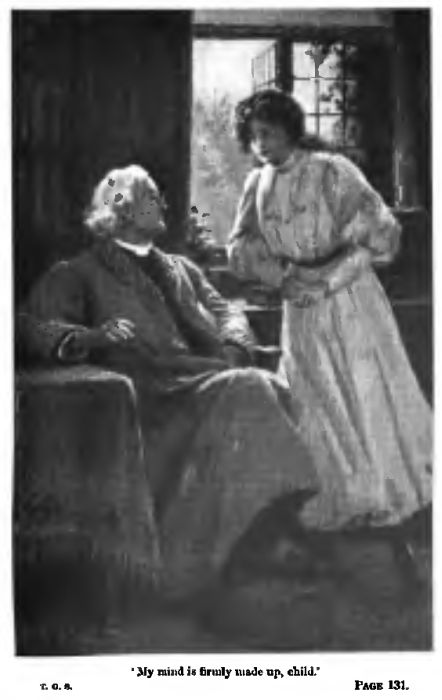
“My mind is firmly made up, child. I will write to Mrs Lyttelton by this post. If her report is favourable I will give you money to go to Paris—not a great deal, for I am poor, but sufficient. This is all that I can say.”
“But listen, darling uncle. Lady Lushington wants me to meet her at the Grand Hotel in Paris on Tuesday night. You cannot hear in time from Mrs Lyttelton. I shall lose my chance of joining Lady Lushington and Mabel. Oh, do—do be reasonable!”
“Annie, I have made up my mind. I will not give you one farthing to join this woman until I know something about her from one who is at least acquainted with her. My child, don’t be angry; I am absolutely determined.”
“Then you are unkind. It is dreadful of you,” said Annie.
She burst into petulant tears and ran out of the room. Here was a checkmate. What was to be done? She was trembling from head to foot. Her heart was full of anger—such anger as she had not known for years. Mrs Shelf was hovering about outside.
“Oh, what is it?” said Annie. “Why do you follow me?”
“I want you to go at once to fetch the doctor. I have ordered Dobbin to be saddled, and Billy will bring him round to the front door for you. Do rush upstairs and put on your riding-habit. Be quick, child; be quick.”
Annie flew upstairs. The village of Rashleigh was between three and four miles away, for the old parish was a very extensive one, and the Rectory happened to be situated a long way from the village.
Annie had just sprung into the saddle, and was arranging her habit preparatory to riding to Rashleigh, when Mrs Shelf came out.
“Take this to the butcher’s, Annie,” she said, handing the girl a letter, “and be sure you get a receipt from him. Ask him to give you what I have ordered on this piece of paper, and bring it back with you.”
“All right,” said Annie carelessly. She started on her ride. When she had gone a very short way she dropped the reins on the old pony’s neck and began to think. She had never for a single moment expected the obstacle which now stood between her and her desires. She had thought that she could easily get round Uncle Maurice, but she had not really analysed his character. He was unselfish of the unselfish—that she knew; but she had failed to remember that he was a man who was always actuated by the very highest religious principles. He was, in short, unworldly. To do right meant far more with him than to be great and grand and rich and powerful. All those things which to Annie meant life and happiness were less than nothing to Uncle Maurice. Lady Lushington might be the richest and the grandest woman on earth, but if she was not also a good woman nothing would induce him to entrust one so precious as Annie to her care. The rector would make his inquiries; nothing that Annie could do would stop him. Even supposing the result were favourable—which Annie rather doubted, for she knew quite well that Lady Lushington was a most worldly woman—the plans made for her by the great lady in Paris could not be carried out. It was already too late to post a letter to Mrs Lyttelton that day; even if she were still at Lyttelton School, she could not get it before Sunday morning, and her reply, under the most favourable circumstances, could not reach the little old Welsh Rectory until Tuesday morning. But in all probability Mr Brooke’s letter would have to follow Mrs Lyttelton, who had doubtless long before now left Hendon. Mrs Lyttelton’s answer would, therefore, be late, and when it came it would most likely not be what Annie desired. Whatever happened, Mrs Lyttelton would tell the truth; she was the sort of woman who never shirked her duties.
At the best, therefore, Annie could not reach the Grand Hotel in Paris by Tuesday night, and at the worst she could not go at all. Was she, who had sinned so deeply in order to obtain her heart’s desire, to be balked of everything at the eleventh hour? Was Priscilla to have things to her liking? Was Mabel to have a great and royal time? And was Annie to be left alone—all alone—in the hideous Rectory, with one stupid woman to talk to her about preserves and pickles, and one stupid old man? Oh, well, he was not quite that; he was a dear old uncle, but nevertheless he was rather prosy, and she was young; she could not endure her life at the Rectory. Something must be done.
She was thinking these thoughts when she suddenly saw advancing to meet her a gig which contained no less a person than Dr Brett.
“Oh doctor!” cried the girl, riding up to him, “will you please call at the Rectory? How lucky it is that I should have met you! I was going to Rashleigh to leave you a message.”
“Welcome back from school, Miss Annie,” said Dr Brett, a stout, elderly man with a florid face. “Is anything wrong, my dear?” he added.
“I don’t think that there is; but Uncle Maurice is fanciful, and Mrs Shelf more so. Will you just look in and give uncle something to put him right?”
“Of course I will go at once. But, my dear Miss Annie, you are mistaken when you call the rector fanciful; I never knew any one less so. I have often told him that he overworks, and that he ought to be careful. It is in the head that the mischief lies; and he is an old man, my dear Miss Annie, and has led a strenuous life. I am glad that you met me; it will save time.”
The doctor drove away, and Annie’s first intention was to turn her pony’s steps back again in the direction of Rashleigh Rectory, but as she was about to do so her hand came in contact with the letter addressed to Dawson the butcher. She might as well take it on; anything was better than dawdling away her time at the dull Rectory. Then, too, she could post her letter herself to Mabel, adding something to it so as to assure her friend that the question of joining her was only postponed. Besides—but this was an afterthought—there were some things wanted at Dawson’s. Annie again touched the letter, and as she did so her eyes rested on the signature. It was in her uncle’s well-known hand. She was to give this letter to Dawson, and he was to give her a receipt. A receipt meant that he was to acknowledge some money.
Annie’s heart gave a sudden leap. Was it possible that there was money in the letter? She felt the crimson colour rushing to her cheeks; a suffocating feeling just for a minute visited her heart. Then, urging the pony forward, she rode as fast as she could in the direction of Rashleigh.
Chapter Twelve.
Her Great Sin.
No one would have supposed that Annie Brooke, brought up so carefully by such an uncle as the Rev. Maurice Brooke, would so easily yield to one temptation after another. But it is one of the most surprising and true things in life that it is the first wrong-doing that counts. It is over the first wrong action that we struggle and hesitate. We shrink away then from the edge of the abyss, and if we do yield to temptation our consciences speak loudly.
But conscience is of so delicate a fibre, so sensitive an organisation, that if she is neglected her voice grows feeble. She ceases to reproach when reproach is useless, and so each fall, be it great or little, is felt less than the last.
A few months ago, even in her young life, Annie would not have believed it possible that she could have brought herself to open her uncle’s letter. Nevertheless, a mile out of Rashleigh she did so. Within the letter lay a cheque. It was an open cheque, payable to bearer and signed by the rector. The cheque was for twenty pounds. A bill of the butcher’s lay within. This bill amounted to twenty pounds. The rector, therefore, was sending Dawson, the well-known village butcher, a cheque for twenty pounds to pay the yearly account. It was the fashion at Rashleigh for the principal trades-people to be paid once a year. This twenty pounds, therefore, stood for the supply of meat of various sorts which was used at the Rectory during the year.
Twenty pounds! Annie looked at it. Her eyes shone. “Take this, and you are all right,” whispered a voice. “With this you can easily get off to London, and from there to Paris. All you want is money. Well, here is money. You must write to your uncle when you get to Paris, and confess to him then. He will forgive you. He will be shocked; but he will forgive you. Of course he will.”
Annie considered the whole position. “I have done a lot of uncomfortable things,” she thought. “I managed that affair of the essays, and I used poor Susan Martin’s poems for my purpose; and—and—I have got Mabel into no end of a scrape; it is my duty to see poor Mabel through. This thing is horrid! I know it is. I hate myself for doing it; but, after all, the money has been thrown in my way. Twenty pounds! I can buy some little articles of dress, too. Dawson will cash this for me; oh, of course he will. It does seem as if I were meant to do it; it is the only way out. Uncle Maurice is terrible when he takes, as it were, the bit between his teeth. Yes, I must do it; yes, I will. It is the only, only way.”
Before Annie and her pony had gone another quarter of a mile Dawson’s bill had been torn into hundreds of tiny fragments, which floated away on the summer breeze, and the open cheque in the old rector’s handwriting, with his signature at the bottom and his name endorsing it behind, was folded carefully up in Annie’s purse.
It was a pretty-looking girl—for excitement always added to Annie’s charms—who rode at last into the little village. She went straight to Dawson’s, sprang off her pony, and entered the shop.
Old Dawson, who had known her from her babyhood, welcomed her back with effusion.
“Dear me, now, miss,” he said, “I am that glad to see you! How I wish my missis was in! Why, you have grown into quite a young lady, Miss Annie.”
“Of course,” replied Annie, “I am grown up, although I am not leaving school just yet. Please, Mr Dawson, I want you to give me—”
She took a piece of paper from her pocket and laid it on the counter. The man glanced at Mrs Shelf’s orders, and desiring a foreman to attend to them, returned to talk to Annie.
“And please,” continued the girl, her heart now jumping into her mouth, “uncle would be so much obliged if you could cash this for him.”
Dawson glanced at the cheque.
“Of course, miss,” he said. “How will you have it?”
“In gold, please,” said Annie.
“I can give you fifteen pounds in gold, miss. Will you take the rest in a five-pound note?”
Annie agreed. Two or three minutes later, with her little parcel of meat put into a basket for her, and twenty pounds in her pocket, she was riding towards the post-office.
There she dismounted, and asking for a sheet of the best note-paper, wrote a line to Lady Lushington. It ran as follows:
“Dear Lady Lushington,—Thank you ever so much for your most kind invitation, which I take pleasure in accepting. My uncle is so glad that you have asked me, and I thank you now in his name as well as my own. I shall be in Paris on Tuesday night, so will you kindly send your maid, as you suggest, to meet me at the railway station? Please give my love to Mabel.—Yours very sincerely and gratefully, Annie Brooke.”
When the letter was finished it was put into a separate envelope from the one which had already been written to Mabel, and then the two were addressed and stamped and dropped by Annie’s own hand into the box of the village post-office. How excited she felt, and how triumphant! Yes—oh yes—she had surmounted every difficulty now, for long before her theft with regard to the cheque had been discovered she would have left the country. She could be agreeable now to every one. She could smile at her neighbours; she could talk to the village children; and, above all things, she could and would be very, very nice to Uncle Maurice.
When she arrived back at the Rectory such a rosy-faced, bright-eyed, pretty-looking girl walked into Mrs Shelf’s presence that that good woman hardly knew her. The sulky, disagreeable, selfish Annie of that morning had vanished, and a girl who was only too anxious to do what she could for every one appeared in her place.
“I met Dr Brett, Mrs Shelf—wasn’t it a piece of luck?—and sent him on to see Uncle Maurice. Has he been, Mrs Shelf?”
“Oh yes, my dear, he has; and I am glad to tell you he thinks that your dear uncle, with care and quiet, will soon be himself again. The doctor thinks a great lot of your being here, Annie, and says that your company will do your uncle more good than anything else in the world. He wants cheering up, he says, and to have his mind distracted from all his parish work. I know you will do what you can—won’t you?”
“Of course I shall,” said Annie. “And here are the things from the butcher’s,” she added.
“It was very thoughtful of you, Annie, to ride on to Rashleigh,” said Mrs Shelf. “I did want these sweetbreads. I mean to make a very delicate little stew out of them for your uncle’s dinner. The doctor says that he wants a lot of building up. He is an old man, my dear, and if we are not very precious of him, and careful of him, we sha’n’t keep him long. There are few of his like in this world, Annie, and it will be a sad day for many when the Lord calls him.”
“Oh, but that won’t be for years and years,” said Annie, who disliked this sort of talk immensely. “Well,” she added, “I will go and sit with uncle now for a bit, and will make his tea for him presently; I know just how he likes it.”
“Do, my dear. You know where his favourite cups and saucers are, and I am baking some special tea-cakes in the oven; and you can boil the kettle yourself, can’t you, Annie? for I shall be as busy as a bee looking after Peggie and the churning. That wench would try any one; she hasn’t a bit of head on her shoulders. And, by the way, Annie, what about the receipt? You paid Dawson, didn’t you?”
Annie was leaving the kitchen. She turned her head slightly. “Dawson will send the receipt,” she said. “To tell you the truth, I was in such a hurry to get back that I didn’t wait for it.”
“Well, my dear,” said Mrs Shelf, “that is all right; I expect it will arrive on Monday. The cart won’t be here before then, for we’ve got our week’s supply of meat in. It came this morning.”
“Splendid,” thought Annie. “By Monday I shall be away.”
She almost skipped into her uncle’s study. The old man was better already. He was lying back in his chair, and was reading a paper which had come by the afternoon’s post.
“Ah, here you are, my love!” he said.
“Here I am, uncle. I am so glad I met Dr Brett; he has made you better already.”
“He has, child; he always does me good.” Annie drew a chair forward, and pushed her hair back from her forehead. The impatient look had left her face. It looked tranquil and at its best.
“By the way, child,” said Mr Brooke, “you will want me to write that letter for you.”
“You must not worry about it now, really, uncle,” said Annie, laying her hand on his.
“It will do quite well to-morrow—quite well,” she added. “You know that whatever your Annie is, she would do nothing to make you worse.”
“My dear little girl,” said the old man, deeply affected by what he considered such thoughtfulness, “you may be sure that all my thoughts with regard to you are prompted by real love for you. I don’t pretend that I have not looked forward very much indeed to these holidays. Nevertheless, I cannot forget that I am old, my love, and you are young. The young must have their day, dear, and the pleasure of the old is to watch them enjoying it. While you were out I have been thinking over my little money matters, and I think I can quite manage to give you a few extra pounds over and above your fare to Paris—a ten-pound note, perhaps, to buy some pretty little articles of dress.”
“Thank you so much, uncle,” said Annie, speaking in her sweetest tone.
“But my dear child, this will depend altogether on what Mrs Lyttelton says. But I expect the best, dear; for all her girls are nice, and you say that Miss Lushington is your special friend.”
“My very greatest,” said Annie—“a sweet girl—a poetess!”
“Indeed, Annie? She shows gifts at this early age? How very interesting! I am always impressed by young efforts; I like to encourage them. You have not by chance any of her little effusions by you?”
Now Annie had brought poor Susan Martin’s manuscript book with her to the Rectory. She thought for a minute. Would it be safe to show these verses to the Rector? After a minute she said:
“I think I have. I will look in my trunk after tea.”
“Do, my love; I shall be much interested. I used to indulge in verses when I was young myself, dear. Ah, those far-off days! And I had my dreams of greatness too. We all have our little ambitions when we are young. I wonder what yours are, my little Annie.”
“Oh, I don’t want to be clever at all,” said Annie; “I just want to have a good time—and to make you happy,” she added as an afterthought, putting out her small hand and laying it on his.
“Bless you, my darling—bless you! You are the sunshine of my life. Yes—thank God, I am much better this afternoon; that horrid feeling in my head has passed away. It gives me anxiety now and then, but only on your account, my child. As far as I am concerned, I am ready and waiting—only waiting to obey. I have had my warning—most old people have, dear; but for your sake I would live a little.”
“Of course you will live for many, many years longer, Uncle Maurice,” said Annie, rising and kissing him. “And now you are not going to be dismal, or to talk horrid things about—about dying. I am going to give you your tea; you always love the tea that Annie makes for you.”
She flitted out of the room. She was the gayest of the gay during the rest of that evening. She chatted, and laughed, and made herself pleasant to every one; and when Uncle Maurice went to bed, feeling almost quite well again, he thanked God on his knees for having given him so bonny a creature as Annie to be the light and joy of his old age.
Meanwhile Annie herself, seated by her open window, with the moonlight falling full upon her, was counting her money—that money which she had stolen from the faithful and affectionate old man. She put it in rows before her on the table. Fifteen beautiful, bright golden sovereigns; and there was also a five-pound note! The note looked a little dirty and as though it had passed through many hands.
Annie sat by the window and made her plans. Whether her conscience would prick her by-and-by remained to be proved; but on the present occasion it was quite tired out, stupefied by all those things which miserable Annie had done to try it. She felt, therefore, quite at her ease, and made her arrangements with care.
It would not do for her to arrive in Paris before the appointed evening. She had, therefore, the whole of to-morrow to spend at the Rectory, and also the whole of Sunday. Monday, too, might be spent there; and she would have done this but for the fact that the butcher’s cart called on Monday morning, and that Mrs Shelf would notice the absence of Dawson’s receipt. At first, of course, she would not be greatly surprised, and would content herself with writing him a note demanding it. It might be possible, however, that she would go to Rashleigh to see him. In great astonishment, he would ask many questions of Mrs Shelf, and would naturally tell her that Annie had cashed the cheque for twenty pounds.
Annie was positively sure that her uncle would forgive her even so great a sin as this, but she did not want to be in the house when he knew of her guilt. She resolved, therefore, to leave the Rectory on Monday morning, of course first writing a little note to her uncle telling him what she had done—in fact, making her confession to him, and begging him to forgive her.
“There is nothing else for it,” she thought. “I know the dear old man will be dreadfully disappointed, but he will forgive me; I know he will.”
That evening Annie neglected even to say that semblance of prayer which she was accustomed to utter before she laid her head on her pillow. Somehow, she dared not pray.
The next morning she was up, bright and early, singing gaily about the house. Mr Brooke had quite recovered. He came to meet her as she ran down into the garden.
“Why, Uncle Maurice!” cried the girl. “Oh, you are naughty!”
“I am quite well,” he answered, “and I have good news for you. Who do you think is coming to stay here to-day?”
“Whom?” asked the girl. “My cousin’s son from Australia—John Saxon. I have not seen him since he was a baby. You will have some fun now, Annie, with a young person in the house.”
“Is he really young?” said Annie.
“Young, my dear? I should think so; about five or six and twenty. He’s as good a lad as ever walked. I had a long letter from his mother. She says he is going to pay me a visit, and I may expect him—yes, to-day. You will have something to look forward to now, Annie, if Lady Lushington’s character as a worldly-minded woman prevents my sending you to Paris.”
“But I think I shall go to Paris,” said Annie. She looked very pretty and expectant. The rector uttered a slight sigh.
“Come in, uncle; I must give you your breakfast, even if fifty John Saxons are coming to pay you a visit. Oh yes, of course I am glad.”
But she did not feel so; she had a dim sort of idea that this young man might interfere with her own plans.
Chapter Thirteen.
Annie’s Appeal.
John Saxon was big and square and muscular. Under ordinary circumstances Annie would have been charmed with his society. He was frankly glad to meet her, and they had not been half-an-hour in each other’s company before they were chatting together as the best of friends.
“We are distant cousins, you know,” said the young man. “I am so glad you are here, Miss Brooke.”
“I am glad to be here, too,” said Annie, “to welcome you; but you won’t have much of my society, for I am going to Paris in a few days.”
“Are you? I am sorry for that.”
“Oh, you won’t stay long either,” said Annie; “you won’t be able to stand the place.”
“But I think I shall like it very much,” he replied. “I love the country, and have never seen English country life before; this place doesn’t seem at all lonely to me after our life in Tasmania. You haven’t an idea what real loneliness is in any part of England; but if you lived fifty or sixty miles away from the nearest neighbour, then you’d have some idea of it.”
“It must be horrible,” said Annie, who was standing that moment in the sunlit garden with an apple-tree behind her and her pretty little figure silhouetted against the evening sky.
“Not for me,” said young Saxon; “I love the life. Your England seems to suffocate me. In London I hadn’t room to breathe, and in that Paris to which you are going, Miss Brooke, I really felt ill.”
“Oh dear!” said Annie; “then you have not my sort of nature.”
He looked at her tentatively. She was fresh and young, and he had never talked to a real English girl before. But, somehow, she did not quite suit him. He was a keen judge of character, and those eyes of hers did not look long enough at any one. They soon lowered their lids as though they were keeping back a secret; and her pretty little mouth could also look unamiable at times. He hated himself for finding these flaws in a creature whom the rector worshipped, but nevertheless he could not help observing them.
Saxon arrived at the Rectory on the afternoon of Saturday, and he and Annie had already become, to all appearance, excellent friends.
When Sunday dawned he accompanied her to church, where the old rector preached one of the best sermons his affectionate congregation had ever listened to. Saxon and Annie were both long to remember that sermon and all that immediately followed, for on the afternoon of that same day the old man had another attack of drowsiness and giddiness. The doctor was sent for, and shook his head.
“He is not at all well,” said Dr Brett; “he is in no condition to stand the slightest shock. He did far too much when he preached to-day. Oh, Miss Annie, you need not look so dismal; I make no doubt we shall pull him round, but we have got to be very careful.”
Annie felt puzzled. Of course she was sorry for her uncle, but she had by no means reached the stage when she would give up her pleasure for him. She was, however, alarmed when the doctor said that the old man was in no condition to stand a shock. Was not a shock being prepared for him? Annie knew well how he loved her. She also knew how strong were his opinions with regard to right and wrong, with regard to goodness and wickedness. To old Mr Brooke Annie’s deed would bring such sorrow that his life, already in danger, might go out under the shock.
The girl felt herself trembling. She turned away from Saxon. He noticed her agitation, and went into the garden. Saxon felt that he had never liked Annie so much before.
“I thought her a rather pretty, rather heartless little thing,” he said to himself; “but I am mistaken. She does love the dear old man very truly.”
Meanwhile Annie was pacing up and down wondering what was to be done. Nothing would induce her to give up Paris; but if only she could go without giving her uncle that terrible shock with regard to the money!
All of a sudden a thought darted through her brain. Why should she not ask her cousin, John Saxon, to lend her twenty pounds? He had talked quite carelessly about his life in Tasmania last night, and, without intending to do so, had given Annie to understand that he was very comfortably off. The more she thought of borrowing money from her cousin, the more easy did it seem to her. If he gave it to her, she would go very early to-morrow to Rashleigh, pay Dawson, and bring back the receipt. Then all would be well. She could write a letter to her uncle explaining that she was forced to go to Paris for a little, but if he were really ill, she would not stay very long. In the meantime John Saxon would look after him. As to the money which she was about to borrow, Annie gave her shoulders a shrug.