RETURNING OF SITTING BULL FROM CANADA.
Reading edition
It was but a few months after Sitting Bull had established his camp in the Northwest Territory in the British possessions that the Canadian government requested the government of the United States to send a commission to have a council with Sitting Bull and induce him to return to the United States. Pursuant to this request, a commission was sent to Fort Walsh, N. W. T., and met Oct. 17, 1877, with General Terry at the head. Colonel Macleod, who was in command of the Canadian mounted police, with four officers and forty policemen, were present. The council was held in the quarters of the commanding officers of the police force, commencing at 2 o’clock p. m., and lasted one hour and a half. Sitting Bull desired to have the meeting take place in the open air, but it was thought judicious by the policemen in charge of the ceremony to have the council held in a convenient room, where the act of every participant could be held under strict surveillance and control. All were seated, and General Terry proceeded to state his mission. The following account of this remarkable meeting was published in the Benton Record, October 21, 1877, and was communicated by Captain J. J. Healy (now of Alaska), who was present at the council. Captain Healy describes Sitting Bull as follows:
“He is a short, thick-set man, about forty-five years of age, and weighs, probably, 175 pounds. He is undoubtedly a full-blooded Sioux Indian, and not a remarkably intelligent looking one at that. He is minus one toe, having at some time or other had his feet frozen. He does not speak and apparently does not understand a word of the English language, and his conversations with the whites are always conducted through an interpreter.”
GENERAL TERRY’S SPEECH TO THE SIOUX.
“We are sent here as commissioners of the United States, at the request of the Canadian government, to meet you (interrupted by Sitting Bull, who objected to a table in front of the speaker. The table was removed). The president has instructed us to say to you that he desires to make a lasting peace with you and your people, and that all the people of the United States may live in harmony. He wishes it for your sake as well as that of the whites, and if you will return to your country and leave your hostile life, a full pardon will be given you for any wrong you may have done in the past. You, or any man among you, shall be forgiven and permitted to enjoy all the liberties of any other Indians at the different agencies. We will not tell you what the president means by saying he will give you a full pardon. Of all the bands of Indians, yours among them, who were at war about a year ago, yours is the only one that has not come into the agency. Of those bands that have come in, not one has been punished, and every man, woman and child has been furnished food and clothing. It is true these Indians have been required to give up their arms and ammunition, which were all sold and the money applied for their benefit. We have already sent 650 cows to one of the agencies, for the use of the Indians. This has been done to get you to leave your wild life and to help you to support yourselves. The president will not consent to have you return unless you give your consent to give up your arms and horses, but he invites you to come to your and his country, give up your arms when you cross the line, thence go to any agency he may assign you to, and there give up your horses (except such as you need for use in civil life), which will be sold and the money applied to buy cows, which will support you after the game has left the country. You will also receive clothes the same as other Indians. We have come many hundred miles to bring this message. Too much blood has already been shed. It is time war should cease. You cannot return to your country and your friends unless you accept these conditions; otherwise you will be treated as enemies of the United States. Think well of these things, and when you have made up your minds we are ready to hear your reply.”
The Indians were asked if they wanted to retire and hold a council among themselves, but they said their minds were already made up and they were ready to reply.
SITTING BULL’S SPEECH TO THE UNITED STATES COMMISSION.
“For sixty-four years you have kept us and treated us bad. What have we done? Your people are the whole cause of the trouble; we could go no place but to this country. Here is where I learned to shoot, and that is why I came here. What did you come for? I did not give you the country, but you followed me and I had to leave. You took my country from me. I was born and raised with the Red River half-breeds, and wanted to come back. (Sitting Bull here shook hands with Colonel Macleod and said he would live with him.) You may think I am a fool, but you are a bigger fool than I am. This house is a medicine house. You come and tell us lies in it. We don’t like it. Don’t say two words more, but go back where you came from. I shake hands with these people (shakes hands with Colonel Macleod); so say no more. You gave that part of the country and then took it back. I want you to go home and take it easy as you go.”
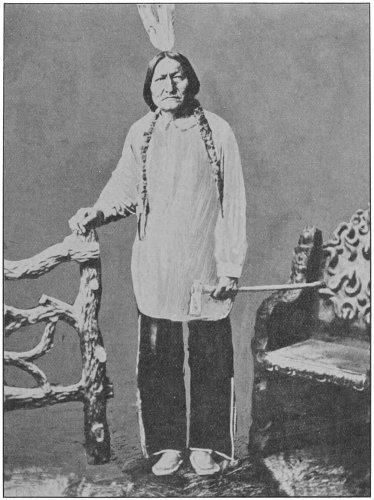
SITTING BULL (SIOUX CHIEF).
THE REE’S SPEECH.
“Look at me. Seven years in the country. For the last sixty-four years you have treated us bad. I don’t like you. You tell lies. I will keep peace with these people as long as I live. I shake hands with them. You come over and tell us lies. Go home, and take it easy as you go.”
SPEECH BY A YANKTON SIOUX WHO WAS IN THE MINNESOTA MASSACRE.
“I don’t wear the same clothes as you do. You come to tell us lies. You have treated us bad for sixty-four years and have been fighting us all the time. There were seven different tribes of us. You promised to take care of us when we were over there, but you did not do it. We like these people and intend to live with them. I don’t intend to kill any one.” (Shook hands with Generals Terry and Lawrence.)
SPEECH BY A SQUAW.
“You would not give me time to raise children, so I came over here to raise children and live in peace.”
(To allow a squaw to speak in council is one of the worst insults that an Indian can offer.)
CROW’S SPEECH.
After kissing all the English officers, he said: “What do you mean by coming over here and talking this way to us? We were driven out of your country and came to this one. I am afraid of God and don’t want to do anything bad. For sixty-four years you have treated us bad. These people give us plenty to eat. You can go back, and go easy. I come to this country, and my grandmother knows it, and is glad I came to live in peace and raise children.”
After the Crow had spoken, Sitting Bull sat down and said they were done. General Terry then stated that the commissioners had nothing further to say. The Indians then left, after shaking hands with the English officers.
The commission left the following day, and a few days later arrived at Fort Benton. No disappointment was expressed by the citizens of Montana that the commission did not succeed. The average citizen was glad rather than sorry that the old savage, imbued with the blood of Custer and his companions, decided to remain on British soil. To live in peace on their reservation—receiving no punishment for what they had done—board and clothes free—to help to lead them from savage life, were some of the inducements proffered for the return of these hostiles. All offers were not only scornfully rejected, but the commission was treated to studied and offensively displayed insults.
After remaining in Canada nearly three years, and finding that the Canadian government had no use for him and that his people were starving, the old fugitive chieftain now sings a different tune and is anxious to return.
On February 4, 1880, he sent a commission to the agent at Pine Ridge Agency, indicating that he and his followers wanted to make arrangements with the United States government so that they could come back and live in peace, and, as a token of friendship, he sent a pipe hatchet; in case terms could not be had, it was to be returned. But, to his disappointment, the government did not wish to make any terms with him then. His followers kept coming, however, in small parties, and in a destitute and starving condition, to Fort Peck Agency, in northern Montana, turning over their guns and what ponies they had left; the other ponies they had eaten to keep from starving. By May 1st, 1,116 of the refugees had returned.
Again Sitting Bull made an application to the government, through the war department, for permission to return, and all the property he wanted was his horse and gun. After both the Canadian and United States governments had several communications in regard to the matter, and after Sitting Bull had been in Canada five years, he was permitted to return to the United States. He stood his trial and was taken to Standing Rock agency and kept there as a kind of prisoner of war. Now, he was not looked upon as a warrior, even by his own people. But it was not long before he began to gain influence, and many of them looked upon him as a kind of high priest and dreamer. It appears that he was determined to be a leader, if not in one thing he would be in another. The next letter will show him up in his new profession, or whatever you may call it, for he was one of the prime movers in the Indian Messiah craze and the floor manager of the ghost dance, which was finally the cause of his death.
Robert Vaughn.
July 15, 1898.