GENERAL SHERMAN’S LETTERS.
Reading edition
The following letters were written by General Sherman, then general of the United States Army, to Secretary McCrary, describing his tour through the valley of the Yellowstone soon after the Sioux war. They were published at the time in some newspaper, the clippings of which I have had in my possession ever since.
Thinking that there are no other records of these interesting letters, I give them place in this book, for they are a valuable addition to the history of Eastern Montana, or what was then termed “the Sioux country,” and of that eventful time when the military had taken possession after Sitting Bull and his followers had been driven across the border into Canada.
LETTER I.
“Cantonment on Tongue River, M. T., July 17, 1877.
“To Hon. Geo. W. McCrary:
“My Dear Sir: Before leaving Washington I promised to write you from time to time of matters of public and private interest.
“As originally appointed, I left St. Louis the evening of July 4, accompanied by my son; reached Chicago on the 5th and St. Paul the 6th. Here I was joined by my aides, Colonels Poe and Bacon; also by Gen. Terry and his aide, Captain Smith, and the quartermaster of his department, General Card. Leaving St. Paul by rail the morning of the 7th, we reached Bismarck the evening of the 8th. There were three steamers there, two of which, the Rosebud and the Ashland, were loading for the Yellowstone, and we selected the former because she was smaller and safer, and better adapted to the strong current of the river. During the day of the 9th we crossed over by ferry to Fort Abraham Lincoln, and inspected the post. It is composed of two distinct posts—a small infantry post, perched on a high hill overlooking the country and valley of the river, and a larger cavalry post on the river bank below, raised about twenty feet above the bottoms, which are usually overflowed by the spring freshets. There is but a small garrison there, because the Seventh Cavalry, its regular garrison, is detached to this point, and is now out on a scout.
“The Rosebud was boarded by 4 p. m. on the 9th, dropped down from Bismarck three miles to Fort Lincoln, to take us on board, and began the ascent of the Missouri, which was full, with a strong current. It was about as large and of the same character as at Sioux City. In three days we reached Fort Buford, on the north bank, just below the mouth of the Yellowstone. We stopped there over the night of the 12th, making as much of an inspection as the mosquitoes would allow, and at daybreak on the 13th resumed the trip, entering the Yellowstone, which for a hundred miles seemed almost as large as the Missouri, with numerous islands and a wide valley. This valley contracted after about a hundred miles, and the river changed its character somewhat, being lined on either side with fantastic hills, known as ‘bad lands,’ making short bends with a powerful current, against which we made slow headway, but in four days we reached this post, on the south bank of the Yellowstone, just above the mouth of Tongue river. The troops, mostly the Fifth Infantry, occupy the huts made last winter, but a new post is in process of construction, about a mile higher, and half a mile back from the Yellowstone, the ground being higher and less in danger of an overflow.
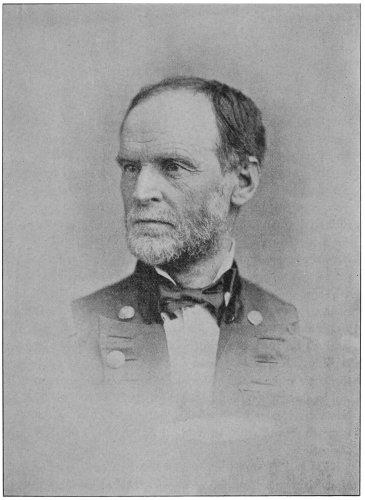
GEN. WILLIAM TECUMSEH SHERMAN, U. S. A.
“General Miles is in command here—has about three hundred Indian prisoners—says none of the boats on the river this year have been molested—that all the hostiles which swarmed hereabouts last year are gone, the greater part to the agencies, while Sitting Bull has taken refuge across the border in Canada, about 250 miles north. When the new post is finished, which will be before winter, the troops will be comfortably quartered, and the Indians cannot return. Already a class of frontiersmen are making ranches and settlements hereabouts, and in a few years we can make the route to Montana by way of the Yellowstone as safe as the Platte and Arkansas, thus forcing the hostile Indians to break up into small and harmless parties. For some years hence we will have to keep a pretty strong garrison here, because, besides defending this point, detachments must go out to protect other threatened points, and to follow any small parties engaged in depredations. In other words, the forts along this line will not only have to defend themselves, but be able to send out strong detachments.
“There is a great deal of valuable country along the line of the Northern Pacific railroad. That road, from Duluth to Bismarck, although a financial failure, has been and will continue to be of advantage to the country at large. As far as Bismarck it is done, and well done. The next link, from Bismarck to the mouth of Powder river, is very important. It will be a distance of 250 miles, but will cut off 300 miles of the Missouri river and 150 of the Yellowstone, leaving the Yellowstone from Powder river to the mouth of the Big Horn for navigation.
“The valleys of the upper Yellowstone afford lands capable of cultivation in wheat, corn, oats, barley, and all garden vegetables, with an unlimited range for cattle, horses and sheep, etc. I do not know a single enterprise in which the United States has more interest than in the extension of the Northern Pacific railroad from its present terminus at Bismarck to the mouth of Powder river on the Yellowstone. After that is done we can safely leave to time the extension of the road to the head of navigation on the Columbia river. After a couple of months I can speak with more confidence on that point. I now regard the Sioux Indian problem as a war question as solved by the operation of General Miles last winter, and by the establishment of the two new posts this summer. Boats can come and go now where a year ago none would venture except with strong guards. Woodyards are being established to facilitate navigation, and the great mass of the hostile Indians have been forced to go to the Agencies for food and protection, or have fled across the border into British territory. I have driven all about this post, looked into the barracks, which are as yet mere huts of cottonwood posts, with dirt floors and dirt roofs, but will soon be replaced by good frame barracks and quarters. The stores of all kinds on hand are abundant and good, so that no apprehension is felt on account of the enemy or severity of the winter. Six small companies of infantry are here, two more are on the way, and four are mounted on captured ponies and are out on a scout. The Seventh Cavalry are also near here, scouting to the north, but discover no marks of an enemy.
“As winter approaches, part of the cavalry will doubtless be sent back to Fort Lincoln for economy of maintenance. Tomorrow night we resume our trip up the Yellowstone and Big Horn to the other new post building, at the forks of the Big and Little Horn. There I expect to meet General Sheridan. * * * I beg you not to construe this as official, as I have been constantly interrupted, and must close, as the steamer is ready to go. With great respect, etc.,
“W. T. Sherman, General.”
LETTER II.
“On the Steamer Rosebud, Big Horn River, July 25, 1877.
“My Dear Sir: We left the cantonment at the mouth of the Tongue river on the evening of July 18, and reached the mouth of the Big Horn in three days, then entering the Big Horn, we steamed hard for three days against a powerful current, and reached the new post at the forks of the Little and Big Horn yesterday morning early. Many boats had preceded us, all, or nearly all, discharging part of their freight on the west bank, from which hauling is comparatively easy. Our boat, which was built especially for the navigation of this and similar streams, had to land four miles below the post one-third of her cargo. The difficulty was not the want of water, but by reason of the strong current, which in the bends must be about eight miles an hour.
“We found at the post the United States steamer General Sherman, which has a good hull, a good engine, but too much and too fine cabin for this work. It will be kept in the Big Horn as long as the water lasts, and will be employed in carrying up to the post the freight dropped on the river bank by the contract boats. The post already has a good supply of all essential stores, and there is no doubt that long before the season closes all invoiced for its use will be on hand and stored. The day before we reached the post we met General Sheridan and party, who had come across the country from Fort Stambaugh. We had a long conference and agree that this new post is well located, and that it can be supplied with reasonable economy in the future. The new post will be garrisoned by six companies of the Eleventh Infantry and four companies of the Second Cavalry, under command of Lieutenant Colonel Buell, of the Eleventh Infantry, an officer of great energy, and by profession an engineer. He served under me during the war as colonel of an engineer regiment, and afterwards as a brigade commander. He has been on the ground less than a month, but has a steam sawmill at work and a large mass of cottonwood logs being rapidly sawed up into lumber for the new barracks. He has about 200 civil mechanics at work and six buildings in progress, besides temporary shelters for his stores as received, and he entertains no fear but that he will finish his post substantially before winter.
“The location of this post is in the very heart of the Sioux country. With this one and the one at the mouth of the Tongue river, occupied by strong, enterprising garrisons, these Sioux can never regain this country, and they will be forced to remain at their agencies or take refuge in the British possessions. At present there are no Indians here or hereabouts. I have neither seen nor heard of any. General Sheridan saw none nor any trace of any, so that the principal end aimed at by the construction of these posts is already reached, and it is only to make this end permanent that we should persist in their completion. The one at Tongue river can be supplied by steamboats. This one, at the mouth of the Little Big Horn, cannot depend on this river, the current being too strong to be navigated by ordinary boats with a fair cargo. General Terry and his quartermaster, General Card, are at this moment reconnoitering to select some point near the mouth of the Big Horn whereat to establish a supply depot, at which all freight destined for this post can be landed and hauled up here.
“We have on board a company of infantry to guard this depot, and we are nearly agreed that the best place will be a point on the Yellowstone proper, three miles above the mouth of the Big Horn, where the hauling will be about thirty miles by ox trains. These can be hired here, and will do the work more surely and better than the steamboats, for they have been sometimes two weeks in working up the Big Horn and have left their loads strung along its banks at points hard to reach by wagons. I am convinced that this is the wisest course, and thus we can maintain a strong military post in the very heart of the hostile Sioux country, with only a haul of twenty miles, which is insignificant as compared with most of our posts south of this. The country west of this is a good country and will rapidly fill up with emigrants, who will, within the next few years, build up a community as strong and as capable of self-defense as Colorado.
“I have Company L of the Second Cavalry, Captain Norwood, which belongs at Fort Ellis, M. T., now camped on the west bank of the Yellowstone, opposite the mouth of the Big Horn, to escort me up to Ellis. As soon as we have decided on the merits of the point mentioned as a supply depot for this post, I will land and start for Ellis, leaving Gen. Terry with this boat to return to Bismarck for a new load. I will instruct General Terry to report in full all these matters to the adjutant general, so that this letter is only preliminary.
“Here we have no news from Idaho or Oregon, or the world generally, but I suppose in Montana there will be need of the four companies of the Second Cavalry, temporarily taken to Tongue river, and I instructed General Sheridan to so order when he reached Tongue river. This will leave General Miles the whole of the Seventh Cavalry available if the Indian Bureau wishes to escort Sitting Bull from British America to an agency.
“The weather has been intensely hot—as hot as Texas—but last night we had a thunder-squall, since which the air has become perfect. General good health prevails here, and I am impressed with the value of this country. * * * Truly yours,
“W. T. Sherman, General.”
LETTER III.
“Fort Ellis, M. T., August 3, 1877.
“Dear Sir: I wrote you last from the steamboat Rosebud, coming down the Big Horn in company with General Terry and others on the 25th of July. We had concluded that the current of the Big Horn was too swift to be managed economically, and that the garrison at Post No. 2, at the mouth of the Big Horn, could best be supplied by establishing a depot on the Yellowstone, just above the mouth of the Big Horn, where stores could be hauled thirty miles to the new post. A company of the Eleventh Infantry was left there to establish and guard the depot when the steamer Rosebud dropped down to the point just below the mouth of the Big Horn, where Company L, Second Cavalry, Captain Norwood, was camped with an outfit. This consisted of six Indian horses, two light spring wagons, and one light baggage wagon. The Rosebud landed us at 2 p. m., when she started down the river, leaving us to begin our real journey. In a few minutes the escort saddled up, and we started on horseback up the Yellowstone.
“The valley is strongly marked, about three miles wide, flat, with good grass, the banks of the river and the streams well wooded with cottonwood trees. In this valley, the Yellowstone, a broad, strong stream, meanders back and forth, forming on both sides strong, perpendicular bluffs of rock and clay, forcing the road constantly out of the flat valley over the points, and causing wide deflections in the road to head the ravines or ‘coolies,’ which flow to the river. There is a strongly-marked wagon trail, but no bridge or cuts, a purely natural road, with steep ascents and descents, and frequent gullies, about as much as wagons could pass. We sometimes shifted into our light wagons, to save the fatigue of travel.
“Thus we journeyed for four days, when we sent a courier from Fort Ellis with a copy of General Townsend’s dispatch to me, saying that the President desired my immediate return, unless I had information that the serious riots then in full career had ceased.
“Light wagons can out-travel horses and baggage wagons. Up to that date we averaged twenty-five miles a day. I therefore turned the courier back with a fresh horse, and orders to reach Fort Ellis in two days with answer, to be sent from Bozeman by telegraph, and, with my immediate party, I followed, taking one more day, being time for answers. On reaching Fort Ellis the day before yesterday (August 1), I was delighted to hear that the riots had ceased, and that you and the President had consented that I should go on as originally intended.
“The escort company came in yesterday, so that we are now all here at Fort Ellis. When we arrived there was but one company of the Seventh Infantry here, Captain Benham, thirty men. The arrival of the escort gives an addition of sixty men.
“There is no seeming danger here or hereabouts, but the Nez Perces are reported to have entered Montana, from Idaho, and are now in the valley of the Bitter Root, about 300 miles west of this; they are reported en route to the buffalo range, east and north of this point. It seems that for many years these same Nez Perces, along with some Flatheads from the western part of Montana, have been accustomed to come to the sources of the Musselshell and Yellowstone to gather meat for the winter, traversing the whole of Montana, doing little or no damage. But the buffaloes of the great northern herd, like that of the southern, are being rapidly slaughtered for their skins, so that now they are becoming scarce. We only saw four buffaloes, two of which were killed, in our course, whereas ten years ago we would have encountered a million.
“The time has come when these restless Indians must cease to look to buffaloes as a means of maintenance, and they should not be allowed to traverse the scattered and explored settlements of Montana, where hunger will sooner or later compel them to kill tame cattle and steal horses, thus leading to murder and war.
“Besides these the Nez Perces should be made to answer for the murders they committed in Idaho, and also to be punished as a tribe for going to war without just cause or provocation.
“Hitherto all danger to Montana has come from the north and the Sioux to the east, and the few troops stationed in the territory were posted, as it were, at the eastern doors or passes through the mountains, over Ellis, Baker, Benton and Shaw, but last year a new post was selected at or near Missoula, the door of the western frontier. Two small companies, not over sixty men, of the Seventh Infantry, under Captain Rawn, were sent to Missoula to build a post there, but he had hardly arrived when the Nez Perces war began. When it was reported that General Howard had defeated the hostiles and that they were retreating to Montana by what is known as the Lo-Lo trail, some of the citizens of the neighborhood joined the soldiers for the purpose of stopping the Indians until the troops from Idaho could come up with them. But it seems the Indians passed around Captain Rawn’s fortified point and then entered the Bitter Root valley, but in such force (300 armed warriors) as to claim to be able, if opposed, to force their way through.
“The country is so large and the passes so scattered that concert of action is most difficult, if not impossible.
“Gen. Gibbon, colonel of the Seventh Infantry, has command of this district, and General Terry is the department commander. Gibbon is stationed at Fort Shaw, on Sun river, 200 miles north of this. As soon as he perceived Captain Rawn’s critical position, he collected about 100 men, and has gone rapidly toward Missoula to take command and control them. The governor of the territory, General Potts, has also gone in the same direction—Deer Lodge—and has organized some volunteer companies, and these may be able to get ahead of the Indians somewhere on the Big Hole or Wisdom river, and hold them in check or turn them back toward Idaho, where General Howard must have a pretty respectable force, able to destroy them, unless, as I suspect, they will scatter, when pursuit becomes impossible. I do not propose to interfere, but leave Howard or Gibbon to fight out this fight.
“Too many heads are worse than one.
“I have sent word to Governor Potts that if the citizens in their own interest will join the regular troops and act with and under them, that the commanding officer will loan them arms and ammunition when possible, and may certify to beef or food taken en route, but that congress alone can raise troops for any purpose. I have telegraphed to General McDowell that I expect that his troops now in Idaho will follow up those Indians to the death, go where they may, regardless of boundaries. He answered that such are still, and were General Howard’s orders from the beginning. So I expect soon to hear of the arrival at or near Missoula of the troops from that quarter. The nearest point from which troops may come to Montana from the east is by the route I came. When I parted with General Terry at the Big Horn it was understood he would detach for General Miles’ command at Tongue river the companies of the Second Cavalry which belong here. It will be two weeks before they reach here, but if they arrive in time, and the troops and volunteers now in the Bitter Root country do not succeed in stopping this band of Nez Perces, these three companies and the one I brought will get on their trail, and change their proposed buffalo hunt into a fight. If, however, they escape, I see no alternative but to drive them across the British border to join Sitting Bull.
“Tomorrow I will start for the park, taking only five soldiers with me, so that my presence here will not materially reduce the fighting force, for I have sent word to General Gibbon that my escort company is subject to his orders. I do not suppose we run much risk, for we are all armed, and the hostile Indians rarely resort to the park, a poor region for game, and to their superstitious mind associated with hell by reason of the geysers and the hot springs. We expect to be gone from here about fifteen days, during which we can receive or send no letters. On our return here, say August 18th, I will go rapidly to Helena, when I will learn all about the movements of the troops, and I will be governed somewhat by them. But I still intend in August to visit Forts Shaw and Benton, and to reach Missoula in the first week of September.
“It is all important that a route or trail be opened between Missoula and Walla Walla, but I can better judge of this after I have passed over the road.
“We found ranches established all along down the Yellowstone, and the mail contractors have already put on a line of two-horse spring wagons, so that soon the route we passed over will fill up with passes. The land is susceptible of cultivation on a small scale, but admirably adapted to cattle raising.
“Fort Ellis is a small post, built of pine logs, all the mountains around being covered with pines.
“We are all perfectly well, and enjoy the isolation and freshness of camp life. Truly yours,
“W. T. Sherman, General.”
LETTER IV.
“Fort Ellis, M. T., August 19, 1877.
“The Territory of Montana, though very large, and surrounded on all sides by Indians liable to become hostile on the slightest provocation, has for ten years been a district forming a part of the Department of Dakota, and has usually been garrisoned by a regiment of infantry and a battalion of cavalry—four companies. The danger usually lay to the east, toward the Sioux, and therefore the posts were Fort Benton, at the head of navigation of the Missouri; Fort Shaw, on Sun river; Camp Baker, at the head of the Musselshell, and Fort Ellis, at the head of the Gallatin.
“The infantry regiment should be 1,000 men, but the policy of reduction has gradually reduced it to 300, and early this spring the four companies of the Second Cavalry, by order of the department commander, were dispatched to Tongue river to assist General Miles in his active campaign against the Sioux, and when I passed up the Yellowstone in July three of these companies had been sent by General Miles to the east of Tongue river, and one company (L, Captain Norwood) was held to escort me to this, their proper post.
“On reaching Fort Ellis I found that General Gibbon, colonel of the Seventh Infantry, commanding this district, had, at the request of General Howard, hurriedly called for every man that could be spared, and marched to Missoula to head off the Nez Perces Indians that had been defeated by him (Howard) in Idaho. Gibbon was absolutely without cavalry, and his small infantry companies marched with extraordinary speed, making twenty-six miles a day. * * * General Gibbon got on the trail, followed it with great earnestness, and overhauled the Indians at a place known as Big Hole. He got into their camp and fought them bravely and well a whole day, inflicting heavy loss and sustaining a corresponding loss himself. Of this you have full reports.
“If General Gibbon could have had 100 more men, there would now be few hostile Nez Perces left. But his force was inadequate, and he did all that a man possibly could do.
“The next day Howard got ahead of his command, and he now has taken up the pursuit, and I hope to hear that he has finished up what General Gibbon so well began.
“I believe these Indians are afraid to return to Idaho, and think they will try to escape to the great plains to the east of the Rocky mountains, by way of the head of Wind river, in which case they will fall to the charge of General Crook or General Miles, either of whom is capable of running them down.
“The moment I reached Ellis I caused General Gibbon to be informed that I had reached the territory, and that I did not wish to interfere with his legitimate command, but on the contrary I gave him the company of cavalry which had escorted me up from the Big Horn, and that company is now with General Howard’s command in pursuit of the Nez Perces.
“Our little army is overworked, and I do not believe the officers and soldiers of any army on earth, in peace or war, work as hard or take as many risks of life as this little army of ours. In what we call peace I am proud of them, and I hope you are also, or soon will be.
“Meantime I suppose you want to hear something of the National Park.”
Having been in the National Park for fifteen days, and giving a graphic description of its spouting geysers and their performances, its majestic mountains, lakes and canyons, the extremely beautiful formation of which neither pen, words nor painting can equal, and that “Wonderland” must be seen to be appreciated and felt, the general in closing his sketch, says:
“This is Sunday, a real day of rest, and I have endeavored to give this wide and rapid sketch in hopes to account for the fifteen days’ absence from duty at this period of military activity, but I have faith that there are plenty of good officers on duty at their posts to do all that is demanded of the army. I now propose to go to work to study closer the present condition and future prospects of Montana as bearing on the great military problems, all of which will be duly reported.
“With great respect, etc., “William T. Sherman, General.”