JESSIE B. RITTENHOUSE (continued 4)
Reading edition
Dawn peered through the pines as we dashed at the ford; Afar the grim guns of the infantry roared; There were miles yet of dangerous pathway to pass, And Moseby might menace, and Stuart might mass; But we mocked every doubt, laughing danger to scorn, As we quaffed with a shout from the wine of the morn Those who rode with Kilpatrick to valor were born! How we chafed at delay! How we itched to be on! How we yearned for the fray where the battle-reek shone! It was forward, not halt, stirred the fire in our veins, When our horses’ feet beat to the clink of the reins; It was charge, not retreat, we were wonted to hear; It was charge, not retreat, that was sweet to the ear; Those who rode with Kilpatrick had never felt fear! At last the word came, and troop tossed it to troop; Two squadrons deployed with a falcon-like swoop; While swiftly the others in echelons formed, For there, just ahead, was the line to be stormed. The trumpets rang out; there were guidons ablow; The white summer sun set our sabres aglow; Those who rode with Kilpatrick charged straight at the foe! We swept like the whirlwind; we closed; at the shock The sky seemed to reel and the earth seemed to rock; Steel clashed upon steel with a deafening sound, While a redder than rose-stain encrimsoned the ground; If we gave back a space from the fierce pit of hell, We were rallied again by a voice like a bell, Those who rode with Kilpatrick rode valiantly well! Rang sternly his orders from out of the wrack: Re-form there, New Yorkers! You, Harris Light, back! Come on, men of Maine! we will conquer or fall! Now, forward, boys, forward, and follow me, all! A Bayard in boldness, a Sidney in grace, A lion to lead, and a stag-hound to chase— Those who rode with Kilpatrick looked Death in the face! Though brave were our foemen, they faltered and fled; Yet that was no marvel when such as he led! Long ago, long ago, was that desperate day! Long ago, long ago, strove the Blue and the Gray! Praise God that the red sun of battle is set! That our hand-clasp is loyal and loving—and yet Those who rode with Kilpatrick can never forget!
The Lochinvar key is also struck in the description of Kilpatrick. Mr. Scollard sounds a less sanguinary note in most of the ballads, as that of “The Troopers” or “King Philip’s Last Stand.”
“On the Eve of Bunker Hill,” while recording no thrilling story, has a note of pensive beauty in its quiet description of the preparation for battle before that memorable day, and of the prayer offered in the presence of the soldiers, “ranged a-row” in the open night. The initial stanza gives the setting and key:
’Twas June on the face of the earth, June with the rose’s breath, When life is a gladsome thing, and a distant dream is death; There was gossip of birds in the air, and the lowing of herds by the wood, And a sunset gleam in the sky that the heart of a man holds good; Then the nun-like twilight came, violet-vestured and still, And the night’s first star outshone afar on the eve of Bunker Hill.
Taking the volume throughout, it is a stirringly sung résumé of all the chief deeds in American history to which attach valor and romance, and is not only attractive reading, but should be in the hands of every lad as a stimulus to patriotism, and to focus in his mind, as
In the lyrical narrative poem, such as “Guiraut, the Troubadour,” Mr. Scollard has one of his most characteristic vehicles. The adventures of the singer who sought a maid in Carcassonne are, no doubt, romantically enhanced by association of the name with that of the hapless one who “had not been to Carcassonne;” but it is certain that one follows the troubadour in his “russet raimentry,” drawn by his charm as
Unto the gate of Carcassonne (Ah, how his blithe lips smiled upon The warded gate of Carcassonne!) As light of foot as Love he strode; The budding flowers along the road Bloomed sudden, with his song for lure; And softlier the river flowed Before Guiraut, the troubadour. · · · · · Unto a keep in Carcassonne (No sweeter voice e’er drifted on That frowning keep in Carcassonne!) Anon the singer drew anigh,—
but we may not follow his propitious fortunes, glimpsed but to show the manner of their telling. The parenthetical lines, recurring in each stanza, impart a peculiar charm to the recital,
The message should also inform more vitally the melody, wedding more subtly the outer and inner grace. A poet is a teacher, whether he will or no, and the heart should be the vital textbook of his expounding. It is because of their deeper rooting in life, though a life foreign to us, that the Oriental poems of Mr. Scollard have often greater vitality than the Occidental ones, whose inspiration is found chiefly in nature. His ballads show that he has a sympathetic insight into character and a knowledge of human motive that would, if infused more widely through his work, give to it a warmth of personal appeal and a subjectivity which in
XV
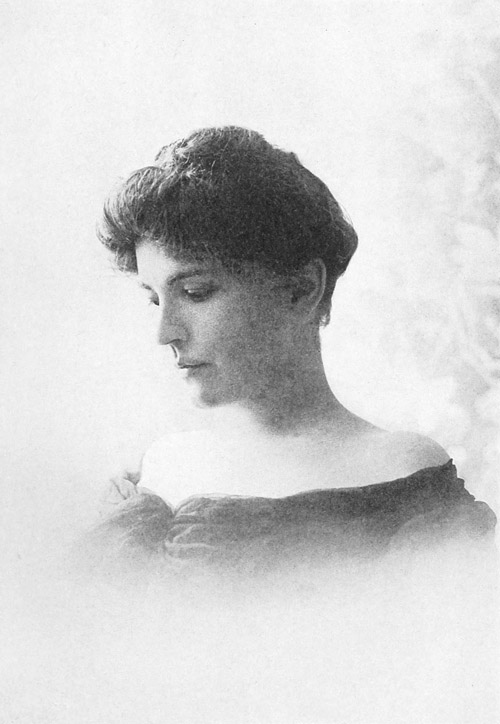
MARY MCNEIL FENOLLOSA
TO be a poet of the East, one must be a painter, using words as a colorist uses pigment. His poem must be a picture wherein form and detail are subjected to the values of tone and atmosphere; like the dawn-crest of Fujiyama it must glow, it must dazzle with tints and light. To convert the pen into an artist’s brush, the vocabulary into a palette, is an end not to be gained by striving; it is a talent a priori, a temperamental color, a temperamental art.
So vividly is this shown in the work of Mrs. Mary McNeil Fenollosa that whereas in her Eastern poems she is every whit the artist, in her Western, her Occidental poems, she is without special distinction. Certain of her Western poems have a conventional, mechanical tone, while those of the East are abrim with vitality and impulse. They were not “reared by wan degrees;” the craftsman did not fashion them; and although varying in charm, there are few that lack the Eastern spirit.
Mrs. Fenollosa’s bit of the Orient is Japan, where nature is ever coquetting,—laughing in the cherry, sighing in the lotos. Nature in the Orient is invested with a personality foreign to Western countries, a personality reminiscent of the gods. Then, too, nature is given a more prominent place in the poetry of the East than is love, or any of the subjects, so infinite in variety, which engross a Western singer; and it happens that Mrs. Fenollosa, catching this spirit during her life in Japan, gives us chiefly nature poems in her Eastern collection. With artist-strokes where each is sure, she flashes this picture before us:
The day unfolds like a lotos-bloom, Pink at the tip, and gold at the core, Rising up swiftly through waters of gloom That lave night’s shore;
or this vision of—
The cloud-like curve, The loosened sheaf, The ineffable pink of a lotos leaf.
One great charm of the imagery in Mrs. Fenollosa’s Japanese poems is its subtlety of suggestion. The imagination has play; something is left for the fancy of the reader, which can scarcely be said of some of the highly
O let me die a singing! O let me drown in light! Another day is winging Out from the nest of night. The morning glory’s velvet eye Brims with a jewelled bead. To-day my soul’s a dragon-fly, The world a swaying reed!
“To-day my soul’s a dragon-fly,”—a wingéd incarnation of liberty and joy; “the world a swaying reed,”—a pliant thing made for my delight, an empery of which I am the sovereign and may have my will.
But these Japanese songs have not wholly the lighter melody; there are those that sing of the devastation of the rice-fields after the floods, a grim and tragic picture; and there are interpretations of the dreams of the great bronze Buddha, looking with sad, inscrutable eyes upon the pilgrims who, with the recurrent seasons, come creeping to his feet like insects from the mould; and there is a story of “The Path of Prayer,”—a Japanese superstition so human that one is glad of a religion where sentiment overtops reason. It pictures one
As banners pendent from a mimic wand.
The poem continues:
I wondered long; when, from the drowsy wood, A whisper reached me, “’Tis the Path of Prayer, Where, nightly, Kwannon walks in pitying mood, To read the sad petitions planted there.” Ah, simple faith! The sun was in the west; And darkness smote with flails his quivering light. Beside the path I knelt; and, with the rest, My alien prayer was planted in the night.
It is to be regretted that Mrs. Fenollosa gives us so little of the religious or mystical in Japanese thought, since no country is richer in material of the sort, and especially as the isolated poems and passages in which she touches upon it are all so interpretative. She has one poem, a petition of old people at a temple, that strikes deep root both in pathos and philosophy. Perhaps the Japanese excel all other peoples in the reverence paid to age, and yet no excess of consideration can supplant
For thy comfort, Lord, we pray, Namu Amida Butsu! In the rice-fields, day by day, Now the strong ones comb the grain; Once we laughed there in the rain, Stooping low in sun and cold For our helpless young and old; In the rice-fields day by day, Namu Amida Butsu!
And the last stanza is imbued with the Buddhistic resignation, the desire to pass, to be reabsorbed, reinvested, reborn. It is philosophical after the Karmic law, and beautiful in spirit even to a Western mind:
For thy mercy, Lord, we pray, Namu Amida Butsu! Let the old roots waste away, That the green may pierce the light! Life and thought, in withered plight, Choke the morning. Far beneath Stirs the young blade in its sheath. Let the old roots pass away! Namu Amida Butsu!
This is symbolism which upon a cursory reading one might lose entirely, thinking its import to be, let the old die and give place
That the green may pierce the light:—
that out of physical decay a regrowth of the spirit may spring; for already,
Far beneath Stirs the young blade in its sheath:—
the soul is quickening for the upper air and making ready to burst its detaining mould. How beautiful is the recognition that
Life and thought, in withered plight, Choke the morning,
the young eternal self, that, having fulfilled the conditions of Karma in its present embodiment of destiny, is obeying the resistless law that calls it to new modes of being. It is unnecessary to be of the Buddhistic faith to feel the spell and the beauty of its philosophy.
Mrs. Fenollosa’s gift is chiefly lyrical, although her sonnets and descriptive poems have many passages of beauty; the picturesque in fancy and phrasing is ever at her command, and there are few poems in which one is not
Beneath the maples crickets wake, And chip the silence, flake on flake.
Or that in which the rain
Brimmed great magnolias up with scented wine.
Or the fir-tree stood,
With clotted plumage sagging to the land.
Or when Fujiyama seen at dawn is pictured as
A crown … self poised in mist,
and again as
A frail mirage of Paradise Set in the quickening air.
So true in color and vision are Mrs. Fenollosa’s lyrics that one cannot understand how in a sonnet she can be guilty of so mixed a metaphor as this describing a “Morning On Fujisan”:
Through powdered mist of dawn-lit pearl and rose There lifts one lotos-peak of cleaving white, The swan-like rhapsody of dying night, Which, softly soaring through the ether, blows To hang there breathless….
The first two lines are unimpeachable, but when the “lotos-peak” is amplified into a “swan-like rhapsody,” one is swept quite away from his bearings. It is but an illustration of the effort that often goes to the building of a sonnet and renders forced and inept what was designed to be artistic. Mrs. Fenollosa’s sonnets, however, do not often violate congruity, for while the sonnet is by no means her representative form, she handles it with as much ease as do most of the modern singers, and occasionally one comes upon her most characteristic lines in this compass; but it is true of the sonnet form in general, except in the hands of a thorough artist, that the mechanism is too obvious and obscures the theme.
To know Mrs. Fenollosa at her best one must read “Miyoko San,” “Full Moon Over Sumidagawa,” “An Eastern Cry,” “Exiled,” and this song “To a Japanese Nightingale,” full of mystic, wistful beauty, of suggestive spiritual grace. How delicate is its fashioning, and yet how it defines a picture, silhouettes it against the Orient night!
Dark on the face of a low, full moon Swayeth the tall bamboo. No flute nor quiver of song is heard, Though sheer on the tip a small brown bird Sways to an inward tune. O small brown bird, like a dusky star, Lone on the tall bamboo, Thou germ of the soul of a summer night, Thou quickening core of a lost delight, Of ecstasy born afar, Soar out thy bliss to the tingling air, Sing from the tall bamboo! Loosen the long, clear, syrup note That shimmers and throbs in thy delicate throat; Mellow my soul’s despair!
XVI
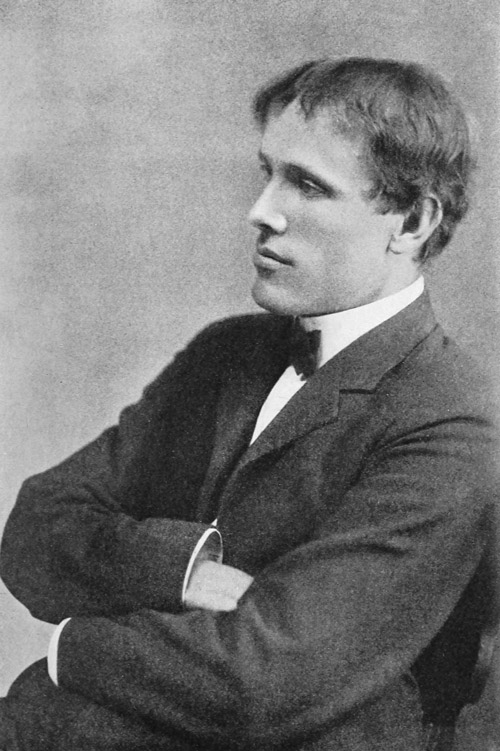
RIDGELY TORRENCE
MR. RIDGELY TORRENCE, whose poetic drama, El Dorado, brought him generous recognition, gave earlier hostages to fame in the shape of a small volume with the caption, The House of a Hundred Lights, and gravely subtitled, “A Psalm of Experience after Reading a Couplet of Bidpai.”
Into this little book were packed some charming whimsicalities, together with some graver thoughts—though not too grave—and some fancies full tender. It had, however, sufficient resemblance to Omar Khayyám to bring it under a Philistine indictment, though its point of view was in reality very different. It was a clever bit of ruminating upon the Where and How and Why and Whence, without attempting to arrive at these mysteries, but rather to laugh at those who did. Mr. Torrence is so artistic as to know that only the masters may go upon the road in search of the Secret, and that the average wayfarer may not The House of a Hundred Lights is in the main of the jocular sort; and Bidpai of indefinite memory may well chuckle to himself in some remote celestial corner that any couplet of his should have been so potent as to produce it.
Mr. Torrence has not, that I can see, filched the fire from Omar’s altar to kindle his hundred lights; this, for illustration, is pure whimsicality, not fatalistic philosophy, as a similar thought would be in Omar:
“Doubt everything,” the Thinker said, When I was parch’d with Reason’s drought. Said he, “Trust me, I’ve probed these things; Have utter faith in me,—and doubt!” Though the sky reel and Day dissolve, And though a myriad suns fade out, One thing of earth seems permanent And founded on Belief: ’tis—Doubt.
But best of all is that quatrain in which he exonerates Providence:
What! doubt the Master Workman’s hand Because my fleshly ills increase? No; for there still remains one chance That I am not His Masterpiece.
If a cleverer bit of humor than that has been put into four lines, I have not seen it, nor a
Yet what have I to do with sweets Like Love, or Wine, or Fame’s dear curse? For I can do without all things Except—except the universe.
Mr. Torrence’s quatrains penetrate into the nebulous dreams of youth, or rather, interpret them, since The House of a Hundred Lights was reared in that charméd air, and carry one through the realm of rainbows to the land of the gray light, to which every pilgrim comes anon. Love receives its toll, the costliest and most precious as youth fares on; and Mr. Torrence proves himself a poet in his picture of this tribute-giving at the road-house of Love. Not only the visioning, but the lucidity of the words, and their soft consonance, prove him sensitive to the values of cadence and simplicity:
Last night I heard a wanton girl Call softly down unto her lover, Or call at least unto the shade Of Cypress where she knew he’d hover. Said she, “Come forth, my Perfect One; The old bugs sleep and take their ease; We shall have honey overmuch Without the buzzing of the bees.” Ah, Foolish Ones, I heard your vows And whispers underneath the tree. Her father is more wakeful than She ever dreamed, for I—was he. I saw them kissing in the shade And knew the sum of all my lore: God gave them Youth, God gave them Love, And even God can give no more.
But much more delicate is this quatrain which follows the last, and traces the unfolding of a young girl’s nature in the years that shape the dream. It is a bit of genuine artistry:
At first, she loved nought else but flowers, And then—she only loved the Rose; And then—herself alone; and then— She knew not what, but now—she knows.
This is a deftly fashioned lyric, rather than a stanza conjoined to others, though, for that matter, the thread of conjunction in the poem is slight; almost any of the quatrains might be detached without loss of value save in atmosphere, as they are arranged with a certain logical view and grow a bit more serious as they progress. We spoke, for instance, of the path of youth leading to the grayer light, and incidentally that Youth acquaints himself with pain as a wayfellow:
Yet even for Youth’s fevered blood There is a certain balm here in This maiden’s mouth: O sweet disease! And happy, happy medicine! And maiden, should these bitter tears You shed be burdensome, know this: There is a cure worth all the pain, —To-night—beneath the moon—a kiss. Girl, when he gives you kisses twain, Use one, and let the other stay; And hoard it, for moons die, red fades, And you may need a kiss—some day.
No one will deny an individual grace of touch upon these strings. The artistic value of the quatrains is unequal; they would bear weeding; and there is a hint of spent impulse in the latter part of the volume, though it may be only by virtue of the grouping that the cleverer stanzas chance to be massed toward the front, as they were probably not written in the order in which they appear. Here and there in the latter part of the volume one comes upon some of Mr. Torrence’s most unique fancies; and, too, if they do not always give one the same pleasurable surprise, they are more thoughtful and the verities are in them. Indeed, Mr. Torrence’s “Psalm of Experience” is not altogether born of a happy insouciance; look a bit more closely and you penetrate the mask, and a face looks out at you, like to your own face, questioning and uncertain. We should be glad to quote more of Mr. Torrence’s quatrains, but must look at El Dorado, his more mature work, which won so kindly a reception from the critics and public.
It would be idle to assert that El Dorado is a great achievement, but it is a fine achievement, and notably so as a first incursion into a field beset with snares for the unwary. Into some of these Mr. Torrence has fallen, but the majority of them he has avoided and has proven his right to fare upon the way he has elected.
As to plot, one may say that El Dorado is a moving tale, full of incident and action, and sharply defining the characters before the mind. The action is focused to a definite point in each scene, making an effective climax, and in the subtler shading of the story, where Perth, the released prisoner, mistaking the love of Beatrix d’Estrada for the young officer of the expedition, thinks it a requital of his own, Mr. Torrence has shown himself sensitive to the effects that are psychological rather than objective; and, indeed, in this quality, as evinced throughout the drama in the character of Perth, the essence of Mr. Torrence’s art consists.
It is more or less an easy artifice for the dramatist to reduce his hero to the verge of despair just as his heroine is conveniently near to save him from leaping over a precipice; but artifice becomes art when the impalpable emotions of a nature lost almost to its own consciousness begin to be called from diffusion and given direction and meaning. While the characterization of Perth is not altogether free from strained sentiment, one recognizes in it a higher achievement than went to the making of the more spectacular crises of the play. The dramatic materials of El Dorado are in the main skilfully handled, and there is logical congruity in the situations as they evolve, assuming the premise of the plot. As an acting play, however, it would require the further introduction of women characters, Beatrix sustaining alone, in its present cast, the feminine element of the drama.
As to the play as literature, as poetry, there is much to commend, and somewhat to deplore. If it remain as literature, it must contain elements that transcend those of its action; if a well-developed plot were literature, then many productions of the stage that are purely ephemeral would take their place as works of art. Between the dramatic and the theatrical there
It is no call, but rather do their sounds Lash me like brazen whips away from her. They shriek two names to me, Honour and Hell; They drive me with two words, Duty and Death. These are the things that I can only find Outside her arms.
In the same scene, however, occurs this fine passage, compact of hopelessness, and having in it the whole heart-history of Perth, who speaks it. He is urged by the friar to hasten that they may join the expedition as it passes the walls:
Perth. It would be useless. Ubeda. In what way? Perth. If to go would be an ill, I need not hasten; it will come to me. And if a good, they will have gone too far; I could not overtake them.
This passage recalls another memorably fine,—that in which Perth upon his release would return to his dungeon, being oppressed by the light:
I seem to have to bear the sky’s whole arch, Like Atlas, on my shoulders.
This is divining a sensation with subtle sympathy. But to return to the consideration of the literature of Mr. Torrence’s drama from the standpoint of his characters. Beatrix is a natural, elemental type of girl, untroubled by subtleties. Impulse and will are one in her understanding, and she counts it no shame to follow where they lead. The love that exists between herself and Coronado discloses no great emotional features, no complexities; but it is not strained nor unnatural, and in the scene where Beatrix discloses her identity to Coronado, as he in desperation at the failure of the quest for El Dorado is about to throw himself over the cliff,—while the situation itself has elements of melodrama, the dialogue is wholly free from it, and indeed contains some of the truest poetry in the play. Coronado, with distraught fancy, thinks it the spirit of Beatrix by whom he is delivered, and fears to approach her lest he dissolve the wraith, whereupon
Have the snow-textured arms of dreams these pulses? Has the pale spirit of sleep a mouth like this?
The counter-passion of Mr. Torrence’s drama, in which its tragedy lies, the passion of Perth for Beatrix, is so manifestly foredoomed on the side of sentiment that one looks upon it purely from a psychological standpoint, but from that standpoint it is handled so skilfully that the dramatic feeling of the play centres chiefly in this character. The Friar Ubeda is also strongly drawn, and one of the motive forces of the drama. It is he who reveals to Perth that he has a son born after his incarceration who is none other than the young leader of the expedition, Don Francis Coronado, although his identity is not revealed by the priest, and only the clew given that on his hand is branded a crucifix, as a foolish penance for some boyhood sin. Many of the finest passages of the play are spoken between Perth and Ubeda.
The temptation to Shakespearize into which nearly all young dramatists fall, Mr. Torrence has wholly avoided, nor has his verse any of the grandiloquent strain that often mars dramatic
O God, ’tis everywhere! But where for me? Youth, love, or hope fulfilled, Whatever dew distils from out its depths, Sparkles till it has lured my eager lips And then sinks back. ’Tis in his desolate heart— And yet I may not drink. ’Tis in her eyes— And yet my own cannot be cooled by it. The wilderness of life is full of wells, But each is barred and walled about and guarded. · · · · · The Source! Can it be true? Oh, may it not be? May it not at last await me in that garden To which we bleed our way through all this waste?— One cup—some little chalice that will hold One drop that will not shudder into mist Till I have drained it.
Passages of this sort might be duplicated in El Dorado, were they not too long to quote with the context necessary to them.
The passage cited above holds a deep suggestion in the lines:—
One drop that will not shudder into mist Till I have drained it.
Here is human longing epitomized; and again the words in which Coronado speaks, as he thinks, to the shade of Beatrix,—
No, I will no more strive to anything And so dispel it,—
are subtly typical of the fear in all joy, the trembling dread to grasp, lest it elude us. That, too, is a fine passage in which Coronado replies to Perth, who seeks to cheer him with thought of the Water of all Dreams:
Ah, that poor phantom Source! I never sought it. I have found the thing called Youth too deadly bitter To grasp at further tasting.
“The thing called Youth” is often “deadly bitter;” and Mr. Torrence has well suggested it in the revulsion from hope to despair which follows upon the knowledge that El Dorado is but a land of Dead-Sea fruit. The atmosphere with which Mr. Torrence has invested the scene where all are waiting for the dawn to lift and reveal the valley of their desire is charged with mystery and portent; one becomes a tense, breathless member of the group upon the cliff, and not a spectator.
Mr. Torrence is occasionally led into temptation, artistically speaking, by the seduction of his imagination, and is carried a bit beyond the point of discretion, as in this passage taken from the scene where the expedition awaits the dawn on the morning when its dream is expected to be realized. Perth and Coronado are looking to the mist to lift. Perth speaks:
And now in that far edge, as though a seed Were sown, there is a hint of budding gray, A bud not wholly innocent of night, And yet a color. Cor. But see, it dies! Perth. Yet now it blooms again, Whiter, and with a rumor of hidden trumpets.
Buds in the common day do not usually bloom with a “rumor of hidden trumpets.” In the same scene Coronado asks:
Can you not see The gem which is the mother of all dawn? Perth. There is some gleam. Cor. It waits one moment yet Before it thunders upon our blinded sight!
It is at least a new conception that gems should thunder upon one’s blinded sight! In another scene Mr. Torrence has the “devouring sun” deepen its “wormlike course” to the world’s edge. Again, his heroine’s mouth is a little
The last act of El Dorado has to my mind less of strength and beauty than its predecessors, and dramatically one may question its conception and construction. In a general study of Mr. Torrence’s plot it seemed that the situations were all developed to the best advantage, but an exception must, I think, be made in regard to the last act. One of the vital requisites of drama is that the suspense of the action shall hold to the end; there may be minor dénouements, but the plot must not be so constructed that the element of mystery shall have been eliminated ere the close, and this is exactly what has been done in El Dorado. The two great scenes have already taken place: El Dorado has been proven a myth, and Beatrix has been united to her lover; there remains but one thread to unravel, the love of Perth for Beatrix; and of that the audience has already the full knowledge and clew, having seen her rejoined to her lover. The only motive of the last act is that the audience may see the
There is a revelation, however, logically demanded by the premises of the plot, in expectation of which the interest is held, and in whose nonfulfilment I cannot but think that Mr. Torrence has lost the opportunity for the most humanly true and effective climax of his play,—the disclosure to Coronado of his parentage. Ubeda, earlier in the drama, has enjoined Perth not to reveal his identity to his son, lest it injure his public career; but in the hour when the supreme loss has come, when Beatrix, as the wife of Coronado, rejoins the homeward detachment of Perth and his friend, and the mortal stroke has fallen,—then Ubeda should have declared the relationship and placed to Perth’s lips ere he died the one draught that would not “shudder into mist” ere he had drained it,—the draught of love from the heart of his child. The bird of hope and light should hover just above the darkest tragedy,—should brood above it with healing in its wings. This is partially realized in the lines in which Mr. Torrence has chosen to veil,
Perth. At last I see! always I seemed to know That one day,—though I knew not when,—some hour, I should behold and know it and possess it,— The Font! Cor. No, it is snow and wine. Beat. He wanders! Perth. I had not thought to find it so at last, Yet here, and here alone, it has arisen Within these two—my only youth! Yes—now! Upon this hour and place at last! The Source! It is a barren place—yet flowers are here, Those which for certain days I seemed to lose; A desolate tender fatherhood has here Found growth, and bears, but all too piteously, A futile bud.
The impression left upon one by El Dorado is that of poetic distinction, and the drama in its character drawing, plot and action is an augury of finer possibilities in the same branch of art.
XVII
GERTRUDE HALL
MISS GERTRUDE HALL is a poet of the intimate mood, the personal touch, one who writes for herself primarily, and not for others. One fancies that verses such as these were penned in musing, introspective moments in the form in which they flitted through the mind, and were indesecrate of further touch. They are as words warm upon the lips, putting one in magnetic rapport with a speaker; and their defects, as well as distinctions, are such as spring from this spontaneity. Frequently a change of word or line, readily suggested to the reader, would have made technically perfect what now bears a flaw; but these lapses are neither so marked nor so frequent as to detract from the prevailing grace of the verse, and but serve to illustrate the point in question,—their unpremeditated note and freedom from posing.
One is not so much arrested by the inevitable image and word in these lyrics of the Age of Fairygold, as by the feeling, the mood, that pervades them. It is not a buoyant mood, nor yet a sombre one, but rather the expression of a varied impulse, a melody of many stops, such as one might play for himself at evening, wandering from theme to theme. The poems convey the impression of coming in touch with a personality rather than a book, the veil between the author and reader being impalpable; and this, their most obvious distinction, is a quality in which many poets of the present day are lacking, either from a mistaken delicacy in regarding their own inner life as an isolated mood not of import to others, or in robbing it of personality and warmth by technical elaboration.
One may confide to the world by means of art what he would not reveal to his closest friend, and yet keep inviolate his spiritual selfhood; but to withhold this disclosure, to become but a poet of externals, is to abrogate one’s claim to speak at all; for a life, however meagre, has something unique and essential to convey, and while one delights in the artist observation, the vivid pictorial touch, it must not be divorced from the subjective. The poems of Miss Hall are happily blended of the objective and subjective; here, for illustration,
I try to fix my eyes upon my book, But just outside a budding spray Flaunts its new leaves as if to say, “Look!—look!” I trim my pen, I make it fine and neat; There comes a flutter of brown wings. A little bird alights and sings, “Sweet!—sweet!” O little bird, O go away! be dumb! For I must ponder certain lines; And straight a nodding flower makes signs, “Come!—come!” O Spring, let me alone! O bird, bloom, beam, “I have no time to dream!” I cry; The echo breathes a soft, long sigh, “Dream!—dream!”
The beautiful lyric,
“Ah, worshipped one, ah, faithful Spring!”
tempers this blitheness to a pensive strain, though only as one may introduce a note of minor in a staccato melody. In another bit of verse celebrating the renewing year, and noting how joy lays his finger on one’s lips and makes him mute, occur these delicate lines:
Thrice happy, oh, thrice happy still the Earth That can express herself in roses, yea, Can make the lily tell her inmost thought!
One nature lyric of two stanzas, despite the fact that its cadence halts in the final couplet, is compact of atmosphere; and to one who has been companioned by the pines, it brings an aromatic breath, full of stimulus:
The sun in the pine is sleeping, sleeping. The drops of resin gleam…. There’s a mighty wizard with perfumes keeping My brain benumbed in a dream! The wind in the pine is rushing, rushing, Fine and unfettered and wild…. There’s a mighty mother imperiously hushing Her fretful, uneasy child!
These lines give over pictures of mornings in the radiant sunlight of the North, that cloudless, lifted air; and “The drops of resin gleam,” has the same touch of transmutation that some suggestion of the brine has for the exiled native of the seaboard.
Miss Hall’s themes are not sought far afield, but bring, in nearly all the poems, a hint of personal experience; nature, love, spiritual emotion, blending with lighter moods and fancies, comprise the record of the Age of Fairygold. We have glanced at the nature
Be good to me! If all the world united Should bend its powers to gird my youth with pain, Still might I fly to thee, Dear, and be righted— But if thou wrong’st me, where shall I complain? I am the dove a random shot surprises, That from her flight she droppeth quivering, And in the deadly arrow recognizes A blood-wet feather—once in her own wing!
In her poem called “The Rival” human nature speaks a direct word, particularly in the contradiction of the last stanza. The lines have the quality of speech rather than of print:
This is the hardest of my fate: She’s better whom he doth prefer Than I am that he worshipped late, As well as so much prettier, So much more fortunate! He’ll not repent; oh, you will see, She’ll never give him cause to grieve! I dream that he comes back to me, Leaving her,—but he’ll never leave! Hopelessly sweet is she. So that if in my place she stood, She’d spare to curse him, she’d forgive! I loathe her, but I know she would— And so will I, God, as I live, Not she alone is good!
The ethical inconsistency of the above stanza, “I loathe her,” and “Not she alone is good,” is so human and racy with suggestion of these paradoxical moods of ours, that the stanza, together with its companion lines, becomes a leaf torn from the book of life.
In its spiritual quality Miss Hall’s work shows, perhaps, its finest distinction: brave, strong, acquiescent, inducing in one a nobler mood,—such is the spirit of the volume. Its philosophy is free from didacticism or moralizing; indeed, it should scarcely be called philosophy, but rather the personal record of experiences touching the inner life,—phases of feeling interpreted in their spiritual import. These lines express the mood:
Then lead me, Friend. Here is my hand, Not in dumb resignation lent Because Thee one cannot withstand— In love, Lord, with complete consent. · · · · · Lead. If we come to the cliff’s crest, And I hear deep below—O deep!— The torrent’s roar, and “Leap!” Thou say’st, I will not question—I will leap.
The last stanza, in its vivid illustrative quality, is an admirable expression of spiritual assurance.
Another brief lyric rings with the true note of valor, declaring the eternal potency of hope, and one’s obligation to pass on his unspent faith, though falling by the way:
Could I not be the pilgrim To reach my saint’s abode, I would make myself the road To lead some other pilgrim Where my soul’s treasure glowed. Could not I in the eager van Be the stalwart pioneer Who points where the way is clear, I would be the man who sinks in the swamp, And cries to the rest, “Not here!”
From an Eastern Apologue Miss Hall has drawn a charming illustration of the power of influence and association:
“Thou smell’st not ill, thou object plain, Thou art a small, pretentious grain Of amber, I suppose.” “Nay, my good friend, I am by birth A common clod of scentless earth…. But I lived with the Rose.”
In the poems of a blither note, Miss Hall excels, having a swift and sprightly fancy and Allegretto, her collection of lighter verse, reveals itself in charming witticisms and whimsicalities. Her children’s poems are delicate in touch and fancy, and quaintly humorous. Her lines, “To A Weed,” in the second collection, tuck away a moral in their sprightly comment; indeed, a bit of philosophy as to being glad in the sun and taking one’s due of life, despite limitations, which renders them more than the merry apostrophe they seem:
You bold thing! thrusting ’neath the very nose Of her fastidious majesty, the rose, Even in the best ordainéd garden bed, Unauthorized, your smiling little head! The gardener, mind! will come in his big boots, And drag you up by your rebellious roots, And cast you forth to shrivel in the sun, Your daring quelled, your little weed’s life done. · · · · · Meantime—ah, yes! the air is very blue, And gold the light, and diamond the dew,— You laugh and courtesy in your worthless way, And you are gay, ah, so exceeding gay! You argue, in your manner of a weed, You did not make yourself grow from a seed; You fancy you’ve a claim to standing-room, You dream yourself a right to breathe and bloom. · · · · · You know, you weed, I quite agree with you, I am a weed myself, and I laugh too,— Both, just as long as we can shun his eye, Let’s sniff at the old gardener trudging by!
In the art of compression, in consistent and restrained imagery, in clearness and simplicity, and in freedom from affectation, Miss Hall’s work is altogether commendable. In technique she makes no ambitious flights, employing almost wholly the more direct and simple forms and metres, but these suit the intimate mood and singing note of her themes better than more intricate measures. Technically her chief defect is in the disregard which she frequently shows for the demands of metre. I say disregard, for it is evident from the grace of the majority of her work that she allows herself to depart from metrical canons at her own will, with the occasional result of jagged lines which may have seemed more expressive to Miss Hall than those of a smoother cadence, but which are likely to offend the ear of one sensitive to rhythm. These lapses are not, however, so frequent or conspicuous as to constitute a general indictment against the work.
The reflective predominates over the imaginative in the Age of Fairygold, notwithstanding the suggestion of the title. Indeed, there is a
Though true it be these splendid dreams of mine Are but as bubbles little children blow, And that Fate laughs to see them wax and shine, Then holds out her pale finger—and they go: One bitter drop falls with a tear-like gleam,— Still, dreaming is so sweet! Still, let me dream! Though true, to love may be definéd thus: To open wide your safe defenceless hall To some great guest full-armed and dangerous, With power to ravage, to deface it all, A cast at dice, whether or no he will,— Still, loving is so sweet! Let me love still!
XVIII
ARTHUR UPSON
WHEN a volume of verse by Mr. Arthur Upson, entitled Octaves In An Oxford Garden, was first brought to my notice by a poet friend with what seemed before reading it a somewhat extravagant comment as to its art, it evoked a certain scepticism as to whether the poet in question would be equally enthusiastic, had he read, marked, learned, and inwardly digested some eighty or more volumes of verse within a given period, thus rendering a more rarely flavored compound necessary to excite anew the poetry-sated appetite; but Mr. Upson’s Octaves proved to be a brew into which had fallen this magic drop, and moments had gone the way of oblivion until the charm was drained.
The volume consists of some thirty Octaves written in Wadham Garden at Oxford in the reminiscent month of September; and so do they fix the mood of the place that one marvels at the restfulness, the brooding stillness, the
The day was like a Sabbath in a swoon. Under late summer’s blue were fair cloud-things Poising aslant upon their charméd wings, Arrested by some backward thought of June. Softly I trod and with repentant shoon, Half fearfully in sweet imaginings, Where lay, as might some golden court of kings, The old Quadrangle paved with afternoon.
What else than a touch of genius is in those three words, “paved with afternoon,” as fixing the tempered light, the drowsy calm, of the place?
The Octaves are written in groups, the poems of each having a slight dependence upon one another, so that to be quoted they require the connecting thought. In many cases also the first or the second quatrain of the Octave is more artistic than its companion lines, as in
As here among the well-remembering boughs, Where every leaf is tongue to ancient breath, Speech of the yesteryears forgathereth, And all the winds are long-fulfilléd vows— So from of old those ringing names arouse A whispering in the foliate shades of death, Where History her golden rosary saith, Glowing, the light of Memory on her brows.
This Octave illustrates also what may be made as a general statement regarding its companions in the volume, that while the glamour may not rest equally upon the poems, they do not lack charm and distinction even in their less creative touches; and there are few in which there does not lurk some surprise in the way of picturesque phrasing.
In the ordering of his cadences Mr. Upson shows a musician’s sense of rhythm; note, for example, how the transposition in the following lines enhances their melody and conveys in the initial one the sense of a river flowing:
It was the lip of murmuring Thames along When new lights sought the wood all strangely fair, Such quiet lights as saints transfigured wear In minster windows crept the glades among. And far as from some hazy hill, yet strong, Methought an upland shepherd piped it there, Waking a silvern echo from her lair: “Sweet Thames, run softly till I end my song!”
Mr. Upson not only obeys by artist instinct the laws of counterpoint, but employs the word with the music in it, and his effects are achieved by the innate harmony of his diction and the poetry in the theme he is shaping. Take as an illustration of this his Octave upon the “Roman Glassware Preserved in the Ashmolean.” Doubtless those fragments of crystal, sheathed, by centuries in the earth, in a translucent film through which shine tints of mother-of-pearl, have met the eyes of many of us, but it needed a poet to deduce from them this illustration:
Fair crystal cups are dug from earth’s old crust, Shattered but lovely, for, at price of all Their shameful exile from the banquet-hall, They have been bargaining beauties from the dust. So, dig my life but deep enough, you must Find broken friendships round its inner wall— Which once my careless hand let slip and fall— Brave with faint memories, rich in rainbow-rust!
One notes in Mr. Upson’s work a restraint that is the apogee of good taste. He conveys the mood, whether of love or other emotion,
Now and again the cosmos thrusts forward a suggestion which becomes the motive of one of the Octaves, as when the garden breeze loosens from the chink a
… measure of earth To match my body’s dust when its rebirth To sod restores old functions I forsook,—
which, in turn, induces a reflection upon the microcosm:
Strange that a sod for just a thrill or two Should ever be seduced into the round Of change in which its present state is found In this my form! forsake its quiet, true And fruitfullest retirement, to go through The heat, the strain, the languor and the wound! Forget soft rain to hear the stormier sound,— Exchange for burning tears its peaceful dew!
Again one has the applied illustration both of the pains and requitals that cling about the sod in its “strange estate of flesh,” in these lines declaring that
Some dust of Eden eddies round us yet. Some clay o’ the Garden, clinging in the breast, Down near the heart yet bides unmanifest. Last eve in gardens strange to me I let The path lead far; and lo, my vision met Old forfeit hopes. I, as on homeward quest, By recognizing trees was bidden rest, And pitying leaves looked down and sighed, “Forget!”
Mr. Upson has one of his characteristic touches in the words “old forfeit hopes,” pictured as starting suddenly before one in the new path that has beguiled him. In looking over the Octaves, which embrace a variety of themes, one doubts if his selections have adequately represented the finely textured lines, pure and individual diction, and the ripe and mellow flavor of it all.
Mr. Upson’s work has had its meed of recognition abroad: his first volume, Westwind Songs, contained a warmly appreciative introduction by The City, just issued in Edinburgh, is introduced by Count Lützow of the University of Prague, a well-known scholar and authority upon Bohemian literature. Taking a backward glance at the first volume before looking at The City, one finds few of the ear-marks of a first collection of poetry, which it must become the subsequent effort of the writer to live down.
The lines “When We Said Good-Bye” are among the truest in feeling, though almost too intimate to quote; and this sympathetic lyric, entitled “Old Gardens,” has a delicate grace:
The white rose tree that spent its musk For lovers’ sweeter praise, The stately walks we sought at dusk, Have missed thee many days. Again, with once-familiar feet, I tread the old parterre— But, ah, its bloom is now less sweet Than when thy face was there. I hear the birds of evening call; I take the wild perfume; I pluck a rose—to let it fall And perish in the gloom.
Westwind Songs, however, waft other thoughts than those of love. There is a heavier freight in this “Thought of Stevenson”:
High and alone I stood on Calton Hill Above the scene that was so dear to him Whose exile dreams of it made exile dim. October wooed the folded valleys till In mist they blurred, even as our eyes upfill Under a too sweet memory; spires did swim, And gables rust-red, on the gray sea’s brim— But on these heights the air was soft and still. Yet not all still: an alien breeze did turn Here as from bournes in aromatic seas, As round old shrines a new-freed soul might yearn With incense to his earthly memories. And then this thought: Mist, exile, searching pain, But the brave soul is free, is home again!
How fine is the imaginative thought of October wooing the valleys till they blurred with mist, as one’s “eyes upfill under a too sweet memory,” and still finer the touch of the “alien breeze” turning
Here as from bournes in aromatic seas.
So one might imagine the journeying winds blowing hither from Vaea, and the intensely human soul of Stevenson yearning to the vital sympathies of earth.
Mr. Upson has recently published in Edinburgh The City, and containing, as previously mentioned, a scholarly introduction by Count Lützow of the Bohemian University of Prague, who points out the historical and traditional sources of the story.
The drama is embraced in one act, and covers a period of but one day, from dawn to dusk; nevertheless, it is not wanting in incident, since its operative causes reach their culmination in this period. The “conditions precedent” of the plot, briefly summarized, show that Abgar, King of Edessa, has married Cleonis, an Athenian, whose foster-sister, Stilbe, having been an earlier favorite of the king, is actuated by jealousy of the pair, and although dwelling as an inmate of the royal household, plots with her lover, Belarion, against the government of the king, ill at his palace outside the city and awaiting the arrival of Jesus to heal him of his disease.
The subjects of Abgar have rebelled not only at his protracted absence from the city, in dalliance, as they deem it, with the Athenian queen, but because of measures of reform instituted by him which had done despite to their ancient idolatries and desecrated certain shrines in the public improvements of the city.
Not only had the king progressed beyond his day in the material advancement of his realm, but his eager, swiftly conceiving mind had imaged a spiritual ideal even more vital; and at the opening of the drama he awaits the coming of the Nazarene to heal him, that he may devote himself to the development of his people.
The scene opens at the dawn in the portico of the palace, where the queen’s women, attired in white pepli, have spent the night singing soft music to the accompaniment of the lyre to charm the fevered sleep of the king. They are dismissed by Agamede, cousin of the queen, who detains Stilbe to learn the cause of her discontent. Sufficient is revealed to indicate that Belarion, the betrothed of Stilbe, whom the oracle has declared a man of promise, is plotting against the life of the king, aided in this design by Stilbe, who has been summoned almost from the marriage altar to attend the queen.
The second scene takes place four hours later, in the palace garden, and pictures the return of the messenger and his attendants sent to conduct Jesus to Edessa. The opening dialogue occurs between Ananias, the returned messenger, and the old and learned doctor of the court, who details with elaborate minuteness the ministries of his skill since the
Tell me of his appearance. What said he?
Ananias replies:
He had prepared this scroll and gave it me With courteous words, yet, as I after thought, Most singularly free from deference For one who ranks with artisans. His look Betrayed no satisfaction with our suit; Yet did he emanate a grave respect Which seemed habitual, much as Stoics use, Yet kinder; and his bearing had more grace Than any Jew’s I ever saw before. As for his words, I own I scarce recall them, And have been wondering ever since that I, Bred at a Court and tutored to brave deeds, Should be so sudden silenced. For I stood Obedient to unknown authorities Which spake in eye and tone and every move, In that his first mild answer of refusal.
Ere the departure of the king’s embassy from Jerusalem, the tragic drama of the crucifixion had been enacted and in part witnessed by them, which Ananias also describes with graphic force; in it appears an adaptation of the Veronica story. The lines well convey the picture:
As the way widened past the high-walled house Of Berenis, the throng thinned, and I saw Plainer the moving figure of the man And the huge beam laid on him. Suddenly From the great gate I saw a form dart forth Straight towards him, pause, and seem to have some speech With the condemned, as, by old privilege, Sometimes the pious ladies do with those Who tread the shameful road. Her speech was brief. She turned, and, as I saw ’twas Berenis, Towards me she came, and her eyes, wet with tears, Smiled sadly, and she said these final words: “Such shame a mighty purpose led him to, Yet he shrinks not, but steadfast to this end Inevitable hath he come his way. A woman of my house was healed of him By kissing once the border of his garment. Take your King this, and say that as he dragged His cruel but chosen cross to his own doom Some comfort in its cooling web he found, And left a blessing in its pungent folds.”
In the third scene of the drama, occurring in the afternoon, Abgar is informed of the Healer’s refusal to accede to his request, but in the presence of the queen and the attendants assembled in the royal garden, the letter of the Nazarene, promising healing and peace, is read to him by the returned envoy, and at length the linen, received from the hand of Berenis, and upon whose folds the healing power of Christ had been invoked, is given into the keeping of Abgar, through whose veins, as by the visible touch of the divine hand, the current of new life throbs and courses. The moment is fraught with intense reality, which Mr. Upson has kept as much as possible to such effects as transcend words. Just previous to the vital transformation Abgar has said:
I have not yet resolved the Healer’s words Into clear meaning; but their crystal soon In the still cup of contemplation may Give up its precious drug to heal our cares,—
but the supreme end was not wrought by contemplation, nor could its processes be resolved
I feel it now! All through these withered veins I feel it bound and glow! O life, life, life!
From this period the incidents of the drama develop with all the tensity of action which previous to this scene it has lacked, giving to the close a certain sense of crowding when compared with the slow movement of the previous scenes consisting chiefly of recital, well told, but with little to enact, making the work to this point rather a graphically related story than a drama. The incidents which come on apace in the latter part of the play have, to be sure, been foreshadowed in the earlier part, but one is scarcely prepared for the swift succession of events, nor for their bloody character after the sabbatical mood into which the earlier scenes of the work have thrown him. If the drama covered a longer period, giving time between scenes for the development of events, even though such development were but suggested by a statement of dates, the impression of undue haste in the climax would be obviated; but in the interval of one day, even though all events leading to the issue have been working silently for months or years, their culmination seems to come without due preparation to the
Immediately following the healing of Abgar, the queen’s cousin, Agamede, enters breathless and announces to the king the plot on foot to overthrow him, which inspires the king with a resolve to set forth at once to the city. Upon the attempt of the queen to deter him, Abgar relates a prophetic dream of his city and its destiny through him, which is one of the finest conceptions, both in spiritual import and elevation of phrase, contained in the drama. The dream is related as having appeared to the king in three distinct visions, glimpsing his city in its past, present, and future. It is too long to follow in detail, but this glimpse is from the vision of the past, where
Through that wreck of fortress, mart and fane And fallen mausoleum crowded o’er With characters forevermore unread, Only the wind’s soft hands went up and down Scattering the obliterative sands. I, led in trance by shapes invisible, Approached a temple’s splendid architrave Half sunk in sod betwixt its columns’ bases, And there by sudden divination read The deep-cut legend of that awful gate: Appease with sacrifice the unknown powers.
The next vision is of the city in its present state, “builded on like dust,” but teeming with activity and material purpose, through which a glimmering ideal begins to dawn:
They toiled, or played, or fought, or sued the gods, Absorbed each in his own peculiar lust, As if there were no morrow watching them; Yet each was happier in the morrow-dream Than ever in all achievéd yesterdays.
Then is revealed to the mind of Abgar the high commission intrusted to him:
And as I looked, I saw a man who long In upward meditation on his roof Sat all alone, communing with his soul, And he arose, and presently went down, Down in the long black streets among his kind, And there with patience taught them steadfastly; But, for the restless souls he made in them, They turned and slew him and went on their ways, And a great fog crept up and covered all.
Here surely is keen spiritual psychology, that “for the restless souls he made in them” they slew him. All martyrdoms are traced to their source in this line, which holds also the suggestive truth as to the final acceptance of that for which the prophet dies. Once having planted the seed whose stirring makes the “restless soul,” its growth is committed to the
Fear not for me: I go unto the city!
The last scene is enacted an hour later in the garden lighted only by the moon, and opens with the lyric sung by Agamede to the blossoming oleander-tree ’neath which her child lies buried. These are lines of a pathos as delicate and spiritual as the moonlight, the fragrance, the memory inspiring them:
Grow, grow, thou little tree, His body at the roots of thee; Since last year’s loveliness in death The living beauty nourisheth. Bloom, bloom, thou little tree, Thy roots around the heart of me; Thou canst not blow too white and fair From all the sweetness hidden there. Die, die, thou little tree, And be as all sweet things must be; Deep where thy petals drift I, too, Would rest the changing seasons through.
Then follows a dialogue of warmly emotional feeling between the king and queen, in the interval of waiting for the chariot and attendants to be brought to the gate. All the physical side of the healing of Abgar has now been resolved into its spiritual meaning, and he reinterprets the words of the Nazarene’s message that of his infirmity he shall know full cure and those most dear to him have peace; but while Abgar speaks of his changed ideal, looking now to a “city which hath foundations, whose builder and maker is God,” a clamor is heard at the gate, and the body-slave rushes to the king with the tidings that armed troops approach the palace, and begs him to flee in the waiting chariot. Spurning thought of escape, the king and queen mount the dais and stand calmly watching in the moonlight the heroic spectacle of the approaching army. At this moment the queen’s women rush into the garden, demanding flight; the conflict begins along the wall; the gate bursts open, and Ananias retreats to the garden, wounded, and shortly dies. A brief interval of quiet, but full of portent, succeeds, when Stilbe, who had plotted with the king’s enemies, rushes through the gate, pursued by the soldiers and bleeding from wounds of their sabres. She is shot, apparently
“Thus Fate helps out!”
is at least a riddle past my solving. If, as the results indicate, Belarion has been using Stilbe as a tool to aid his ambitions, it should scarcely have been related in good faith in the beginning of the drama that their marriage was to be celebrated the week in which the action of the play falls. If logical reasons exist for this change of front, Mr. Upson should have indicated them more clearly.
The climax of the play follows immediately upon the death of Stilbe, when the king, called to account by the insolent Belarion, in righteous indignation strikes him down. It may be questioned whether such a deed could follow so quickly upon the rapt spiritual state to which the king had been lifted; but one inclines to
As they stand defenceless but assured, the soldiers, awed by the might of some inner force in the king, shrink back, and the drama closes with the victorious words,—
Together, Love, we go unto the city!
Though the play, looked upon from a dramatic standpoint, lacks in the earlier scenes a certain magnetism of touch and vividness of action, and in the last scene is somewhat overcharged with them, it has many finely conceived situations which strike the golden mean, and the characterization throughout is strongly defined. Its literary quality must, however, take precedence of its dramatic in the truer appraisal. In diction it shows none of the strained effort toward the supposed speech of an earlier time, which usually distinguishes poetic dramas laid far in the past, but has throughout a fitting dignity and harmony, combined with ease and flexibility of phrase and frequent eloquence of
It is a play rather of character and high motive than of plot, a piece of sheer idealism, notable alike for its spiritual and its poetic quality.
BIOGRAPHICAL INDEX
BROWN, Alice. Born Hampton Falls, N. H., Dec. 5, 1857. Graduated Robinson Seminary, Exeter, N. H., 1876. On staff of Youth’s Companion. Author: Fools of Nature; Meadow-Grass; By Oak and Thorn (English travels); Life of Mercy Otis Warren; The Road to Castaly (poems); The Days of his Youth; Robert Louis Stevenson, A Study (with Louise I. Guiney); Tiverton Tales; King’s End; Margaret Warrener; The Mannerings; Judgment. Resides in Boston.
BURTON, Richard. Born Hartford, Conn., March 14, 1859. Graduated Trinity College, Hartford. Ph.D. Johns Hopkins, 1887. Married Oct. 7, 1889. Taught Old English Johns Hopkins, 1888. Managing Editor N. Y. Churchman, 1888-89. Travelled in Europe, 1889-90. Literary Editor Hartford Courant, 1890-97. Associate Editor Warner Library World’s Best Literature, 1897-99. Professor English Literature, University of Minnesota, 1898-1902. Editor Lothrop Publishing Co., 1902-04. Lectures upon literature and the drama. Author: (verse) Dumb in June, 1895; Memorial Day, 1897; Lyrics of Brotherhood, 1899; Message and Melody, 1903; (prose) Literary Likings, essays, 1898; Life of Whittier, in Beacon Biography Series, 1900; Forces in Fiction, essays, 1902. Resides in Boston.
CARMAN, Bliss. Born Fredericton, N. B., April 15, 1861. Graduate University of New Brunswick, 1881. Postgraduate student University of Edinburgh, 1882-83, and of Harvard, 1886-88. Studied law, practised civil engineering, taught school. Office Editor N. Y. Independent, 1890-1902. For past four years has contributed a weekly column, called “Marginal Notes,” to the Evening Post, N. Y. Unmarried. Author: Low Tide on Grand Pré, 1893; A Sea-Mark, 1895; Behind the Arras, 1895; Ballads of Lost Haven, 1897; By the Aurelian Wall, 1897; Songs from Vagabondia, in collaboration with Richard Hovey, 1894; More Songs from Vagabondia, 1896; Last Songs from Vagabondia, 1900; St. Kavin, a Ballad, 1894; At Michaelmas, 1895; The Girl in the Poster, 1897; The Green Book of the Bards, 1898; Vengeance of Noel Bassard, 1899; Ode on the Coronation of King Edward, 1902; From the Book of Myths, 1902; Pipes of Pan No. 1, 1902; Pipes of Pan No. 2, 1903; The Word at St. Kavins, 1903; Sappho: One Hundred Lyrics, 1903. Resides in New York.
CAWEIN, Madison Julius. Born Louisville, Ky., March 23, 1865. Graduated at High School in Louisville, 1886. Since then has confined himself to the writing of verse. Author: Blooms of the Berry, 1887; The Triumph of Music, 1888; Accolon of Gaul, 1889; Lyrics and Idyls, 1890; Days and Dreams, 1891; Moods and Memories, 1892; Red Leaves and Roses, 1893; Poems of Nature and Love, 1893; Intimations of the Beautiful, 1894; The White Snake (translations from German poets), 1895; Undertones, 1896; The Garden of Dreams, 1896; Shapes and Shadows, 1898; Idyllic Monologues, 1898; Myth and Romance, 1899; Weeds by the Wall, 1901; One Day and Another, 1901; Kentucky Poems (selections published in London with an Introduction by Edmund Gosse), 1902; A Voice on the Wind, 1902. Resides Louisville, Ky.
FENOLLOSA, Mary McNeil. Born in Alabama. Graduated Irving Academy, Mobile. Married, 1895, Ernest F. Fenollosa. Resided in Japan about eight years. Author: Out of the Nest: A Flight of Verses, 1899; and Child Verses on Japanese Subjects. Wrote Monograph upon Heroshige, the Artist of Mist, Snow, and Rain; also verses, sketches, and stories in many magazines.
GUINEY, Louise Imogen. Born Boston, Jan. 7, 1861. Graduated Elmhurst Academy, Providence, R. I., 1879. Studied afterwards under private tutors and abroad. Contributor
HALL, Gertrude. Born Boston, Sept. 8, 1863. Educated private schools in Florence, Italy. Author: (verse) Far from To-day; Allegretto (light verse): Foam of the Sea; Age of Fairygold; Translator Paul Verlaine’s Poems, and of Cyrano de Bergerac; (prose) The Hundred, and Other Stories; April’s Sowing; The Legend of Sainte Cariberte des Ois. Resides New York City.
HOVEY, Richard. Born Normal, Ill., 1864. Educated Dartmouth College. Author: Poems, privately printed, 1880; Songs from Vagabondia; More Songs from Vagabondia; and Last Songs from Vagabondia (in collaboration with Bliss Carman); Seaward: An Elegy (on the death of Thomas William Parsons); The Quest of Merlin: A Masque; The Marriage of Guenevere: A Tragedy; The Birth of Galahad; A Romantic Drama; Taliesin: A Masque; Along the Trail: A Book of Lyrics; Translator the Plays of Maeterlinck (in two series). Died 1900.
KNOWLES, Frederic Lawrence. Born Lawrence, Mass., Sept. 8, 1869. Graduated Wesleyan University, 1894. Harvard, 1896. In editorial department Houghton, Mifflin and Co., from February to September of 1898. Literary adviser of L. C. Page and Co., 1899-1900. Since that time adviser for Dana Estes and Company. Unmarried. Author: (prose) Practical Hints for Young Writers, Readers, and Book Buyers, 1897; A Kipling Primer, 1900. (Republished in England); (verse) On Life’s Stairway, 1900; Love Triumphant, 1904. Edited Cap and Gown Second Series,
PEABODY, Josephine Preston. Born in New York. Educated Girls’ Latin School, Boston, and at Radcliffe College, 1894-96. Instructor in English Literature at Wellesley College, 1901-03. Author: Old Greek Folk-Stories (Riverside Lit. Series) 1899; The Wayfarers, a book of verse, 1898; Fortune and Men’s Eyes; New Poems with a Play, 1900; Marlowe, A Drama, 1901; The Singing Leaves, 1903. Contributor to leading magazines. Resides Cambridge, Mass.
REESE, Lizette Woodworth. Born in Baltimore Co., Md., Jan. 9, 1856. Teacher of English, West High School, Baltimore. Author: A Branch of May; A Handful of Lavender, 1891; A Quiet Road, 1896. Resides in Baltimore.
ROBERTS, Charles George Douglas. Born Douglas, N. B., Jan. 10, 1860. Graduated University of New Brunswick, 1879 (A. M. 1880). Married 1880. Head Master Chatham Grammar School, 1879-81; York St. School, Fredericton, 1881-83. Editor Week, Toronto, 1883-84. Professor English and French Literature, King’s College, Windsor, N. S., 1885-88. Professor English and Economics, same, 1888-95. Associate Editor Illustrated American, 1897-98. Author: (verse) Orion and Other Poems, 1880; In Divers Tones, 1887; Ave: An Ode for the Shelley Centenary, 1892; Songs of the Common Day, and Ave, 1893; The Book of the Native, 1896; New York Nocturnes, 1898; Poems, 1901; The Book of the Rose, 1903; (prose) The Canadians of Old; Earth’s Enigmas; The Raid from Beauséjour; A History of Canada; The Forge in the Forest; Around the Camp-fire; Reube Dare’s Shad Boat; A Sister to Evangeline; Appleton’s Canadian Guide-Book, 1899; By the Marshes of Minas, 1900; The Heart of the Ancient Wood, 1900; The Kindred of the Wild, 1902; Barbara Ladd, 1902; The Bird Book, 1903; The Watchers of the Trails, 1904. Editor the Alastor and Adonais of Shelley with Introduction and Notes, 1902. Resides New York City.
SANTAYANA, George E. Born in Spain, 1863. Assistant Professor of Philosophy, Harvard University. Author: (verse) Sonnets and Other Poems, 1894; Lucifer: A Theological Tragedy, 1899; The Hermit of Carmel and Other Poems, 1901; (prose) The Sense of Beauty, 1896; Interpretations of Poetry and Religion, 1900. Resides Cambridge, Mass.
SCOLLARD, Clinton. Born Clinton, N. Y., Sept. 18, 1860. Graduated from Hamilton College, 1881. Also studied at Harvard and at Cambridge, England. Professor of English Literature at Hamilton College, 1888-96. Author: (verse) Pictures in Song, 1884; With Reed and Lyre, 1888; Old and New World Lyrics, 1888; Giovio and Giulia, 1891; Songs of Sunrise Lands, 1892; The Hills of Song, 1895; A Boy’s Book of Rhyme, 1896; Skenandoa, 1896; The Lutes of Morn, 1901; Lyrics of the Dawn, 1902; The Lyric Bough, 1904; Ballads of Valor and Victory, 1904 (in collaboration with Wallace Rice); Footfarings (prose and verse), 1904; (prose) Under Summer Skies, 1892; On Sunny Shores, 1893; A Man-at-Arms, 1898; The Son of a Tory, 1900; A Knight of the Highway; The Cloistering of Ursula, 1902; Lawton, 1900; Editor Ford’s Broken Hearts, 1904, and of Ballads of American Bravery, 1900. Resides Clinton, N. Y.
THOMAS, Edith Matilda. Born Chatham, O., August 12, 1854. Educated Normal School, Geneva, Ohio. Removed to New York, 1888. Author: (verse) A New Year’s Masque and Other Poems, 1885; Lyrics and Sonnets, 1887; Babes of the Year, 1888; The Inverted Torch, 1890; Fair Shadow Land, 1893; A Winter Swallow, 1896; The Dancers, 1903; (prose) The Round Year. Resides West New Brighton, Staten Island.
TORRENCE, Frederic Ridgely. Born Xenia, O., Nov. 27, 1875. Educated under private tutors and at Miami University, O., also Princeton. Librarian Astor Library, 1897-1901. Librarian Lenox Library, 1901-03. At present Associate Editor of The Critic, New York. Unmarried. Author: (verse) The House of a Hundred Lights, 1900; El Dorado, A Tragedy, 1903. Resides in New York.
UPSON, Arthur. Born in Camden, N. Y., 1877. Graduated from Camden Academy, 1894. B. A. University of Minnesota. Author: Poems (with George Norton Northrop); Westwind Songs (with an Introduction by “Carmen Sylva”); Octaves in An Oxford Garden; The City, a Poem-Drama (with Introduction by Count Lützow). Resides Minneapolis, Minn.
WOODBERRY, George E. Born Beverly, Mass., May 12, 1855. Graduated Harvard, 1877. Professor of English at University of Nebraska, 1877-78, and 1880-82. On editorial staff of the Nation, 1878-79. Author: History of Wood Engraving, 1883; Life of Edgar Allan Poe, 1885; Studies in Letters and Life, 1890; The North Shore Watch and Other Poems, 1890; Heart of Man, 1899; Wild Eden, 1899; Makers of Literature, 1900; Nathaniel Hawthorne, 1902; Poems (collected edition), 1903. Editor: Complete Poems of Shelley; Complete Works of Poe (with Mr. Stedman); National Studies in American Letters; Columbia Studies in Comparative Literature; Lamb’s Essays of Elia; Aubrey de Vere’s Selected Poems, and Bacon’s Essays. Editor of the Journal of Comparative Literature. From 1891 to 1903 Professor of Comparative Literature at Columbia University.