JESSIE B. RITTENHOUSE (continued 3)
Reading edition
What a happy bit of realism is that of the toadstool “bulging, moony white, through loosening loam”! The second of the stanzas may be too Keats-like in atmosphere to have been achieved with unconsciousness of the fact, be that as it may, it is a bit of sheer beauty, as the last is of dainty fancy.
But nature, either realistically or romantically, is not all that Mr. Cawein writes of, though it must be said that his verse upon other themes is so largely tinctured with his nature passion that one rarely comes upon a poem whose illustrations are not drawn more or less from this source, making it difficult to find lyrics wholly upon other themes. Because of his opulent metrical variety, Mr. Cawein is less lyrical than as if he sang in simpler measures. His lyrics, indeed, are in the main his least distinguished work, having frequently, if highly musical, too slight a motive; or if more consequent in motive, not being sufficiently musical; or the melody may be unimpeachable and the theme too romantic to have convincing value, as “Mignon,” “Helen,” “The
Go your own ways. Who shall persuade me now To seek with high face for a star of hope?
and ending,
Though sands be black and bitter black the sea, Night lie before me and behind me night, And God within far Heaven refuse to light The consolation of the dawn for me,— Between the shadowy bourns of Heaven and Hell, It is enough love leaves my soul to dwell With memory.
In such notes as these controlled by the Vox Humana stop, Mr. Cawein best reveals himself; another, coming from the heart rather than the fancy, is “Nightshade,” from the volume called Intimations of the Beautiful, a record of life’s bringing to judgment the late-proffered love, unyielded when desired.
“A Wild Iris” is in the later and finer manner, but although love is the spirit of the song, it is embodied chiefly in terms of nature, and would not reveal a different phase of his work from that already shown. This, too, is the case with the two lighter lyrics, “Love In A Day” and “In The Lane,” each with a most taking measure; the second a rural song lilting into this note:
When the hornet hangs in the hollyhock, And the brown bee drones i’ the rose, And the west is a red-streaked four-o’-clock, And summer is near its close— It’s—Oh, for the gate and the locust lane And dusk and dew and home again!
Mr. Cawein has frequent poems in celebration of the farm, not only its picturesque cheer, but its dignity and finer idealism. “A Song For Labor” is one of the best; also “Old Homes,” an idyllic picture of the Southern plantation, with its gentle haze of reminiscence:
Old homes among the hills! I love their gardens, Their old rock-fences, that our day inherits; Their doors, ’round which the great trees stand like wardens; Their paths, down which the shadows march like spirits; Broad doors and paths that reach bird-haunted gardens. I see them gray among their ancient acres, Severe of front, their gables lichen-sprinkled,— Like gentle-hearted, solitary Quakers, Grave and religious, with kind faces wrinkled,— Serene among their memory-hallowed acres. Their gardens, banked with roses and with lilies— Those sweet aristocrats of all the flowers— Where Springtime mints her gold in daffodillies, And Autumn coins her marigolds in showers, And all the hours are toilless as the lilies. · · · · · Old homes! old hearts! Upon my soul forever Their peace and gladness lie like tears and laughter; Like love they touch me, through the years that sever, With simple faith; like friendship, draw me after The dreamy patience that is theirs forever.
Mr. Cawein blends the mood and the picture in the simple tenderness of these lines, with their unstriving felicity. Kentucky’s more strenuous side also finds a chronicler in his verse: the tragedies of its mountains are told in one of the earlier volumes in such poems as “The Moonshiner,” “The Raid,” and “Dead Man’s Run;” and in Weeds by the Wall, in that graphic poem “Feud,” sketching with the pencil of a realist the road to the spot
… where all the land Seems burdened with some curse,
and where, sunk in obliterative growth of briers, burrs, and ragweed, stands the
… huddled house Where men have murdered men,
and where a terrified silence still broods, for
The place seems thinking of that time of fear And dares not breathe a sound.
Mr. Howells, in an appreciation of Mr. Cawein’s work, after the appearance of Weeds by the Wall, spoke of this poem declaring that “What makes one think he will go far and long, and outlive both praise and blame, is the blending of a sense of the Kentucky civilization in such a poem as ‘Feud.’ Civilization may not be quite the word for the condition of things suggested here, but there can be no doubt of the dramatic and the graphic power that suggests it, and that imparts a personal sense of the tragic squalor, the sultry drouth, the forlorn wickedness of it all.” His poem “Ku Klux,” in a volume published some time ago, is no less dramatic in touch and theme. Mr. Cawein knows how to set his picture; the ominous portent of the night in which the dark deed is done would be understood from these three lines alone:
The clouds blow heavy towards the moon. The edge of the storm will reach it soon. The kildee cries and the lonesome loon.
It may be said of Mr. Cawein’s work in general that it shows him to be alert to impression, and gives abundant evidence that life presents itself to him abrim with suggestion. Occasionally, as mentioned above, he wanders too far into the romantic, or yields to the rhyming impulse in a fallow time of thought; but when he throws this facile poetizing by, and betakes himself to nature and life in the capacity of observer and analyst, he produces work notable for its strength, fidelity, and beauty. Metrically, in his earlier work he was influenced by various poets he had read too well. “Intimations of the Beautiful,” occupying a part of the volume bearing that name, would be one of his best efforts, in thought and imaginative charm, were it not written in a form developed from “In Memoriam,” so that one is haunted by the metrical echo. The poem is devoted to interpretations of life and the spirit, through nature; and has not a division without some revelation from that book of the earth which Mr. Cawein has made his gospel. Its observations, while couched in imagery that now and again tends
In his recent books, however, he adventures upon his way, seeing wholly by the light of his own eyes, and portraying by the skill of his own hand, so that his work has taken on personality and individuality with each succeeding volume.
Its breath from the bourns of meadow and woodland brings with it a stimulating fragrance, and one closes a book by Mr. Cawein, feeling that he has been in some charmed spot under Southern skies where
Of honey and heat and weed and wheat The day had made perfume.
X
GEORGE E. WOODBERRY
“For he who standeth in the whole world’s hope Is as a magnet; he shall draw all hearts To be his shield, all arms to strike his blow.”
THESE words by Mr. George E. Woodberry sound the keynote to his art, for he has set himself to disclose the immanence of beauty, of strength; to mould the real to the ideal; and whether he fashions a god, as in “Agathon,” or a patriot, as in “My Country,” he is concerned only with the development of the spiritual potentialities.
He comes to life, to poetry, enriched by a scholar’s culture, but limited by his enrichment on the creative side of his art. He is too well possessed of the immortal melodies to trust the spontaneous notes of his own voice, and hence his verse on its technical side lacks variety and freedom of movement. It has all the cultivated, classical freedom, it flows ever in pure and true numbers; but the masters sing in its overtones, and one catches himself hearkening to them as to Mr. Woodberry himself.
Mr. Woodberry has, however, something to say; and if he says it rather with grace and cultivation as to form, than with any startling surprises of artistic effect, his work in its essence, in its spirit, is none the less creative, and upon this side its strength lies. It is ethical and intellectual, rather than emotional, poetry. Though rising often to an impassioned height, it is a passion of the brain, pure and cold as a flood of moonlight. Even the songs of “Wild Eden,” and others dealing with love, remain an abstraction; one does not get the sense of personality, except in one or two of them, such as the lyric, “O, Inexpressible As Sweet,” and in these few lines called “Divine Awe”:
To tremble when I touch her hands, With awe that no man understands; To feel soft reverence arise When, lover-sweet, I meet her eyes; To see her beauty grow and shine When most I feel this awe divine,— Whate’er befall me, this is mine; And where about the room she moves, My spirit follows her, and loves.
But although one misses the sense of reality in the songs of love, the ideality is for that reason the more apparent. Love that has sublimated, taken on the rarer part, that has made a mystic interchange with nature and with God, is celebrated in the fervid poem, “He Ate The Laurel And Is Mad,” which marks one of the strongest achievements in Mr. Woodberry’s work, and especially in a lyric it contains, vibrating with a fine, compulsive melody. The lines preceding the lyric relate the coming of Love into the heart of nature:
And instant back his longing runs Through bud and billow, through drift and blaze, Through thought, through prayer, the thousand ways The spirit journeys from despair; He sees all things that they are fair, But feels them as the daisied sod,— This slumbrous beauty, this light, this room, The chrysalis and broken tomb He cleaveth on his way to God.
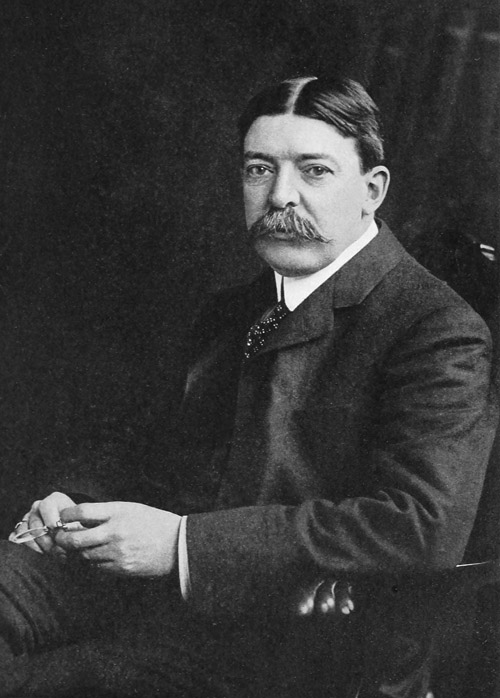
Then the poem breaks into this pæan, whose music outsings its thought when pushed to analysis; this is one of Mr. Woodberry’s metrical exceptions that prove the rule. Here is sheer music making fine but not extraordinary thought seem great, whereas in the majority of his work it is the thought to which one listens rather than the melody; but to the lyric,
I shall go singing over-seas; “The million years of the planets increase; All pangs of death, all cries of birth, Are clasped at one by the heart of the earth.” I shall go singing by tower and town: “The thousand cities of men that crown Empire slow-rising from horde and clan, Are clasped at one by the heart of man.” I shall go singing by flower and brier: “The multitudinous stars of fire, And man made infinite under the sod, Are clasped at one by the heart of God.” I shall go singing by ice and snow: “Blow soon, dread angel, greatly blow, Break up, ye gulfs, beneath, above, Peal, time’s last music,—‘love, love, love!’”
Of his recent volume in which he gathers his most representative work, “The North Shore Watch,” a threnody published some years ago,
I will go down in my youth to the hoar sea’s infinite foam; I will bathe in the winds of heaven; I will nest where the white birds home; Where the sheeted emerald glitters and drifts with bursts of snow, In the spume of stormy mornings, I will make me ready and go; Where under the clear west weather the violet surge is rolled, I will strike with the sun in heaven the day-long league of gold; Will mix with the waves, and mingle with the bloom of the sunset bar, And toss with the tangle of moonbeams, and call to the morning star; And wave and wing shall know me a seachild even as they, Of the race of the great seafarers, a thousand years if a day.
These lines have the bracing ozone of the east wind; it is good to fill one’s lungs with their freshening breath. In another sea-song, “Homeward Bound,” an exultant, grateful hymn, Mr. Woodberry speaks of steering
“Through the weird, red-billowing sunset”
and of falling asleep in the “rocking dark,” and with the dawn,
Whether the purple furrow heaps the bows with dazzling spray, Or buried in green-based masses they dip the storm-swept day, Or the white fog ribbons o’er them, the strong ship holds her way
These are pictures in strong color, freehand records with pigment, of which Mr. Woodberry’s sea-verse contains many duplicates. He paints the sea as an impressionist, catching her evanescent moods. Aside from the pictorial art of the poem from which the lines above are taken, it thrills with the gladness that abides with one coming
Home from the lonely cities, time’s wreck, and the naked woe, Home through the clean great waters where freemen’s pennants blow, Home to the land men dream of, where all the nations go.
Mr. Woodberry is an American, and ever an American, whatever tribute he may pay at longer dedicated shrines. His ode to “My Country” is an impassioned utterance, full of ideality, and pride in things as they are, not lacking, however, in the prophetic vision of what they shall be. He trusts his country without reservation, recognizes her greater commission in what has terrified many poets,—the absorption of the Eastern isles,—and bids her be swift to yield her benefits:
O, whisper to thy clustered isles If any rosy promise round them smiles; O, call to every seaward promontory If one of them, perchance, is made the cape of glory.
In technique the ode has a fine sweep and movement; it thrills with flights of feeling, as in these lines near the close,—
And never greater love salutes thy brow Than his, who seeks thee now. Alien the sea and salt the foam Where’er it bears him from his home; And when he leaps to land, A lover treads the strand.
The ode is somewhat marred by prolixity, and now and again by the declamatory impulse getting the better of the creative; but granting
I lay the singing laurels down Upon the silent grave,
and grows from this into a glimpsing of Emerson’s most characteristic thought, to which Mr. Woodberry sings his own indebtedness. This philosophical résumé has value as critical interpretation and as tribute to whom tribute is due, but it lacks the vital spark as poetry. Odes of this sort are no gauge of a poet’s merit, and although Mr. Woodberry does not reveal his weakness in writing of this sort, neither does he to any marked degree reveal his strength. It is work of conventional creditability, reaching occasionally some flight of pure poetry, but pervaded in general by the perfunctory note that results from coercing the muse; and here one may interpolate the wish that all poems-for-occasion might be “put upon the list,” for it is certain, not only that
It is on the spiritually philosophical side of his nature that Mr. Woodberry makes his strongest appeal. He is not primarily a poet of love, nor of nature, nor a melodist making music for its own sake; he is an eager, questing follower of the ideal; proclaimer of the truth that
The glamour of God hath a thousand shapes And every one divine.
When he interprets the mystery of love, or turns to the world without, it is the immanence of the divine that haunts him:
Over the grey leagues of ocean The infinite yearneth alone; The forests with wandering emotion The thing they know not intone.
He is, indeed, the spirit’s votary, and the ultimate purport of his message is the recognition of one’s own spirit force. His poem, “Nay, Soul,” rebukes the weakness that looks on every side for that which is within; the nature that, seeking props, falls by the way; or, craving understanding, loses the strength that comes of being misunderstood. It subtly divides the legitimate gifts of sympathy from those which weakness demands, and reveals the impossibility of coercing life, or love, or any good to which one’s nature is not so magnetized that it comes to him unentreated. These are potent lines:—
Nay, Soul, thy shame forbear! Between the earth and sky Was never man could buy The bread of life with prayer, Not though his brother there Saw him with hunger die. His life a man may give, But, not for deepest ruth, Beauty, nor love, nor truth Whereby himself doth live. Come home, poor fugitive! Art thou so poor, forsooth? · · · · · Thy heart—look thou aright! Fear not the wild untrod, Nor birth, nor burial sod! Look, and in native light, Bare as to Christ’s own sight, Living shalt thou see God.
The dramatic poem, “Agathon,” which is builded upon the philosophy of Plato, is perhaps the most thoughtful and thought-inciting work in the newly collected volume. It is in no sense of the word dramatic, but doubtless cast in this form from its wider adaptability to the contrasts of thought. The poem is too lengthy to follow an analysis of its philosophy, which is wrought out with subtle elaboration, smacking too much at times of a logical demonstration, but in the main leavened with imaginative phrase. Its poetic climax is in the apostrophe which follows the statement that
The sweetest roamer is a boy’s young heart.
The lines form a blank-verse lyric with a rich cadence and movement:
O youngest Roamer, Hesper shuts the day, White Hesper folded in the rose of eve; The still cloud floats, and kissed by twilight sleeps; The mists drop down, and near the mountain moor; And mute the bird’s throat swells with slumber now; And now the wild winds to their eyries cling. · · · · · O youngest Roamer, wonderful is joy, The rose in bloom that out of darkness springs; The lily folded to the wave of life, The lotus on the stream’s dark passion borne. · · · · · Ah, fortunate he roams who roameth here, Who finds the happy covert and lies down, And hears the laughter gurgling in the fount, And feels the dreamy light imbathe his limbs. No more he roams, he roams no more, no more.
These lines are reminiscent of Tennyson’s “Princess” in their metrical note, particularly in the final couplet of the first stanza, with the “dying fall” of the cadence, bringing to mind:
Now droops the milkwhite peacock like a ghost, And like a ghost she glimmers on to me.
Mr. Woodberry’s poetic affiliation with Tennyson comes out unmistakably in various other poems, leaving no doubt as to one of the masters who sing in his over-tones. Here, for illustration, is a transfusion with Tennyson’s “Tears, Idle Tears.” One stanza of the flawless lyric reads:
Ah, sad and strange as in dark summer dawns The earliest pipe of half-awaken’d birds To dying ears, when unto dying eyes The casement slowly grows a glimmering square; So sad, so strange, the days that are no more.
And Mr. Woodberry says:
O hidden-strange as on dew-heavy lawns The warm dark scent of summer-fragrant dawns; O tender as the faint sea-changes are, When grows the flush and pales the snow-white star; So strange, so tender, to a maid is love.
The mere fact of employing the Tennyson metre, especially when rhymed, would not give the sense of over-assimilation of the other’s work were it not for the marked correspondence in the diction and atmosphere, the first line of Tennyson’s lyric being expanded into the opening couplet of Mr. Woodberry’s stanza, and the final lines of each having so similar a terminology. Shelley is a much more operative force in Mr. Woodberry’s poetry than Tennyson, but rather in temperamental kinship than in a technical way. Mr. Woodberry could scarcely fail to have a keen sympathy with the passionate art of Shelley, who lived in the ideal, subtilized and sublimated beyond all reach but that of longing, but who yet set his hand and brain to the strife about him. In his earlier work Mr. Woodberry occasionally shows the Shelley influence in technique and theme, but not in his later verse. One can scarcely understand his leaving in a definitive collection of his work the poem “Love at the Door,” whose obligations to Taylor’s “Bedouin
Front more majestic of sea-mountains nowhere is there uplifted the whole earth through,—
whose legitimate place is in a rhetorical textbook, as an exercise in redundance. Mr. Woodberry is occasionally allured by his theme until the song outruns the motive, but he rarely pads a line like this; even poetic hyperbole has a limit.
In picturesque imagery his work is finely individualized; witness the figurative beauty of the following lines:
The ocean, storming on the rocks, Shepherds not there his wild, wet flocks. The soaring ether nowhere finds An eyrie for the wingéd winds; Nor has yon glittering sky a charm To hive in heaven the starry swarm; And so thy wandering thoughts, my heart, No home shall find; let them depart.
The two sonnets “At Gibraltar” represent, perhaps, as fine an achievement as distinguishes Mr. Woodberry’s work. It would, indeed, be difficult to surpass them in American literature of to-day in strength, passion, or ideality:
I England, I stand on thy imperial ground, Not all a stranger; as thy bugles blow, I feel within my blood old battles flow— The blood whose ancient founts in thee are found. Still surging dark against the Christian bound Wide Islam presses; well its peoples know Thy heights that watch them wandering below; I think how Lucknow heard their gathering sound. I turn, and meet the cruel, turbaned face. England, ’tis sweet to be so much thy son! I feel the conqueror in my blood and race; Last night Trafalgar awed me, and to-day Gibraltar wakened; hark, thy evening gun Startles the desert over Africa! II Thou art the rock of empire, set mid-seas Between the East and West, that God has built; Advance thy Roman borders where thou wilt, While run thy armies true with His decrees. Law, justice, liberty—great gifts are these; Watch that they spread where English blood is spilt, Lest, mixed and sullied with his country’s guilt, The soldier’s life-stream flow, and Heaven displease! Two swords there are: one naked, apt to smite, Thy blade of war; and, battle-storied, one Rejoices in the sheath, and hides from light. American I am; would wars were done! Now westward, look, my country bids good-night— Peace to the world from ports without a gun!
Whether in his travels or in the quiet of his own contemplation, the emphasis of Mr. Woodberry’s thought is upon the noble, the essential, the beautiful. Although not a strongly creative poet in form, he is a highly cultivated poet, and hands on the nobler traditions of art; and if now and then he wraps another’s “singing robe” about him, it is but an external vesture, leaving the soul of his thought unchanged.
XI
FREDERIC LAWRENCE KNOWLES
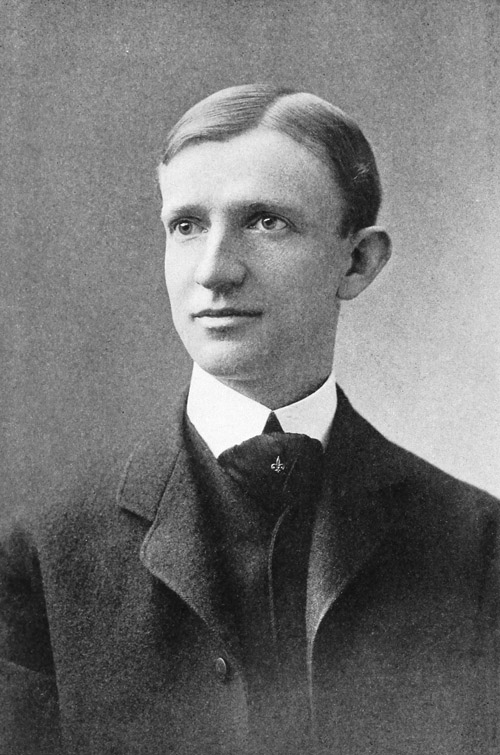
MR. FREDERIC LAWRENCE KNOWLES is one of the younger poets about whose work there is no veneer. This is not to imply that it lacks finish, but rather that the foundation is genuine; it reflects its native grain, and not an overlaid polish. One feels back of the work the probity and directness that underlie all soundly conditioned literature; for while Mr. Knowles has the poet’s passion for the beauties of the art he essays, the primary value is always in that to be conveyed rather than in the medium of transmission.
This sincerity is at once Mr. Knowles’ distinction and his danger. He is so manifestly in earnest that one feels at times in his work a certain lack of the imaginative leaven which should lighten the most serious thought; to put it in a word, there is often an over-strenuous note in his poetry; but were it put to a choice between this mood and the honeyed
The poet is not fed on sweets; Daily his own heart he eats,—
not morbidly, but finding within his own spirit daily manna, and living by this aliment and not by the mere nectar of things. Everything in life bestows this manna and daily renews it; and the poet is he who assimilates and transmutes it to personal needs until his thought is fed from his own heart as in Emerson’s couplet.
This is Mr. Knowles’ ideal of growth, evidenced by the eager interest and open sympathy with which he seeks from life its elements of truth, and from experience its developing properties. It is, of course, an ideal beyond his present attainment, probably beyond his ultimate attainment, gauged by absolute standards, for the “elements of truth” are hardly to be separated from life by one magnet. They are variously polarized, and though one may possess the divining wand that shall disclose the nature and place of certain of them, there is no wand polarized for all; but it is the poet’s part to pass that magnet of truth which is his by nature over the field of life, that it may
Before taking up his later work, however, we may glance at his matin songs, On Life’s Stairway, which have many indicative notes worthy of consideration. This volume, that called forth from John Burroughs, Richard Henry Stoddard, Joaquin Miller, and others, such hearty commendation, has an individuality that makes itself felt. First, perhaps, one notes its spontaneity and the evident love of song that is its primal impulse. The fancy is fresh and sprightly, not having yet thought’s heavier freight; the optimism is robust, the loyalty to one’s own time impassioned and absolute, and the democracy and Americanism distinguishing it are of the commendable, if somewhat grandiloquent, type belonging to youthful patriotism. Another feature of Mr. Knowles’ work, manifest in both volumes, is that its inspiration is from life rather than nature, which is refreshing in view of the fact that the reverse obtains with most of the younger poets. When, however, he comes to this theme, it is with a lightness of touch and a pleasant charm of mood that give to the few poems of this subject an airy delicacy and an unpremeditated note, as in these lines:
Nature, in thy largess, grant I may be thy confidant! · · · · · Show me how dry branches throw Such blue shadows on the snow; Tell me how the wind can fare On his unseen feet of air; Show me how the spider’s loom Weaves the fabric from her womb; Lead me to those brooks of morn Where a woman’s laugh is born; Let me taste the sap that flows Through the blushes of a rose,— Yea, and drain the blood which runs From the heart of dying suns; Teach me how the butterfly Guessed at immortality; Let me follow up the track Of Love’s deathless zodiac Where Joy climbs among the spheres Circled by her moon of tears.
In his poems upon love, Mr. Knowles touches some of his truest and surest notes; those in the second volume have a broader and more sympathetic appeal, and yet have not lost the confessional note which alone gives value to the subject. They are not invariably of a more inspired touch than are several in the first collection, such as “Lost Knowledge,” “A Song for Simplicity,” and “Love’s Prayer;” now and again they combine some newly minted phrase Love Triumphant:
Helen’s lips are drifting dust, Ilion is consumed with rust; All the galleons of Greece Drink the ocean’s dreamless peace; Lost was Solomon’s purple show Restless centuries ago; Stately empires wax and wane— Babylon, Barbary and Spain— Only one thing, undefaced, Lasts, though all the worlds lie waste And the heavens are overturned. —Dear, how long ago we learned! There’s a sight that blinds the sun, Sound that lives when sounds are done, Music that rebukes the birds, Language lovelier than words, Hue and scent that shame the rose, Wine no earthly vineyard knows, Silence stiller than the shore Swept by Charon’s stealthy oar, Ocean more divinely free Than Pacific’s boundless sea,— Ye who love have learned it true. —Dear, how long ago we knew!
Of this group, however, it is in the sonnet, “If Love Were Jester at the Court of Death,” that Mr. Knowles’ most genuine inspiration has visited him.
The conception of the sonnet is unique, and its opening line of epigrammatic force and suggestiveness:
If Love were jester at the court of Death, And Death the king of all, still would I pray, “For me the motley and the bauble, yea, Though all be vanity, as the Preacher saith, The mirth of love be mine for one brief breath!” Then would I kneel the monarch to obey, And kiss that pale hand, should it spare or slay; Since I have tasted love, what mattereth! But if, dear God! this heart be dry as sand, And cold as Charon’s palm holding Hell’s toll, How worse! how worse! Scorch it with sorrow’s brand! Haply, though dead to joy, ’t would feel that coal; Better a cross and nails through either hand, Than Pilate’s palace and a frozen soul!
Here are originality, strength, and white heat of feeling, though the sestett is less artistic than the octave, which holds the creative beauty of the sonnet.
Of the lyrical poems in the second volume there are many clear of tone, having not only a pure, enunciative quality musically, but also color and picturesqueness, as that beginning:
With all his purple spoils upon him Creeps back the plunderer Sea,
with its succession of pictures such as these:
O bandit, with the white-plumed horsemen, Raiding a thousand shores, Thy coffers crammed with spars and anchors And wave-defeated oars!
Admirable phrasing is that of “wave-defeated oars”! But before taking up the more strenuous side of his work, there is another lyric rich in melody and emotion,—a lyric in which one feels the under-current of passion. It is named, “A Song of Desire”:
Thou dreamer with the million moods, Of restless heart like me, Lay thy white hands against my breast And cool its pain, O Sea! O wanderer of the unseen paths, Restless of heart as I, Blow hither from thy caves of blue, Wind of the healing sky! O treader of the fiery way, With passionate heart like mine, Hold to my lips thy healthful cup Brimmed with its blood-red wine! O countless watchers of the night, Of sleepless heart like me, Pour your white beauty in my soul, Till I grow calm as ye! O sea, O sun, O wind and stars, (O hungry heart that longs!) Feed my starved lips with life, with love, And touch my tongue with songs!
Mr. Knowles is a modern of the moderns, and his Whitmanesque conviction that “we tally all antecedents;” that “we are the scald, the oracle, the monk, and the knight;” that “we easily include them and more,”—finds expression in each of his volumes, in poems ranging from boyish fustian, at which he would now smile, to the noble lines of “Veritas” and other poems in the later work. There are certain subjects that hold within them percussion powder ready to explode at the touch of a thought,—subjects which, to one’s own peculiar temperament, seem to be provocative of a fulminant outburst whenever one collides with them, and this is such an one to Mr. Knowles. However, it is well to be shaken up occasionally by such detonating lines as these:
We have sonnets enough, and songs enough, And ballads enough, God knows! But what we need is that cosmic stuff Whence primitive feeling glows, Grown, organized to the needs of rhyme Through the old instinctive laws, With a meaning broad as the boughs of time And deep as the roots of cause. It is passion and power that we need to-day, We have grace and taste full store; We need a man who will say his say With a strength unguessed before:— · · · · · Whose lines shall glow like molten steel From being forged in his soul, Till the very anvil shall burn to feel The breath of the quenchless coal! Your dainty wordsters may cry “Uncouth!” As they shrink from his bellows’ glow; But the fire he fans is immortal youth, And how should the bloodless know!
One will hardly deny that this is sound doctrine, as are the stanzas necessarily omitted, which trace the qualifications of the bard of to-day. Assuredly one touches the question of questions when he seeks the cause for the apparent waning of poetic inspiration in our own time. There is certainly no wane in the diffusion of the poetic impulse; but the poet who is answering the great questions of the age, speaking the indicative words of the future,—to quote Mr. Knowles,
A voice whose sagas shall live with God When the lyres of earth are rust,—
is hardly being heard at the present hour. There are voices and voices which proclaim truths, but the voice that enunciates Truth in its larger utterance—as it is spoken, for example, in the words of Browning—seems not to find expression in our day. From this the impression has come to prevail that Art is choking virility of utterance, and that a wholly new order of song must grow from newer needs,—song that shall express our national masculinity, our robust democracy, our enlarged patriotism, and our sometimes bumptious Americanism; that labor must have its definite poet, and the “hymn to the workman’s God” contain some different note from that hitherto chanted. To put it in Mr. Knowles’ stirring words from another poem:
In the ink of our sweat we will find it yet, The song that is fit for men! And the woodsman he shall sing it, And his axe shall mark the time; And the bearded lips of the boatman While his oarblades fall in rhyme; And the man with his fist on the throttle, And the man with his foot on the brake, And the man who will scoff at danger And die for a comrade’s sake; And the Hand that wrought the Vision With prairie and peak and stream Shall guide the hand of the workman And help him to trace his dream!— Till the rugged lines grow perfect, And round to a faultless whole; For the West will have found her singer When her singer has found his soul.
These are fine, swinging strophes, proclaiming the modern ideal from Whitman to Kipling that “the song that is fit for men” must have in it some robust timbre, some resonant fibre, unheard before; that a sturdier race of bards must arise, “sprung from the toilers at the bench and plough,”—that, in fine, the new America must have a more orotund voice to sing her needs.
This has a convincing plausibility on the face of it; but do the facts bear it out,—are virility and democracy and modernity the essential elements of the “song that is fit for men”? If so, then Whitman, who is the apogee of the elemental and democratic, or Kipling, whose tunes blare in one’s ears like the horns of a band, and whose themes are aggressively of the day and hour, would be the ideal types of the new-day poet, and we should find the sturdy laborer and the common folk in
If, then, Kipling, who outmoderns the moderns in singing what is presumably a song fit for men, and if Whitman, who is as robustly, democratically do, not the men who act, that write “the song of fact” for the laborer and the great class of our strong, sincere, common folk. They do not want the song of fact more than do we; they have no other dream to trace than have we. They want the primal things,—love, hope, beauty, the transforming ideal; they want the carbon of their daily experience turned to the crystal; and for this they go to a poet like Burns, who spoke the universal tongue, who took the common ideals and touched them simply, tenderly, not strenuously, to a new form at the will of his fancy. You shall find the boatman or the woodsman knowing his Burns, often his Shakespeare, for he is quick to grasp the human element, or his Scott, for he loves romance, when the strident cry of a Kipling, or of a modern idealist singing of democracy, or of the newer needs of the laborer himself, will be wholly lost on him; and hence this note
The “song that is fit for men” is any song that has the essence of truth and beauty in it, and no other is fit for men, no matter where sung. We have not evolved a new genus homo by our conquest of arms; our democracy is not changing human nature; we need virility in song, as Mr. Knowles has said in the earlier poem quoted; we need that “cosmic stuff whence primitive feeling glows,” but we need beauty and spirituality to shape it. Poetry must minister first of all to the inner life. Tennyson and Browning were not concerned with matters of empire, or the passing issues of the day; they were occupied with the essential things,—things of humanity and of the soul, that shall outlast empire, democracy, or time. Heaven forefend that our bards shall spring from a race
Unkempt, athletic, rude, Rough as the prairies, tameless as the sea,
rather let them spring from the very ripest, richest-natured class of men and women, not servile to custom, but having the breadth of vision, the poise, the fine and harmonious development that flowers from the highest
He is readier in general to see life’s benign face than its malign one, even though shapen by pain and guilt; and this brings us to the group of poems from his new volume, Love Triumphant, turning upon Sin and Remorse, and presenting an element of human passion at once the most provocative of degradation and the most susceptible of spiritual elevation.
Whitman approached this theme from the cosmic standpoint as he would approach any of
Night scattered gold-dust in the eyes of Earth, My heart was blinded by the excess of stars As, filled with youth and joy, I kept the Way. The solitary and unweaponed Sun Slew all the hosts of darkness with a smile, And it was Dawn. And still I kept the Way. The winds, those hounds that only God can leash, Bayed on my track, and made the morning wild With loud confusion, but I kept the Way. The hours climbed high. Peace, where the zenith broods, Fell, a blue feather from the wings of Heav’n. Lo! it was Noon. And still I kept the Way. At length one met me as my footsteps flagged,— Within her eyes oblivion, on her lips Delirious dreams—and I forgot the Way. And still we wander—who knows whitherward, Our sandals torn, in either face despair, Passion burnt out—God! I have lost the Way!
Here is strong and vivid imagery, especially in the third stanza,
The winds, those hounds that only God can leash,
which is a bold and fine stroke not merely in its metaphorical phrasing, but as a symbol of human passions. The entire poem is a vivid piece of symbolism; it is, however, but one phase of the subject, and in “One Woman” and “Sin’s Foliage” one comes again face to face with the same phase, with that terrible memory-haunted eidolon, the visage of one’s own defaced soul. It is in the poem “Betrayed” that a truer perspective begins to be manifest, of which one stanza—
Yet were his hands and conscience clean; Some monstrous Folly rose unseen To teach him crimes he could not mean—
introduces a truth that strikes deeper than the mere spell of impulse,—a truth that suggests the mystery of election in crime: whether one
… fallen from Heav’n to Hell In one mad moment’s fateful spell,
and finds himself in the isolation of his own spirit,—consciousness will awaken, life will be perceived, sympathy will be born, and Pain, with the daily transfiguring face, will companion him, until in the years he again meet Love and the other fair shapes of his destiny. Since no one remains in the hell to which he has fallen, but by his own choosing, Life rebukes the Art that leaves this sense of finality; for the hour of tragedy is rather the beginning than the end, and often so manifestly the birth of the soul into spiritual consciousness that it may well seem that apparent sin is the mere agency of the higher forces of the nature, the shock that displaces ignorance
In other poems of the group, however, the developing power of sin, and the remedial forces which it evokes for the renewal of the nature, are dwelt upon, so that the poems are redeemed at the last from the impression of hopeless finality which obtained in the earlier ones.
Few of the younger poets have a more vital and personal conviction of spiritual things than Mr. Knowles, and its evolution is interesting to note. There is abundant evidence in his earlier verse that he was bred after the strictest letter of the law; but while his faith was “fixed to form,” it was seeking “centre everywhere,” and the later volume widens to an encompassing view worthy the vision of a poet,—the view that finds nothing impervious to the irradiation of spirit. It is variously sung, but most nobly, perhaps, in the following poem:
In buds upon some Aaron’s rod The childlike ancient saw his God; Less credulous, more believing, we Read in the grass—Divinity. From Horeb’s bush the Presence spoke To earlier faiths and simpler folk; But now each bush that sweeps our fence Flames with the awful Immanence! To old Zacchæus in his tree What mattered leaves and botany? His sycamore was but a seat Whence he could watch that hallowed street. But now to us each elm and pine Is vibrant with the Voice divine, Not only from but in the bough Our larger creed beholds Him now. To the true faith, bark, sap and stem Are wonderful as Bethlehem; No hill nor brook nor field nor herd But mangers the incarnate Word! · · · · · Again we touch the healing hem In Nazareth or Jerusalem; We trace again those faultless years; The cross commands our wondering tears. Yet if to us the Spirit writes On Morning’s manuscript and Night’s, In gospels of the growing grain, Epistles of the pond and plain, In stars, in atoms, as they roll Each tireless round its occult pole, In wing and worm and fin and fleece, In the wise soil’s surpassing peace,— Thrice ingrate he whose only look Is backward focused on the Book, Neglectful what the Presence saith, Though He be near as blood and breath! The only atheist is one Who hears no voice in wind or sun, Believer in some primal curse, Deaf in God’s loving universe!
Mr. Knowles has not embraced the diffusive faith that has no faith to stay it, but is endeavoring to read the newer meaning into the older truths, which is the present-day office of singer and seer. In the matter of personal valor, of optimistic, intrepid mood, Mr. Knowles’ work is altogether commendable. He awaits with buoyant cheer what lies beyond the turn o’ the road. His poem “Fear,” from the first collection, was widely quoted at the time because of its heartening tone, and in his new volume, “A Challenge,” “A Twofold Prayer,” and many another sounds the same invincible note. “Laus Mortis” is a hymn to death holding within it the truer acceptation of that natural and therefore kindly change:
Nay, why should I fear Death, Who gives us life, and in exchange takes breath? He is like cordial Spring That lifts above the soil each buried thing; Like autumn, kind and brief— The frost that chills the branches frees the leaf; Like winter’s stormy hours That spread their fleece of snow to save the flowers. The lordliest of all things, Life lends us only feet, Death gives us wings. Fearing no covert thrust, Let me walk onward, armed in valiant trust; Dreading no unseen knife, Across Death’s threshold step from life to life! O all ye frightened folk, Whether ye wear a crown or bear a yoke, Laid in one equal bed, When once your coverlet of grass is spread, What daybreak need you fear?— The Love will rule you there that guides you here! Where Life, the sower, stands, Scattering the ages from his swinging hands, Thou waitest, Reaper lone, Until the multitudinous grain hath grown. Scythe-bearer, when Thy blade Harvests my flesh, let me be unafraid. God’s husbandman thou art, In His unwithering sheaves, O bind my heart!
Mr. Knowles’ work is virile, earnest, individual, free from affectation or imitation; modern in spirit, recognizing the significance of to-day, and its part in the finer realization of to-morrow; sympathetic in feeling, and spiritual
XII
ALICE BROWN
MISS ALICE BROWN has published but one volume of verse; but we live in feelings, not in titles on a cover, and it is possible to prove oneself a poet in one volume of verse, or in one poem thereof. When Miss Brown some years ago paid this tribute at the toll-gate of song by a small volume entitled The Road to Castaly, it created no inconsiderable comment among lovers of poetry, and there were not wanting those who saw in it as definite gifts as Miss Brown possesses in fiction; but despite the generous recognition which the collection won, she has not seen fit to follow it with others, and with the exception of occasional poems in the magazines, it remains the sole representation of this phase of her work. Yet within a range of seventy pages she has gathered a stronger group of poems than might be winnowed from several collections of some of those who cultivate verse more assiduously. Nor is this to declare that from cover to cover of her volume the inspired touch is
First, then, the work has personality and magnetism, bringing one at once into sympathetic interchange with the writer. The feeling is not insulated by the art, but is imbued with all the warmth of speech; there are no “wires” but the live wires of vibrant words, conducting their current of impulse directly to the reader. One feels that Miss Brown has written verse not as a pleasant diversion, nor yet with painful self-scrutiny, but only when her nature demanded this form of expression, and hence the motive shapes the mechanism, rather than the reverse.

Miss Brown’s poems are not primarily philosophical, not ethical to the degree of being moralistic; but they have a subtly pervasive spirituality, and in certain lyrics, such as “Hora Christi,” a rare depth of religious emotion. They are records of moods: of the soul, of passing life, of the psychic side of death, of the mutability of love, of ecstatic surrender to nature, of loyalty to service,—in short, they are poems of the intuitions and sympathies,
the ferns waver, wakened by no wind Save the green flickering of their blossomy mind.
To read Miss Brown’s “Morning in Camp” is to take a vacation without stirring from one’s armchair,—a vacation by a mountain lake engirt with pine forests, with one’s tent pitched below the “spice-budded” firs and “shimmering birches,” guarded by
… the mountain wall Where the first potencies of dawning fall,
and within sight of the shore where
… the water laps the land, Encircling her with charm of silvery sand;
and where one may lie at dawn in his “tent’s white solitude,” conscious of
… the rapt ecstatic birth Renewed without: the mirrored sky and earth, Married in beauty, consonant in speech, And uttering bliss responsive each to each.
Miss Brown’s rapt poems in celebration of nature range from the impassioned dignity of her stanzas picturing a “Sunrise on Mansfield Mountain” to fancies so delicate that they seem to be caught in gossamer meshes of song. The poems are somewhat inadaptable to quotation, as several of the best, such as “Wood-Longing,” “Pan,” and “Escape,” are written in stanzas whose exuberant impulse carries them so far that they may not be excised midway without destroying a climax. Upon a first reading of some of these periods they give one an impression of being over-sustained; but the imagery is clear, and upon a second reading one is likely to catch the infection of the lines and be borne on with them to the reversal of his first judgment. “Wood-Longing” thrills with the passion of
… the earth When all the ecstasy of myriad birth Afflicts her with a rapturous shuddering,
and celebrating escape from the thraldom of books, it demands of the soul:
Spirit, what wilt thou dare, Just to be one with earth and air? To read the writing on the river bed, And trace God’s mystical mosaic overhead? · · · · · O incommunicable speech! For he who reads a book may preach A hundred sermons from its foolish rote And rhyme reiterant on one dull note. But he who spends an hour within the wood Hath fed on fairy food; And who hath eaten of the forest fruit Is ever mute. Nothing may he reveal. Nature hath set her seal Of honor on anointed lips; And one who daring dips His cup within her potent brew Hath drunk of silence too. What doth the robin say, And what the martial jay? Who’ll swear the bluebird’s lilt is all of love, Or who translate the desolation of the dove? For even in the common speech Of feathered fellows, each to each, Abideth still the primal mystery, The brooding past, the germ of life to be; And one poor weed, upspringing to the sun, Breeds all creation’s wonder, new begun.
“Sunrise on Mansfield Mountain,” written in fine resonant pentameter, and building up stanza by stanza to the supreme climax of the dawn, is, as noted above, one of the finest achievements of Miss Brown’s volume, but one that will least bear the severing of its passages from their place in the growing whole. It is
O changeless guardians! O ye wizard firs! · · · · · What breath may move ye, or what breeze invite To odorous hot lendings of the heart?—
wherein the very pungency of the pine is infused into the words. But more adaptable to quotation in its compactness is the lyric entitled “Candlemas,” captivating in form and spontaneity, though no more felicitous in fancy or rhythm than many other of her nature poems:
O hearken, all ye little weeds That lie beneath the snow, (So low, dear hearts, in poverty so low!) The sun hath risen for royal deeds, A valiant wind the vanguard leads; Now quicken ye, lest unborn seeds Before ye rise and blow. O furry living things, adream On winter’s drowsy breast, (How rest ye there, how softly, safely rest!) Arise and follow where a gleam Of wizard gold unbinds the stream, And all the woodland windings seem With sweet expectance blest. My birds, come back! the hollow sky Is weary for your note. (Sweet-throat, come back! O liquid, mellow throat!) Ere May’s soft minions hereward fly, Shame on ye, laggards, to deny The brooding breast, the sun-bright eye, The tawny, shining coat!
Mr. Archer, in his Poets of the Younger Generation, quotes this poem as the gem of Miss Brown’s collection; and it certainly is a charming lyric, but not more so to my thinking than several of an entirely different nature, which will also in time’s trial by fire remain the true coin. It needs a somewhat broader and deeper term, however, than “charming” to qualify such poems as “Hora Christi,” “On Pilgrimage,” “Seaward Bound,” “The Return,” “The Message,” “The Slanderer,” “Lethe,” and “In Extremis,” in which life speaks a word charged with more vital significance. “On Pilgrimage” (A. D. 1250) reveals an art that is above praise. With only the simplest words Miss Brown has infused into this poem the very essence of pain, of numb, bewildered hopelessness. One feels it as a palpable atmosphere:
My love hath turned her to another mate. (O grief too strange for tears!) So must I make the barren earth my home; So do I still on feeble questing roam, An outcast from mine own unfriending gate, Through the wan years. My love hath rid her of my patient heart. (Wake not, O frozen breast!) Yet still there’s one to pour her oil and wine, And all life’s banquet counteth most divine. O Thou, Who also hadst in joy no part, Give me Thy rest! What strength have I to cleanse Thy stolen tomb, For Christendom’s release? Naked, at last, of hope and trust am I, Too weak to sue for human charity. A beggar to Thy holy shrine I come. Grant me but peace!
And now in contrast with these exquisitely pathetic lines, to show that the tragic side of life is not alone interpreted in Miss Brown’s verse, and that she sees the temperamental contrasts of passion, witness the cavalier parting of this “West-Country Lover,” to whom the light o’ love is too fatuous a gleam to risk one’s way in following. The dash and spirit of these lines are worthy a seventeenth-century gallant:
Then, lady, at last thou art sick of my sighing. Good-bye! So long as I sue, thou wilt still be denying? Good-bye! Ah, well! shall I vow then to serve thee forever, And swear no unkindness our kinship can sever? Nay, nay, dear my lass! here’s an end of endeavor. Good-bye! Yet let no sweet ruth for my misery grieve thee. Good-bye! The man who has loved knows as well how to leave thee. Good-bye! The gorse is enkindled, there’s bloom on the heather, And love is my joy, but so too is fair weather; I still ride abroad, though we ride not together. Good-bye! My horse is my mate; let the wind be my master. Good-bye! Though Care may pursue, yet my hound follows faster. Good-bye! The red deer’s a-tremble in coverts unbroken. He hears the hoof-thunder; he scents the death-token. Shall I mope at home, under vows never spoken? Good-bye! The brown earth’s my book, and I ride forth to read it. Good-bye! The stream runneth fast, but my will shall outspeed it. Good-bye! I love thee, dear lass, but I hate the hag Sorrow. As sun follows rain, and to-night has its morrow, So I’ll taste of joy, though I steal, beg, or borrow! Good-bye!
This is as admirable a bit of nonchalance as Wither’s,
Shall I, wasting in despair, Die because a woman’s fair?
or Suckling’s,
Why so pale and wan, fond lover, Prithee, why so pale?
with its salient advice to the languishing adorer.
Miss Brown’s small volume is by no means lacking in variety, either in theme or form; it is full of spontaneous music, rarely forcing the note in any lyric inspiration. In the sonnet she is less at ease: here one feels the effort, the mechanism; but only four sonnets are included in the volume, which shows her to be a true critic. There are certain poems that might, perhaps, with equal advantage have been eliminated, such as the over-musical numbers to Dian and Endymion; but in the main, Miss Brown has done her own blue-pencilling, and The Road to Castaly, as stated in the beginning, maintains a fine and even grade of workmanship.
In such poems as are touched to tenderness and reverence, half with the sweetness and half with the pain of life, Miss Brown makes her truest appeal. The fine ideality, the spiritual fealty of her nature, as shown in her work, always relates itself to one on the human side. It is not the fealty that shames a weaker nature by its rigid steadfastness, but that in which one sees his own wavering strife reflected. Her lines called “The Artisan,”[2]
O God, my master God, look down and see If I am making what Thou wouldst of me. Fain might I lift my hands up in the air From the defiant passion of my prayer; Yet here they grope on this cold altar stone, Graving the words I think I should make known. Mine eyes are Thine. Yea, let me not forget, Lest with unstaunchèd tears I leave them wet, Dimming their faithful power, till they not see Some small, plain task that might be done for Thee. My feet, that ache for paths of flowery bloom, Halt steadfast in the straitness of this room. Though they may never be on errands sent, Here shall they stay, and wait Thy full content. And my poor heart, that doth so crave for peace, Shall beat until Thou bid its beating cease. So, Thou dear master God, look down and see Whether I do Thy bidding heedfully.
These lines well illustrate the fact that true emotion is not literary nor self-observant, and does not cast about for some rare image in which to enshrine itself. Here is the simplest Saxon, and wholly without ornament, yet who could be unconscious of the heart-beat of life in the words? In her poem, “In Extremis,” one is moved by the same intensity of feeling
Of the more purely devotional poems, “Hora Christi” is perhaps the most reverent, and instinct with delicate simplicity. It is a song of the spirit, interpreting a mood whose springs are deep in the pain of life, but whose hidden wells have turned to sweetness and healing. It is not philosophically penetrative, but a tender, beautiful song warm with sincerity of feeling:
Sweet is the time for joyous folk Of gifts and minstrelsy; Yet I, O lowly-hearted One, Crave but Thy company. On lonesome road, beset with dread, My questing lies afar. I have no light, save in the east The gleaming of Thy star. In cloistered aisles they keep to-day Thy feast, O living Lord! With pomp of banner, pride of song, And stately sounding word. Mute stand the kings of power and place, While priests of holy mind Dispense Thy blessed heritage Of peace to all mankind. I know a spot where budless twigs Are bare above the snow, And where sweet winter-loving birds Flit softly to and fro; There with the sun for altar-fire, The earth for kneeling-place, The gentle air for chorister, Will I adore Thy face. Loud, underneath the great blue sky, My heart shall pæan sing, The gold and myrrh of meekest love Mine only offering. Bliss of Thy birth shall quicken me; And for Thy pain and dole Tears are but vain, so I will keep The silence of the soul.
In glancing over The Road to Castaly, one notes many poems that might perhaps have represented it better than those chosen, such as “The Return,” “The Unseen Fellowship,” “Mariners,” “Forewarned,” and “Seaward Bound;” but sufficient have been cited to show the quality of the volume and the sympathetic touch which Miss Brown possesses. Her nature poems range from the most exuberant fancy to a Keats-like richness and ripeness of phrase; and her miscellaneous verse from the tender, reverential note of the lyric last quoted to the trenchant scathing lines of “The Slanderer.” It is, in brief, such work as combines feeling and distinction, and leaves one spiritually farther on his way than it found him.
XIII
RICHARD BURTON
ABOUT a decade ago there came from the press a demure little book clad soberly in Quaker garb, and hight gravely and mysteriously, Dumb In June. The title alone would have piqued one’s curiosity as to the contents of the volume, but the name of the author, Richard Burton, was already known from magazine association with most of the songs in the newly published collection, and also as literary editor of the “Hartford Courant,” whence his well-considered criticisms were coming to be quoted.
There was, then, a circle of initiates into whose hands Dumb In June soon made its way, and quite as unerringly, in most cases, to their hearts, and certain of these will tell you that Dumb In June still represents him most adequately; that it has a buoyancy and lyric joy such as less often distinguishes his later work; and this point is well taken from the consideration of magnetic touch and disillusioned
This is not an ideal that can embody itself in lightsome, dawn-fresh songs, as those that came, unsullied of pain, inviolate in hope, from out his nature-taught years; but it is an ideal for which one should barter, if need be, the mere lyric joy of that earlier time. To divine the dumb emotion, the unexpectant desire, of the man of the streets, and to become his interpreter, is a nobler achievement than to catch in delicate fancies the airiest thoughts of Pan. The poet who remains merely the voice of the wood-god, or the voice of the mystic, or the voice of the scholar dreaming and aloof, may float a song over the treetops, but it will not be known at the hearth, which is the final Dumb In June and go with him upon the way of nature, unshadowed and elate.
It is interesting to note, in studying the formative time of many poets, that nature is the first mistress of their vows, and a less capricious one than they shall find again; hence their fealty to her and their ardor of surrender. Life has not yet come by, and paused to whisper the one word that shall become the logos of the soul; truth is still in the cosmos, the absolute, and one despairs of reducing it to the relative as he might of detaching a pencil of light from the rays of the sun. Nature alone represents the evolved intelligence, the harmony, the soul of the cosmos, and its ideal made real in law; where, then, shall one begin his quest for truth more fittingly than at the gate of nature, where Beauty is the portress and Beauty is the guide?
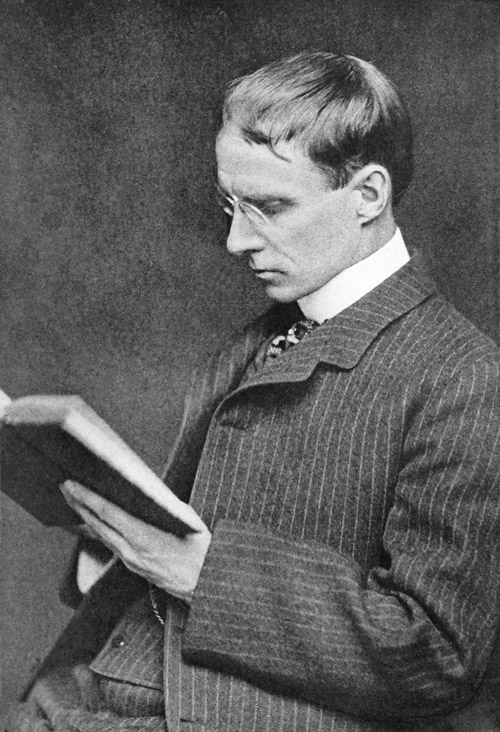
Mr. Burton feels the vitality, the personality, of objects in the outer world. There is no such thing in his conception as inert matter; it is all pulsing with life and sensibility. To him May is a
Sweet comer With the mood of a love-plighted lass,
and henceforth we picture her as coming blithely by with flower-filled hands. This glimpsing of the May is from one of Mr. Burton’s later songs, “The Quest of Summer,”—a poem full of color and atmosphere. After deploring the spring’s withholding, it thrills to this note of exultation:
But it came, In a garment of sensitive flame In the west, and a royal blue sky overhead, With exuberant breath and the bloom of all things Having wonders and wings, Being risen elate from the dead. Yea, it came with a flush Of pied flowers, and a turbulent rush Of spring-loosened waters, and an odorous hush At nightfall,—and then I was glad With the gladness of one who for militant months has been sad.
The very breath of spring is in this; one inhales it as he would a quickening aroma; it thrills him with the sensuous delight in the color, the perfume, the warmth, of the expanding air; and what delicate feeling for the atmospheric value of words is that which condenses a May twilight into “an odorous hush at nightfall.” The words “odorous hush,” in this connection, have drawn together by magnetic attraction; substitute for them their apparent equivalents,
Apropos of the feeling for words and their niceties of distinction as infusing what we term atmosphere into description, it may be said in passing that while Mr. Burton’s sense of these values which is so keen in his prose does not always stand him in equal stead in his poetry, it is seldom lacking in his songs of nature.
One may dip into the out-of-door verse at random and come away with a picture; witness this “Meadow Fancy”:
In the meadows yonder the wingéd wind Makes billows along the grain; With their sequence swift they bring to mind The swash of the open main, Till I smell the pungent brine, and hear— Mine eyes grown dim—the cry Of the sailor lads, and feel vague fear Of the storm-wrack in the sky.
While the metaphorical idea in these strophes is not new, they record with freehand strokes Dumb In June, in its various subjects. It would be idle to assert that it is as strong work as Mr. Burton has done; but it is vivid and magnetic, and touched but lightly with the weltschmerz which life is sure to cast upon maturer work. There is pain, but it is merely artist-pain, in the ode that gives its name to the collection.
Among the few love poems in Mr. Burton’s first volume, “The Awakening” is one of the truest in feeling; “Values” one of the blithest and daintiest; “Still Days and Stormy,” reminiscent of Emily Dickinson in manner, one of the most delicate, catching in charming phrase
How often in the summer-tide, His graver business set aside, Has stripling Will, the thoughtful-eyed, As to the pipe of Pan, Stepped blithesomely with lover’s pride Across the fields to Anne. It must have been a merry mile, This summer stroll by hedge and stile, With sweet foreknowledge all the while How sure the pathway ran To dear delights of kiss and smile, Across the fields to Anne. The silly sheep that graze to-day, I wot, they let him go his way, Nor once looked up, as who should say: “It is a seemly man.” For many lads went wooing aye Across the fields to Anne. The oaks, they have a wiser look; Mayhap they whispered to the brook: “The world by him shall yet be shook, It is in nature’s plan; Though now he fleets like any rook Across the fields to Anne.” And I am sure, that on some hour Coquetting soft ’twixt sun and shower, He stooped and broke a daisy-flower With heart of tiny span, And bore it as a lover’s dower Across the fields to Anne. While from her cottage garden-bed She plucked a jasmine’s goodlihede, To scent his jerkins brown instead; Now since that love began, What luckier swain than he who sped Across the fields to Anne?
Dumb In June has many foregleams of the wider vision which distinguishes Mr. Burton’s present work, as shown in his sonnet upon the Christ-head by Angelo, in “Day Laborers,” and in that noble poem, “Mortis Dignitas,” imbued with reverence and touched with the simplicity of the verities. It must be appraised with the best work of his pen, not only for its theme, but for the direct and unadorned word and measure so integral with the thought:
Here lies a common man. His horny hands, Crossed meekly as a maid’s upon his breast, Show marks of toil, and by his general dress You judge him to have been an artisan. Doubtless, could all his life be written out, The story would not thrill nor start a tear; He worked, laughed, loved, and suffered in his time, And now rests peacefully, with upturned face Whose look belies all struggle in the past. A homely tale; yet, trust me, I have seen The greatest of the earth go stately by, While shouting multitudes beset the way, With less of awe. The gap between a king And me, a nameless gazer in the crowd, Seemed not so wide as that which stretches now Betwixt us two, this dead one and myself. Untitled, dumb, and deedless, yet he is Transfigured by a touch from out the skies Until he wears, with all-unconscious grace, The strange and sudden Dignity of Death.
This is a fitting transition to Lyrics of Brotherhood, which, together with his latest volume, presents the phase of Mr. Burton’s work most representative of his feeling toward life. Any poet worthy of the name will come at last to a vision that only his eyes can see. Life will rise before him in a different semblance from that she presents to another; and if Beauty has lured him on, votary to that he might not wholly see, Life’s yearning face wears no disguise, and, once having looked upon it with seeing eyes, it is an image not to be effaced. There are many who look and never see,—the majority, perhaps. Their eyes are holden by the shapes that cross the inner sight, by hope and memory and their own ideal. They shall see only by one of those
There is a penetrative insight, that of the social economist, for example, that may possess no ray of sympathetic divination. It may probe to the heart of a condition, correlate causes and tendencies and divine effects, all from a scientific motive as professional as the practice of law, and as keen and cold. One may even be an avowed philanthropist and never come in sight of a human soul, as will the poet who looks upon the individual not as a case to be classified and tabulated, but as one walking step to step with him, though more heavily, whom he may reach out and touch now and then with the quickening hand of sympathy, and whose load he may bear bewhiles on the journey.
Such a poet is Mr. Burton, whose nature is shapen to one image with his fellows. To him literature is not an entity to be weighed only in the scales of beauty by the balances of Flaubert; it is to-day’s and to-morrow’s speech. In his prose, especially, this directness is marked; but in his poems one feels rather the inner relation with their spirit, for the magnetism of touch is less communicative than in the more flexible medium of prose. What is communicative, Lyrics of Brotherhood is a genuine clasp of hand to hand, nor is he dismayed by the grime of the hand, for the primal unities are primal sanctities to him. Longing, strife, defeat, achievement, are all interpreted to him of personal emotion, solvent in personal sympathy.
Lyrics of Brotherhood opens with a poem that redeems from odium one opprobrious symbol as old as time. It is that catch-penny epithet, “black sheep,” that we bandy about with such flippancy, tossing it as loose change in a character appraisal and little recking what truth-valuation may lie behind it. It is good to feel that the impulse to redeem this symbol came to Mr. Burton and wrought so well within him, for “Black Sheep” is one of his truest inspirations in feeling and expression:
From their folded mates they wander far, Their ways seem harsh and wild; They follow the beck of a baleful star, Their paths are dream-beguiled. Yet haply they sought but a wider range, Some loftier mountain-slope, And little recked of the country strange Beyond the gates of hope. And haply a bell with a luring call Summoned their feet to tread Midst the cruel rocks, where the deep pitfall And the lurking snare are spread. Maybe, in spite of their tameless days Of outcast liberty, They’re sick at heart for the homely ways Where their gathered brothers be. And oft at night, when the plains fall dark And the hills loom large and dim, For the Shepherd’s voice they mutely hark, And their souls go out to him. Meanwhile, “Black sheep! Black sheep!” we cry, Safe in the inner fold; And maybe they hear, and wonder why, And marvel, out in the cold.
Throughout Mr. Burton’s work there is a warm feeling for the simple tendernesses, the unblazoned heroisms of life; the homely joys, the homely valors, the unknown consecrations, the unconfessed aspirations,—in a word, for all that songless melody of the common soul whose note we do not catch in the public clamor. There is a tendency, however, in his later work that, from an artistic standpoint, is carried too far,—the tendency to analogize. Everything in life presents an analogy to him who is alert for it; and the habit of looking for analogies and
Friends to friends unknown: Tides that should warm each neighboring life Are locked in frozen stone.
Here is the eye of the revelator, for who, looking upon rubies, would have seen in them what Emerson saw, and yet what a truth bides at the heart of this symbol!
Mr. Burton has several analogies, such as “On the Line,” “North Light,” and “Black Sheep,” quoted above, that are excellently wrought; indeed, it is not so much the manner in which the analogy is elaborated that one would criticise, as the frequently too-obvious nature of it.
The danger to a poet in dropping too often into analogy is that he will become a singer of effects, a watcher of manifestations, and forget
Message and Melody, Mr. Burton’s latest collection, opens with perhaps his strongest and most representative poem, “The Song of the Unsuccessful.” It is a poem provocative of thought, and upon which innumerable queries follow. Its opening lines utter a heresy against modern thinking; our friends, the Christian Scientists and Mental Scientists and Spiritual Scientists, would at once cross swords with Mr. Burton and wage valiant conflict over the initial statement that God has “barred” from any one the “gifts that are good to hold.” Indeed, the entire poem would come under their indictment for the same reason. But something would be won from the conflict; the stuff from which thought is made is in the poem. In the mean time let us have it before we consider it further. Here are the types marshalled before us; we recognize them all as they appear:
We are the toilers from whom God barred The gifts that are good to hold. We meant full well, and we tried full hard, And our failures were manifold. And we are the clan of those whose kin Were a millstone dragging them down. Yea, we had to sweat for our brother’s sin And lose the victor’s crown. The seeming-able, who all but scored, From their teeming tribe we come: What was there wrong with us, O Lord, That our lives were dark and dumb? The men ten-talented, who still Strangely missed of the goal, Of them we are: it seems Thy will To harrow some in soul. We are the sinners, too, whose lust Conquered the higher claims; We sat us prone in the common dust, And played at the devil’s games. We are the hard-luck folk, who strove Zealously, but in vain: We lost and lost, while our comrades throve, And still we lost again. We are the doubles of those whose way Was festal with fruits and flowers; Body and brain we were sound as they, But the prizes were not ours. A mighty army our full ranks make; We shake the graves as we go; The sudden stroke and the slow heartbreak, They both have brought us low. And while we are laying life’s sword aside, Spent and dishonored and sad, Our epitaph this, when once we have died, “The weak lie here, and the bad.” We wonder if this can be really the close, Life’s fever cooled by death’s trance; And we cry, though it seem to our dearest of foes, “God give us another chance!”
The ease of the poem, the crisp Anglo-Saxon which it uses, the forthright stating of the case for the weaker side, and the humanity underlying it, are admirable; and, further, from an artistic standpoint it is a stronger piece of work than it would have been had its philosophy chimed better with modern thinking. The unsuccessful are speaking; their view-point and not necessarily the author’s is presented. To have tacked on a clause additional, with a hint of the inner laws that govern success, might have saved the philosophy from impeachment as to falling back upon Providence; but it would have been a decidedly false note put into the mouth of the unsuccessful. We may say at once that
The men ten-talented who still Strangely missed of the goal,
were the Amiels who suffered paralysis of the will to benumb them, rather than those whom it was the will of the Creator to “harrow in soul;” but it would scarcely be expected of the Amiels themselves to analyze their deficiencies thus openly to the multitude. Impotence of will, however, is not at the root of all failure; who can deny that there is
The clan of those whose kin Were a millstone dragging them down;
that there are
The hard-luck folk who strove Zealously, but in vain;
and
The seeming-able, who all but scored,
who put forth apparently more effort to score than did many of the victors, but who were waylaid by some invidious circumstance, or who failed to “grasp the skirts of happy chance” as the flying goddess passed them?
Mr. Burton’s poem is too broad to discuss in the limits of a brief sketch; it would furnish a text for the sociologist. All the complexities of modern conditions lie back of its plaint, which becomes an arraignment. One
This is the apparent fact; but within it as axle to the Wheel is the law upon which it rotates, the law of individual choice. Each was given his supreme gift; his word was whispered to him; if he failed to hear it, or heed it, or express it in the predestined way, the flying Wheel casts him to the void, but the law is not impeached thereby. Outside this law, however, as spokes to the Wheel, are the innumerable radiations of human laws and conditions, so that one may scarcely obey the primary command of his nature if he would, and often loses sight of it as the principle upon which his destiny is revolving. Mr. Burton’s poem goes beyond the cold-blooded outlook upon the unsuccessful as merely those who are cast from the Wheel, and presents the
We are the doubles of those whose way Was festal with fruits and flowers; Body and brain we were sound as they, But the prizes were not ours.
Why? Let the sociologist or the psychologist determine; in the mean time we have the quickened sympathy that follows upon the poem.
Message and Melody has a group of songs turning upon some music theme; of these “Second Fiddle” is the most notable. “In A Theatre” discloses a narrative vein and shows that Mr. Burton has a keen sense of the dramatic in daily life. He has for some time been working upon a group of narrative poems with a prologue connecting them, which are soon to be issued, and which, judging from the fugitive examples in his other volumes, will disclose an interesting phase of his talent.
To leave the impression of Mr. Burton’s work that is most characteristic,—the impression of its tenderness, its sympathy, its emphasis upon the essential things,—one can scarcely do better than to summarize it in his own well-known lines, “The Human Touch”:
High thoughts and noble in all lands Help me; my soul is fed by such. But ah, the touch of lips and hands,— The human touch! Warm, vital, close, life’s symbols dear,— These need I most, and now, and here.
XIV
CLINTON SCOLLARD
THAT genial and delicate satirist, Miss Agnes Repplier, laments in one of her clever essays that our modern poets incline to dwell upon the sombre side of things, and hence contribute so little to the cheer of life. One cannot but wonder what poetry Miss Repplier has been reading, for our own acquaintance with the song of to-day has been so much the opposite that it is difficult on the spur of the moment to recall any poet of the present group in America whose work is not in the main wholesome and heartening and who is not facing toward the sun. To be sure, there must be the relief of shade, lest the light glare; but they who journey to Castaly are in general cheerful wayfarers, taking gladly the gift of the hours and rendering the Giver a song, and among the blithest of them is Clinton Scollard, to whom life is always smilingly envisaged, and to whom, whether spring or autumn betide, it is still the “sweet o’ the year.”
If Mr. Scollard’s way has ever been “through dolor and dread, over crags and morasses,” he is too much the optimist to let the fact be known, or, better still, to recognize it as such; for we see what our own eyes reflect from within, and it is certain that Mr. Scollard’s outlook upon life is governed by the inherent conviction that her ways are ways of pleasantness and all her paths are peace. Possibly this conviction would have more value to the less assured nature if the testimony of its winning were set down as a strength-giving force by the way, as we incline in daily life to undervalue the amiability and cheer which are matters of birthright rather than of overcoming; but this is a standard narrow in itself and wide of the issue at stake, which is so much cheer per se, whether the fortunate dower of nature, or the alchemic result of experience; nor may one draw too definite a line between the temperamental gift and the spiritual acquisition, especially when the psychology of literature furnishes the only data. It is sufficient to note the result in the work, and its bearing upon the art which shapes it. To Mr. Scollard, then, “Life’s enchanted cup” not only “sparkles at the brim;” but when he lifts it to his lips a rainbow arches in its depths, and he has communicated to his
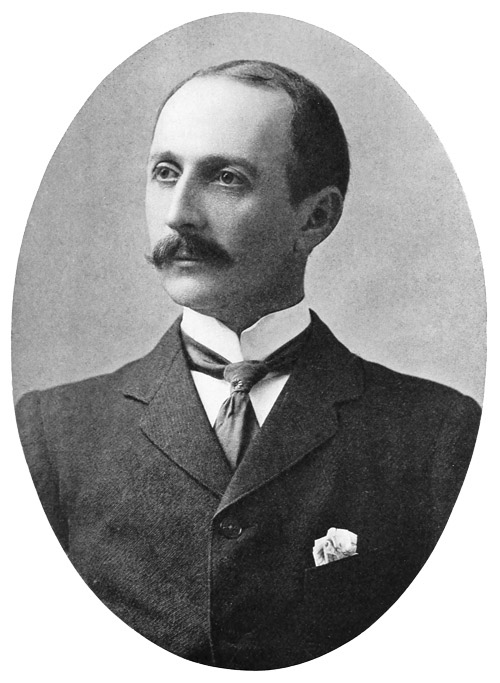
Mr. Scollard is almost wholly an objective poet, and by method a painter. His palette is ever ready for the picture furnished him at every turn, and hence his several volumes relating to the Orient, Lutes of Morn, Lyrics of the Dawn, Songs of Sunrise Lands, etc., are perhaps truer standards by which to measure his work than any other, illustrating as they do the pictorial side of his talent. Every object in the Orient is a picture with its individual color and atmosphere, but Mr. Scollard does not merely offer us a sketch in color; the outwardly picturesque is made to interpret a phase of life, and the spiritual contrasts in this land—where one religion or philosophy succeeds another, bringing with it another civilization and leaving desolate the ancient shrines—are indicated with vivid phrase, as in these lines:
A turbaned guard keeps stolid ward by the Zion gate in the sun, And the Paynim bows his shaven brows at the shrine of Solomon; At the chosen altars, long, long quenched is the flame of the sacred fire, And the jackal has his haunt in the tomb of Hiram, King of Tyre. Great Herod’s pride with its columned aisles is grown with the olive bough, And Gath and Dan are but crumbling piles, while Gaza is gateless now; The sea on the sands of Ascalon sets hands to a mournful lyre, And the jackal has his haunt in the tomb of Hiram, King of Tyre.
The closing stanza draws the contrast, or rather makes the spiritual application of the poem by which “the starry fame of one holy name”
Has blazoned Bethlehem for aye the heart of the world’s desire, While the jackal has his haunt in the tomb of Hiram, King of Tyre.
The final line of these stanzas may offer a metrical stumbling-block until one catches the sweep of the rhythm and falls in note with the cæsural pause after the word “tomb.” Mr. Scollard is nothing if not lyrical, and it would be easier for the traditional camel to go through the eye of a needle than for a captious critic to discover a metrical falsity in his tuneful song.
But to return to the Orient, not alone the reverence for the Christian faith speaks in these poems, but the artistic beauty in the Moslem and other faiths has entered into
From many a marble minaret We heard the rapt muezzin’s call; And to the prayerful cries my guide, During each trembling interval, With reverence serene replied,—
and finds throughout the poems the higher assurance that
The East and West are one in Allah’s grace: Which way so’er ye turn, behold—His face!
It is difficult to choose from the several volumes portraying Oriental life, such poems as shall best represent it, since in any direction we shall find a picture full of color and of strange new charm: the white mosques and minarets; the gardens of citron and pomegranate; the bazaars, with their rare fabrics and curios; the pilgrims, dozing in the shade of the temples; the Bedouins, riding in from the desert; the women carrying from the springs their water-jars. We shall hear the sunrise cry of the muezzin from the minarets; the zither and lute in the gardens at evening; the jargon of tongues in booth and market-place; the philosopher expounding the Koran; the lover singing the songs of Araby. The dramatic
When on the desert’s rim, In sudden, awful splendor, stood the sun—
are excelled in terse, pictorial force by the record of its setting,—
Then sudden dipped the sun.—
Nor easily forgotten are those pictures of lying in the open when the cooling dark had fallen upon the yearning land, or upon the hills when
The night hung over Hebron all her stars, Miraculous processional of flame,
and below from out the “purple blur” rose the minarets of the mosque where
Sepulchred for centuries untold, The bones of Isaac and of Joseph lay; And broidered cloths of silver and of gold Were heaped and draped o’er Abraham’s crumbled clay.
In The Lutes of Morn there are two sonnets—though lyrics in effect, so does the song prevail with Mr. Scollard—that serve hastily to sketch a moving scene and in their touch bring to mind Paul the chronicler. The first is “Passing Rhodes,” and contains these lines with a biblical tang,
At day’s dim marge, hard on the shut of eve, We rocked abreast the rugged Rhodian isle,
which tang appears in stronger flavor in the racy opening of the following:
Cleaving the seadrift through the starlit night, We left the barren Patmian isle behind, And scudding northward with a favoring wind, Lay anigh Chios at the dawn of light. The shore, the tree-set slopes, the rugged height, Clear in the morning’s roseate air outlined,— This was his birthplace who, albeit blind, Saw tall Troy’s fall, and sang the tragic sight. Resting within the roadstead, while the day Grew into gradual glory, on the ear Continuous broke the surge-song of the brine; And as we marked it rise, or die away To rise again, it seemed that we could hear The swell and sweep of Homer’s mighty line.
Mr. Scollard’s musical and finely descriptive poem, “As I Came Down From Lebanon,” has become a favorite with the readers of his verse; but while it has great charm, it is not as strong a piece of work as are many other of the Oriental poems, contained in his later volumes, The Lutes of Morn and Lyrics of the Dawn, nor as that realistic poem, “Khamsin,” which appeared in the same collection. Here indeed is the breath of the sirocco:
Oh, the wind from the desert blew in! Khamsin, The wind from the desert blew in! It blew from the heart of the fiery south, From the fervid sand and the hills of drouth, And it kissed the land with its scorching mouth; The wind from the desert blew in! It blasted the buds on the almond bough, And shrivelled the fruit on the orange-tree; The wizened dervish breathed no vow, So weary and parched was he. The lean muezzin could not cry; The dogs ran mad, and bayed the sky; The hot sun shone like a copper disk, And prone in the shade of an obelisk The water-carrier sank with a sigh, For limp and dry was his water-skin; And the wind from the desert blew in. · · · · · Into the cool of the mosque it crept, Where the poor sought rest at the prophet’s shrine; Its breath was fire to the jasmine vine; It fevered the brow of the maid who slept, And men grew haggard with revel of wine. The tiny fledglings died in the nest; The sick babe gasped at the mother’s breast. Then a rumor rose and swelled and spread From a tremulous whisper, faint and vague, Till it burst in a terrible cry of dread, The plague! the plague! the plague!— Oh the wind, Khamsin, The scourge from the desert blew in!
Of the lighter notes, upon love and kindred themes, Mr. Scollard has many in his poems of the Orient; “The Song of the Nargileh” is of especial charm, but unfortunately too long to quote. Very graceful, too, is the “Twilight Song” with one of Mr. Scollard’s graphic beginnings, but one quaint bit from The Lutes of Morn is so characteristic as showing Oriental felicity of speech that while merely a jotting in song, and less important in an artistic sense than many others touching upon the theme of love, I cannot refrain from citing it instead: it is called “Greetings—Cairo.”
Upon El Muski did I meet Hassan, Beneath arched brows his deep eyes twinkling bright, Good dragoman (and eke good Mussulman) And cried unto him, “May your day be white!” “And yours, howadji!” came his swift reply, A smile illumining the words thereof, (All men are poets ’neath that kindling sky), “As white as are the thoughts of her you love!”
The Oriental poems cover not only a varied range of subject, but pass in review nearly every important city and shrine in the length and breadth of that storied land, making poetical footnotes to one’s history and filling his memory with pictures.
The second source of Mr. Scollard’s inspiration, doubtless the first in point of time, is his delight in nature. Here, too, the objective side predominates. He is footfaring, with every sense alert to see, to hear, and to enjoy; he slips the world of men as a leash and becomes the fetterless comrade of the vagrant things of earth. He stops to do no philosophizing by the way,—the analogies, the laws, the evolving purposes of nature, are rarely touched upon in his verse; nor is he one of the poet-naturalists, intent to observe and record with infinite fidelity the fact, with its mystic spirit of beauty. He finds in the obvious side of nature such glamour and
He has one volume entitled Footfarings, written partly in prose and partly in verse,—a book abrim with morning joy, and bringing with it the aroma of wood-flowers and the minstrelsy of birds. The prose predominates, and is worthy the pen of a poet: its imaginative grace, its enthusiasm, and its quaint and delicate fancy impart to it all the flavor of poetry while adhering to a crisp and racy style. Each chapter is prefaced by a keynote of verse, such as that which conducts one to the haunt of the trillium, where
These nun-like flowers with spotless urns, That shine with such a snowy gloss, Will seem, amid the suppliant ferns, To bow above the cloistral moss. Then Hope, her starry eyes upraised, Will suddenly surprise you there, And you will feel that you have gazed On the white sanctity of prayer!
Were it within the province of this study, I should like to quote some of Mr. Scollard’s prose from a “Woodland Walk,” “A Search for the Lady’s Slipper,” or many another picturesque chapter. One loses thought of print, and is for the nonce following his errant fancy through meadow and coppice to the heart of the spicy fir-woods, picking his way over the forest brooks, from stone to stone; following the alluring skid-roads, latticed by new growths on either side and arched above by interlacing green; penetrating into the tamarack thickets at the lure of the hermit-thrush, that spirit-voice of song; resting on a springy bed of moss and fern,—becoming, in short, wayfellow of desire, and thrall but to his will. Mr. Scollard has also published within the past year a book of nature verse called The Lyric Bough, which contains some of his best work in this way; one of its livelier fancies is that of “The Wind”:
O the wind is a faun in the spring-time When the ways are green for the tread of the May; List! hark his lay! Whist! mark his play! T-r-r-r-l! Hear how gay! O the wind is a dove in the summer When the ways are bright with the wash of the moon; List! hark him tune! Whist! mark him swoon! C-o-o-o-o! Hear him croon! O the wind is a gnome in the autumn When the ways are brown with the leaf and burr; Hist! mark him stir! List! hark him whir! S-s-s-s-t! Hear him chirr! O the wind is a wolf in the winter When the ways are white for the hornèd owl; Hist! mark him prowl! List! hark him howl! G-r-r-r-l! Hear him growl!
One of the earlier books, The Hills of Song, contained a brief, merry-toned lyric, with a cavalier note, that sung itself into the American Anthology, and is perhaps as characteristic and charming a leave-taking of this phase of Mr. Scollard’s work as one may cite:
Be ye in love with April-tide? I’ faith, in love am I! For now ’tis sun, and now ’tis shower, And now ’tis frost, and now ’tis flower, And now ’tis Laura laughing-eyed, And now ’tis Laura shy. Ye doubtful days, O slower glide! Still smile and frown, O sky! Some beauty unforeseen I trace In every change of Laura’s face;— Be ye in love with April-tide? I’ faith, in love am I!
Balladry furnishes the third source of Mr. Scollard’s singing impulse. The Oriental poems have somewhat of this phase of his work, though more especially inclining to the narrative style; and the epic poem “Skenandoa,” while written in a story-lyric, shows the ballad-making qualities, which in their true note had been heard earlier in “Taillefer the Trouvère,” and have been heard more definitely in Ballads of Valor and Victory, recently written in collaboration with Mr. Wallace Rice, and reciting the heroisms and adventures of soldier, sailor, and explorer from Drake to Dewey.
Ballad-writing is an art calling for distinct gifts. The dramatic element must predominate. The story first—and if this be colorless, there is no true ballad; the verse next—and if this be flaccid, or if it swing to the other extreme and become too strained and tense, there is no true ballad; for the essence of ballad-writing is in the freedom of the movement, the swing and verve with which one
“The White November” and “The Eve of Bunker Hill” are among the best of the ballads. The former brings with it a well-known note, but one newly bedight with brave phrase; indeed, all the celebrated ballad measures appear in these song stories, but well individualized in diction and dramatic mood. They differ of course in the degree of these qualities; some have too slight an incident to chronicle; some might with better effect have been omitted, particularly “War in April,” by Mr. Rice; but for this he atones by “The Minute-Men of Northboro” and other vigorous contributions to the collection. The ballads have the merit of structural compactness. While the necessary portrayal of the incident renders