JESSIE B. RITTENHOUSE (continued 2)
Reading edition
This note of spiritual assurance appears throughout Miss Guiney’s work, speaking in her sonnet, “The Acknowledgment,” and again and again in other poems. She has the mystic’s passion for the One Good, the One Beauty—
O hidden, O perfect, O desired, the first and the final fair!—
and gives it impassioned expression in the lines, “Deo Optimo Maximo,”
All else for use, one only for desire; Thanksgiving for the good, but thirst for Thee: Up from the best, whereof no man need tire, Impel Thou me. Delight is menace, if Thou brood not by, Power a quicksand, Fame a gathering jeer. Oft as the morn, (though none of earth deny These three are dear,) Wash me of them, that I may be renewed, Nor wall in clay mine agonies and joys; O close my hand upon Beatitude! Not on her toys.
And here at the last is the tenderest Nativity song for which dedicated words were ever found; so quaint, so gentle, so reverent, so blended of sweet and sad. The second stanza is an artist’s grouping from life:
The Ox he openeth wide the doore And from the snowe he calls her inne, And he hath seen her Smile therefore, Our Lady without sinne. Now soone from sleepe A starre shall leap, And soon arrive both King and Hinde; Amen, Amen: But O, the place co’d I but find! The Ox hath husht his voyce and bent Trewe eyes of Pitty ore the Mow, And on his lovelie Neck, forspent, The Blessed lays her Browe. Around her feet Full Warme and Sweete His Bowerie Breath doth meeklie dwell; Amen, Amen: But sore am I with Vaine Travél! The Ox is Host in Juda’s stall, And Host of more than onelie one, For close she gathereth withal Our Lorde, her littel Sonne: Glad Hinde and King Their Gyfte may bring, But wo’d to-night my Teares were there; Amen, Amen: Between her Bosom and His hayre!
To sum up Miss Guiney’s work, as well as one may, in a sentence,—it has no flaccid thought. There is fibre in all she writes; fibre and nerve. Were the fervor and passion which she throws into her songs of valor to be diffused throughout her verse, making its appeal more intimate and personal, she would speak more widely, but scarcely to more appreciative readers than now delight in her individuality.
V
GEORGE E. SANTAYANA
EMOTION recollected in tranquillity,” perfectly defines the work of Mr. George Santayana. He is a musing philosopher environed by himself. He
‘Shuts himself in with his soul And the shapes come eddying forth,’
shapes that have no being in the world of sense, but are rather phantasms materialized in the ether of dreams. There is no evidence in Mr. Santayana’s work that he is living in America in the twentieth century—and upon his own testimony he is not; he has withdrawn from the importunity of things:
Within my nature’s shell I slumber curled, Unmindful of the changing outer skies,—
and in this inviolate seclusion he enamels the pearl with the nacre of his own spirit.
Mr. Santayana’s poet-kinsmen are not to be found in contemporary literature; he is alone in the midst of the singers as regards temperament
A wall, a wall around my garden rear, And hedge me in from the disconsolate hills; Give me but one of all the mountain rills, Enough of ocean in its voice I hear. Come no profane insatiate mortal near With the contagion of his passionate ills; The smoke of battle all the valleys fills, Let the eternal sunlight greet me here.—
and once enshrined in this Nirvanic close, where the strife of living had merged into the poise of being, he would repeople the desolated earth and air with the forms of his imagination:
A thousand beauties that have never been Haunt me with hope and tempt me to pursue; The gods, methink, dwell just behind the blue; The satyrs at my coming fled the green. The flitting shadows of the grove between The dryads’ eyes were winking, and I knew The wings of sacred Eros as he flew, And left me to the love of things not seen. ’Tis a sad love, like an eternal prayer, And knows no keen delight, no faint surcease, Yet from the seasons hath the earth increase, And heaven shines as if the gods were there. Had Dian passed, there could no deeper peace Embalm the purple stretches of the air.
It is no exaggeration to say that were Mr. Santayana in a cloister, or upon a mid-sea island with his books and dreams, he could scarcely be less in touch with the passing world than he is in the midst of the clamor and insistence of modern life, where he keeps the tranquillity of the inner silence as if there were no voices dinning in his ears. He is subjective to the degree of transfusing himself with another’s consciousness, and looking upon his own nature from an impersonal standpoint:
There we live o’er, amid angelic powers, Our lives without remorse, as if not ours, And others’ lives with love, as if our own,—
says one of the sonnets, imaging the passion-stilled world of reflection.
There is a subtlety in Mr. Santayana’s processes of thought that demands intuitive divination on the part of the reader; there is so little objectivity to the idea that its essence may almost escape him. His illustrative symbolism is almost never drawn from nature or the world of men and events, but from the treasure of beauty at the depth of his spirit,
This gives to his work a certain fixity both of mood and form; his thoughts are as gems that flash without heat, not the ruby-hearted, passion-dyed gems, but the pale topaz or the amber, holding the imprisoned glow of reflection. If this may seem to limit Mr. Santayana’s achievement, it is not so intended, but rather to reveal his distinction. He is not only a true poet, but one of rare accomplishment; his work, however, is for those who are deeply subjective, who trance themselves with the beautiful as an anodyne for pain; those who subordinate to-day to the storied charm of yesterday, and look backward to the twilight of the gods, rather than forward to the renewing sunrise. It is not for those whose creed of poetry is that it should be all things to all men; that life, in travail to deliver truth, should utter its cries through the poet. It is for those
I would I might forget that I am I, And break the heavy chain that binds me fast, Whose links about myself my deeds have cast. What in the body’s tomb doth buried lie Is boundless; ’tis the spirit of the sky, Lord of the future, guardian of the past, And soon must forth to know his own at last. In his large life to live, I fain would die. Happy the dumb beast, hungering for food, But calling not his suffering his own; Blesséd the angel, gazing on all good, But knowing not he sits upon a throne; Wretched the mortal, pondering his mood, And doomed to know his aching heart alone.
The much-mooted, but vaguely understood, sub-conscious mind, speaks in this sonnet in terms of the conscious. It is a subtle bit of philosophy, but not more so than several others in the same sequence which show the evolution of Mr. Santayana’s attitude toward life. One may not in a brief space follow out the clews to this development, whose beginning was in religious emotion:
· · · · · My sad youth worshipped at the piteous height Where God vouchsafed the death of man to share; His love made mortal sorrow light to bear, But his deep wounds put joy to shaméd flight, And though his arms outstretched upon the tree, Were beautiful, and pleaded my embrace, My sins were loth to look upon his face. So came I down from Golgotha to thee, Eternal Mother; let the sun and sea Heal me, and keep me in thy dwelling-place.
The succeeding sonnet traces the winding of the new way, the reluctance, the
… many farewell pious looks behind, And dumb misgivings where the path might wind, And questionings of nature, as I went,—
which every life duplicates as it leaves its well-guarded walls of belief and ventures out upon undiscovered ways. The pain of letting go the old, the loneliness of the new, the alien look of all the heights that encompass one, and the psychology of that impulse by which one is both impelled to retrace his way and withheld from it,—are suggested by the sonnet. In the next occurs one of Mr. Santayana’s finest lines, the counsel
To trust the soul’s invincible surmise.
It would be difficult to define intuition more succinctly than this. It is not, as less subtle poets would have put it, the soul’s assurance that one is to trust; this would be to assume, for what assurance have we but that which Mr. Santayana has so subtly termed the “invincible surmise”?
Lines which lead one out into speculative thought are frequent in Mr. Santayana’s sonnets. His philosophy is constructive only in so far as it unifies a succession of moods and experiences; but it is pregnant with suggestion
Of my two lives, which should I call the dream? Which action vanity? which vision sight?—
after declaring that
Some greater waking must pronounce aright
and blend the two visions to one seeing, continues:
Even such a dream I dream, and know full well My waking passeth like a midnight spell, But know not if my dreaming breaketh through Into the deeps of heaven and of hell. I know but this of all I would I knew: Truth is a dream, unless my dream is true.
The thought in this passage is elusive, but it is more than a play upon words. It is another way of putting the question, which shall be trusted, which shall become the reality, the objective or the subjective world? One knows that his “waking,” his sense perception, is transitory, that it apprehends but the present, which “passeth like a midnight spell,” but how far does the other and finer sight penetrate
Into the deeps of heaven and of hell?
No answer from the void to this query, but by the mystical conclusion that
Truth is a dream, unless my dream is true.
In simpler phrase, unless the vision and conviction are to be trusted, unless, to revert to Mr. Santayana’s former words, the soul’s “invincible surmise” be taken as truth, that which we know as truth is but a phantasm.
The sonnet sequence is the intimate record of an individual soul in its evolving spiritual life, and has the significance belonging only to art which interprets a personality, an experience, in whose development one finds some clew to his own labyrinth. It reveals the many phases of speculation, reflection, questioning, through which one passes in the transition from beliefs indoctrinated in the mind at its earliest consciousness, to convictions which follow thought liberated by life, by intimacy with nature, and by recognition of its own spiritual authority. It is the winning of this conviction, with its attendant seeking and unrest, allayed by draughts from the wayside springs of beauty, memory, and imagination,—which comprises the record of the first sonnet sequence, whose conclusions, as “strewn thoughts” springing along the way, are gathered into a final chaplet for the brows of the “Eternal Mother,” Nature, whose peace he sought when he came down from Golgotha, and whose larger meaning, synonymous with
These strewn thoughts, by the mountain pathway sprung, I conned for comfort, till I ceased to grieve, And with these flowering thorns I dare to weave The crown, great Mother, on thine altar hung. Teach thou a larger speech to my loosed tongue, And to mine opened eyes thy secrets give, That in thy perfect love I learn to live, And in thine immortality be young. The soul is not on earth an alien thing That hath her life’s rich sources otherwhere; She is a parcel of the sacred air. She takes her being from the breath of Spring, The glance of Phœbus is her fount of light, And her long sleep a draught of primal night.
Aside from Mr. Santayana’s philosophical sonnets he has a second sequence, upon love, which, too, is philosophically tinged. In the matter of beauty this is perhaps the more finished and artistic work; but I have chosen rather to dwell upon the subtlety of his speculations in those phases of thought less universally treated of by poets than is love. It has not been possible, however, to follow the sequence in its order, or to present more than certain individual notes of its philosophy.
Thus far it has been the matter, rather than the manner, of Mr. Santayana’s verse that has been considered; but before glancing at the
There is an atmosphere about all of Mr. Santayana’s work that conveys a sense of wandering in the moonlight; it is tempered, softened, stilled; it is like an Isis-veil cast over the eyes; but at times one becomes oppressed with the consciousness of himself, and of the
Because he is not inventive in metre nor sufficiently light in touch, Mr. Santayana is not a lyrist. He has scarcely any purely lyrical verse in his collections, and what is contained in them is too lacking in spontaneity to be classed with his best work. It is not wanting in lines of beauty and in English undefiled; but the sense of tone and rhythm, except of the smoothly conventional sort, is absent. There are no innovations in form and the impulse is too subdued for a true lyric. That called “Midnight” has more warmth than the others. Several of his odes in the Sapphic metre have great charm, especially the first. His elegiac verse has often rare elevation of thought; but it, also, has too set a measure, too much of the “formed style” to be vital. It brings well-conceived, well-imaged thought, as in this stanza:
How should the vision stay to guide the hand, How should the holy thought and ardour stay, When the false deeps of all the soul are sand, And the loose rivets of the spirit, clay?
but it rarely shocks one into thinking for himself.
In relation to diction, there are few American writers who use English of such purity and finish as does Mr. Santayana; but it is the scholar’s English, the English drawn from familiarity with the great masters and models, and hence lacks the creative flexibility, the quick, warm, ductile adaptability, that a much less accomplished poet may give to his words. It keeps to the accepted canons, the highest, the purest, and uses the consecrated words of literature with an artist’s touch; but the racy idiom, the word which some daring poet coined yesterday in an exigent moment—with these it has naught to do.
Mr. Santayana has several dramatic poems, “The Hermit of Carmel,” “The Knight’s Return,” and a dialogue between Hermes and Lucifer, in which the latter relates the details of his banishment from heaven for his daring arraignment and interrogation of God. The dialogue has little dramatic coloring; one hearing it read aloud would have difficulty in determining
A doubtful thing Is blessedness like that…. Their raptured souls, like lilies in a stream That from their fluid pillow never rise, Float on the lazy current of a dream.
Mr. Santayana has not written “The Hermit of Carmel” or “The Knight’s Return” with a theatrical manager in view. They are stories told in verse, tales of gentle melancholy, pleasant to the ear; but when all is said, one returns to his sonnets as the true expression of his nature and the consummation of his gifts. He is a sonneteer, by every phase of his temperament and every canon of his art. His work in all other forms is cultivated, philosophical, finely finished, but pervaded by an atmosphere of cultured conventionality; whereas in the sonnet he finds a medium whose classic distinction and subtlety are so harmonized to his nature and his characteristic mode of thought, that it becomes to him
But, first, let me cite from one of the earlier sonnets, an image drawn from this theme, a jewel-like flash of beauty, not to be overlooked. The first line of the metaphor is commonplace; but note the succeeding ones:
Love but the formless and eternal Whole From whose effulgence one unheeded ray Breaks on this prism of dissolving clay Into the flickering colors of thy soul.
This is defining the individual spirit in exquisite terms.
The second sequence teems with beautiful passages, now and again with a note of the trovatore, as in the sestett of this sonnet:
Yet why, of one who loved thee not, command Thy counterfeit, for other men to see, When God himself did on my heart for me Thy face, like Christ’s upon the napkin, brand? O how much subtler than a painter’s hand Is love to render back the truth of thee! My soul should be thy glass in time to be, And in my thought thine effigy should stand. Yet, lest the churlish critics of that age Should flout my praise, and deem a lover’s rage Could gild a virtue and a grace exceed, I bid thine image here confront my page, That men may look upon thee as they read, And cry: “Such eyes a better poet need!”
This has art and charm, but in contrast note the impassioned nobility of utterance which imbues the one that follows. Here are lines of pure emotion and beauty:
We needs must be divided in the tomb, For I would die among the hills of Spain, And o’er the treeless, melancholy plain Await the coming of the final gloom. But thou—O pitiful!—wilt find scant room Among thy kindred by the northern main, And fade into the drifting mist again, The hemlocks’ shadow, or the pines’ perfume. Let gallants lie beside their ladies’ dust In one cold grave, with mortal love inurned; Let the sea part our ashes, if it must, The souls fled thence which love immortal burned, For they were wedded without bond of lust, And nothing of our heart to earth returned.
Such sonnets as this mark Mr. Santayana as a master of this form, and while his other work has value, it is as a sonneteer that he has made his really individual contribution to literature.
VI
JOSEPHINE PRESTON PEABODY
A BEAUTIFUL and delicate art is that of Miss Josephine Preston Peabody, but somewhat elusive of analysis, so much is its finer part dependent upon the intuition which one brings to it; for Miss Peabody is a poet-mystic, sensitive to impressions from which the grosser part has slipped away,—impressions which come to her clothed upon with a more ethereal vesture than the work-a-day garment of thought,—and while she would fain reveal their hidden import, they often elude her and grow remote in the telling, as if fearful of betraying too openly their secret.
Her first volume, The Wayfarers, revealed at the outset a poet’s imagination, and a technique so finished that it had already the touch of the artist, but its vision was that of the novice who looks at the morning from beneath her white veil and wonders at the world of sin and strife and passion whose pain has never reached her. It was the work of one who had not yet
Lo, a gray pallor on the loom Waxeth apace,—a glamourie Like dawn outlooking, pale to see Before the sun hath burst to bloom; Wan beauty, growing out of gloom, With promise of fair things to be. · · · · · The shuttle singeth. And fair things Upon the web do come and go; Dim traceries like clouds ablow Fade into cobweb glimmerings, A silver, fretted with small wings,— The while a voice is singing low.
Of the eight remaining stanzas several are equally lacking in anything that may be grasped, and while there is a certain art in imaging the elusive fancies which the weavers bring, there should be some more definite fancy or ideal to embody, rather than the mere intent to make beautiful lines. This is, perhaps, an extreme instance of the over-elaboration of the first volume, though it distinguishes the long poem which gives its name to the collection, and appears in many of the lyrics.
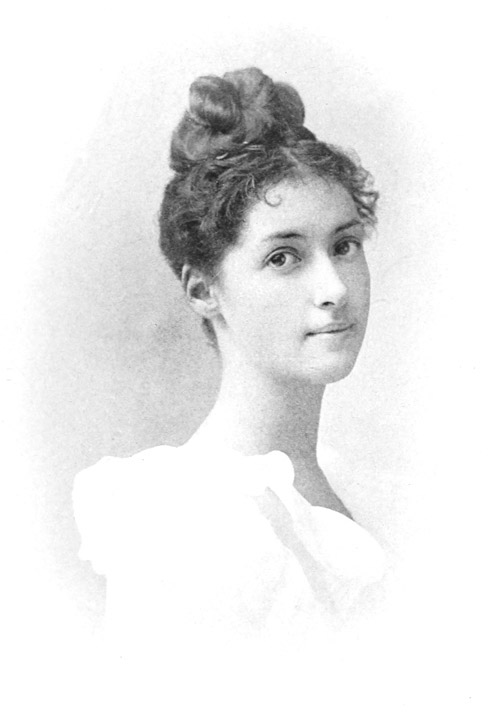
Miss Peabody is an inventive metrist, and her sense of rhythm is highly developed, or
Moon in heaven’s garden, among the clouds that wander, Crescent moon so young to see, above the April ways, Whiten, bloom not yet, not, yet, within the twilight yonder; All my spinning is not done, for all the loitering days. Oh, my heart has two wild wings that ever would be flying! Oh, my heart’s a meadow-lark that ever would be free! Well it is that I must spin until the light be dying; Well it is the little wheel must turn all day for me! All the hill-tops beckon, and beyond the western meadows Something calls me ever, calls me ever, low and clear: A little tree as young as I, the coming summer shadows,— The voice of running waters that I ever thirst to hear. Oftentime the plea of it has set my wings a-beating; Oftentime it coaxes, as I sit in weary wise, Till the wild life hastens out to wild things all entreating, And leaves me at the spinning-wheel, with dark, unseeing eyes.
The poem has several other stanzas equally charming, but which detract from the artistic structure of the song by over-spinning the thought.
Among the simple, sincere lyrics which prevail more by their feeling than mechanism, are “One That Followed,” “Horizon,” “Dew-Fall,”
I saw not they were strange, the ways I roam, Until the music called, and called me thence, And tears stirred in my heart as tears may come To lonely children straying far from home, Who know not how they wandered so, nor whence. If I might follow far and far away Unto the country where these songs abide, I think my soul would wake and find it day, Would tell me who I am, and why I stray,— Would tell me who I was before I died.
There is a mystical touch here in note with the opening reference to the subtlety of Miss Peabody’s sources of inspiration.
In the first volume is also a sonnet from the heart and to the heart, for who has not known the weariness that comes of long striving to image, or interpret the beautiful, and yet is loth to commit his unfulfilled dream to the oblivion of sleep. The sonnet is called, “To the Unsung.”
Stay by me, Loveliness; for I must sleep. Not even desire can lift such wearied eyes; The day was heavy and the sun will rise On day as heavy, weariness as deep. Be near, though you be silent. Let me steep A sad heart in that peace, as a child tries To hold his comfort fast, in fingers wise With imprint of a joy that’s yet to reap. Leave me that little light; for sleep I must, —And put off blessing to a doubtful day— Too dull to listen or to understand. But only let me close the eyes of trust On you unchanged. Ah, do not go away, Nor let a dream come near, to loose my hand.
Altogether, Miss Peabody’s first book of verse revealed strength, feeling, and imagination, though tentative in its philosophy, as the initial work of a young poet must necessarily be, and having but a slight rooting in life.
The second volume, Fortune and Men’s Eyes, opens with a cleverly written one-act play, turning upon an adventure of two maids of honor at Elizabeth’s court, with Master W. S., a player, whose identity is not far to seek, and William Herbert, son of the Earl of Pembroke, the scene being laid at the tavern of the Bear and the Angel, whither Mistress Anne Hughes and Mary Fyton have resorted on a merry escapade under cover of seeing the people celebrate the fête of the Bear.
The atmosphere of the time is well reproduced, the dialogue of the tapsters cleverly
In her second volume, Miss Peabody has also a dramatic monologue called, “The Wingless Joy,” which, though now and again Browningesque in tone, has many felicitous images and shows a true insight into human motive.
The lyrics in the second volume form a less important part of the collection, though there are several, such as “The Source,” “The Survivor,” “Psyche in the Niche,” and “In the Silence,” which rank with Miss Peabody’s best work, particularly the last, illustrating the truth that the Spirit manifests at the need, even the dumb and undivining need, and not alone at the call:
Where did’st Thou tarry, Lord, Lord, Who heeded not my prayer? All the long day, all the long night, I stretched my hands to air. “There was a bitterer want than thine Came from the frozen North; Laid hands upon my garment’s hem And led me forth. “It was a lonely Northern man, Where there was never tree To shed its comfort on his heart, There he had need of me. “He kindled us a little flame To hope against the storm; And unto him, and unto me, The light was warm.” And yet I called Thee, Lord, Lord— Who answered not, nor came: All the long day, and yesterday, I called Thee by Thy name. “There was a dumb, unhearing grief Spake louder than Thy word, There was a heart called not on me, But yet I heard. “The sorrow of a savage man Shaping him gods, alone, Who found no love in the shapen clay To answer to his own. “His heart knew what his eyes saw not He bade me stay and eat; And unto him, and unto me, The cup was sweet. “Too long we wait for thee and thine, In sodden ways and dim, And where the man’s need cries on me There have I need of him. “Along the borders of despair Where sparrows seek no nest, Nor ravens food, I sit at meat,— The Unnamed Guest.”
Before leaving the second volume there is one other poem of which I cannot refrain from quoting a part, to show the subtlety with which a phase of the psychology of sentiment has been grasped and analyzed in these lines called “The Knot”:
Oh, I hated me, That when I loved you not, yet I could feel Some charm in me the deeper for your love: Some singing-robe invisible—and spun Of your own worship—fold me silverly In very moonlight, so that I walked fair When you were by, who had no wish to be The fairer for your eyes! But at some cost Of other life the hyacinth grows blue, And sweetens ever…. So it is with us, The sadder race. I would have fled from you, And yet I felt some fibre in myself Binding me here, to search one moment yet— The only well that gave me back a star,— Your eyes reflecting. And I grew aware How worship that must ever spend and burn Will have its deity from gold or stone; Till that fain womanhood that would be fair And lovable,—the hunger of the plant— Against my soul’s commandment reached and took The proffered fruit, more potent day by day.
And the lines which follow close with the wholly feminine query,
Will you not go?—and yet, why will you go?
It is a human bit of dramatic analysis, and reduces inconsistent femininity to a common denominator.
In her third volume, Marlowe, a drama, founded upon the life of the lovable but erratic poet and playwright, Miss Peabody essayed an ambitious undertaking, but one which, as literature, carries its full justification. As drama, one must qualify. In characterization, aside from Marlowe himself, who comes before one vividly, there is a lack of sharp definition. Nashe, Lodge, Peele, and Green, Marlowe’s fellow playwrights and friends, might, from the evidence of the dialogue, be the same character under different names, so alike are they in speech and temperament. Next to Marlowe himself, Bame, who through jealousy becomes his enemy, and brings on the final tragedy, is the most individually drawn. Of the women characters, the drama presents practically but one,—Alison, the little country maid who loves Marlowe secretly, and becomes in a way his good angel,—as “Her Ladyship” of the Court, object of his adoration, is introduced but twice in the play, and that veiled, so that only for a moment at the last may one see the beauty that—under guise of Helen—inspired Marlowe’s lines:
Was this the face that launched a thousand ships And burned the topless towers of Ilium!
While the two brief comings of “Her Ladyship” impart an artistic touch of mystery, it is to be doubted if in a play so intangible a heroine could become a vital factor, and if she were not, the woman element of the drama must be sustained wholly by Alison, the little “Quietude,” who, until the one beautiful scene with Marlowe after her marriage, remains an artless undeveloped child, with too little color, too weak a human pulse-beat, to compel interest and sympathy. She is delicately drawn, in her unsophisticated sweetness and purity, and the inner strength of her nature is finely shown at the last, but up to this period of revelation one does not feel her; she lacks the touch of life essential to a character in drama.
In plot the work presents somewhat the same limitation. It is, until the two final scenes, after Marlowe’s downfall, literature without action: nothing happens in the earlier part of the play to create an element of suspense forelooking to the developments at the close. Marlowe’s triumphs are detailed to one another by his friends, but they are not shown in some great scene where he might receive the acclamations of the people and so contrast sharply
On the side of literature, the drama contains work of admirable strength and quality, work that in its beauty of phrase and subtlety of penetration is not unworthy to be put into the mouth of Marlowe of the “mighty line.” Miss Peabody never falls into the Shakespearizing
Snowflake pity, Destined to melt and lose itself in fire Or ever it can cool my tongue,
and thus describes her:
Why, she was a maid Of crystalline! If you looked near enough, You’d see the wonder changing in her eyes Like parti-colored marvels in a brook, Bright through the clearness!
Note now in contrast the impassioned words in which he pictures his divinity:
Hers is the Beauty that hath moved the world Since the first woman. Beauty cannot die. No worm may spoil it. Unto earth it goes, There to be cherished by the cautious spring, Close folded in a rose, until the time Some new imperial spirit comes to earth Demanding a fair raiment; and the earth Yields up her robes of vermeil and of snow, Violet-veinéd—beautiful as wings, And so the Woman comes!
And this beautiful passage addressed to her after the triumph of “Faustus”:
Drink my song. Grow fair, you sovran flower, with earth and air; Sip from the last year’s leaves their memories Of April, May, and June, their summer joy, Their lure for every nightingale, their longing.
And finally these words spoken to her in splendid scorn, after his downfall and her rejection:
I took you for a Woman, thing of dust,— I—I who showed you first what you might be! But see now, you were hollow all the time, A piece of magic. Now the air blows in, And you are gone in ashes.
At once the most beautiful and artistically drawn scene is that previously referred to, in which Marlowe, his star in eclipse, visits Alison after her marriage. Here is a dramatic situation, human and vital, and Miss Peabody has developed it with rare feeling and skill. The picture of Marlowe in his disgrace and despondency, coming to the woman who had believed in him, and whose love had shone upon his unseeing eyes, is drawn with fine delicacy and pathos. In the flash of revelation that comes to him from her white spirit, he speaks these words:
Thou hast heard Of Light that shined in darkness, hast thou not? And darkness comprehended not the Light? So. But I tell thee why. It was because The Dark, a sleeping brute, was blinded first, Bewildered at a thing it did not know. · · · · · Have pity on the Dark, I tell you, Bride. For after all is said, there is no thing So hails the Light as that same blackness there, O’er which it shines the whiter. Do you think It will not know at last?—it will not know?
Those, too, are noble passages, though too long to quote, in which Marlowe unburdens his overcharged heart to Alison, and intrusts to her faith the keeping of that higher self she had divined in him; and when Marlowe, early in the scene, referring to his misfortunes, says:
You do not know The sense of waking down among the dead, Hard by some lazar-house,—
note the hidden meaning in Alison’s reply:
Nay; but I know The sense of death. And then to rise again And feel thyself bewildered, like a spirit Out of the grave-clothes and the fragment strewings.
Passages of subtle significance, wistful, tender, and pathetic, distinguish this scene.
Miss Peabody has visualized Marlowe clearly wherever he appears, and created him as the lovable, impulsive, generous-spirited, but ill-starred
Many of her critics have found in Miss Peabody’s latest volume, The Singing Leaves, an inspiration and charm exceeding that of her former work, and in delicacy, lyrical ease, simplicity, and ideality it must be accounted one of her truest achievements; but there is about the volume an impalpability, an airy insubstantiality, which renders it elusive and unconvincing. The mystical subtlety hitherto noted in Miss Peabody’s work has, in the latest volume, grown, until many of the poems have so little objectivity that they float as iris-tinted flecks of foam upon the deep of thought. They have beauty of spirit, beauty of word; but their motive is so subtle, their thought so intangible, that while they charm one in the reading, they have, with a few exceptions, melted into vapor, gone the way of the foam, when once the eye has left them. One feels throughout the volume an ingenuous simplicity, a naïveté, that is, in many of her poems, exceedingly charming, but which, becoming the pervasive note of the collection, communicates to it a certain artificial
But what is, to me, the limitation of the volume,—its over-subtilized mood and lack of definite, moving purpose,—must, to many of its readers, be granted to be its distinction; and for their very impalpability these delicate Leaves, that vibrate with impulse as ethereal as that which moves the aspen when the wind is still, have for many the greater charm.
To glance, then, at some of the finer achievements of the volume, one finds among the lyrics several turning upon love that catch in artistic words an undefined mood, such as “Forethought” and “Unsaid,” or in captivating picture-phrase, a blither fancy, such as “The Enchanted Sheepfold,” or, stronger and finer than these, that vision of love called “The Cloud,” which enfolds truth and wraps the heart in its whiteness. One can scarcely fancy a more exquisite bit of imagery in which to clothe the thought of these lines:
The islands called me far away, The valleys called me home. The rivers with a silver voice Drew on my heart to come. The paths reached tendrils to my hair From every vine and tree. There was no refuge anywhere Until I came to thee. There is a northern cloud I know, Along a mountain crest. And as she folds her wings of mist, So I could make my rest. There is no chain to bind her so Unto that purple height; And she will shine and wander, slow, Slow, with a cloud’s delight. Would she begone? She melts away, A heavenly joyous thing. Yet day will find the mountain white, White-folded with her wing. · · · · · And though love cannot bind me, Love, —Ah no!—yet I could stay Maybe, with wings forever spread, —Forever, and a day.
Here is delicacy enshrining one of the deeper truths of life.
Many of the lyrics have a seventeenth-century lilt, but not of imitation. There are no echoes in Miss Peabody’s song, its note, measure,
Nearly all the lyrics in The Singing Leaves are very brief, showing, in their compactness and restrained use of imagery, just the opposite method from that prevailing in Miss Peabody’s first book, The Wayfarers. So marked is the contrast that, but for the personality imbuing them, they might have been written by another hand. Whereas the diction also in the earlier work inclined to beauty for its own sake, the reaction to its present simplicity is the more marked. It is doubtless for this reason that many of the poems carry with them a note of conscious ingenuousness, as if their simplest effects had been deliberately achieved. Not so, however, such poems as “The Inn,” “The Drudge,” “Sins,” “The Anointed,” “The Walk,” whose words are quick with native impulse, as the trenchant lines of the third:
A lie, it may be black or white; I care not for the lie: My grief is for the tortured breath Of Truth that cannot die. And cruelty, what that may be, What creature understands? But O, the glazing eyes of Love, Stabbed through the open hands!
Two poems contained in The Singing Leaves are of a note far more serious and vital than that of their fellows: the first, “The Ravens;” the second, and to my thinking, the more important, “The Fool,” which from the standpoint of strength, feeling, forceful expression, idealism, and the portrayal of human nature, seems to me the achievement of the book. It holds a truth bitten in with the acid of experience:
O what a Fool am I!—Again, again, To give for asking: yet again to trust The needy love in women and in men, Until again my faith is turned to dust By one more thrust. How you must smile apart who make my hands Ever to bleed where they were reached to bless; —Wonder how any wit that understands Should ever try too near, with gentle stress, Your sullenness! Laugh, stare, deny. Because I shall be true,— The only triumph slain by no surprise: True, true, to that forlornest truth in you, The wan, beleaguered thing behind your eyes, Starving on lies. Build by my faith; I am a steadfast tool: When I am dark, begone into the sun. I cry, ‘Ah, Lord, how good to be a Fool:— A lonely game indeed, but now all done; —And I have won!’
Here speaks a word from life worth a score of “Charms: To Be Said In The Sun,” or other fanciful unreality; and because of such poems as this, fibred in human motive, one feels by contrast in many of the others that Miss Peabody has been playing with her genius, casting “Charms” and “Spells,” which are mere poetic sorcery.
Miss Peabody has a rare sympathy with child-life, and her group of poems of this nature could not well be bettered. With the exception of a line now and then which may be a bit beyond the expression of a child, they are fidelity itself to the moods that swayed The Little Past. “Journey,” “The Busy Child,” and “The Mystic” are among the best, though none could be spared, unless, perhaps, “Cakes and Ale.” Still another with the true child-feeling is that called “Late,”—a tender little song which, because of its brevity, must suffice to represent the group:
My father brought somebody up, To show us all asleep. They came as softly up the stairs As you could creep. They whispered in the doorway there And looked at us awhile, I had my eyes shut up, but I Could feel him smile. I shut my eyes up close, and lay As still as I could keep; Because I knew he wanted us To be asleep.
Miss Peabody’s work, considered in its entirety, is distinguished by an art of rare grace and delicacy, by imagination and vision, susceptibility to the finer impressions, and by an ever-present ideality; and while it lacks somewhat the element of personal emotion and passion, it has a sympathy subtle and spiritual, if less intimate in its revealing.
VII
CHARLES G. D. ROBERTS
MR. CHARLES G. D. ROBERTS presents so marked an example of evolution in the style of his work and the sources of his inspiration, that he has from volume to volume, like the nautilus, “changed his last year’s dwelling for the new,” and having entered the “more stately mansion” has “known the old no more.”
The first chamber which he fashioned for himself in the House of Art could not long contain him, as its walls were built of myths and traditions, incapable of further expansion. This was the period of Orion and Other Poems, such as “Ariadne,” “Memnon,” and “Launcelot And The Four Queens,” work done prior to 1880 and creditable to the initial effort of a young collegian.
The second lodging was scarcely more permanent; though structured less in myth, and showing a gain in workmanship, it was still too narrow a dwelling for an expanding spirit, and did little more than give foretokens
Mr. Roberts’ third volume, Songs of the Common Day, bore almost no relation to its predecessors, and might have been the work of a different hand, as regards both subject and style. Legend and myth had wholly disappeared, and experience had begun to furnish the raw material, the flax, for the poet’s spindle and distaff which earlier effort had been making ready. Not yet, however, had the work the virility and tang that smack in the very first line of its successor, The Book of the Native. It was graceful, artistic singing, but lacking, except in a few instances, the large free note that sounds in the later work. Among its lyrics is one of exquisite tenderness, as sad and sweet as Tennyson’s “Break, break, break,” and
Grey rocks and greyer sea, And surf along the shore— And in my heart a name My lips shall speak no more. The high and lonely hills Endure the darkening year— And in my heart endure A memory and a tear. Across the tide a sail That tosses and is gone— And in my heart the kiss That longing dreams upon. Grey rocks and greyer sea, And surf along the shore— And in my heart the face That I shall see no more.
The simplicity and pathos of this lyric render it unforgettable.
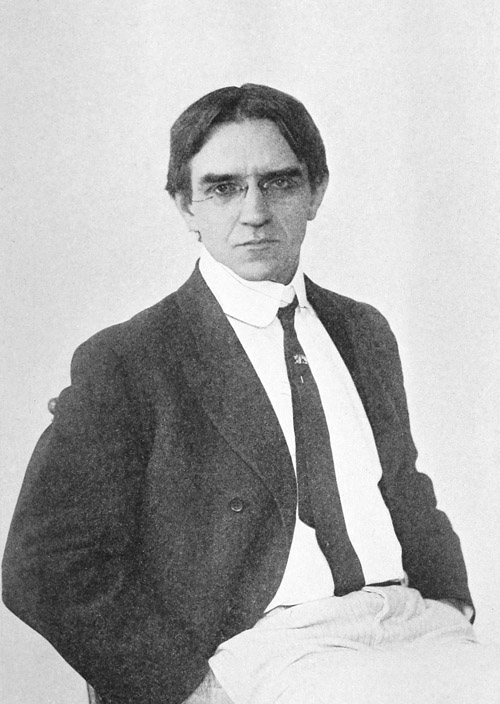
“The Tide on Tantramar,” from the third volume, a ballad of the sea and the salt marshes, transfers to the page the keen pungence of the brine, as do the descriptive stanzas of Tantramar used illustratively in the “Ave” to Shelley. There is noble work in this elegy, and while it wanders over a good deal of Canadian territory, making inspired observations of nature
Other Songs of the Common Day, forelooking to the later poet, are “The Silver Thaw,” “Canadian Streams,” and “The Wood Frolic,” having the first-hand, magnetic touch distinguishing every line of Mr. Roberts’ out-of-door verse in that volume which first truly reveals him,—The Book of the Native. So conscious is one of a new force in this book that it would seem to represent another personality. Its opening poem, “Kinship,” turns for inspiration,
Back to the bewildering vision And the border-land of birth; Back into the looming wonder, The Companionship of Earth,
and puts the query to nature:
Tell me how some sightless impulse, Working out a hidden plan, God for kin and clay for fellow, Wakes to find itself a man. Tell me how the life of mortal, Wavering from breath to breath, Like a web of scarlet pattern Hurtles from the loom of death. How the caged bright bird, Desire, Which the hands of God deliver, Beats aloft to drop unheeded At the confines of forever. Faints unheeded for a season, Then outwings the farthest star, To the wisdom and the stillness Where thy consummations are.
This sounds the keynote to The Book of the Native, which is equally concerned with the enigmas of the soul and the mysteries of nature. The questing spirit is abroad in it; the unquenched faith, the vitality, the hidden import of life is in it; and while its metaphysics do not go to the point of developing a definite philosophy, they set one to thinking for himself, which is a better service. “Origins,” a speculation as to our coming from “the enigmatic Will,” and the “Unsleeping,” a vision of the Force brooding over life,—are among the strongest poems of this motive. To cite the second:
I soothe to unimagined sleep The sunless bases of the deep, And then I stir the aching tide That gropes in its reluctant side. I heave aloft the smoking hill: To silent peace its throes I still. But ever at its heart of fire I lurk, an unassuaged desire. I wrap me in the sightless germ An instant or an endless term; And still its atoms are my care, Dispersed in ashes or in air. I hush the comets one by one To sleep for ages in the sun; The sun resumes before my face His circuit of the shores of space. The mount, the star, the germ, the deep, They all shall wake, they all shall sleep. Time, like a flurry of wild rain, Shall drift across the darkened pane. Space, in the dim predestined hour, Shall crumble like a ruined tower. I only, with unfaltering eye, Shall watch the dreams of God go by.
What a fine touch in the lines declaring that
Time, like a flurry of wild rain, Shall drift across the darkened pane!
Mr. Roberts has the rare pictorial gift of flashing a scene before one without employing an excess of imagery, and never that which is confused or cumbrous. His style is nervous, magnetic, direct, and has, in his later work, very little superfluous tissue. This statement, has, of course, its exceptions, but is sufficiently accurate to be made a generalization, and in no case is it better shown than in the The Book of the Native. What is there about Canada that sets the blood of her poets a-tingle and lends magic to their fingers when writing of her? What is there in Grand Pré’s “barren reaches by the tide,” or in the marshes of Tantramar, that such a spell should wait upon them, calling the roamer
“Back into the looming wonder, The Companionship of Earth”?
With the American poets of the present day, despite their feeling for nature, it is rather her beauty in the abstract than any particular locality with which they chance to be associated, that inspires them,—though Mr. Cawein, in his allegiance to Kentucky, furnishes a marked exception to this statement,—but the Canadian poets, with a passion like that of a lover, sing of the haunts that knew their first devotion: now with a buoyant infectious note, now with a reminiscent sadness; in short, the Canadian poets seem to have a sympathetic identity with their country, an interchange of personality by which they reciprocally express each other.
Particularly is this true of Bliss Carman, Duncan Campbell Scott, and Charles G. D. The Book of the Native. The first belongs to the racy note pervading a good deal of the nature-verse of to-day, of which the Vagabondia books set the fashion: it is called “Afoot,” but might with equal aptness be named the “Processional,” since the second is the “Recessional”:
Comes the lure of green things growing, Comes the call of waters flowing,— And the wayfarer desire Moves and wakes and would be going. Hark the migrant hosts of June Marching nearer noon by noon! Hark the gossip of the grasses Bivouacked beneath the moon! Hark the leaves their mirth averring; Hark the buds to blossom stirring; Hark the hushed, exultant haste Of the wind and world conferring! Hark the sharp, insistent cry Where the hawk patrols the sky! Hark the flapping, as of banners, Where the heron triumphs by!
Note the picturesque phrase and the compulsive, quickstep note in the lines above, as of the advancing cohorts of spring, and in contrast the slow movement, the sadness of the retreating year, in these beautiful “Recessional” stanzas:
Now along the solemn heights Fade the Autumn’s altar-lights; Down the great earth’s glimmering chancel Glide the days and nights. Little kindred of the grass, Like a shadow on a glass Falls the dark and falls the stillness; We must rise and pass. We must rise and follow, wending Where the nights and days have ending,— Pass in order pale and slow, Unto sleep extending. Little brothers of the clod, Soul of fire and seed of sod, We must fare into the silence At the knees of God. Little comrades of the sky, Wing to wing we wander by, Going, going, going, going, Softly as a sigh.
And to make the season-cycle complete, and also to show the delicacy of imagination with
One night came Winter noiselessly, and leaned Against my window-pane. In the deep stillness of his heart convened The ghosts of all his slain. Leaves, and ephemera, and stars of earth, And fugitives of grass,— White spirits loosed from bonds of mortal birth, He drew them on the glass.
Fancies as exquisite as this bespeak the true poet. “The Trout Brook” and “The Solitary Woodsman” are other inspirations as individual.
Mr. Roberts’ fifth volume, New York Nocturnes, as its name implies, was a decided departure from his former work, showing his versatility, but what is more to the purpose, his recognition of the dramatic element, the human, vital poetry in the babel of the streets. One could wish that the Nocturnes penetrated more profoundly into the varied phases of life in the great seething city, that, in short, they sounded other deeps than those of love; but Mr. Roberts has succeeded in conveying that sense of isolation in a throng, that heavy loneliness and reaction, throwing one back upon
The Nocturnes have the city’s over-soul incarnate in them; for in the last analysis, the commerce, the art, the ambition, the strife, the defeat, that one may term the city’s life, are but as hands and feet to minister to the spirit of love. The first of the Nocturnes suggests this:
I walk the city square with thee, The night is loud; the pavements roar. Their eddying mirth and misery Encircle thee and me. The street is full of lights and cries: The crowd but brings thee close to me, I only hear thy low replies; I only see thine eyes.
The “Nocturne of Consecration” is impassioned and full of spirituality; it is, however, too long to quote, which is unfortunately the case with the “Nocturne of the Honeysuckle,” another of the finer poems. “At the Station” is instinct with movement, reproducing the picture of the swiftly changing throngs, and conveying the eager expectancy of the hour of meeting. The Nocturnes have also a group of miscellaneous The Book of the Native, owing to the difference in theme, is distinguished by refinement of feeling and artistry.
In The Book of the Rose Mr. Roberts has done some excellent work, and some, alas, that strikes a decided note of artificiality. The least real and convincing of the poems is that called “On the Upper Deck,” which opens the volume. The first stanza is subtly phrased, and also the lyric which occurs midway of the poem; but the dialogue between the lovers is honeyed poetizing rather than genuine emotion. I find few heart-throbs in it, but rather a melodramatic sentimentality from whose flights one is now and again let down to the common day with summary despatch, as in the parenthetical clause of the stanza which follows:
Let us not talk of roses. Don’t you think The engine’s pulse throbs louder now the light Has gone? The hiss of waters past our hull Is more mysterious, with a menace in it? And that pale streak above the unseen land, How ominous! a sword has just such pallor! (Yes, you may put the scarf around my shoulders.) Never has life shown me the face of beauty But near it I have seen the face of fear.
It may be that an obtuse man upon the deck of a steamer would interrupt his sweetheart’s
No, do not move! Alone although we be I dare not touch your hand; your gown’s dear hem I will not touch lest I should break my dream And just an empty deck-chair mock my longing.
Here again it was scarcely necessary to qualify the chair, and indeed the whole passage savors of melodrama. These are, however, only such lines as show that to the one relating a matter the least incident may appear to lend reality to the setting, whereas to the reader the detail may violate taste.
The opening stanza, mentioned as one of the truly subtle bits of the poem in question, has these fine lines:
As the will of last year’s wind, As the drift of the morrow’s rain, As the goal of the falling star, As the treason sinned in vain, As the bow that shines and is gone, As the night cry heard no more,— Is the way of the woman’s meaning Beyond man’s eldest lore.
This stanza and the lyric below, which is sung as an interlude to the dialogue, go far toward redeeming the over-ripe sentiment of the poem:
O Rose, blossom of mystery, holding within your deeps The hurt of a thousand vigils, the heal of a thousand sleeps, There breathes upon your petals a power from the ends of the earth, Your beauty is heavy with knowledge of life and death and birth. O Rose, blossom of longing—the faint suspense, and the fire, The wistfulness of time, and the unassuaged desire, The pity of tears on the pillow, the pang of tears unshed,— With these your spirit is weary, with these your beauty is fed.
The remaining poems of the volume are much more artistic than the first, with the exception of the passages last quoted. “The Rose of Life” is artistically wrought as to form and metre, and subtle in analysis; but, because of its length and that it voices somewhat the same thought as the lyric above, the former must serve to show with what delicacy
O wild, dark flower of woman, Deep rose of my desire, An Eastern wizard made you Of earth and stars and fire. When the orange moon swung low Over the camphor-trees, By the silver shaft of the fountain He wrought his mysteries. The hot, sweet mould of the garden He took from a secret place To become your glimmering body And the lure of your strange face. From the swoon of the tropic heaven He drew down star on star, And breathed them into your soul That your soul might wander far— On earth forever homeless, But intimate of the spheres, A pang in your mystic laughter, A portent in your tears. From the night’s heat, hushed, electric, He summoned a shifting flame, And cherished it, and blew on it Till it burned into your name. And he set the name in my heart For an unextinguished fire, O wild, dark flower of woman, Deep rose of my desire!
Metrically the poem jars in the line,
And breathed them into your soul,
departing as it does from the general scheme of the third lines, and rendering it necessary to make “soul” bisyllabic in order to carry the metre smoothly, and in accord with its companion verses. “Spirit” would have fitted the metrical exigency better, leaving the final unaccented syllable as in the majority of the lines, but would not have lent itself to repetition in the succeeding line as does “soul,”—so
Aside from the poems upon love, filling the first division of The Book of the Rose it has a miscellaneous group, of which the two that best represent it, to my fancy, are so widely diverse that their mere mention in juxtaposition is amusing; nevertheless they are the lines “To An Omar Punch Bowl,” and the reverent Nativity Song, “When Mary, the Mother, Kissed the Child.” The haunting couplets of the former are by no means of the convivial sort, but the essence of memory and desire, the pathos of this dust that is but “wind that hurries by,”—is in them. However, to be quoted, they need their full context, as does the Nativity Song mentioned.
Mr. Roberts has a rare sympathy with childhood, and a gift of reaching the hearts of the little ones; the “Sleepy Man” and “Wake-up Song” could scarcely be improved; note the picturing in the former and the drowsihood in its falling cadences:
When the Sleepy Man comes with the dust on his eyes (Oh, weary, my Dearie, so weary!) He shuts up the earth, and he opens the skies. (So hush-a-by, weary my Dearie!) He smiles through his fingers, and shuts up the sun; (Oh, weary, my Dearie, so weary!) The stars that he loves he lets out one by one. (So hush-a-by, weary my Dearie!) He comes from the castles of Drowsy-boy Town; (Oh, weary, my Dearie, so weary!) At the touch of his hand the tired eyelids fall down. (So hush-a-by, weary my Dearie!) · · · · · Then the top is a burden, the bugle a bane, (Oh, weary, my Dearie, so weary!) When one would be faring down Dream-a-way Lane. (So hush-a-by, weary my Dearie!) When one would be wending in Lullaby Wherry (Oh, weary, my Dearie, so weary!) To Sleepy Man’s Castle by Comforting Ferry. (So hush-a-by, weary my Dearie!)
Mr. Roberts has collected his several volumes, exclusive of The Book of the Rose, into one, eliminating such of the earlier work as falls short of his standard of criticism, and adding new matter showing growth and constantly broadening affinity with life. He manifests more and more the potentialities of his nature, and while all of his later work does not ring equally true, the majority of it is instinct with sincerity and high idealism, and one may go to it for unforced, unconventional song, having art without trammels, for a breath of the ozone of nature, and
Said Life to Art: I love thee best Not when I find in thee My very face and form, expressed With dull fidelity. But when in thee my longing eyes Behold continually The mystery of my memories And all I crave to be.
VIII
EDITH M. THOMAS
AN earnest idealist is Miss Edith Thomas, who commits to her song a vital word and sends it as a courier to arouse that drowsy lodge-keeper, the soul, and bid him give ear to the importunate message of life. Not by outwardly strenuous numbers, however, is this end achieved; on the contrary, Miss Thomas is a quiet singer whose thoughtful restraint is one of her chief distinctions. The spiritual tidings which she intrusts to her song are destined to be delivered in the silence of the soul; none the less are they sent to awaken it, and none the less do they bide and knock at the door of one’s spirit until one rise and open to them.
The ideality of her work has been from the outset its most informing quality; the thoughts beyond the thrall of words that pass, in Maeterlinck’s phrase, “like great white birds, across the heart,” had brushed with their unsullied wings the thoughts of every-day and left a light upon them, giving assurance, when the
Miss Thomas has written many beautiful lyrics, but her characteristic expression is too thoughtful to be set to the lighter and more purely musical rhythms. She has a finely cultivated style, inventive in form, and often employing richly cadenced measures, but one feels rather that the cadence is well tested, the
As compared with the large body of Miss Thomas’ work, that for which the inspiration has been sought far afield is slight; but it is sufficient to set the mark of deliberate intent upon many of the poems and detract from the spontaneity of the work as a whole. Miss Thomas is so accomplished and ready a technician that the temptation to utilize such allusions
The blossom and the sod Feel the unquiet God,
and exclaiming to a doubting votary,
Despair thine art! Thou canst not hush those cries, Thou canst not blind those eyes, Thou canst not chain those feet, But they a path shall beat Forth from thine heart. Forth from thine heart! There wouldst thou dungeon him, In cell both close and dim— The key he turns on thee, And out he goeth free! Despair thine art!
In her poem, “The Compass,” she carries the reasoning farther, and declares that if one is to wait upon the Force within and give it freedom, he shall also be trusted to follow where it leads, knowing that if temporarily deflected it will adjust itself to the truth as surely as the compass, thrown momentarily out of poise, searches and finds its compelling attraction. Aside from the analogy in the lines, the dignity of their movement, the harmonious fall of the cæsura, and the fine blending of word and tone, render them highly artistic:
Touch but with gentlest finger the crystal that circles the Mariner’s Guide— To the East and the West how it drifts, and trembles, and searches on every side! But it comes to its rest, and its light lance poises only one self-same way Since ever a ship spread her marvellous sea-wings, or plunged her swan-breast through the spray— For North points the needle! Ye look not alone for the sign of the lode-star; the lode-stone too lendeth cheer; Yet one in the heavens is established forever, and one is compelled through the sphere. What! and ye chide not the fluttering magnet that seemeth to fly its troth, Yet even now is again recording its fealty’s silent oath— As North points the needle! Praise ye bestow that, though mobile and frail as a tremulous spheret of dew, It obeys an imperial law that ye know not (yet know that it guideth most true); So, are ye content with its fugitive guidance—ye, but the winds’ and waves’ sport!— So, are ye content to sail by your compass, and come in fair hour to your port; For North points the needle! And now, will ye censure, because, of compulsion, the spirit that rules in this breast, To show what a poet must show, was attempered, and touched with a cureless unrest, Swift to be moved with all human mutation, to traverse passion’s whole range? Mood succeeds mood, and humor fleets humor, yet never heart’s drift can they change, For North points the needle! Inconstant I were to that Sovereign Bidding (why or whence given unknown), Failed I to tent the entire round of motive ere sinking back to my own: The error be yours, if ye think my faith erring or deem my allegiance I fly; I follow my law and fulfil it all duly—and look! when your doubt runneth high— North points the needle!
These lines illustrate Miss Thomas’ command of accurately descriptive phrase: the compass is “mobile and frail as a tremulous spheret of dew,” and touched never so lightly, “how it drifts, and trembles, and searches on every side.” One feels that just these words, and no others, convey at once the sense of its delicacy, and the almost sentient instinct by which it seeks its attraction. Miss Thomas’ diction in general shows rather fineness of discrimination in the expressive value of words than a strenuous attempt to seek out those which are “literary” and inobvious. There is rarely a word that calls undue attention to itself; but when a passage or poem is analyzed, one cannot but note the fine sense of values in its phraseology. Her diction has elegance without conventionality, but one would scarcely say that it is highly temperamental. It is flexible, colorful, picturesque, but has not so strong a note of personality
Now and again in her earlier work the influence of Emerson comes out unmistakably. “A Reed Shaken With the Wind,” “Child and Poet,” and “The Naturalist,” are distinctly Emersonian in manner and atmosphere—the first especially so in its consecutive, unstanzaed lines, and in the note pervading it. Whatever mannerisms of style Miss Thomas acquired from Emerson were, however, quickly cast off; but with his thought she could scarcely fail to have a continued kinship, if not a debt, so much does her own work incline to the spiritually philosophical. One may not trace influences at all definitely in her work, though felt in its general enrichment and breadth. In “Palingenesis,” from her last collection, she has done what poets before her have done,—embody in song the theory of evolution; but it has rarely been done better than in these stanzas, which seize the spiritual side of the scientific
Cycles ferried my cradle, rowing and rowing like cheerful boatmen,
from a poem upon the same theme which inspires Miss Thomas’ stanzas:
I dwelt with the God, ere He fashioned the worlds with their heart of fire, Ere the vales sank down at His voice or He spake to the mountains, “Aspire!” Or ever the sea to dark heaven made moan in its hunger for light, Or the four winds were born of the morning and missioned on various flight. In a fold of His garment I slept, without motion, or knowledge, or skill While age upon age the thought of creation took shape at His will; · · · · · Part had I not in the scheme till He sent me to work on the reef. Nude, in the seafoam, to clothe it with coralline blossom and leaf. Patient I wrought—as a weaver that blindly plyeth the loom, Nor knew that the God dwelt with me, there as I wrought in the gloom. Strength had I not till chiefdom supreme of the waters He gave; Joyous I went—tumultuous; the billows before me I drave— Myself as a surge of the sea when impelled by the driving storm; Nor knew that the God dwelt with me, there in leviathan’s form. Lightness I had not till, decked with light plumes, He endued me with speed— Buoyant the hollow quill as the hollow stem of the reed! And I gathered my food from the ooze, and builded my home at His word; Nor knew that the God dwelt with me clothed in the garb of a bird. I trod not the earth till on plains unmeasured He sent me to rove, To taste of the sweetness of grass and the leaves of the summer grove. For shelter He hollowed the cave; fresh springs in the rock He unsealed; But I knew not the God dwelt with me that ranged as a beast of the field. Foresight I had not, nor memory, nor vision that sweeps in the skies, Till He made me man, and bade me uplift my marvelling eyes! My hands I uplifted—my cries grew a prayer—on the green turf I knelt, And knew that the God had dwelt with me wherever of old I had dwelt! Wild is the life of the wave, and free is the life of the air, And sweet is the life of the measureless pastures, unburdened of care; They all have been mine, I upgather them all in the being of man, Who knoweth, at last, that the God hath dwelt with him since all life began! My heritage draw I from these—I love tho’ I leave them behind; But shall I not speak for the dumb, and lift up my sight for the blind? I am kin to the least that inhabits the air, the waters, the clod; They wist not what bond is between us, they know not the Indwelling God! For under my hands alone the charactered Past hath He laid, One moment to scan ere it fall like a scroll into ashes and fade! Enough have I read to know and declare—my ways He willkeep, If onward I go, or again in a fold of His garment I sleep!
There is no internal evidence in these strongly phrased and stirring lines that a woman’s hand penned them; their vigor, grasp,
For one of her heartening notes and quick-step measures take “Rank-And-File” from her last volume, The Dancers:
You might have painted that picture, I might have written that song: Not ours, but another’s, the triumph, ’Tis done and well done—so ’long! You might have fought in the vanguard, I might have struck at foul Wrong: What matters whose hand was the foremost? ’Tis done and well done—so ’long! So ’long, and into the darkness, With the immemorial throng— Foil to the few and the splendid: All’s done and well done—so ’long! Yet, as we pass, we will pledge them— The bold, and the bright, and the strong, (Ours was never black envy): All’s done and well done—so ’long!
Miss Thomas is very keen to see what may be termed the subjectively dramatic side of life,—all the subtlety of motive and impulse working out of sight to shape the destiny, she sees with acute divination; but constructively she lacks the dramatic touch. In “A Winter Swallow,” her one definite incursion into this field, it cannot be said that she has done such work as would represent her at her real value either in the literary beauty of the lines, or in the insight displayed in the characterization.
So short a dramatic effort, however, could scarcely do more than indicate the likelihood or unlikelihood of Miss Thomas’ success in a more sustained plot; and while a theme having in itself warmer elements of sympathy would doubtless create for itself a more moving and vital art, there is very little to indicate that the effort would be wisely spent. One is inclined more fully to this opinion by the lack of dramatic impulse in Miss Thomas’ narrative poem turning upon the story of Genevra of the Amieri, she who woke by night from the death-trance to find herself entombed in the powerful vault of
The mere skeleton of this story is palpitant with life; but in Miss Thomas’ cultivated and beautiful recital, wherein the well-rounded, suave pentameter falls never otherwise than richly on the ear, all the vibrant, thrilling, terrifying elements of the story have been refined away. When Genevra wakens in the tomb, and touches in the darkness the human skeletons about her, and struggles to free herself from the entangling cerements, and beats with superhuman strength at the gratings until they yield to her hand, and to the outer stone until it unseals at her terrified touch,—there are dramatic materials which even history has infused with red blood; but either Miss Thomas does not conceive the situation as having thrills and terrors, or has not been able to impart them to her record, for she sums the matter up in these two stanzas, illustrating, apparently, the Gentle Art of Being Buried Alive:
And now she dreams she lies in marble rest Within the Amieri’s chapel-tomb, With hands laid idly on an idle breast. How sweetly can the carven lilies bloom, As they would soften her untimely doom…. Nay, living flowers are these that brush her cheek! She starts awake amid the nether gloom, From out dead swoon returning faint and weak; No voice hath she, but none might hear her, could she speak. Vaguely she reaches from her stony bed; The blessed moonbeam, gliding underground, Like angel ministrant from heaven sped, To rescue one in frosty irons long bound, Cheers her new-beating heart, till she has found Recourse of memory and use of will. Then soon her feet are on the ladder-round, The stone above gives way to patient skill; And now the wide night greets her, bright, and lone, and still.
The story of Genevra, as told by Miss Thomas, has often great beauty of phrase, picturesque descriptive passages of Florentine life, delicacy in the scene between the reunited lovers when Genevra seeks Antonio’s gate, and fine pathos in the lines spoken by her father to her supposed spirit returning to haunt him; in short, the poem has all but the dramatic touch. The narrative force is lost in the poetic elaboration.
But although Miss Thomas has not the outward art of the dramatist, she has, as earlier stated, a keenly intuitive sense of the spiritually dramatic in passing life. Upon love she has written with so keen a psychology that certain
Because thy prayer hath never fed Dark Atë with the food she craves; Because thou dost not hate (they said), Nor joy to step on foemen’s graves; Because thou canst not hate, as we, How poor a creature thou must be, Thy veins as pale as ours are red! Go to! Love loves thee not (they said). Because by thee no snare was spread To baffle Love—if Love should stray, Because thou dost not watch (they said), To strictly compass Love each way: Because thou dost not watch, as we, Nor jealous Care hath lodged with thee, To strew with thorns a restless bed— Go to! Love loves thee not (they said). Because thy feet were not misled To jocund ground, yet all infirm, Because thou art not fond (they said), Nor dost exact thine heyday term: Because thou art not fond, as we, How dull a creature thou must be, Thy pulse how slow—yet shrewd thy head! Go to! Love loves thee not (they said). Because thou hast not roved to wed With those to Love averse or strange, Because thou hast not roved (they said), Nor ever studied artful change: Because thou hast not roved, as we, Love paid no ransom rich for thee, Nor, seeking thee, unwearied sped. Go to! Love loves thee not (they said). Ay, so! because thou thought’st to tread Love’s ways, and all his bidding do, Because thou hast not tired (they said), Nor ever wert to Love untrue: Because thou hast not tired, as we, How tedious must thy service be; Love with thy zeal is surfeited! Go to! Love loves thee not (they said). · · · · ·
Every contradiction of passion is in this poem, and the very refinement of satire, as well. In “The Domino,” Miss Thomas images, with a pleasant humor, the various disguises under which one meets Love, and symbolizes in “The Barrier” the infallible intuition, the psychic sense, by which one feels a change not yet apparent.
“A Home-Thrust,” wherein the inconstant
There was a garden planned in Spring’s young days, Then, Summer held it in her bounteous hand; And many wandered thro’ its blooming ways; But ne’er the one for whom the work was planned. And it was vainly done— For what are many, if we lack the one? There was a song that lived within the heart Long time—and then on Music’s wing it strayed! All sing it now, all praise its artless art; But ne’er the one for whom the song was made. And it was vainly done— For what are many, if we lack the one?
The whole argument of Art versus Life is summed up in this poem. The second lyric, of eight lines, is as delicate as the symbol it employs, and globes within it, as the drop within the pearl, many a life-history:
The love of my life came not As love unto others is cast; For mine was a secret wound— But the wound grew a pearl, at last. The divers may come and go, The tides, they arise and fall; The pearl in its shell lies sealed, And the Deep Sea covers all.
It is in such poems as bring from the heart of life a certain poignant strain that Miss Thomas is at her best. She is not a melancholy singer, but her work is too deeply rooted in the pain and unrest of life to be joyous. A certain longing, an almost impalpable sadness, pervades much of her verse. Nevertheless, it is not so emphasized as to be depressing, and, indeed, adds just the touch of personality by which one treasures that which he feels has been fused in experience. This pertains to the more intimate phases of Miss Thomas’ work. Upon death she has written with deep feeling and insight,—feeling all too vital to be analyzed, such as renders Spring the season
When that blithe, forerunning air Breathes more hope than thou canst bear.
Nature is often, in her verse, as it must be to any sympathetic mind, a keener source of pain than of pleasure, instinct as it is with memories, and flaunting before one’s thwarted dreams the infallible fulfilment of its hopes; yet she has
“The Soul of the Violet,” previously referred to, is an illustration in point, being a purely subjective treatment of a nature-suggestion. When spring is yet too young for promise of bloom, and only in the first respite from the snow,
The brown earth raises a wistful face— Whenever about the fields I go, The soul of the violet haunts me so! I look—there is never a leaf to be seen; In the pleachéd grass is no thread of green; But I walk as one who would chide his feet Lest they trample the hope of something sweet! Here can no flower be blooming, I know— Yet the soul of the violet haunts me so! Again and again that thrilling breath, Fresh as the life that is snatched out of death, Keen as the blow that Love might deal Lest a spirit in trance should outward steal— So thrilling that breath, so vital that blow— The soul of the violet haunts me so! Is it the blossom that slumbers as yet Under the leaf-mould dank and wet, · · · · · Or is it the flower shed long ago? The soul of the violet haunts me so!
The subjective touch in the final couplet gives the key-note to the poem.
Miss Thomas is indeed so subjective in her conception of some of the profounder and more vital losses of life, the sense of the irrevocable and irreparable is so keenly emphasized to her mind as to communicate almost a hint of fatalism to certain of her poems, such as “Expiation” and “A Far Cry To Heaven.” The latter is such an utterance, in its impassioned tone, as might proceed from the lips of the Angel with the Flaming Sword sent to bar one’s return to his desecrated Eden. The ultimate effect of such a poem, however, is salutary, as the warning outruns the scath, and one reading it will pay closer heed to the import of the “white hour” of his life. On its technical side, the poem has all the ease of an improvisation, and so at one are the metre and thought that line succeeds line with a surge and a rhythm, as wave follows wave to the shore:
What! dost thou pray that the outgone tide be rolled back on the strand, The flame be rekindled that mounted away from the smouldering brand, The past-summer harvest flow golden through stubble-lands naked and sere, The winter-gray woods upgather and quicken the leaves of last year?— Thy prayers are as clouds in a drouth; regardless, unfruitful, they roll; For this, that thou prayest vain things, ’tis a far cry to Heaven, my soul,— Oh, a far cry to Heaven! Thou dreamest the word shall return, shot arrow-like into the air, The wound in the breast where it lodged be balmed and closed for thy prayer, The ear of the dead be unsealed, till thou whisper a boon once denied, The white hour of life be restored, that passed thee unprized, undescried!— Thy prayers are as runners that faint, that fail, within sight of the goal, For this, that thou prayest fond things, ’tis a far cry to Heaven, my soul,— Oh, a far cry to Heaven! And cravest thou fondly the quivering sands shall be firm to thy feet, The brackish pool of the waste to thy lips be made wholesome and sweet? And cravest thou subtly the bane thou desirest, be wrought to thy good, As forth from a poisonous flower a bee conveyeth safe food? For this, that thou prayest ill things, thy prayers are an anger-rent scroll; The chamber of audit is closed,—’tis a far cry to Heaven, my soul,— Oh, a far cry to Heaven!
For the strong, but aloe-tinctured draught of this poem, “Sursum Corda” is the antidote.
Up and rejoice, and know thou hast matter for revel, my heart! Up and rejoice, not heeding if drawn or undrawn be the dart Last winged by the Archer whose quiver is full for sweeter than thou, That yet will sing out of the dust when the ultimate arrow shall bow. · · · · · Now thou couldst bless and God-speed, without bitterness bred in thine heart, Loves, that, outworn and time-wasted, were fain from thy lodge to depart: Though dulled by their passing, thy faith, like a flower upfolded by night, New kindness should quicken again, as a flower feels the touch of new light. Ay, now thou couldst love, undefeated, with ardor instinct from pure Love,— Warmed from a sun in the heavens that knows not beneath nor above, Nor distance its patience to weary, nor substance unpierce by its ray. · · · · · Now couldst thou pity and smile, where once but the scourge thou wouldst lay; Now to thyself couldst show mercy, and up from all penance arise, Knowing there runneth abroad a chastening flame from the skies. Doubt not thou hast matter for revel, for once thou wouldst cage thee in steel, And, wounded, wouldst seek out the balm and the cordial cunning to heal; But now thou hast knowledge more sovran, more kind, than leech-craft can wield: Never Design sent thee forth to be safe from the scath of the field, But bade thee stand bare in the midst, and offer free way to all scath Piercing thee inly—so only might Song have an outgoing path. · · · · · But now ’tis not thine to bestow, to abide, or be known in thy place; Withdraweth the voice into silence, dissolveth the form and the face. Death—Life thou discernest! Enlarged as thou art, thy ground thou must shift! Love over-liveth. Throb thou forth quickly. Heart, be uplift!
The hard-won philosophy of nearly all lives is summed up in these stanzas, pregnant therefore with suggestion to those who have the untrodden way before them, and full of uplift to those who have the course behind them, and
Not only in this poem, but throughout her work, the evolution of Miss Thomas’ philosophy of life is marked, had one time to trace its growing significance. She has sounded many stops, touched many keys of feeling and thought, so that one may do no more in a brief comment than suggest the various phases of her widely inclusive song.
IX
MADISON CAWEIN
IN nothing, more than in his attitude toward nature, does the modern betray himself. Ours is the questioning age, the truth-seeking, the scientific age; when, for illustration, Maeterlinck laid his philosophy by to observe with infinite pains the habits of the bee and to record, without the intrusion of too many deductions, the amazing facts as nature passed them in review before his eyes,—he became the naturalist-philosopher, selling days, not for speculations, but for laws. To the poet also has come the desire which came to the philosopher to demonstrate the truth within the beauty; to penetrate to the finer law at the heart of things; in short, there has arisen what one may term the poet-naturalist, and in the recent work of Mr. Madison Cawein we have perhaps the most characteristic illustration among our own poets of the younger school, of this phase of nature-interpretation.
Before considering it, however, one must trace briefly Mr. Cawein’s evolutionary steps Myth and Romance. Of the more artistic poems, worthy to be put in comparison with his later work, there are several from the opening group of the collection, as these picturesque lines containing the query:
What wood-god, on this water’s mossy curb, Lost in reflection of earth’s loveliness, Did I, just now, unconsciously disturb? I, who haphazard, wandering at a guess, Came on this spot, wherein, with gold and flame Of buds and blooms, the season writes its name.— Ah me! could I have seen him ere alarm Of my approach aroused him from his calm! As he, part Hamadryad and, mayhap, Part Faun, lay here; who left the shadow warm As wild-wood rose, and filled the air with balm Of his sweet breath as with ethereal sap.
Or from the same group these charming glimpses of “an unseen presence that eludes”:—
Perhaps a Dryad, in whose tresses cling The loamy odors of old solitudes, Who, from her beechen doorway, calls; · · · · · Or, haply ’tis a Naiad now who slips, Like some white lily, from her fountain’s glass, While from her dripping hair and breasts and hips, The moisture rains cool music on the grass. · · · · · Or now it is an Oread—whose eyes Are constellated dusk—who stands confessed, As naked as a flow’r; her heart’s surprise, Like morning’s rose, mantling her brow and breast: She, shrinking from my presence, all distressed Stands for a startled moment ere she flies, Her deep hair blowing, up the mountain crest, Wild as a mist that trails along the dawn. And is’t her footfalls lure me? or the sound Of airs that stir the crisp leaf on the ground? And is’t her body glimmers on yon rise? Or dog-wood blossoms snowing on the lawn?
Who shall deny both charm and accomplishment to these lines, particularly to the glimpse of the dryad in her “beechen doorway,” but on the next page of the same volume occurs this more realistic apostrophe addressed to the “Rain-Crow,” giving a foretokening hint of his later manner of observation, and who shall say that it has not a truer charm and accomplishment?
Can freckled August,—drowsing warm and blonde Beside a wheat-shock in the white-topped mead, In her hot hair the oxeyed daisies wound,— O bird of rain, lend aught but sleepy heed To thee? when no plumed weed, no feather’d seed Blows by her; and no ripple breaks the pond, That gleams like flint between its rim of grasses, Through which the dragonfly forever passes Like splintered diamond. Drouth weights the trees, and from the farmhouse eaves The locust, pulse-beat of the summer day, Throbs; and the lane, that shambles under leaves Limp with the heat—a league of rutty way— Is lost in dust; and sultry scents of hay Breathe from the panting meadows heaped with sheaves— Now, now, O bird, what hint is there of rain, In thirsty heaven or on burning plain, That thy keen eye perceives? But thou art right. Thou prophesiest true. For hardly hast thou ceased thy forecasting, When, up the western fierceness of scorched blue, Great water-carrier winds their buckets bring Brimming with freshness. How their dippers ring And flash and rumble! lavishing dark dew On corn and forestland, that, streaming wet, Their hilly backs against the downpour set, Like giants vague in view. The butterfly, safe under leaf and flower, Has found a roof, knowing how true thou art; The bumble-bee, within the last half-hour, Has ceased to hug the honey to its heart; While in the barnyard, under shed and cart, Brood-hens have housed.—But I, who scorned thy power, Barometer of the birds,—like August there,— Beneath a beech, dripping from foot to hair, Like some drenched truant, cower.
This, however, is airy imagination as compared with the naturalist fidelity of much of Mr. Cawein’s work in Weeds by the Wall, A Voice on the Wind, and in Kentucky Poems,—to which Mr. Edmund Gosse contributes a sympathetic introduction,—books chiefly upon nature, occasionally reverting to the mythological or more imaginative phase of the subject, but in the main set to reveal the fact, with its aura of beauty; for it is never the purely elemental side of a nature-manifestation that presents itself to Mr. Cawein, but always the fact haloed by its poetic penumbra. Indeed, the limitation of his earlier work lay in the excess of fancy over reflection and art; but his growth has been away from the romantic toward the realistic and individual, and upon this side its best assurance for the future is given. Mr. Cawein has yet far too facile a pen not to be betrayed by it into excesses both of production and fancy. He writes too much to keep to the standard set in his best work of the past two or three years, and lacks still to a great degree the self-scrutiny which would reject much that he includes; but granting all this, it must be apparent to any reader of his work that he is not a singer making verse for diversion, but one to whom poetry is the very breath of his
To return, then, to his distinctive field, Kentucky, and his characteristic note of nature, one observes that a hand-book of the flora of his state could doubtless be compiled from his poems, so do they leave the beaten path in their range of observation; but it would be a botany plus imagination and sympathy, analysts keener than microscopes, and in it would be recorded the habits of the bluet, the jewel-weed, the
One follows the feet of September to the forest
Windowed wide with azure, doored with green, Through which rich glimmers of her robe were seen— Now, like some deep marsh-mallow, rosy gold; Now like the great Joe-Pye-weed, fold on fold Of heavy mauve; and now, like the intense Massed iron-weed, a purple opulence;
or wanders under the Hunter’s Moon to watch the frost spirits
… with fine fingers, phantom-cold, Splitting the wahoo’s pods of rose, and thin The bittersweet’s balls o’ gold To show the coal-red berries packed within.
Autumn is apparently, however, little to his liking, and in his attitude toward it he reveals the Southerner; for it is not only Kentucky flora and fauna, but Kentucky climate which Mr. Cawein celebrates, treating Autumn not with the buoyancy that to a Northerner renders it a season of lusty infection, but almost wholly in its aspect of sadness. In his volume called Undertones he has a group of poems upon
… the Fall Like some lone woman in a ruined hall Dreaming of desolation and the shroud; Or through decaying woodlands goes, down-bowed, Hugging the tatters of her gipsy shawl;
and speaks elsewhere of
… the days gray-huddled in the haze; Whose foggy footsteps drip.
Winter is encountered with far scantier cheer, and rarely receives the grace of salutation, as its face appears dire and malevolent to this lover of the sun. To follow Mr. Cawein’s work with such a purpose in view would be to present an interesting study in climatic psychology, for though no mention were made of the section in which he writes, the internal evidence is sufficient to localize the poems. Not alone the gracious side of the Southern summer is presented, but the fearful time of drouth when
The hot sunflowers by the glaring pike Lift shields of sultry brass; the teasel tops, Pink-thorned, advance with bristling spike on spike Against the furious sunlight. Field and copse Are sick with summer: now, with breathless stops, The locusts cymbal; now grasshoppers beat Their castanets: and rolled in dust, a team,— Like some mean life wrapped in its sorry dream,— An empty wagon rattles through the heat.
This is vivid picturing and a fine touch of realism fused with imagination which compares the team rolled in dust to
“Some mean life wrapped in its sorry dream.”
Immediately following the poem upon “Drouth,” of which there are several stanzas sketched with minuteness, occurs one entitled “Before the Rain,” opening with these pictorial lines:
Before the rain, low in the obscure east, Weak and morose the moon hung, sickly gray; Around its disc the storm mists, cracked and creased, Wove an enormous web, wherein it lay Like some white spider hungry for its prey. Vindictive looked the scowling firmament, In which each star, that flashed a dagger ray, Seemed filled with malice of some dark intent.
The moon caught in its creased web of storm mists is another well-visioned image. Mr. Cawein carries the record on to a third poem, picturing the “Broken Drouth;” all are notable for the infusion of atmosphere,—climatic atmosphere, in this case; and indeed of this palpable sort there is plenty, infused into words that fairly parch the page in such poems as Weeds by the Wall.
Mr. Cawein has poems in celebration of many other of the creatures whom he links in fellowship with man in his keenly observant verse. “The Twilight Moth,” “The Leaf Cricket,” “The Tree Toad,” “The Chipmunk,” and even the despised “Screech-Owl,” are observed and celebrated with impartial sympathy and love. He shelters in the wood during a summer rain to learn where each tiny fellow of the earth and air bestows himself, and notes that the “lichen-colored moths” are pressed “like knots against the trunks of trees;” that the bees are wedged like “clots of pollen” in hollow blooms, and that the “mantis, long-clawed, furtive, lean,” and the dragonfly are housed together beneath the wild-grape’s leaves and gourds. Each creature’s haunt, ’neath rock or root, or frail roof-bloom, is determined as a naturalist might lie in wait during the summer storm to record for Science’s sake each detail of this forest tenantry.
To the “Twilight Moth,” “gnome wrought of moonbeam fluff and gossamer,” he addresses in another poem these delicate lines:
Dusk is thy dawn; when Eve puts on her state Of gold and purple in the marbled west, Thou comest forth like some embodied trait, Or dim conceit, a lily-bud confessed; Or, of a rose, the visible wish; that, white, Goes softly messengering through the night, Whom each expectant flower makes its guest. All day the primroses have thought of thee, Their golden heads close-haremed from the heat; All day the mystic moonflowers silkenly Veiled snowy faces,—that no bee might greet Or butterfly that, weighed with pollen, passed;— Keeping Sultana charms for thee, at last, Their lord, who comest to salute each sweet. Cool-throated flowers that avoid the day’s Too fervid kisses; every bud that drinks The tipsy dew and to the starlight plays Nocturnes of fragrance, thy winged shadow links In bonds of secret brotherhood and faith; O bearer of their order’s shibboleth, Like some pale symbol fluttering o’er these pinks.
The final line of this stanza has a certain thinness, and in that above, the ending which turns “sweet” to a noun is too evidently a matter
Secluded, solitary on some underbough, Or cradled in a leaf, ’mid glimmering light, Like Puck thou crouchest: haply watching how The slow toad stool comes bulging, moony white, Through loosening loam; or how, against the night, The glow-worm gathers silver to endow The darkness with; or how the dew conspires To hang at dusk with lamps of chilly fires Each blade that shrivels now. · · · · · Minstrel of moisture! silent when high noon Shows her tanned face among the thirsting clover And parching meadows, thy tenebrious tune Wakes with the dew or when the rain is over. Thou troubadour of wetness and damp lover Of all cool things! admitted comrade boon Of twilight’s hush, and little intimate Of eve’s first fluttering star and delicate Round rim of rainy moon! Art trumpeter of Dwarfland? does thy horn Inform the gnomes and goblins of the hour When they may gambol under haw and thorn, Straddling each winking web and twinkling flower? Or bell-ringer of Elfland? whose tall tower The liriodendron is? from whence is borne The elfin music of thy bell’s deep bass To summon fairies to their starlit maze, To summon them or warn.