Front matter (continued 5)
Reading edition
But Madame Bruin, like the rest of her kin, was a peaceable old lady, not at all disposed to trouble those that let her alone, and on the present occasion she had two sweet little cherubs, whose comfort depended upon her safety; so she contented herself with going simply to her front door, and requesting her impertinent visitors to leave the premises. This request was couched in language which, though not English, nor remarkably polite, was perfectly intelligible.
"I suppose we shall have to go now," said Harold; "it will not be civil to keep prying into the old lady's chamber. But when Sam is able to join us, we can come prepared to make bacon of her and pets of her cubs."
They called off the dog, patted him in praise of his well-doing, and then retreated, blazing the trees all the way from the poplar to the river.
Several of these last miles Robert had walked with increasing painfulness; his feet were so much chafed as to be almost blistered.
"Stop, Harold, and let us rest here," he said, on reaching a fallen log. "I wish to try that soldier's remedy for chafed feet."
"What soldier's?" Harold inquired.
"One of those at Tampa," replied Robert. "I heard several of them relate, one day, how much they had suffered in marching with blistered feet, when one of the number remarked that whenever the signs of chafing occurred he had relieved himself by shifting his socks from one foot to the other, or by turning them inside out. Upon this another stated that he was generally able to escape all chafing by rubbing the inside of his socks with a little soap before setting out. And another still added that he had often cured his blistered feet, in time for the next day's march, by rubbing them with spirits mixed with tallow dropped from a candle into the palm of his hand. Before leaving home, today, I took the precaution to soap the inside of my socks; but now I shall have to try the efficacy of the other remedy; and sorry shall I be if there should be need for the third plan, because we have neither the tallow nor the spirits necessary for the experiment."
Robert gave the proposed plan a trial, and found, to his delight, that it saved him from all further discomfort.
Nothing more of interest occurred that day. On leaving the river, which, after making a great sweep to the south-east, came so near the bank on which they stood, as to afford a good landing for boats, they turned into the woods and kept a northern course parallel with the shore. About sunset they stopped beside a large log of resinous pine, which they selected for the place of their encampment that night, intending to set the log a-fire. Around it they cleared an irregular ring, which they fired on the inner side, thus providing a place for their sleeping free from insects, and from which fire could not escape into the surrounding forest. Next, they made themselves a tent of bushes, by bending down one sapling, fastening its top to the side of another, and then piling against it a good supply of evergreens, inclined sufficiently to allow a narrow space beneath. A neighbouring tree supplied them with moss for a superb woodland mattress, and while Robert was preparing that Harold collected a quantity of pine knots, to be reserved in case their fire should decline.
By the time these preparations were completed darkness closed around. Jupiter, at that time the evening star, glowed brightly from the western sky, while Orion, with his brilliant belt, gleamed cheerily from the east. The boys sat for some time luxuriating in their rest, listening to the musical roar of their fire, and watching the red glare which lighted up the sombre arches of the forest; then uniting in their simple repast, and giving Mum his share, they lay down to sleep, having committed themselves to the care of Him who slumbers not, and who is as near his trustful worshippers in the forest as in the city.
There is a wild pleasure in sleeping in the deep dark woods. The sense of solitude, the consciousness of exposure, the eternal rustle of the leafy canopy, or else its perfect stillness, broken only by the stealthy tread of some beast of night, or the melancholy hooting of a restless owl, give a variety which is not usual to civilized men, but which, being of a sombre character, requires for its enjoyment a bold heart and a self-relying spirit.
The boys retired to rest soon after supper, and tried to sleep; but the novelty of their circumstances kept them awake. They rose from their mossy couch, sat by the fire, and talked of their past history and of their future prospects. All around was perfect stillness. Their voices sounded weak and childlike in that deep forest; and embosomed as they were in an illuminated circle, beyond whose narrow boundary rose an impenetrable wall of darkness, they felt as if they were but specks in the midst of a vast and lonely world.
At last their nervous excitement passed away. They retired once more to bed, having their guns within reach, and Mum lying at their feet. The roar of the blaze and crackle of the wood composed them to sleep; and when they next awoke, daylight had spread far over the heavens, and the stars had faded from sight. They sprang lightly to their feet, and before the sun appeared were once more on their way northward, along the banks of the river.
Their march was now slow and toilsome. In the interior a hammock of rich land, covered with lofty trees, matted with vines, and feathered with tall grass, impeded their progress; while near the river bay-galls, stretching from the water's edge to the hammocks, fringed with gall-berries, myrtles and saw-palmettoes, and crowded internally with bays, tupeloes, and majestic cypresses (whose singular looking "knees" peeped above the mud and water like a wilderness of conical stumps), forced them to the interior. Their average rate of travel was scarcely a mile to the hour.
Several herds of deer darted before them as they passed, and once, while in the hammock, where the growth was very rank, they were almost within arm's length.
About noon they emerged into an open space, which Harold pronounced to be a small prairie; but in the act of stepping into it, rejoiced at a temporary relief from the viny forest, he grasped the arm of his cousin, and drew him behind a bush, with a hurried,
"Back! back! Look yonder!"
Robert gave one glance, and stepped back into concealment as quickly as if twenty panthers were guarding the prairie. There stood an Indian hut.
The boys gazed at each other in dismay; their hearts beat hard, and their breath grew short. Were there Indians then upon the island, and so near them? What might not have happened to Mary and Frank? But a close scrutiny from their bushy cover enabled them to breathe freely. There was a hut, but it was evidently untenanted; grass grew rank about the doorway, and the roof was falling to decay. It had been deserted for years.
The boys went boldly to it, and entered. Rain from the decayed and falling roof had produced tufts of grass in the mud plaster of the walls. In the centre was a grave, banked with great neatness, and protected by a beautifully arched pen of slender poles. At the door was a hominy mortar, made of a cypress block, slightly dished, and having a narrow, funnel-shaped cavity in its centre. Upon it, with one end resting in a crack of the wall, lay the pestle, shaped like a maul, and bearing the marks of use upon that end which white men would ordinarily regard as the handle. Overhanging the house were three peach trees, and around it the ground was covered with a profusion of gourds of all sizes, from that which is used by many as a pocket powder-flask to that which would hold several gallons. Beyond the house, and on the edge of the prairie, was a close growth of wild plums.
"This place," said Harold, musing, "must have belonged to some old chief. The common people do not live so comfortably. It is likely that he continued here after all others of his tribe had gone; and when he died, his children buried him, and they also went away. Poor fellow! here he lies. He owned a beautiful island, and we are his heirs."
"Peace to his ashes!" ejaculated Robert.
They looked sadly upon the signs of ruin and desolation. It always makes one sad to look upon a spot where our kind have dwelt, and from which they have passed away; it is symbolic of ourselves, and the grief we feel is a mourning over our own decay.
It was now twelve o'clock, and they began to feel the demands of appetite. Harold proposed to search longer, in hope of finding a spring of fresh water. "I am sure," said he, "there must be one hereabouts, and we shall find it exceedingly convenient in our frequent hunts."
They searched for nearly half an hour in vain; and as they were on the point of giving up, Harold called out, "I have found it! Come here, Robert, and see what a beauty!" Robert hastened to the shallow ravine which terminated the eastern end of the prairie. Not two steps below its green margin was a real curiosity of its kind--a rill of clear, cool-looking water, issuing from the hollow base of a large tupelo[#] tree. It was a freak of nature, combining beauty, utility and convenience. The water was as sweet as it was clear.
[#] The black gum of the swamps, having, like all trees that grow in water, a spreading, and generally a hollow base.
Having quenched their thirst at this beautiful fountain, and prepared to open their wallet of provisions, Robert's eye was attracted by a glimpse of a rich golden colour, on the edge of the prairie. They went to it, and found several varieties of orange trees, bearing in great profusion, and among them were limes, whose delicate ovals asked only to be tried. Beneath these trees they dined, and afterwards plucked their fragrant dessert from the loaded branches. Then they filled their pockets with the different varieties, and started homewards.
It was scarcely a mile from these orange trees to the first that they had discovered; and thence only three miles home. They reached the tent late in the afternoon. All were rejoiced to see them. Frank made himself merry, as usual, at their expense--laughing now that two hunters should be absent two whole days, and bring back only a few wild oranges. Mary said she had missed them very much, especially when night came on, but that everything had been smooth and pleasant; she had seen no panthers, and had not even dreamed of any.
CHAPTER XXVIII
PLANS--VISIT TO THE PRAIRIE--DISCOVERIES--SHOE MAKING--WATERFOWL
The severe exercise of the two preceding days was more than Harold's ankle, in its state of partial recovery, could endure without injury. For several days afterwards he was compelled to rest it from all unnecessary labour, and to relieve its pain by frequent and copious applications of cold water.
Sam's wounded limbs were rapidly regaining strength, and he insisted that they were well enough to be used; but Robert refused to indulge him.
"We must risk nothing in the case," said he. "It is so important to have you able to help us build our boat, that I think you had better continue in bed one week too long than leave it one day too soon. You must be content to rest your arm for full five weeks, and your leg for six or seven."
Mary and Frank had listened with deep interest to the account which the boys gave of the old Indian settlement, with its open prairie, vine covered forest, orange grove, and sparkling spring; and begged so earnestly for the privilege of accompanying them on their next visit, that they gave their consent. The only difficulty foreseen in the case, was that of leaving Sam alone; but when this was made known to him, he removed all objection by saying:
"Wuddah gwine hu't me?[#] Jes load one gun, and put um by my side. I take care o' myself."
[#] What is going to hurt me?
The object of their visit was not one of mere enjoyment. They had waited for deliverance until they were convinced that it was vain to rely upon anything except their own exertions. It was now between five and six weeks since they had landed upon the island. There had been some strange fatality attending all the efforts that they were sure had been made on their behalf, and now they must try to help themselves.
The exploration had resulted in the discovery of beautiful timber, of every size, fit for boats, and near the water's edge. They well knew it would be a herculean task for persons of their age and education, and possessed of so few tools, to dig out, from these trees, a boat large enough to carry them all home; but they were compelled to do this, or to remain where they were. Having consulted with Sam, upon whose judgment in matters of work they relied far more than on their own, they resolved to build not one large boat but two of moderate dimensions, which might if necessary be lashed firmly together; and for this purpose to select near the water two cypresses of three feet diameter, which should be felled as soon as possible. Their visit to the prairie was for the purpose of selecting these trees, in the low ground near the river.
The four set out in fine spirits early on the morning of Tuesday, November 30th, and continued their walk direct and without incident to the Indian hut. Notwithstanding the gloomy association of the solitary grave inside the deserted house, Mary and Frank were captivated with the wild beauty of the scene. The soft green grass of the prairie--the magnificent wall of forest trees enclosing the peaceful plain--the peach trees over the hut--the oranges and the limes glancing through their dark green leaves--and the bright bubbling spring that flowed so singularly from its living curb--all combined to enchant them. It was so delightful a contrast to the bare and sterile sand of their present encampment, that they plead at once for a removal there. This, of course, had occurred to the minds of the others also; but there were two serious objections to it. One was that here they would be out of sight of vessels passing at sea; and the other (which they kept to themselves) was that here they should be more in danger from wild beasts. They replied that they also preferred the prairie, but that they could not remove until Sam was better able to travel.
Having enjoyed to their satisfaction the view of the hut and its premises, Harold took Frank, and, followed by Fidelle, went in one direction, while Robert and Mary, with Mum, went in another, to search for trees suitable in size and location for their boats. In the course of an hour they returned, having marked a large number, and at the same time having added to their knowledge of the resources of the island. Harold discovered a fine patch of Coontah or arrowroot, from which a beautiful flour can be manufactured; and hard by a multitude of plants, with soft velvet-like leaves, of three feet diameter, having a large bulbous root resembling a turnip, and which Robert pronounced to be the tanyah, a vegetable whose taste is somewhat like that of a mealy potato. The other company went to the river, where Robert discovered an old boat landing, on one side of which was a large oyster bank, and on the other a deep eddy of the stream, in which trout and other fish were leaping about a fallen tree. Mary's discovery was more pleasant than useful. It was a bed of the fragrant calamus or sweet flag, from which she gathered a handful of roots, and washing them clean, brought them as a present to the others. Frank was quite chagrined to see that he had discovered nothing new or valuable, and he did not recover his equanimity for some minutes. While the seniors lingered cheerfully around the remains of their dinner, discussing the merits of their delightful island and the prospect of their return home, Mary suddenly inquired:
"But where is Frank? I have not seen him for half an hour."
Nor had any one else; for, unsatisfied with only one orange allowed him for dessert, while there were so many on the trees, and secretly hoping to find something valuable to announce, he had quietly slipped away, and had stealthily climbed one of the orange trees, from which he plucked an orange for each of his four pockets, then with Fidelle at his side he had strolled a little farther into the forest, eating as he went.
The boys, startled by Mary's question, sprang instantly to their feet, realizing vividly the danger to which he was exposed from wild beasts, but of which they had said nothing to him or to her. Scarcely, however, had their halloo sounded among the trees, than they saw him and his faithful companion approaching leisurely through the small thicket of wild plums.
"You thoughtless little boy," said Robert, upbraidingly; "why did you go off by yourself in these dangerous woods? Did you not know they are full of bears and panthers?"
"No, I didn't," Frank replied.
"Well, I now tell you that they are," continued Robert, "and that you must never again go there unless one of us is with you. But what took you there this time?"
"Humph," grunted Frank; "don't you suppose I want to find something new and good as well as the rest of you? and I have found it, too."
"Indeed," said Harold; "what is it, Frank?"
"You must all guess," he answered, looking very proud, "all of you guess. What is the best thing in the world?"
"I will say," answered Mary, "that one of the best things in the world is a little boy who always tries to do right."
"But it is no boy," Frank continued; "it is something sweet. Guess the sweetest thing in the world."
"I think," said Robert, inclined to amuse himself, "that the sweetest looking things in the world are those pretty little girls we used to meet on King Street, in Charleston."
"No, no," said Frank; "it is neither boys nor girls, but something to eat. What is the sweetest thing in the world to eat?"
"If we were in town," Harold replied, "I should guess candy and sugar-plums; but, as we are in the wild woods, I guess honey."
"Yes, that's it," said Frank, triumphantly; "I have found a bee-tree."
"And why do you think it is a bee-tree?" asked Mary, incredulously.
"Because I saw the bees," he replied, in confident tones.
"Why, Frank," said Robert, laughing, "the bees you saw may have their hives miles and miles away."
"No, they have not," Frank stoutly maintained. "I have seen them going and coming out of their own hole just as they do at home."
"That sounds very much as if Frank is right, after all," argued Harold; "let us go and see for ourselves. But how came you to find the tree, Frank?"
"While I was eating my orange," he replied, "a bee lit on my hand, and began to suck the juice there. I was not afraid of him, for I knew that he would not sting me if I did not hurt him; and more than that, I always love to look at bees. Well, he sucked till he had got juice enough, then he flew right up into a tree a little way off, and went into a hole. While I was looking at that hole, I saw many other bees going in or coming out; and then I knew that it was a bee-tree, because I had heard Riley talk about them at Bellevue. And, Cousin Harold, did you not put up some brimstone for taking bee-trees?"
"That I did, my dear little cousin," answered Harold, pleased with this unexpected allusion. "I have no doubt, from what you say, that you have found a real bee-tree; and, in that case, you have beat us all. Take us to see it."
They all went in joyous mood, and sure enough there was a good sized tree, with a knot-hole about twenty feet above ground, with plenty of bees passing in and out of it. The smell, too, of honey was decidedly strong, showing that the hive was old and plentifully stored.
It may be as well to state here, as elsewhere, that before many days the tree was felled, and that it supplied them with such an abundance of honey that a portion of it was, at Harold's suggestion, stowed away in skin bags, hair side outward. Some of it was beautifully white and clear. This was kept in the comb. The remainder was strained, and the wax was moulded into large cakes for future use. The bees, poor creatures! were all suffocated with the fumes of burning sulphur thrown into the hollow of the tree before it was opened. A few recovered, and for days hovered around their ruined home, until finally they all perished. It made Frank's kind heart very sad to see them, and several times he was stung while watching their movements and trying to help them.
After spending a delightful day, they returned about sunset to the tent. Sam's white teeth glistened when they approached the door. It had been a lonely day with him, but their return compensated for his solitude.
From this time forth the boys had before their minds a fixed object to be accomplished--the felling of those trees, and converting them into boats. But what should be the plan of their procedure while engaged in the work? They could go every morning, and return every evening--a distance altogether of eight miles; or they could spend several nights in succession at the prairie, leaving Frank and Mary with Sam; or they could remove everything to the place of their labour. As to the first two of these plans, it was so manifestly improper to leave the two younger ones for hours and days together, in a wild country, infested with wild beasts, and unprotected, except by a lame, bedridden negro, who was unable to protect himself, that they did not entertain them for a moment. It was finally resolved to delay their regular operations until the next week, by which time they hoped to be able, partly by water and partly by land, to transport everything, and take up their permanent abode at the prairie.
With this conclusion, they set about those little preparations which they could foresee as being necessary to an undivided use of their time after entering upon their work. Their clothes, and particularly their shoes, began to give signs of decay. Frank's shoes had for some time been gaping incontinently at the toes, looking for all the world, Sam said, as if they were laughing.
Harold, foreseeing the necessity before it occurred, had put some deer-skins in soak, wrapped up in lime made from burnt oyster shells; and after removing the hair loosened by this means, had stretched them in the sun, and softened them by frequent applications of suet. The skins were ready now for use; and as soon as it was determined to delay their visit to the prairie, he brought one of them to the tent, and calling to Frank, said,
"Lend me your foot a minute, Master Frank, and I will give you a pair of moccasins."
"Not the snakes, I hope," replied Frank.
"No, but something of the same name," said Harold; "I am going to turn shoemaker, and make you a pair of Indian shoes. I need a pair myself."
"And so do I--and I!" echoed Robert and Mary.
"Indeed, at this rate," said Harold, "we may as well all turn shoemakers, and fit ourselves out in Indian style."
Harold planted Frank's foot upon the leather, which he drew up close around it, and marked at the heel, toe, and instep. He then cut it according to the measure, and there being but one short seam at the heel, and another from the toe to the instep, the sewing was soon finished. Frank tried it on, and for a first attempt the fit was very good. The fellow to this was barely completed, before two reports of Robert's gun, following in quick succession, came lumbering down the river. Fidelle pricked up her ears, and Harold, recalling vividly the panther scene, gave her the word to "hie on," and seizing his own gun followed rapidly along the shore. He had not proceeded far before a turn in the bluff revealed the figure of Robert, moving about the beach, and throwing at something in the water. He saw, too, that when Fidelle came up, Robert patted her, and pointing to the river, she plunged in and brought out a dark looking object, which she laid on a pile already at his feet. Arriving at the spot, he saw six water-fowl, between the size of a duck and a goose, of a kind entirely new to him, and which Robert assured him were brant.
"O Harold!" Robert exclaimed, "the shore was lined with them. I crept behind the bluff and killed four at my first shot, and three at my second, though one of them fell in the marsh and is lost. A little further up was a large flock of mallards, feeding upon the acorns of the live oak. I could have killed even more of them than of these, but I preferred the brant."
"You startled me," said Harold; "I did not know you had left the tent until I heard your gun, and then fearing you had got into another panther scrape, I dispatched Fidelle to your aid."
"She was exactly what I wanted, though I am thankful to say for a pleasanter purpose. See how fat these birds are!"
They gathered up the game, and returned to the tent. All were rejoiced at the new variety of provisions, for they had begun to weary of the old. The brant proved quite as pleasant as Robert anticipated, and alternated occasionally with wild ducks, constituted for a long time an important addition to their stores.
For two days they were occupied with their new art of shoe making, and so expert did they become, that Harold said he doubted whether old Torgah himself could make much better moccasins than those manufactured by themselves. There was one improvement, however, which they made upon the usual Indian mode--a stout sole, made of several thicknesses of the firmest part of the leather as a defence against thorns and cock-spurs, so abundant in the sandy soil of the coast.
CHAPTER XXIX
REMOVAL TO THE PRAIRIE--NIGHT ROBBERY--FOLD--DANGEROUS TRAP--MYSTERIOUS SIGNALS--BITTER DISAPPOINTMENT
On Monday morning, the wind blew so favourably up the river, that even before the tide began to rise, the young movers had loaded their raft, prepared a rude sail, and were ready to start. The raft which had been constructed for the purpose of rescuing Sam, had been originally so small, and the logs were now so thoroughly soaked with water, that to make it carry what they wished at their first load they were compelled to add to its dimensions. But this did not detain them long, and after all was completed, and the baggage stowed away, Sam, by the help of Harold's crutches, hobbled to the beach, and seated himself at the helm, while Harold took the oars, and Robert, Mary and Frank went by their well marked path through the woods, to meet them at the orange landing.
The passage by water occupied nearly three hours, and when the clumsy float slowly approached the shore, Harold could see through the narrow strip of woodland, that Robert had felled two palmettoes on the edge of the other river, and was now engaged in cutting them up.
"Can it be, Robert," he asked, on landing, "that some bird of the air has carried to you the message I wanted to send? Are you not preparing another raft?"
"I am," he replied. "It occurred to me that if we could complete this raft by the turn of the tide, we might take the load to the prairie landing, and yours might be floated hack to the old encampment for another cargo."
The idea was so valuable, that the boys scarcely allowed themselves time to eat or to rest until it was accomplished; and when at last the tide was seen moving towards the sea, they separated, Robert, Mary, and Sam going to the prairie landing, where they soon had the tent spread, and a fire burning; and Harold and Frank floating back to the place of their former residence, where they secured the raft, and calling Nanny, Dora, and the kids, returned overland to join the company at the new home.
For several days they were occupied with the labour of transporting their baggage, and fitting up their present abode with comforts and conveniences. The tent was not established at the landing where it was pitched the first night, but on the edge of the prairie, a furlong distant, and within a stone's throw of the spring.
On the third night after their removal, they experienced a loss which caused them to feel both sad and anxious. Nanny and her kids, having no place provided for them, had selected a nice retreat under the shelter of a mossy oak, and made that their lounging place by day, and their sleeping place by night. At the time referred to the boys had just retired to bed, when they heard one of the kids bleating piteously, and its cry followed by the tramp of the others running to the tent for protection. Harold and Robert sprang to their guns, and calling the dogs, seized each a burning brand, and hurried in the direction of the kid, whose wail of pain and fear became every moment more faint, until it was lost in the distance. The depredator was without doubt a panther. Such a circumstance was calculated to dishearten the boys exceedingly; for it forewarned them that not only were they likely to lose all their pets, but that there was no safety to themselves, and particularly none to Frank, if he should incautiously straggle into a panther's way. They called Nanny to a spot near the tent, fastened her by the dog's chain to a bush, threw a supply of wood on the fire sufficient to burn for some hours, and retired to bed sad and uneasy. Returning from their unsuccessful sally, Harold significantly shook his head, and said, "I will be ready for him before he has time to be hungry again."
There was no other disturbance that night. Frank was asleep at the time of the accident, and knew nothing of it until the next morning, when seeing Nanny fastened near the tent, he asked why that was, and where was the other kid. "Poor Jinny!" he exclaimed, on hearing of its fate (the kids, being a male and female, had been called Paul and Virginia). "Poor Jinny! So you are gone!" He went to Nanny, the chief mourner, and patting her smooth side said, in a pitying tone, "Poor Nanny! Ain't you sorry for your daughter? Only think, Nanny, that she is eaten up by a panther!" Nanny looked sorrowful enough, and replied, "Baa!" But whether that meant, "I am so sorry my daughter is dead," or, "I wish you would loose my chain, and let me eat some of this nice grass," Frank could not determine. After a breakfast, by no means the most cheerful, Harold said,
"Robert, we must make a picket fence for the protection of these poor brutes. But as I have a particular reason for wishing some fresh venison before night, I want to arrange matters so that either you or I shall go out early enough to be sure of obtaining it."
Robert urged him to go at once, but disliking the appearance of avoiding labour, he preferred to remain, and aid them through the most laborious part of the proposed work. The palisade was made of strong stakes, eight or ten feet long, sharpened at one end, and driven into a narrow trench, which marked the dimensions of the enclosure. Harold assisted to cut and transport to the spot the requisite number of stakes; and shortly after noon took Frank as his companion, and left Robert and Sam to complete the work. He had not been gone more than an hour and a half, before Robert heard the distant report of a heavily loaded gun, in the direction of the spot where the brant and ducks had been shot.
"Eh! eh!" said Sam, "Mas Harrol load he gun mighty hebby for a rifle!"
"Yes," said Robert, "and he has chosen a very poor weapon for shooting ducks."
The workmen were too intently engaged to reflect that the report which they heard could not have proceeded from a rifle. In the course of half an hour another report, but of a sharper sound, was heard much nearer, and appearing to proceed from the neighbourhood of the orange-trees, on the tongue of land. Robert now looked inquiringly at Sam, and was about to remark, "That gun cannot be Harold's--it has not the crack of a rifle;" but the doubt was only momentary, and soon passed away. Long afterwards the familiar sound of Harold's piece was heard in the west, and a little before sunset Harold and Frank appeared, bearing a fat young deer between them.
"That looks nice; but you have been unfortunate, Harold," said Robert, who having finished the pen, and introduced into it Nanny and the two young ones, had wiped his brows, and sat down to rest.
"Why so?"
"In getting no more."
Harold looked surprised, but considering the remark as a sort of compliment to his general character, returned,
"O, that must be expected sometimes. But come, Robert, if you are not too weary, I shall be glad of your assistance in a little work before dark. I wish to post up a notice here, that night robbers had better keep away."
By their united efforts they succeeded in constructing a very simple though dangerous trap, which Harold said he hoped would give them a dead panther before morning. He laid Riley's rifle upon two forked stakes, about a foot from the ground, and fastened it so that any movement forwards would bring the trigger against an immovable pin, and spring it. He then tied a tempting piece of venison to a small pole, which was bound to the rifle in a range with the course of the ball. And to make assurance doubly sure, he drove down a number of stakes around the bait, so that nothing could take hold of it, except in such direction as to receive the load from the gun.
"Now," said he, after having tried the working of his gun, by charging it simply with powder and pulling at the pole, as he supposed a wild beast would pull at the bait, then loading it with ball and setting it ready for deadly use--"Now, if there is in these woods a panther that is weary of life, I advise him to visit this place to-night."
The dogs were tied up, and the work was done. So long as the boys were engaged in making and setting their trap their minds were absorbed in its details, and they conversed about nothing else. But when that was finished, Harold referred to Robert's remark about his hunting, and said, "I was unfortunate, it is true, but it was only in going to the wrong place; for I got all that I shot at. But what success had you, for I heard your gun also."
"My gun!" responded Robert, "no, indeed. I heard two guns up the river, and supposed you were trying your skill in shooting ducks with a rifle."
Harold stopped, and stared at him in the dim twilight. "Not your gun, did you say? Then did Sam go out?"
"No. He was working steadily with me, until a few minutes before you returned."
The boys exchanged with each other looks of trouble and anxiety. "Did you hear any gun in reply to mine?" Harold asked. Robert replied he had not.
"Then," said Harold, in a voice tremulous with emotion, "I am afraid that our worst trouble is to come; for either there are Indians on the island, or our friends have come for us, and we have left no notice on our flag-staff to tell them where we are."
Robert wrung his hands in agony. "O, what an oversight again! when we had resolved so faithfully to give every signal we could devise. I'll get my gun! It may not be too late for an answer."
He ran with great agitation into the tent, and brought out his gun, but hesitated. "What if those we heard were fired by enemies, instead of friends?"
"In that case," replied Harold, "we must run our risk. If those were Indian guns, it will be vain to attempt concealment. They have already seen our traces; and if they are bent on mischief, we shall feel it. Let us give the signal."
They fired gun after gun, charging them with powder only, and hearing the echoes reverberate far away in the surrounding forest; but no sound except echoes returned. The person who fired those mysterious guns had either left the island, or was indisposed to reply.
Many were the speculations they now interchanged upon the subject, and gravely did the two elder boys hint to each other, in language intelligible only to themselves, that there was now more to fear than to hope. They ate their supper in silence, and Mary and Frank went sorrowfully to bed. Robert, Harold and Sam sat up late, after the lights were extinguished, watching for the dreaded approach of Indians, and devising various plans in case of attack. At last they also retired, taking turns to keep guard during the whole night. All was quiet until near morning; when, in the midst of Sam's watch, they were aroused by hearing near at hand the sharp report of a rifle. In an instant the excited boys were on their feet, and standing beside their sentry, guns in hand, prepared to repel what they supposed to be an Indian attack. But Sam sung out in gleeful tone:
"No Injin! no Injin! but de trap. Only yerry[#] how he growl! I tell you he got de lead!"
[#] Yerry, hear.
The boys hastily kindled a torch, loosed the dogs, ran to the trap, and found, not a panther indeed, but a large wild cat, rolling and growling in mortal agony. The dogs sprang fiercely upon it, and in less than two minutes it lay silent and motionless, its keen eye quenched, and its once spasmed limbs now softly flexible in death. They took it up. It was nearly as large as Mum, being quite as tall, though not so heavy. Before they had ceased their examinations the grey streak of dawn gleamed above the eastern woods, and instead of retiring to rest again, as their weariness strongly prompted, they prepared for the duties of the opening day.
These duties appeared to be so contradictory, that they scarcely knew what plan to pursue. It was clear that some one or more should go without delay to the coast, to ascertain whether their friends were or had been there. But who should go, and who should stay? If there were Indians abroad, it would be dangerous to divide their little force; and yet all could not go, for Sam was lame. Harold offered to go alone; but the others, burning with the hope that their father might yet be on the island, or within sight, insisted on bearing him company. Sam also helped to settle the question, by saying:
"Go, Mas Robbut, and little Missus, and Mas Frank; go all o' you. Don't be 'fraid for me; s'pose Injin come, he nebber trouble nigger."
This remark was based upon the well known fact that Indians seldom interfere with negroes. And encouraged thus to leave him a second time alone, the young people resolved to go in a body to the coast; agreeing with him, however, that if he saw any danger he should give them timely warning by setting on fire a fallen pine-top.
Carrying what arms they could, and sending their dogs on either side as scouts, they walked swiftly along their well known path to the seacoast. No accident happened, no sign of danger appeared; everything was as usual on the way, and at the place of their old encampment. But scarcely had they reached the oak, before Harold, pointing to the earth, softened by a rain two nights before, cried out:
"Look here, Robert! The tracks of two persons wearing shoes!"
Robert's unpractised eye would never have detected the signs which Harold's Indian tuition enabled him so readily to discover; he could scarcely distinguish, after the closest scrutiny, more than the deep indentation of a boot-heel. But that was enough; a boot-heel proved the presence of a boot, and a boot proved the presence of a white man. That one fact relieved them from all apprehension that the visitors were Indians.
They fired their guns, to attract if possible the attention of the strangers; giving volley after volley, in repeated succession, and scanning the coast in every direction; but it was without the desired result--the persons were gone. Their dogs had by this time gone to a spot near the bluff, where there had been a fire, and were engaged in eating what the boys discovered, on inspection, to be a ham-bone and scattered crumbs of bread. On descending the bluff, where footprints were sharply defined in the yielding sand, Frank exclaimed:
"Here is William's track! I know it--I know it is William's!"
The others examined it, and asked how he knew it was William's.
"I know it," said he, "by that W. When father gave him that pair of thick boots for bad weather, William drove a great many tacks into the sole; and when I asked him why he did so, he said it was to make them last longer, and also to know them again if they should be stolen, for there was his name. In the middle of one sole he drove nine tacks, making that W., and in the other he drove seven, so as to make an H.; for he said his name was William Harper. Yes, look here," pointing to the other track, "here is the H., too."
There was now not the shadow of a doubt that the track thus ingeniously identified was William's. Then whose was that other, formed by a light, well shaped boot? Every heart responded. The elder boys looked on with agitated faces; Mary burst into tears, and Frank, casting himself passionately down, laid his wet cheek upon that loved foot-print, and kissed it.
But he was gone now--though he had been so near--gone without a word, or a sign, to say that he was coming back. Gone? Perhaps not. Perhaps a smoke might recall him, if the guns did not. Harold silently ascended the bluff, and with one of Frank's matches fired the grass placed beneath the heap of wood near the flag-staff. The smoke rose; it attracted the attention of the others, and soon they heard Harold call from a distance, "Come here, all of you! Here is something more."
They ran together, Robert and Mary taking each a hand of Frank; and when they reached the flag-staff, saw a paper fastened to it by wooden pins driven into the bark, and on the paper, written in large round characters:
"Five Thousand Dollars Reward
"Will be cheerfully paid to any one who shall restore to me in safety a boat's company, lost from Tampa Bay on the 26th of October last. They were dragged to sea by a devil-fish, and when last seen were near this island. The company consisted of my nephew, Harold McIntosh, aged nearly fifteen, having black hair and eyes; and my three children, Robert Gordon, aged fourteen; Mary Gordon, aged eleven; and Frank Gordon, aged seven years; all having light hair and blue eyes.
"The above reward will be paid for the aforesaid company, with their boat and boat's furniture; or one thousand dollars for any one of the persons, or for such information as shall enable me to know certainly what has become of them.
"Information may be sent to me at Tampa Bay, care of Major ----, commanding officer; or to Messrs. ---- & Co., Charleston, S. C.; or to R. H----, Esquire, Savannah, Georgia.
"Dec. 9, 1830. "CHARLES GORDON, M.D."
Underneath was the following postscript in pencil:
"P.S. The aforesaid company have evidently been upon this island within ten days past. I have searched the coast and country here in almost every direction. They appear to have left, and I trust for home. Should any fatality attend their voyage, they will probably be heard of between this island and Tampa Bay. C. G."
The young people were overwhelmed. "Poor father!" Mary said with a choking voice, "how disappointed he will be when he reaches home, and finds that we are not there! And poor mother! if she is there I know it will almost kill her."
"But father will come again--he will come right back--I know he will," Frank murmured resolutely through his tears.
"Yes, if mother is not too sick to be left," conjectured Mary.
"Come, children," said Robert, with an air of sullen resolve, "it is of no use to stand here idle. Let us go back to the prairie, and build our boats."
"But not before we have left word on the flag-staff to tell where we are to be found," Harold added. A bitter smile played around the corners of Robert's mouth, as muttering something about "locking the door after the steed is stolen," he took out his pencil, and wrote in deep black letters,
"The lost company, together with Sam, a servant, are to be found at a small prairie three or four miles south-east from this point. We have lost our boat, and are building another.
"Dec. 10, 1830. ROBERT GORDON."
They collected another pile of wood and grass for a fire signal near their flag-staff, and then with slow, sad steps, turned their faces once more to the prairie.
CHAPTER XXX
BEST CURE FOR UNAVAILING SORROW--MARY'S ADVENTURE WITH A BEAR--NOVEL DEFENCE--PROTECTING THE TENT
It was natural that the youthful company should be much cast down by this misfortune. But recent experiences had taught them many valuable lessons, and had caused them to practise, more fully than they would have otherwise, those wise maxims which had formed no small part of their education. While Robert and Mary were yet anguished with their sense of disappointment, Harold cheerfully remarked:
"I have often heard your father say, 'There are two kinds of ill that it is worth no wise man's while to fret about:--Ills that can be helped, for then why do we not help them? and, Ills that cannot be helped, for then what is the use of fretting?' I have also heard him say that 'the best cure for ills that cannot be helped is to set about doing something useful.'"
"But what can we do more than we have already tried to do?" asked Robert, in a questioning tone.
"Not much, I confess," was Harold's reply; "yet we can be on the lookout for something. Yes," he continued, pointing, as they walked, to one of the turkey pens which they had not visited for several days, "there is something now. Very likely that trap has caught, and possibly the poor creature that is in it, is now suffering more in body for want of food and water, than we are in mind. Let us go and see."
They turned aside accordingly, and found within the trap a fine young hen in a half-famished condition. She scarcely noticed them until they were within a few paces of her, and then ran with feeble steps around the pen, twitting mournfully, but without strength to fly. Robert proposed to let her go, saying that there would be no use in carrying home a starved bird; but to this Mary objected. She was beginning to believe with Harold that they were destined to stay a long time on the island. "I think," said she, "we had better take her home, and make a coop for her, and let her be the beginning of a stock of poultry. We can get some ducks, too, I have no doubt, and that will be so nice."
The picture which she drew was so comfortable and pleasant, that they agreed to put it into instant execution. They would make for her not a coop merely, but a poultry yard and house, and stock it for her with turkeys, ducks, and brant; and she and Frank should feed them every morning on acorns and chopped venison, and then they would live like princes. The only particular difficulty that suggested itself in the case was, that wild turkeys cannot be tamed. There is such an innate love of freedom in their very blood, that even those which are raised from the egg by tame hens will soon forsake the yard for the forest.
These little pleasant plans (for after all it is little things that make life pleasant or unpleasant), occupied their minds, and soon employed their hands; for immediately on their return home they commenced upon Mary's poultry house, and marked out also the limits of the adjoining yard. This occupied them for the two remaining days of that week, and it was not until the Monday following that they commenced working upon their boats.
In the midst of that week, however, another incident occurred, which threatened to be fearful enough in its consequences, and caused another interruption to their work. Robert, Harold, and Sam, were engaged upon the fallen tree; Mary was preparing their dinner, and Frank, having found a large beetle, was employed in driving down sticks into the ground, on the plan of the picket fence, "making," as he professed, "a house for his turkey." He had begun to feel hungry; and as the odour of the broiling venison floated to his olfactories, he suddenly became ravenous. He left his beetle half penned, and was on his way to ask his sister for a mouthful or two before dinner, when directly behind the tent he saw a great black object approaching the spot where Mary stood.
He looked a moment, uncertain what it could be, then gave a scream. "Run, sister! run!" he said. "Come here! Look! look!" She looked, but saw nothing, for the tent intervened. As Frank said "run!" he set the example, and reaching a small tree about six inches in diameter, climbed it as nimbly as a squirrel, crying as he ran, "Come here! Come here!"
Mary was astonished. She was sure from the tones of his voice that he was in earnest, yet she saw no danger, and hesitated what to do. Observing him, however, climb the tree, calling earnestly to her, she was about to follow, when in a moment it was too late. An enormous bear came from behind the tent, snuffing the odour of the meat, and looking very hungry. Almost as soon as it discovered her, it rose upon its hind legs, seeming surprised to meet a human being, and came forward with a heavy growl. Had any one been present to help, Mary would probably have screamed and fainted, but thrown upon her own resources she ran to the fire and seized a burning brand. Then another and very fortunate thought came to her mind. The dipper, or water ladle, was in her hand; and as she drew the brand from the fire, she dipped a ladle full of the boiling, greasy water, and threw it into the breast, and upon the fore-paws of the growling beast.
That expedient saved her life. The bear instantly dropped upon all fours, and began most piteously to whine and lick its scalded paws. Mary seeing the success of her experiment, dipped another ladle full, and threw it in its face. The bear now uttered a perfect yell of pain, and turning upon its hind legs, ran galloping past the tent, as if expecting every moment to feel another supply of the hot stuff upon its back.
All this time Frank was calling from his tree, "Come here, sister! He can't get you here! Come! come!" And Mary was about to go; but the bear was no sooner out of sight, than she felt very sick. Beckoning Frank to come to her, she ran towards the tent, intending to fire off one of the guns, as a signal for the large boys to return; but ere reaching the door her sight failed, her brain reeled, and she fell prostrate upon the earth. Frank looked all round, and seeing that the bear was "clear gone," sprang lightly from the tree, and ran to her assistance. He had once before seen her in a fainting fit, and recollecting that Robert had poured water in her face, and set him to fanning her, and chafing her temples and the palms of her hands, he first poured a dipper full of cold water on her face, then seizing the conch, blew the signal of alarm, till the woods rang again.
This soon brought the others. Harold came rushing into the tent, and by the time that Robert arrived, he had loosened Mary's dress, and was rubbing her hands and wrists, while Frank fanned her, and told the tale of her fighting the bear with hot water. The boys were powerfully excited. Harold's eye turned continually to the woods, and he called Mum, and patted him with one hand, while he helped Mary with the other.
"Let me attend to her now," said Robert. "I see by your eye that you wish to go. But if you will only wait a minute, I think sister will be sufficiently well for me to go with you."
"I am well enough now," she faintly replied. "You need not stay on my account. Do kill him. He can't be far away. Oh, the horrible"--she covered her eyes with both hands, and shuddered.
"But will you not be afraid to have us leave you?" asked Robert.
"No, no; not if you go to kill that terrible creature. Do go, before he gets away."
Sam had in the meantime hobbled in, and the boys needed no other encouragement. Frank showed them the direction taken by the bear, and they set out instantly in pursuit. Mum had already been smelling around, and exhibiting signs of rage. Now he started off on a brisk trot. They followed him to a moist, mossy place, where the bear appeared to have rolled on the damp ground, and drawn the wet moss around it to alleviate the pain of the fire; then to another low place, where he showed by his increasing excitement that the game was near at hand. Indeed, they could hear every minute a half whine, half growl, which proved that the troubled beast was there in great pain, and conscious of their approach. But it did not long remain. Seeming to know that it had brought upon itself a terrible retribution, by attacking the quiet settlement, it broke from the cover, and ran to a large oak, in the edge of the neighbouring hammock, and when the boys arrived, they found it climbing painfully, a few feet above ground. Its huge paws convulsively grasped the trunk, and it made desperate efforts to ascend, as if confident that climbing that tree was its only refuge, and yet finding this to fail it in its time of need. Both boys prepared to shoot, but Harold beckoned to Robert.
"Let me try him in the ear with a rifle ball, while you keep your barrels ready in case he is not killed."
He advanced within ten paces, rested his rifle deliberately against a tree, took aim without the quivering of a muscle. Robert saw him draw a "bead sight" on his victim, and knew that its fate was sealed. There was a flash, a sharp report, and the heavy creature fell to the earth, like a bag of sand, and the dark blood, oozing from ears and nose, proved that its sufferings and its depredations were ended for ever.
"He will give us plenty of fresh pork, the monster!" said Harold, endeavouring to quell his emotions, by taking a utilitarian view of the case, and, in consequence, making a singular medley of remarks, "What claws and teeth! I don't wonder that Mary fainted! She is a brave girl!"
"Yes, indeed," replied Robert; "there is not one girl in a thousand that could have stood her ground so well. And that notion of fighting with hot water--ha! ha! I must ask where she got it. It is capital. Only see here, Harold, how this fellow's foot is scalded; this is the secret of his climbing so badly."
Mary's hot water had done its work effectually. The bear was terribly scalded on its paws, breast, face, and back of its head. The boys bled it, as they did their other game, by cutting through the jugular vein and carotid artery; but wishing to relieve Mary's mind as soon as possible, they returned to inform her that her enemy was dead.
"And pray tell me, sister," said Robert merrily, after recounting the scene just described, "where did you learn your new art of fighting bears?"
"From cousin Harold," she replied.
"From me, cousin!" Harold repeated. "Why, I never heard of such a thing in my life. How could I have told you?"
"You said one day," Mary continued, "that wild beasts are afraid of fire, and that they cannot endure the pain of a burn. Now when I took up the brand to defend myself, according to your rule, I remembered that hot water hurts the most, and that moreover I could throw it. But if you had not mentioned the one, I should not have thought of the other."
"I think you deserve a patent," said Harold, patting her pale cheek. "You have beat the whole of us, not excepting Robert, who was a perfect hero in his day; for he conquered a panther with duck-shot, but you have conquered a bear with a ladle. Why, cousin Mary, if ever we return to a civilized country we shall have to publish you for a heroine."
She smiled at these compliments, but remarked that she was not heroine enough to covet another such trial; for that she was a coward after all.
"And you, Master Frank," said Robert, whose pleasurable feeling excited a disposition to teaze, "you climbed into a tree."
"Indeed I did," replied Frank, "as fast as I could, and tried to get sister Mary there too. But she would stay and fight the bear with hot water. Sister, why did you not come?"
"I did not know why you called," she answered. "I did not see anything, and did not know which way to run."
"I think, cousin," remarked Harold, "that if you had run when Frank called, you would have saved yourself the battle. The bear was after your meat, not after you; and if you had only been willing to give up that dinner, which you defended so stoutly, he would probably have eaten it, and let you alone."
With this lively chatting, Mary was so much cheered, that she joined them at dinner, and partook slightly of the choice bits that her brother and cousin pressed upon her. The afternoon was spent in preparing the flesh of their game. They treated it in every respect as they would pork, except that the animal was flayed; and they found the flesh well flavoured and pleasant. The parings and other fatty parts were by request turned over to Sam, who prepared from them a soft and useful grease. The skin was stretched in the sun to dry, after which it was soaked in water, cleansed of all impurities, and rubbed well with salt and saltpetre (William had put up a quantity), and finally with the bear's own grease. After it had been nicely cured, Harold made a present of it to Mary, who used it as a mattress so long as she lived upon the island.
Warned so impressively to protect their habitation against wild beasts, the boys spent the rest of the week in erecting a suitable enclosure. They planted a double row of stakes around the tent and kitchen, filling up the interstices with twigs and short poles. The fence was higher than their heads, and there was a rustic gateway so contrived that at a little distance it looked like part of the fence itself.
CHAPTER XXXI
HARD WORK--LABOUR-SAVING DEVICE--DISCOVERY AS TO THE TIME OF THE YEAR--SCHEMES FOR AMUSEMENT--TIDES ON THE FLORIDA COAST
For a fortnight the boys worked very hard, and yet made but little apparent progress. Previous to this, they had devoted two days to Mary's convenience, and three more to her protection. The rest had been spent in hacking, with dull axes, upon an immense tree. The log was three feet in diameter, and had been rough shaped into the general form of a boat, eighteen feet long. But having no adze, nor mattock, which might be used in digging, and receiving from Sam very little assistance more than the benefit of his advice, they began to feel somewhat discouraged at the small results of their unpractised labours. This caused them to cast in their minds for some device by which their work might be facilitated, and thankful enough were they to Indian ingenuity for suggesting the plan by fire. They set small logs of pine along the intended excavation, and guarding the edges with clay, to prevent the fire from extending beyond the prescribed limits, had the satisfaction to see, the next morning, that the work accomplished by this new agent during the night, was quite as great as that accomplished by themselves during the day.
For a few days they had been working under the pleasing stimulation produced by this discovery, when Robert, pausing in the midst of his work, said,
"Harold, have you any idea what day of the month this is?"
"No," replied Harold, "I know that it is Friday, and that we are somewhere past the middle of December. But why do you ask?"
"Because, if I am not mistaken, tomorrow is Christmas day. This is the twenty-fourth of December."
The announcement made Sam start. He looked at Robert with a half bewildered, half joyful gaze. The very name of Christmas brought the fire to his eye.
"Ki, Mas Robbut," said he, "you tink I remember Christmas? Who ebber hear o' nigger forget Christmas befo'? But for sure, I nebber say Christmas to myself once, since I been come to dis island. Eh! eh! I wonder if ee ent[#] 'cause dis Injin country, whey dey nebber hab no Christmas at all? Eh! Christmas? Tomorrow Christmas?"
[#] If it is not.
Robert could have predicted the effect which his discovery would have upon Sam, but he was excessively amused to observe how unforgiving he seemed to be to himself for neglecting this part of a negro's privilege. As soon as it was settled, by a brief calculation, that the next day was indeed the twenty-fifth of December, another thing was settled, of course--that no work should be done, and that the day should be spent in enjoyment. Sam clapped his hands, and would have been guilty of some antic on the occasion, if his lame leg had not admonished him to be careful. So he only tossed his cap into the air, and shouted,
"Merry Christmas to ebbery body here, at Bellevue and at home!"
"Now comes another question," said Robert; "how shall the day be spent? We have no neighbours to visit. No Christmas trees grow here, and Frank may hang up his moccasins in vain, for I doubt whether Santa Claus ever heard of this island."
"O, yes, Mas Robbut," Sam merrily interposed. "Dere is one neighbour I been want to see for long time. I hear say I got a countryman[#] libbin way yonder in a hollow tree. He is a black nigger, 'sept he is got four legs and a mighty ugly face."
[#] Pronounced long, country ma-an. It usually means a native African.
"What does the fellow mean?" said Harold, seriously.
"O," replied Robert, laughing, "it is only his way of asking us to visit our friend the bear. What do you think of it?"
"We have promised to make Mrs. Bruin a visit," said Harold, entering into the joke; "and perhaps she may think it hard if we do not keep our word." Just then the conch called them home. "But let us hear what Mary and Frank have to say. I foresee difficulties all around."
When the question was discussed in general conclave, Mary looked rather sober. She had not yet recovered wholly from her former fright; but not willing to interfere with a frolic, from which the others seemed to anticipate so much pleasure, although it seemed to her to be one of needless peril, she replied that she would consent on two conditions--one was that they should go on the raft, to save the immense walk to the spot, and the other was that they should either put her and Frank in some place of safety while they fought the bear, or supply her with an abundance of hot water.
"That idea of the raft is capital," said Robert. "The tide will suit exactly for floating down in the morning and back in the afternoon. I think we can give sister all she asks, and the hot water too, if she insists upon it."
A word here about tides on the western coast of Florida. From Cape Romano, or Punta Largo, northward to Tampa, and beyond, there is but one tide in the course of the day, and that with a rise usually of not more than three feet. But south of Cape Romano, and particularly in the neighbourhood of Chatham Bay, there are two, as in other parts of the world, except that they are of unequal lengths, one occupying six, and the other eighteen hours, with its flood and ebb. People there call them "the tide and half tide." The plan of the boys was to float down on the nine hour ebb, and to return on the three hour flood.
Sam's notions about the observation of Christmas eve, as a part of Christmas, suited exactly the inclination of the boys; their hands were blistered, and they were glad of a good excuse for leaving off work, by an hour or two of the sun. In anticipation of the next day's absence, and of the Sabbath succeeding, Frank gathered during the afternoon plenty of acorns for the poultry, and grass for the deer and goats, which were to be kept in their fold; and the others laid up a supply of wood for the fire. Mary sliced some nice pieces of venison and bear's meat, and made some bread and Christmas cakes; all, which she packed away in a basket, with oranges, limes, and a bottle of transparent honey. Long before dark everything was ready for the expedition.
CHAPTER XXXII
CHRISTMAS MORNING--VOYAGE--VALUABLE DISCOVERY--HOSTILE INVASION--ROBBERY--MASTERLY RETREAT--BATTLE AT LAST--A QUARREL REQUIRES TWO QUARRELLERS--THE GHOST'S VISIT
There may have been many a more noisy Christmas, but never a brighter one, and few merrier, than that which dawned upon our young marooners; nor was it entirely without its noise. The boys had requested Sam, in case he was first awake, to rouse them at the break of day, and he had promised to do so. A secret whispering had been observed between him and Frank; and the latter had also begged for a piece of twine, which he promised to return, but the use of which he refused to tell. Conjecturing that it was intended for some piece of harmless fun, they gave it to him, and waited his own time to reveal the purpose.
On going to bed Mary noticed that Frank fidgetted a great deal with his toes, and seemed to be much tickled with several remarks made by himself, but which seemed to her to have nothing in them particularly witty. He was evidently in a frolic, and wanted excuses to laugh. In the dead of night, as Mary supposed, though it was really just before day, she was awakened by feeling him move restlessly, and then put his hands to his feet with the inquiry:
"What is the matter with my toe?"
"Is there anything the matter with it!" she drowsily asked.
"O, no, nothing at all," he replied. "I dreamed that a rat was gnawing it off. But it is only a string I tied there myself."
He then turned over, and lay still, pretending to be asleep; but when he heard her breathe hard, he slipped out of bed, put on his clothes, and went softly out of the tent. Sam had agreed to wake him, so that they two might, according to Christmas custom, "catch" the others, by hailing them first; and as Sam could not go into the room where Mary slept, he persuaded Frank to tie a string to one of his toes, and to pass the other end outside of the tent. It was Sam's pulling at this string that gave Frank his dream, and finally waked him. For a minute or two they whispered together in merry mood, and on Sam's saying, "Now, Mas Frank, now!" the roar of two guns, and then the sound of a conch, broke upon the ears of the startled sleepers.
"Good morning, lazy folks!" said Frank, bursting into the tent. "Merry Christmas to you all!"
"Merry Christmas, Mas Robbut!" Sam echoed from behind, "Merry Christmas, Mas Harrol! Merry Christmas, little Missus!"
"Fairly caught!" answered Robert; "and now, I suppose, we must look out some presents for you both."
The company completed their toilet, and came together under the awning, which was still their kitchen. The day star was "flaming" gloriously, and the approach of day was marked by a hazy belt of light above the eastern horizon. They kindled their fire, and prepared for breakfast, with many jests and kind expressions; then sobering themselves to a becoming gravity, they sat around the red blaze, and engaged in their usual morning worship.
While the sun threw his first slanting beams across the island, Harold went to the landing, and returned, saying, "Come all. The tide has been going down for hours, and is now running like a mill-tail!"
Hastening their preparations, they were in a short time seated upon the raft, Sam at the helm, and Robert and Harold by turn at the oars. Borne by the current, and impelled by their own efforts, they were not two hours in reaching the proposed landing place.
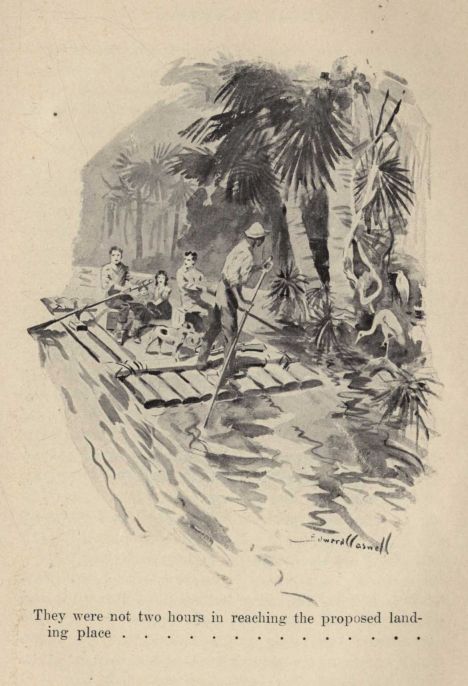
They were not two hours in reaching the proposed landing place
The river was exceedingly crooked, and so densely bordered with mangroves, that from the place they left to that which they sought, it was nowhere possible for them to reach the shore. Once when they approached nearest land, they saw a herd of deer peep inquisitively at them through an opening glade, and turn quietly to feed. The tall heron was a frequent sight, lifting its long blue neck high as their heads, and then flapping its broad wings to escape too near an approach; and the dapper kingfisher turning his big head to look at them; and the "poor jobs," or small white cranes clustering thick upon the dead trees; and the Spanish curlew sticking forward its long curved bill; and the grey curlew with its keen note; and the marsh hens, cackling far and near, to say (such is the report) that the tide is moving; and ducks rising in clouds from different points of the marsh and reaches of the river;--these sights were very frequent, and seen with the bright eyes of young people on a Christmas excursion, imparted a charming vivacity to the scene.
Passing a creek which drained the marsh to their left, they made a discovery, which proved a valuable one indeed. Harold was looking up the creek with that universal scrutiny that had become in him second nature, when he suddenly dropped his oars, exclaiming, "What is that?"
The raft shot so quickly past that no one but Sam had time to look. He, however, replied instantly, "Starn ob a vessel!"
"Stern of a vessel, did you say?" inquired Robert. "'Bout ship, Sam. Come, Harold, let us pull right for it and see."
They brought the raft into an eddy near shore, and though it required a prodigious pull to propel so clumsy a thing against the tide from the creek, they managed to do so, and discovered not the stern of a vessel only, but the whole of a small brig turned bottom upwards, and lying across the creek jammed in the mud and mangroves.
"Well, that is indeed a Christmas gift worth having," said Robert. "Did I say Santa Claus never heard of this island? I take that back; he has not forgotten us."
"He or some One greater," interposed Mary, with seriousness.
They rowed alongside, and tried to enter; but having no tools for penetrating the vessel's side, nor candles for lighting them after they had entered, they concluded to prosecute their voyage, and to delay their visit to the wreck till Monday.
With this intention they pushed out of the creek, and descended to the proposed landing, where they made fast their raft to a crooked root, and stepped upon a firm beach of mixed mud and sand. The fiddlers (a small variety of crabs that look at a little distance like enormous black spiders) were scampering in every direction, with their mouths covered with foam, and their threatening claws raised in self-defence, until each one dived into its little hole, and peeped slyly at the strange intruders. A wild cat sat upon a neighbouring tree, watching their motions with as much composure as if she were a favourite tabby in her mistress' parlour. Frank was the first to spy and point it out. It was within a good rifle shot.
"Stand still a moment, if you wish to see how far a cat can jump," said Harold.
He rested his rifle upon a small tree, and taking steady aim, sent the ball, from a distance of seventy yards, through both sides of the cat, directly behind the shoulders. She leaped an immense distance, and fell dead. Frank seized it, saying it was his cat, and that he intended to take off its skin, and make it into a cap like cousin Harold's.
From the landing they followed the mark left by their hatchet upon the trees in their exploring tour, and it was not long before they recognized from a distance the poplar or tulip tree, in the hollow base of which the bear had made her den.
As yet Mum had given no indications of alarm; but on approaching the tree the boys selected for Mary and Frank a pretty little oak, with horizontal branches, in full sight of the den; and having prepared them a seat made comfortable with moss, and helped them into it, advanced to the field of battle.
To their disappointment the old bear was gone. The sun shone full into the hole, and revealed the two cubs alone, nicely rolled up in the middle of their bed, and soundly asleep. There was some reason to suppose that the mother would return before they left the neighbourhood, and in this expectation Harold prepared to secure the cubs. He placed Robert and Sam as videttes at a little distance, and also charged Mary and Frank to keep a sharp look out from their elevated position, while Mum and Fidelle were set to beating the surrounding bushes as scouts. But, notwithstanding all his care and skill, he found that the work of capturing the cubs was very difficult. The cavity being too large to allow of reaching them with his arms, and afraid to trust himself inside the hole, lest the old bear should arrive and catch him in the act, he relied upon throwing a slip noose over their heads, or upon their feet; but young as they were he found them astonishingly expert in warding off his traps. The only plan by which he at last succeeded, was with a hooked pole, by which he drew forth first one, and then the other, to the mouth of the den, where, after sundry bites and scratches, he seized their hind legs, passed a cord round their necks, and made it secure by a fast knot. This done, he tied each to a tree, where they growled and whined loudly for help. The hunters were now in a momentary expectation of hearing the bushes burst asunder, and seeing the old bear come roaring upon them; but she was too far distant, and had no suspicion of the savage robbery that was going on at her quiet home.
It was fully an hour before the cubs were taken and secured. By that time Mary and Frank had become so weary of their unnatural roosting, that they begged the others to cease their hunt, and return at once to the raft. But here arose a new and unforeseen difficulty. The distance to the raft was considerable, and the way was so tangled that they had made slow progress when they came; what could they now do, encumbered with two disorderly captives, and in constant danger of attack from the fiercest beast of the forest, "a bear robbed of her whelps"? It was easy enough to decide this question, if they would consent to free the captives and return as they came. But no one, except Mary and Frank, entertained this idea for a moment; they would have been ashamed to give up through fear what they had undertaken through choice.
The plan they at last devised was this--which though appearing to assign the post of danger to the youngest, was in fact the safest they could adopt. Mary and Frank led each a cub, but they were instructed to drop the cord on the first appearance of danger, and run to the safest point. Sam marched in the van, Harold brought up the rear; Mary and Frank were in the centre, and while Robert guarded one flank, the dogs were kept as much as possible on the other. It was with much misgiving that this plan was adopted, for the boys began to feel that they had engaged in a foolish scrape, involving a needless exposure of the young people, as well as of themselves. But they were now in for it, and they had no choice, except to go forward or to give up the project in disgrace. Formed in retreating column as described, and ready for instant battle, they turned their faces to the river, and marched with what haste they could.
They had not gone many steps, however, before Harold suddenly faced about, levelled his piece, and called to them to "look out!" He heard a bush move behind him, and supposed, of course, that it was the bear coming in pursuit, but it proved to be only a bent twig righting itself to its natural position.
Not long after Robert raised a similar alarm on his side, and levelled his gun at some unseen object that was moving rapidly through the bushes. Mary and Frank dropped the cords, and Frank clambered up a small tree near at hand. Mary turned very pale, and ran first to Sam, but hearing the noise approach that way, she ran back to Harold for protection. The next moment she saw Sam drop his gun from its aim, and call out,
"You Mum! Come in, sah! You git yo' libber shot out o' you, you scary warment!"
The alarm was occasioned by Mum, who, unperceived by any, had wandered to the wrong side.
The cubs, trained by this time to obey the cord, and either weary with the walk, or submissive to a fate that seemed so gentle, had not stirred from the spot where they were left. Frank slipped quietly from his tree, hoping that nobody had seen him; but Robert caught his eye, and gave a sly wink, to which Frank doggedly replied,
"I don't care, sir. I suspect you would like to have been up a tree too, if you could have got there."
"That I should, Frank," said Robert; "but it seems that you are the only one of the crowd who can find trees in time when bears are about."
They resumed their march to the landing, and were interrupted only once more. The bushes before them rustled loudly, Fidelle rushed forward in pursuit, and the ground shook with the heavy trampling of some large beast. It was on Sam's side; but as he brought his piece to a level, Harold cried, "Deer! deer! don't shoot!" and again all was quiet.
A short walk brought them to the landing; where they wiped their moist brows, and rested, thankful that they had completed their perilous journey without accident. But their dangers were by no means over. The tide was down; the raft was aground; it was not possible to leave for hours; and in the meantime the enraged beast might follow the trace of her cubs, and perhaps assault them where they were. In view of this contingency they tied the young bears at a distance from the shore, but within sight of their own place of repose, confident that if the mother came she would bestow her first care in breaking their bonds, and taking them away, in which case they could attack and destroy her.
With this expectation they sat down to their Christmas dinner, for which they had by this time a pretty keen appetite. Sam stood sentry while they ate; then Robert and Harold by turns took his post, and gave him opportunity to dine. The spice of danger gave great zest to the enjoyment of all except Mary, who would vastly have preferred being at their comparatively secure and quiet home upon the prairie.
The tide finally rose, and floated the raft. They once more embarked. The young bears were secured, so that they could neither escape nor annoy. The fastening was cast off. Harold's oar, which he used as a pole for shoving off, sunk in the yielding sand, and Robert's "Heigh ho for home!" was hardly uttered, when they heard a tramping on the bluff, and a moment after saw the bear standing on the spot they had left. She stared in surprise at the retreating raft, whined affectionately to her cubs, who whined in answer, and tried to break loose; then seeing their efforts to be ineffectual, and the raft to be moving away, she raised such a roar as made every heart tremble, and with a fierce look at the persons on board plunged into the water. The raft was by this time but ten yards from shore, and slowly "backing" into the stream. Harold's rifle was quickly at his shoulder, and in a second more the blood spouted from the mouth and nose of the terrible beast. But the wound was not mortal, piercing below the eyes, and entering the nostrils and throat; and blowing out the blood by successive snorts, she plunged on, and began to swim.
"Now, Robert!" shouted Harold, "be steady! Aim between her eyes!"
Robert fired first one barrel, and then the other; the bear sunk for a moment, borne down by the heavy shot, but she rose again, streaming with gore, and roaring till the waters trembled. Sam's gun was the only remaining chance, and he used it most judiciously. Waiting until the bear was almost ready to place her feet upon the raft, he coolly levelled his gun, and putting the muzzle within a few inches of her ear, poured its contents bodily into her brain. The furious creature had just time to grasp the side of the raft; she gave one convulsive shake, and turned on her side, stone dead.
"It was a desperate fight," said Robert, drawing a long breath.
"And a very foolish one," rejoined Harold. "I have been thinking for the last hour that we might have been better employed."
Robert looked displeased. "Answer for yourself. If it is foolish, you helped to bring it on."
"I know that," replied Harold, with mildness, "and that makes me condemn it the more."
"Then please, sir, not to blame the rest," said Robert, "for I am sure everybody behaved as bravely as people could."
"I have not questioned any one's courage, nor have I quarrelled with any one except myself," replied Harold.
"Yes, sir, you have," persisted Robert, "you called us all a parcel of fools for coming on a Christmas excursion."
"O! no, brother," mediated Mary, "he only said we might have been better employed; and I think father would say so too. I am sure if I had known all before coming, as I know it now, I should not have given my consent."
"Please, mossa," said Sam, looking from one to the other, "'tain't any o' you been de fool. Nobody fool but me. Enty I ax you,[#] please come see my countryman in de hollow tree; and you come? And now, please, mossa, don't let my countryman git away. See he floatin' away to de alligator. Please let me catch 'em. I want him fat to fry my hominy."
[#] Did not I ask you.
Sam looked so whimsical throughout the whole of this eloquent appeal, that Robert's face relaxed from its stern and angry expression, and at the last words he caught Harold's eye, and burst into a laugh.
"Come, Harold," said he, "let us save his fat; I know his mouth waters for it."
The quarrel was over. Indeed it could not properly be called a quarrel, for it was all on one side, and no one can quarrel alone. They caught the floating carcass, tied it behind the raft, then pulling into the current, floated rapidly home, and reached the prairie about the middle of the afternoon.
For the rest of the day their hands were full; and it was not until late at night that they were able to retire. The young bears were first stowed away in the same pen with the goats and deer, but Harold was scarcely able to remove them in time to save their lives; for Nanny, after running from them as far as the limits of the pen allowed, rose upon her hind legs with a desperate baa! and bringing her stony forehead against the head of the nearest, laid it senseless on the ground, and was preparing to serve the other in the same way.
What to do with them Harold did not know. He dared not put them in the poultry house, and he was unwilling either to shelter them in the tent or to tie them outside the palisade. So, until some other arrangement could be devised, he fastened them to a stake inside the enclosure round the tent, where he supplied them with water, honey, and a piece of venison.
The adventure, however, was not quite over. Late in the night Sam was awaked by feeling something move upon his bed, and put its cold nose upon his face. Thinking it was some one walking in his sleep, he called out, "Who dah?" and putting out his hand, felt to his dismay the rough head and shaggy skin of a bear. Sam was a firm believer in ghosts, both human and brute. He gave one groan, and cried out, "O massy!" expecting the next moment to be overpowered, if not torn to pieces; then jumping from bed in the greatest hurry, he hunted tremulously for some weapon of defence, exclaiming all the while,
"Mas Harrol! Mas Robbut! O massy! Here de ole bear, or else he ghost, come after us."
The taper was brought from Mary's room, and disclosed the secret. One of the cubs feeling in the chill, night air the want of its mother's warmth, had loosed the insecure fastening, and come to seek more comfortable quarters in the tent. "It is your countryman's baby, Sam," said Robert, after the excitement had subsided. "You killed its mother, and it has come, poor little orphan, to ask that you shall be its daddy now."
CHAPTER XXXIII
THE CUBS--VOYAGE TO THE WRECK--STORES--HORRID SIGHTS--TRYING PREDICAMENT--PRIZES--RETURN--FRANK NEEDS ANOTHER LECTURE
Early on Monday morning Robert and Harold set out for the wreck, leaving Sam to guard the young people, and to add another apartment to the fold, for the accommodation of the cubs. It may be stated here, that the new pets had eaten little or nothing since they were taken. For several days Sam was compelled to force the food and water into their mouths; but after they had acquired the art of feeding in a domestic way, Frank assumed their whole care, and was indefatigable in attending to their wants and their education. He taught them to stand on their hind feet and beg; to make a bow by scraping their feet, like country clowns; and many a wrestling match did he have with them, in which for a long time he was invariably the victor. Robert named them, after the twins of old, Castor and Pollux.
By Sam's advice, the boys took with them on their voyage an ax, hatchet, auger, and saw, together with some candles and a rope, and reached the wreck about nine o'clock. They moored their raft fast to a projecting bolt, and then, with much difficulty, succeeded in reaching the stern windows, from which the receding tide flowed gently, bearing on its bosom an unpleasant odour, like that of animal matter long decayed. They peeped into the dark cavity, and receiving a full blast of its sepulchral odours, drew back in disgust.
"I cannot go into that hole," said Harold, "it is stifling. Let us cut a passage through the side or bottom."
Clambering along the sloping side next the rudder, they selected a place for their scuttle, and commenced to work, but the thick and well fastened copper was so difficult to remove, that their hatchet was nearly ruined before they reached the wood. Then, with their auger, they made an entrance for the saw, and soon opened a hole between two of the ribs, large enough to admit their bodies.
Harold descended first, and standing upon a hogshead, which, being on the top of a confused pile, reached near the hole, lit a candle, and helped Robert to descend.
They were in the hold where all the grosser articles were stowed. Some of the hogsheads visible appeared to contain sugar, others molasses, rum, &c. Passing towards the stern, they saw half a dozen boxes and crates, of different sizes, one of which was filled with lemons, and from the other, on being broken, rolled out a cocoanut. Returning from this hasty survey towards the forward part of the hold, they discovered a plentiful supply of flour, ship-bread, rice, hams, and beef, stowed away in the style appropriate to each. The vessel was evidently victualled for a long voyage.
Satisfied with this partial examination, they returned amidships, and sought the hatchway, through which they might descend into the habitable part of the vessel. It was choked by such a multitude of boxes and bags, that they were a long time in finding it, and longer still in freeing it from encumbrances. Descending by their rope, they found themselves on the inner side of the inverted deck. The water had by this time all run off, except a puddle in one corner; and the floor, or rather that which had been ceiling, was wet and slimy, with deposits from the muddy river water.
On entering the cabin the sight which greeted them was horrid. There lay four skeletons, of a man and woman, a boy and girl, handsomely dressed; the soiled though costly garments still adhering to the wet and ghastly bones. The sight was more than Harold could endure; he called to Robert, and hastened as fast as possible to the open air.
"O, horrid! horrid!" said he, pale as a sheet. "I don't think I can ever go back to that dreadful cabin. It made me almost faint."
"It was horrid, indeed," responded Robert. "But you will soon recover; the trouble was more in your mind than in your body. I doubt not you are feeling as father says he felt when going first into a dissecting room--he fainted outright; and he said that this is no uncommon thing with beginners, but they soon become used to it."
"I am willing enough to go through the whole vessel," said Harold, "but not into that cabin, for a while at least."
"Poor creatures!" sighed Robert, "they appear to have been passengers; and unless the cabin filled soon with water, they must have had a lingering death."
"Don't speak of it," Harold pleaded. "The bare thought makes me shudder. And then to think of their being devoured by such slimy things as eels and catfish, and of being pinched to pieces by crabs, as these bodies were--it is sickening!"
Robert perceived that these reflections were exceedingly painful to his cousin, and had been in fact the cause of his sickness; he therefore managed adroitly to shift the conversation from point to point, until it gradually assumed a cheerful character. Pleasant thoughts were the medicine Harold needed, and in the course of a few minutes he himself proposed to renew the search.
Descending between decks, they found in the side of the vessel, contrary to custom, the cook's room. It contained a stove, with all its appurtenances complete. This was a real treasure; they rejoiced to think how much labour and trouble would be saved to Mary, whose patience and ingenuity were often put to the test for the want of suitable utensils.
The steward's room adjoined; and here they found crockery of all sorts, though most of it was in fragments; knives, forks, spoons, and candlesticks, none of which they valued, having plenty of their own; two bottles of olives, and a case of anchovies, sound and good, and a fine set of castors, partly broken, containing mustard, pepper, catsup and vinegar. Upon the topmost shelf (or under what had been the lowest) were two large lockers, which they opened with difficulty, the door being fast glued with paste, and out of which poured a deluge of musty flour from an upturned barrel. There were also different kinds of hard biscuit and ship bread, but they were all spoiled.