Front matter (continued 2)
Reading edition
"Remember," said Dr. Gordon, "that in marooning we must wait upon ourselves. William is the only servant I can take. His time will be fully occupied with cooking, and other duties belonging to the tent. We cannot depend on him for anything more than is absolutely necessary. Are you still of the same mind?"
"The same!" they all replied.
"Still I will not hold you to your promises until you have had further time for reflection," said he. "You may not have looked at all the difficulties of the case. I will give you until dinner-time to make up your minds; and to help your thoughts, I will assign to each of you an office, and make you responsible for providing all things necessary for a week's excursion, to begin in the morning.
"Harold, I appoint you master of the hunting and fishing departments.
"Robert shall be sailing-master, and provide for the literature of the party.
"Mary shall be housekeeper still, and mistress of the stores.
"And Master Frank shall be--I know not what to make him, unless supercargo."
"Now I wish you each to sit down at your leisure, and make out a written list, to be presented to me at dinner-time, of all things needed in your several departments."
They responded very heartily, and were about to retire, when Dr. Gordon, observing a comical expression on Frank's face, said, "What is the matter, Frank? Are you not willing to be supercargo?"
"I do not know what supercargo is," answered Frank, "unless it is somebody to catch rabbits. But I know how to do that. So I mean to take my dog and hatchet, and a box of matches."
"Well done, Frank," said his father; "you have the marooning spirit if you do not know what supercargo is. But where did you learn the art of catching rabbits?"
"Oh, I learnt it from cousin Harold," said he. "We got a rabbit into a hollow tree, and caught him there. I caught him, father, with my own hand; I know exactly how to catch a rabbit."
"Very well, Mr. Supercargo, carry what you will. But go along all of you, and be ready with your lists against dinner-time."
They retired in great glee to plan out and prepare. Robert and Harold, having first gone to the beach to think alone, were to be seen, half an hour afterwards, in their room, busily engaged with pencil in hand. At this time Frank came in. He had been almost frantic with joy at the prospect of the change; and after having romped with his dog Fidelle and the goats in the yard, he had come to romp with any one who would join him in the house.
"Brother Robert and cousin Harold," said he, "what are you doing? Are you writing? are you ciphering? are you studying? Why do you not answer me?" He was evidently in a frolic.
"Go to your play, Frank, and do not bother us," returned Robert, impatiently; "we are thinking."
"I know you are; for father said we are thinking all the time we are awake, and sometimes while we are asleep. But I want to know what you are thinking about so hard."
"Don't you know," Harold answered, mildly, "that we are going to Riley's Island tomorrow, and that Robert and I have to make out a list of what we are to carry? We are making our lists."
"Ah ha! but I have to carry some things too," said he. "Father is going to let me catch the rabbits there; and he called me a ----, some kind of a ----; I forget the name, but it means the person to catch rabbits. What is the name, brother?"
"Supercargo?"
"Yes, that's it--supercargo. Mustn't I think of something too?"
"Certainly," replied Harold, humouring the joke. "But the way we did, was first to go off by ourselves, and think of what we were to carry; then to come in and write off our lists. Do you go now and think over yours, and when you come in I will write it for you."
Frank went out, but he was not gone long. He insisted on having his list made out at once.
"What do you wish to carry?" Harold asked. Frank told him.
"Now," said Harold, "I will make a bargain with you. If you do not trouble us before we have finished our work, I will write your list for you so that you yourself can read it. Will you stay out now?"
"That I will. But can you write it so that I can read it?"
"Yes, and will not print it either."
"Well, then you must be a very smart teacher, almost as smart as the foxes; for father has been teaching me this summer to make writing marks, but I have never made one of the writing marks yet."
Harold however persisted in his promise, and he and Frank were as good as their several words. Frank, it is true, did creep on tip-toe, and peep through the crack of the door, but he disturbed nobody; and when at last the boys came out, Harold presented him with a folded paper, which he instructed him to put into his pocket, and not to open till the lists were called for.
At the appointed hour they all assembled. The meal passed pleasantly off; not an allusion had as yet been made to the proposed excursion. It was a part of Dr. Gordon's training to practise his children in self-restraint. He could however discern by their looks that their decisions remained as before. Said he, "I presume you have all made up your minds to the marooning party; am I correct?"
"O yes, sir, yes," was the answer, "and we are all ready to report, not excepting Frank and William."
"Really, you have done wonders! But let me call upon you each in turn. Harold McIntosh, you are hunting and fishing-master. Let me hear your report."
Harold took from his pocket a piece of paper about as broad as his hand, and a little longer. Besides the arms, ammunition and appurtenances, fishing-hooks, lines and nets, he closed his list with reading "brimstone."
"And what use," asked his uncle, "do you expect to make of that?"
"Taking bee-trees," he replied. "Brimstone is used in driving bees from the honey."
"Whether we meet with bee-trees or not, the brimstone will be in nobody's way; let it go. Mr. Hunting-master your list is perfect. Now Robert, yours."
His list embraced all that the boat would need for comfort, or for repair in case of accident. The books selected had reference to the taste of each. Shakespeare for his father, Goldsmith's Natural History for Harold, Scott's Napoleon for himself, Robinson Crusoe and Botany for his sister, and (in a spirit of mischief) Old Mother Hubbard for Frank.
But Frank was quite indignant at what he knew to be an insinuation against his childish taste. "I will not have old Mother Hubbard for my book," he said, as soon as he heard the list read. "I have passed that long ago; I wanted to carry Jack the Giant Killer."
"Scratch out Mother Hubbard," said his father to Robert, "and put down Jack. Your list, Master Robert, is pretty good; but I shall take the liberty of adding several volumes to the stock, in case of bad weather. And beside this, I should advise you all to carry your pocket Testaments, that you may continue your plan of daily reading. I should be sorry, and almost afraid, to let our sports interfere with our devotions."
Up to this time Frank had been listening to what had been read or spoken. But now, on a sign from Harold, he took a paper from his pocket, and, looking at its contents, commenced capering round the room, saying, "I can read it--I can read every word of it!"
"Read what?" asked his father.
"My list," replied Frank, "that cousin Harold wrote for me. I can read it all!"
"Then let us have it."
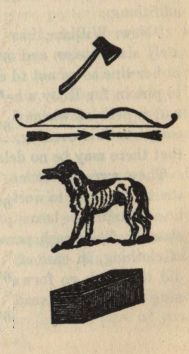
pictures of items on the list
"Here," said he, "is my hatchet."
"And here is my bow and arrows."
"And here is my dog; only it is not half so pretty as Fidelle."
"And down here at the bottom--that is--that is--I believe it is--either a block or a brick-bat. O, now I remember, it is my box of matches."
"Bravo, Frank," said his father, "you do credit to your teacher. I doubt whether I could myself have guessed what that last thing was intended for. Your list may pass also.
"Now, Miss Mary, let us have yours. You have had more to think of than all the others put together, and yet I'll warrant you are nearly as perfect in proportion."
Mary blushed to hear the commendation bestowed upon her on trust, and replied, "I doubt it, father. For though it is very long, I am all the while thinking of something else to be added, and I am pretty sure there is a great deal yet that I have forgotten." She then read her own list, containing about thirty-five articles, and William's, embracing half a dozen more; upon which her father continued to bestow praise for the house-wifery they showed, and to each of which he made some slight additions.
"Now, William," said he, "do you select two moderately sized boxes, and aid Miss Mary to pack everything in her line so as not to crowd the boat. Remember, too, to put in for Riley a half bushel of salt, a loaf of sugar, and a peck of wheat flour. Pack the boat, and have it complete this evening, however late it should take you, that there may be no delay in the morning."
They were no sooner dismissed from table than all went vigorously to work. Guns were cleaned--hooks and lines examined--boxes packed--all things being done by classes. Then each person put up an extra suit or two of clothing, in case of accidents. And so expeditiously did the work go forward, that by five o'clock that evening the boat was ready for her trip.
CHAPTER IX
EMBARKATION--ABDUCTION EXTRAORDINARY--EFFORTS TO ESCAPE--ALTERNATE HOPES AND FEARS--DESPAIR--VESSEL IN THE DISTANCE--RENEWED HOPES AND EFFORTS--WATER-SPOUT--FLASH OF LIGHTNING AND ITS EFFECTS--MAKING FOR SHORE--GRATEFUL ACKNOWLEDGMENTS
Many visions that night danced before the young sleepers--prancing deer with bright eyes and branching horns; turkeys running, flying, fluttering; white tents, mossy beds, and all the wild scenes of woodland life. They were up and dressed at daybreak. The wind was fair, and the day promised to be fine. Frank's little feet were pattering over the whole house and yard, carrying him into everybody's way, on the pretence of rendering assistance. There was one useful suggestion which he made. He had gone to each room and corner in the house, saying "good-bye" to every person and thing, chairs, tables, and all, when at last he came to his father's cloak and umbrella, kept in the same corner.
"Good-bye, umbrella," said he, "but as for you, good Mr. Cloak, father will want you to sleep on. Poor umbrella! are you not sorry? Don't you want to go too? But, father!" he cried, running into the next room, "had we not better carry the umbrella? Maybe we shall need it."
"That is a good idea, Master Frank," said his father. "Do you take charge of the umbrella, as a part of your office, and see it put into the boat."
Frank ran back to the room he had left, and taking the umbrella from its corner, he said, "O ho, my little fellow, father says you may go. Are you not glad I asked for you? But you must be a good boy, and not put yourself in anybody's way. Come now, spread your wings, and let me see how glad you look."
He opened the umbrella, and flapped it several times to make it look lively, then closed it, and set it beside the cloak where it belonged. Presently he heard the tinkle of a little silver bell, and knew that it was the signal for family prayers. He went to the breakfast-room, and took his seat.
Dr. Gordon's children were well versed in the Scriptures, and were remarkably attentive during the reading of them. Perhaps one secret of this fact was to be found in their father's practice of stopping every few verses during the family reading to ask them questions on what had been read, and briefly to explain what they could not otherwise comprehend. This morning the children observed that the chapter read was remarkably appropriate to their circumstances, and that the Doctor prayed particularly that the Lord would preserve them from all sin and harm during their excursion; that he would preside over their pleasures, and that he would make their temporary absence the means of their knowing him better, and loving him more.
They breakfasted as the sun was rising. While at table no one could speak of anything but the voyage and the island, and what they expected to see, do, and enjoy. The boat was at the wharf, which had been erected for the brig. It was packed, and ready for departure, with the exception of a few things to be carried by hand. William had breakfasted at the same time with the family, and now came in, saying, "All ready, sir."
"Come, children," said Dr. Gordon, "let us go."
"Come, umbrella," said Frank, "you are to go with me."
"O, father," exclaimed Mary, as they approached the shore, "there is Nanny with her sweet little kids. See how anxiously she looks at the boat, and tries to say, 'Do let me go too.' Had we not better take her? She is so tame; and then you are so fond of milk in your coffee."
"I doubt," he replied, "whether there will be room for dogs, goats, and ourselves too. But we can easily determine; and as I know that all of you are as fond of milk as I am, I will let her go if there is room."
They took their places, Dr. Gordon at the helm, Robert and Harold amidships, Mary and Frank next to their father, and William in the bow. Everything had been stowed so snugly away, and the boat was withal so roomy, that Nanny and her kids were invited to a place.
"Now, children, for order's sake," said Dr. Gordon, "I will assign the bow of the boat, where William is, to Nanny and her kids; Fidelle must lie here by Frank and Mum may go with Harold. Mary, call your pet, and have her in her place."
A word about the dogs. Fidelle was a beautiful and high-blooded spaniel, that might have been taught anything which a dog could learn, but whose only accomplishments as yet were of a very simple character, and confined chiefly to such tricks as were a source of amusement to her little master. Mum was a large, ugly, rough-looking cur, whose value would never have been suspected from his appearance. He was brave, faithful, and sagacious; strong, swift-footed, and obedient. But his chief value consisted in his education. He came from the pine barrens of Georgia, where Dr. Gordon had first seen and purchased him, and where he had been trained, according to the custom of the wild woodsmen there, to hunt silently; and in following the trail of a deer or turkey to keep just in advance of his master, and to give suitable indications of being near the object of pursuit. Mum was no common dog; and he proved of inestimable service to the young adventurers in their coming difficulties.
"Draw in the anchor, William, while I cast off at the stern," said Dr. Gordon. "But hold! let us see what that means." He pointed with his finger to a horseman, who turned a point on the beach, and seeing them about to depart, waved his hat to say "stop!" The horseman rode at full speed, and soon was within speaking distance. He bore a note from the surgeon at Fort Brooke, requesting the loan of a certain instrument which Dr. Gordon had promised when on his visit, and for which there was now a sudden call.
"Keep your places, children," said the Doctor. "I shall be gone only five minutes. William, do you take my place, and keep the boat steady by holding to this frame."
He ascended the wharf, went with the soldier to the house, and was absent a very few minutes; but during that interval an event occurred which separated them for a long, long time and made them oftentimes fear that they should never more meet in this world.
The position of the boat at the wharf was peculiar. Her stern had been lashed to the timbers, for the purpose of keeping it steady, until all had entered; and the bow was kept to its place by the anchor dropped into the two and half fathoms water, which "was had" there at high tide. The fastening to the stern having been cast off, preparatory to leaving, William was now holding to the wharf, awaiting his master's return.
This was not long after sunrise, at which moment they had heard the report of a cannon unusually loud from the fort. Scarcely had Dr. Gordon disappeared from the bluff, when the young people noticed a heavy ripple of the water, between them and the fort, indicating that it was disturbed by a multitude of very large fish, moving with rapidity towards the sea.
"What can they be?" was a question which all asked, with a curiosity not unmixed with fear, as they looked upon the approaching waves. William held firmly to the pier head, that the boat should not be moved too roughly by the disturbed water.
"Mas' Robert," said he, with anxious, dilating eyes, "I do believe it is a school of dem debbil-fish. Yes," and his eyes grew wild and his lips became ashy, "dey making right for dis pint."[#]
[#] The following is a description of the hideous monster known in our waters as the Devil Fish.
It is a flat fish, belonging to the family of Rays, and usually measures somewhere between ten and twenty feet from tip to tip of its wings. On each side of its mouth is a flexible arm, with which the animal grasps and feeds. It appears to be as remarkable for its stupidity as it is for its size, strength, and ugliness, seldom letting go anything which it once seizes with its arms. A few years since, one was discovered dead upon a mud flat near St. Mary's, Georgia, grasping even in death a strong stake of which it had taken hold during high water. The incident related in the following pages is in perfect keeping with the habits of the fish. There are hundreds of persons now living, who recollect a similar adventure which took place in the bay of Charleston. On every occasion of serious alarm the fish makes for the deep water of the ocean, and sometimes so frantically as to run high and dry ashore.
Whoever wishes to read more on this subject, can do so by referring to a volume called "Carolina Sports," in which the author (Hon. William Elliott), sketches with lively and graphic pen some most adventurous scenes, in which he himself was principal actor.
The children sprang to their feet, and made a rush to the stern, in the effort to get out of the boat, but William put his hand against them, and exclaimed piteously, "Back! Mas' Robert--Mas' Harrol! All of you! You habn't time to git out! Here dey come! Down on your seats! For massy's sake, down! ebery body!"
They were about to obey, when there was a whirl, and then a jerk of the boat, that threw them flat on their faces. They heard William's voice crying hoarsely, "O Lord hab----;" and when they arose and looked around, they saw that he was missing, and that their boat was rushing onward with a swiftness that made the water boil.
"William! William!" Robert called in bewilderment; but no answer came, and they saw him no more.
"O mercy! Brother Robert! cousin Harold!" cried Mary, "what is the matter?"
Robert looked vacantly towards the receding shore. Harold answered, "One of these fish has tripped our anchor, and is carrying us out to sea."
The horrid truth was evident; and it sent a chill like death through their limbs and veins. Mary screamed and fell back senseless. Robert started up as though about to spring from the boat. Harold covered his face with his hands, gave one groan, then with compressed lips and expanded nostrils hastened to the bow of the boat. As for poor little Frank, it was not for some moments that he could realize the state of the case; but when he did, his exhibition of distress was affecting. He stretched his hands towards home; and as he saw his father running to the bluff, he called out, "O, father, help us--dear father! O send a boat after us! O----!" Perceiving his father fall upon his knees and clasp his hands in prayer, he cried out, "O, yes, father, pray to God to help us, and he will do it--God can help us!" Then falling upon his own knees, he began, "O God bless my father and mother, my brothers and sisters! O God help us!"
By this time the boat had passed fully half a mile from shore. Harold's movement forward had been made with the intention of doing something, he knew not what, to relieve the boat from the deadly grasp of the devil fish. He first seized his rifle, and standing upon the forward platform, aimed it at the back of the monster, which could be distinctly seen at two fathoms' distance, clutching the chain which constituted their cable. Despairing of reaching him with a ball through the intervening water, he laid aside the rifle, and seizing William's ax, aimed several lusty blows at the cable chain. He struck it just on the edge of the boat where there was the greatest prospect of breaking it; but the chain was composed of links unusually short and strong, and the blows of the ax served only to sink it into the soft wood of the boat.
"Robert," said he, "look for Frank's hatchet, and come here." But Robert, stupefied with fear, sat staring at him from beside his prostrate sister and weeping brother, and seemed neither to understand nor to hear.
"Robert," he repeated, "get up, and be a man. Bring Frank's hatchet, and help me break this chain."
Still he did not come. "It is no use, Harold," he replied. "Do you not see that sister is dead? William is dead too! We shall all die!"
"Robert! Robert!" he reiterated, almost with a threat, "do rouse up and be a man. Mary is not dead, she has only fainted; she will come to directly. Come here and help me."
As he said, "She has only fainted," Robert sprang from his seat, took off his cap, dipped it full of water, poured it on her face, rubbed her palms and wrists to start the blood into circulation, then blew in her face, and fanned her with his wet cap. In the course of a minute Mary began to breathe, and then to sigh.
"Thank God!" he exclaimed, "she has only fainted! she is coming to! Frank, do you fan her now and I will help Harold."
But Harold had helped himself. Going to Frank's parcel, he had taken out the hatchet, and returned to the bows, where he was now adjusting the ax, preparatory to his work. "There, Robert," on his coming up, "do you hold the ax firmly under the chain, while I strike this link with the hatchet."
He did so, and Harold struck a blow upon the chain, so heavy that it rang again. Instantly they staggered, said fell backwards in the boat. The sharp sound of the hatchet upon the links had been conveyed along the metal to the fish, and made it dart forward with a sudden jerk. Harold rose, and looked on a moment. "We can't help his being frightened, Robert. We must break the chain. Let us try again."
He struck blow after blow, though the fish seemed to be affected by each as by an electric shock. Robert held back his arm. "Stop! stop! Harold, we are sinking!"
It was even so. The fish, frightened by the sharp repeated sounds, had gone down so far as to sink the bow of the boat within a few inches of the water. But Harold was not to be stopped. With an almost frantic laugh, he looked fiercely at the slimy monster beneath, then at his pale companions, and raised his arm for another blow. "Robert," said he, "it must be so. We must break the chain or die." He struck again, again, and again, until the water began to ripple over the bow, and splash upon his hand. He stopped, and tears came into his eyes.
"Look, Harold, at the staple," said Robert. "Let us see if that cannot be started." They tried it, striking from side to side, but in vain. The boat was too well made; the staple was too large, and too firmly imbedded in the timbers to be disturbed; and, moreover, it was guarded by an iron plate all around. Harold decided it was easier to break the chain. "Is there not a file, nor even a chisel among the tools?" he asked. They rummaged among the several boxes and parcels, but no tools of the kind could be found; and then they sat down pale, panting, and dispirited.
By this time the boat had passed out of the bay. The persons on shore, the houses, indeed the very trees which marked the place of their abode, had faded successively from sight. They had been running through the water at a fearful rate, for an hour and a half, and were now in the broad open gulf, moving as madly as before. The frightened fish, alarmed at these repeated noises in the boat, and grasping still more convulsively the chain which was to it an object of terror, had outstripped its hideous companions, and after passing from the bay had turned towards the south.
"There is Riley's Island!" said Robert, pointing sadly to a grove of tall palmettoes, which they were passing. "And yonder is a boat, near shore, with a man in it. O, if Riley could see us, and come after us! And yet what if he did! No boat can be moved by wind or paddle as we are moving." After a few minutes he resumed: "There is one plan yet which we have not tried; it is to saw the chain in two with pieces of crockery. I have read of marble being cut with sand, and of diamonds being cut with horse hair. And I think that if we work long enough we can cut the chain in two with a broken plate. Shall we try it?"
"O, yes, try anything," Harold replied, "But," looking at the flapping wings and horrible figure of the fish, and grinding his teeth, "if he would come near enough to the surface, I should try a rifle ball in his head."
They broke one of the plates, and commenced to saw. Harold worked for half an hour, then gave it to Robert, who laboured faithfully. Had they been able to keep the link perfectly firm, and also to work all the time precisely on one spot, they might possibly have succeeded. But after two hours' hard work, the only result was that they had brightened one of the links by rubbing off the rust and a little of the metal.
"O, this will never, never do!" exclaimed Harold. "It will take us till midnight to saw through this chain, and then we shall be upon the broad sea, without any hope of returning home. Robert, I am done! My hands are blistered! My limbs are sore! I have done what I could! And now the Lord have mercy upon us!"
Up to that moment Harold had been the life and soul of the exertions made. His courage and energy had inspired the rest with confidence. But now that his strong spirit gave way, and he sunk upon his seat, and burst into tears, it seemed that all hope was gone. Robert threw down his piece of plate, and went to seat himself by Mary, in the hinder part of the boat. Frank had long since cried himself to sleep, and there he lay sobbing in his slumbers, with his head in Mary's lap. Mary was still pale from suffering and anxiety; having recovered by means of the water and fanning, she had summoned her fortitude and tried to comfort Frank with the hope that Harold and Robert would succeed in breaking the chain, and then that they would spread their beautiful sail, and return home. When Robert took his seat, Frank awakened, and asked for water.
"Sister Mary," said he, "where is father? I thought he was here."
"No, buddy," she replied, her eyes filling to think that he had awakened to so sad a reality, "father is at home."
"O, sister," said he, "I dreamed that father was with us, that he prayed to God to help us, and God made the fish let go, and we all went home. Brother Robert, have you broken that chain?"
This last appeal was too much for Robert's fortitude, tried already by repeated disappointments. He covered his face with his cap, and his whole body shook with emotion.
"Brother Robert," said Mary, speaking through her own tears, "you ought not to give up so. The fish is obliged to let go some time or other, and then may be some ship will pass by, and take us up. Remember how long people have floated upon broken pieces of a wreck, even without anything to eat, while we have plenty to eat for a month. Brother Robert and cousin Harold, do try to be comforted."
She obtained the water for Frank, and gave him something to eat. "Brother," she added, "you and cousin Harold have worked hard, and eaten nothing. Will you not take something? There are some nice cakes." Both declined. "Well, here is some water. I know you must be thirsty."
Harold was so much surprised to see a girl of Mary's age and gentle spirit exercising more self-control than himself, that he was shamed out of his despair. He did not then know that trait in the female character, which fits her to comfort when the stronger spirit has been overwhelmed. He drank a mouthful of the water. She handed it also to Robert, but he pushed it way, saying, "No, sister, I do not want anything now. We have done all that we could, and yet--."
"No, brother," she replied, "not at all. There is one thing more that you have not even tried to do; and that may help us more than anything else. It is to pray to God to help us."
"O, yes, brother," Frank added, "don't you recollect what father read to us out of the Bible, and talked to us about? What is it, sister?"
"When my father and my mother forsake me, then the Lord will take me up," Mary recited.
"Yes, brother," he continued, "remember that father prayed for us, when he saw us going off. And sister and I have been praying here, while you and cousin Harold were working yonder. Brother Robert, God will take care of us, if we pray to him."
"What Frank says is true, brother," said Mary. "He and I have been praying most of the time that you were working. And now see the difference! when you two have given up everything, he and I are quiet and hoping. Brother Robert, we all ought to pray."
"I do pray--I have prayed," replied Robert.
"That may be," persisted Mary, "but what I mean is, that we all ought to pray together."
"I cannot pray aloud," Robert answered; "I never did it. I do not know how to do it. But we can all kneel down together, and pray silently that God will have mercy on us. Harold, will you join us in kneeling down?"
As they were rising for this purpose, Frank called out, "Brother, what is that yonder? Isn't it a boat coming to meet us?"
Their eyes turned in the direction of Frank's finger and it was plain that a sail had heaved into the offing far away to the south, and almost in their course. The sun shone upon the snow-white canvas. "God be praised!" exclaimed Robert; "that is a vessel! Who knows but we may yet meet her, and be saved! Let us kneel down, and pray God to be merciful to us." They did so; and when they rose from their knees the vessel was evidently nearer.
"Let us try her with the spy glass," said Robert, and drawing it out to its proper length, he gazed steadily at her for a minute. "That is a schooner, or rather an hemaphrodite brig. I can see her sails and masts. She is rigged like a revenue cutter, and seems also to have the rake of one. She is coming this way, and if she is a cutter, she is almost certainly bound for Tampa, and can take us home again."
How rapidly characters appear to shift with shifting circumstances! Mary and Frank, who but a minute before were the only ones calm and disposed to speak in tones of energy and hope, now began to weep and lose all self-control; while Robert and Harold, shaking off their despondency, sprang to their feet, and with bright eyes and ready limbs, prepared once more for effort. Harold seized the glass, and looked long and steadily. "She is coming to us, or we are going to her very fast," said he. "Perhaps both; and now what shall we do?"
"Rig up a signal, and load the guns," replied Robert. "Let us attract their attention as soon as possible. Quick, sister, get me a sheet!"
In the course of fifteen minutes they had the sheet rigged and floating; and by the time the guns were loaded, they could clearly discern not only the hull, but the port holes of the vessel, and her long raking masts. There was no further doubt that she was a revenue cutter bound for the bay. Still it became every moment more certain that without some change in the course of one or the other, they must pass at a considerable distance. Now what should they do? The sky, which had been gradually clouding over since they saw the vessel, began to be rapidly and heavily overcast as they approached. Fearful that rain might fall, and utterly obscure their signal before it was seen, the boys resolved to fire their guns, ere there was any reasonable hope that they could be heard. At the first discharge the fish, which had probably been frightened in the morning by the cannon at the fort, jerked so terribly as almost to unseat them. At the discharge of the remaining guns it seemed less and less alarmed, until finally it ceased darting altogether; its strength was failing. Soon afterwards they saw the smoke of two cannon from the vessel, and then a flag run up the mast. "They see us! They see us!" cried Robert and Mary.
"But can they help us?" asked Harold. "Here we are running between them and shore, faster than any vessel can sail except in a storm, and there is scarcely wind enough to fill their sails, and what there is is against their coming to our aid. Robert, we must break that chain, or yet all is lost."
There was apparently some bustle on board the cutter. Many persons could be distinguished by the glass looking at them and at the clouds. They were preparing to lower a boat, yet with manifest hesitation. This was immediately explained by the singular appearance of the cloud between the boat and the vessel. It had become exceedingly dark and angry. A portion in the middle assumed the shape of a trumpet, and descended with the sharp point toward the water; while a broad column ascended from the sea to meet it; and then sea and sky roared and tossed in terrible unison.
"It is a water-spout!" said Robert, "if it strikes the vessel she is gone. Look there, Harold, look!"
The cutter began to give sensible evidence of the whirling eddy. Her sails flapped and her masts reeled. Soon they heard boom! boom! the roar of two more cannon. They were for the purpose of breaking the threatening column. They saw the descending pillar gradually ascend, and spread itself into a dark mass of cloud, which poured out such a shower of rain as entirely to hide the vessel from sight. Afterwards they heard another cannon. "That is for us," Robert said; "let us answer it as well as we can."
They fired gun after gun, and heard cannon after cannon in reply, but each fainter than before. Their last hope of being saved by the vessel was gone. She was far away, and hidden by the rain which enveloped her. There had been no rain upon themselves, but it was very dark overhead, and threatened both rain and wind. They were far enough from home--how far they could not conceive, and far too from the barely visible shore, upon the broad wild sea. The boys were relapsing rapidly into that moody despair which is so natural after strong yet fruitless exertion, when a sharp flash of lightning struck in the water about one hundred yards before them. So near was it, and so severe, that they were almost blinded by the blaze, and stunned by the report. Their boat instantly relaxed its speed, and was soon motionless upon the water. The boys rushed to the bow. Their cable hung perpendicularly down, and the fish was nowhere to be seen. It had darted back from the lightning flash, and the cable had slipped quietly from its grasp.
"Thank God we are loose!" burst triumphantly from Robert. Harold looked on with strong emotion. Once more tears gathered in his eyes. "Robert," said he, "I never did make pretension to being a Christian, or a praying person, but if we do not thank God all of us for this when we get ashore, we do not deserve to live."
"Amen!" said Robert; and Mary and Frank responded, "Amen!"
The shore was full seven miles away. It was probably wild and barren. It might be difficult of approach, and inhospitable after they should land. But gladly did they draw aboard their anchor, raise their sail, and make toward it. The sea was smooth, but there was wind enough to fill their sails, and give promise of their reaching the shore ere night. Robert took the helm, and Harold managed the sails. Mary once more brought out her cakes and other eatables. Frank laughed from very pleasure; and seldom, if ever, was a happier looking company to be seen, going to a strange and perhaps a hostile coast.
Far as the eye could reach, to the north and south, there was a bluff of white sand, varied here and there by a hillock, higher than the rest, which the winds had blown up from the beach. Before them was an inlet of some sort--whether a small bay, the mouth of a river, or an arm of the sea, they could not determine; it was fringed on the south with a richly coloured forest, and on the north by a growth of rank and nauseous mangroves. Into this inlet they steered, anxious only for a safe anchorage during the night. A little before sunset they reached a pleasant landing-place, on the southern shore, near the forest; and having been confined all day to the boat, they were glad enough to relieve themselves from their wearisome inaction, by a few minutes' exercise on land. Harold first ascended the bluff, and looked in every direction to see if there was any sign of inhabitants. No house or smoke was visible; nothing but an apparently untouched forest to the left, and a sandy, sterile country to the right.
"Cousins," said he, "I think we may with safety sleep on the beach tonight. With our dogs to guard, nothing can approach without our knowledge. I am almost afraid to anchor in the stream, lest we should be carried off by another devil-fish."
To this proposal they agreed. The tent was handily contrived, requiring only a few minutes for its erection; and while Mary and Frank drove down the tent-pins, Harold and Robert brought into it the cloaks and blankets for sleeping, together with their guns, and other necessaries for comfort and safety.
As the darkness closed around them, its gloom was relieved by the ruddy blaze of a fire, which Robert and Harold had made with dried branches from a fallen oak, and kindled by Frank's matches Mary soon had some tea prepared, which they found delightfully refreshing. Immediately after it, Harold, whose countenance ever since their escape from the fish had assumed a peculiarly thoughtful expression, remarked:
"I have no doubt we all remember what we said in the boat about being thankful; and I have no doubt that from the bottom of our hearts we do thank God for our deliverance; but I think we ought to say so aloud together, and in our prayers, before we go to sleep this night."
No one answered, and he proceeded: "Robert, if you can speak for us, please say in our name what you know we ought to say."
There being still no reply, except a shake of Robert's head, Harold continued:
"Then we can at least kneel down together, and I will say, 'Thanks to the Lord for his mercies, and may we never forget them;' after which we can unite in the Lord's Prayer."
They knelt down. Harold did not confine himself to the words just recorded; he was much more full, and became more at ease with every word he uttered; and when the others united with him in repeating aloud the Lord's Prayer, as they had been accustomed to unite with their father in family worship, it was with an earnestness that they never felt before, and that was perceptible in every word and tone. That wild coast was probably for the first time hallowed with the voice of Christian prayer.
They made the boat secure by drawing the anchor well upon the beach. They spread their cloaks and blankets upon the dry sand, and lay down to rest. Their dogs kept watch at the door of their tent; and they slept soundly, and without the least disturbance, during the whole of this their first night of exile.
CHAPTER X
WAKING UP--GOOD RESOLUTIONS--ALARM--MAROONING BREAKFAST--SEARCH FOR WATER--UNEXPECTED GAIN--OYSTER BANK--FATE OF A RACCOON--THE PLUME AND FAN
Shortly after day-light Mary was awaked by feeling Frank put his arm round her neck. She opened her eyes, and seeing the white canvas overhead, started in surprise; then the fearful history of the preceding day rushed into her mind, and her heart beat fast at the recollection. She put her arm softly round Frank's neck, drew him near to her, and kissed him.
"Sister Mary," said he, awaking, "is this you? I thought it was father. Why, sister--what house is this! O, I remember, it is our tent."
Frank drew a long breath, nestled close to his sister, and laid his head on her bosom. He seemed to be thinking painfully. After a minute or two he sprang to his feet, and began to dress. Peeping through the curtain that divided the two sleeping apartments, he said, "Brother and cousin Harold are sleeping yet, shall I wake them?"
"No, no," she replied. "They must be very weary after all their hard work and trouble. Let us just say our own prayers, and go out softly to look at the boat."
The first thing which greeted their eyes, on coming to the open air, was Nanny with her kids. The tide had gone down during the night, leaving the boat aground, and the hungry goat had taken that opportunity to jump out, with her little ones, and eat some fresh grass and leaves.
Mary's mind, as housekeeper, turned towards breakfast. She and Frank renewed the fire, the crackling and roar of which soon roused the others, who joined them, and then went to the boat to see that all was safe.
No change had occurred, other than has been noticed, except that the fulness of the dogs proved that they had fed heartily upon something during the night; and of course that they had proved unfaithful sentinels. The sight of the boat made them sad. It told of their distance from home, and of the dangers through which they had passed. For some minutes no one broke the silence; yet each knew instinctively the other's thoughts. Frank finally came near to Robert, and looking timidly into his face, said, "Brother, do you not think that father will send somebody after us?"
"Yes, indeed; if he only knew where to send," Robert replied in a soothing tone; "and more than that, I think he would come himself."
"I think he will send," said Frank; "for I remember that after he knelt down by the landing and prayed for us, he turned to the man on horse-back, and pointed to us; and then the man went back where he came from as hard as he could gallop."
"Well, buddy," returned Robert, "if father does not come after us, nor send for us, there is one thing we can do--try to get back to him. So there now"--he stooped down, and kissed him affectionately. Then he and Harold walked together on the beach.
During the whole morning, as on the preceding evening, Harold had been unusually grave and thoughtful. "Robert," he remarked, when they were beyond the hearing of the others, "I have been trying ever since we rose to think what we ought to do today; but my mind cannot fix on anything, except what we said yesterday about being thankful, and trying to do better. There is no telling how long it will be before we see Bellevue again, or what dangers we must meet. One thing, however, seems certain, that we ought to try and act like good Christian people; and that part of our duty is to have some kind of worship here, as we have been used to having at your father's."
Robert assented, but asked, "How can we do it? I am not accustomed to conduct these things, nor are you."
"We can at least do this," replied Harold, whose mind was so deeply impressed with a sense of his obligations, that he was neither afraid nor ashamed of doing his duty. "We can read a chapter, verse about, morning and evening, and repeat the Lord's prayer together."
This was so easy, so natural, and so proper, that it was without hesitation agreed to. Mary and Frank were informed of it, and it was immediately put into practice. They gathered round the fire; and as the murmur of their prayer ascended from that solitary beach, the consciousness that this was their own act of worship, without the intervention of a minister, who is the priest of the sanctuary, or of a parent, who is the priest of the household, imparted a deep solemnity to their tones and feelings.
Scarcely had they risen from their knees, before Nanny and her kids were seen to run bleating down the bluff, while Mum and Fidelle, having rapidly ascended at the first alarm, gave signs of more than usual excitement. The boys hurried up the sandy steep, gun in hand, and looked in every direction. Nothing was to be seen, but Fidelle's tail was dropped with fear, and Mum's back was bristling with rage.
"What can be the matter with the dogs?" asked Robert.
"I do not know," Harold replied. "But we can soon find out. Here, Mum, hie on!"
He gave the sign of pursuit, and the two dogs ran together, and began barking furiously at something in an immense mossy live oak near at hand. The boys stood under the tree, and scrutinized every branch and mossy tuft, without discovering anything except a coal black squirrel, that lay flat upon a forked limb. "You foolish beasts!" exclaimed Harold, "did you never see a black squirrel before, that you should be so badly frightened at the sight of one?" then levelling his rifle at its head, he brought it down. It was very fat, having fed upon the sweet acorns of the live oak, and appeared also to be young and tender. Harold took it back to the tent, as an addition to their dinner, remarking, "It is the sweetest meat of the woods." All admired its glossy black skin, and Frank begged for the rich bushy tail, that he might wear it as a plume. This little diversion, though trifling in itself, exerted a very cheering effect upon the elastic spirits of the young people, and made them for a time forget their solitude and comparative helplessness. Had they known the country as well then as they had occasion to know it afterwards, they would not have felt so quiet, or have been so easily satisfied, when they saw the signs of alarm in their brutes.
When they sat down to their simple breakfast, it made Frank laugh to see how awkward everything appeared. There was no table, and of course there were no chairs. All sat on their heels, except Mary, who being the lady was dignified with a seat upon a log, covered with a folded cloak. It was a regular marooning breakfast.
"I think that our first business this morning is to look for water," remarked Harold, while they were sitting together. "The goat seems to be very thirsty, and, as our jug is half empty, it will not be long before we shall be thirsty too. But how shall we manage our company? Shall Mary and Frank continue at the tent, or shall we all go together?"
"O together, by all means," said Mary, speaking quickly. "I do not like the way those dogs looked before breakfast; they frightened me. There may not be anything here to hurt us, but if there should be, what could Frank and I do to help ourselves?"
"Then together let us go," Robert decided. "And Frank, as you have nothing else to do, we will make you dipper master."
They ascended the bluff, and looked in every direction, to ascertain if possible where they might obtain what they wished; but nowhere could they discern the first sign or promise of water. Far to the south as the eye could reach, the country looked dry and sandy. Eastward extended the river, or arm of the sea, but it appeared to have no current, other than the daily tides, and its shore gave no indication of being indented by rivulets, or even by the rains.
"It will put us to great inconvenience if we are not able to obtain fresh water," remarked Harold. "We shall be compelled to move our quarters without delay, for our supply cannot last long. However, there is no such thing as not trying. Which way shall we move?"
"Towards the sea," replied Robert. "There is one fact about a sandy coast, that perhaps you have had no occasion to know--that oftentimes our best water is found on the open beach, just about high-water mark. I have heard father explain this fact by saying that rain water is lighter than that which is salt; and that the rain probably filters through the sandy soil of the coast, and finds its vent just above the ordinary surface of the sea. I think, therefore, our best chance for finding fresh water is on the seashore, in the sand."
They had not proceeded far along the bluff before they heard a loud rushing in the air, and looking up they saw what Mary and Frank supposed to be a gang of enormously large buzzards, flying rapidly towards the forest, and passing very near them. "What can they be!" inquired Robert, in momentary doubt. "Really, Harold, they are turkeys! wild turkeys!"
But as he uttered the words "wild turkeys," bang! went Harold's rifle, and down fluttered a gobler, with his wing broken. "Here, Mum!" he shouted; but Mum knew his business too well to need exhortation, for by the time the bird had scrambled to its legs Mum had seized and held it, until Harold put an end to its struggles by cutting off its head.
"Here now is a fine dinner," said he, lifting it, "only feel how heavy; he is rolling fat."
"Yes, indeed," replied Robert; "and that was a quick shot of yours, Mr. Harold--with a rifle too. I wonder I did not think sooner of shooting; but in truth I was in doubt what they were, and also astonished at their number."
"What a lovely fan his tail will make!" exclaimed Mary, examining the rich stripes of black and brown that marked the end of the feathers. "We must be sure to carry it home for--," she was going to say "mother when she comes," but the thought of their forlorn condition came over her, and she added softly--"if we ever get there."
"Let us leave the turkey, hanging in this tree to bleed, until we return," said Harold; "we must look for water now."
They returned to the beach, and walked along the smooth hard sands. The tide, or rather "half tide" (as it is called on that coast), having an ebb and flow, each of three hours, was nearly down, and they had a full opportunity for the proposed search.
"There is water somewhere here about, you may be sure," said Harold, pointing to tracks of the dogs, made during the night, and partly obliterated by the tide. "Our dogs passed here last night before high water, and they look as if they had had plenty both to eat and to drink."
A quarter of a mile's walk brought them to a place, when Robert called out, "Here is the water! and here are our dogs' tracks, all about and in it. Get out you Mum!--begone Fidelle!" he added, as the dogs trotted up, intending to drink again. The water was good, and in great abundance. They quenched their thirst, and were preparing to return for the bucket to carry home a supply, when Harold suggested to pursue the tracks of the dogs a little further, and learn what they had obtained to eat. "I perceive not far off," said he, "what appears to be an oyster bank, but do dogs eat oysters?"
They proceeded to the spot, and found a large bank of uncommonly fine oysters. It was an easy task for those who knew how to manage it, to break the mouth of one with another and to cut the binding muscle with a pocket-knife. Harold shrunk aghast at the idea of eating an oyster alive; but Robert's example was contagious, and the assurance that this primitive mode of eating them was the most delicious, sufficed to make every one adopt it. Engaged in selecting some of the finest specimens to carry back, the others heard Frank call out, in one of his peculiarly merry exclamations:
"Ohdy! dody! Look here! There is a big, black cat's foot in this oyster's mouth. I wonder if the cat bit off his own foot!"
They hurried to the spot, Mary and Harold laughing at the odd fancy, as they esteemed it, of a cat biting off its own foot, and saw, not a cat's foot indeed, but that of a raccoon, firmly fastened in the oyster's mouth.
"What does this mean?" Harold inquired, with wonder.
"Why, Harold," replied Robert, "did you never hear of a raccoon being caught by an oyster?"
"Never," he answered; "but are you in earnest?"
"Certainly, in earnest as to there being such a report," he replied, "and this I suppose is proof of its truth. It is said that the raccoon is very fond of oysters, and that when they open their mouths, at a certain time of tide, to feed upon the scum of the water, it slips its paw suddenly between the shells, and snatches out the oyster before it has time to close. Sometimes, however, the raccoon is not quick enough, and is consequently caught by the closing shells. Such was probably the case with this fellow; he came to the bank last night to make a meal of the oysters, but was held fast until our dogs came up and made a meal of him."
"But I doubt," said Harold, "whether dogs ever eat raccoons. They will hunt and worry them as they do cats and other animals, which they never eat, at least never except in extremity."
"Then I suppose," added Robert, "we must account for this by another story which is told, that a raccoon, when driven to the necessity, will actually gnaw off its own foot."
"Really," said Harold, "this is a curiosity. I must take this oyster to the tent, and examine it more at my leisure."
The young people gathered as many oysters as they could carry in their hands, and reaching the tent about ten o'clock, began preparing them, together with their game, for the table. Robert cut off the squirrel's tail for Frank; and having drawn out the bone, without breaking the skin, inserted a tough, slender stick, so that when it was properly dried, Frank might use it as a plume. The preparation of the turkey's tail was undertaken by Harold. He cut off the tail-bone, with the feathers attached, and having removed every particle of flesh and cartilage not necessary for keeping the feathers together, he stretched it like a fan, and spread it in the ran to dry.
CHAPTER XI
DISCUSSION OF PLANS--DOUBTS--DIFFERENCES OF OPINION--WHAT WAS AGREED UPON--BAKING A TURKEY WITHOUT AN OVEN--FLYING SIGNAL
"Really this is a fine country!" said Robert, referring, with the air of a feasted epicure, to the abundant marooning dinner from which he had risen. "Wild turkey, squirrel, and oysters! I doubt whether our old friend Robinson Crusoe himself fared better than we."
"It is a fine place indeed," Harold replied; "and so long as our powder and shot last, we might live like princes. But, Robert," he continued, "it is time that we begin to determine our plan of operations. What shall we do?"
"Do!" echoed Robert, "why return home as soon as possible. What else have we to do?"
"To determine how we are to return and in what direction."
"Then I say," Robert replied, "the same way that we came, only a little nearer shore."
"But who can tell me the course?" Harold asked.
"Yonder," replied Frank, pointing to the sea.
"No, buddy," said Robert, "that is only our last course; we came in from sea. Home is yonder," pointing nearly north.
"Now, I think you are both wrong," said Harold, "for according to my judgment home is yonder," pointing nearly east. "At least, I recollect that when I was working at the chain the sun was behind us, for my shadow fell in the water, and I do not recollect that we have changed our course since. So far as I know we started west, and kept west."
"That would have carried us into the open gulf," returned Robert.
"And that is exactly where I think we are," Harold affirmed.
"But there are no islands in the gulf," argued Robert, "nor land either, after you leave Tampa, until you reach Mexico. And we are surely not in Mexico."
"I do not know where we are," said his cousin. "I only know that we left home with our faces to the west, and that the water kept boiling under our bow for ten long hours. How fast we went, or what land we have reached, I know no more than Frank does."
"But we saw islands and points of land to our left," Robert insisted; "it is impossible for us to be in the gulf."
"Then where do you suppose we are!"
"On the coast of Florida, to the south of Tampa. There is no other place within reach, answering the description."
"But how do you know we are not on some island?"
"We may be on an island; but if so, it is still on the Florida coast," Robert replied, "for there are no islands beside these, nearer than the West Indies, and we are surely not on any of them."
Harold shook his head. "I cannot answer your reasoning, for you are a better scholar than I. We may be where you suppose; and I confess that without your superior knowledge of geography I should never have conceived it; but still my impression is, that neither of us know well enough where we are to warrant our going far from land. A voyage in an open boat upon a rough sea is no trifle. I am afraid of it. Put me on land, and I will promise to do as much as any other boy of my age; but put me on sea, out of sight of land, and I am a coward, because I know neither where I am, nor what to do."
"But what shall we do?" Robert inquired; "we cannot stay here for ever."
"No; but we can remain here, or somewhere else as safe, until we better understand our case," answered Harold. "And who knows but in the meantime some vessel may pass and take us home. One passed on yesterday."
Robert mused awhile, and replied, "I believe you are right as to the propriety of our waiting. Father will certainly set all hands to work to search for us. The vessel we saw yesterday will no doubt carry to him the news of their seeing us going in a certain direction at a certain time. He will be sure to search for us somewhere in this neighbourhood; and we had better on that account not move far away."
Mary and Frank were attentive, though silent listeners to this colloquy. Mary's colour went and came with every variation in their prospect of an immediate return. She was anxious, principally, on her father's account. Her affectionate heart mourned over the distress which she knew he must then be feeling; but when she came to reflect on the uncertainty of their position, and the danger of a voyage, and also that her father had probably ere this heard of them through the cutter, she was satisfied to remain. Poor Frank cried bitterly, when he first learnt that they were not to return immediately; but his cheerful nature soon rebounded, and a few words of comfort and hope were sufficient to make him picture to himself a beautiful vessel, with his father on board, sailing into their quiet river, and come for the purpose of taking them all home.
"Before we conclude on remaining here," said Harold. "I think it will be best for us to sail around the island, if it is one, and see what sort of a place it is."
This precaution was so just that it received their immediate assent. They fixed upon the next morning as the time for their departure; and not knowing how far they should go, or how long they might stay, they concluded to take with them all that they had.
"But," inquired Mary, "what shall we do with our large fat turkey?" (a part of it only having been prepared for the table); "shall we cook it here, or carry it raw?"
"Let us cook it here," said Harold; "I will show you how to bake it, Indian fashion, without an oven."
Among the articles put up by William were a spade and a hoe. With these Harold dug a hole in the dryest part of the beach; and, at his request, Robert took Mary and Frank to the tree above, and brought down a supply of small wood. The hole was two and a-half feet deep and long, and a foot and a-half wide, looking very much like a baby's grave. Frank looked archly at his cousin, and asked if he was going to have a funeral, now that he had a grave. "Yes," replied Harold, "a merry one." The wood was cut quite short, and the hole was heaped full; and the pile being set to burning at the top, Harold said,
"There is another little piece of work to be done, which did not occur to me until digging that hole. It is to set up a signal on the beach to attract attention from sea."
"I wonder we did not think of that before," remarked Robert. "It would certainly have been an unpardonable oversight to have left the coast, as we expect to do tomorrow, without leaving something to show that we are here, or in the neighbourhood."
The boys went to the grove, and cutting a long straight pole, brought it to the tent, and made fast to it the sheet which before had served them as a signal; after which the company went together to the sea shore, and planted the signal under the bluff, so that it could be distinctly seen from sea, but would be hidden from the land. This place was selected for the same reason that induced Harold to build his fire under the bluff--to avoid hostile observation. The young people looked up sadly yet hopefully to this silent watchman, which was to tell their coming friends that they were expected; and with many an unuttered wish turned their faces towards the tent.
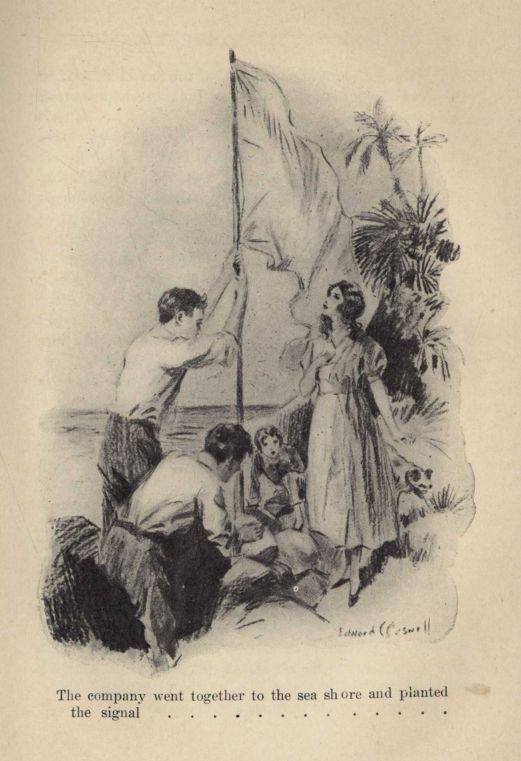
The company went together to the sea shore and planted the signal
The fire in the oven had by this time burnt down, but by reason of the dampness of the earth the hole was not hot enough. Another supply of wood was put in, and while it was burning our young marooners went to the oyster bank for another supply of oysters, then to the spring for water, and to the tree for wood. The labours of life were coming upon them.
A sufficient heat having been produced by the second fire, Harold requested Robert to clear the hole of all ashes, smoking brands, and unburnt bits of wood, while he went once more to the grove. He returned with a clean white stick, about a yard long, which he used as a spit for the turkey, resting the two ends in holes made at each end of the oven.
It was now nearly dark. The little company stood around the heated hole, admiring the simple contrivance by which their wild turkey was to be so nicely cooked, when, to the surprise of every one, Mary burst into a hearty laugh. Harold asked what she meant.
"I was thinking," she replied, almost choking with laughter, "how funny it will be tomorrow morning when you visit your grave, and come to take out your nice baked turkey, to find that the dogs had been to the funeral before you."
"That is a fact," said Harold, amused at the conceit. "I did not think of the dogs. But do you all come with me again for a few minutes, and I will make the oven secure from that danger also."
He led the way up the bluff, hatchet in hand, and loaded all with small poles and palmetto leaves. The poles were laid across the oven, and the palmetto leaves spread thickly above the poles. "I had forgotten this part of the ceremony," said Harold. "But this cover is put on not so much to keep the dogs out as to keep the heat in. I will show you at bed time a surer way to manage them."
"O, you will tie them up, hey?" asked Harry.
"Surely," he replied, "that is the cheapest way to keep dogs from mischief."
Buried almost hermetically in its heated cell, the turkey seasoned to their taste, was left to its fate for the night.
CHAPTER XII
RESULTS OF THE COOKERY--VOYAGE--APPEARANCE OF THE COUNTRY--ORANGE TREES--THE BITTER SWEET--RATTLESNAKE--USUAL SIGNS FOR DISTINGUISHING A FANGED AND POISONOUS SERPENT--VARIOUS METHODS OF TREATING A SNAKE BITE--RETURN
The morning sun found the young people preparing to carry their resolution into effect. When Harold opened the oven the turkey was baked brown as a nut, and from the now tepid hole arose an odour, so tempting, that their appetites began to clamour for an enjoyment that was not long delayed.
After breakfast the first work to be done was packing the boat, during which time Harold, at the suggestion of Robert, took Frank, and made a short tour through the surrounding forest, for the purpose of obtaining a breakfast for the dogs. The bark of the dogs and crack of a rifle soon announced that the hunters were successful, and in less than half an hour they returned each with a rabbit, as we Americans call the hare. "See here, brother Robert! See here, sister Mary!" was the merry chatter of Frank, the moment he came near. "I caught this myself. Fidelle ran it into a hollow tree--he is a fine rabbit dog. Mum is good for nothing; he will not run rabbits at all, but just stood and looked at us while Fidelle was after it. Cousin Harold would not let me smoke out the rabbit, but showed me how to get it with a switch. Isn't it a nice fellow?"
"It is indeed," replied Robert, "and I think that before we can return home, you will make an excellent supercargo."
Scarcely a smile followed this allusion; it was too sadly associated with the painful events of their forced departure from home. The packing completed, they called in the dogs and goats, pushed from shore, raised their sails to a favourable breeze, and moved gaily up the river.
For a mile and a half the water over which they sailed, lay in a straight reach, due east and west, then turned rapidly round to the north, where its course could be traced for many a mile by the breaks among the mangroves. Just where the river made its turn to the north, a small creek opened into it from the south. The course of this creek was very serpentine; for a considerable distance hugging the shore in a close embrace, then running off for a quarter or half a mile, and after enclosing many hundred acres of marsh, returning to the land, within a stone's throw of the place which it had left.
As the object of the voyagers was to explore the land, they turned into this creek, which seemed to form the eastern boundary of the island. They observed that the vegetation which was very scant and small near the sea, increased rapidly in variety and luxuriance as they proceeded inland. Tall palmettoes, pines, hickories, oaks, tulip trees, magnolias, gums, bays, and cypresses, reared aloft their gigantic forms, their bases being concealed by myrtles, scarlet berried cascenas, dwarf palmettoes, gallberries, and other bushes, intermingled with bowers of yellow jessamine, grape-vine, and chainy brier; while a rich grass, dotted with variously coloured flowers, spread like a gorgeous carpet beneath the magnificent canopy. Some of the flowers that glistened, even at this late season, above the floor of this great Gothic temple, were strikingly beautiful.
For five miles they followed the meanderings of the creek, now rowing, now sailing, until at last it turned suddenly to the east, and dividing into a multitude of small innavigable branches became lost in the marshes beyond. Fortunately, however, for the explorers, the channel terminated at an excellent landing-place, which was made firm by sand and shells, and where, securing their boat to a projecting root, they went ashore to examine the character of the country. To their surprise they had not proceeded twenty paces before discovering that this piece of land was only a narrow tongue, not a half furlong wide, and that beyond it was a river in all respects like the one they had left, coming also close to the opposite bank, and making a good landing on that side.
"O, for strength to lift our boat over this portage!" exclaimed Robert. "The river, no doubt, sweeps far around, and comes back to this point, making this an island."
"We can settle that question tomorrow," said Harold. "It is too late to attempt it now."
"O, brother," cried Mary, "there is an orange tree--look! look! look!--full of ripe yellow oranges."
It was a beautiful tree, and not one only, but a cluster of seven, scattered in a kind of grove, and loaded with fruit, in that state of half ripeness in which the dark green of the rind shows in striking contrast with the rich colour called orange. The young people threshed down several of the ripest, and began to eat, having first forced their fingers under the skin, and peeled it off by patches. But scarcely had they tasted the juicy pulp, before each made an exceeding wry face, and dashed the deceptive fruits away, as if they had been apples of Sodom, beautiful without, but ashes within. The orange was of the kind called the "bitter sweet," having the bitter rind and membranes of the sour, with the pleasant juice of the sweet.
"Open the plugs, all of you, and eat it as you do the shaddock, without touching the skin to your lips," said Robert. "There is nothing bitter in the juice, I recollect now that this kind of orange is said to grow plentifully in many parts of South Florida, and also that the lime is apt to be found in its company. This is another proof, Harold, that I am right as to our whereabouts."
"Really," said Harold, "this is a splendid country. I have another fact about it that you will be glad to learn, and that I intended as a pleasant surprise to you ere long. There are plenty of deer here. I saw their signs all through the woods this morning, within a quarter of a mile of the tent."
They gathered about a bushel of the ripest looking of the fruit, and deposited them in the boat; then beginning to feel hungry, they seated themselves on a green mound of velvet-like moss at the foot of a spreading magnolia, and there dined. Nanny and her kids were already on shore, cropping the rich grass, and the dogs were made happy with the remaining rabbit.
Shortly after dinner, while the boys were cutting a supply of grass for their goats during the voyage of the following day, they heard the bark of Fidelle and the growling of Mum, uttered in such decided and angry tones as to prove that they had something at bay, with which they were particularly displeased. "One of us ought to go and see what those dogs are about," remarked Robert; "and since you took your turn this morning, I presume it is my business now." He had not gone long, before Harold saw him returning with rapid steps.
"Do come here, cousin," said he, "there is the largest king-snake I ever saw, and desperately angry. The dogs have driven him into a thicket of briers, and he is fighting as if he had the venom of a thousand serpents in his fangs. His eyes actually flash. I cut a stick and tried to kill him, but it was too short, and he struck at me so venomously, that I concluded to cut me a longer one. The most curious part of the business is, that there is a large grasshopper or locust (if I may judge from the sound), in the same thicket, making himself very merry with the fight. There he is now--do you not hear him? singing away as if he would crack his sides."
"Locust!" exclaimed Harold, as soon as his quick ear distinguished the character of the music, "you do not call that a locust. Why, Robert, it is the rattle of a rattle-snake. Did you never hear one before?"
"Never in my life," he replied. "I have often seen their skins and rattles, but never a live rattle-snake. O, Harold," he said, shuddering, "what a narrow escape I have made. That fellow struck so near me twice, as barely to miss my clothes."
The boys obtained each a pole of ten feet in length. They stood on opposite sides of the narrow thicket in which the venomous reptile was making its defence, and as it moved, in striking, to the one side or the other, they aimed their blows, until it was stunned by a fortunate stroke from Robert, and fell writhing amid the leaves and herbage. The moment the blow took effect, Mum, whose eyes were lighted with fiery eagerness, sprang upon the body, seized it by the middle, shook it violently, then dropped and shook it again. It was now perfectly dead. They drew it out, and stretched it on the ground. Its body was longer than either of theirs, and as large around as Robert's leg. The fangs, which he shuddered to behold, were half as long as his finger, and crooked, like the nails of a cat, and the rattles were sixteen in number.
"This is an old soldier," said Harold; "he is seventeen or eighteen years of age. Had we not better carry it to the boat that Mary and Frank may see it? It is well for all to be able to distinguish a rattle-snake when it is met."
The precaution was necessary. For though Mary had a salutary fear of all reptiles, Frank had not; he would as soon have played with a snake, as with a lizard or a worm; and these last he would oftentimes hold in his hand, admiring what he considered their beauty. They stretched it on the earth before the children; put it into its coil ready for striking; opened its mouth; showed the horrid fangs; and squeezing the poison bag, forced a drop of the green liquid to the end of the tooth.
"Frank," said Harold, "if you meet a snake like this, you had better let him alone. Rattle-snakes never run at people. They are very peaceable and only trouble those that trouble them. But they will not budge out of their way for a king; and if you wrong them, they will give you the point of their fangs, and a drop of their poison, and then you will swell up and die. Do you think that you will play with snakes any more!"
"No, indeed," he replied.
"Harold," said Robert, "do you know how to distinguish a poisonous snake from a harmless one?"
On his replying in the negative, Robert continued, "The poisonous serpents, I am told, may be usually known by their having broad angular heads, and short stumpy tails. That rattlesnake answers exactly to the description, and I wonder at myself for not having put my knowledge to better use when I met him. The only exception to this rule I know of is the spreading adder, which is of the same shape, but harmless. Poisonous serpents must have fangs, and a poison bag. These must be somewhere in the head, without being part of the jaws themselves. This addition to the head gives to it a broad corner on each side, different from that of a snake which has no fangs. But if ever you see a thick set snake with a broad head and a short stumpy tail, take care."
The conversation now turned upon the subject of snake-bites and their cure. "My father," said Harold, "had two negroes bitten during one summer by highland moccasins, and each was cured by a very simple remedy. In the first case the accident happened near the house, and my father was in the field. He sent a runner home for a pint bottle of sweet oil, and made him drink by little and little the whole. Beside this there was nothing done, and the negro recovered. The other case was more singular. Father was absent, and there was no oil to be had, but the overseer cured the fellow with chickens."
"Chickens!" exclaimed Mary, laughing. "Did he make him take them the same way?"
"Not exactly," Harold answered; "he used them as a sort of poultice. He ordered a number of half grown fowls to be split open alive, by cutting them through the back, and applied them warm to the wound. Before the first chicken was cold, he applied another, and another, until he had used a dozen. He said that the warm entrails sucked out the poison. Whether or not this was the true reason, the negro became immediately better; and it was surprising to see how green the inside of the first few chickens looked, after they had lain for a little while on the wound."
"We also had a negro bitten by a ground rattle," said Robert, "and father cured him by using hartshorn and brandy, together with an empty bottle."
Harold looked rather surprised to hear of the empty bottle, and Robert said, "O, that was used only as a cupping-glass. Hot water was poured in, and then poured out, and as the air within cooled, it made the bottle suck very strongly on the wound, to which it was applied, and which father had opened more widely by his lancet. While this operation was going on, father made the fellow drink brandy enough to intoxicate him, saying that this was the only occasion in which he thought it was right to make a person drunk. The hartshorn, by-the-by, was used on another occasion, when there was neither a bottle nor spirit to be had. It was applied freely to the wound itself, and also administered by a quarter of a teaspoonful at a time in water, until the person had taken six or eight doses. I recollect hearing father say that all animal poisons are regarded as intense acids, for which the best antidotes are alkalies, such as hartshorn, soda saleratus, and even strong lye."
"Last year," said Harold, "I was myself bitten by a water-moccasin. I was far from home, and had no one to help me; but I succeeded in curing myself, without help."
"Indeed! how was it?"
"I had gone to a mill-pond to bathe, and was in the act of leaping into the water, when I trod upon one that lay asleep at the water's edge. Although it is more than a year since, I have the feeling under my foot at this moment as he twisted over and struck me. Fortunately his fangs did not sink very deep, but there was a gash at the joint of my great toe, of at least half an inch long. I knew in a moment that I was bitten, and as quickly recollected hearing old Torgah say, that the Indian cure for a bite is to lay upon the wound the liver of the snake that makes it. But I suppose that my snake had no notion of being made into a poultice for his own bite; for though I chased him, and tried hard to get his liver, he ran under a log and escaped. Very likely if I had succeeded in killing him, I might have relied upon the Indian cure and been disappointed. As it was, I jumped into the water, washed out the poison as thoroughly as possible, and having made my foot perfectly clean, I sucked the wound until the blood ceased to flow."
"And did not the poison make you at all sick?"
"Not in the least. My foot swelled a little, and at first stung a great deal. But that was the end of it. I was careful to swallow none of the blood, and to wash my mouth well after the sucking."
"Do, if you please, stop talking about snakes," said Mary, "I begin to see them wherever I look; suppose we return to our old encampment."
The boys gathered the remainder of the hay, called Nanny and the dogs, and reached the place which they had left, about five o'clock in the afternoon--having seen no signs of human habitation, and being exceedingly pleased with the appearance of their island; they made a slight alteration, however, in the place of their tent. Instead of continuing on the beach, they pitched it upon the bluff near the spring, and under the branches of a large mossy live oak. By the time the duties of the evening were concluded, they were ready for sleep. They committed themselves once more to the care of Him who has promised to be the Father of the fatherless, and laid down in peace, to rest during their third night upon the island.
CHAPTER XIII
DISAPPOINTMENT--THE LIVE OAK--UNLOADING--FISHING EXCURSION--HAROLD'S STILL HUNT--DISAGREEABLE MEANS TO AN AGREEABLE END
Before sunrise it was manifest that, without a change in the wind, the excursion proposed for that day was impossible; a strong breeze was blowing directly from the east, and brought a ceaseless succession of mimic billows down the river. Hoping, however, that the wind might change or moderate, they resolved to employ the interval in transferring all their articles of value from the boat, to their new home under the oak. And it was indeed fortunate, as they afterwards had occasion to know, that they attended to this duty so soon.
The live oak, under which their tent was pitched, was a magnificent tree. Its trunk was partially decayed from age, and the signs of similar decay in many of the larger limbs was no doubt the cause of its being spared in the universal search along this coast for ship timber; but it was so large, that the four youngsters by joining hands could barely reach around it. Ten feet above the root, it divided into three massive branches, which in turn were subdivided into long pendant boughs extending about sixty feet in every direction, and showing, at their ends, a strong disposition to sweep the ground. The height of the tree did not correspond to its breadth. It is characteristic of the live oak that, after attaining the moderate height of forty or fifty feet, its growth is directed laterally; the older trees often covering an area of more than double their height. Every limb was hung so plentifully with long gray moss, as to give it a strikingly venerable and patriarchal aspect, and Harold declared he could scarcely look at it without a disposition to take off his hat.
At noon Harold proposed to Robert that, the wind having ceased, they should spend the afternoon either in hunting or fishing. "If," said he, "Mary and Frank will allow us to leave them, I propose the first; if not, I propose the last, in which all can join."
"O, let us go together, by all means," said Mary. "I do not like to be left alone in this far off place; something may happen."
"Then let it be fishing," said Harold; "but what shall we use for bait?"
"The old bait that our grandfathers used--shrimp," replied Robert. "I observed on yesterday a multitude of them in a nook of the creek near the river. We can first catch some of these with our scoop net, and then try for whatever may bite. At any rate we can take the offals of the turkey, and fish for crabs."
However, on ascending the river in their boat, and making the trial, they found that the shrimp had disappeared, and they were left with only six or seven caught at a venture.
"This is a dull prospect," said Harold, whose active nature made him impatient of fishing as an amusement, unless the success was unusually good. "If you will allow me to go ashore I will try my luck with the gun."
"Certainly, certainly," was the reply; though Robert added, "You must remember that this is a wild country, Harold, and that we had better keep within hearing at least of each other's guns."
Harold promised not to wander beyond the appointed limit; and each agreed that if help were needed, two guns should be fired in quick succession.
"Will you not take my double barrel?" said Robert. "It is loaded with duck and squirrel shot, but you can easily draw and load for deer."
"I thank you, no," replied Harold. "It is so long since I have handled anything but a rifle, that a smooth bore now would be awkward."
They put him ashore, then dropped anchor, and began to fish. Mary and Frank had been long initiated into the mysteries of the art. On the present occasion, Robert reserved to himself the shrimp, and set them to the easier task of fishing for crabs. For security he tied the lines to the thowl pins. Crabs, as all upon the seaboard well know, are not caught with hooks, but with bait either hooked or tied to a lie, and with a spoon-shaped net. The crab takes hold of the bait with its claws, and is drawn to the surface, when the net is carefully introduced below. Robert inserted his own hook through the back of a live silver fish, and threw it in the water as a bait for drum. Soon Mary was seen drawing up her line, which she said was very heavy. "There is a crab on it, brother!" she cried, as it approached the surface; "two crabs! two! two!" Robert was near her. He inserted the net below, and the two captives were soon in the boat. "Well done for you, Miss Mary; you have beat us all!"
Here Frank called out suddenly, "I have got one too! O, how heavy he is! Brother, come; he is pulling my line away!"
It was not a crab. Robert and he pulled together, and after considerable play, they found that it was an enormous cat-fish or bull-head.
"This fellow will make a capital stew for tomorrow's dinner," said Robert. "But hold to your line, Frank, while I put the net under him also. I am afraid of these terrible side fins."
The fish had scarcely been raised over the gunwale of the boat, with the remark, "that is a bouncer!" when Robert noticed his own line fizzing through the water at a rapid rate. He quickly loosed it from the place where it was tied, and payed out yard after yard as the vigorous fish darted and struggled away; then humouring its motion by giving or taking the line as seemed to be necessary, he at last drew it towards him, and took it aboard. It was a drum, the largest he had ever caught, or indeed ever seen. It was as long as his arm, and strong enough to require all his art for its capture.
He loosed the hooks from the floundering fishes, and tried for more. But they now seemed slow to bite. He took only two others, and they were small. Mary, however, caught nine crabs, and Frank two. Becoming weary of the sport, they heard afar off the sharp crack of a rifle.
"There goes Harold's rifle!" said Robert; "and I warrant something has seen its last of the sun. Let us put up our lines, and meet him at the tent."
The anchor was weighed, the sail spread, and in the course of half an hour they saw Harold at the landing.
"What have you brought?" they all asked.
"O, nothing--nothing at all," he replied, looking at the same time much pleased.
"Nothing!" responded Robert. "Why we paid you the compliment of saying, 'There goes Harold's rifle! and you may be sure he has killed something."
"If you have not anything, we have," boasted Frank. "See what a big fish I caught! Isn't it a bouncer for a little fellow like me to catch? Why, sir, he nearly pulled me into the water; but I pulled and pulled, and brother Robert came to help me, and we both pulled, and got him in. See, too, what brother Robert caught--a big trout; and sister Mary, she caught a parcel of crabs; I caught two crabs myself. And you haven't anything! Why, cousin Harold, are you not ashamed of yourself?"
"But you have killed something; I see it in your looks," said Mary, scrutinizing his countenance; "what is it?"
"That is another question," replied Harold. "You all asked me at first what I had brought. Now, I have brought nothing; but I have to bring a deer."
"Then, indeed, you have beat us," said Robert; "but that is only what I expected."
"A deer!" exclaimed the two younger. "O, take us to see it!"
Mooring the boat safely, they hastened with Harold to the scene of slaughter. It was about half a mile distant. There lay a large fat buck, with branching horns, and sleek brown sides. Frank threw himself upon it in an ecstasy of delight; patted, hugged, and almost kissed it. Mary hung back, shrinking from the sight of blood.
"O, cousin Harold," she cried, "what a terrible gash your bullet has made in the poor thing's throat! Just look there!"
Harold laughed. "That was not made by my ball, but by my knife. Hunters always bleed their game, cousin, or it will not look so white, taste so sweet, nor keep so well."
The boys prepared to carry it home. Harold, taking from his bosom the hatchet, cut a long stout pole, and Robert brought some leaves of the silk grass (the yucca filamentosa, whose long narrow leaves are strong as cords), with which the legs of the deer were tied together. Swinging it on the pole between them, they marched homewards.
By this afternoon's excursion they were provided with a delightful supply of fish, crabs, and venison. But, alas! they were compelled to be their own butchers and cooks; and there are certain processes through which these delicacies must pass before being ready for the mouth that are not so agreeable. Mary and Frank brought up the fish, and set about preparing them for supper. They laid each upon a flat root of the tree, and with a knife scraped off the scales. This was dirty work for a nice young lady, but it was necessary to the desired end. She pshawed and pshawed at it as the slimy scales adhered to her fingers, or flew into her face, but she persevered until all was done.
In the meantime the fire had been mended, and water poured into their largest pot. When it began to boil, Mary and Frank dropped in the crabs. Poor creatures! it was a warm reception they met with from their native element. Each one gave a kick at the unwelcome sensation, and then sunk into quiet repose, at the bottom of its iron sepulchre. They remained boiling until their shells were perfectly red, when they were taken out, and piled in a dish for supper.