Front matter (continued 4)
Reading edition
"Why did we not think of this before?" Robert querulously asked.
"Simply because we had other things to think of," replied Harold. "For my part, I am thankful that we have a dry tent."
"So am I," rejoined Robert, changing his tone. "But I should be still more thankful if we had a place where we could sit by the fire."
"Very likely, now since we know from experience, how uncomfortable it is to be without. But I doubt if any of us would be half so thankful, were it not for being put to inconvenience. I recollect a case in point. My mother was once taken sick while we were travelling through the Indian nation. At that time the Indians were becoming hostile, and we were every day expecting them to declare war. O, how troubled we all were! I remember that every morning we made it a point to say how thankful we were for spending another night, without being scalped. But afterwards, when we had returned home, and could spend our days and nights in peace, we forgot to be thankful at all."
Robert smiled at the naturalness of the description, and remarked, "Well, I think we shall be thankful now for a fire and shelter. Can we not devise some way to have them?"
The result of this conference was, that in the course of an hour they set up the boat-awning as a sort of kitchen, enclosed on three sides by the remaining bed-sheets, and having a fire at the windward gable, near which they sat very cosily on boxes and trunks brought from the tent.
Contrary to their expectation, the rain began to abate about noon, and long before sunset the surface of the earth was so much dried, and the drops left upon the trees and bushes so thoroughly exhaled or shaken off by a brisk wind, that the boys used the opportunity to bring in a supply of wood and lightwood. The light-wood was very rich, and split into such beautiful torch pieces, that Harold was tempted to think of a kind of sport in which he had often engaged, and in which he was very fond. "We have been pent up all day," said he to Robert; "suppose we change the scene by taking a fire-hunt tonight."
"With all my heart," was the reply; "and I think no one will object to our having a fat roast pig for our Sunday's dinner."
"Probably not," Harold rejoined, "and I am still more in favour of the idea, for the reason that, as we take such game alive, we can keep it as long as we will."
Their preparation for the excursion consisted simply in splitting an armful of lightwood, which Harold tied into a bundle, to be readily slung over the shoulders by a strap. In the midst of their preparations Frank came up, and on learning their purpose, almost shouted for joy. He had so often heard Sam and William speak of the pleasure of their 'possum hunts, that it had long been the height of his ambition, as a sportsman, to engage in one; but for various reasons the convenient time had never yet come.
"O, I am so glad!" he exclaimed, with a face lighted with pleasure; "you will let me go, won't you?"
Here now was a dilemma. How could they refuse him? and yet how could they with propriety leave Mary with no other companion than poor bed-ridden Sam? The boys saw no alternative but to give up the hunt, until Robert proposed himself to stay with Mary, on condition that Frank should carry the torch and light-wood, while Harold bore the ax and gun. But to their gratification, Frank, perceiving the difficulties of the case, and ashamed to rob his brother of a place which he himself was incompetent to fill, set the matter at rest, by saying:
"No, brother, I will not go tonight; I will wait and go with Cousin Harold some time when Sam gets well. But you must give me the pigs when you come back, and let me feed them every day."
They praised him sincerely for his act of self-denial, and promised that he should be no loser on account of it. Soon as it was dark they bid him good-night, and departed. He stood in the tent door, happy in the thought of their pleasure, and watched the animated motions of boys and dogs, as the red light flashed upon the trees, and the whole party became gradually lost from sight in the forest.
The boys had not proceeded a half mile, before the quick sharp bark, first of Mum, then of Fidelle, gave indications of their having "treed" some kind of game. Hastening to the spot, they saw the dogs looking eagerly up a slender, tall persimmon, and barking incessantly. For a time they could discover nothing in its branches, or on its body; and had begun almost to conclude that (in hunter's phrase) their dogs had lied, when Harold took the torch, waved it to and fro behind him, walking thus around the tree, and keeping his eyes fixed on those places where he supposed the opossum to be. Presently he cried out, "We have him! I see his eyes! Mum, poor fellow," patting his head, "you never lie, do you?" Mum wagged his expressive tail with great emphasis, as much as to say that he perfectly understood both the slander and the recantation, and that he now desired nothing but the privilege of giving that 'possum a good shake. Robert also took the light, and holding it behind him, saw amid a bunch of moss two small eyes glistening in the dark. The aim was so fair that the gun might have been used with certainty, were it not against all hunting rule; an opossum must be caught, not killed. The boys plied their ax upon the yielding wood, the eyes of the now silent dogs being fixed alternately upon the game above and the work below. The tree cracked and toppled. Mum's ears stood perfectly erect; and ere the branches had time to sway back, from their crash upon the ground, he was among them, growling at something upon which he had pounced. It was the opossum; and like all the rest of its tribe when in the presence of an enemy, it seemed to be stone dead. They took it up by its scaly, rat-like tail, and again went on.
In the course of a short walk they took a second, and on their way back, a third. These were quite as many as they could conveniently carry; and taking their captives home, they made them secure, by tying a forked stick around the neck of each, on the plan of a pig-yoke. From the moment that these singular animals found themselves in the power of their enemies, they put on all the usual appearances of death; not a muscle twitched, nothing stirred or trembled; each limb was stiff, and each eye closed; not even the growl or grip of the dogs was sufficient to disturb their perfect repose. Robert could scarcely persuade himself that they were not really dead. Harold laughed.
"They can stand the crash of a tree and the worrying of dogs," he said, after they were made secure; "but there is one thing which they cannot stand. See here!" and he poured a cupful of cold water on each. The shock seemed to be electric. Each dead opossum was galvanized into life, and pulled stoutly to break away from its wooden fetters. "Now let us to bed."
CHAPTER XXII
FRANK AND HIS "PIGS"--THE CAGE--WALK ON THE BEACH--IMMENSE CRAWFISH--THE MUSEUM--NAMING THE ISLAND
Frank's first words the next morning, as in his night-clothes he ran from Mary's room, were, "Have you brought my pig?"
"Yes! yes!" they answered, "three of them; and all yoked to boot, so that they cannot get either into the garden or the cornfield."
Frank did not comprehend this enigmatical language; he hastily dressed and went out. Close to the awning he found the new comers sitting, each secured by the novel pillory which Harold had contrived. They were ugly looking creatures, with long, hypocritical faces, coarse, grizzly hair, and an expression of countenance exceedingly contemptible. Frank had often seen opossums before, but the fancy name of pigs had caused him mentally to invest them with the neat and comely aspect of the little grunters at home. When he hurried from the tent, and saw them in their native ugliness, writhing their naked, snakey tails, he turned away with unaffected disgust.
"They are not very pretty," said Harold, watching the changes that flitted across the little fellow's face.
"No, indeed," he replied; "they are the ugliest things I ever saw. You may keep them and feed them yourself; for I will not have them for mine."
The unsightly appearance of the opossum excites in many persons a prejudice against its use for the table. But when young and tender, or after having been kept for several days, its flesh is so nearly in taste like that of a roast pig, that few persons can distinguish the difference.
A cage for the captives was soon constructed, of poles several inches in diameter, notched into each other, and approaching at the top like a stick trap. The floor was also guarded with poles, to prevent their burrowing out.
"Now we need one or two troughs for their water and food," observed Harold, after the prisoners, loosed from their neck-locks, had been introduced into the airy saloon erected for their accommodation. "I propose, therefore, that Mary and Frank shall go with one of us to Shell Bluff, and bring home a supply of conch shells, to be converted, as we need them, into troughs, cups, dippers, and trumpets."
Mary and Frank needed no persuasion to go upon this excursion, after the glowing description given by the boys on their return from the beach. Robert preferred to remain with Sam. The others set off--Harold with his gun, which, for reasons of policy, was an inseparable companion, Mary with a basket, and Frank with his dog and hatchet. On arriving at the beach, down which they were to pass for a mile or more, the youngsters amused themselves for a time with writing names, or making grotesque figures in the hard smooth sand; then ran to overtake Harold, who had walked slowly on, watching the sea-gulls plunge after their prey on the surface of the water; for a short distance they went with him side by side, chatting through mere excitement; then dashing far ahead, they picked up shells and other curiosities thrown up from the sea. Several times was Mary's basket filled with prizes, and afterwards emptied for others still more beautiful, before they reached the place which the boys had named "Shell Bluff."
The beach at that place was lovely indeed. For half a mile or more it looked like snow, mottled with rose colour here, and with dark brown there; while, crowning the bluff above, waved a cluster of tropical palmettoes, around whose bases gathered the dark and fragrant cedar.
Again Mary replenished her basket, Frank filled every pocket he had, and his cap besides, and Harold collected his handkerchief full of fine-looking conch shells. They were about returning, when their attention was attracted by the shell of an enormous crawfish, whose body alone was nearly a foot long, and whose claws, extending far in front, were of hideous dimensions. This last Harold said he must take home for "Mr. Philosopher Robert," and learn from him what it was.
Robert was much pleased to see the collections they had made, and particularly so with the shell. He said that this was another proof, if he needed any other, to show that they were on the western coast of South Florida, for he had often heard of the enormous crawfish that abounded there, and that were almost equal in size to the lobster.
"Let us be sure, Harold," said he, "to put it beside your oyster, with the raccoon's foot, as the beginning of a museum gathered from the island."
"Yes; and our rattlesnake's skin," Frank added.
"And our turkey's tail, and Frank's plume," said Mary. "We have the beginning of a museum already; for there are besides these things about twenty varieties of shells and sea-weeds in this basket, some of which I never saw before."
Harold was as much interested as any in the idea of a museum; for though he knew nothing of its proper arrangement, he had good sense enough to perceive that it was a very ready means of acquiring and retaining knowledge.
"But the name of this island," said Robert, musing; "I have several times wished that we had one. And why should we not, for who has a better right to give it a name than we, its only inhabitants?"
He expressed the mind of the whole company, and they soon proceeded to call upon each other for nominations. "The rule in such cases, I have heard, is to begin with the youngest," said Robert. "So Master Frank, do you tell us what you would have it called."
Frank mused a moment, and replied, "I will call it Turkey Island; because turkeys were the first thing we saw here."
"My name, I think, will be the Island of Hope," said Mary, as her brother's eye rested on her. "We have certainly been hoping ever since we came, and will continue to hope until we get away."
"Yes, but we sometimes despaired, too," answered Robert, "especially on the morning after the storm. I have thought of the Caloosa name--the Enchanted Island."
"Please, Massa," Sam implored, "don't call um by dat name. I begin to see ghosts now; and I 'fraid, if you call um so, I will see ghosts and sperits all de time."
"I think a more suitable name still," said Harold, "is the Island of Refuge. It has certainly been to us a refuge from the sea, and from the storm. And if it is the Enchanted Island, of which Riley spoke, it will also prove a refuge from the Indians, for none will dare to trouble us here."
Sam declined suggesting any name. He said, pointing across the river to the bluff, where he had met with his accident, "Dat my place, obe' turrah side;[#] and my name for him is Poor Hope."
[#] That is my place, over the other side.
The name decided by universal acclamation, was THE ISLAND OF REFUGE.
"I wish we had a horn of oil," said Robert, "I would anoint it, as discoverers are said to do. And if any person could suggest an appropriate speech I would repeat it on the occasion; but the only words I can think of now are,
'Isle of Beauty, fare thee well!'
And much as I admire everything around, I hope ere long to repeat those words in truth."
CHAPTER XXIII
THEIR SECOND SABBATH ON THE ISLAND, AND THE WAY THEY SPENT IT
On coming together in the morning, Robert proposed that they should add to their usual religious exercises the singing of a hymn. "It is father's plan," said he, "to mark the Sabbath with as many pleasant peculiarities as possible."
Harold was gratified with the suggestion, but remarked, "As I cannot sing, you must allow me to join you in my heart, or else to assist the music with my flute."
"Oh, the flute, by all means!" Mary replied. "And see here what a beautiful hymn I have just found!"
Robert took the book, and read with remarkable appropriateness of tone and manner that exquisite hymn by Dr. Watts, beginning
"My God, how endless is thy love!"
The music that morning was unusually sweet. The voices of the singers were rendered plaintive by a consciousness of their helpless situation; and the rich tones of the flute, together with Sam's African voice, which was marked by indescribable mellowness, added greatly to the effect.
The subject of the chapter was the parable of the prodigal son. Sam, poor fellow, raised himself on his elbow, and listened attentively; his remark made afterwards to Mary, showed that, however far beyond his comprehension a great part of the parable may have been, he had caught its general drift and meaning. "De Lord is berry kind; he meet de sinner afore he get home, and forgib him ebbery ting."
About nine o'clock the young people separated, with the understanding that they were to re-assemble at eleven, for the purpose of reading the Scriptures, and of conversation about its teachings.
Robert went to the beach, and taking his seat upon a log, near the flag-staff, looked upon the ocean, and engaged in deep reflection upon their lonely situation, and the waning prospects of their deliverance. His Testament gradually slipped from his grasp, and his head sunk between his knees. Such was his absorption of mind, that the big drops gathered upon his forehead, and he was conscious of nothing except of his separation from home, and of the necessity for exertion. At last he heard a voice from the tent. Harold and Mary were beckoning to him; and looking up to the sun, he saw that eleven o'clock had come and passed. He sprang to his feet, and in doing so, was rebuked to see lying on the ground the Testament which he had taken to read, but had not opened.
Harold, on leaving the tent, took his pocket Bible and strolled up the river bank, to a pleasant cluster of trees, where he selected a seat upon the projecting root of a large magnolia. His mind also reverted naturally to their lonely situation; but he checked the rising thoughts, by saying to himself, "No. I have time enough during the week for thoughts like these. The Sabbath is given for another purpose, which it will not do for me longer to neglect. When the Lord delivered us in that strange way at sea, I resolved to live like a Christian, but I have neither lived nor felt as I ought. The Lord forgive me for my neglect, and help me to do better." He knelt down, and for several minutes was engaged in endeavouring to realize that he was in the presence of God. His first words were a hearty confession that, although he had been early taught to know his duty, he had not done it, nor had the heart to do it; and, though in the experience of countless blessings, he had never been grateful for any until the time of that unexpected deliverance. He thanked God for having taught him by that dreadful accident to feel that he was a sinner, and that it was a terrible thing to live and to die such. He said he knew there were promises, many and great, to all who would repent of sin, and believe in Jesus Christ, and he prayed that God would enable him so to repent and believe, as to feel that the promises were made to him.
Rising from his knees, and sitting upon the root of the tree, he opened the Bible, and his eye rested upon the fifty-fifth chapter of Isaiah, "Ho, every one that thirsteth, come ye to the waters, and he that hath no money; come ye, buy and eat; yea, come; buy wine and milk, without money and without price." Here he stopped, for his eyes filled, and the page became obscured. He put his hands to his face, and thought, "That passage surely describes me. I came to this spot as a thirsty person goes to a spring. My soul longs for something, I know not what, except that God only can supply it, and that I have nothing to offer for its purchase. Now God says that he will give it, 'without money and without price.' O, what a blessing! O, how merciful! Let me see that passage again."
He re-opened the Bible, which had been laid in his lap, but the place had not been marked, and was not to be found. After searching some time, he turned to the New Testament, and having opened it at the Epistle to the Romans, was turning back to the Gospels, when his eye was caught by these words (contained in the seventh and eighth verses of the fourth chapter of Romans): "Blessed are they whose iniquities are forgiven, and whose sins are covered. Blessed is the man to whom the Lord will not impute sin." "Ah, yes!" he exclaimed, "how true that is! There is no blessing like it." Supposing that something might be said in the chapter to show how sin may be forgiven and covered, he read the chapter through, but was disappointed. The only clear idea he gained was that Abraham was counted righteous, and was saved, not by his works, but by his faith. This confused him. "I always thought," said he, "that people were saved because they were good. But this teaches,--let me see what,"--at this time his eye rested on the words, "Now it was not written for his sake alone (viz. that Abraham's faith was imputed to him for righteousness), but FOR US ALSO, to whom it shall be imputed, if we believe on him that raised up Jesus, our Lord, from the dead, who was delivered for our offences, and was raised again for our justification."
"Ah, there comes my case again!" he mentally exclaimed. "It does seem as if God is opening to me the scriptures. This fact, about Abraham, was recorded not for his sake, but FOR OUR SAKES now. And the blessing bestowed on him (that is, the forgiveness of sin), shall be bestowed on us too, 'if we believe on Him (that is, God the Father), that raised up Jesus from the dead, who was delivered (that is, given up to death--put to death) for our offences, but raised again for our justification.' But justification, what does that mean?"
He glanced his eye over the chapter. It flashed upon him that justification means nothing more nor less than what Paul had been speaking of throughout the whole chapter. Abraham was "justified"--that is, "sin was not imputed to him"--he was "counted righteous," on account of his faith. Now he understood the passage. It declared that we too shall be justified, if we believe on God, who gave up Jesus to suffer for our sins, and who raised him again that we might be counted righteous.
As soon as he had conceived this idea, and had certified his mind of its correctness, by reading the passage over several times, he fell once more upon his knees, and said, "O Lord, I am a sinner. But thou hast said, 'Ho, every one that thirsteth, come ye to the waters; and he that hath no money.' I come as a sinner, thirsting for pardon, but having no money to offer for its purchase. My only hope is in Thy promise. I plead it now before Thee. Thou hast promised, that as Abraham was justified by faith, so shall we be, if we believe on Thee, who didst raise Jesus from the dead. Lord, I believe; help thou my unbelief. Accept of me as righteous in thy sight, not because I am righteous--for I am not, but because Jesus Christ was delivered for our offences, and raised again for our justification. Forgive my iniquities, cover my sins, and make me all that thou wouldst have me be, for Jesus Christ's sake. Amen."
For some minutes he continued kneeling; his eyes were closed, his hands clasped, and his bowed face marked by strong emotion. It was pleasant to be thus engaged. He had experienced for the first time the blessedness of drawing near to God, and now he was listening to that "still small voice," that spoke peace to his inmost soul.
Once more he sat upon the rough root of the tree. He opened his Bible to the same page which had been so instructive, but it was to the next chapter, where he read: "Therefore, being justified by faith, we have peace with God, through our Lord Jesus Christ." "Yes, yes," he murmured, as his hand sought his bosom. "Peace indeed! Peace with God! Peace through our Lord Jesus Christ--and justified by faith." He continued reading:
"By whom we have access by faith into this grace wherein we stand, and rejoice in hope of the glory of God. And not only so, but we glory in tribulations also; knowing that tribulation worketh patience, and patience experience, and experience hope, and hope maketh not ashamed, because the love of God is shed abroad in our hearts, by the Holy Ghost which is given unto us."
"Ah! is not this true?" he joyfully soliloquized. "We glory in tribulations. I used to wonder how people could glory in trouble. But now, thanks to God for trouble! especially for the trouble that brought us to this island, and brought me to Jesus Christ! Yes, thanks to God for trouble!"
Having read the chapter to the end, and found, as is usual with persons in his state of mind, that although he could not understand it all, there was scarcely a verse in which he did not discover something suitable to his case, he knelt down and consecrated himself to God; praying that the Lord would grant him grace to live as a Christian, and more particularly so to live, as to be the means of bringing his young companions to a knowledge of the truth. As he closed his prayer, the words of the morning hymn rose vividly to his recollection; he did not indeed use them as any part of his address to a throne of grace, but he used them as uttering beautifully the language of his own heart in that sweet communion to which he was now initiated.
"I yield my powers to thy command,
To thee I consecrate my days;
Perpetual blessings from thy hand
Demand perpetual songs of praise."
Looking at his watch he saw that the hour of eleven was at hand. He turned his face toward the tent, and walked slowly onward, and as he went his lips continually murmured,
"Perpetual blessings from thy hand,
Demand perpetual songs of praise."
While Robert and Harold were thus engaged, Mary told Frank to amuse himself not far away, and that after she had looked over her own lessons she would call for him. In the act of going to her room, she was arrested by the voice of Sam, who said:
"Please, misses, Mas Robert and Mas Harold both gone away; and if you can, read some of the Bible to your poor sick servant--do, misses."
Touched by his melancholy earnestness, she promised to do so with pleasure, after having finished Frank's lessons and her own; and indeed, urged on by his apparent thankfulness, she dispatched her task in one-half the usual time, and then called for Frank.
"What! have you learned your lessons already?" he asked, in some surprise. She replied, "Yes." "Then," said he, "I wish you would make mine as short, for it took you a very little while." But when she informed him of the secret of her rapidity, and he heard a plaintive, half-devotional sigh from Sam's corner, he said, "Get the book, sister; I will learn as fast as I can, and then we can both go and sit by him, while you read." Mary patted his cheek, saying that he was a good fellow, whenever he chose to be; and giving him the book, he stood by her side, and learnt his lessons very soon, and very well.
The chapter selected at Sam's request was the third of John. With this he was so well acquainted as to be able to repeat verse after verse, while Mary was reading, and he seemed withal to have a very clear idea of its meaning. Mary was surprised. She knew that her father was in the habit of calling his plantation negroes together on Sabbath evenings, and instructing them from the Scriptures, but she had no idea that the impressions made by his labour had been so deep.
It was not until half-past eleven that they were all assembled and composed. They sang several hymns, then conversed freely upon the subject of the chapter, which had interested them in the morning, and on which they had promised to reflect. These exercises occupied them so pleasantly that it was past the usual hour ere any one thought of dinner.
A part of Dr. Gordon's custom had been to call upon each of his children every day at their midday meal, to tell what "new knowledge" they had gained since that hour of the day preceding. On Sundays the same plan was pursued, except that the knowledge was required to be suitable to the day. This practice was on the present occasion resumed by the young people. Frank's new knowledge consisted of part of his morning lesson; Mary's, of a new method devised by her for remembering the order of certain books in the Bible; Robert's, of the aim and object of the parable just discussed: it was a keen rebuke to the Scribes and Pharisees, who murmured against Jesus for receiving sinners and eating with them. When Harold's turn came, he spoke with much emotion, and a face radiant with pleasure. He said that he had on that day learnt the most important lesson of his life; how good the Lord is, and how great a sinner he himself had been; he had learnt how to love Him, and how to trust Him; how to read the Bible, and how to pray. He was not able to tell how it happened, but there was now a meaning in the Scriptures, and a sweetness in prayer, that he had never before suspected, and that he hoped it would last for ever. He concluded by saying that he could conceive of no greater blessing than that of being enabled to feel all his life-long as he felt that morning, after promising to try to live like a Christian.
To these remarks of Harold no one made reply. Robert looked down a moment, then directed his gaze far away, as if disturbed by some painful recollection. Mary gazed wistfully on her cousin, and covered her face with both hands. Frank slid from his seat, and coming to Harold's side, insinuated himself upon his knee, and looked affectionately into his face. All felt that a great event had happened in their little circle; and that from that time forth their amiable cousin was in a most important sense their superior. They separated in silence, Robert going to the spring, Mary to her room, and Harold to talk with Sam.
Late in the afternoon they went together to the seashore, and sitting around their flag-staff, on the clear white sand, looked over the gently rippling waters, and talked thankfully of their merciful deliverance, and of their pleasant Island of Refuge. The air became chilly, and the stars peeped out, before they sought the tent. Again soft music stole upon the night air, and floated far over the sands and waters. Then all was hushed. The youthful worshippers had retired. And so softly did sleep descend upon their eyelids, and so peacefully did the night pass, that one might almost have fancied angels had become their guardians, were it not for the still more animating thought that the God of the angels was there, and that He "gave his beloved sleep."
CHAPTER XXIV
MOTE IN THE EYE, AND HOW IT WAS REMOVED--CONCH TRUMPET AND SIGNALS--TRAMP--ALARM
The next morning, while planning together the employments of the day, Frank came in, holding his hand over his eye, having had a grain of sand thrown into it by an unfortunate twitch of Dora's tail. It pained him excessively, and he found it almost impossible to keep from crying. Mary ran quickly and brought a basin, for the purpose of his washing it out. He however became frightened at finding his mouth and nose immersed, and was near being strangled in the attempt. It would have been better for so young a person, if Mary had made him hold back his head, and dropped the water under the uplifted lid. She next proposed to remove it by introducing the smooth head of a large needle to the painful spot, and moving the mote away; but neither would Frank allow this. Robert then took the matter in hand, and having in vain blown and rubbed in various ways, endeavoured to remove the substance by drawing the irritated lid over the other, in such a way as to make the lash of one a sort of wiper to the other. But neither did this succeed. By this time the eye had become much inflamed, and Frank began to whimper. Harold asked him to bear it for a minute longer, and he would try old Torgah's plan. With a black filament of moss, the best substitute he could devise for a horse hair, he made a little loop, which he inserted under the uplifted lid, so as to enclose the foreign substance; then letting the lid fall, he drew out the loop, and within it the grain of sand. Robert observed that an almost infallible remedy is to bandage the eye and take a nap; and Mary added, that it would be still more certain if a flaxseed were put into the eye before going to sleep. Frank, however, needed no further treatment; he bathed his eye with cold water, wore a bandage for an hour, and then was as well as ever.
During the conversation that preceded this incident, Harold had brought out a hammer and large nail, and now occupied himself with making a smooth hole in the small end of one of the conches. Having succeeded, he put the conch to his lips, and after several trials brought from it a loud clear note like that of a bugle. Robert also, finding that the sound came easily, called aloud, "Come here, sister, let us teach you how to blow a trumpet."
It was not until after several attempts that Mary acquired the art. Frank was much amused to see how she twisted and screwed her mouth to make it fit the hole; and though he said nothing at the time, Harold had afterwards reason to remember a lurking expression of sly humour dancing about the corners of his mouth and eyes.
"Now, cousin," said Harold, when Mary had succeeded in bringing out the notes with sufficient clearness, "if ever you wish to call us home when we are within a mile of you at night, or half a mile during the day, you have only to use this trumpet. For an ordinary call, sound a long loud blast, but for an alarm, if there should be such a thing, sound two long blasts, with the interval of a second. When you wish to call for Frank, sound a short blast, for Robert two, and for me three.
In his different strolls through the forest, Harold had observed that the wild turkeys frequented certain oaks, whose acorns were small and sweet. It was part of his plan to capture a number of these birds in a trap, and to keep them on hand as poultry, to be killed at pleasure. For this purpose, it was necessary that the spot where the trap was to be set should first be baited. He therefore proposed to Robert to spend part of the forenoon in selecting and baiting several places; and with this intention they left home, having their pockets filled with corn and peas. It did not require long to select half a dozen such places, within a moderate distance of the tent, to bait, and afterwards to mark them so that they could be found.
Having completed this work, they were returning to the tent, when they heard afar off the sound of the conch. It was indistinct and irregular at first, as if Mary had not been able to adjust her mouth properly to the hole; but presently a note came to them so clear and emphatic, that Mum pricked up his ears, and trotted briskly on; and after a second's pause came another long blast. "Harold! Harold!" Robert said in a quick and tremulous tone, "that is an alarm! I wonder what can be the matter. Now there are two short blasts; they are for me; and now three for you. Come, let us hurry. Something terrible must have happened to Frank or to Sam."
They quickened their pace to a run, and were bursting through the bushes and briers, when they again heard the two long blasts of alarm, followed by the short ones, that called for each of them. They were seriously disturbed, and continued their efforts until they came near enough to see Mary walking about very composedly, and Frank sitting, not far from the tent, with the conch lying at his feet. These signs of tranquillity so far relieved their anxiety, that they slackened their pace to a moderate walk, but their faces were red, and their breath short from exertion. They began to hope that the alarm was on account of good news instead of bad--perhaps the sight of a vessel on the coast. Robert was trembling with excitement. A loud halloo roused the attention of Frank, and springing lightly to his feet he ran to meet them.
"What is the matter?" asked Robert; but either Frank did not hear, or did not choose to reply. He came up with a merry laugh, talking so fast and loud, as to drown all the questions.
"Ha! ha!" said he, "I thought I could bring you! That was loud and strong, wasn't it?"
"You!" Robert inquired. "What do you mean? Did you blow the conch?"
"That I did," he replied; "I blew just as cousin Harold said we must, to bring you all home."
"But, Frank," remonstrated Harold, "the conch sounded an alarm. It said, Something is the matter. Now what was the matter?"
"O, not much," Frank answered, "only I was getting hungry, and thought it was time for you all to come back. That was something, wasn't it?"
"You wicked fellow!" said Robert, provoked out of all patience, to think of their long run. "You have put us to a great deal of trouble. Sister, how came you to let him frighten us so?"
"Really, I could not help it," she replied. "When I went to the spring a little while since, he excused himself from going by saying that he felt tired; but no sooner had I passed below the bluff, than I heard the sound of the conch. I supposed at first it must be Sam, who had become suddenly worse, and was blowing for you to return; so I filled my bucket only half full, and hurried home; when I ascended the bluff I saw the little monkey, with the conch in his hand, blowing away with all his might."
"And didn't it go well?" asked Frank.
The young wag looked so innocent of every intent except fun, and seemed withal to think his trick so clever, that in spite of their discomfort, the boys laughed heartily at the consternation he had produced, and at the half comic, half tragic expression which his face assumed on learning the consequences of his waggery. They gave him a serious lecture, however, upon the subject, and told him that hereafter he must not interfere with the signals. But as he seemed to have such an uncommon aptitude for trumpeting, Harold promised to prepare him a conch for his own use, on condition that he played them no more tricks. Frank was delighted at this, and taking up the horn, blew, as he said, "all sorts of crooked ways," to show what he could do. The boys were astonished. Frank was the most skilful trumpeter of the company; and on being questioned how he acquired the art, replied, that when he and his mother had gone on a visit to one of her friends, during the preceding summer, he and a negro boy used to go after the cows every evening, and blow horns for their amusement.
CHAPTER XXV
A HUNTER'S MISFORTUNE--RELIEF TO A SPRAIN--HOW TO AVOID BEING LOST IN THE WOODS, AND TO RECOVER ONE'S COURSE AFTER BEING LOST--A STILL HUNT
It was remarked by Mary the next morning, that if some one did not go out hunting they should soon be out of provision. "Which for our character as marooners I hope will not be the case," rejoined Harold. "Come, Robert, shall we be hunters today?"
"We cannot do better," Robert languidly replied, "unless we go fishing instead."
"O, do let me go with you," begged Frank. "I am so tired of being cooped up here under this oak tree, and running for ever to the spring and to the oyster bank. I want to go either hunting or fishing."
"Perhaps we can do both," said Mary, perceiving from Robert's looks that he was disinclined to any great exertion. "Cousin Harold can take Frank and go to the woods, while you and I, brother, can catch a mess of fish."
"That will do! O, yes, that is the very plan," Frank exclaimed, clapping his hands. "Then we can run a race to see who shall do best."
The company separated; Harold took Frank and disappeared in the forest, where they were absent several hours, and Robert and Mary went to the oyster bank, where they supplied themselves with bait, and then embarking on the raft, began to fish for sheepshead, near a log imbedded in the mud, and covered with barnacles and young oysters. The success of the fishing party was very good; they soon had a basket half full of fish, and the remainder filled with shrimp.
Not so with the hunters. Robert and Mary were engaged in preparing their prizes for use, when they heard a sharp halloo, and saw Frank emerging from a dense growth of bushes, with the rifle upon his shoulder, followed by Harold, who was limping painfully, and beckoning them to approach.
Washing their hands with haste, Robert and Mary ran to meet them. Harold was seated on a log, looking very pale. Within an hour after leaving the tent he had sprained his ankle, and ever since had been slowly and with great suffering attempting to return. Mary was frightened to see the haggard looks of her cousin, and inquired anxiously what she could do to help him.
"Take the gun, sister," said Robert. "Lean on me, cousin, I will support you to the tent, and then show you the best thing in the world for a sprain."
Mary ran to the tent, put the gun in its place, prepared Harold's couch, and then at Robert's request hurried with Frank to the spring and brought up a bucket of water, by the time that Harold's shoe and stocking had been removed. The ankle was much swollen, and the blood had settled around it in deep blue clouds.
"Now, sister, bring me the coffee pot and a basin."
The basin was placed under the foot, and the coffee pot filled with cool water was used to pour a small stream upon the injured part. This process was continued for half an hour, by which time the inflammation and pain were greatly reduced. It was also repeated several times that day, and once more before retiring to bed, the good effects being manifest on each occasion.
This accident not only confined the whole company at home for the rest of the day, but caused an unpleasant conviction to press heavily upon the mind of Robert--the whole responsibility of supplying the family with food and other necessaries would for a time devolve upon himself. This fact almost made him shudder, for though a willing boy, he was not robust; labour was painful to him; at times he felt a great disinclination to bodily effort, but the greatest difficulty in the way of his success in their present mode of life, was his ignorance of some of the most necessary arts of a hunter.
"Harold," said he, with a rueful face, the next morning, when they had finished talking over the various means for discovering and approaching game in the forest; "to tell you the truth, I am afraid of getting lost in these thick and tangled woods. It is a perfect wonder to me how you can dash on through bush and brier, and turn here and there, as if you knew every step of the way, when, if I were left alone, I should never find my way home at all. Now my head is easily turned, and when I am once lost, I am lost."
"I know exactly what you mean," replied Harold, "and in former times I used to feel the same way. But there are two or three rules which helped me much, and which I will give to you.
"The first is, never allow to yourself that you are lost. Say to yourself that you are mistaken, or that you have taken the wrong course, or anything that you will, but never allow the lost feeling to come over you, so long as you can keep it off.
"When, however, you ascertain that you have unfortunately missed your track, your next rule is to sit down as quietly as possible to determine your course. Most people in such a case become excited, run here and there, at perfect random, and become worse bewildered than before. First do you determine the points of the compass, and then strike for the point you are most certain of reaching. For instance, you know that anywhere on this island the sea lies to the west, and a river to the north. You can surely find either of these places; and when once found you will be no longer in doubt, although you may be far from home."
"But how am I to know the points of the compass?" inquired Robert.
"Easily enough," his cousin replied. "But before speaking of that, let me give you my third rule, which is, never get lost."
Robert laughed. "That is the only rule I want. Give me that and you may have the rest."
"Then," continued Harold, "make it your constant habit to notice the course you travel, and the time you are travelling. Watch the sun, or else the shadows of the trees, and the angle at which you cross them. Early in the morning the shadows are very long, and point west. In the middle of the forenoon, they are about as long as the trees that make them, and all point north-west. And at twelve o'clock they are very short, and point due north. To a woodsman the shadows are both clock and compass; and by keeping your mind on them, you can easily make what the captain would call your dead reckoning."
"But," said Robert, "what would you do on such a day as this, when there is neither sun nor shadow?"
"You must work by another rule," he replied. "Old Torgah gave me three signs for telling the points of the compass, by noticing the limbs, the bark, and the green moss on the trunks of trees well exposed to the sun. Moss, you know, loves the shade, while the bark and limbs grow all the faster for having plenty of light. As a general rule, therefore, you will find the south, or sunny side of a tree marked by large limbs and thick, rough bark, and the north side covered, more or less, with whatever green moss there may be on it.[#] Did I ever tell you how these signs helped me once to find my way home?"
[#] Happening not long since to converse with an old and observant farmer, on the subject of these natural signs, he pointed out another.
"Notice," said he, "the direction in which those trees lean."
We were in a pine forest, and, almost without exception, the trees that declined from a perpendicular leaned towards the east. The severe winds through the up country of South Carolina, Georgia and Alabama, which start our trees and unsettle our fences, usually prevail from the west. That is the point also from which almost invariably come our thunder storms.
Robert replied that he had not. "I was at my uncle's, where I had never been before, in a newly settled part of the country. A small stream ran near his house, and bent considerably around his plantation. Down this stream I followed one day, in search of ducks, and walked several miles before thinking of home. My uncle's house lay due east, and instead of returning the way I went, I determined to take a shorter course through the woods. I had not gone far, however, before a fat squirrel jumped upon a log, within good shooting distance, curled his tail over his back, and sat there barking; he seemed to give me every invitation that a squirrel possibly could to shoot him, and I did so. But it was really curious to see the consequence. Such a barking of squirrels I never heard before in my life. They were all around me, jumping, shaking their tails, and quaw-quawing at such a rate, that it was almost like witchcraft. I killed as many as I could carry, and once more set out for home. But I had completely lost my course; the chase had taken off my mind, and I could tell neither which way I came into the wood, nor how I was to go out of it. My uncle's house I knew lay to the east, and the stream to the north. But which way was east, and which north? The sun was hidden, and the trees were so close and thick, that the moss covered their large trunks on every side, and the limbs and bark for the same reason seemed to be of equal size all round. At last I spied a small tree, that was pretty well exposed to the sun, and the limbs of which were evidently larger, and the bark rougher on one side than on the other; there was also a beautiful tuft of green moss growing at its root, on the side opposite to the large limbs. These signs satisfied me; but to make assurance doubly sure, I cut into the tree far enough to ascertain that the thickest bark was on the roughest side. That one tree was my guide. I struck a straight course for home, and reached it without difficulty. Now, if you take these rules, you can guide yourself anywhere through these woods, in which you will never be more than three or four miles to the east of the sea-shore."
"Thank you, cousin," said Robert; "thank you sincerely. You have relieved my mind from the greatest embarrassment I have felt at the thought of roaming these dark woods alone. Your rules give me confidence; for the very trees that before caused my bewilderment shall now become my guides."
He took his gun, called his dog, and gave a look to Frank, in the expectation that he also would come. But Frank had listened quietly to the preceding conversation, and had as quietly made up his mind not to go. He sat beside the cage, watching the opossum, and took no notice of dog, gun, or look.
"Jump, Frank," said Robert, in a cheering tone; "I am ready to go. Let us see if we cannot find a deer."
"No, I thank you," he soberly replied; "I do not love to get lost. It does not feel pleasant. I had rather stay at home and pour water on cousin Harold's foot."
"Then stay," said Robert, in a disappointed tone; "I forgot that you were a baby."
Harold, however, who knew that Frank was an uncommon pedestrian, and that Robert preferred to have company, whispered to him, "He is not going to lose himself, Frank. I think, too, he will kill some deer, and who knows but he may find another fawn to keep Dora company." Frank seized his cap, and calling out, "Brother! brother! I am coming!" dashed off in pursuit. Fidelle started too, but they returned to tie her up, and to say to Mary that she must not be uneasy if they did not return by dinner-time, as they were unwilling to come without game; then taking some parched corn in their pockets in case of hunger, together with Frank's hatchet and matches, they again set off.
The first business was to visit the turkey baits; at one of which the corn and peas had all disappeared, with evident traces of having been eaten by turkeys. "What a pity we had not brought some more bait," remarked Robert; "Harold says that when they have once found food at a place, they are almost sure to return the next day to look for more. We must share with them our dinner of parched corn."
Renewing the bait, they proceeded in a straight course south, having for their guide the bright clouds that showed the place of the sun to the south-east. Frank was very anxious for Robert to kill some of the many squirrels that frolicked around them. "May be," said he, "if you shoot, they will quaw-quaw for you as they did for Cousin Harold, and then we can go home loaded." But Robert replied that this would be a useless waste of ammunition: that it would probably scare off the deer from the neighbourhood; and that, moreover, his gun was not loaded for such small game.
Hardly had the argument closed before Mum began to smell and snort, here and there, intent upon a confused trail. His motion became soon more steady, and he started off at a pace that made the hunters run to keep in sight. Afraid that at this rate Frank would give out, and that he himself would be too much out of breath to aim surely, or to creep cautiously upon the deer, Robert called out, "Steady, Mum!" The well-trained brute instantly slackened his speed, and keeping only about a rod ahead, went forward at a moderate walk. In this way they followed for a full quarter of a mile, when Robert observed him take his nose from the ground, and walk with noiseless step, keeping his eyes keenly directed forwards. He "steadied" him again by a half whispered command, and kept close at his heels. Soon he saw a pair of antlers peering above a distant thicket, and the brown side of a deer between the branches. Softly ordering Mum to "come in," and noticing that what little wind there was blew so as not to carry their scent to the deer, he said to Frank, "Buddy, if you will remain by this large poplar, I will creep behind yonder thicket, and see if I cannot get a shot. Will you be afraid?"
"No," he replied, "if you do not go too far away."
"I will not go out of hearing," Robert said, "and if you need anything, whistle for me, but do not call. Hide yourself behind this tree, and when you hear me shoot, come as soon as you please."
It was easy to cover his advance behind the dense foliage of a viny bower, until he was quite near. He paused to listen; the rustle of leaves and the sound of stamping feet were distinctly heard. A short but cautious movement gave him a commanding view of the ground. There were three deer feeding within easy reach of his shot. He sprung both barrels, and tried to be deliberate, but in spite of all resolution his heart jumped into his mouth, and his hand shook violently; he had what hunters call "the buck-ague." Steadying his piece against a stout branch, he aimed at the shoulders of the largest, and fired. It fell, with a bound forward. The other deer, instead of darting away, as he expected, turned in apparent surprise to look at the unusual vision of smoke and fire, accompanied by such a noise, when he took deliberate aim with a now steady hand, and fired at the head of the next largest, as it was in the act of springing away.
"Come, Frank! come!" he shouted.
Frank, however, had started at the first report, and was now running at the top of his speed. Robert rushed forward to dye his hand for the first time in the blood of so noble a victim; yet it made him almost shudder to hear the knife grate through the delicate flesh, and to see the rich blood gurgling upon the ground. Had it not been that such butchery was necessary to subsistence, he would have resolved at that moment to repeat it no more.
But what was next to be done? Here were two large deer lying upon the earth. Should he skin and cleanse them there, and attempt to carry home the divided quarters? or should he carry home one deer and return for the other? He decided upon the last. Before proceeding homewards, however, he blazed a number of trees, to show afar off the place of his game; then selecting a tree, as far as he could distinguish in his way, he went towards it, chopping each bush and sapling with his hatchet; and making a broad blaze upon this tree, he selected another in the same line, and proceeded thus until he reached the tent. He had learnt by one-half day's practice to thread the trackless forest with a steadiness of course and a confidence of spirit that were surprising to himself.
CHAPTER XXVI
CRUTCHES IN DEMAND--CURING VENISON--PEMMICAN--SCALDING OFF A PORKER'S HAIR WITH LEAVES AND WATER--TURKEY TROUGH--SOLITARY WATCHING--FORCE OF IMAGINATION--FEARFUL RENCOUNTER--DIFFERENT MODES OF REPELLING WILD BEASTS
Harold's ankle continued so painful whenever he attempted to move, that Sam advised him, the morning after the accident, to construct for himself a pair of crutches. "Make 'em strong and good, Mas Harol," said he, with a broad grin of satisfaction. "I hope by time you trow 'em away, I'll pick 'em up." This work occupied the two invalids, while Robert and Frank were engaged in their successful deer hunt.
When the venison was brought home, Harold assisted in various ways in preparing it for use; and also promised that if he was provided with the necessary means, he would see that all which was thereafter brought in should be properly cured. His favourite mode was by the process called jerking. The plan was this: A wig-wam was made, about five feet in diameter at the base, and five feet high, leaving a hole at the top about two feet wide. A place for fire was scooped in the middle; and the pieces of venison were hung in the smoke that poured through the open top. Pieces an inch thick, when exposed at the same time to smoke and sunshine were perfectly cured in the course of a day. The hams required, of course, a longer time, and were all the better for a little salt. The salting tub was made of a fresh deer's skin, fleshy side up, supported by stakes so as to sag in the middle. A substitute for a pickle barrel was also devised in the course of time; this consisted of a deer's skin, stripped off whole, and rendered water-tight by stopping the holes; in this the meat was put, covered with a strong brine, and drawn up into a tree. When the visits of the flesh-fly were apprehended, the mouth of the sack was secured by a string. But the most convenient form in which the meat was cured was that known as pemmican. To prepare this the meat was jerked until perfectly dry, then pounded fine, and mixed with half its own weight of melted grease; after which it was packed away in skin bags, having the hair outwards. The pemmican could be eaten, like bologna sausage, either cooked or raw, and kept perfectly sweet as long as it was needed.
While describing these several modes of preparing and preserving their meat, it may not be amiss to mention also a method adopted by Harold for scalding off an opossum's hair without any of the usual appliances for heating the water. The opossum had been killed before it was known that the utensils for boiling were all in use and could not be spared. Robert was perplexed, for he knew that the hair "sets" as soon as the carcass is cold, and refuses to be drawn. But Harold replied with a smile,
"I have seen hogs scalded by being put into a deep puddle of water heated with red hot stones. All the water needed for so small an object as the opossum may be heated in a deer skin, hung like our salting tub over the fire. But I will show you a still easier plan."
He gathered a pile of dry leaves, with which he covered the body, and then poured on water until the pile was quite wet; after which he piled on a much larger quantity of dry leaves, which he set on fire. When the mass had burnt down, the hair of the opossum was found so thoroughly steamed by the surrounding heat, that it yielded as easily as if it had passed through the most approved process of the pork cleaning art.
Towards sunset Robert went to the turkey baits; the birds had returned to the place they had visited before, and eaten all the parched corn thrown there the second time. He renewed the bait, with this difference (made on Harold's suggestion)--that whereas he had formerly scattered the corn broad-cast, he now strewed it in a sort of trough, or shallow trench, made in the ground. This trench was made on a line proceeding straight from a place of concealment, selected within good shooting distance. Turkeys are greedy feeders; and when they find a place baited as that was, they gather on each side of the trench, with their heads close together, trying each to obtain his share of the prize; and a person having a gun loaded with duck or squirrel shot, has been known to kill six or eight at a time, by firing among their interlocking heads.
An additional visit enabled Robert to determine that the hour of their coming was early in the morning; and this being the only other circumstance wanting to fix the time of his own coming to meet them, he used that opportunity to arrange to his fancy the place of his concealment. The trench was on a line with two short hedges of bamboo brier, diverging from each other in the shape of the letter V, having a place of egress at the angle. He closed the mouth of the V by planting a blind of evergreens, high as his head, and very close at the bottom; and as it was probable that he should be compelled to remain some hours in concealment, he made a seat, and opened through the blind a hole for observation.
On the following morning he was up and moving at the peep of day. Mary prepared him a cup of coffee, and by the time that there was light sufficient to follow the blazed track he was on the way. His course lay eastward, and through the opening branches glowed that beautiful star which he had often admired, Venus, the gem of the morning, "flaming upon the forehead of the dawn."
Frank begged hard to be allowed to go too, his confidence in Robert's woodsmanship having been greatly increased by the recent success; but Harold decided against him. He said that in turkey shooting the fewer persons there were present the better; that Robert himself must keep still as a mouse, and that well trained as Mum was, it would be better even for him to be left behind. Robert therefore departed alone, putting into his pocket a small volume of Shakespeare, to aid in whiling away the slow hours of his solitary watch.
On arriving at the spot his first act was to see that the bait was yet untouched. He took his seat, and continued for a long time peeping through the port hole, and listening with an attention so acute that he could hear the rush of his own blood along the throbbing arteries. But as the minutes passed, and no change occurred, not even the chirp of a bird or the bark of a squirrel enlivening the grim solitude, his excitement gradually gave way to weariness. He leaned his gun against the wall of vines, and drew out his book. It was the first volume, containing that magnificent drama, "The Tempest." He read rapidly the familiar scenes describing Ariel, the light, invisible spirit, and Caliban, the hideous son of the old hag, and Prospero, with his beautiful daughter, and the dripping refugees from the sea, and became so deeply absorbed as perfectly to forget where he was, until a slight rustling behind a briery thicket near the bait aroused his attention. Whatever the animal might have been, its step was very stealthy, and evidently approaching. Laying down the book, and grasping his gun, he peeped cautiously around; nothing was visible. Soon he heard a rattling upon the ground of falling fragments, as if from some animal climbing a tree, and a grating sound like that of bark which is grasped and crushed.
"I wonder what that can be?" he mentally soliloquized. "Perhaps a large fox-squirrel climbing after acorns--but no, there is too much bark falling for that. It must be a squirrel barking a dead limb for worms. That's it! O, yes, that's it."
But it was no squirrel, and had Robert been more of a woodsman he would not have returned so quietly to his reading. Indeed, he had become more deeply interested in his book than in his business, and was glad of any excuse that allowed him to return to Prospero and the shipwrecked crew. He read a few pages more, and stopping to connect in his mind the disjointed parts of the story, his eye rested upon what appeared to be the bushy tail of a very large squirrel, lying upon a limb of the tree that overhung the bait.
"I knew it was a squirrel," said he to himself; "but he is a bouncer! How long his tail is! and how it moves from side to side like a cat's, when it sees a bird or a mouse that it is trying to catch. I wish I could see his body, but it is hidden by that bunch of leaves."
His imagination was so powerfully impressed with the graphic scenery of "The Tempest," that he could scarcely think of anything else. The idea in his mind at that moment was the ludicrous scene in which the drunken Stephano comes upon the queer bundle, made up of Caliban and Trinculo, lying head to head under the same frock, and appearing to his unsteady eyes like a monster with two pairs of legs at each end. As Robert looked into the tree, he almost laughed to catch himself fancying that he saw Caliban's head lying on the same limb on which lay the squirrel's tail, and staring at him with its two great eyes. Indeed he did see something. There was a veritable head resting there, and two great eyeballs were glaring upon him, and nothing but the irresistible influence of the scenes he had read deceived him for a moment with the idea that it was Caliban's.
A second and steady look would probably have revealed the truth; but for this he had not time. The welcome "twit! twit!" of the expected game caused him to look through his port hole, and a large turkey cock, accompanied by four hens, ran directly to the trench, and began to eat as fast as they could pick up the grains. Robert cautiously slipped his gun through the port hole, and took deliberate aim, confident that he could kill the five at one shot. But hesitating a moment whether he should commit such wholesale destruction, when they were already so well supplied with fresh meat, his gun made a slight noise against the leaves, which attracted the attention of the turkeys, and caused the hens to dart away. The gobbler, being the leader and protector of the party, stood his ground courageously, stretching his long neck full four feet high, looking in every direction, and then coming cautiously towards the blind to reconnoitre.
Robert had gained experience from his still hunting; and in this conjuncture stood perfectly motionless, keeping his gun as immovable as the stiff branch of a dry tree. The bird was deceived. It returned quietly to the trench, and commenced feeding. Robert waited in the hope that it would be joined by another; but no other coming, he fired while it was picking up the last few grains, and killed it. The moment of pulling the trigger, he heard a rustle of leaves in the tree above the turkey, and the moment after the report of his gun a heavy fall upon the ground. As he rushed from his concealment to seize the fallen game, he was horrified to see an enormous beast of the cat kind, crushing the head of the bird in its mouth, while its paw pinioned the fluttering wings. It was a panther. It had crawled into the tree while Robert was reading. It was its tail he had mistaken for a squirrel's, and its head he had fancied was Caliban's. For half an hour it had been glaring upon him with its big eyeballs, waiting until he should pass near enough to be pounced upon.
The coming of the turkeys had distracted its attention; and being hungry, it had ceased to watch for its human victim, and resolved upon that which was surer. When Robert emerged from his concealment it turned upon him, dropped the mangled head from its bloody mouth, reversed the hair on both back and tail, showed its enormous fangs, and growled. Had he retreated from the field he might have escaped the terrible conflict that awaited him, for the panther, left to the peaceable possession of its prize, would probably have snatched it up and ran away. But his horror at the sight was so great that for a moment he was paralysed. He convulsively clutched his gun, and was on the point of firing almost without aim, when another fierce growl from the panther, that appeared to be gathering itself for a leap, brought him to his senses. He took deliberate aim between its eyes, and fired. It was a desperate chance, for the gun was loaded only with duck shot. The howl of rage and pain with which the panther bounded upon him, and the grinning horrible teeth that it showed, made his blood run cold. He clubbed his gun, prepared to aim a heavy blow upon its forehead, but, to his surprise, instead of leaping upon him, it sprang upon the thicket of briers, about three feet distant, and began furiously to tear on every side at perfect random.
He needed no better chance to escape from so dangerous a neighbourhood; and, in the moment of leaving, saw that both eyes of the animal had been shot away, and that the bloody humour was streaming down its face. He hurried on for a few steps, but fearing that the frantic beast might pursue him, he slipped behind a tree, and pouring hastily into his gun a charge of powder, which he rammed down as he ran, put upon that a heavy load of deer shot, and then made his way homewards.
Ere he had run one-half the distance, however, his fears began to subside. The panther, if not mortally wounded, was stone-blind; why should he not muster courage enough to complete the work, and thus perform a feat of which he might be proud as long as he lived? In the midst of this cogitation, he heard before him the tramp of footsteps, and saw the glimmering of an animal that bounded towards him with rapid pace. Could this be the panther which had pursued him, and intercepted his flight! He levelled his piece in readiness for battle, and was preparing to pull trigger at the first fair sight, when he saw that, instead of a panther, it was Mum--good faithful Mum, broken loose from his confinement at home, and come in a moment of need to help his master. What a relief! Robert called him, patted him, hugged him, and then said, "Stop, Mum! I'll give you something to do directly. Just wait a minute, boy, till I load this other barrel; and with you to help me, I shall not be afraid of any panther, whether his eyes are in or out."
Mum had sagacity enough to know that his master was greatly excited, and he showed his own sympathy by whining, frisking about, and wagging his short tail. Robert loaded with dispatch, hurried back, keeping Mum directly before him, and holding his piece ready for instant use; but the panther had disappeared.
On reaching the field of battle, Mum's first act was to spring upon the prostrate bird, but finding it dead he let it lie; then perceiving the odour of the panther's track, his hair bristled, he followed the trail for a few steps, and returned, looking wistfully into his master's face. He evidently understood the dangerous character of the beast that had been there, and was reluctant to follow. Robert, however, put him upon the trail, and encouraged him to proceed. Mum undertook the business very warily. He went first to the brier on which the panther had last been seen; then in a zigzag course, that seemed to be interrupted by every bush against which the blinded beast had struck; finally he bristled up again, and gave signs of extreme caution. A few steps brought them to a fallen log, between two large branches of which Robert saw his formidable enemy, crouched and panting. He softly called in his dog. The panther pricked up its ears, and raised its head, as if trying to pierce through the impenetrable gloom. Robert came noiselessly nearer and nearer, until within ten paces, then deliberately taking aim, he discharged the whole load of bullets between the creature's eyes. It leaped convulsively forward, and died almost without a struggle.
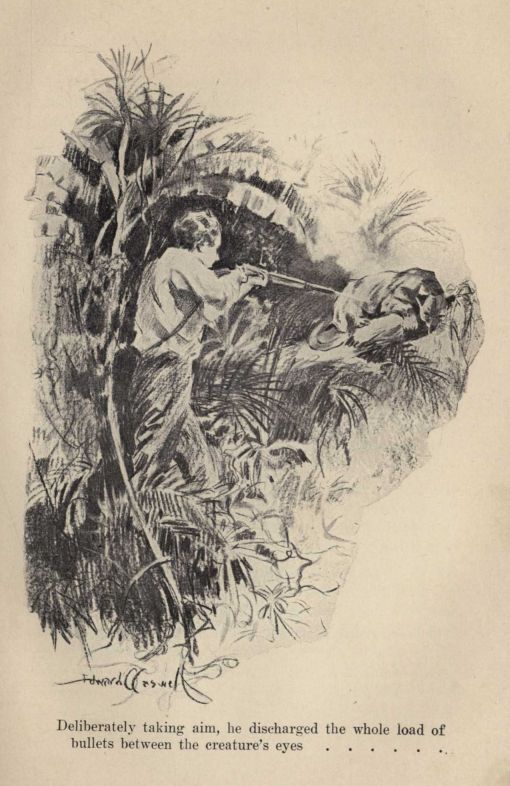
Deliberately taking aim, he discharged the whole load of bullets between the creature's eyes
Soon as it was indubitably dead, Robert went forward to examine it. He turned it over, felt its bony legs and compact body; looked at the terrible fangs from which he had made so narrow an escape, and, having satisfied his curiosity, attempted to take it upon his shoulder; but this was far beyond his strength--the panther was heavy as a large deer. He marked carefully the spot where it lay, and returning to the tree for his book and bird, hurried home, to tell the others of his perilous adventure.
Hardly had he come within sight, before Frank's quick eyes discerned him. "What!" said he, with a playful taunt, "only one turkey! I thought you would have had a house full, you staid so long and fired so often. Cousin Harold hardly knew what to make of it; he said he supposed you must have wounded a turkey; so I ran and let Mum loose to help you."
"I am glad you did," replied Robert, drawing a long breath, "for never in my life was I more in need of help."
"And you didn't get the other after all?"
"O, yes, all I aimed at. But something came near getting me, too. Where are Cousin Harold and sister?"
"In the tent."
Harold and Mary smiled with pleasure to see the fine bird on his shoulder, but could not understand the seriousness of countenance with which he approached. He related the particulars of his adventure, to which they listened with breathless attention. Mary turned very pale, Harold's eyes flashed fire, and Sam's white teeth shone in repeated laughs of admiration.
"How I wish I could have been with you," said Harold, looking mournfully at his lame foot.
"I wish you had been."
"That was a terrible moment, when you had fired your last barrel, and the panther was rushing upon you. You must have given up all for lost."
"No," replied Robert, "I felt myself tremendously excited, but had no idea of giving up."
"That is natural," said Harold. "No one ever gives up while there is anything to do. But do tell me, what did you think of? People can think so fast, and so powerfully, when brought to the pinch, that I like to hear all about their plans and thoughts. Tell me everything."
"From first to last," said Robert, smiling, "I thought of many things, but of none which I had time to execute, except to fire into his eyes, and club my gun. I first thought of running away, but not until I had stood so long that the panther seemed about to spring upon me. Then the idea occurred to me of trying the power of my eye, as father recommended about dogs; but I confess there was more power in his eye than mine, for I was badly frightened. My next thought was to take off my cap and rush upon him, as if that was some deadly weapon. I heard once of a lady in India, who saved herself and several others from a Bengal tiger, by rushing at him with an umbrella which she kept opening and shutting as she ran. There was another plan still, of a negro in Georgia, who fought and killed a panther with his knife. But," he continued, "let us talk a moment of the carcass. What shall I do with it; leave it there or bring it to the tent?"
"O, bring it, bring it, by all means," Harold replied; "I doubt not Cousin Mary and Frank will help you."
Mary was not at all pleased with the prospect of such unladylike business, and in consequence gave Harold a look of disapproval, which he affected not to see. She went, nevertheless, and the panther was soon lying before the tent-door. The rest of the forenoon was spent in flaying it, which they did with the claws, tail and ears attached; for Robert had remarked, that being compelled to imitate Hercules in destroying wild beasts, he had a fancy to imitate him also in his couch. While thus engaged, Harold asked for the story of the negro.
"It is not much of a story," said Robert; "I thought of it merely in connection with the rest. The negro was going to his wife's house, which was some miles distant from the plantation, and which made it necessary for him to pass through a dark, dismal swamp. Usually he passed it by daylight, for it was infested by wild beasts; but being a daring fellow, he sometimes went by night, armed only with a long sharp knife. The last time he made the attempt he did not reach his wife's house, and his master went in search of him. Deep in the swamp he had met with a panther, and had a terrible fight. Traces of blood were plentiful, and deep tracks, where first one and then the other had made some unusual effort. Near at hand lay the panther, stabbed in nine places, and a little beyond lay the negro, torn almost to pieces. They had killed each other."
"I wonder," said Harold, "that he did not carry a torch; no wild beast will attack a person bearing fire."
"Are you sure of that?" Robert inquired.
"As sure as I can be, from having heard of it often, and tried it twice."
Robert begged for the particulars.
"I went with my father and two other gentlemen, on a hunting excursion among the mountains, where we camped out, of course. One of the gentlemen having heard that there were plenty of wolves in that region, and wishing, as he said, to have some fun that night, had rubbed gum assafoetida upon the soles of his boots, before leaving the tent for it is said that wolves are attracted by the smell of this gum, and will follow it to a great distance. Now, whether it was the smell of the assafoetida or of our game, I will not pretend to say, but the wolves came that night in such numbers that we could scarcely rest. They howled first on this side and then on that, and barked in such short quick notes, that one sounded like half a dozen. Our horses were terribly frightened; we could scarcely keep them within bounds; and our dogs ran slinking into the tent with every sign of fear. The only plan by which we could sleep with comfort was by building a large fire, and keeping it burning all night."
"Did not the gentleman who was so fond of wolves go out after them?" asked Robert.
"O, yes, we all went, again and again, but the cunning creatures kept in the edge of the darkness, and when we approached on one side, they ran to the other. It was there I heard the other gentleman, who was esteemed a great hunter, remark, that all wild beasts are afraid of fire."
"I wonder why?"
"Night beasts are afraid I suppose, because they prowl in darkness; and as for the others, if they once feel the pain of fire they will be apt to keep out of its way."
"The other circumstance is this:--Last year I went on a night hunt, with some boys of my own age; and not only did we meet with very poor success, but for some hours were completely lost. About an hour before day I left the company, and returned home; for I had promised my mother to return by twelve o'clock. Before parting company, we heard a panther in the woods directly in my way, crying for all the world like a young child. The boys tried to frighten me out of my intention; but I told them that if they would only let me have a good torch, I should safely pass by a dozen panthers. It was full two miles home. The panther continued his cry until I came within a furlong, and then ceased. As I passed the piece of woods from which his voice appeared to come, I heard afar off the stealthy tread of something retiring, and saw two large eyes shining in the dark. I have always supposed that these were the eyes and tread of the panther, and that it was driven off by the torch."
CHAPTER XXVII
TURKEY-PEN--SUCKING WATER THROUGH OOZY SAND--EXPLORING TOUR--APPEARANCE OF THE COUNTRY--"MADAME BRUIN"--SOLDIER'S REMEDY FOR CHAFED FEET--NIGHT IN THE WOODS--PRAIRIE--INDIAN HUT--FRUIT TREES--SINGULAR SPRING
It would be useless, and perhaps tedious, to trace thus day by day, and hour by hour, the history of our young friends. We will now pass over an interval of nearly three weeks, from Saturday, November sixth, when Robert's contest with the panther occurred, to Wednesday, November twenty-fourth, when their affairs received another turn.
The only incident worth relating that occurred during this period, was the construction of a pen for entrapping turkeys. It was simply a covered enclosure, of ten or twelve feet square, with a deep trench communicating from the outside to the centre. This trench was made deep enough to allow a feeding turkey to walk under the side of the pen, and next the wall, inside, it was bridged over, so that the birds in running around the enclosure, after having entered, might not fall into the trench, and see their way out. This trap is planned with a knowledge of the fact, that though a turkey looks down when feeding, it never looks down when trying to escape. This is equally true of the quail or southern partridge, and perhaps of most of the gallinaceous birds. By means of this trap the boys took so many turkeys that they were at last weary of seeing them.
In the meantime Harold's ankle had become so nearly well, that for a week it had been strong enough for all ordinary purposes; and Sam's bones, though by no means fit to be used, were rapidly knitting, and gave promise of being all that broken bones can become in the course of a few weeks. No one had yet come to their rescue. Often had they gone, singly and together, to the flag-staff, and swept the watery horizon with their glass, but no helper appeared, and no sign. Robert and Mary had learned by this time to curb their impatience, and to wait in calmness the time when they should commence working upon their proposed boat.
From the first day that they found themselves shut up upon the island, Robert and Harold had meditated an exploration of the surrounding country, but had hitherto been prevented by various causes. Among these was Mary's excessive nervousness at the idea of being left alone, and particularly so after Robert's contest with the panther; but now she said, that with Fidelle to guard, and with Sam to shoot, exclusive of what she herself might do in case of an emergency, she gave her consent to the tour.
The stock of provision laid in by this time was quite respectable. Five deer had been killed, and their hams were now in the smoke, the company having in the meantime subsisted upon the other parts of the venison, turkeys from the pen, oysters, crabs, and fish. There were also fifty dried fish, two live turkeys, and four fat "pigs" (so called) in the cage, to say nothing of the stores brought from home. Before starting, the boys provided Mary with a large supply of wood for the kitchen and smoke-house, water also, and everything else which they could foresee as needful. They loaded the remaining guns with heavy shot, and laid them aside ready for use; and, moreover, offered to build for her a palisade around the tent, by driving down stakes, and wattling them with grape vines; but to this last Mary objected, saying she was ashamed to be considered so great a coward.
It was broad daylight on the morning of Wednesday, the twenty-fourth day of November, when they set out upon their tour. Robert carried the wallet of provision, consisting of parched corn, jerked venison, and a few hard crackers of Mary's manufacture; in his belt he fastened a flat powder flask filled with water, being the best substitute he could devise for a canteen. Harold carried the blanket rolled like a wallet, and Frank's hatchet stuck in his belt.
Willing to ascertain the coastwise dimensions of the island, and also the approaches to it from sea, they directed their course along the hard smooth beach, occasionally ascending the bluff for the purpose of observing the adjacent country. Their rate of travelling was at first intentionally slow, for they were both pedestrians enough to know that the more slowly a journey is commenced, the more likely it is to be comfortably continued.
At the end of six miles they plainly discerned the southern extremity of the island, lying a mile beyond, and marked by a high bank of sand, thrown up in such profusion as almost to smother a group of dwarfish, ill-formed cedars. Beyond the bluff they saw the river setting eastward from the sea, and bordered on its further side with a dense growth of mangroves. Satisfied with this discovery, and observing that, after proceeding inland for a few miles, the river bent suddenly to the north, they turned their faces eastward, resolved to strike for some point upon the bank. The sterile soil of the beach, and its overhanging bluff, which was varied only by an occasional clump of cedars and a patch of prickly pears, with now and then a tall palmetto, that stood as a gigantic sentry over its pigmy companions, was exchanged as they receded from the coast, first for a thick undergrowth of low shrubs and a small variety of oak, then for trees still larger, which were oftentimes covered with vines, whose long festoons and pendant branches were loaded with clusters of blue and purple grapes. About midway of the island the surface made a sudden ascent, assuming that peculiar character known as "hammock," and which, to unpractised eyes, looks like a swamp upon an elevated ridge.
Before leaving the beach the boys had quenched their thirst at a spring of cool, fresh water, found by scratching in the sand at high water mark, but which they would not have been able to enjoy had it not been for a simple device of Robert's. The sand was so soft and oozy, that before the basin they had excavated was sufficiently full to dish from, its sides had fallen in. Harold had tried at several places, but failing in all, he hallooed to Robert, whom he had left behind, to know what had been his success.
"Come and see," was the reply. Harold went, but saw nothing.
"There is my spring," said Robert, pointing to the end of a reed like that of a pipe-stem, sticking out of the sand. "Suck at that," he continued, "and you will get all that you want."
Harold tried it, and rose delighted. "Capital!" he exclaimed; "but how do you keep the sand from rising with the water?"
Robert drew out the reed, and showed him a piece of cloth fastened as a strainer on its lower end. "I have often thus quenched my thirst when fishing on our sandy beaches, and have never found it to fail."
"It is exceedingly simple," remarked Harold. "I wonder I never saw it nor heard of it before."
"So do I," rejoined Robert; "and yet I question whether I should ever have heard of it myself, had it not been for the Hottentots."
Harold's eyes opened wide at the mention of Hottentots, and Robert went on to say, "A year or two since, while reading an account of the suffering of people in South Africa for the want of water, and their various devices for obtaining it, I was struck with the simplicity of one of their plans. On coming to a place where the water was near the surface, but where they could not dig a well, they would make a narrow hole a yard or more deep, and insert a small reed having a bunch of grass or moss tied around its lower end. This reed they buried, all except a short end left above ground, and packed the earth tightly around it. Then they sucked strongly at the open end, and it is said that, if the earth was sufficiently moist and if the soil was not too close, the water would soon run through the reed, cleansed of its mud and sand by passing through the rude filter attached to its lower end."
"Whoever may have been its author, it is an excellent device," said Harold. "I shall not forget it."
At noon the boys seated themselves under a heavy canopy of vines, and ate their frugal dinner in sight of a luscious-looking dessert, hanging in purple clusters above and around them, which in its turn they did not fail to enjoy.
Resuming their journey to the east, they proceeded about a mile further, when Mum, who had trotted along with quite a philosophic air, as if knowing that his masters were intent upon something other than hunting, was seen to dash forward a few steps, smell here and there intently, then with a growl of warning to come beside them for protection.
"That is a panther, I'll warrant," said Robert. "At least Mum acted exactly in that way the other day when I put him upon the panther's track. Had we not better avoid it?"
"By no means," replied Harold. "Let us see what the creature is. We are on an exploring tour, you know, and that includes animals as well as trees. A panther is a cowardly animal, unless it has very greatly the advantage; and if you could conquer one with a single load of duck-shot when alone and surprised, surely we two can manage another."
"Yes," said Robert, "but I assure you, my success was more from accident than skill; and I would rather not try it again. However, it will do no harm to push on cautiously, and see what sort of neighbours we have."
They patted their dog, and gave him a word of encouragement; the brave fellow looked up, as if to remonstrate against the dangerous undertaking, but on their persisting went cheerfully upon the trail; he took good care, however, to move very slowly, and to keep but little in advance of the guns. The two boys walked abreast, keeping their pieces ready for instant use, and proceeded thus for about fifteen minutes, when their dog came to a sudden halt, bristled from head to tail, and showed his fangs with a fierce growl; while from a thicket, not ten paces distant, there issued a deep grumbling sound, expressive of defiance and of deadly hate. Harold stooped quickly behind the dog, and saw an enormous she bear, accompanied by two cubs that were running beyond her, while she turned to keep the pursuers at bay.
"We must be cautious, Robert," said Harold; "a bear with cubs is not to be trifled with. We must either let her alone, or follow at a respectful distance. What shall we do? She has a den somewhere near at hand, and no doubt is making for it."
Robert was not very anxious for an acquaintance with so rough a neighbour, but before the fearless eye of his cousin every feeling of trepidation subsided, and he was influenced only by curiosity, which, it is well known, becomes powerfully strong when spiced with adventure. They followed, governing themselves by the cautious movements of their dog, and able to catch only a casual glimpse of the bear and her cubs, until they came within thirty paces of a poplar,[#] five feet in diameter, with a hollow base, into which opened a hole large enough to admit the fugitives.
[#] Tulip tree (Liriodendron tulipifera), called poplar at the South.
"There, now, is the country residence of Madame Bruin," said Robert, stopping at a distance to reconnoitre the premises. "Shall we knock at her door, and ask how the family are?"
"I think not," replied Harold, "the old lady is rather cross sometimes, and I suspect from the tones of her voice she is not in the sweetest humour at the present. Take care, Robert, she is coming! Climb that sapling! Quick! Quick!"
The boys each clambered into a small tree, and as soon as they were well established, Harold remarked, "Now let her come, if she loves shot. A bear cannot climb a sapling. Her arms are too stiff to grasp it; she needs a tree large enough to fill her hug."