"Every Day Life of a Soldier" (continued 4)
Reading edition
“The dogs were taken out of the cage, the brindle and the white being carried out of the amphitheatre on a litter, the tiger never taking his eyes off them all the time. The black dog was able to walk away, though sadly mangled. The tiger, after the departure of his visitors, walked about his cage in his ordinary way, as though nothing had happened to him, although he must certainly have felt sore about the flanks and hind-quarters. The fight lasted altogether about twenty minutes.”
Chapter Twenty Three.
There through the piny forest half absorbed, Rough tenant of these shades, the shapeless bear ... stalks forlorn; Slow-paced and sourer as the storms increase, He makes his bed beneath the inclement drift, And with stern patience scorning weak complaints Hardens his heart against the assailing storms. Thomson.
My friend the sergeant had, at some period prior to his enlistment into our corps, been to the gold diggings in California, probably from Mexico, where I believe he was born of English parents, though nothing could be ascertained in regard to his origin. The stories he told at various times would have filled a tolerable sized volume, and, had I ever thought of writing these pages, I would have preserved notes of his most interesting adventures, which he was ever ready to relate to us, either in barrack, camp, or on the line of march.
One particular story, in reference to trapping a grizzly bear, I have heard him relate so often that I can repeat it in almost his own words.
My readers should first be informed that the grizzly bear is the largest and most powerful wild beast that ranges the wilds of North America. The early pioneers of the route across the Rocky Mountains to Oregon and California, told of the wondrous size of these animals, and their reports were looked upon as fables until later research confirmed their truth.
The grizzly is found throughout the whole range of the Rocky Mountains from Mexico to British Columbia, but he attains the largest size in New Mexico and Upper California. Unlike most other bears, the grizzly cannot climb a tree; the method of hunting him is mostly with dogs trained for the purpose—a pack, consisting of a dozen small terriers and four large mastiffs or bull-dogs, being best suited for the sport, if sport it can be called, which involves so great a risk of life. This bear, being a heavy limbed and sluggish brute, seldom travels far from his wonted haunts, although he can go very fast when pressed or in pursuit of his prey, of which he is not very particular in the selection. Buffalo, wild horses, deer, or man, are alike acceptable to him. He will crush in the head of the largest buffalo with a single stroke of his paw, and, throwing it across his back, carry it for miles to his lair.
The sergeant stated that the Indians talk of bears of this species that have inhabited the same region for many years, and, as they live in deadly fear of the monsters, the advent of a party of grizzly-hunters is most welcome to them, and they willingly render all the service in their power in the hunt, but retire in fear when the game is brought to a stand. When pressed by hunters, the bear generally takes refuge in a thicket of bushes among the rocks, where it is hardly possible to get a shot at him; and, indeed, it is of little use shooting at this stage of the hunt, for, unless you can hit him in the eye, his skull will turn an ounce bullet as if it were a putty-ball. The skin is so thick, and so well covered with hair and fur, that it is almost impenetrable, and, unless you can hit him just beneath and behind the shoulder, you might as well spare your powder.
When his retreat is discovered, the large dogs are held fast and the little terriers turned into the thicket; they yelp, snap at his heels, then fall back to avoid the strokes of his paws. Thus they worry and tease him for hours. Meanwhile his roars of anger, loud as thunder, seem to shake the very earth; sometimes the small dogs approach too near his head, and receive the penalty of their temerity in the form of a stroke which leaves them a mangled and lifeless mass, bearing little resemblance to the canine species. When the bear becomes completely tired, he seats himself upon his haunches, and turns this way and that, so as to always keep his face to the dogs. Now a hunter creeps stealthily up and endeavours to plant a ball in a vulnerable spot. If he succeeds in getting a clear sight of the bear, he generally wounds him, and he then breaks cover. The large dogs are now loosed, and fasten on him in the rear; the riflemen drop their shot at him, taking care to miss the dogs.
It often requires hours to overcome the monster, whose tenacity of life is most wonderful. This is accounted for by the fact that the heart of the bear is thickly covered with fat, which prevents its bleeding; there is also a coat of fat just beneath the skin, which closes after the passage of the ball and prevents the blood flowing.
The sergeant used to commence his story as follows:—
“In the autumn of the year 1846 (being then only seventeen years old), I was encamped with a party of gold-diggers upon the head of the Sacramento River, at the western base of the California range of mountains. Our party consisted of a dozen men, myself being about the youngest; we were living in a small cabin constructed of poles and logs, and a happy, merry lot we were. All were engaged in washing the glittering gold-dust from the bed of the river, save a friend and myself, who were assigned the duty of victualling the camp with game and fish, now and then making a trip of four or five days’ duration to a trading port about sixty miles down the river, for tea, sugar, ammunition, etc. My friend, a young Irishman, generally went with me; we rode a couple of mustangs (horses bred in a wild state), and led or drove two pack-mules.
“The ‘Emeralder’ and myself had formed a project to secure a menagerie of wild native animals, and adjoining our lodge we had a large cage, in the compartments of which were wolves, foxes, California lions, pumas, panthers, and a host of smaller fry, including birds. These we had, for the most part, secured when very young. We had long been most anxious to get a specimen of the ‘grizzly,’ but all our efforts in that way had failed. One morning, while we were at breakfast, a Mexican hide-dealer, who lived in a cabin a few miles from us, and from whom we had purchased several animals, called on us accompanied by four or five half-naked Indians, and told us that a large ‘grizzly,’ called by the natives ‘Mountain Thunder,’ had come down from the hills during the night and made a supper of a fat ox belonging to the Mexican. The Indians we had met in our hunting excursions had frequently told us of this monster. According to their reports he must have been near one hundred years of age, and of a size that a bear had never before attained. Their fathers had known that he lived years before they were born. This was not unlikely, for bears live to a great age; even in captivity they have been known to live a hundred years. We set out for the cabin of the Mexican. Near the house was the cattle-yard, the scene of the last night’s affair. The yard covered an area of about an acre, surrounded by a stout fence formed of large poles or stakes driven into the ground, and about ten feet high; within this the stock were all driven at night to preserve them from the attacks of bears, wolves, etc. On the side of the yard farthest from the dwelling, Bruin had made his entrance and left full proof of his strength behind him. Three or four large posts, about twelve inches in diameter, were torn from the earth in which they had been firmly planted to the depth of four feet; one had been broken at the surface of the ground, apparently by a stroke of the bear’s paw, as the indentures of his claws were an inch deep in the solid timber.
“After seizing the ox, he had thrown him on his back and decamped. We followed his track up the banks of a small stream towards the mountains for some miles. I measured the prints of his hind-feet in the soft clay, and found they were eighteen inches in length from the heel to the mark of his claws, and a little over nine inches wide.
“As we ascended the stream the course became more narrow and rocky, with a dense thicket of rough bushes clothing the hills on each side. Here the bear had made his feast; a few bones, horns, and hoofs, were all that was left, the wolves having eaten what the bear had left; some of the larger bones had been crushed like straws by his powerful grinders. After his brief banquet he had taken to the hills, where the party, with the exception of the Emeralder and myself, declined to follow him. After a brief consultation we determined to capture the ‘grizzly’ alive, if possible, and we set out on our return to our own cabin to complete our arrangements. The idea was scouted by our companions, but we determined to make the attempt. We felt sure, from the many footmarks, that the ravine was a favourite walk of the bear, and that he would return to the cattle-yard again in the course of a few nights. Loading our mules with tools at the lodge, we returned to the ravine and selected a suitable place where timber was plentiful. We then set about felling trees, and constructed a pen of logs about twenty feet square and six feet high, covering it with large poles, all firmly pinned together, and lashed with the bark of the ‘leather wood.’ It was midnight when we completed our task, and we could take no further proceedings that night. The next morning we returned, bringing with us a yearling heifer as a bait. We now raised one side of the pen about four feet, and placed a ‘figure four,’ or what is there termed a ‘dead-fall’ trap, beneath it, so arranged that, by pulling a cord attached to the ‘spindle,’ the edifice would come down with a run. We next staked the yearling under the cage, giving her plenty of grass, and led our cord out several yards down the stream, making it fast to a small tree which commanded a view of our trap, and in the branches of this tree one of us was to remain, ready to pull the cord, each night, until Bruin was captured. We fitted up a dry cave with buffalo-skins, near by, as a sleeping apartment.
“We watched two nights without success, passing a portion of our time in the day, when not sleeping, in fishing, cooking, and cutting grass for the heifer. About the middle of the third night, I was perched in my tree—the Emeralder had just retired to rest—when I heard a rustling of the bushes on the hill-side above me, and a low growl, which was unmistakably a signal of Bruin’s approach. My companion heard it as well, and put his head out of the cave. I motioned him to remain quiet. Soon the bear came slowly down into the ravine below me, and walked into the water-course to drink. When he emerged from the shelter of the bush into the bright moonlight, I was astonished at his size; he seemed like an elephant cut off at the knees. He took a drink, snuffing the water and the air around him, as if his instinct told him all was not right. I was fearful that he would go down the stream towards the Mexican’s cattle-yard, and thus we should lose him.
“The proximity of the bear alarmed the yearling; as if from instinct, she gave a low bellow of terror. Bruin caught the sound, and started off in a trot in the direction of the trap. He passed directly under my perch, stopping for a moment as if he scented me, which he no doubt did; and if I was not frightened, I certainly felt better when he moved on. I watched him until he reached the cage, around which he walked to reconnoitre. His love of veal soon overcame whatever scruples he might have had as to the nature of the structure, and my heart went pit-a-pat as I saw him stoop and crawl under the raised side.
“I waited until I heard the doomed calf’s bellow of pain; then I gave the cord a strong pull. With a crash, the machine came down; and the bear gave such a roar as I never heard before, or care to hear again. He made good his Indian title of ‘Mountain Thunder.’
“The terrible sound rolled down through the ravine, and was echoed from hill to hill like the reports from a battery of artillery. Wolves, panthers, and hundreds of birds answered the sound with screams of terror in every direction. In a trice my mate and myself were on the spot, shouting with delight at our good fortune. We drove some large stakes, which we had previously prepared, into the earth, and lashed our cage firmly to them.
“Meanwhile, the bear was rushing about the trap, tearing and crushing the poor yearling to atoms, biting and breaking the timber which had formed the ‘figure four,’ as if he knew it was the author of his woes. We made a fire, and watched by him until morning. By this time he had found all his efforts to escape futile, and he stood in a corner of the cage with his nose to the ground in sullen silence.
“At daylight my mate left me on guard, while he returned to the cabin to make arrangements for moving him. Towards mid-day the bear ate up what was left of the calf, and laid himself down, first scratching a large hole in the ground, in which he wallowed like a pig. I had a visit during the day from the Mexican and Indians, who were much astonished and rejoiced at our success.
“The second day after the capture, the Emeralder returned with our friends from the cabin, who were wonder-struck at the huge size of our prize. They brought with them a large cage constructed, at the cabin, of heavy bars of lancewood, rudely but strongly secured with iron. It was mounted upon one of the heavy waggons we had brought from Saint Louis across the plains, and drawn by six oxen.
“We managed to fasten the bar into one side of the trap by shoving poles through; then we cut an opening in the other side big enough for his egress. We then sank the wheels into the soil, bringing the door of the cage down to the opening of the trap; then, by using burning firebrands, we forced Bruin into the cage on the waggon, and secured him.
“Over a bottle of whisky we christened him, in our style, after his Indian name, ‘Mountain Thunder,’ by which title he was afterwards well known throughout California. We gave him some water, which he drank eagerly; and, after satisfying himself of the strength of his new lodgings, he lay sullenly down, and gave no further trouble. On reaching the cattle-yard, we gave him the carcase of a sheep, which he soon ate up, bones and all. In a few days after our arrival at the camp, the bear appeared perfectly reconciled to his new position. He ate, drank, and slept well, and at times appeared inclined to gambol, if he had room enough.
“The Emeralder and myself, a few weeks after the capture of the bear, bade adieu to our gold-seeking friends, and with a small train of wild-beast waggons took our line of march for Sacramento City, where we made plenty of money by exhibiting our menagerie.
“While there a Mexican butcher made a wager that his six large bull-dogs could ‘flax out’ ‘Mountain Thunder.’ A huge amphitheatre was constructed, and Bruin turned loose; we had over one thousand visitors that day, at one dollar per head. The six dogs, of the largest size, trained and used to throwing wild cattle on the plains for the butcher’s knife, were turned in and resolutely attacked the bear with great pluck. In about six minutes six mangled masses of dog’s meat were strewed about the amphitheatre, while the bear had not a visible scratch. ‘Mountain Thunder’ was weighed at Sacramento, and found to pull down eighteen hundred and sixty pounds.
“We next went to San Francisoo, where we reaped a rich harvest, and afterwards shaped our course for the city of Mexico, where ‘Mountain Thunder’ fought a battle with a fierce Spanish bull in the bull-ring. The bull gored him slightly in the mouth, which enraged him to the highest pitch of ferocity, and giving him one blow of his paw he sent him flying across the ring, with his back and shoulder broken and his ribs crushed in. The bear performed a similar fête at Vera Cruz, where he was shipped for New Orleans. Here we chartered all the ferry-boats plying between New Orleans and the opposite side of the Mississippi for one day, and leased the race-course at Algiers for the same period. We then advertised that ‘Mountain Thunder’ would fight a bull on that day, and the speculation turned out a success. I first thought the bear would be killed, he appeared so very slow and stupid. The bull, a large and fierce black one, plunged his horns against his ribs, nearly upsetting him; even then he did not seem disposed to resent it, and not till he came again did he show signs of pluck; then as the bull came bellowing on, with eyes flashing fire and head to the earth, Bruin coolly raised one paw and struck him between the eyes. The blow was terrific; blood and brains flew from his ears and nose, and on examination it was found that the entire front of his skull was crushed in and his neck broken.
“The Emeralder and myself finally sold ‘Mountain Thunder’ to winter in a museum at Cincinnati; the various other animals and birds were also taken at a good price by the Curator. We divided the money equally, and found ourselves in possession of thirteen hundred pounds each.”
Chapter Twenty Four.
Portance in my travels’ history; Wherein of antres vast and desarts idle, Rough quarries, rocks and hills whose tops touch heaven, It was my wont to speak. Shakespeare.
“Having done so well with our wild-beast speculation, we determined to return to, the Rocky Mountains on another cruise after bears, panthers, or anything we could manage to secure likely to make money.
“Providing ourselves with stores, ammunition, etc, we set out with a train of four waggons and eight horses. Two of these waggons were constructed for the safe keeping of wild animals: one was laden with stores, and the other was a covered van to live in.
“We engaged two assistants, named respectively Jake Barnes and Pete Tonsley. Onwards we trudged, slowly but surely, over our, at times, uncertain track in the wilderness. Jake and Pete, who were two overgrown lads, were continually breaking away into the bush after birds of beautiful plumage, which were continually flitting across our path, and armed with short pieces of stick they killed many that were valuable for the sake of their skins. Pete was the wildest of the two, and we had on several occasions to halt for hours awaiting his return ere the night set in. On one occasion Pete had been away most of the afternoon, promising before he started to take his bearings properly, and keep the smoke from the chimney of the caravan in sight; Jake, whom he left behind, promising to feed the fire well with green leaves, in order to make the smoke more dense.
“It was fast growing dark, the smoke was no longer visible, and we had reached a thick piece of wood where, Pete being still absent, we determined to come to a halt. Rifles were fired, and we had all shouted until we were quite hoarse. Poor Pete was evidently lost in the bush, or had fell a prey to panthers, or perhaps Indians. We determined to find him dead or alive, if possible. Feeling our way through the bush, each with a lantern and candle, Jake and I started in search of our missing mate, leaving the Emeralder in charge of the waggon-train. We had not proceeded far when a series of screams and smothered sounds, as if produced by some one in great distress, reached us from a point not far from our left.
“‘What’n all creation’s that?’ said Jake, coming to a sudden halt.
“‘Indians,’ said I, looking ahead as far as I could.
“‘Ingins! No, sir, it’s Pete; and that’s somethin’ a-hurting him. Let’s run out that way,’ said Jake.
“‘H-o-o-o-o! bah-h-h! he-e-e-oy! murder-r-r! hoo-o-o-oy!’ came the sounds, so thick and fast that it was scarcely possible to distinguish any space between them.
“We dashed off towards the point from whence the sounds issued.
“‘Bla-a-a-blah! bla-a-a-bloo! ho-o-o-oyh!’ went the sufferer, if such it really was, and ‘ipitty-tip’ through the thick shrubs went Jake and I, now nearly out of breath. Nearer and nearer came the sounds, until presently the light of a fire broke in upon our visions.
“‘What kin all this mean, guvner?’ said Jake.
“‘It’s an Indian decoy. We’re in for a fight,’ said I, loosening my bowie-knife.
“‘No. Don’t think it’s Ingins; tha wouldn’t a’ kindled a fire that-a-way. No; can’t be Ingins! ’Sides, tha is friendly now,’ said Jake, as he dodged behind in my footsteps, striving to appear brave.
“At length we reached within hail of the fire, but, although the sounds of distress continued, we could perceive nothing beyond a log and a little brushwood around it on fire. Not a human form was visible; yet the strange sounds came forth as fresh as formerly, and, what was more unaccountable, they appeared to issue immediately from the fire. What was it?—the Evil One, or an Indian decoy, surely, for, as the fire was not larger than a bushel measure, we believed that no creature with life could be in it.
“While we stood gazing, first at the fire, then at each other, Jake’s face, naturally dark, but now darker than usual, became suddenly lightened as with a new idea, and away he bounded to the other end of the log farthest from the fire.
“‘Claw away the fire! claw away the fire!’ shouted he, springing towards the end of the log, which the brushwood had set on fire and burnt away about a foot. I did not know what he wanted the fire ‘clawed away’ from, but I fell to work, and very naturally clawed it away from the log. ‘Wait’ll I come back with an axe,’ said Jake, bounding off towards the waggons, and leaving me alone beside the log, which was hollow and contained something alive—evidently a man—perhaps poor Pete; but the whole circumstance was wrapt in such a great degree of mystery that I could not attempt to unravel it, especially as the sounds of distress had ceased. Presently, Jake returned with a sharp axe, and, mounting on the log without saying a word to me, he brought the implement down with such force as to send the great chips whizzing in every direction.
“Suddenly there appeared something black; Jake had cut through. He stopped, raked the chips away with his bands, and peered into the hollow; a simple glance seemed, to satisfy his curiosity, and, leaping upon the log some six or eight feet farther back from the fire, he fell to chopping again with as much eagerness as before. In a little while the hollow appeared at that point, and then he commenced to split out the block between the two holes. A few strokes started a crack. A few more, very cautiously dealt, and out tumbled the block, as if a box-lid had been suddenly opened, leaving exposed to our wondering gaze the body of a man.
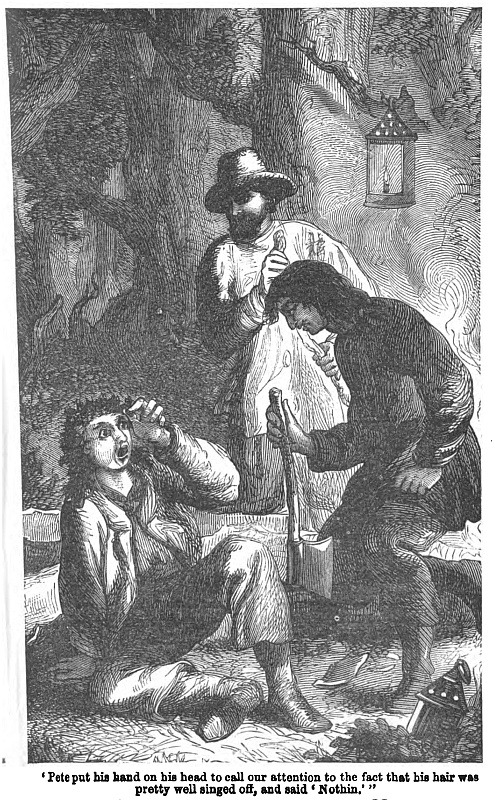
“‘Pete Tonsley, as I live!’ said Jake. ‘Pete, what in thunder are you doing here?’
“Pete rolled over two or three times, put his hand on his head to call our attention to the fact that his hair was pretty well singed off, and then said—
“‘Nothin’.’
“‘Wal, I think ye wasn’t a doin’ nothin’ only a-hollerin’,’ continued Jake; ‘and if we hadn’t just a-heard ye, ye wouldn’t soon a’ bin doin’ that. But tell us how ye come to be in that thar log?’
“‘Wal,’ said Pete, ‘I sees a ground-hog (hedgehog) a sort o’ slippin’ across this way, soon after I left the track this afternoon, and we had a mortal tight race out to this log here, and then it got here first, and got away. When I sees what the thing went and done, my dander riz, and sez I to myself, Pete Tonsley ’ll show you how to slide into a log next time; and then I kindles a fire up in the holler at this end of the log, a-thinkin’ I might smoke the varmint out at t’other. Wal, I smoked, and I smoked, but nary a ground-hog could I see come out, and then sez I to myself, it might be that the “wood chuck” had slipt out while I was lightin’ the fire, and I had best be going back to the track afore it gets dark. But I didn’t like to be beat by a ground-hog, so I got a long pole and punched into the log at t’other end, but nary nothin’ would come out, though it struck me I could feel it, and once I thought I heard it chatter, as if a sorter a-darin’ me. That made me mortal mad, and, seeing as how the holler was big enough to creep in at yon end furthest from the fire, I lay down, grit my teeth, and slid in, determined to fetch out the varmint, dead or alive. I wound into the log right up to the fire thar, and seed it was all a mistake. I could feel nary a ground-hog in it, and then I began to hitch back feet foremost, but one hitch was all I could make, for just as I was making the second scrouge out, a knot, or a sharp sliver, or somethin’ catched into the seat of my britches, and held me as tight as a wedge. The britches bein’ new, I could not tear loose. I kickt and I cust, and squirmed around in the log for some time, and then I found one of my legs got fast too. It seemed a funny thing at fust to be in this fix, but when the fire begun to blaze in at the end of the log thar, and to creep atords me, I kinder got to feelin’ very oneasy, and when it got right up, and kotched the handkerchief what I tied around my head, I felt mortal skeered. When it came to singin’ of my har, I began to holler, and that’s what brought you out here, I reckon.’
“It was a lucky moment for Pete that we found him, for fire in ten minutes more would have sent him to his long home.”
With these two narratives of the sergeant’s adventures abroad, I must close my remarks concerning him. How he lost his money, got into the Spanish service, and eventually in the British army, he never appeared ready to explain.
Chapter Twenty Five.
Hear the shrill whistle, which doth order give To sounds confused; behold the threaden sails. Borne with the invisible and creeping wind, Draw the huge bottoms through the furrow’d sea, Breasting the lofty surge. Shakespeare.
Beyond the ordinary routine of barrack life, and the every-day duty of a dragoon, nothing very remarkable occurred during my term of service, in addition to what I have related, until the embarkation of my regiment for active service in the Crimea.
The reader will please to observe that I had never before been on a campaign, and the regiment in which I had the honour to serve had never been particularly distinguished in battle for a period of more than twenty years. It had been well understood for years, that whenever a serious war was declared we should be first on the roll of regiments for service. In fact, we had twice been under orders for India—once during the Affghanistan campaign in 1841-2, and again when the Sikh war broke out—but the cavalry already abroad turned out a sufficient force for the purpose.
I may safely remark that three-fourths of the soldiers in the British army would sooner serve on a campaign than endure the monotony of life in a barrack. The former kind of service is just the sort of life for which all really good men join the army. There are many very respectable, educated men serving in the ranks of our dragoon regiments that would cheerfully endure the hardships of a campaign and the privations of a camp life, surrounded by danger, disease, cold, hunger, and even death, in preference to years of drudgery and comparative inactivity in barracks.
It is wonderful to see with what rapidity the ranks of a cavalry regiment proceeding on active service are augmented from other corps not under orders to serve. As may be supposed, when a regiment is told off for service abroad, there are numbers who are physically incapable of enduring the change of climate, and others whose term of service having nearly expired, with other considerations, render it advisable for commanding officers to reject them; consequently, their places have to be filled up by a system of volunteering from other regiments.
On such occasions, orders are sent to the commanding officers of those corps remaining at home to supply a certain number of good men. These orders are read out to the soldiers when they assemble for roll-call at evening stable hour. The regiment, with the locality to which it is proceeding, and the nature of the service in which it is expected to be engaged, together with the number of men required, is distinctly specified; after which, it is stated that “those men willing to serve will step forward.” Instantly the words are delivered there is a rush to the front of many more than is required. In my opinion, nothing can be more noble: there stand the gallant fellows ready to sacrifice a life of comparative ease for hardships, danger, and, probably, death in a foreign land.
I have frequently noticed that the men so volunteering are chiefly the most intelligent and best soldiers in the regiment—men who, having enlisted as soldiers, wish to fulfil the purpose for which they joined the army, and not the idle “skulks” who enlist, thinking that a soldier’s life in barracks is easier than the occupation in which they are engaged as civilians.
By this system of volunteering, the best men and willing hearts have ever been secured for the desperate struggles in which they have from time, to time been engaged. The amount of enthusiasm which pervades the army and the greater part of the population on the declaration of war, is a striking instance of the bravery of the British race. The deserving soldier—always well treated by civilians in England, Ireland, and Scotland in time of peace—is absolutely idolised when proceeding on or returning from a campaign. I perfectly remember the—I might almost say—triumphant march of a portion of our regiment from barracks for many days, on our way for embarkation at Plymouth. The country people cheered us, shook hands, clung to our stirrups, gave us tobacco, and, at times, too much drink. The ladies—high, low, and middle-class—waved their handkerchiefs, threw us kisses, “wished they were going with us,” and many made us handsome presents of money, rings, etc. We were all in good health and spirits, and our horses fresh, sound, and full of spirits.
In this order we entered Plymouth, and were rapidly embarked aboard three transports, and sailed the evening of the day we arrived, amidst many a round of hearty cheers from the thousands of people who crowded on the beach.
Nothing very extraordinary occurred during the voyage to Varna, except that many of our men were dreadfully sea-sick, the nature of our duty on board rendering it impossible for us to lie down, which is the only effectual remedy for sea-sickness.
I was fortunate enough to obtain a mixture, containing a few drops of chloroform, from our surgeon, and I scarcely felt the effects of the buffeting which the vessel sustained a few days after we were fairly out at sea. The horses were sadly crowded, and many suffered from want of exercise and ventilation, a little nitre being served out to us in order to be mixed with the bran mashes, and their eyes, nostrils, and face being regularly sponged with sea-water, at stable hours, tended to refresh them and to allay inflammation, the most frequent of all disorders to which troopers are subject when confined for any length of time aboard ship. I have made no remarks in reference to my personal feelings on leaving friends and relatives in England, for by this time I had many comrades in the regiment to whom I was as much attached as to anyone else, except my mother. It was owing to no want of affection to the latter that, although I could have had a short “pass” before I left the country, I did not visit her. I knew she would feel it very acutely, and that the little word “good-bye” at parting would have been ringing in my ears during many a weary march.
I saw many a heart-rending scene on leaving barracks, along the line of march, with the friends and relations of our men resident in those country parts, and towns we passed through on our way to Plymouth, and on the evening of our embarkation. Therefore I was not sorry that I had not gone through the ordeal, for, like many of my comrades, I might, even in the garb of a soldier, have betrayed the weakness of a man.
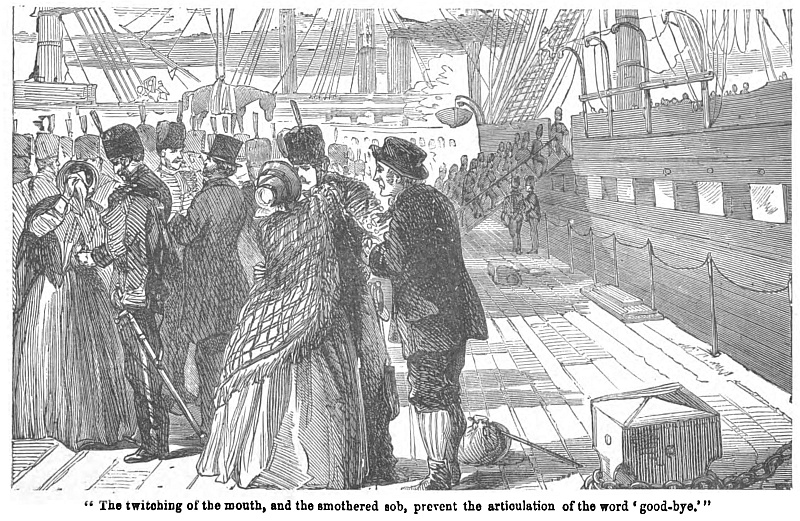
The anticipation of a severe engagement and the shock of battle itself is nothing to the very trying ordeal of parting with a dear friend, probably for ever. The piercing screams of mothers, sisters, sweethearts and wives, are usual concomitants of the embarkation of British soldiers on active service. The grasp of a father’s or brother’s hand as they linger on the pier, the steady gaze into the soldier’s eye, the twitching of the mouth and the smothered sob, prevent the articulation of the word “good-bye!” The soldier’s natural pride mostly predominates over tears, and the display of sorrow indulged in by civilians under similar circumstances, but although I did not subject myself to the ordeal of such a leave-taking, I felt deeply for certain of my comrades, who, although as brave soldiers as ever leaped into a saddle or drew a sabre in action, were utterly prostrated with grief after leaving their friends on the beach.
This kind of grief proceeds from a sort of sorrow at having been the cause of suffering to those you love dearly and leave behind. For this I have sometimes thought the soldier is to blame, because, in order to gratify a roving disposition, or other causes, he leaves his home, blasting the hopes of a father who may have given him a good education, and looked forward to the time when the boy grown into a man may be a prop to him in his declining years. He tramples upon the deep and true affection of a mother, and throws to the winds the kindly words and devotion of his brothers and sisters. Next to a soldier’s mother, nothing on earth is more dear to him than a sister. Women are invariably fond of soldiers: some like them simply for their gaudy attire, others adore them for their splendid figure, but every woman respects the soldier who risks his life in the service of his country. The last to bid him adieu and the first to welcome him home will be the soldier’s sister, if he is blessed with one. The mother may be dead, the father hastening to the grave, from old age and infirmities, but if there is a sister alive, she will always welcome to the most humble cot her gallant soldier-brother, when, suffering from wounds and broken down in constitution, he returns from the wars. Thousands of men (I am too well aware) live and die regardless of the affections of mother, father, brother, or sister, but the majority of our brave fellows in all ranks of the service retain the affections and associations inculcated during early youth.
Superior intelligence in the soldier is as great a recommendation as mere brute strength, and, let the discontented say what they please, the duty of a soldier will never deaden the feelings of a man, who during the most arduous and dangerous campaign can always find time to think.
I never was fond of preaching morality to others. Always cheerful and fond of company, I would never debar the soldier from enjoyment, either in or out of barracks. I do not mind confessing that I have had many a “turn up” with policemen, especially when those so-called “guardians of the peace” have attempted to take an unwarrantable liberty with a comrade. But to those “ruffians” in the uniform of soldiers, who constantly figure in our police-courts on the cowardly charge of fighting with their belts and indiscriminately striking civilians in the streets with the frightful weapons, I would say, “You are no soldiers.” Indeed, the whole term of the service of such men is not worth a day’s pay. They are only the refuse of society, who have foisted themselves upon the public service with no other object than that they fancy they can eat the bread of idleness, and be better clothed and lodged than by remaining civilians. In the latter case, they would become a burden to the country through being lodged in some gaol or transported, and in the army they are not only a disgrace to their corps in time of peace, but are always the first to scheme and skulk when any fighting or long marching has to be done.
Such characters would laugh at and deride any display of affection, simply because they never knew it. They would ransack a cottage when campaigning, abuse the inmates, break up the furniture through sheer wantonness, and commit all sorts of frightful excesses; but show them an enemy in force, let the trumpet or bugle sound the “advance,” and they are the first to show the “white feather.”
Your genuine blackguard, whether he be a “rough” in a London mob, or a soldier in the ranks, is invariably a coward when he is equally matched. All attempts to reform him by discipline, good advice, and kind treatment, will fail in making a bad man good, but fear of death and the “cat-o’-nine-tails” will make him the most abject wretch alive. Lash him to the halberds after a drum-head court-martial on the line of march and he will writhe about like an eel, and scream like a jay before a lash is laid on his back. I am no advocate for flogging in time of peace, but if it were abolished in time of war, the gallows and the gibbet-post would have to be substituted. A long campaign with plenty of fighting is, however, the best purgative to get rid of these characters, because none of them will enlist or volunteer in time of war; those already in the service will desert or contrive to be taken prisoners if they can, and those who remain in the ranks are kept to their duty by the aid of the “cat,” without which I am certain they would neither march nor fight, but always be ready to plunder, and disgrace the British name.
To return, however, to our voyage. The men regained their usual spirits in the course of a few hours, and as the three vessels, which had embarked the greater part of our men and horses, sailed out of the Sound on a beautiful evening in the early part of May, 1854, the joke and song, with the merry laugh at some attempts to dance, told plainly that there was more of gladness than sorrow on board our transport. The sailors especially were very pleased with our company: they donned our clothes, examined our arms, patted our horses, and would have jumped on their backs had they been allowed. After we had been at sea a couple of days a stiff breeze sprung up, and many of the men being unable to drink their daily rations of excellent rum, the sailors tossed theirs off instead, with many a wish for their safe return from “a-lickin’ the Roosians.” The weather was, however, on the whole favourable, and the men having quite recovered from sickness, before a week had passed were enabled to drink their own rum and eat their rations with amazing relish; indeed, food is never so enjoyable as after a recovery from sea-sickness.
Chapter Twenty Six.
Now all the youth of England are on fire, And silken dalliance in the wardrobe lies; Now thrive the armourers, and honour’s thought Reigns solely in the breast of every man. Shakespeare.
About sixteen days after leaving Plymouth, the vessel I sailed in reached Scutari, where we found one of the transports had arrived nearly a day before us; the other had not come in, but arrived in about twelve hours after us. Many regiments of infantry had a couple of months prior to our arrival landed at Malta, from whence they had sailed for Gallipoli, where they met the first instalment of our allies—the French and the Turks.
The change of climate had already sown the seeds of disease among the infantry, and many who arrived at Gallipoli from Malta got no farther and never came back. The number of our infantry landed at Gallipoli was considerable, consisting of the 93rd, 41st, 77th, 88th, 33rd, 28th, 44th, and 60th regiments, and a portion of the rifle brigade. In addition to the above, about 20,000 French and a large Turkish force had been encamped in the neighbourhood. The commander-in-chief, Lord Raglan, with a portion of his staff, arrived at Gallipoli early in May, and the Duke of Cambridge was only a few days behind him. General Sir George Brown and a numerous staff came out with the first expedition, and the French commander-in-chief, Marshal St. Arnaud, General Canrobert, Prince Napoleon, etc, also sailed, viâ Gallipoli, where they reviewed and manoeuvred the French troops prior to their moving to Scutari, where I first saw them, and it was interesting to witness the curiosity with which some of our men eyed the French infantry, particularly the Zouaves. At first sight the Zouave strikes you as being a native of India, being a deep copper colour, with a flowing beard and huge moustachios. Many suppose them to be Arabs, but the majority are of pure French descent, and I more than suspect that they dye their skin with some liquid to darken it, and give them a more picturesque appearance. Their uniform is loose and easy, forming a striking contrast to the buttoned-up straight-jacket style with which our soldiers are encased and encumbered. The height of these Zouaves runs from five feet four inches to five feet seven inches, and they are proportionately stout and well made, with wiry wearing limbs, and a quickness in their eye and every movement that many of our crack infantry regiments would do well to emulate. They wear a red cap and tassel, in addition to which they have several folds of cloth round their head, altogether forming a sort of turban. Their jackets are blue with scarlet facings; they have also a scarlet waistcoat and a sash to fold several times round the waist. They wear no stocks, and their necks are quite bare; their trousers are red and made very wide, reaching only as far as the knees, where they are met by a sort of yellow gaiter, reaching to the shoes. They regarded a party of ours with as much interest as some of our fellows did them, being particularly struck with the weight of our swords and the pure whiteness of our belts. One of our men remarked, while eyeing over a little consequential fellow (who seemed particularly busy, thrusting his hands into our sabretaches, ostensibly to examine them, but probably for plunder), that he was “so dried up and so hard-fleshed, that no ball could ever enter into his body, no shell could tear him to pieces, and the most experienced carver at a cannibal banquet would have great difficulty in cutting him up.” The worst part of these meetings with the French soldiers was, that, notwithstanding the difficulty each party experienced in making themselves understood, they generally managed to get drunk together, and it was certainly laughable to hear a group of a score or more, about equal numbers of French and English, Scotch and Irish, singing together, the former in different language, and the latter in different accents—a perfect medley and no mistake—with no more tune than a pig tied to a gate. Ours would be singing, or rather shouting, “God Save the Queen,” and “Red, White, and Blue,” while the French were screeching out the “Marseillaise.”
Numerous vessels, chiefly transports, were moored off Scutari when we arrived, all waiting to embark the forces for Varna, a stage nearer to the Crimea. Early in June the encampment at Scutari broke up and proceeded on board the transports, which formed a very considerable fleet. We sailed in the most beautiful weather up the Bosphorus and over the Black Sea, where a dense fog enveloped every vessel, and we had to proceed very cautiously until we sighted the Bay of Varna, where we arrived the day after our embarkation from Scutari.
The Light Division, Rifle Brigade, and several other infantry regiments were disembarked before the cavalry and artillery, during which we had a fine view of the town and neighbourhood, and the busy scene on the jetty, from the deck of our vessel. Cheer after cheer rent the air as each regiment recognised the number of the corps by the colours of their facings. Varna is surrounded by a high wall, behind which are a range of steep hills. These hills were studded here and there with groups of country people; and many of these also crowded on the beach to witness our landing and offer food for sale, principally fowls, which were good and very cheap. A good fowl could be had for eighteen-pence, and a turkey for half-a-crown.
As each regiment landed, they formed on the jetty, and marched off to the merry strains of their band on their way to camp, the men of other regiments cheering them as long as they remained in sight. The encampment was at Aladyn, about a mile and a half from Varna, on a wide, open plain, and only intended as a temporary resting-place before marching to Devna, twenty miles farther up the country.
When most of the infantry had been landed, and the jetty was clear, our disembarkation commenced, after which we marched to Aladyn, and were loudly cheered and played to our lines by the gallant Light Division, composed of the 19th, 77th, 23rd Fusiliers, 7th Fusiliers, 33rd (Duke of Wellington’s), and the 88th Connaught Rangers.
After remaining at Aladyn a few days, we struck our tents and marched out of the encampment for Devna, being accompanied by the Light Division, five guns, and a part of the 17th Lancers. Leaving the Light Division to encamp at a place called Kojuck, about ten miles from Varna, we continued our march through a most beautiful tract of country, but almost destitute of inhabitants, the wild flowers covering the face of the land as far as the eye could reach. Here and there were droves of sheep of a dark-brown colour, and no bigger than a thorough-bred French poodle. We also saw numerous herds of cattle—queer little creatures, about the size of a good Leicestershire ram—but we afterwards found them not bad eating, and not too dear. When the country people found they had nothing to fear, and that we paid them freely for everything they brought, they came into camp every morning, but were never accompanied by women.
We had left two troops of our regiment at Aladyn, but they afterwards came into head-quarters, having lost four men from disease through drinking the bad water, for the ale and porter we had heard so much about had not arrived, or, having arrived, was perhaps being consumed by the staff of the imbecile commissariat. The wine was sour, and gave us the diarrhoea; and the spirits, though cheap enough, were so fiery and villainous that a glass or two drove us headlong into trouble.
Chapter Twenty Seven.
Follow, follow! Grapple your minds to steerage of this navy, And leave your England as dead midnight still, Guarded with grandsires, babes, and old women, Either past or not arrived at pith and puissance; For who is he whose chin is but encircled, With one appearing hair, that will not follow These cull’d and choice drum cavaliers? Shakespeare.
While the detachment in which I had honour to serve was in camp at Aladyn, the 5th Dragoon Guards, familiarly called the “Green Horse,” from the colour of their facings (cuffs and collars) being of green cloth, arrived at Varna, having come direct from Ireland in the Himalaya. The heavy brass helmets worn by all the Heavy Dragoon regiments were so distressing to the men, that white calico covers were issued in order to counteract the effects of the blazing sun, for which the men were deeply thankful. Some companies of the Grenadiers arrived about the same time, and so much dissatisfaction prevailed among the men in reference to the choking stock, that an order was issued for them to march without wearing them. As regards my own regiment no such order was given, as we only wear stocks when on duty even in barracks, and not having to walk and carry our own kit, like even the most crack regiments of infantry, we were content and happy enough to ride through a beautiful tract of country from our encampment at Aladyn to Devna, a little village chiefly inhabited by small farmers, who, failing to keep their pigs and turkeys without the boundary of the camp, as a natural consequence they lost many of them, and, as another natural consequence, they were constantly complaining that the soldiers stole them. The turkeys being small, and the pigs queer little creatures, all at large, and far away from the village, feeding upon grass and acorns in such places, and under such circumstances, as naturally led our men to suppose they were running wild, and that they had as much right to them as any one else, they hunted them as much for the fun of catching as for that of eating them.
A pig is a difficult animal to catch in an open place, and these pigs being in all but a wild state, run very fast—much faster than any I ever saw in my life. The turkeys were brought to grass with short sticks, but they were scarcely worth the trouble, as there was very little meat on their bones worth the trouble of picking off, when killed in this state before having been taken up to fatten. We had a man from the neighbourhood of Chowbent, in Lancashire, who, it was said, once, when coming off picket duty, ate one of these Bulgarian turkeys, bones, feathers, and all; but of course I cannot vouch for its truth. Of one thing I am, however, quite certain—that soldiers, when campaigning, can eat nearly twice as much victuals as is allowed them in barracks, and therefore it need not be wondered that a turkey, a goose, fowl, or pretty little grunter should mysteriously disappear at times when a regiment is stationed so near to farm villages.
The weather during the middle of the day was intensely hot while we lay at Devna; but the nights being cold, we made fires of wood, which was easily obtainable, as many of the inhabitants of cabins isolated from the village, being frightened at our approach, went away with their families, and left their stores behind them, and it was better for us to burn them than leave them for the benefit of the enemy.
Many men were punished for appropriating this deserted property, especially in the victualling line; but when it is considered that we were frequently short of food, the meat being wretchedly fed, no beer or porter could be got, and not a sight of a potato or a bit of vegetable was seen in camp for weeks, the men could not be blamed for helping themselves to those necessaries which the imbecility of our Government had failed to supply them with. We could get tobacco and tea, but our meat was frequently eaten without the essential flavour of salt.
About the middle of June a detachment of the 6th “Green Horse” and a troop of the 13th Light Dragoons joined us at Devna. They had suffered much from the sun during their march, and scarcely one of them had a bit of skin left on his lips. The hot weather was, however, frequently tempered by heavy showers of rain, and the thunder-storms were awfully grand, and sufficient to terrify our outlying pickets on the hills, in the dead of the night; but the men braved it out, returning to camp drenched to the skin, and almost hungry enough to eat an iron bedstead.
In the early part of July we were joined by the Light Division (infantry), and the remainder of the cavalry regiments, consisting of detachments of the 8th and 11th Hussars, the 13th Light Dragoons, and the 1st and remainder of the 5th Dragoon Guards. They gave us an awful account of the march, the roads, or rather track, being sandy; every vestige of the vegetation with which it was covered at the time we marched over it from Varna was destroyed by the immense traffic of infantry, cavalry, guns, ammunition waggons, and arabas containing stores and baggage. It was, therefore, as cheerless and uncomfortable as a cavalry march would be across the deserts of Arabia, and the men suffered much inconvenience and pain from the particles of fine sand getting into their eyes, which was so intense that they instinctively rubbed them with their hands, which augmented their agony, and the scorching rays of the sun completed their misery. There was, however, plenty of pure water in the lake not far distant from the camp, and a thorough washing alleviated their sufferings, and kept them to their duty.
A few days after the arrival of these additional troops at Devna, Omar Pasha, the Turkish Commander-in-Chief, arrived on his way from Silistria, the Russians having evacuated their position in front of that fortress, and set the garrison at liberty. He was on his way to Varna, attended by a brilliant escort of English and Turkish officers. The troops were turned out to present arms. Only a few squadrons of cavalry, however, took part in the salute; these were from the 8th and 11th Hussars and the 17th Lancers, the Heavy and Light Dragoons, with the artillery, having gone down to the lake in watering order.
I was left in camp with my regiment, and, of course, had a good opportunity of seeing this Turkish general for the first time. He rode a grey entire Arab, and several remarkably handsome horses of the same class, but different colours, were led by servants in rear of the escort. He was a little weather-beaten man, with grey hair and whiskers, and wore a common fez cap, and a plain blue coat with but little lace trimming upon it. He rode with such a remarkably straight leg, that he sat his horse in much the same style as a pair of compasses would appear when crossed over a rail. After the Light Division had been inspected, and our troops had dashed through a few difficult manoeuvres at a brisk trot, canter, and gallop, he opened his eyes, threw up his right arm, appearing highly delighted and astonished. He afterwards reviewed the Turkish troops, and then cantered off in the direction of Varna.
In the course of a few days he returned from Varna on his way to Shumla, and again the troops were paraded, and went through some movements for his inspection; after which he vanished with Lord Raglan, Sir George Brown, the Duke of Cambridge, General Yorke Scarlett, etc, in the direction of the General’s quarters.
Thousands of the Pasha’s troops—the Bashi-Bazouks—encamped themselves in the neighbourhood of our quarters, on their way to Varna, and many a good hiding they got from our men, who frequently caught them stealing our rations; and the Bulgarian villagers had a harassing time of it during the few days they remained around the camp at Devna and Aladyn.
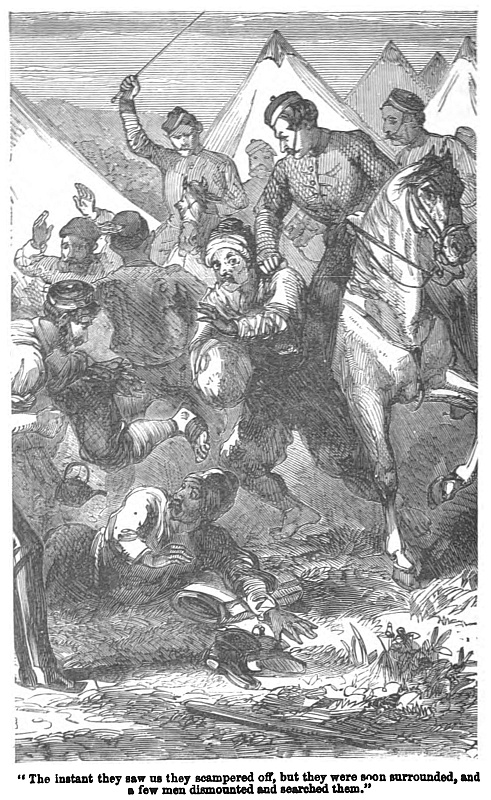
One evening, while returning from the lake, where my troop had been to water, we met about a score of these ruffians, who had been prowling about our tents while engaged with our horses. The instant they saw us they turned to the left and scampered off; but they were immediately surrounded by our horses; a few men dismounted and searched them. They had previously thrown away a valise belonging to our regiment; boots, socks, flannels, shirts, and many other things were found upon them. A man of the 17th Lancers, to whom a pair of excellent boots belonged, picked up one of the scamps upon whom they were found, and threw him into the lake, from whence he crawled after a rare ducking; the remainder were rather roughly handled, and sent about their business. These ruffians were soon afterwards sent away to be drilled into something like soldiers under General Beatson at Shumla.
During our stay at Devna several murders were committed either by the natives of the district or the Bashi-Bazouks, of whom many were left behind by General Beatson; and these found refuge on the hills, from whence they prowled forth at night like wild beasts, seeking what they might devour, and steal or destroy. Many a black crime, which our officers fathered upon the natives, was without a doubt the work of the Bashi-Bazouks.
About this period Lord Cardigan marched with detachments from the 8th and 11th Hussars on a reconnoitring expedition along the desolate track of country by the banks of the Danube towards Silistria; they took no tents, and only a few days’ provisions with them, and therefore had to sleep in the open air, with their horses picketed at their feet, to feed upon such scanty herbage as the ground allowed. After being away about ten days, they came in sight of the Russian field column, said to be under General Luders, who afterwards commanded the army in the field after we landed in the Crimea.
Having attained the object of this expedition, during which both his lordship and his detachments might have been surrounded and cut to pieces at any time, so ignorant were our leaders at this period of the position and whereabouts of the Russian army, Lord Cardigan retired by forced marches to Devna, and nearly every one of the horses had to be long afterwards rested from illness and sore backs. But the men were for the most part well and hearty, and Lord Cardigan experienced but little inconvenience, although it was said he suffered much from the effects of the damp ground some months afterwards in the Crimea.
We had some capital fun while lying at Devna: the officers, on horseback, would hunt the great, lurching, hungry-looking dogs, that many of the men would insist were hyenas and jackals, so wild and savage did they look. When disturbed and started at a dusting pace, the young officers would ride after—them as if for dear life, cracking their whips or flourishing a sword close to their very tails, and then would come, in motley crowd, soldiers in undress, looking as excited as if in front of the enemy, and bringing up the rear would be all the rag, tag, and bob-tail of the camp. The brute invariably ran towards the hills, and if he gained them unscathed he was safe, for both horses and men would be blown ere they could follow up the slopes. Some of these dogs are very savage, and if brought to bay in a corner would dash at your throat in an instant; but as few of us ever had sword beyond our reach, we generally made short work of them if caught red-handed with probably a piece of meat in their mouths, when carelessly left unguarded, prior to its being cooked for the dinners of a dozen men.
Towards the latter end of July the cholera made its unwelcome appearance in our camp, and many men, both cavalry, infantry, and artillery, died after a few hours’ illness in extreme agony. Every regiment encamped on the track of country extending for about twenty miles from Devna to Varna lost more or less men from this dreadful scourge; but the troops in and around the latter place suffered most, as many of our men were removed to Monastir, a healthier place farther up on the hills than Devna. The disease was said to be engendered at Varna among the Turks and Bashi-Bazouks, who are horribly filthy, and of not much real service as fighting-men on a battle-field.
About this time we were pleased to hear the news that the 4th Light Dragoons had arrived to join our brigade, henceforth being our brethren in arms; they were encamped with the 6th by the sea-shore, but both regiments lost several men from cholera, and each (especially the gallant 4th) were destined to lose the greater part of their men by the sword, as will afterwards be related. Many of the best, the bravest, and the most light-hearted of my own regiment died of the fearful pestilence at Devna.
At the latter end of August we got the welcome order to march from Devna and Monastir to Varna, with an assurance that we should soon be embarked for the Crimea, and at least be allowed to fight for our lives with a more chivalrous, if not a less relentless, enemy than the cholera. The 5th “Green Horse” lost so many men, that the remainder were for a time (until augmented by drafts from home) attached to the 4th Royal Irish Dragoon Guards.
Chapter Twenty Eight.
In brief, a braver choice of dauntless spirits, That now the English bottoms have waft o’er, Did never float upon the swelling tide. Shakespeare.
After our arrival at Varna we had to wait a few days for the order of embarkation, and finally sailed in company with the 17th Lancers in the Himalaya, Lord Cardigan and his staff being aboard the same vessel; the 11th Hussars, 4th and 13th Light Dragoons being embarked aboard other transports, as also the heavy cavalry at the same time. Never was an army embarked for almost immediate active service under less favourable circumstances. Our ranks were decimated by disease, and the authorities apparently regardless of our health, food, clothing, and comfort, so necessary to render an army contented and vigorous in the face of the enemy. Still our men kept up their spirits, and only one desire pervaded the whole of the cavalry with whom I came in contact, and this was to “meet the Roosians and have done with it.” Not a man knew where it was intended to land the army, but it was generally understood that fighting would begin in earnest directly we came in sight of the enemy on the shores of the Crimea. I noticed the gallant 42nd Highlanders aboard the Emeu, and the Scots Fusiliers aboard the Kangaroo, and no men could be in better spirits.
The 4th Light Dragoons embarked in the Simla, and the 4th Royal Irish Dragoon Guards, with the remnant of the 5th, were conveyed to the scene of action in the Trent. The men were all in capital spirits, and their after-service proved that they meant business, as also did the 13th Light Dragoons (who sailed in the Jason, if I remember right); and the 17th Lancers, with the old 8th King’s Royal Irish and 11th Hussars, proved what British cavalry can do, even under the most distressing circumstances, as shown by their wild death-ride through the vale of Balaklava, where the imbecility of their leaders nearly caused what few of them that the cholera had left, to be annihilated by charging unsupported an army in position. The transports and other vessels necessary to remove the Allied array numbered over 700, which, with the fleet, formed a magnificent sight when fairly out of the bay of Varna. Captain Longmore of ours, who accompanied Lord Cardigan in his reconnoitring expedition along the Danube, died of cholera aboard the Himalaya before we sailed, and his body was taken ashore and buried. Not a better officer ever commanded a troop; he was a strict disciplinarian, but not a petty tyrant, and there was not a man in the regiment but who mourned his loss as children would a father. Several more officers and men died before sailing and on the passage, and their bodies were thrown overboard. I saw about fifty Zouaves drowned between the transport on board which they were to embark and the shore: they were all in complete marching order, and thus were prevented from swimming. The boat came in contact with a foreign vessel containing stores, and the former was sunk in less than a minute, the Zouaves disappearing with the most frightful yells; and they never rose again, a few—very few—only being saved.
Lord Raglan, the Commander-in-Chief, and staff embarked on board the Caradoc; and some idea may be formed of the expedition when I say that it would have formed a line upwards of ten miles in length. We sailed in the direction of Eupatoria, and when some distance from the place, but within range of the guns of the fleet, the Caradoc sailed towards the town with the white flag of truce, and it was generally understood we were to land there at once. But for some reason the idea was abandoned, and orders were given to sail farther down shore, for about ten miles, until we came to a low sandy beach on the 14th of September. All eyes were now directed to the beach—the first glimpse we had ever had of the Russian soil—and we fully expected to see it bristling with cannon; but all was peaceful and silent; not an armed man was visible as our officers eagerly scanned the shore with the aid of their glasses. Plenty of corn and cattle, and the Tartar farmers were all busy with their harvest. After some hours’ delay, caused by having to wait until the whole of the transports—some of whom were slower sailers than others—had come up, the expedition came to anchor from two to three miles from the beach. The French, who anchored some vessels on our right, were the first to lower a boat, with about a score of men in it; they quickly ran on shore, and jumped out, some of them up to the middle in water. A flag-staff was handed out, carried quickly ashore, and in a few seconds they had planted it on Russian territory, with the tricolour streaming from its summit. Shakos were thrown up, and Vive l’Empereur! made the welkin ring. All this time the French were busily engaged lowering boats and running their men ashore. The French numbered about 25,000, and the English of all arms about 27,000. The French landed very quickly, and the moment they reached the shore they ran about like antelopes until they were assembled and formed into skirmishing parties, for fear of the enemy being in ambush; but none appeared, save a small knot of Cossacks on a high, rocky hill about a mile off. These Cossacks formed the escort of an officer who had evidently been sent from Sebastopol to ascertain the strength of our force, which they did not think it prudent to oppose on landing. A shell or round shot from the fleet, or a rifle ball or two from the deck of a man-of-war, would have scattered the party; but our officers, ever busy with their glasses, were anxious to gratify their curiosity. Sir George Brown and General Airey were amongst the first of our officers to land, and with a picket of riflemen some distance in their rear, they pushed on to reconnoitre for camping-ground. The generals were on foot, and never dreamt of the enemy being so near as they ascended the hill, behind whose crest the Cossacks were lying in ambush, having seen them some distance from and isolated from their escort of riflemen. The whole affair was seen from the decks of many of the vessels, that of the Himalaya being crowded with officers and men of the 8th Hussars and 17th Lancers. The officer in command of the Cossacks dismounted, and his men followed his example. Walking and crouching behind their horses, they approached the two generals, who, the instant they saw the danger, turned and ran down the hill, the Cossacks throwing themselves into their saddles, and flourishing their long lances, preparing to pursue. Their career was, however, cut short, as the riflemen suddenly rose up and fired upon them; but the distance was too far, or the aim too bad to be effective, for no saddles were emptied, and the party rapidly disappeared behind the hill amidst a cloud of dust. We afterwards heard that one of the peasants had been wounded by the fire of the rifles while at work with his team on an adjacent farm.
As each of our divisions of infantry landed they marched away from the beach, some in one direction and some in another, until the shore, as far as the eye could reach, was literally covered with armed men, whose bayonets flashing in the sun had a very pretty effect, as seen from the decks of the transports by the force still waiting their turn to land. At about noon the rain began to fall, and the wind getting up, the whole aspect of things underwent a change for the worse. The rain continued to fall steadily, and, to make matters worse, the men had no tents. Each was landed with his great coat and rations for three days, with a drop of rum to keep him warm. In this state the majority of our infantry had to pass their first night on hostile ground; but the cavalry still remained on board their respective transports. While the disembarkation still went on, some of our men-of-war boats were sent along the shore to reconnoitre, and found a Russian encampment, containing, it was said, about 5000 men; this they shelled, and soon destroyed. The rain continued to fall, but notwithstanding this, no orders were given to land the tents, only one for General Evans being sent on shore.
Sir George Brown and staff were fortunate to procure a native cart, beneath which they slept, and no doubt soundly. Notwithstanding this night’s misery, every man being wet through and without a change of dry linen, or a bit of dry wood to make fires, the soldiers were in good spirits, the sea voyage of about fourteen days having freshened them up wonderfully; and they had the ever-cheering prospect before them—although the consummation of their wishes was destined to be long deferred—of eventually being inside the walls of Sebastopol, with the whole of the Russian stores and baggage at their chief disposal. Indeed, the fact that our commanders considered that we should be in the Russian stronghold in the course of a few days, was the reason why the tents were not landed simultaneously with our forces.
The morning after our arrival orders were given for the cavalry to land. We had been lurching and tumbling in the waves all night, getting but little sleep, and our horses having been in slings the whole voyage, sadly needed exercise; and although the wind almost blew a whole gale, the order was welcome. Our vessel, the magnificent Himalaya, was the first to commence operations. We had nearly 400 horses and about 700 men aboard. The rest of the vessels stood in as near shore as possible, and commenced to land. One of Lord Raglan’s horses was the first to tumble off a horse-float into the water, and was drowned; several more followed suit, chiefly officers’ horses, through being, perhaps, better fed and higher bred than common troopers. A dozen horses were lowered in slings from the decks of the vessels on to these floats, with a soldier to each horse’s head when he got aboard. The floats were coupled to each other to the number of eight or ten, and then they were tugged as near shore as possible by steam-tugs that had accompanied the transports in readiness for any such service. In this manner most of the cavalry were landed, being rowed the remainder of the way until the floats bumped on the beach, when the horses were led or pushed along planks resting on the bow of the float, and walked into the water; through which, with sundry wild plunges and snorting, they romped on to the shingle, shook their sides, gave a shrill neigh to their companions, and trotted after them farther away on shore, both horse and trooper drenched in sea-water. After the cavalry had been disembarked, the tents—so much required the night before—were got on shore, and the men, infantry and cavalry, lay in comparative comfort the second night after our landing in the Crimea.
Chapter Twenty Nine.
How stands the glass around? For shame! ye take no care, my boys; How stands the glass around? Let the mirth and wine abound. The trumpets sound, The colours flying are, my boys, To fight, kill, or wound; May we still be found Content with our hard fare, my boys, On the cold ground.
We were now fairly on the enemy’s ground, had bearded him in his den, and though our men had been subjected to a long period of suffering, consequent on the cholera ravaging our ranks at Varna and Devna (the one idea prevalent in every man’s breast being that he himself might be the next victim), we were still a very imposing force. When our videttes brought in the news that they had been menaced and yelled at in unmistakable sneers by the Cossacks, who were plainly seen in almost every direction galloping their shaggy little horses, and waving their long lances for us to come on and meet them, we were anxious to be among them. Like our own advanced posts, however, their field columns were plainly within a short distance, and any demonstration on the part of our pickets would only have sent them back direct to their lines, while our skirmishers, with their limited knowledge of the ground, might have been surrounded, and either cut down to a man, or taken prisoners. At this time we were said to be within twenty miles of Sebastopol, and the number of effective Englishmen, besides French and Turkish infantry, was about 27,000, who, I may truly say, were most eager to meet the enemy in battle; and no order during the whole campaign was more cheerfully obeyed than that issued by Lord Raglan on the night of the 18th of September, to “strike tents and march at break of the following day.” That march will long be remembered by all who were engaged in it. Every brigade, every division, every regiment, troop, battery, company, and every man with his arms and other accoutrements, was examined by colonels, adjutants, and their deputies, with a minuteness that told us plainly it would not be long before our services were called into active requisition. It was not until eight o’clock that the trumpeters of our brigade sounded the advance, and when our horses capered away from the camping-ground, to the merry strains of the various bands, no hearts were lighter than the five hundred cavaliers who formed the advanced guard of the army which has ever gone forth from British shores “to conquer or to die.” It was a lovely day, and the heat of the sun was tempered by the gentle sea-breeze, as we marched with our right flank resting on the beach under cover of the fleet.
I was one of the advanced guard formed of men selected from the 8th Hussars, 4th Light Dragoons, 17th Lancers, 13th Light Dragoons, and 11th Hussars, and we were, of course, the first to come within sight of the enemy, who, in place of advancing to meet us, set fire to houses, corn-stacks, and every vestige of harvest produce on the land for miles around. We could see numerous Cossacks driving away the stunted cattle and sheep to their lines, ostensibly to prevent them falling into our hands, but in reality to rob the farmers of their property, which would have been unmolested by us, though, probably, the French would have appropriated it. After marching about two hours we drew nearer to the outlying pickets of the Russian army, who had fallen back upon each other, and so near to their reserves, that the latter could be plainly seen, as stated by Lord Cardigan, who, with a field-glass, rode at the head of our column, and ordered out a skirmishing party. These skirmishers spreading out on each flank of the advancing army like a fan, rode forth to meet the Cossacks, who capered and wheeled about, flourished their lances, and performed many grotesque movements quite new to us. But they finally settled down, and forming up in a very business-like manner, advanced as if determined to meet our skirmishers. Ere we had gone far, however, the “halt” was sounded, it was said by order of the Earl of Lucan, who with several more staff officers had ridden to the front. Emboldened by our halt, the Cossacks commenced to yell, flourish their lances, and some few shots were tired at us, which, however, fell out of range, and it was with a feeling of disappointment that we were forced to obey the trumpeter’s call of “skirmishers in,” retiring upon the main body which had been pushed forward in anticipation of a general action. During these few minutes, the enemy had brought up a few field-guns, and our men were exasperated beyond measure at the apathy of Lord Lucan, for allowing us to be fired into with artillery, and followed by a horde of yelling Cossacks into the shelter of our lines, like a pack of whipped hounds to their kennels.
It will ever redound to the credit of Lord Cardigan, that in this, his first meeting of the enemy in force, he was most anxious to lead the Light Cavalry to battle, even before our reserves had come in sight; but Lord Lucan, by a rapid communication with Lord Raglan, decided that, not knowing the strength or position of the enemy, it was better to wait until the main body came up, and bivouacked, ere we made an attack. Several of our men were badly wounded, and five or six horses were killed by the Russian gunners, who had got our range and made beautiful practice. At last, however, a battery of six and nine-pounders came up at a gallop, and instantly opened fire. “Whiz,” “ugh,” “rippety tip,” went the balls, some ricocheting and sending up clouds of dust as they danced over the intervening space. The Cossacks ceased yelling when many of them were knocked over, horses and all, like nine-pins, and the remainder scampered off to their lines like frightened sheep. Meanwhile the main body of our army were fast coming up, and forming in order of battle to repel a general attack, should one be made. A shell, however, which was so directed as to burst in the centre of an advanced column of the enemy’s infantry, settled their business, for limbering up their guns in great haste they quickly retired, and one of our sergeants (O’Brien Kennedy, a Tipperary man) remarked, that although they appeared to “care but little for cannon-balls, they did not relish bullocks’ hearts stuffed with thunder and lightning.”
Only one feeling pervaded our brigade that night, which was regret at not being allowed to meet the Russian cavalry hand to hand, and stirrup to stirrup. This little skirmish was always designated amongst us as “that affair of the Bouljanak;” but as we dismounted and patted our horses’ necks, we rejoiced that we were fairly up with the enemy. Without laying ourselves open to the charge of vain boasting, there was not a man of us who collected round our bivouac fires that night, who did not resolve that those “yelling Cossacks” should be “skivered” when we were permitted to meet them sword to sword and man to man. It afterwards transpired, from the statements of prisoners and spies, that no less than five regiments of cavalry were in reserve behind the “yelling Cossacks;” therefore it was, perhaps, as well that the recall was sounded, or the story of the “Young Dragoon” might not have been written.
Soundly our grand army slept that night on the cold ground, and thousands awakened only to march forth to certain death up the heights of the Alma. Passing over the events that occurred on the morning of the day on which the battle of Alma was fought, which was spent by our generals in arranging the army in the order of battle to meet the enemy, and beard him in his own earthworks, I now bring my readers to the banks of the river Alma, called a river, but in reality only a brook, which most of our horses could have cleared at a jump, even in its widest part. Our brigade was held in reserve, as, if the infantry should suffer a reverse and be obliged to retire from the hill over the brook on to the plain, we were ready to play our part on that ground. Onwards the army advanced in a vast extended line, so as to prevent the enemy from descending the heights in front and outflanking us. The French were disposed so as to march on our extreme right, in order to attack the enemy’s left, who occupied a position which, from its steepness, was difficult to approach; but to our army was assigned the hardest fighting—namely, the forcing of the enemy’s centre and right. The whole face of the hill as far as the eye could reach was swarming with squares of infantry intermixed with earthworks thrown up on the slopes, over which peeped the muzzles of muskets ready to deal death and destruction to our dauntless infantry.
As we neared the banks of the stream, towards the right of the Russian position, we noticed myriads of Cossacks, supported by a large force of dragoons wearing helmets, who, when they observed us, descended the hills and boldly crossed the stream. This time we quite expected to meet them, but we were again disappointed, as a battery of our artillery was at once pushed forward and placed between us and glory.
A clump of houses and haystacks had been set on fire some distance to our left, the smoke of which was intended to hide the enemy’s cavalry from the view of our generals, and so enable them to charge upon the left flank and rear of our infantry, just at the moment the latter forded the river. But the artillery, before mentioned, with our brigade ready to dash among them, effectually kept them at bay. During this time the enemy had opened fire on our right, and very soon it extended over the whole length of our line. The infantry were ordered to lie down, and while our artillery replied well to the enemy’s fire, we sat on our horses passive observers of all that occurred. An occasional shot dropped in the midst of us, and many rolled harmlessly among our horses’ legs. Not a hundred yards from where we formed up was Lord Raglan and staff: the commander-in-chief was evidently getting very anxious, as he continually interrogated an aide-de-camp as to something that was passing on the extreme left of the enemy’s position.
At length Captain Nolan came up at a tearing gallop. “They are over, my Lord!” said he: then followed a hurried, conversation among the staff, and after a short interval the welcome order was given to the infantry to rise and advance.
By this time it was ascertained that not only were the French over the river, as Captain Nolan had stated, but they were hard at it, climbing the heights and engaged hand to hand with the enemy. Not a moment was to be lost; a splash, a scramble along the whole line, and in a few brief moments British bayonets were introduced to the ribs of Russian soldiers. The Highland brigade being nearest to us, we were enabled to watch their every movement, as well as the excitement consequent upon our position would allow, for we were constantly threatened by the demonstrations of the cavalry on our left. We saw the kilted heroes march at quick time up that deadly incline as steadily as if on parade, and the infantry on their right (as far as we could see for the smoke) followed their example. It appears, however, from the reports of those actually engaged, that the Light Division, being too impetuous, got into some disorder, owing to their being in advance of the main body, and they consequently suffered heavily.
Sir George Brown, who commanded this division, rode in the front of them on a grey horse, and led them on at too fast a pace, for which he nearly paid the penalty with his life, for his horse was shot under him, and a terrible fire being concentrated upon this part of our line, the gallant Light Division was awfully cut up. Onward, however, swept the main bulk of that army, the majority of whom were composed of men who had never been in action before. We could distinctly see at intervals, through the dense columns of smoke, as the fire gradually receded from the base up the slopes and finally died out at the crest of the hill, the belching forth of the musketry from the earthworks as our men neared one ridge after the other. A puff of smoke, a long stream of fire, and down came our men in heaps, but plenty remained to avenge their death. A wild “hurrah,” and over the crest of the earthworks they leaped with their bayonets at the charge, followed by a deadly hand-to-hand struggle within the earthworks.
This order of advance, and successive storming of what may almost be termed batteries in position, was unparalleled in the history of war, but it was successful in every instance; for the enemy were either driven from every earthwork, or bayoneted on the spot: yard by yard, inch by inch, they retired up the hill, and were finally driven beyond their last rallying point, a confused, defeated, and humiliated army, flying with their chief, Prince Menschikoff, in the direction of their stronghold, Sebastopol.
In this action the enemy left all their cannon, and upwards of 6000 men dead, wounded, and prisoners, in our hands. Our loss in killed and wounded was estimated at little less than 4000 men. Our own dead, as also the Russians, were buried, and all our wounded were sent on board the fleet, but hundreds of wounded Russians were left in the places where they lay.
Much has been written as to the policy pursued by Lord Raglan, of not following up the retreating enemy and completing their destruction ere they reached Sebastopol. With this I have nothing to do, but I may remark that it would have been worse policy to have left our dead on the field to fester in the burning sun, and so spread disease and death, more terrible than dying in action, throughout the whole army. The wounded would also have been left without succour, for it must be remembered that no assistance was sent from the fleet: the survivors had to bury their dead comrades, and carry the wounded to the ships. A weary, harassing night was that after the battle, in which I had myself happily to take no part, being engaged on picket duty; but I could plainly hear the shrieks and groans of the wounded as the surgeons amputated the poor fellows’ legs or arms, and dressed the less serious wounds.
The action was fought on the 21st September, but not until the morning of the 23rd did we leave the vicinity of the battle-field. The fleet had orders to sail about the same time in the direction of Balaclava. On our line of march we found that our old foes, the Cossacks, had ruthlessly plundered several houses that had evidently been inhabited by well-to-do natives, and we found numerous smaller houses along the banks of the Katcha river, from which the inhabitants had fled, leaving them to be plundered by the bloodthirsty ruffians. Here and there, however, we met with a Tartar farmer, who, more bold than the rest, came forth from their hiding-places to stare at us from motives of sheer curiosity. On arriving at a village called Eskel, we were allowed to dismount, and here we found plenty of newly-gathered corn for our horses, who much enjoyed eating it from the straw, and we equally enjoyed the rich clusters of grapes, which hung invitingly from the vines which surrounded nearly every dwelling. We learned from the few natives who were visible, that the defeated army had reached the village on the evening of the battle in a sadly deteriorated condition, and after only an hour’s rest an alarm was spread that our army was pursuing them, and they continued their retreat in great disorder.
Pursuing our march through a thickly-wooded country, we could distinctly see the forts of Sebastopol but we kept well away from the range of their guns, and made all haste, by a flank movement, not the least expected by the enemy, to reach Balaclava, in order to form a base of operations and establish a communication with the fleet. During this march, parties of our corps and the 11th Hussars formed the advance guard, keeping in sight of Lord Raglan and his staff, and we suddenly came upon the enemy’s baggage guard, which we quickly dispersed, and an enormous quantity of baggage, principally clothing, was instantly surrounded. The carriage of Prince Menschikoff also fell into our hands, but I did not see it, being otherwise engaged: my share of the plunder was a capital cloak of fine blue cloth, lined throughout with fur, which I took from a box, the lid of which had been smashed open by a private of the 88th regiment, with a blow from the butt end of his rifle. I also managed to secure a couple of flannel shirts, but having pursued the enemy two or three miles on the road, we returned too late to share in the most valuable spoil that fell into the hands of our comrades.
Halting next at the village of Tractir, or Traktir, near which is a place called Mackenzie’s farm, which only consists of plantations of fir, and stores of wood grown for the use of the enemy’s navy. This the French set fire to, and we left it blazing merrily, to resume our march on Balaclava, where a portion of the fleet arrived before us, and the guns of the Agamemnon, commanded by Sir E. Lyons, were at once called into requisition (in conjunction with our infantry), to reduce a fort from whence several rounds of shot were fired on our approach, but the commandant of the place soon surrendered, and we entered the town, or rather village, without further opposition. Having taken prisoner an Englishman named Upton, a relative of the engineer whom the enemy had employed during the erection of the forts at Sebastopol, we found the object of his capture was to obtain information from him as to the strength of the army, the forts, and the positions of the field columns; but he refused to give any information, and, I believe, was set at liberty. From this time the infantry, artillery, sappers, and commissariat were as busy as bees, preparing to invest Sebastopol, landing siege-trains, stores, etc, and the enemy continually kept up a dropping fire upon everything that came within range of their forts. The cavalry from this to the battle of Balaclava was principally employed on picket duty, reconnoitring and foraging, with an occasional skirmish with the Cossacks; but the infantry had a hard time of it in the trenches, and, what was worse than all, the cholera was still busy in our midst; indeed, up to this time we had lost more men by disease than in battle. Worked as hard as labourers on a railway, under fire all the time, fed on scanty and inferior rations, with little or no fuel with which to cook them, any infantry except the British would have revolted en masse, and left their rulers to fight their own battles. We had, before our arrival at Balaclava, been reinforced by the Scots Greys, who had been landed from the Himalaya at the Katcha river, and here also the French were joined by large reinforcements, said to be upwards of ten thousand men. In coming from Varna to Balaclava, the 1st Royal Dragoons and the Enniskillen Dragoons had upwards of 200 horses washed overboard in a heavy gale of wind, and the men were landed in a very disheartened state. There is nothing so miserable for a trooper on a campaign as to be without his horse: it is part and parcel of himself, as, besides furnishing him with an easy means of transport from place to place, it is essential to his personal safety.
Chapter Thirty.
Above the tide each broadsword bright Was brandished like a beam of light, Each targe was dark below; And with the ocean’s mighty swing, When heaving to the tempest’s wing, They hurled them on the foe. Scott.