"Every Day Life of a Soldier" (continued 2)
Reading edition
At last a cloud of dust was seen along the lane that led from the barracks to the heath, and in a few minutes the messengers halted in front of the regiment: every man’s heart beat—at least, I know that mine did—as one of them delivered his report in an under-tone to the colonel. The adjutant ran his eye along the line until it rested on Bob Norris, one of the best, the steadiest, and most harmless men in the corps, who had borne an irreproachable character ever since he had enlisted. He was ordered to the front, and commanded by the adjutant (a man who had risen from the ranks), in a fierce tone and manner, to account for one of his ten rounds of ball-ammunition found to be missing, while one round of blank was found on the floor of the barrack-room close to his bed. Poor fellow, it was evident that he could not explain; indeed, he could not speak; all who knew the man’s disposition thoroughly, knew also that he must have made a mistake in the exchange of the ammunition. What so easy and so probable? Other matters of far less importance in the internal arrangement of a regiment were scrupulously observed with a fuss and a bother that was positively sickening to any man of sound common sense: why not have a box with a lock and key in every room, and let the troop-sergeants collect every round of ball-ammunition, and place them in this box prior to issuing the blank for field-firing?
Poor Bob Norris was divested of his arms, and marched off between two of his comrades, a prisoner to barracks. The case was investigated in due course; the owner of the horse was paid for his loss by the Government—60 pounds; and Bob got twenty-one days’ kit drill. This was said by some non-commissioned officers to be a lenient sentence, in consequence of his previous good character and the commanding officer taking a merciful view of his case. The ball, he said, “might have been intended for one of the superior officers or it might not,” he was willing to take the latter view of the case and give the prisoner the benefit. As a punishment for carelessness, however, the prisoner would, in addition to the drill, be kept on the stoppages as long as he remained in the regiment, and in the event of his requiring to purchase his discharge, he would not be allowed to do so unless the whole of the money advanced by Government to recompense the man for the loss of the horse was refunded.
Thus Bob was placed in a most unfortunate and pitiable position, positively nailed to the service for sixteen more years, without ever being allowed to draw a farthing of pay in money, and although he was as good as gold, and true to his colours as steel, he could not “put up” with such hardships as these: he had, he said, enlisted solely because “he thought he should like a soldier’s life, and had made up his mind to deserve, and, if possible, to attain promotion.” This stroke of pure misfortune had completely crushed all his hopes, he became sullen and morose, and after wearily plodding in the barrack-yard with the heavy burden of his kit (about 60 pounds weight) on his back for four hours during each of six days, he dashed the pack from his back with a heavy thud on the floor of the barrack-room. The expression of his fine open countenance plainly betokened that “something was brewing in Bob’s mind,” as old Jem Page remarked while burnishing his spurs. When the réveillé sounded the next morning at five o’clock, Bob Norris’s bed was empty: he had quitted it and scaled the barrack-wall during the night, and was heard of no more as a soldier in our regiment.
Now if drunkenness had been the primary cause of this dangerous mistake, few men in the regiment would have been sorry for Bob Norris; but he was a steady, good motif and it was generally thought that he had been most cruelly used; for be it remembered, that notwithstanding he had deserted and so got rid of his troubles, yet he never could be a happy man. A deserter is always in fear of being retaken, and with good reason, for let him be disguised as he may, one soldier can always detect another. Many, very many men who desert give themselves up again solely because they cannot bear the misery consequent on the constant fear of being retaken; and a more lenient punishment is administered to a man who voluntarily surrenders, than if he had given much trouble in his capture. A deserter can be taken and placed in any gaol in Her Majesty’s dominions, when the police or military authorities forward the report of his capture to his regiment, if they know it; if not, they publish his description in the Hue and Cry.
Chapter Ten.
Though we march, or though we halt, Or though the enemy we assault; Though we’re cold, or though we’re warm, Or though the sleeping town we storm, Still the merry, merry fife and drum Bid intruding care be dumb; Sprightly still we sing and play, And make dull life a holiday.
I was once taken prisoner myself on suspicion of being a deserter, being on a two months’ furlough. I was visiting a married sister resident in a village near Derby, and I frequently wore a suit of her husband’s clothes to save my regimentals. This is very often done by soldiers on furlough. Walking up the corn-market one day, I was tapped on the shoulder by a recruiting sergeant from the 33rd Regiment.
“Have you got a pass?” said he.
“Yes; I have a two months’ furlough.”
“Show it,” said he.
“It is at Mugginton,” said I.
“Yes, or somewhere else,” said he; “therefore you had better come along with me to the police-station.”
It was market-day, and a crowd soon collected. Two policemen came up, and in spite of my asseverations that I had left my furlough in the pocket of my regimentals at my sister’s house, I was marched off a prisoner to the lock-up; but I was allowed to send a note to my sister, and she soon made her appearance in a gig, with all my regimentals and furlough. This satisfied the superintendent, and he set me at liberty.
Every soldier is, on all occasions (except when a reduction of the army takes place, which is very seldom), invested with power to enlist recruits. In time of peace, however, recruiting is not carried on in the cavalry to the same extent as in the infantry; the latter being so much more numerous than the former, and available for service in every part of the British possessions, where fever and change of climate often leave a larger vacancy than death in battle from the weapons of a living enemy. Many recruits enlist in foot regiments, because there are generally recruiting parties in every market-town, which is more convenient for a poor, destitute lad, who is too often compelled to enlist because he has neither money nor food. The presence of a dragoon or a hussar in full regimentals is more of a rarity everywhere than a foot soldier. I was anything but pleased with the “starchy” old sergeant who had interfered with my freedom, and, by way of retaliation, I was determined to enlist some likely-looking young fellows, who stood idling around the door of the “Cross Keys,” in the market-place—the recruiting rendezvous,—and who, it afterwards appeared, had made up their minds to enlist in the 33rd Regiment.
Going to the inn where my sister had put up the horse and gig, I rigged myself out in a manner that would have passed muster for a parade before royalty. We were not allowed to take the two jackets (pelisse and dress jacket as well) with us on furlough; but, being the winter season, I wore only the scarlet pelisse, with its many rows of lace and more than a hundred buttons in front, fantastically trimmed with yellow braid behind, with fur collars, cuffs, and waistband, when I left barracks. But I had managed to get hold of a nice dress jacket, which, though cast into store, was in very good condition, from the quartermaster-sergeant. This I put on, and slinging the gorgeously trimmed scarlet pelisse loose over my left shoulder, as in full dress, I sallied out with my high-crowned, bell-topped shako, and black horse-hair plume, into the streets, and strutted proudly up to the “Cross Keys.” There I was soon surrounded by a crowd of growing lads likely to make hussars. The crusty old sergeant and his minions looked daggers at me; for, after all, it is the dress of a soldier that allures many of the recruits from their homes into the service, and it was easy to be seen that they fancied my dashing uniform much more than the ruddle-coloured, beer-stained coatees and shovel-shaped shakos of the foot soldiers.
I called for “a gallon of ale,” and asked each of the people in the room, including the infantry soldiers, to drink.
Now I had fully made up my mind long before this occurrence not to enlist a recruit, if I could possibly avoid it; and, although I had entered the public-house in defiance of this resolution solely to retaliate upon the recruiting-sergeant for his giving me into custody, I reflected upon the misery I might entail upon the mothers, fathers, brothers, sisters, and friends of these poor deluded lads, several of whom looked like the younger sons of farmers; and although I was constantly importuned to enlist them, I refused, and soon after left them a prey to the infantry-sergeant, who, I have no doubt, got them into the meshes of his net before the day was over.
It is often a source of comfort to me to reflect that I never enlisted a recruit in my life; and I thank goodness that I was never sent on the recruiting service, for, although I pretend to be not a whit better than the majority of my comrades in point of morality, I had a particular aversion to inveigle a youth from his home and friends, perhaps for ever, by means of the gross deception and paltry untruths so often practised by recruiting parties both in cavalry and infantry regiments.
While on this furlough I of course visited my home; but although my mother, sisters, and brothers received me joyfully, and treated me with great kindness, my father positively refused to see or speak to me, and even said that he would “horsewhip me whenever he could get a sight of me;” so, after remaining cooped up in a bedroom for a couple of days, I returned to my kind sister at Mugginton, and shortly after left for my regiment, where, in the spirit-stirring incidents constantly occurring, I soon got over the unpleasant feeling always engendered in the mind of a soldier by the visit to, and leave-taking of, his relatives and friends in his native village. That little word “good-bye” leaves a very unpleasant sensation after shaking hands and kissing a kind and indulgent mother, whose heart is well-nigh broken through her son leaving her, perhaps for ever, to follow the fortunes of war. My mother said she never went to bed but she prayed for me, and she never awoke in the night but her “soldier-son” was uppermost in her mind. She is dead now, and I often think that my leaving home to become a soldier might have hastened her end, for she died at the age of sixty-five. But after all comes the balm to my qualms of conscience for any breach of duty I may have been guilty of to my parents,—I have still done my duty to my country.
Besides these furloughs granted to well-conducted soldiers, they are frequently indulged with a few hours or days’ “passes” to spend with any friends they may have in the vicinity of the barracks. A soldier may be invited to an evening party, or he may wish to spend a few extra hours with a sweet heart, go to church or chapel with her, or, more frequently, take her to a theatre, the admittance to which she generally pays out of her own pocket-money. These “passes” may be obtained by a good soldier about once a week, so that in place of having to be in barracks by nine o’clock, he may, when furnished with a “pass,” signed by the captain of his troop, prolong his stay until any hour that may be convenient to him to return; but the time is generally limited to twelve, one, two, or three o’clock, so as to allow him to have a little sleep before the réveillé sounds, at five o’clock in summer and six in winter. Some of these “late” soldiers are fond of playing practical jokes upon their comrades, who are generally sound asleep when they return from these passes, and enter the barrack-rooms in the dark, for lights are not allowed to be struck on any pretence whatever.
We had a very good-tempered, rollicking young Irishman in our room named Larry Byrne, who often went on pass to meet his sweetheart Nannie McCarthy, who was cook at a gentleman’s house about two miles from barracks. Larry generally came to barracks in high spirits; and he would either disturb every man in the room and keep them awake by a recital of his “divarshuns” with Nannie and the rest of his friends, or quietly play off some practical joke invented before he entered the room.
He had returned from his “coorting” one morning about two o’clock—it was a beautiful bright moonlight morning, and I happened to be awake and could see Larry’s every movement—when he softly entered the room. He was evidently bent on having a lark. Pulling out of his pocket a ball of twine, and after undressing himself, he walked stealthily up to the foot of old Sam Whelan’s bed (a man with none the best of tempers, even when he ought to have been pleased); turning up the clothes, so as to bare old Sam’s feet, he tied one end of the twine round the joint of his big toe, and then, replacing the bed-clothes, got into his own bed at the farther end of the room with one end of the string in his hand. There were eight of us in the room, and it afterwards appeared that, although not a word had been spoken, there were more watching the movements of Larry than myself. All was still for a few moments. I could distinctly see, in the moonlight that bore full upon Larry’s bed near the window, his white teeth grinning underneath his jet-black moustache as he bobbed up his curly head and jerked the string; but there was no response. A suppressed titter from some one reached Larry’s ears. “Whist! whist! ye omedhaun!” said he, in a low whisper; and then, with twofold vigour, he jerked at the line again. “Whah!” sang out old Sam, in a strange, unearthly yell, as he sat bolt upright in bed and peered anxiously around the room. All was, however, as still as the grave; and, thinking it must have been a dream, he lay down again. By his snoring, Larry could tell he was asleep, and that he had not detected the string round his toe. Seizing the end of the string again, which he had dropped at his bedside to slacken the tension on the toe, Larry gave it another regular “twinger.”
“Whah! whah! whah! Murther! Boys, did ye’s see anything in the room?” Larry and I burst out laughing, the rest of the men were awoke by the row; old Sam found the string tied to his toe, and, accusing Larry of the trick, jumped out of bed, seized his sword, and I believe would have killed Larry had not the latter, knowing the customer he had to deal with, jumped out of bed, drawn his own sword from the scabbard, and taken up his position on the defensive, until old Sam could be pacified.
We had a great number of Irishmen in our regiment—brave as lions in action, at all times clever and smart in the performance of their duty, and as merry as crickets in the barrack-room or on the line of march; but some of them, enlisted from the remote country districts, very superstitious and firm believers in ghosts.
A tale is handed down from regiment to regiment to the effect that the ghost of a soldier once flogged to death in Hounslow Riding-school haunts the place every night. I have been on sentry on what is called the “Hospital Post,” near to the riding-school, very many times, but I never saw or heard anything of the ghost.
One man I knew, who had been tolerably well educated, and who, I consider, was by no means short of common intelligence, frequently declared to me that he has, while on guard on this particular post, heard noises in the riding-school just after the clock over the front of the officers’ quarters had struck twelve, as though a ride of twenty or more soldiers were in the school. He asserted that he heard the regular beat of the horses’ hoofs on the floor, the tinkling of the scabbards on the stirrup-irons, and the shouts of the rough-riders. This was supposed to arise from the ghost of a man who had been killed some years previously by a horse rearing and falling backwards upon him. At other times, both he and many others would say, when they were relieved from the post and afterwards sat round the guard-room fire, that they had plainly heard the shrieks of the man’s ghost who was flogged to death.
One of our men, who had been little more than a year in the regiment, having been sent by our Irish recruiting party from the county Mayo, and rejoicing in the rather funny name of Barney Mulgruddery, created quite a sensation in the regiment by the apparent sincerity with which he related an interview with one of these ghosts or some other spectra.
“Shure,” said he, “I seen a mighty quare thing coming towards me between the sintry-box and the hospital; it was all surrounded wid blue lights, and was like a big dog with a man’s head. Nearer and nearer it came. ‘Faix,’ thought I to myself, ‘Barney, me hold fellow, I wish you were again cutting turf in the bog.’ Well, me jewels, it seemed to grow bigger and bigger until it was as big as me mother’s peat-stack, and more betoken it had horns too. I tried to spake for to challenge, as was me duty, boys; but oh, Meila Murther! I’d lost the power of spache. Well, me jewels, it came nearer and nearer, until at last it stood quite convanient to the sintry-box. ‘Bad scan to your impudence!’ sis I (my spache returning all at oncst), ‘is it clane off me post you want for to dhrive me, and desthroy me karacther for ever?’ ‘Hould yer whist; go along out of that, and show me the back ov yer stockings, Barney Mulgruddery,’ sis the ghost, in a tunderhin’ passion. ‘Not a step I’ll take for any ov the likes ov ye. Shure I was placed here by me supariors, and I’ve as good a right to be here as you.’ ‘Be gorra! if yer not off out of this like a shot, you great nagur, I’ll desthroy your body and soul for ever,’ sis the ghost. ‘Why you murtherin’ villain! shure you wouldn’t be afther killing me?’ sis I, keeping me finger on the trigger of me carbine; for you see, boys, I was not going to be dhruv off me post widout a struggle. Oh, blue nagurs! he kem wid a rush right forenenst me. I backed a few paces. ‘Barney Mulgruddery, attention!’ sis I to meself, aloud; ‘make ready! prisint!’ and I brought me carbine up to me shoulder. ‘Hould yer hand, Barney Mulgruddery,’ sis the ghost, beginning to get smaller and smaller every moment, and lookin’ me sthraight in the face all the while, as impidint as a tinker’s dog. But, me jewels, it wasn’t long before the ghost was thransmuggrified into as nice a young lady as ever the moon shone on. ‘Barney, me bold sodger,’ sis she, ‘you’re the bravest man I ever seen on sintry here. Shure,’ sis she, ‘Barney Mulgruddery, you’re a credit to ould Ireland, and you’re sure to be a giniral;’ and wid that she vanished. Och! it’s she was the Colleen Dhas. It was right good for sore eyes to look on her, the darlint. It may be a quare notion, but I’m thinking she took it into her head to fall in love wid me. At any rate, shure, she gev me the encouragement and the swate look, as if she was sthruck wid me appearance.”
This extraordinary story proved too clearly that Barney had either invented it from beginning to end; or, what was perhaps as bad, he had been sleeping and dreaming at his post.
Chapter Eleven.
Which of their weapons hath the conquest got Over their wits; the pipe or else the pot? For even the derivation of the name Seems to allude and to include the same: Tobacco as “to Bakcho”, one would say; To cup-god Bacchus dedicated ay. (This includes a joke in Greek script, not a very clever one.)
A few days after this occurrence, Terence Daly, more familiarly called “Terry,” a comrade quartered in the same room as myself, returned from Ireland, whence he had been on furlough, and brought with him a large bladder full of whisky. Now there were few, if any, of us ever calculated the effect of this ardent spirit so pure and so strong as Terry had brought it.
“Boys,” said he, as he tumbled the bladder from his valise on to the floor, “this is the raal dhrop of Irish eye-water—not Jamieson’s eye-water, but a betther soort, by rason of its being distilled in the Bog of Allan, and never paid a farden of duty.”
I had never before taken liquor of any description to such an extent as to make me intoxicated—in fact, I had fully made up my mind to avoid intemperance (the greatest curse of all, to both soldiers and civilians); but Terry, with the proverbial good nature of his race, insisted that I should have “one glass,” as all the rest of the men in the room. Some, unfortunately, were not content with one, two, or three glasses.
We were ordered for a “parade under arms” that afternoon, at three o’clock, and it was dinner-time when Terry produced the whisky. Now, a parade under arms, on foot, requires an uncommon degree of steadiness and precision. We were all steady enough until required to “form” and “dress” in troops before taking our place in the ranks with the main body of the regiment, but it was then discovered that the men who had partaken of the “eye-water,” including myself, could scarcely stand at all, let alone stand or march steady. It is a most serious crime in the army to be “drunk for duty;” indeed, a man who has been four times convicted of this crime is “drummed out of the regiment” (a process I shall describe in a future chapter). The result was that we were all confined in the guard-room until the following day, when we were escorted before the colonel.
Each was taken into the office and interrogated separately, and we told the truth, namely, that we had “no idea the whisky would have such an effect.” We were then all taken in together, and received a severe reprimand from the colonel, who ordered us to be “confined to barracks” for fourteen days. Terry, whose furlough did not expire until the evening of the day he returned, did not go to parade, and so he escaped.
Being simply “confined to barracks” is not considered a very severe punishment, as the soldier is only prohibited from passing out of the barrack-gate (except he be on duty), and not subjected to any other punishment. All soldiers undergoing punishment are “confined to barracks” in addition to such punishment, whatever it may be, and are termed “defaulters,” a list being kept in the guard-room, pasted on a board, so that the corporal of the guard, who is supposed to be in or about the door of the guard-room day and night, can always ascertain when a soldier presents himself to “pass out” whether he be a “defaulter” or not. It is the duty of the sentry at the front gate to prevent any soldier passing through until the corporal of the guard has first inspected him, in order to see, in the first place, that he is properly dressed for walking out in town, namely, that he is clean in his person and attire, has on a pair of white leather gloves, well-polished boots, and bright spurs, a whip or cane in his hand, and his cap “cocked” in that jaunty style that gives him an appearance of smartness, and a proper display of personal pride, without “puppyism.” This inspection, though always performed, is very seldom necessary, as the soldier generally possesses a sufficiency of native pride to dress himself so as to fancy he is a regular “swell.” Most young men, whether soldiers or civilians, are imbued with a certain amount of personal vanity; in some instances this amounts to gross foppishness; therefore the cavalry soldier may readily be excused for any display that may appear superfluous in the eyes of a civilian; for although he has few, if any, worldly possessions, and seldom more than a day’s pay in his pocket, yet he is for the most part in the enjoyment of rosy health and a sound constitution. Being subjected on his enlistment to the most skilful surgical examination, in order to ascertain if he be free from every taint of constitutional disease, and that all his limbs and the various organs of his body are perfect, he is more excusable for “showing off” his figure to the best than others, the nature of whose business directs their ideas into a more profitable channel.
Some of the “swells” in a cavalry regiment are more primitive in their style and manner of performing their toilets than their brother “swells” in civil life. The military “swell” is always his own valet and groom, and sometimes his own washerwoman. Rimmel’s perfumes, Rowlands’ Macassar and Odonto, and the rest of the toilet paraphernalia that forms a very considerable portion of the travelling luggage of a civilian “swell,” are all dispensed with in barrack or camp life. When the soldier “swell” prepares for parade or a “show off” in town, he first gives his clothes a thorough brushing, then he “chrome-yellows” the braid of his jacket and the stripes of his trousers, or applies some other “reviver” to correspond with the colour of the “facings” of his uniform, cleans his buttons, spurs, boots, and pipe-clays his gloves; he then whistles a tune, or sings a scrap of a song, as he sallies down to the stable with his towel and a piece of common soap, and drawing a bucket of water at the pump, he gives himself a thorough washing, often from head to foot, a spare stall in the stable being his bath-room; the rest of his toilet is performed in the barrack-room. If he wears only a moustache, and no beard on his chin, the latter part of his face must of course be frequently shaven, so as always to appear clean and respectable; for this purpose there is sometimes a “looking-glass,” about eight inches long and six inches wide, placed in some conspicuous part of the room for general use, but more frequently a fragment of a broken mirror about the size of a man’s hand, and mostly a three-cornered, or some other “cornered” shape, is all the toilet-glass used or required for the dressing and shaving of eight men. The “swells” will sometimes indulge in tooth-powder, and a species of villainous scented oil purchased at the canteen, but the majority, if they use oil or tooth-powder at all, will be content with powdered Bath-brick, a coarse but most effective tooth-powder; and the oil used for cleaning bits, stirrups, swords, and the like, is substituted for “Macassar,” to make the hair glossy. The “swells” will generally sport a riding whip during their walks in town, and those of their comrades who are not so fortunate as to possess one of their own will sometimes borrow these whips without leave, and then there is a “row in the island.” Many of these so-called “swells” have been well educated, and are well connected in civil life, and agreeable, nice fellows they are too; others are arrogant, conceited, and ignorant; these are termed “jumped-up swells-out-of-luck,” and are often told by the old soldiers that they are “better off in the army than any of their friends at home.” The idea that one man is better than another as a private soldier cannot be entertained, because it is considered that if the one who fancies himself superior to his comrades could by any means raise the money, he would purchase his discharge. The fashion of dyeing the moustachios, whiskers, and beard black, is quite a process, during which the barrack-room presents the appearance of a chemical laboratory. This toilet operation is performed just before bed-time. Procuring some litharge from the chemist’s and quicklime from a bricklayer, they mix these two powders together with salad-oil into a paste, and plaster it over every particle of the hair intended to be dyed; sometimes the hair on the head is treated to the process. Over this mixture they place a dock or cabbage leaf, and tie over the whole a bandage to keep the paste in its place, and then retire to rest, presenting, as they lie in bed, much the appearance of an Egyptian mummy about the head. If more than a proportionate quantity of quicklime be used, it will burn the skin; still, a necessary quantity should be added, as it is the principal acting ingredient, the oil and litharge only being added to counteract the burning effect the lime would otherwise have on the skin. When they rise in the morning and take off the bandages, the paste is perfectly dry and crumbles off the hair like dust; the hair is then washed and oiled, after which it presents a beautiful black and glossy appearance, which retains its colour for three or four weeks, and never stains the skin. As respects myself, I am gifted with a very fair crop of dark-brown hair, and, save when my moustachios were just beginning to bud, and I used the old toothbrush and india-ink given to me by my sweetheart “Dorcas” to make me appear more “manly,” and which dyed more of the skin than the hair, I have always been content with the colour given it by Nature.
There was little to “dress up” and walk out for in the neighbourhood of Hounslow, the barracks being a long way from the town, and the town itself small, dull, and uninteresting to soldiers of the “dandy school,” whose main object is to “show off,” as they fancy that every female they may meet will be in love with them.
Notwithstanding that the regiment was divided into four detachments, while the head-quarters was stationed here, we had in the winter season some “idle time” on our hands; and with the proverbial thoughtlessness and improvidence of soldiers generally, we sometimes spent it foolishly enough. Remaining in barracks for a week or more, and “saving up” our superfluous pay, we then used to sally out in parties of about a dozen each, to have what we called a “spree.”
About half a mile from barracks, on the road to the town, there was a public-house, the sign of “The Cricketers,” if I remember right. This house was frequented by many country people, such as waggoners, market-gardeners, and others, who called to “bait” and refresh themselves. With these people we used to fraternise, and have some fun, at times. I remember one cold, frosty day about Christmastime, about half a dozen of us went to this house for the purpose of having some “mulled ale,” commonly called “egg-flip,” from its being made of eggs, ale, nutmeg, ginger, etc. When we walked into the room, there was a very large company of the class I have named above assembled. A smoking-match had just been made between two Berkshire waggoners, as to which could smoke four ounces of tobacco in the east time for a wager of half-a-crown each. Nothing was said about the kind of pipes to be used by either party.
The tobacco and two short clay-pipes were placed on the table, and one of the competitors, called Sam by his friends, at once commenced smoking and puffing away at a great rate; the other, whose name was Dick, looked calmly on, while his tobacco and pipe lay on the table untouched.
“Go on, lad; I shall overtake thee presently,” said he.
Sam puffed away, emptied the ashes out of his pipe, and filled it again. Dick now made a move, walking into the kitchen. He soon returned with an old teapot.
“This is my pipe,” said he, placing it on the table, and putting the tobacco, paper, and all into the teapot, and then seizing the tongs, he selected a red-hot cinder from the fire, placing it on the tobacco, and then applying his capacious mouth to the spout, he sent forth a perfect volcano. This was smoking with a vengeance; we were obliged to open the door and windows, or we should have been partially suffocated. In vain Sam rammed the weed into the small bowl of his pipe and smoked away with all his might. A very short time sufficed to settle the business, and Dick, with his novel pipe, was declared the winner of the five shillings and the price of the tobacco. But Sam objected to pay: he had been outwitted, not outsmoked. There was a violent altercation, and, finally, the “sodgers” were requested to settle the dispute, which they did by calling upon each person to pay for his own tobacco, and smoke the wager over again at some future period.
While this uproarious scene was going on, I noticed, sitting in rather a dark corner of the room, an individual who was evidently not of the same class as the rest of the party, yet he appeared to be quite at home in their company, as they called him “Doctor.” He was a tall, miserable-looking specimen of human kind, attired in a rusty black surtout coat, buttoned close up to the throat, as if to conceal the disagreeable fact of his having no shirt on; his trousers, of the same material as his coat, were greasy and threadbare, and ragged at the bottoms; his boots were out at the toes: still he appeared cheerful and happy under the circumstances, and even cracked a joke now and then with the “Johnny Whopstraws,” who sat near him, one of whom, referring to the dilapidated shoes, asked him if they did not “let the wet in sometimes.” “What of that? they let it out again,” said he. Next to the “Doctor,” on a sort of wooden-seated sofa, sat another individual, well known in barracks as “Soapy,” who existed chiefly by collecting horse-droppings, and assisting the forage-carters to unload hay and straw.
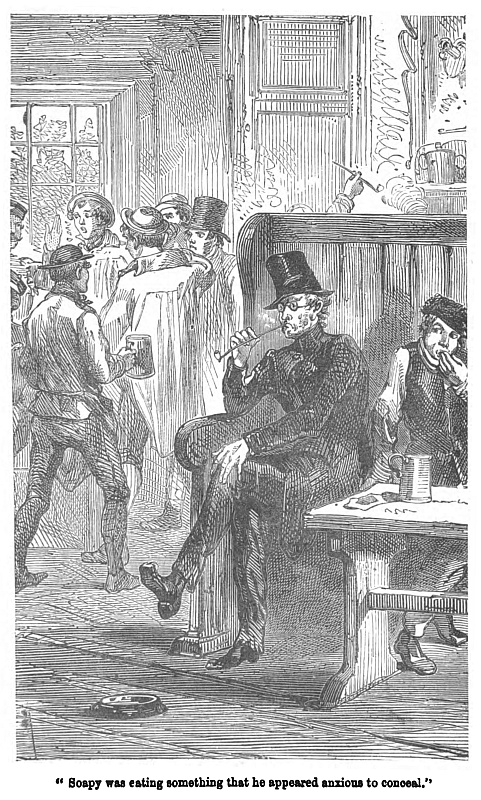
“Soapy” was eating something that he appeared anxious to conceal, and, by the manner he put his hand up to his mouth, I suspected it to be horse-beans. He appeared confused whenever his gaze met mine, and therefore was not a little relieved when the party got up to dance to a tune that a merry little journeyman shoemaker was whistling and drumming on the table with his knuckles.
A rough-looking fellow took hold of the “Doctor.”
“Come, Doctor,” said he, “you must stir your old stumps.”
“Now, Soapy,” said another; and in a moment “Soapy” and the “Doctor” were hustled round and round; we preferred to sit still and witness the fun, otherwise our spurs would have left their marks on the shins of the clodhoppers. Tired of dancing, they began to push one another about. One man had his face blackened, but he was evidently unaware of it; some one pushed this man against the “Doctor,” and they both fell on the saw-dusted floor together; “Soapy” was pushed on the top of them, Dick and Sam, the rival smokers, being topmost of all. “Murder!” shouted the “Doctor;” the landlord came, and peace was soon restored.
After this row I noticed a lot of little round objects strewed all over the floor, which on examination proved to be empty pill-boxes. The mystery was now unravelled: the “Doctor” was a travelling quack, and “Soapy” had been eating his pills, to which he had helped himself from the “Doctor’s” pockets. When asked how he liked the pills, he said they were “very good,” and he thought they were “only comfits” (a mixture of flour and sugar). He had abstracted and actually eaten the contents of seventeen boxes, enough to “kill six horses,” as the “Doctor” said, by reason of their powerful purgative properties. He felt “Soapy’s” pulse, and talked of the stomach-pump, which did not in the least alarm the half-wit, who declared that he “could eat a wheelbarrow full of them.”
“Well,” said the Doctor, “I would not be in your place for all the world.”
We remained over an hour after this, during which no change took place in “Soapy’s” ordinary health, and meeting him in barracks about ten days after, I asked him whether the pills had made him ill. He replied, “No, not yet, but I expect they will do so, before long.”
Chapter Twelve.
Cassio.—I will rather sue to be despised than to deceive so good a commander, with so slight, so drunken, and so indiscreet an officer. Drunk? and speak parrot? and squabble? swagger? swear and discourse fustian with one’s own shadow?—O, thou invisible spirit of wine, if thou hast no name to be known by, let us call thee—devil!
Shakespeare.
Our visits to public-houses during the winter months must not be accepted as a sign that we were loose and careless as to our morals, as we frequently attended church or chapel on such evenings as we could, in our turns, procure leave from stables, and such of the inhabitants as were attendants at these places of worship gave us every encouragement to come more frequently by opening their seat doors, and beckoning us to sit beside them. We had a library, too (as provided in every barracks), for our especial use, in which there was no lack of entertaining and useful books.
There can be no question that the morals, general conduct, intelligence, and appearance of a youth are very much improved by enlistment. I know that one section, at least, of the public hold a contrary opinion. I have, however, carefully observed the habits of men, who in civil life would have degenerated into drunken reprobates, and contrasted them with the class from whence they have been enlisted, when the balance is found immeasurably superior to their companions who prefer to remain civilians. The general public imagine, that because a youth is a “worthless fellow,” or a “lazy, drunken blackguard,” before he is enlisted, that he must for ever remain so; and that, therefore, he is a fair sample of soldiers generally. Nothing can be more erroneous than this idea. A youth who has given himself up to habits of idleness, and, perhaps, drunkenness in civil life, must reform when he becomes a British soldier. He finds a master in the army, if he never had one before; his whole habits are soon changed, and his general demeanour and bearing are, in the course of a few days, seen to be such as to distinguish the effects of order and discipline from the habits and manners of an untrained rustic, or a village vagabond. It is imperative that not only the dress and appearance but the conduct of the soldier should be such as to create in the minds of all civilians, as well as the soldier himself, a respect for the military service; and though, in a few instances, cases do occur where soldiers grossly misconduct themselves, yet they are at all times most strictly enjoined to avoid being mixed in broils or disturbances, or in meetings where party or political subjects may be agitated, or where intemperance may produce argument and discussion, which lead to no useful result, but too frequently end in breaches of the public peace.
I have before remarked that drunkenness is the source of almost every evil that can befall the soldier; and, although he is allowed to purchase liquor to any extent that his means allow, and his inclination may prompt him, yet he is so well aware of the severe penalty that any undue indulgence in liquor will entail upon him, that a confirmed drunkard is more rarely to be met with in a regiment than is generally supposed. Solitary confinement, or confinement in the “black hole,” are at all times reserved for cases of drunkenness; not violence or insolence to superiors. The penalty awarded by the articles of war for “habitual drunkenness” is discharge from the service with ignominy. Thus the Government prove beyond a doubt, that habitual drunkenness cannot be tolerated in the army with the same degree that we all know it to exist in civil life.
When orders have been given, as the result of a court-martial, for discharging a soldier with ignominy, commonly called “drumming him out of the regiment,” the whole corps is assembled and formed in double rank, facing inwards (towards each other), one flank of each rank reaching close up to each side of the front gate, which is generally besieged by a mob of people (the fact being previously known in the neighbourhood of the barracks that a man is to be “drummed out”); thus a sort of lane is formed for the culprit to walk through, so that every soldier can see him. He is then escorted by an armed party from the guard-room; the several crimes and irregularities of which he has been guilty are read over, as also the sentence of the court-martial for his dismissal from the service; together with his discharge, in which is noticed his disgraceful conduct. The buttons, facings, lace, etc, are then stripped from his clothing, his discharge is handed to him, and he is then marched down the ranks, with the drummer behind him, to the front gate, which is closed behind him for ever; and he is launched upon society a ruined, disgraced, and broken-down individual. Soldiers serving abroad, who have been sentenced to be discharged with disgrace, are not finally discharged until they reach the depot of their regiment at home; but they are sent home as prisoners (though not kept in confinement on the passage) for the purpose of being finally discharged, in the manner above alluded to, in a few days after their arrival.
Corporal punishment is but seldom inflicted now; indeed, I never saw but one man flogged, and that was for knocking down a sergeant: he had only fifty lashes, and bore it without flinching. We had three men in our regiment who had received two hundred lashes each, for being drunk on guard at a post requiring great vigilance; their backs were frightfully scored with blue ridges, or “wheals,” from the neck to the bottom of the waist. They each said that they scarcely felt the pain of infliction after the first fifty lashes; but the greatest agony of all was the application of a lotion after being taken to hospital. They were good soldiers; and, contrary to the general impression, that flogging has the effect of “debasing the mind of a soldier,” they seemed to think that they deserved it, because they knew how to avoid it.
Generally speaking, soldiers would rather be flogged than handed over to the civil power, and imprisoned in a common gaol, or sentenced to a long term of “kit drill” in hot weather—the latter punishment blistering the feet, and causing as much pain as the lash on the bare back, and it has to be endured so much longer.
Flogging is, however, after all, a most unfair and degrading punishment to a man who may at any time be called upon to lay down his life in the defence of his country. Sentences of corporal punishment are inflicted in the riding-school, and always at head-quarters. A triangular-shaped frame of timber is placed against the wall; the whole regiment is then assembled under arms, and with drawn swords; the culprit is brought from the guard-room, handcuffed, into the hollow square formed by his comrades; the colonel reads the particulars of his crime and sentence; he is then conducted to the triangle, and divested of his jacket and shirt; his hands are tied to the apex and his feet to the base of the triangle; the surgeon takes his stand, as also the colonel, adjutant, and other officers. The instrument of torture (cat-o’-nine-tails—a whip with nine lashes, made of catgut) is produced by the farrier-major, under whom are the requisite number of troop-farriers to inflict the punishment, so many lashes each. The culprit is considered as having expiated his offence when he shall have undergone, at one time, as much of the punishment as, in the opinion of the surgeon, he is able to bear. The idea, often promulgated by the newspapers, that a soldier who has been flogged until ordered by the surgeon to be taken down, because of his physical inability to undergo the punishment the first time, is again brought out to undergo the remainder of his punishment, is not correct. The infliction of corporal punishment a second time, under one and the same sentence, was never resorted to in the British army.
The punishment of marking a deserter with the letter D is inflicted on the parade-ground in presence of the whole regiment, and under the personal superintendence of the surgeon. The operation is performed with an instrument made for the purpose, and the punishment is inflicted in the cavalry by the trumpet-major, a person who is responsible for the observance of discipline and duty of the troop-trumpeters, and in the infantry by the drum-major or bugle-major, and these are first instructed by the surgeon how to apply the instrument or ingredient (generally gunpowder or ink) properly and effectually.
Flogging is the penalty of the following offences only:
First.—Mutiny, insubordination, violence, or offering violence to superior officers.
Second.—Drunkenness on duty.
Third.—Sale of, or making away with arms, ammunition, accoutrements, clothing, or necessaries, stealing from comrades, or other disgraceful conduct.
In former times, desertion was included in the above crimes, but imprisonment, and the degradation of being branded for life with the letter D, is considered a sufficient punishment.
In cases where non-commissioned officers misconduct themselves, they are not confined in the guard-room, but considered as placed under arrest in their own room, without a guard over them. In serious cases, where it is necessary to hold a court-martial over them, and the offence is established, they are generally sentenced to be reduced to the rank and pay of a private, being stripped of their stripes in the presence of a parade of the whole regiment.
Chapter Thirteen.
Reputation, reputation, reputation! O, I have lost my reputation! I have lost the immortal part, sir, of myself, and what remains is bestial.
The sergeant; to whom I alluded in a former chapter as having deserted from Liverpool, where he was stationed in command of a recruiting party, was the first non-commissioned officer that ever I witnessed “broke” and reduced to the ranks. It was two years after the corporal with whom he deserted gave himself up, and the regiment was then stationed at York. The sergeant had been to the “gold diggings” in California, or part way there; but, after a great deal of privation and suffering, he resolved to come to England again and run his chance of being taken as a deserter. Landing in Liverpool, spirit-broken, and with but little money in his pocket, he set out for his native place, somewhere near Sheffield, travelling by railway; and having to change carriages at Victoria Station, Manchester, he was recognised by our adjutant (the son of a Liverpool brewer), who had been on a visit to his friends, and of course given into the custody of the police until an escort could be sent to bring him to head-quarters. He was tried by court-martial in the ordinary course, and, having made away with all his regimental clothing, kit, necessaries, and some money belonging to the regiment, he was sentenced to three months’ imprisonment in York gaol, and reduced to the rank and pay of a private soldier. Some months after he had returned to his duty, I was on guard with him one very cold night in the depth of winter. We were sitting round the guard-room fire waiting for our turn to go on sentry. The ex-sergeant, was dull and morose generally, and more especially when on guard; “the time above all times,” he used to say, when he reflected the most upon his disgrace, was as he paced to and fro in the dark and deep stillness of a winter’s night. We had a gay young Irishman in the same relief, Jerry O’Neil, who had told several good stories in the course of the night and so got the party into good spirits. Singing was not allowed in the guard-room; and, therefore, story-telling was always the most approved method of entertainment. We had each told our story, and it came round to Brailsford’s turn (that was his name); and, now that he was a private soldier, he was always addressed by his surname, like the rest of us. The fire was replenished, pipes reloaded, and both the corporal and sergeant of the guard drew dearer to the hearth, so as to hear the ex-sergeant relate an incident that occurred to him on his way to the “diggings,” the substance of which I have reduced, and endeavoured to render in a readable form.
“You are all aware, boys,” began the ex-sergeant, “that I deserted in a moment of temptation, and with Corporal — went to America. Soon after our arrival in New York, the corporal left me to go to some of his friends in the state of Ohio, and I was left to shift for myself, intending to get some kind of situation in New York. Having plenty of money, however, to keep me in idleness for some time, I joined a party of ‘gold-seekers,’ who were going by the overland route to California. I formed one of six men. We had six horses, three pack-mules, and two dogs; and, although we journeyed for days with the heavy plodding ox-teams of the main body of our party, and intended to keep their company more or less all the way, yet we were equipped for, and intended to have some hunting and sport, diverging from the main track in the morning, and sometimes returning to it some distance ahead, so as to fall in with our party in the evening. Frequently, however, we missed the track; or, having game in view, we slept away from the main body.
“One bright summer morning we were up and broke camp earlier than usual. Old Ben Walton, our captain and guide, to whom these wilds were home, had promised that this day we should strike the great buffalo trail, by which mighty herds of those animals migrate from their winter pasturage in the south to fatten on the prairies of Utah and Oregon. For several days we had been separated from the rest of the party, and found ourselves, according to Ben’s calculation, on one of those great dry prairies that skirt the eastern slope of the Rocky Mountains, near the northern boundary of New Mexico; we were suffering from want of water, the last quart remaining in my canteen I had shared with my horse in the morning. It was now mid-day, and our course lay due east, beneath a broiling sun; the plain was dry and parched, and it seemed that if we could not get into the track of our head-quarters, or find water, both man and beast must soon give way. Old Ben promised us water within a few miles, and we jogged on as fast as we could urge our half-famished horses. About four o’clock in the afternoon we came upon one of those singular ravines which the spring floods wash out of the loose soil of these prairies; the banks were perpendicular, the ravine about twenty feet deep, and from twenty to thirty yards wide, and in the sand and gravel bottom we beheld the welcome water, not a running stream, but standing in small limpid pools. The sight was very cheering, yet still it was out of our reach; we turned our course to the south, down the bank of the ravine; continuing thus for near a mile, we came upon a deep, wide pathway or gully worn by the hoofs of the buffaloes, and leading down to the bottom of the ravine. With a wild shout of joy we dashed down, and soon man, horse, and dog were regaling themselves at these delicious fountains of Nature.
“Kettles were swung, and in a few minuted the fragrant coffee, and boiling pemmican (dried buffalo beef, pounded) saluted our nostrils and whetted our appetites. All were busy, some unloading mules, others gathering fuel—the dried droppings of the buffalo, the only fuel of the plain, burning like turf. As we finished our meal, night was coming on, and Ben had advised us all to prepare for rest, when a low, rumbling sound, like distant thunder, started us all to our feet. As the sky was clear overhead, we were at a loss to account for the strange noise, until Ben, throwing his ear to the ground shouted,—
“‘Buffaloes! Mount!’
“The order was scarcely delivered before every man was in his saddle, and following Ben up the gully at full speed. On reaching the plain we had not long before crossed, a terrific sight to novices in prairie-life broke upon our vision.
“Away in the distance was a great brown mass, undulating like a sea, and extending miles in each direction. A cloud of dust hung above the mighty herd of buffaloes, darkening the sky. Already they snuffed the water, and were approaching at full speed. A glance was enough for Ben. Wheeling his horse again into the ravine, he shouted for all to follow. His practised eye saw that they were making for the water-course, and in a few moments, if we remained, we should be trampled to death.
“I thought that the hurried manner in which Ben ordered us to re-pack the mules and run up the ravine had something of cowardice in it. It would have been well for me had I partaken of this fear. While my more sensible companions hastened after Ben up the bottom of the ravine, I spurred my horse up the steep path to have another look—I even thought of bagging a few buffaloes, to astonish old Ben. When I reached the level of the plain, I witnessed such a sight as I shall never forget—a moving wall of life! and, within a few yards of me, grizzly, shaggy monsters, with heads to the ground, and tails erect, bellowing like an earthquake, throwing white froth from their parched mouths, while their tread seemed to shake the very earth. With a sudden start my horse reared, twisting round upon his haunches, and, wheeling round, he dashed down the pathway; and, before I could regain my presence of mind, he was galloping at the top of his speed down the ravine, in a contrary direction to that taken by my comrades, who were now out of sight. For nearly a mile he held his headlong course, until a turn in the channel brought me in sight of a new danger.
“The herd had divided upon the plain, and thousands were crowding down another pathway below me, choking up the ravine with a dense, impenetrable living mass. This new barrier enabled me to control my horse; turning him round I scanned the high bank on each side for an opening of escape. All was vain! There was not a place for a cat to crawl up, and here was coming on either side a mass of buffaloes that would soon crush me between them. A few stragglers, more speedy than the rest, came first, crowding their noses into the little pools of water, and sucking them dry in a moment. Now the mass behind came sweeping like a mighty torrent, completely choking up the narrow ravine. There was no escape; and in less time than it takes me to tell you, boys, I was forced between the two divisions, and my frantic horse made a part of the living stream. The air was filled with sand, gravel, and froth. The hot breath from the feverish mass rose like steam, and sickened me. I felt that I must fall, not to the ground (there was no room for that), but upon the backs of the crushing, sweltering, reeking mass. A furious old bull gored my poor horse in the flank; again and again he plunged his short, sharp, strong horn into my dying horse until his entrails were torn out. I felt him giving way beneath me, his strength almost gone; still he was carried along by the crush. We came to a slight widening of the ravine and the pressure was relieved, but my lifeless horse sank to the earth, and was trampled to a jelly in a moment. As I felt him going, I sprang from the saddle, and landed erect upon the backs of the rushing, ramping buffaloes. I fell, but recovered myself before I came to the ground. At last I landed and lay at full length upon the back of a huge beast; with a feeling of desperation I twisted my hands into his mane, and on with the heaving torrent, my wild courser, mad with terror, throws his head wildly about, tearing the sides of all within his reach, and sprinkling me with a shower of froth and gore.”
Chapter Fourteen.
We rustled through the leaves like wind, Left shrubs and trees and wolves behind.
“On went the buffalo, tearing and crushing all before and around him. How long this lasted I know not; but, although I was very weak, stunned, and nearly blinded, I still madly clung to him! to fall would be certain death. At length he darted up a narrow gully upon the side of the valley from which we had entered it, and dashed off across the open plain. The cold breeze revived me a little, and I began to cherish a hope of life. I gradually drew myself into a sitting position, and began to feel the want of a saddle badly; it required all my nerve, strength, and skill to retain my seat. I could not turn to look back, and dared not slip from the beast for fear of meeting with the fate of my poor horse—not knowing but the whole herd was close in my wake. For miles we held our course, until the silence convinced me that we were alone. I began to reflect on the best means of ending the fearful race. I had bought a revolver and a large bowie-knife in New York, and these I had stuck in my belt, but to wound and not kill the monster would he to expose myself to certain death, as nothing is more terrible than a wounded buffalo. I decided upon the knife as the surest. My bowie was as keen as a razor, with a blade near twelve inches long. I drew it, and, twisting my left hand into the brute’s mane, I gradually leaned down over his shoulders, pressed the point of my knife against the side of his neck, and, with all my strength, thrust it in and down. Thank goodness, the monster began to tremble, the blood gushed forth, he reeled, and with a terrific plunge on his knees, sent me flying over his head on to the springing turf. I remained still to see if he was able to rise. He once or twice attempted it, but when half upon his legs he dropped from exhaustion and loss of blood, and the mountain of flesh lay quivering in the agonies of death.
“I knew not how far I had ridden: my mind was in confusion, and every joint in my frame seemed as if about to snap asunder. I stood upon the body of the dead buffalo and gazed about me. Night was fast closing in, and there was nothing in sight but sky and plain. I felt then for the first time as if alone in the wide world; not a vestige of man or his handiwork was visible. Alone with nature, the stillness to me was painful; even the carcase of the slain brute seemed company, and I determined to remain by it until morning, I felt that with the darkness gathering round, and in my exhausted state, to attempt to reach my comrades that night, even if I knew the direction, would be useless. This point decided, I gathered a quantity of fuel, and soon a blazing fire sent its cheerful glow around me, making the gloom beyond the circle of its rays still more impenetrable. I cut some slices of the buffalo’s tongue and broiled them upon the fire, and of these, seasoned with salt from my pouch, and eaten with some parched corn from the same receptacle, I made a hearty meal.
“My lodgings gave me no uneasiness; so, after gathering a further supply of fuel to make up a good fire for the purpose of intimidating the wolves, that I judged would be drawn by the scent of fresh meat, I placed myself upon the ground, my feet to the fire, and my head and shoulders resting upon the body of the still warm animal. My mind was easy as to the future, though my conscience pricked me when I reflected upon the past. I knew that old Ben had his own reasons for liking me, as I had more money than all the rest of the hunting party together; and I felt sure that he would never leave the vicinity until satisfied of my fate. With this reflection I fell asleep.
“During the night, I was once awoke by the snarling of a pack of wolves. My fire had burned low, and they were gathered in great numbers about me. I had no fear of them; for Ben had told me that the prairie wolf is a cowardly animal, and will seldom molest a man, unless driven to it by famine. For revenge, however, at being disturbed, I fired my revolver among them. A howl of pain followed; then yells and a gnashing of teeth, tearing of flesh, and crunching of bones, enough to convince me that I had hit one or more of them. It is a singular fact, that when blood is once drawn from one of these animals, the others instantly set upon and devour it.
“After replenishing my fire and reloading my revolver, I again lay down, watching the smoke which rose in the stillness of the atmosphere like a column, then spreading out, it formed the only cloud visible. I slept undisturbed until daylight.
“On my awaking, I found myself very stiff and sore, and came to the conclusion, over my breakfast of broiled buffalo-steak, to remain where I was until my friends sought me. I was aware that a smoke would be visible many miles in the clear air of the plains; and I covered my fire with grass and soil wet with the morning dew. Soon a dense white steam ascended, which I felt sure must attract attention. And so it did, but not exactly in the quarter I would have chosen; for, scarce had I finished my repast, when I saw in the distance a horseman rapidly approaching. I felt sure it was Ben, and was inwardly congratulating myself on a pleasant meeting with my comrades, when the strange movements of the fast approaching person attracted my attention not a little. Instead of coming in a direct line, he took a circular course, gradually drawing nearer, and lessening the circle around me; and I soon saw that it was an Indian, mounted on a splendid horse. The way I saw him handling his rifle convinced me that his morning call would not be a very agreeable one to me. I had lost my rifle with my horse: true, I had a Colt’s revolver—the best weapon ever invented for close quarters; but against his long range the odds were sadly against me.
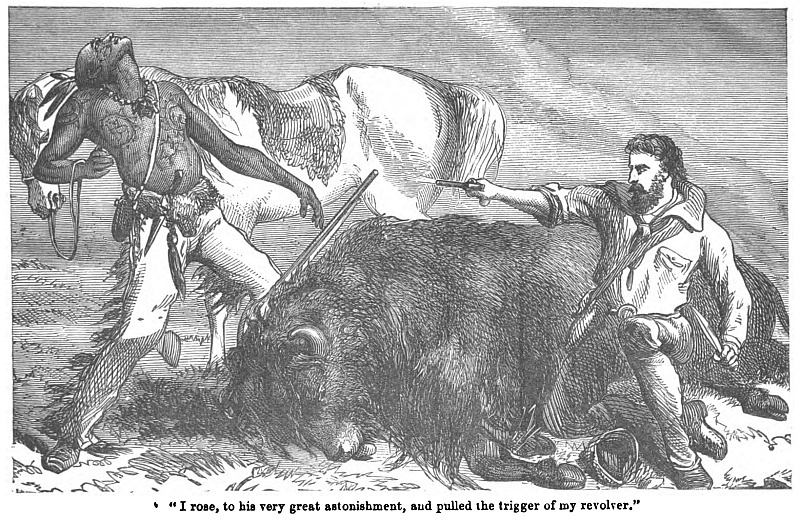
“Tearing a piece of white linen from my shirt sleeve, I waved it above my head as a flag of truce. While in the very act, the tawny rascal raised his rifle and fired. I heard the bullet whistle past my head. Finding that he had missed his mark, he galloped back some distance to reload. This gave me a moment for reflection. As the scoundrel had fired upon my flag of truce, I felt justified in killing him if I could. Throwing myself down behind my barricade of beef, I examined my revolver and drew my knife, determined to sell my life as dearly as possible. Cautiously looking over the body of the buffalo, I saw him drawing near; he saw the motion, and was about to fire, when I withdrew my head. After a few moments’ silence I could plainly hear the panting breath of his horse, and detected the click of his gun-lock. The rascal knew very well that to fire on him I must expose myself, and now stood waiting his prey. Placing my fur-cap upon the point of my knife, I gradually raised it above the carcase of the buffalo. The ruse succeeded: when he fired, I dropped the cap and gave a loud groan. With a yell he sprung from his horse, with the evident intention of transferring my scalp to his belt—a proceeding I had a decided objection to, and, moreover, I felt that this was the proper time to urge it. As I heard his footsteps approaching, I rose, to his very great astonishment, and pulled the trigger of my revolver; he staggered; another shot eased him of his pain, and I was again alone. No, boys, not alone, for a few yards off stood his horse, tethered to the arm of his defunct master, by a few yards of buffalo hide. I had no trouble in securing him, and a beauty he was. Gathering up some trifles which the dead Indian could have no further use for, such as a rifle, tomahawk, etc, I knocked off a horn from the buffalo as a trophy. I mounted, and, turning towards the rising sun, set the horse off at a brisk canter. Knowing that the instinct of the animal would take him to the water, I gave him his head, and I was right: an hour’s ride brought me to the ravine. I soon found a path to descend, but I examined the horizon well for buffaloes before I trusted myself in the gulf.
“Finding all clear, I rode down to the water, and, after refreshing myself and my horse, I took my course up stream. A trot of a few miles and a turn of the water-course brought me in sight of my friends, encamped near the mangled remains of my horse, and holding a consultation as to my probable fate. I received a warm greeting from all, and tears ran down old Ben’s cheeks as he pressed me to his heart. Over our evening meal I related my story. Ben listened to the finish. ‘So you shot a Camanche—eh?’ ‘Yes, Ben,’ said I. ‘Well,’ replied he, ‘you that are on duty to-night had better keep your eyes open, for we shall hear more of this day’s work.’ ‘How could I help doing it, Ben?’ said I. ‘Wal, I s’pose you couldn’t.’ With this complimentary remark, he knocked the ashes from his pipe, wrapped himself in his blanket, and fell asleep. When the fire was made, and two of the party had been placed as sentries, and enjoined to keep a sharp look-out for ‘Camanches,’ I followed his example.
“Nothing occurred to disturb us during the night except the howling of the wolves, to which we were now getting pretty well accustomed. And, after making a hearty breakfast, we considered it advisable to join the main body of our party as soon as possible; as, on the discovery of the dead body of one of their tribe, the Camanches would be sure to attack any detached parties like ours, found in small numbers, in which case we might probably lose our scalps. After riding all day, we at length found the main track, and soon discerned the smoke from their encampment for the night. The story was related again after supper, the whole party anxiously listening to every word. When I had finished, a tall, masculine-looking woman, who usually had charge of one of the wagons and oxen, struck up with a story for our amusement.
“‘When I was a gal,’ she commenced, and went on in the pure American dialect, ‘and even arter I married my man—poor fellow! he’s gone long ago—I used to go out in the woods arter the deer that our hunters had killed and hung up, so that they could go on killin’ without losin’ time; and I used to bring ’em in, skin ’em, and jerk ’em, too. And that warn’t all: I allers attended the wolf-traps, and all sitch like. There’s but few mortal men livin’ now what’s seen as much fun a killin’ wolves as I have. Whenever we got one fast in a trap, me and the dogs, we was allers good for him in double-quick time; but occasionally we got a little more than we bargained for. I recollect one time, little Josey (that’s my oldest boy) and me, we went to a trap, and found the surliest-lookin’ old “bar” (bear) in all creation fast in it by one hind-leg. “Turk” and “Rome” (them was our dogs), they mounted him, and began to do their best to kill him, and Josey and me sick’t ’em on, and slapped our hands, but they weren’t no more than fleas in his ear. He boxed ’em about hither and thither jest as he liked, till at last he got ’em both in his hug, and I seed he was a squeezin’ the life out en ’em; so I told Josey to stop by a big tree, and then I took the axe (for I hadn’t nothin’ else with me), and run up to help the dogs. By the time I got up to him he’d laid one of ’em cold, and had t’other in a purty fair way. I let drive at his head; but he up with one paw and knocked the axe out of my hand about ten steps. This kinder staggered me, so I felt down like; and the next thing I know’d, the “bar” was a top o’ me. I tusselled with him as hard as I could, you may be sure; but it warn’t of much use. He squeezed me tighter and tighter, and I begun to think it was all over with me, and my little Josey screeching like mad, when up came my ole man, and cut the bar’s wozzen from ear to ear. He’d hearn the noise the dogs and little Josey made, and knowin’ there must be somethin’ more than common, he’d run out. As soon as the “bar” was dead, he bust out into a loud laugh, and, said he, “You’re a purty woman to be caught out here in the woods huggin’ a bar, ain’t you?” But poor old Rome! we couldn’t fetch him to life any more. The bar had crushed all the bones in his body. I recollect another shindy I had when attending the traps. It was some time arter the “bar” scrape. Just afore I got in sight of a trap, I hearn Turk, what had trotted ahead of me, a makin’ a dreadful queer kind of a whinin’ noise. I ses, ses I, to myself, there must be something wrong with Turk; so I hurried up as fast as I could. And, shure enough there was too. The biggest eagle I ever hearn tell on was a standin’ with one claw fast in the trap and t’other clamp up around Turk’s nose so fast that he couldn’t no more open his mouth than he could a whistled if it had been open. There he stood, with all his legs poked for’ard, a yankin’ back, and a makin’ all the noise he possibly could. I hunted up a stick, and, after a heap of trouble, I got the life manted out of it; but even then it wouldn’t let go its hold on Turk’s nose, nor could I get him loose till I’d took my knife and cut its claw off. Turk was always shy of eagles from that time.
“‘I never was frightened much by any of the backwoods varmint but once, and then I was but a young gal. Tom Ennis had gone up to Louisville with a load of skins, and it was so far he couldn’t make it back the same day; so Sally (that was Tom’s wife) she got me to go over to their cabin and stay with her all night for company. Sally had a young baby that weren’t very well, so it kept up such a crying that we couldn’t sleep for it. I recollect we had the bed made up on the floor. In the middle of the night we hearn somethin’ about on the boards of the roof, a scrapin’ and scratchin’ as if a tryin’ to get in. The moon was shinin’ atween the boards, and by the light of it we soon seed, whatever the thing might be, that it had got the board slipt aside enough so it could poke a great heavy paw down. Well, it worked on like a trooper, and directly we saw a big whiskery-lookin’ head, poked through, and two fiery eyes a glarin’ down at us. A little longer, and the hole was big enough to admit its body, and in he bounced on to the floor of the cabin, the biggest kind of an old he-panther. You’d better believe there was a couple of folks scart enough then, for we knowed the cries of the baby had attracted its attention, and it had come on purpose to make a meal out’n some of us. We covered up our heads, and laid there with our hearts a thumping. The panther sat down by the side of our bed, and wriggled his tail a bit, and then he begun to pat us gently with his paws, as if he wanted to play afore eatin’ us, like a cat does with a mouse when she ain’t very hungry. Just then, Sally, who was so scart that she didn’t know what she was at, gave a loud scream, and flirted the blanket right off’n us on to the panther. The movement, being so sudden and so unlooked for, gave the varmint a dreadful scare, and up through the hole he went, like a kite. That was the last we saw or heerd of him, and you may be sartain we were satisfied.’”
The ex-sergeant promised to relate more of his adventures on his way to and from the gold diggings on a future occasion. But the corporal with whom he deserted having frequently written to him since he was taken, at last purchased his discharge, and started him in business at Sheffield; so we saw no more of him after he left the regiment.
Chapter Fifteen.
Bid him beside, his daily pains employ To form the tender manners of the boy, And work him like a waxen babe with art, To perfect symmetry in every part.
Story-telling is a very favourite method of passing away spare time on guard, or after the lights are extinguished in the evenings when we retire to rest, and as these chapters proceed I shall from time to time relate such as I can remember, always giving preference to those which I fancy will be most interesting to my readers.
Meanwhile, I may be allowed to offer some details of the interior economy of a regiment in barracks.
In reference to the regimental school for the instruction of the children of non-commissioned officers and soldiers, I may state that their object is to instil into the minds of the children the duties of religion; to implant in them early habits of morality, obedience, and industry; to give the boys that amount of instruction which—may qualify them for non-commissioned officers, or enable them to become useful members of civil society. It entirely rests with the children themselves, when they arrive at a proper age, to adopt any line of life to which they give the preference, but it is considered by the proper authorities to be extremely essential that competent persons be selected from the ranks or roll of non-commissioned officers for the duties of schoolmasters and superintendents of the regimental schools. The boys are all dressed in regimentals corresponding with the stable-dress of the men, and very proud the little fellows are of it too, especially on a Sunday, when they march to church in rear of the regiment and band.
The schools are conducted on military principles, and, as far as circumstances permit, their establishment is assimilated to that of the regiment, being formed, I believe, on a system recommended by a Rev. Dr Bell. In addition to their daily lessons in reading, writing, and arithmetic, the boys are instructed in various ways of making themselves useful, and of gaining a respectable subsistence when they grow to maturity; the trades of armourers, tailors, saddlers, and boot and shoe makers being the most popular with them, because of their being carried on in barracks. The prevalent idea among civilians, that a soldier’s son, born in the regiment, must be a soldier, or that he is claimed by the Government when he arrives at the proper age, is entirely fallacious: no such system is tolerated in the British army. The education and care of a soldier’s child is as much the object of the sovereign’s and the Government’s solicitude, as the soldier himself.
The female children of the soldiers also equally partake of the benefits of this system of education, whenever accommodation and other circumstances permit, and a liberal allowance for eligible schoolmistresses is granted by the Government. The girls are taught reading, writing, arithmetic, plain needlework, and knitting, so that they are not only useful to the regiment while at school, but qualified to earn their own livelihood in after life.
In reference to the particular trades in which the children are to be instructed, the wishes of the parents are, as far as possible, to be consulted. Many of the boys born in the regiment become so attached to their parents and other individuals serving in the corps, and, moreover, so accustomed to military routine, that they seldom leave it to become civilians. They chiefly enter the band, and many of them attain the position of trumpeters, in which case they are, for the most part, as well off as if they had chosen the life of a tradesman; for I am bound to say that whatever position a man may hold in the army, and however much he may dislike that position and yearn for his liberty, he is, after he attains his freedom, either by purchase or desertion, more or less unsettled by being separated from his comrades. Numbers who have purchased their discharge, having a good home and livelihood in civil life, enlist again, and remain soldiers for the full period of their service.
I may here state, that whatever time a soldier has served prior to purchasing his discharge, that time does not count in his favour on second enlistment: he has still twenty-four years to serve in the cavalry and twenty-one years in the infantry, from the date of his second or any subsequent enlistment.
In reference to the bands of music in either cavalry or infantry, they are supported out of the private purses of the commissioned officers. Every officer on entering a regiment is required to contribute towards the support of a band, twenty days’ pay on appointment, and an annual subscription, at the discretion of the commanding officer. In cases of promotion, the officer has to give the difference between twenty days’ pay of the rank attained and of that previously held.
The bandsmen are all regularly enlisted and drilled, so as to be effective as soldiers, and they are liable to serve in the ranks on any emergency. They are generally attired in a more gaudy and expensive uniform than the privates in the ranks. The number of a band depends much upon the caprice of the commanding officer, and although the limit is prescribed by Government to a sergeant as master, and fourteen privates as musicians, yet the majority of regimental bands are composed of a band-master, a band-sergeant, a band-corporal, and frequently upwards of thirty privates as performers. The band invariably accompanies the regiment to church. I remember an attempt being made by the officiating minister of a church attended by the 16th Lancers, to prevent that regiment from being accompanied by its band to Divine worship, but Colonel Smyth, who had led the corps with great distinction through the Sikh war, was inexorable. He said, “the band had many times played his regiment in and out of battle, and so long as he remained its commander, it should play him and his men to and from church.” It is only right, however, to observe that the minister did not object to it in a religious point of view, only that the regiment having but recently returned from India covered with honours, it attracted such a concourse of people as to greatly impede the comfort of the regular habitués of his church, and it was suggested that the withdrawal of the band would, to a great extent, check the assemblage of such vast crowds, that not only choked up the thoroughfares and approaches to the church, but filled the sacred edifice itself. The men and officers all attend Divine service in full dress, with swords; and where they have to attend a church out of barracks, a portion of the sitting accommodation is especially set apart for their use. In some barracks, however, a chaplain is appointed, who preaches a sermon in the riding-school, the children of the soldiers being seated on forms carried from the schools, the men and officers standing around them and the pulpit.
In almost every regiment there are a number of Roman Catholics, who are, of course, free to attend their own place of worship, but the band at all times accompanies the Protestants to the service of the Church of England.
Chapter Sixteen.
Hast thou given the horse strength? Hast thou clothed his neck with thunder?
He paweth in the valley, and rejoiceth in his strength; he goeth on to meet the armed men.
He mocketh at fear and is not affrighted, neither turneth he back from the sword.
He saith among the trumpets, “Ha! ha!” and he smelleth the battle afar off.
My readers will probably be interested in the mode of procuring and management of troop-horses. In the first place, the horses which are purchased for the cavalry are selected of a sufficient height and strength, so as to be able to carry a man of average weight and four stone in addition, that being about the weight of a cavalry soldier’s kit and necessaries, which he must always carry with him when on a campaign or the line of march. The most favourable season for purchasing troop-horses is considered the autumn, and the commanding officers either attend the large fairs themselves, or they leave the business to a contractor, who has to supply the horses at a stated price (35 pounds for dragoons, hussars, lancers, and artillery, and 45 pounds for black horses for the Horse Guards,) subject, of course; to the inspection of the commanding officer and the professional examination of the regimental veterinary surgeon.
Except in time of war, when large drafts are required to supply the places of those killed in action, or that die of disease, exposure, and want of forage, no horses are purchased for the cavalry at a younger age than three years, and all must be perfectly unbroken, so that their instinct is untainted by any manner of training except the one uniform system in use throughout the entire service.
The trumpeters are generally mounted on grey horses, but the prevailing colours of troop-horses are bay, brown, and black. The Horse Guards (1st and 2nd Life Guards, and Horse Guards Blue, or Royal Horse Guards) are all mounted on black horses, and the 2nd North British Dragoons, or Scots Greys, are all mounted on grey horses. The most scrupulous care is of course taken of them in barracks. The veterinary surgeon is responsible as to their health, as reported to him by the troop-sergeant-major and the troop-farrier daily, the latter being more particularly required to examine each foot of every horse in his troop twice at least every week for any appearance of loose shoes, broken nails, or any change in the healthy condition of the feet. The troop-sergeant-major is supposed to be always present in the stable when the horses are fed, watered, and groomed; and he is therefore responsible for their condition, grooming, and general appearance.
Every horse, as a rule, is supposed to be shod once a month; but so great is the variety in size and formation in feet, and in the degrees of toughness and rapidity of growth of the hoof and sole of different horses, and even on different feet of the same horse and at different parts of the same shoe, that no particular pattern or form of shoe is prescribed. This is left to the skill and judgment of the farrier, to make according to the shape of the foot with which he has to deal. In this particular branch of his business he is far superior to the village blacksmith or the more pretentious shoeing-smiths in large towns, even London itself, where many veterinary farriers keep a lot of shoes by them that have been made by machinery; and, as a rule, they pare, cut down, and model the poor horse’s foot to fit their shoe, instead of making the shoe to fit the peculiar conformation of the foot. Hundreds of valuable horses used by civilians are constantly ruined by the pernicious practice of cutting the hoof and sole of the horse’s foot into a shape quite contrary to that intended by Nature, who has cast it in a mould necessary and proper to support the horse’s weight or the peculiar shape of its legs, which differ more or less in all animals, although the basis of their construction is essentially the same. All unnecessary loading of the horse’s foot with iron is carefully avoided; and if any farrier is caught in the reprehensible practice of applying a red-hot shoe to the foot, he is very severely dealt with.
A very important point in the care of troop-horses is the prevention of predisposing causes of disease, such as exposure to extreme cold and heat. Of course this cannot be so well carried out in camp as in barracks, and the consequence is that disease is much more frequent in the former than the latter. I, for one, think it very questionable policy on the part of our Government to take horses out of warm barrack-stables and picket them in the open air, as at Aldershot and the Curragh camp, when there is neither war nor rumours of war. Such a course of proceeding only exposes the extreme ignorance of those who have the direction of these affairs. Alternately exposing either horses or human beings to heat and cold is the surest way of bringing on disease and undermining the constitution. The horses, at least of those regiments who are first on the roll for a campaign, ought to remain in camp, and never be allowed to enter a stable, the atmosphere of which is much warmer than the open air, and then they would be always in readiness to proceed to any part, without running the risk of disease and death by exposure, as occurred in the Crimea, where more than half the number of our cavalry were rendered non-effective from want of horses. This plan would not entail the necessity of submitting the men of the regiment to which the horses belong to the hardship of remaining constantly in camp, for there would be nothing to hinder them from being relieved by soldiers from other regiments, who could march to the camp with the whole of their kit and necessaries, and the men who are relieved could pack up their own kit and march out with the horses of the relieving corps. This system would be far better than, for instance, marching our troop-horses from the stables of barracks situate in the inland towns of England to Ireland, and exposing them to the cold blasts that, both in winter and summer, sweep through the camp at the Curragh of Kildare, one of the most bleak and cold parts of either Ireland or England. The soldiers themselves are aware of all this, and it is fast spreading discontent among them, especially those who are stationed at the latter place, where I have myself witnessed horses standing at their picket-posts nearly up to the hocks in mud, while a cold north-east wind was blowing and causing their backs to stick up and their coats to stare like hedgehogs. Let us hope that, if not for the sake of the poor animals, the legislature will, for the benefit of the service and consideration for the soldiers, see the necessity of changing so suicidal a policy as exposing our troops and troop-horses to such sudden changes from barracks (in some places absolutely in want of ventilation) to the most exposed places they can possibly select throughout the length and breadth of our proverbially capricious and changeable climate.
When horses become unserviceable from any cause, they are disposed of by public auction to the highest bidder. Many a gallant old trooper is now dragging out his existence in omnibuses, cabs, and the like, being generally bought for harness work. Every troop-horse is marked on the front of both hoofs of his fore-feet with the number and initials of the regiment in which he served. Sometimes these “cast horses” are bought by dealers, who file out the marks and sell them to novices as young fresh horses just up from the country; but an experienced man may always detect an old trooper by the hollow place left by filing out the marks; and if the horse be mounted, the rider may find out in an instant whether he has been a trooper if he will feel the off-rein and lightly press his left leg to the horse’s near side, or vice versâ, when the animal will commence to cross his legs and move sideways, as if to “dress” to some imaginary companions in forming line; for whenever a horse has been taught anything and practised in it he never forgets it, and needs but the necessary signals to again remind him that the movement is required.
It is a spirit-stirring sight to witness the embarkation of a cavalry regiment for a sea voyage. In the first place, it is considered advisable, when circumstances permit, for the embarkation to take place immediately after a day’s march, when the horses are more quiet and manageable, than when brought fresh out of stables, time being always allowed for wisping them over and picking out their feet to clear them from gravel or any dirt which may accumulate between the edge of the shoe and the sole of the foot (a point too often neglected by gentlemen’s grooms after their horses come in from a journey). When all is ready for business, a sling is passed under the horse’s belly, and also supports his chest and quarters; the ropes attached to this sling meet over the middle of the horse’s back, and are hitched to the chain of the windlass or crane. Two soldiers have each hold of a rein attached to the head-stall on either side of his head, while they soothe and allay his fears by hand and voice, or, if he violently resist, hold him by main force, until he is snatched from the ground and swung over that portion of the sea which intervenes between the beach and the vessel. Some troop-horses fight with all the strength and old-fashioned tactics for which they are especially famous, and they lead the sailors a nice dance when they are guiding them over the hatchway, and conducting them through it into the hold of the vessel.
Once deposited in the hold, however, and released from the slings, a lock of hay and the voice of his master will soothe the animal’s fears and reconcile him to his new situation. Horses that are embarked for Ireland are generally conducted on board by means of gangways, as the ships are brought sufficiently near to the piers at Liverpool for that purpose. Great care is taken that they are not overheated or overfed during a sea voyage, and, therefore, bran, with occasional doses of nitre, forms a large proportion of their daily food. The face, eyes, and nostrils of each horse are washed with a sponge and sea-water at every stable hour, and the hold of the vessel is ventilated by means of wind-sails. Sometimes, however, in stormy weather, the hatches have to be closed, or partially so, and it is then very close and hot below, but great advantage is in such cases obtained by washing the manger with vinegar and water, and occasionally sponging the nostrils of the horses with the same. The use of dumb bells, dancing, and any diversion calculated for the purpose of daily exercise, is permitted, in fact, encouraged as much as possible, in order to maintain the health and strength of the men, and they are put through the sword, carbine, and other exercises in parties, according to the extent of the accommodation on deck.