"Every Day Life of a Soldier" (continued 3)
Reading edition
To return, however, to the relation of current events at head-quarters. While our regiment was lying in York, the country, especially the manufacturing districts, was much disturbed by what were called “Chartist riots,” or “plug drawing,” the latter term being derived from the rioters drawing the street plugs, so as to allow the water that supplied the mill with steam and power to escape and run to waste. The regiment was divided into detachments, and marched in various directions to be quartered in towns where the civil power was considered insufficient to preserve the public peace. Manchester, Oldham, Bolton, Bury, Blackburn, Hyde, and all the manufacturing towns in Lancashire, were in a state of siege for more than a month. Mills and warehouses were fired, machinery broken, shopkeepers were pilfered and openly robbed of their stock in trade, which the lawless mob either destroyed or consumed, and the peaceable inhabitants were kept in a continual state of terror bordering on despair. Nothing but the devoted loyalty of the soldiers, aided by the superhuman exertions of the police, preserved the whole country from revolution and the public buildings from being sacked by the off-scourings of society.
The detachment to which I belonged was despatched to Dudley, so as to be in readiness to aid the civil power in the Staffordshire Potteries. We were there upwards of three weeks, and never slept in bed; some of our horses were kept ready saddled, and we could have turned out the whole fully equipped in “field order” any time at a few minutes’ notice. No part of a soldier’s duty is more disagreeable than to be called out to quell a riot. To fire upon, ride down, or cut down with the sabre, indiscriminately, any individual that may come within reach, is a proceeding exceedingly repugnant to the feelings of a British soldier; therefore it was with no very pleasureable feelings that we one day noticed a mounted policeman ride hurriedly up to the Stork Hotel, where the commanding officer of the detachment was staying, and in a few moments afterwards the trumpeter sounded “Turn out the whole.” We rapidly formed; the command was given, “Threes right,” and off we marched at a swinging trot to the place indicated, a town some miles distant, where we found the house-tops literally swarming with human beings, who had ripped the tiles from the roofs to throw at the police and a small troop of yeomanry cavalry, who were totally surrounded by the mob, and getting by far the worst of it, no orders having been given by the civil authorities for the yeomanry to fire; which, indeed, it is questionable whether they could have performed with safety to themselves. As fast as the police arrested any of the mob, they were rescued. The road, or rather street, by which we approached the market-place (a wide thoroughfare) was crammed full of the most lawless-looking ruffians—men and women—it was ever my lot to see together, before or since, in England; they were all armed with sticks, pikes, stones, and some had old guns too, which they now and then fired—more from bravado, I should imagine, than from any intent to kill. The sea of human faces and glistening eyes were turned full upon us as we swept at a rapid trot round a corner into full view of the yelling, screaming mass.
The shops were all closed, and the timid inhabitants were here and there peeping from the corners of the window-blinds from the rooms above. Crash! crash! went the stones at the windows, wherever the mob were foiled in their attempts to break open the doors and plunder the shops. Barrels of ale were rolled into the streets and the ends driven in for the mob to drink out of, many using their hats for drinking-vessels; flitches of bacon and cheeses were handed to and fro over the heads of the rioters; loaves were pitched from the bakers’ shops among the people; a draper’s shop was on fire, and the contents of a toy-shop were showered among us, just as we arrived in the mêlée. The trumpet sounded “Walk,” and the babel of yells and shrieks was hushed as if by magic; not a stone was thrown, nor a weapon raised to attack us; all appeared astonished when we came upon the scene, and, with the exception of an occasional cry of “The regulars! the regulars!” scarce a sound was heard above a low hum of human voices, as if in conversation with each other.
The space immediately in our front was soon cleared, as the dense masses opened out, fell back, and trampled upon the more helpless. We walked our horses steadily on, with our sabres still in their scabbards, to the market-place, where our captain found the chief of police surrounded by yeomanry and his own men. An attempt had just been made to break open the doors and sack the town-hall, and they were all in a terrible state of excitement. We rapidly took up our ground and formed in double rank, with the yeomanry and police in our rear. Just then a shower of stones was hurled at us, but they did but little damage; the Riot Act was read, and the captain in command gave the order, in a clear, ringing voice, to draw swords; but when those ominous-looking weapons flashed in the blazing sun, the dense masses scampered off helter-skelter, and, with the exception of a few rioters, whom the police succeeded in apprehending, we were soon left alone in our glory.
Such is the amount of fear and respect with which disciplined soldiers are regarded by an infuriated and misguided mob, and the simple exhibition of such discipline is generally sufficient to prevent a collision with those pests of society, who, happily for the peace and prosperity of England, do not exist in numbers sufficient to endanger the peace and happiness of its respectable and industrious people.
Chapter Seventeen.
And there was mounting in hot haste; the steed, The mustering squadron, and the clattering car Went pouring forward with impetuous speed, And swiftly forming in the ranks of war; And the deep thunder, peal on peal, afar; And near, the beat of the alarming drum Roused up the soldier ere the morning star.
Notwithstanding the opposition and ill-feeling with which the lower orders regard soldiers who may at times be called out in aid of the civil power, it is gratifying to think that, in the event of a war breaking out, it is extremely improbable that our Government would be compelled to have recourse to the objectionable practice which has frequently been pursued by other nations with regard to the draft or conscription. The lower classes are ever more ready to voluntarily enlist in time of war than in peace; and although we are generally understood to be a peaceable, industrious people, and designated as “a nation of shopkeepers,” no other nation on the face of the earth could muster more voluntary recruits, able-bodied and enthusiastic, in time of war, than the British Government. The civilians, too, during the period of a popular war, vie with each other in their treatment and general admiration of the soldier. Many of our militia regiments volunteered to a man to serve “wherever Her Majesty should please to direct” during the Crimean campaign; and should we ever be so unfortunate as to be again embroiled in another struggle of the same nature, I have no doubt that the ranks of the regular army will at once be augmented to the required number from our militia and volunteer regiments. Though the latter may only be engaged and required, under their present conditions, to fight in defence of our homes in case of invasion, they would be sure to be fired with a desire to participate in the honours and distinctions always to be attained in a more or less degree by brave and well-conducted men in the regular army. I am not, of course, presuming that all, or perhaps one-fourth, of the volunteers enrolled would respond to the probable call for men to proceed on active service, in case of a war breaking out; neither would any stigma of cowardice or want of loyalty rest upon those who chose to stay at home. It is at all times advisable for men to stay at home who really cannot enter upon the active and arduous duties of a campaign with a full determination to fight and distinguish themselves, so as to attain not only honour but a pecuniary consideration in the form of pension on discharge, or such promotion while living and serving in the army, as will compensate the respectable civilian for exchanging a comparatively easy life at home for one of privations, dangers, and hardships in a foreign land.
The majority of our soldiers are enlisted from a different class to volunteers. The same restrictions, rigid rules, and discipline to which the former are subjected would be exceedingly distasteful to the latter, whose superior knowledge and discrimination between right and wrong would render them very troublesome to the school of commanding officers of the present day. They would grumble and spread discontent to a degree that might be dangerous to the discipline of the army as at present constituted. It is true that very many of our soldiers are drawn from the strongest, the hardiest, and I may add the most headstrong class of people in the world: for the most part, they are given to habits of intemperance, and always taught from boyhood to consider independence a virtue, and to look upon the higher classes as their enemies. When, however, they become soldiers, they are required at once to abandon all such thoughts, and yield implicit obedience to the restrictions on their habits and feelings. I have already stated that this class of men are really benefited by the change from a civil to a military life, and also set forth my reasons for so stating. But such a change for the majority of our volunteers as they are at present constituted would be anything but welcome, for it must be remembered that, however gallant they may be in action, or however well conducted generally, promotion is very slow in the British army, and, after all, it is not scrupulously awarded according to merit. The habits and manners of the British volunteer in civil life are far different to those of three-fourths of the regular army before they enlisted. But when divested of his clownish manners and rendered obedient to his superiors, the common labourer is in every point of view (except that of making him into a non-commissioned officer) a better man for military purposes than the son of a tradesman. He is quite as moral, as docile, and can stand the change of climate better than three-fourths of the volunteers we see marching so gaily through the streets of our large towns and cities. Soldiers are required to march, to fight, to starve, to encounter storms at sea, pestilence on land, to abandon their native country, relatives, and friends, for years—often for life. They have little pay, few promises of rewards, and still fewer rewards; and when worn out and miserable, and racked with pain from long hardships and wounds, they are too often sent in poverty to their native places, and pine away their lives the lowest of the lowly. The life of a private soldier, infantry or cavalry, would be considered on the whole as one irksome and distasteful to the natural feelings of a great number of our volunteers. The duty of the former is to “work at soldiers,” and the latter only to “play at soldiers.” But, rich or poor, educated or uneducated, they must all be kept in strict subordination in the army, and do their duty, whatever it may be, with scrupulous exactness and punctuality. On the field of battle the one is as good as the other; and who can say that the national spirit, the vital energy, of the thorough Englishman, Irishman, or Scotchman, has not always been as firm on the battle-field with the men descended from poor parents as those who can boast of the great and rich for their progenitors?
My object in making the above observations is to press upon the minds of such of my readers as are already or may eventually become volunteers, that in the event of a war breaking out, and the spirit of patriotism extending, as it invariably does, to militia and volunteer corps, it would be the height of folly to enter the regular army, without first calculating the consequences of so great a change from the “feather-bed soldiering” at home to that I have described as a matter of imperative duty to the regular soldier on a campaign.
The maintenance of a large volunteer force at home is as much a matter of policy with our Government, as it is to send the regular army abroad to meet the enemy. Therefore, morally, the volunteer is, considering his capability, as much entitled to credit as his brethren in arms, who by nature are better fitted to the post of danger and hardships assigned to them. A certain class of civilians (speech-makers at public meetings, and the like) frequently state that “a better system of rewards, and a milder discipline, would bring a better class of men into the army.” No change that could be devised would bring a better class of men into the army. The British army has nearly always conquered every army it encountered: this, therefore, should be proof sufficient that it is the best army. But good as it undoubtedly has been, and, moreover, sorely put to the test, through the incompetency of its leaders and administrators, it never was in anything like the state of efficiency it is at the present time; and it doubtless will continue to improve until engaged in another campaign. When on the line of march, I have often heard civilians question soldiers as to their feelings and individual experience in action. “Did you not feel frightened?” they would say; and I daresay that many of my readers would like to hear the same query truthfully answered. Now, I am well aware that there are some enthusiastic people who would almost consider it a “national crime,” so to speak, for any person to assert, or in the most distant manner insinuate, that at the commencement of a battle a British soldier feels anything approaching to fear; yet in making a few remarks upon this subject, I am compelled to admit that all British soldiers are men, and it is peculiar to the constitution of man to be afraid on the approach of death, unless he becomes so excited that his passions overcome his reflection.
The British soldier must have credit, over all others, for steady unflinching courage and cool discipline in standing still under the raking fire of an enemy, until his commander sees a proper opportunity to give the order to advance; but on these occasions the faces of the bravest often change colour, and the limbs of the most resolute tremble, as the fatal thud of the enemy’s bullets is heard and seen to take effect upon some respected comrade or favourite officer. Those who have not experienced this peculiar feeling can form but little idea of the effects which it produces on the mind of a soldier at such a time. On such occasions no conversation is supposed to be going on, but now and then a stifled whisper expressing an anxious desire to hear the welcome sound of the trumpet to “advance” is heard. Every minute seems an hour, as bullet after bullet whistles through the ranks, and the round shot, first ploughing up the ground or scattering the dust in front of the brigade, comes crashing amongst the men and horses. Sometimes a huge shell is seen “whizzing” through the air, and hovering for an instant ere it explodes and deals death and destruction in every direction. This appears like cool, unexcited courage, and no troops in the world have ever displayed it with less flinching than the British. But it would be absurd to say that it is done with out fear of death. It is hard to stand still or sit still on your horses and be shot at, with a consciousness that every second of time may be your last, and the next you may be in eternity. But when once the order is given to “advance”—first at a “walk,” then a rapid trot, then a fast canter, and finally, amidst the clash of the sabre-scabbards on the stirrup-irons, and the rumbling roll of the horses’ hoofs, the shrill voice of the commander is heard as he turns his head to the trumpeter and shrieks out the order “charge,” and the latter turns in his saddle and sounds the blast which calls many a good soldier to his last account—instantly the horses stretch out their necks, lay back their ears, and dash into a gallop at full speed; each man clenches his teeth, drops the hilt of his sabre on his right thigh, firmly clutched in his hand, and leaning forward in his stirrups, he is rapidly borne to the ranks of the enemy. Sometimes he has to encounter, as at Balaclava, a field-battery, bellowing and belching forth fire and smoke, first seen, then terribly realised as the men and horses that happen to be riding in the line of fire tumble heels over head in a quivering mass of mangled flesh, blood, and ghastly splinters of bone—seen but for one instant, when seen at all, but long enough to make you remember it for ever; and it renders you temporarily insane with excitement for the time being: your only desire is to kill. On, on, you ride, amidst the fire and the smoke, the blood and the thunder, until you meet the foe hand to hand: a streak of fire flashes simultaneously from end to end of the enemy’s front. Many saddles are emptied, and many horses are plunging here and there without riders. Strong men, shot through the heart or the head, throw up their arms, and, falling backwards from their horses, are seen no more; if any life be left in them it is soon trampled out. Behind the field-battery is a solid square of infantry; the front ranks are kneeling with bayonets presented the height of the horses’ chests, the rear ranks are standing with their arms at the “present.” On, on, the cavalry dash, over the guns or through the narrow passages between them. Those gunners, with here and there an officer, who stand bravely to their field-pieces to the last, are only like so many chopping-blocks for the rear squadrons, who dash forward in rapid succession and keep the front ranks intact. And now the work of carnage is at hand. Crashing into the solid squares with one wild British hurrah, the rattle of bayonets and the clash of sabres are awful evidence that the death-struggle between cavalry and infantry has fairly begun. But little firing is heard beyond an occasional shot from an officer’s revolver (the best of all firearms in close conflict); the smoke is not so dense, and you can plainly see the whites of your enemies’ eyes, which have a strange supernatural appearance, many rolling in the agonies of death. Now and then you feel the spurting of blood on your hands and face, unconscious at the moment whether it be from your own body, your comrade’s, or your foe’s. Nothing intelligible is heard beyond the shrieks of the dying, the rattle of steel, the loud groan of some horse who, mortally wounded, drops on the ground, rolls on his back, and struggles with his shoes upwards, until all is over; but you cannot stay to see the end.
The incidents of an action are all taken at a glance; you don’t think until safe out of it; and sometimes days elapse before you call to mind the many things that have flitted before your vision in the heat of an engagement. You may see a trooper fairly cleave the head of an enemy, like cutting through the heart of a cabbage; the point of a sword enter the mouth of another enemy and peep out at the other side; a swinging cut or two from your own arm may be delivered so as to sever the jugular vein and all the arteries of the neck of a man on your right, whose bayonet may be within an inch of your ribs. On the other hand, the desperate infantry will thrust their bayonets up to the hilt into the breast or behind the shoulder of a horse and pierce his heart, so that he rolls over, and before the trooper can clear his stirrups, and rise to form his guard, his foe has pinned him to the ground with a thrust through the pit of his stomach, and leaves man and horse to mingle their life’s blood together. The cuts one and two with the point are the most effective in close fighting with infantry; but the latter, if well drilled to the use of the bayonet, are at all times the most formidable opponents that cavalry have to contend with.
Nothing but good horses, with plenty of bone and substance, ridden at a very rapid gallop by determined men, can break up a solid square of infantry composed of good men well drilled in the use of the bayonet. Such squares formed by our own men in the face of the best cavalry that could be brought to bear against them have never yet been broken; but, on the other hand, our cavalry have never been known to fail in breaking up solid squares of our enemies’ infantry. A reference to the history of any of our great battles will be sufficient to confirm this statement.
A battle between two regiments or brigades of cavalry is, however, a species of fighting in which our own dragoons excel over every other mounted troops that ever were, or in my opinion, ever will be, opposed to them in action. They are most unnecessarily encumbered with a heavy, unwieldy firearm (the carbine), when a neat and exceedingly effective weapon—a repeating pistol, or revolver—could be loaded with five rounds of ball-cartridge before going into action, and when fairly engaged and surrounded with enemies on every side, the revolver could be drawn from a holster-pipe, and every round it contained fired at such close quarters as to render it a matter of certainty that a man would be killed at every shot.
As an illustration of the value of this weapon, I may state that the 8th King’s Royal Irish Hussars (one of the regiments engaged in the Light Cavalry charge at Balaclava) had fifty of these revolvers served out to them before embarking for India to assist in quelling the Mutiny in 1858. Soon after their arrival, they were called into action at Gwalior, where they charged the rebels, and in a few minutes the latter were put to flight, leaving upwards of one hundred dead on the field. On examining the bodies, it was found that, with one or two exceptions, they had all been killed by the men armed with revolvers, who composed the front rank. Now, if the leading squadron had simply been armed with a carbine and sabre, the manner in which the majority of our cavalry regiments (except lancers) are armed, the odds are that not a man of the enemy would have been killed, inasmuch as the rebels would have fled before our troops had been near enough to use the sabre.
The carbine, by its great weight, adds materially to the load which the horse has to carry in long and forced marches. Its weight and length also render it a cumbersome and awkward weapon to load and fire in close action; and the continual plunging, unsteady movements of the horse make it a pure matter of chance whether the soldier can take a correct aim so as to hit an enemy at any range. Then, again, it is much in the way of the sword-arm in cutting to the right, and the manner in which it is attached to the saddle is at all times extremely dangerous to the soldier when mounting in a hurry, or if, when a horse is hit or killed in action (a thing of very frequent occurrence), the animal should fall on his off (right) side, the soldier’s thigh being wedged, as it were, between the stock of the carbine crosswise, the man’s thigh is snapped like a twig, and he is therefore incapable of releasing himself.
After the famous charge at Balaclava some noise was made about the inefficiency of the carbine, and the necessity of equipping our dragoons with a better weapon; but it is very difficult to introduce such a change into the British army.
Corporal Shaw, the life-guardsman, threw his carbine away on the field of Waterloo, and trusted to his sabre, with which he killed eleven men. In the face of the improved equipment of foreign cavalry, it is to be hoped that our dragoons will not be left with this unwieldy, cumbersome, and most useless weapon in future campaigns.
Further reference to this subject, together with my own experience on active service, must be reserved for the concluding chapters of my story. For the present, it will be my especial business to endeavour to amuse my readers with the continuous events and other matters connected with my term of service at home.
Chapter Eighteen.
Upon a bonnie day in June, When wearing thro’ the afternoon, Twa dogs that were na thrang at hame Forgather’d ance upon a time.
During our stay in the Staffordshire Potteries we enlisted three recruits. One of these had been a dealer in all kinds of dogs, and, according to his own admission, sometimes a stealer of canine property; but dog-stealing was at that time not considered a felony, nor indeed was it a punishable offence at all, so far as I remember. At the time he enlisted he had in his possession a very small black-and-tan terrier, of not more than two or three pounds weight. This little animal he called Prim, and was very particular to stipulate, before he enlisted, that Prim should accompany him to barracks. “Perhaps,” he said, “the colonel of the regiment, or some of the officers, might take a fancy to it and give me a deal of money for it, especially when they hear its history.” This was said in the stable-yard of the Stork Hotel, Dudley, one morning after a party of us had returned from night patrol, the rioters being at that time very troublesome, prowling about the country at all hours, frightening the inhabitants out of their wits.
We were very anxious to hear the history of Prim, the little terrier, and after cleaning our kit and horses, the recruit (a very intelligent fellow for his class, about eighteen years of age) related the following story, while sitting on a truss of hay with Prim on his knee:—
“This here little dog once belonged to a gemman who lived at Hands worth, just outside of Brummagem. This gemman was so well known among the dog-fanciers at Brummagem, that none on ’em would ever steal any of his dogs, and he had lots on ’em, but this was the best of the whole bilin’. Well, not far from where the gemman lived there was a sort of farmer, wot sold milk and kept cows. This farmer had a big, savage bulldog, wot he had bought from a butcher in Brummagem; the dog’s name was Turk. The gemman who owned Prim had his house and garden fenced off from the road with boarding about seven feet high, and in this boarding, near the bottom, was a hole just large enough for the fowls to come through on to the road, whenever they was inclined for to do. Well, Prim was in and out through this here hole quite as often as the fowls. It was just the thing for him; he used for to rush out and snap at any big dog that might be passing, and when the big dogs turned round upon him, the impudent little joker would dart through the hole, and further insult the others by barking at them, knowing very well that they could not follow him; so the big dogs used to trot off, vowing all sorts of vengeance, if ever they got him within reach of their jaws.
“Turk was a very savage dog, but was always upon very good terms with Prim; ’cos why? Prim used for to bring meat and bones from his master’s kitchen every day and give them to Turk through the hole. The two dogs were often seen at play together in the road, for Turk was too big to get through to Prim in the garden. But Turk was always very cross, and whenever he thought Prim was going too far with his marlocks, he would give the little dog a nip and a shake to keep him civil; but Prim never bore no malice, and never forgot to bring Turk a good meal whenever he found the cook off her guard in the kitchen.
“This state o’ things, however, was too bright to last. The older Turk got, the more crusty and ill-tempered he became. He actually growled and snapped at Prim one day because the little un brought him a piece of beef with too much bone. Still Prim’s friendship was as true as ever. One day last summer, Turk set off as usual to visit his friend, who was generally somewhere handy about the garden. When Turk arrived at the hole in the fence, he put his head down to the opening, and not seeing Prim, he barked several times to let the little un know that he was waiting on him coming with the dinner; but Prim was too busy looking out for a chance to pick up something nice, so he took no notice of Turk’s angry yelp. At last Turk thought he would lie down in the warm sun just by the hole. He became sleepy, and lazily opened and shut first one eye and then the other; then he licked his paws, and brushed a fly off his nose, wondered how long Prim would be with his dinner, gradually began to doze, let his head down between his paws, and fell asleep. Turk had only slept a few minutes before Prim made his appearance at the hole, with about half a shoulder of cooked mutton. Seeing Turk asleep, he gently laid down the meat, and thought he would play a trick upon him, although the old un had often warned him not to take liberties, as his temper was not to be trusted. The little un, however, did not think of the consequences, and quickly seizing Turk’s stumpy tail between his teeth, he soon pulled the old dog out of his dreams. Turk jumped up, rolled his eyes about fiercely, while every hair on his back stood on end, and savagely turned to seize the little un. But Prim was too nimble for him; he jumped through the hole in the fence, and was safe. Peering his little impudent-looking head through the opening, he gave two or three short, sharp yelps, as if making game of Turk, who regarded him with that quiet, savage look peculiar to a bulldog, as much as to say, ‘Every dog has his day; wait till I catch you.’ But, angry though he was, he did not leave until he had finished the meal Prim had so kindly brought him.
“Turk’s savage nature now began to show itself. A bulldog, like some human creatures, never forgives an injury. His rage was terrible; his mouth foamed, his eyes grew red as blood, and his teeth grated as if they were already chewing up little Prim’s bones.
“An old bulldog is always a very sensible-looking animal, and as he stood looking at Prim through the hole in the fence, he seemed to be saying to himself as well as he was able, ‘From this day forth I am your deadly foe; revenge shall be my only thoughts by day and my dreams by night. Beware of the future; I will never rest until my teeth are buried in your throat. I hate you and the whole race of dogs, and my temper is so bad that I hate myself and every living thing.’ Turk then cantered off home. On his way he had to pass an old man breaking stones by the side of the road. Between this man and Turk there existed a deadly feud, which had arisen from Turk having once stolen the poor man’s dinner, bag and all. Up to this period Turk had crept through the hedge and trotted along the field, until fairly past the spot where the man was at work, when he would come through the hedge again and trot along until he came to his meeting-place with Prim. Now, on this particular day, Turk was determined not to go out of his way, and if the man should throw a stone at him, or in any way interfere with him, he would attack him and worry him if possible. On he trotted up the middle of the road until he reached a point where the old man caught a sight of him. Rising quickly from his seat on the stone-heap, hammer in hand, he placed himself in the middle of the road, determined to dispute Turk’s passage.
“‘Come on!’ said the old man, ‘and with this hammer,’ (flourishing it over his head) ‘I will be thy butcher,’ said he. Still Turk trotted on, apparently undismayed, until within a few yards of the stonebreaker, who lost his temper and threw the hammer with all his force at the head of Turk. The bulldog jumped aside and avoided the murderous weapon, then, with a short, sharp growl, he dashed at the old man, who turned round and stooped towards the stone-heap for one to throw at the dog. Turk instantly took advantage of the man’s position by seizing hold of his breeches, which he tore to shreds, and then, as if satisfied with the assault, he cantered up the lane and crept into his kennel to meditate upon his plan of revenge upon poor little Prim. How was he to get square with the terrier for biting his tail? Plan after plan was turned over in his mind as he lay with his head between his paws just outside the kennel, his upper lip curled up, and showing a formidable set of snow-white teeth. He hated even the flies as they dropped on his nose, and crawled around his bleary-looking eyes, bloodshot with rage. At last he thought of a plan. True, it would not be a very agreeable one for himself, but what of that? He was a thorough-bred bulldog, and nothing should stand between him and his plan of revenge.
“Hitherto Turk’s appetite had been good; he had never been known to desert a bone until it was as bare and as shiny as his own teeth. He gradually began to leave off his inroads upon the farmer’s kitchen, and the wife thought he must in consequence be sick. In vain he was tempted with the choicest bits, raw and cooked; he gazed at them with a longing look, and even condescended to snuff in their savoury odours, but that was all. One bite sufficed for his breakfast, two or three for his dinner, and be retired into the farthest end of his kennel supperless.
“A Brummagem dog-fancier was sent for, and notwithstanding Turk’s determined opposition, some medicine was forced down his throat, which, it was said, would give him an appetite as good as a famished gorilla in about a couple of days. But the two days passed without restoring his appetite; he grew thinner and thinner, and the farmer at last gave him up as incurable, assigning as his reason that he must be in a ‘dog consumption.’
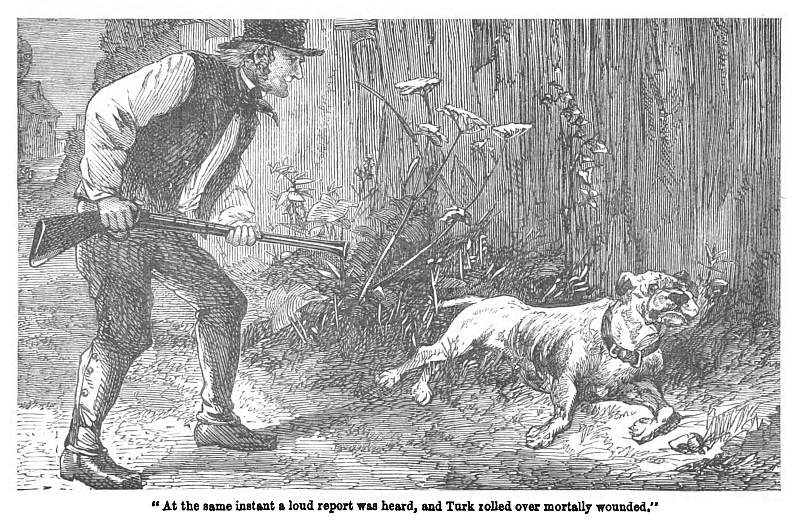
“Shortly after this unaccountable disease had set in, it had been noticed that, the animal quitted his kennel every night as it was growing dark, and trotted down the road; but no one knew what these twilight expeditions were undertaken for. But the plot was drawing to a head. One evening he departed, as usual, down the road. His tortures were about to end, and his long fast be followed by a feast. Nearing the well-known garden where he had so often met Prim, his movements became curious. He moved like a ghost, and stopped to listen, but nothing was stirring. Finally he reached the opening in the fence; he pushed his head stealthily through the hole, his neck followed his head, his body followed his neck, his tail followed his body, and now Turk was fairly in the garden, where he had never been before. Being satisfied with this experiment (which had been repeatedly made since he had brought his plan of fasting into operation, but never successfully until this occasion) he returned to the road and began to bark. In a few moments an answering yelp was heard—Prim was hastening to his doom. Suddenly his little head was popped out of the opening of the fence. A sharp growl escaped Turk—he was too eager for his revenge; and Prim, instead of coming through the hole on to the road (where Turk had often tried to coax him without effect), gave a defiant ‘wow, wow, wow,’ and was making his way back to his kennel, as much as to say, ‘I can’t accommodate you to-night.’ Quick as lightning, Turk darted towards the hole. At the same instant, a loud report was heard; the figure of a man appeared upon the scene. It was the enraged stonebreaker. Turk rolled over, mortally wounded by a shot from an old blunderbuss. ‘Ha! ha! you would steal my dinner, would you, and then rip a good pair of corduroy breeches off my legs all to pieces, would you?’ said the old man, giving him a kick over the ribs. Turk made answer by one prolonged howl of disappointment, pain, and despair, which grew fainter and fainter, until it ceased altogether, and he died the victim of his own selfish and revengeful disposition. By the timely arrival and interposition of the stonebreaker the life of Prim was saved, but he never appeared happy afterwards, probably from the fear of encountering Turk and paying with his life the consequences of his harmless joke.”
I have endeavoured as far as I could to render the recruit’s dog-story as it was given, with as little alteration as possible. When finished, we asked him how he became possessed of Prim? His answer was that he had exchanged a small French poodle with the gentleman for the little hero of the tale. Prim was allowed to accompany the recruit to head-quarters; he lived some years in the regiment, and finally got worried through venturing too near a large monkey kept chained behind the stables, around whom he was accustomed to dance and make fun of him, much in the same manner as he had done with Turk and the large dogs who passed his old master’s residence at Handsworth.
Chapter Nineteen.
For gold the merchant ploughs the main, The farmer ploughs the manor; But glory is the sodjer’s pride; The sodjer’s wealth is honour. The brave, poor sodjer ne’er despise, Nor count him as a stranger; Remember he’s his country’s stay In day and hour o’ danger. Burns.
As thousands of my readers have never seen the camps at Aldershot or the Curragh, a slight sketch of each of these great military stations will, no doubt, be interesting. It has never been my lot to be quartered at either place, therefore I am unable to enter into details as regards the extent of accommodation. I believe, however, that upwards of twenty thousand men of all arms are frequently concentrated at Aldershot, the object of which appears to be the thorough training of troops for foreign service. The authorities in this, as well as many other matters connected with the War Department, display a lamentable degree of ignorance. When first the camp at Aldershot was instituted, the greater part of the men were encamped in huts built of deal and roofed with felt, and some few regiments were under canvas. Gradually the accommodation was extended, until at the present time there are numerous ranges of brick buildings erected on quite a model plan, and superior as examples of barrack architecture to anything in Europe. These are called the “permanent barracks;” the cavalry quarters and stabling, with two spacious riding-schools and other necessary buildings, such as cook-houses, saddlers’, armourers’, shoemakers’, and tailors’ shops, all being separated some distance from the infantry barracks.
Very many infantry regiments and several brigades of artillery, together with one regiment of cavalry and a battalion of the Rifle Brigade, were in huts when I visited the camp in April, 1860. It is the ridiculous system of picketing horses in the open air to which I allude as displaying a great amount of ignorance on the part of the authorities of the War Department. The system entails a great and very unnecessary loss to the country annually. When troop-horses have been used to warm stables—many of them for years—they are certain to take cold when picketed in the open air. Inflammation, influenza, greasy heels, and that dreadful disease, glanders, are almost sure to break out, and in time extend their effects to other regiments who come in contact with them or their quarters. If young horses, on being purchased from their breeders, were never permitted to enter a stable, no harm would come of the system; but moving horses from warm stables to the open air, in such an exposed situation as Aldershot, can only have a parallel in a gardener transplanting his choicest hot-house plants into the open air during the rigours of a severe winter.
Aldershot, in the county of Hants, is about fifty miles from London, on the South-Western Railway. The camp is fourteen miles in circumference, and is completely surrounded by piquets (soldier-police-men), mounted and on foot; so that if any poor, discontented wight makes an attempt to desert, it is a guinea to a gooseberry in favour of his being caught, and walked back under escort to camp. When I alighted at Farnborough Station my eye at once rested upon the fine bronzed countenance of Sergeant McGuinness, of the 10th Hussars (one of the Kertch heroes), who was at that period provost-sergeant in charge of a piquet always on duty between Farnborough and the camp, a distance of three miles. No ticket is allowed to be issued at the Farnborough or other stations to soldiers until the provost-sergeants have inspected the “pass,” or “furlough,” which they ought to have duly signed by the captain of their troop or company.
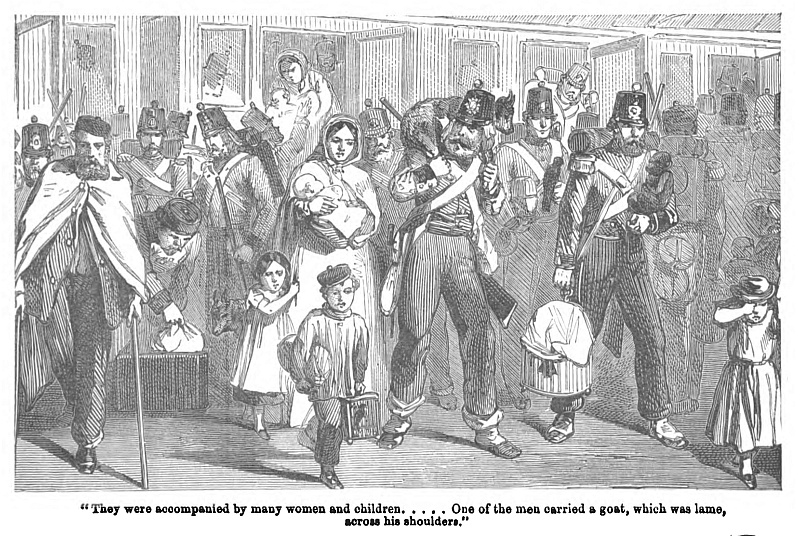
As an instance of the want of discretion before spoken of, in reference to the unnecessary exposure to the weather of men and horses, I may state, that while I was visiting the camp, the 40th Regiment and a few companies of the 41st Regiment of infantry arrived, having come direct from the West Indies, where they had been stationed many years. I was at the railway-station when they were disgorged from the special train, in all about 1000 men, besides women and children. The sick, some partially blind, others lame, and many suffering from extreme weakness, were assisted into the ambulances sent from the camp to convey them from the station to the hospital. The main body looked sadly emaciated, and in want of warmer and more comfortable quarters than are to be found at Aldershot. I have seen thousands upon thousands of soldiers embarked and disembarked, many with more than a chance of certain death staring them in the face, but none with such miserable-looking countenances as these poor men. It was a cold, showery day for the time of year, and they were accompanied by many women and children, who had to toil through to camp on foot as best they could; some with infants at the breast, and others toddling and fretting at their side. Why a few ambulances were not sent down from the camp to convey these women and children to their quarters, Lieutenant-General Knollys (then in command of the troops at Aldershot) can best answer.
It is, however, impossible not to ask why soldiers, calling themselves men, should marry women to such misery as this? And why do women ever marry soldiers at all? The Legislature ought either to prohibit the marriage of soldiers, or treat their wives as women, and not worse than dogs.
It was curious to see the number of parrots and birds of beautiful plumage, together with monkeys and goats, the men had brought with them from the West Indies. I noticed a soldier carrying one of the latter, which was lame, across his shoulders; I also noticed several pure-bred Arab horses, especially two noble-looking greys of high caste, with flowing manes and tails, and showing a perfection of symmetry such as I very seldom see in Arab horses imported into this country. Those of the officers who had wives assisted them to cabs, and then took their own places in the ranks; the colonels mounted their Arab chargers, and “Forty-ninth, fall in! Forty-first, fall in! Attention! Right form four deep! Quick march!” the columns stepped off with the left foot, and commenced their measured tramp to the music, which sounded as a mockery to the horde of weary women and children toiling in their rear, and who were soon left far behind.
The road from Farnborough station to the camp is pleasant enough in fine weather to those who are light-hearted and free, but it is miserable at any time, with nothing but more, misery at the end of the journey, to the unfortunate individuals I have described. I mounted the box of an omnibus which meets every train, and we trundled merrily away along the sandy lane, bounded on each side for a part of the way by stately firs. The ’bus stops a few minutes at the “Queen’s Hotel,” a temporary building of iron and glass, situate on the edge of what is called the north camp, and on an eminence overlooking the south camp in the far distance. To the right, almost as far as the eye can reach, is a barren desert, with only here and there a patch of stunted heather; and, although the showers have been heavy, I notice a dense cloud of black dust, moving now here, now there. Hark! I hear borne on the wind that well-known trumpet-sound, “Halt!” and when the dust (which has been trodden up by the horses’ feet) has partially cleared away, I can perceive the gay pennons of that time, newly-raised corps, the 5th Royal Irish Lancers. Lower down in the valley are the 18th Royal Irish Hussars, another regiment raised since the close of the Crimean campaign; these, at the time I write, are about embarking for India. The old time-honoured “Green Horse,” the 5th Dragoon Guards, are with them at field-drill, and all are in a high state of efficiency. I saw them march to their quarters an hour afterwards all begrimed with dust, which made them appear as black as sweeps, the whites of their eyes rolling beneath their shaggy eyebrows, like those of the inhabitants of an uncivilised region, more than British dragoons.
The first range of huts that met my eye after passing the Queen’s Hotel was occupied by a battalion of the Rifle Brigade—a fine, well-made class of men, of more than ordinary intelligence: these were at drill, all on the run (double) on the wide sandy plain in front of their huts. In the rear of these huts, and nearer to the north camp railway-station (on the South Eastern line), are a couple of squadrons of the 16th Lancers not long arrived from York, the men in huts, and the horses picketed in sand-pits; and farther on still I could distinguish a party of foot guards, attired in their white flannel jackets, at rifle practice. Lower down, on our way to the south camp and permanent barracks, is the canal with its pontoon bridge, the connecting link between the north and south camps. Away the omnibus trundles along the Farnham road, leaving the aforesaid encampments on our left, until it reaches the Club-house, for the use of officers only, and situate in a fine space of pleasure-ground: it is a prettily designed structure of wood, iron, and glass, painted green and white. Opposite the Club-house we diverge from the main road, and enter the precincts of the south camp, and pass by the innumerable huts, which would be black and sombre enough but for the scarlet uniforms of their inmates, hung here and there while being brushed and pipeclayed, which helps to relieve the everlasting blackness of their asphalte-bedaubed roofs and sides.
The first regiment I noticed was the 21st Light Infantry: a smart, well-disciplined corps it is too, hardy-looking, well-built fellows, with plenty of bone and muscle. They wear white facings on their jackets, and have white plumes nodding in their ugly-looking shakos. Passing the 11th regiment, wearing green facings, and the 12th, not long arrived from Australia, where I was told they lost many men, who deserted to the gold diggings, I came to the lines of a militia regiment, their uniform fitting them like sentry-boxes, their forage-caps placed on their heads like inverted quartern measures, and their heads sticking out of their stiff leathern stocks like a cod-fish boiling in a kettle with the head upwards. Why do the militia wear leathern stocks, especially in hot weather?
I have now arrived on the crest of the hill overlooking the south camp, situate in a valley; and travelling on its ridge I can see, far away to my left, the stables of the Royal Horse Artillery. These are constructed of heather, hazel-sticks, straw, and furze; and though in a very exposed situation, they are tolerably warm—a sort of medium temperature between brick-built stables and the open air. These stables have all been burnt down and many horses destroyed since I was at Aldershot. A large open space in front of the stables was covered with Armstrong guns, at which some recruits were at practice. Farther away still is the commissariat—a pile of ugly-looking buildings, full of prime ox-beef, living and slaughtered, ready for the cook-houses, which are here fitted with improved patented apparatus that will bake, boil, or stew with equal facility. Not the least prominent object on the crest of the hill, in the centre of the camp, and hanging on a sort of gibbet-post, is a very large bell, fought for, won, and transported from Sebastopol. Here I have a full view of the permanent barracks in the valley below, together with a range of little shops—butchers’, bakers’, shoemakers’, greengrocers’, outfitters’, jewellers’, public-houses, etc, etc. The first building on my right, after descending the bill, was once a workhouse—it is now an hospital for sick soldiers; and those poor fellows who were able were taking exercise outside its walls. Farther on still I find myself fairly in the middle of the camp, and have little more to say in reference to Aldershot, except that it is the only encampment or station of the British army where the Queen witnesses an occasional review of her troops.
There is one very objectionable matter in connexion with these royal reviews, which is, that her Majesty—known to be so kind and considerate to all persons with whom she comes in contact—invariably chooses the middle of the day at the hottest period of the year to order a field-day in review order, on which occasion it not unfrequently happens that more than one poor fellow is sun-struck, dies, or loses his reason. There is a house or pavilion built and expressly fitted up for the royal family, and the Queen would be far more popular with her army if she would remain all night at the camp, and order the review to take place from four to seven in the morning. As matters now are conducted, the sovereign is by no means welcome by either soldiers or officers at Aldershot; and the sooner the absurd practice of drilling soldiers in the middle of a hot summer’s day is dispensed with, the better will it be for the health, the contentment, and the discipline of the army. The welfare of the army should always be the first consideration of the sovereign and the advisers of the Crown.
The camp at the Curragh is conducted much on the same principle as the camp at Aldershot. It is situate on a vast plain between Newbridge and Kildare, about thirty miles from Dublin, and convenient to the railway-stations at each of the above places. The Curragh is to Ireland what Newmarket is to England—the head-quarters or metropolis of horse-racing and training. There are four race meetings a year at this place—in April, June, September, and October; but they create little interest as compared to former years, when the Marquis of Waterford, Messrs Irwin, Watts, and others of the old Irish school were alive. Unlike the dusty, bleak, and barren desert of Aldershot, the Curragh, all around the camp, is composed of the most beautiful turf, kept short by being eaten by vast flocks of sheep.
The camp occupies a position on the highest portion of the plain, being considered healthy; though many of the horses are continually exposed to the open air, and I have myself seen them over the fetlocks in mud. There are frequently as many as 15,000 to 20,000 men stationed here in the summer months, but many of them are dispersed into winter quarters in the month of October. It was here that the Prince of Wales went through the practical part of his military drill, in 1861-62. I frequently saw him mounted on a grey cob, called “Rupee,” cantering in great glee in company with some young subalterns, little more than his own age, over the beautiful greensward of the Curragh, and many an Irish beggar he has relieved with his own hand. The village or small town of Newbridge is just on the borders of the Curragh, and there is always a cavalry regiment stationed in the barracks, which is the most prominent building in the place.
The revolutionary spirit is, I regret to say, still very predominant throughout the southern and western districts of Ireland, and there are few towns of any magnitude without a regiment or battalion of soldiers; besides this, the police are all, mounted and foot, armed with swords and carbines, being drilled and living in barracks just the same as soldiers. They wear a dark-green uniform with black leather belt. The mounted police have their staff of rough-riders, riding-masters, etc, the same as the regular cavalry: they ride well, and are a fine body of men, but more ornamental than really useful, as they lack the intelligence and detective zeal of English policemen.
Before the camp at the Curragh was instituted, the soldiers stationed in Dublin were drilled and reviewed in Phoenix Park, on the outskirts of the city. This park, for a public one, is the largest and most natural in the kingdom. It is not many years ago since races were held there, but they are now done away with, and it is seldom that troops are reviewed in the park now. There is a splendid monument erected to the Duke of Wellington, a sort of obelisk with the names of all the actions in which he was engaged, reaching from base to summit. The base all around is relieved by bronze castings, representing scenes in the various battles, something after the fashion of Nelson’s monument in Trafalgar Square. One peculiar feature in Phoenix Park is the vast number of very old hawthorn trees, and their red and white bloom has a very pretty effect in the month of May. The viceregal lodge—the residence of the Lord-Lieutenant—is situate in a lovely spot in Phoenix Park. The Chief Secretary’s lodge is also in this park. The space of ground set apart for the drilling of cavalry is called the “fifteen acres,” and it was more of a treat than a toil to be drilled on such ground. The Dublin citizens pay great respect to soldiers generally; they do not, however, like the foot guards, a battalion of whom is generally stationed there—for what reason I cannot understand, as they never leave the city without having a riot with the civilians or the men of some other corps.
There is, however, a way to account for this ill-feeling. The Irish are a very impulsive race, and, as a rule, hate everything English, solely because they are for the most part taught to do so from their childhood. The guards, horse and foot, are mostly English; but other regiments are composed of English, Irish, and Scotch. The Irish agree better with Englishmen in barrack, camp, or on the line of march, than they do among themselves; because, if the one is hot and impulsive, the other will reason: but, knowing the guards to be all English, and never having an opportunity to converse soberly and rationally with them, there is neither time nor inclination to reason, and so they never meet or part without either high words or blows—oftener the latter than the former—and Paddy mostly gets the worst of it.
To foreigners visiting this country, there are no more interesting sights than the camps of Aldershot and the Curragh; and the arsenal at Woolwich has been visited by thousands of distinguished individuals from every country and clime.
Chapter Twenty.
A triple mounted row of pillars laid On wheels (for like to pillars most they seem’d, Of hollow’d bodies made of oak or fir, With branches lopp’d in wood or mountain fell’d): Brass, iron, stony mould, had not their mouths With hideous orifice gaped on us wide, Portending hollow truce. Milton.
Woolwich is the great rendezvous and head-quarters of the Royal Artillery, the Military Train, and the Royal Engineers, and few troops, besides marines—who are continually moving in and out with the various men-of-war vessels—are ever quartered at Woolwich. The royal arsenal is the main attraction of Woolwich; and the principal part of the inhabitants derive their support from Government in some shape or other. The admission is by ticket; and the visitor is accompanied in his tour of inspection by policemen. The days of admission are Wednesdays and Fridays.
There are generally about 12,000 men employed at the arsenal; but the ordinary visitor is not allowed to walk into the workshops where ammunition is being made. He is restricted to the paved footpaths, from whence he can see the various artificers at work. The din of hammers, the movement of wheels, the rush of steam, and the roar of the furnace, is proof of the vast extent of the manufactures which are continually going on. All kinds of shot are cast here—grape, chain, canister, bullets, and cannon-balls. Rockets, percussion-caps, metal fusees, and stores of round shot and shell are accumulated to a vast extent, the two latter being piled up in pyramids to upwards of ten millions. There are store-rooms for saddlery and arms of every description, both ancient and modern; and a park of artillery numbering upwards of 30,000 pieces, which comprise the reserve from which the army, navy, garrisons, batteries, etc, are recruited. Sentries are stationed here and there to keep people in order, as there are great numbers of all classes constantly going through the arsenal. Not the least interesting, though melancholy, feature of the place is, the gangs of convicts chained together, and dragging heavily-laden trucks from one part of the yard to another. Some of these unhappy wretches have chains attached to their leg, and the expressions of their faces are as fierce as those of a hyena, while others look completely spirit-broken.
Nearly every kind of gun is made at Woolwich, from the light field-piece to the guns which form a siege-train. Every gun, after being cast, undergoes a proof process, the strength of heavy ordnance being tested by the fire proof. The guns being laid on the ground in front of a target, or butt, with their muzzles towards it, slightly elevated, they are loaded with the regulation proof charges, and fired by means of a galvanic battery, which is placed in a bomb-proof building, and the current of electricity conveyed to the tubes in the guns through copper wires. Each gun is then searched by a long rod having a number of steel springs at the end, each of which has a spike attached; these springs are released from a grasping ring when at the bottom of the barrel, in the same manner as a cork-drawer. Any flaw in the barrel is at once disturbed in passing the searcher up and down. The soundness of the metal itself is tested by what is called the water proof: a hollow, wooden plug, covered with leather, is fixed in the muzzle of the gun by chains, which pass round the trunnions and are connected with the main pipe of the waterworks. A pressure of about 50 pounds weight to the square inch is thus obtained, and water is forced into the gun barrel until it issues a continuous stream from the vent (touch-hole). A wooden plug is then inserted into the latter, and a few more strokes given by the engine. If any water has penetrated through the thinnest part (the neck), the metal is unsound. The next, and last, test is the sun proof. After two or three days, the bore, being supposed to be perfectly dry, is examined by reflecting the sun’s rays into it by means of a mirror, and if any part appears wet, it indicates a flaw. The sighting process is the last operation.
In the construction of carriages, wheels, etc, many men are constantly employed. The timber used is principally ash, elm, and oak; it is crosscut and planed, and all the holes for rivets, bolts, etc, are bored by machinery; but the various parts of the carriages are finished and put together by hand.
By taking the train from the arsenal station the visitor will easily escape passing through the dirty streets of Woolwich, which lie between the arsenal and the dockyard, and those who have not seen this latter magnificent establishment may spend a very agreeable hour or two. There are the enormous chimney-shaft—a landmark for miles; the engine-house; the saw-mills, with their marvellous machinery; the huge Nasmyth’s hammer, which can be made to crack a nutshell without injuring the kernel, or snap an iron bar like a rotten stick on the anvil. There, too, are the building slips, with the shipwrights hammering with an incessant din on the grand three-decker, piled up beam on beam, to which access is gained by inclined planes, reaching to the top of the factory-like structure. The yard is nearly a mile in length; the docks, the gunboats, the steel-plated floating batteries, the beautiful chapel built by Mr Scott, and a passing look at the craft on the Thames, will afford ample opportunity to indulge and gratify curiosity.
Leaving convicts and policemen, I now ascend the hill, on one side of which, among the trees, may be discerned the splendid new buildings of the hospital, and pass the barracks of the marines, capable of containing nearly 2000 men. A short walk farther, and I pass through a wicket-gate near the guardhouse, in front of which is the open common, with the Royal Military Academy for the cadets on the east, and crowned with the woods of Shooter’s Hill. To the left is the long range of the barracks of the Royal Artillery; while to the right is a park of artillery, gun-carriages, waggons, and limbers, divided by a road leading down to a pretty, picturesque valley, containing a small sheet of water, on which pontooning, passage of troops, diving, and transport of artillery are practised and carried out. Above it, on the opposite side, over the broken undulating ground, diversified by clumps of fir-trees, is seen the tent-like building known as the Rotunda, in front of which is an earthwork, green with turf, but having the dark muzzles of guns peeping through the grassy embrasures of the Repository ground. A monument to Sir Alexander Dickson stands in the enclosure, which is entered by a gate, and near by is a French cannon captured by Marlborough at Malplaquet, and many other specimens of the old style of ordnance. The Rotunda itself was removed from Cariton Gardens, where George the Fourth, then Prince Regent, entertained in it the allied sovereigns in 1814: it now contains models of fortifications, dockyards, every arm used by the artillery, and every conceivable specimen of bomb-ships, shields, kettle-drums, tilting lances, armour, all kinds of weapons, and all sorts of ordnance; trophies won by our soldiers in every quarter of the world; and a cinder that represents what was once fifty-six millions of one-pound notes burned by the Bank of England when they were called in.
The Royal Artillery is now in a high state of efficiency: the men are strong in their build, as well as the horses; no expense is spared by Government to obtain by competitive trials, and the employment of the most talented persons, the very best guns that can be manufactured.
The cavalry dépôts for regiments on service abroad are Maidstone and Canterbury, the former place being the more important of the two, because of the riding establishment being there. This establishment is kept up in order to give full effect to the only approved system of equitation which is in use throughout the whole of the cavalry service. The commanding officers are called upon from time to time to select certain non-commissioned officers and men, and to send them to the riding establishment at Maidstone, for the purpose of being thoroughly practised in horsemanship, and of being rendered competent, on returning to their regiments, to afford instruction and to maintain the system of uniformity in training both men and horses for active service. The selection of both men and horses for this important duty is made with the greatest care; and those men only who are remarkable for qualities constituting the good soldier and the active, intelligent dragoon, are detached upon this essential duty. They are in all cases unmarried men, and able to read and write. No unsound, inactive, or vicious horses are sent to Maidstone; the very best in the corps are generally detached for this duty. Upon the return of the parties to their regiments, they take their places in the ranks until the commanding officer sees an opportunity to encourage such as are favourably reported by the commandant of the riding establishment whilst under his instruction, by promoting them as opportunities occur, and making them assistants in the regimental riding-school. Thus a foundation is laid for promotion from the ranks to the position of riding-master, who ranks as a commissioned officer. It is always understood that no individual shall, upon any account whatever, succeed to this respectable position unless he can produce a certificate of perfect fitness both as to education, general character, sobriety, and a high degree of proficiency in the established system of horsemanship.
In order to prevent any men being sent to Maidstone who, from weakness of constitution or other cause, may not be fit for the duty of the riding-school, a medical examination is made into their fitness. In addition to the regular pay, a riding-master is entitled to the following fees:—For teaching young officers to ride, three guineas; and for training every horse into a charger, one guinea; and no officer is allowed to ride at field-drill a horse which the riding-master has not certified to the commanding officer as fit to be properly broken as a charger; and no officer is allowed to part with such horse without the commanding officer’s permission.
There are always two or more men from every cavalry regiment in the service at Maidstone. The recruits for the regiments in India, China, and the Cape are put through their drill with all possible despatch, both here and at Canterbury, and are generally considered proficient in about six months, after which they are drafted off in detachments to join the head-quarters of their corps on foreign service; and hundreds of them never return to their native land. I have, however, occasionally met with men who, after being discharged, from purchase or some other cause, have preferred to remain in India, the Cape, Canada, etc, until they have amassed sufficient means to return home and live in comparative comfort, like others of the same grade in society.
Chapter Twenty One.
Excess of bodily exercise may render us wild and unmanageable, but excess of arts, science, and music, makes us faddled and effeminate. Only the right combination makes the soul wise and manly.
Plato.
The difference between the walk of a cavalry and infantry soldier cannot fail to be noticed, even by a person the most indifferent to military matters. The gait of the dragoon is distinguished for its ease and elasticity over that of the foot soldier, which may be accounted for by the mounted exercise having the effect of suppling the loins and hips of a recruit in the first stages of drill, which seldom, if ever, becomes eradicated in after life, even though the man may leave the army after a short term of service. Horse-exercise brings every muscle of the body into play, and thereby imparts to the proper method of walking, attained by infantry drill, an amount of ease and grace never seen in our infantry soldiers.
As I shall probably write a series of articles on horsemanship in a separate form, I shall, for the present, confine my remarks to the manner in which both cavalry and infantry soldiers are taught to throw off that lounging, shuffling style of walking, into which many young gentlemen fall, through habits of indifference and carelessness, which grow with their growth until the limbs become set and modelled with age, so that no amount of drill or gymnastic exercise can alter or improve the figure.
Volunteering has now become all the fashion; every high-spirited boy looks forward with hope to the time when he is big enough and old enough to join his companions in some town or provincial volunteer corps, and shoulder the rifle. Now, I am not particularly au-fait at the new rifle practice, and therefore I shall not attempt to forestall the many effective drill sergeants appointed to the duty of instructing their companies of “civilian soldiers,” but a few remarks in reference to the position-drill, without arms—to which both the cavalry and infantry recruit is first subjected on donning his uniform—may be useful and probably interesting to my young readers. The practice of the following instructions, either in schools or at the homes of those boys who wish to expand their chest and develop their figure as they progress towards the age of adults, by giving them the general “set-up” and bearing of the soldier without any of his stiffness or constraint, which, however necessary it may be for the ranks, would certainly detract from the appearance of the thorough gentleman on the promenade or in the ball-room.
The first instruction conveyed to a recruit at drill is to stand straight and keep his head up. But as the simple command to do this would only cause him to endeavour to comply in his own particular way, he must be instructed in detail at first, as one movement involves many others, which, when he becomes perfect, can scarcely be distinguished while changing position. In order to stand in the proper position at “attention,” the heels must be in a line with each other and close together, the knees straight, the toes a little turned out so that the feet may form an angle of about sixty degrees, the arms must hang near the body, the little finger touching the thighs, and the thumbs placed as far back as the seams of the trousers; the elbows and shoulders must be kept back, the belly rather drawn in, and the chest advanced, but without stiffness or awkward constraint; the body must be upright, but inclining forward so that the weight of it principally bears on the fore part of the feet; the head must be erect, but dignified and without stiffness or the appearance of a forced attitude. The position in which a soldier moves also determines that in which he should stand still, and too many methods cannot be used to render the recruit supple and easy in his walk, so as to banish the air of the rustic; but that excess of setting up which stiffens the body to such an extent, that a person appears as if he had swallowed a poker, is contrary to every true principle on which the movement of the human body ought to be regulated, and should therefore be carefully avoided. On the instructor giving the command “stand at ease,” the recruit draws back his right foot about six inches, and the greatest part of the weight of the body bears upon it, the left knee is a little bent, the hands are brought together before the body the left being locked in the right, but the shoulders must be kept back, the head square to the front, and the whole attitude without constraint or stiffness. On the word “attention,” the hands are to fall smartly down the outside of the thighs, the right heel must be brought up in a line with the left, and the proper, easy, unconstrained position of a soldier and a gentleman immediately resumed.
The above instructions may, by a slight alteration, be applicable to boys or adults, who, having no taste for a military life or the inseparable drill connected with a soldier’s duty, may, nevertheless, wish to attain that ease and grace of movement which ever distinguish the soldier from the undrilled civilian. For instance, the majority of civilians, whether gentlemen or rustics, both stand and walk on their heels; very many, from habit alone, turn their toes in while walking, and, when either standing or walking in their best position, they push out the belly in place of drawing it in and advancing the chest. When a boy is told to hold his head up, he simply throws it back by raising his chin and jerking his neck, in place of throwing back his shoulders, pushing forward his chest, and drawing back his chin, which three movements, all combined in one, at once has the desired effect of improving the figure, raising the head, and imparting dignity to the whole upper part of the body. In the instruction of boys or adults, not intended to become soldiers, it is not necessary that the heels should be placed close together, or the hands to touch the trousers when standing at attention as above directed, but a similarity of position should be adopted, if the rule is not strictly adhered to. In obeying the command “eyes right” or “eyes left,” the soldier is required to look to either side with the slightest possible turn of the head. These motions are used in the dressing or keeping in line in the wheeling of divisions, and particular attention is necessary to be paid in the several turnings of the eyes to prevent the soldier from moving his body, which should be preserved in a position perfectly square to the front. If a civilian, ignorant of military drill, were told to look to his right or left, he would either give his neck a sharp twist, or turn his whole body in the direction indicated.
Having explained how those of my young readers, who have no ambition to become either soldiers or volunteers, may improve their appearance, it now becomes our duty to put those whose intention is to become volunteers, or to enter the regular service, “through their facings.” In going through the facings, the left heel never quits the ground, the body must rather incline forward, and the knees be kept straight. On the command “to right face,”—1st. Place the hollow of the right foot smartly against the left heel, keeping the shoulders square to the front. 2nd. Raise the toes, and turn smartly to the right on both heels. “To the left face,”—1st. Place the right heel against the hollow of the left foot, keeping the shoulders square to the front. 2nd. Raise the toes, and turn to the left on both heels. “To the right-about face,”—1st. Place the ball of the right toe against the left heel, keeping the shoulders square to the front. 2nd. Raise the toes, and turn completely round to the right-about (reversing the direction of the face) on both heels. 3rd. Bring the right foot smartly back in a line with the left. “To the left-about face,”—1st. Place the right heel against the ball of the left toe, and keep the shoulders square to the front. 2nd. Raise the toes, and turn to the left-about on both heels. 3rd. Bring up to the right smartly in a line with the left. The greatest precision is observed in drilling of recruits to these facings, for if they are not exactly executed, a body of men, after being properly dressed in line, will lose their dressing, and cause the line to be crooked on every small movement of facing. It will be seen that by placing a number of men in line their execution of the command—“together, right face”—will instantly bring them from the line into Indian file (one behind the other), or the “right-about face” will as quickly reverse the front of their line; and supposing the command “march” to be given while the men are in Indian file, although so close together as to nearly touch each other’s backs with their chests, if they each step off at the same instant, with the left foot, the sound of their feet will enable them to keep step and time, and march about in this form, as directed by the instructor, to the leading file, “right turn” or “left turn,” without confusion. On the command “halt” being given, the step is finished at the last sound of the word; and at the command “front” each man faces to his left, as above directed, and they will then be in line as before.
In marching, the soldier must maintain, as much as possible, the position of the body as before directed. He must be well balanced on his limbs; his arms and hands must be kept steady by his sides; and he must not be allowed to stoop forward, still less to lean back. His body must be kept square to the front, and thrown rather more forward in marching than when standing still, so that it may accompany the movement of the leg and thigh, which movement must Spring from the haunch; the ham must be stretched, but without stiffening the knee; the toes a little pointed outwards, and kept near the ground, so that the boot-soles may not be visible to a person in front. The head should be kept well up, without stiffening the neck, and straight to the front, and the eyes not suffered on any account to be cast down; the foot, without being drawn back, must be placed flat on the ground. The length of each pace, from heel to heel, is thirty inches; and the recruit is taught to take seventy-five of these steps in a minute, without tottering and in perfect steadfastness. This is the ordinary step, being the pace on all occasions whatever for both infantry and cavalry, unless greater celerity be particularly ordered, which is called the “quick step,” and the “double,” or run. Each individual recruit is very carefully trained and thoroughly instructed in this part of his duty, as it is considered to form the basis of the proper deportment of the soldier.
In the regular army, where men are enlisted from all grades of society, it requires the most unremitting perseverance and accurate knowledge of the part each instructor has to teach, as also a clear and concise manner of conveying his instructions, allied to a firmness that will command from all classes of men a perfect attention to the directions he is giving them. He must allow for the weak capacity of the recruits, and exercise patience and good-temper, without rigour, where endeavour and good-will are evidently not wanting. Quickness in military drill is not at first required, because it is the result of much practice; but if officers and instructors are not critically exact in their commands, and in observing the execution of what is required from others, slovenliness must take place, labour will be ineffectual, and the end proposed will never be attained. The recruit must be carried through his drill progressively; he should comprehend one thing perfectly before he is required to learn another.
In the first lessons as to position, the instructor should carefully place the hands, arms, etc, of the recruit in the form desired. When he is more advanced, he should not be touched; but from the example shown, and the directions prescribed, be taught to correct himself when so admonished. Recruits are not kept too long at any particular part of their exercise, so as to fatigue or make them uneasy. Music is not used in the early stages of the recruit’s drill; and he is taught and confirmed by habit alone to the cadence of step which he is afterwards required to maintain in his march to the enemy, in spite of every variety of noise and circumstance that may tend to derange him.
A very useful movement for a civilian to learn is to “change step.” We frequently see two persons walking together (often arm-in-arm) in different steps, that is, while one is stepping forward with the left foot, the other has his right foot advanced, which causes them to roll and jostle each other in a very unseemly and awkward manner. To remedy this, without stopping, one of the parties should complete his pace with the advancing foot, and bring the toe of the other quickly up to the heel of the advanced one, which instantly makes another step forward, so that the cadence may not be lost, and both parties will then be found walking “in step,” each with the same foot in advance.
If any of my young readers will practise the movement according to the above directions, they will be surprised at its simplicity, and the rapidity with which it may be acquired, and it will be extremely useful in after life, especially while engaged in the pleasing duty of escorting their female friends, for nothing looks so ungainly as a gentleman walking in one step and a lady in another. The “back step” is a very useful movement in foot drill, by which the recruit is taught to move straight to the rear, preserving his shoulders square to the front, and his body erect. On the word “halt,” the foot in front must be brought back square with the other; only a few paces of the back step is, however, necessary at one time, in military tactics. After the cadence of the ordinary step has become perfectly habitual to the recruits, they are able to march and manoeuvre in small squads, and are taught to march in what is called quick time, which is 108 steps in the minute, each of 30 inches, making 270 feet, or 90 yards in a minute. The command “quick march” being given with a pause after the word “quick,” which is to be considered as a caution, the whole of the recruits must remain perfectly still and steady, until the word march is given, when they step off with the left feet foremost, keeping the body in the same posture, and the shoulders square to the front, the foot to be lifted off the ground, so that it may clear any stones or other impediments in the way, and to be thrown forward and placed firm, the whole of the sole to touch the ground, and not the heel alone; the knees are not to be bent, neither are they to be stiffened so as to occasion fatigue or constraint; the arms must hang with ease down the outside of the thigh, a very small motion to prevent constraint may be permitted, but not to swing to and fro, and thereby occasion the least unsteadiness or movement of the shoulder; the face is to be kept to the front, the body upright, and an easy, dignified demeanour preserved. As the being able to march straightforward is of the greatest consequence, he who commands at the drill should take great pains in making his squad do so, and for this purpose he should frequently go behind the squad or division, placing himself behind the flank file (the end-most soldier), by which the squad is ordered to move in marching, and taking a point or object exactly in front of that file, he will then give his command march, and remaining in his place, he will direct the advance of the squad, his object being to keep the flank file always in a line between himself and his object: it is also from behind that one soonest perceives the leaning back of the soldier, and the bringing forward or falling back of a shoulder—faults which ought instantly to be rectified, as it is productive of the worst consequences in a line, where one man, by bringing forward a shoulder, may change the direction of a march in such a manner as to break the line, or cause the wing of a battalion to run, in order to keep dressed in line. In short, it is impossible for the instructor to labour too much at his duty in making the soldier march straightforward, keeping always the same front as when he set off: this is effected by moving solely from his haunches, keeping the body steady, the shoulders square, and the head to the front, and will without difficulty be attained by my young friends, by a strict attention to the rules herewith given, with a careful observance of an equal length of step, and an equal cadence, or time of march. In a cavalry regiment, corporals and sergeants are appointed to instruct recruits in all the preliminary stages of foot drill, for which they are responsible to their superior officer (the regimental sergeant-major), the same as the corporal and sergeant-rough-riders are responsible to the riding-master for the recruit’s progress and efficiency in riding drills. For the first two or three months the recruit is subjected to the “manual exercise” as well as the drills above named; this exercise consists of a series of gymnastic movements of the arms, legs, and body; the object of which is to render the limbs supple, set the shoulders back, and expand the chest. If any recruit shows a disinclination to practise this manipulation of the body according to the prescribed rules, he is put through the “dumb bell” exercise, which, having to swing two heavy pieces of iron, one in each hand, over and around his head, while practising some rather novel contortions, is very hard work indeed, as compared to the ordinary “manual exercise.”
Chapter Twenty Two.
Such the ungentle sport that oft invites The Spanish maid, and cheers the Spanish swain. Nurtured in blood betimes, his heart delights In vengeance gloating on another’s pain. Byron.
When I first joined the army, we had a drill sergeant who had been in the Queen of Spain’s service, a most intelligent and agreeable fellow, as I afterwards found out when I was myself promoted and allowed to associate with him; but, while I was a recruit, I would freely have given one of my ears, on one or two occasions, to have been fairly out of his clutches. We were sergeants together, and I, in common with the rest of my brother non-commissioned officers, have been often amused and interested by the relation of his experience in the Spanish service, which by his account is immeasurably inferior to our own; indeed, the treatment to which private soldiers in the Spanish army are subjected, would soon incite the British army to open mutiny. My friend was a commissioned officer in Spain, but I have frequently heard him say that he would much prefer to be a private dragoon in the British army. He was about thirty-five years of age when I enlisted, standing about 5 feet 9 inches high, with jet-black curly hair and an olive complexion set off by a handsome soldier-like figure. His word of command to young recruits was divested of that croaking harshness and fierce demeanour so predominant with drill-corporals, sergeants, and adjutants generally; still he was very severe and very exacting, for the slightest appearance of carelessness or inattention he would report a recruit and get him punished. This, however, arose from excessive zeal more than an unkindly disposition, and he never made an enemy who remained so for many hours. He never alluded to his family, and his name—which I forbear to mention—was generally understood to be assumed, but it was evident he was well bred and well educated. After my promotion to the rank of full sergeant, I was necessarily thrown more into his society, particularly at the sergeants’ mess (for sergeants have a mess and dine together as well as officers), where I have often listened with a great degree of interest to his stories of bull-fights in the amphitheatres of Madrid, which I do not particularly remember to repeat, but his relation of a fight between a full-grown Bengal tiger and three bulldogs at Havana I perfectly well remember. He said, “I took my seat in the amphitheatre, in front and within forty feet of the tiger, who was perfectly quiet in a cage about twenty-four feet long and fifteen feet wide, at times walking about, apparently indifferent to the noise which the multitude made around him. Some circus performances were first introduced, after which a couple of trained elephants went through some novel antics, one of them turning the handle of a barrel-organ, while the other danced to a lively Spanish air. These performances occupied about an hour; the three dogs matched to fight the tiger were then introduced, and the instant they caught the eye of the tiger he gave a loud roar, and lashed his tail angrily from side to side. The dogs were of the purest bull breed. One was a brindle, with his ears and tail cut, and of large size; the second dog had neither his ears nor tail trimmed, but he had a very ferocious look—he was all white, and looked as if ready to fight to the death; the third dog was black, with long tail and ears, but had nothing very striking in his appearance beyond a powerful frame and a set of blackguard-looking teeth, always visible through the shortness of his upper lip. I had anticipated seeing the large bloodhounds of the island, one of which weighs as much as all these three, and when I saw these I felt that the tiger would easily conquer them. Boards being placed through the bars of the cage as a partition, the dogs were put in one part, while the tiger was in the other.
“The moment the dogs were put in the cage, all the combatants became infuriate. The tiger, with the hair on his back bristling, rushed to the partition, and the dogs were anxious to get at him. While removing the boards to give them the satisfaction of meeting, the tiger thrust his paw under the board, which was at once seized by the white dog; the board was immediately withdrawn, all pitched in, and the fight grew fast and furious. The white dog was most active, and attacked his monster adversary with great pluck. The tiger vented his first act of anger upon him, giving him a bite in the back of the neck which injured him severely, but, pressing on with a courage which could not be exceeded, he received another wound which evidently touched his spine, and rendered him almost entirely hors de combat, as he could not do any further damage, but he was game to the last. While the blood was flowing from his neck, and he staggering and constantly falling from the injury to his spine, he still endeavoured to assist his brothers in the fray. At the time the white dog was engaging the attention of the tiger, the black had fastened his teeth in his flank, and the brindle was assailing him about the neck. He did not notice the black, but gave the brindle an ugly stroke with his paw. The tiger appeared surprised at such rough treatment, he leaped over all the dogs, and would have run off, if he could have got away; but the dogs followed him up, and now a regular ‘rough-and-tumble’ fight ensued, the black again fastening on the flank of the tiger. The fight had lasted about five minutes, and the tiger began to show signs of giving up. He lay down apparently exhausted, the white dog was disabled, but the black was busily engaged worrying the tiger’s flank, and the brindle was tearing away at his neck and shoulders, but presently he rallied, and gave the brindle a crushing blow with his paw, which, although it did not kill the dog outright, so disabled him that he had nothing more to do with the fight. Black was all this time worrying at the tiger’s flank and hind-legs.
“At length the tiger sprang into a corner of the cage, when the dog caught him by the under jaw and gave him a severe bite, but the tiger shut down his upper jaw upon the dog’s head, and gave him a severe wound. At this time active hostilities ceased. The tiger was evidently willing for an armistice, and quietly lay down in a corner of the cage to lick his wounds; the dogs, however, disabled as they were, staggered up to him and vainly attempted to renew the contest, but the tiger after a snap or blow of his paw ran to another part of the cage.
“There was much excitement evinced by the owner of the dogs, who claimed the victory on the ground that the tiger had run and would not continue the fight. True, he had run, and would probably have run away soon after the fight commenced, could he have done so, but he was not beaten—he was still in good condition, while all the dogs were more or less disabled.
“The nature of all the cat species is to run away, and fight on the defensive; they will spring upon an enemy, fight, run off, and steal back again to spring, fight, and run away. The bulldog has no such traits—he knows only to stand up and fight, to conquer or die. It was decided a drawn battle by the referee.