"A Story of the Zulu and Boer Wars" (continued 5)
Reading edition
“The next thing I remember was that it was night. I got up on my feet and staggered to a bullock that I heard faintly groaning; I cut a vein in his neck and sucked the blood, and then started to walk; fortunately, as it turned out, I had not gone a hundred yards when a dizziness came over me, and I fell again to the ground. I must have lain there for some hours; when I became conscious, water was being poured between my lips. I soon recovered sufficiently to sit up, and found that it was my faithful man. When the caravan started from the last halting-place, he had seen that it was impossible for it to reach its journey’s end, and although, like the rest, he was exhausted and worn out, he had started at full speed alone, and by morning reached water, having travelled fifty miles in the night. It was midday before he succeeded in finding a native kraal; then by promise of a large reward he induced forty men, each laden with a heavy skin of water, to start with him, and at three in the morning reached the camp; fortunately he stumbled across me just before he got there.
“The assistance arrived in time. Two of the drivers were found to be dead, but Macgregor and the other hands, sixteen in number, were all brought round. The supply carried by the natives was sufficient to give an ample drink to the eighteen oxen which were still alive. A feed of maize was then given to each, but as they were too weak to drag even one of the waggons they were driven on ahead, and most of them got over the twenty-five miles which still separated them from water. We halted there a week, to allow the animals to recover; then, carrying skins of water for their supply on the way, they went back and brought in the two waggons, one at a time. With these I came down to the colony. Macgregor remained behind, and directly the rain set in went up with native cattle and brought down the other waggons, all the valuable contents of which, however, had in the intervening time been carried off by natives. It was a near squeak, wasn’t it? Macgregor was never the same man again, and shortly after his return to Natal he sold off his waggons and went back to Scotland. Being young and strong I soon recovered from my privation.”
“Lions are very abundant in some parts of the interior, are they not, Mr Harvey?” one of the officers asked, after they had thanked the trader for his story.
“Extraordinarily so,” Mr Harvey replied; “in fact it has long been a puzzle among us how such vast quantities could find food—in no other country in the world could they do so; but here the abundance of deer is so great that the lions are able to kill vast numbers, without making any great impression upon them.”
“But I should not have thought,” an officer said, “that a lion could run down a deer!”
“He cannot,” Mr Harvey said, “except for short distances. The South African lion is a lighter and more active beast than the northern lion, and can for the first hundred yards run with prodigious swiftness, taking long bounds like a cat. Stealing through the long grass, and keeping to leeward of the herd, he will crawl up to within a short distance unperceived, and then with half a dozen tremendous bounds he is among them before they have fairly time to get up their full speed. They hunt too in regular packs; twenty or thirty of them will surround a herd, and, gradually lessening their circle, close upon their affrighted prey, who stand paralysed with fear until the lions are fairly among them.
“I was once surrounded by them, and had a very narrow escape of my life. I had left my waggons at a large native village, and had ridden—accompanied only by my native servant—some fifty miles across the country to another tribe, to see whether they had lately been visited by any traders, and whether they had goods to dispose of. I reached the kraal in the morning, and the palaver with the chief as usual wasted the best part of the day; it was nearly dark when I started, but I was accustomed to ride by the light of the stars, and had no fear of missing my way. I had been only two hours on the road, when the sky became overcast, and half an hour later a tremendous storm burst. Having now no index for directing my way I found that it was useless to proceed; the plain was open, but I knew that a goodsized river ran a short distance to the north, so I turned my horse’s head in that direction, knowing that on a river-bank I was likely to meet with trees. Several times I missed my way in the driving rain, for the wind shifted frequently, and that was of course the only guide I had.
“At last, to my great satisfaction, I struck upon the river and kept along its bank until I came to a large clump of trees; here we unsaddled our horses, picked out a comparatively dry spot under a big tree, which stood just at the edge of the river, wrapped ourselves in our rugs, and prepared to pass the night as comfortably as we could. The river was high, and my only fear was that it might overflow its banks and set us afloat before morning. However, we had not been there long before the rain ceased, the sky cleared, and the stars came out again; but as the horses had done a long day’s work on the previous day, I determined to remain where I was until morning. Having been in the saddle all the previous night, I slept heavily. The wind was still blowing strongly, and I suppose that the noise in the trees, and the lapping of the water by the bank close by, prevented my hearing the stamping of the horses, which, under ordinary circumstances, would certainly have warned me of the approaching danger. Suddenly I awoke with a terrific uproar. I sprang to my feet, but was instantly knocked down, and a beast, I knew to be a lion, seized me by the left shoulder. My revolver was, as always, in my belt; I drew it out, and fired into the brute’s eye; his jaw relaxed, and I knew the shot was fatal. A terrible din was going on all round; there was light enough for me to see that both the horses had been pulled to the ground; two lions were rending the body of my servant, and others were approaching with loud roars. I sprang to my feet and climbed up into the tree, just as two more lions arrived upon the spot. My servant had not uttered a cry, and was, I have no doubt, struck dead at once. The horses ceased to struggle by the time I gained my tree. At least twenty lions gathered round, and growled and quarrelled over the carcases of the horses. When they had finished these, they walked round and round the tree, roaring horridly; some of them reared themselves against the trunk, as if they would try to climb it, but the lion is not a tree-climber, and I had not much fear that they would make the attempt. I hoped that in the morning they would move off; but they had clearly no intention of doing so, for, as it became daylight, they retired a short distance and then either lay down or sat upon their haunches in a semicircle fifty yards distant, watching me.
“So the whole day passed; I had only the four shots left in my revolver, for my spare ammunition was in the holster of my saddle, and even had I had a dozen revolvers I could have done nothing against them. At night they again came up to the tree, and in hopes of frightening them off I descended to the lower branches, and fired my remaining shots at brutes rearing up against it. As I aimed in each case at the eye, and the muzzle of my pistol was within four feet of their heads, the shots were fatal; but the only result was that the lions withdrew for a short distance, and renewed their guard round the tree.
“You will wonder perhaps why all this time I did not take to the water; but lions, although, like all the cat tribe, disliking water, will cross rivers by swimming, and they seemed so pertinacious that I feared they might follow me. Towards morning, however, I determined on risking it, and creeping out to the end of a branch which overhung the river I dropped in. The stream was running strong, and I kept under water, swimming down with it as hard as I possibly could. When I came up I glanced back at the tree I had quitted. The lions were gathered on the bank, roaring loudly and lashing their tails with every sign of excitement, looking at the water where they had seen me disappear. I have not the least doubt but that they would have jumped in after me, had I not dived. I took this in at a glance, and then went under again, and so continued diving until I was sure that I was beyond the sight of the lions; then I made for the bank as quickly as possible. The river swarmed with crocodiles, and had it not been for the muddiness of the water I should probably have been snapped up within a minute or two of entering it.
“It was with a feeling of deep thankfulness that I crawled out and lay down on a clump of reeds half a mile beyond the spot where the lions were looking for me. When the sun got high I felt sure that they would have dispersed as usual, and returned to their shelter for the day, and I therefore started on foot, and reached my camp late at night.
“The next day we got in motion, and when, three days later, we arrived at the kraal from which we had started, I rode over to the tree and recovered my revolver and saddles. Not even a bone remained of the carcases of the horses, or of my native attendant.”
“That was a very nasty adventure,” the colonel said. “Is it a common thing, caravans being attacked by lions?”
“A very common thing,” the trader replied; “indeed in certain parts of the country such attacks are constantly made, and the persistency with which the lions, in spite of the severe lessons they have received of the deadly effect of fire-arms, yet continue to attack caravans is a proof that they must often be greatly oppressed by hunger.”
“Which do they seem to prefer,” one of the officers asked, “human beings or cattle?”
“They kill fifty oxen to one human being; but this probably arises from the fact that in the lion-country the drivers always sleep round large fires in the centre of the cattle. I think that by preference the lions attack the horses, because these are more defenceless; the cattle sometimes make a good fight. I have seen them when loose forming a circle with their heads outside, showing such a formidable line of horns that the lions have not ventured to attack them. Once or twice I have seen single oxen when attacked by solitary lions, come out victors in the assault. As the lion walked round and round, the bullock continued to face him, and I have then often seen them receive the spring upon their horns, and hurl the lion wounded and half-stunned yards away. Once I saw both die together—the bullock with one of his horns driven into the lion’s chest, while the latter fixed his teeth in the bullock’s neck, and tore away with his claws at its side, until both fell dead together.”
“It must be a grand country for sport,” one of the officers said.
“It is that!” the trader replied. “I wonder sometimes that gentlemen in England, who spend great sums every year in deer-forests and grouse-moors, do not more often come out for a few months’ shooting here. The voyage is a pleasant one, and although the journey up country to the interior of course takes some time, the trip would be a novel one, and every comfort could be carried in the waggons; while the sport, when the right country was reached, would be more abundant and varied than in any other part of the world. Lions may be met, deer of numerous kinds, giraffes, hippopotami, crocodiles, and many other animals, not to mention an occasional gallop after ostriches. The expenses, moreover, would not be greater than the rental and keep of a deer-forest.”
“Yes, I am surprised myself that more sportsmen do not come out here. In odd times, too, they could get good fishing.”
“Excellent,” the trader replied; “some of the rivers literally swarm with fish.”
“When I get back to England,” the colonel said, “I must advise some of my friends to try it. As you say, there are scores of men who spend their thousands a year on deer-forests, grouse-shooting, and horseracing, and it would be a new sensation for them to come out for a few months’ shooting in the interior of Africa. I must not tell them too much of the close shaves that you and your friends have had. A spice of danger adds to the enjoyment, but the adventures that you have gone through go somewhat beyond the point.”
Chapter Eighteen.
The Boer Insurrection.
The next morning the lads bade farewell to Mr Harvey and the three hunters, and then rode on with the regiment. The day passed as quietly as the preceding ones had done.
On the 20th the column was marching along a road commanded on both sides by rising ground. The troops as usual were marching at ease; one company was ahead of the line of waggons, two companies marched in straggling order by the side of the long teams, and the fourth company formed the rearguard.
Suddenly, without the slightest warning, a flash of fire burst from the edge of the rise at either side. Numbers of the men fell, and a scene of the wildest confusion ensued. Some of the young soldiers ran for shelter underneath the waggons; others hastily loaded and fired in the direction of their unseen foes.
The colonel and officers strove to steady the men, and to lead them up the slope to attack the Boers; but so deadly was the fire of the latter, and the men fell in such numbers, that the colonel soon saw that resistance was hopeless. Many of the officers were killed or wounded by the first fire, and in five minutes after the first shot was fired 120 men were killed or wounded; and as the rest could not be got together to charge up the slope under the deadly fire of the Boers, the colonel, who was himself wounded, surrendered with the survivors to the Boers. Two or three mounted officers only succeeded in getting through.
When the fire opened, Dick and Tom at once threw themselves off their horses, and, unslinging their rifles, opened fire. When they saw the bewilderment and confusion, and how fast the men were dropping under the fire of the Boers, Dick said to his friend,—
“It is all up, Tom; it is simply a massacre. We will wait for a minute or two, and then mount and make a dash for it.”
Their horses were both lying down beside them, for the lads had taught them to do this at the word of command, as it enabled them often, when out hunting, to conceal themselves in a slight depression from the sight of an approaching herd of deer. Thus they, as well as their masters, remained untouched by the storm of bullets. The Boers almost concealed from view, steadily picked off the men.
“It is of no use, Tom; let us mount and make a bolt for it. They must surrender in a few minutes, or not a man will be left alive.”
They gave the word to their horses, and these leaped to their feet, and, as was their habit in the chase, dashed off at full speed the instant their masters were in the saddle. Bending low on the necks of their horses, the lads rode at the top of their speed. Several bullets came very close to them, but keeping closely side by side, to lessen the mark they presented to the enemy, they dashed on untouched. Looking round, when they had proceeded some little distance, they saw that four Boers had mounted and were in hot pursuit. Their horses were good ones, in capital condition, and had done easy work for the last few days. The Boers also were well mounted, and for three or four miles the chase continued, the Dutch from time to time firing; but the lads were a good four hundred yards ahead, a distance beyond that at which the Boers are accustomed to shoot, or which their guns will carry with any accuracy.
“We must stop this,” Dick said, as they breasted an ascent. “If they should happen to hit one of our horses, it would be all up with us. Dismount, Tom, as soon as you are over the rise.”
As soon as they were out of sight of their pursuers, they reined up their horses and dismounted. They again made the animals lie down, and, throwing themselves behind them, rested their rifles upon them.
The Boers, they had noticed, were not all together—two of them being about fifty yards ahead of the others. At full speed the leading pursuers dashed for the rise; as they came fairly in view, they were but fifty yards distant. The lads and their horses were almost hidden in the long grass, and the Boers did not for a moment notice them. When they did, they instantly reined in their horses, but it was too late.
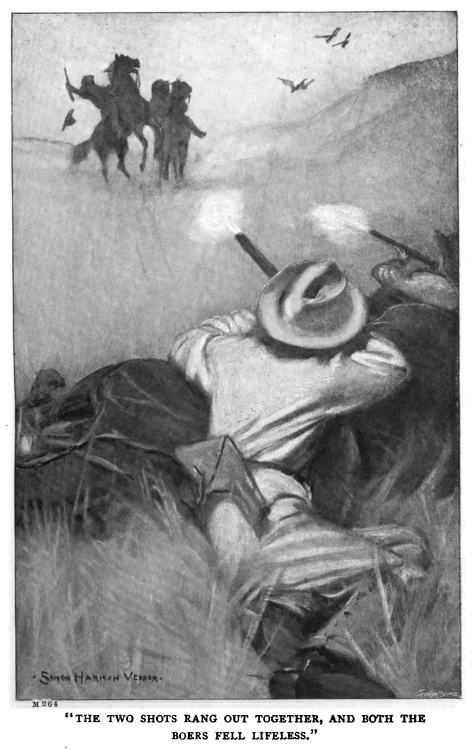
The lads had their rifles fixed upon them, the two shots rang out together, both the Boers fell lifeless from the saddle, and the Dutch horses dashed back along the track by which they had come.
The lads instantly reloaded; but they waited in vain for the coming of the other pursuers; these on seeing the horses galloping towards them after the shots had been fired had at once turned and rode off. After waiting for a little time to be sure that they were not going to be attacked, the friends mounted and rode on. They did not retrace their steps to see what had become of the other pursuers, as it was possible that these had imitated their own tactics, and were lying down by their horses, waiting to get a shot at them, should they ride back. They now continued their journey at an easy canter, and late in the evening entered the little town of Standerton.
Standerton presented a scene of unusual excitement; teams of waggons filled its streets, armed men moved about and talked excitedly, numbers of cattle and horses under the charge of Kaffirs occupied every spare place near the town—it was an exodus. The loyal Boers, who were at that time in an absolute majority throughout the colony, were many of them moving across the frontier, to escape the conflict which they saw approaching.
The more enlightened among these people had been fully conscious of the short-comings of their own government, prior to the annexation to England.
Short as had been the period that had elapsed since that event, the benefits which had accrued to the country had been immense. The value of land had risen fourfold; English traders had opened establishments in every village, and the Dutch obtained far higher prices than before for their produce, with a corresponding reduction in that of the articles which they had to purchase. Peaceable men were no longer harassed by being summoned to take part in commandos or levies for expeditions against the natives. The feeling of insecurity from the threatening attitude of the Zulus and other warlike neighbours was at an end, as was the danger of a general rising among the natives in the colony, who outnumbered the Boers by ten to one.
Thus the wiser heads among the Boers bitterly regretted the movement which had commenced for the renewed independence of the country. They did not believe that it would be successful, because they could not suppose that England, having, by the repeated assertions of its representatives that the annexation was final and absolute, induced thousands of Englishmen to purchase land, erect trading establishments, and embark their capital in the country, could ever desert and ruin them. They foresaw, moreover, that even should the rebellion be successful it would throw the country back a century, the rising trade would be nipped in the bud, the English colonists would leave the country, the price of land would again fall to a nominal sum, the old difficulties of raising taxes to carry on the government would recur, and restless spirits would again be carrying out lawless raids upon the natives, and involving them in difficulties and dangers.
Farther north the loyal portion of the Dutch remained quiet during the trouble; but around Standerton, Utrecht, and other places near the frontier large numbers of them crossed into Natal, with their wives and families, their cattle and horses, and there remained until the end of the war. The English settlers, almost to a man, abandoned their farms, and either retired into Natal or assembled in the towns and formed themselves with the traders there into corps for their defence. The manner in which throughout the war these little bodies uniformly succeeded in repulsing every attempt of the Boers to capture the towns showed how easily the latter could have been defeated, had the British government acted with energy when a sufficient force had been collected on the frontier, instead of losing heart and surrendering at discretion. It is not too much to say that, had the British government stood altogether aloof, the colony of Natal, with the English settlers and loyal Boers, could single-handed have put down the insurrection in the Transvaal.
The news which the lads brought to Standerton of the unprovoked attack upon, and massacre of, the 94th caused a wild feeling of excitement. A crowd rapidly gathered round the lads, and so great was the anxiety to hear what had taken place that Dick was obliged to mount on a waggon, and to relate the whole circumstances to the crowd.
Englishmen living at home in the happy conviction that their own is the greatest of nations can form little idea of the feelings of men in a colony like the Cape, where our rule is but half-consolidated, and where a Dutch population, equal in numbers, are sullenly hostile, or openly insolent. The love of the old flag and the pride of nationality are there very different feelings from the dull and languid sentiment at home; and the news of this bloody massacre, at a time when hostilities had not commenced on either side, and when no overt act of rebellion had taken place, caused every eye to flash, and the blood to run hotly in men’s veins.
Those who had hitherto counselled that the English settlers should remain neutral in the contest were now as eager as the rest in their demands that the place should be defended. There was but one company of British troops in the town; but within an hour of the story of the massacre being known 150 men had put down their names to form a corps; officers were chosen, and these at once waited upon the captain in command of the troops, and placed themselves under his orders.
The next morning scores of men set to work throwing up a breastwork round the place, cutting holes in the walls and houses for musketry, and preparing to defend the little town to the last against any attack of the Boers.
The moment that he had heard from the lads of the disaster to the 94th, the officer in command despatched a horseman to carry the news at full speed to Sir G. Pomeroy Colley, who was advancing towards Newcastle with the troops from Natal.
The same night a messenger rode in, saying that the Boers had raised their flag at Pretoria, had killed several English there, and were preparing to attack the little British force encamped at a small distance from the town; that at Potchefstroom they had also attacked the troops; and that the insurrection was general.
The next morning the lads mounted and proceeded on their way, and reached home late that evening, to the immense delight of their parents.
The news of the rising created a fever of excitement throughout Natal. H.M.S. Boadicea landed a rocket-battery and a naval brigade, who at once marched up towards the front; and Sir G.P. Colley, who commanded the forces, hurried every available man towards Newcastle, as the Boers were advancing in force towards the frontier, and were preparing to invade Natal.
Every day brought fresh news from the Transvaal. The little towns where the British were centred, isolated and alone as they were in the midst of a hostile country, in every case prepared to defend themselves to the last; and at Potchefstroom, Wackerstroom, Standerton, Leydenberg, and other places the Boers, attempting to carry the towns were vigorously repulsed. The news that a large force of Boers was marching against Newcastle caused great excitement in that portion of Natal; here large numbers of Dutch were settled, and the colonists were consequently divided into hostile camps. Large numbers of British colonists sent in their names as ready to serve against the Boers; but the English military authorities unfortunately declined to avail themselves of their services, on the ground that they did not wish to involve the colonists in a struggle which was purely an imperial one. For, were they to do so, the Dutch throughout the colony and in the Orange Free State might also join in the struggle, and the whole of South Africa be involved in a civil war.
There was much in this view of the case; but had a strong corps of colonists been attached to the force of General Colley, it is pretty certain that it would have escaped the disaster which subsequently befell it; for, being for the most part excellent shots and accustomed to the chase, they would have met the Boers with their own tactics, and thus, as the English settlers in the garrisons in the Transvaal showed themselves far better fighters than their Dutch antagonists, so Natal, where large numbers of young colonists had served against the Zulus, Secoceni, Moirosi, and in other native troubles, could, if permitted, have furnished a contingent which would have entirely altered the complexion of the struggle.
Upon the very day after the return of their sons, Mr Humphreys and his friend Jackson, furious at the two attacks which had been made by the Boers upon the parties accompanied by their sons, rode into Newcastle and inscribed their names in the list of those willing to serve against the enemy. They also offered their waggons and cattle to the authorities, to facilitate the advance of the British troops.
This offer was at once accepted, and it was arranged that on the 26th the carts still on the farm should go down to Pieter-Maritzburg, and Mr Humphreys wrote a letter to Mr Harvey, telling him that he was, upon his arrival, after clearing the waggons of the goods that he had brought down from the interior, to place them at once at the disposal of the authorities for the transport of military stores to Newcastle. Bill Harrison was to go down with the carts, and to be in charge of them and the waggons on their upward march.
Christmas was held with great festivity, to celebrate the return of the lads. Mr and Mrs Jackson and Tom, and four or five young settlers in neighbouring farms were invited by Mr Humphreys to spend the day with him. At his request they came early, and after the service of the church had been read by him the day was spent in festivity. The young men rode races on their horses, shot at marks for prizes of useful articles, presented by Mr Humphreys, and at five o’clock sat down to a Christmas dinner.
The holly, the mistletoe, and above all the roaring fire were absent, but the great kitchen was decked with boughs. The roast beef, plum-pudding, and mince-pies were equal to the best at home, and no pains were spared to recall home customs on the occasion.
At one o’clock there had been an equally good dinner given to the labourers and their families belonging to the farms of Mr Humphreys and his guests, and in the evening all assembled in the great kitchen, and to the tunes of a violin, played by one of the young colonists, a merry dance was kept up for some hours. The next morning Harrison started with the remaining waggon and several carts for Pieter-Maritzburg, and the lads were supposed to resume regular work on the farms.
Chapter Nineteen.
The Garrisons in the Transvaal.
The excitement of the time was, however, too great to permit the lads to settle down quietly, and every day they rode over to Newcastle to gather the latest news. The towns which held out in the Transvaal were Pretoria, Potchefstroom, Standerton, Wackerstroom, Leydenberg, Rustenberg, and Marabastadt. At Pretoria, the capital, Mr Edgerton and Sergeant Bradley of the 94th Regiment, who escaped from the massacre, brought in the news, and on the following day the authorities proclaimed martial law. Colonel Bellairs, C.B., was commandant, and the military authorities at once decided that the town must be abandoned, as, with its gardens and scattered houses, the extent was too large to be defended. A military camp was therefore formed outside the town, and to this the whole of the loyal inhabitants moved out. The civilians consisted of 975 men, 676 women, 718 children, 1331 servants and natives,—total 3700. In addition to these were the British troops. All horses were at once taken for the volunteers, among whom most of the white residents were numbered. The effective fighting force was about 1000—made up of four companies of the 2nd battalion, 21st Fusiliers; three companies of the 94th; 140 mounted volunteers, known as the Pretoria Horse; 100 mounted volunteers, known as Norris’s Horse, and the Pretoria Rifles, an infantry volunteer corps, 500 strong. For the reception of the women and children intrenchments were thrown up, connecting the jail and loretto convent, and the defence of this point was intrusted to six companies of the Pretoria Rifles, under Major Le Mesurier. The camp was distant about a third of a mile from the jail and convent, and the approaches were commanded by three little forts erected on eminences around.
Several skirmishes took place in the last fortnight in December, but the first sharp engagement occurred on the 6th of January. Colonel Gildea took out a force of twenty officers, 450 men, a gun, and fifteen waggons to bring in some forage and attack a Boer position at Pienness River, about twelve miles off. Norris’s Horse scouted in front, and the Pretoria Pioneers were detached to cut off the retreat of the Boers. The Boers were easily turned out of their position. Their defence was feeble; but several English were killed, owing to the Boers treacherously hoisting a flag of truce, upon which the English skirmishers, who were creeping forward, stood up, thinking that the Boers surrendered; they then fired, and several of our men were killed or wounded. The Boers being largely reinforced came forward to the attack, but were smartly repulsed. Our loss was four men killed and one officer (Captain Sampson); fourteen men were wounded. On the 15th another force started to attack a Boer laager, but found the enemy in such strength that they retired without serious fighting.
On the 12th of February an ineffective attempt was made to take the Red Horse Kraal, seven miles from Pretoria, on the road towards Rustenberg. The force consisted of twenty-two officers and 533 men. The carabineers under Captain Sanctuary advanced and attacked a large stone building, 1000 yards from the kraal. They were received by a very heavy fire from the Boers, who advanced in such strength that Colonel Gildea thought it prudent to fall back. This movement, covered by the horse, was effected, the infantry taking no part in the fight. Captain Sanctuary and eight men were killed; Colonel Gildea and eight others severely wounded. No further sortie was made during the continuance of the war, but the Boers did not venture to attack the British position.
The town of Potchefstroom stood in the district most thickly inhabited by the Boers. On the 14th of December, when it was reported that a large number of Boers were approaching, Colonel Winsloe, who commanded, sent Captain Falls with twenty men of the 21st Fusiliers, twenty-six men of a corps commanded by Commandant Raaff, and sixteen civilian volunteers to hold the court-house. The jail was garrisoned by twenty fusiliers, and the fort and earthwork, of some thirty yards square, situated about 1000 yards from the court-house, was held by 140 men of the fusiliers and a detachment of artillerymen, with two 9-pounders, under Major Thornhill. The three posts were provisioned as well as circumstances permitted.
On the 15th 500 mounted Boers entered the town. On the 16th fighting began in earnest, and the firing was hot on both sides. A very heavy fire was kept up on the prison and court-house. Half an hour after it commenced Captain Falls was killed. For the next sixty hours the firing continued, night and day, and one of the little garrison was killed and nine wounded. During the night the Boers broke into a stable close to the court-house, and from a distance of eight yards a heavy fire was kept up. During this time Colonel Winsloe in the fort had given what aid he could to the garrison of the courthouse by shelling the building from which the Dutch were firing upon it. On the evening of the 17th he signalled to the garrison to retire on the fort; but, being completely surrounded, they were unable to do this. On the morning of the 18th the Boers attempted to set fire to the thatch roof of the court-house; and as nothing in that case could have saved the garrison, Major Clarke and Commandant Raaff agreed to surrender on the terms that the lives of all those in the court-house should be spared. This was agreed to; but two loyal Boers, who had been captured at an outpost, were tried, condemned to death, and shot. On the 21st of December the garrison of the prison, falling short of provisions, evacuated it, and succeeded in gaining the fort without loss. The Boers occupied the post, but were driven out by the shell-fire from the fort. Mr Nelson, the magistrate, was taken prisoner in the town by the Boers, and kept in close confinement. Three of his sons got into the fort, and took part in its defence. Two of them, on a dark night, on the 19th of February, got through the Boer lines, and carried despatches from Colonel Winsloe to Newcastle, arriving there on the 5th of March, after many perils, not the least of which was swimming the Vaal River when in full flood.
In the meantime the attack on the fort itself had been uninterrupted. The very first evening the watercourse from which the supply of water to the camp was taken was cut. A well had already been commenced and sunk to a depth of twenty feet, but no water had been obtained. Fortunately the water-barrels had been filled an hour or two before the supply was cut, but these only contained two quarts of water per man. The weather was terribly hot, and the work of the men in the intrenchments was very severe.
On the night of the 17th Lieutenant Lindsell, with some of the drivers of the Royal Artillery, acting as cavalry, and a company of the 21st, went out to fill the water-casks from a stream half a mile away from the camp, and fortunately succeeded in doing so, the Boers not being on the look-out in that direction. This gave a further supply of two quarts per man.
The work of sinking the well had been continued without intermission, and a depth of thirty-six feet had been attained, but still no water was met with. A reward of 5 pounds was offered to the first party who struck water, and the soldiers off duty commenced digging in several places. At last, to the intense relief of the garrison, a party of Royal Artillery men found water at a depth of nine feet. The well soon filled, and yielded plenty of water during the remainder of the siege.
A desultory fire was kept up until the 1st of January, when, the Boers being strongly reinforced, 2000 men surrounded the fort at a distance of 500 yards, and opened a heavy fire upon it. They did not, however, venture to attack the little garrison. On the 5th they occupied the cemetery, 300 yards from the fort, but Lieutenant Lindsell with a party of volunteers went out by moonlight and drove them out. The Boers then commenced making trenches, gradually approaching the fort; but on the 22nd Lieutenant Dalrymple Hay went out, carried the position from which the Boers had been most troublesome, and captured four prisoners, some guns, ammunition, and trenching-tools. From that time, although the Boers continued to throw up trenches, they contented themselves with a desultory fire.
The siege continued for three months and five days; at the end of that time the whole of the provisions were exhausted. Fever, dysentery, and scurvy had broken out, and many of the garrison had died. Out of 213 men eighty-three had been killed, wounded, or taken prisoners. In fact an armistice between the armies had at that time been proclaimed, but Cronje, the Boer who commanded the attack, treacherously concealed the fact from the garrison. When only three days’ quarter-rations remained the garrison surrendered the fort, on the condition that they should be allowed to march down to Natal.
Messengers had reached Cronje nine days before with news of the armistice, but although he was aware of this he continued the siege to the end, the firing during the last week being heavier than at any time during the siege,—on two days alone 150 round shot fell on the fort. The Boers were afterwards obliged to allow that the surrender of the fort had been obtained by treachery, and to agree to the garrison being reinstated.
Standerton is the first town of any size on the main road from Natal to Pretoria, and is situated on the north bank of the Vaal River. On the outbreak of hostilities two companies of the 94th and one of the 88th marched from Wackerstroom to this town, and Major Montague of the 94th Regiment arrived from Natal to take the command. The total strength of the garrison consisted of about 350 soldiers and seventy civilians. The Landdrost, J.C. Krogh, remained loyal and assisted in the defence, three forts were erected on eminences round the town, two outworks and many breastworks and rifle-pits were dug, houses interfering with the line of fire were pulled down, and other buildings in suitable positions were barricaded and loop-holed.
The centre point of defence was a building known as Fort Alice, 800 yards from the town, and a military camp was formed on a height one mile and a quarter from this point. Preparations were made to blow up some of the buildings, should the Boers carry the town, mines being dug and laid to the fort. A good store of provisions was collected.
On the 29th a scout on a hill signalled a large number of Boers were approaching Erasmus Farm, three miles distant from Standerton. Captain Cassell, with sixteen mounted volunteers, went out to reconnoitre. Two or three scouts were thrown out, and these arrived within 600 yards of the farm; suddenly a number of Boers made their appearance, and Mr G.B. Hall, one of the mounted volunteers, gallantly tried to cross their line to warn his comrades of the coming danger. Galloping in front of the Boers, his horse was shot under him; taking shelter behind it, he opened fire on the enemy, and so attracted the attention of his party. One man could not long resist 300, and Hall was soon killed. The alarm, however, had been given in time, and the mounted men fell back on the camp, exchanging shots with the enemy. The Boers now took up a position 600 yards from the camp, and kept up a heavy fire. Skirmishes occurred daily, and the enemy harassing the garrison from a height called Standerton Kop, Major Montague caused a dummy-gun, mounted on two waggon-wheels, to be placed in the intrenchments; the sight of this frightened the Boers off Standerton Kop.
On the 7th of January a Swazi, named Infofa, who had greatly distinguished himself by his bravery in the Secoceni War, but was now undergoing a term of penal servitude for culpable homicide, performed an act of singular bravery. The Boers had during the night erected a small earthwork on the outside of the Vaal River; 400 yards nearer the town stood a house, and fearing that this might be occupied by the Putch, it was determined to destroy it. Infofa with a party of Kaffirs volunteered for the duty; he crossed the river with his party, and the Kaffirs began to pull down the house. Infofa, however, took his gun, and marched boldly away to the Boer earthwork, 400 yards distant, to the astonishment of the lookers-on. It happened that at the moment no Boers were present in the works, and the man reached it without a shot being fired at him; inside he found some tools, and with these he deliberately set to work and levelled the breastwork; this accomplished, he returned to the party.
Until the end of the war the Boers were unable to make any impression upon Standerton, and whenever they approached too closely the garrison sallied out and drove them off.
At Leydenberg fifty men of the 94th, under Lieutenant Long, had been left, when the four companies under Colonel Anstruther had marched away. The people of the town, when the news of the rising arrived, offered to defend themselves with the troops against attacks; but Lieutenant Long declined to accept the offer. There were in the town 220 women and children, and only thirty-four white men who could be relied on; there were no defences and no water-supply, and as Lieutenant Long knew that three or four months must elapse before a relieving force could arrive, he decided that it would only cost the townspeople their lives and property were they to attempt to defend the place. He therefore advised them to remain neutral, while he with his fifty soldiers defended the fort. This they did, and the commandant of the Boer force, Piet Steyn, caused their property to be respected when he entered the town with his troops.
For three months Lieutenant Long defended the fort gallantly against all attacks. At one time the enemy set fire to the thatch roof of one of the buildings, but the soldiers succeeded in extinguishing it, although the Boers kept up a heavy fire; during the night the defenders stripped off the roofs of the remaining thatch buildings, and so prevented a renewal of this form of attack. The Boers cut off the water-supply, but the garrison sunk wells, and succeeded in reaching water in time. The casualties among the fifty men during the siege were three killed and nineteen wounded. At the end of the war a general order was published, conferring the highest praise upon Lieutenant Long and his little garrison, for the bravery and endurance which they had shown in maintaining for three months a close siege, and this without any hope of relief or succour. At the conclusion of the war Lieutenant Long was so disgusted at the humiliating terms of the treaty, and the surrender to the Boers, that he resigned his commission in the army.
Marabadstadt, though called a village, consists of only seven or eight houses. Sixty men of the 94th, under Captain Brook, formed the garrison which was stationed there to keep order after the Secoceni War, as no less than 500,000 natives inhabit the surrounding district. Fortunately the races were being held at the time when the news of the massacre of the 94th arrived, and the English inhabitants of the neighbourhood, who were present, at once responded to the call of Captain Brook to aid in the defence, and thirty white men and fifty half-castes enrolled themselves as volunteers. The Boers attacked in considerable force, having with them two cannons; but the fort held out until the end of the war, the garrison making many sorties when the Boers brought up their guns too close. At Rustenberg and Wackerstroom a successful defence was also maintained throughout the war by the British and loyalists; but no incidents of importance marked the siege of those places.
Chapter Twenty.
Laing’s Neck.
On the 24th of January General Colley’s little column, consisting of the 58th, a battalion of the 60th, a small naval brigade, 170 mounted infantry, and six guns, moved out from Newcastle; they took with them an amount of baggage-train altogether out of proportion to their force, as in addition to their own baggage and ammunition they were taking up a considerable amount of the latter for the use of the troops besieged in the various towns in the Transvaal.
Mr Humphreys and Jackson rode over to Newcastle to see them start, and the lads sat chatting to them on their horses, as the column filed by.
“I don’t like the look of things, father,” Dick said, “and if you had seen the way the Boers polished off the 94th, I am sure you wouldn’t like it either. If we are attacked by them, the troops would, for the most part, be wanted to guard this huge baggage-train, and I am sure, from what I have seen of the Boers, the only way to thrash them is to attack them quickly and suddenly. If you let them attack you, you are done for. Their shooting is ten times as good as that of the troops; they are accustomed, both in hunting and in their native wars, to depend each man on himself, and they would hang round a column like this, pick the men off at long distances, and fall upon them in hollows and bushes; while, whenever our fellows tried to take the offensive, they would mount their horses and ride away, only to return and renew the attack as soon as the troops fell back to the waggons. Besides, with such a train of waggons we can only crawl along, and the Boers will have time to fortify every position. I wonder, at any rate, that General Colley does not push forward in light marching-order and drive the Boers at once out of Natal, and cross the river into the Transvaal; then he would have a flat, open country before him, and could bring the waggons up afterwards.”
“What you say seems right enough, Dick,” his father answered; “but General Colley has the reputation of being an excellent officer.”
“I have no doubt that he is an excellent officer, father; but he has had no experience whatever in the Boers’ style of fighting; he knows that they have often been defeated by natives, and I fancy he does not value them highly enough. They cannot stand a quick, sudden attack, and that’s how the natives sometimes defeat them, but at their own game of shooting from behind rocks I believe that they are more than a match for regular troops. However, we shall see. As I am not going as a combatant I shall be able to look on quietly, and fortunately the Boers are not like Zulus, and there is no fear of non-combatants and prisoners being massacred. If there were, I tell you fairly, father, that I would cry off, and let the waggons go without me, for I do believe that things will not turn out well.”
“Well, I hope you are wrong, Dick. But you have seen so much fighting in this country, during the last two years, that your opinion is certainly worth something. However, there is one satisfaction, there are a number of troops now landing at Durban and on the march up; so that if this little force does get a check, it will soon be retrieved. Now, good-bye, lad; mind, if there is an attack on the waggons, take as little part in it as you can, and stick to the position of non-combatants. If they would have had us as volunteers, we would have done our best; but as they have declined to accept the offer of the colonists, let them fight it out their own way. If they get beaten and the Boers swarm into Natal, as in that case they certainly will do, the colonists will take the matter in hand by themselves, and if we don’t send the Dutchmen packing back faster than they come, I am a Dutchman myself.”
Had Sir George Colley pushed on rapidly with his column, he would have passed all the points at which the Boers could have taken up strong defensive positions, before they could gather in force to oppose him, as he had the choice of three or four different lines of advance, and until the one by which he would travel was known, the Boer army was forced to remain inactive, awaiting his disposition. As soon, however, as he had left Newcastle, and it was known by them that he had started along the line of road to the west of Newcastle, they moved their whole force to oppose him, and took post on a position known as Laing’s Neck, at a spot where the road had to cross over a steep and difficult ridge. Here they set to work to throw up intrenchments, and the leisurely, and indeed dilatory, advance of the British gave them ample time for this. Although the distance from Newcastle to Laing’s Neck was but twenty-five miles, and the column, unimpeded by baggage, could by a forced march have seized the position on the very day of their leaving Newcastle, and long before the Boers could have moved their army to reinforce the little body who occupied the position as corps of observation, no less than six days elapsed before Sir George Colley’s force arrived before Laing’s Neck.
This time was spent in frequent halts, in improving the roads, bridging the streams, and other similar operations, all useful enough in their way, but fatal to the success of a flying column, whose object was to strike a sudden blow at the enemy, and to secure the road and passes as far as the frontier, in order to facilitate the march of the main column of invasion, which was on its way up from the coast. Dick and Tom chafed under the long delays, and twice rode home and spent a day with their parents.
At last, however, the column was in front of the enemy’s position. The Boers, who were some 3000 strong, held a strong position on the line of the crest of the ridge, with breastworks thrown up in front. The total force of Sir George Colley consisted of but 870 infantry, together with the mounted men and guns; and to attack such a position, with a chance of success, every man should have been sent against the intrenchments. General Colley, however, seems at the last moment to have been alarmed for the safety of his baggage, which was menaced by parties of Boers on his left flank. He therefore prepared to attack with only five companies of the 58th—that is, but little more than 250 men, keeping the whole of the rest of the infantry in reserve, but ordering the mounted infantry to assist in the attack—a service which, upon such ground, they were altogether unfitted to perform. The result of such an arrangement as this was inevitable. Tom and Dick could scarcely believe their eyes when they saw this handful of men advancing up the steep hill, at whose summit was a force more than ten times as numerous, and composed of some of the finest marksmen in the world. The six English guns opened fire to cover the advance, and the 58th went gallantly up the hill As soon as they approached the crest, a tremendous fire of musketry was opened upon them by the Boers lying behind the intrenchments. The men were literally swept away by the fire. Gallantly led by their officers, they pressed forward until within a few yards of the breastworks; then the Boers leapt to their feet, sprang over the works and fell upon them. Colonel Deane, Major Poole, Lieutenant Elwes, and Lieutenant Bailey were killed, and no less than 180 of the little force were killed, wounded, or taken prisoners. Few even of the survivors would have escaped, had not the mounted infantry, who had ascended the spur at a point farther to the right, made a gallant charge along the crest of the hill and checked the pursuit. The main body of the British advanced a short distance to make a demonstration, and prevent the Boers from following up their success. The whole column then fell back four miles, to the ground which they had occupied the night before. The gallantry displayed by the 58th and mounted infantry was the sole redeeming feature in the discreditable affair of Laing’s Neck, where defeat had been rendered almost certain by the previous hesitation and delays, and was ensured by the folly of sending a mere handful of men to attack such a position. As the British fell back, the Boers advanced, and at nightfall placed themselves on the road between the camp and Newcastle, entirely cutting the force off from its base, and threatening both them and the town of Newcastle.
Several days passed, the attitude of the Boers became more and more threatening, and General Colley determined at all hazards to open the way back to Newcastle. On the morning of the 8th of February he moved out with five companies of the 60th rifles, two field and two mountain-guns, and a detachment of mounted infantry; Dick and Tom obtained leave to ride back with the mounted detachment. At a commanding post near the River Ingogo Sir George Colley left two mountain-guns and a company of rifles as a garrison, and moved forward with the rest of the column. The River Ingogo runs at the bottom of a deep ravine. Crossing this the English force mounted to the top of the opposite crest, but they had gone but a short distance farther when they were attacked on all sides by the Boers. The troops were ordered at once to take shelter among the boulders and bushes, while the two guns from the top of the eminence opened fire with shell upon the enemy.
Dick and Tom sought shelter with the rest, making their horses lie down beside them, and were soon as hotly engaged as the Rifles around them in answering the heavy fire of the Boers. The fight began at twelve o’clock, and raged without intermission for six hours; sometimes the Boers attacked on one side of the position, sometimes upon another. The ground was broken and thickly strewn with boulders and bushes, and favoured by these the Boers crept up sometimes close to the position held by the English. So accurate was their shooting that none of the defenders could show his head above shelter for a moment, and it was as much as they could do to prevent the enemy from carrying the position at a rush. The 60th fought with the greatest coolness and steadiness, and, numerous as were the enemy, they could not muster up courage for the rush which would have assuredly overwhelmed the little party that they were attacking. The two English guns could render but small service, the men being shot down as fast as they stood up to load, and every officer, driver, gunner, and horse was killed or wounded within half an hour after the action commenced. So incessant indeed was the rain of balls that the guns after the action were spotted with bullet-marks so thickly that it would have been difficult to place the tip of the finger upon a place unstruck by a ball.
When darkness put a stop to the fight 160 men—more than two-thirds of the force—were killed or wounded. Among the former were Captain MacGregor of the staff, Captain Green of the Royal Artillery, and Lieutenants Green and O’Connell of the 60th; while Lieutenants Pixney, Parsons, Twistlewaite and Haworth, all of the 60th, were wounded. Had the Boers taken advantage of the cover of darkness to steal forward, they must have annihilated the little force; but they believed that they had them in their power, for the rain had fallen heavily, the Ingogo had risen, and was, they thought, unfordable. General Colley ascertained, however, that it was stilt possible to cross, and with the greatest silence the survivors moved off from their position, the storm helping to conceal the movement from the Boers. Very quietly they moved down to the stream, and with the greatest difficulty succeeded in crossing; then picking up on their way the company and guns which had been left on the eminence beyond, the column reached camp in safety.
In the meantime reinforcements had been pushing forward from the sea as fast as possible, and on the 17th the column under Sir Evelyn Wood arrived at Newcastle, to the great joy of its inhabitants. For days an attack by the Boers had been expected, intrenchments had been thrown up round the great convoy which had been collected to advance with the force, and all the inhabitants who could bear arms, and many settlers from the surrounding country, had come in to aid in the defence, should the Boers attack it.
The arrival of the relieving column ensured the safety of the town, and the Boers between Newcastle and General Coney’s little camp at once fell back to their old position on Laing’s Neck, leaving the road open. General Colley and his staff rode in from Prospect Hill, the name of the camp, and had a consultation with General Wood. The 92nd Regiment marched out and reinforced General Colley’s column.
The Boers’ position at Laing’s Neck was commanded by a lofty and rugged mountain, called Majuba Hill, on its right, and the occupation of this hill by the British would render the position untenable. It would have been an admirable military movement to seize this hill when the whole force was collected at the camp in readiness to advance, as, with their flank turned and a force advancing for a direct attack, the Boers must at once have retreated, but General Colley most unfortunately desired to retrieve the two defeats he had suffered, by compelling the Boers to fall back, before the arrival on the scene of Sir Evelyn Wood with the main body. He believed, no doubt, and with reason, that Majuba Hill once captured would be impregnable against any attack which might be made against it.
Accordingly, on the night of the 26th, with twenty officers and 627 men drawn from the 58th, 60th, 92nd, and naval brigade, he started from the camp with the intention of seizing the hill. The night was a dark one, and the march across the unknown country difficult in the extreme. The intervening ground was cut up by steep valleys and rapid ascents, and for hours the troops struggled up and down these places, many of which would have been difficult to climb by daylight. At last, after immense labour, the force reached the foot of Majuba Hill, having taken six hours in accomplishing a distance which, as the crow flies, is little more than four miles. At a commanding point near the foot of the hill 200 men were left, to keep open the communication; the main body kept on until they reached the summit, just before daylight, the Boers being entirely in ignorance of the movement which had taken place. The position was of immense natural strength, as it was only at a few points that an ascent could be made. On the summit was a plateau, so that all the troops not actually engaged in repelling assaults could lie down perfectly secure from the fire from below. At sunrise the Boers could be seen moving about in their lines. An hour later a party of mounted vedettes were seen trotting out towards the hill, which during the day they used as a post of observation; as they approached the outlying pickets fired upon them. As the sound of the guns was heard by the Boers below, a scene of the greatest confusion and excitement was observed from the height to prevail. Swarms of men were seen rushing hither and thither; some to their arms, some to their horses, others to their waggons, to which the oxen were at once harnessed, ready for a retreat in case of necessity. Then a great portion of the Boers moved forward towards the hill, with the evident intention of attacking it.
At seven o’clock the enemy opened fire, and the bullets whistled up thickly round the edge of the plateau. The main body of the troops remained in the centre of the plateau, out of fire, small bodies being posted near the edge to answer the fire of the Boers and prevent their approaching the accessible points. For five hours the musketry duel continued. So far its effect had been trifling, a few men only being wounded. The position appeared perfectly safe. The Boers were indeed between the garrison of the hill and the camp, but the former had three days’ provisions with them, and could therefore hold out until Sir Evelyn Wood arrived with the main body for a direct attack upon the Boers’ position.
Between twelve and one o’clock the Boers’ fire slackened, and the besieged force thought that their assailants were drawing off; this, however, was not the case. Under cover of the shrubs and rocks the Boers were creeping quietly up, and at one o’clock a terrific fire suddenly broke out, and the enemy in great numbers rushed up the short intervening distance between themselves and the scanty line of defenders on the edge of the plateau; these, seized by panic, at once fled, and the exulting Boers poured up on to the plateau and opened a destructive fire upon the troops.
The scene which ensued was one of the most discreditable in the annals of the British army. Although armed with breech-loaders, and fully as numerous as the assailants who had gained the crest of the hill, the resistance offered was feeble in the extreme; had the troops charged the Boers, the advantages of discipline and of their vastly superior weapons would have been irresistible, and they could have cleared the plateau as speedily as it had been occupied. The great majority, however, were seized with a wild panic, and, in spite of the efforts of the officers, thought of nothing but seeking safety in flight. A few stood and fired, but how few these were can be judged from the fact that only one Boer was killed, one severely wounded, and four slightly so; while half the British force were killed, wounded, or taken prisoners, the remainder managing to escape down the sides of the hill, and to join the force left at its foot, or to hide in the bushes until night. Among the killed were General Colley, Captain the Hon. C. Maude, Surgeon-Major H. Cornish, Surgeon A. Landon, and Lieutenant Trower of the naval brigade; eight officers were killed, and seven taken prisoners; eighty-six men were killed, 125 wounded, fifty-one taken prisoners, and two missing. The fight, such as it was, lasted five minutes. The force which had been left at the bottom of the hill, under Captain Robertson, was also attacked; but, being admirably led by that officer, fought its way back to the camp with but small loss, the guns there assisting to cover its retreat.
The boys had not accompanied the expedition, and from the camp had watched the line of smoke round the hill, and had joined in the laughter of the officers at the idea of the Boers attacking so tremendously strong a position. Intense was the astonishment in camp when a wreath of smoke suddenly rose from the summit, and when this cleared away, and all was quiet, and it became evident that the Boers had carried the position, it was difficult to say whether the feeling of dismay or humiliation most prevailed.
With the defeat of Majuba Hill the war in the Transvaal virtually terminated. When the news reached England, the government declared that the honour of the British flag should be vindicated, and great numbers of troops were sent out to Natal; these marched up the country, and were in readiness to assault the Boers’ position, when the English government suddenly gave way, and granted to the Boers all that they demanded, the sole provision insisted upon being a purely nominal sovereignty on the part of the queen, and an equally nominal protection for the natives—a clause in the treaty which, from that time to this, no attempt whatever has been made to enforce. Not only were the natives practically abandoned to the mercy of the Boers, to be shot down or enslaved at their will, as in former times, but the English settlers, who had for months made such a noble defence in every town in the Transvaal, were abandoned, and the greater portion of them, ruined and plundered, have long since left the country where, relying upon the empty promises and vain guarantee of England, they had embarked their fortunes. A more disgraceful and humiliating chapter in English history than the war in the Transvaal, and the treaty which concluded it, is not to be found.
After the battle of Majuba Hill Dick and Tom returned to their farms, resolved to have nothing farther to do with the business; there they have remained steadily since that time. Mr Humphreys’ plantation of trees now covers a great extent of ground, and promises fully to answer his expectations of eventual profit. Those first-planted are attaining large size, and the thinning brings in a considerable annual income. His waggons are fully employed in taking down fruit to Pieter-Maritzburg. In another ten years Mr Humphreys expects that he will be a very wealthy man; he is thinking next year of paying a visit, with his wife and two sons, to England, where John will be left to finish his education and pass through college, with a view of eventually entering the Church. Dick is quite contented with his life; he has taken no farther part in trading expeditions into the interior, although the profit realised in the venture under Mr Harvey was considerable, but there is plenty of work on the farm to occupy his time. A large number of natives are employed in planting operations, and since the first year Mr Humphreys has raised all his own trees from seeds. The breeding of cattle and horses has been abandoned, only a small herd and a flock of sheep being kept for home requirements, as it is found that the ever-increasing plantation and the great orchards of fruit-trees are quite sufficient to occupy their attention.
Mr Jackson too is prospering greatly; influenced by the example of his neighbour, he too has gone in for planting, although on a much smaller scale than Mr Humphreys, his means being insufficient to carry out such extensive operations. Tom and Dick are as great friends as ever, and, when they can be spared, often go out together on a deer-hunting expedition. Tom is engaged to the daughter of a trader in Newcastle; Dick, laughing, says that he shall look out for a wife when he gets to England. The prospects would be altogether bright for the emigrants from Derbyshire, were it not for the trouble which the weakness of the British government, in sending back Cetewayo to Zululand, brought about, and from the increasingly bad feeling growing up between the Boers and the natives, owing to the constant aggressions of the latter, and their ill-treatment of the natives, in defiance of the agreements in the treaty with the British government. If the day should come when the natives at last rise and avenge upon the Boers the accumulated injuries of many years, neither Dick Humphreys nor Tom Jackson will be inclined to lift a hand to save the Boers from their well-merited fate. The example of the successful resistance offered by the Basutos to the whole power of the Cape government has had an immense effect among the native tribes of South Africa, and sooner or later the colonists there will have a very serious crisis to pass through. Dick hopes that this crisis will not occur in his time, for Mr Humphreys intends in another fifteen years, if he live so long, when his first-planted trees will have gained maturity, to divide his great forest into lots, to sell off, and to return to his native land. Dick quite agrees in the plan, and hopes some day to be settled with an abundant competency in Old England.
The End.
|
Preface
| |
Chapter 1
| |
Chapter 2
| |
Chapter 3
| |
Chapter 4
| |
Chapter 5
| |
Chapter 6
| |
Chapter 7
| |
Chapter 8
| |
Chapter 9
| |
Chapter 10
| |
Chapter 11
| |
Chapter 12
| |
Chapter 13
| |
Chapter 14
| |
Chapter 15
| |
Chapter 16
| |
Chapter 17
| |
Chapter 18
| |
Chapter 19
| |
Chapter 20
|