"A Story of the Zulu and Boer Wars" (continued 4)
Reading edition
Chapter Thirteen.
A Brush with the Natives.
One day Jumbo touched Dick’s arm, as he was riding along with the caravan, and, pointing to a clump of trees at some little distance, said,—
“Giraffe.”
Dick reined in his horse, and gazed at the trees.
“I don’t see it,” he said.
“They are very difficult to see,” Mr Harvey remarked; “they have a knack somehow of standing so as to look like a part of the tree. I don’t see him myself, but if Jumbo says he is there, you may be sure he is.”
“Is the skin valuable?” Dick asked.
“No, Dick, it would not be worth cumbering ourselves with. Nor is the flesh very good to eat—I do not say it cannot be eaten, but we have plenty of venison. I never like shooting a giraffe when I can help it. Clumsy and awkward as they are, they have wonderfully soft and expressive eyes, and I do not know anything more piteous than the look of a dying giraffe; however, if you ride up to the trees and set them scampering, you will get a good laugh, for their run is as awkward and clumsy as that of any living creature.”
Dick accordingly started at a gallop towards the trees; it was not until he was close to them that he saw three giraffes, two old ones and a young one. They started off, as he approached, at a pace which seemed to Dick to be slow, as well as extraordinarily clumsy. The two old ones kept themselves between their offspring and the pursuer, as if to shield it from a shot. Dick, however, had no idea of firing; he only wished to gallop up close, so as to get a nearer view of these singular beasts, but to his astonishment he found that, although his horse was going at its best speed, the apparently slow-moving giraffes were steadily gaining upon him. He could hardly at first believe his eyes. But he was gradually tailed off, and at last, reining in his horse, he sat in the saddle and enjoyed a good laugh at the strange trio in front of him, with their long, straggling legs and necks.
When he rejoined the caravan Mr Harvey, who had watched the pursuit, asked him laughingly if he managed to catch the giraffe.
“I might as soon have tried to catch an express train; they went right away from me,—and Tommy can gallop too; but he hadn’t a chance with them, although he did his best.”
“They do move along at a tremendous pace in their clumsy fashion. They take such immense strides with those odd long legs of theirs, that one has no idea of their speed until one chases them. I never knew a new hand who tried it, but he was sure to come back with a crestfallen face.”
Three weeks after leaving what they called the elephant-camp the caravan halted for two days. They had now arrived at the spot where their troubles with the natives might be expected to begin; they were at the border of the Matabele country, and here Mr Harvey intended to turn west, and after keeping along for some time to bend to the south and re-enter the colony north of Kimberley, and to journey down to Port Elizabeth, which is the principal mart for goods from the interior. Between the Matabele and the tribes on their border hostilities had for some time prevailed, and while they halted Mr Harvey sent forward Blacking with a few presents to the chief of the next tribe, saying that he was coming through his country to trade, and asking for a promise that he should not be interfered with in his passage.
At the end of the second day the messenger returned.
“The chief says come; he says he has been a long time without trade. But before he answered he talked with his chiefs, and I don’t know whether he means honestly. The tribe has a bad name; they are thieves and robbers.”
“Well, we will go on,” Mr Harvey said, “nevertheless; we have got the chief’s word, and he will not after that venture to attack us openly, for if he did he knows very well that no more traders would visit his country. His people may make attacks upon us, but we are strong enough to hold our own. We muster about thirty guns, and in our laager would be able to beat off his whole tribe, did they attack us; we will, however, while travelling through his country, be more careful than hitherto. The waggons shall, when it is possible, travel two abreast, so that the line will not be so long to guard, and you must not wander away to shoot. Fortunately we have a store of dried meat, which will last us for some time.”
On the following morning the caravans set out, and after travelling twelve miles halted on the bank of a stream. Soon after they had formed their camp five or six natives came in; they brought a few bunches of ostrich plumes and some otter skins; these they bartered for cotton, and having concluded their bargains wandered about in the camp, as was the custom of the natives, peeping into the waggons, examining the bullocks, and looking at all the arrangements with childish curiosity.
“I expect these fellows have come as spies rather than traders,” Mr Harvey said to the lads. “As a general thing the natives come in with their wives and children; but, you see, these are all men. I observed too that they have particularly examined the pile of muskets, as if reckoning up our means of defence. In future, instead of merely a couple of men to look after the cattle and keep off any marauders, I will put six every night on guard; they shall be relieved twice during the night, and one of the hunters shall be in charge of each watch,—if there are signs of trouble, we will ourselves take it by turns.”
Two or three times that night the sentries perceived moving objects near the camp, and challenged; in each case the objects at once disappeared; whether they were hyenas or crawling men could not be discerned.
At the halt next day a much larger number of natives came in, and a satisfactory amount of trade was done. Their demeanour, however, was insolent and overbearing, and some of them went away with their goods, declining to accept the exchange offered. After they had left the camp several small articles were missed.
The next day they passed across a plain abounding in game, and Mr Harvey said that the boys and the three hunters might go out and kill some fresh meat; but he warned Dick and Tom not to allow their ardour in the chase to carry them away from the hunters, but to keep as much as possible together. When they had killed as many animals as could be carried on their horses and the hunters’ shoulders, they were to return at once.
It was the first time that Tom had been out hunting since his accident; his bones had all set well, and beyond a little stiffness and occasional pain he was quite himself again.
“I am glad to be riding out again with you, Dick,” he said; “it has been awfully slow work jogging along by the side of the caravan.”
In addition to the three hunters they took as usual a native with them, to hold the horses should it be necessary to dismount and stalk the game, instead of chasing it and shooting it from the saddles, an exercise in which by this time the boys were efficient. They found more difficulty in getting up to the game than they had expected, and the hunters said confidently that the animals must have been chased or disturbed within a few hours. They had accordingly to go four or five miles across the plain before they could get a shot; but at last they saw a herd feeding in a valley. After the experience they had had that morning of the futility of attempting to get near the deer on horseback, they determined that the hunters should make a circuit, and come down upon the herd from different points. Tom and Dick were to stay on the brow where they were then standing, keeping well back, so as to be out of sight from the valley, until they heard the report of the first gun, when they were to mount and endeavour to cut off and head the deer back upon the others. The hunters then started—Jumbo and Blacking going to the right, Tony and the other to the left.
After an hour’s walking they reached their places at points about equidistant from each other, forming with Tom and Dick a complete circle round the deer. They were enabled to keep each other in sight, although hidden from the herd in the hollow. When each had gained his station they lay down and began to crawl towards the deer, and until they were within 150 yards of the herd the latter continued grazing quietly. Then an old buck gave a short, sharp cry, and struck the ground violently with his hoofs; the others all ceased feeding, and gazed with startled eyes to windward, and were about to dash off in a body when the four men fired almost simultaneously, and as many stags fell. The rest darted off at full speed in the direction in which Tom and Dick were posted, that being the only side open to them. An instant later Tom and Dick appeared on horseback on the brow, and dashed down towards the herd; these, alarmed at the appearance of a fresh enemy, broke into two bodies, scattering right and left, giving both lads an opportunity for a good shot. Both succeeded in bringing down their mark. They then dismounted, and giving their horses to the native joined the hunters. They had bagged six deer, and the hunters at once proceeded to disembowel them; one was to be slung behind each of the saddles, and the others would be carried by the hunters and native.
While they were so engaged they were startled by a shout, and saw the native running down towards them, leading the horses and gesticulating wildly.
“We are attacked,” Blacking said, and almost at the same moment three or four arrows fell among them.
They had collected the dead deer at one spot, and were standing in a group; looking round they saw a large number of natives crowning the low hills all round them, and saw that while they had been stalking the deer they themselves had been stalked by the natives. Without a moment’s hesitation the hunters disposed the bodies of the deer in a circle; seizing the two horses they threw them beside the deer, fastening their limbs with the lassoes which they carried, so that they could not move; then the six men threw themselves down in the circle.
All this had been done in a couple of minutes. The arrows were falling fast among them, but none had been hit, and as soon as the preparations were complete they opened a steady fire at the enemy. With the exception of the man who had come out with the horses all were good shots, and their steady fire at once checked the advance of the natives, whose triumphant yelling ceased, as man after man went down, and they speedily followed the example of their opponents, and, throwing themselves down on the grass, kept up a fire with their arrows in a circle of seventy or eighty yards round the hunters.
Gradually, however, their fire ceased, for to use their bows they were obliged to show their heads above the grass, and whenever one did so the sharp crack of a rifle was heard; and so often did the bullets fly true to their aim that the natives soon grew chary of exposing themselves.
“What will they do now?” Dick asked, as the firing ceased.
“They are cowards,” Jumbo said contemptuously. “If they had been Zulus, or Swazis, or Matabele, they would have rushed in upon us, and finished it at once.”
“Well, I am very glad they are not,” Dick said; “but what is to be done?”
“They will wait for night,” Tony answered; “then, when we cannot see them, they will creep up close and charge.”
“In that case,” Dick said, “the best thing will be for us to keep in a body, and fight our way through them, and make for the camp.”
Jumbo shook his head.
“They quiet now because they think they got us safe; if we try to get away, they rush down upon us; we shoot many, but we all get killed.”
“Then,” Dick said, “the best thing will be for me to jump on my horse and ride straight through them; if I get off alive, I will make for the caravan and bring back Mr Harvey and the rest to your assistance.”
“No good,” Blacking said; “your horse would be stuck full of arrows before you get away; he drop dead; they kill you. I go.”
“But it would be just as dangerous for you as for me, Blacking.”
“No,” the hunter said; “directly you stand up to get on horse they see you and get ready to shoot; the horse fall dead before he reach them. I will crawl through the grass; they will not see me till I get to them—perhaps I get through without them seeing at all; if not, I jump up sudden and run; they all surprised, no shoot straight; once through line they never catch me.”
Jumbo and Tony assented with a grunt, and Dick, seeing that no better plan could be suggested, offered no opposition to the young hunter undertaking the task.
Leaving his gun and ammunition behind him, the black at once without a word crawled out between the carcases of the deer, making his way, like a snake, perfectly flat on his stomach, and soon it was only by a very slight movement of the grass, which was nearly two feet high, that Dick could follow his progress. But he could not do this for long, an arrow whizzing close to his head warned him that he was exposing himself, and he lay down behind his stag and listened with intense eagerness for the outcry which would arise when Blacking was discovered.
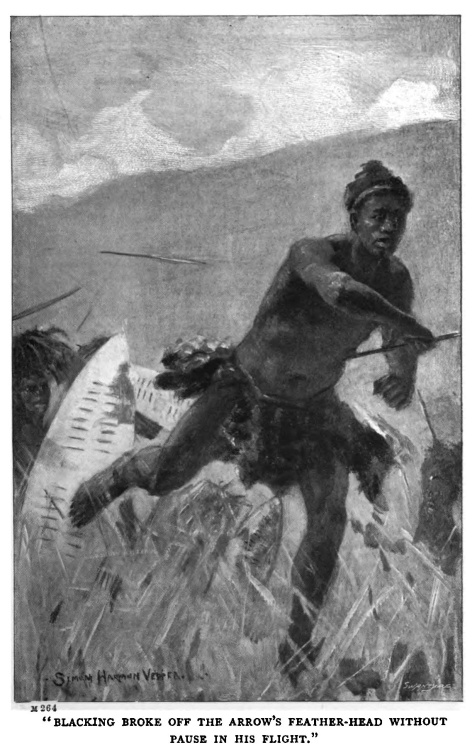
It seemed a long time, so slow and cautious was the black’s advance. At last there was a sudden yell, and the little party, sure that the attention of their assailants would for the moment be diverted, raised their heads from the shelter and looked out. They saw Blacking bounding at full speed up the slope; a score of natives had sprung to their feet, and were discharging their arrows in the direction of the fugitive, who zigzagged, as he ran with rapid bounds, to unsteady and divert their aim. One arrow struck him in the side; they saw him break off the feather-head, pull it through the wound, and throw it away without a moment’s pause in his flight.
“Is it a serious wound?” Tom asked eagerly.
Jumbo shook his head.
“Not kill him,” he said; “too near skin.”
By this time Blacking’s pursuers had thrown their bows across their shoulders, and grasping their assegais had started in pursuit.
“They no catch him,” Tony said confidently; “Blacking clever man; he not run too fast; let them keep close behind him; they think they catch him, and keep on running all the way to camp. People here watch, not tink to attack us; then they wait again for the oders to come back; half of dem gone, a good many killed, they not like to attack us now.”
“What do you say, Tony?—shall we get up and follow in a body slowly?”
“That would be good plan,” Tony said, “if sure no more black men come; but if others come and join dem, dey attack us out on plain, we got no stags to lie behind. Dey fight hard ’caus they know that Blacking have got away, and that help come; make bad affair of it; better stop here.”
Presently two or three of the natives were seen coming back over the brow, having given up the pursuit. Dick’s rifle was a good one, and the brow was not more than 400 yards away; he took a steady aim and fired, and one of the natives fell. A yell of astonishment broke from the others, and they threw themselves instantly on the grass. This, however, although long enough to shelter them in the bottom, was shorter and scantier on the slope. The inclined position too enabled Dick to see them, and he again fired. He could not see where the ball struck, but it must have been close to the two natives, for these leapt to their feet and bounded back again over the brow.
“That was a capital shot of yours, Dick,” Tom said. “I will try next time. Our rifles will carry easily enough as far as that, although the hunters’ won’t. If we can but prevent any of these fellows who have gone after Blacking from coming down and rejoining those round us, we are safe enough, for if they did not dare to make a rush when there were about sixty of them they will not try now when there are not half that number.”
An hour later a party of some ten or twelve natives appeared again on the brow. Dick and Tom at once fired. One of them fell, and the rest again retired behind the brow, shouting something to those below, which Tony at once translated that Blacking had got away. The news, added to the effect of the fall of their comrades on the height, dispirited the natives below, and one or two were to be seen stealing up the slopes.
Dick and Tom were on the alert, and one of the natives fell with a broken leg; this completed the uneasiness of the party below. Creeping away from the deadly rifles to the foot of the slopes, they suddenly rose and bounded up it. A general volley was fired by the beleaguered party, and two more natives fell; the rest dashed up the slope, two of them on the way lifting and carrying off their wounded comrades.
“We all right now,” Jumbo said; “dey no attack us here any more; like enough dey wait and lie in ambush in grass, in case we move away; but we not do that; we sit here quietly till the caravan arrive.”
“Do you think Mr Harvey will bring the whole caravan?”
“Sure to do dat,” Jumbo said. “He no able to leave party to protect the waggons and to send party here to us; he bring the caravan all along together. If he attacked, he make laager; but me no tink dey attack. The people ready to cut off little party; den the chief say he not responsible, but if his people attack the caravan dat different thing.”
The hours passed slowly; the heat in the bottom, as the sun, almost overhead, poured its rays down into it, was very great. As the hours passed on the heat became less oppressive, but it was with intense pleasure that the boys saw Mr Harvey suddenly appear on the brow, and checking his horse gaze into the valley.
They leapt to their feet and gave a shout, which was answered by Mr Harvey.
“Are they round you still?” he shouted.
“No; they have all gone,” Dick replied; and Mr Harvey at once rode down.
By the time he reached them the hunters had freed the legs of the horses, and these struggled to their feet.
“You have given me a nice fright,” Mr Harvey said, as he rode up.
“We have had a pretty good fright ourselves,” Dick replied. “If it had not been for Blacking pluckily getting through them to take you the news, I don’t think we should have seen daylight. Is he much hurt, sir?”
“He has got a nasty wound,” Mr Harvey replied. “An arrow has gone between his ribs. He fell down from loss of blood when he reached us, and had we gone much farther he would have been overtaken. They were close upon his heels when he got in. Fortunately I halted the caravan soon after you started; when I saw the herds making way I thought it better to wait till you rejoined us. It was well I did so; we noticed him a couple of miles away, and when we saw he was pursued I went out with six men and met him half a mile from the caravan. He had just strength left to tell us what had happened. Then we went back to the caravan, and moved out towards you. We were obliged to come slowly, for there are a good many natives out on the plains, and twice they looked so threatening that I had to laager and treat them to a few distant shots. They evidently did not like the range of my rifle, and so I have come on without any serious fighting. I have been in a great fright about you; but Blacking, when he recovered from his faint, told me that he thought you were safe for a while, as nearly half the party which had been attacking you had followed him, and that you had already killed so many that he thought they would not venture to attack before nightfall. Now, you had better come up to the waggons at once; you can tell me all about it afterwards.”
The deer which had formed such useful shelter were now lifted, and in a quarter of an hour the party reached the waggons without molestation. A vigilant watch was kept all night, but no alarm was given.
In the morning Mr Harvey rode down with the lads and the hunters into the valley. Except that here and there were deep blood-stains, no signs of the conflict remained, the natives having carried off their dead in the course of the night. The hunters, after examining the ground, declared that fifteen of the enemy had fallen, including those shot on the slopes. The journey was now resumed.
At the next halt the natives came in to trade as usual, and when questioned professed entire ignorance of the attack on the hunters.
Three days later, without further adventure, they arrived at the kraal of the principal chief. It was a large village, and a great number of cattle were grazing in the neighbourhood. The natives had a sullen appearance, but exhibited no active hostility. Mr Harvey formed his waggons in a laager a few hundred yards outside the village, and then, accompanied by the boys, proceeded to the chief’s abode. They were at once conducted to his presence. He was seated in a hut of bee-hive form, rather larger than those which surrounded it. When the white men crawled in through the door, which like all in native structures was not more than three feet high, they were at first unable to see, so dark was the interior. The chief uttered the usual words of welcome.
“I have a complaint to make, chief,” Mr Harvey said, “against some of your people. They attacked my two friends and some of my followers when out hunting. Fortunately they were repulsed, with the loss of some fifteen of their number, but that does not make the attack upon them any the less inexcusable.”
“That is bad,” the chief said; “how does my friend, the white trader, know that they were my men?”
“They were inside your territory anyhow,” Mr Harvey said. “It was upon the third day after I had left the Matabele.”
“It must have been a party of Matabele,” the chief said; “they often come into my territory to steal cattle; they are bad men—my people are very good.”
“I can’t prove that they were your people,” Mr Harvey said, “whatever I may think; but I warn you, chief, that if there is any repetition of the attack while we are in your country you will have no more traders here. Those who attacked us have learned that we can defend ourselves, and that they are more likely to get death than plunder out of the attempt.”
Chapter Fourteen.
Trapped in a Defile.
“What do you think of affairs?” Dick asked Mr Harvey, as, on leaving the chief’s hut, they walked back to their waggons.
“For the moment I think we are perfectly safe; the chief would not venture to attack us while we are in his village. In the first place it would put a stop to all trade, and in the second, far as we are from the frontier, he would not feel safe were a massacre to take place in his village. He knows well enough that were a dozen white men to come out to avenge such a deed, with a few waggon-loads of goods to offer to his neighbours as pay for their assistance, he and his tribe would be exterminated. When we are once on our way again we must beware. The feeling among the tribe at the loss they have sustained must be very bitter, although they may repress all outward exhibition of it to us, and if they attack us just as we are on the line between their land and their neighbour’s they can deny all knowledge of it. However, they shall not catch us asleep.”
“I see the men have put the waggons in laager,” Tom said.
“Yes, I told them to do so,” Mr Harvey answered; “it is the custom always with traders travelling north of the Limpopo, and therefore will not be taken as a sign of suspicion of their good faith. A fair index to us of their disposition will be the amount of trade. If they bring their goods freely, we may assume that there is no fixed intention of attacking us; for if they are determined to seize our goods, those who have articles to trade would not care to part with them, when they would hope to obtain a share of our goods for nothing.”
The next morning Mr Harvey spread out a few of his goods, but hardly any of the natives came forward with articles for barter. In the afternoon Mr Harvey went across to the chief.
“How is it,” he asked, “that your people do not bring in their goods for sale? Among the tribes through which I have passed I have done much trade; they see that I give good bargains—your people bring nothing. If they do not wish to trade with the white men, let them say so, and I will tell my brethren that it is of no use to bring their waggons so far.”
“My people are very poor,” the chief said; “they have been at war with their neighbours, and have had no time to hunt the ostrich or to get skins.”
“They cannot have been fighting all the time,” Mr Harvey rejoined; “they must have taken furs and skins—it is clear that they do not wish to trade. Tomorrow morning I will go on my way; there are many other tribes who will be glad at the coming of the white trader.”
After Mr Harvey’s return to the waggons, it was evident that orders had been issued that some trade should be done, for several parcels of inferior kinds of ostrich feathers and skins were brought in. As it was clear, however, that no genuine trade was to be done, at daybreak the oxen were inspanned, and the caravan continued its journey.
For the next two days the track lay across an open country, and no signs of molestation were met with.
“We are now coming,” Mr Harvey said, “to the very worst part of our journey. The hills we have seen in front of us for the last two days have to be crossed. To-morrow we ascend the lower slopes, which are tolerably easy; but the next day we have to pass through a very wild gorge. The road, which is the bed of a stream, mounts rapidly; but the ravine is nearly ten miles in length. Once at its head we are near the highest point of the shoulder over which we have to cross, and the descent on the other side is comparatively easy. If I could avoid this spot, I would do so; but I know of no other road by which waggons could cross the range for a very long distance either way; this is the one always used by traders. In the wet season it is altogether impassable, for in some places the ravine narrows to fifteen yards, with perpendicular cliffs on either side, and at these points the river, when in flood, rushes down twenty or thirty feet deep. Even putting aside the danger of attack in going through it, I would gladly avoid it if I could, for the weather is breaking; we have already had some showers, and may get heavy thunderstorms and a tremendous downfall of rain any day.”
The next day the journey was an arduous one; the ground was rough and broken, and the valley up which the road lay was frequently thickly strewn with boulders, which showed the force with which the water in flood-time rushed down over what was now its empty bed.
After a long day’s work the caravan halted for the night at the spot where the valley narrowed to the ravine.
“It has been a pretty hard day’s work to-day!” Tom said.
“It is nothing to to-morrow’s, as you will see,” Mr Harvey replied. “Traders consider this defile to be the very hardest passage anywhere in South Africa, and there are plenty of other bad bits too. In many cases you will see we shall have to unload the waggons, and it will be all that a double team can do to pull them up empty. Sometimes of course the defile is easier than at others; it depends much upon the action of the last floods. In some years rocks and boulders have been jammed so thickly in the narrow parts that the defile has been absolutely impassable; the following year, perhaps, the obstruction has been swept away, or to a certain extent levelled by the spaces between the rocks being filled up with small stones and sand. How it is this season, I do not know; up to the time we left I had heard of no trader having passed along this way. I have spoken of it as a day’s journey, but it is only under the most favourable circumstances that it has ever been accomplished in that time, and sometimes traders have been three or four days in getting through.”
Directly the caravan halted Blacking and Jumbo started to examine the defile; it was already growing dusk, and they were only able to get two miles up before it was so dark that they could make their way no further. They returned, saying that the first portion of the defile, which was usually one of the most difficult, was in a bad condition; that many enormous boulders were lying in the bottom; but that it appeared to be practicable, although in some places the waggons would have to be unloaded.
At daybreak the oxen were inspanned, and in a quarter of an hour the leading waggon approached the entrance of the gorge; it seemed cut through a perpendicular cliff, 200 feet high, the gorge through which the river issued appearing a mere narrow crack rent by some convulsion of nature.
“It would be a fearful place to be attacked in,” Dick said, “and a few men with rocks up above could destroy us.”
“Yes,” Mr Harvey said; “but you see up there?”
Dick looked up, and on one side of the passage saw some tiny figures.
“The three hunters and ten of our men with muskets are up there; they started three hours ago, as they would have to go, Jumbo said, five miles along the face of the cliff before they reached a point where they could make an ascent so as to gain the edge of the ravine. They will keep along parallel with us, and their fire would clear both sides; it is not usual to take any precaution of this sort, but after our attack of the other day, and the attitude of the chief and his people, we cannot be too cautious. After passing through the first three miles of the defile, the ravine widens into a valley a hundred yards wide; here they will come down and join us. There are two other ravines, similar to the first, to be passed through, but the country there is so wild and broken that it would be impossible for them to keep along on the heights, and I doubt whether even the natives could find a point from which to attack us.”
They had now fairly entered the ravine. For thirty or forty feet up the walls were smooth and polished by the action of the winter torrents; above, jagged rocks overhung the path, and at some points the cliffs nearly met overhead. Although it was now almost broad daylight, in the depths of this ravine the light was dim and obscure.
The boys at first were awestruck at the scene, but their attention was soon called to the difficulties of the pass. The bed of the stream was covered with rocks of all sizes; sometimes great boulders, as big as a good-sized cottage, almost entirely blocked the way, and would have done so altogether had not the small boulders round them formed slopes on either side. The depths of the ravine echoed and re-echoed, with a noise like thunder, the shout of the driver and the crack of the whip, as the oxen struggled on. The waggons bumped and lurched along over the stones; the natives and whites all worked their hardest, clearing away the blocks as far as possible from the track required for the waggons. Armed with long wooden levers four or six together prized away the heavy boulders, or, when these were too massive to be moved by their strength, and when no other path could be chosen, piled a number of smaller blocks, so as to make a sort of ascent up which the wheels could travel. The waggons moved but one at a time, the united efforts of the whole party being required to enable them to get along. When the leading waggon had moved forward a hundred yards, the next in succession would be brought up, and so on until the six waggons were again in line; then all hands would set to work ahead, and prepare the path for another hundred yards.
In two places, however, no efforts sufficed to clear the way; the blocks rose in such jagged masses that it was absolutely impossible for the oxen to pull across them,—indeed it was with the greatest difficulty that when unyoked they were one by one got over; then tackles were fastened from the top of the rock to the waggons below—ropes and blocks being generally carried by travellers for such emergencies,—the oxen fastened to the ends of the ropes, and with the purchase so obtained the waggons were dragged bodily one by one over the obstacles.
It was not until late in the afternoon that the party passed safely through the defile and reached the valley beyond, men and animals worn out by the exertions they had undergone.
The day had not passed without excitement, for when they were engaged at the most difficult point of the journey the crack of rifles was heard far overhead, and for half an hour a steady fire was kept up there. Those below were of course wholly ignorant of what was passing there, and for some time they suffered considerable anxiety; for if their guard above had been overpowered they must have been destroyed by rocks cast down by their foes.
At the end of half an hour the firing ceased; but it was not until they camped for the night in the valley beyond the gorge that they learned from the hunters, who joined them there, what had happened. There were, Jumbo explained, three or four hundred natives, but fortunately these approached from the opposite side of the gorge; consequently the little party of defenders was in no danger of attack. The enemy had been disconcerted when they first opened fire, but had then pressed forward to get to the edge of the ravine. The superior weapons of the defenders had, however, checked them, and finding that there was no possibility of coming to close quarters with the little band, they had, after losing several of their number, abandoned the attempt and fallen back.
Soon after nightfall they were startled by a heavy crashing sound, and great rocks came bounding down the sides of the valley. The cattle and waggons were at once moved to the centre of the watercourse, and here they were safe, for the bottom of the valley was so thickly strewn with great boulders that, tremendous as was the force with which the rocks loosened far above came bounding down, these were either arrested or shivered into fragments by the obstacles before they reached the centre of the valley.
No reply to this bombardment of the position was attempted. The enemy were invisible, and there was no clue to their position far up on the hill-side. So long as the rolling down of the rocks was continued, it was certain that no attack at close quarters was intended; consequently, after posting four sentries to arouse them in case of need, the rest of the party, picking out the softest pieces of ground they could find between the stones, lay down to rest.
Before doing so, however, Mr Harvey had a consultation with the hunters. They said that the next narrow ravine was broken by several lateral defiles of similar character, which came down into it, and that it would therefore be quite impossible to keep along the top; whether there were any points at which the enemy could take post and assail them from above, they knew not.
There was, then, nothing to do but to push steadily on, and early next morning they resumed their way. On the preceding day a slight shower of rain had fallen, but this had been insufficient to increase notably the waters of the streamlet which trickled down among the rocks, for the most part hidden from view. The hunters were of opinion that heavier storms were at hand, and Mr Harvey agreed with them in the belief.
“We are in a very nasty position, boys,” he said, “and I wish now that I had turned south, and made my way down to the Limpopo again, and kept along its banks until past this mountain-range; it would have meant a loss of two months’ time, and the country which we shall reach when we get through this defile is a very good one for trade. Still, I am sorry now that I did not adopt that plan; for, what with the natives and the torrent, our position is an extremely serious one; however, there is nothing for it but to push on now. We have passed one out of the three gorges, and even if the other two are in as bad a condition as the one we came up yesterday, two more days’ labour will see us through it.”
As the caravan moved along the valley the yells of the natives, high up on the slopes, rose loud and menacing. They must have been disgusted at seeing that the labour upon which they had been engaged the whole night, of loosening and setting in motion the rocks, had been entirely thrown away, for they could see that the waggons and teams were wholly uninjured.
As the caravan reached the point where the valley narrowed again, a mile above the halting-place, they began to descend the slopes, as if they meditated an attack, and the rifles of the whites and the three hunters opened fire upon them and checked those on the bare sides of the hill. Many, however, went farther down, and descending into the valley crept up under the shelter of the stones and boulders, and as soon as they came within range opened fire with their bows and arrows. By this time, however, the waggons were entering the ravine which, although at its entrance less abrupt and perpendicular than that below, soon assumed a precisely similar character.
Once well within its shelter Mr Harvey posted Dick with the three hunters and four of the other natives to defend the rear. This was a matter of little difficulty. Two or three hundred yards up the ravine a barrier, similar to those met with on the previous day, was encountered, and the waggons had to be dragged up by ropes, an operation which took upwards of three hours.
While the passage was being effected, Dick with his party had remained near the mouth of the ravine, and had been busy with the enemy who pressed them; but after the last waggon had safely crossed the barrier they took their station at this point, which they could have held against any number of enemies.
The caravan proceeded on its way, men and animals labouring to the utmost; when, at a point where the sides of rock seemed nearly to close above them, a narrow line of sky only being visible, a great rock came crushing and leaping down, bounding from side to side with a tremendous uproar, and bringing down with it a shower of smaller rocks, which it had dislodged in its course. The bottom of the ravine was here about twelve yards wide, and happened to be unusually level. The great rock, which must have weighed half a ton, fell on one side of the leading waggon and burst into fragments which flew in all directions. Fortunately no one was hurt, but a scream of dismay broke from the natives.
“Steady!” Mr Harvey shouted; “push on ahead; but each man keep to his work—the first who attempts to run and desert the waggons I will shoot through the head.”
“Tom, go on a hundred yards in front, and keep that distance ahead of the leading waggon. Shoot down at once any one who attempts to pass you.”
Rock followed rock in quick succession; there was, however, fortunately a bulge in the cliff on the righthand side, projecting some twenty feet out, and as the blocks struck this they were hurled off to the left side of the path. Seeing this Mr Harvey kept the waggons close along on the right, and although several of the oxen and three or four of the men were struck by detached fragments from above, or by splinters from the stones as they fell, none were seriously injured.
Long after the caravan had passed the point the rocks continued to thunder down, showing Mr Harvey that those above were unable to see to the bottom of the gorge, but that they were discharging their missiles at random. A short distance farther a cross ravine, a mere cleft in the rock, some five feet wide at the bottom, was passed, and Mr Harvey congratulated himself at the certainty that this would bar the progress of their foes above, and prevent the attack being renewed from any point farther on.
At this point so formidable an obstacle was met with in a massive rock, some thirty feet high, jammed in the narrowest part of the ravine, that the waggons had to be emptied and hauled by ropes up the almost perpendicular rock, the oxen being taken through a passage, which with immense labour the men managed to clear of stones, under one of the angles of the rock. It was not until after dark that they reached the spot where the ravine again widened out into a valley, having spent sixteen hours in accomplishing a distance of only three miles. However, all congratulated themselves that two-thirds of their labour was over, and that but one more defile had to be surmounted.
The rear-guard remained encamped at the opening of the defile, but the night passed without interruption, the natives being doubtless disheartened by the failure to destroy the caravan by rocks from above.
“Do you think there is any chance of their attacking us to-night, down the slopes, as they did this morning?” Tom asked Mr Harvey.
“None whatever,” the latter replied, “as you will see in the morning. This valley does not resemble the last; the rocks rise almost perpendicularly on both sides, and it would not be possible for them to make their way down, even if they wanted to do so.”
With the first dawn of light the oxen were inspanned. Just as they were starting, one of the natives of Dick’s party came up to Mr Harvey, and reported that the natives in large numbers were showing in the ravine, and the sharp crack of the rifles, which almost at the same moment broke out, confirmed his statement.
“The defile must be held,” Mr Harvey said, “until we are well in the next pass. When the last waggon has entered I will send back word, and they must then follow us and hold the entrance. Tom, you had better take four more of the armed natives to strengthen the rear-guard. Tell Dick to come on and join me. You had your fair share of labour yesterday, and your hands are cut about so, by lifting and heaving rocks, that you would be able to do little to-day. It is rather a good sign that the natives are pressing forward in such force on our rear, as it shows that they have no great faith in any attempt they may make to-day to repeat their rock-throwing experiment of yesterday.”
As before two natives were sent on ahead to examine the defile, and Mr Harvey moved on with the caravan until he reached the upper edge of the valley, which was scarcely half a mile long. Just as he did so the natives came hurriedly down the defile; they reported that a short distance up they had met with another obstacle, to the full as difficult as that which they had got the waggons over on the preceding day, and that, as they turned an angle in the defile, and came in sight of it, they were saluted by a shower of arrows, and saw a crowd of natives on the top of the barrier. They had thrown themselves down behind the boulders, and had obtained a good view of the natives and the obstacle. It was some forty feet farther up, and was formed by three or four great boulders jambed in together. On the other side small boulders and stones seemed to have been piled up by the torrent to the level of the rocks; but on the lower side it was almost perpendicular, and they questioned if a man could climb it,—certainly there was no passage for oxen.
Chapter Fifteen.
A Mountain-Torrent.
The news brought by the scouts was very serious. The continued fire in the rear showed that the enemy were making a serious attack in that quarter. But Mr Harvey feared that his fighting force there must be weakened greatly, to enable him to attack so formidable a position as that which the enemy occupied in front. Before arriving at any decision as to his best course, he halted the caravan, and went forward himself, with the two natives, to inspect the position which they had discovered.
When he reached the turn in the defile he crawled forward among the boulders until he reached a spot where he could obtain a clear view of the barrier; it was to the full as formidable as it had been described by the scouts. It would have needed an active man to scale the rocks without any opposition from above, while on the top a dense body of natives were clustered, numbering at least fifty, and probably a considerable portion of their force was concealed from view.
Mr Harvey sent back one of the natives to tell Dick to come on and join him; after which he was to go back and bid Jumbo come up, as Mr Harvey had great confidence in the hunter’s shrewdness.
Dick presently arrived, and was much impressed with the formidable nature of the obstacle.
“We might creep forward,” he said, “among the stones and soon drive those fellows off the edge, but they would only lie down behind, and could easily destroy us, as we climbed one by one to the top. Each one, as he got up, would be riddled with assegais. What are you thinking of doing, sir?”
“I don’t know what is best, Dick. I quite agree with you, it is a tremendous position to storm, but on the other hand it would be almost as bad to retreat.”
Ten minutes later Jumbo arrived at a run; without a word he threw himself down by the side of Mr Harvey, and for two or three minutes gazed silently at the obstacle ahead; then, to Mr Harvey’s surprise, he turned over on to his back, and lay there with his eyes open.
“What on earth are you doing, Jumbo?”
“Look there, sir,” the native said, pointing to a glistening spot, the size of a crown-piece, on his stomach.
“Well, what of that?” Mr Harvey said; “that’s a drop of rain—there’s another fallen on my hat. What do you think of that place ahead?”
“Me no think nothing about him, sir; that place, sir, no consequence one way or the other. You hear him, sir?”
As he spoke a louder crash of thunder burst overhead. Mr Harvey looked up now. That portion of the sky which could be seen was inky black. Great drops of rain were falling with a pattering sound on the rock.
“Storm come, sir; very bad storm. I see him coming, and say to Massa Tom, ‘Two or tree hour fight over; now you see someting like a mountain-storm. In tree hours water come down twenty feet deep.’”
“You are right, Jumbo. It is lucky the storm has begun so early; if we had got far into the defile we should have been caught. Now, all we have got to do is to wait. Go back, Dick, and send up every man with fire-arms; we must at once engage those fellows in front and occupy their attention. If they once perceive their danger they will make a desperate rush down here, and it will go hard with us then. When you have sent the fighting-men up, see that the teamsters move all the waggons to the highest piece of ground you can find in the valley. Let them arrange the waggons there as closely as they will pack, and keep the animals well round them. A flood will destroy our enemy, but I am not sure that it may not destroy us too. Now hurry away, and tell the fighting-men to run up as quick as they can. When you have seen everything in readiness, join Tom, and warn him to be ready to fall back to the waggons as soon as the flood comes.”
Dick ran down the ravine. It was not until he issued from it that he was aware how tremendously the rain was pouring down. In the defile he had been conscious only of a slight mist, with an occasional drop of heavy rain, for very few of the rain-drops which entered the gap far above descended to the bottom, almost all striking against the sides. In the comparatively open valley, however, the rain was coming down in a perfect cataract. Dick at once sent all the fighting-men to the front, and three minutes later the report of musketry told that they were engaged with the enemy.
Dick now set to work with ten of the natives to select the spot on which to place the waggons. The bottom of the valley was very flat, and the sand between the boulders showed that when the water was high the whole was covered. He, however, found a spot on the left-hand side, about midway between the two defiles, which was some feet higher than the rest. The hill-side behind at this point rose somewhat less abruptly than elsewhere, and it was probable that the rise in the bottom was formed by a slip which had taken place at some past period. Here the waggons were arranged side by side in two rows, the wheels of the three inner waggons close against the slope above them. The cattle were gathered closely round.
Dick then joined Tom, whom he found in high spirits, the hunters having already told him that the flood would very soon come to their relief. The party was hotly engaged. About thirty or forty yards intervened between them and their enemy, who, crouching behind rocks, were shooting their arrows high into the air, so that they came down almost perpendicularly upon the defenders. One of these had been killed and three severely wounded by the missiles; while they themselves could only get an occasional shot at a limb exposed beyond the shelter of the boulders.
Not having received orders to stay by Tom, Dick retraced his steps up the valley to the party above. From the cliffs at the side of the valley waterfalls were leaping down, and a stream of water was already beginning to flow down its centre. The bed of the defile was perfectly dry, the stones being scarcely wetted by the fine mist from above. Dick found Mr Harvey and the natives engaged in keeping up a hot fire at the top of the obstacle, lying at a distance of forty or fifty yards from it among the rocks. One or two dead natives were stretched on the top of the rock; the rest were not to be seen, but the arrows whistled fast over his head, showing that they were lying down just behind it.
“The rain is tremendous outside,” Dick said, as he joined Mr Harvey. “You can have no idea what it is here. The water is pouring so fast into the valley that a stream is forming there already, and will soon be running two or three feet deep down the lower pass. I wonder it has not begun to make its way down from above.”
“It has begun, Dick; look at those little threads of water between the stones. When it comes, it will come with a rush; that is always the way with these gorges. Jumbo is listening; it will come with a roar like thunder. He has just told me I had better send most of the men back at once, keeping only four or five to continue firing to the last moment. You see the enemy, who are there on a sort of platform, will not notice the water that is making its way down. See how fast it rises; it is ankle-deep already—and, I tell you, we shall have to run when the time comes.”
All the natives, with the exception of Jumbo and two other men, were sent back.
“I don’t see anything to fire at,” Dick said.
“No,” Mr Harvey agreed; “it is a pure waste of ammunition, except that it occupies their attention. They can hardly be conscious yet how tremendously it is raining. If they were they would not remain where they are, but would make a rush upon us, however great the risk.”
“Listen!” Jumbo exclaimed suddenly.
They listened and were conscious of a dull, heavy, roaring sound. Jumbo leapt to his feet.
“Come!” he said; “run for your lives.”
They started up and took to their heels. A terrible yell was heard behind them, and, glancing over his shoulder, as he turned the corner, Dick saw the natives climbing down from their defence, and even leaping from the top in their terror. Fast as Dick was running, the roar behind rose louder and louder.
“Quick, Dick,” Mr Harvey shouted, “or you will be too late.”
Dick hurried to the utmost, but the stream was already rising rapidly, and was running knee-deep between the stones. Stumbling and slipping, and cutting himself against the rocks, Dick struggled on. The mighty roar was now close behind him, and seemed to him like that of a heavy train at full speed. He reached the mouth of the ravine; the water was already up to his waist. Mr Harvey and Jumbo dashed in, seized him by the arms, and dragged him out.
“Run!” they said.
They were not fifty yards from the mouth, when Dick, looking round, saw a mighty wall of water, fifteen feet high, leap from it, pouring as from huge sluice-gates into the valley. He did not stop running until he joined the rest gathered by the waggons.
Tom and his party were already there, for the rising water had soon warned their assailants of the danger, and the fire had suddenly ceased. Already the greater part of the valley was covered with water, down the centre of which a foaming torrent was flowing. Here and there could be seen numerous dark objects, which, he knew, were the bodies of the Indians who had defended the upper defile, caught before they could reach its mouth by the wall of water from above. They had instantly been dashed lifeless against the rocks and boulders, and not one could be seen to make towards the comparatively still waters on either side of the centre stream.
Driven back again by the narrow entrance to the lower defile the water in the valley rose rapidly, as with an ever-increasing violence it poured in from above. There it was rushing out in a solid, dark-brown cataract, which Dick judged to be fully forty feet in height. In a quarter of an hour from its first outburst the water had already reached the feet of those standing upon the little knoll of ground in the valley. The oxen lowing and stamping with terror pressed more and more closely together. The young ostriches were placed in one of the waggons, for although their height would have left their heads well above water, they would probably have succumbed to the effects of a prolonged submersion of their bodies.
“If it goes on like this for another quarter of an hour,” Mr Harvey said, “the oxen will be washed away, if not the waggons. Thank God, I think we can all manage to climb up the slope. Jumbo, tell the men each to load themselves with five or six days’ provisions. Let half a dozen take boxes of ammunition, and as many bales of the best cloth. Let the rest take as many bundles of the best ostrich feathers as they can carry. Let them lay them all on the slope, twenty or thirty yards up, wherever they can find place for them, and then come down again, and make as many trips with the best goods as they can.”
All hands worked hard; inch by inch the water rose; Mr Harvey, assisted by the boys and teamsters, fastened ropes together, and with these surrounded the closely-packed throng of cattle. The water was now more than waist-deep, and was still rising; soon the cattle on the outside were lifted off their feet. There was no current here, and they floated with their heads on the backs of those in front of them; higher and higher the water rose, till the whole of the cattle were afloat. At first a few struggled, but soon they subsided into quiet, and the whole mass floated together, with only their heads above water.
On every available ledge on the hillside were placed bundles and bales of all kinds, and here the whites and natives stood, watching the progress of the flood. The thunder-shower had ceased soon after the water first burst through the gorge, but Mr Harvey knew that some hours must elapse before the flood would begin to abate.
“I don’t see why the water should not run off as fast as it comes in,” Dick said.
“It all depends, Dick, upon the question whether in the lower defile there is any place narrower than the mouth, through which the water is rushing from above. According to appearances this is so; for, could the water escape faster than it comes in, the lake here would cease to rise. I think now the water has reached a level, where the outflow nearly equals the inflow. I have been watching the wheels of the waggons, and for the last ten minutes I do not think it has risen above an inch or two.”
“I will get down and watch,” Dick said, and he scrambled down to the water’s edge.
Two minutes later he shouted up,—
“It has not risen at all since I came here!” The teamsters had taken their station on the outside waggons, and continued to talk and shout to the oxen, exhorting these to be patient and quiet, as if the animals were capable of understanding every word they said.
For three hours there was no change in the situation. Then all thought that there was a slight decrease in the height of the torrent of water pouring from the defile, and half an hour later a slight but distinct subsidence in the level of the water could be perceived. In another hour it had fallen a foot, and after that the fall was rapid and steady. The deep roar caused by the rushing torrent and the rumbling of the huge boulders and rocks swept along in the narrow defile, gradually subsided, and soon the bullocks were again standing on their feet.
The natives set to work to wash away the thick sediment which the flood had left on the floor of the waggons, and before nightfall the goods were all repacked. But few signs of the recent flood now remained in the valley. A stream still rushed through the centre. Trunks and branches of trees lay here and there, as the water had left them, and the bodies of some twenty or thirty natives were lying amongst the rocks. In some places shallow pools remained; in others were sheets of glistening mud.
“We shall have no more trouble with the natives,” Mr Harvey said; “the fighting-men of that tribe must have been nearly annihilated.”
“Do you think that those below were caught, as well as those above?”
“Certainly,” Mr Harvey answered; “the water went down with the speed of a race-horse; they had only a few minutes’ start, and would have been overtaken before they could have even gained the lower bed of the gorge. We can journey on peacefully now. We have been fortunate indeed; we have only lost one man, and the three who were hit with stones are all likely to do well. We have not lost a single bullock, nor a bale of goods.”
“We shall have hard work to get the waggons up that place where the natives made the stand tomorrow.”
“It is quite likely,” Mr Harvey said, “that the obstacle there no longer exists. A flood like that of to-day would carry away anything. Look at those great blocks, some of which must weigh more than a hundred tons. Likely enough some of them have formed part of that great pile. I have already sent Tony and Blacking up the defile to see how the flood has left it, and in an hour they will be back to report.”
The hunters on returning brought the good news that the great block had been removed, and so far as they had explored no other of any importance had been found. They said indeed that the defile was now more open than either of the two gorges they had already passed through.
This was very satisfactory, for all had had enough of lifting and heaving rocks. Their hands were all cut and wounded, and every limb ached with the strains which they had undergone.
The next morning at daybreak the caravan started. The hunters’ report of the state of the roads was fairly borne out, and although some difficulties were met with it was unnecessary to unyoke the oxen, although of course many boulders had to be cleared away to allow them to pass. On emerging at the upper end of the defile they found they were in a valley which opened out to a great width, and rose in gradual slopes at its head to the crest of the hills. As the only egress at the lower end was by the defile, it was clear that the whole rainfall must make its way by this exit, which fully accounted for the tremendous torrent they had witnessed.
Two days’ travelling brought them to the foot of the slopes on the other side of the range of hills, and they were soon engaged in carrying on a considerable trade with the natives there.
For another three months they travelled slowly through the country, by the end of which time they had disposed of all their goods, and the waggons were filled to the tilts with skins and bales of ostrich feathers.
They now turned their faces to the south. After journeying for a fortnight they perceived one day, far across the country, the white tilts of another caravan. The three whites at once started at full gallop, eager to hear news of what had taken place in the colony during their absence. As they neared the caravan two white men rode out to meet them; both were known to Mr Harvey, and hearty greetings were exchanged.
The new-comers were halting for the day, and Mr Harvey and the boys were soon seated in tents, with three bottles of beer in front of them, a luxury which they heartily enjoyed, having been many months without tasting it.
“And now what is the news in the colony?” Mr Harvey asked, after having replied to their questions as to the state of trade, and the route which they had followed, as the new-comers would of course take another line, so as not to pass over the same ground.
“Things don’t look well,” they answered; “the Boers are growing so insolent that there is no getting on with them. Several English have been shot down in various places, without the smallest cause. They openly declare their intention of recovering their independence. The English stores are for the most part tabooed, and things altogether look very threatening. There is a mere handful of British troops in the Transvaal, and only a regiment or so in Natal. Those wretched duffers at home hurried every soldier out of the country the instant the fighting was over, and if the Boers really mean business we shall have no end of trouble. You see, we have crushed their two enemies, the Zulus and Secoceni, and now that we have done the work for them they want to get rid of us.”
“I thought we should have trouble with them,” Mr Harvey said; “they are an obstinate, pig-headed race; they never would pay taxes to their own government; they would not even turn out and fight when Secoceni threatened to overrun the country; and now, as likely as not, they will fight desperately for the independence they were glad enough to relinquish in the hour of danger. What you tell me is a nuisance. I had originally intended to go down through Kimberley to Port Elizabeth; but I changed my mind and decided to go back again through the Transvaal, and I have come so far to the east that I do not like to change my plans again. However, I don’t suppose we shall be interfered with. They can’t very well quarrel with us, if we won’t quarrel with them.”
“Perhaps not,” the trader said; “but I tell you I have found it precious difficult to keep my temper several times. The insolence and swagger of those fellows is amazing.”
The two caravans halted near each other for the day, and a pleasant evening was spent. The next morning each resumed its way.
No further adventure was met with until the Limpopo was reached; this was crossed on rafts. The natives who had accompanied them were now paid off, receiving a handsome present each, in addition to the sum agreed upon, and the caravan proceeded on its way.
At the first Dutch village at which they arrived, a week after leaving the Limpopo, they had evidence of a change of demeanour in the Boers. As they passed through the streets a group of five or six men were standing at the door of a store; one of them in a loud and insolent voice made a remark to the others, that before long they would not have any of these English dogs going through their country—a remark which was received with boisterous approval by the others. Mr Harvey’s face flushed, and he was on the point of reining in his horse, and riding up to chastise the insolent Boer, but the thought of the distance of country yet before him checked him. It was clearly the intention of the man to force a quarrel, and in this the English were sure to get the disadvantage finally. He therefore rode quietly on with the insolent laughter of the Dutchmen ringing in his ears. The lads were equally indignant, and it was only the example of Mr Harvey which had restrained them.
“Things have come to a pretty pass,” Mr Harvey said, as he dismounted, “that Englishmen should be openly insulted in this way. However, I suppose it will not do to resent it, for these scoundrels would clearly be only too glad of an excuse to shoot us down; but if this sort of thing is going on at every village we pass through, we shall have hard work in keeping our tempers until we are fairly out of the Transvaal. I pity our countrymen who have bought land or setup stores in this country. I was never fond of the Boers, though I am willing to allow that they are a splendid set of men, and that they are magnificent riders and good shots. I question if we shall ever retain them against their will. Of course if we had a government which worked with energy and decision it would be a different matter altogether. There are a considerable number of English and Scotch settlers already here, and the natives would rise against the Dutch to a man if called upon to do so; and if a couple of dozen of their ringleaders were promptly seized and shot, there would be an end to the whole matter. But I know what it will be: the natives will not be encouraged or even allowed to rise, our soldiers, who can hardly hit a haystack at a hundred yards, will be shot down at a distance by the Boers, and, likely enough, we shall meet with a serious disaster, and then the English government will get frightened and make any terms these fellows demand.”
Chapter Sixteen.
A Fight with the Boers.
For some time they continued their journey, meeting everywhere with the grossest incivility on the part of the Boers; in many places they were refused water at the farms, and warned at once off the land, and Mr Harvey had the greatest difficulty in keeping his own temper and restraining the boys from resenting the language of the Boers.
One day, as they were riding along, two Boers on horseback halted on an eminence near the road and addressed taunting remarks to them; they made no answer, but continued their way. They had not gone a hundred yards when one of the Boers deliberately took aim and fired at them; the ball passed between Dick and Mr Harvey and struck one of the natives walking just in front of them, killing him upon the spot. This was too much. Mr Harvey and the lads wheeled their horses, unslung their rifles, and fired at the Boers, who were galloping away. One of them at once dropped from his saddle, shot through the head; the other reeled, but, retaining his seat, galloped off at full speed.
“This is a bad business, boys,” Mr Harvey said; “we could not help it, but it will bring trouble upon us. Now let us branch off from the road we are following, and make for Leydenberg; we are within three days’ march of that place. There is an English garrison there, and justice will be done. If we push on straight for Standerton, we shall be overtaken and probably killed before we get there.”
The bullocks’ heads were turned towards the southeast, and at the best pace the teams were driven across the country. Several large native kraals were passed in the course of the day, and after a march of nearly double the ordinary length the caravan halted for the night on the banks of a stream. A sharp watch was kept all night, but nothing particular happened.
Just as they were about to inspan the oxen in the morning some fifteen or twenty men were seen approaching at a gallop. The oxen were at once driven again to the laager, and every man seized his arms. The Dutchmen halted at a distance of a hundred yards, and then three of them rode up to the caravan.
“What do you want?” Mr Harvey said, advancing on foot in front of the waggons, while the lads and the three hunters stood, rifles in hand, behind them.
“We summon you to surrender,” the Boers said; “you have murdered Mr Van Burer and wounded Mr Schlessihoff.”
“We have done nothing of the sort,” Mr Harvey answered. “We were going quietly along the road when those men insulted us; we passed on without answering. After we had gone a hundred yards they fired at us, narrowly missed me, and killed one of my men. We fired back, and with the result you have named. We are quite ready to answer for our conduct, and when we get to Leydenberg we shall at once deliver ourselves up to the magistrate, and report what has occurred, and you can then bring any charge you want to make against us.”
“You will never get to Leydenberg,” the Boers said scoffingly; “we are your magistrates and judges; we want no English law here. Once for all, will you surrender?”
“We certainly will not,” Mr Harvey replied, “and if you molest us it will be at your peril.”
Without another word the Boers turned their horses’ heads and rode back to their comrades; upon their joining them the whole rode some little distance to the rear, and then divided, half turning to the left, the other to the right.
“What on earth are they going to do?” Dick asked in surprise.
“They are going to surround us,” Mr Harvey said; “they will dismount and leave their horses in shelter. Now, lads, out with all the bales of skins and pile them up under the waggons.”
All hands set to work, and soon under each waggon a thick breastwork of bales was erected, reaching nearly up to the floor, leaving only enough space to see out of and fire; the three whites and the hunters took station, one under each waggon, the teamsters and other natives being distributed round the square. Quickly as they had laboured, the preparations were not complete, when from a brow, at the distance of about a hundred yards from the laager, a shot was fired, the bullet burying itself with a thud in one of the bales of skins; almost instantly from every point in a circle round other shots were fired, and the splintering of wood and the dull sounds, as the shots struck the barricade, told how accurate was their aim.
Mr Harvey’s orders had been, “Don’t throw away a shot. When you see the flash of a rifle, aim steadily at that point; the next time a head is lifted to take aim, hit it.” The natives were ordered on no account to fire, unless the Boers attempted to close, but to lie quietly under shelter of the defences. In consequence of these orders not a shot replied to the first volley of the Boers; but when the second round commenced, puffs of smoke darted from beneath the waggons. Dick and Tom knew that their shots had been successful, for the heads at which they had aimed lay clearly in view, and no discharge came from the rifles pointed towards them. The other shots must have passed near their marks, and after this first exhibition of the shooting powers of the defenders, the Boers became much more careful, firing only at intervals, and shifting their ground each time, before they raised their heads to take aim. So the whole day passed, a dropping fire being kept up on both sides. The defenders were convinced by the end of the day that seven or eight of the Boers had fallen, but their places had been more than filled by new-comers who had been seen galloping across the plain towards the scene of conflict. On the side of the defenders no casualties had occurred.
Towards evening the fire died away, and Tom and Dick joined Mr Harvey.
“What will they do next?”
“I don’t know, Dick; the Boers are by no means fond of exposing themselves to danger, as has been proved over and over again in their fights with natives. They must have suffered already a great deal more than they bargained for, and are no doubt heartily sick of the job. They may try a rush at night, though I question whether they will do so. I rather imagine that their tactics will be to besiege us until we are driven to make a move, and then to attack us by the way. Fortunately the stream is close at hand, and we can get water for our cattle. Still, there must be an end of it at some time or other.”
Blacking now crept under the waggon.
“Massa, what you say?—me think the best plan will be for me to crawl out and run to chief Mangrope; his place twenty miles away; he always hate the Dutch, and refuse to pay tribute; several times they have sent parties against him, but he always beat them off. Blacking tell him that de Boers attack English, and that if he come down and help drive them off you give him one team of fine oxen,—he come.”
“I think your plan is a very good one, Blacking; but do you think that you can get through?”
“Get through those stupid Boers? Easily,” Blacking said contemptuously.
“Very well, Blacking; then, as soon as it is dark, you had better start.”
Blacking nodded and withdrew, and an hour afterwards stole out from the camp.
As soon as night fell the Boers opened fire again, this time aiming entirely at the end of the waggons nearest the water, evidently with the intention of rendering it difficult to procure water from the stream.
Mr Harvey and his companions answered by firing at the flashes. As they hoped that rescue would arrive ere long, Mr Harvey did not permit any one to go outside shelter to fetch water, as the animals had been watered in the morning the first thing, and could, if necessary, hold out until the following night.
Just as daylight was breaking a tremendous yell was heard, followed by a hasty discharge of muskets; then there was the sound of horses’ hoofs galloping at full speed, and then, headed by Blacking, two to three hundred natives came up to the camp. The chief himself was among them. Mr Harvey had on several occasions traded with him, and now thanked him warmly for the welcome aid he had brought him.
The Boers were already far away, each man having run to his horse and galloped off, panic-stricken at the sudden attack. The oxen were at once inspanned, two being taken from each team and presented to the chief, together with a large bale of cotton in return for his assistance. The caravan then started, and after a march of sixteen hours arrived at Leydenberg.
“It is an awful nuisance,” Dick said to Tom on the march, “our being obliged to come round here. If everything had gone straight, I calculated that we might be at home by Christmas-eve. Now, goodness only knows when we shall arrive; for, as likely as not, we may be kept here for days over this row with the Boers.”
The moment they arrived at Leydenberg Mr Harvey, accompanied by the two lads and the three native hunters, went to the house of the magistrate. That gentleman had just finished his dinner; but on being told that his visitors’ business was urgent he asked them to be shown in. The hunters remained outside, and the lads followed Mr Harvey into the house.
“I have come to make a complaint against some Boers,” the trader said.
“Then I can tell you beforehand,” the magistrate put in, “that your mission is a vain one. Outside this town I have not at present the slightest authority. Complaints reach me on all sides of outrages perpetrated by the Boers upon English settlers and traders. Strong armed parties are moving about the country; and although I will of course hear anything that you have got to say, with a view of obtaining redress when things settle down again, I cannot hold out any hope of being able to take action at present.”
“I have scarcely come to you, sir, with the idea of obtaining redress, but rather of stating my case, in case the Boers should bring a complaint against me.”
The trader then proceeded to relate the circumstances which had occurred: the wanton attack upon them in the first place, the murder of one of their servants, the killing of one and the wounding of the other of the aggressors, the subsequent attack upon their camp, and their relief by Mangrope.
“I think you have got remarkably well out of the affair, and although the attack of the Boers has cost you the life of one of your followers and twelve oxen, as you have killed eight or ten of them you have made matters more than even, and have, moreover, given them a lesson which may be useful. I will take down your depositions, as it is as well that your friends here, and the hunters you speak of, should testify to it. It is hardly likely that I shall hear any more of the matter; the Boers were clearly in the wrong, and in any case they would not be likely at the present moment, when the country is in a state very closely approaching insurrection, to seek redress in an English court. Fortunately 250 men of the 94th Regiment leave here to-morrow morning, on the way to Pretoria. Their road will, for some distance, be the same as yours; their colonel is at the present moment in the next room with several of his officers, and I will request permission for your waggons to follow his baggage-train. Thus you can keep with him until the road separates, by which time you will be well out of the district of the Boers who attacked you. You will, I suppose, go through Utrecht and keep the eastern road, as that will be shorter than going round by Standerton and Newcastle. If you will wait here for a few minutes, I will speak to the colonel.”
In a short time the magistrate returned, saying that Mr Harvey’s six waggons might join the baggage-train of the 94th on the following morning.
At eight o’clock the 94th marched from Leydenberg, and Mr Harvey’s waggons fell in the rear of the column. As they had a considerable amount of baggage and stores, the column would not proceed at a faster rate than the ordinary pace of the bullock-train.
When the column was once on the march, the colonel rode down the line and entered into conversation with Mr Harvey and the lads, who were riding with him, and after having heard the narrative of the fight with the Boers, he said to the lads, “You have had a baptism of fire early.”
Mr Harvey smiled.
“They have had some very much more serious fighting in the country north of the Limpopo; besides, they were both present at Isandula, Kambula, and Ulundi.”
“Indeed!” the colonel said; “then they have seen fighting. Perhaps you will ride on with me to the head of the column again; we have a long day’s march before us, and if your young friends will give us some of their experiences it will while away the time.”
The four cantered together to the head of the column, where the doctor and one or two other officers were riding. After a word or two of introduction the colonel asked the lads to tell them how they came to be at Isandula, and how they escaped to tell the tale.
“You had better tell it, Dick,” Tom said; “you are a better hand at talking than I.”
Dick accordingly proceeded to relate their adventures during the Zulu war, and the story excited great interest among the officers. When the column halted for the day, the colonel invited Mr Harvey and the lads to dine at the mess, and would not listen to any excuse on the ground that their clothes were better suited for travelling among the native tribes than for dining at a regimental mess.
The dinner was a very pleasant one, and after the cloth had been removed and cigars were lit, Mr Harvey, at the colonel’s request, related their adventures north of the Limpopo.
“Your life is indeed an adventurous one,” he said, when the trader had finished. “It needs endurance, pluck, coolness, and a steady finger on the trigger. You may truly be said, indeed, to carry your lives in your hands.”
“Our present journey has been an exceptionally adventurous one,” Mr Harvey said, “and you must not suppose that we are often in the habit of fighting our way. I have indeed on several occasions been in very perilous positions, and some other evening, before we separate, I shall be glad, if it will interest you, to relate one or two of them.”
“By the way,” the colonel said, when they took their leave, “remember, the word for the night is, ‘Newcastle.’ You will probably be challenged several times by sentries before you get to your waggons, for, although there is no absolute insurrection at present, there is no saying when the Boers may break out. They will hardly think of attacking a body of troops marching peaceably along; still, it is as well to neglect no precautions. If you are challenged, ‘Who comes there?’ you will reply, ‘Friends.’ The sentry will then say, ‘Advance and give the word.’ You walk forward and say, ‘Newcastle,’ and you will pass all right.”
The march was continued for four days. At the end of this time they arrived at the spot where the direct road for Pieter-Maritzburg through Utrecht left that which they were following.
“Look here, lads,” Mr Harvey said; “this road will take you considerably out of your way. If you like you can follow the column for another couple of days. You will then cross the south road, and can there leave them and gallop on by yourselves to Standerton in one day, and home the next. That will take you back by the 23rd; whereas, if you go on with me, you will not be back by New Year’s Day. We are getting now to a part of the colony where the English element is pretty strong, and the Boers are not likely to be troublesome; so I shall have no difficulty in passing down with the waggons. You can tell your fathers that we have had a most satisfactory trip, and I expect when I have sold our goods at Durban they will have good reason to be content.”
The lads gladly accepted the offer; they were longing to be at home again, and especially wished to be back by Christmas.
The colonel on hearing of the arrangement heartily invited the lads to mess with the regiment for the time that they continued with them, and offered to have a spare tent pitched for their accommodation.
Chapter Seventeen.
A Terrible Journey.
That evening Mr Harvey and the lads were again invited to dine at mess, and after dinner the colonel asked Mr Harvey if he would be good enough to tell them some of his adventures in the interior.
“I have had so many,” the trader said, “that I hardly know which would be most interesting. I have been many times attacked by the natives, but I do not know that any of these affairs were so interesting as the fight we had in the defile the other day. Some of the worst adventures which we have to go through are those occasioned by want of water. I have had several of these, but the worst was one which befell me on one of my earliest trips up the country. On this occasion I did not as usual accompany my father, but went with a trader named Macgregor, a Scotchman, as my father was ill at the time. He considered me too young to go by myself, and when he proposed to Macgregor that I should join him with the usual number of waggons he sent up, Macgregor objected, saying,—I have no doubt with justice,—that the double amount of goods would be more than could be disposed of. He added, however, that he should be glad if I would accompany him with a couple of waggons. It was; as it turned out, a very good thing for my father that his venture was such a small one. Macgregor was a keen trader; he understood the native character well, and was generally very successful in his ventures. His failing was that he was an obstinate, pig-headed man, very positive in his own opinions, and distrusting all advice given him.
“Our trip had been a successful one. We penetrated very far in the interior, and disposed of all our goods. When we had done so, we started to strike down to Kimberley across a little-known and very sandy district. The natives among whom we were, endeavoured to dissuade Macgregor from making the attempt, saying that the season was a very dry one, that many of the pools were empty, and that there would be the greatest difficulty in obtaining water. Macgregor disregarded the advice. By taking the direct route south he would save some hundreds of miles. He said that other caravans had at different times taken this route in safety, and at the same time of the year. He insisted that the season had not been a particularly dry one, and that he was not going to be frightened by old women’s tales. The natives were always croaking about something, but he did not mean to lose a month of his time for nothing.
“Accordingly we started. The really bad part of our journey was about 150 miles across a sandy country, with low scrub. The bullocks, when driven to it, would eat the leaves of this scrub, so that we did not anticipate any difficulty in the way of forage. In the wet season many streams run across the country and find their way into the Limpopo. In summer they dry up, and water is only obtained in pools along their courses. There were twelve waggons in the caravan—ten belonging to Macgregor, and my two. I had with me a servant, a native, who had been for years in the employment of my father, a very faithful and trustworthy fellow.
“At the end of the first day’s march of fifteen miles we found water at the spot to which our native guide led us. The second day the pool was found to be dry. We got there early, having started before daybreak, for the heat was tremendous. On finding the pool empty I rode ten miles down the course of the stream, and Macgregor as far up it, but found no water, and on getting back to the camp the oxen were inspanned, and we made another march; here we found water, and halted next day.
“So we went on, until we were half-way across the desert. Several of the marches had been double ones, the track was heavy from the deep sand, some of the oxen had died, and all were much reduced in strength. Although Macgregor was not a man to allow that he had been wrong, I saw that he was anxious, and before advancing he sent on a horseman and the native guide two days’ journey to see how the water held out. On their return they reported that twenty miles in front there was a pool of good water, and that thirty miles farther there was a small supply, which was, however, rapidly drying up. Macgregor determined to push on. The first day’s march was got through, although five or six more oxen dropped by the way. The second was a terrible march; I have never known a hotter day in South Africa, and one felt blinded and crushed by the heat. The weakened teams could scarcely draw the waggons along, and by nightfall but half the journey had been performed. The oxen were turned loose and allowed for an hour or two to crop the bush; then they were inspanned again. All night long we continued our march; when, just at sunrise, we got to the place where water had been found, the pool was empty—the two days’ sun since the horseman had been there had completely dried it up. We set to work to dig a hole; but the sand was shallow, the rock lying but a foot or two below, and we only got a few buckets of water, but just enough to give a swallow to each of the oxen and horses. Again we searched far up and down the course of the stream, but without success; we dug innumerable holes in its bed, but without finding water.
“We were still fifty miles from safety; but in that fifty miles the natives said that they did not think a drop of water would be found, as this was notoriously the driest point on the route. Half the oxen had now died, and Macgregor determined to leave all but two of the waggons behind, to harness teams of the strongest of those remaining, and to drive the rest alongside. We halted till night to allow the animals to feed, and then started. We got on fairly enough until daybreak, then the sun rose, and poured down upon us. It was a terrible day. No one spoke, and the creaking of the wheels of the waggons was the only sound to be heard. Every mile we went the numbers lessened, as the bullocks lay down to die by the way. My tongue seemed to cleave to the roof of my mouth, and the sun to scorch up my brain. I hardly took notice of what was going on around me, but let the reins hang loose on my horse’s neck. Several times he stumbled, and at last fell heavily. I picked myself up from the sands, and saw that he was dying. The waggons had come to a standstill now, and I had, I saw, for the last quarter of a mile gone on alone. I looked at my watch; it was four o’clock, and I turned and walked slowly back to the waggons. The drivers had unroped the oxen, but most of them lay where they had halted, incapable of rising to their feet; others had tottered to the shade cast by the waggons, and had thrown themselves down there. The drivers were lying among them. As I came up Macgregor staggered towards me; he was chewing a handful of leaves. ‘I have been wrong, Harvey,’ he said, in a hoarse voice, ‘and it has cost us all our lives. Say you forgive me, my boy.’ ‘I forgive you heartily,’ I said; ‘you thought it was for the best.’ I don’t remember much more. I lay down and wondered vaguely what had become of my man, whom I had not seen since we started on the previous evening.