"A Story of the Zulu and Boer Wars" (continued 2)
Reading edition
Early next morning the 1st battalion of the 1st Native Regiment, four companies of the 1st battalion of the 24th, and 300 of the irregular horse started on a reconnaissance towards the kraal of Sirayo, the chief whose sons had been the greatest offenders in the raids into Natal. The cavalry were thrown out in skirmishing order, and after marching nine miles they descended into the slope of the valley in which Sirayo’s kraals were situated. The enemy were heard singing their war-songs in one of the ravines, and the 3rd Native Regiment advanced against them with the 24th in reserve. The Zulus opened fire as they approached, and so heavy was this that many of our natives turned and ran; they were rallied, however, and with a rush carried the caves in which the Zulus were lurking.
In the meantime the 24th’s men had moved round to the head of the ravine, and cut off the enemy’s retreat. There was a skirmish between the cavalry and some mounted Zulus, and six of these, including a son of Sirayo, were killed. Thirty horses and 400 head of cattle were captured.
The next day was spent in cleaning up arms and accoutrements, after the heavy rain which had fallen the preceding week, and several days were spent in making the roads passable for the waggons.
On the 20th the force moved forward, leaving one company of the 2nd battalion of the 24th, under Lieutenant Bromhead, with some engineers and a few natives to guard the ford and look after the platoons, and garrison the store and hospital. The column camped at Isandula, or, as it is more properly called, Isandwhlana, ten miles distant from Rorke’s Drift. A portion of the road was extremely rough, and the waggons had the greatest difficulty in making their way forward.
The spot selected for a camping-ground was a wide flat valley, with hills on the left and undulating ground on the right; almost in the centre rose an isolated hill, perpendicular on three sides, and very steep and difficult on the fourth. The camp was pitched in front of this hill, looking down the valley, with a mile of open country between it and the hills on the left.
The camp was formed in the following order: on the left were the two battalions of the 3rd Native Regiment; the Royal Artillery were in the centre; next to these was the 2nd battalion of the 24th. The line was then taken up by the cavalry, with the 1st battalion of the 24th on the right of the whole. The waggons were all placed between the camp and the hill at the back.
By a strange and criminal neglect no attempt was made to intrench this position, although it was known that the column might at any moment be attacked by the Zulus.
It was determined that the greater part of the force should advance the next morning towards a stronghold, ten miles distant from the camp, straight down the valley. News had come that a large number of Zulus were at this spot, and it was supposed that these would fight. The column consisted of eight companies of each of the battalions of the 3rd Native Regiment, with the greater part of the cavalry.
The force started early and marched for three hours down the valley. Here they came on much cultivated ground, but the kraals had been deserted by the enemy. At four o’clock, as the cavalry were skirmishing at a distance on both flanks, they came upon a body of Zulus about 2000 strong. The horse fell back upon the infantry, but, as it was now late, Major Dartnell decided to encamp for the night, and to attack in the morning. A messenger was despatched into camp with a report of the day’s proceedings, and some provisions and blankets were sent out, with news that the general would join the troops with reinforcements in the morning.
At daybreak he left the camp at Isandula with seven companies of the 2nd battalion of the 24th, and orders were sent to Colonel Durnford, at Rorke’s Drift, to bring up 200 mounted men and his rocket-battery, which had reached that spot.
The Zulus were seen in all directions, and a good deal of skirmishing took place. By a gross neglect, equal to that which was manifested in the omission to fortify the camp, no steps whatever were taken to keep up communication between the column, which now consisted of the greater part of the troops, and those who remained at the camp at Isandula. No signallers were placed on the hills, no mounted videttes were posted, and the column marched on, absorbed in its own skirmishes with the enemy, as if the general in command had forgotten the very existence of the force at Isandula. Even in the middle of the day, when the firing of cannon told that the camp was attacked, no steps were taken to ascertain whether reinforcements were needed there, and it was not until hours after all was over that a party was despatched to ascertain what had taken place at the camp.
Upon the day on which the two native regiments advanced, the two boys felt the time hang heavy on their hands; they would have liked to take their guns and go out to shoot some game for their dinners, but all shooting had been strictly forbidden, as the sound of a gun might cause a false alarm. After hanging about the camp for an hour or two, Dick proposed that they should climb the hill which rose so steeply behind them.
“If the columns have any fighting,” he said, “we should be sure to see it from the top.”
Borrowing a telescope from one of the officers of the volunteer cavalry, they skirted round to the back of the hill, and there began their climb. It was very steep, but after some hard work they reached the summit, and then crossed to the front and sat down in a comfortable niche in the rock, whence they could command a view far down the valley. They could see the two battalions of infantry marching steadily along, and the cavalry moving among the hills and undulations on both flanks. They had taken some biscuits and a bottle of beer up with them, and spent the whole day on the look-out. The view which they gained was a very extensive one, as the hill was far higher than those on either side, and in many places they could see small bodies of the enemy moving about. At sunset they descended.
“I vote we go up again,” Tom said the next morning. “The general has gone forward with most of the white troops, and there is sure to be fighting to-day. We shall have nothing to do, and may as well go up there as anywhere else.”
After the general’s departure there remained in camp five companies of the 1st battalion of the 24th, and one of the 2nd battalion, two field-pieces with their artillery men, and some mounted men.
Just as the boys were starting at eight in the morning, there was a report in the camp that the Zulus were gathering in force to the north of the camp. This quickened the boys’ movements and half an hour later they gained the top of the hill, and from their old position looked down upon the camp lying many hundred feet below them. There was considerable bustle going on, and the Kaffir drivers were hastily collecting the cattle which were grazing round, and were driving them into camp.
“There is going to be a fight!” Dick exclaimed, as they gained their look-out; “there are crowds of Zulus out there on the plains.”
Could the boys have looked over the hills a mile away to their right, they would have seen that the number of Zulus down in the valley in front was but a small proportion of those gathering for the attack; for 15,000 men had moved up during the night, and were lying quietly behind those hills, 3000 or 4000 more were taking the road to Rorke’s Drift, to cut off any who might escape from the camp, while as many more were showing down the valley. Altogether some 24,000 of the enemy had gathered round the little body in the camp. To the boys, however, only the party down the valley was visible.
At eleven o’clock Colonel Durnford came into camp with his 350 mounted men from Rorke’s Drift, and advanced with them to meet the enemy threatening the left flank, while two companies of the 1st battalion of the 24th moved out to attack their right. The Zulus, now reinforced from behind the hills, moved forward steadily, and Colonel Durnford with his cavalry could do little to arrest them. For an hour the infantry stood their ground, and the two field-pieces swept lines through the thick ranks of the enemy. The Zulus advanced in the form of a great crescent.
“Things look very bad, Dick,” Tom said; “what do you think we had better do?”
“I think we had better stay where we are, Tom, and wait and see what occurs; we have a splendid view of the fight, and if our fellows meet them we shall see it all; but if—oh, look there, Tom!”
Over the hills on the left thousands of Zulus were seen pouring down.
“This is terrible, Tom. Look here, I will crawl along over the crest, so as not to be seen, and look behind to see if it is clear there. If it is, I vote we make a bolt. It is of no use our thinking of going down for a couple of horses; the Zulus will be in the camp long before we could get there.”
Five minutes later he again joined his friend.
“They are coming up behind too, Tom. They have really surrounded us. Look, they are close to the camp!”
It was a scene of frightful confusion. Nothing could be seen of the companies of the 24th, which had gone out to meet the Zulus. The great wave of the advancing army had swept over them. Below, the panic was complete and terrible, and soldiers, native drivers, and camp-followers were running wildly in all directions.
One party of the 24th’s men, about sixty strong, had gathered together and stood like a little island. The incessant fire of their rifles covered them with white smoke, while a dense mass of Zulus pressed upon them. Many of the soldiers were flying for their lives; others again, when they found that their retreat was cut off, had gathered in groups and were fighting desperately to the last. Here and there mounted men strove to cut their way through the Zulus, while numbers of fugitives could be seen making for the river, hotly pursued by crowds of the enemy, who speared them as they ran.
“It is frightful, frightful, Tom! I cannot bear to look at it.”
For a few minutes the fight continued. The crack of the rifles was heard less frequently now. The exulting yell of the Zulus rose louder and louder. On the right Colonel Durnford with his cavalry essayed to make one last stand to check the pursuit of the Zulus and give time for the fugitives to escape; but it was in vain, showers of assegais fell among them, and the Zulu crowd surged round.
For a time the boys thought all were lost, but a few horsemen cut their way through the crowd and rode for the river. The artillery had long before ceased to fire, and the gunners lay speared by the cannons. The first shot had been fired at half-past eleven, by one o’clock all was over. The last white man had fallen, and the Zulus swarmed like a vast body of ants over the camp in search of plunder.
Horror-stricken and sick, the boys shrank back against the rock behind them, and for some time sobbed bitterly over the dreadful massacre which had taken place before their eyes. But after a time they began to talk more quietly.
“Will they come up here, do you think, Dick?”
“No, I don’t think so,” Dick replied. “They could hardly have seen us come up here, even if they had been on the look-out on the hills, and as they reached the back of the mountain before the camp was taken, they will know that nobody could have come up afterwards. Lie back here; we cannot possibly be seen from below. They will be too much taken up with plundering the camp to think of searching this hill. What on earth is the general doing?—I can see his troops right away on the plain. Surely he must have heard the guns? Our only hope now is that when he hears it he will march straight back; but, even if he does, I fear that the Zulus will be too strong for him. The whole force which he has with him is no stronger than that which has been crushed here, and I don’t expect the native regiments can make much stand if attacked by such a tremendously strong force.”
So long as the daylight lasted, the boys, peering occasionally over, could see the Zulus at the work of plundering. All the sacks and barrels were taken from the waggons and cut or broken open, each man taking as much as he could carry of the tea, sugar, flour, and other necessaries; many of the yoke-oxen were assegaied at once, and cut up and eaten, the rest being driven off towards the north by a party of warriors.
At nightfall the tents were set on fire; they soon burnt out, and the boys could no longer see what was taking place. Rising from the shelter, they walked back to the other side of the crest.
“I can hear firing now,” Dick said; “it seems to me that it is back at Rorke’s Drift.”
They were soon sure that they were not mistaken; as it grew darker a flittering light was seen in that direction, and a continued fire of distant musketry was heard. Later on there was a broad glare in the sky.
“I fear it is all over there too,” Dick said, “and that the place has been burnt.”
Still, however, the firing continued, as heavy as ever, and long on into the night the lads sat listening to it. At last they fell asleep, and when they awoke the sun was already high. Thus they missed their chance of escape.
At nine o’clock in the evening Lord Chelmsford’s force, hearing at last what had happened, marched back into the camp, and before day had fairly broken continued their way down to Rorke’s Drift. The defenders here, a little garrison, under Lieutenant Bromhead of the 24th, and Chard of the Royal Artillery, had made an heroic defence against some 4000 of the enemy. With mealy bags and boxes they built up a breastwork, and this they held all night, in spite of the desperate efforts of the Zulus to capture it. The hospital, which stood at one end of the intrenchment, was carried and burnt by the Zulus, but the little garrison held out till morning in an inner intrenchment round the store-house.
Here was seen what could be done in the way of defence by the aid of hastily-thrown-up intrenchments; and had breastworks been erected at Isandula, as they ought to have been the instant the troops arrived there, and still more so when the major portion of the column marched away, the force there, small as it was, would doubtless have made a successful resistance. Even had the step been taken, when the Zulus were first seen approaching, of forming a laager—that is, of drawing up the waggons in the form of a hollow square—at the foot of the steep mountain, the disaster might have been averted. It may be said that the massacre of Isandula was due entirely to the over-confidence and carelessness of the officers in command of the column.
The boys on waking crawled back cautiously to a spot where they could obtain a view over the valley, and, to their surprise, the force which, on the afternoon before, they had seen out there had entirely disappeared. Many bodies of Zulus were seen moving about, but there was no trace of the white troops. They made their way to the back of the hill, and then, to their horror, saw the column moving away from them, and already half-way on its road to Rorke’s Drift.
Their first impulse was to get up and start off in a run in pursuit of it, but this feeling lasted but a moment, for between the hill and the column many scattered parties of Zulus were to be seen. The boys looked blankly at each other. It was but too clear that they were cut off and alone in the enemy’s country.
“Whatever shall we do, Dick?”
“I have not the least idea, Tom. At any rate there is nothing to be done at present. We should be assegaied in a moment if we were to go down; let’s go back to our old look-out.”
After much talk they agreed that it would be hopeless to attempt to make south and cross the Buffalo, as many of the fugitives had done. There were sure to be strong bodies of Zulus along the river, and even if they passed these without detection they would be unable to cross the river, as they would find no ford, and neither of them was able to swim.
There were great numbers of Zulus in the camp below, and these seemed to be pursuing the work of plundering more minutely than they had done on the previous day. The stores scattered recklessly about were collected, placed in empty barrels, and loaded up on the waggons. Presently a number of cattle were brought down; these were harnessed to the waggons and driven off, and by nightfall nothing save scattered remnants marked the place where the British camp had stood. But from their post the boys could see that the ground far and near was dotted with corpses, black and white.
After nightfall the boys descended to the camp, and having marked the exact spot where the waggons had stood were able to collect a number of pieces of the broken biscuit scattered about; they were fortunate enough to light upon a water-bottle still full, and with these treasures they returned to the post on the mountain. They had agreed to wait there for three or four days, in fact as long as they could hold out, and then quietly to walk into one of the native kraals. If caught in the act of flight they were certain of being killed, but they hoped that when the Zulus’ blood had cooled down after the conflict their lives might possibly be spared.
This plan was carried out; for four days they remained on the hill of Isandula, and then descending late one evening to the plain walked for ten or twelve miles north, and waiting until daybreak showed them a large native kraal at no great distance, they made for it, and sat quietly down at the door of the principal hut. Presently a girl issued from a neighbouring hut, and, upon seeing them, gave a scream and ran back again. The cry brought others to the doors of the huts. When the boys were seen, a perfect hubbub of tongues broke forth, and many of the men, running out with their spears, advanced towards the lads. They sat perfectly quiet, and held up their hands to show that they were unarmed. The Zulus hesitated. Dick went through the motion of eating and drinking, and in his best Kaffir begged for a glass of water.
The Zulus, seeing that the boys were alone, approached them, and began to ask them questions, and were evidently much surprised at hearing that they had escaped from the massacre of the British. From the door of the hut in which they were sitting a chief, evidently of high rank, for the others greeted him respectfully, now came out.
After the cause of the tumult was explained to the chief, he ordered the boys to be bound. This was done and they were put into an empty hut while their fate was decided upon; after much deliberation it was agreed by the Zulus that, as they were but boys and had come into the camp unarmed and of their own accord, their lives should for the present be spared.
It happened that in the village were a party of men who belonged to the tribe of Umbelleni, whose territory lay to the north-west, and these volunteered to take the prisoners to their chief, who was one of the strongest opponents of the English. His country, indeed, lay just within the Zulu frontier, and, having been engaged in constant skirmishes and broils with the Dutch settlers, he was even more disappointed than the other chiefs at the taking over of the Transvaal by England, just at the time when the Zulus were meditating its conquest.
The road from Itelezi, the village at which the boys had given themselves up, to Umbelleni’s country ran along between the Blood River and the lofty hill-country; and, although they were ignorant of the fact, Colonel Wood’s force was at that moment lying on this line. They were therefore taken up over a mountain-country, crossing Mount Ingwe, to the Zlobani Mountain, a stronghold ten miles south of Umbelleni’s chief kraal, and where at present he was residing. After three days’ journey the lads, exhausted and footsore, ascended to the plateau of the Zlobani Mountains.
Upon their way they passed through many villages, and at each place it needed the efforts of their guards to prevent their being seriously maltreated, if not killed. The Zulus, although victorious at Isandula, had suffered terribly, it being estimated that nearly 3000 had fallen in the attack.
Thus there was not a village but had lost some of its members, for, although the Zulu regiments have local denominations and regular military kraals, each regiment consists of men drawn from the population at large.
Every four or five years all the lads who have passed the age of eighteen since the formation of the last corps, are called out and formed into a regiment, or are embodied with some regiment whose numbers have fallen in strength. Thus a regiment may consist of men differing considerably from each other in point of age, the great distinction being that some corps consist entirely of married men, while others are all unmarried. A regiment remains unmarried until the king formally gives the permission to take wives, and the corps to whom the boon has been granted are distinguished from the others by their hair being arranged in a thick ring round the head. So great is the enmity between these married regiments and their less fortunate comrades that they are never encamped in each other’s view, as fighting in that case would inevitably take place. Thus it happened that, although some of the corps had suffered far more than others, the loss was spread over the whole of Zululand.
Chapter Six.
Zlobani.
While disaster had fallen upon the centre column, the division under Colonel Evelyn Wood had been showing what could be done when care and prudence took the place of a happy-go-lucky recklessness. It had advanced from Utrecht on the 7th of January, and had moved up to the frontier at Sandspruit. At two in the afternoon of the 10th it moved forward, halted at six, and again advanced by the light of the moon at half-past one in the morning; a mounted advance-guard was thrown out, flanking patrols were organised, and the troops moved in the greatest silence.
The next day Colonel Buller, with his irregular horse, went out, and after a skirmish with the Zulus brought in a thousand cattle, and Captain Barton, with a party scouting in another direction, captured 550.
On the following morning a reconnaissance in force was made, and a good deal of skirmishing took place; but, as Colonel Wood never allowed his men to follow the Zulus into rough ground, the latter were unable to effect anything against the column. This division advanced forward but slowly, as it was intended that they should keep within reach of the leisurely-moving central column.
After several slight skirmishes the news reached them on the 24th of the disaster of Isandula, and with it Colonel Wood received orders to fall back; and on the 26th he encamped at Kambula. Raids were made in all directions with great success; the great military kraal of Manyamyoba was captured and destroyed by Colonel Buller and his cavalry. As Colonel Wood’s was now the most advanced column, Colonel Rowlands, with a wing of the 80th and a couple of guns and 200 Swazis, together with Raaff’s Horse and Wetherby’s Borderers, were sent as a reinforcement to him.
The Zulus were not idle, and Umbelleni and Manyamyoba made several successful raids across the border and destroyed the kraals of natives friendly to the English. These two chiefs were not regular Zulu chieftains; both were adventurers who had gathered under them numbers of broken men, and had for years carried on raids on their own account from their mountain-stronghold, in much the same way that the Scotch borderers of olden times harassed the country on the English side of the frontier.
Oham, the king’s brother, with his own following, came into Colonel Wood’s camp, and gave himself up, saying that he was altogether opposed to the war.
The boys on their arrival at Zlobani were brought before Umbelleni. That chief briefly gave orders that they should be killed; but two or three of his headmen represented to him that they might be of use; they would be able to carry a message to the British camp, should he desire at any time to send one; by their appearance and dress, they could tell him the nature of any troops they might intend to attack, and could read and explain any letters which might be captured on messengers; finally, they might be an acceptable present to send to Cetewayo, who might not be pleased if he heard that prisoners had been killed in cold blood.
Umbelleni assented to the reasoning, and ordered the boys to be taken to a hut. The Zulu dwellings resemble in form great bee-hives. They are circular and dome-roofed; the entrance is but three feet high, and people can only enter by crawling. A woman was ordered to cook for them. No guard was placed over them, and they were permitted to wander about freely, as escape from such a position was considered impossible.
Six weeks passed slowly, and on the 11th of March a messenger arrived, and there was a sudden stir in the camp. In a few minutes the fighting-men assembled. The boys were ordered to take their place in the column, and at a swift march, with which they had the greatest difficulty in keeping up, the column moved away.
“Where are they taking us now, I wonder?” Tom said.
“I suppose they are going to attack some English party on the march; our men are hardly likely, I should think, again to be caught napping, as they were at Isandula.”
Crossing two rivers, the Bevana and Pongola, they at night halted in another mountain-kraal of Umbelleni, about three miles from the Intombe River. On the bank of the river could be seen twenty waggons. These waggons had come down from Derby, on their way to Luneberg, a town situated four miles from the Intombe. Major Tucker, who commanded there, sent Captain Moriarty with a company of the 80th, seventy strong, down to the river to protect the waggons whilst crossing, and that officer had orders to neglect no precaution, and above all to keep an incessant and vigilant look-out.
The river was in flood, and no crossing could be effected, and for four days the waggons remained on the northern bank. Captain Moriarty placed the waggons in laager on the bank, and took post there with forty of his men, leaving Lieutenant Harwood with thirty-four on the south bank with directions to cover the sides of the laager with a flanking fire, should it be attacked. The position of the waggons was a dangerous one, as the ground rose immediately behind them, and was covered with bush.
In the middle of the night of the 11th Umbelleni’s men arose, and, accompanied by the boys, started from the kraal, and Dick and Tom were filled with forebodings of what was about to happen. Dick had already gathered from the natives that the guard of the waggons was an extremely small one, and, as the body moving to attack them were between 4000 and 5000 strong, the chance of a successful resistance appeared small.
When within a short distance of the waggons two of the Zulus motioned to the boys to stop. In ten minutes they heard a sentry challenge; his shout was answered by a loud yell, and the Zulus poured down to the attack. Unfortunately Captain Moriarty had not taken sufficient precaution against surprise, and before the men were fairly under arms the Zulus were upon them.
The force on the other side of the river were now on the alert, and their rifle-fire opened before that of the defenders of the waggons. For a moment or two there was a sharp rattling fire from the waggons; then there were shouts and screams, the firing ceased, and the boys knew that the laager had been captured. Many of the soldiers indeed were assegaied before they could leave their tents, most were slaughtered at once, but a few managed to swim across the river. The Zulus swarmed after them. Lieutenant Harwood jumped upon his horse and rode off to Luneberg to fetch assistance. The little detachment was broken by the rush of the Zulus, but a serjeant and eight men fell back into a deserted kraal, and succeeded in repelling the attacks of the enemy.
Lieutenant Harwood was afterwards tried by court-martial for his conduct; he was acquitted, but the general in command refused to confirm the verdict, and the commander-in-chief at home approved of the view he took of the matter, and issued a general order to the effect that “An officer, being the only one present with a party of soldiers actually engaged with the enemy, is not under any pretext whatever justified in deserting them, and thus by so doing abandoning them to their fate.”
Apprehensive of the arrival of reinforcements from Luneberg, Umbelleni did not continue his attack upon the little party in the kraal, but, after hastily plundering the waggons, retreated with his force, and the next day returned to Zlobani.
A few days passed and the boys learnt that two regiments from Ulundi were expected shortly to reinforce Umbelleni’s men. The chief himself, with the majority of his followers, was now at his kraal, four miles distant, but the boys remained in the village on the Zlobani plateau. Several times they saw parties of British horse riding over the plains and from a distance reconnoitring the position, and they wondered whether there could be any intention on the part of Colonel Wood to attack it. There was on the plateau a large number of cattle, part the property of Umbelleni’s men, but the great majority spoil taken in raids. It seemed to the boys that an attack could scarcely be successful. The sides of the mountains were extremely precipitous, covered with bush, and contained large numbers of caves. There was but one path up which mounted men could ride; this was about hallway along the west side, the hill being a much greater length from north to south than from east to west. Up the southern extremity of the plateau was a path by which footmen could descend to the plain, but it was exceedingly steep and altogether impracticable for cavalry; a handful of men should have been able to hold the position against an army.
Colonel Wood having heard of the large quantity of cattle concealed on the Zlobani Mountain had determined to attack it, and at three o’clock in the morning of the 27th of March a cavalry party started. It consisted of 150 mounted infantry; the Frontier Light Horse, 125; Raaff’s Troop, 50; Piet-Uys’ Boer Contingent, 50; Wetherby’s Horse, 80; Schermbrucker’s Horse, 40;—a total of 495 men. They were commanded by Colonel Russell, and Colonel Wood was himself to join them in the evening. The party was a picked one, all being well mounted and good rifle-shots.
The track led across a rough sandy country with deep nullahs, and thickly covered with trees and bush. At five o’clock they halted for half an hour, and then again advanced. After five miles’ travelling across a very rough country they came out into a large cultivated flat, which terminated in a long, dark, winding gorge, black with bush and skirted by precipices of sandstone and granite. They turned into this and followed a rivulet until they came to the end of the gorge, where they discovered a steep path which seemed cut out of the solid rock, and was only wide enough for one horseman to pass. After three quarters of an hour’s climbing they gained the summit. The country was wild in the extreme. The plateau upon which they found themselves extended for seven or eight miles. Huge masses of scrub and boulders, peaks, terraces, and ledges of rock appeared everywhere, while caves and immense fissures formed retreats for the cattle. It was now late in the afternoon, and the force bivouacked for the night, having brought with them three days’ provisions. At seven in the evening Colonel Wood joined them with his staff, eight mounted men of the 50th regiment and six natives under Untongo, a son of Pongo, a friendly chief. Untongo had by some means obtained information that seven strong regiments had marched from Ulundi seven days before, and was most anxious that the column should return to Kambula.
Colonel Wood, however, could not carry out this advice, for Colonels Buller and Wetherby and Piet-Uys, with their commands, who were in front, had moved forward a long distance, and a retreat now would leave them to be surrounded and cut off. The troops lay down and slept, and at half-past three o’clock again prepared to advance. Distant shots were heard, showing that Colonel Buller was attacked, and just as the party was setting off, Colonel Wetherby with his troopers rode in, having in the night got separated from Buller’s men in the wild and broken country. As the troops advanced they came here and there across the bodies of Zulus, showing that Buller had had to fight his way. Captain Ronald Campbell ascended a rock and scanned the country with his glass. Far away, almost in the centre of the gigantic and apparently inaccessible cliff of Zlobani, the remains of Buller’s column could be seen slowly advancing, driving some dark masses of cattle and Zulus before them.
Colonel Wetherby obtained permission to lead his men on at once to Buller’s assistance, while Colonel Wood followed with the remainder of the force. Wetherby moved by a terribly difficult path to the right, while Wood kept to what seemed the main track. About half a mile further the latter came on a party of 200 Zulus, armed with rifles; these crossed in front of him, taking an occasional shot at the leading files of the party, who on account of the difficulties of the road were compelled to dismount and lead their horses. Their object was evidently to cut off Wetherby’s troop from the main column. Lieutenant Lysons, leaving the column, reconnoitred the ground, and found that Wetherby’s party was already divided from them by a deep and impassable ravine, at the bottom of which was the pathway by which Buller had made his way to the summit of the cliff. A strong party of Zulus were seen faraway in front, working as if to cut off Buller’s horse. It was clear that there was nothing to do but to press forward in hopes that the line taken by Wetherby and that which the main column was following would come together.
At this moment a heavy fire was opened by a party of the enemy from a narrow ledge of rock a hundred yards above them. Untongo and two of his men guided a party of eight marksmen to a still higher point, and their fire speedily drove off the Zulus. Half an hour’s march brought Wood upon Wetherby’s track, and high above them to the right the rear of Buller’s column could be seen. No more unsuitable ground for the operation of mounted men could be found; perpendicular rocks rose in all directions, while steep precipices fell away at their feet. Killed and wounded horses were seen at every turn of the road, showing how stoutly the enemy had held their ground, and how difficult an operation Buller had performed. Sending fifty men to work upon the right flank and endeavour to take the Zulus in the rear, Colonel Wood kept his men for a few moments under cover of a friendly ledge of rocks, to take breath and look to their rifles, girths, and ammunition, and then pressed rapidly forward and joined the Border Horse.
The scene was now most exciting. The firing was almost continuous, and the yells of the savages rose from every rock and bush, mingled with the loud cheers of Buller’s men far up in front, as they saw the column approaching to their aid. The ground was now more level and practicable for riding, and Colonel Wood mounted his horse and, accompanied by his own little escort of a dozen men and the Border Horse under Colonel Wetherby himself, with his gallant boy, aged fifteen, who was fighting by his side, galloped forward for the front, leaving Colonel Russell in command of the column. When within a hundred paces of the summit of the cliff a rain of fire opened upon their front and flank from a mass of Zulus firing from caves, crevices, and behind enormous boulders. From one cave to the right front an excessively heavy fire was kept up, and Colonel Wetherby dashed at this with his men just as Colonel Wood’s horse staggered from a deep assegai wound in the chest. At the same moment a native from behind a boulder fired at that officer at ten paces’ distance; the bullet missed him and Lieutenant Lloyd rode at the man, but fell, shot through the head. Colonel Wood and Captain Ronald Campbell rode forward to cover his body. Two more Zulus fired at the same instant and the colonel’s horse fell dead. Colonel Wetherby’s men were hotly engaged at close quarters with the Zulus, and were unable to join the colonel. Captain Campbell, Lieutenant Lysons, and the eight 90th men of the escort rushed at the opening. Captain Campbell fell, shot through the head, but the rest dashed forward.
There was a movement in the cave and a sudden shout in English of “Come on!” and as the little band dashed in and fell upon the Zulus they saw, to their astonishment, two English boys, armed with assegais, attacking these in the rear. In another minute the Zulus were all cut down, and the party returned to Colonel Wood.
On the previous afternoon Zulu scouts had arrived at Zlobani with the news that an English column was on its way towards it. Messengers were despatched to Umbelleni’s kraal, and at night his force there came to the assistance of those at Zlobani. Early in the morning the boys proceeded with a number of Zulus to the edge of the plateau, and were placed with eight of their guards in a cave. From its mouth they watched anxiously the events of the day.
Colonel Buller’s party had struck upon the right road, and after hard fighting gained the summit of the cliff. Here a great quantity of cattle were collected, and these were sent off in charge of a body of friendly natives, which accompanied the force. This column in the advance had not passed near the cave in which the boys were placed. Their hearts beat high as they saw Colonel Wood’s column suddenly turn off from the line which Buller had followed, and make straight for it. Their excitement grew higher and higher as the conflict increased in vigour.
Soon the Zulus in the cave were at work. When Captain Campbell charged forward with his handful of men, Dick and Tom exchanged a glance. They stood quiet until it was evident that the English attack would be pushed home; then, as the men of the 90th, led by Lysons, dashed at the entrance of the cavern, the boys seized two assegais and each pinned one of the crouching Zulus to the ground. Before the others could turn round upon them Lysons and his men were among them.
The fire of Buller’s men from above drove the Zulus from their hiding-places. But Colonel Wood, finding it impossible to make his way up at this point, moved round at the foot of the rocks, to try and find the point at which Buller had ascended the cliff. Before doing so, however, the bodies of Captain Campbell and Lieutenant Lloyd were carried down the hill, and buried in a hastily-made grave. As, carrying their wounded men, the little party made their way to the foot of the cliff, Untongo, who had been reconnoitring the rocks on both sides, ran down to him and began to talk rapidly, pointing over towards the plain.
Colonel Wood did not understand Kaffir, but Dick, who was standing by, said—
“He says, sir, that there is a great Zulu army marching below.”
Colonel Wood mounted a fresh horse, and making his way with great difficulty across some broken ground reached a point where he could see the plain. There, in five continuous columns, the Zulu army from Ulundi, 20,000 strong, was sweeping along at its usual rapid pace. It was evident at once that only by a speedy retreat could any of the force hope to escape. Colonel Wood despatched a message at once to Colonel Russell, who had with his force by this time commenced the ascent at the extreme westerly point, to retrace his steps instantly, and to cover as far as possible the retreat of the native allies with the cattle.
Colonel Buller above had also seen the coming danger. So far he had accomplished his work admirably. The Zulu position had been triumphantly stormed, and a large number of cattle taken and driven off.
Had Colonel Wood’s force and Wetherby’s troop arrived on the scene of action immediately after Buller had ascended to the plateau, the retreat could have been made in time, and the expedition would have been successful at all points. The unfortunate incident of their losing the track, the delay caused thereby, and their inability to rejoin him had given time for the Ulundi army to come up.
Colonel Buller found that it was impossible now to descend to the plain by the path by which he had ascended. Not only would he have to fight his way back through the whole force of Umbelleni, but his retreat by that route would be cut off by the Ulundi men. Consequently, pursued by a great body of exulting Zulus, he made his way along the plateau to the steep path at its extremity.
The scene here was terrible. The Zulus blocked the way in front and lined both sides. Buller himself, with Piet-Uys, defended the rear, assisting the wounded, and often charging desperately into the ranks of the Zulus pressing upon him. The path was slippery with blood and strewn with dead. As the last of his troop made their way down it, Piet-Uys, a most gallant Dutchman, fell dead across the body of his horse, with six Zulus, whom he had shot with his revolver, around him.
Wetherby’s troop was surrounded, and forty-five out of his eighty men killed. The colonel himself and his boy both fell, the latter refusing to leave his father, although the latter urged him to gallop off and join the column, which appeared to be making its way through the Zulus. Colonel Russell’s command got through without so much opposition; but Buller’s horse, Piet-Uys’ troop, and Wetherby’s command suffered terribly.
Fortunately the Ulundi army did not follow the retreat; first, because the tremendous three days’ march which they had made had in a great measure exhausted the men, who had started in such haste that they had brought no provisions with them, and secondly, on account of the steady attitude and resolute bearing of Russell’s command.
Buller’s force reached Kambula camp at half-past seven at night. It had set in stormy, and torrents of rain were falling. Although he had been in the saddle for forty-eight hours, Colonel Buller, on hearing that a small party of the survivors had taken refuge in hiding ten miles away, collected a party of volunteers, and, taking led horses, set out to rescue them. This was effected; the fugitives were found to be seven in number, and returned with their rescuers safely to camp.
The boys had both escaped, two of Wetherby’s men, who accompanied Colonel Wood, taking them on their saddles behind them. The total loss was ten officers and seventy-eight men.
For the night the boys were handed over to the charge of one of the officers of the staff, but in the morning Colonel Wood sent for them, and they then told him the story of their adventures since the battle of Isandula, with which he was greatly interested. He said that he would at once have sent them to Utrecht, but that the camp would probably be attacked during the day.
The troops had been on the alert all night, expecting an attack. Before daylight Captain Raaff was sent out with twenty-five men to reconnoitre, and returned with one of Oham’s natives. This man had joined the Zulu army as it advanced, and was, fortunately for himself, not recognised by them as being one of Oham’s people. In the night he had slipped away. He reported the Zulus 20,000 strong, a great portion of them being armed with rifles.
Fortunately little preparation was necessary at Kambula. Nothing had been left to chance here, and there was therefore no fear of a repetition of the Isandula disaster. Each corps, each subdivision, each section, and each man had his place allotted to him, and had been told to be in that place at the sound of the bugle.
The little fort was in a strong position, laid out upon an elevated narrow reach of table-land. A precipice, inaccessible to a white man, guarded the right flank; on the left a succession of steep terraces had been utilised and carefully intrenched, each successive line commanding that below it. At one end there was a narrow slip of land swept by two 7-pounders. Immediately in the rear, upon an eminence 120 feet higher than the fort, was a small work, armed with two guns. The camp consisted of an outer defence of 100 waggons, and an inner one of fifty—the whole protected by earthworks and ditches.
Chapter Seven.
Kambula.
Immediately Oham’s Zulu had made his report, the bugle sounded, and the garrison quietly and quickly took up the places assigned to them. Messengers went out to order a fatigue-party, which had gone out wood-cutting, to return at once. These men reported that they had seen the Zulus scouting, about five miles to the west. The tents were struck, the men lined the shelter-trenches, and ammunition was served out by fatigue-parties told off for this duty. The white conductors and commissariat men, most of whom were old settlers and good shots, were told off to the different faces of the laager. A small party were provided with stretchers, in order to carry the wounded to the hospital in the centre.
Dick and Tom, having no duty and being without arms, thought that they might as well make themselves useful at this work, and therefore, taking a stretcher, they proceeded to one of the outer shelter-trenches.
It was nearly eleven o’clock when the Zulus were seen approaching, and halted just out of musket-range. Here apparently a council of war was held, and it was more than an hour before any forward movement was made. Then a body of them, about 7000 strong, ran at a tremendous pace along a ledge situated at the edge of the cultivated land. The troops were ordered not to fire, as it was thought better to wait until the Zulus came on in earnest. At half-past one a cloud of skirmishers advanced from the Zulu army, and fed by supports began to scale the north front of the English position. Here, behind the outermost line of intrenchments, some of Buller and Russell’s dismounted men, and a portion of the band of the gallant Piet-Uys were stationed, and these opened fire upon the Zulus. Scarcely one of them but was a dead-shot, and no sooner did a head or a shield appear above rock or boulder or tuft of grass than the deadly rifle rang out, and in most cases there was an enemy the less to encounter.
The Boers particularly distinguished themselves at this work. Most of these men are certain shots, being trained from childhood in the use of their large single-barrelled guns, carrying an enormous bullet, and suited for the destruction of big game. Animated by a hatred of the Zulus, and a longing for vengeance for the death of their late leader, the Boers picked off their foes with unerring aim. The enemy’s skirmishers now retired, and a more solid line took their place, supported by a dense column in its rear. The cavalry remounted and fell slowly back, and Major Russell, with twenty of his men, made a brilliant charge on a party of Zulus who were running to take possession of a sheltering ledge of rocks, and, after cutting down a great many, retreated without the loss of a man.
Buller and Russell now retired slowly within the laager, their retreat being covered by Colonel Gilbert and four companies of the 13th, who were posted at this face of the works. One company of the 13th, under Captain Cox, held the cattle-laager, which was situated outside the line, and so were able to take the enemy in flank, as they attacked the main work. This little garrison and Colonel Gilbert’s men poured a tremendous fire upon the Zulus, who still, however, pushed forward.
Major Hackett was now ordered to take a couple of companies of the 90th, and to advance up the slope, round the rear of the cattle-laager. Taking post here, they opened a deliberate and deadly fire upon the enemy, and then advancing drove back the Zulus with great loss. The Zulu general, however, led a party of his best marksmen round to his right, and opened a heavy fire upon the 90th, as they fell back upon their intrenchments. Lieutenant Bright fell mortally wounded, and in running forward to pick him up Major Hackett was struck by a ball sideways, which passed through both eyes and destroyed his sight for ever. Meanwhile, from the works on the heights, Captain Nicholson was doing great execution with his two 7-pounders. The Zulu main body had now come within range, and grape and canister were poured into their heavy masses. As Nicholson was standing on the parapet, field-glass in hand, directing the pointing of two guns, a bullet struck him on the temple and he fell dead. He was seen from the laager to fall, and Major Vaughan was sent to take his place. Major Tremlett, R.A., now took the four guns, hitherto held in reserve, to a small piece of rising ground outside the laager, and opened fire upon the masses of the enemy with immense execution. From time to time Buller and Russell, as they saw openings for a charge, swept down and drove the enemy’s skirmishers back on to their main body; the Zulus, altogether unaccustomed to cavalry, always falling back precipitately at these assaults.
At three o’clock a hot cross-fire was opened upon a company commanded by Captain Woodgate, which was stationed half-way between the laager and the upper fort, keeping open a communication between them, the enemy’s fire from a height commanding this line being particularly galling. Two of Tremlett’s guns were brought to bear on the point, and the enemy’s fire speedily slackened. For another hour and a half the troops continued to be hotly engaged, for the enemy, when driven back from one flank, swept round in most perfect order and attacked another.
At half-past four the Zulus, concentrating again, attacked the northern side, and made some desperate rushes up to the muzzles of the English rifles, and the fighting for a time was almost hand to hand.
The boys had worked round with their stretchers, wherever the fire was hardest, and had carried many wounded men into hospital. They were at the north face when the Zulus swarmed up towards it, and Woodgate’s men fell back into the shelter of the laager. As they came in, a young lieutenant, who was commanding the rear, fell, apparently dead. Being in the rear of the company his fall was unnoticed by the men. Dick, who was peering over the intrenchment, saw him fall, and saw too that he moved slightly.
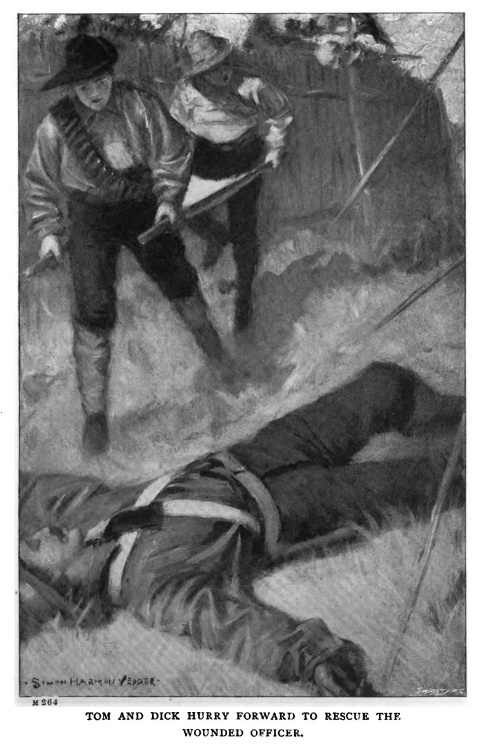
“Quick, Tom!” he exclaimed; and, carrying the stretcher, the boys scrambled over the breastwork and ran towards the officer. He had fallen some twenty yards outside, and the Zulus, rushing on, were but eighty yards away.
On reaching the side of the young officer, the boys laid their stretcher on the ground, rolled him upon it, and, lifting it, turned towards the camp. A ringing cheer from the men had greeted this action, mingled with shouts of “Run! run!” for by this time the Zulus were but twenty yards behind.
A stream of fire broke out from the top of the breastworks; an assegai whizzed over Dick’s shoulder, and another grazed Tom’s arm, but they hurried on until they reached the ditch, and then threw themselves and their burden down. There for five or six minutes they lay, while the fight raged above them. Then the British cheer rose, and the boys knew that the Zulus had fallen back.
A minute later a dozen men leapt from the intrenchment into the ditch outside, and lifted the wounded lieutenant over it into the arms of those behind.
“Bravo! boys, bravo!” a hundred voices shouted, as the boys scrambled back into the works, while the men crowded round to pat them on the shoulder and shake their hands.
It was evident now that the Zulu fire was slackening, and three companies of the 13th went out, and, taking posts by the edge of the slope of the cattle-laager, opened fire upon them, as they retired. Every gun was brought to bear upon them, and as, disheartened and beaten, they fell back, Buller and Russell, with every mounted man in camp, sallied out and fell upon them, and, burning with the desire to wipe out their misfortune of the preceding day, chased them for seven miles, like a flock of sheep, cutting down immense numbers.
It was ascertained afterwards from prisoners that the Zulu force which attacked was composed of 25,000 men. It was commanded by Tyangwaiyo, with Umbelleni as his second. Many of the leading chiefs of Zululand and 3000 of the king’s bravest and best troops fell in the attack on Kambula, and this battle was by far the hottest and best-contested which took place during the war.
Upon our side two officers and twenty-one men were killed. The difference between the result of the action at Kambula and that at Isandula was due entirely to the fact that in one case every precaution was taken, every means of defence utilised; while in the other no more attention was paid to any of these points than if the troops had been encamped at Aldershot.
Upon the day following the battle Colonel Wood set his men to work to erect further defences at the points which the recent action had shown to be weak, and never ceased work until the place had been made almost impregnable against an assault of savages, however brave.
The messenger who carried to Natal the news of the victory of Kambula also took letters from the boys to their parents, acquainting them of their safety; and with the first convoy of wounded on the following day the boys started for home, Colonel Wood having given to each a flattering testimonial as to their gallant conduct in the action, and having presented them with two horses belonging to men of Buller’s corps who had fallen in the action, ordering that the horses should be entered as bought for the Queen’s service, and the value paid to the relatives of their late owners.
Three days’ march took the convoy to Utrecht, and the next morning the boys rode home, the distance from there to Newcastle being about forty miles. They were received as if they had risen from the dead, for their letters had not arrived before them, and their parents had of course assumed that they had been killed at Isandula. Both the mothers were in mourning, and their joy at the restoration of their sons was unbounded.
Mrs Jackson fainted from surprise and delight, as Tom rode up; but Dick, remembering the effect which the news of his being alive in the snow had produced upon his mother, was careful to save her the shock. Accordingly, instead of riding direct to the house, he made a devour and rode across the farm until he met Bill Harrison. The man was delighted at the sight of his young master, and could hardly believe his eyes, as he saw him riding towards him.
After the first warm greeting was over, Dick learned that his mother had been seriously ill, and was now recovering, and that his father had been much shaken. Dick told Harrison to go to the house, and, under the excuse of some question about his work, to call Mr Humphreys out, and to tell him of his return, leaving it to him to break the news to his wife.
This Mr Humphreys, after recovering from his own emotion at the joyful intelligence, did so gradually and quietly, that the tale produced no injurious effect upon the mother.
He began by saying that he had heard that a rumour was afloat that some of those that were supposed to have been killed at Isandula had been kept captives by the Zulus.
Mrs Humphreys for a time doubted the news, but, upon her husband’s assurance that the intelligence was well founded, a faint feeling of hope began to spring up; then gradually, step by step, he told her that it was reported that these captives consisted chiefly of non-combatants, men who had taken refuge among the rocks and bushes when the fight was seen to be going against the troops. This still further raised Mrs Humphreys’ hopes; for, from the presence of mind and shrewdness which Dick had shown on the occasion of the snow-storm, it seemed probable that he would be quick to avail himself of any chance of escape there might be. Then Mr Humphreys said that the report affirmed that among the prisoners were two or three quite young lads, and so step by step he went on, until the delighted mother learned that her son was already upon the farm, and was only waiting until he knew she would be strong enough to see him.
Mr Humphreys now went to the door and gave a loud shout, and Dick, who had been waiting the signal agreed on at a short distance from the house, ran up and was soon in his parents’ arms. A minute or two later his younger brother ran in, having just heard the news from Harrison, and it was indeed a happy party which that night assembled in the sitting-room of the farmhouse, and listened to Dick’s account of the adventures he had gone through. Not a little proud were the father and mother, as they read Colonel Wood’s testimony to the gallant conduct of their son.
The next day Mr and Mrs Jackson drove over with Tom, and the warmest congratulations were exchanged.
“Have you been paid for the waggons, father?” Dick asked.
“Yes, my boy, for there was a notice that the owners of all waggons and teams destroyed at Isandula would be paid at once. As there was a record kept of the ownership of those which accompanied the column, there was of course no difficulty in proving the loss, and both Mr Jackson and myself received orders on the public treasury for their value last week. You see more transports were required, and there was such a panic after Isandula, that if government had not promptly paid for their losses there, they would have got no more waggons from farmers for their work. We have already four more building for us at Newcastle.”
“I suppose there was a great fright in the colony after the defeat?”
“Terrible!” Mr Humphreys answered. “Everyone imagined that the Zulus would at once cross the frontier, and carry fire and sword throughout the colony. The rest of the 4th Regiment instantly went forward to Colonel Glyn’s column, and this restored it to something like its strength before the fight. The rivers were high, which may have accounted partly for the Zulus not taking the offensive. Probably too the great loss which they themselves must have suffered had some effect; while they might not have liked to have advanced in force across the frontier, being, as they were, threatened on the one side by the column of Colonel Wood at Kambula, and on the other by that of Colonel Pearson at Ekowe.”
“I have not heard about that column, father. What are they doing?”
“I will tell you about it this evening, Dick, as it is rather a long story.”
After the Jacksons had driven off in the evening, Dick again asked his father about the doings of Colonel Pearson’s column.
“Well, my boy, they have neither suffered a great defeat, like that under Lord Chelmsford, nor obtained a decisive victory, like the column of Colonel Wood; they have beaten the enemy in a fight, and are at present besieged in a place called Ekowe, or, as it is sometimes spelt, Etckowi. The column consisted of eight companies of the 3rd Buffs under Colonel Parnell; six companies of the 99th, under Colonel Welman; one company of Royal Engineers and two 7-pounder guns; they had, besides a naval brigade consisting of 270 bluejackets and marines of her Majesty’s ships Active and Tenedos, with three gatling-guns, 200 mounted infantry; 200 colonial mounted riflemen also formed part of the column, with about 2000 men of the native contingent. They had great difficulty in crossing the Tugela, which was nearly 400 yards wide. But, thanks to the exertions of the sailors, a flying bridge was constructed—that is, a boat with ropes attached to both shores, so that it can be pulled backwards and forwards, or, as is sometimes done, taken backwards and forwards by the force of the stream itself.
“It was the 13th before the crossing was effected. The enemy were in considerable force near the river. A small earthwork, called Fort Tenedos, was thrown up on the Zulu bank of the river. On the 18th the leading division started on its march into the enemy’s country, followed the next day by the second division, a small detachment being left to garrison the fort. Every precaution was taken in the advance, and the cavalry scouted the country in front of the column. At the end of the first day’s march the Inyoni, a small stream ten miles north of the Tugela, was reached.
“The second day they encamped on the Umsindusi. The third day’s march brought the column to the Amatikulu; beyond this the country became covered with bush, and great care was then taken, as it was known that a large force was marching from Ulundi to oppose their farther advance. Early on the morning of the 22nd, the day which proved so fatal to Colonel Glyn’s column, the first division had just crossed the Inyezane River and was halted for breakfast, when they were attacked by a large force of the enemy, who, having chosen this position, were lying in wait for them. The ground chosen for the halt was not a favourable one, as it was surrounded by bush. But as no other place could be found by Major Barrow, who commanded the horse, near water, the halt had been made here. Scarcely had they begun their preparations for breakfast, when Captain Hart, who was out scouting in front with the advance company of the native contingent, discovered the enemy advancing rapidly over the ridge in his front and attempting to gain the bush on both flanks of the halting-place. The Zulus at once opened a heavy fire upon the native contingent, and of these one officer and four non-commissioned officers and three men fell almost immediately.
“The native contingent was called in, and the naval brigade and two guns, under Lieutenant Lloyd, and two companies of the Buffs were ordered to take up a position upon a knoll close to the road, on which they were halted. The sailors at once opened fire on the enemy with two 7-pounders and two 24-pounder rocket-tubes, while the Buffs poured a heavy fire with their rifles upon them. The waggons were still coming up, and these were parked as they reached the ground; and two companies of the Buffs, who were guarding them on the march, being now free to act, were ordered to move out in skirmishing order, and draw the enemy out of the bush, when, as they retired, they were exposed to the fire from the knoll.
“The engineers and mounted troops moved forward, with the infantry skirmishers, supported by a half-company of the Buffs and a half-company of the 99th. The enemy tried to outflank their left, and Captain Campbell with a portion of the naval brigade and some of the native contingent went out and drove them from a kraal of which they had taken possession. A still farther advance was now made, and the Zulus took to flight, leaving 300 dead upon the ground. The attacking party were 5000 strong, and against these some 500 or 600 of our troops were engaged. We had only eight Europeans killed and four natives, and about twenty wounded. The next day Colonel Pearson reached Ekowe. The position was a strong one, as the place stood upon rising ground; it had been a missionary station, and there was a church which could at the worst be converted into a citadel.
“Colonel Pearson at once set to work to fortify the position. The same evening the news arrived of the disaster at Isandula. After a consultation with his officers Colonel Pearson decided to hold the spot at which he now was, convinced that, without further supplies of reinforcements, he could hold the place for two months. In order to economise food, the mounted men and most of the natives were sent back, and there remained 1200 British troops.
“Colonel Pearson at once commenced his preparations for a siege. Three moderate-sized brick erections were turned into store-houses, and the church into a hospital, the tower making a capital look-out; from this a splendid view was obtained, the hill by the Tugela being clearly visible. The men set to work to fortify the place. The intrenchments were of a six-sided form, about sixty yards across, with a ditch outside them eighteen feet deep and twelve feet wide. Assegais were planted in the bottom. Added to the south side was a kraal for cattle and horses, also defended by a small wall. Outside the fort were entanglements of rows of felled trees and bushes. The supply of water was obtained from a good well, outside the walls, but covered by the fire of the fort. The guns were placed in position, and the garrison was ready for any attack that might be made upon them. All these details we learned in the early days of the siege by occasional messengers, who managed to find their way through, but these had been few and far between; of twelve messengers sent out the first week of February, only one got through. The garrison had made several sorties, and had destroyed Dabulamanzi’s kraal. They also went out and cut off a large convoy of cattle on its way to Ulundi.”
“But how have they found out what is being done at Ekowe, if the first week only one messenger got through out of twelve?” Dick said.
“By a very ingenious plan, Dick. For three weeks we knew nothing of what was going on, and then it struck an engineer that communication might be established by flashing signals.”
“What are flashing signals, father?”
“Well, my boy, as a general rule they are made by showing a light either for a long or short period. Thus, one long and one short might be A; one short and one long, B; two short and one long, C; and so on all through the Alphabet. The distance was so great that ordinary lights would not have answered, but it struck one of the engineers that with a looking-glass the sunlight might be reflected. You know at what a distance the sun’s reflection on a window can be made out. Well, it was tried in vain for a whole week by Lieutenant Haynes, of the Royal Engineers, but at the end of that time he was delighted at seeing answering flashes from the hill on which Ekowe stands. Since that time news has been regularly received every day by this means of what is passing in the fort.
“In the meantime preparations were being made for the relief of the garrison. The news of the defeat at Isandula was sent home by a swift ship, by which the particulars were telegraphed from Saint Vincent. The people at home did not lose an hour. The Shah, which was on her way home, heard the news at Saint Helena, and Captain Bradshaw, who commanded her, at once, on his own responsibility, turned his ship’s head south, and steered for Durban, bringing with him the garrison of the island. Some draughts from the 4th, 88th, and 99th Regiments were brought down from the Cape; the Boadicea also arrived, and every man who could be spared from her and the Shah was landed and sent up to the Tugela.
“In the second week in March the 57th and 91st Regiments arrived from England. One hundred and sixty men were brought over from the garrison of Mauritius, and a few days later the 3rd battalion of the 60th Regiment also arrived. These assembled on the Tugela on the 27th, and that day set out. The vanguard was composed of the seamen and marines of the Shah and Tenedos—640 men and two gatlings, the 91st regiment of 900 men, 400 men of the 99th, 180 men of the 3rd Buffs, 150 mounted infantry, 200 of the mounted native contingent, and 1600 men of the native infantry contingent. The second division consisted of 200 men of the Boadicea with gatlings, the 37th Regiment, and the 3rd battalion of the 60th, 900 men, and two troops of mounted natives. That is all I can tell you, my boy. The news only arrived here yesterday that they had started. In the course of three or four more days I hope that we shall hear that they have given the Zulus a thorough licking. It is a strong force, and as there are about 3300 white troops among them, and there is no fear of their being taken by surprise this time, we need not have any anxiety about the result. I understand that, in accordance with the advice which Colonel Pearson has flashed from Ekowe, they are not going to follow the road he took, but to keep along on the lower ground near the sea.”
“And do you think, father, that they will push on for Ulundi when they have rescued the garrison of Ekowe?”
“No, Dick; I think they are quite strong enough to do so, but as there are at least half a dozen more regiments on their way out from England, including some regiments of cavalry, it will be more prudent to stop until our whole fighting force is here, when we ought to be enabled to make short work of them, and to do the work completely and effectually. And now, Dick, I am thoroughly sleepy—the sooner we are in bed the better.”
Chapter Eight.
The Second Advance.
It was some days before the news reached Newcastle of the complete success of the relieving column. On their first day’s march no difficulty was met with. The road was a good one, and the Zulus did not show in any force. The column halted for the night near the junction of the Inyoni and Amatikulu rivers. The waggons were placed in laager and a ditch and parapet formed round the camp. The ground was open and the waggons were able to travel six abreast. Numerous Zulu kraals were passed; but these were found deserted.
On the afternoon of the 1st they encamped at Ginghilovo. From this point Ekowe was visible; signals were exchanged with the besieged, and Colonel Pearson warned Lord Chelmsford that the Zulus were moving forward to attack him. The night passed quietly, but the greatest vigilance was maintained.
At daybreak dense masses of Zulus were seen in the distance, and at six o’clock they approached the camp. They came on in their usual order, with a massive centre and advanced horns on either flank. The British were kept lying down behind the shallow trenches they had thrown up. The Zulus advanced in splendid order with a sort of dancing step. Their white and coloured shields, their crests of leopard skins and feathers, and the long ox-tails dangling from their necks gave them a wild and strange appearance. Every ten or fifteen yards the first line would halt, a shot would be fired, then a loud yell burst forth, and they again advanced with a humming sound, in time to which their dancing movement was kept up. The 60th, who lay opposite to the point against which they advanced, withheld their fire until the first line of skirmishers came to within 300 yards. Then a deadly sheet of flame flashed along the ridge of the shelter-trench, and a number of the Zulu warriors fell.
The main body now rushed forward, and although a tremendous fusilade was kept up on them, the Zulu advance pressed on, ever fed by those in the rear, which deployed in excellent order as they reinforced the first line. For twenty minutes the fire of the 60th never ceased. Again and again the Zulus pressed forward, but their leading ranks were swept away by the storm of bullets.
At half-past six the Zulu masses, without the smallest confusion, faced to their right, ran round in columns, and fell upon the face of the laager held by the 57th and 91st. Here they were as hotly received as they had been by the 60th. Notwithstanding the deadly fire, the Zulus pressed forward with noble courage. They had ceased to shout now, and seemed only anxious to reach the square. Four times they rushed forward; each time they fell back with terrible loss. The fire of the soldiers was assisted by that of the native contingent, who, posted in the waggons behind, added their fire to that of the 91st and 57th.
The last attack was led by Dabulamanzi in person, and arrived within five yards of the muzzles of the men’s rifles; indeed one or two of the chiefs actually seized the hot barrels with one hand, while they stabbed at the men with their shortened assegais.
This was their final repulse, and they now began to fall back. The moment that they did so, the cavalry dashed out in pursuit, and chased them far across the plain. The gatlings and 9-pounders added in no slight degree to the effect of the rifles. The entire English loss was but two officers and four privates killed, and three officers and thirty-four privates wounded; while the Zulu loss exceeded 1000. The force under Dabulamanzi was about 11,000, and a similar force was close at hand, but fortunately had not joined that of Dabulamanzi before he attacked the British.
On the following day the 57th, 60th, and 91st, together with the mounted men and several of the mounted brigade, taking with them three days’ provisions, marched for Ekowe. Major Barrow scouted the ground, and reported that everywhere assegais, shields, feathers, ear and head ornaments, skins, furs, blankets, and ever; guns were lying about in confusion, evidently cast away in their headlong flight by the Zulus, but that none of these had been seen.
The column, however, advanced with every precaution, as it was possible that Dabulamanzi might procure reinforcements. No enemy, however, was met with, and the column continued its march until they were met by Colonel Pearson with 500 men, coming out to lend a hand to them in case they should be attacked. The united column then marched into Ekowe. The health of the garrison had suffered much from exposure to the sun and rain, and from the want of vegetables and useful medicine. Beef they had plenty of, as it was considered advisable to kill and consume the waggon-oxen rather than see them die from want of forage.
The great event of the siege had been the discovery of certain strange flashes of light on the white walls of the church-tower; these, after puzzling many of the officers and soldiers, were at length brought under the notice of an officer of the naval brigade, who had been trained in the use of the heliograph, and he was able at once to explain the mystery. They were three days before they could contrive an apparatus, which could be worked, to reply. Fortunately an old mirror was found, and communication was opened. The effect of their renewed intercourse with the outer world, and of learning the preparations which were being made for their relief, acted more beneficially on the health of the imprisoned garrison than all the tonics the hospital could afford. Nevertheless between the commencement of the siege and the arrival of the relief thirty deaths had occurred.
To the great regret of the garrison they found that it had been determined by the general to abandon the fort which they had held so long, as the whole force was required in Natal for operations in the veld in conjunction with the reinforcements on their way out. Before leaving, however, it was determined to strike another blow at Dabulamanzi, whose private residence had escaped at the time that his kraal was burnt. A small party of about 200 men therefore went out and fired the place without resistance. Ekowe was evacuated, and, having left a garrison at Ginghilovo, Lord Chelmsford retired with his force across the Tugela.
Every day for the next fortnight news reached Newcastle of the arrival of one or more transports with reinforcements, and in a month from the date of the arrival of the first from England, seventeen transports came in, bringing more than 9000 soldiers and 2000 horses. The force consisted of two regiments of cavalry, 1250 sabres, two batteries of artillery with 540 men, 190 men of the Royal Engineers, six regiments of infantry, 5320 bayonets, draughts of the regiments already in the colony and Army Service Corps’ men, 1200. Most of the regiments brought their equipments complete and ready for the field—tents, waterproof-sheets, cooking utensils, and camp stores. The Army Service Corps brought with them 100 light but strongly-built waggons.
Among the arrivals was the Prince Imperial of France, who had come out as a volunteer.
To convey the baggage and stores of so numerous a force an immense number of waggons was required, and a very urgent appeal was made to the loyalty of the colonists to furnish transport for the troops engaged in fighting their battles.
In answer to this appeal Mr Humphreys and Mr Jackson decided to send down the new waggons which had just been finished. Immediately they heard of the decision, Dick and Tom begged for permission again to accompany the waggons. Their mothers at first refused even to listen to the request, but their fathers, talking the matter over between them, agreed that harm was not likely this time to come of it.
The force was so overwhelmingly strong that there was not the slightest prospect of a repetition of the disaster of Isandula. At that time several hundred English soldiers had been surprised and crushed by some 20,000 of the enemy, but in future every precaution would be taken, and the British force would be ten times as strong as that which fought at Isandula. The colonists thought that it would be really an advantage to the boys to take part in the expedition; it was quite possible that if they remained in the colony they might have occasion to take part in wars with one or other of the native tribes, and the experience that they would gain in the campaign would in that case assuredly be useful to them. Having thus decided, Mr Humphreys and his friend succeeded in obtaining their wives’ consent to the boys accompanying the waggons, and in high glee they started for Durban on the 20th of April.
The campaign was arranged on a new plan. The numerous columns in which the strength of the force had been frittered away were abolished, and the following was adopted as the designation of the forces in the field, under the lieutenant-general commanding, viz.:— 1st Division South African Field-forces, Major-General Crealock, C.B., commanding, consisting of all troops on the left bank of the Lower Tugela; 2nd Division South African Field-forces, Major-General Newdigate commanding, consisting of all troops in the Utrecht district other than those attached to the Flying Column under Brigadier-General Wood, V.C., C.B., which was designated as “Brigadier-General Wood’s Flying Column.” Major-General Marshall assumed command of the cavalry brigade, and Major-General the Hon. H.H. Clifford, C.B., V.C., took up the command of the base of operations and superintendence of the lines of communication. The forces were divided as follows:—
First Division (General Crealock’s), Lower Tugela Command. Naval Brigade... 800 M. Battery, 6th Brigade, Royal Artillery... 90 Detachment, 11-7th Royal Artillery... 25 2-3rd Regiment... 836 57th Regiment... 830 3-60th Regiment... 880 88th Regiment... 640 91st Regiment... 850 99th... 870 Mounted Infantry, 2nd Squadron... 70 Army Service Corps... 50 Army Hospital Corps... 20 Royal Engineers... 150 8-7th Royal Artillery... 80 0-6th Regiment... 50 Lonsdale’s Horse... 84 Cooke’s Horse... 78 Colonial Volunteers... 105 Native Contingent:— Foot... 2556 Mounted... 151 Total strength, effective and non-effective... 9215
Second Division (General Newdigate’s.) 1st Dragoon Guards attached to 2nd Division... 650 17th Lancers attached to 2nd Division... 626 N-5th Royal Artillery... 76 N-6th Royal Artillery... 80 10-7th Royal Artillery... 70 10-6th Royal Artillery... 30 Royal Engineers... 60 2-4th Regiment... 790 Detachment, 1-13th Regiment... 63 2-21st (two companies at Maritzburg)... 820 1-24th Regiment... 530 2-24th Regiment... 586 58th (one company at Durban)... 906 80th (several companies in the Transvaal)... 300 94th (one company at Grey Town)... 870 Army Service Corps... 60 Army Hospital Corps... 30 Grey Town District Colonial Volunteers... 139 Natal Mounted Police... 75 Natal Carabineers... 27 Newcastle Mounted Rifles... 18 Buffalo Mounted Guard... 20 Native Contingent:— Europeans... 41 Natives (foot)... 3128 Natives (mounted)... 243 Total strength, effective and non-effective... 10,238
General Wood’s Flying Column. 11-7th Royal Artillery... 87 Royal Engineers... 13 1-13th Regiment... 721 90th Regiment... 823 1st Squadron, Mounted Infantry... 103 Army Service Corps... 9 Army Hospital Corps... 13 Frontier Light Horse... 173 Baker’s Horse... 179 Transvaal Rangers... 141 1st Battalion, Wood’s Irregulars:— Europeans... 14 Natives... 377 2nd Battalion, Wood’s Irregulars:— Europeans... 5 Natives... 355 Natal Native Horse:— Europeans... 4 Natives... 75 Total strength, effective and non-effective... 3092
Grand Total. 1st Division... 9215 2nd Regiment... 10,238 General Wood’s Flying Column. 3092 Total, effective and non-effective: namely, Europeans, 15,660, and natives, 6885... 22,545
Out of this grand total there were about 400 sick and non-effective with the 1st Division, 300 with the 2nd Division, and 600 (including some of Wood’s Irregulars, absent and not accounted for since the 28th of March) with Wood’s Flying Column. So that altogether, deducting, say, 1500, Lord Chelmsford had at his disposal, from the middle of April, a total of 21,000 troops, of which over 15,000 were European. Colonels Pearson and Wood were made Brigadier-Generals, and the former was to command Number 1 Brigade, 1st Division, and Colonel Pemberton, 3-60th, the other. They both, however, had to give up their commands through sickness, and Colonels Rowland, V.C., C.B., and Clark, 57th Regiment, succeeded them.
Major-General Clifford, V.C., C.B., had the following staff for the management of the base of the operations and the maintenance of the lines of communication between Zululand and Natal:—
Lieutenant Westmacott, 77th Foot, aide-de-camp; Major W.J. Butler, C.B., assistant-adjutant and quartermaster-general, stationed at Durban; and Captain W.R. Fox, Royal Artillery, deputy assistant-adjutant and quartermaster-general.
On the arrival of the boys with the waggons at Pieter-Maritzburg, they reported themselves at the headquarters of the transport corps, and were told that they were not to go down to Durban, but were to load up at once and accompany the Dragoon Guards, who were to march the next morning for the front.
This time the lads were mounted, as their fathers thought that they would gain more benefit from their experience if they were able to move about instead of being confined to the sides of their waggons, and it was a satisfaction to their mothers that, in case of any untoward event again happening, they would be in a better position for making their escape.
General Newdigate’s columns were encamped at Landmann’s Drift; the cavalry, under General Marshall, was also there. The march was altogether without incident.
Some days passed quietly, when a small party of horse made an expedition to Isandula; they reported that nearly a hundred waggons were still standing upon the field of battle. On the 17th of May, three days later, the rumour ran through the camp that the cavalry were to start on the 19th, to bury the dead and bring away the waggons. The Army Service Corps and waggons were to accompany the party, which was to consist of the Dragoon Guards and Lancers, with a party of native mounted scouts.
In the afternoon of the 18th the two boys went to Colonel Marshall’s tent; they waited patiently until he came out, accompanied by two or three other officers.
“We have come to ask, sir, if you will allow us to go with your column. We are in charge of waggons here, but they are not going. We were at the battle, and saw the whole thing, and were taken prisoners afterwards and carried to Umbelleni’s kraal, where we were liberated when Colonel Wood’s cavalry attacked the Zlobani hill. We are well mounted, sir, and are good shots; so, if you will let us go, we could keep with the scouts and not be in your way.”
“How did you see the fight?” General Marshall asked.
“We had gone up to the top of the hill, sir, before it began, and fortunately the natives did not notice us.”
“Oh, yes, you can go,” the general said. “Probably you can give us a better account of the action than any one else, as others who escaped were occupied by their own business, and could not mark the general progress of the battle. So you were taken prisoners! Well, I am going out now, but if you will call in this evening at about half-past eight, I shall be glad to have a talk with you.”
In the evening the boys called upon the general, one of the most popular and dashing officers in the service. Three or four of his staff were there, and all listened with great interest to the boys’ account of their adventures.
“You seem to have plenty of pluck and coolness, youngsters,” the general said, when they had finished. “In future you need not trouble to ask for permission to accompany me whenever the cavalry go out, providing we have natives mounted with us; you must go as recruits, and can either keep with them or ride with my orderlies.”
Much pleased with the permission given, the lads returned to the waggons, and the next morning they started on their way.
The column bivouacked that night at Dill’s Town, and reached Rorke’s Drift between three and four o’clock in the morning, and were there joined by the Natal Carabineers and Colonel Harness, R.A., with guns.
At daybreak on the 20th the reconnoitring force crossed the river. No signs of the enemy were seen until they neared Isandula; then signal-fires blazed up on the hills to the right, and spread quickly from hill to hill far into the interior. Pushing steadily on, the plain of Isandula was reached by ten o’clock. The whole scene of the conflict was overgrown with long grass, thickly intermixed with growing crops of oats and Indian corn. Lying thickly here, and scattered over a wide area, lay the corpses of the soldiers. The site of the camp itself was marked by the remains of the tents, intermingled with a mass of broken trunks, boxes, meat-tins, papers, books, and letters in wild disorder. The sole visible objects, however, rising above the grass, were the waggons, all more or less broken up.
The scouts were placed in all directions to give warning of the approach of any enemies. The Army Service Corps set to work to harness the seventy pairs of led horses they had brought with them to the best of the waggons, and the troops wandered over the scene of the engagement, and searched for and buried all the bodies they found, with the exception of those of the 24th Regiment, as these, Colonel Glyn had asked, should be left to be buried by their comrades. The bodies of the officers of Colonel Durnford’s corps were all found together, showing that when all hope of escape was gone they had formed in a group and defended themselves to the last. The men of the Royal Artillery buried all the bodies of their slain comrades who could be found, but the shortness of the time and the extent of the ground over which the fight had extended rendered anything like a thorough search impossible.
The object of the expedition was not to fight, and as at any moment the Zulus might appear in force upon the field, a start was made as soon as the waggons were ready. Forty of the best waggons were brought out, with some water-carts, a gun-limber and a rocket-battery cart. Twenty waggons in a disabled condition were left behind. Some seventy waggons were missing, these having been carried off by the Zulus, filled either with stores or with their own wounded. Having accomplished this work the cavalry rejoined headquarters at Landmann’s Drift.
On the 27th of May the column advanced, Newdigate’s division leading the way. By two o’clock in the afternoon the men had crossed the Buffalo and marched to Kopje-allein through a bare and treeless country. One of the most popular figures in the camp was the Prince Imperial of France, who, having received a military education at Woolwich, and being anxious to see service, had applied for and obtained leave to accompany the expedition. The young prince had been extremely popular at Woolwich, and was indeed an immense favourite with all who knew him—high-spirited and full of life, and yet singularly gentle and courteous in manner. He was by nature adapted to win the hearts of all who came in contact with him. His abilities too were of the very highest order, as was proved by the fact that, although suffering under the disadvantage of being a foreigner, he yet came out so high in the final examination at Woolwich as to be entitled to a commission in the Royal Engineers. When it is considered how keen is the competition to enter Woolwich, and that all the students there, having won their places by competitive examinations, may be said to be considerably above the average of ability, it will be seen that, for one who had previously gone through an entirely different course of education, and had now to study in a language that was not his own, to take rank among the foremost of these was a proof both of exceptional ability and industry.
A splendid career was open for the young prince, for there is little doubt that, had he lived, he would sooner or later have mounted the throne of his father, and there are few pages of history more sad than those which relate to his death in a paltry skirmish in a corner of Africa. To Englishmen the page is all the more sad, inasmuch as, had the men accompanying him acted with the coolness and calmness generally shown by Englishmen in a moment of danger, instead of being carried away by a cowardly panic, the Prince Imperial might yet be alive.
At Kopje-allein Newdigate’s column was joined by that of General Wood. Three days were spent in carefully exploring the country, and on the 1st of June the division, as nearly as possible 20,000 strong, with a baggage-train of 400 native waggons, moved forward and encamped near the Itelezi River. The flying column of General Wood went on one march ahead, and the country was carefully scouted by Buller’s horse for twenty miles round, and no Zulus were found.
Chapter Nine.
Ulundi.
On Sunday, the 1st of June, General Wood with a small escort was out reconnoitring in advance of his column, which was about five miles in front of the force of General Newdigate. The morning was clear and fresh, the ridges of the hills on either side were dotted with Buller’s horsemen. They crossed the river by a ford, and having ridden about another mile forward they observed some of the vedettes on the high ground signalling that horsemen were approaching.
Riding on to see who they could be, they were joined by Colonel Buller and a dozen of his men, and together they rode forward to meet the five men who were seen approaching. In a few seconds Lieutenant Carey and four troopers of Bettington’s Horse rode up, and when they had told their story English soldiers had the shame and humiliation of knowing that an English officer and four English troopers had escaped unwounded from a Zulu ambush, in which they had left a gallant young prince, the guest of England and the hope of France, to be barbarously slain.