A Criticism of Volume I
Reading edition
By Philip Gilbert Hamerton, LL.D.
I—The Literature
The Editor and Publishers of The Yellow Book, who seem to know the value of originality in all things, have conceived the entirely novel idea of publishing in the current number of their quarterly, a review in two parts of the number immediately preceding it, one part to deal with the literature, and another to criticise the illustrations.
I notice that on the cover of The Yellow Book the literary contributions are described simply as Letterpress. This seems rather unfortunate, because letterpress is usually understood to mean an inferior kind of writing, which is merely an accompaniment to something else, such as engravings, or even maps. Now, in The Yellow Book the principle seems to be that one kind of contribution should not be made subordinate to another; the drawings and the writings are, in fact, independent. Certainly the writings are composed without the slightest pre-occupation concerning the work of the graphic artists, and the draughtsmen do not illustrate the inventions of the scribes. This independence of the two arts is favourable to excellence in both, besides making the business of the Editor much easier, and giving him more liberty of choice.
The literary contributions include poetry, fiction, short dramatic scenes, and one or two essays. The Editor evidently attaches much greater importance to creative than to critical literature, in which he is unquestionably right, provided only that the work which claims to be creative is inspired by a true genius for invention. The admission of poetry in more than usual quantity does not surprise us, when we reflect that The Yellow Book is issued by a publishing house which has done more than any other for the encouragement of modern verse. It is the custom to profess contempt for minor poets, and all versifiers of our time except Tennyson and Swinburne are classed as minor poets by critics who shrink from the effort of reading metrical compositions. The truth is that poetry and painting are much more nearly on a level in this respect than people are willing to admit. Many a painter and many a poet has delicate perceptions and a cultivated taste without the gigantic creative force that is necessary to greatness in his art.
Mr. Le Gallienne's Tree-Worship is full of the sylvan sense, the delight in that forest life which we can scarcely help believing to be conscious. It contains some perfect stanzas and some magnificent verses. As a stanza nothing can be more perfect than the fourth on page 58, and the fourth on the preceding page begins with a rarely powerful line. The only weak points in the poem are a few places in which even poetic truth has not been perfectly observed. For example, in the first line on page 58, the heart of the tree is spoken of as being remarkable for its softness, a new and unexpected characteristic in heart of oak. On the following page the tree is described as a green and welcome coast to the sea of air. No single tree has extent enough to be a coast of the air-ocean; at most it is but a tiny green islet therein. In the last stanza but one Mr. Le Gallienne speaks of the roar of sap. This conveys the idea of a noisy torrent, whereas the marvel of sap is that it is steadily forced upwards through a mass of wood by a quietly powerful pressure. I dislike the fallacious theology of the last stanza as being neither scientific nor poetical. Mr. Benson's little poem, [Greek: Daimonizomenos], is lightly and cleverly versified, and tells the story of a change of temper, almost of nature, in very few words. The note of Mr. Watson's two sonnets is profoundly serious, even solemn, and the workmanship firm and strong; the reader may observe, in the second sonnet, the careful preparation for the last line and the force with which it strikes upon the ear. Surely there is nothing frivolous or fugitive in such poetry as this! I regret the publication of Stella Maris by Mr. Arthur Symons; the choice of the title is in itself offensive. It is taken from one of the most beautiful hymns to the Holy Virgin (Ave, maris stella!), and applied to a London street-walker, as a star in the dark sea of urban life. We know that the younger poets make art independent of morals, and certainly the two have no necessary connection; but why should poetic art be employed to celebrate common fornication? Rossetti's Jenny set the example, diffusely enough.
The two poems by Mr. Edmund Gosse, Alere Flammam and A Dream of November, have each the great quality of perfect unity. The first is simpler and less fanciful than the second. Both in thought and execution it reminds me strongly of Matthew Arnold. Whether there has been any conscious imitation or not, Alere Flammam is pervaded by what is best in the classical spirit. Mr. John Davidson's two songs are sketches in town and country, impressionist sketches well done in a laconic and suggestive fashion. Mr. Davidson has a good right to maledict Elkin Mathews & John Lane for having revived the detestable old custom of printing catchwords at the lower corner of the page. The reader has just received the full impression of the London scene, when he is disturbed by the isolated word Foxes, which destroys the impression and puzzles him. London streets are not, surely, very favourable to foxes! He then turns the page and finds that the word is the first in the rural poem which follows. How Tennyson would have growled if the printer had put the name of some intrusive beast at the foot of one of his poems! Even in prose the custom is still intolerable; it makes one read the word twice over as thus (pp. 159, 60), Why doesn't the wretched publisher publisher bring it out!
We find some further poetry in Mr. Richard Garnett's translations from Luigi Tansillo. Not having access just now to the original Italian, I cannot answer for their fidelity, but they are worth reading, even in English, and soundly versified.
It is high time to speak of the prose. The essays are A Defence of Cosmetics, by Mr. Max Beerbohm, and Reticence in Literature, by Mr. Arthur Waugh. I notice that a critic in the New York Nation says that the Whistlerian affectations of Mr. Beerbohm are particularly intolerable. I understood his essay to be merely a jeu d'esprit, and found that it amused me, though the tastes and opinions ingeniously expressed in it are precisely the opposite of my own. Mr. Beerbohm is (or pretends to be) entirely on the side of artifice against nature. The difficulty is to determine what is nature. The easiest and most natural manners of a perfect English lady are the result of art, and of a more advanced art than that indicated by more ceremonious manners. Mr. Beerbohm says that women in the time of Dickens appear to have been utterly natural in their conduct, flighty, gushing, blushing, fainting, giggling, and shaking their curls. Much of that conduct may have been as artificial as the curls themselves, and assumed only to attract attention. Ladies used to faint on the slightest pretext, not because it was natural but because it was the fashion; when it ceased to be the fashion they abandoned the practice. Mr. Waugh's essay on Reticence in Literature is written more seriously, and is not intended to amuse. He defends the principle of reticence, but the only sanction that he finds for it is a temporary authority imposed by the changing taste of the age. We are consequently never sure of any permanent law that will enforce any reticence whatever. A good proof of the extreme laxity of the present taste is that Mr. Waugh himself has been able to print at length three of the most grossly sensual stanzas in Mr. Swinburne's Dolores. Reticence, however, is not concerned only with sexual matters. There is, for instance, a flagrant want of reticence in the lower political press of France and America, and the same violent kind of writing, often going as far beyond truth as beyond decency, is beginning to be imitated in England. One rule holds good universally; all high art is reticent, e.g., in Dante's admirable way of telling the story of Francesca through her own lips.
Mr. Henry James, in The Death of the Lion, shows his usual elegance of style, and a kind of humour which, though light enough on the surface, has its profound pathos. It is absolutely essential, in a short story, to be able to characterise people and things in a very few words. Mr. James has this talent, as for example in his description of the ducal seat at Bigwood: very grand and frigid, all marble and precedence. We know Bigwood, after that, as if we had been there and have no desire to go. So of the Princess: She has been told everything in the world and has never perceived anything, and the echoes of her education, etc., p. 42. The moral of the story is the vanity and shallowness of the world's professed admiration for men of letters, and the evil, to them, or going out of their way to suck the sugar-plums of praise. The next story, Irremediable, shows the consequences of marrying a vulgar and ignorant girl in the hope of improving her, the difficulty being that she declines to be improved. The situation is powerfully described, especially the last scene in the repulsive, disorderly little home. The most effective touch reveals Willoughby's constant vexation because his vulgar wife never did any one mortal thing efficiently or well, just the opposite of the constant pleasure that clever active women give us by their neat and rapid skill. The Dedication, by Mr. Fred Simpson, is a dramatic representation of the conflict between ambition and love—not that the love on the man's side is very earnest, or the conflict in his mind very painful, as ambition wins the day only too easily when Lucy is thrown over. The Fool's Hour, by Mr. Hobbes and Mr. George Moore, is a slight little drama founded on the idea that youth must amuse itself in its own way, and cannot be always tied to its mamma's apron-strings. It is rather French than English in the assumption that youth must of necessity resort to theatres and actresses. Of the two sketches by Mr. Harland, that on white mice is clever as a supposed reminiscence of early boyhood, but rather long for its subject, the other, A Broken Looking-Glass, is a powerful little picture of the dismal end of an old bachelor who confesses to himself that his life has been a failure, equally on the sides of ambition and enjoyment. One of my friends tells me that it is impossible for a bachelor to be happy, yet he may invest money in the Funds! In Mr. Crackanthorpe's Modern Melodrama, he describes for us the first sensations of a girl when she sees death in the near future. It is pathetic, tragical, life-like in language, with the defects of character and style that belong to a close representation of nature. A Lost Masterpiece, by George Egerton, is not so interesting as the author's Keynotes, though it shows the same qualities of style. The subject is too unfruitful, merely a literary disappointment, because a bright idea has been chased away. A Sentimental Cellar, by Mr. George Saintsbury, written in imitation of the essayists of the eighteenth century, associates the wines in a cellar with the loves and friendships of their owner. To others the vinous treasures would be good wine and nothing more; to their present owner they are a casket of magic liquors, a museum in which he lives over again the vanished life of the past. The true French bookless bourgeois often calls his cellar his bibliothèque, meaning that he values its lore as preferable to that of scholarship; but Mr. Saintsbury's Falernianus associates his wines with sentiment rather than with knowledge.
On the whole, the literature in the first number of The Yellow Book is adequately representative of the modern English literary mind, both in the observation of reality and in style. It is, as I say, really literature and not letterpress. I rather regret, for my own part, the general brevity of the pieces which restricts them to the limits of the sketch, especially as the stories cannot be continued after the too long interval of three months. As to this, the publishers know their own business best, and are probably aware that the attention of the general public, though easily attracted, is even more easily fatigued.
II—The Illustrations
On being asked to undertake the second part of this critical article, I accepted because one has so rarely an opportunity of saying anything about works of art to which the reader can quite easily refer. To review an exhibition of pictures in London or Paris is satisfactory only when the writer imagines himself to be addressing readers who have visited it, and are likely to visit it again. When an illustration appears in one of the art periodicals, it may be accompanied by a note that adds something to its interest, but no one expects such a note to be really critical. In the present instance, on the contrary, we are asked to say what we think, without reserve, and as we have had nothing to do with the choice of the contributors, and have not any interest in the sale of the periodical, there is no reason why we should not.
To begin with the cover. The publishers decided not to have any ornament beyond the decorative element in the figure design which is to be changed for every new number. What is permanent in the design remains, therefore, of an extreme simplicity and does not attract attention. The yellow colour adopted is glaring, and from the æsthetic point of view not so good as a quiet mixed tint might have been; however, it gives a title to the publication and associates itself so perfectly with the title that it has a sufficient raison d'être, whilst it contrasts most effectively with black. Though white is lighter than any yellow, it has not the same active and stimulating quality. The drawing of the masquers is merely one of Mr. Aubrey Beardsley's fancies and has no particular signification. We see a plump and merry lady laughing boisterously whilst she seems to be followed by a man who gazes intently upon the beauties of her shoulder. It is not to be classed amongst the finest of Mr. Beardsley's designs, but it shows some of his qualities, especially his extreme economy of means. So does the smaller drawing on the back or the volume, which is a fair example of his ready and various invention. See how the candle-flame is blown a little to one side, how the candle gutters on that side, and how the smoke is affected by the gust of air. Observe, too, the contrasts between the faces, not that they are attractive faces. There seems to be a peculiar tendency in Mr. Beardsley's mind to the representation of types without intellect and without morals. Some of the most dreadful faces in all art are to be found in the illustrations (full of exquisite ornamental invention) to Mr. Oscar Wilde's Salome. We have two unpleasant ones here in l'Éducation Sentimentale. There is distinctly a sort of corruption in Mr. Beardsley's art so far as its human element is concerned, but not at all in its artistic qualities, which show the perfection of discipline, of self-control, and of thoughtful deliberation at the very moment of invention. Certainly he is a man of genius, and perhaps, as he is still very young, we may hope that when he has expressed his present mood completely, he may turn his thoughts into another channel and see a better side of human life. There is, of course, nothing to be said against the lady who is touching the piano on the title-page of The Yellow Book, nor against the portrait of Mrs. Patrick Campbell opposite page 126, except that she reminds one of a giraffe. It is curious how the idea of extraordinary height is conveyed in this drawing without a single object for comparison. I notice in Mr. Beardsley's work a persistent tendency to elongation; for instance, in the keys of the piano on the title-page which in their perspective look fifteen inches long. He has a habit, too, of making faces small and head-dresses enormous. The rarity of beauty in his faces seems in contradiction with his exquisite sense of beauty in curving lines, and the singular grace as well as rich invention of his ornaments. He can, however, refuse himself the pleasure of such invention when he wants to produce a discouraging effect upon the mind. See, for instance, the oppressive plainness of the architecture in the background to the dismal Night Piece.
It is well known that the President of the Royal Academy, unlike most English painters, is in the habit of making studies. In his case these studies are uniformly in black and white chalk on brown paper. Two of them are reproduced in The Yellow Book, one being for drapery, and the other for the nude form moving in a joyous dance with a light indication of drapery that conceals nothing. The latter is a rapid sketch of an intention and is full of life both in attitude and execution, the other is still and statuesque. Sir Frederic is a model to all artists in one very rare virtue, that of submitting himself patiently, in his age, to the same discipline which strengthened him in youth.
I find a curious and remarkable drawing by Mr. Pennell of that strangely romantic place Le Puy en Velay, whose rocks are crowned with towers or colossal statues, whilst houses cluster at their feet. The subject is dealt with rather in the spirit of Dürer, but with a more supple and more modern kind of skill. It is topography, though probably with considerable artistic liberty. I notice one of Dürer's licences in tonic relations. The sky, though the sun is setting (or rising) is made darker than the hills against it, and darker even than the two remoter masses of rock which come between us and the distance. The trees, too, are shaded capriciously, some poplars in the middle distance being quite dark whilst nearer trees are left without shade or local colour. In a word, the tonality is simply arbitrary, and in this kind of drawing it matters very little. Mr. Pennell has given us a delightful bit of artistic topography showing the strange beauty of a place that he always loves and remembers.
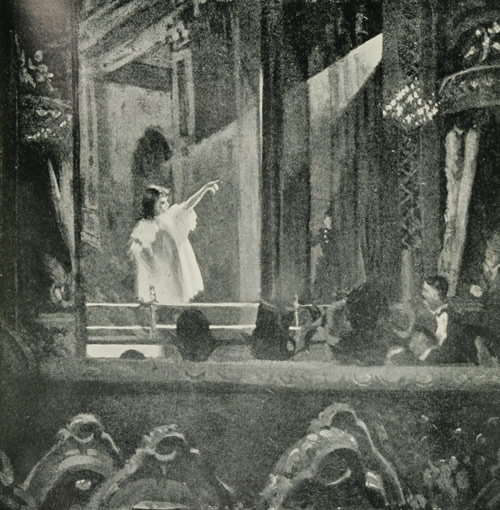
Mr. Sickert contributed two drawings. The Old Oxford Music Hall has some very good qualities, especially the most important quality of all, that of making us feel as if we were there. The singer on the stage (whose attitude has been very closely observed) is strongly lighted by convergent rays. According to my recollection the rays themselves are much more visible in reality than they are here, but it is possible that the artist may have intentionally subdued their brightness in order to enhance that of the figure itself. The musicians and others are good, except that they are too small, if the singing girl (considering her distance) is to be taken as the standard of comparison. The pen-sketch of A Lady Reading is not so satisfactory. I know, of course, that it is offered only as a very slight and rapid sketch, and that it is impossible, even for a Rembrandt, to draw accurately in a hurry, but there is a formlessness in some important parts of this sketch (the hands, for instance) which makes it almost without interest for me. It is essentially painter's pen work, and does not show any special mastery of pen and ink.
The very definite pen-drawing by Mr. Housman called The Reflected Faun is open to the objection that the reflections in the water are drawn with the same hardness as the birds and faun in the air. The plain truth is that the style adopted, which in its own way is as legitimate as any other, does not permit the artist to represent the natural appearance of water. This kind of pen-drawing is founded on early wood-engraving which filled the whole space with decorative work, even to the four corners.
Mr. Rothenstein is a modern of the moderns. His two slight portrait-sketches are natural and easy, and there is much life in the Portrait of a Gentleman. The Portrait of a Lady, by Mr. Furse, is of a much higher order. It has a noble gravity, and it shows a severity of taste not common in the portraiture of our time; it is essentially a distinguished work. Mr. Nettleship gives us an ideal portrait of Minos, not in his earthly life, as king of Crete, but in his infernal capacity as supreme judge of the dead. The face is certainly awful enough and implacable:
Stavvi Minòs orribilmente, e ringhia: Esamina le colpe nell'entrata; Giudica e manda, secondo ch'avvinghia.
The book-plate designed by Mr. Beardsley for Dr. Propert has the usual qualities of the inventor. It seems to tell a tale of hopeless love. The other book-plate, by Mr. Anning Bell, is remarkable for its pretty and ingenious employment of heraldry which so easily becomes mechanical when the draughtsman is not an artist.
On the whole, these illustrations decidedly pre-suppose real artistic culture in the public. They do not condescend in any way to what might be guessed at as the popular taste. I notice that the Editor and Publishers have a tendency to look to young men of ability for assistance in their enterprise, though they accept the criticism of those who now belong to a preceding generation.
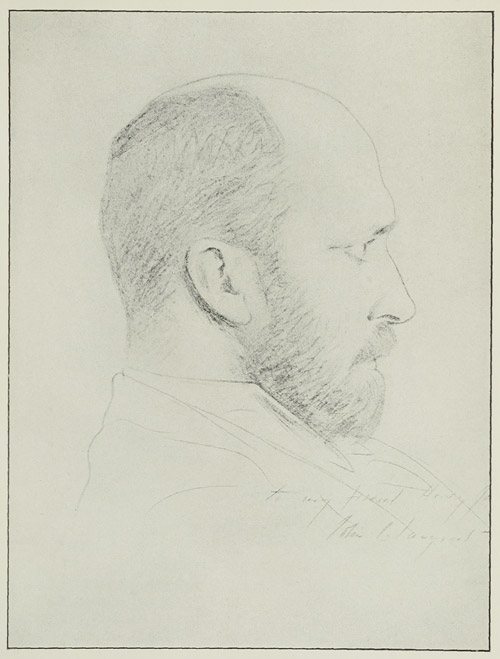
Portrait of Henry James
By John S. Sargent, A.R.A.
Dreams
By Ronald Campbell Macfie
In the first dream that comes with the first sleep I run, I run, I am gathered to thy heart
Unworthy! yea, So high thou art above me I hardly dare to love thee, But kneel and lay All homage and all worship at thy feet, O lady sweet! Yet dreams are strong: Their wordless wish suffices To win them Paradises Of sun and song. Delight our waking life can never know The dreams bestow. And in a dream, Dupe of its bold beguiling, I watch thy blue eyes smiling; I see them gleam With love the waking moments have forbidden, And veiled and hidden. O brave deceit! In dreams thy glad eyes glisten, In dreams I lie and listen Thy bosom beat, Hiving hot lips among thy temple-hair, O lady fair! And tho' I live, Dreaming in such fair fashion, I think, in thy compassion, Thou wilt forgive, Since I but dream, and since my heart will ache When I awake.
Madame Réjane
By Dauphin Meunier
A fabulous being, in an everyday human form; a face, not beautiful, scarcely even pretty, which looks upon the world with an air at once ironical and sympathetic; a brow that grows broader or narrower according to the capricious invasions of her aureole of hair; an odd little nose, perked heavenward; two roguish eyes, now blue, now black; the rude accents of a street-girl, suddenly changing to the well-bred murmuring of a great lady; abrupt, abundant gestures, eloquently finishing half-spoken sentences; a supple neck—a slender, opulent figure—a dainty foot, that scarcely touches the earth and yet can fly amazingly near the ceiling; lips, nervous, sensuous, trembling, curling; a frock, simple or sumptuous, bought at a bargain or created by a Court-dressmaker, which expresses, moulds, completes, and sometimes almost unveils the marvellous creature it envelops; a gay, a grave demeanour; grace, wit, sweetness, tartness; frivolity and earnestness, tenderness and indifference; beauty without beauty, immorality without evil: a nothing capable of everything: such is Woman at Paris: such is the Parisienne: and Madame Réjane is the Parisienne, is all Parisiennes, incarnated.
What though our Parisienne be the daughter of a hall-porter, what though she be a maid-servant, a courtesan, or an arch-duchess, she goes everywhere, she is the equal of every one, she knows or divines everything. No need for her to learn good manners, nor bad ones: she's born with both. According to the time or place, she will talk to you of politics, of art, of literature—of dress, trade, cookery—of finance, of socialism, of luxury, of starvation—with the patness, the sure touch, the absolute sincerity, of one who has seen all, experienced all, understood all. She's as sentimental as a song, wily as a diplomate, gay as folly, or serious as a novel by Zola. What has she read? Where was she educated? Who cares? Her book of life is Paris; she knows her Paris by heart; and whoso knows Paris can dispense with further knowledge. She adores originality and novelty, but she can herself transmute the commonplace into the original, the old into the new. Whatever she touches forthwith reflects her own animation, her mobility, her elusive charm. Flowers have no loveliness until she has grouped them; colours are colourless unless they suit her complexion. Delicately fingering this or that silken fabric, she decrees which shall remain in the darkness of the shops, which shall become the fashion of the hour. She crowns the poet, sits to the painter, inspires the sculptor, lends her voice to the musician; and not one of these artists can pretend to talent, if it be her whim to deny it him. She awards fame and wealth, success and failure, according to her pleasure.
Madame Réjane—the Parisienne: they are interchangeable terms. Whatever rôle she plays absorbs the attention of all Paris. Hearken, then, good French Provincials, who would learn the language of the Boulevards in a single lesson; hearken, also, ye children of other lands who are eager for our pleasures, and curious about our tastes and manners; hearken all people, men and women, who care, for once in a way, to behold what of all Parisian things is most essentially Parisian:—Go and see Réjane. Don't go to the Opéra, where the music is German; nor to the Opéra-Comique, where it is Italian; nor yet to the Comédie-Française, where the sublime is made ridiculous, and the heroes and heroines of Racine take on the attitudes of bull-fighters and cigarette-makers; nor to the Odéon, nor to the Palais-Royal, nor here, nor there, nor elsewhere: go and see Réjane. Be she at London, Chicago, Brussels, St. Petersburg—Réjane is Paris. She carries the soul of Paris with her, wheresoever she listeth.
A Parisienne, she was born in Paris; an actress, she is the daughter of an actor, and the niece of Madame Aptal-Arnault, sometime pensionnaire of the Comédie-Française. Is it a sufficient pedigree? Her very name is suggestive; it seems to share in the odd turn of her wit, the sauciness of her face, the tang of her voice; for Réjane's real name is Réju. Doesn't it sound like a nick-name, especially invented for this child of the greenroom? Réjane calls up to us the fanciful actress—fanciful, but studious, conscientious, impassioned for her art; Madame Réjane has rather a grand air; but Réju makes such a funny face at her.
I picture to myself the little Réju, scarcely out of her cradle, but already cunningly mischievous, fired with an immense curiosity about the world behind the scenes, and dreaming of herself as leading lady. She hears of nothing, she talks of nothing, but the Theatre. And presently her inevitable calling, her manifest destiny, takes its first step towards realisation. She is admitted into the class of Regnier, the famous sociétaire of the Théâtre-Français. Thenceforth the pupil makes steady progress. In 1873, at the age of fifteen, she obtains an honourable mention for comedy at the Conservatoire; the following year she divides a second prize with Mademoiselle Samary. But what am I saying? Only a second prize? Let us see.
To-day, as then, though twenty years have passed, there is no possibility of success, no chance of getting an engagement, for a pupil on leaving the Conservatoire, unless a certain all-powerful critic, supreme judge, arbiter beyond appeal, sees fit to pronounce a decision confirming the verdict of the Examining Jury. This extraordinary man holds the future of each candidate in the palm of his fat and heavy hand. Fame and fortune are contained in his inkstand, and determined by his articles. He is both Pope and King. The Jury proposes, he disposes. The Jury reigns, he governs. He smiles or frowns, the Jury bows its head. The pupils tremble before their Masters; the Masters tremble before this monstrous Fetich,—for the Public thinks with him and by him, and sees only through his spectacles; and no star can shine till his short sight has discovered it.
This puissant astronomer is Monsieur Francisque Sarcey.
Against his opinion the newspapers can raise no voice, for he alone edits them all. He writes thirty articles a day, each of which is thirty times reprinted, thrice thirty times quoted from. He is, as it were, the Press in person. And presently the momentous hour arrived when the delicate and sprightly pupil of Regnier was to appear before this enormous and somnolent mass, and to thrill it with pleasure. For Monsieur Sarcey smiled upon and applauded Réjane's début at the Conservatoire. He consecrated to her as many as fifty lines of intelligent criticism; and I pray Heaven they may be remembered to his credit on the Day of Judgment. Here they are, in that twopenny-halfpenny style of his, so dear to the readers of Le Temps.
"I own that, for my part, I should have willingly awarded to the latter (Mademoiselle Réjane) a first prize. It seems to me that she deserved it. But the Jury is frequently influenced by extrinsic and private motives, into which it is not permitted to pry. A first prize carries with it the right of entrance into the Comédie Française; and the Jury did not think Mademoiselle Réjane, with her little wide-awake face, suited to the vast frame of the House of Molière. That is well enough; but the second prize, which it awarded her, authorises the Director of the Odéon to receive her into his Company; and that perspective alone ought to have sufficed to dissuade the Jury from the course it took.... Every one knows that at present the Odéon is, for a beginner, a most indifferent school.... Instead of shoving its promising pupils into it by the shoulders, the Conservatoire should forbid them to approach it, lest they should be lost there. What will Mademoiselle Réjane do at the Odéon? Show her legs in La Jeunesse de Louis XIV., which is to be revived at the opening of the season! A pretty state of things. She must either go to the Vaudeville or to the Gymnase. It is there that she will form herself; it is there that she will learn her trade, show what she is capable of, and prepare herself for the Comédie Française, if she is ever to enter it.... She recited a fragment from Les Trois Sultanes.... I was delighted by her choice. The Trois Sultanes is so little known nowadays.... What wit there is in her look, her smile! With her small eyes, shrewd and piercing, with her little face thrust forward, she has so knowing an air, one is inclined to smile at the mere sight of her. Does she perhaps show a little too much assurance? What of it? 'Tis the result of excessive timidity. But she laughs with such good grace, she has so fresh and true a voice, she articulates so clearly, she seems so happy to be alive and to have talent, that involuntarily one thinks of Chénier's line:
Sa bienvenue au jour lui rit dans tous les yeux.
... I shall be surprised if she does not make her way."
Praised be Sarcey! That was better than a second prize for Réjane. The Oracle gave her the first, without dividing it. She got an immediate engagement; and in March, 1875, appeared on that stage where to-day she reigns supreme, the Vaudeville, to which she brought back the vaudeville that was no longer played there. She began by alienating the heart of Alphonse Daudet, who, while recognising her clever delivery, found fault with her unemotional gaiety; but, in compensation, another authoritative critic, Auguste Vitu, wrote, after the performance of Pierre: Mademoiselle Réjane showed herself full of grace and feeling. She rendered Gabrielle's despair with a naturalness, a brilliancy, a spontaneity, which won a most striking success.
Shall I follow her through each of her creations, from her début in La Revue des Deux-Mondes, up to her supreme triumph in Madame Sans-Gêne? Shall I show her as the sly soubrette in Fanny Lear? as the woman in love, whose ignorance divines all things, in Madame Lili? as the comical Marquise de Menu-Castel in Le Verglas? Shall I tell of her first crowning success, when she played Gabrielle in Pierre? Shall I recall her stormy interpretation of Madame de Librac, in Le Club? and her dramatic conception of the part of Ida?—which quite reversed the previous judgments of her critics, wringing praise from her enemy Daudet, and censure from her faithful admirer Vitu. The natural order of things, however, was re-established by her performance of Les Tapageurs; again Daudet found her cold and lacking in tenderness; and Vitu again applauded.
Her successes at the Vaudeville extend from 1875 to 1882; and towards the end of that period, Réjane, always rising higher in her art, created Anita in L'Auréole and the Baronne d'Oria in Odette. Next, forgetting her own traditions, she appeared at the Théâtre des Panoramas, and at the Ambigu, where she gave a splendid interpretation of Madame Cézambre in Richepin's La Giu; and at Les Variétés as Adrienne in Ma Camarade. Now fickle, now constant to her first love, she alternated between the Variétés and the Vaudeville; took an engagement at the Odéon; assisted at the birth and death of the Grand-Théâtre; and just lately the Vaudeville has won her back once more.
Amidst these perambulations, Réjane played the diva in Clara Soleil. The following year she had to take two different parts in the same play, those of Gabrielle and Clicquette in Les Demoiselles Clochart. Gabrielle is a cold and positive character; Clicquette a gay and mischievous one. Réjane kept them perfectly distinct, and without the smallest apparent effort. In 1887, she telephoned in Allô-Allô, and represented so clearly, by means of clever mimicry, the absurd answers of the apparatus, that from the gallery to the stalls the theatre was one roar of laughter and applause; I fancy the salvoes and broadsides must still sometimes echo in her delicate ears.
Réjane's part in M. de Morat should not be forgotten; nor above all, the inimitable perfection of her play in Décoré (1888). Sarcey's exultation knew no bounds when, in 1890, she again appeared in this rôle. Time, that had metamorphosed the lissom critic of 1875 into a round and inert mass of solid flesh, cruel Father Time, gave back to Sarcey, for this occasion only, a flash of youthful fire, which stirred his wits to warmth and animation. He shouted out hardly articulate praise; he literally rolled in his stall with pleasure; his bald head blushed like an aurora borealis. Look at her! he cried, see her malicious smiles, her feline graces, listen to her reserved and biting diction; she is the very essence of the Parisienne! What an ovation she received! How they applauded her! and how she played! From M. Sarcey the laugh spreads; it thaws the scepticism of M. Jules Lemaître, engulfs the timidity of the public, becomes unanimous and universal, and is no longer to be silenced.
In 1888, M. Edmond de Goncourt entrusted Réjane with the part of Germinie Lacerteux. On the first night, a furious battle against the author was waged in the house. Réjane secured the victory sans peur et sans reproches.
Everything in her inspires the certitude of success; her voice aims at the heart, her gestures knock at it. Réjane confides all to the hazard of the dice; her sudden attacks are of the most dare-devil nature; and no matter how risky, how dangerous, how extravagant the jump, she never loses her footing; her play is always correct, her handling sure, her coolness imperturbable. It was impossible to watch her precipitate herself down the staircase in La Glu without a tremble. And fifteen years before Yvette Guilbert, it was Réjane who first had the audacity to sing with a voice that was no voice, making wit and gesture more than cover the deficiency. In Ma Cousine, Réjane introduced on the boards of Les Variétés a bit of dancing such as one sees at the Elysée-Montmartre; she seized on and imitated the grotesque effrontery of Mademoiselle Grille-d'Egout, and her little arched foot flying upwards, brushed a kiss upon the forehead of her model; for Réjane the grand écart may be fatal, perhaps, but it is neither difficult nor terrifying.
Once more delighting us with Marquise in 1889; playing with such child-like grace the Candidate in Brevet Supérieur in 1891; immediately afterwards she took a part in Amoureuse at the Odéon. The subject is equivocal, the dialogue smutty. Réjane extenuated nothing; on the contrary, accentuated things, and yet knew always how to win her pardon.
Now, it so happened that in 1882, after having personified the Moulin-Rouge in Les Variétés de Paris, Réjane was married on the stage, in La Nuit de Noces de P. L. M., to P. L. Moriseau. On the anniversary day, ten years later, her marriage took place in good earnest, before a real M. le Maire, and according to all legal formalities, with M. Porel, a sometime actor, an ex-director of the Odéon, then director of the Grand-Théâtre, and co-director to-day of the Vaudeville.... But to return to her art.
Just as the first dressmakers of Paris measure Réjane's fine figure for the costumes of her various rôles, so the best writers of the French Academy now make plays to her measure. They take the size of her temperament, the height of her talent, the breadth of her play; they consider her taste, they flatter her mood; they clothe her with the richest draperies she can covet. Their imagination, their fancy, their cleverness, are all put at her service. The leaders in this industry have hitherto been Messrs. Meilhac and Halévy, but now M. Victorien Sardou is ruining them. Madame Sans-Gêne is certainly, of all the rôles Réjane has played, that best suited to bring out her manifold resources. It is not merely that Réjane plays the washerwoman, become a great lady, without blemish or omission; she is Madame Sans-Gêne herself, with no overloading, nothing forced, nothing caricatured. It is portraiture; history.
Many a time has Réjane appeared in cap, cotton frock, and white apron; many a time in robes of state, glittering with diamonds; she has worn the buskin or the sock, demeaned herself like a gutter heroine, or dropped the stately curtsey of the high-born lady. But never, except in Madame Sans-Gêne, has she been able to bring all her rôles into one focus, exhibit her whole wardrobe, and yet remain one and the same person, compress into one evening the whole of her life.
The seekers after strange novelties, the fanatics for the mists of the far north, the vague, the irresolute, the restless, will not easily forget the Ibsenish mask worn by Réjane in Nora of The Doll's House; although most of us, loving Réjane for herself, probably prefer to this vacillating creation, the firm drawing, the clear design, the strong, yet supple lines of Madame Sans-Gêne.
Why has Réjane no engagement at the Comédie-Française? Whom does one go to applaud on this stage, called the first in France, and from which Réjane, Sarah Bernhardt, and Coquelin the elder, all are absent? I will explain the matter in two words.
The house of Molière, for many years now, has belonged to Molière no more. Were Molière to come to life again, neither he nor Réjane would go to eat their hearts out, with inaction and dulness, beneath the wings of M. Jules Claretie—although he is, of course, a very estimable gentleman. Were Réjane unmarried, Molière to-day would enter into partnership with her, because she is in herself the entire Comédie-Française. I have already said she is married to M. Porel, director of the Vaudeville, where she reigns as Queen. I am quite unable to see any reason why she should soon desert such a fortunate conjugal domicile.
Notwithstanding the dryness and the rapidity of this enumeration of Réjane's rôles, I hope to have given some general idea of the marvellous diversity and flexibility of her dramatic spirit and temperament; it seems to me that the most searching criticism of her various creations, would not greatly enhance the accuracy of the picture. This is why I make no attempt to describe her in some three or four parts of an entirely different character. Besides, I should have to draw on hearsay; and I desire to trust only to my own eyes, my own heart. Needless to say, I have not had the good luck to see Madame Réjane in each of her characterisations since her first appearance. Her youthful air has never changed; but I have only had the opportunity of admiring it during the last few years. I confidently maintain, however, that she could not have been more charming in 1875 than she is to-day, with the devil in her body, heaven in her eyes.
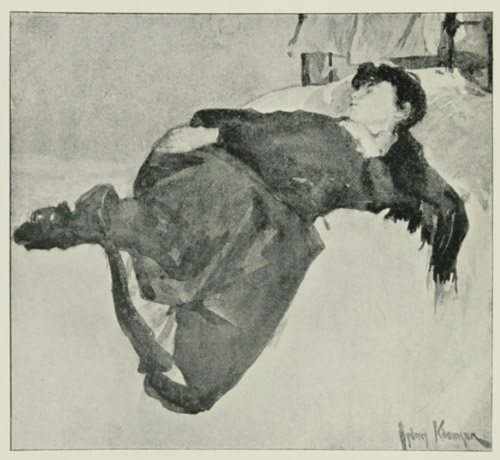
A Girl Resting
By Sydney Adamson
The Roman Road
By Kenneth Grahame
All the roads of our neighbourhood were cheerful and friendly, having each of them pleasant qualities of its own; but this one seemed different from the others in its masterful suggestion of a serious purpose, speeding you along with a strange uplifting of the heart. The others tempted chiefly with their treasures of hedge and ditch; the rapt surprise of the first lords-and-ladies, the rustle of a field-mouse, splash of a frog; while cool noses of brother-beasts were pushed at you through gate or gap. A loiterer you had need to be, did you choose one of them; so many were the tiny hands thrust out to detain you, from this side and that. But this other was of a sterner sort, and even in its shedding off of bank and hedgerow as it marched straight and full for the open downs, it seemed to declare its contempt for adventitious trappings to catch the shallow-pated. When the sense of injustice or disappointment was heavy on me, and things were very black within, as on this particular day, the road of character was my choice for that solitary ramble when I turned my back for an afternoon on a world that had unaccountably declared itself against me.
The Knight's Road we children had named it, from a sort of feeling that, if from any quarter at all, it would be down this track we might some day see Lancelot and his peers come pacing on their great war-horses; supposing that any of the stout band still survived, in nooks and unexplored places. Grown-up people sometimes spoke of it as the Pilgrim's Way; but I didn't know much about pilgrims—except Walter in the Horselburg story. Him I sometimes saw, breaking with haggard eyes out of yonder copse, and calling to the pilgrims as they hurried along on their desperate march to the Holy City, where peace and pardon were awaiting them. All roads lead to Rome, I had once heard somebody say; and I had taken the remark very seriously, of course, and puzzled over it many days. There must have been some mistake, I concluded at last; but of one road at least I intuitively felt it to be true. And my belief was clinched by something that fell from Miss Smedley during a history-lesson, about a strange road that ran right down the middle of England till it reached the coast, and then began again in France, just opposite, and so on undeviating, through city and vineyard, right from the misty Highlands to the Eternal City. Uncorroborated, any statement of Miss Smedley's usually fell on incredulous ears; but here, with the road itself in evidence, she seemed, once in a way, to have strayed into truth.
Rome! It was fascinating to think that it lay at the other end of this white ribbon that rolled itself off from my feet over the distant downs. I was not quite so uninstructed as to imagine I could reach it that afternoon; but some day, I thought, if things went on being as unpleasant as they were now—some day, when Aunt Eliza had gone on a visit—we would see.
I tried to imagine what it would be like when I got there. The Coliseum I knew, of course, from a woodcut in the history-book: so to begin with I plumped that down in the middle. The rest had to be patched up from the little grey market-town where twice a year we went to have our hair cut; hence, in the result, Vespasian's amphitheatre was approached by muddy little streets, wherein the Red Lion and the Blue Boar, with Somebody's Entire along their front, and Commercial Room on their windows; the doctor's house, of substantial red-brick; and the façade of the new Wesleyan chapel, which we thought very fine, were the chief architectural ornaments: while the Roman populace pottered about in smocks and corduroys, twisting the tails of Roman calves and inviting each other to beer in musical Wessex. From Rome I drifted on to other cities, dimly heard of—Damascus, Brighton, (Aunt Eliza's ideal), Athens, and Glasgow, whose glories the gardener sang; but there was a certain sameness in my conception of all of them: that Wesleyan chapel would keep cropping up everywhere. It was easier to go a-building among those dream-cities where no limitations were imposed, and one was sole architect, with a free hand. Down a delectable street of cloud-built palaces I was mentally pacing, when I happened upon the Artist.
He was seated at work by the roadside, at a point whence the cool large spaces of the downs, juniper-studded, swept grandly westwards. His attributes proclaimed him of the artist tribe: besides, he wore knickerbockers like myself. I knew I was not to bother him with questions, nor look over his shoulder and breathe in his ear—they didn't like it, this genus irritabile; but there was nothing about staring in my code of instructions, the point having somehow been overlooked: so, squatting down on the grass, I devoted myself to a passionate absorbing of every detail. At the end of five minutes there was not a button on him that I could not have passed an examination in; and the wearer himself of that home-spun suit was probably less familiar with its pattern and texture than I was. Once he looked up, nodded, half held out his tobacco pouch, mechanically as it were, then, returning it to his pocket, resumed his work, and I my mental photography.
After another five minutes or so had passed he remarked, without looking my way: Fine afternoon we're having: going far to-day?
No, I'm not going any farther than this, I replied: I was thinking of going on to Rome: but I've put it off.
Pleasant place, Rome, he murmured: you'll like it. It was some minutes later that he added: But I wouldn't go just now, if I were you: too jolly hot.
You haven't been to Rome, have you? I inquired.
Rather, he replied briefly: I live there.
This was too much, and my jaw dropped as I struggled to grasp the fact that I was sitting there talking to a fellow who lived in Rome. Speech was out of the question: besides I had other things to do. Ten solid minutes had I already spent in an examination of him as a mere stranger and artist; and now the whole thing had to be done over again, from the changed point of view. So I began afresh, at the crown of his soft hat, and worked down to his solid British shoes, this time investing everything with the new Roman halo; and at last I managed to get out: But you don't really live there, do you? never doubting the fact, but wanting to hear it repeated.
Well, he said, good-naturedly overlooking the slight rudeness of my query, I live there as much as I live anywhere. About half the year sometimes. I've got a sort of a shanty there. You must come and see it some day.
But do you live anywhere else as well? I went on, feeling the forbidden tide of questions surging up within me.
O yes, all over the place, was his vague reply. And I've got a diggings somewhere off Piccadilly.
Where's that? I inquired.
Where's what? said he. Oh, Piccadilly! It's in London.
Have you a large garden? I asked; and how many pigs have you got?
I've no garden at all, he replied sadly, and they don't allow me to keep pigs, though I'd like to, awfully. It's very hard.
But what do you do all day, then, I cried, and where do you go and play, without any garden, or pigs, or things?
When I want to play, he said gravely, I have to go and play in the street; but it's poor fun, I grant you. There's a goat, though, not far off, and sometimes I talk to him when I'm feeling lonely; but he's very proud.
Goats are proud, I admitted. There's one lives near here, and if you say anything to him at all, he hits you in the wind with his head. You know what it feels like when a fellow hits you in the wind?
I do, well, he replied, in a tone of proper melancholy, and painted on.
And have you been to any other places, I began again presently, besides Rome and Piccy-what's-his-name?
Heaps, he said. I'm a sort of Ulysses—seen men and cities, you know. In fact, about the only place I never got to was the Fortunate Island.
I began to like this man. He answered your questions briefly and to the point, and never tried to be funny. I felt I could be confidential with him.
Wouldn't you like, I inquired, to find a city without any people in it at all?
He looked puzzled. I'm afraid I don't quite understand, said he.
I mean, I went on eagerly, a city where you walk in at the gates, and the shops are all full of beautiful things, and the houses furnished as grand as can be, and there isn't anybody there whatever! And you go into the shops, and take anything you want—chocolates and magic-lanterns and injirubber balls—and there's nothing to pay; and you choose your own house and live there and do just as you like, and never go to bed unless you want to!
The artist laid down his brush. That would be a nice city, he said. Better than Rome. You can't do that sort of thing in Rome—or in Piccadilly either. But I fear it's one of the places I've never been to.
And you'd ask your friends, I went on, warming to my subject; only those who you really like, of course; and they'd each have a house to themselves—there'd be lots of houses, and no relations at all, unless they promised they'd be pleasant, and if they weren't they'd have to go.
So you wouldn't have any relations? said the artist. Well, perhaps you're right. We have tastes in common, I see.
I'd have Harold, I said reflectively, and Charlotte. They'd like it awfully. The others are getting too old. Oh! and Martha—I'd have Martha to cook and wash up and do things. You'd like Martha. She's ever so much nicer than Aunt Eliza. She's my idea of a real lady.
Then I'm sure I should like her, he replied heartily, and when I come to—what do you call this city of yours? Nephelo—something, did you say!
I—I don't know, I replied timidly. I'm afraid it hasn't got a name—yet.
The artist gazed out over the downs. 'The poet says dear city of Cecrops;' he said softly to himself, 'and wilt not thou say, dear city of Zeus?' That's from Marcus Aurelius, he went on, turning again to his work. You don't know him, I suppose; you will some day.
Who's he? I inquired.
Oh, just another fellow who lived in Rome, he replied, dabbing away.
O dear! I cried, disconsolately. What a lot of people seem to live at Rome, and I've never even been there! But I think I'd like my city best.
And so would I, he replied with unction. But Marcus Aurelius wouldn't, you know.
Then we won't invite him, I said: will we?
I won't if you won't, said he. And that point being settled, we were silent for a while.
Do you know, he said presently, I've met one or two fellows from time to time, who have been to a city like yours—perhaps it was the same one. They won't talk much about it—only broken hints, now and then; but they've been there sure enough. They don't seem to care about anything in particular—and everything's the same to them, rough or smooth; and sooner or later they slip off and disappear; and you never see them again. Gone back, I suppose.
Of course, said I. Don't see what they ever came away for; I wouldn't. To be told you've broken things when you haven't, and stopped having tea with the servants in the kitchen, and not allowed to have a dog to sleep with you. But I've known people, too, who've gone there.
The artist stared, but without incivility.
Well, there's Lancelot, I went on. The book says he died, but it never seemed to read right, somehow. He just went away, like Arthur. And Crusoe, when he got tired of wearing clothes and being respectable. And all the nice men in the stories who don't marry the Princess, 'cos only one man ever gets married in a book, you know. They'll be there!
And the men who fail, he said, who try like the rest, and toil, and eat their hearts out, and somehow miss—or break down or get bowled over in the mêlée—and get no Princess, nor even a second-class kingdom—some of them'll be there, I hope?
Yes, if you like, I replied, not quite understanding him; if they're friends of yours, we'll ask 'em, of course.
What a time we shall have! said the artist reflectively; and how shocked old Marcus Aurelius will be!
The shadows had lengthened uncannily, a tide of golden haze began to flood the grey-green surface of the downs, and the artist put his traps together, preparatory to a move. I felt very low: we would have to part, it seemed, just as we were getting on so well together. Then he stood up, and he was very straight and tall, and the sunset was in his hair and beard as he stood there, high over me. He took my hand like an equal. I've enjoyed our conversation very much, he said. That was an interesting subject you started, and we haven't half exhausted it. We shall meet again, I hope?
Of course we shall, I replied, surprised that there should be any doubt about it.
In Rome perhaps? said he.
Yes, in Rome, I answered; or Piccy-the-other-place, or somewhere.
Or else, said he, in that other city—when we've found the way there. And I'll look out for you, and you'll sing out as soon as you see me. And we'll go down the street arm-in-arm, and into all the shops, and then I'll choose my house, and you'll choose your house, and we'll live there like princes and good fellows.
Oh, but you'll stay in my house, won't you? I cried; I wouldn't ask everybody; but I'll ask you.
He affected to consider a moment; then Right! he said: I believe you mean it, and I will come and stay with you. I won't go to anybody else, if they ask me ever so much. And I'll stay quite a long time, too, and I won't be any trouble.
Upon this compact we parted, and I went down-heartedly from the man who understood me, back to the house where I never could do anything right. How was it that everything seemed natural and sensible to him, which these uncles, vicars, and other grown-up men took for the merest tomfoolery? Well, he would explain this, and many another thing, when we met again. The Knight's Road! How it always brought consolation! Was he possibly one of those vanished knights I had been looking for so long? Perhaps he would be in armour next time—why not? He would look well in armour, I thought. And I would take care to get there first, and see the sunlight flash and play on his helmet and shield, as he rode up the High Street of the Golden City.
Meantime, there only remained the finding it,—an easy matter.
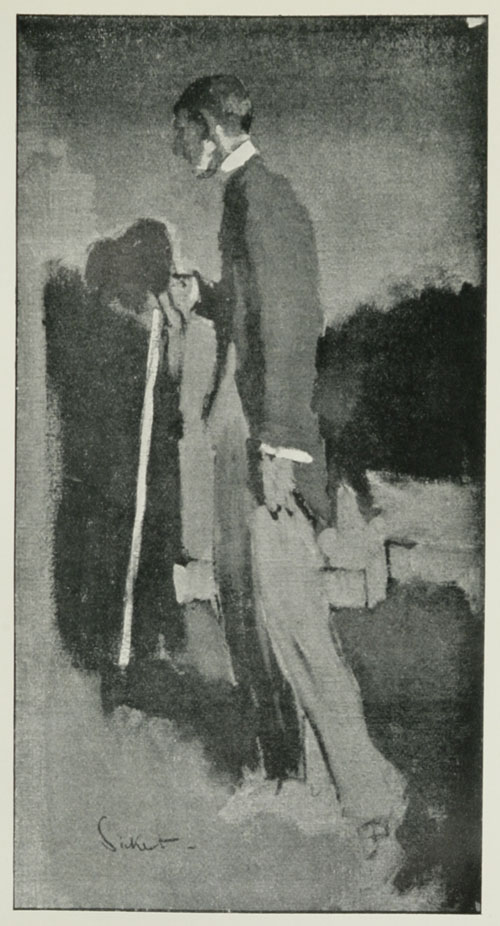
Three Pictures
By Walter Sickert
I. The Old Bedford Music Hall
II. Portrait of Aubrey Beardsley
III. Ada Lundberg
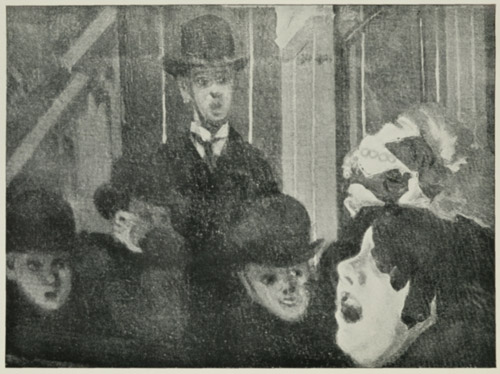
Betrothed
By Norman Gale
She is mine in the day, She is mine in the dusk; She is virgin as dawn, And as fragrant as musk. And the wood on the hill Is the home where we meet— O, the coming of eve, It is marvellous sweet! To my satisfied heart She has flown like a dove; All her kisses are taught By the wisdom of love. And whatever my grief There is healing, and rest, On the pear-blossom slope Of her beautiful breast.
Thy Heart's Desire
By Netta Syrett
I
The tents were pitched in a little plain surrounded by hills. Right and left there were stretches of tender vivid green where the young corn was springing; further still, on either hand, the plain was yellow with mustard-flower; but in the immediate foreground it was bare and stony. A few thorny bushes pushed their straggling way through the dry soil, ineffectively as far as the grace of the landscape was concerned, for they merely served to emphasise the barren aridness of the land that stretched before the tents, sloping gradually to the distant hills.
The hills were uninteresting enough in themselves; they had no grandeur of outline, no picturesqueness even, though at morning and evening the sun, like a great magician, clothed them with beauty at a touch.
They had begun to change, to soften, to blush rose-red in the evening light, when a woman came to the entrance of the largest of the tents and looked towards them. She leant against the support on one side of the canvas flap, and putting back her head, rested that too against it, while her eyes wandered over the plain and over the distant hills.
She was bareheaded, for the covering of the tent projected a few feet to form an awning overhead. The gentle breeze which had risen with sundown, stirred the soft brown tendrils of hair on her temples, and fluttered her pink cotton gown a little. She stood very still, with her arms hanging and her hands clasped loosely in front of her. There was about her whole attitude an air of studied quiet which in some vague fashion the slight clasp of her hands accentuated. Her face, with its tightly, almost rigidly closed lips, would have been quite in keeping with the impression of conscious calm which her entire presence suggested, had it not been that when she raised her eyes a strange contradiction to this idea was afforded. They were large grey eyes, unusually bright and rather startling in effect, for they seemed the only live thing about her. Gleaming from her still set face, there was something almost alarming in their brilliancy. They softened with a sudden glow of pleasure as they rested on the translucent green of the wheat fields under the broad generous sunlight, and then wandered to where the pure vivid yellow of the mustard-flower spread in waves to the base of the hills, now mystically veiled in radiance. She stood motionless watching their melting elusive changes from palpitating rose to the transparent purple of amethyst. The stillness of evening was broken by the monotonous, not unmusical creaking of a Persian wheel at some little distance to the left of the tent. The well stood in a little grove of trees: between their branches she could see, when she turned her head, the coloured saris of the village women, where they stood in groups chattering as they drew the water, and the little naked brown babies that toddled beside them or sprawled on the hard ground beneath the trees. From the village of flat-roofed mud-houses under the low hill at the back of the tents, other women were crossing the plain towards the well, their terra-cotta water-jars poised easily on their heads, casting long shadows on the sun-baked ground as they came.
Presently, in the distance, from the direction of the sunlit hills opposite, a little group of men came into sight. Far off, the mustard-coloured jackets and the red turbans of the orderlies made vivid splashes of colour on the dull plain. As they came nearer, the guns slung across their shoulders, the cases of mathematical instruments, the hammers and other heavy baggage they carried for the Sahib, became visible. A little in front, at walking pace, rode the Sahib himself, making notes as he came in a book he held before him. The girl at the tent-entrance watched the advance of the little company indifferently, it seemed; except for a slight tightening of the muscles about her mouth, her face remained unchanged. While he was still some little distance away, the man with the note-book raised his head and smiled awkwardly as he saw her standing there. Awkwardness, perhaps, best describes the whole man. He was badly put together, loose-jointed, ungainly. The fact that he was tall profited him nothing, for it merely emphasised the extreme ungracefulness of his figure. His long pale face was made paler by a shock of coarse, tow-coloured hair; his eyes even looked colourless, though they were certainly the least uninteresting feature of his face, for they were not devoid of expression. He had a way of slouching when he moved that singularly intensified the general uncouthness of his appearance. Are you very tired? asked his wife gently when he had dismounted close to the tent. The question would have been an unnecessary one had it been put to her instead of to her husband, for her voice had that peculiar flat toneless sound for which extreme weariness is answerable.
Well, no, my dear, not very, he replied, drawling out the words with an exasperating air of delivering a final verdict, after deep reflection on the subject.
The girl glanced once more at the fading colours on the hills. Come in and rest, she said, moving aside a little to let him pass.
She stood lingering a moment after he had entered the tent, as though unwilling to leave the outer air; and before she turned to follow him she drew a deep breath, and her hand went for one swift second to her throat as though she felt stifled.
* * * * *
Later on that evening she sat in her tent sewing by the light of the lamp that stood on her little table.
Opposite to her, her husband stretched his ungainly length in a deck-chair, and turned over a pile of official notes. Every now and then her eyes wandered from the gay silks of the table-cover she was embroidering to the canvas walls which bounded the narrow space into which their few household goods were crowded. Outside there was a deep hush. The silence of the vast empty plain seemed to work its way slowly, steadily in, towards the little patch of light set in its midst. The girl felt it in every nerve; it was as though some soft-footed, noiseless, shapeless creature, whose presence she only dimly divined, was approaching nearer—nearer. The heavy outer stillness was in some way made more terrifying by the rustle of the papers her husband was reading, by the creaking of his chair as he moved, and by the little fidgeting grunts and half exclamations which from time to time broke from him. His wife's hand shook at every unintelligible mutter from him, and the slight habitual contraction between her eyes deepened.
All at once she threw her work down on to the table. For Heaven's sake——please, John, talk! she cried. Her eyes, for the moment's space in which they met the startled ones of her husband, had a wild hunted look, but it was gone almost before his slow brain had time to note that it had been there—and was vaguely disturbing. She laughed a little, unsteadily.
Did I startle you? I'm sorry. I—— she laughed again. I believe I'm a little nervous. When one is all day alone—— She paused without finishing the sentence. The man's face changed suddenly. A wave of tenderness swept over it, and at the same time an expression of half-incredulous delight shone in his pale eyes.
Poor little girl, are you really lonely? he said. Even the real feeling in his tone failed to rob his voice of its peculiarly irritating grating quality. He rose awkwardly and moved to his wife's side.
Involuntarily she shrank a little, and the hand which he had stretched out to touch her hair sank to his side. She recovered herself immediately and turned her face up to his, though she did not raise her eyes; but he did not kiss her. Instead, he stood in an embarrassed fashion a moment by her side, and then went back to his seat.
There was silence again for some time. The man lay back in his chair, gazing at his big clumsy shoes, as though he hoped for some inspiration from that quarter, while his wife worked with nervous haste.
Don't let me keep you from reading, John, she said, and her voice had regained its usual gentle tone.
No, my dear; I'm just thinking of something to say to you, but I don't seem——
She smiled a little. In spite of herself, her lip curled faintly. Don't worry about it—it was stupid of me to expect it. I mean—— she added hastily, immediately repenting the sarcasm. She glanced furtively at him, but his face was quite unmoved. Evidently he had not noticed it, and she smiled faintly again.
Oh, Kathie, I knew there was something I'd forgotten to tell you, my dear; there's a man coming down here. I don't know whether——
She looked up sharply. A man coming here? What for? she interrupted breathlessly.
Sent to help me about this oil-boring business, my dear.
He had lighted his pipe, and was smoking placidly, taking long whiffs between his words.
Well? impatiently questioned his wife, fixing her bright eyes on his face.
Well—that's all, my dear.
She checked an exclamation. But don't you know anything about him—his name? where he comes from? what he is like? She was leaning forward against the table, her needle with a long end of yellow silk drawn halfway through her work, held in her upraised hand, her whole attitude one of quivering excitement and expectancy.
The man took his pipe from his mouth deliberately, with a look of slow wonder.
Why Kathie, you seem quite anxious. I didn't know you'd be so interested, my dear. Well,—another long pull at his pipe—his name's Brook—Brookfield, I think. He paused again. This pipe don't draw well a bit; there's something wrong with it, I shouldn't wonder, he added, taking it out and examining the bowl as though struck with the brilliance of the idea.
The woman opposite put down her work and clenched her hands under the table.
Go on, John, she said presently in a tense vibrating voice—his name is Brookfield. Well, where does he come from?
Straight from home, my dear, I believe. He fumbled in his pocket, and after some time extricated a pencil with which he began to poke the tobacco in the bowl in an ineffectual aimless fashion, becoming completely engrossed in the occupation apparently. There was another long pause. The woman went on working, or feigning to work, for her hands were trembling a good deal.
After some moments she raised her head again. John, will you mind attending to me one moment, and answering these questions as quickly as you can? The emphasis on the last word was so faint as to be almost as imperceptible as the touch of exasperated contempt which she could not absolutely banish from her tone.
Her husband, looking up, met her clear bright gaze and reddened like a schoolboy.
Whereabouts 'from home' does he come? she asked in a studiedly gentle fashion.
Well, from London, I think, he replied, almost briskly for him, though he stammered and tripped over the words. He's a University chap; I used to hear he was clever—I don't know about that, I'm sure; he used to chaff me, I remember, but——
Chaff you? You have met him then?
Yes, my dear—he was fast relapsing into his slow drawl again—that is, I went to school with him, but it's a long time ago. Brookfield—yes, that must be his name.
She waited a moment, then When is he coming? she inquired abruptly.
Let me see—to-day's——
Monday, the word came swiftly between her set teeth.
Ah, yes,—Monday—well, reflectively, next Monday, my dear.
Mrs. Drayton rose, and began to pace softly the narrow passage between the table and the tent-wall, her hands clasped loosely behind her.
How long have you known this? she said, stopping abruptly. Oh, John, you needn't consider; it's quite a simple question. To-day? Yesterday?
Her foot moved restlessly on the ground as she waited.
I think it was the day before yesterday, he replied.
Then why in Heaven's name didn't you tell me before? she broke out fiercely.
My dear, it slipped my memory. If I'd thought you would be interested——
Interested? She laughed shortly. It is rather interesting to hear that after six months of this—she made a quick comprehensive gesture with her hand—one will have some one to speak to—some one. It is the hand of Providence; it comes just in time to save me from—— She checked herself abruptly.
He sat staring up at her stupidly, without a word.
It's all right, John, she said, with a quick change of tone, gathering up her work quietly as she spoke. I'm not mad—yet. You—you must get used to these little outbreaks, she added after a moment, smiling faintly, and to do me justice, I don't often trouble you with them, do I? I'm just a little tired, or it's the heat or—something. No—don't touch me, she cried, shrinking back, for he had risen slowly and was coming towards her.
She had lost command over her voice, and the shrill note of horror in it was unmistakable. The man heard it, and shrank in his turn.
I'm so sorry, John, she murmured, raising her great bright eyes to his face. They had not lost their goaded expression, though they were full of tears. I'm awfully sorry, but I'm just nervous and stupid, and I can't bear any one to touch me when I'm nervous.
II
Here's Broomhurst, my dear! I made a mistake in his name after all, I find. I told you Brookfield, I believe, didn't I? Well, it isn't Brookfield, he says; it's Broomhurst.
Mrs. Drayton had walked some little distance across the plain to meet and welcome the expected guest. She stood quietly waiting while her husband stammered over his incoherent sentences, and then put out her hand.
We are very glad to see you, she said with a quick glance at the newcomer's face as she spoke.
As they walked together towards the tent, after the first greetings, she felt his keen eyes upon her before he turned to her husband.
I'm afraid Mrs. Drayton finds the climate trying? he asked. Perhaps she ought not to have come so far in this heat?
Kathie is often pale. You do look white to-day, my dear, he observed, turning anxiously towards his wife.
Do I? she replied. The unsteadiness of her tone was hardly appreciable, but it was not lost on Broomhurst's quick ears. Oh, I don't think so. I feel very well.
I'll come and see if they've fixed you up all right, said Drayton, following his companion towards the new tent that had been pitched at some little distance from the large one.
We shall see you at dinner then? Mrs. Drayton observed in reply to Broomhurst's smile as they parted.
She entered the tent slowly, and moving up to the table, already laid for dinner, began to rearrange the things upon it in a purposeless mechanical fashion.
After a moment she sank down upon a seat opposite the open entrance, and put her hand to her head.
What is the matter with me? she thought wearily. All the week I've been looking forward to seeing this man—any man, any one to take off the edge of this. She shuddered. Even in thought she hesitated to analyse the feeling that possessed her. Well, he's here, and I think I feel worse. Her eyes travelled towards the hills she had been used to watch at this hour, and rested on them with a vague unseeing gaze.
Tired, Kathie? A penny for your thoughts, my dear, said her husband, coming in presently to find her still sitting there.
I'm thinking what a curious world this is, and what an ironical vein of humour the gods who look after it must possess, she replied with a mirthless laugh, rising as she spoke.
John looked puzzled.
Funny my having known Broomhurst before, you mean? he said doubtfully.
* * * * *
I was fishing down at Lynmouth this time last year, Broomhurst said at dinner. You know Lynmouth, Mrs. Drayton? Do you never imagine you hear the gurgling of the stream? I am tantalised already by the sound of it rushing through the beautiful green gloom of those woods—aren't they lovely? And I haven't been in this burnt-up spot as many hours as you've had months of it.
She smiled a little.
You must learn to possess your soul in patience, she said, and glanced inconsequently from Broomhurst to her husband, and then dropped her eyes and was silent a moment.
John was obviously, and a little audibly, enjoying his dinner. He sat with his chair pushed close to the table, and his elbows awkwardly raised, swallowing his soup in gulps. He grasped his spoon tightly in his bony hand so that its swollen joints stood out larger and uglier than ever, his wife thought.
Her eyes wandered to Broomhurst's hands. They were well shaped, and though not small, there was a look of refinement about them; he had a way of touching things delicately, a little lingeringly, she noticed. There was an air of distinction about his clear-cut, clean-shaven face, possibly intensified by contrast with Drayton's blurred features; and it was, perhaps, also by contrast with the grey cuffs that showed beneath John's ill-cut drab suit that the linen Broomhurst wore seemed to her particularly spotless.
Broomhurst's thoughts, for his part, were a good deal occupied with his hostess.
She was pretty, he thought, or perhaps it was that, with the wide dry lonely plain as a setting, her fragile delicacy of appearance was invested with a certain flower-like charm.
The silence here seems rather strange, rather appalling at first, when one is fresh from a town, he pursued, after a moment's pause, but I suppose you're used to it; eh, Drayton? How do you find life here, Mrs. Drayton? he asked a little curiously, turning to her as he spoke.
She hesitated a second. Oh, much the same as I should find it anywhere else, I expect, she replied; after all, one carries the possibilities of a happy life about with one—don't you think so? The Garden of Eden wouldn't necessarily make my life any happier, or less happy, than a howling wilderness like this. It depends on oneself entirely.
Given the right Adam and Eve, the desert blossoms like the rose, in fact, Broomhurst answered lightly, with a smiling glance inclusive of husband and wife; you two don't feel as though you'd been driven out of Paradise evidently.
Drayton raised his eyes from his plate with a smile of total incomprehension.
Great Heavens! What an Adam to select! thought Broomhurst involuntarily, as Mrs. Drayton rose rather suddenly from the table.
I'll come and help with that packing-case, John said, rising, in his turn, lumberingly from his place; then we can have a smoke—eh? Kathie don't mind, if we sit near the entrance.
The two men went out together, Broomhurst holding the lantern, for the moon had not yet risen. Mrs. Drayton followed them to the doorway, and, pushing the looped-up hanging further aside, stepped out into the cool darkness.
Her heart was beating quickly, and there was a great lump in her throat that frightened her as though she were choking.
And I am his wife—I belong to him! she cried, almost aloud.
She pressed both her hands tightly against her breast, and set her teeth, fighting to keep down the rising flood that threatened to sweep away her composure. Oh, what a fool I am! What an hysterical fool of a woman I am! she whispered below her breath. She began to walk slowly up and down outside the tent, in the space illumined by the lamplight, as though striving to make her outwardly quiet movements react upon the inward tumult. In a little while she had conquered; she quietly entered the tent, drew a low chair to the entrance, and took up a book, just as footsteps became audible. A moment afterwards Broomhurst emerged from the darkness into the circle of light outside, and Mrs. Drayton raised her eyes from the pages she was turning to greet him with a smile.
Are your things all right?
Oh yes, more or less, thank you. I was a little concerned about a case of books, but it isn't much damaged fortunately. Perhaps I've some you would care to look at?
The books will be a godsend, she returned with a sudden brightening of the eyes; I was getting desperate—for books.
What are you reading now? he asked, glancing at the volume that lay in her lap.
It's a Browning. I carry it about a good deal. I think I like to have it with me, but I don't seem to read it much.
Are you waiting for a suitable optimistic moment? Broomhurst inquired smiling.
Yes, now you mention it, I think that must be why I am waiting, she replied slowly.
And it doesn't come—even in the Garden of Eden? Surely the serpent, pessimism, hasn't been insolent enough to draw you into conversation with him? he said lightly.
There has been no one to converse with at all—when John is away, I mean. I think I should have liked a little chat with the serpent immensely by way of a change, she replied in the same tone.
Ah, yes, Broomhurst said with sudden seriousness, it must be unbearably dull for you alone here, with Drayton away all day.
Mrs. Drayton's hand shook a little as she fluttered a page of her open book.
I should think it quite natural you would be irritated beyond endurance to hear that all's right with the world, for instance, when you were sighing for the long day to pass, he continued.
I don't mind the day so much—it's the evenings. She abruptly checked the swift words and flushed painfully. I mean—I've grown stupidly nervous, I think—even when John is here. Oh, you have no idea of the awful silence of this place at night, she added, rising hurriedly from her low seat, and moving closer to the doorway. It is so close, isn't it? she said, almost apologetically. There was silence for quite a minute.
Broomhurst's quick eyes noted the silent momentary clenching of the hands that hung at her side as she stood leaning against the support at the entrance.
But how stupid of me to give you such a bad impression of the camp—the first evening, too, Mrs. Drayton exclaimed presently, and her companion mentally commended the admirable composure of her voice.
Probably you will never notice that it is lonely at all, she continued, John likes it here. He is immensely interested in his work, you know. I hope you are too. If you are interested it is all quite right. I think the climate tries me a little. I never used to be stupid—and nervous. Ah, here's John; he's been round to the kitchen-tent, I suppose.
Been looking after that fellow cleanin' my gun, my dear, John explained, shambling towards the deck-chair.
Later, Broomhurst stood at his own tent-door. He looked up at the star-sown sky, and the heavy silence seemed to press upon him like an actual, physical burden.
He took his cigar from between his lips presently and looked at the glowing end reflectively before throwing it away.
Considering that she has been alone with him here for six months, she has herself very well in hand—very well in hand, he repeated.
III
It was Sunday morning. John Drayton sat just inside the tent, presumably enjoying his pipe before the heat of the day. His eyes furtively followed his wife as she moved about near him, sometimes passing close to his chair in search of something she had mislaid. There was colour in her cheeks; her eyes, though preoccupied, were bright; there was a lightness and buoyancy in her step which she set to a little dancing air she was humming under her breath.
After a moment or two the song ceased, she began to move slowly, sedately; and as if chilled by a raw breath of air, the light faded from her eyes, which she presently turned towards her husband.
Why do you look at me? she asked suddenly.
I don't know, my dear, he began, slowly and laboriously as was his wont. I was thinkin' how nice you looked—jest now—much better you know—but somehow—he was taking long whiffs at his pipe, as usual, between each word, while she stood patiently waiting for him to finish—somehow, you alter so, my dear—you're quite pale again all of a minute.
She stood listening to him, noticing against her will the more than suspicion of cockney accent and the thick drawl with which the words were uttered.
His eyes sought her face piteously. She noticed that too, and stood before him torn by conflicting emotions, pity and disgust struggling in a hand-to-hand fight within her.
Mr. Broomhurst and I are going down by the well to sit; it's cooler there. Won't you come? she said at last gently.
He did not reply for a moment, then he turned his head aside sharply for him.
No, my dear, thank you; I'm comfortable enough here, he returned huskily.
She stood over him, hesitating a second, then moved abruptly to the table, from which she took a book.
He had risen from his seat by the time she turned to go out, and he intercepted her timorously.
Kathie, give me a kiss before you go, he whispered hoarsely. I—I don't often bother you.
She drew her breath in deeply as he put his arms clumsily about her, but she stood still, and he kissed her on the forehead, and touched the little wavy curls that strayed across it gently with his big trembling fingers.
When he released her she moved at once impetuously to the open doorway. On the threshold she hesitated, paused a moment irresolutely, and then turned back.
Shall I——Does your pipe want filling, John? she asked softly.
No, thank you, my dear.
Would you like me to stay, read to you, or anything?
He looked up at her wistfully. N-no, thank you, I'm not much of a reader, you know, my dear—somehow.
She hated herself for knowing that there would be a my dear, probably a somehow in his reply, and despised herself for the sense of irritated impatience she felt by anticipation, even before the words were uttered.
There was a moment's hesitating silence, broken by the sound of quick firm footsteps without. Broomhurst paused at the entrance, and looked into the tent.
Aren't you coming, Drayton? he asked, looking first at Drayton's wife and then swiftly putting in his name with a scarcely perceptible pause. Too lazy? But you, Mrs. Drayton?
Yes, I'm coming, she said.
They left the tent together, and walked some few steps in silence.
Broomhurst shot a quick glance at his companion's face.
Anything wrong? he asked presently.
Though the words were ordinary enough, the voice in which they were spoken was in some subtle fashion a different voice from that in which he had talked to her nearly two months ago, though it would have required a keen sense of nice shades in sound to have detected the change.
Mrs. Drayton's sense of niceties in sound was particularly keen, but she answered quietly, Nothing, thank you.
They did not speak again till the trees round the stone-well were reached.
Broomhurst arranged their seats comfortably beside it.
Are we going to read or talk? he asked, looking up at her from his lower place.
Well, we generally talk most when we arrange to read, so shall we agree to talk to-day for a change, by way of getting some reading done? she rejoined, smiling. You begin.
Broomhurst seemed in no hurry to avail himself of the permission, he was apparently engrossed in watching the flecks of sunshine on Mrs. Drayton's white dress. The whirring of insects, and the creaking of a Persian wheel somewhere in the neighbourhood, filtered through the hot silence.
Mrs. Drayton laughed after a few minutes; there was a touch of embarrassment in the sound.
The new plan doesn't answer. Suppose you read as usual, and let me interrupt, also as usual, after the first two lines.
He opened the book obediently, but turned the pages at random.
She watched him for a moment, and then bent a little forward towards him.
It is my turn now, she said suddenly. Is anything wrong?
He raised his head, and their eyes met. There was a pause. I will be more honest than you, he returned. Yes, there is.
What?
I've had orders to move on.
She drew back, and her lips whitened, though she kept them steady.
When do you go?
On Wednesday.
There was silence again; the man still kept his eyes on her face.
The whirring of the insects and the creaking of the wheel had suddenly grown so strangely loud and insistent, that it was in a half-dazed fashion she at length heard her name—Kathleen!
Kathleen! he whispered again hoarsely.
She looked him full in the face, and once more their eyes met in a long grave gaze.
The man's face flushed, and he half rose from his seat with an impetuous movement, but Kathleen stopped him with a glance.
Will you go and fetch my work? I left it in the tent, she said, speaking very clearly and distinctly; and then will you go on reading? I will find the place while you are gone.
She took the book from his hand, and he rose and stood before her.
There was a mute appeal in his silence, and she raised her head slowly.
Her face was white to the lips, but she looked at him unflinchingly; and without a word he turned and left her.
IV
Mrs. Drayton was resting in the tent on Tuesday afternoon. With the help of cushions and some low chairs she had improvised a couch, on which she lay quietly with her eyes closed. There was a tenseness, however, in her attitude which indicated that sleep was far from her.
Her features seemed to have sharpened during the last few days, and there were hollows in her cheeks. She had been very still for a long time, but all at once with a sudden movement she turned her head and buried her face in the cushions with a groan. Slipping from her place she fell on her knees beside the couch, and put both hands before her mouth to force back the cry that she felt struggling to her lips.
For some moments the wild effort she was making for outward calm, which even when she was alone was her first instinct, strained every nerve and blotted out sight and hearing, and it was not till the sound was very near that she was conscious of the ring of horse's hoofs on the plain.
She raised her head sharply with a thrill of fear, still kneeling, and listened.
There was no mistake. The horseman was riding in hot haste, for the thud of the hoofs followed one another swiftly.
As Mrs. Drayton listened her white face grew whiter, and she began to tremble. Putting out shaking hands, she raised herself by the arms of the folding-chair and stood upright.
Nearer and nearer came the thunder of the approaching sound, mingled with startled exclamations and the noise of trampling feet from the direction of the kitchen tent.
Slowly, mechanically almost, she dragged herself to the entrance, and stood clinging to the canvas there. By the time she had reached it, Broomhurst had flung himself from the saddle, and had thrown the reins to one of the men.
Mrs. Drayton stared at him with wide bright eyes as he hastened towards her.
I thought you—you are not—— she began, and then her teeth began to chatter. I am so cold! she said, in a little weak voice.
Broomhurst took her hand, and led her over the threshold back into the tent.
Don't be so frightened, he implored; I came to tell you first. I thought it wouldn't frighten you so much as——Your—Drayton is—very ill. They are bringing him. I——
He paused. She gazed at him a moment with parted lips, then she broke into a horrible discordant laugh, and stood clinging to the back of a chair.
Broomhurst started back.
Do you understand what I mean? he whispered. Kathleen, for God's sake—don't—he is dead.
He looked over his shoulder as he spoke, her shrill laughter ringing in his ears. The white glare and dazzle of the plain stretched before him, framed by the entrance to the tent; far off, against the horizon, there were moving black specks, which he knew to be the returning servants with their still burden.
They were bringing John Drayton home.
V
One afternoon, some months later, Broomhurst climbed the steep lane leading to the cliffs of a little English village by the sea. He had already been to the inn, and had been shown by the proprietress the house where Mrs. Drayton lodged.
The lady was out, but the gentleman would likely find her if he went to the cliffs—down by the bay, or thereabouts, her landlady explained, and, obeying her directions, Broomhurst presently emerged from the shady woodland path on to the hillside overhanging the sea.
He glanced eagerly round him, and then with a sudden quickening of the heart, walked on over the springy heather to where she sat. She turned when the rustling his footsteps made through the bracken was near enough to arrest her attention, and looked up at him as he came. Then she rose slowly and stood waiting for him. He came up to her without a word and seized both her hands, devouring her face with his eyes. Something he saw there repelled him. Slowly he let her hands fall, still looking at her silently. You are not glad to see me, and I have counted the hours, he said at last in a dull toneless voice.
Her lips quivered. Don't be angry with me—I can't help it—I'm not glad or sorry for anything now, she answered, and her voice matched his for greyness.
They sat down together on a long flat stone half embedded in a wiry clump of whortleberries. Behind them the lonely hillsides rose, brilliant with yellow bracken and the purple of heather. Before them stretched the wide sea. It was a soft grey day. Streaks of pale sunlight trembled at moments far out on the water. The tide was rising in the little bay above which they sat, and Broomhurst watched the lazy foam-edged waves slipping over the uncovered rocks towards the shore, then sliding back as though for very weariness they despaired of reaching it. The muffled pulsing sound of the sea filled the silence. Broomhurst thought suddenly of hot Eastern sunshine, of the whirr of insect wings on the still air, and the creaking of a wheel in the distance. He turned and looked at his companion.
I have come thousands of miles to see you, he said; aren't you going to speak to me now I am here?
Why did you come? I told you not to come, she answered, falteringly. I—— she paused.
And I replied that I should follow you—if you remember, he answered, still quietly. I came because I would not listen to what you said then, at that awful time. You didn't know yourself what you said. No wonder! I have given you some months, and now I have come.
There was silence between them. Broomhurst saw that she was crying; her tears fell fast on to her hands, that were clasped in her lap. Her face, he noticed, was thin and drawn.
Very gently he put his arm round her shoulder and drew her nearer to him. She made no resistance—it seemed that she did not notice the movement; and his arm dropped at his side.
You asked me why I had come? You think it possible that three months can change one, very thoroughly, then? he said in a cold voice.
I not only think it possible, I have proved it, she replied wearily.
He turned round and faced her.
You did love me, Kathleen! he asserted; you never said so in words, but I know it, he added fiercely.
Yes, I did.
And——You mean that you don't now?
Her voice was very tired. Yes—I can't help it, she answered, it has gone—utterly.
The grey sea slowly lapped the rocks. Overhead the sharp scream of a gull cut through the stillness. It was broken again, a moment afterwards, by a short hard laugh from the man.
Don't! she whispered, and laid a hand swiftly on his arm. Do you think it isn't worse for me? I wish to God I did love you, she cried passionately. Perhaps it would make me forget that to all intents and purposes I am a murderess.
Broomhurst met her wide despairing eyes with an amazement which yielded to sudden pitying comprehension.