A Criticism of Volume I (continued 2)
Reading edition
So that is it, my darling? You are worrying about that? You who were as loyal, as——
She stopped him with a frantic gesture.
Don't! don't! she wailed. If you only knew; let me try to tell you—will you? she urged pitifully. It may be better if I tell someone—if I don't keep it all to myself, and think, and think.
She clasped her hands tight, with the old gesture he remembered when she was struggling for self-control, and waited a moment.
Presently she began to speak in a low hurried tone: It began before you came. I know now what the feeling was that I was afraid to acknowledge to myself. I used to try and smother it, I used to repeat things to myself all day—poems, stupid rhymes—anything to keep my thoughts quite underneath—but I—hated John before you came! We had been married nearly a year then. I never loved him. Of course you are going to say: 'Why did you marry him?' She looked drearily over the placid sea. Why did I marry him? I don't know; for the reason that hundreds of ignorant inexperienced girls marry, I suppose. My home wasn't a happy one. I was miserable, and oh,—restless. I wonder if men know what it feels like to be restless? Sometimes I think they can't even guess. John wanted me very badly—nobody wanted me at home particularly. There didn't seem to be any point in my life. Do you understand?... Of course being alone with him in that little camp in that silent plain—she shuddered—made things worse. My nerves went all to pieces. Everything he said—his voice—his accent—his walk—the way he ate—irritated me so that I longed to rush out sometimes and shriek—and go mad. Does it sound ridiculous to you to be driven mad by such trifles? I only know I used to get up from the table sometimes and walk up and down outside, with both hands over my mouth to keep myself quiet. And all the time I hated myself—how I hated myself! I never had a word from him that wasn't gentle and tender. I believe he loved the ground I walked on. Oh, it is awful to be loved like that, when you—— She drew in her breath with a sob. I—I—it made me sick for him to come near me—to touch me. She stopped a moment.
Broomhurst gently laid his hand on her quivering one. Poor little girl! he murmured.
Then you came, she said, and before long I had another feeling to fight against. At first I thought it couldn't be true that I loved you—it would die down. I think I was frightened at the feeling; I didn't know it hurt so to love anyone.
Broomhurst stirred a little. Go on, he said tersely.
But it didn't die, she continued in a trembling whisper, and the other awful feeling grew stronger and stronger—hatred; no, that is not the word—loathing for—for—John. I fought against it. Yes, she cried feverishly, clasping and unclasping her hands, Heaven knows I fought it with all my strength, and reasoned with myself, and—oh, I did everything, but—— Her quick-falling tears made speech difficult.
Kathleen! Broomhurst urged desperately, you couldn't help it, you poor child. You say yourself you struggled against your feelings—you were always gentle. Perhaps he didn't know.
But he did—he did, she wailed, it is just that. I hurt him a hundred times a day; he never said so, but I knew it; and yet I couldn't be kind to him—except in words—and he understood. And after you came it was worse in one way, for he knew. I felt he knew that I loved you. His eyes used to follow me like a dog's, and I was stabbed with remorse, and I tried to be good to him, but I couldn't.
But—he didn't suspect—he trusted you, began Broomhurst. He had every reason. No woman was ever so loyal, so——
Hush, she almost screamed. Loyal! it was the least I could do—to stop you, I mean—when you——After all, I knew it without your telling me. I had deliberately married him without loving him. It was my own fault. I felt it. Even if I couldn't prevent his knowing that I hated him, I could prevent that. It was my punishment. I deserved it for daring to marry without love. But I didn't spare John one pang, after all, she added bitterly. He knew what I felt towards him—I don't think he cared about anything else. You say I mustn't reproach myself? When I went back to the tent that morning—when you—when I stopped you from saying you loved me, he was sitting at the table with his head buried in his hands; he was crying—bitterly: I saw him—it is terrible to see a man cry—and I stole away gently, but he saw me. I was torn to pieces, but I couldn't go to him. I knew he would kiss me, and I shuddered to think of it. It seemed more than ever not to be borne that he should do that—when I knew you loved me.
Kathleen, cried her lover again, don't dwell on it all so terribly——don't——
How can I forget? she answered despairingly, and then—she lowered her voice—oh, I can't tell you—all the time, at the back of my mind somewhere, there was a burning wish that he might die. I used to lie awake at night, and do what I would to stifle it, that thought used to scorch me, I wished it so intensely. Do you believe that by willing one can bring such things to pass? she asked, looking at Broomhurst with feverishly bright eyes. No?—well, I don't know—I tried to smother it. I really tried, but it was there, whatever other thoughts I heaped on the top. Then, when I heard the horse galloping across the plain that morning, I had a sick fear that it was you. I knew something had happened, and my first thought when I saw you alive and well, and knew that it was John, was, that it was too good to be true. I believe I laughed like a maniac, didn't I?... Not to blame? Why, if it hadn't been for me he wouldn't have died. The men say they saw him sitting with his head uncovered in the burning sun, his face buried in his hands—just as I had seen him the day before. He didn't trouble to be careful—he was too wretched.
She paused, and Broomhurst rose and began to pace the little hillside path at the edge of which they were seated.
Presently he came back to her.
Kathleen, let me take care of you, he implored, stooping towards her. We have only ourselves to consider in this matter. Will you come to me at once?
She shook her head sadly.
Broomhurst set his teeth, and the lines round his mouth deepened. He threw himself down beside her on the heather.
Dear, he urged still gently, though his voice showed he was controlling himself with an effort. You are morbid about this. You have been alone too much—you are ill. Let me take care of you: I can, Kathleen—and I love you. Nothing but morbid fancy makes you imagine you are in any way responsible for—Drayton's death. You can't bring him back to life, and——
No, she sighed drearily, and if I could, nothing would be altered. Though I am mad with self-reproach, I feel that—it was all so inevitable. If he were alive and well before me this instant my feeling towards him wouldn't have changed. If he spoke to me, he would say 'My dear'—and I should loathe him. Oh, I know! It is that that makes it so awful.
But if you acknowledge it, Broomhurst struck in eagerly, will you wreck both of our lives for the sake of vain regrets? Kathleen, you never will.
He waited breathlessly for her answer.
I won't wreck both our lives by marrying again without love on my side, she replied firmly.
I will take the risk, he said. You have loved me—you will love me again. You are crushed and dazed now with brooding over this—this trouble, but——
But I will not allow you to take the risk, Kathleen answered. What sort of woman should I be to be willing again to live with a man I don't love? I have come to know that there are things one owes to oneself. Self-respect is one of them. I don't know how it has come to be so, but all my old feeling for you has gone. It is as though it had burnt itself out. I will not offer grey ashes to any man.
Broomhurst looking up at her pale, set face, knew that her words were final, and turned his own aside with a groan.
Ah! cried Kathleen with a little break in her voice, don't. Go away and be happy and strong, and all that I loved in you. I am so sorry—so sorry to hurt you. I—— her voice faltered miserably. I—I only bring trouble to people.
There was a long pause.
Did you never think that there is a terrible vein of irony running through the ordering of this world? she said presently. It is a mistake to think our prayers are not answered—they are. In due time we get our heart's desire—when we have ceased to care for it.
I haven't yet got mine, Broomhurst answered doggedly, and I shall never cease to care for it.
She smiled a little with infinite sadness.
Listen, Kathleen, he said. They had both risen and he stood before her, looking down at her. I will go now, but in a year's time I shall come back. I will not give you up. You shall love me yet.
Perhaps—I don't think so, she answered wearily.
Broomhurst looked at her trembling lips a moment in silence, then he stooped and kissed both her hands instead.
I will wait till you tell me you love me, he said.
She stood watching him out of sight. He did not look back, and she turned with swimming eyes to the grey sea and the transient gleams of sunlight that swept like tender smiles across its face.
An Idyll
By W. Brown MacDougal
Reticence in Literature
Some Roundabout Remarks
By Hubert Crackanthorpe
During the past fifty years, as everyone knows, the art of fiction has been expanding in a manner exceedingly remarkable, till it has grown to be the predominant branch of imaginative literature. But the other day we were assured that poetry only thrives in limited and exquisite editions; that the drama, here in England at least, has practically ceased to be literature at all. Each epoch instinctively chooses that literary vehicle which is best adapted for the expression of its particular temper: just as the drama flourished in the robust age of Shakespeare and Ben Jonson; just as that outburst of lyrical poetry, at the beginning of the century in France, coincided with a period of extreme emotional exaltation; so the novel, facile and flexible in its conventions, with its endless opportunities for accurate delineation of reality, becomes supreme in a time of democracy and of science—to note but these two salient characteristics.
And, if we pursue this light of thought, we find that, on all sides, the novel is being approached in one especial spirit, that it would seem to be striving, for the moment at any rate, to perfect itself within certain definite limitations. To employ a hackneyed, and often quite unintelligent, catchword—the novel is becoming realistic.
Throughout the history of literature, the jealous worship of beauty—which we term idealism—and the jealous worship of truth—which we term realism—have alternately prevailed. Indeed, it is within the compass of these alternations that lies the whole fundamental diversity of literary temper.
Still, the classification is a clumsy one, for no hard and fast line can be drawn between the one spirit and the other. The so-called idealist must take as his point of departure the facts of Nature; the so-called realist must be sensitive to some one or other of the forms of beauty, if each would achieve the fineness of great art. And the pendulum of production is continually swinging, from degenerate idealism to degenerate realism, from effete vapidity to slavish sordidity.
Either term, then, can only be employed in a purely limited and relative sense. Completely idealistic art—art that has no point of contact with the facts of the universe, as we know them—is, of course, an impossible absurdity; similarly, a complete reproduction of Nature by means of words is an absurd impossibility. Neither emphasization nor abstraction can be dispensed with: the one, eliminating the details of no import; the other, exaggerating those which the artist has selected. And, even were such a thing possible, it would not be Art. The invention of a highly perfected system of coloured photography, for instance, or a skilful recording by means of the phonograph of scenes in real life, would not subtract one whit from the value of the painter's or the playwright's interpretation. Art is not invested with the futile function of perpetually striving after imitation or reproduction of Nature; she endeavours to produce, through the adaptation of a restricted number of natural facts, an harmonious and satisfactory whole. Indeed, in this very process of adaptation and blending together, lies the main and greater task of the artist. And the novel, the short story, even the impression of a mere incident, convey each of them, the imprint of the temper in which their creator has achieved this process of adaptation and blending together of his material. They are inevitably stamped with the hall-mark of his personality. A work of art can never be more than a corner of Nature, seen through the temperament of a single man. Thus, all literature is, must be, essentially subjective; for style is but the power of individual expression. The disparity which separates literature from the reporter's transcript is ineradicable. There is a quality of ultimate suggestiveness to be achieved; for the business of art is, not to explain or to describe, but to suggest. That attitude of objectivity, or of impersonality towards his subject, consciously or unconsciously, assumed by the artist, and which nowadays provokes so considerable an admiration, can be attained only in a limited degree. Every piece of imaginative work must be a kind of autobiography of its creator—significant, if not of the actual facts of his existence, at least of the inner working of his soul. We are each of us conscious, not of the whole world, but of our own world; not of naked reality, but of that aspect of reality which our peculiar temperament enables us to appropriate. Thus, every narrative of an external circumstance is never anything else than the transcript of the impression produced upon ourselves by that circumstance, and, invariably, a degree of individual interpretation is insinuated into every picture, real or imaginary, however objective it may be. So then, the disparity between the so-called idealist and the so-called realist is a matter, not of æsthetic philosophy, but of individual temperament. Each is at work, according to the especial bent of his genius, within precisely the same limits. Realism, as a creed, is as ridiculous as any other literary creed.
Now, it would have been exceedingly curious if this recent specialisation of the art of fiction, this passion for draining from the life, as it were, born, in due season, of the general spirit of the latter half of the nineteenth century, had not provoked a considerable amount of opposition—opposition of just that kind which every new evolution in art inevitably encounters. Between the vanguard and the main body there is perpetual friction.
But time flits quickly in this hurried age of ours, and the opposition to the renascence of fiction as a conscientious interpretation of life is not what it was; its opponents are not the men they were. It is not so long since a publisher was sent to prison for issuing English translations of celebrated specimens of French realism; yet, only the other day, we vied with each other in doing honour to the chief figure-head of that tendency across the Channel, and there was heard but the belated protest of a few worthy individuals, inadequately equipped with the jaunty courage of ignorance, or the insufferable confidence of second-hand knowledge.
And during the past year things have been moving very rapidly. The position of the literary artist towards Nature, his great inspirer, has become more definite, more secure. A sound, organised opinion of men of letters is being acquired; and in the little bouts with the bourgeois—if I may be pardoned the use of that wearisome word—no one has to fight single-handed. Heroism is at a discount; Mrs. Grundy is becoming mythological; a crowd of unsuspected supporters collect from all sides, and the deadly conflict of which we had been warned becomes but an interesting skirmish. Books are published, stories are printed, in old-established reviews, which would never have been tolerated a few years ago. On all sides, deference to the tendency of the time is spreading. The truth must be admitted: the roar of unthinking prejudice is dying away.
All this is exceedingly comforting: and yet, perhaps, it is not a matter for absolute congratulation. For, if the enemy are not dying as gamely as we had expected, if they are, as I am afraid, losing heart, and in danger of sinking into a condition of passive indifference, it should be to us a matter of not inconsiderable apprehension. If this new evolution in the art of fiction—this general return of the literary artist towards Nature, on the brink of which we are to-day hesitating—is to achieve any definite, ultimate fineness of expression, it will benefit enormously by the continued presence of a healthy, vigorous, if not wholly intelligent, body of opponents. Directly or indirectly, they will knock a lot of nonsense out of us, will these opponents;—why should we be ashamed to admit it? They will enable us to find our level, they will spur us on to bring out the best—and only the best—that is within us.
Take, for instance, the gentleman who objects to realistic fiction on moral grounds. If he does not stand the most conspicuous to-day, at least he was pre-eminent the day before yesterday. He is a hard case, and it is on his especial behalf that I would appeal. For he has been dislodged from the hill top, he has become a target for all manner of unkind chaff, from the ribald youth of Fleet Street and Chelsea. He has been labelled a Philistine: he has been twitted with his middle-age; he has been reported to have compromised himself with that indecent old person, Mrs. Grundy. It is confidently asserted that he comes from Putney, or from Sheffield, and that, when he is not busy abolishing the art of English literature, he is employed in safeguarding the interests of the grocery or tallow-chandler's trade. Strange and cruel tales of him have been printed in the monthly reviews; how, but for him, certain well-known popular writers would have written masterpieces; how, like the ogre in the fairy tale, he consumes every morning at breakfast a hundred pot-boiled young geniuses. For the most part they have been excellently well told, these tales of this moral ogre of ours; but why start to shatter brutally their dainty charm by a soulless process of investigation? No, let us be shamed rather into a more charitable spirit, into making generous amends, into rehabilitating the greatness of our moral ogre.
He is the backbone of our nation; the guardian of our mediocrity; the very foil of our intelligence. Once, you fancied that you could argue with him, that you could dispute his dictum. Ah! how we cherished that day-dream of our extreme youth. But it was not to be. He is still immense; for he is unassailable; he is flawless, for he is complete within himself; his lucidity is yet unimpaired; his impartiality is yet supreme. Who amongst us could judge with a like impartiality the productions of Scandinavia and Charpentier, Walt Whitman, and the Independent Theatre? Let us remember that he has never professed to understand Art, and the deep debt of gratitude that every artist in the land should consequently owe to him; let us remember that he is above us, for he belongs to the great middle classes; let us remember that he commands votes, that he is candidate for the County Council; let us remember that he is delightful, because he is intelligible.
Yes, he is intelligible; and of how many of us can that be said? His is no complex programme, no subtly exacting demand. A plain moral lesson is all that he asks, and his voice is as of one crying in the ever fertile wilderness of Smith and of Mudie.
And he is right, after all—if he only knew it. The business of art is to create for us fine interests, to make of our human nature a more complete thing: and thus, all great art is moral in the wider and the truer sense of the word. It is precisely on this point of the meaning of the word moral that we and our ogre part company. To him, morality is concerned only with the established relations between the sexes and with fair dealing between man and man: to him the subtle, indirect morality of Art is incomprehensible.
Theoretically, Art is non-moral. She is not interested in any ethical code of any age or any nation, except in so far as the breach or observance of that code may furnish her with material on which to work. But, unfortunately, in this complex world of ours, we cannot satisfactorily pursue one interest—no, not even the interest of Art, at the expense of all others—let us look that fact in the face, doggedly, whatever pangs it may cost us—pleading magnanimously for the survival of our moral ogre, for there will be danger to our cause when his voice is no more heard.
If imitation be the sincerest form of flattery, then our moral ogre must indeed have experienced a proud moment, when a follower came to him from the camp of the lovers of Art, and the artistic objector to realistic fiction started on his timid career. I use the word timid in no disparaging sense, but because our artistic objector, had he ventured a little farther from the vicinity of the coat-tails of his powerful protector, might have secured a more adequate recognition of his performances. For he is by no means devoid of adroitness. He can patter to us glibly of the gospel of ugliness; of the cheerlessness of modern literature; he can even juggle with that honourable property-piece, the maxim of Art for Art's sake. But there have been moments when even this feat has proved ineffective, and some one has started scoffing at his pretended delight in pure rhythm or music of the phrase, and flippantly assured him that he is talking nonsense, and that style is a mere matter of psychological suggestion. You fancy our performer nonplussed, or at least boldly bracing himself to brazen the matter out. No, he passes dexterously to his curtain effect—a fervid denunciation of express trains, evening newspapers, Parisian novels, or the first number of The Yellow Book. Verily, he is a versatile person.
Sometimes, to listen to him you would imagine that pessimism and regular meals were incompatible; that the world is only ameliorated by those whom it completely satisfies, that good predominates over evil, that the problem of our destiny had been solved long ago. You begin to doubt whether any good thing can come out of this miserable, inadequate age of ours, unless it be a doctored survival of the vocabulary of a past century. The language of the coster and cadger resound in our midst, and, though Velasquez tried to paint like Whistler, Rudyard Kipling cannot write like Pope. And a weird word has been invented to explain the whole business. Decadence, decadence: you are all decadent nowadays. Ibsen, Degas, and the New English Art Club; Zola, Oscar Wilde, and the Second Mrs. Tanqueray. Mr. Richard Le Gallienne is hoist with his own petard; even the British playwright has not escaped the taint. Ah, what a hideous spectacle. All whirling along towards one common end. And the elegant voice of the artistic objector floating behind: Après vous le déluge. A wholesale abusing of the tendencies of the age has ever proved, for the superior mind, an inexhaustible source of relief. Few things breed such inward comfort as the contemplation of one's own pessimism—few things produce such discomfort as the remembrance of our neighbour's optimism.
And yet, pessimists though we may be dubbed, some of us, on this point at least, how can we compete with the hopelessness enjoyed by our artistic objector, when the spectacle of his despondency makes us insufferably replete with hope and confidence, so that while he is loftily bewailing or prettily denouncing the completeness of our degradation, we continue to delight in the evil of our ways? Oh, if we could only be sure that he would persevere in reprimanding this persistent study of the pitiable aspects of life, how our hearts would go out towards him? For the man who said that joy is essentially, regrettably inartistic, admitted in the same breath that misery lends itself to artistic treatment twice as easily as joy, and resumed the whole question in a single phrase. Let our artistic objector but weary the world sufficiently with his despair concerning the permanence of the cheerlessness of modern realism, and some day a man will arise who will give us a study of human happiness, as fine, as vital as anything we owe to Guy de Maupassant or to Ibsen. That man will have accomplished the infinitely difficult, and in admiration and in awe shall we bow down our heads before him.
In one radical respect the art of fiction is not in the same position as the other arts. They—music, poetry, painting, sculpture, and the drama—possess a magnificent fabric of accumulated tradition. The great traditions of the art of fiction have yet to be made. Ours is a young art, struggling desperately to reach expression, with no great past to guide it. Thus, it should be a matter for wonder, not that we stumble into certain pitfalls, but that we do not fall headlong into a hundred more.
But, if we have no great past, we have the present and the future—the one abundant in facilities, the other abundant in possibilities. Young men of to-day have enormous chances: we are working under exceedingly favourable conditions. Possibly we stand on the threshold of a very great period. I know, of course, that the literary artist is shamefully ill-paid, and that the man who merely caters for the public taste, amasses a rapid and respectable fortune. But how is it that such an arrangement seems other than entirely equitable? The essential conditions of the two cases are entirely distinct. The one man is free to give untrammelled expression to his own soul, free to fan to the full the flame that burns in his heart: the other is a seller of wares, a unit in national commerce. To the one is allotted liberty and a living wage; to the other, captivity and a consolation in Consols. Let us whine, then, no more concerning the prejudice and the persecution of the Philistine, when even that misanthrope, Mr. Robert Buchanan, admits that there is no power in England to prevent a man writing exactly as he pleases. Before long the battle for literary freedom will be won. A new public has been created—appreciative, eager and determined; a public which, as Mr. Gosse puts it, in one of those admirable essays of his, has eaten of the apple of knowledge, and will not be satisfied with mere marionnettes. Whatever comes next, Mr. Gosse continues, we cannot return, in serious novels, to the inanities and impossibilities of the old well-made plot, to the children changed at nurse, to the madonna-heroine and the god-like hero, to the impossible virtues and melodramatic vices. In future, even those who sneer at realism and misrepresent it most wilfully, will be obliged to put their productions more in accordance with veritable experience. There will still be novel-writers who address the gallery, and who will keep up the gaudy old convention, and the clumsy Family Herald evolution, but they will no longer be distinguished men of genius. They will no longer sign themselves George Sand or Charles Dickens.
Fiction has taken her place amongst the arts. The theory that writing resembles the blacking of boots, the more boots you black, the better you do it, is busy evaporating. The excessive admiration for the mere idea of a book or a story is dwindling; so is the comparative indifference to slovenly treatment. True is it that the society lady, dazzled by the brilliancy of her own conversation, and the serious-minded spinster, bitten by some sociological theory, still decide in the old jaunty spirit, that fiction is the obvious medium through which to astonish or improve the world. Let us beware of the despotism of the intelligent amateur, and cease our toying with that quaint and winsome bogey of ours, the British Philistine, whilst the intelligent amateur, the deadliest of Art's enemies, is creeping up in our midst.
For the familiarity of the man in the street with the material employed by the artist in fiction, will ever militate against the acquisition of a sound, fine, and genuine standard of workmanship. Unlike the musician, the painter, the sculptor, the architect, the artist in fiction enjoys no monopoly in his medium. The word and the phrase are, of necessity, the common property of everybody; the ordinary use of them demands no special training. Hence the popular mind, while willingly acknowledging that there are technical difficulties to be surmounted in the creation of the sonata, the landscape, the statue, the building, in the case of the short story, or of the longer novel, declines to believe even in their existence, persuaded that in order to produce good fiction, an ingenious idea, or plot, as it is termed, is the one thing needed. The rest is a mere matter of handwriting.
The truth is, and, despite Mr. Waugh, we are near recognition of it, that nowadays there is but scanty merit in the mere selection of any particular subject, however ingenious or daring it may appear at first sight; that a man is not an artist, simply because he writes about heredity or the demi-monde, that to call a spade a spade requires no extraordinary literary gift, and that the essential is contained in the frank, fearless acceptance by every man of his entire artistic temperament, with its qualities and its flaws.
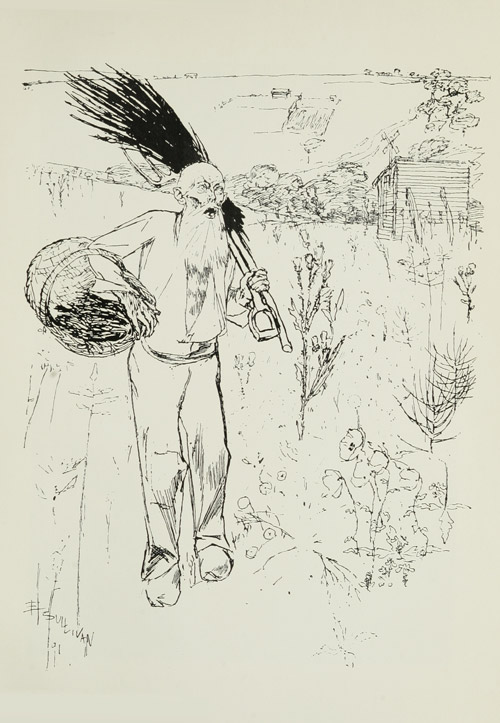
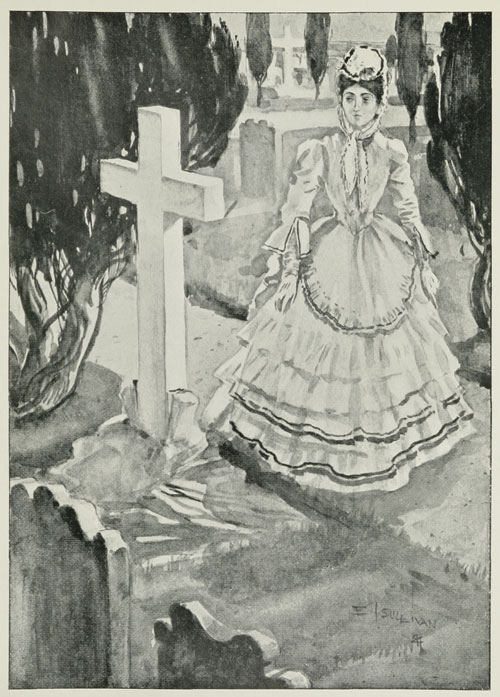
Two Drawings
By E. J. Sullivan
I. The Old Man's Garden
II. The Quick and the Dead
My Study
By Alfred Hayes
Let others strive for wealth or praise Who care to win; I count myself full blest, if He, Who made my study fair to see, Grant me but length of quiet days To muse therein. Its walls, with peach and cherry clad, From yonder wold Unbosomed, seem as if thereon September sunbeams ever shone; They make the air look warm and glad When winds are cold. Around its door a clematis Her arms doth tie; Through leafy lattices I view Its endless corridors of blue Curtained with clouds; its ceiling is The marbled sky. A verdant carpet smoothly laid Doth oft invite My silent steps; thereon the sun With silver thread of dew hath spun Devices rare—the warp of shade, The weft of light. Here dwell my chosen books, whose leaves With healing breath The ache of discontent assuage, And speak from each illumined page The patience that my soul reprieves From inward death; Some perish with a season's wind, And some endure; One robes itself in snow, and one In raiment of the rising sun Bordered with gold; in all I find God's signature. As on my grassy couch I lie, From hedge and tree Musicians pipe; or if the heat Subdue the birds, one crooneth sweet Whose labour is a lullaby— The slumbrous bee. The sun my work doth overlook With searching light; The serious moon, the flickering star, My midnight lamp and candle are; A soul unhardened is the book Wherein I write. There labouring, my heart is eased Of every care; Yet often wonderstruck I stand, With earnest gaze but idle hand, Abashed—for God Himself is pleased To labour there. Ashamed my faultful task to spell, I watch how grows The Master's perfect colour-scheme Of sunset, or His simpler dream Of moonlight, or that miracle We name a rose. Dear Earth, one thought alone doth grieve— The tender dread Of parting from thee; as a child, Who painted while his father smiled, Then watched him paint, is loth to leave And go to bed.
A Reminiscence of The Transgressor
By Francis Forster
A Letter to the Editor
From Max Beerbohm
Dear Sir,—When The Yellow Book appeared I was in Oxford. So literary a little town is Oxford that its undergraduates see a newspaper nearly as seldom as the Venetians see a horse, and until yesterday, when coming to London, I found in the album of a friend certain newspaper cuttings, I had not known how great was the wrath of the pressmen.
What in the whole volume seems to have provoked the most ungovernable fury is, I am sorry to say, an essay about Cosmetics that I myself wrote. Of this it was impossible for anyone to speak calmly. The mob lost its head, and, so far as anyone in literature can be lynched, I was. In speaking of me, one paper dropped the usual prefix of Mr. as though I were a well-known criminal, and referred to me shortly as Beerbohm; a second allowed me the Mr. but urged that a short Act of Parliament should be passed to make this kind of thing illegal; a third suggested, rather tamely, that I should read one of Mr. William Watson's sonnets. More than one comic paper had a very serious poem about me, and a known adherent to the humour which, forest-like, is called new, declared my essay to be the rankest and most nauseous thing in all literature. It was a bomb thrown by a cowardly decadent, another outrage by one of that desperate and dangerous band of madmen who must be mercilessly stamped out by a comity of editors. May I, Sir, in justice to myself and to you, who were gravely censured for harbouring me, step forward, and assure the affrighted mob that it is the victim of a hoax? May I also assure it that I had no notion that it would be taken in? Indeed, it seems incredible to me that any one on the face of the earth could fail to see that my essay, so grotesque in subject, in opinion so flippant, in style so wildly affected, was meant for a burlesque upon the precious school of writers. If I had only signed myself D. Cadent or Parrar Docks, or appended a note to say that the MS. had been picked up not a hundred miles from Tite Street, all the pressmen would have said that I had given them a very delicate bit of satire. But I did not. And hinc, as they themselves love to say, illæ lacrimæ.
After all, I think it is a sound rule that a writer should not kick his critics. I simply wish to make them a friendly philosophical suggestion. It seems to be thought that criticism holds in the artistic world much the same place as, in the moral world, is held by punishment—the vengeance taken by the majority upon such as exceed the limits of conduct imposed by that majority. As in the case of punishment, then, we must consider the effect produced by criticism upon its object, how far is it reformatory? Personally, I cannot conceive how any artist can be hurt by remarks dropped from a garret into a gutter. Yet it is incontestable that many an illustrious artist has so been hurt. And these very remarks, so far from making him change or temper his method, have rather made that method intenser, have driven him to retire further within his own soul, by showing him how little he may hope for from the world but insult and ingratitude.
In fact, the police-constable mode of criticism is a failure. True that, here and there, much beautiful work of the kind has been done. In the old, old Quarterlies is many a slashing review, that, however absurd it be as criticism, we can hardly wish unwritten. In the National Observer, before its reformation, were countless fine examples of the cavilling method. The paper was rowdy, venomous and insincere. There was libel in every line of it. It roared with the lambs and bleated with the lions. It was a disgrace to journalism and a glory to literature. I think of it often with tears and desiderium. But the men who wrote these things stand upon a very different plane to the men employed as critics by the press of Great Britain. These must be judged, not by their workmanship, which is naught, but by the spirit that animates them and the consequence of their efforts. If only they could learn that it is for the critic to seek after beauty and to try to interpret it to others, if only they would give over their eternal fault-finding and not presume to interfere with the artist at his work, then with an equally small amount of ability our pressmen might do nearly as much good as they have hitherto done harm. Why should they regard writers with such enmity? The average pressman, reviewing a book of stories or of poems by an unknown writer, seems not to think where are the beauties of this work that I may praise them, and by my praise quicken the sense of beauty in others? He steadily applies himself to the ignoble task of plucking out and gloating over its defects. It is a pity that critics should show so little sympathy with writers, and curious when we consider that most of them tried to be writers themselves, once. Every new school that has come into the world, every new writer who has brought with him a new mode, they have rudely persecuted. The dulness of Ibsen, the obscurity of Meredith, the horrors of Zola—all these are household words. It is not until the pack has yelled itself hoarse that the level voice of justice is heard in praise. To pretend that no generation is capable of gauging the greatness of its own artists is the merest bauble-tit. Were it not for the accursed abuse of their function by the great body of critics, no poet need live uncrown'd, apart. Many and irreparable are the wrongs that our critics have done. At length let them repent with ashes upon their heads. Where they see not beauty, let them be silent, reverently feeling that it may yet be there, and train their dull senses in quest of it.
Now is a good time for such penance. There are signs that our English literature has reached that point, when, like the literatures of all the nations that have been, it must fall at length into the hands of the decadents. The qualities that I tried in my essay to travesty—paradox and marivaudage, lassitude, a love of horror and all unusual things, a love of argot and archaism and the mysteries of style—are not all these displayed, some by one, some by another of les jeunes écrivains? Who knows but that Artifice is in truth at our gates and that soon she may pass through our streets? Already the windows of Grub Street are crowded with watchful, evil faces. They are ready, the men of Grub Street, to pelt her, as they have pelted all that came before her. Let them come down while there is still time, and hang their houses with colours, and strew the road with flowers. Will they not, for once, do homage to a new queen? By the time this letter appears, it may be too late!
Meanwhile, Sir, I am, your obedient servant,
MAX BEERBOHM.
Oxford, May '94.
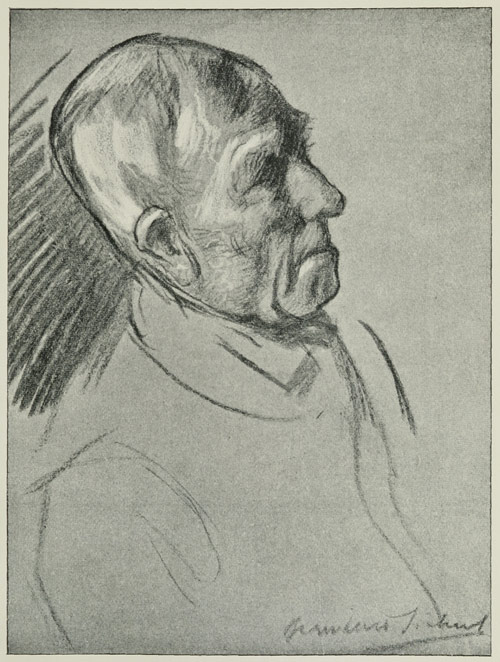
A Study
By Bernhard Sickert
EPIGRAM
TO A LADY RECOVERED FROM A DANGEROUS SICKNESS
Life plucks thee back as by the golden hair— Life, who had feigned to let thee go but now. Wealthy is Death already, and can spare Ev'n such a prey as thou.
WILLIAM WATSON
The Coxon Fund
By Henry James
I
"
They've got him for life!" I said to myself that evening on my way back to the station; but later, alone in the compartment (from Wimbledon to Waterloo, before the glory of the District Railway), I amended this declaration in the light of the sense that my friends would probably after all not enjoy a monopoly of Mr. Saltram. I won't pretend to have taken his vast measure on that first occasion; but I think I had achieved a glimpse of what the privilege of his acquaintance might mean for many persons in the way of charges accepted. He had been a great experience, and it was this perhaps that had put me into a frame for divining that we should all have the honour, sooner or later, of dealing with him as a whole. Whatever impression I then received of the amount of this total, I had a full enough vision of the patience of the Mulvilles. He was staying with them for the winter; Adelaide dropped it in a tone which drew the sting from the temporary. These excellent people might indeed have been content to give the circle of hospitality a diameter of six months; but if they didn't say that he was staying for the summer as well it was only because this was more than they ventured to hope. I remember that at dinner that evening he wore slippers, new and predominantly purple, of some queer carpet-stuff; but the Mulvilles were still in the stage of supposing that he might be snatched from them by higher bidders. At a later time they grew, poor dears, to fear no snatching; but theirs was a fidelity which needed no help from competition to make them proud. Wonderful indeed as, when all was said, you inevitably pronounced Frank Saltram, it was not to be overlooked that the Kent Mulvilles were in their way still more extraordinary; as striking an instance as could easily be encountered of the familiar truth that remarkable men find remarkable conveniences.
They had sent for me from Wimbledon to come out and dine, and there had been an implication in Adelaide's note (judged by her notes alone she might have been thought silly), that it was a case in which something momentous was to be determined or done. I had never known them not to be in a state about somebody, and I daresay I tried to be droll on this point in accepting their invitation. On finding myself in the presence of their latest revelation I had not at first felt irreverence droop—and, thank heaven, I have never been absolutely deprived of that alternative in Mr. Saltram's company. I saw, however (I hasten to declare it), that compared to this specimen their other phœnixes had been birds of inconsiderable feather, and I afterwards took credit to myself for not having even in primal bewilderments made a mistake about the essence of the man. He had an incomparable gift; I never was blind to it—it dazzles me at present. It dazzles me perhaps even more in remembrance than in fact, for I'm not unaware that for a subject so magnificent the imagination goes to some expense, inserting a jewel here and there or giving a twist to a plume. How the art of portraiture would rejoice in this figure if the art of portraiture had only the canvas! Nature, however, had really rounded it, and if memory, hovering about it, sometimes holds her breath, this is because the voice that comes back was really golden.
Though the great man was an inmate and didn't dress he kept dinner on this occasion waiting long, and the first words he uttered on coming into the room were a triumphant announcement to Mulville that he had found out something. Not catching the allusion and gaping doubtless a little at his face, I privately asked Adelaide what he had found out. I shall never forget the look she gave me as she replied: Everything! She really believed it. At that moment, at any rate, he had found out that the mercy of the Mulvilles was infinite. He had previously of course discovered, as I had myself for that matter, that their dinners were soignés. Let me not indeed, in saying this, neglect to declare that I shall falsify my counterfeit if I seem to hint that there was in his nature any ounce of calculation. He took whatever came, but he never plotted for it, and no man who was so much of an absorbent can ever have been so little of a parasite. He had a system of the universe, but he had no system of sponging—that was quite hand to mouth. He had fine, gross, easy senses, but it was not his good-natured appetite that wrought confusion. If he had loved us for our dinners we could have paid with our dinners, and it would have been a great economy of finer matter. I make free in these connections with the plural possessive because, if I was never able to do what the Mulvilles did, and people with still bigger houses and simpler charities, I met, first and last, every demand of reflection, of emotion—particularly perhaps those of gratitude and of resentment. No one, I think, paid the tribute of giving him up so often, and if it's rendering honour to borrow wisdom I have a right to talk of my sacrifices. He yielded lessons as the sea yields fish—I lived for a while on this diet. Sometimes it almost appeared to me that his massive, monstrous failure—if failure after all it was—had been intended for my private recreation. He fairly pampered my curiosity; but the history of that experience would take me too far. This is not the large canvas I just now spoke of, and I would not have approached him with my present hand had it been a question of all the features. Frank Saltram's features, for artistic purposes, are verily the anecdotes that are to be gathered. Their name is legion, and this is only one, of which the interest is that it concerns even more closely several other persons. Such episodes, as one looks back, are the little dramas that made up the innumerable facets of the big drama—which is yet to be reported.
II
It is furthermore remarkable that though the two stories are distinct—my own, as it were, and this other, they equally began, in a manner, the first night of my acquaintance with Frank Saltram, the night I came back from Wimbledon so agitated with a new sense of life that, in London, for the very thrill of it, I could only walk home. Walking and swinging my stick, I overtook, at Buckingham Gate, George Gravener, and George Gravener's story may be said to have begun with my making him, as our paths lay together, come home with me for a talk. I duly remember, let me parenthesise, that it was still more that or another person, and also that several years were to elapse before it was to extend to a second chapter. I had much to say to him, none the less, about my visit to the Mulvilles, whom he more indifferently knew, and I was at any rate so amusing that for long afterwards he never encountered me without asking for news of the old man of the sea. I hadn't said Mr. Saltram was old, and it was to be seen that he was of an age to outweather George Gravener. I had at that time a lodging in Ebury Street, and Gravener was staying at his brother's empty house in Eaton Square. At Cambridge, five years before, even in our devastating set, his intellectual power had seemed to me almost awful. Some one had once asked me privately, with blanched cheeks, what it was then that after all such a mind as that left standing. It leaves itself! I could recollect devoutly replying. I could smile at present at this reminiscence, for even before we got to Ebury Street I was struck with the fact that, save in the sense of being well set up on his legs, George Gravener had actually ceased to tower. The universe he laid low had somehow bloomed again—the usual eminences were visible. I wondered whether he had lost his humour, or only, dreadful thought, had never had any—not even when I had fancied him most Aristophanesque. What was the need of appealing to laughter, however, I could enviously inquire, where you might appeal so confidently to measurement? Mr. Saltram's queer figure, his thick nose and hanging lip were fresh to me: in the light of my old friend's fine cold symmetry they presented mere success in amusing as the refuge of conscious ugliness. Already, at hungry twenty-six, Gravener looked as blank and parliamentary as if he were fifty and popular. In my scrap of a residence (he had a wordling's eye for its futile conveniences, but never a comrade's joke), I sounded Frank Saltram in his ears; a circumstance I mention in order to note that even then I was surprised at his impatience of my enlivenment. As he had never before heard of the personage, it took indeed the form of impatience of the preposterous Mulvilles, his relation to whom, like mine, had had its origin in an early, a childish intimacy with the young Adelaide, the fruit of multiplied ties in the previous generation. When she married Kent Mulville, who was older than Gravener and I, and much more amiable, I gained a friend, but Gravener practically lost one. We were affected in different ways by the form taken by what he called their deplorable social action—the form (the term was also his) of nasty second-rate gush. I may have held in my for intérieur that the good people at Wimbledon were beautiful fools, but when he sniffed at them I couldn't help taking the opposite line, for I already felt that even should we happen to agree it would always be for reasons that differed. It came home to me that he was admirably British as, without so much as a sociable sneer at my bookbinder, he turned away from the serried rows of my little French library.
Of course I've never seen the fellow, but it's clear enough he's a humbug.
Clear enough is just what it isn't, I replied: if it only were! That ejaculation on my part must have been the beginning of what was to be later a long ache for final frivolous rest. Gravener was profound enough to remark after a moment that in the first place he couldn't be anything but a Dissenter, and when I answered that the very note of his fascination was his extraordinary speculative breadth he retorted that there was no cad like your cultivated cad and that I might depend upon discovering (since I had had the levity not already to have inquired), that my shining light proceeded, a generation back, from a Methodist cheesemonger. I confess I was struck with his insistence, and I said, after reflection: It may be—I admit it may be; but why on earth are you so sure?—asking the question mainly to lay him the trap of saying that it was because the poor man didn't dress for dinner. He took an instant to dodge my trap and come blandly out the other side.
Because the Kent Mulvilles have invented him. They've an infallible hand for frauds. All their geese are swans. They were born to be duped, they like it, they cry for it, they don't know anything from anything, and they disgust one (luckily perhaps!) with Christian charity. His intensity was doubtless an accident, but it might have been a strange foreknowledge. I forget what protest I dropped; it was at any rate something which led him to go on after a moment: I only ask one thing—it's perfectly simple. Is a man, in a given case, a real gentleman?
A real gentleman, my dear fellow—that's so soon said!
Not so soon when he isn't! If they've got hold of one this time he must be a great rascal!
I might feel injured, I answered, if I didn't reflect that they don't rave about me.
Don't be too sure! I'll grant that he's a gentleman, Gravener presently added, if you'll admit that he's a scamp.
I don't know which to admire most, your logic or your benevolence.
My friend coloured at this, but he didn't change the subject. Where did they pick him up?
I think they were struck with something he had published.
I can fancy the dreary thing!
I believe they found out he had all sorts of worries and difficulties.
That, of course, was not to be endured, and they jumped at the privilege of paying his debts! I replied that I knew nothing about his debts, and I reminded my visitor that though the dear Mulvilles were angels they were neither idiots nor millionaires. What they mainly aimed at was re-uniting Mr. Saltram to his wife. I was expecting to hear that he has basely abandoned her, Gravener went on, at this, and I'm too glad you don't disappoint me.
I tried to recall exactly what Mrs. Mulville had told me. He didn't leave her—no. It's she who has left him.
Left him to us? Gravener asked. The monster—many thanks! I decline to take him.
You'll hear more about him in spite of yourself. I can't, no, I really can't, resist the impression that he's a big man. I was already learning—to my shame perhaps be it said—just the tone that my old friend least liked.
It's doubtless only a trifle, he returned, but you haven't happened to mention what his reputation's to rest on.
Why, on what I began by boring you with—his extraordinary mind.
As exhibited in his writings?
Possibly in his writings, but certainly in his talk, which is far and away the richest I ever listened to.
And what is it all about?
My dear fellow, don't ask me! About everything! I pursued, reminding myself of poor Adelaide. About his idea of things, I then more charitably added. You must have heard him to know what I mean—it's unlike anything that ever was heard. I coloured, I admit, I overcharged a little, for such a picture was an anticipation of Saltram's later development and still more of my fuller acquaintance with him. However, I really expressed, a little lyrically perhaps, my actual imagination of him when I proceeded to declare that, in a cloud of tradition, of legend, he might very well go down to posterity as the greatest of all great talkers. Before we parted George Gravener demanded why such a row should be made about a chatterbox the more and why he should be pampered and pensioned. The greater the windbag the greater the calamity. Out of proportion to all other movements on earth had come to be this wagging of the tongue. We were drenched with talk—our wretched age was dying of it. I differed from him here sincerely, only going so far as to concede, and gladly, that we were drenched with sound. It was not, however, the mere speakers who were killing us—it was the mere stammerers. Fine talk was as rare as it was refreshing—the gift of the gods themselves, the one starry spangle on the ragged cloak of humanity. How many men were there who rose to this privilege, of how many masters of conversation could he boast the acquaintance? Dying of talk?—why, we were dying of the lack of it! Bad writing wasn't talk, as many people seemed to think, and even good wasn't always to be compared to it. From the best talk, indeed, the best writing had something to learn. I fancifully added that we too should peradventure be gilded by the legend, should be pointed at for having listened, for having actually heard. Gravener, who had looked at his watch and discovered it was midnight, found to all this a response beautifully characteristic of him.
There is one little sovereign circumstance, he remarked, which is common to the best talk and the worst. He looked at this moment as if he meant so much that I thought he could only mean once more that neither of them mattered if a man wasn't a real gentleman. Perhaps it was what he did mean; he deprived me, however, of the exultation of being right by putting the truth in a slightly different way. The only thing that really counts for one's estimate of a person is his conduct. He had his watch still in his hand, and I reproached him with unfair play in having ascertained beforehand that it was now the hour at which I always gave in. My pleasantry so far failed to mollify him as that he presently added that to the rule he had just enunciated there was absolutely no exception.
None whatever?
None whatever.
Trust me then to try to be good at any price! I laughed as I went with him to the door. I declare I will be, if I have to be horrible!
III
If that first night was one of the liveliest, or at any rate was the freshest, of my exaltation, there was another, four years later, that was one of my great discomposures. Repetition, I well knew by this time, was the secret of Saltram's power to alienate, and of course one would never have seen him at his finest if one hadn't seen him in his remorses. They set in mainly at this season and were magnificent, orchestral. I was perfectly aware that one of these great sweeps was now gathering; but none the less, in our arduous attempt to set him on his feet as a lecturer, it was impossible not to feel that two failures were a large order, as we said, for a short course of five. This was the second time, and it was past nine o'clock; the audience, a muster unprecedented and really encouraging, had fortunately the attitude of blandness that might have been looked for in persons whom the promise (if I am not mistaken) of an Analysis of Primary Ideas had drawn to the neighbourhood of Upper Baker Street. There was in those days in that region a petty lecture-hall to be secured on terms as moderate as the funds left at our disposal by the irrepressible question of the maintenance of five small Saltrams (I include the mother) and one large one. By the time the Saltrams, of different sizes, were all maintained, we had pretty well poured out the oil that might have lubricated the machinery for enabling the most original of men to appear to maintain them.
It was I, the other time, who had been forced into the breach, standing up there, for an odious lamplit moment to explain to half-a-dozen thin benches, where the earnest brows were virtuously void of guesses, that we couldn't put so much as a finger on Mr. Saltram. There was nothing to plead but that our scouts had been out from the early hours and that we were afraid that on one of his walks abroad—he took one, for meditation, whenever he was to address such a company—some accident had disabled or delayed him. The meditative walks were a fiction, for he never, that anyone could discover, prepared anything but a magnificent prospectus; so that his circulars and programmes, of which I possess an almost complete collection, are as the solemn ghosts of generations never born. I put the case, as it seemed to me, at the best; but I admit I had been angry, and Kent Mulville was shocked at my want of attenuation. This time therefore I left the excuses to his more practised patience, only relieving myself in response to a direct appeal from a young lady next whom, in the hall, I found myself sitting. My position was an accident, but if it had been calculated the reason would scarcely have eluded an observer of the fact that no one else in the room had an appearance so charming. I think indeed she was the only person there who looked at her ease, who had come a little in the spirit of adventure. She seemed to carry amusement in her handsome young head, and her presence quite gave me the sense of a sudden extension of Saltram's sphere of influence. He was doing better than we hoped and he had chosen this occasion, of all occasions, to succumb to heaven knew which of his infirmities. The young lady produced an impression of auburn hair and black velvet, and had on her other hand a companion of obscurer type, presumably a waiting-maid. She herself might perhaps have been a foreign countess, and before she spoke to me I had beguiled our sorry interval by thinking that she brought vaguely back the first page of some novel of Madame Sand. It didn't make her more fathomable to perceive in a few minutes that she could only be an American; it simply engendered depressing reflections as to the possible check to contributions from Boston. She asked me if, as a person apparently more initiated, I would recommend further waiting, and I replied that if she considered I was on my honour I would privately deprecate it. Perhaps she didn't; at any rate something passed between us that led us to talk until she became aware that we were almost the only people left. I presently discovered that she knew Mrs. Saltram, and this explained in a manner the miracle. The brotherhood of the friends of the husband were as nothing to the brotherhood, or perhaps I should say the sisterhood, of the friends of the wife. Like the Kent Mulvilles I belonged to both fraternities, and even better than they I think I had sounded the dark abyss of Mrs. Saltram's wrongs. She bored me to extinction, and I knew but too well how she had bored her husband; but she had her partisans, the most inveterate of whom were indeed the handful of poor Saltram's backers. They did her liberal justice, whereas her peculiar comforters had nothing but hatred for our philosopher. I am bound to say it was we, however—we of both camps, as it were—who had always done most for her.
I thought my young lady looked rich—I scarcely knew why; and I hoped she had put her hand in her pocket. But I soon discovered that she was not a partisan—she was only a generous, irresponsible inquirer. She had come to England to see her aunt, and it was at her aunt's she had met the dreary lady we had all so much on our minds. I saw she would help to pass the time when she observed that it was a pity this lady wasn't intrinsically more interesting. That was refreshing, for it was an article of faith in Mrs. Saltram's circle—at least among those who scorned to know her horrid husband—that she was attractive on her merits. She was really a very common person, as Saltram himself would have been if he hadn't been a prodigy. The question of vulgarity had no application to him, but it was a measure that his wife kept challenging you to apply to her. I hasten to add that the consequences of your doing so were no sufficient reason for his having left her to starve. He doesn't seem to have much force of character, said my young lady; at which I laughed out so loud that my departing friends looked back at me over their shoulders as if I were making a joke of their discomfiture. My joke probably cost Saltram a subscription or two, but it helped me on with my interlocutress. She says he drinks like a fish, she sociably continued, and yet she admits that his mind is wonderfully clear. It was amusing to converse with a pretty girl who could talk of the clearness of Saltram's mind. I tried to tell her—I had it almost on my conscience—what was the proper way to regard him; an effort attended perhaps more than ever on this occasion with the usual effect of my feeling that I wasn't after all very sure of it. She had come to-night out of high curiosity—she had wanted to find out this proper way for herself. She had read some of his papers and hadn't understood them; but it was at home, at her aunt's, that her curiosity had been kindled—kindled mainly by his wife's remarkable stories of his want of virtue. I suppose they ought to have kept me away, my companion dropped, and I suppose they would have done so if I hadn't somehow got an idea that he's fascinating. In fact Mrs. Saltram herself says he is.
So you came to see where the fascination resides? Well, you've seen!
My young lady raised her fine eyebrows. Do you mean in his bad faith?
In the extraordinary effects of it; his possession, that is, of some quality or other that condemns us in advance to forgive him the humiliation, as I may call it, to which he has subjected us.
The humiliation?
Why mine, for instance, as one of his guarantors, before you as the purchaser of a ticket.
You don't look humiliated a bit, and if you did I should let you off, disappointed as I am; for the mysterious quality you speak of is just the quality I came to see.
Oh, you can't see it! I exclaimed.
How then do you get at it?
You don't! You mustn't suppose he's good-looking, I added.
Why, his wife says he is!
My hilarity may have struck my interlocutress as excessive, but I confess it broke out afresh. Had she acted only in obedience to this singular plea, so characteristic, on Mrs. Saltram's part, of what was irritating in the narrowness of that lady's point of view? Mrs. Saltram, I explained, undervalues him where he is strongest, so that, to make up for it perhaps, she overpraises him where he's weak. He's not, assuredly, superficially attractive; he's middle-aged, fat, featureless save for his great eyes.
Yes, his great eyes, said my young lady attentively. She had evidently heard all about them.
They're tragic and splendid—lights on a dangerous coast. But he moves badly and dresses worse, and altogether he's strange to behold.
My companion appeared to reflect on this, and after a moment she inquired: Do you call him a real gentleman?
I started slightly at the question, for I had a sense of recognising it: George Gravener, years before that first flushed night, had put me face to face with it. It had embarrassed me then, but it didn't embarrass me now, for I had lived with it and overcome it and disposed of it. A real gentleman? Decidedly not!
My promptitude surprised her a little, but I quickly felt that it was not to Gravener I was now talking. Do you say that because he's—what do you call it in England?—of humble extraction?
Not a bit. His father was a country schoolmaster and his mother the widow of a sexton, but that has nothing to do with it. I say it simply because I know him well.
But isn't it an awful drawback?
Awful—quite awful.
I mean, isn't it positively fatal?
Fatal to what? Not to his magnificent vitality.
Again there was a meditative moment. And is his magnificent vitality the cause of his vices?
Your questions are formidable, but I'm glad you put them. I was thinking of his noble intellect. His vices, as you say, have been much exaggerated: they consist mainly after all in one comprehensive misfortune.
A want of will?
A want of dignity.
He doesn't recognise his obligations?
On the contrary, he recognises them with effusion, especially in public: he smiles and bows and beckons across the street to them. But when they pass over he turns away, and he speedily loses them in the crowd. The recognition is purely spiritual—it isn't in the least social. So he leaves all his belongings to other people to take care of. He accepts favours, loans, sacrifices, with nothing more restrictive than an agony of shame. Fortunately we're a little faithful band, and we do what we can. I held my tongue about the natural children, engendered, to the number of three, in the wantonness of his youth. I only remarked that he did make efforts—often tremendous ones. But the efforts, I said, never come to much; the only things that come to much are the abandonments, the surrenders.
And how much do they come to?
I've told you before that your questions are terrible! They come, these mere exercises of genius, to a great body of poetry, of philosophy, a notable mass of speculation, of discovery. The genius is there, you see, to meet the surrender; but there's no genius to support the defence.
But what is there, after all, at his age, to show?
In the way of achievement recognised and reputation established? I interrupted. To 'show' if you will, there isn't much, for his writing, mostly, isn't as fine as his talk. Moreover, two-thirds of his work are merely colossal projects and announcements. 'Showing' Frank Saltram is often a poor business; we endeavoured, you will have observed, to show him to-night! However, if he had lectured, he would have lectured divinely. It would just have been his talk.
And what would his talk just have been?
I was conscious of some ineffectiveness as well perhaps as of a little impatience as I replied: The exhibition of a splendid intellect. My young lady looked not quite satisfied at this, but as I was not prepared for another question I hastily pursued: The sight of a great suspended, swinging crystal, huge, lucid, lustrous, a block of light, flashing back every impression of life and every possibility of thought! This gave her something to think about till we had passed out to the dusky porch of the hall, in front of which the lamps of a quiet brougham were almost the only thing Saltram's treachery hadn't extinguished. I went with her to the door of her carriage, out of which she leaned a moment after she had thanked me and taken her seat. Her smile even in the darkness was pretty. I do want to see that crystal!
You've only to come to the next lecture.
I go abroad in a day or two with my aunt.
Wait over till next week, I suggested. It's worth it.
She became grave. Not unless he really comes! At which the brougham started off, carrying her away too fast, fortunately for my manners, to allow me to exclaim Ingratitude!
IV
Mrs. Saltram made a great affair of her right to be informed where her husband had been the second evening he failed to meet his audience. She came to me to ascertain, but I couldn't satisfy her, for in spite of my ingenuity I remained in ignorance. It was not till much later that I found this had not been the case with Kent Mulville, whose hope for the best never twirled its thumbs more placidly than when he happened to know the worst. He had known it on the occasion I speak of—that is immediately after. He was impenetrable then, but he ultimately confessed—more than I shall venture to confess to-day. It was of course familiar to me that Saltram was incapable of keeping the engagements which, after their separation, he had entered into with regard to his wife, a deeply wronged, justly resentful, quite irreproachable and insufferable person. She often appeared at my chambers to talk over his lacunæ, for if, as she declared, she had washed her hands of him, she had carefully preserved the water of this ablution and she handed it about for inspection. She had arts of her own of exciting one's impatience, the most infallible of which was perhaps her assumption that we were kind to her because we liked her. In reality her personal fall had been a sort of social rise, for there had been a moment when, in our little conscientious circle, her desolation almost made her the fashion. Her voice was grating and her children ugly; moreover she hated the good Mulvilles, whom I more and more loved. They were the people who by doing most for her husband had in the long run done most for herself; and the warm confidence with which he had laid his length upon them was a pressure gentle compared with her stiffer persuadability. I am bound to say he didn't criticise his benefactors, though practically he got tired of them; she, however, had the highest standards about eleemosynary forms. She offered the odd spectacle of a spirit puffed up by dependence, and indeed it had introduced her to some excellent society. She pitied me for not knowing certain people who aided her and whom she doubtless patronised in turn for their luck in not knowing me. I daresay I should have got on with her better if she had had a ray of imagination—if it had occasionally seemed to occur to her to regard Saltram's manifestations in any other manner than as separate subjects of woe. They were all flowers of his nature, pearls strung on an endless thread; but she had a stubborn little way of challenging them one after the other, as if she never suspected that he had a nature, such as it was, or that deficiencies might be organic; the irritating effect of a mind incapable of a generalisation. One might doubtless have overdone the idea that there was a general exemption for such a man; but if this had happened it would have been through one's feeling that there could be none for such a woman.
I recognised her superiority when I asked her about the aunt of the disappointed young lady: it sounded like a sentence from a phrase-book. She triumphed in what she told me and she may have triumphed still more in what she withheld. My friend of the other evening, Miss Anvoy, had but lately come to England; Lady Coxon, the aunt, had been established here for years in consequence of her marriage with the late Sir Gregory of that ilk. She had a house in the Regent's Park and a Bath-chair and a page; and above all she had sympathy. Mrs. Saltram had made her acquaintance through mutual friends. This vagueness caused me to feel how much I was out of it and how large an independent circle Mrs. Saltram had at her command. I should have been glad to know more about the charming Miss Anvoy, but I felt that I should know most by not depriving her of her advantage, as she might have mysterious means of depriving me of my knowledge. For the present, moreover, this experience was arrested, Lady Coxon having in fact gone abroad, accompanied by her niece. The niece, besides being immensely clever, was an heiress, Mrs. Saltram said; the only daughter and the light of the eyes of some great American merchant, a man, over there, of endless indulgences and dollars. She had pretty clothes and pretty manners, and she had, what was prettier still, the great thing of all. The great thing of all for Mrs. Saltram was always sympathy, and she spoke as if during the absence of these ladies she might not know where to turn for it. A few months later indeed, when they had come back, her tone perceptibly changed: she alluded to them, on my leading her up to it, rather as to persons in her debt for favours received. What had happened I didn't know, but I saw it would take only a little more or a little less to make her speak of them as thankless subjects of social countenance—people for whom she had vainly tried to do something. I confess I saw that it would not be in a mere week or two that I should rid myself of the image of Ruth Anvoy, in whose very name, when I learnt it, I found something secretly to like. I should probably neither see her nor hear of her again: the knight's widow (he had been mayor of Clockborough) would pass away, and the heiress would return to her inheritance. I gathered with surprise that she had not communicated to his wife the story of her attempt to hear Mr. Saltram, and I founded this reticence on the easy supposition that Mrs. Saltram had fatigued by over-pressure the spring of the sympathy of which she boasted. The girl at any rate would forget the small adventure, be distracted, take a husband; besides which she would lack opportunity to repeat her experiment.
We clung to the idea of the brilliant course, delivered without a tumble, that, as a lecturer, would still make the paying public aware of our great mind; but the fact remained that in the case of an inspiration so unequal there was treachery, there was fallacy at least, in the very conception of a series. In our scrutiny of ways and means we were inevitably subject to the old convention of the synopsis, the syllabus, partly of course not to lose the advantage of his grand free hand in drawing up such things; but for myself I laughed at our categories even while I stickled for them. It was indeed amusing work to be scrupulous for Frank Saltram, who also at moments laughed about it, so far as the rise and fall of a luxurious sigh might pass for such a sound. He admitted with a candour all his own that he was in truth only to be depended on in the Mulvilles' drawing-room. Yes, he suggestively conceded, it's there, I think, that I am at my best; quite late, when it gets toward eleven—and if I've not been too much worried. We all knew what too much worry meant; it meant too enslaved for the hour to the superstition of sobriety. On the Saturdays I used to bring my portmanteau, so as not to have to think of eleven o'clock trains. I had a bold theory that as regards this temple of talk and its altars of cushioned chintz, its pictures and its flowers, its large fireside and clear lamplight, we might really arrive at something if the Mulvilles would only charge for admission. But here it was that the Mulvilles shamelessly broke down; as there is a flaw in every perfection, this was the inexpugnable refuge of their egotism. They declined to make their saloon a market, so that Saltram's golden words continued to be the only coin that rang there. It can have happened to no man, however, to be paid a greater price than such an enchanted hush as surrounded him on his greatest nights. The most profane, on these occasions, felt a presence; all minor eloquence grew dumb. Adelaide Mulville, for the pride of her hospitality, anxiously watched the door or stealthily poked the fire. I used to call it the music-room, for we had anticipated Bayreuth. The very gates of the kingdom of light seemed to open and the horizon of thought to flash with the beauty of a sunrise at sea.
In the consideration of ways and means, the sittings of our little board, we were always conscious of the creak of Mrs. Saltram's shoes. She hovered, she interrupted, she almost presided, the state of affairs being mostly such as to supply her with every incentive for inquiring what was to be done next. It was the pressing pursuit of this knowledge that, in concatenations of omnibuses and usually in very wet weather, led her so often to my door. She thought us spiritless creatures with editors and publishers; but she carried matters to no great effect when she personally pushed into back-shops. She wanted all moneys to be paid to herself; they were otherwise liable to such strange adventures. They trickled away into the desert, and they were mainly at best, alas, but a slender stream. The editors and the publishers were the last people to take this remarkable thinker at the valuation that has now pretty well come to be established. The former were half distraught between the desire to cut him and the difficulty of finding a crevice for their shears; and when a volume on this or that portentous subject was proposed to the latter they suggested alternative titles which, as reported to our friend, brought into his face the noble blank melancholy that sometimes made it handsome. The title of an unwritten book didn't after all much matter, but some masterpiece of Saltram's may have died in his bosom of the shudder with which it was then convulsed. The ideal solution, failing the fee at Kent Mulville's door, would have been some system of subscription to projected treatises with their non-appearance provided for—provided for, I mean, by the indulgence of subscribers. The author's real misfortune was that subscribers were so wretchedly literal. When they tastelessly inquired why publication had not ensued I was tempted to ask who in the world had ever been so published. Nature herself had brought him out in voluminous form, and the money was simply a deposit on borrowing the work.
V
I was doubtless often a nuisance to my friends in those years; but there were sacrifices I declined to make, and I never passed the hat to George Gravener. I never forgot our little discussion in Ebury Street, and I think it stuck in my throat to have to make to him the admission I had made so easily to Miss Anvoy. It had cost me nothing to confide to this charming girl, but it would have cost me much to confide to the friend of my youth, that the character of the real gentleman was not an attribute of the man I took such pains for. Was this because I had already generalised to the point of perceiving that women are really the unfastidious sex? I knew at any rate that Gravener, already quite in view but still hungry and frugal, had naturally enough more ambition than charity. He had sharp aims for stray sovereigns, being in view most from the tall steeple of Clockborough. His immediate ambition was to wholly occupy the field of vision of that smokily-seeing city, and all his movements and postures were calculated at this angle. The movement of the hand to the pocket had thus to alternate gracefully with the posture of the hand on the heart. He talked to Clockborough in short only less beguilingly than Frank Saltram talked to his electors; with the difference in our favour, however, that we had already voted and that our candidate had no antagonist but himself. He had more than once been at Wimbledon—it was Mrs. Mulville's work, not mine—and, by the time the claret was served, had seen the god descend. He took more pains to swing his censer than I had expected, but on our way back to town he forestalled any little triumph I might have been so artless as to express by the observation that such a man was—a hundred times!—a man to use and never a man to be used by. I remember that this neat remark humiliated me almost as much as if virtually, in the fever of broken slumbers, I hadn't often made it myself. The difference was that on Gravener's part a force attached to it that could never attach to it on mine. He was able to use him in short, he had the machinery; and the irony of Saltram's being made showy at Clockborough came out to me when he said, as if he had no memory of our original talk and the idea were quite fresh to him: I hate his type, you know, but I'll be hanged if I don't put some of those things in. I can find a place for them: we might even find a place for the fellow himself. I myself should have had some fear, not, I need scarcely say, for the things themselves, but for some other things very near them—in fine for the rest of my eloquence.
Later on I could see that the oracle of Wimbledon was not in this case so serviceable as he would have been had the politics of the gods only coincided more exactly with those of the party. There was a distinct moment when, without saying anything more definite to me, Gravener entertained the idea of getting hold of Mr. Saltram. Such a project was factitious, for the discovery of analogies between his body of doctrine and that pressed from headquarters upon Clockborough—the bottling, in a word, of the air of those lungs for convenient public uncorking in corn-exchanges—was an experiment for which no one had the leisure. The only thing would have been to carry him massively about, paid, caged, clipped: to turn him on for a particular occasion in a particular channel. Frank Saltram's channel, however, was essentially not calculable, and there was no knowing what disastrous floods might have issued. For what there would have been to do The Empire, the great newspaper, was there to look to; but it was no new misfortune that there were delicate situations in which The Empire broke down. In fine there was an instinctive apprehension that a clever young journalist commissioned to report upon Mr. Saltram might never come back from the errand. No one knew better than George Gravener that that was a time when prompt returns counted double. If he therefore found our friend an exasperating waste of orthodoxy, it was because he was, as he said, up in the clouds; not because he was down in the dust. He would have been a real enough gentleman if he could have helped to put in a real gentleman. Gravener's great objection to the actual member was that he was not one.
Lady Coxon had a fine old house, a house with grounds, at Clockborough, which she had let; but after she returned from abroad I learned from Mrs. Saltram that the lease had fallen in and that she had gone down to resume possession. I could see the faded red livery, the big square shoulders, the high-walled garden of this decent abode. As the rumble of dissolution grew louder the suitor would have pressed his suit, and I found myself hoping that the politics of the late Mayor's widow would not be such as to enjoin upon her to ask him to dinner; perhaps indeed I went so far as to hope that they would be such as to put all countenance out of the question. I tried to focus the page, in the daily airing, as he perhaps even pushed the Bath-chair over somebody's toes. I was destined to hear, however, through Mrs. Saltram (who, I afterwards learned, was in correspondence with Lady Coxon's housekeeper), that Gravener was known to have spoken of the habitation I had in my eye as the pleasantest thing at Clockborough. On his part, I was sure, this was the voice not of envy but of experience. The vivid scene was now peopled, and I could see him in the old-time garden with Miss Anvoy, who would be certain, and very justly, to think him good-looking. It would be too much to say that I was troubled by such an image; but I seem to remember the relief, singular enough, of feeling it suddenly brushed away by an annoyance really much greater; an annoyance the result of its happening to come over me about that time with a rush that I was simply ashamed of Frank Saltram. There were limits after all, and my mark at last had been reached.
I had had my disgusts, if I may allow myself to-day such an expression; but this was a supreme revolt. Certain things cleared up in my mind, certain values stood out. It was all very well to talk of an unfortunate temperament; there were misfortunes that people should themselves correct, and correct in private, without calling in assistance. I avoided George Gravener at this moment, and reflected that at such a time I should do so most effectually by leaving England. I wanted to forget Frank Saltram—that was all. I didn't want to do anything in the world to him but that. Indignation had withered on the stalk, and I felt that one could pity him as much as one ought only by never thinking of him again. It wasn't for anything he had done to me; it was for something he had done to the Mulvilles. Adelaide cried about it for a week, and her husband, profiting by the example so signally given him of the fatal effect of a want of character, left the letter unanswered. The letter, an incredible one, addressed by Saltram to Wimbledon during a stay with the Pudneys at Ramsgate, was the central feature of the incident, which, however, had many features, each more painful than whichever other we compared it with. The Pudneys had behaved shockingly, but that was no excuse. Base ingratitude, gross indecency—one had one's choice only of such formulas as that the more they fitted the less they gave one rest. These are dead aches now, and I am under no obligation, thank heaven, to be definite about the business. There are things which if I had had to tell them—well, I wouldn't have told my story.
I went abroad for the general election, and if I don't know how much, on the Continent, I forgot, I at least know how much I missed, him. At a distance, in a foreign land, ignoring, abjuring, unlearning him, I discovered what he had done for me. I owed him, oh unmistakably, certain noble conceptions; I had lighted my little taper at his smoky lamp, and lo, it continued to twinkle. But the light it gave me just showed me how much more I wanted. I was pursued of course by letters from Mrs. Saltram, which I didn't scruple not to read, though I was duly conscious that her embarrassments would now be of the gravest. I sacrificed to propriety by simply putting them away, and this is how, one day as my absence drew to an end, my eye, as I rummaged in my desk for another paper, was caught by a name on a leaf that had detached itself from the packet. The allusion was to Miss Anvoy, who, it appeared, was engaged to be married to Mr. George Gravener; and the news was two months old. A direct question of Mrs. Saltram's had thus remained unanswered—she had inquired of me in a postscript what sort of man this Mr. Gravener might be. This Mr. Gravener had been triumphantly returned for Clockborough, in the interest of the party that had swept the country, so that I might easily have referred Mrs. Saltram to the journals of the day. But when I at last wrote to her that I was coming home and would discharge my accumulated burden by seeing her, I remarked in regard to her question that she must really put it to Miss Anvoy.
VI
I had almost avoided the general election, but some of its consequences, on my return, had squarely to be faced. The season, in London, began to breathe again and to flap its folded wings. Confidence, under the new ministry, was understood to be reviving, and one of the symptoms, in the social body, was a recovery of appetite. People once more fed together, and it happened that, one Saturday night, at somebody's house, I fed with George Gravener. When the ladies left the room I moved up to where he sat and offered him my congratulation. On my election? he asked after a moment; whereupon I feigned, jocosely not to have heard of his election and to be alluding to something much more important, the rumour of his engagement. I daresay I coloured however, for his political victory had momentarily passed out of my mind. What was present to it was that he was to marry that beautiful girl; and yet his question made me conscious of some embarrassment—I had not intended to put that before everything. He himself indeed ought gracefully to have done so, and I remember thinking the whole man was in this assumption, that in expressing my sense of what he had won I had fixed my thoughts on his seat. We straightened the matter out, and he was so much lighter in hand than I had lately seen him that his spirits might well have been fed from a double source. He was so good as to say that he hoped I should soon make the acquaintance of Miss Anvoy, who, with her aunt, was presently coming up to town. Lady Coxon, in the country, had been seriously unwell, and this had delayed their arrival. I told him I had heard the marriage would be a splendid one; on which, brightened and humanised by his luck, he laughed and said: Do you mean for her? When I had again explained what I meant he went on: Oh, she's an American, but you'd scarcely know it; unless, perhaps, he added, by her being used to more money than most girls in England, even the daughters of rich men. That wouldn't in the least do for a fellow like me, you know, if it wasn't for the great liberality of her father. He really has been most kind, and everything is quite satisfactory. He added that his eldest brother had taken a tremendous fancy to her and that during a recent visit at Coldfield she had nearly won over Lady Maddock. I gathered from something he dropped later that the free-handed gentleman beyond the seas had not made a settlement, but had given a handsome present and was apparently to be looked to, across the water, for other favours. People are simplified alike by great contentments and great yearnings, and whether or no it was Gravener's directness that begot my own, I seem to recall that in some turn taken by our talk he almost imposed it upon me as an act of decorum to ask if Miss Anvoy had also by chance expectations from her aunt. My inquiry elicited that Lady Coxon, who was the oddest of women, would have in any contingency to act under her late husband's will, which was odder still, saddling her with a mass of queer obligations intermingled with queer loopholes. There were several dreary people, Coxon relations, old maids, whom she would have more or less to consider. Gravener laughed, without saying no, when I suggested that the young lady might come in through a loophole; then suddenly, as if he suspected that I had turned a lantern on him, he exclaimed quite dryly: That's all rot—one is moved by other springs!