Volume 2 — The Yellow Book (continued 2)
Reading edition
"contrast The petty done—the undone vast."
But his early life was not unhappy. He had no pitiful struggle with poverty in childhood, at all events. Some tell us he was precocious—terribly so; but I had rather take my cue from his own words, Je ne me suis donné qu'à contre-cœur à la musique, than dwell upon his precocity, real or fictional. It was only hereditarily consistent that he should have a musical organisation. His father was a teacher of music, not without repute; his mother was a sister of François Delsarte, who, although unknown to Grove, has two columns and more devoted to him by Fetis, by whom he is described as an artiste un peu étrange, quoique d'un mérite incontestable, doué de facultés très diverses et de toutes les qualités nécessaires à l'enseignement. What there was of music in their son the parents sought to encourage assiduously, and Bizet himself has shown us in his work, more clearly than aught else could, that the true dramatic sense was innate in him. And that he loved his literature too, was well proved by a glance at the little appartement in the Rue de Douai, which he continued to occupy until well-nigh the end.
In 1849—he was just over his tenth year—Delsarte took him to Marmontel of the Conservatoire. Without being in any sense of the word a prodigy, says the old pianoforte master, he played his Mozart with an unusual amount of taste. From the moment I heard him I recognised his individuality, and I made it my object to preserve it. Then Zimmerman, with whom l'enseignement was a disease, heard of him and sought him for pupil. But Zimmerman seems to have tired of him as he tired of so many and ended by passing him on to Gounod. From entry to exit—an interval of eight years—Bizet's academic career was a series of premiers et deuxièmes prix. They were to him but so many stepping-stones to the coveted Grand Prix de Rome. He longed to secure this—to fly the crowded town and seek the secluded shelter of the Villa Medici. And in the end he had his way. In effect, he commenced to live only after he had taken up his abode on the little Pincian Hill. Even there life was a trifle close to him, and some time passed before he really fixed his focus.
In Italy, more than in any other part of the world, the life of the present rests upon the strata of successive past lives. And although Bizet was no student, carrying in his knapsack a superfluity of culture, this place appealed to him from the moment that he came to it, and the memory of it lingered long in after days.
The villa itself was a revelation to him. The masterpiece of Renaissance façade over which the artist would seem to have exhausted a veritable mine of Greek and Roman bas-reliefs; the garden with its lawns surrounded by hedges breast-high, trimmed to the evenness of a stone-wall; the green alleys overshadowed by ilex trees; the marble statues looking forlornly regretful at Time's defacing treatment; the terrace with its oaks gnarled and twisted with age; the fountains; the roses; the flower-beds; and in the distance, over the dumb Campagna-sea, the hills melting into light under the evening sky—all these made an intaglio upon him such as was not readily to be effaced, and which he learned to love. Perhaps because, after all, Italy is even more the land of beauty than of what is venerable in art, he did not feel the want of what Mr. Symonds calls the mythopœic sense. It is a land ever young, in spite of age. Its monuments, assertive as they are, so blend with the landscape, are so in harmony with the surroundings, that the yawning gulf of years that would separate us from them is made to vanish, and they come to live with us.
And the place was teeming with tradition. From the time, 1540, when it had been designed by Hannibal Lippi for Cardinal Ricci, passing thence into the hands of Alexandro de' Medici, and later into those of Leo XI., it had been the home of art; and then, on its acquisition by the French Academy in 1804, it became the home of artists. Here had lived and worked and dreamed David, Ingres, Delaroche, Vernet, Hérold, Benoist, Halévy, Berlioz, Thomas, Gounod, and the minor host of them. In truth the list awed Bizet not a little, and had he needed an incentive here it was. For the rest, he was supremely content. As a pensionnaire of the Academy he had two hundred francs a month, and he apportioned them in this wise: Nourriture, 75fr.; vin, 25fr.; retenue, 25fr.; location de piano, 15fr.; blanchissage, 5fr.; bois, chandelles, timbre-poste, &c., 10fr.; gants, 5fr.; perte sur le change de la monnaie, 5fr. Even then he wrote: I have more than thirty francs pour faire le grand garçon. In another letter he says: I seem to cling to Rome more than ever. The longer I know it, the more I love it. Everything is so beautiful. Each street—even the filthiest of them—has its own charm for me. And perhaps what is most astonishing of all, is that those very things which startled me most on my arrival, have now become a part of and necessary to my very existence—the madonnas with their little lamps at every corner; the linen hanging out to dry from the windows; the very refuse of the streets; the beggars—all these things really divert me, and I should cry out if so much as a dung-heap were removed.... More too, every day, do I pity those imbeciles who have not been more fully able to appreciate their good fortune in being pensionnaires of the Academy. But then one cannot help observing that they are the very ones who have achieved nothing. Halévy, Thomas, Gounod, Berlioz, Massé—they all loved and adored their Rome.
Then on the last day of the same year: I seem to incline more definitely towards the theatre, for I feel a certain sense of drama, which, if I possessed it, I knew not of till now. So I hope for the best. But that is not all. Hitherto I have vacillated between Mozart and Beethoven, between Rossini and Meyerbeer, and suddenly I know upon what, upon whom to fix my faith. To me there are two distinct kinds of genius: the inspirational and the purely rational, I mean the genius of nature and the genius of erudition; and whilst I have an immense admiration for the second, I cannot deny that the first has all my sympathies. So, mon cher, I have the courage to prefer, and to say I prefer, Raphael to Michael Angelo, Mozart to Beethoven, Rossini to Meyerbeer, which is, I suppose, much the same as saying that if I had heard Rubini I would have preferred him to Duprez. Do not think for a moment that I place one above the other—that would be absurd. All I maintain is that the matter is one of taste, and that the one exercises upon my nature a stronger influence than does the other. When I hear the 'Symphonie Héroïque,' or the fourth act of the 'Huguenots,' I am spell-bound, aghast as it were; I have not eyes, ears, intelligence, enough even to admire. But when I see 'L'École D'Athènes,' or 'La Vierge de Foligno,' when I hear 'Les Noces de Figaro,' or the second act of 'Guillaume Tell,' I am completely happy; I experience a sense of comfort, a complete satisfaction: in effect, I forget everything.
This, then, is what Rome did for Bizet; but, be it said, for Bizet très jeune encore. For a time the result is patent in his work, but afterwards there comes, although no revulsion, a distinct variation of feeling, which has in it something of compromise. The genius innate in him was inspirational before it was—if it ever was—erudite. Even in his later days there was for him no cowering before his culture. In 1867 he wrote in the Revue Nationale—the only critique, by the way, he ever wrote—under the pseudonym of Gaston de Betzi: The artist has no name, no nationality. He is inspired or he is not. He has genius or he has not. If he has, we welcome him; if he has not, we can at most respect him, if we do not pity and forget him.
He was the same in all things: I have no comrades, he said, only friends. And there is one sentence that he wrote from Rome that might well be held up to the gamins of the French Conservatoire. Je ne veux rien faire de chic; je veux avoir des idées avant de commencer un morceau.
In August of his second year Bizet left Rome on a visit to Naples. He carried a letter to Mercadente. On his return good news and bad awaited him. Ernest Guiraud, his good friend and quondam fellow-student in the class of Marmontel, has just been proclaimed Prix de Rome. And this at the very moment Bizet was to leave the Villa; for the Academy would have it that their musical pensionnaires should pass the third year in Germany. The prospect was entirely repugnant to Bizet. So he went to work against it, directing his energies in the first place against Schnetz, the dear old director as they called him. Schnetz, owning to a soft spot for his young pensionnaire, was overcome, and through him I fancy the powers that were in Paris. However, Bizet was permitted to remain in his beloved Rome. Delighted, he wrote off to Marmontel: I am daily expecting Guiraud, and words cannot express how glad I shall be to see him. Would you believe it, it is two years since I have spoken with an intelligent musician? My colleague Z—— bores me frightfully. He speaks to me of Donizetti, of Fesca even, and I reply to him with Mozart, Mendelssohn, and Gounod.
This last year spent with Guiraud was perhaps the happiest of his life. At the close of it the two set off together on a ramble through the land, with fancy for their only guide. They had got so far as Venice when news of his mother's dangerous illness called Bizet to her side. He arrived in time to say farewell, and he never returned to Italy.
Of work done at the Villa, Vasco de Gama is the only tangible sample; but I have not wasted my time, he wrote, I have read a good many volumes of history, and ever so much more literature of all kinds. I have travelled, I have learned something of the history of art, and I really am a bit of a connoisseur in painting and sculpture. All I want now, on my return, are trois jolis actes for the Théâtre Lyrique.
And shortly we find him in full swing with Les Pêcheurs des Perles. It was produced on the 30th September of 1863, and had some eighteen representations. La Jolie Fille de Perth, which followed it four years later, had, I think, twenty-one. In between these two works, we are told, Bizet, in a fit of violent admiration for Verdi, strove to emulate him in an opera entitled Ivan le Terrible. It is said to have been completed and handed to the management of the Théâtre Lyrique. Then Bizet, recognising as suddenly that he had made a mistake, withdrew the score and burned it.
M. Charles Pigot, who is chiefly responsible for this story, goes on to say that the libretto was the work of MM. Louis Gallet and Edouard Blau. But in that he is not correct, for Gallet himself tells us that he knew Bizet only ever so slightly at the time, and that neither to him nor to Blau is due a single line of this Ivan.
Then there were Griselidis, of which, in a letter dated February of 1871, Bizet speaks as très avancée; Clarisse Harlowe; and the Calendal of M. Sardou, to each of which he referred in the same year as à peine commencée. There was also an opera in one act written by M. Carvalho, and actually put into rehearsal at the Opéra Comique. But none of these saw the light, and I have little doubt they all met their fate on a certain eventful day, shortly before he died, when Bizet remorselessly destroyed a whole pile of manuscript. And in truth these early works had little value of themselves. They were but so many rungs of the ladder by which he climbed to the heights of Djamileh, of L'Arlésienne, and of Carmen. No musician ever took longer to know himself than did Georges Bizet. His period of hesitation, of vacillation, was unduly protracted. For why, it is hard to tell; but one cannot help feeling that the terrible lutte pour la vie had a deal to do with it. Those early years in Paris were very hard ones. Believe me, he wrote from le Vésinet (always a favourite spot with him), believe me, it is exasperating to have one's work interrupted for days to write solos de piston. But what would you? I must live. I have just rushed off at a gallop half-a-dozen melodies for Heugel. I trust you may like them. At least I have carefully chosen the verses. ... My opera and my symphony are both of them en train. But when, oh when, shall I finish them? Yet I do nothing but work, and I come only once a week to Paris. Here I am well out of the way of all flaneurs, raseurs, diseurs de riens, du monde enfin, hélas. Then a few days later: I am completely prostrate with fatigue. I can do nothing. I have even been obliged to give up orchestrating my symphony; and now I feel it will be too late for this winter. I am going to lie down, for I have not slept for three nights, and all seems so dark to me. To-morrow, too, I have la musique gaie to write.
Just then time was pressing him hard. He was under contract to produce La Jolie Fille de Perth by the end of the year, and he was already well into October. It became a matter of fifteen and sixteen hours work a day; for there were lessons to be given, proofs to be corrected, piano transcriptions to be made, and the rest. And, truth to tell, he was terribly lacking in method. He was choke-full of ideas, he was indeed borne along by a very torrent of them; and if only he could have stopped to collect himself it would have been well for him. But no; before he realised it, La Jolie Fille was finished and in rehearsal. Then for the time he was able to put enough distance between himself and his work to value it. And it seems to have pleased him. The final rehearsal, he writes to Galabert (by this time his confidant in most things), has produced a great effect. The piece is really highly interesting, the interpretation is excellent, and the costumes are splendid. The scenery is new and the orchestra and the artists are full of enthusiasm. But more than all this, cher ami, the score of 'La Jolie Fille' is une bonne chose. The orchestra lends to all a colour and relief for which, I confess, I never dared to hope. I think I have arrived this time. Now, il faut monter, monter, monter, toujours.
Shortly after this he married Geneviève Halévy, the daughter of the composer of La Juive, and lived almost exclusively at le Vésinet. There, at 8, Rue des Cultures, a rustic place enough, one might find Georges Bizet, seated in his favourite corner of the lovely garden, en chapeau de canotier, smoking his pipe and chatting to his friends. It had been the home of Jacques Halévy, and Bizet had been wont to do his courting there. Now the old man was no more, and in the long summer days, the daughter and the son—for Halévy had been as a father to Bizet—missed sorely the familiar figure hard at work with rake or hoe at his beloved flower-beds. They were the passion of his later days, and they well repaid his care. Even in the middle of a lesson—and he taught up to well-nigh the last weeks of his life—would he rush out to uproot a noxious weed that might chance to catch his eye. How well I remember my first day there, says Louis Gallet. "The war was not long finished, and the traces of it were with us yet. True, Paris had resumed her lovely girdle of green; but beneath this verdure reflected in the tardy waters of the Seine, there was enough still to tell the terrible tale of ruin. One could not go to Pecq or le Vésinet without some difficulty. Bizet, to save me trouble, had taken care to meet me at Rueil, whence we made for the little place where he was staying for the summer. The day was lovely, and 'Djamileh' made great strides as we talked and paced the pretty garden walks. This habit of discussing while walking, what was uppermost in his mind, was always, to me, a powerful characteristic of Georges Bizet. I do not remember any important discussion between us that did not take place during a stroll, or at all events whilst walking, if only to and from his study. We talked long that afternoon—of the influence of Wagner on the future of musical art, of the reception in store for 'Djamileh,' both by the public and by the Opéra Comique itself. This latter, indeed, was no light matter. The Direction was then undertaken by two parties: that of Du Locle, tending towards advancement in every form; that of De Leuven, clinging with all the force of tradition to the past.
"Then in the evening nothing would do but Bizet should see me well on my way to Paris. The bridges were not yet restored. So we set off on foot, in company with Madame Bizet, to find the ferry-boat. How delicious was that walk by the little islets in the cool of the twilight; along the towing-path so narrow and overrun with growth that we were obliged to proceed in Indian file. And how merry we were, until perchance we stumbled on the fragment of a shell lying hidden in the grass, or came face to face with some majestic tree, still smarting from its wounds, when there would rise before us in all its vividness the terrible scene so recently enacted on that spot. Then we talked of the war and all its sorrows; and we tried to descry there on the right, in the shade of Mount Valerien, the spot where Henri Regnault fell.
At length we found the ferry, and reached the other bank. There at the end of the path we could see the lights of the station; so we separated. And although I made many after visits, none remained so firmly fixed in my memory, or left me so happy an impression as did this, my first to Bizet's summer home.
During the siege itself, he had been forced to remain in Paris. But it was much against his will, and he seems to have chafed sorely at it. Yet it is difficult to picture Bizet bellicose. Dear friend, he writes to Guiraud, who was stationed at some outpost, the description you give of the palace you are living in makes us all believe that luck is with you. But every day we think of the cold, the damp, the ice, the Prussians, and all the other horrors that surround you. As for me, I continue to reproach myself with my inaction, for in truth my conscience is anything but at rest; but you know well what keeps me here. We really cannot be said to eat any longer. Suzanne has just brought in some horse bones, which I believe are to form our meal. Geneviève dreams nightly of chickens and lobsters.
Not till the following year, during the days of the Commune, do we find him at le Vésinet. Then he writes (also to Guiraud): Here we are without half our things, without our books, without anything in fact, and absolutely there are no means of getting into Paris.... So, dear friend, if you have any news, do, I pray you, let us have it. I read the Versailles papers, but they tell their wretched readers (and expect them to believe it) that France is 'très tranquille,' Paris alone excepted (sic). The day before yesterday was anything but tranquil. For twelve hours there was nothing but a continuous cannonade.... But we are safe enough, for although the Prussian patrols continue to increase in number we are not inconvenienced by them, and they will not, in all probability, occupy le Vésinet. But it seems quite impossible to say how all this is going to end. I am absolutely discouraged, and what is more, I fear, dear friend, there is worse trouble ahead of us. I am off now to the village to look at a piano; I must work and try to forget it all.
He finished Djamileh at le Vésinet. It was produced at the Opéra Comique in May of 1872. Gallet tells us that he did not write the book specially for Bizet. Under the title of Namouna, it had been given by M. du Locle to Jules Duprato, a musician and a prix de Rome. But Duprato paressait agréablement, and never got much further with it than the composition of a certain air de danse to the verses commencing: Indolente, grave et lente, which are to be found also in Bizet's score. Then there came a time when the Opéra Comique, truly one of the most good-natured of institutions in its own peculiar way, so far belied its reputation as to tire of this idling on the part of M. Duprato. So the work passed on to Bizet. He suggested change of title, and Namouna became Djamileh. But it remained nevertheless the poem of Musset.
"Je vous dirais qu' Hassan racheta Namouna * * * * * Qu'on reconnut trop tard cette tête adorée Et cette douce nuit qu'elle avait espérée Que pour prix de ses maux le ciel la lui donna. Je vous dirais surtout qu' Hassan dans cette affaire Sentit que tôt ou tard la femme avait son tour Et que l'amour de soi ne vaut pas l'autre amour."
There you have the whole story. It is but an état d'âme—a little love scene, simple enough in a way, yet so delicate and so full of colour. It was a matter of atmosphere, not of structure, a masterpiece of style rather than of situation; and from its first rehearsal as an opera it was doomed. In truth, these rehearsals were amusing. There was old Avocat—they used to call him Victor—the typical régisseur of tradition; a man who could tell of the premières of Pré-aux-Clercs and La Dame Blanche, and, what is more, expected to be asked to tell of them. From his corner in the wings he listened to the music of this Djamileh, his face expressive of a pity far too keen for words. But it was a matter of minutes only before his pity turned to rage, and eventually he stumped off to his sanctum, banging his door behind him with a vehemence that augured badly for poor Bizet. As for De Leuven, his co-director: had he not written. Postillon de Lonjumeau? and was it not the most successful work of Boiledieu's successor? The fact had altered his whole life. Ever after, all he sought in opera was some similarity with Le Postillon. And there was nothing of Adam in this music, still less anything of De Leuven in the poem. That was sufficient for him. Allons, said he one day to Gallet, who arrived at rehearsal just as Djamileh was about to sing her lamento: allons, vous arrivez pour le De Profundis.
As for the public, they understood it not at all, this charming miniature. C'est indigne, cried one; c'est odieux, from another; c'est très drôle, said a third. Quelle cacophonie, quelle audace, c'est se moquer du monde. Voilà, où mène le culte de Wagner à la folie. Ni tonalité, ni mesure, ni rythme; ce n'est plus de la musique, and the rest. The press itself was no better, no whit more rational. Yet this Djamileh was rich in premonition of those very qualities that go to make Carmen the immortal work it is. It so glows with true Oriental colour, is so saturate with the true Eastern spirit, as to make us wonder for the moment—as did Mr. Henry James about Théophile Gautier—whether the natural attitude of the man was not to recline in the perfumed dusk of a Turkish divan, puffing a chibouque. Here the tints are stronger, mellower, and more carefully laid on than in Les Pêcheurs des Perles. There is, too, all the bizarrerie, as well as all the sensuousness of the East. Yet there is no obliteration of the human element for sake of the picturesque. Wagnerism was the cry raised against it on all sides; yet, if it be anything but Bizet, it is surely Schumann. It was, in effect, all too good for the public—too fine for their vulgar gaze, their indiscriminating comment. And Reyer, farseeing amongst his fellows, spoke truth when he said in the Débats: I feel sure that if M. Bizet knows that his work has been appreciated by a small number of musicians—being cognoscenti—he will be more proud of that fact than he would be of a popular success. 'Djamileh,' whatever be its fortunes, heralds a new epoch in the career of this young master.
Then came L'Arlésienne, as all the world knows, a dismal failure enough. It was to Bizet a true labour of love. From the day that Carvalho came to him proposing that he should add des mélodrames to this tale of fair Provence, to the day of its production some four months later, he was absorbed in it. The score as it now stands represents about half the music that he wrote. The prelude to the third act of Carmen, and the chorus, Quant aux douaniers, both belonged originally to L'Arlésienne, The rest was blue pencilled at rehearsal. And of all the care he lavished on it, perhaps the finest, certainly the fondest, was given to his orchestra. Every instrument is ministered to with loving care. Luckily for him, fortunately too for us, he knew not then what sort of lot awaited this scrupulous score of his. He knew he wrote for Carvalho—for the Vaudeville; but that was all. And they gave him twenty-five musicians—a couple of flutes and an oboe (this latter to do duty too for the cor-anglais); one clarinet, a couple of bassoons, a saxophone, two horns, a kettle-drum, seven violins, one solitary alto, five celli, two bass, and his choice of one other. The poor fellow chose a piano; but they never saw the irony of it. All credit to his little band, they did their best. But the most that they could do was to cull the tunes from out his score. The consolation that we have is, that, so far as the piece as a piece is concerned, no orchestra in the world could have saved it. It was doomed to failure for all sorts of reasons. Daudet himself goes very near the mark when he says that it was unreasonable to suppose that in the middle of the boulevard, in that coquettish corner of the Chaussée d'Antin, right in the pathway of the fashions, the whims of the hour, the flashing and changing vortex of all Paris, people could be interested in this drama of love taking place in the farmyard in the plain of Camargue, full of the odour of well-plenished granaries and lavender in flower. It was a splendid failure; clothed in the prettiest music possible, with costumes of silk and velvet in the centre of comic opera scenery. Then he goes on to tell us: I came away discouraged and sickened, the silly laughter with which the emotional scenes were greeted still ringing in my ears; and without attempting to defend myself in the papers, where on all sides the attack was led against this play, wanting in surprises—this painting in three acts of manners and events of which I alone could appreciate the absolute fidelity. I resolved to write no more plays, and heaped one upon the other all the hostile notices as a rampart around my determination.
At this time Bizet seems to have come a good deal into contact with Jean Baptiste Faure. They met frequently at the Opéra. You really must do something more for Bizet, said the baritone to Louis Gallet. Put your heads together, you and Blau, and write something that shall be bien pour moi. Lorenzaccio, perhaps the strongest of De Musset's dramatic efforts, first came up. But Faure was not at all in touch with it. The rôle of Brutus—fawning Judas that he is—revolted him. He had no fancy to distort as menteur à triple étage; so the subject was put by. Then came Bizet one morning with an old issue of Le Journal pour tous in his pocket. Here is the very thing for us: 'Le Jeunesse du Cid' of Guilhem de Castro; not, mark you, the Cid of Corneille alone, but the inceptive Cid in all the glory of its pristine colour—the Cid, Don Rodrigue de Bivar, in the words of Sainte-Beuve 'the immortal flower of honour and of love.' The scène du mendiant held Bizet completely. It was to him simple, touching, and great. It showed Don Rodrigue in a new light. Those—and there were many of them—who had already cast their choice upon this legend, had recognised—but recognised merely—in their hero, the son prepared to sacrifice his love for filial duty, and to yield his life for love. But they had not seen in him the Christian, the true and godly soul, the Good Samaritan that De Castro represents. The scene of Rodrigue with the leper, disdained and done away with by Corneille, with which De Castro too was so reproached, was full of attraction for Bizet. His whole interest centred round it. He was impatient and hungered to get at it; and Carmen, on which he was already well at work, was even laid aside the while. Faure, too, had expressed a sound approval and a hearty interest, and this alone meant much. So Bizet once again was full of hope. There follows a long and detailed correspondence on the subject with Gallet, with which I have not space to deal; but it shows up splendidly the extreme nicety of the musician's dramatic sense.
In the summer of 1873 Don Rodrigue was really finished, and one evening Bizet called his friends to come and listen. Around the piano were Edouard Blau, Louis Gallet, and Jean Faure. Bizet had his score before him—to common gaze a skeleton thing enough, for of accompaniment there was but little. But to its creator it was well alive, and he sang—in the poorest possible voice, it is true—the whole thing through from beginning to end. Chorus, soprano, tenor, bass, yea, even the choicer bits for orchestra—all came alike to him; all were infused with life from the spirit that created them. It was long past midnight when he ceased, and then they sat and talked till dawn. All were enthusiastic, and in the opinion of Faure (given three years later) this score was more than the equal of Carmen. His word is all we have for it, but it carries with it something of conviction. He was no bad judge of a work. Anyway, no sooner had he heard it than he set about securing its speedy production at the Opéra. And he succeeded in so far that it was put down early on the list. But Fate had yet to be reckoned with. She was not thus to be baulked of her prey: she had dogged the footsteps of poor Bizet far too zealously for that; and on the 28th October (less than a week after he had put finis to his work), she stepped in. On that day the Opéra was burned down.
As for the score, it was laid aside, and of its ultimate lot we are in ignorance. Inquiry on the part of Gallet seems to have elicited nothing more definite than a courteous letter from M. Ludovic Halévy, to the effect that he was quite free to dispose of the book to another composer. It was George's favourite, wrote his brother-in-law, and he had great hopes for it; but it was not to be.
Perhaps of all his powers Bizet's greatest was that of recuperation. It would be wrong to say he did not know defeat; he knew it all too well, but he never let it get the better of him. He was never without his irons upon the fire, never without a project to fall back upon. And perhaps it is not too much to say that he had no life outside his art. This too may in truth be told of him: that in all the struggle and the scramble, in all his fight with fortune, it was the sweeter qualities of his nature that came uppermost. His strength of purpose stood on a sound basis—a basis of confidence in, though not arrogance of, his own power. Where he was most handicapped was in carrying on his artistic progress coram populo. Had it been as gradual as most men's—had it been but the acquiring of an ordinary experience—all might have been well; he would probably have been accorded his niche and would have occupied it. But he progressed by leaps and bounds, and even then his ideal kept steadily miles ahead of his achievement. It was for long a very will-o'-the-wisp for him. Now and again he caught it, and it is at such moments that we have him at his best; but he can be said only to have captured it completely—so far as we are in a position to tell—in L'Arlésienne and certain parts of Carmen. His faculty of self-criticism was developed in such an extraordinary degree as to baulk him. He loved this Don Rodrigue and thought it was his masterwork, and that too at the time when Carmen must have been well forward. We know then that the loss is not a small one.
It had not been alone the fate of the Opéra House that had stood in the way. That institution had in course taken up its quarters at the Salle Ventadour, and once installed there had proceeded with the répertoire. But Bizet's Rodrigue, although well backed by Fauré, was pushed aside for others. The three names that it bore were all too impotent; and when a new work was announced, it was L'Esclave of Membrée that was seen to grace the bills, and not Don Rodrigue.
Poor Bizet, disappointed and sore at heart, vanished to hide himself once more by his beloved Seine. This time it was to Bougival he went.
M. Massenet had recently produced his Marie Madeleine and, curiously enough, it had been successful. This seems to have spurred Bizet on to emulation. With his usual happy knack of hitting on a subject, he wrote off to Gallet, requesting him to do a book with Geneviève de Paris—the holy Geneviève of legendary lore—for heroine. And Gallet, accommodating creature that he was, forthwith proceeded to construct his tableaux. Together they went off to Lamoureux and read the synopsis to him. He approved it heartily, and Bizet got to work. Carmen was then finished and was undergoing the usual stage of adjournment sine die. Three times it had been put into rehearsal, only to be withdrawn for apparently no reason, and poor Bizet was wearying of opera and its ways. This sacred work was relief to him. But hardly had he settled down to it when up came Carmen once again, this time in good earnest. He was forced to leave Geneviève and come to Paris for rehearsals. It was much against his inclination that he did so, for his health was failing fast. For long he had suffered from an abscess which had made his life a burden to him. Nor had his terrible industry been without its effect upon his physique. He did not know it, but he had sacrificed to his work the very things he had worked for. He felt exhausted, enfeebled, shattered. Probably the excitement of rehearsing Carmen kept him up the while; but it had its after-effect, and the strain proved all the more disastrous. A profound melancholy, too, had come over him; and do what he would he could not beat it off. A young singer (some aspirant for lyric fame) came one day to sing to him. Ich grölle nicht and Aus der Heimath were chosen. Quel chef d'œuvre, said he, mais quelle désolation, c'est à vous donner la nostalgie de la mort. Then he sat down to the piano and played the Marche Funèbre of Chopin. That was the frame of mind he was in.
In his gayer moments he would often long for Italy. He had never forgotten the happy days passed there with Guiraud. I dreamed last night (he is writing to Guiraud) that we were all at Naples, installed in a most lovely villa, and living under a government purely artistic. The Senate was made up by Beethoven, Michael Angelo, Shakespeare, Giorgione, e tutti quanti. The National Guard was no more. In place of it there was a huge orchestra of which Litolff was the conductor. All suffrage was denied to idiots, humbugs, schemers, and ignoramuses—that is to say, suffrage was cut down to the smallest proportions imaginable. Geneviève was a little too amiable for Goethe, but despite this trifling circumstance the awakening was terribly bitter.
Carmen was produced at last, on the 3rd of March in that year (1875). The Habanera—of which, by the way, he wrote for Mme. Galli-Marié no less than thirteen versions before he came across, in an old book, the one we know—the prelude to the second act, the toreador song, and the quintett were encored. The rest fell absolutely flat.
The blow was a terrific one to Bizet. He had dreamed of such a different lot for Carmen. Arm in arm with Guiraud he left the theatre, and together they paced the streets of Paris until dawn. Small wonder he felt bitter; and in vain the kindly Guiraud did his best to comfort him. Had not Don Juan, he argued, been accorded a reception no whit better when it was produced in Vienna? and had not poor Mozart said I have written 'Don Juan' for myself and two of my friends? But he found no consolation in the fact. The press, too, cut him to the quick. This Carmen, said they, was immoral, banale; it was all head and no heart; the composer had made up his mind to show how learned he was, with the result that he was only dull and obscure. Then again, the gipsy girl whose liaisons formed the subject of the story was at best an odious creature; the actress's gestures were the very incarnation of vice, there was something licentious even in the tones of her voice; the composer evidently belonged to the school of civet sans lièvre; there was no unity of style; it was not dramatic, and could never live; in a word, there was no health in it.
Even Du Locle—who of all men should have supported it—played him false. A minister of the Government wrote personally to the director for a box for his family. Du Locle replied with an invitation to the rehearsal, adding that he had rather that the minister came himself before he brought his daughters.
Prostrate with it all, poor Bizet returned to Bougival. When forced to give up Geneviève, he had written to Gallet: I shall give the whole of May, June, and July to it. And now May was already come, and he was in his bed. Angine colossale, were the words he sent to Guiraud, who was to have been with him the following Sunday. Do not come as we arranged; imagine, if you can, a double pedal, A flat, E flat, straight through your head from left to right. This is how I am just now.
He never wrote more than a few pages of Geneviève. He got worse and worse. But even so, the end came all too suddenly, and on the night of the 2nd of June he died—died as nearly as possible at the exact moment when Galli-Marié at the Opéra Comique was singing her song of fate in the card scene of the third act of his Carmen. The coincidence was true enough. That night it was with difficulty that she sung her song. Her nervousness, from some cause or another, was so great that it was with the utmost effort she pronounced the words: La carte impitoyable; répétera la mort; encore, toujours la mort. On finishing the scene, she fainted at the wings. Next morning came the news of Bizet's death. And some friends said—because it was not meet for them to see the body—that the poor fellow had killed himself. Small wonder if it were so!
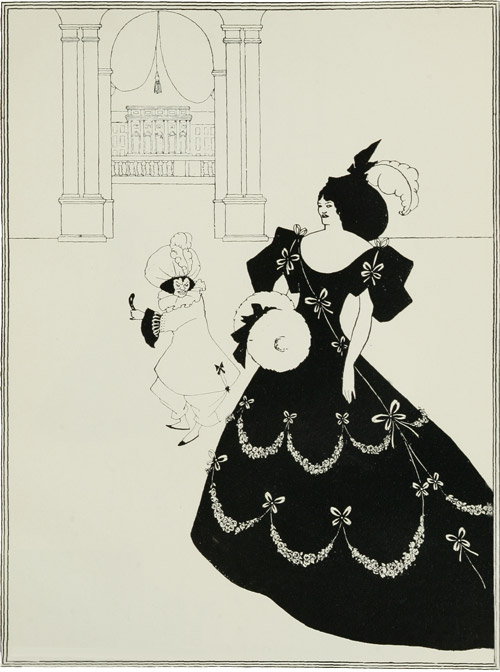
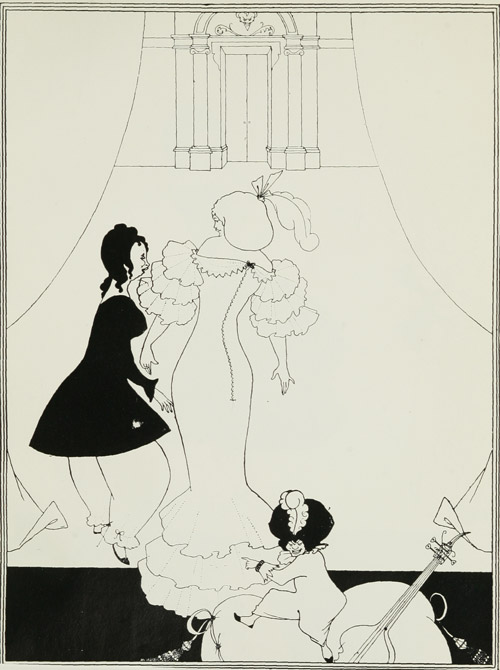
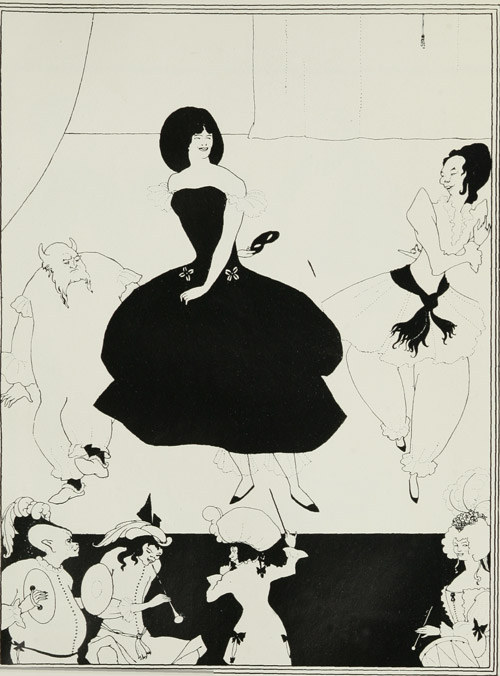
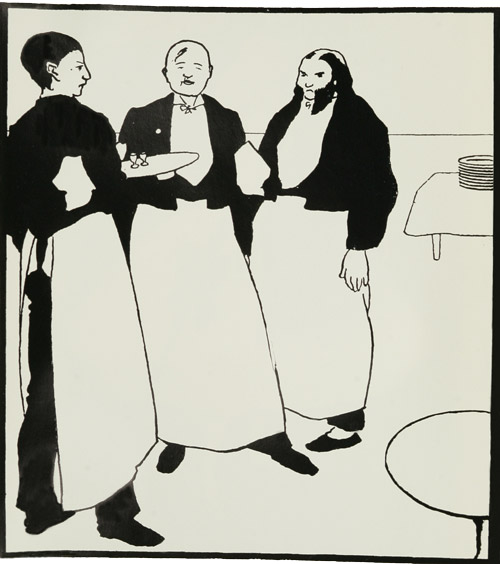
Six Drawings
By Aubrey Beardsley
I. II. III.
The Comedy-Ballet of Marionnettes, as performed by the troupe of the Théâtre-Impossible, posed in three drawings
IV. Garçons de Café
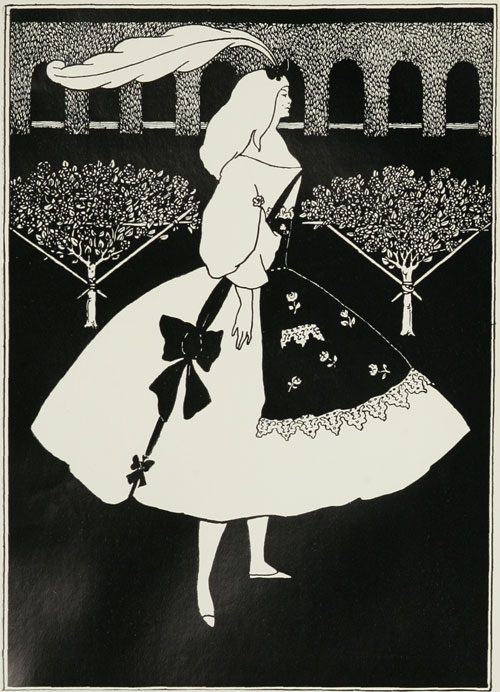
V. The Slippers of Cinderella
For you must have all heard of the Princess Cinderella with her slim feet and shining slippers. She was beloved by Prince ——, who married her, but she died soon afterwards, poisoned (according to Dr. Gerschovius) by her elder sister Arabella, with powdered glass. It was ground I suspect from those very slippers she danced in at the famous ball. For the slippers of Cinderella have never been found since. They are not at Cluny.
Hector Sandus
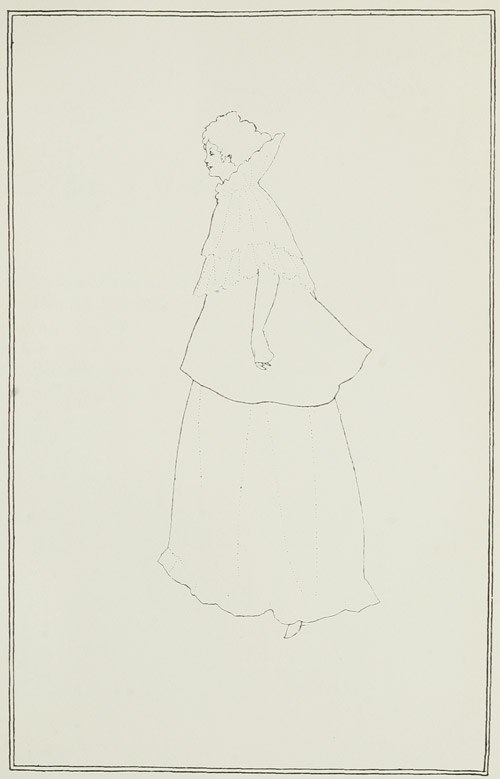
VI. Portrait of Madame Réjane
Thirty Bob a Week
By John Davidson
I couldn't touch a stop and turn a screw, And set the blooming world a-work for me, Like such as cut their teeth—I hope, like you— On the handle of a skeleton gold key. I cut mine on leek, which I eat it every week: I'm a clerk at thirty bob, as you can see. But I don't allow it's luck and all a toss; There's no such thing as being starred and crossed; It's just the power of some to be a boss, And the bally power of others to be bossed: I face the music, sir; you bet I ain't a cur! Strike me lucky if I don't believe I'm lost! For like a mole I journey in the dark, A-travelling along the underground From my Pillar'd Halls and broad suburban Park To come the daily dull official round; And home again at night with my pipe all alight A-scheming how to count ten bob a pound. And it's often very cold and very wet; And my missis stitches towels for a hunks; And the Pillar'd Halls is half of it to let— Three rooms about the size of travelling trunks. And we cough, the wife and I, to dislocate a sigh, When the noisy little kids are in their bunks. But you'll never hear her do a growl, or whine, For she's made of flint and roses very odd; And I've got to cut my meaning rather fine Or I'd blubber, for I'm made of greens and sod: So p'rhaps we are in hell for all that I can tell, And lost and damned and served up hot to God. I ain't blaspheming, Mr. Silvertongue; I'm saying things a bit beyond your art: Of all the rummy starts you ever sprung Thirty bob a week's the rummiest start! With your science and your books and your the'ries about spooks, Did you ever hear of looking in your heart? I didn't mean your pocket, Mr.; no! I mean that having children and a wife With thirty bob on which to come and go Isn't dancing to the tabor and the fife; When it doesn't make you drink, by Heaven, it makes you think, And notice curious items about life! I step into my heart and there I meet A god-almighty devil singing small, Who would like to shout and whistle in the street, And squelch the passers flat against the wall; If the whole world was a cake he had the power to take, He would take it, ask for more, and eat it all. And I meet a sort of simpleton beside— The kind that life is always giving beans; With thirty bob a week to keep a bride He fell in love and married in his teens; At thirty bob he stuck, but he knows it isn't luck; He knows the seas are deeper than tureens. And the god-almighty devil and the fool That meet me in the High Street on the strike, When I walk about my heart a-gathering wool, Are my good and evil angels if you like; And both of them together in every kind of weather Ride me like a double-seated bike. That's rough a bit and needs its meaning curled; But I have a high old hot un in my mind, A most engrugious notion of the world That leaves your lightning 'rithmetic behind: I give it at a glance when I say "There ain't no chance, Nor nothing of the lucky-lottery kind." And it's this way that I make it out to be: No fathers, mothers, countries, climates—none!— Not Adam was responsible for me; Nor society, nor systems, nary one! A little sleeping seed, I woke—I did indeed— A million years before the blooming sun. I woke because I thought the time had come; Beyond my will there was no other cause: And everywhere I found myself at home Because I chose to be the thing I was; And in whatever shape, of mollusc, or of ape, I always went according to the laws. I was the love that chose my mother out; I joined two lives and from the union burst; My weakness and my strength without a doubt Are mine alone for ever from the first. It's just the very same with a difference in the name As Thy will be done. You say it if you durst! They say it daily up and down the land As easy as you take a drink, it's true; But the difficultest go to understand, And the difficultest job a man can do, Is to come it brave and meek with thirty bob a week, And feel that that's the proper thing for you. It's a naked child against a hungry wolf; It's playing bowls upon a splitting wreck; It's walking on a string across a gulf With millstones fore-and-aft about your neck: But the thing is daily done by many and many a one.... And we fall, face forward, fighting, on the deck.
A Responsibility
By Henry Harland
It has been an episode like a German sentence, with its predicate at the end. Trifling incidents occurred at haphazard, as it seemed, and I never guessed they were by way of making sense. Then, this morning, somewhat of the suddenest, came the verb and the full stop.
Yesterday I should have said there was nothing to tell; to-day there is too much. The announcement of his death has caused me to review our relations, with the result of discovering my own part to have been that of an accessory before the fact. I did not kill him (though, even there, I'm not sure I didn't lend a hand), but I might have saved his life. It is certain that he made me signals of distress—faint, shy, tentative, but unmistakable—and that I pretended not to understand: just barely dipped my colours, and kept my course. Oh, if I had dreamed that his distress was extreme—that he was on the point of foundering and going down! However, that doesn't exonerate me: I ought to have turned aside to find out. It was a case of criminal negligence. That he, poor man, probably never blamed me, only adds to the burden on my conscience. He had got past blaming people, I dare say, and doubtless merely lumped me with the rest—with the sum-total of things that made life unsupportable. Yet, for a moment, when we first met, his face showed a distinct glimmering of hope; so perhaps there was a distinct disappointment. He must have had so many disappointments, before it came to—what it came to; but it wouldn't have come to that if he had got hardened to them. Possibly they had lost their outlines, and merged into one dull general disappointment that was too hard to bear. I wonder whether the Priest and the Levite were smitten with remorse after they had passed on. Unfortunately, in this instance, no Good Samaritan followed.
The bottom of our long table d'hôte was held by a Frenchman, a Normand, a giant, but a pallid and rather flabby giant, whose name, if he had another than Monsieur, I never heard. He professed to be a painter, used to sketch birds and profiles on the back of his menu-card between the courses, wore shamelessly the multi-coloured rosette of a foreign order in his buttonhole, and talked with a good deal of physiognomy. I had the corner seat at his right, and was flanked in turn by Miss Etta J. Hicks, a bouncing young person from Chicago, beyond whom, like rabbits in a company of foxes, cowered Mr. and Mrs. Jordan P. Hicks, two broken-spirited American parents. At Monsieur's left, and facing me, sat Colonel Escott, very red and cheerful; then a young man who called the Colonel Cornel, and came from Dublin, proclaiming himself a barr'ster, and giving his name as Flarty, though on his card it was written Flaherty; and then Sir Richard Maistre. After him, a diminishing perspective of busy diners—for purposes of conversation, so far as we were concerned, inhabitants of the Fourth Dimension.
Of our immediate constellation Sir Richard Maistre was the only member on whom the eye was tempted to linger. The others were obvious—simple equations, soluble in the head. But he called for slate and pencil, offered materials for doubt and speculation, though it would not have been easy to tell wherein they lay. What displayed itself to a cursory inspection was quite unremarkable: simply a decent-looking young Englishman, of medium stature, with square-cut plain features, reddish-brown hair, grey eyes, and clothes and manners of the usual pattern. Yet, showing through this ordinary surface, there was something cryptic. For me, at any rate, it required a constant effort not to stare at him. I felt it from the beginning, and I felt it till the end: a teasing curiosity, a sort of magnetism that drew my eyes in his direction. I was always on my guard to resist it, and that was really the inception of my neglect of him. From I don't know what stupid motive of pride, I was anxious that he shouldn't discern the interest he had excited in me; so I paid less ostensible attention to him than to the others, who excited none at all. I tried to appear unconscious of him as a detached personality, to treat him as merely a part of the group as a whole. Then I improved such occasions as presented themselves to steal glances at him, to study him à la dérobée—groping after the quality, whatever it was, that made him a puzzle—seeking to formulate, to classify him.
Already, at the end of my first dinner, he had singled himself out and left an impression. I went into the smoking-room, and began to wonder, over a cup of coffee and a cigarette, who he was. I had not heard his voice; he hadn't talked much, and his few observations had been murmured into the ears of his next neighbours. All the same, he had left an impression, and I found myself wondering who he was, the young man with the square-cut features and the reddish-brown hair. I have said that his features were square-cut and plain, but they were small and carefully finished, and as far as possible from being common. And his grey eyes, though not conspicuous for size or beauty, had a character, an expression. They said something, something I couldn't perfectly translate, something shrewd, humorous, even perhaps a little caustic, and yet sad; not violently, not rebelliously sad (I should never have dreamed that it was a sadness which would drive him to desperate remedies), but rather resignedly, submissively sad, as if he had made up his mind to put the best face on a sorry business. This was carried out by a certain abruptness, a slight lack of suavity, in his movements, in his manner of turning his head, of using his hands. It hinted a degree of determination which, in the circumstances, seemed superfluous. He had unfolded his napkin and attacked his dinner with an air of resolution, like a man with a task before him, who mutters, Well, it's got to be done, and I'll do it. At a hazard, he was two- or three-and-thirty, but below his neck he looked older. He was dressed like everybody, but his costume had, somehow, an effect of soberness beyond his years. It was decidedly not smart, and smartness was the dominant note at the Hôtel d'Angleterre.
I was still more or less vaguely ruminating him, in a corner of the smoking-room, on that first evening, when I became aware that he was standing near me. As I looked up, our eyes met, and for the fraction of a second fixed each other. It was barely the fraction of a second, but it was time enough for the transmission of a message. I knew as certainly as if he had said so that he wanted to speak, to break the ice, to scrape an acquaintance; I knew that he had approached me and was loitering in my neighbourhood for that specific purpose. I don't know, I have studied the psychology of the moment in vain to understand, why I felt a perverse impulse to put him off. I was interested in him, I was curious about him; and there he stood, testifying that the interest was reciprocal, ready to make the advances, only waiting for a glance or a motion of encouragement; and I deliberately secluded myself behind my coffee-cup and my cigarette smoke. I suppose it was the working of some obscure mannish vanity—of what in a woman would have defined itself as coyness and coquetry. If he wanted to speak—well, let him speak; I wouldn't help him. I could realise the processes of his mind even more clearly than those of my own—his desire, his hesitancy. He was too timid to leap the barriers; I must open a gate for him. He hovered near me for a minute longer, and then drifted away. I felt his disappointment, his spiritual shrug of the shoulders; and I perceived rather suddenly that I was disappointed myself. I must have been hoping all along that he would speak quand même, and now I was moved to run after him, to call him back. That, however, would imply a consciousness of guilt, an admission that my attitude had been intentional; so I kept my seat, making a mental rendezvous with him for the morrow.
Between my Irish vis-à-vis Flaherty and myself there existed no such strain. He presently sauntered up to me, and dropped into conversation as easily as if we had been old friends.
Well, and are you here for your health or your entertainment? he began. But I don't need to ask that of a man who's drinking black coffee and smoking tobacco at this hour of the night. I'm the only invalid at our end of the table, and I'm no better than an amateur meself. It's a barrister's throat I have—I caught it waiting for briefs in me chambers at Doblin.
We chatted together for a half-hour or so, and before we parted he had given me a good deal of general information—about the town, the natives, the visitors, the sands, the golf-links, the hunting, and, with the rest, about our neighbours at table.
Did ye notice the pink-faced bald little man at me right? That's Cornel Escott, C.B., retired. He takes a sea-bath every morning, to live up to the letters; and faith, it's an act of heroism, no less, in weather the like of this. Three weeks have I been here, and but wan day of sunshine, and the mercury never above fifty. The other fellow, him at me left, is what you'd be slow to suspect by the look of him, I'll go bail; and that's a bar'net, Sir Richard Maistre, with a place in Hampshire, and ten thousand a year if he's a penny. The young lady beside yourself rejoices in the euphonious name of Hicks, and trains her Popper and Mommer behind her like slaves in a Roman triumph. They're Americans, if you must have the truth, though I oughtn't to tell it on them, for I'm an Irishman myself, and its not for the pot to be bearing tales of the kettle. However, their tongues bewray them; so I've violated no confidence.
The knowledge that my young man was a baronet with a place in Hampshire somewhat disenchanted me. A baronet with a place in Hampshire left too little to the imagination. The description seemed to curtail his potentialities, to prescribe his orbit, to connote turnip-fields, house-parties, and a whole system of British commonplace. Yet, when, the next day at luncheon, I again had him before me in the flesh, my interest revived. Its lapse had been due to an association of ideas which I now recognised as unscientific. A baronet with twenty places in Hampshire would remain at the end of them all a human being; and no human being could be finished off in a formula of half a dozen words. Sir Richard Maistre, anyhow, couldn't be. He was enigmatic, and his effect upon me was enigmatic too. Why did I feel that tantalising inclination to stare at him, coupled with that reluctance frankly to engage in talk with him? Why did he attack his luncheon with that appearance of grim resolution? For a minute, after he had taken his seat, he eyed his knife, fork, and napkin, as a labourer might a load that he had to lift, measuring the difficulties he must cope with; then he gave his head a resolute nod, and set to work. To-day, as yesterday, he said very little, murmured an occasional remark into the ear of Flaherty, accompanying it usually with a sudden short smile: but he listened to everything, and did so with apparent appreciation.
Our proceedings were opened by Miss Hicks, who asked Colonel Escott, Well, Colonel, have you had your bath this morning?
The Colonel chuckled, and answered, Oh, yes—yes, yes—couldn't forego my bath, you know—couldn't possibly forego my bath.
And what was the temperature of the water? she continued.
Fifty-two—fifty-two—three degrees warmer than the air—three degrees, responded the Colonel, still chuckling, as if the whole affair had been extremely funny.
And you, Mr. Flaherty, I suppose you've been to Bayonne?
No, I've broken me habit, and not left the hotel.
Subsequent experience taught me that these were conventional modes by which the conversation was launched every day, like the preliminary moves in chess. We had another ritual for dinner: Miss Hicks then inquired if the Colonel had taken his ride, and Flaherty played his game of golf. The next inevitable step was common to both meals. Colonel Escott would pour himself a glass of the vin ordinaire, a jug of which was set by every plate, and holding it up to the light, exclaim with simulated gusto, Ah! Fine old wine! Remarkably full rich flavour! At this pleasantry we would all gently laugh; and the word was free.
Sir Richard, as I have said, appeared to be an attentive and appreciative listener, not above smiling at our mildest sallies; but watching him out of the corner of an eye, I noticed that my own observations seemed to strike him with peculiar force—which led me to talk at him. Why not to him, with him? The interest was reciprocal; he would have liked a dialogue; he would have welcomed a chance to commence one; and I could at any instant have given him such a chance. I talked at him, it is true; but I talked with Flaherty or Miss Hicks, or to the company at large. Of his separate identity he had no reason to believe me conscious. From a mixture of motives, in which I'm not sure that a certain heathenish enjoyment of his embarrassment didn't count for something, I was determined that if he wanted to know me he must come the whole distance; I wouldn't meet him halfway. Of course I had no idea that it could be a matter of the faintest real importance to the man. I judged his feelings by my own; and though I was interested in him, I shall have conveyed an altogether exaggerated notion of my interest if you fancy it kept me awake at night. How was I to guess that his case was more serious—that he was not simply desirous of a little amusing talk, but starving, starving for a little human sympathy, a little brotherly love and comradeship?—that he was in an abnormally sensitive condition of mind, where mere negative unresponsiveness could hurt him like a slight or a rebuff?
In the course of the week I ran over to Pau, to pass a day with the Winchfields, who had a villa there. When I came back I brought with me all that they (who knew everybody) could tell about Sir Richard Maistre. He was intelligent and amiable, but the shyest of shy men. He avoided general society, frightened away perhaps by the British Mamma, and spent a good part of each year abroad, wandering rather listlessly from town to town. Though young and rich, he was neither fast nor ambitious: the Members' entrance to the House of Commons, the stage-doors of the music halls, were equally without glamour for him; and if he was a Justice of the Peace and a Deputy Lieutenant, he had become so through the tacit operation of his stake in the country. He had chambers in St. James's Street, was a member of the Travellers Club, and played the violin—for an amateur rather well. His brother, Mortimer Maistre, was in diplomacy—at Rio Janeiro or somewhere. His sister had married an Australian, and lived in Melbourne.
At the Hôtel d'Angleterre I found his shyness was mistaken for indifference. He was civil to everybody, but intimate with none. He attached himself to no party, paired off with no individuals. He sought nobody. On the other hand, the persons who went out of their way to seek him, came back, as they felt, repulsed. He had been polite but languid. These, however, were not the sort of persons he would be likely to care for. There prevailed a general conception of him as cold, unsociable. He certainly walked about a good deal alone—you met him on the sands, on the cliffs, in the stiff little streets, rambling aimlessly, seldom with a companion. But to me it was patent that he played the solitary from necessity, not from choice—from the necessity of his temperament. A companion was precisely that which above all things his heart coveted; only he didn't know how to set about annexing one. If he sought nobody, it was because he didn't know how. This was a part of what his eyes said; they bespoke his desire, his perplexity, his lack of nerve. Of the people who put themselves out to seek him, there was Miss Hicks; there were a family from Leeds, named Bunn, a father, mother, son, and two redoubtable daughters, who drank champagne with every meal, dressed in the height of fashion, said their say at the tops of their voices, and were understood to be auctioneers; a family from Bayswater named Krausskopf. I was among those whom he had marked as men he would like to fraternise with. As often as our paths crossed, his eyes told me that he longed to stop and speak, and continue the promenade abreast. I was under the control of a demon of mischief; I took a malicious pleasure in eluding and baffling him—in passing on with a nod. It had become a kind of game; I was curious to see whether he would ever develop sufficient hardihood to take the bull by the horns. After all, from a conventional point of view, my conduct was quite justifiable. I always meant to do better by him next time, and then I always deferred it to the next. But from a conventional point of view my conduct was quite unassailable. I said this to myself when I had momentary qualms of conscience. Now, rather late in the day, it strikes me that the conventional point of view should have been re-adjusted to the special case. I should have allowed for his personal equation.
My cousin Wilford came to Biarritz about this time, stopping for a week, on his way home from a tour in Spain. I couldn't find a room for him at the Hôtel d'Angleterre, so he put up at a rival hostelry over the way; but he dined with me on the evening of his arrival, a place being made for him between mine and Monsieur's. He hadn't been at the table five minutes before the rumour went abroad who he was—somebody had recognised him. Then those who were within reach of his voice listened with all their ears—Colonel Escott, Flaherty, Maistre, and Miss Hicks, of course, who even called him by name: Oh, Mr. Wilford. Now, Mr. Wilford, &c. After dinner, in the smoking-room, a cluster of people hung round us; men with whom I had no acquaintance came merrily up and asked to be introduced. Colonel Escott and Flaherty joined us. At the outskirts of the group I beheld Sir Richard Maistre. His eyes (without his realising it perhaps) begged me to invite him, to present him, and I affected not to understand! This is one of the little things I find hardest to forgive myself. My whole behaviour towards the young man is now a subject of self-reproach: if it had been different, who knows that the tragedy of yesterday would ever have happened? If I had answered his timid overtures, walked with him, talked with him, cultivated his friendship, given him mine, established a kindly human relation with him, I can't help feeling that he might not have got to such a desperate pass, that I might have cheered him, helped him, saved him. I feel it especially when I think of Wilford. His eyes attested so much; he would have enjoyed meeting him so keenly. No doubt he was already fond of the man, had loved him through his books, like so many others. If I had introduced him? If we had taken him with us the next morning, on our excursion to Cambo? Included him occasionally in our smokes and parleys?
Wilford left for England without dining again at the Hôtel d'Angleterre. We were busy doing the country, and never chanced to be at Biarritz at the dinner-hour. During that week I scarcely saw Sir Richard Maistre.
Another little circumstance that rankles especially now would have been ridiculous, except for the way things have ended. It isn't easy to tell—it was so petty, and I am so ashamed. Colonel Escott had been abusing London, describing it as the least beautiful of the capitals of Europe, comparing it unfavourably to Paris, Vienna, and St. Petersburg. I took up the cudgels in its defence, mentioned its atmosphere, its tone; Paris, Vienna, St. Petersburg were lyric, London was epic; and so forth and so forth. Then, shifting from the æsthetic to the utilitarian, I argued that of all great towns it was the healthiest, its death-rate was lowest. Sir Richard Maistre had followed my dissertation attentively, and with a countenance that signified approval; and when, with my reference to the death-rate, I paused, he suddenly burned his ships. He looked me full in the eye, and said, Thirty-seven, I believe? His heightened colour, a nervous movement of the lip, betrayed the effort it had cost him; but at last he had done it—screwed his courage to the sticking-place, and spoken. And I—I can never forget it—I grow hot when I think of it—but I was possessed by a devil. His eyes hung on my face, awaiting my response, pleading for a cue. Go on, they urged. I have taken the first, the difficult step—make the next smoother for me. And I—I answered lackadaisically, with just a casual glance at him, I don't know the figures, and absorbed myself in my viands.
Two or three days later his place was filled by a stranger, and Flaherty told me that he had left for the Riviera.
All this happened last March at Biarritz. I never saw him again till three weeks ago. It was one of those frightfully hot afternoons in July; I had come out of my club, and was walking up St. James's Street, towards Piccadilly; he was moving in an opposite sense; and thus we approached each other. He didn't see me, however, till we had drawn rather near to a conjunction: then he gave a little start of recognition, his eyes brightened, his pace slackened, his right hand prepared to advance itself—and I bowed slightly, and pursued my way! Don't ask why I did it. It is enough to confess it, without having to explain it. I glanced backwards, by and by, over my shoulder. He was standing where I had met him, half turned round, and looking after me. But when he saw that I was observing him, he hastily shifted about, and continued his descent of the street.
That was only three weeks ago. Only three weeks ago I still had it in my power to act. I am sure—I don't know why I am sure, but I am sure—that I could have deterred him. For all that one can gather from the brief note he left behind, it seems he had no special, definite motive; he had met with no losses, got into no scrape; he was simply tired and sick of life and of himself. I have no friends, he wrote. Nobody will care. People don't like me; people avoid me. I have wondered why; I have tried to watch myself, and discover; I have tried to be decent. I suppose it must be that I emit a repellent fluid; I suppose I am a 'bad sort.' He had a morbid notion that people didn't like him, that people avoided him! Oh, to be sure, there were the Bunns and the Krausskopfs and their ilk, plentiful enough: but he understood what it was that attracted them. Other people, the people he could have liked, kept their distance—were civil, indeed, but reserved. He wanted bread, and they gave him a stone. It never struck him, I suppose, that they attributed the reserve to him. But I—I knew that his reserve was only an effect of his shyness; I knew that he wanted bread: and that knowledge constituted my moral responsibility. I didn't know that his need was extreme; but I have tried in vain to absolve myself with the reflection. I ought to have made inquiries. When I think of that afternoon in St. James's Street—only three weeks ago—I feel like an assassin. The vision of him, as he stopped and looked after me—I can't banish it. Why didn't some good spirit move me to turn back and overtake him?
It is so hard for the mind to reconcile itself to the irretrievable. I can't shake off a sense that there is something to be done. I can't realise that it is too late.
Song
By Dollie Radford
I could not through the burning day In hope prevail, Beside my task I could not stay If love should fail. Nor underneath the evening sky, When labours cease, Fold both my tired hands and lie At last in peace. Ah! what to me in death or life Could then avail? I dare not ask for rest or strife If love should fail.
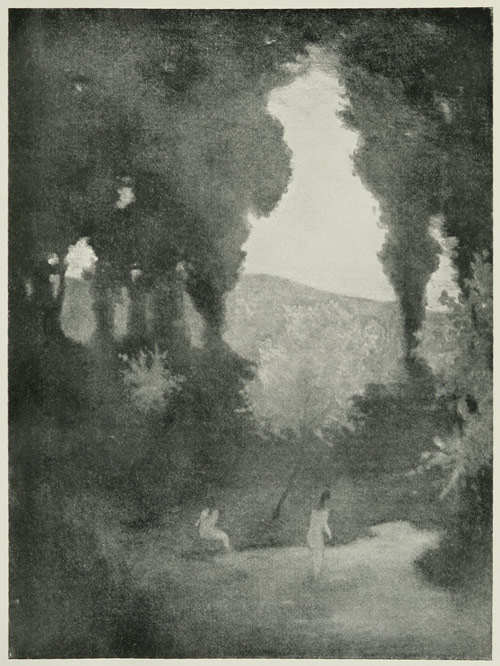
A Landscape
By Alfred Thornton
Passed
By Charlotte M. Mew
"Like souls that meeting pass, And passing never meet again."
Let those who have missed a romantic view of London in its poorest quarters—and there will romance be found—wait for a sunset in early winter. They may turn North or South, towards Islington or Westminster, and encounter some fine pictures and more than one aspect of unique beauty. This hour of pink twilight has its monopoly of effects. Some of them may never be reached again.
On such an evening in mid-December, I put down my sewing and left tame glories of fire-light (discoverers of false charm) to welcome, as youth may, the contrast of keen air outdoors to the glow within.
My aim was the perfection of a latent appetite, for I had no mind to content myself with an apology for hunger, consequent on a warmly passive afternoon.
The splendid cold of fierce frost set my spirit dancing. The road rung hard underfoot, and through the lonely squares woke sharp echoes from behind. This stinging air assailed my cheeks with vigorous severity. It stirred my blood grandly, and brought thought back to me from the warm embers just forsaken, with an immeasurable sense of gain.
But after the first delirium of enchanting motion, destination became a question. The dim trees behind the dingy enclosures were beginning to be succeeded by rows of flaring gas jets, displaying shops of new aspect and evil smell. Then the heavy walls of a partially demolished prison reared themselves darkly against the pale sky.
By this landmark I recalled—alas that it should be possible—a church in the district, newly built by an infallible architect, which I had been directed to seek at leisure. I did so now. A row of cramped houses, with the unpardonable bow window, projecting squalor into prominence, came into view. Robbing these even of light, the portentous walls stood a silent curse before them. I think they were blasting the hopes of the sad dwellers beneath them—if hope they had—to despair. Through spattered panes faces of diseased and dirty children leered into the street. One room, as I passed, seemed full of them. The window was open; their wails and maddening requirements sent out the mother's cry. It was thrown back to her, mingled with her children's screams, from the pitiless prison walls.
These shelters struck my thought as travesties—perhaps they were not—of the grand place called home.
Leaving them I sought the essential of which they were bereft. What withheld from them, as poverty and sin could not, a title to the sacred name?
An answer came, but interpretation was delayed. Theirs was not the desolation of something lost, but of something that had never been. I thrust off speculation gladly here, and fronted Nature free.
Suddenly I emerged from the intolerable shadow of the brickwork, breathing easily once more. Before me lay a roomy space, nearly square, bounded by three-storey dwellings, and transformed, as if by quick mechanism, with colours of sunset. Red and golden spots wavered in the panes of the low scattered houses round the bewildering expanse. Overhead a faint crimson sky was hung with violet clouds, obscured by the smoke and nearing dusk.
In the centre, but towards the left, stood an old stone pump, and some few feet above it irregular lamps looked down. They were planted on a square of paving railed in by broken iron fences, whose paint, now discoloured, had once been white. Narrow streets cut in five directions from the open roadway. Their lines of light sank dimly into distance, mocking the stars' entrance into the fading sky. Everything was transfigured in the illuminated twilight. As I stood, the dying sun caught the rough edges of a girl's uncovered hair, and hung a faint nimbus round her poor desecrated face. The soft circle, as she glanced toward me, lent it the semblance of one of those mystically pictured faces of some mediæval saint.
A stillness stole on, and about the square dim figures hurried along, leaving me stationary in existence (I was thinking fancifully), when my mediæval saint demanded who I was a-shoving of? and dismissed me, not unkindly, on my way. Hawkers in a neighbouring alley were calling, and the monotonous ting-ting of the muffin-bell made an audible background to the picture. I left it, and then the glamour was already passing. In a little while darkness possessing it, the place would reassume its aspect of sordid gloom.
There is a street not far from there, bearing a name that quickens life within one, by the vision it summons of a most peaceful country, where the broad roads are but pathways through green meadows, and your footstep keeps the time to a gentle music of pure streams. There the scent of roses, and the first pushing buds of spring, mark the seasons, and the birds call out faithfully the time and manner of the day. Here Easter is heralded by the advent in some squalid mart of air-balls on Good Friday; early summer and late may be known by observation of that unromantic yet authentic calendar in which alley-tors, tip-cat, whip- and peg-tops, hoops and suckers, in their courses mark the flight of time.
Perhaps attracted by the incongruity, I took this way. In such a thoroughfare it is remarkable that satisfied as are its public with transient substitutes for literature, they require permanent types (the term is so far misused it may hardly be further outraged) of Art. Pictures, so-called, are the sole departure from necessity and popular finery which the prominent wares display. The window exhibiting these aspirations was scarcely more inviting than the fishmonger's next door, but less odoriferous, and I stopped to see what the ill-reflecting lights would show. There was a typical selection. Prominently, a large chromo of a girl at prayer. Her eyes turned upwards, presumably to heaven, left the gazer in no state to dwell on the elaborately bared breasts below. These might rival, does wax-work attempt such beauties, any similar attraction of Marylebone's extensive show. This personification of pseudo-purity was sensually diverting, and consequently marketable.
My mind seized the ideal of such a picture, and turned from this prostitution of it sickly away. Hurriedly I proceeded, and did not stop again until I had passed the low gateway of the place I sought.
Its forbidding exterior was hidden in the deep twilight and invited no consideration. I entered and swung back the inner door. It was papered with memorial cards, recommending to mercy the unprotesting spirits of the dead. My prayers were requested for the repose of the soul of the Architect of that church, who passed away in the True Faith—December,—1887. Accepting the assertion, I counted him beyond them, and mentally entrusted mine to the priest for those who were still groping for it in the gloom.
Within the building, darkness again forbade examination. A few lamps hanging before the altar struggled with obscurity.
I tried to identify some ugly details with the great man's complacent eccentricity, and failing, turned toward the street again. Nearly an hour's walk lay between me and my home. This fact and the atmosphere of stuffy sanctity about the place, set me longing for space again, and woke a fine scorn for aught but air and sky. My appetite, too, was now an hour ahead of opportunity. I sent back a final glance into the darkness as my hand prepared to strike the door. There was no motion at the moment, and it was silent; but the magnetism of human presence reached me where I stood. I hesitated, and in a few moments found what sought me on a chair in the far corner, flung face downwards across the seat. The attitude arrested me. I went forward. The lines of the figure spoke unquestionable despair.
Does speech convey intensity of anguish? Its supreme expression is in form. Here was human agony set forth in meagre lines, voiceless, but articulate to the soul. At first the forcible portrayal of it assailed me with the importunate strength of beauty. Then the Thing stretched there in the obdurate darkness grew personal and banished delight. Neither sympathy nor its vulgar substitute, curiosity, induced my action as I drew near. I was eager indeed to be gone. I wanted to ignore the almost indistinguishable being. My will cried: Forsake it!—but I found myself powerless to obey. Perhaps it would have conquered had not the girl swiftly raised herself in quest of me. I stood still. Her eyes met mine. A wildly tossed spirit looked from those ill-lighted windows, beckoning me on. Mine pressed towards it, but whether my limbs actually moved I do not know, for the imperious summons robbed me of any consciousness save that of necessity to comply.
Did she reach me, or was our advance mutual? It cannot be told. I suppose we neither know. But we met, and her hand, grasping mine, imperatively dragged me into the cold and noisy street.
We went rapidly in and out of the flaring booths, hustling little staggering children in our unpitying speed, I listening dreamily to the concert of hoarse yells and haggling whines which struck against the silence of our flight. On and on she took me, breathless and without explanation. We said nothing. I had no care or impulse to ask our goal. The fierce pressure of my hand was not relaxed a breathing space; it would have borne me against resistance could I have offered any, but I was capable of none. The streets seemed to rush past us, peopled with despair.
Weirdly lighted faces sent blank negations to a spirit of question which finally began to stir in me. Here, I thought once vaguely, was the everlasting No!
We must have journeyed thus for more than half an hour and walked far. I did not detect it. In the eternity of supreme moments time is not. Thought, too, fears to be obtrusive and stands aside.
We gained a door at last, down some blind alley out of the deafening thoroughfare. She threw herself against it and pulled me up the unlighted stairs. They shook now and then with the violence of our ascent; with my free hand I tried to help myself up by the broad and greasy balustrade. There was little sound in the house. A light shone under the first door we passed, but all was quietness within.
At the very top, from the dense blackness of the passage, my guide thrust me suddenly into a dazzling room. My eyes rejected its array of brilliant light. On a small chest of drawers three candles were guttering, two more stood flaring in the high window ledge, and a lamp upon a table by the bed rendered these minor illuminations unnecessary by its diffusive glare. There were even some small Christmas candles dropping coloured grease down the wooden mantel-piece, and I noticed a fire had been made, built entirely of wood. There were bits of an inlaid workbox or desk, and a chair-rung, lying half burnt in the grate. Some peremptory demand for light had been, these signs denoted, unscrupulously met. A woman lay upon the bed, half clothed, asleep. As the door slammed behind me the flames wavered and my companion released my hand. She stood beside me, shuddering violently, but without utterance.
I looked around. Everywhere proofs of recent energy were visible. The bright panes reflecting back the low burnt candles, the wretched but shining furniture, and some odd bits of painted china, set before the spluttering lights upon the drawers, bore witness to a provincial intolerance of grime. The boards were bare, and marks of extreme poverty distinguished the whole room. The destitution of her surroundings accorded ill with the girl's spotless person and well-tended hands, which were hanging tremulously down.
Subsequently I realised that these deserted beings must have first fronted the world from a sumptuous stage. The details in proof of it I need not cite. It must have been so.
My previous apathy gave place to an exaggerated observation. Even some pieces of a torn letter, dropped off the quilt, I noticed, were of fine texture, and inscribed by a man's hand. One fragment bore an elaborate device in colours. It may have been a club crest or coat-of-arms. I was trying to decide which, when the girl at length gave a cry of exhaustion or relief, at the same time falling into a similar attitude to that she had taken in the dim church. Her entire frame became shaken with tearless agony or terror. It was sickening to watch. She began partly to call or moan, begging me, since I was beside her, wildly, and then with heart-breaking weariness, to stop, to stay. She half rose and claimed me with distracted grace. All her movements were noticeably fine.
I pass no judgment on her features; suffering for the time assumed them, and they made no insistence of individual claim.
I tried to raise her, and kneeling, pulled her reluctantly towards me. The proximity was distasteful. An alien presence has ever repelled me. I should have pitied the girl keenly perhaps a few more feet away. She clung to me with ebbing force. Her heart throbbed painfully close to mine, and when I meet now in the dark streets others who have been robbed, as she has been, of their great possession, I have to remember that.
The magnetism of our meeting was already passing; and, reason asserting itself, I reviewed the incident dispassionately, as she lay like a broken piece of mechanism in my arms. Her dark hair had come unfastened and fell about my shoulder. A faint white streak of it stole through the brown. A gleam of moonlight strays thus through a dusky room. I remember noticing, as it was swept with her involuntary motions across my face, a faint fragrance which kept recurring like a subtle and seductive sprite, hiding itself with fairy cunning in the tangled maze.
The poor girl's mind was clearly travelling a devious way. Broken and incoherent exclamations told of a recently wrung promise, made to whom, or of what nature, it was not my business to conjecture or inquire.
I record the passage of a few minutes. At the first opportunity I sought the slumberer on the bed. She slept well: hers was a long rest; there might be no awakening from it, for she was dead. Schooled in one short hour to all surprises, the knowledge made me simply richer by a fact. Nothing about the sternly set face invited horror. It had been, and was yet, a strong and, if beauty be not confined to youth and colour, a beautiful face.
Perhaps this quiet sharer of the convulsively broken silence was thirty years old. Death had set a firmness about the finely controlled features that might have shown her younger. The actual years are of little matter; existence, as we reckon time, must have lasted long. It was not death, but life that had planted the look of disillusion there. And romance being over, all good-byes to youth are said. By the bedside, on a roughly constructed table, was a dearly bought bunch of violets. They were set in a blue bordered tea-cup, and hung over in wistful challenge of their own diviner hue. They were foreign, and their scent probably unnatural, but it stole very sweetly round the room. A book lay face downwards beside them—alas for parochial energies, not of a religious type—and the torn fragments of the destroyed letter had fallen on the black binding.
A passionate movement of the girl's breast against mine directed my glance elsewhere. She was shivering, and her arms about my neck were stiffly cold. The possibility that she was starving missed my mind. It would have found my heart. I wondered if she slept, and dared not stir, though I was by this time cramped and chilled. The vehemence of her agitation ended, she breathed gently, and slipped finally to the floor.
I began to face the need of action and recalled the chances of the night. When and how I might get home was a necessary question, and I listened vainly for a friendly step outside. None since we left it had climbed the last flight of stairs. I could hear a momentary vibration of men's voices in the room below. Was it possible to leave these suddenly discovered children of peace and tumult? Was it possible to stay?
This was Saturday, and two days later I was bound for Scotland; a practical recollection of empty trunks was not lost in my survey of the situation. Then how, if I decided not to forsake the poor child, now certainly sleeping in my arms, were my anxious friends to learn my whereabouts, and understand the eccentricity of the scheme? Indisputably, I determined, something must be done for the half-frantic wanderer who was pressing a tiring weight against me. And there should be some kind hand to cover the cold limbs and close the wide eyes of the breathless sleeper, waiting a comrade's sanction to fitting rest.
Conclusion was hastening to impatient thought, when my eyes let fall a fatal glance upon the dead girl's face. I do not think it had changed its first aspect of dignified repose, and yet now it woke in me a sensation of cold dread. The dark eyes unwillingly open reached mine in an insistent stare. One hand lying out upon the coverlid, I could never again mistake for that of temporarily suspended life. My watch ticked loudly, but I dared not examine it, nor could I wrench my sight from the figure on the bed. For the first time the empty shell of being assailed my senses. I watched feverishly, knowing well the madness of the action, for a hint of breathing, almost stopping my own.
To-day, as memory summons it, I cannot dwell without reluctance on this hour of my realisation of the thing called Death.
A hundred fancies, clothed in mad intolerable terrors, possessed me, and had not my lips refused it outlet, I should have set free a cry, as the spent child beside me had doubtless longed to do, and failed, ere, desperate, she fled.
My gaze was chained; it could not get free. As the shapes of monsters of ever varying and increasing dreadfulness flit through one's dreams, the images of those I loved crept round me, with stark yet well-known features, their limbs borrowing death's rigid outline, as they mocked my recognition of them with soundless semblances of mirth. They began to wind their arms about me in fierce embraces of burning and supernatural life. Gradually the contact froze. They bound me in an icy prison. Their hold relaxed. These creatures of my heart were restless. The horribly familiar company began to dance at intervals in and out a ring of white gigantic bedsteads, set on end like tombstones, each of which framed a huge and fearful travesty of the sad set face that was all the while seeking vainly a pitiless stranger's care. They vanished. My heart went home. The dear place was desolate. No echo of its many voices on the threshold or stair. My footsteps made no sound as I went rapidly up to a well-known room. Here I besought the mirror for the reassurance of my own reflection. It denied me human portraiture and threw back cold glare. As I opened mechanically a treasured book, I noticed the leaves were blank, not even blurred by spot or line; and then I shivered—it was deadly cold. The fire that but an hour or two ago it seemed I had forsaken for the winter twilight, glowed with slow derision at my efforts to rekindle heat. My hands plunged savagely into its red embers, but I drew them out quickly, unscathed and clean. The things by which I had touched life were nothing. Here, as I called the dearest names, their echoes came back again with the sound of an unlearned language. I did not recognise, and yet I framed them. What was had never been!
My spirit summoned the being who claimed mine. He came, stretching out arms of deathless welcome. As he reached me my heart took flight. I called aloud to it, but my cries were lost in awful laughter that broke to my bewildered fancy from the hideously familiar shapes which had returned and now encircled the grand form of him I loved. But I had never known him. I beat my breast to wake there the wonted pain of tingling joy. I called past experience with unavailing importunity to bear witness the man was wildly dear to me. He was not. He left me with bent head a stranger, whom I would not if I could recall.
For one brief second, reason found me. I struggled to shake off the phantoms of despair. I tried to grasp while it yet lingered the teaching of this never-to-be-forgotten front of death. The homeless house with its indefensible bow window stood out from beneath the prison walls again. What had this to do with it? I questioned. And the answer it had evoked replied, Not the desolation of something lost, but of something that had never been.
The half-clad girl of the wretched picture-shop came into view with waxen hands and senseless symbolism. I had grown calmer, but her doll-like lips hissed out the same half-meaningless but pregnant words. Then the nights of a short life when I could pray, years back in magical childhood, sought me. They found me past them—without the power.
Truly the body had been for me the manifestation of the thing called soul. Here was my embodiment bereft. My face was stiff with drying tears. Sickly I longed to beg of an unknown God a miracle. Would He but touch the passive body and breathe into it the breath even of transitory life.
I craved but a fleeting proof of its ever possible existence. For to me it was not, would never be, and had never been.
The partially relinquished horror was renewing dominance. Speech of any incoherence or futility would have brought mental power of resistance. My mind was fast losing landmarks amid the continued quiet of the living and the awful stillness of the dead. There was no sound, even of savage guidance, I should not then have welcomed with glad response.
The realm of Silence, says one of the world's great teachers, is large enough beyond the grave.