The Beginnings
Reading edition
The consuming interest of the Wrights, of course, was in flight as such, and in their thinking the required power unit was of only secondary importance. However, regardless of their feeling about it, the unit was an integral part of their objective and, due to the prevailing circumstances, they very early found themselves in the aircraft engine business despite their inexperience. This business was carried on very successfully, against increasingly severe competition, until Orville Wright withdrew from commercial activity and dissolved the Wright Company. The time span covered approximately the twelve years from 1903 to 1915, during the first five years of which they designed and built for their own use several engines of three different experimental and demonstration designs. In the latter part of the period, they manufactured and sold engines commercially, and during this time they marketed three models, one of which was basically their last demonstration design. A special racing engine was also built and flown during this period. Accurate records are not available but altogether, they produced a total of something probably close to 200 engines of which they themselves took a small number for their various activities, including their school and flying exhibition work which at one time accounted for a very substantial part of their business. A similar lack of information concerning their competition, which expanded rapidly after the Wright's demonstrations, makes any comparisons a difficult task. The Wrights were meticulous about checking the actual performance of their engines but at that time ratings generally were seldom authenticated and even when different engines were tried in the same airplane the results usually were not measured with any accuracy or recorded with any permanency. There is evidence that the competition became effective enough to compel the complete redesign of their engine so that it was essentially a new model.
For their initial experimentation the Wrights regarded gravity as not only their most reliable power source but also the one most economical and readily available, hence their concentration on gliding. They had correctly diagnosed the basic problem of flight to be that of control, the matter of the best wing shapes being inherently a simpler one which they would master by experiment, utilizing at first gravity and later a wind tunnel. Consequently, the acquisition of a powerplant intended for actual flight was considerably deferred.
Nevertheless, they were continuously considering the power requirement and its problems. In his September 1901 lecture to the Western Society of Engineers, Wilbur Wright made two statements: "Men also know how to build engines and screws of sufficient lightness and power to drive these planes at sustaining speed"; and in conjunction with some figures he quoted of the required power and weight: "Such an engine is entirely practicable. Indeed, working motors of one-half this weight per horsepower [9 pounds per horsepower] have been constructed by several different builders." It is quite obvious that with their general knowledge and the experience they had acquired in designing and building a successful shop engine for their own use, they had no cause to doubt their ability to supply a suitable powerplant when the need arose. After the characteristics of the airframe had been settled, and the engine requirements delineated in rather detailed form, they had reached the point of decision on what they termed the motor problem. Only one major element had changed greatly since their previous consideration of the matter; they had arrived at the point where they not only needed a flight engine, they wanted it quickly.
The indicated solution to their problem of obtaining the engine—and the engine that would seem by all odds most reliable—would have been to have a unit produced to their specifications by one of the best of the experienced engine builders, and to accomplish this, the most effective method would be to use the equivalent of a bid procedure. This they attempted, and sent out a letter of inquiry to a fairly large number of manufacturers. Although no copy of the letter is available, it is rather well established that it requested the price of an engine of certain limited specifications which would satisfy their flight requirements, but beyond this there is little in the record.
A more thorough examination of the underlying fundamentals, however, discloses many weaknesses in the simple assumptions that made the choice of an experienced builder seem automatic. A maximum requirement limited to only one or two units offered little incentive to a manufacturer already successfully producing in his field, and the disadvantage of the limited quantity was only accentuated by the basic requirement for a technical performance in excess of any standard of the time. Certainly there was no promise of any future quantity business or any other substantial reward. Orville Wright many times stated that they had no desire to produce their own engine, but it is doubtful that they had any real faith in the buying procedure, for they made no attempt to follow up their first inquiries or to expand the original list.
Whatever the reasoning, their judgment of the situation is obvious; they spent no time awaiting results from the letter but almost immediately started on the task of designing and building the engine themselves. Perhaps the generalities were not as governing as the two specific factors whose immediate importance were determining: cost and time. The Wrights no doubt realized that a specially designed, relatively high performance engine in very limited hand-built quantities would not only be an expensive purchased article but would also take considerable time to build, even under the most favorable circumstances. So the lack of response to their first approach did not have too much to do with their ultimate decision to undertake this task themselves.
The decision to build the engine themselves added one more requirement, and possibly to some extent a restriction, to the design. They undoubtedly desired to machine as much of the engine as possible in their own shop, and the very limited equipment they had would affect the variety of features and constructions that could be utilized, although experienced machine shops with sophisticated equipment were available in Dayton and it is obvious that the Wrights intended to, and did, utilize these when necessary. The use of their own equipment, of course, guaranteed that the parts they could handle themselves would be more expeditiously produced. They commenced work on the design and construction shortly before Christmas in 1902.
The two sets of drawings, that is, the one of the Science Museum and that made in Dayton for the Smithsonian Institution, cannot be reconciled in the matter of details. Hardly any single dimension is exactly the same and essentially every part differs in some respect. Many of the forms of construction differ and even the firing order of the two engines is not the same, so that in effect the drawings show two different engines.
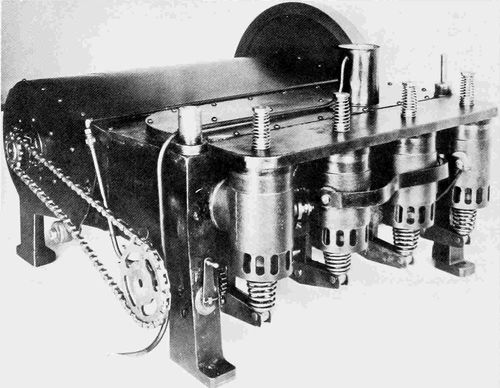
Figure 1.—First flight engine, 1903, valve side. (Photo courtesy Science Museum, London.)
The primary trouble is, of course, that the exact engine which flew in 1903 is no longer in existence, and since no original drawings of it exist, there is considerable doubt about its details. The engine had its crankcase broken in an accident to the airframe (this was caused by a strong wind gust immediately following the last of the first series of flights at Kitty Hawk), and when it was brought back to Dayton it was for some inexplicable reason completely laid aside, even though it presumably contained many usable parts. When the engine was disassembled to obtain measurements for constructing the 1904 engines, again apparently no drawings were made. In February 1906 Orville Wright wrote that all the parts of the engine were still in existence except the crankcase; but shortly after this the crankshaft and flywheel were loaned for exhibition purposes and were never recovered. In 1926 the engine was reassembled for an exhibition and in 1928 it was again reassembled for shipment to England. The only parts of this particular engine whose complete history is definitely known are the crankshaft and flywheel, which were taken from the 1904-1905 flight engine. This latter engine, now in the restored 1905 airplane in the Carillon Park Museum in Dayton, does not contain a crankshaft, and in its place incorporates a length of round bar stock.
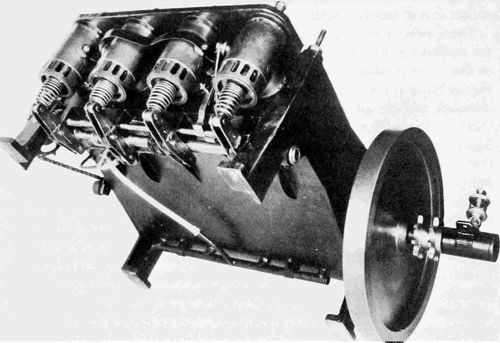
Figure 2.—First flight engine, 1903, underside and flywheel end. (Photo courtesy Science Museum, London.)
In late 1947 work on the Educational and Musical Arts drawings was initiated under the direction of Louis P. Christman and carried through to completion by him. Christman has stated that Orville Wright was critical of the Science Museum drawings but just what he thought incorrect is not known. Whatever his reasons, he did encourage Christman to undertake the major task of duplication. Christman worked directly with Orville Wright for a period of six weeks and had access to all the records and parts the Wrights had preserved. The resultant drawings are also very complete and, regardless of the differences between these two primary sets, both give a sufficiently accurate picture of the first engine for all purposes except that of exact reproduction in every detail.