Front matter
Reading edition
SERIAL PUBLICATIONS OF THE SMITHSONIAN INSTITUTION
The emphasis upon publications as a means of diffusing knowledge was expressed by the first Secretary of the Smithsonian Institution. In his formal plan for the Institution, Joseph Henry articulated a program that included the following statement: "It is proposed to publish a series of reports, giving an account of the new discoveries in science, and of the changes made from year to year in all branches of knowledge not strictly professional." This keynote of basic research has been adhered to over the years in the issuance of thousands of titles in serial publications under the Smithsonian imprint, commencing with Smithsonian Contributions to Knowledge in 1848 and continuing with the following active series:
Smithsonian Annals of Flight
Smithsonian Contributions to Anthropology
Smithsonian Contributions to Astrophysics
Smithsonian Contributions to Botany
Smithsonian Contributions to the Earth Sciences
Smithsonian Contributions to Paleobiology
Smithsonian Contributions to Zoology
Smithsonian Studies in History and Technology
In these series, the Institution publishes original articles and monographs dealing with the research and collections of its several museums and offices and of professional colleagues at other institutions of learning. These papers report newly acquired facts, synoptic interpretations of data, or original theory in specialized fields. Each publication is distributed by mailing lists to libraries, laboratories, institutes, and interested specialists throughout the world. Individual copies may be obtained from the Smithsonian Institution Press as long as stocks are available.
S. Dillon Ripley Secretary Smithsonian Institution
The Wright Brothers' Engines And Their Design
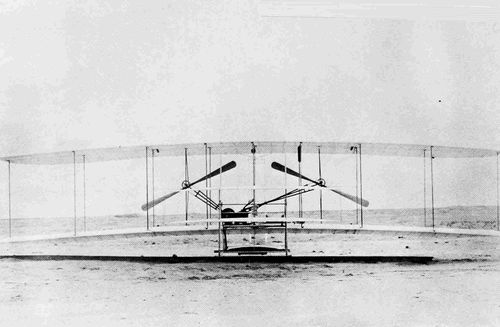
Kitty Hawk Flyer with original Wright engine poised on launching rail at Kill Devil Hill, near Kitty Hawk, North Carolina, 24 November 1903, the month before the Wrights achieved man's first powered and controlled flight in a heavier-than-air craft.
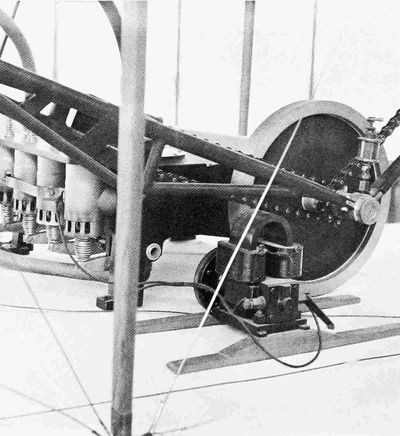
Reproduction of the first engine, built by Pratt & Whitney, as displayed in Wright Brothers National Memorial at Kitty Hawk. Engine is mounted in a reproduction of the Wrights' Flyer built by the National Capital Section of the Institute of the Aeronautical Sciences (now the American Institute of Aeronautics and Astronautics). Engine and plane were donated in 1963 to the National Park Service Cape Hatteras National Seashore.
SMITHSONIAN ANNALS OF FLIGHT * NUMBER 5
SMITHSONIAN INSTITUTION * NATIONAL AIR AND SPACE MUSEUM
The Wright Brothers' Engines And Their Design
Leonard S. Hobbs

SMITHSONIAN INSTITUTION PRESS CITY OF WASHINGTON 1971
Smithsonian Annals of Flight
Numbers 1-4 constitute volume one of Smithsonian Annals of Flight. Subsequent numbers will bear no volume designation, which has been dropped. The following earlier numbers of Smithsonian Annals of Flight are available from the Superintendent of Documents as indicated below:
The First Nonstop Coast-to-Coast Flight and the Historic T-2 Airplane, by Louis S. Casey. 1964. 90 pages, 43 figures, appendix, bibliography. Out of print.
The First Airplane Diesel Engine: Packard Model DR-980 of 1928, by Robert B. Meyer. 1964. 48 pages, 37 figures, appendix, bibliography. Price 60¢.
The Liberty Engine 1918-1942, by Philip S. Dickey. 1968. 110 pages, 20 figures, appendix, bibliography. Price 75¢.
Aircraft Propulsion: A Review of the Evolution of Aircraft Piston Engines, by C. Fayette Taylor. 1971 viii + 134 pages, 72 figures, appendix, bibliography of 601 items. Price $1.75.
For sale by Superintendent of Documents, Government Printing Office Washington, D.C. 20402—Price 60 cents