POEMS BY A POOR GENTLEMAN.
Reading edition
There, in a lonely room, from bailiffs snug, The Muse found Scroggins stretched beneath a rug.—GOLDSMITH.
POETRY and poverty begin with the same letter, and in more respects than one, are “as like each other as two P’s.”—Nine tailors are the making of a man, but not so the nine Muses. Their votaries are notoriously only water drinkers, eating mutton cold, and dwelling in attics. Look at the miserable lives and deaths recorded of the poets. “Butler,” says Mr. D’Israeli, “lived in a cellar, and Goldsmith in a Deserted Village. Savage ran wild,—Chatterton was carried on St. Augustine’s Back like a young gipsy; and his half-starved Rowley always said Heigho, when he heard of gammon and spinach. Gray’s day’s were ode-ious, and Gay’s gaiety was fabulous. Falconer was shipwrecked. Homer was a blind beggar, and Pope raised a subscription for him, and went snacks. Crabbe found himself in the poor-house, Spenser couldn’t afford a great-coat, and Milton was led up and down by his daughters to save the expense of a dog.”
It seems all but impossible to be a poet, in easy circumstances. Pope has shown how verses are written by Ladies of Quality—and what execrable rhymes Sir Richard Blackmore composed in his chariot; in a hay-cart he might have sung like a Burns.
As the editors of magazines and annuals (save one) well know, the truly poetical contributions which can be inserted, are not those which come post free, in rose-coloured tinted paper, scented with musk, and sealed with fancy wax. The real article arrives by post, unpaid, sealed with rosin, or possibly with a dab of pitch or cobbler’s wax, bearing the impression of a halfpenny, or more frequently of a button,—the paper is dingy, and scant—the hand-writing has evidently come to the author by nature—there are trips in the spelling, and Priscian is a little scratch’d or so—but a rill of the true Castalian runs through the whole composition, though its fountain-head was a broken tea-cup, instead of a silver standish. A few years ago I used to be favoured with numerous poems for insertion, which bore the signature of Fitz-Norman; the crest on the seal had probably descended from the Conquest, and the packets were invariably delivered by a Patagonian footman in green and gold. The author was evidently rich, and the verses were as palpably poor; they were declined, with the usual answer to correspondents who do not answer, and the communications ceased—as I thought for ever, but I was deceived; a few days back one of the dirtiest and raggedest of street urchins delivered a soiled whity brown packet, closed with a wafer, which bore the impress of a thimble. The paper had more the odour of tobacco than of rose leaves, and the writing appeared to have been perpetrated with a skewer dipped in coffee-grounds; but the old signature of Fitz-Norman had the honour to be my “very humble servant” at the foot of the letter. It was too certain that he had fallen from affluence to indigence, but the adversity which had wrought such a change upon the writing implements, had, as usual, improved his poetry. The neat crowquill never traced on the superfine Bath paper any thing so unaffected as the following:—
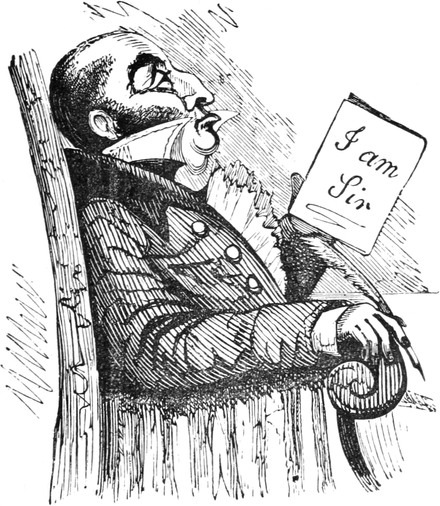
“YOUR VERY HUMBLE SERVANT.”
STANZAS. WRITTEN UNDER THE FEAR OF BAILIFFS.
ALAS! of all the noxious things That wait upon the poor, Most cruel is that Felon-Fear That haunts the “Debtor’s Door!” Saint Sepulchre’s begins to toil, The Sheriffs seek the cell:— So I expect their officers, And tremble at the bell! I look for beer, and yet I quake With fright at every tap; And dread a double-knock, for oh! I’ve not a single rap!
SONNET. WRITTEN IN A WORKHOUSE.
OH, blessed ease! no more of heaven I ask: The overseer is gone—that vandal elf— And hemp, unpick’d, may go and hang itself, While I, untask’d, except with Cowper’s Task, In blessed literary leisure bask, And lose the workhouse, saving in the works Of Goldsmiths, Johnsons, Sheridans, and Burkes; Eat prose and drink of the Castalian flask; The themes of Locke, the anecdotes of Spence, The humorous of Gay, the Grave of Blair— Unlearned toil, unletter’d labours hence! But, hark! I hear the master on the stair And Thomson’s Castle, that of Indolence, Must be to me a castle in the air.
SONNET.—A SOMNAMBULIST.
“A change came o’er the spirit of my dream.”—BYRON.
Methought—for Fancy is the strangest gadder When sleep all homely Mundane ties hath riven— Methought that I ascended Jacob’s ladder, With heartfelt hope of getting up to Heaven: Some bell, I knew not whence, was sounding seven When I set foot upon that long one-pair; And still I climbed when it had chimed eleven, Nor yet of landing-place became aware; Step after step in endless flight seem’d there; But on, with steadfast hope, I struggled still, To gain that blessed haven from all care, Where tears are wiped, and hearts forget their ill, When, lo! I wakened on a sadder stair— Tramp—tramp—tramp—tramp—upon the Brixton Mill!
FUGITIVE LINES ON PAWNING MY WATCH.
“Aurum potabile:”—Gold biles the pot.—FREE TRANSLATION.
FAREWELL then, my golden repeater, We’re come to my Uncle’s old shop; And hunger won’t be a dumb-waiter, The Cerberus growls for a sop! To quit thee, my comrade diurnal, My feelings will certainly scotch; But oh! there’s a riot internal, And Famine calls out for the Watch! Oh! hunger’s a terrible trial, I really must have a relief,— So here goes the plate of your dial To fetch me some Williams’s beef! As famish’d as any lost seaman, I’ve fasted for many a dawn, And now must play chess with the Demon, And give it a check with a pawn. I’ve fasted, since dining at Buncle’s, Two days with true Perceval zeal— And now must make up at my Uncle’s. By getting a duplicate meal.
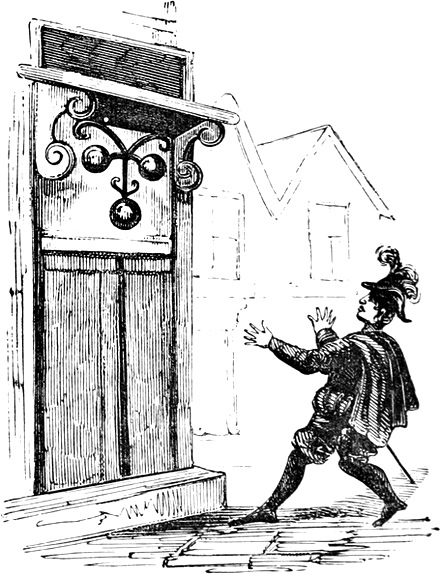
“OH MY PROPHETIC SOUL—MY UNCLE!”
No Peachum it is, or young Lockit, That rifles my fob with a snatch; Alas! I must pick my own pocket, And make gravy-soup of my watch! So long I have wander’d a starver, I’m getting as keen as a hawk; Time’s long hand must take up a carver, His short hand lay hold of a fork. Right heavy and sad the event is, But oh! it is Poverty’s crime; I’ve been such a Brownrigg’s Apprentice, I thus must be “out of my Time.” Alas! when in Brook Street the Upper, In comfort I lived between walls, I’ve gone to a dance for my supper; But now I must go to Three Balls! Folks talk about dressing for dinner, But I have for dinner undrest; Since Christmas, as I am a sinner, I’ve eaten a suit of my best. I haven’t a ram or a mummock To fetch me a chop or a steak; I wish that the coats of my stomach Were such as my uncle would take! When dishes were ready with garnish My watch used to warn with a chime— But now my repeater must furnish The dinner in lieu of the time! My craving will have no denials, I can’t fob it off, if you stay, So go,—and the old Seven Dials Must tell me the time of the day. Your chimes I shall never more hear ’em, To part is a Tic Douloureux! But Tempus has his edax rerum, And I have my Feeding-Time too! Farewell then, my golden repeater, We’re come to my Uncle’s old shop— And Hunger won’t be a dumb-waiter, The Cerberus growls for a sop!