THE WONDER-CHILD (continued 4)
Reading edition
Roly? Roly was killing his Boers down in the paddock, or wheeling heavy loads of earth to make kopjes in the bush. He would tell her to 'clear out of the way of lyddite shells,' if she sought him out.
Floss? Floss, who hated a needle, was sitting on the grass making, with incredible labour, a pincushion for the mother she had begun to love with an almost fierce affection. Challis would have liked to go and help her, but the child, if she pricked her fingers till they were empty of blood, would have no stitch set in it that was not her own. Furthermore, all the dreams on the Utopia were dispersed. Challis had never buttoned one of the little girl's garments, never tied a sash, never brushed out a curl. The small woman had dressed herself independently ever since she was three, and indignantly scorned all help; she hated sashes—her straight light hair she raked herself. And though she accepted in an offhand fashion the toys Challis had chosen with such love and interest, she kept up an inexplicably warlike attitude towards her, and deprecated her on every possible occasion. Her hands—'Pooh! Well, I would be ashamed to have hands that colour! S'pose you never take your gloves off?' 'Frightened to walk in the bush 'cause of snakes! Well, some girls are ninnies!' 'Never been-on a horse—'fraid to get on Tramby! Why, she—Floss—had galloped all over on Tramby without a saddle when she was only four!'
Challis, sensitively aware of her own want of courage to explore and grow familiar with these bush things, got into the habit of shrinking away when Floss came on the scene.
There seemed no niche left for her in this home she had looked forward to; that was what it was. The place, rightly hers, had filled up entirely during her long absence.
No one understood her, or tried to. They took it for granted that her genius and her life abroad had lifted her to a higher plane than the one on which they themselves lived. It might be very cultivated and beautiful up there, but they were not familiar with it, and therefore did not take any interest in it.
The girl tried hard to get on to their plane, and be interested in their things; but they knew she was trying hard, and it merely irritated them. Let her stay where she belonged.
It was so lonely, too—so very lonely. Used to the pleasant uproar and friendliness and excitement of cities, this little clearing in the great silent bush oppressed her intolerably after a week or two.
She had been a little ill before leaving Sydney. The doctors had said her nervous system was completely run down—a shocking thing in a child! They advised complete rest for several months, and expressed their opinion that the quiet bush life at Wilgandra and roughing it with children, who would take her out of herself, would be the best possible thing for her, and the triumphal career could be resumed later on.
So there were to be no concerts yet, no happy strivings to interpret Chopin's varying moods to a breathless audience, to reach up with Mendelssohn to his pleasant sunlit heights, to go down with Wagner to strange depths that stirred her soul. She was to practise very little, to appear in public not at all. The papers expressed their regret at her illness, and said a kind thing or two. After that her name had no mention in them.
One paragraph she had read had touched her to the quick. Some interviewer who had been to see her in Sydney wrote in his paper, 'Thank Heaven, she is not pretty! Her chances are hereby much greater.'
Poor little Fifteen! Her pillow was wet that night. She felt she had much rather he had said, 'She has no genius, but she is very pretty.' She longed for Hermie's shining wavy hair, for the sweet blue of her eyes, the pink that pulsed about her cheeks. Who cared if you could interpret the waves and storms of Lizst's rhapsodies, and let the keen little rifts of melody in between the thunder until the almost intolerable sweetness made the heart ache? Who cared that Leschetizky himself had taught you and had tears in his eyes once, when you had played to him the wind in the trees just as he himself heard it? What did all these things matter? Every one went home from your concerts and forgot all about you. Oh, surely it were better to be so exquisitely pretty that all who saw you loved you on the spot!
She looked at herself again and again in the glass that night. Until that wounding paragraph, she had never given one thought to her looks; the sensitive small face, the grey eyes drenched with this new tragedy, the fair straight hair falling over her shoulders—not pretty, not pretty, and all the world knew it now!
She drifted in from the verandah to the living-room, where the piano stood open as Hermie had left it, when, imagining Challis out of hearing an hour or two ago, she had sat down to it for a few minutes. But the cheap tinkling stuff that comprised poor Hermie's repertoire—the jingling waltzes, the pretty-pretty compositions of Gustave Lange and Brindley Richards, 'Edelweiss' and 'Longing,' 'Warblings at Eve,' and such—they set her ear horribly on edge, though she would rather have died than have said so. It were less torture to hear Flossie thumping conscientiously away at 'The Blue Bells of Scotland' and 'We're a' Noddin'.'
The very piano was a heartache; it was seven years since it had been tuned, and despite the careful dusting of Miss Browne, the silverfish led a gay existence in its interior, and ate all the softness and depth from the notes.
But this afternoon the girl, with that vague misery tugging at her heart, was driven to it; nothing else could ease her. She put her foot down on the soft pedal, to keep the discordant jangle away, and avoiding as much as she could the B that was flat, and the D that was dumb, and the F sharp that Roly had torn off bodily, she worked off the gloom that oppressed her with Beethoven and Bach.
Roly came in. He was arming himself for a new attack on Ladysmith; he had the kitchen poker and the stove-brush, the tin-opener, a knife from a broken plough, a genuine boomerang, the corkscrew, the gravy-strainer, and the carving-knife, disposed about his person, and he came into the living-room, his eye roving about in search of fresh implements of warfare. Nothing seemed to appeal to him, however, and he was going out again discontentedly when he noticed his new sister had dropped her hands from the keyboard, and was resting her forehead there instead.
He approached her with some awe.
'Can you play with your head too?' he asked; then he noticed there were tears running down her cheeks. 'Don't cry,' he said; 'I'll run out and ask mother to let you off. Did she say you'd got to practise an hour? Oh, I'll soon get her to let you off!'
Challis smiled faintly through her tears.
'It's all right,' she said; 'don't disturb mother. No one told me to practise.'
'Well, you are a muggins!' said the uncouth bushikin. 'Catch me setting myself a copy or a sum! Why don't you go out and play?'
Challis let a new tear fall.
'I don't know how to play at anything,' she said. 'I never had any one to play with.'
Roly's breast swelled with magnanimity.
'Look here,' he said, 'you can be Cronje if you like. Here, you can have these two for your weapons.' He handed her the stove-brush and the corkscrew. 'Come on down here, I'll soon show you how to do it.'
Challis shook her head.
'No,' she said, 'I'm fifteen; it's too late to learn now. I'll just have to go on playing and playing at concerts. And who cares when you're playing your very best, and have practised one composition six hours a day? Who cares?' She looked at him miserably.
'Look here, Chall,' he said, a most brotherly, kindly tone in his voice, 'it's only because you play such fat-headed things, that's why they don't care. I can't listen to them myself. Often when I've been digging my garden outside the window, and you've started to play, I've just had to go away. If you'd learn some nice-sounding pieces now, instead of things like Flossie's scales, only worse! There's Peter Small's sister, down in W'gandra, you ought to hear her play; she can play "Soldiers of the Queen," and "Sons of the Empire," and "Absent-Minded Beggar," and "Girl He Left Behind Him," and all those things, and she jumps her hands about, and runs up and down, and crosses them just as much as you do. If you like, I'll ask Peter to get her to lend you them; I'm friends with Peter just now.'
Challis smiled and dried her tears.
'I mightn't be able to play them, Roly,' she said; 'so I don't think I'll trouble you to ask.'
'Oh,' said Roly encouragingly, 'you'd soon pick them up. You could watch her a few times, and notice how she does them. But I'll have to be going now, Challis, if you don't want me. I'll be down in the bush at the back, if you want to come and have a try to play. Don't let on to Brownie that I've collared this.' He pointed to the gravy-strainer that adorned his breast. I'll bring it back all right.'
Left alone once more, Challis wandered about the little house. Miss Browne's door was half open, to let in the evening breeze. Miss Browne herself, her day's work finished, was sitting at the table writing a multitude of letters with a happy flush on her cheeks.
Challis looked on wistfully.
'Would you mind if I came in and sat with you?' she said.
Miss Browne dropped her pen and jumped up to welcome her.
'My dear, my love, why, you know you may; most pleased, most delighted, whenever you like—honoured, most delighted.'
Challis stepped into the little room.
CHAPTER XX
Miss Browne
'I shall have no man's love
For ever, and no face of children born
Or tender lips upon me.
Far off from flowers or any love of man
Shall my life be for ever.'
What was it that broke the barriers down? The wet eyelashes of the little music-maker? The droop of her soft mouth? Or came there across that poor room one of those divine waves of sympathy and understanding that wash at times from a richly endowed soul to a lonely stunted one?
Miss Browne found herself telling anything and everything that had happened in her life, and even the things that might have happened. Not that the whole of them made a sum of any account, if you condensed them; but, told ramblingly and with pauses for tears, they fell pathetically on the young listening ears.
Thirty-eight grey years! Life in this country town and that country town, in this crowded suburb or on that out-back station or selection—a hireling always. The first twenty-five had dragged by under English skies that even in summer had no sun for a motherless, fatherless girl, pupil-teacher from the age of fourteen. She bore twelve years of it patiently enough, and indeed would have borne another score, but two friends, stronger, more restless souls than she, though chained to the same life, told her they were going to break through it all, strike out of the stagnant waters of suburban England into the fresh, glittering sea the other side of the world.
They were saving their salaries to pay their passage to Australia. Governesses were royally paid out there, they had heard, and more than that—they whispered this a little ashamed—husbands grew on every bush.
Miss Browne scraped and saved for a year, cheerfully shivering without a winter jacket, happily heedless of the rain that came through the holes of her umbrella. If it had been a question of economising in her diet, she would have brought herself down to a crust a day, in her eagerness to make a plunge into a different life, but fortunately governesses are 'all found.' The three women cheerfully cramped their bodies third-class for the voyage, letting their souls soar boundlessly in the pleasant evenings on deck.
They came to their new land, saw it, and after a few years were conquered. Almost the same conditions of life, the same sickening struggle of a multitude of educated women for one poor place, the same grey outlook. One found a husband; he took her to some heaven-forgotten corner of North Queensland, where she had for neighbours Japanese and Chinese and Javanese, and he drank, as the men all do in those forgotten corners, where alligators are to be found on the river-banks, and coloured labour crowds out the white man's efforts. She bore him six children in eight years, and then died thankfully. The second woman went into a hospital and became a nurse; for the last five years she had been in Western Australia, kept busy with the typhoid in Perth. Once in a while she wrote to Miss Browne; once or twice she had eagerly said she was 'all but engaged,' but later letters never confirmed the hope, and now a dull commonplace had settled down over the correspondence.
Miss Browne drifted from place to place, place to place; there was nothing she was capable of doing really well, and no land has a hospitable welcome for such.
'It is a funny thing,' she said to Challis, 'but, however hard I try, I never seem able to do things like other people can.' Her eyes stared in front of her. 'If it had been your mother now in my place, she could have managed; she is made of the stuff that never goes under. But you would have thought any one like I am would have been sheltered and—cared for—as so many women are cared for.'
Challis stroked her restlessly moving hand.
'Sometimes,' she continued—her voice dropped, her eyes stared straight out before her—'sometimes I can't help feeling as if Providence has pushed me out to the front, and quite forgotten to give me anything to fight with.'
Then she pulled herself together reprovingly.
'Of course, that attitude is very wrong of me,' she said. 'It is only very seldom I think that, my love.'
Challis squeezed her hand sympathetically.
'It will all come right some day,' she said, with the large vague hopefulness of the very young.
'That's what I have always told myself,' said Miss Browne; 'but you must see, my love, if—if it does not come right very soon, it will be too late. I am thirty-eight—there, there is no need to mention it to Hermie or the rest of the family, my love.'
'But thirty-eight is not old,' said Challis, so eager to comfort, she left truth to take care of itself. 'Think what lots of people are fifty, and they don't think themselves a bit old.'
'But who will marry you after you are thirty-eight?' said poor Miss Browne, unable to keep any ache back to-night.
'Oh,' said Challis, 'lots of people don't get married, and they are as happy as anything.'
Miss Browne's lip quivered.
'If I had been asked,' she said, 'then I should not mind so much. But I am—thirty-eight, and no one has—ever asked me.'
Challis put her arm round the poor woman's neck; she stroked her cheek, patted her shoulder.
'Of course,' Miss Browne said at last, sitting up with tremulous, red-eyed dignity, 'there is no need to tell Hermie that, my love.'
'But you must have lots of friends,' said Challis, looking at the number of envelopes lying on the dressing-table. The colour ran up into Miss Browne's face. She half put her hand over the letters, then drew it back.
'If I told you about these, you would think me so foolish, my dear,' she faltered.
'Oh no, I wouldn't!' said Challis. 'Now I know you so well, I seem to understand everything.'
Miss Browne got some little papers out of a drawer, English penny weeklies devoted to 'ladies' interests.' She turned to the Answers to Correspondents pages, 'Advice on Courtship and Marriage.'
'Those marked with a little cross are the answers to me,' whispered Miss Browne. And Challis read these three marked paragraphs:
'Fair Australienne writes: "I am the only daughter of a very wealthy squatter, and have two lovers. One is a squatter on an adjoining station, the other an English baronet travelling in Australia. If I marry the baronet, I must leave my father, who loves me dearly; but I care for him more than I do for the squatter. What would you advise me to do?"
And the 'Aunt Lucy' who conducted the page had replied:
'Marry where your heart dictates. Could you not induce your father to live in England with you?'
'Sweet Rock Lily.—"I am eighteen, and, my friends tell me, very, very beautiful. I am governess in a wealthy family, and the son is deeply in love with me. If he marries me, he will be disinherited. What should I do? I love him very much. And will you tell me a remedy for thin hair?"
'The editor's answer is: "Try to overcome the prejudice of the family, Rock Lily, and all will go well. Bay rum and bitter apples is an excellent tonic."
'Little Wattle Blossom.—"I am seventeen, and only just out of the schoolroom. I am passionately in love with a young handsome man, who loves me in return; but my parents are trying to force me into a marriage with an old foreign nobleman. They have even fixed the wedding day, and I am kept a prisoner. What would you advise me to do?"
'The editor's answer is: "You cannot be forced into a marriage in these days. Refuse firmly. In four years you will be of age. In answer to your second question, your friend had better try massage for the crow's feet and thin neck."'
Challis read in extreme puzzlement.
'I hardly understand,' she said. 'How do you mean—these are to you?'
'It is only my foolishness, my love,' said Miss Browne, gathering them up again; 'but I get a great deal of pleasure out of it. The days the mail comes and I get the papers, I am so excited I don't know what to do. You get into the way of feeling it really is yourself.'
But this phase of Miss Browne was beyond Challis's comprehension, and she only looked doubtfully at the papers, so Miss Browne was swift to change the subject.
'These letters,' she said, 'are to the Melbourne and Adelaide art societies. I should like to tell you about this, my love. Your father, about four years ago, painted a picture, and something happened that made him try to burn it. Well, we managed to prevent that, and I got hold of it and hid it away. He has forgotten all about it now, imagines I sold it, but I haven't, and it occurred to me lately to write to several artists and describe the picture to them, and see if they would buy it. I did not mention your father's name; just said it was by a friend of mine—you will forgive me for the liberty, my love?'
'But didn't you send the picture?' said Challis. 'They could hardly tell from a description.'
'I had no money,' said Miss Browne, sighing 'I made inquiries at Wilgandra, but it would cost so much to have it packed and sent to Sydney. And there is the risk of losing it. I was very careful over the description; it took me five long evenings to write—I left no detail out.'
'And what happened?' said Challis.
Miss Browne flushed.
'Courtesy seems dying out,' she said. 'Not one of them answered. It might have been any lady writing—they could not know it was only I.'
Challis asked more questions about the picture. She asked to be shown it, and waited patiently while Miss Browne disinterred it from under the bed, and took off the old counterpane with which it was wrapped.
'I have never seen any great picture-galleries,' said Miss Browne, 'but I know there is something about this that must be good. It could not work up the feelings in me that it does, if it were just an ordinary picture. Look at the man's eyes, my love—isn't the hopelessness frightful?—and yet look at him well. You just know he'll keep on trying and trying till he gets there.'
Challis gazed at it for a long time.
'Yes,' she said slowly; 'that is how it makes me feel. I feel I want to beg him to stop trying, and lie down and go to sleep. But it wouldn't be any use. You feel the storm will last for ever, and the captain will go on trying for ever to get to wherever he has made up his mind to get to.'
'Your father intends it to represent the Flying Dutchman,' said Miss Browne.
'Oh yes!' Challis said. 'Of course. I ought to have known. But it is just like this picture—just as sad. And I play it too. Wagner, you know,—Der fliegende Hollander,—it makes you want to cry.'
'My love,' cried Miss Browne, 'you say you know an artist in Paris. Why, surely that would be the very thing! I believe they are all jealous of him in Sydney. Write to your friend. He would take notice of a letter from you. Write to him, and send the picture too. You can afford to, and it is not likely to go astray, since you know the exact address. Suppose we start to do it now?'
Challis sprang up with shining eyes. It seemed the loveliest plan in the world.
'It shall be our secret, you dear, dear thing!' she cried. 'We won't tell a single soul in the world—not even mother. Let's write it down that we promise.' She pushed pen and ink to Miss Browne. 'Write on this paper,' she said, '"I promise Challis Cameron faithfully I won't tell any one in the world."'
Miss Browne wrote the compact down, smiling.
Challis seized the pen.
'I promise Miss Brown faithfully I won't tell,' she wrote.
'Oh, my dear, my love!' said Miss Browne distressed. 'My love, how careless of you! I spell my name with an "e." I never thought you would forget, my love. No, don't add it on there; it looks as if it were an afterthought. Please write it again. We have always spelt our name with an "e," my love.'
CHAPTER XXI
The Morning Cables
'With rending of cheek and of hair,
Lament ye, mourn for him, weep.'
Bart came clattering at a great pace up the path with the mail. It was the midday dinner-time; and such pleasant appetising foods were the order of the day now, boylike he did not care to be a moment late.
He took the saddle off, laid it down on the verandah, drove the horse down to the first paddock, and hastened in to the dining-room.
His father was just unfolding the daily paper he had brought, and opening it to find the war cables.
'Read them out, Jim,' said Mrs. Cameron, looking up from her task of apportioning the peas and cauliflower and potatoes.
Cameron read out the headings:
'"DESPERATE FIGHTING AT KRUG'S SPRUIT."
"GALLANT ATTEMPTS TO RESCUE GUNS."
"OFFICERS SERVING THE ARTILLERY."
"FIFTEEN THOUSAND BOERS IN ACTION."
"BRITISH UNDER A GALLING CROSS-FIRE."
"BRITISH CASUALTIES."
"CONSPICUOUS GALLANTRY BY A NEW SOUTH WALES PRIVATE."
"LOSSES OF AUSTRALIAN TROOPS."'
The last two headings sent Cameron's eyes hurrying down the long column to seek details.
'Oh,' he said, 'poor lad, poor lad! Oh, I'm sorry for this—sorry for this!'
'Not old Morty,' said Bart—'not poor old Morty, dad?' Yet even as he spoke he knew it must be, for who else of all the contingent had they a personal interest in? He pushed his chair back and went to his father's shoulder. His eyes read the meagre paragraph, and burnt with swift tears for his friend.
'CONSPICUOUS GALLANTRY BY A NEW SOUTH WALES TROOPER'
was the heading of the cable. Below it said:
'During the engagement, Trooper Stevenson, of the N.S.W. Bush Contingent, made a most gallant rescue. He galloped to the assistance of General Strong, whose horse had fallen, and bore him under a scathing fire to a place of safety. General Strong escaped unhurt, and obtained another horse, but while galloping after his troop through the dusk, Stevenson was hit by a bullet, and killed instantaneously.'
'Just the sort of thing old Morty would do,' Bart said, his throat thick.
'I am thinking of the poor old man,' said Mrs. Cameron. 'It will kill him. Jim, you had better go up; you might be able to do something. None of the other sons are at home.'
'I'll go, certainly,' Cameron said; 'but it won't kill him. His pride in the lad's courage will keep him up.'
'I say,' said Bart, 'he won't have got the paper yet. That fellow Barnes was waiting for the mail while I was, and he had been drinking frightfully. It'll be hours before he gets back. I saw him turn in to the Golden Fleece as I came along.'
A strange stifled cry came from the end of the table. It was no use; Miss Browne had fought desperately to keep her self-control, but nature was too strong for her, and she was struggling with a piteous fit of hysterics.
Mrs. Cameron went round to her, got her to the sofa, opened the neck of her dress, administered cold water, spoke firmly and decidedly to her. There was nothing in the poor woman's cries for a long time, and she only pushed at Mrs. Cameron, as if trying to force her away. Finally a word came from her choking throat:
'Hermie!' she cried, and pointed to the open door. 'Go—to—Hermie.'
Where was Hermie? Mrs. Cameron looked round in surprise. It seemed only two minutes since she had been cutting the bread, and laughing at Roly because he had arranged his plate as a battle-field, with the peas for the army, the cauliflower as a kopje, the mashed potatoes in dots for the tents, while a slice of beef made the enemy's laager, and a gravy river flowed between the troops. Why had she left the table like this?
'Go—to—Hermie!' gasped the shivering, sobbing woman on the sofa. 'I—am—all right—quick, quick!'
Where had the girl gone? No one but Miss Browne had even noticed her chair was empty.
Mr. Cameron armed himself with another tumbler of cold water, and came across to the sofa.
'I will look after Miss Browne,' he said. 'You go to Hermie; perhaps she was a little faint.'
'Down—the—path,' gasped Miss Browne, 'near the wattles, most likely.'
Mrs. Cameron made her way down the path, looking from left to right, a puzzled expression on her face. The girl was nowhere to be seen. She looked among the roses, in the various shady corners, beneath the trees. Finally she came to the thick-growing wattles near the fence, and a gleam of blue cambric showed through the leaves. The mother went in among the bushes, and found the girl face downward on the ground, sobbing in so bitter and heartbroken a way that she was quite alarmed for a moment. Then a wondering comprehension came; her girl was almost a woman. Was it possible she had cared for this friend of the family in a different way from Bart and Floss and Roly?
'My poor little girl!' she said, and sat down on the ground beside her, and lifted the bright head that had been Morty's perpetual delight on to her knee.
But Hermie pulled herself away, and rose wildly to her feet, and ran this way among the bushes with her broken heart, and then that way.
'Oh,' she sobbed, 'go away, go away—I want to be alone! Oh, it is my fault!—I want to be alone—oh, mother, mother!'—and she came back to her mother's side, and fell down beside her again, clinging to her piteously. The mother said nothing at all—just stroked her hair and let her weep as she would, and soon a little calmness came back to the girl.
'Oh,' she said, 'if you knew how I loved him, mother!'
'Did you, my darling?' said the tender mother, and never showed the ache that was at her heart because her child had kept so great a thing as this from her confidence.
'Ever since he went I have been loving him,' Hermie said, 'and yet when he told me, I sent him away, and he was so miserable. I am sure that is why he went to the war.'
'And you thought you did not care for him, then?' said Mrs. Cameron. 'Well, darling, that was not your fault.'
'Oh, it was—it was!' said Hermie. 'You don't understand, of course. You never could. But I shall be miserable now all my life!'
'You found you had made a mistake, and you cared for him after all?' said Mrs. Cameron.
'I didn't know quite how much till to-day!' sobbed Hermie. 'I have kept thinking of him and thinking of him ever since he went; out now—oh, now it is too late! I know I shall love him till I die.'
The mother's heart ached, as all mothers' must do when their children have to stand alone in a grief, and there can no longer be any kissing of the place to make it well.
'It seems as if I have been blind,' went on the girl, sometimes wiping the tears away and hiding her swollen eyes, sometimes letting them trickle unchecked down her cheeks. 'I can't tell you how silly and small I have been—thinking men ought to be just like men in books, and never looking at what they really are. Oh, he was so good, such a brave fellow; ever since he has gone, people are always telling different brave or kind things he has been doing ever since he was a boy. And, just because he wore clothes and ties I didn't like, and sometimes knocked things over, I——'
Her voice choked, and she fell to sobbing again heart-brokenly.
Mrs. Cameron was silent again for a space; but when as the time went on the girl seemed to abandon herself more and more to her grief, she rose to her feet and drew the sobbing figure up also.
'There is a hard task before you, dear one,' she said, 'but I know you will do it.'
Hermie gazed at her helplessly.
'His poor old father does not know yet, for Bart tells me his man Barnes is still drinking in Wilgandra. I want you to go up to Coolooli and break it to him.'
'Me?' gasped Hermie. 'Me?'
'Yes, you, my dear. You cared for his son; it will establish a bond between you, and make it a little easier for him.'
'Oh, I couldn't!' cried the girl, shrinking back, actual alarm on her face. 'Oh, it is cruel of you to even ask me, mother! Why should I do such a thing? Surely it is hard enough already for me!'
'Because you are a woman, my dear, and must always think of yourself last,' the mother said quietly. 'How soon can you be ready to start?'
One glance the girl gave at her mother's face that was so quietly expectant that she would do the right thing. Her head lifted a little, and her mouth tried to compose itself.
'I have only my skirt to put on,' she said; 'I can do it while Bart saddles Tramby for me.'
Up to the cottage she walked again, and put on the neat blue riding-skirt her mother had lately made her. She bathed her red eyes; she drank two tumblers of cold water, to take the choking from her throat.
'Father will go with you,' the mother said, coming to the door; 'but when you get to Coolooli you can ride on ahead.'
Through the pleasant winter sunshine they rode, up hill, down dale, across bush stretches where Mortimer's horse had worn a path for them. Coolooli faced them at last, secret stern-looking, with its curtainless windows, its garden barren of sweet flowers. It was the first time the girl had been so near her lover's home.
She was among the trees now that lined the drive leading up to the house; her father had dropped behind, and was to follow on in half an hour.
Her heart seemed fluttering in her throat; a deadly sickness possessed her.
The old man was standing at a table on the verandah; he had a great map of the Transvaal spread open before him, and, with small flags stuck in it here and there, was following his son's footsteps.
He turned at the sound of the horse's hoofs. When he saw the rider he went down instantly on to the path, to help her to dismount.
'Well, little missie,' he said, 'it's not often you ride this way.' He looked at her colourless cheeks keenly. 'What is the matter—can't you jump down?'
She absolutely could not, and he had almost to lift her off her saddle. He tied the horse's reins loosely round the verandah-post, and looked at her again from beneath his shaggy eyebrows. He told himself he knew what was the matter. The family was in difficulties again, and had sent this particular member of it as an emissary to borrow money. Well, this freak of his son's was going to cost him dear. Still, the little thing was trembling dreadfully, and evidently did not like her task. He put his hand on her shoulder reassuringly.
'Out with it, lassie,' he said; 'how much do you want?'
Hermie clung to his arm—her very lips were white.
'Mortimer has been very brave,' she said; 'he has done something magnificent.' Her voice fell.
'My lad!' he cried, in a changed tone. 'Where? show me—I haven't seen the paper yet.'
She clung to it.
'You will be very proud of him,' she said 'All Australia is talking of him to-day.'
He pulled vigorously at the paper; his creased old face had a strangely illumined look; his hands were trembling with eagerness.
'I knowed it,' he said; 'he always had grit. I've kep' expectin' this. Well, I'll lie quiet in me grave now, whenever the Lord up there likes.'
'Yes,' the girl continued, and gave him the paper. 'All the world is proud of him to-day, so that must help you. He gave his life to save the general's.'
The old man drew a curious breath, and sat down on his chair; he opened the paper and read the paragraph. Then he read it again, and again, and again, until his eyes had carried the news to his brain twenty times at least.
'It was a fine thing to do,' he said at last.
'Yes,' said Hermie.
'No other Australian's been mentioned like that.'
'No,' said poor Hermie.
'It was a fine thing to do,' he repeated. He got little further than that all the time the girl stayed; even when Cameron came up, all a-quiver with deep sympathy, he still only said, 'It was a fine thing to do.' After an hour or so, he looked at them expectantly.
'I suppose you'll have to be getting back?' he said; and Cameron and Hermie rose at once.
He saw them down the steps, and even helped Hermie on her horse again. Cameron rode on.
'Good-bye, missie,' he said. Then he shot an almost aggressive look at her. 'You ought to be fine and set up that a fellow like that loved you.'
'I am,' said Hermie bravely. 'I shall be proud of it just as long as I live, Mr. Stevenson.'
He softened a little, then looked suddenly old and very tired.
'I want to be alone now,' he said. 'But I don't mind if you come up again to-morrow.'
With that he went back to the house, the paper still in his hand. But the next day, when she went, she found him pacing the place like a wounded tiger. The servants told her he had been very quiet all the morning and the previous evening, and had told them all several times about the fine thing his son had done. But Barnes had brought in the day's papers an hour ago, and he had been raging like this ever since. The girl found him with bloodshot eyes and clenched hands, walking the big verandahs.
'Go away!' he shouted when he saw her. She turned and went into the house at once, to wait the passing of the mood. She stood at the window of one of the handsome rooms, and looked with dreary eyes out to the twin hill that lay bathed in the clear sunshine half a mile away, and never knew how often Mortimer had sat at that same window, smoking his after-dinner pipe, and building his sunny cottage for her on the bright hill-top.
Presently the old man came in to her.
'Take the paper from me,' he said quaveringly, and held it out to her. 'If I read it any more, I'll lose me reason!'
The girl looked startled.
'I didn't know there was anything new to-day,' she said. 'Bart told me he had lost our paper on the way.' Her eyes, large with fear and grief, tore through the cables they had kept back from her at the selection.
'Private Stevenson,' said a paragraph, 'did not die instantaneously. He was shot through the jaw and through one lung, and dragged himself to a rock, leaving a long trail of blood behind. He must have lingered in frightful agony all night, for when his body was picked up by the ambulance, it was found that he had written the word "Cold" on the ground with his finger.'
'Dear God, how can they do this?' Mrs. Cameron had cried, when she saw the paragraph. 'Have they no sense of pity or decency, that they print these frightful details? This is more terrible a thousandfold for those who loved him than the plain news that he was dead.'
The poor little girl, who had gone up so resolved to be calm and brave, screamed out uncontrollably at the cruel news, then buried her head in her hands to keep the moans back.
The old man brought her a glass of water from the sideboard.
'Let's tear it up,' he said, and rent the horrid news in pieces. 'Let's only remember the boy did the right thing, and died like a man.'
He found himself comforting the girl who had come to comfort him. She found herself telling him with streaming eyes how she had loved his boy and thought of him, even though at the time he asked her she had said, 'No.'
'If only he could have known!' she sobbed. 'Perhaps, perhaps he was thinking of me part of that night when he—was cold.'
The next day there was another cable about the affair.
'The trooper who saved General Strong's life at Krug's Spruit was Private Mark Stevenson, of the Queensland Contingent, not Mortimer Stevenson of the New South Wales, as reported yesterday.'
Hermie tore along the road to Coolooli to rejoice with the old man, since before she had gone to grieve with him.
He was sitting on the verandah looking very shaken and bewildered, and reading the third cable as often as he had read the first.
'I—hardly understand,' he said feebly.
Hermie had seized his two hands, and was shaking them joyously.
'He is alive—alive!' she cried.
He looked at her piteously.
'Didn't he do that fine thing at all?' he said.
'No,' she cried. 'Some other man did it, thank God! He is alive, alive—Mortimer—he is not dead!
He drew his hands out of her eager ones a little pettishly.
'They should be more careful with these cables,' he said.
'Oh,' she cried happily, 'we will forgive them anything! He is alive—alive!'
'But he never did that fine thing,' he repeated sadly.
CHAPTER XXII
Conclusion
'Let one more attest
I have lived, seen God's hand through a lifetime, and
all was for best.'
Life, so long a hopeless tangle, smoothed itself out at last for the little family. Challis was well again, and had gone off to give a series of concerts in the respective capitals of each colony; gone off in high spirits, touched with sweet responsibility, inasmuch as she was the bread-winner for the family. Mr. Cameron went with her this time, and her mother stayed thankfully at home on the selection. And Australia, despite the fact that she neither recited 'The Absent-Minded Beggar,' nor yet had 'Sons of the Empire' in her repertoire, gave her so warm a welcome everywhere that in three months she was back again at The Rosery with a fresh thousand pounds put to her credit in the bank.
This pleasant sum was to pay passages across the sea for all the family.
For, warm-hearted as the big overgrown young island had proved, its eager, easily roused enthusiasm would soon be turned upon some other object, and there would be no permanent opening for the girl-musician. She must go to the little, pulsing, crowded island the other side of the world for that.
Mrs. Cameron had the plan of campaign all in readiness in her head. They were to find an ideal house in a pleasant countrified suburb just out of London, and Challis, accompanied by her father, was to fulfil her English engagements from there.
When she went abroad, they would all, when possible, go with her, and make headquarters in some inexpensive French or German village. The benefit of a varied life like this would be incalculable to the young ones, after the stagnant years at Wilgandra.
Bart was to go to an English public school the moment they touched land after the voyage. He had but three or four years left now in which to crowd all his school education, and he was eager to begin. In general education and the making of moral fibre, Wilgandra had done a better work than Eton or Rugby could ever hope to do.
'But I shall come back and be a squatter,' he always insisted. 'No other life for me.'
'If he sticks to that,' old Stevenson said to his father, 'send him back to me. I'll give him a start, and be thankful to do it. He's got the stuff in him to make the kind of man this country wants.'
Then he fell to chuckling over the memory of the calf that Bart had sold him, and so started the intimacy between them.
Hermie was to travel as much as possible, take lessons in various subjects from good masters, and go on with her general education under the able guidance of her mother. And there were picnics and dances and all manner of brightness for her in her mother's campaign, to counteract the grey monotony of her earlier girlhood.
And, when the war was over, one in khaki would step in and take the young life into his keeping, and make all the sunshine for it that a boundless love makes possible.
On his far battle-fields Mortimer knew now the little girl's heart was his own. His father had written to him one of his characteristic letters.
'I'm glad to hear, my boy, you're still alive, but it was a fine thing that other fellow Stevenson did for his general. I take pride that my name's the same. But perhaps you'll get a chance yet to do the same thing. I've been looking round, and I think the hill over the way will make the best place for your house, and I daresay two or three thousand a year would keep you going for a time, as she's not flighty and used to fine things, like Luke's wife. It's a pity she can't make soap and such things, but maybe she can learn; she may favour her mother, who seems a sensible body, more than that fool of a father of hers. I'll give the little baggage credit, at all events, for being fond of you. A nice job of it I had with her, when we thought it was you killed instead of that fine fellow Mark Stevenson. She was nearly crazy, because she said you'd never know how she loved you.'
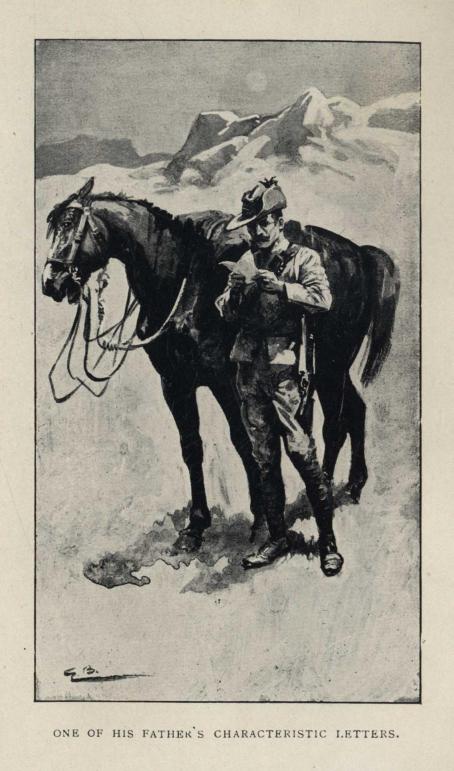
ONE OF HIS FATHER'S CHARACTERISTIC LETTERS.
So Mortimer fought the rest of his battles with a light heart, and many a night, when the veldt slumbered restlessly beneath its covering of white, harmless-looking tents, he lay happily awake, thinking of the green twin hill at home and the bright cottage that was going to crown it.
'But I shall insist that he travels about with you for a year or two before you settle down,' said the mother; 'it will do you both good. And he must bring you for a visit home to us at least every three years.'
The girl went on her way, shyly, sweetly, learning all she might to fit her for the high office of woman and wife.
Miss Browne?
At first Mrs. Cameron had almost obeyed the natural impulse to dismiss her kindly, give her a handsome present of money, and help her to find a comfortable situation. But the vision perpetually haunted her of the poor woman with a strand of dull hair blown loose, and her blouse and skirt not quite meeting, and her face moist with perspiration, toiling in one hot country town after another, getting sparks in her eyes, cooking other peoples' food, dragging fat babies out for a walk, battling helplessly with naughty small boys and girls, and distractedly saying to them, 'My love, my dear.'
This while she and her own family, their eyes turned eagerly to a glowing future, sailed thankfully away from all the misery and monotony of the past.
She could not do it. The woman seemed to stand right in their path, a moral responsibility for all their lives.
So while Mr. Cameron was away with Challis on the Australian tour, she filled in all her spare time undertaking a mission to Miss Browne. Her first battle was to make the woman respect herself, trust herself. She ordered some clothes for her, well-cut coats and skirts, warm-coloured home dresses with soft lace to hide the bony neck and wrists. She gave deep thought to a style of doing her hair, and having found it, kept her to it, insisting that she should give plenty of time to curling those helpless strands and brushing them and getting them into good condition. She encouraged her to form her own opinions on things, and teased her gently out of her little eccentricities of speech. She applied herself energetically to making her capable and efficient in the branches of housekeeping which all these years she had so hopelessly muddled. The mission was sheer hard, exhausting work—there were times when it seemed almost desperate; but women have battled far harder and with far less hope of success with the Island blacks or the far Chinese, and here was her work come to her hand.
'Why,' cried the changed woman, at the end of a day that had seen the accomplishment of a most respectable pie-crust, an almost invisible patch on a coat, and a hard piece of music mastered, 'I shall be able to ask for ten shillings a week, I am sure, when I go to the registry office again; I never used to get more than five or six until I came to Mr. Cameron, and I am sure I was not worth the ten he used to pay me then.'
'My dear,' said Mrs. Cameron, 'you have finished with registry offices. I want you to come to England with us, and help me with Floss and Roly.'
This decision she and her husband had only just arrived at; to leave her behind, even improved as she was, would mean she would soon sink back without stimulus into her dreary ways. So Challis gave yet one more concert in a country town, to pay for the extra passage money and frocks, and the future they left to look after itself. She had a relative or two in England who might give her a home; if not, well, unless life went very crookedly again, they would always keep a corner for her themselves wherever they lived.
But before they had been in London six months the pleased Fates relieved them of their anxiety.
Next door to them in the pleasant home they had made was a widower, just getting over—and without overmuch difficulty—the loss of a wife who had insisted upon managing his very soul as well as his house, and his two children and his very respectable cheque-book.
His small ones were running wild—he noted the contrast between them and Floss and Roly, whom Miss Browne seemed now to manage so admirably. The intimacy increased; the change from his past, overruled existence to the companionship of this gentle lady-help, who deferred humbly to his opinions, and asked his advice, and was curiously grateful for the smallest attention, was such a restful novelty to him that he offered her his hand and heart and lonely little children forthwith.
And now that Fortune, so long harsh and uncompromising, had taken to flinging gifts at the family with unstinted hand, it did not leave Cameron himself out of its scheme of sudden generosity.
The picture of the ship had found its way safely from under Miss Browne's bed at Wilgandra across the sea to the artist who painted in leafy Fontainebleau pictures the world was pleased to stand and look at long.
And the man's artist-soul rose in recognition of the passion and strength that had gone forth into the brush that had worked so feverishly in that far-away bush township.
An important Paris exhibition was just coming on. He rushed up to the city with the canvas, and his influence got it in at the right time, and saw it well hung. The second day the exhibition was opened it sold for two hundred guineas, and the path Cameron had ached to walk on all his life was at last open to his feet.
The day had not dropped her burdens from the backs of these people for ever; it had merely strengthened weak shoulders with soldierly discipline, and readjusted the weight.
Bright days, sad days, separations, meetings, temptations, love, death, all would come along, as they always have done, as they always will.
For this is Life we fare upon, and not just a little journey to ask smooth ground for all the way.
THE END.
Printed in Great Britain by Hazell, Watson & Viney, Ltd., London and Aylesbury.
* * * * * * * *
The Favourite Author Series.
A splendid series of entertaining stories, by Popular Authors, for girls still at school. Illustrated.
Crown 8vo, or large crown 8vo, cloth gilt, 2s. 6d. net.
Bede's Charity. By HESBA STRETTON.
A poor farmer's daughter, "an unlearned woman," tells the history of her life—and very interesting reading it makes, too.
Carola. By HESBA STRETTON.
A most graphic and powerful story. The career of the heroine and the character of an old Jew are skilfully portrayed.
The Children of Cloverley. By HESBA STRETTON.
A charming story for children of life in England and America during the terrible time of the American Civil War.
Cobwebs and Cables. By HESBA STRETTON.
A powerful story, the general teaching showing how sinful habits that begin as "cobwebs" generally end as "cables."
Dwell Deep. By AMY LE FEUVRE.
The difficulties and happiness of a very sober-minded girl among her more flighty companions are brightly described.
Enoch Roden's Training. By HESBA STRETTON.
A thoroughly interesting story for young people, who will find the teaching conveyed in it very helpful when in trying circumstances.
Was I Right? By Mrs. O. F. WALTON.
Should a woman marry a man who has not her own religious belief? That is the whole point of this interesting tale.
Winter's Folly. By Mrs. O. F. WALTON
This helpful story shows how a little girl found her way to the heart of a disappointed and friendless old man.
The Wonderful Door; or, Nemo. By Mrs. O. F. WALTON
A very spirited and amusing story of a nameless child who is adopted by a basket-hawker, a noble-hearted dwarf.
Kiddie; or, The Shining Way. By AMY WHITTLE.
Kiddie is a child of misfortunes who escapes from the cruel guardianship of the owner of travelling roundabouts.
Looking Heavenward. By ADA VON KRUSENSTJERNA. Translated by A. DUNCAN DODDS.
A Russian lady's sincere Christian character and conversation bring blessings and peace to the hearts of all whom she meets.
The Hillside Children. By AGNES GIBERNE.
Risely's boyishly-clever criticisms and witticisms frequently lead to his own undoing, and his venturesome pranks bring trouble.
The Scarlet Button. By KATE MELLERSH.
John and Joan discover an old family jewel, the fortunes of which form the chief subject of this story.
Our Dick. By LAURA A. BARTER SNOW.
A really good story of a boy who is a boy, and fights his battles in a brave, manly way.
More About Froggy. By BRENDA.
Froggy has much trouble, brought about by bad acquaintances, and many adventures on land and sea, until all ends well.
Peter and Pepper. By KATE MELLERSH.
Peter is a jolly little fellow, and the pranks he and "Pepper" play together provide splendid and interesting reading.
* * * * * * * *
POPULAR STORIES BY AMY LE FEUVRE.
Illustrated. Crown 8vo, cloth gilt, 2s. 6d. net.
Harebell's Friend. By AMY LE FEUVRE.
A pleasant story of domestic interest. Little Harebell is full of quaint sayings, high spirited, and has the most tender and loving little heart in the world.
Laddie's Choice. By AMY LE FEUVRE.
The small hero has to choose between living with a rich uncle, or with his father who is poor.
A Little Listener. By AMY LE FEUVRE.
A splendid story of child-life. Trixie is a delightful little prattler, very imaginative, and quite entertaining about things in general.
Me and Nobbles. By AMY LE FEUVRE.
A wholesome, natural story of a child who yearns to meet the father whom he does not remember.
Miss Lavender's Boy. By AMY LE FEUVRE.
A series of excellent stories all showing some pleasant trait of human nature and inculcating good moral lessons.
Us, and Our Donkey. By AMY LE FEUVRE.
A rattling tale of the doings of some rectory children who, with a donkey, have many exciting adventures.
Us, and Our Empire. By AMY LE FEUVRE.
An amusing story describing the various mishaps that befall a family of children who formed an Empire League.
* * * * * * * *
Charming Stories for Girls.
—BY— Mrs. George de Horne Vaizey.
Mrs. George de Horne Vaizey is one of the foremost writers of girls stories. All her works are full of brightness and unflagging interest, and any girl who has not yet made Mrs. de Horne Vaizey's acquaintance through her books has a great pleasure in store.
Illustrated. Large crown 8vo, cloth gilt, 3s. net.
About Peggy Saville. By Mrs. G. de H. VAIZEY.
How Peggy rescues a rival from burning, plays innumerable pranks, and disarms rebuke by her quaint ways, is pleasantly told.
More About Peggy. By Mrs. G. de H. VAIZEY. A Sequel to "About Peggy Saville."
A charming sequel to "About Peggy Saville." Peggy is never short of an excuse to help her out of her scrapes.
Pixie O'Shaughnessy. By Mrs. G. de H. VAIZEY.
Describes the remarkable experiences of a little Irish girl and her family, containing a rich fund of exhilarating humour.
More About Pixie. By Mrs. G. de H. VAIZEY. A Sequel to "Pixie O'Shaughnessy."
The happy-go-lucky O'Shaughnessy's are delightful, especially Pixie, with her French hats and manners, and her Irish heart and tongue.
A Houseful of Girls. By Mrs. G. de H. VAIZEY.
The hopes, the fears, the serious endeavours, the pranks, and the love-makings of six bright-eyed maidens are here charmingly set forth.
* * * * * * * *
Pure High-toned Stories.
By Rosa Nouchette Carey.
Containing graceful, vivid pictures of girl life. Abounding in striking incidents and full of pathos. The character sketching is very true to life.
Illustrated. Large crown 8vo, cloth gilt, 3s. net.
Aunt Diana. By ROSA N. CAREY.
A characteristic love story by this popular writer, told in a quiet, gentle, tender style, and with many strongly-marked individualities.
Averil. By ROSA N. CAREY.
A young lady of delicate health and with ample means, seeks to befriend her poorer relatives, also various waifs and strays.
Cousin Mona. By ROSA N. CAREY.
A charming story of two motherless girls suddenly bereft of their father. Their trials are told in Miss Carey's inimitable way.
Esther Cameron's Story. By ROSA N. CAREY.
The whims and fancies, the mental qualities, and varying dispositions of several girls are pleasantly set forth in this chatty story.
Little Miss Muffet. By ROSA N. CAREY.
From a wild, unmanageable schoolgirl, the charming heroine develops into a sweet and lovable young woman.
Merle's Crusade. By ROSA N. CAREY.
A delightful story for elder girls. The heroine strikes out a new line for herself as a nurse for little children.
Our Bessie. By ROSA N. CAREY.
Bessie's sunniness of disposition makes her the delight of everybody, and brings her a good husband and a happy home.
* * * * * * * *
Fascinating Stories FOR GIRLS.
By Evelyn Everett-Green.
Illustrated. Crown 8vo, or large crown 8vo, cloth gilt.
Barbara's Brothers. By E. EVERETT-GREEN. 3s. net.
Wulfric, M.D., and Gerald, would-be artist, have little in common, so Barbara sees many family dissensions before her brothers finally agree.
The Conscience of Roger Trehern. By E. EVERETT-GREEN. 3s. net.
Roger's warfare with himself, a year or so of storm and stress, is powerfully and skilfully told.
The Cossart Cousins. By E. EVERETT-GREEN. 2s. net.
A charming love story. A young brother and sister are left unprovided for and thrown on their cousin's tender mercies.
The Family. By E. EVERETT-GREEN. 3s. net.
Some reminiscences of a housekeeper. A young wife at the commencement of her married life, found herself unequal to the responsibilities of her position.
The Family Next Door. By E. EVERETT-GREEN. 3s. net.
The "family" consists mainly of some unruly Anglo-Indian children, over whom their mother exercises practically no control.
Fir Tree Farm. By E. EVERETT-GREEN. 2s. net.
Davenant trod the downward path, passed through the depths of degradation and despair, but finally struggled back from darkness.
Greyfriars. By E. EVERETT-GREEN. 2s. net.
Esther takes charge of her married sister's home, and has much trouble with the children left in her care.
* * * * * * * *
Every Girl's Bookshelf.
A Splendid Series of Stories for Girls. Each with Two Illustrations in colour, and coloured medallion on cover.
Large crown 8vo, cloth gilt, coloured wrapper, 2s. net.
Her Treasure of Truth. By H. LOUISA BEDFORD.
Madge Bramley, brought suddenly into contact with Alice Masterman, acts on a generous impulsive desire to help her, with splendid results.
Beryl's Triumph. By EGLANTON THORNE.
Depicting in a pleasant manner a young girl's life at her sea-side home. Her final heroic deed completely changes Beryl's whole life.
Annie Carr. A Tale of Two Hemispheres.
A sorely-tried girl passes through untold misery, not from any fault of her own, but from the basest treachery.
Ellen Tremaine. By M. FILLEUL.
A splendidly told story of a woman's hard domestic struggles. Her husband is lost at sea, but turns up again at last.
The Girls of Marleigh Grange. By M. M. POLLARD.
A very readable story, describing three years of a girl's life. There is also a good love element in the tale.
Little Maid Marigold. By ELEANORA H. STOOKE.
Little Marigold's winsomeness and unselfishness completely undermined an unreasoning hostility and prejudice which her aunts had conceived towards her mother.
The Mysterious Locket. By RUTH LYNN.
From a little motherless babe, rescued from shipwreck, Ermyn becomes an heiress—and all by the aid of a locket.
The Mistress of the Manor. By E. KIRBY.
A domestic tale of unusual interest, in which the heroine passes through many troubles and trials before she finally marries happily.
Anthony Cragg's Tenant. By AGNES GIBERNE.
An agreeably written story of a very good girl, a selfish, deceitful woman, and a kindly man.
The Heart of a Friend. By FLORENCE WILMOT.
A noble girl's influence and her genuine unselfishness has the happiest effect on the members of a very mixed family.
Brown Eyes and Blue. By ANNIE MABEL SEVERS.
There are thrilling episodes, deep mysteries and startling surprises in this invigorating story of home and school life.
Arthur Glynn. By RUTH LAMB.
Half-a-dozen well written tales, which combine interest of plot, skill of narrative, and sound moral teaching.
Two Enthusiasts. By EVELYN EVERETT-GREEN.
The efforts of an heiress and her companion to carry out their views on social and religious questions are well told.
The Faith of Hilary Lovel. BY EVELYN EVERETT-GREEN.
Describes the exciting times of the Spanish Armada, and how the people of England rose unitedly to resist the attempted invasion.
The Romance of Miss Hilary, and other Stories.
Romances of humble life in which poor, hardworking people make life beautiful by mutual sacrifice and unusual kindness.
Kitty and Kit. By FLORENCE WILMOT.
A brightly written story of home life, spiritedly told. Kitty, an orphan girl, and Kit, her cousin, are especially attractive.
The Colleen's Choice, and other Stories.
An interesting set of fourteen brightly told stories inculcating the maxim, "Be good, and you will be happy."
Dick and Brownie. By MABEL QUILLER-COUCH.
A little girl, accompanied by her dog, runs away from a gipsy caravan, and has many adventures.
Alwyn Ravendale. By EVELYN EVERETT-GREEN.
A modern story of west country child life. The young hero is quixotic, and in the end proves a faithful lover.
Half-a-Dozen Sisters. By EVELYN EVERETT-GREEN.
A pretty story of family life in which six sisters take their varied parts, and into whose interests the reader is irresistibly drawn.
Brought Out of Peril. By EMMA LESLIE.
An interesting story describing what befell a young servant girl, silly, wilful, and easily led, although of good parentage.
A Turn of the Road; or, The Homeseekers. By ADELAIDE M. PLUMPTRE.
Depicting the delightfully free life of a party of home seekers, in the still wild country of Canada West.
The Young Gordons in Canada. By MARY B. SANFORD.
A vivid account of the experiences and adventures of a family that reduced circumstances obliged to leave the old country.
The Finding of Angela. By ALICE M. PAGE.
Four girls come from Alexandria to a school in England, hoping to find Angela, a poor little kidnapped baby cousin.
A Queen of Nine Days. By E. C. KENYON.
An interesting account of the troubled but brief reign of Lady Jane Grey, narrated by one of her maids of honour.
Lenore Annandale's Story. By EVELYN EVERETT-GREEN.
A splendid book for young people, the pervading thought being the fulfilment of duty in obedience to the commands of religion.
Veiled Hearts. By RACHEL WILLARD. A Romance of Modern Egypt.
The Sacred Carpet, howling Dervishes, and the Sword of Azrael, form the groundwork of this fascinating romance of Modern Egypt.
The Orphans of Merton Hall. By EMILY BRODIE.
Claire and Olive are foster sisters, and their youthful experiences and girlish confidences are told in an entertaining style.
Joint Guardians. By EVELYN EVERETT-GREEN.
A captivating and romantic tale of two families of cousins, whose fathers are joint guardians of a young girl.
Tom Heron of Sax. By EVELYN EVERETT-GREEN.
A country lad who began by scoffing at religion, ended in being shot while preaching among rough quarrymen.
Fir Tree Farm. By EVELYN EVERETT-GREEN.
Davenant trod the downward path, passed through the depths of degradation and despair, but finally struggled back from darkness to light.
Greyfriars. By EVELYN EVERETT-GREEN.
Esther takes charge of her married sister's home, and has much trouble with the children left in her care.
* * * * * * * *
The "Home Art" Series
EDITED BY FLORA KLICKMANN.
Demy 8vo. About 120 pages. Fully illustrated. Paper boards. 1s. 3d. net.
The Home Art Crochet Book.
These designs are extremely handsome, the advanced worker being as well catered for as those who are not so skilful.
The Home Art Book of Fancy Stitchery.
This book contains an amazing quantity of information which will be found an extremely valuable addition to the needlewoman's equipment.
The Mistress of the Little House.
Practical talks on domestic topics for educated women who are not in a position to keep a properly trained servant.
The Craft of the Crochet Hook.
Giving explicit instructions which are augmented by illustrations so clear that the most intricate stitch can be traced without difficulty.
The Modern Crochet Book.
Contains original ideas for combining crochet with embroidery and with fancy braids, together with new and unusual designs.
The Cult of the Needle.
A magnificent collection of new ideas, giving directions for Bulgarian, Catalan, Hungarian and Baro Embroidery, and other forms of needlecraft.
Artistic Crochet.
Novel Beadings, Insertions and Edgings, and exquisite floral designs in Irish Crochet, are some of the contents of this splendid book.
* * * * * * * *
The "All Time" Stories.
A Splendid Series of Select Books by Popular Authors.
Illustrated. Crown 8vo, cloth gilt. 2s. net.
Alone in London. By HESBA STRETTON.
A pleasant story showing that in whatever condition of life one may happen to be, there are always some compensations.
His Little Daughter. By AMY LE FEUVRE.
A high-spirited, mischievous little girl reads Bunyan's "Pilgrim's Progress," and imagines and adapts the story to herself and her surroundings.
The Vicar of St. Margaret's. By M. G. MURRAY.
An interesting story of how a bright girl's life is clouded, and her lover estranged by a crafty priest.
Max Krömer. By HESBA STRETTON.
A children's story of the siege of Strasburg, 1870, showing how the children were involved in the keen sufferings of the war.
David Lloyd's Last Will. By HESBA STRETTON.
The incidents of this interesting story are connected with the Manchester cotton famine in the early sixties.
The Highway of Sorrow. By HESBA STRETTON.
A vivid story of village life in Russia, written with all Miss Stretton's usual force and skill.
LONDON: THE RELIGIOUS TRACT SOCIETY.