THE WONDER-CHILD (continued 2)
Reading edition
'It—it certainly comes to thirty-six thousand,' she said at last.
'Would you please multiply it by a shilling a dozen, and say what it comes to,' was Hermie's further request.
Miss Browne again took a surprising time to do the simple sum.
'A hundred and fifty pounds,' she said.
'That is for the first year,' Hermie said; 'but now would you please work it out on this big piece of paper, and see what we should get the second year. Two hundred and forty fowls——'
'And the twelve you began with, too,' said Roly.
Hermie was quite willing to be cautious.
'We won't count them, we'll allow for them dying, too,' she said. 'Two hundred and forty fowls with, say, twenty chickens each in the year. What's that?'
Miss Browne's pencil worked.
'Four thousand eight hundred,' she said.
'And they lay one hundred and fifty eggs a year.'
Miss Browne looked quite shaken at the result her arithmetic produced—seven hundred and twenty thousand eggs! Three thousand pounds!
The excitement made her work out the results of the third year, and she was weeping when the sun came out—sixty thousand pounds. She was weeping for her grey spoiled life. Exquisite dresses, travel, health, even marriage, and little children of her own, would have been all possible, had she worked these sums years and years ago, and set to work with twelve fowls.
Bart still had misgivings.
'More might die than that,' he said.
Hermie was quite pale with excitement.
'We have counted that half that come out die,' she said, 'and Lizzie says her mother always reared ten out of every thirteen. We have only counted six. But count three, if you like; still, that is thirty thousand pounds. And we have not counted selling any.'
Even Bart saw the moderation that only counted three chickens to each hatching, and his doubts died away.
Visions of all this wealth intoxicated the children; they tore their father from his book; Hermie told him, with eyes ashine with tears and little heaving breast, that he was never to do any more of that dreadful ploughing, that in three years they would be making thirty thousand a year, at least, by no harder work than just feeding the fowls and packing up eggs.
He smiled at them very gently; he could not bear to damp their ardour. In very truth he could not exactly find out why these figures should not be as they seemed.
'Of course you would have a huge feed-bill and want a big run of land,' he said.
Bart gave a comprehensive sweep of his young arm towards the scrubby bush-land that lay around them.
'As much as we like for a shilling an acre a year,' he said.
'But the feed-bill?'
'Five thousand a year would buy enough at all events, and still we'd have twenty-five thousand left,' Hermie said jubilantly. 'You will give up the ploughing, won't you, daddie?'
Cameron temporised, and said he would just do a little while the chickens grew.
That night a violent wind came up with drenching rain. Cameron lay listening to it, wondering what skies were over the head of his beloved whom the seas held from him.
Then he heard doors opening and shutting, whispered words, and finally a series of very angry cackles. He threw on some clothes, and went to find out the meaning. In the living-room an oil lamp was flaring in the draught, a Plymouth rock was roosting on the piano top, a white Leghorn was regarding the sofa suspiciously. On the floor sat Hermie, rubbing a wrathful fowl dry with a Turkish bath-towel, and presently in staggered Bartie and Miss Browne, the former with five fowls by the legs, the latter nervously holding one at arm's length.
Cameron fell into a convulsion of silent laughter, so earnest were the children, so absorbed. And Miss Browne, poor Miss Browne, how ludicrous she looked with her scanty hair flying ragged round her shoulders, her figure clad in an ancient mackintosh, her mouth frightened, her eyes heroic with the endeavour not to let go the fowl, which twisted itself madly to peck at her trembling hand!
'I don't know what you are laughing for, papa,' Hermie said, a trifle offended. 'The fowl-house leaks dreadfully.'
'But it has rained half a dozen nights since we came; you never brought the things in here before, my child,' he urged.
Hermie received Miss Browne's contribution on her knee, and fell to drying its dejected feathers.
'We didn't know before that each of them was worth two thousand five hundred pounds,' she said. 'Please, papa, will you hold Bartie's fowls, so that he can light the fire. We are going to give them something hot to drink.'
CHAPTER VII
Come Home! Come Home
.
'Oh, that 'twere possible,
After long grief and pain,
To find the arms of my true love
Around me once again!'
Five years dragged on. Sometimes word came that the travellers were at last coming home, and Cameron's heart grew warm, only to grow cold again, as he realised he dare not let them come to this. Then, while the agony of dread still was crushing him, the next mail would bring the bitter relief that the time was not yet—the agent or the music masters or some one else had found another year was necessary, or the great career would be spoiled. Not one word all this time of the selection, else had the 'career' been in instant danger of the ruin predicted, the mother would have journeyed at the greatest possible number of knots an hour back to them. Her dreamer of dreams depending on a selection, her children depending on her dreamer, become his own master!
Yet surely the man had had his lesson, and toiled now marvellously, piteously.
Five years, and not one idle day.
Five years of bewildered struggling with unknown enemies—drought, hurricanes of wind, bush fires, devastating rains, a soil that the farmer born and bred could hardly have made pay. Never a complaining word. Hermie, growing to womanhood, broke her heart over his life at times.
There was even a day when she fell down on her knees at a chair, and covered paper wildly with a pen that commanded her mother to come home.
Cameron working obstinately on one frightful day, the thermometer one hundred and seventeen degrees, had a 'touch of the sun,' and even after the doctor had left him quieted, his head in cool cloths, his temperature falling, he still moaned for his wife, cried to her like a child, stretched out his arms, raved, besought her to hold his hand. It was then that Hermie broke her promise, down on her knees, just hidden by the bed-curtain, writing wildly with the pen she had brought for the doctor to write his prescription.
'By the next boat,' she wrote; 'if you wait for the one after, it will be wicked of you. How can you stay like this? Challis, Challis—all our lives spoiled for her to have a chance! We have no chance; father's life is worse than any dog's. Challis—I think I hate Challis! Going along quietly and happily, are we? Miss Macintosh taking your place? We are starving, worse than starving; the food we have to eat is worse than none at all. He needs delicate things, ice and invalid dishes, properly cooked. I have just been to the safe to look what I could get, and the mutton has gone bad—it goes bad nearly every day in summer here; there is no milk, for the cows have no feed, there is some nasty mouldy bread and bad butter, and golden syrup with flies in it, and sugar alive with ants. You! You and Challis are eating the best things that can be bought with money. I hate Challis! The doctor says we are to keep his head cool with water, and to stand vessels full of water about the room to cool the air. The well is nearly dry, the sun has turned the tank water bad, or else a wombat or a bird has fallen in, and it is poisonous. Bartie has gone a mile with the cart to beg some from the Dalys.
'Miss Macintosh taking care of us all so nicely! We have no one in the world but Miss Browne. Oh yes, we have told you lies and lies, but you ought not to have believed them. You should have come to see for yourself that he was happy and well. Oh, if you could hear him crying, just to hold your hand, he says, and to hear you talk! Ah, mother, mother, mother, how cruel you are!'
But the spirit of the man, just learning to be indomitable, kept him back from long illness. In four days he was up again, easily turned sick and faint, but able to lie on the sofa, and even take an interest in the delicacies that Hermie set before him. She had ridden Tramby into Wilgandra herself, gone to the grocer, and implored him for nice things—calf's foot jellies, and whitebait, and Canadian tinned fruit.
'My sister, Challis Cameron, the pianist will be back soon. I have written for them to come, so you will be sure to be paid.'
And the grocer, a kindly spot in his heart still for the youngest housekeeper he had ever taken orders from, made up a big basket of tinned goods, and said he would wait for Challis to pay him.
'Hermie,' Cameron said from the sofa on the fifth day, 'my head is still confused, but I seem to remember when I was very bad that you kept telling me mamma was coming. There has been no letter, has there?'
Hermie grew a little pale.
'No, there has been no letter, papa,' she said.
'Hermie,' he cried, after spending a minute trying to find the reason for her curiously averted head, 'you did not write for mamma, Hermie?'
She turned to him then, her blue young eyes on fire.
'I did,' she said; 'it is time, more than time she came. If she does not come soon, you—we—we shall all be dead!'
'Child, child!' he said.
He had risen from his sofa and gone to the window, to look once more with aching eyes at his wretched lands. If this had been the green isle in the sea he had dreamed of making it, he would have sent long ago himself. But these desolate acres!
'Child,' he groaned, 'I couldn't let her come to this. I am only half a man—half a man. God left the manliness out of me when He made me, and gave me womanish ways instead. And I have never fought them down, as it must have been meant I should do. But I will begin again, I will work harder—things must take a turn, and then I can meet her, and she will not despise me. Child, God has no more awful punishment than when He lets those we love despise us. Send another letter, tell her not to come yet—not just yet. Let me have one more chance.'
Hermie was sobbing at his side, pulling at his arm, trying to urge him back to the sofa. She knew he was not talking to her, knew he was hardly aware she was there, but her sensitive spirit, leaping at his troubles with him, was bowed down with the knowledge and weight of them. How she loved this man—this grey-haired, blue-eyed man at her side! Hardly the love of daughter for father; her feelings for him had in them something of the passionate, protecting tenderness of a mother for a crippled child.
'Lie down,' she said, 'there—let me move these pillows; that is better. She must come—she should have come long ago. And I told her to be sure to come by the next boat. Now lie still; I am going to get your lunch.'
The exertion and emotion had tried him exceedingly. He lay still, still, his face to the wall; and now his mood brought a tear from under his eyelid. It was too late! She would have started! Ah, well, praise God for that! God who took these things out of our hands. She was coming—he might give up for a little time, and lie with his head on her breast; she who had always forgiven him would forgive him still and clasp him to her, and call him, 'Dear One.' Then all he would ask would be the happiness of dying before the world began again.
The happy tears rolled down his cheeks. Hermie, tip-toeing back with her tray, saw them, and was filled with dismay. What had she done by this interference?
'Darling,' she said, dropping beside him, 'don't mind, don't mind. The letter is not posted yet—Bartie was going to take it in this afternoon. It is not mail day till to-morrow. We will not send it.'
Not posted! Not posted! She was not coming—she might not know of his extremity, his need for her! The chill wind passed over him and dried his tears, dried his heart.
'Here is the letter,' the poor child cried; 'don't look like that, darling. I would not vex you for the world. Shall I tear it up?'
He looked at it piteously. Oh, that Bartie had it, riding with it through the bush, summoning her, summoning her!
'Shall I burn it?' said the poor little girl.
'Yes,' he said, 'burn it.' His voice was lifeless, his eyes stared dully at the wall.
CHAPTER VIII
An Atheist
'Thou hast made them equal unto us, which have borne the burden and heat of the day.'
Hermie put her letter and all hopes of rescue together into the kitchen fire.
Life was an endless drab again.
She went listlessly out, and stood on the doorstep to look at it.
Her father did not want her, he had pushed his lunch aside, and bidden her, irritably—he who was so gentle—to leave him to himself.
Bart, poor grave little Bart, a man at fourteen, was working about the place. Neither he nor the young ones had gone to school while the father had been ill. He and Roly had been all the morning beating monotonously at a bush fire just across the road. There was no excitement about it, there seemed little danger; the fire burned quietly, steadily—it had been burning for two days—but this morning it had crept to the fences; the boys had been obliged to cut boughs and beat at it.
Roly sat on the fence most of the time, and sleepily kept back the cunning yellow tongues from the patch Bart had entrusted to him. Bart walked up and down, mechanically threshing out the little licking flames that longed to curl round the fence.
Sometimes he left Roly on guard, and went to do necessary work, feed the two calves, shed a burning tear over the dying sheep, give Tramby a few drops of water.
Hermie went down to him wearily, a sun-bonnet on her head.
'There's no danger about the fire?' She looked at it a little apathetically.
'Oh no; if there were three of us, we could put it all out. Roly's not much use, of course.'
'Bart, what are we going to do?'
'For water? Oh, Daly's going to let me have a big cask to-night. You've got half a bucketful still, haven't you? I didn't want to take Tramby out till it was cooler. Reminds me, I must mend the cart—that old shaft's smashed again.'
'And when that cask's gone?'
'Oh, I'll go and get some from old Perry. His well's not half dry, and there's only himself. But don't you go and be wasteful, Herm—no washing clothes and that sort of waste.'
'I want a bath—I want to turn on a tap, and not have to use just a dipper or two. All Challis has to do is turn on a tap.' Hermie spoke with a strange bitterness.
Bart smiled good-humouredly. 'Yes, she's a lucky little beggar,' he said. 'My word, if I could have the bath-water she wastes, I'd make this poor old place look up a bit.'
He looked round on the desolate acres, looked at them with yearning affection. He was a quiet-natured boy; he did not call himself unhappy; he would have felt he had nothing left to ask for, had he but a plentiful water supply for the stock and crops, and better tools to work with, and a little more strength in that young arm of his. Like his mother, he had the knack of doing the thing at hand with all his power, and already he was a far more proficient farmer than his father would ever be.
'What are you going to do now?' the girl asked, as he hurried away. 'I'll come with you if you like.' Such a hot, patient young face his was, it smote her that she seldom heeded him. He looked pleased at her faint show of interest.
He showed her the corn, coming up bravely, the wheat patch, not drooping quite as much as it might have done. He pointed to the trees in the little orchard. 'In another month or two those apricots and peaches will be about ripe,' he said; 'make a nice change, won't they?' His eyes dwelt lovingly on the green small fruit. 'When the drought breaks——'
'Pshaw!' said the girl.
'Oh,' the lad said cheerfully, 'it will, one of these days; then we'll go along grand.'
He had caught the spirit of patience, of acceptance of ills, from the settlers about.
'But the sheep, nothing will give them life again!' The girl's eyes burned.
The boy had no fortitude against this; he gave a sudden wet glance towards the far end of the selection.
'Let's go and see how they're getting on,' he said in a low tone.
The girl rebelled.
'No—why?' she said. 'It only makes us miserable, and we can't help.'
'All right, you go back,' Bart said. 'I'll have to go. I might have to light another fire.'
Hermie followed him.
The sheep crept away from the house to die, once they found no water was to be had there. They chose to lie down and cease to be at the spot where once had been a dam. Patches of ashes showed where Bart had piled wood over the poor carcases and burnt them up, in his wise young knowledge that the air must be kept pure.
None were dead to-day, though fifty seemed dying. Half a dozen brown ragged little lambs filled the air with piteous outcry.
Hermie's heart swelled.
'Can't you do anything?' she said.
'No,' he said, 'they'll have to go. I've had to give them up, dear. If I can get water for the house for the next week, I'll be glad. Daly is running very short himself.'
There were footsteps in the bush just near, a panting of breath, a curious dragging sound.
'Floss,' said Hermie, and remembered for the first time she had not seen her little sister for hours. 'Where can she have been?'
The child was dragging a bucket. Her face was almost purple with the heat; she had kept her eyes half closed, to shut out the almost unendurable glare, and did not know she was so close to home till she stumbled almost into Bart's arms.
When she saw Hermie there too, she clung to the handle jealously.
'It's not for the house,' she said, 'so don't you think it. Let it alone, Bart! Bart, if you take it, I'll scratch.'
Such a fierce little face it was!
'I'm only going to carry it for you, Chucks,' Bart said. 'You shall do what you like with it.'
'True'n honour?'
'True and honour.'
The little girl relinquished her hold, but kept a guarding eye on the precious fluid.
'Where did you get it, old girl?' Bart said.
'Don't tell father?'
'Why ever not?' said Hermie.
Floss turned on her vehemently.
'I took it,' she said. 'Don't care, I'm glad. They've got a whole cask, the greedies, and lots of money, so they can get as much as they like. They get casks from the Bore, and they're sent down in the train, and they've got a cart to fetch it. They drink it all themselves—pigs! They don't care about the sheep.'
'Not the Scotts, Floss—you've not been stealing the poor Scotts' water?' cried Hermie, aghast. The Scotts lived in a miserable hut on the adjoining selection, and were the nearest neighbours.
Flossie's eyes blazed indignantly.
'Them!' she said. 'They've got less than us! I got it from those mean measuring men.'
Hermie looked puzzled.
'She must mean that camp of surveyors down the road,' Bart said. 'It's a mile away at least. Why, you poor old Flossie, have you been right down to that camp for this little drop of water?' He put his disengaged arm over her bony little shoulders.
Floss caught her breath, and looked unhappily into the half-full bucket.
'The first one was fuller,' she said, 'but the s-sheep nearly knocked me down to g-get it, and they s-s-spilled it on the g-ground.' Her voice shook with sorrow for the waste.
'Twice,' muttered Bart, 'she's been twice, Hermie.'
They were back among the sheep now, and Bart hardly knew what to do with such a drop among so many.
'This one,' said Floss; 'look at its poor eyes—and that one lying down, and the little lambs, Bartie.'
Bart put the bucket to the noses of the ones she touched, but had to drag it away before the poor things had half what they wanted.
A piteous bleat went up from the others.
'I—I think I'll just get one more,' Floss said, and almost staggered to the bucket. 'It's quite easy to steal it now; the camp's left all by itself. Oh, I must get one more—look at that one's eyes.'
But Bart picked her up in his arms, and started back to the house with her.
'You'll just come and lie down quietly,' he said. 'I never saw anything like your face. You'll be ill like father. Poor little Floss! poor little old Floss!'
'There—there would have been half a bucket more,' said Floss, 'only I nearly fell once, and it s-s-spilled.' She was sobbing on his shoulder, sobbing heart-brokenly, hard little Floss who never cried.
Hermie took the child from her brother at the door.
'I'll undress her and sponge her,' she said; 'that will cool her a little, but I quite expect she will be ill like father. Well, it is all Challis's fault.'
In an hour Floss lay asleep, the fierce heat of her cheeks a little faded, and Hermie's hands were idle again.
Miss Browne was helping Lizzie to fold the poor rags of clothes from the wash; the father still begged to be left alone; outside Bart and Roly still threshed monotonously at the fire.
Hermie went into the tiny bedroom that had been run up for her because the house was too small—the bedroom that the mother had been so pleased to hear was built. She found herself looking in the glass at herself, looking sadly, listlessly.
She saw a girl, thin, undeveloped, with a delicately cut face, and shadows lying like ink-smears beneath her eyes. Her womanhood was coming, and she had no strength to meet it; at her age she should have had rounded limbs and pleasing curves. She seemed to recognise this, as she gazed unhappily at her angles. Her hair pleased her, for the sun was making a glory of it; there was a nameless beauty about her face that she recognised vaguely.
'I shall never marry,' she sobbed. 'No one ever comes here but that heavy, stupid Morty. I shall be like Miss Browne in a few more years. I'm getting untidy now—no one can be tidy in clothes like these; I never care how I do my hair—what is the use, when there is no one to see it? I've not been to a party or a proper picnic, like the girls in the book, in all my life. I shouldn't know what to do, if I did go to one. No; I shall grow just like Miss Browne, and it is all Challis's fault.'
A portrait of the sweet-faced girl-player hung on the wall. Hermie tore it down from its place and broke it into fragments.
'I'm just tired to death of seeing you smile!' she muttered.
Miss Browne came in—Miss Browne, with perspiration on her face and a strand or two of her colourless hair loose. She carried an armful of Hermie's clothes from the wash. 'They are a very bad colour,' she said, 'but we cannot blame Lizzie, when there was next to no water. My dear, what is the matter?'
Hermie did not even wipe the tears from her face; she was sitting still, her hands on her knees, and letting the salt drops trickle drearily down her cheeks.
Miss Browne took a step towards her, then paused timidly. There had never been much intimacy or confidence between them. Hermie, with her innate love of daintiness and beauty and the hardness of youth, despised while she pitied the poor woman.
'Is it—anything I can help—your father—Floss—you are anxious—worried?'
'Oh no,' said Hermie, 'I wasn't thinking of any one but myself.' She leaned her head back, and had a sense of pleasure in her rolling tears. 'I suppose I'm not much more miserable than usual; but then I expect you are miserable—every one is, I think.'
'But not in the middle of the day, love,' the lady-help said.
'Why not?'
'Oh'—vaguely—'there isn't time, as a rule. One is so busy. It is a different thing when you go to bed.'
'What do you do then,' said Hermie, 'when you are miserable in bed?'
Miss Browne thought a second. 'I think I say my prayers,' she said.
'And if that does not cure you?'
'I say them again.'
'And if you are still miserable?'
'I—I think I go to sleep then; one is generally tired.' She spoke apologetically.
Hermie leaned her head still farther back. 'Saying prayers would not help me much,' she said. 'I am an atheist.'
'What?' screamed Miss Browne.
'An atheist,' said Hermie. 'It is very comfortable to be one. You have only to think about eating and sleeping. Oh dear!'
She arose languidly and administered water to Miss Browne, who was gasping alarmingly. 'This room is hot,' she said. 'Go and lie down in your own. You shouldn't have made me talk, if you didn't want to hear things. Mind that bit of loose wood at the door.'
Miss Browne, thus dismissed, went away like a chidden child, but her eyes were full of terror, and her very knees trembled. She groped her way to the sitting-room and poured out the frightful story into Mr. Cameron's ears.
He made his own way presently to the hot, cramped bedroom. Hermie had let her hair down, and was sitting on the edge of the bed surveying her poor little prettinesses tragically in the looking-glass.
Her father sat down on the bed beside her, and disclaimed fatigue and headache and everything else she urged upon him.
'What is this Miss Browne tells me, little one?' he said, and almost indulgently, so young, slight, and absurd she looked, to be questioning eternity.
Hermie twisted her wavy hair up into a hard plain knot.
'I only said I was an atheist,' she said, and her young lips quivered and her eyes grew wild.
He put his arm round her.
'How long have you been feeling like this, childie?'
She burst into a passion of frightened tears.
'Since yesterday morning,' she said.
'Tell me about it,' he whispered.
She swallowed a few sobs. 'I'm tired of saying prayers, nothing gets better—nothing comes. It—it's easy enough to believe in God, if you live in Sydney and have water laid on—and cool days and money and a mother. But out here—oh, He can't expect us to believe in Him!'
'I think a few of us do,' he said.
'Us!' she repeated. 'You don't believe anything, do you, father? I've never heard you say a word. I have thought for long enough you were an atheist too.'
He took his arm away and moved to the little window; it was almost ten minutes before he turned round and came back to her.
'Child,' he said, 'sometimes I think my mistakes are too many for me. I have nothing to say to you. I dare not even say, Forgive me. Poor little child, to have come to such rocks! I should have helped you long ago. Only, you see, I had got in the habit of leaving these things to mother.'
'Mother did not often go to church,' said Hermie discontentedly. 'I don't remember her talking religion much.'
'She breathed it instead,' he said; 'she is the best woman in the world, never forget that, Hermie. When we were first married I was full of the young university man's talk—brain at war with established doctrines. She never came over weakly to me, as some women might have done, she never kept spotlessly aloof, indeed, she conceded me freely many of my points. But she managed to make it plain to me that all these questions mattered very little—Christ, and prayer, and love, and doing our best—those were her rocks, and waves of dogma washing for ever on them could not move them.'
'Did she ever read any of those books of yours—those on the top shelf?' whispered Hermie.
'Ah,' said Cameron, 'you have been reading those, have you? Oh yes, she was never afraid to read anything that was written, but she distinguished between faith and creed. She said she did not try to explain or understand God, only to believe in Him. She is quite right. It is the hard names, the popular orthodoxies, the iron creeds, that take the soul and heart and warmth out of religion. When you were little, she did nothing more than show you God as your Father, and Christ as your Saviour, to be tenderly loved and obeyed, and gone to for refuge and comfort.'
'No,' said Hermie.
'No; it was her way. She wanted the love of God to be a living thing to you all—a glad, warm, spontaneous thing, like the love you bore us, only deeper. She would have no lines and rules and analyses of it while you were small. It was not a thing she actually spoke about very often, but white hours, find room for themselves at times—on plain Mondays and Saturdays as often as on quiet Sundays, and she had a way of making the influence of them run, clear, fresh, pleasant streams through the mud-flats of life. Can you realise in any degree what it is to me to find her daughter with such thoughts, Hermie?' His voice was very low. Hermie pulled the pin from the plain tight knob, and let all her hair hide her flushed face again.
'If—if only I had known you thought like this!' she muttered.
'Yes,' he said; 'it is a thing I shall never be able to put away from my mind again, that I did not let you know. A man gets in the way of keeping quiet things like these to himself, but I should not have forgotten I had children. I knew Miss Browne was a good woman, whatever her faults, and I felt that I might leave you to her. Don't think I am excusing myself.'
'It was not your fault, darling, darling,' Hermie said, and clung to him; 'but think how miserable we are—all of us, even poor little Floss! How can He forget us like this?'
Cameron's blue eyes looked out at the blue sky.
'Not to understand, only to believe. He does not lead us always through green pastures. The severe and daily discipline makes us shrink, no doubt. But we have to go on.'
'Oh, darling, I do love you, I do love you!' wept the girl.
'Tie up your hair, childie, and we will go down and sit among the roses, if any are still alive. I am quite strong enough to walk.'
He opened the door, and they went out together, and neither looked at the sky. But here had gathered a brave cloud host, and there another contingent came, determined, black-browed, strenuously fighting the long-victorious sun, desperately clinging together. And over the fainting earth flashed its lights, and through the heavens tore the sudden thunder of its guns.
And the battle was to it.
Down came the sweet torrents of the rain, and the cracked, piteous earth lay breathlessly glad and still beneath it. You heard the calves call to their mothers, the surprised whinny of the horses seeking shelter. You saw the sheep struggling to their feet and lapping the wet grass with swollen tongues.
You heard the birds making all sorts of new little cries and noises, as they flew wildly for shelter—birds many of them that had been born and grown to make nests for themselves, and never known the strange phenomenon of rain.
You heard the hisses and splutters of the bush fires, as the evil spirit went out of them.
You saw a lad come up from them, his beating bough still in his hand, the lines of his young grave face all broken up, and the glad tears bursting out, to meet the deluge of rain that beat in his face.
You saw a small girl rushing out half dressed and heedless of the torrent, for the exquisite pleasure of seeing the sheep drink.
You saw a woman with thin, blown hair and a drab complexion saying her prayers in her bedroom.
Down where the roses were just recalled to life, Hermie was clinging to her father, both wet through with the sweet blinding rain.
'Oh, you didn't believe me, did you?' she cried. 'As if I could—as if I could! It was just that the dust had got into my heart and choked me. Oh, darling, I never really meant that dreadful thing! Dearest, you don't think I meant it, do you?' Her tears were gushing out in streams.
'I never believed it for one moment,' he said, and kissed her, and led her back to the house.
CHAPTER IX
Mortimer Stevenson
He was a man, take him for all and all.'
Morty came up to the selection the next Sunday—Mortimer Stevenson.
'Glad to see you, Morty,' Cameron said. 'What's the news of the war? It is a week since we have seen the paper.
Mortimer fastened his horses' reins to the verandah-post, then drew half a dozen papers out of his saddle-bag—a daily or two, a couple of weeklies, one or two English special war numbers.
'I'd rather you read for yourself,' he said, handing them to the older man; 'it's not pretty enough to talk about much. Those Boers take a lot of beating. Of course, it will be all right as soon as Lord Roberts takes charge.'
The crisp papers were in Cameron's hands; a few yards away an old canvas chair stretched itself out invitingly.
'Hermie, my dear—Miss Browne—here is Mr. Stevenson,' he called down the passage of the little house.
'Don't mind me, I'll just sit down here and have a smoke while you read,' Stevenson said; 'don't disturb any one, perhaps they are busy.'
He sat down on the verandah step, and began to fill his pipe, and Cameron, relieved, opened his papers, and was in the Transvaal for the rest of the afternoon.
To look at, Stevenson was a typical young bushman. He had added inches to his stature so rapidly, and breadth to his shoulders, that he was ill at ease anywhere but in the saddle. His complexion was burnt to a deep copper. Grey, good eyes looked squarely at you.
Used to cities, you would not like his dress. A serviceable tweed suit, country-cut, one of the brilliant ties, which, so the storekeepers persuade the bush, are worn in Sydney, a soft brown hat with its dangling, string-coloured fly-veil.
His father was a vigorous old man of seventy; his type occurs again and again on the out back stations.
He had gathered great wealth during all those laborious years, and he spent it, if not frugally, at least with full respect for its difficult garnering. He had been a member of the Upper House, and his wife, during her lifetime, had much enjoyed the dignity of seeing his letters addressed, 'The Hon. Matthew Stevenson, M.L.C.'
He had had but a rudimentary education, yet his plain common-sense and clear intellect had made the loss only a slight one to him. To his sons—six of them he had—he offered education, or at all events its equivalent—the money for it—liberally, and three of them had taken advantage of it, and gone finally into various professions in Sydney.
The others—the duller three—had assimilated just as much of the tonic waters as does the ordinary youth of eighteen; then they shook the dust of Sydney off their feet, and returned thankfully to the station where their hearts had always been. Mortimer was youngest of this latter three, and the only one now unmarried.
Bart came down the passage, and his eyes brightened at the sight of the figure smoking on the verandah step.
'Hallo!' he said, 'just the fellow I wanted. Look here, Daly gave me a whole lot of new seed—Sheep Burnett I think he called it. Will it hurt to sow it on that place where the sorghum was?'
'Oh, any place will do, old chap; but you needn't waste your best ground; it's great stuff, you know—it would grow in the Sahara. Just sow it along with your grass or clover seeds.'
'It comes up quickly, doesn't it?' Bart said anxiously. 'Do you think it would make all down there look smooth and green and nice in a month?'
Mortimer laughed. 'Are you taking to landscape gardening, Bart?' he said. 'I never knew before you had an eye for effect.'
Bart sat down on the step. 'It's no joking matter, Morty,' he said. 'My mother and Challis will be home in a month; we've got to make the place look up a bit before they come. The governor's been making bonfires of all the rubbish since breakfast—it does look tidier, doesn't it?'
Mortimer looked round. 'It's not the same place,' he said heartily, and added for encouragement, 'And after all, perhaps they won't come, old fellow; you know you've had a lot of false alarms.'
'Oh, but this time it's certain,' Bart said, and not without unhappiness; 'they've actually started by this.'
Floss came clattering out in her rough boots. She sat down on the other side of the family friend.
'I knewed it was you when I heard Pup bark,' she said; 'you came last Sunday, too, and the Sunday before that.'
'Did I, Flossie?' he said. 'That sounds as if it were a Sunday too many.'
'Oh no, no one minds you,' she answered; 'if it were your father, now, or the Revering Mr. Smith, it might be a nuisance; we'd have to put a clean tablecloth on for them.'
'And that sounds as if I am going to be asked to stay to tea, Floss?' Mortimer said.
'Of course you are,' was Flossie's reply. 'Miss Browne says it's the least we can do, considering all the papers and things you give us. Only she says she doesn't know how she's going to make the butter spin out. We don't get it from the store again till Thursday.'
'There, hold your tongue, Floss,' said Bart, 'you'll make Morty afraid to take any.'
'Oh no, he needn't be,' Floss said. 'Me and Roly's going to say we don't like it under our jam.'
Roly came stealthily from behind some trees.
'Where is she?' he whispered.
'It's all right,' Floss said; 'she's got to change her dress, and her hair was pretty awful, so she'll have to do it again.'
Thus reassured, Roly ventured to the step, and took up a position at Mortimer's shoulder. He was attired in an orange and blue-striped football jersey, and the most respectable pair of knickerbockers he possessed. Mortimer had given him the jersey on his last birthday, and it was the boy's dearest possession.
'Why,' said Mortimer, 'what have you been after? Is Miss Browne laying wait for you for stealing her jam?'
'Oh no,' said Roly. 'It's only this,' and he pointed to his jersey; 'she doesn't think it's religious to wear football things on Sunday.'
'Well,' said Floss, in the virtuous tone a clean pinafore made justifiable, 'I don't think it is, either. Look at me. I learnt a collect this morning.'
'A what?' said Roly.
'A collect,' said Floss. 'Collect for the thirteenth Sunday after Trinity. Hermie wasn't sure if this was the right Sunday, only it was a nice short one to begin with.'
'Does Miss Hermie teach you your collects?' asked Mortimer, his head turned away a little.
'She wants to,' said Floss, 'but I don't know if she'll always be able to find me. She was looking for Roly, too, this morning, only he was playing Boers somewhere, so he got off.'
'Wasn't playing Boers,' said Roly. 'I was putting a new name on our gate.'
'What a story you are!' cried Floss. 'I saw you creeping along with father's guns.'
'Wasn't!' said Roly. 'Hadn't I got this jersey on?'
'That's nothing; you sleep in it—truly he does, Morty. As soon as Hermie or Miss Browne go out of the room, he puts on the jersey over his pyjamas. Why he hates school is 'cause he can't go in it.'
'What name were you writing on the gate, old fellow?' asked Mortimer, to save the situation.
'Transvaal Vale,' said Roly; 'come on down and see—it looks great. I rubbed Hermie's silly name off.'
But Mortimer did not move. Dunks' Selection the place had always been, and always would be called; but Hermie in piteous rebellion had written years ago in violet ink on the sliprails, The Rosery. Mortimer would not go and look at the poor little name defaced.
Miss Browne came out, Miss Browne with her face shiny with recent washing, her hair almost tidy, the better of her two colourless gowns on her back.
'Very glad indeed to see you—very sorry to keep you waiting so long—hope you, your father is quite well—Bart, my dear, a chair—what are you thinking of, to let Mr. Stevenson sit on the step?—very sad about the war—Flossie, don't tease Mr. Stevenson, my dear—quite a cool day—providential thing the drought has broken—hope you will stay to tea.'
These and sundry other remarks she delivered breathlessly, and at the end put her hand to her side and gasped gently.
'I shall be most pleased to stay, Miss Browne, if it will be putting you to no inconvenience,' Mortimer said.
'Most pleased—most happy—an honour—who is so kind, so thoughtful—those English magazines—and she had never thanked him yet, and those delicious chocolates—too good of him; most glad if he would stay—uncomfortable house—unavoidable—bush, no comfort—he would understand——'
'He knows he's not to take more than two helpings of butter,' said Bart, with a twinkle in his eye.
'Bart, my dear—oh, my love—your mother—what would she say?—Mr. Stevenson—what can he think?—my dear—oh, my love,' and the poor lady withdrew in hot haste, to hide the embarrassment Bart had plunged her into, and to laboriously prepare tea.
'I see your father's come down generously,' said Mr. Cameron, glancing up a moment from his papers. 'Matthew Stevenson—that is your father, of course—five thousand pounds, and more if wanted, to the fund for the Bushmen's Contingent.'
'Yes, that's the governor,' Mortimer said. 'He's red-hot on the war. I believe if he were five years younger, wild horses wouldn't keep him back from volunteering himself. You must come up to Coolooli and have a chat with him over it, Mr. Cameron.'
But Cameron was deep again in the war correspondent's letter.
Bart went off to feed the calves—Roly had vanished at the sound of Miss Browne's footstep.
'Did you know our mother and Challis was coming home, Morty?' said Floss.
'Bart just told me—yes, that will be very nice for you, Flossie. All will be well, now, won't it?' said Mortimer.
'Oh, you're like the rest, are you?' Floss said. 'Every one going to live happy ever after, eh? No, thank you, not me; I'm always going to hate them. They don't get over me. No, thank you. I know them—bring me a doll, won't they? and "There you are, Flossie darling, sweetest, come and kiss us." Not me. See my finger wet, see it dry, cut my throat sure's ever I die, if I have anything to do with them. Stuck-ups, that's what they are!'
Mortimer gazed on the child, a little uncomfortable horror mixed with his amusement; his bringing-up had been orthodox, and reverence for parents was entwined with all his life.
'Why, girlie,' he said, 'this is shocking! Your own mother!'
'Challis's mother,' corrected Floss. 'Didn't she go off and leave me? Lot she cared! I was only two, Lizzie says, and I might have picked up anything, and eaten it and died. Even Mrs. Bickle minds her baby, although she does get drunk at times. S'pose I'd had measles? or Roly? We'd have died, or at least got dropsy, Lizzie says, having no mother to nurse us. No, thank you—no getting round me with a doll. As for that Challis, I'll give her a time of it—just you see.'
'But—but—but,' cried Mortimer, greatly at a loss, 'your mother is as fond of you as anything, of course. I expect it is very hard for her to go so long without seeing you. She doesn't do it on purpose, old woman. You see, Challis was so clever they had to give her a chance.'
'How do they know I'm not clever?' demanded Floss. 'I believe I am. You should have seen the man I drew on my slate this morning. Or how do they know I couldn't play before the Queen? I'm up to "What are the Wild Waves Saying?" and it's got two flats.'
Mortimer had no answer for this; he could only gaze at her.
There was another step in the doorway, and Hermie came out, a very slender-looking Hermie in the let-down white frock that had made a woman of her in a day. Floss leaned back and giggled as her sister shook hands with the visitor.
'He! he! he! She's put her long dress on,' she said. 'Morty, look! it's as long as Miss Browne's. You'd think she never had short ones, wouldn't you? She's 'tending she's growed up.'
'Flossie,' said Mortimer, 'wouldn't you like to look at my watch? you haven't seen the works for a long time.'
'Me holding it then,' stipulated Flossie.
'All right,' said Mortimer, and gave up his valuable timekeeper into the bony little outstretched hand.
'You spoil that child shockingly,' Hermie said.
Floss looked up from the entrancing little wheels.
'He spoils you worser,' she said. 'Look at the books and flowers and chocolates he brings over and gives you, no matter how bad-tempered you may be.'
Hermie looked vaguely disturbed.
'Spoil me—do you spoil me? Surely I'm too big,' she said.
The man's heart leapt to his eyes.
'Wish I'd the chance,' he muttered.
'What did you say?' said Hermie.
'Nothing,' said Mortimer, and began to smoke furiously again.
'Morty,' said Floss, 'Morty, how many times does the littlest wheel turn while the big wheel turns once?'
'Thirteen,' Mortimer said recklessly.—'I hear your mother is coming home, Miss Cameron?'
'Yes,' sighed Hermie.
'This is surely very good news?'
Hermie gave a troubled glance around.
'Y-yes,' she said.
'Why, what a story you are, Morty!' said Floss. 'It doesn't turn thirteen times.'
'I mean thirty,' said Morty. 'Miss Cameron, I have three men loafing around at the sheds, and can't find work for them to do. It would be doing me a real kindness if you'd let them put in their time straightening up this place.'
'Thank you,' Hermie said, 'but we should not like to employ men we were not paying.'
'Not when they're eating their heads off in idleness?' implored Morty.
'No, thank you,' Hermie said stiffly.
'I beg your pardon,' Mortimer said dejectedly.
'I should think you do,' cried Floss; 'it doesn't turn anything like thirty times. I wouldn't have a watch I didn't understand. Here, take it.'
He pocketed it humbly.
'I'd like to see the ground Bart spoke of sowing Burnett on,' he said, plunging away from his mistake. 'Will you walk down with me, Miss Cameron? It is quite cool and pleasant now.'
Hermie rose to her feet, then remembered her shabby little shoes that she had all this time been successfully hiding beneath her long dress.
'Oh,' she said, 'it's too far. Floss will go with you, won't you, Floss? I will go in and help Miss Browne with tea.'
CHAPTER X
'I Love You'
'The bird of life is singing on the bough
His two eternal notes of "I and Thou."'
It was after tea, and the long shadows of the dusk had fallen so gently, so tenderly, that even Dunks' selection had a beauty of its own.
Mortimer sat on the verandah and talked war to Mr. Cameron till his very soul loathed the Transvaal. Then he was captured by Bart, and forced into the dining-room to explain something in the Town and Country Journal, and give his opinion on the merits of Johnson's Grass.
And when he went outside again, Roly and Floss hung upon his arms and begged and begged him to 'come with us a bit.'
At eight o'clock he broke away from them, and stumbled through the dark passage to the kitchen regions to seek Miss Browne.
But here only an oil-lamp flickered in the breeze; even Lizzie was away from her post, having gone before tea to walk to Wilgandra, in the urgent need of a little pleasant human intercourse, ere she began another grey week.
There was a door open near by, and glancing in Morty saw Miss Browne, seated at her cleared dressing-table so busily writing and so surrounded by little papers and letters he came to a vague conclusion that she was 'literary.'
'Miss Browne,' he called imploringly.
She laid down her pen and hastened to the door to him.
He seized both her hands, he pressed them, he wrung them as he stood, labouring with his excitement.
'Miss Browne,' he said, 'will you help me? You must help—oh, do not refuse—she has gone down the garden alone—I think she is leaning on the gate. I must go to her. I must go to her. Will you keep them back—all the others—could you get them in a room and turn the key—how can I tell her if they follow me like this?'
'Tell her—who—what—why?' said the astonished Miss Browne.
'I love her,' said the man; 'I love her with all my soul—I must tell her; you will help me?'
His face looked quite white; there was a moisture on his forehead, his eager voice shook.
Miss Browne was crying; she had taken one of his big hands and was stroking it.
'Oh, my dear, my dear!' she said. 'How beautiful, how very beautiful! Oh, my love, how sweet—oh, how sweet, my love!'
'You will help?' he said. 'You will keep those little beggars away?'
'Leave it to me,' she said; 'you go to her, down in the garden, and the dusk is here, and the moon beginning to rise! How sweet, how beautiful! And she has on a white dress! Don't trouble about anything, my love—just go out to her.' The happy tears were gushing from her eyes.
'What a good sort you are!' he said, and wrung her hand, and patted her shoulder, then went plunging out into the sweet darkness to tell his love.
He found her where the wattles grew thickest, leaning on the fence, her flower-face turned to the young rising moon.
'How did you know I was here?' she said.
'I knew,' he answered, and a long silence fell. 'What are you thinking of?' he whispered.
'I don't—know,' she said, and a strange little sob shook in her throat.
His arm sprang round her.
'Oh,' he said, 'I love you—I do love you! Dearest, dearest, I love you! Do love me, darling—I love you, I love you so!'
Hermie was trembling like the little leaves around them—too surprised, too stricken with the newness of the situation even to slip out of his arms. The pleased young moon smiled down at them, the leaves whispered the news all along the bush, an exquisite perfume of flowers and trees and freshening grass rose up to them. How sweet something was—the clasp about her waist, the kisses that had rained upon her cheeks, the eager, beautiful words that still were beating in her ears!
'Oh, I don't understand, I don't understand,' said the excited girl, and burst into strange tears, and tried to move from his arms, and put a startled hand to her cheeks, to feel what difference those kisses had made.
'Did I frighten you—did I frighten you, my darling, my little girl?' he said. 'See there, don't tremble, I will take my arm away. It is too big and rough, isn't it? There, there, I won't even kiss you; let me hold your hand, there. You have only to understand that I love you, that I have always loved you—ever since you were a tiny thing of twelve, and I used to ride this way just for the pleasure of watching you. You were like no other child here, so slender and sweet and white and pink, and all that shining hair hanging round you. I think I wanted you always. I wanted to pick you up and put you on the saddle in front of me and ride away with you—away and away right out of the world. You will let me, darling? You will try to love me a little? You will be my own little wife?'
Wife! One of the Daly girls had just been married to a boundary rider near. Hermie had seen the lonely place where they were to live together with no one else to break the monotony.
Wife! All those dull, uninteresting women who came to call in Wilgandra were wives, all those dull, horrid men in Wilgandra were their husbands.
Be married; she, Hermie Cameron, like the girls in Miss Browne's books! Perhaps it might not be so very bad—they all seemed to look forward to it.
But to Mortimer Stevenson! Oh no, none of them ever married any one like that, the men there were all officers, penniless young artists and authors, or at least earls. Most of them had proud black eyes and cynical smiles, and spoke darkly of their youth. Or else they were debonair young men with laughing blue eyes and Saxon curly hair.
Mortimer! She had actually forgotten it was only Mortimer speaking all this time, Mortimer Stevenson, who wore red and blue painful ties, and grew red if she spoke to him, and knocked chairs over in his clumsiness, and had never been anywhere farther than Sydney, and thought Wilgandra and his father's station the nicest places in the world.
A cloud came over the happy moon, the leaves hung sad and still; from somewhere far away came the piteous wail of the curlew.
Hermie freed her hand and found her voice.
'This is really ridiculous,' she said petulantly. 'I suppose you are in fun.'
'In fun!' he echoed dully.
'Yes, you can't really be serious. Think what a fearfully long time we have known each other! I'd as soon think of being married to Bart, or Bill Daly.'
He winced at Daly—big, coarse, uneducated bushman.
'If I waited a long time, couldn't you grow to love me?' he said. 'I could stop doing anything you don't like; I—I would go through the University like James and Walter did, if you liked.'
The exceeding pain in his voice touched the girl's awakening heart.
'Forgive me, Morty,' she said, 'it must seem very horrid of me. I didn't understand myself at first——'
'Perhaps—perhaps——' he began hopefully.
'No, I am sure, quite, quite sure I could never love you,' she said decidedly. 'I shall never marry, I have quite made up my mind. There is no one I could ever care for enough.'
'Have you anything particularly against me?' persisted Mortimer. 'I'd alter anything; you don't know how I would try.' His voice choked.
She could not instance his ties, his clumsy length of limb, his habit of furious blushing.
'You make it very hard for me,' she said. 'I—I wish you would go home; I want to go to bed.'
'Forgive me,' he said humbly. 'Forgive me; you have been very good and patient with me. I will go at once.'
Hermie looked for him to move. He took a step away from her—a step back—a step away. The sad moon came out and showed her his blurred miserable eyes, his working mouth.
'Oh, I am sorry—sorry!' she cried.
'May I kiss you—just once?' he whispered.
She stood still, her head drooped down, till he lifted it, very gently, very tenderly, and bent his head and put his quivering lips on hers.
Her hand went gently round his neck a minute.
'Poor Morty, dear Morty!' she said. Her breath came warm on his cheek one second, and a feather kiss, a sweet little sorry kiss that made his heart like bursting, was laid there.
The next second she had slipped away into the darkness, and he was stumbling to find his horse and carry his misery as far as he might.
Hermie went a circuitous route round the back of the cottage, so anxious was she to reach her bedroom without having her hot cheeks challenged by the sharp eyes of Floss or Roly. And there on the back verandah, where they never went, the two little figures were sitting, one at either end with their backs against a post.
'It's time you were in bed,' were the natural words that sprang to her lips, when she found she might not elude them.
Two laughs bubbled up. 'We're not going to bed for hours,' they said; 'we're having a 'speriment.'
'A what?' said Hermie.
'See this,' said Floss, standing up, 'we're both tied to the posts with the clothes-line. Such larks! Brownie said she wanted to try a 'speriment on us, and see if we could sit still for two hours. If we do, she's going to give me her little gold brooch, and Roly the green heart out of her work-box.'
'We can swop them at school for usefuller things,' interpolated Roly.
'The best is,' giggled Floss, 'we like sitting still, we'd been running about all day. And she forgot to tell us not to speak to each other, and she didn't put us too far to play knuckle-bones. I've wonned Roly three times.'
But Hermie had gone in, an impatient doubt as to Miss Browne's sanity crossing her mind.
She found Bart climbing out of the dining-room window.
'Did you go doing that?' he demanded.
'What?' said Hermie.
'Lock the door while I was reading.'
'Of course I didn't,' Hermie said impatiently.
'It's that young beggar Roly,' Bart said; 'I'll have to take it out of him for this. He'd even jammed the window, and I'd no end or work to get it open. I want to go and help father.'
'Where is he?' Hermie said.
'He's washing the paint-brushes in the cowshed,' said Bart. 'Isn't it lucky? Morty says there are about three dozen tins of red paint at his place, no earthly good to any one, and he's going to send them down in the morning, and dad and I are going to give all the place a coat of paint before mother comes.'
Hermie went to her bedroom, shut the door, and sat down by the window, glad of the sheltering darkness.
But two or three feet away, at the next window, sat Miss Browne, also in the dark, Miss Browne, now crying happily into her wet handkerchief, now looking at the moon and whispering, 'Love, love, how beautiful, how beautiful!'
The sound of footsteps, however, in the adjoining room brought her swiftly outside Hermie's window.
'Hermie!' she cried in a breathless tone at the sight of the girl sitting there in her white dress. 'That cannot be you?'
'Yes, it is,' said Hermie; 'why shouldn't it be?'
'Oh, my love, my love! It is hardly half an hour. I thought two hours, at the least. My dear, my love, no one disturbed you? Oh, my love, don't tell me Roly and Floss got loose?'
'I don't know what you mean,' Hermie said shortly, 'but I can't help thinking it is rather ridiculous to keep those children sitting there. They ought to be in bed. I am going to bed.'
'To bed—my love—my dear!' gasped Miss Browne. 'Where is he?'
'Where is who?' asked Hermie impatiently.
'M-M-Mr. M-Mortimer Stevenson,' said Miss Browne in a whisper.
Hermie had her secret to hide.
'What should I know about Mr. Stevenson?' she said coldly. 'I presume he has gone home.'
Gone home! All could not have gone well and happily in half an hour! Miss Browne grew quite pale.
Such a sweet half-hour it had been for her! For twenty minutes of it she had thought of nothing but the white light of love that was going to flood Hermie's life. But during the last ten minutes there had come to her a thought of the material advantages that would accrue to the girl—Stevenson would have four or five thousand a year at his father's death. It had been very sweet to sit and think of dear little flower-faced Hermie lifted for ever above the sordid cares of wretched housekeeping.
'My love—my dear,' she faltered, 'I—I am old enough to be your mother. Could you trust me—won't you——'
But Hermie, with the blind young eyes of a girl, saw nothing outside her window but tiresome Miss Browne, crying a little into her handkerchief (she often cried), stammering out sentences that seemed to have no beginning or end (her sentences seldom had), twisting her fingers about (she never kept them still).
This, when the girl's excited heart wanted to be away from all voices, all eyes, and go over the strange sensations, with the moon alone for witness.
'Miss Browne,' she said, making a strong effort not to speak unkindly, 'I have a headache to-night, and want to be alone. Would you be so kind as to keep what you have to say till morning, and tell me then?'
Nothing could have been swifter than the way Miss Browne melted away into the darkness.
CHAPTER XI
A Squatter Patriot
It was eleven o'clock before Mortimer reached home, not that Coolooli lay two hours and a half distant from the selection, but that he was trying to ride and ride till the raw edges of his wound had closed together somewhat.
Finally he remembered his father would be waiting up for him—one of the old man's fixed customs was to be the last one up in his house—and he turned his mare's head in the direction of the sleeping station. He rode up through the moonlit paddocks and the belts of bush, and wondered a little, as he looked at his home, that the sadness of the place had never struck him before.
The house rose on the crest of a hill, convict-built, most of it, in the very early days of the colony, and with a wing or two added here and there. Large, thoroughly comfortable, yet it stood there with a certain air of sternness, as if it knew what unhappy hands had laid its strong foundations, what human misery built up its plain thick walls.
No creepers clung to it and wooed it with their grace; no fluttering muslins, fashioned by women's hands, blew about its plain windows. In the wide garden that encircled it trees grew, and handsome shrubs, but the flowers seemed to know themselves for strangers there, and came not. Mortimer's eyes went to the twin hill, half a mile away.
How often had he raised a house on that! Not a grim, plain one, like this his home, but a large sunny cottage, with wide verandahs and large bright windows, and a garden where all the sweet flowers in the world ran mad.
Near enough the big house for the old man, left to himself, not to feel lonely; far enough away for Hermie to be unquestioned queen, and free as the winds that blew.
Oh, the happy hours he had wandered on that farther hill, raising that happy home to receive his love! There had even been a moonlight night or two when he had furnished it—furnished it with deep chairs and wide sofas and delicious hammocks, all for the little light-haired girl who worked so hard on that wretched selection to nestle into and rest. He had begun to work harder and give deeper thought than was his wont to the management of the station; there would be plenty of money for an income, he knew, but he wanted even more than plenty; he wanted the little hands that had always been so afraid to spend sixpence, to revel in the joy of flinging sovereigns broadcast. He had been waiting—waiting to tell her, it seemed for years—waiting till she was just a little older and a little older.
But the long frock to-day had told him she was a woman, and he had rushed to know his fate; and now all was over.
He put his saddle in the harness-room, and turned the horse out into the moonlit paddock. He went in through the side door, down the wide hall where the lamps still burned for him, and into the dining-room.
His father was sitting at the big table drinking very temperately at whiskey and water, and reading a paper.
'I'm sorry to have kept you up, dad,' Mortimer said.
'That's all right,' said his father, 'it's not often you do it.'
'No,' said Mortimer.
The old man pushed the spirit-casket across the table.
'You look as if you've got a chill,' he said; 'take a nip.'
The son poured himself a finger's depth, and drank it off, his father watching him from under his shaggy eyebrows.
'Did Luke or Jack come up this afternoon?' asked Mortimer.
'Jack and his wife,' said the old man. 'Luke went to Sydney yesterday, Jack says, to watch the sales himself.'
'Take Bertha with him?'
'I rather think the young woman took him. Don't believe she's the wife for any squatter; Macquarie Street's the only run she'll ever settle on, with the theatres and dancing halls within cooey.'
'Oh, well,' sighed Mortimer, 'Luke can afford it, and he seems happy enough. Anything fresh about the war? You seem to have all the papers there.'
The old man's eyes gleamed, his hand trembled as he reached for an evening paper, and opened it.
'See here,' he said, 'Buller's made a fatal mistake, a fatal mistake. He's advancing on Ladysmith by this route, wheeling here and doubling there, and having a brush or two on the way. Now, what he ought to have done is plainly to have gone along by night marches up here, and taken up a strong position here. See, I've marked the way he ought to have gone with those red dots. You don't look as if you agree.'
'Oh,' said Mortimer, 'I don't know anything about it. But I should say those Johnnies at the head of things know what they're about better than we can out here.'
'Not a bit, not a bit,' said the old man excitedly; 'it's always the looker-on who sees the most. He's just rushing on to his doom, and those brave chaps shut up in that death-trap'll never get as much relief from this attempt as they would if I sent old Rover out. You mark my words and see. This range of hills is the key of the position, and until those thick-headed generals can be brought to see it, there'll be defeat after defeat. Did I tell you Blake and Lewis and Walsh and Simons came to me, and asked to volunteer?'
'Whew!' said Mortimer. 'I don't see how we'll get along without Blake. Did you give your consent?'
'Consent!' cried the old man. 'If the place went to ruin, d'ye think I'd keep the fellow back? I gave him a cheque, and I promised to look after his wife and brats if he fell; that's what I did.'
'But it's unlucky Walsh wants to go too,' said Mortimer; 'he'd have been the very fellow to take Blake's place. We could have better spared Doherty.'
'That mean-spirited dog! A lot of volunteering there is in him. He'll take good care to keep his cowardly carcase out of bullet range.'
Mortimer looked thoughtful, and poured a little more whiskey into his tumbler.
'I suppose we must get fresh men on in their places straight away,' he said; 'we don't want the place to suffer.'
'Hang the place!' shouted the old man; 'let it go to ruin if it likes. Every man that has the pluck to come and tell me he'll go and shoot at them scoundrels out there, hang me, it's a cheque I'll give 'im, and be a father to his brats if he's got any, and keep his place open till he comes back. And a horse to each—the best I've got on the place—hang me, two horses.'
'It's very generous of you, father,' Mortimer said, a little unsteadily. 'I see, too, by yesterday's paper, you are giving five thousand pounds to the fund. I—hardly knew you felt as strongly about it as this.'
The old man sprang up, and began to thunder about the room.
'Feel strongly about it—strongly! If I was only ten years younger, I'd do more than feel strongly! Me very bed's like stones the nights the cables show no victories; the food in me mouth turns to dust. Feel strongly!'
Mortimer left the table, and stood at the window looking out at the moonlight that made snow of the twin hill. He did not know he drummed on the window pane until his excited father roared to him to stop. Then he turned and went across the room to where his father was sitting again at the table, gazing with furious eyes at the cables that told of Buller's line of march.
'Father,' he said, and put his hand on the old man's shoulder, 'will you give me a couple of horses? I don't know that I want the cheque.'
Old Stevenson trembled. 'You're fooling me,' he said.
'I wouldn't fool when you're so much in earnest,' Mortimer said. 'I'm afraid I'm a slow-witted chap. It never occurred to me before to-night to volunteer. Now it seems the one thing I'd care to do in all the world.'
The old man breathed hard.
'I'm not as young as I was, Morty,' he said quaveringly; 'I—can't take disappointments easy. You're not just saying this lightly? You'll abide by it?'
'The only thing that could stand in my way,' said Mortimer, 'would be your objection. That is removed, since it never existed; so it only remains to find out the date of the sailing of the Bush contingent. Thanks to your subscription, there'll be no difficulty in getting me in, for I know my riding and shooting will pass muster.'
'Morty,' the old man was clinging to the young one's arm, 'Morty, I'd given up the hope of ever seeing this day. Six sons I had—six, and not a puny, poor one among them. That's what held me up when the war got into me veins first, and I had to face it that seventy was too old to fight. It took some facing, lad. After that I just waited and waited. And none of you spoke. I kep' reading the Sydney news, to find that my sons there was going. None of their names was in. Dick, I could ha' forgave him—p'r'aps—as he's six childers and a wife; but James, a doctor, no end of chances to get in. And Walter, the best shot and best horseman ever come from out back. Never a word that Walter had blood in his veins. I thought it might be funds stoppin' 'em—they might be feared to leave their businesses, thinking they'd suffer. No need of that, I thinks, and sends them a cheque a-piece—a solid thousand each. Does that fetch 'em? Not it. They writes back, very useful, come in nicely. Jack here, married to a wife, wouldn't mind going—see some life; but wife cries and clings, and he gives in. Luke! No son of mine. Oh, I'll not cut him out my will, or do anything dirty by him, but don't never let him give me his hand no more. Cries down his own people, upholds the dirty scoundrelly Boers, and hopes they'll win their fight; dead against the Britain that his own father comed from. My only lad left at home——'
'Well, that laggard at least is off to shoot his best,' said Mortimer lightly.
'Morty,' said the old man, and pressed his hand, 'you'll ha' to forgive me. I've had hard thoughts of you, Morty.' His faded eyes were suffused.
'Don't let's think of that, dad,' said Mortimer. 'What horses do you think I'd better take?'
'In the morning, in the morning,' said Stevenson. 'I only want to sit still to-night, and thank God I've got one son that's a man.'
Mortimer looked at the creased, illumined face, the wet eyes, the old, working mouth. His heart swelled towards him.
'Dad, old fellow,' he said, 'I'm hard hit. I love a girl, and she won't have me.'
His father gripped his hand.
'Poor chap, poor chap!' he said. 'I know, I've been through it. I loved a girl before I married your mother, and I met her daughter the other day, and it was the same as if it had been yesterday.' He looked at his big son with new eyes. 'The girl's got hanged bad taste,' he said.
'You'd have liked her, dad,' Morty said. 'Not like the girls round here, big, strapping women; very slender and sweet-looking, her skin's as pink and soft as that baby of Jack's.'
'Happen I know her?' said his father.
'Her name is Hermie Cameron,' Mortimer said.
'That thriftless beggar's daughter!' was on the old man's lips, but the look on his son's face checked him.
'Yes—a pretty child,' was what he said instead, and thanked Heaven that her taste had been so bad.
'See here, dad,' Mortimer said awkwardly, 'of course it's not in the least likely I shall get hit—-but of course war's war, and there's a chance that one may get knocked over.'
'I don't need telling that,' said the old man quickly.
Mortimer pressed his shoulder. 'It's this, dad,' he said. 'I want to ask you a favour The Camerons—they're so hard up, it—it makes me fairly miserable.'
'A cheque, lad,' said the father eagerly, 'of course, of course. Would a thousand pounds do? You shall have it to-night—this minute.'
He was moving to get his cheque-book, but Morty detained him.
'No, no, dad,' he said, 'you don't know poor Cameron; he's the most unfortunate fellow in the world, but he's the last man who would take a present of money.'
'I could offer it as a loan,' suggested the old man.
'No, he wouldn't have even that, I'm positive,' Mortimer said. 'I've tried a time or two myself, but he's choked me off jolly quickly.'
'Then what can I do, boy?' the father said helplessly. 'Believe me, I'm willing enough.'
'I know, I know, dad. All I want to ask you is to keep an eye on them, and if you can do them a turn, do it. The mother's coming from England in a month or so, and I'd give my head to be able to make the place look up a bit. Cameron and his boy are fairly killing themselves to do their best, but you can guess what their best is when there's only labour and not a sixpence to spend.'
'You leave it to me, leave it to me,' said Stevenson.
'And one other thing,' said Morty. 'Of course I won't, dad, but if I should come a cropper, will you let some of my share go to the little girl I wanted?'
'She shall have every penny of it,' cried the old man; 'hang me, it's the least I can do.'
They gripped hands.
'Good-night, boy!'
'Good-night, dad!'
CHAPTER XII
R.M.S. Utopia
'There,' said Challis, 'that is exactly the middle of the sheet, mother. Just as many again, and we're all kissing each other and going mad.'
She held a piece of note-paper in her hand, and had just carefully marked out with a red pencil one more of the thirty-three days of their voyaging.
'That leaves just sixteen,' said Mrs. Cameron.
'And a half,' said Challis, 'and Mr. Brooks told me the captain says we may be two whole days late, so we'll count seventeen, darling, and not disappoint ourselves.'
'There is the captain now, talking to Mrs. Macgregor and Lady Millbourne,' said Mrs. Cameron. 'Run and ask him, dear, if it is true. I can't bear the thought.'
'Oh, mother,' said the little girl, and hung back, looking with nervous eyes at the group.
'Girlie, you must get over this silly shyness,' said Mrs. Cameron. 'I think you get worse every day, instead of better. Run along at once.'
The girl rose and walked slowly down the long deck. Some children rushed to her.
'Come and play, come and play,' they said. 'It's rounders, and we want another on our side.'
'Don't ask her,' said a boy, 'she's a stuck-up—never plays with any one.' The voice reached Challis, and coloured her cheeks.
'You will be on our side, won't you?' a little girl said. 'We don't know what to do for another.'
'I—I don't know how to play. I'm very sorry—if I could I would,' Challis said.
'Oh, but you can't help knowing,' urged the small girl. 'All you've to do is hit the ball and run. Mamma's deck-chair there is one rounder, and the barometer thing's another, and that life-buoy's the third, and here's home. Of course you mustn't hit the ball overboard.'
'Oh, please,' said Challis, 'won't you get some one else? I should spoil the game. Oh, I couldn't play—please,' and she broke away from the hand, and heard 'stuck-up' again from the boy as she moved away.
Used to the fire of a thousand eyes, the girl shrank nervously from disporting herself before half a dozen idle watchers. She liked the quiet corners on the deck where no one could see her; she had a habit of lying on some cushions by her mother's side, and pretending to be asleep, just to escape being talked to.
A group of ladies drew her amongst themselves before she could pass.
'The sweet little thing!' said one.
'Have you been dreaming a Wave Nocturne up in your corner?' said another.
'Don't tease the child,' said a third. 'Darling, we're getting up a concert for to-morrow evening, and we're going to give the money to the Patriotic Fund when we get to Sydney. You will play some of your lovely pieces for us, won't you? You know we couldn't have a concert without the aid of the famous Miss Cameron.'
'I am afraid mother will not allow me to again,' Challis said. 'She said yesterday was to be the last time.'
'The last time! Oh, why—why?' chorused the ladies.
'She said something about wanting me to rest now,' said poor Challis, flushing.
'Oh, but just two or three little pieces,' persisted the promoter of the concert, 'for the wives of the brave boys going to the war! Oh, I know you won't refuse us, will you? That pretty little thing you played for the funds of the Sailors' Home on Monday—what was that?'
'The Funeral March from Chopin's Second Sonata,' said Challis shyly. 'I will ask mother. I am sure, as it is for the soldiers, she will allow me,' and she edged out of the group.
A lady lying on a lounge beckoned to her.
'How are you, my dear, to-day?' she said.
'Quite well, thank you,' was Challis's answer.
'You are looking pale, I think. Your mother should give you quinine. Don't you ever take anything before you play to your big audiences?'
'No,' said Challis.
'Your mother should see you have a quinine powder before you begin, and just before going home a dessert-spoonful of malt extract. It would fortify the system immensely.'
'Would it?' said Challis, a little wearily.
'Is that little Miss Cameron?' said another lady, coming up. 'Now I think Mrs. Goodenough might really introduce us. Ah, now we know each other, and I am very proud—very proud indeed to shake hands with Australia's celebrated player. I heard you in the Albert Hall two nights before we left London, my dear. You play magnificently—magnificently.'
Challis stood with gravely downcast eyes, and never said a word.
'I wonder could you spare me a photograph, my dear,' continued the lady, 'one of those in a white frock that are all over London? And I should like you to write your name across it. Will you?'
'We have not any left—we gave the last away,' said Challis, and with a little good-bye bending her head—something like the grave quiet bend she gave her audiences—she moved along on her errand.
'So that's your player,' the flouted lady said. 'Well, I don't think much of her. Not a word to say for herself. I suppose she is greatly overrated; it is mostly advertisements, you know—wonderful nowadays what can be done by advertisements.'
Challis reached the captain at last. Lady Melbourne had a pleasant word for her, and asked nothing but how she was enjoying Treasure Island, which was in her hand. Mrs. Macgregor merely inquired after her mother's headache.
'Captain,' Challis said, 'are we really going to be two days late? Mother is very anxious.'
'Why, we are all hoping it will be more than that,' said Lady Millbourne. 'A perfect voyage like this should last for ever. I want to persuade the captain to break the shaft of his propeller, like the Perthshire did, and let us drift for forty days.'
'Then mother and I would steal the captain's gig and row home by ourselves,' Challis said with a little shy roguery that dimpled her mouth, and made you think she was pretty after all.
'I never loved a dear gazelle,' said the captain, 'but I had to land it days before I should have had to, if it had only been a tiresome elephant. My dear little fairy-fingers, I have to give you up two days before the time. This will be the quickest run I've made this year.'
The glad colour leapt all over the girl's face. 'Oh-h-h!' she cried, and broke away from them, and went bounding back along the deck to her mother, just as any of the children might have gone.
The delightful news necessitated giving all the rest of the morning up to happy chat. They drew their chairs close up together, sheltered from over-much observation by the angle of the deck-house. Mrs. Cameron had no more headache, Treasure Island fell flat and forgotten on the deck.'
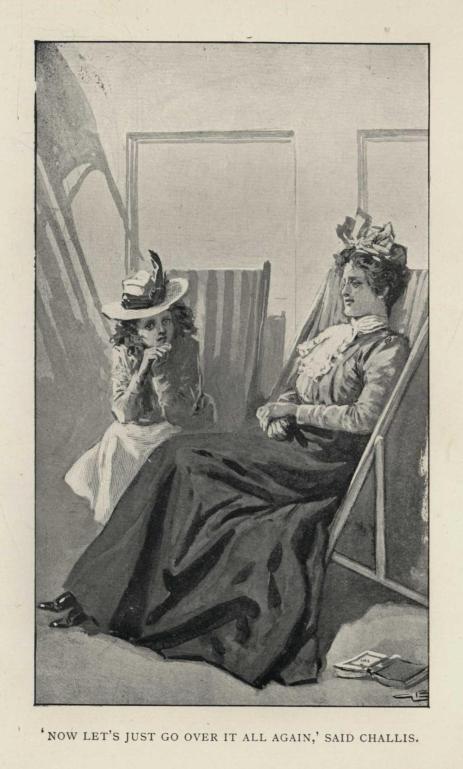
'NOW LET'S JUST GO OVER IT ALL AGAIN,' SAID CHALLIS.
'Now let's just go over it all again,' said Challis. 'Father'll come first. I don't want to kiss any one till I have kissed him. Well, what's he like? No, don't you say, I'll say. He'll have a moustache—no, I think he'll have a beard—yes, a beard. Not a long one, just a short one, and rather curly. And his eyes have a nice laughing look in them, just the nice look like M'sieu de Briot's, who said there was nothing in the world worth worrying about. You said, didn't you? that daddy hated worrying over things. I can't help thinking he'll have a brown velveteen jacket when he comes to meet us, like Mr. Menel's, at Fontainebleau, and paint all over it. But of course he won't. Let's see, he'll have a grey suit and a shiny hat, like Mr. Warner. No, he mustn't have that—that's not like daddie at all. No, I'll tell you; it's very hot at Wilgandra, so he'll have a nice white linen suit and a white helmet, and he might—he might be holding up a big white umbrella lined with green—you know, mamma, like that nice man who came on board at Malta.'
Mrs. Cameron was leaning back, her eyes shining, a fond smile on her lips as she listened to the girl's prattle.
'Then there'll be Hermie, and I know she's lovely. Don't you think she will be? You said you always thought she would grow up very beautiful. Oh, isn't it dreadful that we've never had a photo of them? Such lots of mine sent to them, and never any of theirs! It's like drawing their faces with your eyes shut. I think Hermie will have her hair in a thick plait. I suppose she goes to picnics and dances and everything, and always knows what to say to people. Mother, I don't think I shall ever get to know what to say. I'm fourteen, and nothing will come into my head to answer people. A lady said to me this morning, "You play magnificently." Now what can you answer to that? I really felt I'd like to say, "Yes, don't I?" just to see how she would look. Only I was afraid it would be rude. If I'd said, "Oh no, I don't, you're mistaken," she would have thought I was mock modest, wouldn't she? But Hermie, yes, she'll always know what to say. I can sleep in her room, can't I? You said there wouldn't be any other. It will be like Ellen and Edie Fowler we met on the trip to Dover; they always had their arms round each other, and used to tell each other everything and everything. Hermie and I will; we'll whisper and whisper all night, just like they did.'
The steward came up with eleven-o'clock tea and the glass of milk that Challis always drank. Mrs. Cameron left her cup to grow cold, Challis set her tumbler in an insecure place, and a lurch of the ship sent it flying.
'Never mind, I couldn't have drunk it,' she said, then as the man came back, 'I am so sorry to give you that trouble, steward. If you like to bring a cloth, I'll wipe it up myself.'
'Well, about Bart,' said the mother, 'what will Bart be like?'
'Oh, Bart,' said Challis, 'I just feel as if we'll rush straight together, and never come undone again. That's the sort of feeling you have when you're twins. I feel I'd like to give him everything and sew his buttons on and let him bully me. You notice the Griffithses here. They're twins, and she does everything he tells her, and he gets everything for her. It's lovely. I hope Bart hasn't forgotten we're twins.'
'And Roly?'
'Roly? I'm not sure of Roly. I can hardly see him at all. I think, p'r'aps, he's like that little boy at our table who wears Eton suits and tries to walk like the boatswain. All I can remember about Roly is one day we were eating water-melon in the paddock, and Roly ate his slice away and away, till there was just a green circle round his head.'
'And Flossie—my little baby Floss?'
'Darling little Flossie, I almost love her best of all. She's got very goldy hair and a teeny little face, and she's as little as Lady Millbourne's little girl. And she likes being carried about, and she can't dress herself, and I shall dress her, and fasten all the dear little buttons, and tie her sashes. And I shall put her to bed myself, nobody else must, and I'll tell her stories and stories. And every day there'll be something new for her out of my box. There are fifteen things for her, mother, not counting what she's to go halves with Roly in. Isn't it a darling little tea-set? I never saw such sweet little cups. And won't she like the little dolls from the Crystal Palace? I'd really like to play with them myself. And the big doll we got in the Rue de Crenelle. I must get on with its frock to-morrow, mother, or it never will be done.'
On, on went the ship through the secret waters. New stars came out on the great night skies, new breezes played in the rigging. On, on, and the long days dropped away, somewhere, somewhere, beyond the edge of the sea. On, on, and the happy eyes saw at last the dear frown of the Australian coast-line.
CHAPTER XIII
The Bush Contingent
'Armed year—year of the struggle!
No dainty rhymes or sentimental love verses for you, terrible year.
Year that suddenly sang by the mouths of the round-lipped cannon—
I repeat you, hurrying, crashing, sad, distracted year.'
Cameron was in Sydney again—the first time for seven long years. He had come down almost a month before the date upon which the Utopia was advertised as due, with the desperate hope of getting something to do that might yield him enough money to buy a new suit.
Up on the selection he wore soft shirts and old tweed trousers almost all the time.
When it came to a question of finding him starched shirts and a decent suit and hat in which to face his wife, Hermie and Miss Browne were nonplussed.
Finally they discovered one suit that had not been taken, piecemeal, to work in; but the moths had also discovered it. Sponge and press and darn as Hermie might, it still looked disreputable; the shirts were ragged, there was no hat that was not hopelessly spoiled with the sun and dust and rain.
It forced itself upon Cameron that there was but one thing to do—he must borrow a few pounds from some one.
And there was but one man he knew who would lend it to him—Mortimer Stevenson. Hermie had never told her secret. He groomed Tramby up a little, and put on a linen coat and hat, and set out in the direction of Coolooli. He hoped he might not meet the father; he was quite conscious of the fact that the business-like, successful old man looked upon him as a shiftless beggar. They knew each other slightly; Stevenson had ridden in two or three times when passing the selection, and stayed for an hour or two talking stock and crops and the war. Once or twice Cameron had been for dinner to Coolooli while shearing was on, and there were chances to learn successful methods. But he shrank with all his soul from encountering the old man this morning.
Two or three aboriginal women were coming back from a journey to the house, cloths full of stores and broken food slung over their shoulder. Stevenson forty years ago had had to break up a big camp of them on the land he had just taken up, and drive them farther west. Ever since he had not felt justified in refusing food to any of their colour.
Cameron stopped the women, to ask if they had seen Mortimer riding away that morning.
'I say, Mary,' he said, 'you been see that one Mr. Mortimer?'
'Ba' al mine see 'im that one young pfeller Stevenson walk about,' said the most ancient of the women. 'Old pfeller Stevenson 'im up there. You gib it tik-a-pen, you gib it plenty pfeller 'bacca.'
Cameron threw her a bit of precious tobacco, which she proceeded at once to cut up and cram into her unsavoury-looking pipe. Then he rode on; Mortimer might by chance have gone out somewhere on the run before the women had reached the station. Half a mile nearer to the house a sundowner had been put on to mending a fence. At present he was smoking and looking at it occasionally.
'Going up to volunteer, mate?' he said, as Cameron rode through a gate.
Cameron disclaimed the honour.
'Take a tip and do it,' the fellow said. 'The old chap is off his nut just now, and is jolly well flinging his money round—him as was too close to give a fellow tucker without turning him on to axe-sharpening first. You'll get your fare to Sydney and a moke and pocket of tin handed over to you afore you've finished of telling him you want to join.'
Cameron inquired good-humouredly why under such exceptional circumstances he himself did not volunteer.
He grinned. 'Guv'nor's knowed me on and off for twenty year,' he said, and fell to looking at the work before him again. 'Seems to think I've had too much bush experience. Had a try on, of course, but Mister Mortimer he put the stopper on me. I'm cursing my luck for not waiting till he'd gone.'
'Gone!' said Cameron; 'why, where's he going?'
'He went larst Monday—you must be a just-come not to know,' the man said; 'he's goin' off to glory along o' the Swaggies Army.'
Cameron turned his horse's head and rode slowly back to the selection.
He took a picture or two, and tried to sell them in Wilgandra, but they were still frameless, and he only raised a pound by the sale of both.
It was his neighbour Daly who helped him most; he saved him his fifty shilling railway ticket by sending him to Sydney in charge of a dozen trucks of sheep.
Landed there after the almost intolerable journey, he tried desperately for work—even beat up an old friend or two, who looked askance at his shabby appearance. One offered him a pound which he could ill spare, having fallen on hard times himself, the other wrote him half a dozen useless recommendations to various business men.
Cameron hung around the quay in a sort of fascination; no pilot boat went out but he did not tremble, no great ship came round Bradley's Head but he felt it bore his wife on board. The transports sent from the Cape for the Bush Contingent—The Atlantian and the Maplemore—were already anchored out in the stream, the great numbers painted on their sides adding an unusual note to the shipping on the smiling harbour. Launches and heavily weighed boats bearing timber for the horse-boxes were continually putting off from the quay to cross the intermediate stretch of water to where they lay.
The bustle and movement woke Cameron to life again, and the knowledge that he must do something, if it were only to take a header into the plentiful water; not here at the quay where a thousand eyes would see, but from one of the quiet bays or headlands the harbour has so many of.