THE WONDER-CHILD (continued 3)
Reading edition
Then he pulled himself together again, recognised it was want of food that had begot such cowardice in him, and spent his last shilling on a good meal. After that he tramped out to Randwick to the camp, and asked for Private Mortimer Stevenson.
The sentry jerked his head in a certain direction, and Cameron made his way to where some ten thousand perhaps of Sydney's citizens, women and children, had crowded, as they crowded almost every afternoon, for the novelty of seeing the bushmen drill.
It was an odd, unmilitary spectacle. Uniforms were not yet served out, and there seemed no regularity as to height. Here a sunburnt fellow from 'out back' drilled in a tattered flannel shirt and a pair of ancient moleskins that had seen several hard shearing seasons. Next to him was some wealthy squatter's son in a well-cut light grey suit, then a rough fellow with a beard half a foot long, moleskins again, and an old red handkerchief tied round his throat, then a lad, a fine well-grown fellow in the white flannels he played tennis in on his far-off station. None of the pomp, the éclat of militarism was there—not even the discipline; the men gossiped cheerfully with each other even while they stood in their ranks, they laughed at the girls in the crowd—even threw kisses to them. They were a fine, independent-looking lot, and you knew at a glance at them that they would think no more of carrying their lives in their hands than most people think of carrying umbrellas. But you marvelled how they were to assume in so few weeks' time the well-groomed, spick-and-span, automatic appearance you had hitherto associated with the word soldiers.
Cameron watched the different squads for a little time, and felt proud of Mortimer when he found girls and men were pointing him out and saying. 'That one, look! the fourth from the end; he's a splendid-looking fellow, isn't he?' 'See that fourth chap, that's the sort of man we want to represent us.'
But the drilling and the hoarse cries of the hardworked sergeants seemed endless, and Cameron wandered on and watched the riding and shooting tests which separated the genuine bushmen from the counterfeits, who swarmed here, as easily as the winnow separates the grain from the chaff. At last the squads broke up, and the men mixed with the crowd or went off, mopping their steaming faces, to their tents or the canteen.
Mortimer broke loose from the men around him, and went instantly to Cameron, whom he had quickly seen while drilling. He carried him off direct to his tent.
'I'm awfully sorry to have kept you waiting so long,' he said. 'Here, try this deck-chair, it's more comfortable than that bench. And what will you have to drink? Oh, I know, you like lemon squash.' He turned to a rough-looking fellow at the door. 'Go down to the canteen, Brady, like a good fellow, and get a jug of lemon squash. Here's the money.' He turned back to Cameron. 'I'd have given anything to get away when I saw you, but you can guess what it is out there.'
'Yes, yes,' said Cameron, 'it doesn't matter; it was all interesting. I have been looking about.'
Mortimer gave him a sharp look.
'Is all well up there?' he said. 'It isn't often you come down.'
'Nothing's wrong,' said Cameron, 'I came down to meet my wife, that's all.'
'Of course, of course,' said Mortimer; 'stupid of me. I was reading about it only this morning in the paper—about the big welcome the citizens intend to give your little girl. There is to be a launch—the Government launch, isn't it?—and the mayor and no end of people are going up the harbour to meet her.'
'Are they?' said Cameron.
'You've been consulted about it, surely?' said Mortimer warmly. 'They're not doing all this without referring to you?'
Cameron straightened himself a little.
'I've had no fixed address since I came down,' he said. 'They've overlooked me, I suppose, because they don't know I exist; I hardly do, you know.'
'Are any of the others down with you?' asked Mortimer—'Bart or Roly or any of them?'
'Oh no,' said Cameron. 'Some one has to mind the landed property against my return.'
'And are they all well?' pursued Mortimer. 'Roly—wasn't Roly looking a little thin before I left?'
'Oh no,' Cameron said, 'he's right enough. The girls feel the life more than he and Bart. My eldest girl seemed very off colour when I left?'
'Not typhoid?' burst out Mortimer. 'I saw in the paper it had broken out in Wilgandra——'
'Oh no, we're too far for that. Nothing but the heat. Was that Timon I saw among the horses?'
'Yes, I brought him and the governor's favourite roan down—he made me have him.'
'Mortimer—I'm compelled to ask—I cannot do without—my wife—Challis—suit—make them ashamed——' Cameron's voice choked.
'Confound that Brady!' said Mortimer, springing up and upsetting his chair; 'takes as long to get a lemon squash as if I'd sent him to town for it. If it had been a bottle of whiskey, now, no delay then; might come in for a spare glass himself. You r'mber Brady, rouseabout up at Coolooli, gives a home-touch to see him about. He volunteered the same time as I. I say, I'm off duty now for the rest of the day—may as well come back to town and have a bit of spree. Brooks, I say Brooks, go and see if there's a spare cab, there's a good fellow.' Another coin went into another rough fellow's hand.
Cameron found himself driving back to town by Stevenson's side before he had collected his thoughts—or even had his lemon squash.
Half the way Mortimer rattled on about the day's work in camp, the transports, provisions for the comfort of the horses, the prospect of the contingent's success.
'By the way,' he said all at once, 'I want you to do me a favour. The governor's been too free with his cash for me—not safe to have too much about, you know—tempt some poor devil. D'ye mind taking some of it and looking after it for me—just for a year or two till I get back? Use it, you know; you might use it now instead of drawing any out of your own account, then when I come home you can pay me back. Awfully obliged it you will; had a couple of pounds stolen out of my tent yesterday, and have been going about with fifty pounds on me since. I'll get you to look after thirty of it; the governor's cabled no end of money to a bank in Durban for me, for fear I'll run short.'
Half a dozen crisp notes were thrust into Cameron's hands, and Mortimer, hot and red in the face, was rattling on again about the horse-boxes for the voyage, and how they should have been made this way, and not that way, and about the wisdom of telling the men to bring their own saddles, and about that egregious ass the public, who seemed to think the Bushmen were so thin-skinned that they could not bear a word of command, unless it was put in the form of a polite request.
'Isn't it tommy-rot?' said Mortimer. 'We're not a pack of sensitive girls. We enjoy the discipline, and recognise we have to be licked into some sort of order, unless we want to remain a mob.'
Cameron was very quiet, but he gripped Mortimer's hand on parting, and cleared his throat to try to say something.
But the young volunteer found he must be off in violent haste.
'By George,' he said, 'haven't another minute; promised the colonel I'd go out and kick up a row about the horse-boxes,' and his big loose figure plunged back to the waiting cab. 'You'll come and see me off, all right, so long'; and the cab woke to life and moved smartly off, to lose itself in the stream of vehicles going towards the quay.
Cameron, a lump in his throat, turned towards the General Post Office, to see if there were further news from the little contingent at home. The last letters from Bart had been disquieting; Small, the butcher, it seemed, had transferred the mortgage he held on the selection to old Mr. Stevenson. 'And Daly says,' Bart had written, 'it's about the worst thing that could have happened, Stevenson's so close-handed. Small often used to give you time, but he says Stevenson never will.' A second letter followed. Stevenson had foreclosed, but was willing for a year or two, until a tenant he had in view was ready to occupy, that Cameron should remain on the place. In the meantime, however, he, Stevenson, must be at liberty to make any alteration or improvement he saw fit to the property.
The present letter was excited in tone. 'After all, dad,' the boy wrote, 'I believe it's the best thing that could have happened. The place is looking up no end, there are quite ten men at work on it, so the chances are the mater and Challis won't quite die of the shock of seeing it. And what do you think? You know that calf we gave Hermie two years ago? Well, I never knew there was good blood in it, did you? It's the last thing you'd think to look at it. But that Stevenson knows a thing or two. He comes down here and pokes about pretty often, and he saw it, and what did you think? Offered me ten pounds down for it! I couldn't believe my ears. Don't you remember I tried to sell it when you were ill, and Small offered two for it? But I wasn't going to let on I was so green as not to know it was a good sort, and I said straight that we could not let it go under fifteen. He looked at me in that queer, sharp way of his, and he poked at the calf a bit, and then said, "Say twelve ten." But I'd got my mettle up by that. I knew if a close-handed, hard chap like that offered twelve ten, it must be worth quite twenty-five. I just turned round and went on digging up the potatoes for dinner and said, "Fifteen pounds," for all the world like Small does at the sales. He went round to Dimple and began poking at her again, and examining her like anything, and then he said, "Fourteen pounds, sonny." I'd got enough potatoes out for Miss Browne by then, so I put them in the basket and just said, "Good morning, sir," and pretended to be going.
'Then he began laughing fit to kill himself, and in between the laughs he said, "Fifteen," and I said, just like Small, "She's yours, and you've got a bargain." And he laughed again, and said, "I have." I hope you're not vexed, dad, at me doing this on my own. I've been feeling very anxious ever since, for she must have been a really valuable little thing—he's not the man to be deceived; they say he's the best judge of stock in the country. I told Daly about it, and he wanted to know if Stevenson was drunk at the time. He doesn't drink at all, does he? But I thought you'd agree that the fifteen would be more use to us now than twenty-five later, and that's why I closed with him. I'm sending five down in this, thinking it will come in usefully for you. And Hermie and Miss Browne have gone off to Wilgandra to get new dresses and cups and sheets and whips of other things with the rest. You should have seen their list. The mater and Challis'll think we're no end of swells after all.'
CHAPTER XIV
Home to the Harbour
'City of ships!
City of the world! (for all races are here,
All the lands of the earth make contributions here;)
Proud and passionate city—mettlesome, mad, extravagant city!
Spring up, O city—not for peace alone, but be indeed yourself, warlike!
War, red war is my song through your streets, O city!'
Down through the excited waters of the harbour came the great ship Utopia, the fussy little tug running on ahead.
Away near the Heads the stretching blue had danced almost as unfurrowed by the lines of boats as outside, where the ocean's ways lay wild.
But as the ship came down, down closer to the city, a stately untroubled belle on the arm of her hot, nervous, fidgety little partner, many of the passengers felt with astonishment they had never seen so many watercraft in all their lives before. Rowing boats—scores and scores of them! They looked like flies on an agitated surface of translucent honey. Sailing boats! Surely not one stitch of canvas owned by the city was out of use. Poised, waiting, up and down, everywhere, you felt there was going to be a storm and these were the white gulls come in flocks to flutter and dip and rise till it began. The ferry-boats! They went their hurried journeys to and from—across to North Shore, to Mosman's, and Neutral Bay, to Manly, and you could fancy they were looking over their shoulders all the way and longing to come back. The ocean-going boats, leaning at the Woolloomooloo wharves or anchored out in the stream, they were black with eager people, and waved from every point long strings of brilliant flags—the flags of half the world. America was there, shaking out her Stars and Stripes from a mail steamer, a San Francisco timber-boat passing along to a berth in Darling Harbour, and a transport come to take stores for the army in the Philippines.
From one of the men-of-war in Farm Cove floated Japan's white flag with its red chrysanthemum; France had her war-ship, with its red, white, and blue ensign, also in the cove. All the others, half a dozen of them, floated the white ensign of England.
Up at the quay lay the mammoth Friedrich der Grosse, Germany's black, red, and white ensign flying in the wind amid her gay strings of bunting, and round the corner, in Darling Harbour, among the boats that had come down heavily laden from the rivers, the boats from all the other colonies and Fiji and Noumea. Russia and Norway both were represented.
And the city—had the City of Blue Waves gone mad?
As the Utopia made her slow progress up the harbour, those on board were able to catch a breath of the excitement from the land.
The wharves at Woolloomooloo seemed a black mass of humanity; the windows of the warehouses were lined with faces, men and small boys had taken up vantage-points on scaffolding, cranes, the very roofs of the wharf buildings. On the green park-like slopes of the Domain thousands were patiently waiting, white and gay coloured parasols and dresses enlivening the sombre garments of the men.
Challis stood at the side of the boat with trembling knees and rounded eyes. Mrs. Cameron was beside her, very pale, struggling hard for composure, putting her hand to her throat secretly now and again, to smooth the lumps that seemed to be rising there. A warm reception she had had no doubt her child would have; indeed, the Melbourne papers she had seen had said big preparations were to be made for her reception, for was not this the city of her birth, the eager, open-handed city that had made it possible for the world to judge of her genius? But the mother's wildest thoughts had never dreamed of anything like this; royalty itself had never on any of its journeyings been welcomed in more magnificent fashion.
She paled and paled—she slid down her hand, and caught and held tightly in it one of the small thin hands of her gifted child.
Yet, great as the honour undoubtedly seemed, had the power to change things been hers, she would have swept the wharves clear of all that strange-faced crowd, and have had, standing there alone, looking up at her, the husband her heart was throbbing for, the children she yearned for, and yet would hardly know.
The lady who had begged the photograph pressed her way up.
'What does it all mean? Did ever you see such excitement? Is it really as Mrs. Graham says—the welcome for Miss Cameron? I never saw anything to equal it in my life. My dear, my dear, you are the most fortunate girl in the world. I am proud to have shaken hands with you, honoured to have sat at the same table. See, here is my travelling ink-pot and a pen, write me your autograph, darling.'
Mrs. Goodenough bustled up and caught at the mother's arm.
'Such excitement is enough to kill her; give her two of these quinine tablets, and keep these in your pocket, to give if you notice a sign of flagging. It will be a most exhausting day for her. And you are pale—here, I have my flask of tonic—you must, you must indeed take some. You will never bear up through all the congratulations, if you do not. Well, well, I must say I have never seen anything like this in my life.'
Challis stood as white as if carved in marble; sometimes her little soft underlip quivered, sometimes she gave an almost piteous glance round, as if seeking an impossible escape. She had had warm welcomes and even cheers and a little bunting in many towns, but what was this she had fallen upon?
The gangways were hardly down before there hurried on board from the wharf a gentleman in a tall hat, and two others with the ungroomed, long-haired appearance of the musician the world over. One of them bore a moderate-sized bouquet of white flowers, and another a small harp of roses that looked a little dashed with the sun and dust.
'Miss Cameron, Miss Cameron!' was the call echoed all along the deck. The captain himself came up and took the little girl and her mother down to the men. They were warmly shaken hands with, their healths and the voyage asked after, and the flowers presented. Then one of the musicians began to read an address couched in the most flattering terms, but half-way through the tall-hatted gentleman tapped his arm and whispered and looked at his watch. And the musician nodded and turned over the leaves of the address, and shook his head doubtfully and looked hastily also at his watch.
'My dear Miss Cameron,' he said, and rolled the big paper up, 'I shall really have to keep this for a more opportune time. We had thought the Utopia would not have been here until four this afternoon, when all our arrangements would have gone well. But now the mayor and the Euterpe Society, and all the musical bodies in the town are of course engaged in seeing the Bush Contingent off. We expect the procession any minute—indeed, it must be nearly in Pitt Street by this.'
Mrs. Cameron said a few graceful words, in which she begged them not to waste time now; she was assured by all their kind speeches of the welcome her daughter had in this her native city, and she expressed her sense of the good fortune that had awaited them, inasmuch as the Utopia had arrived in time to see an event of such national importance as the departure of the Bush Contingent. No one could have guessed at the dear fatuous notion she had been nursing in that sensible head of hers until a moment back.
As for Challis—Challis put her head over her fast-fading harp and laughed, laughed uncontrollably a minute or two. Then she stretched out her hand and touched one of the musician's sleeves. 'Couldn't we get off and see the procession?' she said.
The musician looked at her eagerly, admiringly. 'Just what I was going to suggest,' he cried. 'Come on, come on—we've got a carriage out here for you, and if we've any luck we'll just get up into Macquarie Street in time.'
He and his friends swept the two voyagers off their feet, and carried them with the pushing throng to the gangway. None of the passengers had any time to look at them; all were a little off balance at the time, rushing about with faces broken up into tears and laughter, kissing and throwing arms round those they had been long parted from, wildly imploring stewards for gladstones and handbags from their cabins.
In the crush Challis whispered to her mother, 'Oh, aren't I glad it's not for me!' in a tone of fervent thankfulness.
When they were down on the wharf, the rapturous meetings on all sides sent their eyes hungrily searching the crowd again for their own home welcomers. But there seemed no one, no one, look as they would, and they went slowly down the company's wharf with the welcomers the city had sent to the hired open carriage outside.
Challis and her mother sat facing the horses, the tall-hatted gentleman and one musician sat opposite to them, the other went on the box. It had been the committee's intention to bid the coachman wear white favours, in honour of the visitor's youth. But the item had been forgotten, and the man wore instead three of the Contingent medals boys were selling in the streets. The carriage made a snail's progress along the quay crowded with the emptyings of the ferry-boats, and slowly, slowly climbed up to Bridge Street, which was on the line of march. The multitude looked at the vehicle.
'Who's the kid?' shouted a youth.
And a bright young Australian yelled:
'The colonel's kid—going to meet her pa and say good-bye.' On which the human sea lifted up its lungs and hurrahed wildly, till something new came along to attract its interest.
So Challis had her cheers.
But in Macquarie Street all traffic was suspended, and a hoarse, red-faced man in some sort of a uniform charged at the open carriage, and ordered it to go back, as if it were no more important than a broken-springed buggy with one horse.
'Have to take yer up Castlereagh Street, ladies,' said the driver regretfully. 'If yer'd been 'arf an hour sooner, we'd have just got up to the 'ospital, and yer'd 'ave seen it all fine.'
'Oh,' said Challis eagerly to the musicians, 'see! see that lovely heap of wood—look—over there—those women are getting off—there would be lots of room for us. Oh, do let's get out!'
In three minutes the little party was sitting, clinging, or standing on a pile of timber outside a half-built house, and the carriage had backed, backed away to take a clear course up deserted Castlereagh Street.
The sudden roll of a drum sent its electric vibration through the tense multitude. The cry of, 'Here they come!' raised falsely a dozen times during the last two hours, now had the positive ring in it that carried entire conviction.
'Oh, look, mother! See here come the horses! Doesn't it remind you of the Jubilee crowd in London?' said Challis.
But Mrs. Cameron pushed roughly at her shoulder. 'Come here,' she said hoarsely; 'change places with me. Don't fall—there, hold fast. Let me get lower down.'
A man was fighting his way through the throng—a grey-bearded man in a well-cut light grey suit and a white helmet; and such was his determination that five minutes after Mrs. Cameron had seen him he had worked his way through twenty yards of solid crowd and was standing just below her.
Mrs. Cameron turned to the musician who had been at much pains to secure a little room for himself on the timber.
'Mr. Jardine,' she said, 'will you please get down and give up your place to my husband? I—I have not seen him for six years.'
Jardine climbed down cheerfully—but also of necessity. Cameron pulled himself into the vacant place.
They were side by side at last, and neither could speak; they just looked at each other with white faces—looked, looked.
Finally their hands went together.
A choked little voice came from above after a minute or two.
'Me too, daddie—speak to me too.' And it was then he remembered his child as well as his wife was come back to him.
He reached up and squeezed the eager hand, he put his other hand round her little shoe and squeezed that too. Challis leaned down and kissed the top of his helmet.
'I said you'd have a helmet on,' she said, with a hysterical little laugh.
His hand went back to his wife's.
'Is there no way of getting out of this rabble?' she said.
'You might be crushed to death. There's nothing for it now, but to sit still till it is over.'
'Why—why weren't you on the wharf?'
'I was—of course I was—I saw you both plainly just as they put the gangway down. But there was an accident: a little child near me was knocked down by a luggage truck, badly hurt, at the moment: there seemed no one else to give the mother a hand. By the time I'd got him up and into a cab and found a fellow willing to go with her to a doctor's, you had gone. They told me the carriage had come up Bridge Street. I have been fighting my way and looking for you ever since.'
'The children?' said the mother.
'All well, quite well; I couldn't bring them.'
'No. Oh, to get out of this hateful crowd!'
'Here they come,' Challis said; 'no, they are only policemen.'
The fine horses and men of the mounted police rode by, then a small body of Lancers; after these marched some two hundred sailors of the Royal Navy, and perhaps half that number of Royal Marines.
Then the Bushies.
And now the crowd took the reins off itself, and gave head to its madness. It hurrahed itself hoarse; it waved its arms, and its handkerchief, and its hat, and its head; it flung flowers, and flags, and coloured paper; it hung recklessly from roofs, and walls, doors, chimneys, fences, lamp-posts, balconies, verandah-posts, and it yelled, 'There's Jack,' 'Good-bye, Joe,' 'Come back, Wilson,' 'Shoot 'em down, Tom,' 'Hurrah, Cooper!' 'Luck to you, Fogarty,' 'There's Storey,' 'Hurrah, Watt!' It handed up drinks to the thirsty horsemen, it pressed handkerchiefs, cigars, and sweets indiscriminately upon them.
In return the sunburnt Bushies waved their helmets and little toy flags; one held up a small fox-terrier, another an opossum by the tail; they rode along with one arm free for handshaking all along the route, threw kisses to the excited women, even at times leaned down and kissed some tip-toe eager girl in a white dress and a wonderful hat.
They looked as military as one could wish now; Cameron was amazed to think this was the same material he had seen drilling. A finer body of men had never passed down the streets of any city. They sat their magnificent horses magnificently; you knew there was nothing they could not do with the splendid beasts. The khaki uniform and khaki helmet, and the sunburnt ruddy faces made a healthful, workmanlike study in brown.
'That's the dog Bushie,' said Cameron to Challis. 'Every one in the colony is interested in him; the men say he will be very useful.'
The crowd yelled, 'Bushie, Bushie—hurrah! good old doggie,' as the intelligent sheep-dog came into sight.
'Here's Stevenson—see, the man on the left, Molly,' Cameron said; 'our best friend. Good-bye, Mortimer, good luck! Good-bye, old fellow, good-bye.'
Mortimer waved his helmet gaily.
'What a fine fellow!' said Mrs. Cameron, and what a good face! Who is the old man?'
'Why, it's old Stevenson. Yes, just like him to do that,' Cameron answered. The old squatter had ridden alongside the Bushmen the whole of the line of march. His face was working with excitement; every time a cheer went up from the crowd he cheered too, standing up from time to time in his saddle and waving his soft felt hat. He kept beside his son as much as he could; he was almost bursting with the pride of his position.
Challis's eyes were full of tears.
'Oh,' she said, 'what a very dreadful thing if that nice man should be killed!' She was quite captivated by the sunny smile Mortimer had given their group.
'There's not a better fellow in the world,' Cameron said warmly.
The khaki died away in the distance, the prancing horses were gone, the sound of the band grew fainter and fainter.
Yet a little time, and the transports would be plunging through the Heads with them, carrying them forward as fast as might be to dye the veldt red with their own blood or that of the Boers.
CHAPTER XV
Heart to Heart
'We will not speak of years to-night;
For what have years to bring,
But larger floods of love and light,
And sweeter songs to sing?'
They were in a quiet room at the hotel at last. They had lost sight of the tall-hatted gentleman and one musician entirely; the other had said thoughtfully that he would not intrude.
'This is not the way we meant to welcome your daughter, Mrs. Cameron,' he said, laughing, as he clung by one hand to the timber, 'but, as you see, we're all mad together to-day. By to-morrow we shall have calmed down a little, and there will be a deputation and everything in order. You'll be at the Australia, of course?'
'Yes, I have rooms waiting for them,' Cameron said quietly.
So the pleasant, long-haired fellow drifted away, and Cameron, at the first chance, steered his little family out of the thinning crowd, and found a cab to take them to the peace of the hotel.
They took their hats off. Waiters seemed to think eating was a necessity, and brought in a meal, and stood, two of them, to help serve.
Mrs. Cameron turned her head.
'We would rather wait on ourselves,' she said. 'We have everything that we shall need, thank you, so you may go.'
Cameron drew a relieved breath, though he would as soon have thought of dismissing the men himself as of calmly ordering one of those magnificent colonels out of his way during the afternoon.
'Now we can be cosy,' Challis said, and sat down on her father's knee, instead of using the chair the waiter had placed for her. 'Are we like what you thought?' she asked. 'Someway I can't think now how I could have fancied you would be any different. Oh, I'm sure you're just like what I thought, only——' She paused then, and a little sensitive flush ran up into her cheeks. She had almost said, 'Only your beard is grey.'
But her eyes had gone to its greyness.
'Yes,' he said a little sadly, 'I didn't wait for you, Molly, did I? We always said we would grow old together, but I have left you far behind.'
He hardly knew his wife. Time seemed to have turned back for her. There was not a wrinkle on her skin, the sharp winters had given a bloom like girlhood's to her cheeks, and the varied life and rest from domestic worries had brought the spring back into her blood.
The wife who had gone away had been shrinking, careworn; she had worn shabby bonnets of her own trimming, dresses she had turned and turned about again. This one had the quiet, assured manner of a woman accustomed to travel. She wore a tailor-made fawn coat and skirt, whose very severity accentuated their style. There was the hall-mark of Paris on her bonnet of violets.
Cameron sent a fleeting thought of gratitude to Mortimer, who had made it possible for his own clothes not to blush beside such garments. They were a quiet little party, and Challis did most of the talking. Cameron looked at his wife when she was occupied with the tea-cups; her searching eyes fastened on him when he turned to speak to his little daughter.
Once, when he passed a plate to Challis, she noticed his hands against the snow of the tablecloth—hands she did not know at all, so rough and weather-marked and deeply brown they were. But she asked no question; instinctively she felt there was something to be told to her, and she hung back from the knowledge, knowing the telling would be pain to him.
'Oh dear,' said Challis, 'if only you had brought Bart down, too, daddie, and he was sitting just here on this chair next to me!'
'I thought it was Hermie you wanted most,' the mother said.
'Ah, Hermie! I want Hermie to sleep with. No, not to sleep with, for we sha'n't shut our eyes at all, but just to lie in the dark and talk and talk.'
'Roly wanted to come,' Cameron said. 'He's war mad, of course. He's painted the name Transvaal Vale on the sliprails.'
'On the what?' said Mrs. Cameron.
Cameron went darkly red.
'The—gate,' he said.
'What else does he do? I want to know about Roly,' Challis said eagerly.
'He wears a football jersey most of the time,' said the father, 'and is to be met at any hour of the day hung all over with the table-knives and the tin-opener and the cork-screw and the sharpening-steel. Also, he carries round his neck a string of what I think he calls double bungers. These are his cartridges. And he came possessed of an old tent in some way—the railway navvies gave it to him, I believe—and he has pitched it just outside the back door, and sleeps in it all night.'
'Oh dear, oh dear! The night air; he will catch a dreadful chill!' cried the mother, used now to English nights.
'Not he! He's a hardy little chap,' said Cameron.
'More, more,' said Challis. 'He's great fun, I think. Tell some more about him, daddie.'
'A neighbour, young Stevenson—you remember the Stevensons of Coolooli, Molly?—gave him half a crown the other day, and of course he went off to Wilgandra and laid in a stock of crackers. He made a rather ingenious fortification that he called Spion Kop, and invited us all out to see it. You don't know Darkie, the cattle dog, of course—we've only had him four years; Darkie naturally came too. He's rather a curiosity in his way, old Darkie; seems to have a natural love for fire, and goes off his head with excitement whenever a cracker is let off or the boys make a bonfire. Well, he made enough noise barking and yelping over Roly's display to satisfy even that young man. Presently Roly Put a whole packet of his double bungers on the top of his fort, and—what he did not tell me till afterwards—a quantity of blasting powder he had purloined from the navvies. Then he put a lighted match near a long piece of string, and cut down to us as hard as he could. Just at the critical moment, when we were getting our ears ready for the big explosion, Darkie gave a frantic bark of delight, bounded to the fort and seized the whole packet in his mouth. There wasn't time even to shout at him; there came a tremendous explosion, and the air seemed full of stones and earth and Darkie. The old fellow must have been blown six feet up in the air. I think we all shut our eyes, not liking the thought of seeing the poor old dog descend in a thousand pieces. But when we opened them he was down on the ground barking and yelping with more furious delight than ever, and except for a badly singed coat and a burnt tongue, not a bit the worse for his elevation.'
Mrs. Cameron was looking disturbed.
'He seems to do very dangerous things,' she said.
Cameron laughed.
'That's what Miss Browne says,' he answered; 'but he always turns up safe and sound.'
'Miss Browne?' repeated Mrs. Cameron.
Cameron's eyes dropped to his plate, and he drank deeply at his tea, to put off the moment of his answer.
'Who is Miss Browne?' his wife asked again.
Cameron moved his eyes to a button on her coat.
'I was obliged to change lady-helps,' he said.
Mrs. Cameron's face expressed absolute alarm.
'Miss Macintosh—is not Miss Macintosh still with you? You did not tell me. Why did she go? How long has she been gone?'
Cameron looked white. 'Some—little time,' he said; 'she—went to be married.'
'And is this other—is Miss Browne as good? Oh, it would almost be impossible. Have you had to change much?'
Cameron reassured her on that point. Miss Browne had been with them ever since Miss Macintosh left.
'But how long is that? You don't tell me,' she cried.
Cameron looked at a lower button.
'Some—time,' he repeated faintly.
'Jim,' she cried, and almost sharply, 'have you been keeping things from me? How long has Miss Macintosh been gone?'
He lifted his eyes and looked at her. The day of reckoning had come.
'She left six months after you went,' he answered.
The news held Mrs. Cameron speechless for three minutes.
'This other person—Miss Browne—is she as good?' she asked at length.
Cameron breathed hard, and cut a slice of bread.
'She does her best,' he said, 'but she is not—very capable.'
'Jim,' said Mrs. Cameron, 'is there anything else? Have you lost your position?'
He bent his head a little. He merely nodded, and she might have thought it a careless nod, only her eyes suddenly saw the trembling of his work-marked hands.
'Challis,' she said, 'go away—leave us alone.'
The child put down her spoon and fork, and vanished.
Cameron stood up, looking fixedly at the carpet, waiting with bowed head for her questions.
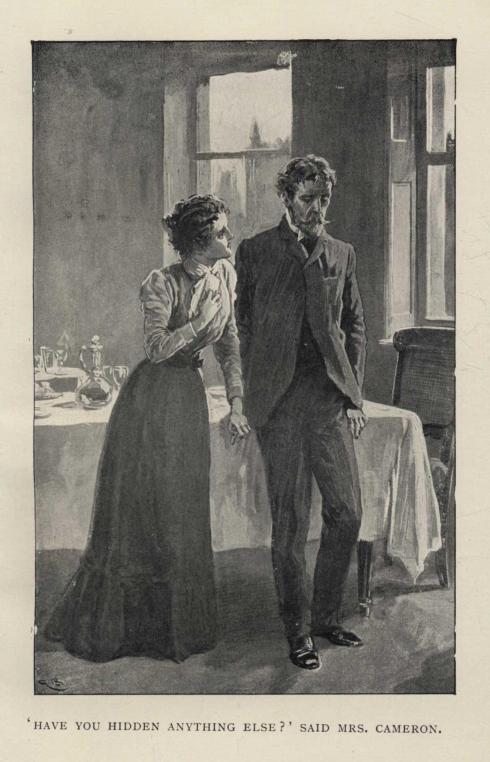
'HAVE YOU HIDDEN ANYTHING ELSE?' SAID MRS. CAMERON.
'Have you hidden anything else?' she said, 'Are any of the children dead?'
'None of them are dead,' he said.
'Are any of them deformed or hurt in any way?'
'None of them are hurt—they are in good health,' he said.
'Have you ceased to love me?'—her voice was losing the note of fear that made it hard and unnatural.
He looked at her, and his eyes swam.
Her arms were round him, she was kissing him, kissing his wet eyes, his trembling lips, stroking his cheeks, crying over him.
'You are afraid to tell me—me, your own little wife—something that does not matter at all. What can anything matter? We are all alive, and we love each other as we have done always. Darling, darling, don't look like that! Put down your head here, here on my breast—my husband, my darling! This is Molly, who went all through the ups and downs with you; you never used to be afraid to tell her anything.'
He tried to speak, but sobs shook him instead.
'Hush!' she said. 'There, don't talk, don't try to tell me. I know, darling. You lost the position, and you couldn't get another, and you're all as poor as poor can be. Pooh! what does that matter? You have none of you starved, since you are all alive, and the end has come. Poor hands, poor hands,'—her kisses and tears covered them,—'have they been breaking stones that the children might have bread?'
'Molly,' he said, anguished, 'your worst thought cannot picture what I have brought them to.'
She trembled a little—Hermie, little Floss, the boys!
But she laughed.
'They are alive—they are together, and not in the Benevolent Asylum. My darling, I don't mind in the very least.'
'Molly,' he cried, 'you cannot dream how bad it is! It is Dunks' selection; we have been there four years!'
She trembled again, for she had seen Dunks' selection, and the memory of it was yet in her mind.
But again she laughed.
'It will have made them all hardy,' she said; 'I can see it has done so, or Roly wouldn't be sleeping out of doors.'
'My wife,' he said, 'my wife, my wife!'
They clung together.
'The past is gone,' she whispered. 'I will never leave you again.'
'My wife, my wife!'
'Together now till death; nothing else shall part us, nothing else.'
'My wife!'
Her tears rained down, mingled with his, and fell away into the greyness of his beard.
They clung together, and the room and the world faded. They clung together, and there was no one in all space but themselves and God—God who had given them into each other's arm once more.
Challis came to the door—she had knocked twice, to tell them that the luggage had come from the ship—then she turned the handle, for she thought they had gone out.
But those faces! Those faces of the father and mother, wet, uplifted, almost divine!
Very softly she closed the door again, and stole away.
CHAPTER XVI
The Rosery
They cling in the moonlight, they kiss each other.
"Child, my child!" and "Mother, mother!"'
Bart was on Wilgandra Station to meet them—Bart, healthy-looking and sinewy, if thin; he wore white flannel trousers, a white linen coat, and a new straw hat with a new fly-veil attached. Mrs. Cameron had looked when her husband cried, 'There's Bart,' with eyes that expected to see an out-at-elbow lad, possibly barefoot, probably ill-developed. But there was nothing she would have changed.
'Of course they all wanted to come to meet you,' the boy said, when the first glad greetings were over, and the great panting, shrieking train had become just a quiet black thread climbing the side of the next rise. 'But I didn't want to crowd the buggy.'
'The buggy!' his father said. 'I was just going into the hotel to get one. I'm glad you thought to order it.'
'It's Mr. Stevenson's,' Bart said. 'He sent it down this morning for me to meet you in,' and he led them with much satisfaction to the handsome roomy sociable he had in waiting. Their own solitary equipage, the shabby cart drawn by Tramby and driven by young Daly, was in readiness for the many boxes.
Once, in carrying the luggage to the cart, Bart and his father found themselves alone on the station for a moment. Bart gave a laughing glance from his father's to his own apparel.
'Isn't it a lark?' he said. 'I feel quite shy of myself, don't you?'
'Do the girls look nice?' Cameron said anxiously.
'Spiffin,' said Bart, 'and Miss Browne's got a new dress, and even curled her hair. I say, have you told mother about Miss Browne?'
'Yes, she is quite prepared.'
'And she knows about the selection?'
'She knows about the selection.'
'We've—we've been tidying up a bit, dad. I think you'll find it's a bit—er—tidier.' There was a flush on the boy's cheek, a look of suppressed excitement in his eyes. 'Let's get on now; the horse doesn't like to stand, and everything's in.'
They drove up the road that wound out of civilised Wilgandra away to parts where the bush took on its wild character again, and rolled either side of them in unbroken severity and loneliness for miles.
But it was early winter now, and the thankful land lay smiling and happy-eyed beneath a cooler sky. Even the newest clearings flaunted rich carpets of grass, green as grass only springs where a bush fire has purged the ground for it. The air was fragrant with the bush scents that rise after rain. A cool, quiet breeze swayed the boughs of the ocean-waste of trees, here and there it lifted the long string of warm-coloured bark—autumn's royal rags—that hung from the silvered trunks.
Cameron was driving, and mechanically turned the horse's head at the place where he had always turned for the sliprails of his selection.
And there were no sliprails!
He turned an astonished glance at Bart, but the boy's eyes only danced.
'I'll get down and open the gate,' he said demurely, and jumped down while his father stared at the neat white gate with The Rosery painted on in black letters. Could this be Dunks' selection that stretched before the head of the horse that bore them slowly along? This the grey, dreary place that had cast its colour over the souls of those who looked at it. A drive ran up from the gate to the house, not a smooth, red gravelled drive by any means, but it was cleared and stumped now all its length and width, and went with pleasant windings between the trees.
A low white two-rail fence divided the bush and sheep ground from the land about the house; the small orchard showed freshly ploughed up and trenched between the trees; a vegetable garden was laid out, and the peas and beans were above the ground already. The flower-beds near the house were dug and weeded, as if they had been beds in the Botanical Gardens; and dahlias, little sunflowers, and cosmea of all shades made a gay mass of colour. The pixies' hands had even attacked the cottage; Cameron himself had given it a coat of red paint that had much altered its forlorn aspect; these new hands had carried the coat of paint even over the dreary galvanised iron roof, had 'picked out' the chimneys, and windows, and verandah-posts with white, added a seven-foot verandah all round, and knocked a French window into the walls here and there.
'Why,' cried Challis, 'it's the sweetest, darlingest little place I ever saw! Oh, I never want to go away from it again!'
Mrs. Cameron was looking with eyes full of pleased surprise.
'Why, Jim,' she said, 'why, dearest, it is really very nice, very nice indeed, so peaceful-looking. You did not prepare me for anything like this.'
Cameron swallowed a lump in his throat.
'I didn't prepare myself,' he began; but his wife's hand was fluttering to the fastening of the sociable door, and her ears were no longer for him, for Hermie and Roly were running out to meet her.
Such a rushing into arms, such kissings, such a choking of laughter and tears! Mrs. Cameron held Hermie to her and from her, and to her again, and marvelled to find her almost a woman.
'My pretty girl, my pretty girl!' she said, the fond tears starting, and Hermie blushed herself into even lovelier colour than before.
Challis kissed her sister and clung to her a moment, then stood away shy and pink, almost crying. Hermie's hair was done 'on top,' her dress was long, so long; she was very pretty and sweet-looking; but oh, there would never be any whispering and whispering in bed—she was far too grown up for that.
Roly came up to the sister and submitted the edge of his left ear to her kiss. He looked at her critically.
'Did the Queen cry when you came away?' he said.
'I didn't notice,' said Challis. 'She was in the garden when I went to say good-bye, and she waved her handkerchief when I got back to the house—perhaps she had been crying into it.'
'Floss, Floss! I want my baby,' the mother's voice was saying.
Hermie looked about her distressed.
'Will you take no notice just yet, darling?' she said. 'She is very—shy, but she won't be able to stay away long; she's hiding somewhere.'
'Well, look here,' Roly said, 'I suppose she'll be wanting to come out here and see you——'
'Who?' said Challis, who also was looking longingly for the little girl she was going to put to bed at night.
'That Queen-woman, of course,' said Roly. 'Look here, you can tell her straight before she comes I'm not going to take my tent down for her. You can let her have Miss Browne's bedroom, and you can't see it from that window. Miss Browne's got a cheek. Wanted me to take it down just for you and mother, cos she says it's untidy.'
'Why, we're dying to see the tent, aren't we, mother?' Challis said.
Mrs. Cameron's arm went round her boy's shoulder, and her lips down to his round, closely cropped head. He dodged skilfully.
'Come and see the tent,' he said. Then a gush of gentler feeling came up in his little boy-heart, and he moved up to her again and rubbed his head on her arm. 'If you like,' he said, 'I'll let you sleep out in it to-night, but not her,' and he pointed a finger at Challis; 'she'd get messing about and trying to tidy up.'
He dragged them round to the back of the cottage, where the tent stood, a most dilapidated spread of ragged canvas.
'Look here,' the owner said, nearly bursting with pride, 'up there, that's the fly, keeps it cool. I can sit in it on the hottest day.'
'No one else could,' laughed Bart.
Roly took no heed of the depreciation.
'See that? That's my water-bag; hang it in a draught, and it's as cool as you like.'
'No,' said Bart again, 'only as you like.'
'See this? Keep my meat in it, flies can't get in, hang it up out of the way. Here's my gridiron—here's my frying-pan.'
'Why,' cried Hermie, 'Miss Browne's been looking for the frying-pan all the morning!'
'Let her cook her things in the oven,' said Roly. 'See this? It's my bunk, made it myself—just legs of trees, and you stretch canvas on it. No sheets for me, only this blue blanket——'
The blanket moved convulsively, a little brown bare foot was sticking out of one end of it, a strand of straight light hair showed at the other.
'Flossie!' the mother cried, and made a rush at the bunk.
The small girl sat up.
'Go away!' she said. 'Go away! I won't be kissed. I'm not your girl. Keep your old dolls for yourself.'
'Flossie,' cried the mother, 'Flossie!' and tried to gather her up as if she had been two instead of seven, and tried to kiss her; but Floss covered her face tightly with her bony little hands.
'Floss,' said Cameron, 'don't be ridiculous. Kiss your mother, and why are you not dressed?'
Hermie was looking ready to cry. Had she not herself put the child a clean white frock on, and tried to curl her hair and seen her into shoes and stockings? And here was the naughty little thing barefoot, and in a ragged print frock!
'Kiss your mother,' Cameron said sternly, the surprised pain on his wife's face angering him against the child.
Floss turned a sullen little face to her mother, but her lips did not move.
'Now kiss Challis,' the father said; for the mother, stooping over the child, had hidden it from him that he had only been half obeyed. Challis came forward to put a loving arm round the ragged shoulder. But Floss struggled to the ground, dived under the bunk, dragged at one of the tent-pegs, and was out and flying off to the bush like a wild rabbit before any one could stop her.
'Go and fetch her back, Bart,' Cameron said, extreme annoyance in his tone.
'It was to be expected,' Mrs. Cameron said, but she looked a little white. 'We mustn't force her; you must let me lay siege to the fortress my own way.'
They went into the cottage, and Miss Browne showed herself—Miss Browne, with her usual strands of hair in little tight curls round her forehead, and a ready-made blouse and skirt of white pique vainly endeavouring to accommodate itself to her figure.
'Oh dear!' she said, 'most ashamed, most grieved, Floss, peculiar disposition, soon come round, hope a pleasant journey, hot, dusty, must be hungry, Roly, ashamed, grieved, most untidy tent, unwilling to take it down, like to wash and take hats off, bedroom, show the way, dinner, hoped they would like it, not what they were accustomed to, holes in curtains, had not had time to mend them, must excuse table, afraid not a good manager, ignorant many things.'
'Everything is very nice,' Mrs. Cameron said. 'I am quite sure you have always done your best. Mr. Cameron has told me how hard you have worked, and you must let me thank you for it. There, there, I am afraid you have overtired yourself preparing for us. Don't trouble any more, we are going to shake down into place at once, Challis and I, and forget we have ever been away.'
'Oh, my love,' said Miss Browne, 'my dear, oh, my love!' and went away into the kitchen, and wept happily all the time she helped Lizzie to dish up the dinner.
'Be quick,' said Roly, as the travellers went to a bedroom to take off their hats, 'there's fowls for dinner. It's Bluey, and Speckle, and Whitey. Whitey'll be the fattest, he was mine.'
'Oh dear,' said Hermie, as she shut the bedroom door, 'I wish he hadn't said that. Now father won't eat any. He never eats meat at all, but he likes poultry unless any one says anything like that. He says he likes to think of dinner just as dinner, and hates to remember the things have once been walking about. Now it won't be roast fowl at all to him, but just Whitey.'
'I don't think he heard,' said Challis; 'he was looking at the roses on the dinner-table, and saying, "I hope they didn't break my Souvenir de Terese Levet when they plucked these."'
Hermie laughed.
'Dear old dad!' she said. 'Mother, I don't know how he could have done so long without you if it had not been for his roses.'
'I must go down and see them,' the mother said, and tossed her bonnet off hastily. 'See, he is already going out to them. Is there time before dinner, darling? Plainly he can't wait any longer.'
She went through the long window on to the verandah, and caught him up.
Challis was taking off her hat, brushing her hair, removing the signs of travel with a dainty deftness born of so frequent journeys. Hermie's eyes followed her everywhere. They saw a girl not tall for her fourteen years, slender, not over strong-looking. Soft light hair fell away down her back, curlless, waveless. The greyish, hazel eyes were full of quiet shining, the face was thin, yet soft and childish, the mouth sensitive, a little sad.
'Oh,' she said, 'the smell of the soap, Hermie! I can see the other bedroom so well—the Wilgandra one, and your bed was near the fireplace, and mine had white tassels on, and there was a pink vase on the washstand for our tooth-brushes.'
Hermie looked in slight bewilderment at the pieces of common household soap that her sister held; she did not realise that the girl had seen and smelt nothing but scented since she went away, and that this plain yellow piece was pungent with the old days.
'Where am I going to sleep, Hermie?' said the little girl, and her heart throbbed with the hope that Hermie would cry, 'With me, of course.'
'Bart is going to sleep out in the tent with Roly,' Hermie said, hanging up the well-cut little travelling-coat with a sigh for its style. 'You'll have his room.'
'Where do you sleep?' Challis ventured.
'Dad and Bart built me a little room across there,' said Hermie.
'And Floss?'
'Her cot is in Miss Browne's room.'
Challis was glad bed-time was still some hours off; she had never yet slept in a room all to herself, but did not like to tell Hermie so.
Roly banged at the door. 'There you go,' he said, 'grabbing everything, Hermie. She wants to come out and finish looking at the tent.'
'Finish looking at your grandmother!' laughed Hermie, then blushed vexedly. That was such a favourite phrase of Bart's she unconsciously fell into it herself; but what would Challis think of such slang, Challis, who was used to the conversation of cultured, travelled people? Challis, who looked such a little lady in her well-cut English-looking clothes, and spoke with the clipped, clear pronunciation her mother had insisted upon all these years?
Challis, of course, would think her a boor, an uneducated, unrefined Australian back-blocks girl. Well, whose fault was it if she was?' She turned to her sister coldly. 'If you have finished we may as well go.'
Challis followed her meekly.
'Flossie,' said the mother, going into a bedroom when it was eight o'clock at night, and the rebel had come in and put herself to bed, 'I've just been unpacking my box and found this for Hermie. Do you think it is pretty?'
She held up the daintiest of hats.
Flossie looked at it, then squeezed her eyes up tight.
'Don't want to see it,' she said.
'We are unpacking the boxes,' the mother said; 'I thought you might like to put your dressing-gown on and come and watch.'
'Don't want to watch,' said Floss; 'haven't got any dressing-gown.'
Mrs. Cameron was standing in the bedroom doorway. She held out a box of fascinating doll's tea-things.
'Those are rather pretty, aren't they?' she said. 'We almost decided on a blue set, but then these little pink flowers seemed so fresh-looking we took it.'
Flossie sent a devouring gaze to the beautiful boxful through the bars of her cot. Then she squeezed her eyes up tightly again.
'Wouldn't look at them,' she said.
The mother went away, and the darkness deepened in the room, and Floss lay gazing with hard eyes at a patch of light thrown from the living-room lamp upon the ceiling.
Her heart swelled more and more; she pictured miserable scenes in which, while the rest of the family flaunted about in silk, she, Floss, was attired in rags and had crusts only to eat.
'Only,' she muttered to herself, 'I won't eat them, and then I'll die, and p'r'aps she'll be sorry.'
There was a movement in the room.
'I think I'll lie down quietly on your bed for an hour, Miss Browne,' the mother's voice was saying; 'it will do my head good. Yes, thank you, I have the bottle of lavender water here; I never travel without getting a bad head.'
Miss Browne shook up the pillows and left her; this idea of making capital out of the headache was her own. 'Flossie never can bear any one to suffer,' she said. 'I always remember when I first came here, and she was only about three, some one cut a snake in half along the road. And what must the child do but rush from us and pick up one half—by the mercy of God, the tail half! You remember, Hermie? Bart, my love, you can't have forgotten that shocking day? She came running back to us crying dreadfully, and with that horrible thing in her hands. "Mend it, mend it!" she sobbed "oh, poor sing, poor sing, mend it twick!"'
So Mrs. Cameron went to lie on the bed far from Floss, and to sigh occasionally, once or twice to moan, as indeed she could, for her headache was severe.
At the sighs there were restless movements in the cot; at the first moan the little figure climbed over the rail.
'I don't mind bathing your head,' she said, her voice a little unsteady. 'Is it hurting you much?'
'Yes,' sighed the mother, 'it is very bad.'
Floss dipped her handkerchief in the water-jug, and kept laying it softly on the aching forehead. For ten minutes Mrs. Cameron allowed herself to be thus ministered to, and presently the child sat down on the bed, almost within the arm that yearned to circle her. 'Would you like me to fan it?' she whispered. 'Fanning is good.'
'I would rather you laid your little hand on it,' said the mother.
The little hand lay there instantly.
'I think a kiss on it would do it more good than anything else,' whispered the mother, 'just a little one, sweetheart, sweetheart.'
'I couldn't,' quavered Floss. 'I promised faithfly and somenley.'
'Promised who?'
'Me.'
'What do you mean?'
'When you say, "See my finger wet, see it dry, cut my throat suresever I die," you've got to keep to it.'
'And you promised yourself like that that you wouldn't kiss me—me—mamma, who has been away for years and years breaking her heart for her little baby.'
'Oh,' gasped Floss, the fortress nearly down, 'but we might have got dropsy, truly, dropsy and deafness, me and Roly; May Daly's mother says so; you gen'ally get them after measles.'
'But you didn't, you didn't, Tiny. I prayed and prayed over the seas to God to take care of you all for me, and I knew He would. See how well and strong you all are! But ah, I never thought Tiny would break my heart like this.'
Her voice quivered—fell away; Floss, putting up an uncertain hand through the darkness, found the cheek above her quite wet.
'Mother!' she cried, and was face downward in a minute sobbing relievedly on her mother's breast.
When they had lain together happy and quiet for a little time, the mother stirred to go, for Miss Browne must come to bed.
Floss gave her a final hug. 'I do love you,' she said.
'My baby,' murmured the mother. Floss shook back her straight hair and climbed off the bed and got into her own.
'But I'm not going to let that Challis off,' she said. 'I'll just have to take it out of her.'
CHAPTER XVII
Crossing the Veldt
'Why criest them for thy hurt? Thy pain is incurable.'
'Truly this is my grief, and I must bear it.'
'Thus saith the Lord, Such as are for death, to death
and such as are for the sword, to the sword.'
Jeremiah.
His good horse under him, a thunder-clouded sky above, a strange country astretch on every side, Mortimer was off, despatches in his pocket from his own colonel to the colonel of an Imperial regiment stationed some hundred and thirty miles away.
The day hung heavy from the sky, the land lay sad hearted and patient-eyed beneath it.
Yet now for the first time in all the weeks he had been on African soil Mortimer felt at home with his surroundings, even happy in them. The tumultuous days that lay behind him—he felt that some other, not he, had been living them. The frantic excitement of the send-off, the days at sea, the storm or two, the troubles with the horses, the uneventful landing on the unfamiliar shores, the hurried packing off up country by train, the feverish days and nights in camp at the bewildered little village that saw the armies of the greatest nation on earth swarming about its quiet fields, his first patrol and the fierce whizz and rattle of marvellously harmless bullets from a deserted-looking kopje, his first battle, with its horrid nightmare of flashing lights and thundering guns, its pools of blood, its contorted human faces, its agonised horses writhing in the dust—these were all nothing to him now, but the coloured bits of glass one shakes about in a kaleidoscope.
The smell of tents and of spent gunpowder was no longer in his nostrils; the brown earth alone sent up its homely odour, and he drew the breath of it in with thankfulness. Such a quiet country; silent little farms asleep in the afternoon's sunshine, their crops long since ready, but gathered only by the birds. The cottages, some of them empty of all signs of habitation, some of them with their doors carefully locked on all a woman's treasure of furniture and homely things.
Here and there the sheep had not been driven off, but cropped placidly at the plentiful pasturage. Mortimer's heart went out to the brown soft things.
On and on he rode, finding his way with a bushman's instinct for the right path.
The sky grew grey and more grey.
Up from the west rolled a great woollen cloud that drooped lower and lower till it burst with a sudden fury over the land, as if shrapnel shells charged with hail had exploded in mid-air. Mortimer put up his collar, and ducked his head to the heavy ice-drops that struck him on every side. He looked in vain for shelter; the veldt rolled smooth and gently undulating in all directions, and no tree was anywhere. To the left a kopje loomed in the darkness ahead, to the right he had seen when on the last rise the white gleaming palings and lights of a farm. He pulled his watch out, and just made out in the rapidly falling darkness that it was eight o'clock. His colonel had advised him to camp for the night somewhere, lest he should lose his way in the darkness, and start off again at earliest dawn. He rapidly resolved to make the farm his halting-place, should, as was most likely, it prove to be unoccupied. The rumour that two lines of defence would join across this part of the country had swiftly cleared the sparsely occupied place. The thought of camping among the rocks of the kopje he did not entertain, having by this the same firmly rooted distrust of that kind of geological formation that the British soldier will carry henceforth in all ages. He forced his plunging horse along; the terrified beast was trembling in every limb with fright at the blinding lightning.
The sound of voices on the road made him push forward harder than ever, his hand going swiftly to the pocket that held his revolver; then he found it was women's voices he heard, a woman's cry of anguish came after him. He wheeled his horse round, and went back slowly, almost feeling his way in the darkness.
A flash of lightning showed him a cart with a fallen horse, an old man, and three girls.
'What's wrong?' he asked.
The old man began to explain rapidly in Dutch, but a girl who was stooping over the horse rose up and came to him.
'Our horse has been struck,' she said in perfectly good English; 'one wheel was struck too, and blazed for a minute, but the rain has put it out.'
'Are none of you hurt?' said Mortimer.
'None; it is wonderful!' said the girl.
'Then run along all of you as hard as you can,' said Mortimer. 'There's a farm and shelter I think quite close. I'll take the old man up on my horse.'
'We can't leave the cart,' said the girl.
'Oh, confound the cart!' said Mortimer, struggling with his plunging horse. 'You can get it after the storm is over.'
'We have some one in it,' said the unemotionable voice of the girl. 'He is dead.'
Again the anguished cry of one of the other girls rose through the rain.
Mortimer rode round the cart twice before he could think what to do.
'Whose farm is it? Is any one living on it?' he said.
'It is ours,' said the girl; 'we were almost home.'
'Who is at the farm—how many?' Mortimer said, having no inclination to run the risk of being made a prisoner before his despatches were safe.
'My mother, we girls, our grandfather here, and some children.'
'I think I had better put up my horse in the shafts,' said Mortimer, 'though I much doubt if he'll go.'
'It is no use, the wheel is broken,' said the girl. 'We were just going to carry him home, only they will not do anything but cry. Anna, Emma, for shame! What use are tears? Come, we are strong; let us carry him out of this rain.' The girls still moaned and wept, however, and she spoke sharply again to them, this time in Dutch, the language in which their lamentations had been.
'See here,' said Mortimer, 'I will take him up on my saddle.' He dismounted and went to the cart and felt about nervously. The English-speaking girl lifted up a rug, and there on pillows on the cart lay a dead young Boer.
'Are you sure he's dead?' Mortimer said. The hands, though wet with rain, were hardly stiff, the body had some faint warmth.
The girl was helping him to lift.
'He is quite dead,' she said. 'He was wounded and going down by train to a Hospital. But as he passed this place, his home, he made them put him out on the station, and send for us to take him home. We brought the cart and pillows, but he had died in the waiting-shed before we got there. We are taking him home to bury.' The other girls shrilled loudly again. 'Anna, Emma,' she said, with more sharp words in Dutch. Then, excusingly, to Stevenson, and with pity in her voice, 'He was to have married one of them, the other is his sister.'
Mortimer got the dead man up before him, held him with one arm and rode slowly, the girls and the old man hurrying by his side. The farm lay about a quarter of a mile away. The English-speaking girl opened the gate.
'There is a ditch all the way up; don't stumble in it,' she said. 'I must go on and warn his mother.' She ran forward in the darkness. A turn in the path, and the lamplight from the farmhouse sent out its rays into the night. Some children, small boys chiefly, clustered at the door; in front of them stood the girl and another woman, fifty or sixty years old.
Mortimer with their aid lifted his burden down, and laid it on a bed in an inner room. He gave a fearful glance at the elder woman, the man's mother. She was a big woman, not fat, like the Boer women generally are, but of angular outline, and with sharp high cheek-bones, and brown piercing eyes.
She was of English parentage, married in early girlhood to a Boer farmer, and become mother of one daughter and six sons. Her husband had fallen with the handful at Jameson's Raid; two sons had with their life-blood helped on the British reverse at Modder River, one lay buried on the field at Elandslaagte, one at Magersfontein, one had been flung in the river at Jacobsdal, here was the sixth come home to her.
She turned from the bed a moment to her niece, the English-speaking girl, who had been a teacher in Johannesburg, but had come to her aunt for refuge at the beginning of the war, and remained as mainstay of the farm.
'Take those shrieking girls out of my hearing, Linda!' she said. 'Let no one come in to me.' She closed the door of the bedroom in their faces.
Linda turned away.
'I must get some hot drinks,' she said. 'Grandfather and the girls will take cold. Where are you going?'
'Oh, I'll get along now,' said Mortimer.
'Nonsense!' said the girl; 'you must dry yourself and eat and drink.' She moved towards the kitchen.
'Oh,' said Mortimer, 'I'd better go. Just think, I might have been one of the lot who knocked that poor chap over.'
'We cannot stay to think of that,' the girl answered. 'You helped us; you must stay till the storm is over.'
'But,' urged Mortimer again, 'how will she feel?' and he glanced at the closed bedroom door.
'Oh, she understands,' said Linda; 'her feeling is not against individuals. Your soldiers have eaten and rested here three or four times, for we are almost the only people left. We stay because we have nowhere to go, and we none of us care what happens.'
Mortimer went to the door.
'I must see to my poor horse,' he said presently.
The girl summoned the stolid-faced little boys—sons they were of the sons who were slain. She gave them a lantern, and bade them show the strange guest the stables. Then she ran to the kitchen herself.
Mortimer was twenty minutes drying down his horse, feeding it, making it comfortable, for the fate of his despatches rested on its welfare. Then he went back to the kitchen.
The mother was there. She had left her dead after a few minutes, to busy herself with the task of getting all the wet figures into dry garments. She was mixing drinks, hot, strong drinks that made the girls blink and choke even while it restored them. She had the grandfather wrapped in rugs, sitting closest of all to the fire.
When Mortimer stood in the doorway, dripping helmet, dripping khaki suit, she moved towards him.
'Drink this,' she said, and gave him a deep mug of hot liquid.
He swallowed it gratefully, for the cold seemed in his very bones.
'Here are some clothes,' she said, and picked up a rough farming-suit that she had laid in readiness on a chair—'here is a room.' She stepped across the passage. 'Change at once, and hand me your wet things to dry.'
Mortimer obeyed her, and, after doing so, sat down on the bed to await the call to eat of the food the girl Linda was preparing.
And then outraged nature took her revenge. He had not slept for fifty-six hours; he had been in the saddle eighteen hours of yesterday, and twelve of to-day. It was three hours before he knew anything more, and then it was only his cramped position on the bed that woke him; except for that he would have slept the clock round.
He sat up numbed, his heart beating suffocatingly. Where were his despatches? What clothes were these he wore? He fell to his feet, a groan of horror bursting from him. What was this he had done—raw, careless, culpable soldier that he was? He had never taken the envelopes from the clothes he had handed the woman—the woman whose sons' and husband's deaths lay at his country's door, still unavenged! Two strides took him down the hall to the kitchen, his face was like ashes. All the little house lay still as the tall, thin young farmer who, in the front room, was taking his rest for ever from the ploughing of fields, the sowing and reaping of crops, the blind and strenuous guarding of his land and liberty at the command of those in the high places.
The fire still burnt brightly in the grate. Linda sat before it so plunged in mournful thought she did not hear the young bushman's footfall.
Across one side of the fire a clothes-horse stood holding the draggled skirts of the girls, the grandfather's moleskin clothes, the familiar khaki of the uniform he had disgraced.
His hand clutched the coat convulsively; beads of sheer terror stood on his forehead. Then he sat down suddenly, the passion of relief bringing the tears of relief to his eyes.
The papers were there untouched; the long envelopes with the red army seal upon them stuck up out of his breast-pocket in full view! That woman, the mother whose sons were dead, that clear-headed young girl, they must both have known the importance of the papers, yet neither had laid a finger upon them, since he was their guest, their helper!
Linda smiled at him in a pale way.
'You have come to say you are hungry,' she said. 'I went to your room twice, but you slept so soundly I thought the food might wait.' She put a dish before him, meat and vegetables mixed up together. 'This is hot, at least, and nourishing,' she said.
He thanked her, his voice still thick from agitation, then ate while she went back to her morbid gazing at the glowing fire.
'Do you know it is twelve o'clock?' he said presently. 'Won't you go to bed? I am afraid you have sat up to keep this fire alight for the food.'
She pushed back the thick hair from her forehead. No one could call her pretty, but the clear eyes and the patience and strength of the young mouth struck one.
'I think I was trying to see the end of the war,' she said, sighing; 'but it takes better sight than mine.'
'You?' he said pityingly. 'Have you lost any one very near—nearer than these cousins?'
She blenched a moment.
'One of them,' she said. 'I had been married to one of them—a week. We will not speak of that.'
He begged her pardon, his throat thick again.
She fought her lip quiet.
'Oh,' she said, 'it is the same everywhere; our lovers, our husbands, our sons—all gone from us! Some will come back, of course, but crushed and mutilated. A little time, and your army will only have a handful of women to contend against.'
'We, too,' he said, 'we have lost our brothers, our fathers, our sons. Everywhere we have women mourning.'
'Yes,' she said, 'I suppose so.' She sat silent a little time. 'But then it was you who came,' she urged again. 'We used to be quiet and happy in our own way, even if we were unprogressive and unintelligent. It seems, to a woman, we might have been left alone.'
'Ah, but,' he said, 'there were bigger issues than that at stake. You have read—I can see that you have read—you must know why we are fighting.'
'Somewhere at the top,' she said, with a wan smile, 'there may be a few—a very few—on both sides who know. But our men don't know. They have been told they will lose their liberty and homes if they don't fight; that is all any of my cousins knew, and they went off to death, not cheerfully, but because there was nothing else to be done. Your men, of course they come because they are sent, and they fight their best because they are brave and obey orders. We have been insolent—isn't that what you say of us?—and we must be crushed. But some of you must know the rights of it all. Think how much wiser you are than we. You read while we plough. Those of you who know should stay behind.'
'No,' he smiled; 'that is not our way either. We are no different from you. We pay a few great men to do the thinking for us, and if they say it's got to be fighting, then, whatever it seems to us individually, collectively we just shoot.'
The fire burnt lower and lower; it was the only light in the room, for the oil-lamp, exhausted, had died out. Outside the rain still fell in straight soaking sheets over the thatched roof of the little house. A wind moaned restlessly over the empty country; you fancied it was lost and full of woe, because it had no trees to wander through. Once or twice a horse whinnied, once or twice there came through the night the inexpressibly mournful sound of the bleat of a sheep. You felt the rain was like no other rain at all; it seemed as if the land, swollen-eyed, was weeping in the quiet of midnight for its unutterable woes.
The girl's head drooped back against the wall. Sleep had claimed her; but, by the anguish of the mouth and the pitiful stirring of the breast, you knew it was but to show her the body of her young husband, cast with a score of others in a trench, all wet with red.
Stevenson sat, a cold sweat upon his brow; he felt he was the only soul awake on all the frightful continent.
Then through the silence of the house came a woman's voice reading the Bible—the mother seated a foot away from her quiet son. The thin wood offered no resistance to the sound of her voice.
'"Gather up thy wares out of the land, O thou that abidest in the siege. For thus saith the Lord, Behold, I will sling out the inhabitants of the land at this time, and will distress them, that they may feel it. Woe is me for my hurt! My wound is grievous: but I said, Truly this is my grief, and I must bear it."'
The sound of the voice pierced into Linda's wretched slumbers. She opened dilated eyes, and stared wildly at Mortimer. And the voice went on again:
'"My tent is spoiled, and all my cords are broken: my children are gone forth of me, and they are not: there is none to stretch forth my tent any more, and to set up my curtains. For the shepherds are become brutish, and have not inquired of the Lord: therefore they have not prospered, and all their flocks are scattered. The voice of a rumour, behold it cometh, and a great commotion out of the north country, to make the cities of Judah a desolation, a dwelling-place of jackals."'
'Oh,' said the girl with a sobbing breath, 'it is only aunt, of course; she often reads aloud like that. But, oh, I have had such dreams—such frightful dreams!'
The voice went on.
'"O Lord, I know that the way of man is not in himself: it is not in man that walketh to direct his steps. O Lord, correct me"'—the tone of the voice fell a little—'"but with judgment; not in Thine anger, lest Thou bring me—to nothing."'
'I dreamt—I dreamt,' said the girl, pressing both hands on her throbbing heart—'ah, I could never tell you what I dreamt!'
'Hush,' said Mortimer, 'don't try, don't try! Won't you go to your room, and try to sleep in comfort?'
She looked at him with distended eyes.
'I daren't,' she said. 'O God, I never shall dare to sleep again!'
The voice rose; the horrible exultant thrill in it made the flesh creep.
'"Pour out Thy fury upon the heathen that know Thee not, and upon the families that call not on Thy name: for they have devoured Jacob, yea, they have devoured him and consumed him, and have laid waste his habitation."'
The girl staggered to her feet.
'I will go and sit with her,' she said; 'she should not be alone.'
CHAPTER XVIII
A Skirmish by the Way
At earliest dawn Mortimer was up and away again.
Linda had risen up and prepared breakfast for him; quiet, capable, busied with frying-pan, fire, the setting of a place at table; he looked at her as she moved about the kitchen, and wondered had not the sight of her face of agony last night been a dream? She even rallied him a little.
'You must eat well,' she said, as she put fried eggs and bacon before him—the pleasantest meal he had eaten since he had left Sydney; 'you don't want to be out another night with those despatches of yours loose.'
'I want shooting,' he said, his forehead burning.
'Oh no,' she said, 'you are young yet to it all; you will have plenty of time to learn carefulness before the war is over.'
'I hope so,' he said.
'I am afraid so,' she assented.
Something struck him. That soldier-farmer in the quiet front room—who was to bury him? who dig his grave?
'If I had thought,' he said, 'I would have done it myself the—the grave, you know—instead of having breakfast. You girls cannot do it. Is the old man strong enough? I would do it now, but my time is not my own.' He looked at his watch.
'I have sent the three little boys to Du Toit's farm,' she said, 'five miles away, to ask them to send two of their Kaffir boys down. All of ours have gone off.'
He shook hands with her when he was going, thanked her for all she had done.
'It is nothing,' she said; 'we have to thank you, yet we don't, you notice. It is war-time. Good-bye.'
The grey air freshened as the sun climbed foot by foot up over the great kop to the east. The night's storm had left the veldt fragrant as our own bush after rain. The deserted farms looked at him, a mist of sleep and forgetfulness in their eyes. Those every-day fences, those gates made for farmers to pass through, farmers' daughters to lean on watching for their lovers, farmers' children to swing on—was it possible half a dozen regiments had gone crashing through and over them, hastening to headquarters only a week before?
Mortimer looked at the healthy land with a bushman's appreciative eyes. He wondered now many sheep the farms held. A Boer prisoner at the camp had told him the country carried a sheep to six acres, an ostrich to twelve, and a horse to twenty. He speculated loosely on the chances there would be for an army of drought-ruined Australian settlers to come here after the war with modern implements and knowledge, and astonish these pastoralists, who were a century at least behind Europe in the way of agriculture.
'Even Cameron's ahead of them,' Mortimer thought, his mind reverting sadly to the poor little selection at Wilgandra that bounded Hermie's life.
A heavy waggon went past drawn by a span of mules, and driven by a Kaffir, who cracked a whip of such length that the ordinary stockwhip was nowhere beside it.
A bent old man, with a cart of vegetables and a horse too decrepit for the war, crept by. Smoke in a place or two went up from the chimneys of the scattered farmhouses. The continent was awake.
Riding yesterday, Mortimer had never known when he might run into a Boer picket, but the farther he went now the danger lessened—in another dozen miles he ought to be somewhere about the beginning of the line the British had made to defend a railway. And after that his ride would lie through country dotted over by the British army.
He pushed on; his horse was fresh and ready again after the night's rest and a couple of good feeds; his own spirits, chiefly owing to his excellent breakfast, began to rise again and push his carelessness from the chief place in his mind; he grew aflame for a chance to prove his courage, and respect himself once more. Before he left the camp it had been held that a big engagement was certain in a very few days; his mind leapt forward to it now with a keenly sharpened appetite, and he beheld himself making famous his country's name by impossible feats of strength.
Crack! To the left of him a firearm went off; the bullet passed clear over his head, and rattled on some loose stones as it fell.
He glanced round less in fear than astonishment. At the spot the veldt was singularly clear, and the nearest kopje was far beyond rifle-range. Whir! A second shot struck his helmet, a third grazed his shoulder! His horse plunged and reared; he spun it round and faced a clump of karoo bushes twenty yards to his left, the only place from which the shots could have come, and even these seemed absurd, for no shrub was more than two or three feet high. He raised his revolver; his finger was at the trigger. Then he saw three small faces over the edge of one of the bushes—three that he knew; they were the stolid, secret-looking little boys who had lighted him to the stable last night.
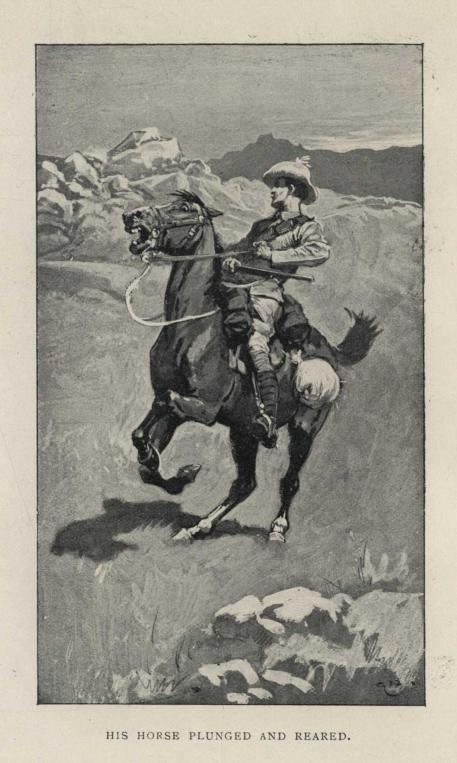
HIS HORSE PLUNGED AND REARED.
'The little sweeps!' he muttered, but moved his finger from the trigger, even though he kept the revolver cocked at them.
'Do you want me to blow the brains of all three of you out?' he called. 'Lay down those guns this minute, or I will.' He was close up to them, and a sharp glance among the sparse bushes showed him that beyond these small youths he had no other attackers. At the sight of British might in the concrete form of a mounted soldier standing right over them, two of the lads instantly laid down their ponderous old style weapons. The third essayed another shot, but his rifle kicked and the bullet went wild.
'You young beggar!' said Stevenson; 'put it down this instant.'
The lad obeyed sullenly; he was the eldest of the three, and yet not more than twelve; a thickset boy with a heavy, brooding face and fine eyes.
'And what's the meaning of this little performance?' said Mortimer.
Two of the boys had very little knowledge of English, but the eldest had been quick to pick it up from his grandmother and Linda, who had just become his aunt.
'You killed our fathers,' he said doggedly. 'They've taken all the good guns with them, or we wouldn't have missed like this.'
Mortimer had no doubt of it; as it was, the shots had landed so near to the mark that it was plain what was the Boer boys' pastime at present. There was something about the three small lads that reminded Mortimer irresistibly of Roly—Roly, hung all over with the kitchen cutlery, or prowling about the bush with a broken-barrelled gun, Roly lying face downward behind a great ant-bed and picking off his foes at a lightning rate. He found it hard not to smile.
'Hand me up those guns,' he said to the eldest boy.
The boy gave him a stubborn glance, and it needed the discharge of a cartridge over his head to bring him to obedience. Then he handed the poor old musket up sullenly to the conqueror.
'See here,' Mortimer said, 'you'll make fine soldiers by-and-by. Don't go and get yourselves into trouble while you're young, and so ruin your chances. If it had happened to be some one less in a hurry than I am, he'd have marched you over and seen you among the prisoners, just to keep you out of mischief.'
'He'd have to catch us first,' said the boy, with a defiant smile.
'There is such a thing as putting a bullet into the legs,' said Mortimer gravely. 'But now cut along and fetch those Kaffirs for your aunt.'
The boys turned round and struck off dejectedly in a new direction; they had come three miles off the road their aunt had sent them by to execute this plot, secretly formed by the eldest boy, for killing off one at least of the enemy.
When Mortimer looked round again, they were mere specks on the veldt.
'Poor little beggars!' he said, smiling as he thought over the adventure again. He flung two of the rifles into the river; the third he carried with him as far as the British camp, and gave it to some one of the ambulance there, promising a five-pound note if it were kept safely till the end of the war.
'Roly'll go off his head at such a trophy,' he thought.
He handed in his despatches not many hours later, with no further adventures.
CHAPTER XIX
The Mood of a Maid
'Do you know what it is to seek oceans, and to find puddles, to long for whirlwinds, and have to do the best you can with the bellows? That's my case.'
Bartie had gone up to Coolooli for the afternoon. Old Mr. Stevenson had taken a great fancy to the boy, and prophesied that he had the making of a fine squatter in him.
Stevenson had ridden in to the selection on his way from Wilgandra. It was not often he passed the neat new gate in these days without turning in. He always felt a pleasant glow of conscious virtue, as his eyes marked all the improvements that had so suddenly sprung up.
'Me boy's pleasing me,' he would mutter. 'It wasn't much to ask.'
He told the surprised Cameron that it was his fad to leave none of his property unimproved, and that he was merely making the trial on this particular selection, to see what might be done with a small holding. Cameron was rather relieved than otherwise that he no longer owned the place; the money he had borrowed on it at different times was almost equal to the sum he had paid for it at first. With such a landlord it was a much less responsible thing to be merely a tenant, especially as Stevenson, since he had foreclosed, would accept no rent, professing that he was getting the place ready for some one who could not take possession for a year or two, and that it was a convenience to him for Cameron to stay on the place and keep it in order. The long-established character of the man as hard and close kept any suspicion from Cameron that he was being helped out of kindness.
The old man had come in this afternoon to carry Bartie up to Coolooli with him, to show him the new invention he was about to try for the destruction of rabbits. Bart rushed off to get his horse ready while Stevenson stayed talking of the war and his son to Mrs. Cameron. It was quite a surprise to her when she learned much later that the old man had five other sons. This one at the front was the only one he ever spoke about.
He liked talking to this practical, sensible mother of the family. He felt amazed that such a shiftless fellow as Cameron should own such a treasure, and he felt, as he looked at her, that the salvation of the family would have been assured after her arrival, even if he himself had not lent a hand. With Hermie his manner was unconsciously somewhat aggressive, and she shrank from the rugged-faced old man who looked at her so sharply from under his bushy eyebrows. He saw her one day as he passed her in the verandah, reading a book fresh from London. Mrs. Cameron saw to it that the poor girl had time now for such rest and recreation.
'Can you make soap and candles?' he said, stopping suddenly in front of her.
It was not likely such arts had been learned on Dunks' selection.
'No,' said Hermie. 'At least, we did try once with the fat to make soap, but it went wrong.'
'How would you instruct your men to corn beef or make mutton hams?'
Hermie looked at him distressed.
'I have never done any,' she said.
'Humph!' he growled, and went to untie his horse, muttering, 'A pretty wife, a pretty wife!' to himself.
This particular afternoon Bart went off in high spirits, Challis watching him wistfully from the verandah.
Hermie was—oh, who knew where Hermie was? Wandering up and down among the roses perhaps, her eyes soft with tears—Challis had found her like that two or three times—or reading poetry in some quiet corner in the paddocks, or writing it in the secret solitude of her bedroom, or on Tramby's back riding, riding with dreamy eyes down the road to the sunset. Wherever she was, she did not want Challis.
Mrs. Cameron was with her husband. Up and down the path they walked, his arm round her waist, her hand in his, talking, talking a little of the future, not at all of the quivering past, mostly of the tender all-sufficing present. Challis, who had had such sweet monopoly of her mother for so long, missed it exceedingly now, while readily acquiescing that the turn for the others had come. She looked from the verandah with yearning eyes. It seemed months instead of weeks since she had poured all her hopes and imaginings and longings and queer little fancies into that ever-ready ear.